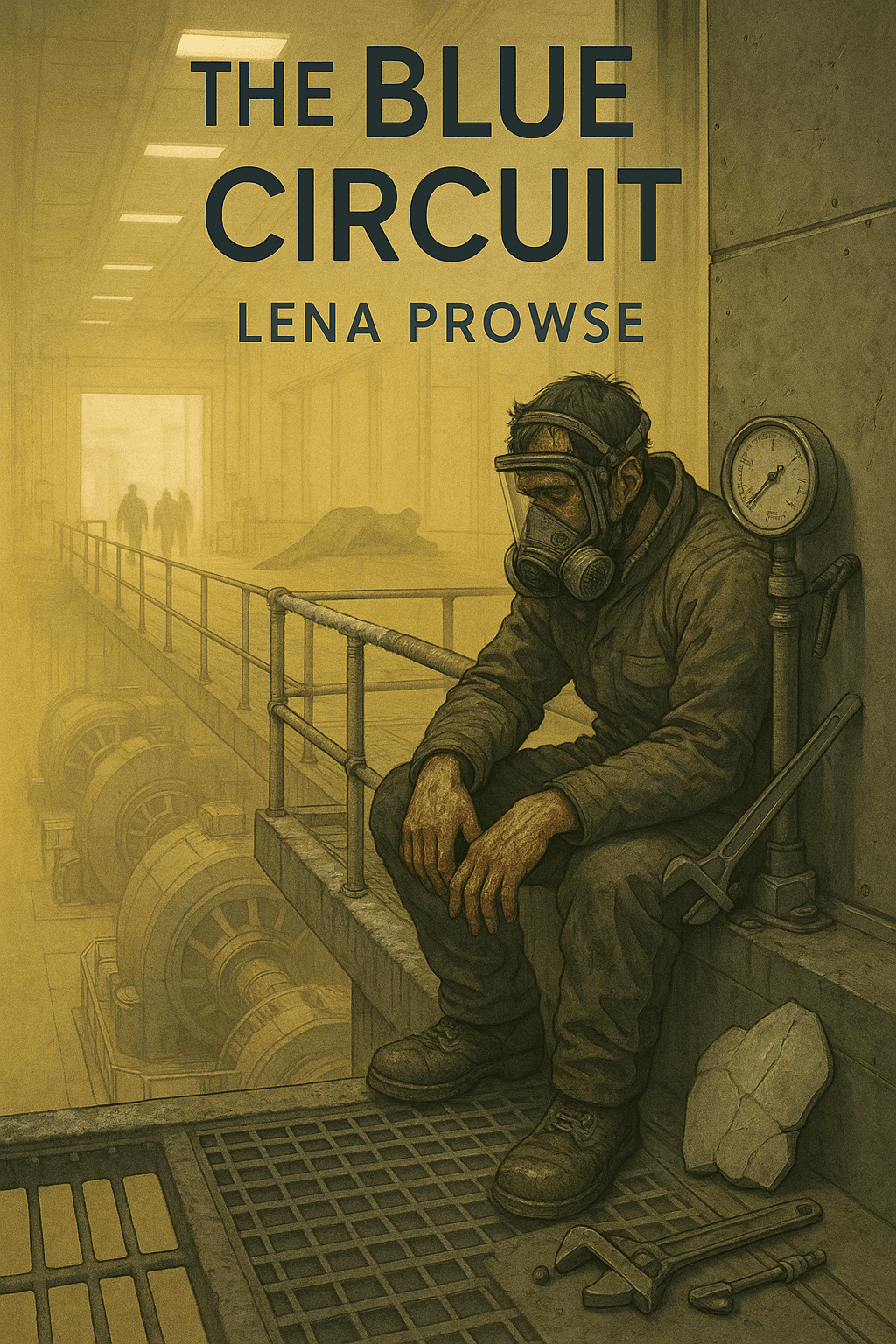
The Blue Circuit
Chapter 1
The Maintenance Log
Kael unseated the taped cover over the sub meter LED and watched the colour change.
Green to amber took less than a minute. The unit gave a soft chirp that meant the cut had started and the block had been dropped to a controlled percentage the notice promised, the one they were meant to accept. He put his thumb over the lens anyway, out of habit, and checked the digits on the little screen instead.
19%.
The notice board in the corridor had a drill line printed under the month. The drill figure was 21%. A kettle could run at 21% and still leave enough for two rooms of breathing if people stayed still.
The meter ticked.
18%.
A door latch clicked across the landing. Someone coughed into a filter and then cut it off, breath held. Footsteps scuffed on wet paint. Kael let the tape fall back over the LED and kept his fingers there until he heard the first words in the corridor.
“Don’t open it,” a woman said, sharp. “It’ll drop quicker.”
“It’s already,”
“Don’t.”
The cut alarm was meant to sound only inside the service stair. In the flats they relied on the LEDs and the board. Management called it noise reduction. People in the block called it keeping panic cheap.
Kael pulled his half-mask up and checked the seal at the bridge of his nose. His filters didn’t match. One canister had a new thread and a clean label; the other had a smear of old glue where someone had tried to keep a split closed. He ran his thumb around the gasket line, felt a nick, and rotated the canister until the nick sat under the strap pressure.
He grabbed his belt and clipped it by feel: spanner, flat screwdriver, a small pouch of fasteners, a folded strip of gasket sheet in the pocket he always used. His work suit was patched at the knee and the hip where he’d slid down stairs on wet metal. He did not pull on the whole respirator harness. The block air was still usable. It wasn’t kind, but it wasn’t lethal.
In the corridor, the percentage board was already busy.
It was bolted beside the service stair door with two security screws and a strip of clear plastic over the dial. The Rust didn’t get a proper display board. They got a scavenged industrial unit with the casing yellowed and the mounting lugs cracked from being overtightened. Someone had taped over the status light. The tape had been replaced often enough to leave a ring of adhesive on the plastic.
A man in a vest stood with his palm flat against the board, eyes fixed on the digits. A girl sat on the floor in her socks, knees to chest, watching her mother’s face instead of the numbers.
“Kael.”
It came from behind him. He didn’t answer right away. He watched the number drop again.
17%.
He turned. The woman who’d spoken earlier had her hair tied back with a strip of cable tie. Her mask strap had been repaired with stitched webbing. She held a small tin in both hands, grip tight enough to dent it.
“That’s under drill,” she said.
“Yeah.” He kept his voice even. “Board’s slow. Meter’s faster.”
The man in the vest leaned in. “Is it the stub?”
Kael looked at the service stair door and then at the board again. His father’s rule came back, plain and clipped.
Who controls the valve controls the air.
He didn’t say it. He wasn’t giving them something to quote back at him when somebody wanted a scapegoat.
He pushed through the service stair door.
The stairwell smelled of solvent sealant and damp concrete. A thin pipe ran up the wall with a condensation line halfway up where the air changed temperature between levels. The communal intake stub was on the second landing inside a metal cabinet with a padlock hasp that didn’t have a lock on it. Locks were for people who could afford to keep them.
Kael swung the cabinet open. Inside was a short length of duct with a union joint, a cheap flap valve, and the block’s sensor pack bolted to a bracket with one missing washer. Someone had marked the last service date in pen on a strip of tape.
Kael pressed his compact meter against the sensor pack. The pressure reading settled low. Two fingers on the union joint found vibration from flow, thin but present. Under the screwdriver tip, the flap valve moved cleanly and returned.
He loosened the union a quarter turn, just enough to smell. The mix came through: smog, ozone, sour drains from Dock Lane. No chemical spike. No sweetness. No clean, cold air.
He tightened it again.
Seal, seat, test.
He didn’t say it out loud. Not yet. It wasn’t a ritual. It was an instruction that kept his hands from lying to him.
The stub was not the problem.
Upstream.
He shut the cabinet and took the stairs back out to the corridor.
The number on the board was 16% now. The man in the vest had started breathing through his mouth. He saw Kael’s glance and tried to fix it, lips pressed, but the next breath went wide again.
“It’s upstream,” Kael said.
A low noise went through the corridor. Not words. A shift.
The woman with the tin stepped forward. She opened it and tipped the contents into her palm: three air credit tokens, old brass with worn ridges. She held them out.
“Go first,” she said. “If it’s stuck, if it’s… whatever. Just go. Take it.”
Kael looked at the tokens. Air credit wasn’t cash. It was proof you’d paid for breathing. It was worth more than rent at the wrong time.
“No,” he said.
“Kael…”
He shook his head once. “Keep it for your meter. You’re paying for your own air.”
The woman’s fingers closed over the tokens. She swallowed and then opened the tin again. This time she pulled out a filter canister, still in its wrapper, the plastic already fogged with age.
“You can take this. It’s spare.”
He hesitated. He did not like accepting anything without writing. He did not like owing. But a filter was not a favour in Dock Lane. It was a tool.
“What spec?” he asked.
She turned it so he could read the stamp through the wrapper. It was a general particulate unit, not a chemical pack, but it was sealed.
He took it.
“Thank you,” he said, because it cost nothing to say it and because it meant she’d stop offering the tokens.
“Bring it back if you don’t use it,” she said quickly.
“I will.”
A child’s voice started up further down the corridor.
“Ready,”
Another voice joined. Then another. Small voices, trained.
“Ten, nine, eight…”
Kael turned his head. The count came from the far end, near the flats with the patched doors. A woman stood at a threshold with her hand on a child’s shoulder, guiding them back inside.
“…three, two, one. Lock.”
The door shut. A bolt slid.
The count started again.
Kael looked at the notice board. The drill count was meant to run once a month, at a time printed in the block log. It wasn’t due for another week.
Someone had brought it forward.
He didn’t say that either. He watched the board tick to 15% and then he moved.
His flat was two doors from the stair. He went in fast, shut the door behind him, and lifted the bed panel.
His tools lived under the bed because the landlord’s idea of safety was an inspection that ended with confiscation. Under the panel were a coil of cable, a sack of fasteners, a small case with his compact meter, and the thermal lance in its scuffed housing.
He pulled the lance free and checked the fuel gauge. Enough for a cut. Not enough for a long fight.
The compact meter clipped to his belt. The spare filter canister went into his suit pocket, weight settling against his thigh.
In the doorway, the taped LED on his own sub meter blinked once under the tape. Kael paused, then shut the door behind him.
He left the flat and almost walked into Elias.
Elias smelled of hot grease, wet rope, and old smoke caught in cloth. He wore his old filter mask, straps patched, and a belt with two spanners and a tube of sealant stuck through the loop.
His cough came first, then his voice.
“They moved it,” Elias said.
Kael stopped with one hand on the thermal lance sling. “Moved what.”
“The cut schedule. It’s not the posted window.” Elias’s eyes were reddened above the mask. He lifted his chin at the board. “You seen the level?”
“I seen it.”
Elias’s fingers flexed on his spanner handle. “Dock maintenance got told to clear lanes. No reason given. Just told. As a drill.”
Kael felt heat rise behind his ribs. He kept his shoulders loose.
“Don’t go up there,” Kael said.
Elias made a short sound. “Up where.”
“Don’t go argue. Don’t go sign anything.” Kael kept his voice flat. If he let it sharpen, Elias would treat it as a challenge and go anyway.
Elias’s gaze shifted past Kael to the corridor where people watched the board and pretended they weren’t watching him.
“You’re going down,” Elias said.
Kael adjusted the lance on his sling. “I’m checking the main.”
Elias nodded once. The cough hit again. He covered it with his fist and the mask muffled it, but it still sounded wet.
“What’s the posted drill level?” Elias asked.
“Twenty-one.”
“And what’s it at.”
“Fifteen.”
Elias’s eyes narrowed. “That’s not a drill.”
“No.”
The children started the count again. The rhythm was too practiced. The cut had taught them.
Elias’s fingers worked at the strap on his own mask, tugging it tight.
Kael looked at the people in the corridor. A woman had her hand on a baby’s chest, counting the rise and fall instead of trusting the air.
“I’m going to the sewer access,” Kael said.
Elias leaned in. “Call a crew.”
“Crew in fifteen,” Kael said. “The board would be in single digits by then.”
Elias’s eyes held on him.
“I’ll signal,” Kael said. “Within an hour.”
Elias’s jaw shifted. He took a breath and the mask pulled tight against his cheeks.
“What signal,” he asked.
“Three knocks on the riser door. If I’m back.” Kael kept it simple. Their block didn’t have a comm line that couldn’t be listened to.
Elias stared at him for a beat longer than needed.
Kael turned toward the service stair.
Behind him, Elias said, “Kael.”
Kael stopped.
Elias didn’t tell him to stop. He didn’t tell him to be safe. He didn’t offer a spanner or a prayer.
Elias said nothing. His hand stayed on the spanner handle. Then he turned away, boots scuffing on the first step. Kael started down.
*
The service stair ran down into the block’s underside where the paint stopped and the concrete stayed wet year-round. The lamps were caged and dim. Water tracked in lines down the wall where pipes sweated and the block never got enough heat to dry it out.
Kael took the stairs fast and kept one hand on the rail because the tread was slick. His boots were scored with old tar and metal filings. He’d slipped before and learned the cost in bruises that didn’t get time to heal.
The hatch was on the lowest landing behind a mesh gate that no longer latched. Somebody had wired it closed with scrap copper. Kael snapped the wire with cutters and folded it into his pocket. Copper was copper. Even a strip.
He set the thermal lance down on the landing and knelt by the hatch frame.
The frame was bolted through the floor plate with eight fasteners. Six were standard hex heads, corroded. Two were newer, zinc bright, wrong pitch. The wrong pitch mattered. It meant someone had been here with a bag of whatever fit, not whatever matched.
Kael put the compact meter against the hatch seam and watched the pressure differential. Not much. The air above and the air below still shared through leaks and vents, but the cut meant the block was being starved from somewhere else.
Bootsteps came down behind him.
Kael didn’t turn at first. He tightened his grip on the spanner and waited for the rhythm. Elias’s step was heavy on the ball of the foot from years of dock plating. Even when he tried to be quiet, the weight came through.
“You’re not alone down here,” Elias said.
Kael exhaled through the mask. “Go back up.”
Elias ignored that the way he ignored management notices.
He came to the landing and stood over the hatch. He had his belt of spanners and sealant tubes, and his hands looked cracked in the knuckles where the cold got into the skin.
“Say it,” Elias said.
Kael worked the spanner onto the first bolt. “Say what.”
“The rule.” Elias’s voice stayed level. That made it worse.
Kael paused. His jaw tightened until his teeth ached.
“Who controls the valve controls the air,” he said.
Elias nodded once. “And who controls the valve now.”
Kael didn’t answer. The answer was printed on every block notice and on every contract he’d ever signed.
Elias leaned down, close enough that Kael could smell the dock oil through the mask.
“The Enclosure controls it,” Elias said. “Not you. Not me. Not this block. So if you put a tool on their side of a line and something goes wrong, they’ll write your name on it. You know that.”
Kael loosened the bolt a quarter turn. The head squealed against rust.
“It’s not normal,” Kael said.
Elias’s eyes narrowed. “Normal’s a word they use. We use numbers.”
Kael glanced up at the stair door above them, picturing the board.
“Drill is twenty-one,” he said. “We’re below fifteen already.”
“That happens,” Elias said.
“It doesn’t happen this fast.” Kael put his spanner back on the bolt and kept turning. “And the stub’s clean. Upstream drop.”
Elias shifted his stance and looked down at the hatch.
“You remember Fourteen-East,” Elias said.
Kael didn’t answer. He remembered anyway.
Elias’s voice stayed flat. “They called it sabotage. Didn’t matter what it was. Didn’t matter the kid in the corner flat needed more air. Didn’t matter what you meant. They wrote it down and that was it.”
Kael’s fingers worked the bolt free. He set it aside and moved to the next.
“I’m not cracking their line,” Kael said.
Elias made a short sound. “You say that now. You go down there and you see something you don’t like and you’ll do what you do. Fix. Cut. Patch. And they’ll call it sabotage.”
Kael freed another bolt and put it with the first, head to head. He didn’t like losing fasteners. He didn’t like leaving evidence.
“I’m not reporting it,” Kael said.
Elias went still.
“Not up chain,” Kael added.
Elias stepped back half a pace. The mesh gate behind him rattled once.
“You’re going off-book,” Elias said.
Kael did not deny it.
Elias’s fingers went to his belt and came back with two filter canisters. These matched. They were older, with scuffs and a thin film of grime, but the seals were intact.
“Take these,” Elias said.
Kael looked at them. “You need them.”
“I’m staying in the block,” Elias said. “I can sit still. You can’t. You’re going down there where it’s wet and full of rot. Take them.”
Kael’s throat tightened. He reached for them and took them without making it ceremonial.
Elias watched him clip them into a belt pouch.
“You’re still going,” Elias said.
“Yes.”
Elias’s jaw worked. “Then take a crew.”
Kael shook his head. “By the time I find two who’ll come under a cut, we’ll be under ten. They’ve got kids counting lockdown in the corridor. That’s early. Somebody’s pushing this.”
Elias looked up the stairwell at that. His eyes flicked, quick.
A dull thump came through the concrete.
Kael froze with his hand on the hatch bolt.
Another thump followed, a few seconds later.
“Freight,” Elias said.
“Not dock freight,” Kael said.
Kael listened. The timing was too regular for a dropped pallet. Too heavy for a person on stairs.
“It’s kit moving into the sector,” Kael said. “That’s why the cut shifted.”
Elias’s mouth tightened. “You don’t know that.”
Kael put the spanner down and set his palm flat on the hatch. He felt the temperature through the glove. Cold. Condensation. Sewer air below.
“I know the stub’s not leaking,” he said. “I know the pressure’s falling too fast. I know the drill count’s early. I know there’s heavy kit moving above our heads while the schedule shifts. That’s enough.”
Elias’s shoulders slumped a fraction.
Kael picked up the thermal lance and checked the igniter.
He looked at Elias.
“Go back,” Kael said. “Prep the block for longer. Shut doors. Keep people still.”
Elias stared at him.
“The Enclosure doesn’t send drills without a reason,” Elias said. “They don’t spend for nothing. If they’re moving kit and cutting air, it’s because they want something to happen.”
Elias turned and went up.
Kael waited until the sound was gone.
He finished the last bolts and lifted the hatch.
The smell came up first.
Kael clipped his mask strap tighter, swapped his left filter for one of Elias’s matching canisters, and checked the seal with a slow breath.
Seal, seat, test.
He lowered himself into the opening.
*
The ladder ended in ankle-deep water.
Kael stepped off onto a narrow ledge of concrete and kept one hand on the rung until he trusted the footing.
Torch out, set to low, he followed the trunk in the direction of the intake pressure main.
At the first junction he stopped and put his glove on the pipe.
A clamp sat around the pipe, stainless, the kind the Rust didn’t buy. The marks on the pipe under it were clean and recent.
He traced the impressions through old paint and kept moving.
His torch picked up a pale strip in the water. He crouched and lifted it.
Gasket material. Old and swollen, but the cut edge was fresh. It carried a smear of grey compound.
Recent.
A scrape sounded ahead.
Kael turned off the torch. He covered the meter screen with his thumb and waited.
The scrape came again.
He backed into a side channel marked with a stencil that was too clean for Dock Lane and moved without light.
The air down the side channel was colder. The floor had sunk. Slime coated the wall.
He kept going until the side channel opened back into the main trunk.
A grate in the floor was clogged with rags, and a hard housing was jammed against the bars. Kael crouched.
A maintenance drone shell. Battery pack removed. Serial plate scraped.
Someone had been down here with equipment the Rust didn’t get.
He left it and moved on.
The pull in the air became noticeable at the intake pressure main junction. His mask pulled tighter on inhale.
New hardware sat against old pipe: fresh washers on bolts, a clean weld bead on a bracket, a tidy cable run clipped at even spacing.
Not a patch.
Kael set the torch down, checked the meter again, then picked up the thermal lance and held it ready.
He crouched behind a concrete lip, watched the junction, and waited for the next sound.
The air draw stayed steady.
It cost the block above him with every second it ran.
Chapter 2
The Retrofit
Kael lifted the thermal lance off the wet concrete and kept the nozzle down.
The junction sat ahead in a widened section of trunk where older pipework met newer sections through reducers and clamps. The floor was uneven. A low ledge of poured concrete ran along one side, chipped where someone had dragged kit through before. The pull of air had a direction here. His mask straps tightened on inhale.
He clicked his torch to low and aimed it at the tidy cable run he had seen from cover. The clips were evenly spaced. The cable jacket was intact, no rub marks where Dock Lane usually chewed through corners. The bracket holding it had a clean weld bead with no slag drip. No one in the Rust wasted time cleaning a bead unless an inspector was due.
Boots quiet in the water, Kael moved in and set his compact meter against the nearest sensor pack.
Pressure. Low on the intake side. A different reading on the waste line.
He shut the torch off and let his eyes adjust to the limited light from the stairwell lamps bleeding down through cracks and grates above. The trunk carried enough glare off wet pipe to see outlines.
A stainless body, rectangular, with a bulged housing on one side and a manual actuator at the top. It was mounted to old pipe by a set of saddles that took the load off the joints. The pipe on the left had a heat-discoloured band and chemical residue dried at the seam. The pipe on the right ran toward the intake pressure main. Kael had walked this trunk enough to know the direction of its climbs; if this output rose, it would end up in the residential runs.
A gloved hand went to the waste-side pipe first.
Cooler than it should have been. That suggested flow in a line that did not run hot from compression. The residue smell backed it up.
His hand moved to the intake side.
Vibration. Thin, steady, carried through the pipe.
He leaned in and looked for the installation details that mattered in court and in blame.
The fasteners were new. Not the zinc-bright hatch bolts in his block, but black oxide with clean heads. His thumb ran over one.
M12 flange bolt. Grade stamp on the head. 10.9.
Dock Lane had bins of mixed M8 and M10 hardware, most of it soft, most of it rounded. The union sometimes bought proper stock for critical work. Nobody put 10.9 flange bolts into a sewer trunk unless they had a purchase order and a storage cage.
Grey gasket compound was squeezed out in a thin bead at one flange.
Fresh.
He scraped a line of it with the edge of his screwdriver and checked the texture. It came away soft and tacky. The stuff the Rust used came in tubes that smelled of vinegar and set slow. This smelled of solvent and set fast.
Kael took a breath through the mask and kept it slow.
Seal, seat, test.
He said it out loud this time, quiet, because his hands wanted to rush and his mouth needed to give them an order.
He followed the shunt body up to the bulged housing. A small window sat there under a clear cover with six security screws. Through it, a display showed digits.
He angled the torch to avoid glare and read it.
47:23:18.
Hours, minutes, seconds. It counted down.
The label strip beneath the window had been printed, then laminated. The corners were sharp. The laminate still had its sheen.
RETROFIT FLOW CONTROL.
There was a serial field with a number too long for a local shop. There was a service stamp with a date.
Two days out.
Kael watched the seconds tick.
47:23:17.
The cut in his block had started less than an hour ago. People were already mouth-breathing at fifteen percent. Forty-eight hours was a schedule, not a warning.
He moved to the actuator on top.
A manual lever sat under a collar. The collar was a thick ring of steel with a keyed slot and a set of shear screws that had been snapped off flush. No hex head to bite. No Torx. The collar had been installed with the intention that no one without the matching key tool could move the lever.
His spanner went on the collar anyway.
The spanner slipped on the smooth ring. He tightened his grip, repositioned, and tried again with a sharper pull. The metal didn’t move. The collar sat locked.
He checked for a bypass.
A small cap on the side of the housing had a tamper seal strip across it, printed with a pattern that would tear if lifted. Another line of those M12 bolts held a side plate.
A simple fix would have been a lever. This had been designed to stop simple.
Heat rose under his ribs, not from exertion. He kept it there and directed it into the next check.
Who supplied this. Who signed for it. Who planned to stand in a pressurised suit while people below tried to breathe through taped LEDs.
Kael set the thermal lance down on the concrete ledge and checked the fuel gauge again with a thumb.
Still enough for a cut.
He looked up and down the trunk.
No movement. No torch beams.
The lance came up and the igniter clicked. The tip lit with a hard, bright flame and a hiss that sounded too loud in the confined space. He angled it to the side plate and began a shallow cut along one edge, keeping the flame narrow.
Tool. Heat. Contact.
The stainless surface discoloured where the cut ran. The smell hit fast: heated metal, solvent residue, and something chemical that did not belong in a breathing line.
He killed the lance and set it down. The flat screwdriver pried at the cut edge. The panel lifted enough to get fingers under it. He pulled, controlled, and bent it outward.
Inside, a smaller plate sat behind the housing, stamped with fine text.
Kael leaned in until his visor almost touched the opening.
UNAUTHORISED INTERFERENCE WITH FLOW CONTROL ASSEMBLY CONSTITUTES TAMPERING.
LIABILITY FOR RESULTING CONTAMINATION EVENTS TRANSFERS TO INTERFERING PARTY.
REPORTING REQUIREMENT: IMMEDIATE.
He read it twice to be sure.
It was contract language pressed into steel.
He pictured a report filed up chain with his name in the line where blame went. He pictured an after-action brief in a clean room with a percentage board that never fell below nineteen.
He didn’t have a neutral authority to report to. He had an administration that called silence noise reduction.
Kael closed his eyes for half a second, then opened them and looked at the bolts holding the outer plate.
The plate mattered. It had the stamp. It had the bolt pattern. It had the fasteners that didn’t belong down here.
He could try to disable the shunt anyway.
He could try to cut the lockout collar.
He could cut a pipe.
Every one of those actions would be written down as sabotage by the same people who installed the trap language. Even if he succeeded, they would use it as justification to tighten the cut and call it an emergency response.
If he brought proof to the union, Jarra could seal it into action with witnesses.
Kael put the lance aside and took out his fastener pouch.
Matching heads for these bolts weren’t in his kit. He had to remove them.
A small adjustable wrench slipped on the first try. The bolt heads were not standard hex.
Torchlight went back on the head recess.
Security drive. A five-lobe with a pin.
He had a bit set in his belt for odd work. The set came out, the closest match found, and engagement checked.
The bit seated with a small click.
Seal, seat, test.
Torque went on. The first bolt moved with a sharp crack, then turned.
He counted as he worked because counting kept the job from becoming a panic. One, then two, then three.
Each bolt went into his pouch, not onto the wet floor. Evidence stayed with him if he could manage it.
By six, his wrist had started to ache. The last bolt fought him. Elbow braced on his knee, he leaned in and turned slow until it gave.
He eased the plate outward.
It was heavier than it looked, a thick section meant to resist impact. The gasket behind it stuck and then released with a wet sound when the compound let go.
He held it in both hands and felt the edge bite through glove fabric.
A sound came down the trunk behind him.
Bootsteps.
Not bare boots in water. Not Dock Lane work boots on slick concrete. These were heavier and more regular, with a scrape at the end of each step that suggested sealed soles.
Kael froze with the plate half free.
A torch beam cut across the trunk wall, fast, then back again.
The beam hit the shunt body and washed it in hard white light.
Kael lowered the plate and pressed himself behind the concrete ledge, keeping the plate flat against his chest. The metal cooled against his suit, then warmed with his body heat.
He shut his torch off. He covered the compact meter screen with his glove.
The beam swept again. It passed over the water. It caught the edge of his thermal lance where he’d left it.
One hand reached out, slow, and pulled the lance closer until the sling was under his elbow.
The boots came nearer. The torch beam steadied on the open access cut. The light caught the bent panel.
A voice came through a respirator speaker, muffled.
“Service panel’s been touched.”
Another voice, lower. “Check seals.”
Kael kept his breath shallow.
Seal, seat, test.
He mouthed it without sound and used it as an instruction to keep still.
The boots stopped at the junction. The torch beam moved to the floor where his bolts had been. He had kept them off the floor. That mattered.
The beam moved along the ledge and then away.
“Nothing removed,” the first voice said.
Kael didn’t move. The plate edge dug into his ribs through the suit.
The boots shifted. A gloved hand tapped metal somewhere near the actuator. He heard a dull ring through the trunk.
“They used a lance,” the second voice said.
“Rust,” the first voice answered.
They didn’t sound surprised. They sounded like they were reciting a line.
The torch beam swept the ledge once more, then snapped away.
The boots backed off, step by step, and the sound faded into the trunk.
Kael waited until he couldn’t hear the scrape anymore. He listened for radio crackle and heard only the pull of air and water movement around his boots.
He shifted the plate out from under his suit and checked the gasket edge.
The gasket compound clung in grey strings.
A strip of cloth tore off an old rag from the ledge, then wrapped around the plate to stop it ringing against his belt.
Torch off, he moved away from the junction and stayed close to the wall where the trunk narrowed.
The underworks had multiple routes. Some led back to his block. Others ran toward the exchange throat or into old service shafts that climbed into the union quarter, where the underblock had been built in phases and never mapped clean.
He didn’t go home.
He followed the shunt output line.
It ran along the wall for ten metres, then rose over a support and disappeared into a manifold bank fixed to a crossbeam. Kael crouched and looked at the stencil.
The paint was clean and white.
RES-IN-A.
RES-IN-B.
RES-IN-C.
Residential intake.
His palm went to the manifold. Vibration came through three separate feeds. The shunt wasn’t aimed at one block. It wasn’t aimed at Dock Lane alone.
It would go where subscription sent it.
People thought in terms of their own flat because that was what rent and percentage boards taught them. People saved tokens for their own meter. They traded filters with neighbours and counted children into lockdown.
Door bolts wouldn’t stop it.
Kael moved his torch along the manifold bank and found a small storage alcove cut into the wall, screened by a half-height metal gate.
The gate had a keyed latch. The key was in it.
He touched the latch. It was clean.
He lifted it and opened the gate.
Inside sat a crate, polymer, sealed with two straps and a tamper tag. The tag carried a printed code, black on white.
Kael cut the strap with his knife.
The lid popped under pressure from the seal.
He opened it and saw canisters stacked in foam.
Each canister had a printed marking strip with multiple fields.
CLASS 4 PARTICULATE.
DISPERSAL ADDITIVE.
The next line was a code he had seen once before on a dock manifest that had come through the wrong route and been pulled fast by someone in a clean suit.
PRESERVATIVE ADDITIVE: ORG-HOLD.
He stared at it until the letters stayed fixed.
Org hold. Organ hold.
A preservative additive code.
It wasn’t a leak. It wasn’t a heavy-handed cut to make people comply.
It was a plan with storage and handling built into it.
He put the canister back and shut the crate lid. He didn’t reseal the strap. He didn’t have time.
He backed out of the alcove and followed the manifold bank to the cable run.
A second cable run peeled away from the tidy line that fed the shunt display. This one ran up along an older conduit, clipped onto a bracket that had been bolted into the concrete with expansion anchors.
It headed in the direction of the Exchange Gate throat.
The gate was the blast door where the intake entered the Rust.
If they were running a shunt, they would not leave the gate open.
Kael ran his gloved finger along the cable jacket until the conduit disappeared into a wall sleeve.
A thin sound came through the pipe.
Not airflow. Not water.
Speech, conducted through metal.
Kael put his ear close to the manifold support and listened.
Words came in fragments through vibration. A radio speaker on the other side of the wall. A person talking close to it.
“Asset...”
“Two on the collar...”
“Delta Three, confirm.”
Call signs.
He had heard them in dock maintenance directives when the Enclosure sent instructions down through the chain with no explanation and expected compliance.
Asset Protection.
Official.
There was no neutral authority to appeal to. There was no mistake to correct.
Footsteps sounded again.
Closer this time.
Kael killed the torch and pressed himself behind the manifold support, crouched low with his shoulder against the cold pipe.
Two pairs of boots passed the junction, the scrape of sealed soles on concrete. The gaiters above the boots were smooth. The legs above were covered in grey suit fabric with sealed seams. Their movement was steady, no cough breaks, no breath rate change he could hear.
They could walk through whatever they planned to push into the intake.
Kael could not.
Hardware. Not luck.
Once the boots moved on, he slipped away from the manifold bank.
Breathing had thickened. The left canister felt loaded; each inhale took a fraction more effort. The waste smell sat closer now, and a trace of solvent came through at the edge of his lip.
He ducked into the shadow of a support, turned his face away from the flow, and got his fingers under the left canister.
Seal, seat, test.
The mask seal broke with a small hiss when he twisted. He held his breath, spun the loaded canister free, and capped it against his palm to keep it from dripping. Elias’s spare canister came off his belt next. He checked the gasket ring with his thumb, set the threads, and turned until it seated.
Straps tightened. A quick palm press along the mask edge, then a slow inhale to test.
Airflow eased.
He had wanted to save that spare for later. Now the last clean margin in his kit was gone, and only one sealed canister remained.
Torch still off, he pulled away from the junction and headed toward an older service ladder that ran up through a shaft reinforced with angle iron.
He knew it because he had repaired the lower rungs last winter with scrap plate and four bolts that didn’t match.
The ladder well opened from the trunk through a narrow hatch. The hatch frame had been cut by hand years ago and never sealed properly. Kael checked the seam with his glove.
Moisture. No fresh gasket.
Good. It meant the Enclosure hadn’t bothered to lock this route yet.
He popped the hatch with his screwdriver and pulled it open.
The ladder inside ran up into darkness. The first rungs were wet with condensation.
He clipped the thermal lance sling tighter across his shoulder and began to climb.
He counted rungs out of habit.
Ten.
Twenty.
Thirty.
Breath resistance climbed with the rungs.
At forty he stopped at a mid-platform where the ladder met a narrow service landing. The landing had a grated floor and a handrail made from pipe.
He leaned in toward the wall and listened.
A sound came down from above.
A boot shift. A metal tap.
Someone was at the top of the shaft.
Kael raised his torch a fraction and aimed it up through the ladder line.
The light caught the underside of a boot sole and the edge of a sealed shin plate.
An Asset Protection sentry.
Kael froze in place with one hand on a rung and one on the rail.
If he climbed, he climbed into a waiting grip.
If he went back down, he went toward the shunt and the team with pressurised boots.
To his right, a service duct opening sat in the wall, half covered by a bent grille.
He had never used it. It was too small for comfort. The duct was meant for cable access and low airflow, not people.
He pulled the grille away and tested the opening with his shoulder.
It would take him.
He shifted sideways, pulled himself into the duct, and dragged the thermal lance behind him by the sling.
The duct smelled of dust and old insulation. The walls were sheet metal with rivets that caught on suit fabric.
He kept his torch off.
Above, the sentry moved. Kael heard the sound of a canister being handled.
A second later, a hiss.
Gas puffed into the ladder well.
It had a sharp chemical smell that reached even into the duct. It wasn’t smoke from a welding job. It wasn’t a cleaning solvent.
It was a dispersal test.
Kael tightened his mask straps until the seal bit at the bridge of his nose. His fingers checked the canister threads and felt them seated.
Seal, seat, test.
The words came out through the mask, rough.
He crawled forward.
The duct ran for several metres, then turned left. He kept one hand on the seam to count turns and not lose direction.
Metal scraped under his knee patches. His shoulder caught once on a rivet head. He pulled free and kept moving.
Breathing got harder. The spare canister was doing its job, but the duct air carried whatever had been pushed into the ladder well, and the load showed in the resistance and the taste at the back of his throat.
He kept his pace steady.
Too fast would spike breathing. Too slow would let the gas catch.
At the next turn, the duct widened into a service box where cables crossed in bundles. The cable jackets were varied, some old, some new.
A fresh tie wrap sat on one run with the tail cut clean.
Recent work.
He didn’t stop.
He pushed through the box and found a down hatch at the end of the duct with two quarter-turn latches.
Kael worked the latches with his screwdriver tip and lowered the hatch.
A maintenance closet sat below.
He dropped down quietly and shut the hatch above him.
The closet had a rack of empty spools, a stack of broken ceiling tiles, and a small wall cabinet with a padlock hasp and no lock. A strip light flickered overhead. The air was warmer than the duct.
He listened.
Above the closet, through the ceiling and the retail shell structure, came a heavy movement sound.
Not people.
Not forklifts.
Something with mass and jointed load. A hydraulic hiss. A low vibration through the wall.
Assault kit staging above street level.
They were moving it already while the corridor boards still ticked down in slow digits.
Kael pulled his tool bag off the closet hook and opened it.
It had been left here by someone who never came back or who couldn’t carry it out.
He dumped the contents onto the floor, then sorted through fast with his glove: low-grade cable, a cracked junction box, two lengths of conduit, and a handful of mixed screws.
The shunt plate slid into the bag under the cable coil, and the coil went over it to break the outline. A hand check would find coiled cable and conduit before it found a flat edge.
He added his thermal lance to the bag, then shortened the strap and clipped it across his chest so the load rode high and didn’t swing.
The extra weight settled on his shoulder.
He opened the closet door and stepped into the retail shell.
The space had once been small shops and service counters. Now it was a corridor of shuttered bays, most of them stripped. The floor was tiled and cracked. A puddle sat in one corner under a ceiling leak.
He moved along the back service route where old delivery corridors ran behind the bays, keeping away from street exits and the few intact camera housings. Somewhere beyond the wall, a hydraulic line hissed again, then cut off.
A service stair took him down one level, then up another, following the path that ended behind the union hall.
The union quarter had been built around the hall. Old docks and maintenance spaces fed into it through corridors that were never meant to be public.
Kael reached the back door and stopped with his fist raised.
The door was heavy steel with a welded patch at the bottom where someone had tried to pry it years ago. The handle was wrapped in tape where the rubber grip had split.
He knocked the pattern used for emergency entry.
Three quick. Two slow. Three quick.
He kept his head down and his body close to the frame.
A slot in the door opened.
A pair of eyes behind a face mask looked him over.
“What,” a voice said.
Kael kept his voice flat. “Need in.”
The slot shut.
A chain rattled. A bolt moved.
The door opened far enough for a hand to grab his sleeve and pull him inside.
Two union guards stood there, both in dock leathers with plate additions bolted on. One held a short baton. The other held a compact scanner unit with a stub antenna and a taped battery pack.
“Bag off,” the baton guard said.
Kael slid the bag off and handed it over.
“Mask stays,” he said.
“It stays,” the scanner guard agreed. “Hands out. Palms up.”
Kael held his hands out.
They patted his sleeves, his belt, the seams at his hips. They pulled the thermal lance housing free and checked it for a tracker tag, then ran the scanner along it. The scanner made a soft click every few seconds as it sampled.
The baton guard opened the tool bag and shifted the cable coil aside.
The shunt plate stayed buried.
“Boots,” the baton guard said.
Kael lifted one boot, then the other, while they checked the soles for embedded tags.
He didn’t argue. Union suspicion kept people alive. It also bruised pride. Kael let the pride go.
“Clear,” the scanner guard said.
The baton guard nodded and handed the bag back.
“Move,” he said. “Straight through. Don’t wander.”
Kael walked into the hall.
The Dockworkers Union hall had a welding bay on one side with curtains hung from a rail. Sparks had burned holes in the curtain fabric and someone had patched them with tape. Ration racks lined the far wall, shelves of tins and sealed packs with a hand-written count on each. Numbered lockers ran along the wall by the wash sinks. Cylinder tags hung from hooks. A kettle sat on a hot plate near a stained bench, limescale ring visible inside the spout.
People looked up as he came in.
Some knew him by sight. Some didn’t. A few had masks off and pulled them on fast when they saw his gear and the wet on his suit.
Kael set the tool bag on the bench and unzipped it.
The cable coil came out first, then the shunt plate.
The plate was still damp. Grey gasket compound clung to its edge.
A man near the ration rack leaned in.
“What’s that,” he said.
“Proof,” Kael answered.
The word sounded wrong in his mouth. He didn’t like saying it. He preferred measurements.
He laid the plate flat on the bench and pointed at the stamp.
“Installed under Dock Lane,” he said. “On the intake pressure main junction. It’s a shunt between chemical waste and residential intake.”
A murmur moved through the nearest group.
Someone on the far side of the hall said, “We’ve had cuts before.”
Kael looked at him.
“This isn’t a cut,” Kael said. “It’s a feed.”
He tapped the edge of the plate where the gasket compound still stuck.
“New compound. New bolts. Security heads. Lockout collar on the actuator. Forty-eight hour countdown on the housing.”
He said the number and watched shoulders tighten.
Forty-eight hours was two shifts. It was one pay cycle for some crews. It was time enough for management to deny and for people to die anyway.
A woman with burn scars on her forearms stepped closer, eyes fixed on the plate.
“Countdown,” she repeated.
Kael nodded.
He didn’t know her name. He had seen her in the hall before, moving through crowds and making space. Her build was wide. A powered brace sat on her right leg, strapped over leathers. Plate additions had been bolted onto her shoulders and hips.
Jarra Holt.
She came to the bench and put her hand on the plate.
Her hand was heavy. Her nails were short. The skin had old burn marks where heat had blistered and healed.
“Bolt pattern,” she said.
Kael pointed.
“Eight bolts on the outer plate,” he said. “M12 flange, 10.9. Security drive, five-lobe with a pin. They’re not local stock. The gasket compound is solvent set. The collar on the actuator is shear-fastened. You can’t turn it without the key tool.”
Jarra’s eyes stayed on the stamp.
“Routing,” she said.
Kael took a breath.
He kept it short.
“Output runs into a manifold bank stencilled RES-IN-A, B, C,” he said. “Residential intake trunks. It goes up into the subscription path. Every flat that breathes off metered intake gets it.”
Jarra lifted her gaze.
“You’re certain.”
Kael held the look.
“It’s labelled,” he said. “Clean stencil. Not Rust paint.”
Jarra looked at the plate again.
“What’s the countdown set to,” she asked.
“Forty-eight hours,” Kael said. “I saw forty-seven and change when I was on it.”
Jarra nodded once.
No speech. No reassurance. A simple acceptance that a number was a number.
“Why didn’t you shut it,” someone behind Kael asked.
The question came sharp, the edge of accusation.
Kael didn’t turn. He kept his eyes on the plate.
“Lockout collar,” he said. “And the liability stamp.”
He slid the plate toward Jarra so she could read the cut-out section he had opened.
She leaned in and read the stamp.
Her mouth tightened.
“It transfers liability to the person who touches it,” Kael said. “They’ll call it sabotage.”
Jarra straightened.
“It is sabotage,” someone said.
Jarra looked at the speaker.
“Not theirs,” she said. “Ours would be. That stamp is a trap. Lone action gives them the story they want.”
Her eyes came back to Kael.
“You did right bringing metal,” she said. “You did wrong going alone.”
Kael accepted the second sentence without argument because it was true and because there wasn’t time to defend his habits.
Jarra turned her head and called out.
“Seal the hall,” she said.
Two guards moved at once. One went to the front doors. Another moved to the side entrance by the welding bay.
Bolts slid. Chains clinked.
A woman at the ration rack started counting inventory under her breath, hands moving on the shelf tags.
Jarra stayed at the bench.
“You found anything else,” she asked.
Kael nodded.
“A crate of canisters near the manifold,” he said. “Sealed. Marked Class 4 particulate. Preservative additive code. Org hold.”
The hall went quieter.
Jarra’s face didn’t change much, but her posture shifted. Her brace motor whined once as she adjusted stance.
“Organ hold,” she repeated.
Kael nodded.
“Handling logistics,” he said. “Not for compliance.”
A man near the welding curtain spat into a drain bucket.
“That’s murder,” he said.
Jarra didn’t correct his word choice.
She looked down at the plate again, then at Kael.
“You’re under protection now,” she said.
Kael waited.
“Also under obligation,” she added. “You brought this in. You don’t walk out and let someone else carry it blind.”
The old reflex rose in him, the one that kept him out of binds. His jaw worked once, then he let it go.
“Fine,” he said.
Jarra held his gaze.
“Say it like you mean it,” she said.
Kael tightened his jaw.
“I’m in,” he said.
A runner came through the side door before the bolt fully seated. A slim person in a stained jacket, mask hanging from one ear. Sweat shone on their forehead and a strip of tape stuck to one sleeve.
“Kit’s moving into Dock Lane,” the runner said. “Heavy. Not dock.”
Jarra didn’t look surprised.
“How far,” she asked.
“Two streets off your old yard,” the runner said. “They’re clearing lanes. Telling people it’s a drill.”
Jarra nodded once and turned back to Kael.
“You’ve got an hour,” she said. “Brief crew heads. Dock crews, welders, maintenance. Tell them what you saw. Bolt sizes. Labels. Countdown. Don’t dress it up.”
Kael looked at the plate.
He thought of Elias at the block, tightening a mask strap and listening to the percentage board tick down. He thought of the three knocks he had promised on the riser door.
There wasn’t time to go home. There wasn’t time to pretend this was still a private job.
“Alright,” Kael said.
Jarra watched him.
“That’s you saying yes in front of people,” she said. “That binds you. Don’t make me chase you for it.”
Kael met her gaze.
“Yes,” he said. “I’ll brief them.”
Jarra reached down and picked up the shunt plate. She held it steady.
“Good,” she said. “Now wash. Then talk. If you drop in the middle of your own warning, you don’t help anyone.”
Kael moved toward the wash sinks.
The hall lights buzzed overhead. The kettle clicked off on the hot plate. Someone wrote a number on a scrap of carton and slid it under a magnet on the ration rack.
A guard slid the final bolt at the back door.
The metal clicked into place.
Kael was on the inside when it happened.
Chapter 3
The Mobilization
Kael rinsed his hands at the union sinks until the water ran clear enough that the grease lines showed again.
The hall pipework was old and ran warm even in a cut. A strip light above the basins flickered. The numbered lockers along the wall had cylinder tags on hooks, most of them blank. Somebody had taped over three locker LEDs to keep them from showing through the front windows.
After checking his mask seal, he tightened the left strap a fraction.
Seal, seat, test.
A rag that had once been a tea towel took most of the water off, leaving lint on his knuckles. He wiped it away and went back to the main floor where Jarra had taken over the central table.
The shunt plate sat flat under her palm, damp edge up. Grey compound clung to it in strings and smears. Under the hall lights it showed clean cuts and new sealant. Proof had to read as recent work.
Jarra didn’t give him time to settle.
“Crew heads,” she said. Her voice carried without effort. “In. Now.”
A guard by the back door pulled the chain again and opened to a new knock pattern. People came in fast, masks half on, eyes red from filter load or bad sleep.
The first was a dock foreman Kael knew by sight. Broad shoulders, dock leathers, earmuffs hanging at his neck with the pads worn flat. Behind him came two scrappers from the yard by the scrap cranes. Their suits were mismatched, plates riveted onto knees and elbows. One had a band of taped foam at the edge of a cracked visor.
A miner crew head arrived next, still in a dust suit with the knees patched. The miner’s boots had a different tread, deep lugs meant for grit and sloped cut faces. His respirator was a full face unit with a yellowed housing and two identical canisters.
More came in from the back corridor and bunched near the ration racks first, eyes on the shelves without asking. The shelves carried tins and sealed packs with hand-written counts. A guard stood in front of them with a baton down by his leg and didn’t move.
Jarra waited until the circle tightened.
“No one touches the racks unless I say,” she said. “No one takes plate off a block unless it’s assigned. If you can’t work that way, walk out and let someone else breathe your air.”
A scrapper laughed through his mask. It came out as a cough.
“Your air,” he said.
Jarra’s eyes tracked his mask seam, then the plate.
“Union stores,” she said. “Union hall. Union doors. If your crew wants to do private business, do it outside and don’t come back in when you run dry.”
Just off the table edge, Kael held his hands behind him and kept his eyes on the plate.
The miner crew head stepped closer.
“Who is he,” he said, chin flick at Kael.
“He brought the metal,” Jarra said.
A dock foreman leaned in and put his hands on the table.
“Show it,” he said.
Jarra lifted her hand off the plate.
“You,” she said to Kael. “Put it in the middle.”
It was already on the table, but the order wasn’t about location.
Kael slid the shunt plate inward until it sat under the bare strip light. He turned it so the stamp and cut-out section faced the crowd.
Hands moved in. A thumb ran along the gasket edge and came away with grey smear. Someone tapped the bolt holes.
Kael’s swallow caught; the next inhale scraped through the filter.
A welder sniffed at the edge.
“Solvent set,” he said.
Kael nodded once.
“Fresh,” Kael said. “Two days by the stamp. The bolts are black oxide M12 flange. Ten point nine. Security drive, five-lobe with a pin.”
The scrapper crew head leaned close enough that his breath fogged his visor.
“Dock lane’s full of new bolts,” he said. “All sorts come through.”
“Not with a lockout collar and a countdown,” Kael said.
The miner crew head lifted his visor a fraction to spit into his own glove and then shut it again.
“Countdown,” he said. “That’s the story?”
“It’s in the housing window,” Kael said. “Forty-eight hours set when I saw it. Forty-seven and change.”
“Where,” the dock foreman asked.
“Under Dock Lane,” Kael said. “At the intake pressure main junction. Waste line on one side, intake on the other. Output runs to a manifold.”
Jarra nodded at him.
“Say it clean,” she said.
Kael worked his jaw once.
“Manifold bank labelled RES-IN-A, RES-IN-B, RES-IN-C,” he said. “Residential intake trunks. It goes into the subscription path. Anyone breathing metered intake gets what they put through it.”
A scrapper leader—different to the one who’d laughed—stepped out of the circle. He had a hard hat clipped to his belt and a forearm guard made of cut conveyor belt.
“That’s not my block,” he said. “Show proof it hits us.”
Kael kept his eyes on the scuffed face shield taped at the edge.
“It isn’t aimed at one block,” Kael said. “The routing’s inclusive. RES trunks feed multiple blocks. If you’re on metered intake, it’s yours as soon as it opens.”
The scrapper’s eyes narrowed.
“You’re saying we’re all dead in two days,” he said.
“I’m saying someone installed a shunt between waste and intake with a timed actuator,” Kael said. “If you want to argue about the rest, argue with the stamp.”
He tapped the cut-out section where the liability language sat.
A miner reached out and read the stamp aloud, slow.
“Unauthorised interference constitutes tampering,” he read. “Liability for contamination transfers to interfering party. Reporting required.”
He stopped.
“Transfers,” the dock foreman said.
“That means they blame the person who touches it,” Kael said.
A welder snorted.
“They’ll write it up on us anyway,” she said.
Jarra took that without comment and moved on.
“Here’s what happens next,” she said. “They weld the gate. They push kit into the lanes. They call it maintenance. They call it a drill. Then the meter drops and people stay inside because that’s what they’ve been trained to do.”
The miner crew head held up two fingers.
“Mining gel,” he said. “We’ve got gel. We can cut a heading open if we get close. We trade that for priority on oxygen. Written.”
Jarra’s attention shifted to the racks and the cylinder tags. Her brace motor gave a short whine as she set her right foot, then she checked the shift board nailed beside the ration shelf.
“No,” she said.
The miner blinked.
“No,” he repeated.
“No special rations,” Jarra said. “No breath bought with leverage. Clinic and gate work get supply because they keep bodies alive in bulk. Your gel comes in because you’re part of the bulk.”
“Gel costs,” the miner said.
“Then it goes in your crew ledger,” Jarra said. “If any of us live long enough, you get settled.”
A low mutter ran the circle.
A scrapper leaned on the table edge.
“You’ve got tins,” he said. “You’ve got cylinders. You’re telling us to go build your barricades and you’ll hand it out when you feel like.”
Jarra’s right leg brace motor whined again as she shifted stance. She kept both hands on the table.
“I’m telling you what holds up,” she said. “If you want to do private business under a shunt, do it. But don’t expect the union to carry you when the air goes.”
The dock foreman turned his head toward the back door.
“Outside’s already low,” he said.
Jarra nodded once.
“Assignments,” she said.
People quieted because it was work language.
She pointed at the welders.
“Windows first,” she said. “Ground floors. Stair doors. Plate what can be plated. Reinforce frames. Don’t waste clean stock on show. Put fasteners through structure.”
She pointed at the dock foreman.
“Barricade frames,” she said. “Kill Box approaches and Dock Lane choke points. Your crews haul. Your crews carry. If you steal plate off another block I cut you off the racks.”
Her gaze shifted to the scrappers.
“Scrap yard,” she said. “Cut. Sort. Bring plate. Bring angle. Bring fasteners. Don’t bring rust-thin sheet and call it armour.”
The scrapper leader opened his mouth.
Jarra raised her hand.
“Bring a sample,” she said.
She turned to the miner.
“Gel,” she said. “You bring it to the welding bay. You keep it out of the main floor. You mark it. You don’t store it in flats. If you can’t follow that, you don’t bring it.”
The miner’s eyes narrowed.
“That’s not how we store,” he said.
“That’s how you store now,” Jarra said.
Kael watched the way people took it. No vote, no speeches. Just racks, doors, and who got sent where.
Jarra looked at Kael.
“You map,” she said.
Kael didn’t answer fast enough.
Jarra waited.
“Street load limits,” she said. “Voids. Sewer trunks. Where it’ll take a drop and where it won’t. We don’t put defenders on soft fill. We don’t put kids behind plates that’ll pull out.”
His breath rasped against the mask seal line.
“Yes,” he said.
Jarra’s expression stayed flat.
“Good,” she said. “You take a foreman. You mark it. You don’t guess. And you don’t disappear.”
A cough came from the hall edge.
Near the lockers, Elias stood with his shoulders wide in an old jacket. His mask strap had a patched segment that sat against his cheek wrong. He didn’t push in and didn’t argue. He kept his hands low and watched the table.
Kael kept his eyes on the plate.
Jarra’s voice went hard.
“Time,” she said. “We don’t have the full forty-eight. We work as if it’s half because that’s how they write schedules. You’ve got six hours to get your first defences in place. You’ve got twelve to get second lines. We meet again when the countdown loses another eight. Anyone not here by then gets assigned by someone else and doesn’t get to complain.”
The miner opened his hands.
“You’re using his numbers,” he said.
“I’m using a clock installed in our pipes,” Jarra said. “You can pretend it’s not yours. It’ll still tick.”
She nodded at a guard.
“Doors,” she said.
Chains moved. The hall unsealed in controlled increments. Crews started to peel away, talking over each other now in work terms.
Kael stayed by the table until Jarra tilted her chin toward the side exit.
“Go,” she said.
He turned without looking at Elias.
*
Outside the hall, the air dropped colder and carried a sour drain smell from the lane. Behind him the chain rattled as the door pulled shut.
Dock Lane looked worse in mobilisation than it did on quiet cut days.
On quiet days the damp showed in ceiling corners and the paint scuffed where people dragged crates. On mobilisation days everything that had been tolerated turned into a trip hazard.
With Jarra’s assigned foreman, Kael walked beside a man called Stenn who had a scar under one eye and a habit of rubbing two fingers together over his glove seam.
Stenn carried a roll of chalk line and a pad of stiff card.
“You know where the trunks are,” Stenn said.
“By repairs,” Kael said.
They moved down the lane where the tarmac had been patched in rectangles and circles that didn’t match. Kael watched for settlement lines and the way puddles sat.
At an old access cover, he tapped a boot on a patch.
“Hollow,” he said.
Stenn crouched and ran a hand along the patch seam.
“Old cut,” he said.
“Void under,” Kael said. “Trunk’s two metres left. The cover’s decorative. If you load a barricade on this seam it’ll punch through when bodies hit it.”
Stenn marked the patch with chalk, then wrote on the card.
“Drop point.”
Kael moved on. He didn’t need to narrate. He needed to leave marks a crew could follow in a rush.
Two blocks down, welders had set up at a ground-floor frontage. They worked with portable screens and a generator that rattled as it loaded.
Plate leaned against a wall, varied thickness, varied origin. Some had bolt holes from prior use, some had paint still on it.
At the corner of one sheet, Kael lifted and flexed it.
“Too thin,” he said.
A welder with soot on her wrists looked over.
“It’s what we’ve got,” she said.
“It’ll tear at the fasteners,” Kael said. “Use it as a secondary skin behind a better piece, or stitch it with another sheet.”
She stared at him.
“That doubles fasteners,” she said.
“Then count fasteners,” Kael said.
Behind him a resident’s voice went sharp.
“Our plate’s gone,” a woman said. “You took our plate.”
Kael turned.
Two scrappers rolled a thick sheet on a trolley, wheels squealing.
Stenn paused his two-finger rub.
“Leave it,” Stenn said under his breath.
Jarra’s warning from the hall had reached the lane; nobody stepped in yet.
Kael walked toward the trolley.
“Where’s that assigned,” he said.
One scrapper kept his hands on the plate edge.
“Gate,” he said.
“Show the mark,” Kael said.
The scrapper’s eyes flicked to Stenn’s chalk line.
“Chalk didn’t stick,” he said.
Kael came in closer and put two fingers on the plate. It was heavy, thick enough to matter.
“Eight mil,” Kael said. “Maybe nine. That’s barricade plate. You take it off a block and you’ve made a hole that air and gas go through.”
The scrapper’s jaw worked.
“We’re not waiting behind glass,” he said.
“Then don’t,” Kael said. “But don’t make someone else breathe through a crack because you want your odds higher.”
The scrapper leaned closer.
“You’re a tech,” he said. “You don’t tell us what to do.”
“I tell you what fails,” Kael said.
Stenn moved up beside him.
“Put it back,” Stenn said.
The scrapper’s fingers tightened on the plate edge.
Kael’s bag strap sat tight against his shoulder, thermal lance sling across his chest. He kept his hands off it.
Seal, seat, test.
The scrapper spat into his mask and wiped the front with his sleeve.
A shout from the frontage interrupted.
“Mount it,” a man called. “Quit talking.”
An air hose dragged past them, boots splashing in a puddle.
Stenn stepped away.
“Mapping,” he said to Kael. “We’ve got to mark the lane before they hit it.”
Kael let the plate dispute sit for the moment and kept moving with Stenn.
Between two old service blocks, the lane narrowed. A vent stack on one wall leaked condensation down into a pale stain.
Under his boots, the sound changed. Kael tapped again.
“Soft fill,” he said.
Stenn knelt.
“Under there?” he asked.
“Sewer trunk,” Kael said. “Old brick, patched concrete cap. It’s been undercut. You can drop a walker-sized load through with gel. But you don’t put your own people here when it goes.”
Stenn marked it and looked up.
“Gel,” he said.
“Keep it off the street until you’re ready,” Kael said. “One spark and you’ve got a hole you didn’t plan.”
At a staging point, a crew had set up a modified rivet gun.
It was a pneumatic unit built to drive structural rivets into steel beams. Somebody had welded a bracket to its body and bolted it onto a tripod made from scaffold poles.
A small compressor sat beside it, belt drive exposed, housing cracked.
Too young for the tool, a kid stood near the compressor with a strip of tape and a roll of cable ties.
Kael stepped in.
“Who built this,” he asked.
A scrapper with a red band on his sleeve lifted a hand.
“Works,” he said.
Kael crouched and checked the mount bolts.
Two were M10, one was M8, none matched washers. The gun’s air line was pushed onto the fitting and held by a clamp with a stripped screw.
With a flat screwdriver, he tightened until the screw started to deform.
“Stop,” he said. “That’s your limit. Replace the clamp or you blow the line.”
The scrapper shrugged.
“Just needs to shoot,” he said.
“It needs to keep shooting,” Kael said.
He checked the rivet feed. The magazine was a cut pipe with a crude spring inside.
“Your spring rate’s wrong,” he said. “It’ll double-feed when it warms up.”
A man laughed.
“Everything warms up,” he said.
Kael put a gloved hand on the gun casing. It was already warm from test cycles.
“Short bursts,” he said. “Two seconds. Rest. Two seconds. Swap operator.”
To make the point, he triggered a two-second burst. The feed chattered, then caught; the next rivet wedged at the mouth.
With two gloved fingers, Kael pinched the bent rivet, pulled it free, and checked the casing again. Heat had climbed under the palm.
“Clear it by hand,” he said. “Then back to short bursts. Don’t run it until you cook the seals.”
The scrapper leader opened his mouth, then shut it.
A runner pushed in through the crew.
“Jarra wants you,” the runner said. “Clinic.”
*
Jarra stood near a stack of plate, brace humming quiet as she balanced. The staging lights here were dimmer; welding screens threw hard shadows across the lane.
A clinic runner faced her. Small, masked, with a strip of tape over one cheek seam. They held a folded sheet of plastic with writing on it.
“First claim,” the clinic runner said, voice flat. “Any oxygen cylinders. Captured off suits. Any sealed canisters too. Clinic takes them.”
Jarra didn’t take the sheet.
“We know what hypoxia looks like,” the runner said. “We’ve got kids blue-lipped on benches. We’ve got old lungs already loaded. Gate crews will take a cylinder and sit on it.”
Stenn shifted his weight.
“We’ve got people on the line who’ll be dead without it,” he said.
The clinic runner’s gaze flicked to him.
“Your line is a choice,” they said. “Clinic isn’t.”
Jarra’s eyes went to the ration box at her feet, then to the rack tags on the wall behind the plate stack. She adjusted her stance, brace motor whining once, and left her hands open.
“No,” she said.
Kael watched her hands. No shake, no reach for the baton at her belt.
“This isn’t a charity negotiation,” Jarra said. “It’s a triage rule.”
She nodded at Kael.
“Say it,” she said.
Kael didn’t want to, but he understood why she did it.
“Oxygen is mass and pressure,” Kael said. “A cylinder’s not infinite. Stored wrong, it leaks. Hoarded, it shifts deaths down the lane. Put all of it in one room and you lose it if they hit that room.”
The clinic runner’s shoulders tightened.
“So we get none,” they said.
“You get priority when it’s for survival in the clinic,” Jarra said. “You don’t get a blanket clause that strips the line. Gate work gets oxygen for duty shifts. Clinic gets oxygen for patients. Captured cylinders get logged and split.”
She squatted by the ration box, pulled a grease pencil from a side pocket, and wrote a cylinder code placeholder on a tag—CYL-14—then clipped it to a hook on the rack frame.
A duplicate tag went into the clinic runner’s palm.
“Hold that,” Jarra said. “When cylinders come in, you match the codes to the ledger. One runner. Not six.”
The runner looked down at the tag, then back up.
“Who logs,” they asked.
“I do,” Jarra said.
The clinic runner nodded once.
“Alright,” they said. “If I see cylinders vanish, I’m coming back.”
Jarra’s voice stayed even.
“Then you come through the hall door and you talk,” she said.
The runner turned away.
Jarra looked at Kael.
“Back to mapping,” she said.
Kael went with Stenn again. They marked two more drop points, one near a drain run that smelled sour, another near a patched slab where the edges had lifted.
A low hum came through the lane.
Above roofline, a drone passed overhead. Its light cut a weak cone through the smog. Kael caught the hard white of it for a second and then it was gone.
At his belt, the compact meter blinked 14%. He’d left it reading 15 at the hall.
“Cover LEDs,” Kael said.
A crew member looked blank.
“On your sensors,” Kael said. “Any indicator light. Tape it. Cloth it.”
A woman held up a motion sensor pack with a green status LED.
“This?” she asked.
“Yes,” Kael said.
She fumbled for tape.
Kael took the roll, tore a strip, and pressed it over the LED.
Light still bled through.
“Double it,” he said.
A second strip went on.
His breathing had gone loud in the mask. He braced a hand to the strap and forced the inhale to slow.
Seal, seat, test.
At the edge of the staging point a child stood with a mug.
The mug was cracked down one side and had a chip on the rim. Water filled it close to the top.
The child held it out with both hands.
“For you,” the child said.
Kael hesitated, then took it.
He lifted the bottom edge of his mask a fraction, controlled, and took one sip. The water tasted of old pipe and kettle scale.
After reseating the mask, he checked the seal line with his palm.
Seal, seat, test.
He set the mug on a flat plate edge away from boots, choosing the spot by the tripod leg where it was less likely to be kicked.
“Thanks,” he said.
The child nodded and backed away.
A wet ring spread under the mug.
From farther up-lane came a faint, steady hiss followed by crackle.
Welding.
Not the rough sputter from dock work. This cadence held even.
Kael turned toward the Exchange Gate throat.
“They’re on it,” he said.
Stenn’s eyes tightened.
“Already,” he said.
Kael didn’t answer. He let go of the card and started moving.
*
By the time he reached the Kill Box streets, the sound profile had changed—more boots on plate, more shouting, and the constant hiss ahead.
The plate theft argument caught up with him before he reached the throat.
A scrapper crew had stopped the trolley beside a plated frontage and started unbolting a sheet fixed over a window frame.
Two residents stood in their doorway, masks on, hands empty but shoulders set.
“Get off our wall,” one of them said.
“It’s union plate,” the scrapper said.
“It’s on our wall,” the resident said.
Kael pushed in.
“What’s your assignment,” he said.
The scrapper leader turned.
“Gate,” he said again.
“Show the mark,” Kael said.
The scrapper’s hand went to his belt.
“There’s no time to chalk,” he said.
“There was time to unbolt,” Kael said.
The scrapper stepped closer.
“You want to stop me,” he said.
Kael looked at the plate.
It was thick enough to matter at the Gate.
It would also matter here.
“You pull that plate and you leave a breach point,” Kael said. “If they push gas into the lane, that flat takes it first.”
The scrapper’s eyes flicked to the resident.
“They’re already taking it,” he said.
“Not with you making the hole,” Kael said.
The scrapper laughed.
“Steel’s steel,” he said.
Kael pointed at the fasteners.
“M8 coach screws into a rotted frame,” he said. “This plate’s held by soft fixings. You take it to the Gate and try to mount it under load and it’ll tear out. You need through-bolts and backing plates.”
The scrapper’s grin slipped.
“You calling me stupid,” he said.
“I’m calling the mount wrong,” Kael said.
The scrapper’s shoulders rose.
Behind Kael, a resident coughed wet and shallow.
Kael kept his eyes on the scrapper’s hands.
The scrapper’s hand twitched toward a bar on the trolley.
A body moved into the gap.
Elias.
Kael saw his father’s shoulder first, then the old tool belt, then the thick hands.
Elias didn’t speak. He stepped between them and stood still.
The scrapper’s eyes went to Elias’s hands.
Elias’s hands were empty.
Kael’s teeth pressed together behind the mask.
A shout cut through the lane.
“Jarra,” someone called.
She arrived with two guards and a portable ration box. The box was polymer, sealed, with a padlock hasp and a numbered tag.
Jarra set it down on the trolley edge so the scrapper had to step back.
“Who’s pulling plate,” she said.
The resident pointed.
“He’s pulling our plate,” she said.
The scrapper started.
“Gate needs—”
Jarra lifted her hand.
“No speeches,” she said. “Names.”
The scrapper hesitated.
Jarra looked at a guard.
“Scanner,” she said.
The guard raised a small unit with a stub antenna and taped battery pack. He swept it past the scrapper’s sleeve.
A code chirped.
“Crew mark,” the guard said.
Jarra nodded.
“You,” she said to the scrapper leader. “You pull plate assigned to a block, you lose ration access. Filters. Oxygen. Food.”
The scrapper’s jaw worked.
“You’d cut us,” he said.
“You breathe like everyone else,” Jarra said. “You don’t breathe better because you can lift more.”
The scrapper’s eyes flicked to the ration box.
A swallow moved under his mask. His hand went to the strap and tugged once.
Jarra didn’t wait.
“Put it back,” she said.
The scrapper stepped back.
“Alright,” he said.
Jarra didn’t let him leave it there.
“Work,” she said. “You’re on first response. Report to the throat in ten minutes. Bring your cutter. Follow Stenn’s lead. A guard walks with you.”
The scrapper’s eyes widened.
“You’re sending me under watch,” he said.
“I’m sending you to the throat,” Jarra said. “Under watch. Because you’ve already shown me your hands wander.”
The scrapper opened his mouth.
Jarra’s voice dropped.
“Move,” she said.
He moved.
The trolley stayed.
The resident exhaled hard through her mask and coughed. She put a hand on the plate over her window and checked the fasteners.
A runner came in from the direction of the Gate, panting.
“They’re in coveralls,” the runner said. “Maintenance coveralls. Welding at the throat. Quiet. No lights.”
Jarra turned toward the hiss.
“Gate,” she said.
Crews started moving.
Kael fell in beside Elias because Elias stayed there.
Elias didn’t look at him. Kael kept his eyes forward.
*
Past his own block stair, Kael cut toward the service corridor anyway. A lamp on the second landing buzzed and stuttered, throwing the stairwell into short dim pulses.
The service stair door stuck on its hinge. Someone had painted it last month and the paint had swollen.
Kael pushed through and climbed two landings fast.
The corridor outside his flat smelled of damp paint and kettle steam.
By the stair door, the scavenged percentage board showed 14%.
Kael moved to his door and slid the key in. The lock caught on the second turn.
Inside, the flat was as he had left it: bed partition, kettle on the counter, sink ringed with limescale.
The sub meter LED near the door was still taped over.
He peeled the tape back.
The LED blinked amber. The small screen read 13%.
No notice. No corridor paper. No posted change.
Kael pressed the tape back down until the edge stuck.
Above the sink, the cupboard opened on a rough hinge.
Elias kept spare filters there because it was the driest spot. Kael had seen two sealed canisters and a pair of older ones last week.
Now there was one sealed canister and the older pair.
Kael’s grip tightened on the cupboard door before he shut it.
In the lower cabinet, his work emergency kit sat where he’d left it.
Inside were three small oxygen canisters, steel, painted dull blue, each with a compact valve and a threaded port.
Kael lifted one.
He left the other two.
Through the wall, a cough came sharp, then a pause, then a second cough that came up thin.
Kael stepped into the corridor and listened.
Two flats down, a door stayed shut. A child’s voice came under it, counting slow.
Kael didn’t knock.
Back inside, he tore a scrap of carton from a box under the counter, found a marker, and wrote in block letters:
SEAL: CHECK MASK EDGE WITH PALM SEAT: THREAD FILTER TIGHT, NO CROSS-THREAD TEST: SLOW INHALE, LISTEN FOR HISS
At the bottom he added:
SEAL, SEAT, TEST.
He set the carton on the counter next to the kettle where Elias would see it.
Bag in hand, Kael clipped the oxygen canister onto the side with a strap and locked the door.
Back in the lane, barricades were half built. Frames stood with gaps between plates because nobody had enough fasteners.
Kael’s hands cinched on the bag strap.
He walked faster.
A runner in a union armband spotted him and waved.
“Kael,” the runner called.
Kael kept moving.
“Gate,” the runner said. “Jarra says now. They’re on the throat.”
Kael glanced once at the service stair behind him.
Home was a locked door and thirteen percent on a screen.
The gate line was down the lane and a weld hiss that didn’t stop.
He didn’t turn back for the stair.
He pushed into the moving group heading toward the Exchange Gate line, oxygen canister knocking once against his bag with each third step.
At his belt, the compact meter still blinked 13%.
Ahead, the welding hiss held to a steady pattern: four-second pulls, a half-second pause, then another pull.
Chapter 4
The First Wave
Kael pushed through the last gap in the half-built barricade. Solvent and hot metal sat on his tongue before he reached the throat. The air carried a sharp additive edge above the sewer sour.
A work lamp on a tripod threw a white rectangle across the blast door seam. The light cut through smog in the throat and showed hands, not faces. Three people in grey maintenance coveralls were down on one knee with clamps on the seam. Another stood with a wand and a cable looped over his forearm, feeding a weld head about twenty centimeters long.
They had masked up, but not with Rust kit. Their respirators had rigid housings and matched canisters, both sides. Their gloves were clean at the cuffs. Their boots made no wet slap when they shifted.
The blast door took up the far wall, a curved slab with old weld scars on the frame from earlier lockdowns. A new bead was being set on top of old grind marks. The seam was being bridged in short runs, each one overlapping by a finger width.
Jarra came in on Kael’s left, exo brace humming once as she took her weight. Two union guards moved with her and stopped at the throat edge with batons down and masks tight.
Stenn appeared behind a pallet stack with his chalk card still in his hand. He had left the mapping and come anyway.
A welder whispered, too loud inside a mask.
“Maintenance.”
Jarra didn’t look at him.
“Show me,” she said.
Kael kept his eyes on the kit. The weld rig sat on a frame made from box section with Enclosure paint still on it, white under a thin coat of grey. The power pack was a sealed unit with a hardcase and two keyed couplings. The cable jacket had a printed spec strip at even spacing.
Not Dock Lane stock. Not union salvage.
He moved in a step, then stopped before the throat line where the ground dropped to bare concrete and old rails. The rails ran into the blast door base. Any fall there left a body in the seam zone.
One of the coveralled workers leaned closer to the seam. A torch tip sparked. The weld head sat on a guide shoe and ran the bead with a steady feed.
Kael lifted his compact meter toward his face. The screen glowed dull in the mask reflection.
13%.
He shoved it back down to his belt and pulled his gaze to the weld rig again.
Elias was there, not close enough to take a shot, close enough to grab a shoulder if someone went down. His old mask strap sat wrong on his cheek. He kept one hand on a spanner, but he didn’t raise it.
Kael’s stomach tightened against the belt line.
They were not closing a door for a drill.
He took the thermal lance off his sling and kept the nozzle down. The fuel gauge sat in its slot, needle low but not dead. Enough for a cut.
Jarra’s voice stayed flat.
“How long,” she asked.
Kael watched the weld head run, stop, lift. It shifted by a set distance, then ran again.
“Minutes if they’ve prepped the seam,” he said. “Hours if they’re doing full penetration. But if that rig’s programmed, it’ll keep cycling. It doesn’t need them to stay alive.”
Stenn made a sound through his mask.
“Programmed,” he said.
Kael pointed with two fingers.
“Sealed couplings,” he said. “Keyed. That’s Enclosure issue. Not local maintenance.”
Jarra’s head turned enough to show she had heard it.
Her hand went up once, palm out, and the bodies behind her stopped shifting.
The welders in the throat didn’t look up. Their focus stayed on the seam and the guide shoe.
A guard beside Jarra whispered.
“We can wait. Finish plates. Then hit.”
Jarra’s mouth set.
“If they finish that seam, we don’t get another hit,” she said. “A sealed door means sector death.”
Her gaze moved along the barricade line. It was too thin, too new, with gaps you could put a fist through.
Kael saw her calculation in where she didn’t look. She didn’t look at the kids. She didn’t look at the clinic runner holding a bag of wraps and a bottle of rinse. She didn’t look at the flats behind them.
She looked at the seam.
“Ambush,” she said.
A man behind the pallet stack lifted a nail gun. It had a worn hose and a taped trigger guard. A scrapper crew had the modified rivet gun on its tripod, compressor rattling, belt exposed.
Kael heard the compressor load and felt the vibration through the ground plate under his boots.
Jarra pointed, not with drama, with a dock foreman’s economy.
“Nailers first,” she said. “Rivet gun after. Don’t waste fasteners into air.”
Someone laughed, short and high.
Jarra’s head snapped.
“You want to laugh, you do it after,” she said.
The laugh stopped.
Kael’s hands were on the thermal lance grip and the igniter. He didn’t light it yet. Heat and light in the throat gave target shape.
Jarra leaned toward him.
“You cut their rig,” she said.
He nodded once.
It came out as a work phrase.
Jarra’s hand dropped.
The first burst came from the nail gun, not a gun, a pneumatic thud. The nails hit coverall fabric and the wall behind with different sounds. One of the Enclosure workers jerked and dropped to both knees.
The rivet gun barked in the two-second burst Kael had told them. A rivet hit the weld rig frame and snapped off with a ping.
Noise rose, not from cheering, from people breathing wrong.
An Enclosure worker turned fast enough that Kael saw the side of his mask and the seam of his hood. A drop of blood ran down the outside of his sleeve and fell, dark against concrete.
He fell sideways and hit the rail line. His helmet didn’t crack. His body stayed still.
A union man behind the barricade lowered his nail gun and stared at the downed worker.
“That’s…” he started.
Jarra didn’t let him finish.
“Keep moving,” she said.
The Enclosure team responded without shouting. One of them reached to a belt pouch and threw a canister low. It bounced once and rolled, metal on concrete. Another canister followed.
The first canister vented with a hiss that didn’t match welding gas.
A pale cloud spread, thick and close to the ground first, then up.
Someone coughed and kept coughing.
Kael’s mouth went dry behind his mask. His filters took the first load. The air on inhale felt denser.
They weren’t clearing the throat for space.
They were checking dispersal.
He saw it as a sequence: a gas puff in a ladder well in the underworks, then a sealed weld team in maintenance coveralls, then canisters into a throat where people had to either stand and breathe or break line.
Test conditions.
“Gas,” Kael shouted.
No one needed the word. People were already pulling back from the throat edge, stepping on each other’s boots. A woman stumbled and caught herself on a pallet stack. Her mask straps were loose.
A kid in a welding hood ran back toward the lane, hands over his mask housing, eyes red.
Jarra shoved two bodies sideways with her forearms.
“Hold,” she said. “Hold the line. Masks on. Tight.”
Kael moved toward the throat because he had to cut the rig and because the gas would do its job if they let it.
A man near the throat edge dropped to his hands and knees and coughed until spit hit the inside of his mask.
Kael caught him by the shoulder seam and dragged him back. The man’s weight came heavy and dead, panic in the way he stopped helping.
Kael hauled him behind a steel plate leaned against a pallet, then shoved him into a sitting position.
“Mask,” Kael said.
The man clawed at the respirator housing and couldn’t find the latch.
Kael slapped his hands away.
“Keep still,” he said.
He grabbed the man’s filter canister. It was old, label worn, seal ring dirty. He twisted. It came off with a wet squeak.
Kael pulled a sealed spare canister from his own pouch. General particulate. It wasn’t made for nerve agent. It was what they had.
He checked the gasket on the new canister with a thumb. No nick, no grit. He threaded it onto the man’s mask port and turned until it seated without cross-thread.
“Slow inhale,” Kael said.
The man sucked hard anyway. The mask sucked to his face with a loud pull. The seal line held.
One old pair left in pouch; one sealed canister at the flat.
The man’s cough came back, smaller. His eyes met Kael’s for a second. There was fear and a question he couldn’t ask.
Kael stood and looked back toward the seam.
The weld head still moved.
It ran the bead with the same cycle: feed, stop, lift, shift.
The coveralled worker who had been guiding it was down. Another had stepped into his position without looking at him.
The rig did not pause.
Kael set his jaw and checked couplings and frames.
He lifted the thermal lance.
Jarra saw him move and jerked her chin.
“Now,” she said.
Kael ran into the throat.
The ground under his boots was slick with condensation and something else. He kept his weight centered and didn’t try to sprint. A fall here would cost air and time.
The gas cloud stayed low but thickened with each canister. It made the work lamp blur at the edge.
A nail gun fired again. A rivet gun burst hit the wall.
Kael got to the weld rig frame and put one hand on the box section. It was hot, not glowing, hot enough to make his glove tacky. The vibration from the power pack came steady through the frame.
He needed to kill power.
The couplings were on the side away from the blast door, shielded by a plate skirt and a loop of cable. The connectors were sealed and keyed, the kind that didn’t back out with a tug.
He looked for the weak point.
A short section of conduit ran between the power pack and the weld head controller. It had a metal sheath and a gasketed clamp. The clamp was clean, bolts zinc-bright.
Enclosure work.
Kael braced the thermal lance nozzle near the clamp but not against it. He sparked the igniter.
The lance flared and threw heat across his glove backs.
He held his breath on the first second to keep the mask from pulling hard against the seal under heat.
He put the flame on the clamp bolts.
Metal went bright, then flowed.
The smell cut through the mask filters, sharp and bitter. The filter canister took it and loaded.
The weld head didn’t stop yet. It kept running because the controller still had power.
Kael held the lance steady until the clamp gave. The conduit sagged and the cable sheath split.
The weld head lifted, attempted a reset, then stopped mid-cycle.
The feed motor whined for a fraction and then died.
When the feed motor died, people paused for a breath.
Then a shot cracked.
Not a nail gun.
A sealed carbine report, sharp and contained. It came from the right side where the throat wall had a service recess.
Kael dropped behind the rig frame. He pressed his back to the rig’s left upright; carbine fire came from the right-hand service recess; the frame blocked a direct line.
A coveralled figure stepped into view with a carbine shouldered. The weapon’s magazine was sealed, no exposed feed. The muzzle had a short shroud.
Combat kit under maintenance cloth.
Kael’s jaw locked.
A second shot hit the rig frame and sparked.
Kael shifted and looked under the frame.
Near the downed Enclosure worker, a bag lay open. It was polymer, with a stiff mouth and a strap. It had been dropped in the scramble.
He reached out and hooked the strap with two fingers, then dragged it to him with a quick pull.
The bag scraped on concrete and caught on a rail. Kael yanked again and got it free.
He flipped the mouth open.
Inside were canisters nested in foam sleeves. Each canister was palm-long, matte black, with a pull ring and a twist cap.
The tags were the proof.
A yellow strip label on the top sleeve read: NERVE AGENT.
Below it, a second tag with a printed pattern grid and a line of text: DISPERSAL PATTERN: THROAT.
Kael’s stomach turned, not from fear, from clarity.
This wasn’t crowd control. It wasn’t a scare.
The bag held issued canisters with printed identifiers.
Another shot hit the frame. The carbine operator was trying to pin him until someone reset the rig or finished the seam by hand.
Kael pulled the bag against his chest, then shoved himself up and over the frame edge enough to see Jarra’s position behind the pallet stack.
She was up, braced, baton down, eyes fixed on the throat.
Kael threw the bag.
It hit the ground once, then skidded. A guard lunged and caught it before it went into the gas.
He passed it to Jarra.
Jarra grabbed it with one hand, opened it with the other, and looked down.
Her face didn’t change much. Her mouth tightened at one corner.
She looked up.
“Thermite,” she said.
A welder behind her already had a tub of paste and a strip of ignition cloth.
Thermite paste: two strips used; tub down by a third.
Jarra raised her voice and flattened it.
“Two alive,” she said. “Not one. Two. You kill them and you’ve bought yourself a story that doesn’t pay.”
A scrapper shouted.
“They gassed us.”
Jarra didn’t turn.
“Alive,” she repeated. “Put it in writing if you want to argue.”
No one argued after that.
Kael stayed behind the rig frame with the thermal lance running low. He killed the lance flame to save fuel and to reduce light signature.
The weld head was dead. The seam was half-run, fresh bead still bright under the lamp.
The Enclosure team started to pull back.
They did it in pairs, one aiming, one dragging a case. They didn’t run.
One coveralled worker looked at the downed body near the rails and kept moving.
No attempt to lift.
No call for a stretcher.
They didn’t leave their tools, but they left their own.
Kael noted it and kept his eyes on the retreat.
A union man started forward, nail gun raised.
Kael stepped out and grabbed his sleeve.
“Back,” Kael said.
The man jerked.
“Let me…”
“Back,” Kael repeated. “More gas.”
The man’s eyes were wide. He was breathing fast. His mask seal line fluttered at one cheek.
Kael shoved him toward the barricade.
“Seal, seat, test,” Kael snapped.
The man’s hands went to his mask housing automatically, tightening straps.
Jarra’s guard dragged two coveralled welders out of the throat by the shoulders. Their hands were zip-tied behind their backs. Their masks stayed on.
One of them tried to twist away and got a baton across the thigh. He stopped.
Jarra moved in and looked at the canister bag again.
“How many,” she asked.
Kael leaned out from the rig frame.
“Eight in the bag,” he said. “Maybe more on bodies.”
“And you saw tags,” she said.
“Nerve agent,” Kael said.
The words came out flat. He didn’t dress it up because there was no point.
Jarra’s head tilted once toward the seam.
“Rig dead,” she asked.
“For now,” Kael said. “I cut the coupling. They can swap parts if they’ve got spares.”
Jarra nodded.
“Strip it,” she said. “Burn what we can’t carry.”
A welder moved past her with a tub of thermite paste and a scraper. He slapped paste onto the rig’s control box and the coupling end Kael had cut.
Kael saw him hesitate at the power pack.
“It’s sealed,” the welder said.
“Then burn the seals,” Jarra said.
The welder pressed paste into the connector interface and along the gasket line.
The gas cloud in the throat thickened again, not from a new canister, from residue that had soaked into damp concrete and been kicked up by boots.
Kael’s inhale started to pull harder.
Filter loading.
He took one breath, then another, and felt the resistance climb.
He touched the filter canister on his own mask. It was warm.
He had given away a sealed spare.
He had Elias’s older pair and one sealed canister left back in the flat, not here.
He had the small blue oxygen canister on his bag, but oxygen was not filtration. It was air without poison only if the intake was clean.
This wasn’t.
Kael moved back to Jarra’s shoulder at the throat edge; they watched the upper access.
When he reached the barricade edge, he spoke into the gap by Jarra’s shoulder.
“They tested it,” he said. “Gas in the throat under maintenance cover. They’re checking how fast masks fail and how far it carries.”
A scrapper with a bar in his hand leaned in.
“Then we hit them now,” he said. “We chase.”
Kael looked at his face through the mask. The man’s pupils were wide. His hands shook.
“Chase into a throat full of agent,” Kael said. “That’s not a fight. That’s you feeding their test.”
The scrapper’s mouth moved.
“Coward,” he said.
Kael didn’t answer the word. He checked Jarra’s eyes.
“Clear the throat,” Kael said. “Get people back behind the second line. Rinse masks. Swap filters if you’ve got them. Count who’s down.”
Jarra’s gaze flicked to the coughing man Kael had dragged out. The man was still sitting behind a plate, hands on his knees, trying to keep his breath slow.
Jarra raised her voice, not a shout, a command that carried.
“Back line,” she said. “Now. Civvies out. Meds in. No one chases into gas for pride.”
The scrapper opened his mouth again.
Jarra’s baton tapped the top of the pallet stack once.
“Put it in writing,” she said.
No one did.
Union guards pushed bodies back from the throat edge. A clinic runner moved in with wraps and a bottle of rinse. They took one look at the gas residue on the concrete and pulled their hood tighter.
Kael stepped away from the barricade to a safer patch of lane where the air mixed more. He crouched and pulled his compact meter up again.
12%.
The number had dropped while they fought.
He kept watching it, waiting for the glitch that would mean the sensor was contaminated or the screen was lying.
It didn’t glitch.
Elias stood close enough to see the meter. He didn’t comment. He coughed once into his mask and spat into the housing without taking it off.
“Upstream,” Elias said.
Kael nodded.
“They’re throttling intake,” Kael said. “While they hit the gate.”
Elias’s eyes stayed on the throat.
“They do both,” Elias said.
Jarra walked to where the captured welders were being held. Union welders had dragged two plate sheets together with a gap between, then slid a mesh panel over the opening and chained it to a scaffold pole.
The welders inside sat on the concrete with their backs to the plate. Their hands were tied. Their masks stayed on. Their coveralls had no visible marks besides a stitched patch with a number.
A guard stood over them with a baton and a compact scanner, checking for tags and devices.
Jarra looked down at one captive.
“Name,” she said.
The captive didn’t answer.
Jarra didn’t strike him. She crouched, brace motor whining under her weight shift.
“Who’s liable,” she said.
The captive’s shoulders rose and fell fast.
Jarra turned her head a fraction toward the guard.
“Pen,” she said. “Seal it.”
The guard pulled the mesh panel tighter and looped chain through two holes, then locked it with a small padlock.
Kael watched the lock go on and saw what it meant.
Keeping them alive meant there would be an attempt to take them back or to erase them.
Either way, it brought a second wave.
He heard the alarm tone change before he saw anything shift in the Enclosure line.
At first it was the same maintenance chirp that management used in service stairs during drills. Then it dropped into a lower pattern, a two-note sequence with a pause that matched security classification.
Kael knew it from the service stair cabinets that had been updated two years ago. He had tested one unit after a false alarm and heard the classification table cycle.
He looked up toward the tower-side speaker housings set into the throat wall above the blast door.
A sealed speaker clicked on.
A voice came through, filtered and flat, no accent, no emotion.
“Sanitation cycle commencement,” it said. “Time: zero four hundred. Clearance in effect. Remain in designated compartments.”
Local time 03:12.
Sanitation.
A kill order under a neutral label.
People in the lane went still in small ways. Hands tightened on tools. A rivet gun operator looked down at the magazine.
Jarra stood upright again and looked toward the upper access slits above the blast door where a catwalk ran behind a mesh.
The first Enclosure team was gone from the throat edge now, withdrawing behind the tower-side cover.
They were replaced by heavier kit moving into position.
Not a panicked response. Not a scramble.
Cases came through the upper access on slings. A sealed unit with handles. A coil of hose with proper couplers. Two bodies in grey kits that were not coveralls, bulkier at the shoulders, helmets with full face shields.
Kael tracked the sequence and felt his pulse sit under the mask straps.
Second wave staging.
Jarra called for medics.
“Clinic,” she shouted. “Here. Throat edge. Triage.”
A clinic runner raised a hand and moved with two others carrying a hardcase and a bundle of wraps. They set up behind the second barricade line, not in the gas, not in the seam zone.
Jarra pointed at the lane mouths.
“Civvies back,” she said. “You don’t stand and watch. You don’t stand and breathe for a story.”
A woman with a child in a filter mask hesitated.
“It’s our gate,” she said.
Jarra’s voice stayed hard.
“It’s your lungs,” she said. “Back.”
The woman backed.
Kael watched a man take his mask off to vomit and then try to put it back on with shaking hands. The inside of the mask was wet.
Kael stepped in.
“Stop,” he said.
The man’s eyes rolled to him.
“I can’t…”
Kael grabbed the mask housing.
“Wipe the seal line,” he said. “Dry cloth. Then seat it. Don’t pull it on wet.”
The man fumbled for cloth.
Kael tore a strip from his own rag and shoved it into the man’s palm.
“Slow inhale after,” Kael said.
The saved fighter tried to say something. Kael was already moving.
A lookout climbed onto a plate stack near the third barricade line and raised a hand toward Jarra.
Jarra turned.
The lookout’s voice came strained through his mask.
“Command’s up,” he said. “Direct.”
Kael heard it and didn’t need names. Somebody with enough authority to spend bodies and change procedure had leaned in.
It meant adaptation.
It meant the next wave would not repeat the first.
Jarra looked at Kael as if she could pull numbers from his pockets.
“You,” she said. “You stay close. You tell me what breaks next.”
Kael nodded because it was true and because it wasn’t a request.
He looked down at his compact meter again.
12% still.
Then it blinked once and dropped.
11%.
No notice. No horn. Just a number falling in a lane full of bodies.
Kael kept his hand over the meter screen for a second to block glare, then pulled it away and checked again.
11%.
He felt the lane shift. People didn’t announce panic. They pulled their masks tighter. They stopped talking. They counted their breaths without saying the count.
Jarra’s voice carried.
“Second line,” she said. “Move our firing points. Don’t give them a throat full of bodies.”
A scrapper swore.
“We had them running,” he said.
Jarra stepped toward him.
“You had them testing,” she said. “That’s what you had.”
She turned back to Kael.
“Tell me what they bring,” she said.
Kael looked up to the upper access again. He saw the sealed cases, the hoses, the heavier suits.
“They’ll try to reseal the seam,” he said. “Or they’ll weld the frame from inside the service recess. They’ll push gas again. They’ve got patterns tagged for the throat.”
Jarra’s mouth tightened.
“And if we keep prisoners,” she said.
Kael looked at the holding pen where the welders sat, breathing hard behind their masks.
“They’ll come back for them or they’ll try to erase them,” he said. “Either way, it’s a pull on this line.”
Jarra nodded once.
“Then we hold,” she said. “And we don’t get sloppy because we’re angry.”
Nobody was tidy in poison. Discipline was a sequence: check, act, check again.
A welder shouted from the throat edge.
“Rig’s burning,” he called.
Thermite had been lit on the coupling and the control box. The reaction threw a tight, white heat. It ate through seals and housings.
Kael watched and counted the cost in materials.
Enclosure kit didn’t come cheap.
Neither did blood.
Jarra walked the line, brace whining under each shift. She checked the second barricade gaps with her hand, not trusting eyes.
Kael stayed near her because she had ordered it and because his filter was already loading and he couldn’t afford to lose track of where the cleanest air was.
The clinic runner waved him over.
“Filters,” the runner said. “Any spares.”
Kael patted his pouch.
“One old pair,” he said. “No sealed.”
The runner’s eyes narrowed.
“That’s more than most,” they said.
“It’s not enough,” Kael said.
The runner moved on.
Kael checked his bag strap where the small blue oxygen canister knocked once against the fabric when he shifted. He didn’t touch the valve. He didn’t want to start spending it without a plan.
Jarra stopped and looked toward the blast door seam again.
The bead they’d interrupted sat exposed, still bright in places. The seam wasn’t closed yet.
But the Enclosure side was preparing.
Kael tasted metal on inhale and knew it was residue, not blood. His filter canister took it and tightened.
He kept his breathing slow. He checked his own mask seal with two fingers at the cheek and jaw.
Seal, seat, test.
He kept his mouth shut. The meter showed the facts.
The compact meter blinked 11% and stayed there.
He watched the meter: 11%.
11%.
Chapter 5
The Drop
Kael checked the last strap on the man’s hood and pushed him down behind the second line.
The throat had a different sound after the first wave. Less shouting. More coughing through seal lines and the scrape of boots on wet concrete. The thermite burn on the weld rig had finished eating through the sealed couplings; the remaining casing cooled from white heat to a dull grey. A welder dragged the ruined control box by a strap and left it to one side where nobody had to breathe near it.
The compact meter on Kael’s belt stayed at 11%. It did not blink now.
He was still near Jarra because she had told him to stay close and because the best airflow was where the lane widened and the pull from the intake throat came through in short, uneven draws. The pull changed when the Enclosure throttled, and Kael felt it as mask suction and as the way people started talking less.
A low thump came from above Dock Lane.
Not the old thump of a crane or a scrap cart. This was rotor wash hitting the roofline. The sound travelled down the lane, then shook the sheet plate of the barricade with a hard rattle.
Heads tilted up. No one took a mask off to listen.
Jarra lifted her chin once and turned her head toward the left, toward the Dock Lane approach where the street opened enough for an aircraft to see the ground.
“Drop,” someone said.
Kael did not answer. He watched the gap where the smog thinned, where a lighter yellow showed the edge of the Enclosure’s floodlight wash.
The first ship came down through the smog as a black underside and a line of landing lights. Its rotors were shrouded; the wash came hard and low and threw dust and grit along the lane. A second ship followed, offset to the right, then a third.
Under each ship, a cradle hung on straps.
The cradles dropped before the ships touched down. A latch opened and the load released. The straps snapped up and recoiled against the belly.
The first cradle hit Dock Lane with a sound that ran through the concrete, through pipe clamps, through the metal ribs of the barricade. It was a dull impact, then a second, then a third.
The cradles split open along scored seams. Hydraulic hisses vented. Pressure equalised in short bursts.
Sanitation Walkers came up on jointed legs.
They were taller than the first barricade line. Not a tower, not a showpiece. Practical height for stepping over plate and pallets. Their legs were boxed and plated. Each foot had a wide pad with a tread ring and a centre coupling, built to spread load on broken streets.
Kael had seen walkers on inspection footage and once from a distance during a past clearance. Seeing them in his own lane changed scale. His nails and rivets were for sheet. These were pressure units.
On the forward walker’s right side, a hose reel sat inside a pressurised housing. On the left, a flame unit sat on a gimbal mount with a short nozzle and a guard ring. The turret on top was not a gun. It was a sensor head inside a sealed dome.
Under the belly, a crew pod sat low, with a narrow vision strip and gasket clamps along the seam.
Rust defenders at the first line raised nail guns and the tripod rivet gun.
A nail volley hit the walker’s front plate. Nails snapped. Some stuck at an angle and bent. None went in.
The rivet gun operator fired a two-second burst the way Kael had told him. Rivets struck the leg plate and skittered, leaving bright scuffs.
Kael watched the impacts and took the measure.
The joints were where the design had to move. Each knee had a cylindrical actuator with a seal collar and a service cover held by recessed fasteners. The cover seam was gasketed. The collar had a pressure rating stamp, too small to read at range but present.
There was no soft spot where a nail would do work.
He moved his jaw once and spoke through his mask.
“Stop wasting nails,” he said to the closest fighter.
The fighter looked at him, eyes wide behind a scratched visor.
“Then what,” the fighter said.
“We don’t punch that,” Kael said. “We drop it.”
Jarra heard him without turning. She was watching the walker deployment and the Enclosure line beyond.
Between the walker legs, a figure in grey pressurised combat kit stepped forward.
Commander Sable Rusk.
Her face shield was black. She carried a short carbine slung and a wrist-mounted controller on her left arm. She did not hurry. She moved up behind the walker’s rear leg pair where the leg plates took fire that would have hit her body.
She lifted her wrist and spoke.
Her voice came through a suit amp, flat and cut.
“Push to the throat,” she said. “Left walker takes plate. Right walker takes alley. Wash unit forward. No pause.”
No panic in it. No threat words. A job.
The forward walker stepped.
The leg lift was slow. The foot pad rose, cleared a line of scrap, then planted. The pad made a short grind as it seated on wet concrete.
The flame unit swung down toward the first barricade line.
Kael saw a welder brace a plate with both hands, trying to keep it from shifting.
The flame unit fired.
A hard jet of fire hit the barricade edge and the plate face. Paint burned off in bands. Fastener heads brightened and softened. A pallet stack smoked and then went into open flame.
The heat pushed through masks and gloves as a pressure against skin. Kael’s gloves tightened as the material warmed. He stepped back because staying forward meant the seal line on his mask would heat and sweat, and sweat made slips.
People moved fast without calling it running.
A woman fell over a pallet edge and got up with help. A man tried to pick up a dropped nail gun and left it when the plastic grip started to soften.
The first line did not hold. It couldn’t. Not without making bodies.
Jarra raised her baton arm and cut the lane.
“Back,” she said. “Back line. Throat stays held.”
A guard near the throat looked at her as if he wanted to argue about the first barricade being their work.
“You want to keep that plate,” Jarra said, “you hold it with your lungs. Move.”
They moved.
The flame unit kept firing in short bursts to clear a path. It did not linger. It did not waste fuel on the already-burning pallet.
Rusk stayed behind the legs, advancing with the machine.
On the right, the second walker turned its body a fraction toward a side alley and fired two canisters.
The canisters bounced into the alley mouth and rolled under a low overhang.
They vented with a hiss and a pale cloud that thickened at knee height first, then rose.
Civilians came out of the alley.
A man with no helmet, only a cloth hood, staggered and coughed into his bare hands. A child followed him, mask half-seated, straps twisted. The child’s eyes were wide, and the chest movement was too fast.
The cloud behind them kept feeding. It was not a big cloud. It did not need to be. The alley was narrow and the air trapped.
Bodies pushed forward toward the Rust line because that was where the lane was wider.
Kael grabbed the man’s shoulder seam and pulled.
“Mask on,” he said.
The man tried to answer and coughed again instead.
Kael could not carry him. His shoulder was still fine at that point, but his time wasn’t. He pushed the man toward a plate that still had unburned paint and a small shadow behind it.
He saw the child’s mask strap twisted and too loose.
He bent, took the strap, and set it flat against the child’s head.
“Seal, seat, test,” he said.
The child stared.
“Pull it tight,” Kael said. “Then breathe slow.”
The child’s hands went to the mask housing. The strap tightened.
The man stumbled again toward the alley, pulled back by cough.
Kael caught him under one arm and dragged him away from the cloud edge.
He felt the pull in his own mask as he exerted. He kept his mouth shut so he didn’t suck hard.
A defender ran past and slammed into Kael’s side.
Kael’s pouch caught on the defender’s elbow. A strap snapped free.
Something hit the ground and rolled.
Kael looked down and saw an older filter canister, one of his last spares after giving away his sealed one. It rolled across wet concrete toward the alley mouth, then into the pale cloud.
He reached once and did not get it.
The cloud covered it.
A canister that had rolled into gas was contaminated. He could not reseal it. He could not trust its threads after it had been kicked.
He pushed the man behind plate and turned back toward the lane.
Jarra had already shifted the line. The second barricade had gaps, but it had angles and cover that kept heat off faces. Medics were working behind it, hoods tight, rinse bottles ready.
The walkers kept coming, stepping over the remains of the first line.
Kael watched the joint housings again and made the same conclusion. Bullets would not help. Nails would not help. The flame unit would cook anyone who stayed in one place.
He thought of Stenn’s chalk marks on Dock Lane and the stiff card with “Drop point” written in blunt letters.
The void under the patched cap. Soft fill. Old brick sewer crown.
He had mapped it because he hated surprises.
Now the only way to use that knowledge was to break his own streets.
He moved to Jarra’s shoulder.
“They’re plated,” he said. “Pressurised joints. Nailers are wasting. We drop them into the trunk.”
Jarra looked at him.
“Where,” she said.
“Dock Lane, two blocks back,” Kael said. “Soft fill over a brick crown. We marked it.”
“Gel,” Jarra said.
“Miners had some,” Kael said.
Jarra’s mouth tightened. She was already counting what it would cost to take gel out of the bay and put it into the street under fire.
“Take a runner,” she said. “Don’t go alone.”
Kael nodded once.
He already had movement in his legs. His hands were slower because of what he had lost. One less spare filter meant less margin if the gas hit his seal line.
He grabbed a runner by the sleeve.
“You know the miner bay,” he said.
The runner’s eyes flicked to the walkers.
“Yeah,” the runner said.
“Then move,” Kael said.
They moved.
*
The sewer access was a round plate cover set into patched concrete, with a weld bead that didn’t match the surrounding work. Kael had chalked it once with Stenn and then watched rain wash the chalk into the cracks. The cover had a lifting slot and two fasteners that had been replaced with non-matching heads.
He dropped to one knee beside it and hooked his fingers into the slot.
His compact meter knocked against his belt as he shifted. He kept it clipped. He did not want a drop now.
The runner arrived with a miner behind them. The miner carried a small polymer case marked with a grease pencil line and a number.
“How much,” Kael said.
“Two packs,” the miner said. “You sign for it. Jarra signs if you don’t.”
Kael looked at the case.
“She’ll sign,” he said.
“She’ll sign and you’ll pay,” the miner said. “Don’t treat it as a gift.”
“Put it on the ledger,” Kael said.
The miner popped the case latches. Inside were two gel packs, each in a sealed sleeve with a peel strip and a short lead.
The miner held one up.
“Short fuse,” he said. “You don’t wave it around.”
Kael took it and checked the sleeve seal. No tears.
“Seal, seat, test,” he said under his breath.
The miner did not smile.
“You know the crown,” the miner said.
Kael nodded.
He lifted the cover. It was heavier than it looked, cast with a reinforcement ring. He slid it aside and set it down flat so it wouldn’t topple and slam shut.
The hole below was wet brick and stale air.
The smell came up first. Sewage gas, old soap, chemical runoff, and a sharper solvent bite that matched the Enclosure’s new tastes in the underworks.
He clipped his thermal lance higher on his sling so it wouldn’t bang on the rim and dropped into the access.
The ladder rungs were slick. He used his left hand more because his right had to keep the gel sleeve tight.
At the bottom, the underworks floor had a thin film of water and grit. He put his palm to the brick curve overhead.
Vibration.
The walkers were moving onto the section above.
The vibration had a cadence that wasn’t human. Longer step, heavier plant, then a short grind as the pad seated.
He looked up at the crown and found the old brick joints. Mortar had washed out in places. It was a good crown for a void and a bad crown for a city.
He moved to the point where the crown was thinnest, where he had marked it before.
The gel sleeve peeled open with a stiff pull.
He pressed the gel onto the brick crown in a line, keeping it off the wettest patch so it would stick. He used the second pack two feet along the curve to spread the break.
He did not have enough gel for a full cut.
He had enough for a drop.
The runner held the leads with shaking hands.
“You’re sure,” the runner said.
Kael put his palm back to the crown.
Vibration increased. The cadence changed as more mass moved onto the patch.
“They’re on it,” Kael said.
He set the fuse lead and checked the seat of the connector.
Seal, seat, test.
He pressed the connector until he felt the click, then tugged once to confirm it held.
“On my hand,” he said.
“What,” the runner said.
“When I lift,” Kael said. “You fire.”
The runner swallowed and nodded.
Kael raised his hand.
The runner fired the lead.
The gel snapped, tight and brutal. The pressure wave came down through the trunk and hit Kael’s mask and chest as a shove.
Brick dust came down in a sheet.
The crown cracked.
Water and waste dropped.
Then the street above gave.
The underworks shook as the slab broke and fell in sections. A roar came through the hole that was the street tearing.
Kael grabbed a pipe clamp and held.
Debris hit his shoulder.
Not a sharp strike, a heavy slam of broken concrete and grit. It drove his shoulder down and back. He clenched his jaw and kept his grip on the clamp because letting go meant falling into the surge.
The pain came in after the impact.
Hot and deep.
He flexed his fingers and found they still worked. He tried to lift his right arm and got a limited rise.
Above, a mass hit the trunk.
The sound was metal on brick, then a grinding that carried through the pipes.
A walker leg had gone in.
The cadence stopped.
He heard a second heavy impact and a third.
Not all of them dropped. A few steps pulled back. The Enclosure crews reacted fast.
But a walker element was down in the trunk.
Waste water surged around Kael’s boots, then settled in a dirty wave.
From above, a cheer started.
It was half a cheer. One shout. Then another.
Then it stopped.
The break kept spreading.
A pipe joint on the left wall split under the shock. Waste water sprayed out as a pressurised line and ran into a side channel that led toward flats.
Kael heard it as a change in flow.
Then he heard voices.
Not on the street.
Below street level.
Screaming through brick and pipe.
A woman’s voice broke into cough and then into a second scream.
A child cried, high and thin.
Kael stood too fast and his shoulder flared. He grabbed the wall with his left hand and held himself upright.
He had chosen the drop.
It had worked.
And it had torn open a line into the flats.
The runner looked at him with wide eyes.
“We did it,” the runner said.
Kael did not answer.
He reached down, grabbed the empty gel sleeves, and stuffed them in his pouch. Both sleeves were empty, tacky inside, with the peel strips still stuck to one edge.
“Up,” he said.
They climbed.
At street level, the slab break had opened a jagged hole. The edge was raw concrete and rebar. Sewage water surged in the hole and spilled along the gutter.
A walker leg protruded at an angle. It twitched once. Hydraulic fluid leaked from a hose coupling and ran in a thin line into the waste water.
Defenders stood at the edge and shouted down.
One man laughed.
Then the laugh died when a door in the adjacent block opened and brown water ran across the threshold.
A woman came out with her mask on and her hands out, trying to stop the water.
“It’s in the flat,” she shouted.
Someone behind her screamed again.
Kael pushed through bodies toward the Gate line because he knew what was coming next.
Rusk would not keep stepping into unknown crowns.
She would seal and reroute.
He heard her voice over the suit amp, carried along the lane.
“Perimeter seal,” she said. “Plate the break. Mark contamination. Reroute left.”
No anger. No surprise. An adjustment.
Walkers shifted their path.
One moved to the break edge and dropped a plate from a belly mount. The plate slid and clanged into place, bridging part of the jagged hole. It was not structural. It was a cordon.
The path of the push shifted to streets with intact slabs.
The advantage of a single mapped void was gone.
Kael pushed on, shoulder stiff, and kept his mask seal line dry with a sleeve wipe.
Seal, seat, test.
He said it because his breath had started pulling harder again and because he could not afford a leak.
When he reached the second line, he saw medics moving toward the flooded flats.
Jarra stood with her brace motors humming under her weight shift.
She looked at Kael’s face, then at his shoulder seam where dust had cut a line through the grime.
“You got one,” she said.
“Partial,” Kael said. His voice came out tight.
A runner came up to Jarra.
“Flats are flooding,” the runner said.
Jarra did not look away from Kael.
“Medics,” she said. “Now. Two teams.”
“We’ll lose the line,” someone said.
“No,” Jarra said. “We lose people anyway. Line holds.”
Kael heard it and felt it in his ribs.
Saving the many demanded harm to the few. Not as a slogan. As a count.
He turned his head toward the flooded block.
A man carried a child out with water dripping off the child’s boots.
Kael looked back at the street where the walkers were rerouting.
They were still coming.
He grabbed the miner runner by the sleeve.
“Any gel left,” he asked.
“That was it,” the runner said.
Kael nodded once.
He shoved the empty sleeves deeper into his pouch. He started moving back toward the Gate because he could not fix floods and walkers and the shunt at the same time.
He could only choose where to stand.
*
The second wave of gas came behind them.
Kael heard the canisters hit metal first. A clatter on plate. Then a bounce on concrete. Then the hiss.
People turned their heads and saw the pale cloud rising behind the second line.
Retreat route contaminated.
It was not an accident. The canisters landed where the lane narrowed, where bodies would have to pass shoulder to shoulder.
Kael saw a welder shove a child forward through the gap before the cloud thickened. The welder’s own mask strap slipped at the cheek, and his hands went up on reflex.
Seal, seat, test.
Kael said it without meaning to, then swallowed the words because talking in gas was spending breath.
The holding pen was still near the edge of the union yard.
Two plate sheets, mesh panel, chain, padlock.
Two captives inside.
They had been sitting with their backs against the plate. Their hands were zip-tied behind them. Their masks stayed on.
Now they were coughing.
Kael saw their shoulders jerk with each cough, fast and uncontrolled. The seal line on one man’s mask fluttered at the edge as if the straps had been set too loose for comfort. He had not set them. Someone had issued them.
A cloud rolled in through the mesh.
Trace exposure was enough.
The Enclosure did not stop gassing because its own people were inside a pen.
It confirmed what Kael already knew. They would spend personnel and write it off.
A guard at the pen grabbed the mesh and tried to drag it tighter to reduce the gap.
Jarra arrived and looked at the captives, then at the gas line behind them.
“Move it,” she said.
A guard hesitated.
“Deeper,” Jarra said. “Now. You want them dead, you can write the notice yourself.”
They moved the pen.
Moving it meant unchaining the mesh, dragging plate, and relocking. It meant making gaps in a yard already under threat.
Kael helped because his hands still worked and because his shoulder pain did not stop him from pulling with the other arm.
They dragged the first plate sheet across the yard. The bottom edge scraped on concrete and left a bright line through grime.
The captives coughed and tried to keep their balance as the plate moved.
A guard kept a baton in his hand and did not strike.
The pen relocation put the captives deeper into union space.
It also put them closer to the ration racks and the oxygen ledger tags.
That risk came with them.
A new walker came into view at the edge of the kill zone.
This one carried the hose unit forward.
The pressurised housing was larger. The hose nozzle sat on a swivel mount with a guard ring and a short stiff lead.
Rusk walked with it.
She stayed behind the legs again, using the machine as cover. Her wrist controller was up.
“Wash,” her voice said. “Clear cover.”
The hose unit fired.
A jet of liquid hit a plate stack.
The first effect Kael saw was paint lifting.
Old paint on reused Enclosure plate came off in a sheet. The liquid ran down and left bare metal behind.
A man behind the plate stack screamed.
Not a battle shout. A pain sound.
He had been too close. The spray hit his forearm where his sleeve had ridden up.
His skin went red fast, then mottled.
He dropped his tool and staggered into the open.
The wash did what it was designed to do. It drove people out of cover.
People started shouting over each other. Bodies backed up and pressed together. Someone fell. A medic shouted for rinse and cloth.
Kael’s compact meter bounced on his belt as he moved.
His shoulder dragged against the strap. Pain ran down his arm. He kept moving because stopping meant being caught in wash.
A child came out from behind a crate, mask half on, hands up.
A woman reached for the child and missed.
Kael grabbed the child by the back of the suit and hauled them in.
The child weighed less than his tool bag. The carry should have been easy.
His shoulder seized.
The strap cut into the injury. He felt the joint grind and then lock.
He changed grip, took the child onto his left side, and ran two steps to get out of the spray line.
The child’s mask housing hit his chest once. The child gasped.
“Seal, seat, test,” Kael said, and pulled the child’s mask strap tight with his left hand.
The child’s breath slowed by a fraction.
Kael set the child down behind a low plate edge.
The woman reached them and grabbed the child with shaking hands.
“Don’t take it off,” Kael said.
The woman nodded and did not speak.
Behind them, a barricade line failed.
Not at the throat.
A street position, two blocks out, where a walker took weight onto a slab edge and the slab broke.
Plate and pallets shifted. A rivet gun tripod tipped and slammed onto concrete. The compressor hose jerked and then went slack.
The walker stepped through the gap and kept moving.
Kael looked at the slab break and saw the pattern.
The walker had chosen a path where the load would hold.
Not luck. Not brute force alone.
They had mapping.
They knew where the voids were.
Kael felt something shift inside his chest that was not fear.
His jaw locked. His grip tightened on the strap. His breathing steadied.
Because his work had been the one advantage he could claim. Mapping, knowing, marking.
Now the Enclosure had the same information.
Jarra shouted over the noise.
“Controlled back,” she said. “To the Gate. Leave Dock Lane. Don’t bunch.”
A defender shouted a protest.
“My flat’s there,” someone said.
Jarra did not answer that. She pointed with her baton.
“Gate or death,” she said.
The line moved.
Kael moved with it because his shoulder would not let him carry much else.
As they fell back, he pulled out the folded scrap he had kept in his inner pocket.
It was not a contract. It was his own sketch.
A rectangle with a bulged housing. A small window. A digital count.
He had drawn it back when he came up from the underworks, when the number still read forty-seven and change. He had copied the digits because he did not trust memory and because proof had to survive a beating.
He unfolded the sketch with his left hand.
The digits he had written were precise.
47:23:18.
He checked his own sense of time. The first wave. The weld rig. The gas. The thermite. The walker drop. The sewer collapse.
Hours had passed.
Not days. Not an abstract “soon.”
Hours.
He refolded the paper and put it back.
The number did not change on paper.
Everything else did.
*
Kael cut through the pulled-back lanes toward the Gate throat perimeter, following the trench markers and the plate angles Jarra’s crews had set.
The Gate throat perimeter had been rebuilt into layers.
Not elegant trenches. Quick cuts in rubble piles, plate sheets leaned at angles, pallet stacks filled with broken brick, and scaffold poles tied into frames.
Jarra moved along the line with her brace whining under each shift.
She stopped at a rack of oxygen cylinders that had been dragged into cover behind a plate wall.
Cylinder tags hung from hooks.
Numbers in grease pencil. Squad names.
No one took a cylinder without a tag.
Jarra lifted a cylinder by the neck ring and set it down in front of a squad leader.
“Three minutes each,” she said. “Not five. You go over, you steal breath.”
The squad leader nodded.
Kael watched and understood the change.
Breath time was being split into minutes on the cylinders.
A clinic runner came up, hood tight, eyes red.
“We’re running through stock,” the runner said. “Gas cases. Wash burns. People are taking hits and then coming back down.”
“Numbers,” Jarra said.
“Half the rack is gone,” the runner said. “Since the walkers dropped.”
Jarra did not react with speech. She shifted her weight and looked at the hooks.
Half the hooks were empty.
“You log it,” she said.
“We are,” the runner said.
Jarra nodded once.
“Then don’t lie about it,” she said. “If you run dry, you say it. No surprises.”
Kael moved in close enough to speak without shouting.
“We can push to the junction,” he said. “Hit the shunt from below.”
Jarra turned her head toward him.
Her face was damp around the seal line where her mask met skin. The brace motor noise was a constant under her words.
“No,” she said.
Kael started to answer.
Jarra lifted her hand, palm down.
“Gate must not fall,” she said. “You go under there and you die alone with proof in your pocket. They weld this throat and we die in our flats. We hold.”
Kael swallowed the argument.
He was a technician. His impulse was always to go to the component and fix it.
Jarra was running a war with ration racks.
She was right.
The Gate was the only path that still mattered for bodies moving and medics working and air drawing. Even at 11%, it was air.
He nodded once.
“Fine,” he said.
“Say it clean,” Jarra said.
Kael looked at her.
“Fine,” he said again. “We hold.”
Jarra accepted it with a short tilt of her head.
A cough behind them drew Kael’s attention.
Elias came up through the trench line with a belt of spanners and two sealant tubes. His mask strap was still patched, and the patch had shifted. He had a small battery pack in his hand, scuffed and warm.
Kael looked at it first, then at his father’s eyes.
Elias held the pack out.
“From dock kit,” Elias said. “Not full.”
Kael did not ask why his father had a pack. Dock maintenance had access to things the Rust didn’t.
Taking it meant accepting that Elias was not staying back in the block corridor with a kettle.
Elias was here.
Kael took the pack.
The casing was scratched. The output port was proprietary, with an adapter lead taped to the side.
“You sure,” Kael said.
Elias shrugged once.
“No,” he said.
Kael’s shoulder throbbed as he clipped the pack into his bag.
“Seal, seat, test,” he said, mostly to himself.
Elias watched him.
“Still saying it,” Elias said.
“Still works,” Kael said.
Elias coughed once, then looked toward the kill zone where walkers waited at range.
Rusk’s units had stopped pushing for the moment. They stood with legs spread for stability, hose units and flame units forward, sensor domes panning.
Kael saw the regroup as a choice.
They could wait.
They had pressurised crews, sealed stock, and drop ship support.
The Rust had filters that loaded and oxygen cylinders that emptied.
He spoke low to Jarra.
“They can spend longer than we can,” he said.
Jarra’s eyes stayed on the kill zone.
“I know,” she said.
Kael shifted his weight and felt his shoulder catch again.
He looked past the walkers, past the throat wall, up toward the Enclosure ribs he could not see through smog.
“Even if we hold this throat,” he said, “the shunt still opens. We hold and then we suffocate.”
Jarra looked at him then.
“Say it plain,” she said.
Kael did not dress it.
“Only fix is above,” he said. “Turbine deck.”
Jarra’s face hardened. Not surprise. Acceptance that cost would rise.
“Climb team,” she said.
Kael nodded.
“Riggers,” he said.
Jarra turned her head back to the trench line.
“You form it,” she said. “I hold the Gate.”
A division of fronts.
Kael felt the weight of it settle on his injured shoulder and his breath.
He did not argue.
“Within the hour,” Jarra added.
Kael’s eyes flicked to Elias.
Elias was watching the walkers, not Kael.
Kael heard the unspoken part: leaving meant he might not see Elias again if the Gate fell.
He nodded once.
“Within the hour,” he said.
*
A percentage board had been bolted to a plate post near the throat.
It was a scavenged unit, yellowed casing, cracked clear cover. Somebody had wired it into a local sensor pack with a cable run that was too neat for the Rust, but it was what they had.
The digits read 10.8.
An alarm pulse sounded once, then stopped.
Not a steady wail. Intermittent.
A warning designed to keep people working while they slipped.
Kael watched a fighter in the trench line stand too fast and sway.
The fighter’s hands went to the trench edge. Knees buckled.
The fighter dropped onto the rubble and then onto their side.
A medic moved in.
“Don’t yank the mask,” the medic said.
They tilted the fighter’s head and checked the seal line. Then they pressed a small oxygen canister valve open for a short hit, counted seconds out loud, and shut it.
The fighter’s chest movement changed. Slower, then a cough.
Eyes opened.
The medic pulled the canister back.
“That’s it,” the medic said. “You get one more today if you don’t waste it.”
The fighter nodded without speaking.
Kael took the battery pack Elias had given him out of his bag and connected it to a small adapter lead with a two-pin output.
He clipped his compact meter to the lead and checked the read.
The pack was partly drained.
Not dead. Not full.
Dock supply was stretched. That meant the docks were already bleeding equipment into this fight, and there was no hidden warehouse waiting to save them.
He looked at the pack again and felt the cost of relying on others.
Taking the pack did not make him safer.
It meant someone else had less.
Behind the trench line, a crack of fire hit plate.
Enclosure probing fire.
Not a full push.
Jarra raised her baton and pointed toward the yard.
“Move the prisoners again,” she said. “Deeper. Different corner.”
A guard started to protest.
Jarra cut it off.
“They die and they write the story,” she said. “You want to hand them that, put it in writing.”
Nobody put anything in writing.
The pen moved again.
Kael watched the guards drag plate and chain while keeping their own masks tight. Operational strain was visible in the way hands shook and in the way someone dropped a padlock key and had to find it by touch.
At the edge of the kill zone, the walkers shifted.
Rusk ordered a probe.
Two walkers stepped forward, flame and wash units held low.
Rust defenders fired.
Nails snapped off armour. Rivets scuffed leg plates.
A welder used a strip of thermite cloth and then realised there was nothing close enough to burn before the probe pulled back.
The probe stopped short.
Then it withdrew.
Rusk was testing.
Testing firing discipline.
Testing how many fasteners the Rust would use up when scared.
Kael watched the oxygen board pulse again.
10.6.
Alarm pulse.
A defender swore and slapped a nail gun magazine into place with shaking hands.
Kael saw the pattern.
Not only the probe.
The pause after it.
They were measuring oxygen burn rate.
How quickly the Rust went from working breath to fast breath.
How many oxygen hits got spent when the walkers stepped and then stopped.
The thought did not make Kael afraid.
His jaw stayed tight. He kept his breathing even.
He stepped to Jarra.
“They’re counting us,” he said.
Jarra did not ask what he meant. She watched the board and the walkers and the medics.
“I know,” she said.
Kael looked at Elias.
His father was standing at the trench edge with his spanner in hand, not using it, just holding it because having an empty hand felt wrong.
Kael could not promise anything. Promises did not change seals.
He made it practical.
“I’m leaving within the hour,” Kael said.
Elias turned his head a fraction.
“Where,” Elias said.
“Up,” Kael said.
Elias breathed out through his mask.
“You’ll come back,” Elias said.
Kael did not answer that.
He turned to his bag.
He repacked without taking his eyes off the lane for long, keeping only what he could carry with one shoulder working. The thermal lance stayed on the sling, and he kept the compact meter where he could reach it. He made room for the pry bar, the security bits, a coil of cable, tape, the battery pack, and the small blue oxygen canister he had taken from the flat.
He kept the empty gel sleeves in his pouch because the miners would want to see them as proof he had spent what he took.
He still had one spare filter canister.
Only what was threaded onto his mask and one replacement.
A medic passed close, hands stained from rinse and blood.
Kael reached into his pouch and pulled out the last canister he had been carrying since before the drop, the one he had hoped to keep for a swap. He had kept it dry. It was old stock, not sealed in wrapper, but the threads were clean and the gasket ring was intact.
He held it out.
The medic looked at it and then at his face.
“For who,” the medic said.
“Gas cases,” Kael said. “Someone who can’t seat a strap.”
The medic hesitated.
“You’ll need it,” the medic said.
Kael shook his head once.
“Take it,” he said.
The medic took the canister and shoved it into a pouch with a short nod.
Kael felt the immediate change.
No spare filter.
If the one on his mask failed, he had nothing to swap.
The oxygen board pulsed again.
10.5.
Jarra shouted a squad name and pointed.
A cylinder moved from one trench corner to another.
Rusk’s walkers waited at range.
Kael lifted his bag with his left shoulder, because his right would not take the strap without pain.
The injured shoulder burned under the suit seam.
He adjusted the strap until it sat flat and did not cut into the joint.
Seal, seat, test.
He checked his mask seal with two fingers and took one slow inhale.
The breath resistance was higher than it had been the day before.
He turned away from the trench line and headed for the service route that led out of the Gate perimeter, keeping to cover and watching for the next probe.
Chapter 6
The Choke Point
On his way to the service cut, Kael checked the valve on the nearest blue cylinder with his left hand and left it shut.
The trench line had been rebuilt twice in as many hours and it looked like it. Plate leaned against broken brick. Pallets sat softened at the corners where flame had licked them. Scaffold poles were tied into triangles with cable and cloth, knots pulled tight until the fibres squeaked. The floor under the plates stayed wet. A strip of chemical wash ran in a thin line along a gutter cut and ate paint wherever it touched.
A fighter sat on a crate with their mask still on, chin tipped too high. Their hands opened and closed as if they were testing for pins they could not find. A nail gun lay on its side beside their boot. The magazine was half seated.
Kael stepped down into the trench and moved along the inside edge because the outer edge was a wash line and because he did not want his shoulder strap dragged across another person’s breath space. His compact meter thumped his belt on each step. He kept it clipped. Looking at it made him count. The board on the plate post already did that work.
10.5.
The intermittent alarm chirped once and cut off.
A squad leader near the cylinder rack had a grease-pencil tag looped through a hook on their sleeve. The tag had a number and a crew name. The leader’s hands shook when they reached for the valve.
Jarra stood with the rack between her and the kill zone. Her brace motors hummed under each shift of weight. One forearm had a fresh line of stripped paint. The skin beneath looked red and wet.
She held a stopwatch in one hand. Not a proper unit. A battered timing puck with a cracked cover and taped edges.
“Next,” she said.
A crew moved in as a group, masks on, eyes red. They had been at the front where the wash had hit.
“Thirty,” Jarra said.
The crew leader went for the valve.
“Not you,” Jarra said. “Your hands are shaking. Rika.”
A smaller woman stepped forward and took the valve. She opened it and counted under her breath with her eyes shut. Jarra watched the puck.
At the far end of the rack, a different crew started talking over each other.
“We’ve been on the throat since the first weld,” one of them said. “We’re done. We get a full hit.”
“You get what you get,” Jarra said.
“We’re losing people,” the crew man said. His voice came out too loud in a place where breath was rationed.
“Then stop wasting minutes arguing,” Jarra said.
A second voice cut in. “You gave them two.”
“I gave them what the count said,” Jarra replied. “Show me your tag.”
The man slapped a tag onto the rack edge. It stuck for a moment and slid down.
Jarra looked at it without bending.
“Your tag says alley,” she said. “You weren’t on the throat.”
“We got dragged into it,” the man said.
Jarra did not answer that. She touched the puck and spoke to the woman on the valve.
“Shut,” she said.
The valve went closed.
The crew that had been taking the hit started to protest.
“No,” Jarra said. “You got your thirty. Back.
“You want more, you write me what you’re giving up. Clinic runs out first. Then line runs out. Pick it.”
The loud crew man’s jaw moved under his mask.
“Easy for you,” he said.
Jarra’s eyes stayed on him.
“You can’t count,” she said. “You can shout. Get back on your line.”
The man took a step forward.
A guard with a baton shifted between them. He did not raise it. He simply blocked the step.
The loud crew fell back with mutters that did not become a chant. Their shoulders stayed tight, and their hands hovered at their own canisters.
Kael moved past them without stopping. He was not here to make friends. He was here to find where the Enclosure was cutting in.
A fighter in the trench two positions down tried to stand and failed.
Their knees went first. Then their hands hit the plate edge. Their mask scraped metal and left a smear.
A medic grabbed their shoulder and pushed them down into the trench wall.
“Stay down,” the medic said.
“I’m fine,” the fighter tried.
The medic’s gloved hand flattened on the fighter’s chest.
“You’re not,” the medic said. “Breathe slow.”
The fighter’s eyes rolled and then focused again. A cough pushed against the mask and made the seal line flutter at one corner.
Kael saw it and felt his own fingers twitch toward the strap habit.
He kept walking.
His right shoulder burned under the bag strap and the joint caught when the trench shifted him sideways. The ache ran down his arm and left his hand slightly numb at the fingertips. It had not improved. The only change was that he had learned the limits.
He reached the throat wall where the blast doors sat behind a plate skin and a mesh gate, and he looked at what people did not look at when they were being fired at.
The main seam had old weld scars. Thick beads, ground down, re-welded, ground again. Old work.
On the secondary seam, where a service frame met the throat wall, the metal showed fresh heat.
A narrow band had gone blue at the edge. There were slag flecks stuck to damp paint.
Kael put his left glove on the seam and felt the texture. The bead start had been cleaned with a wire wheel. Not a Rust wheel. It left a tight swirl pattern. The bead itself had a consistent overlap.
They were not only trying to close the doors. They were trying to close around them.
He leaned in and looked under the plate lip.
The seam had been stitched in three places. Small starts. Enough to anchor a clamp later.
Kael’s mouth went dry behind the respirator.
He looked up toward the catwalk above the throat where the first weld team had staged. The mesh still hung. The upper access was partly blocked by plate now, but he could see movement: grey suits, sealed cases, a coil of hose.
He moved to the side seam and checked the intake stub points where the throat ductwork narrowed.
Two new bead starts sat on the outer edge. They were small. They were not finished.
Someone had been down there with a head and a light, working quick.
Kael straightened and walked back toward the cylinder rack because Jarra needed the detail.
He passed a stack of used filters in a crate by the medic station. The crate was half full of canisters with threads stripped or gasket rings torn. The smell coming off them was sour and metallic. The clinic was not swapping to spec. They were swapping to anything that seated.
A medic spotted him and grabbed his sleeve.
“Bristow,” she said.
Her hood was tight. The clear face cover had a scuff line across it.
“What,” Kael said.
“Don’t go,” she said. It came out flat, like an instruction she knew would fail.
Kael looked past her at the crate.
“Give me numbers,” he said.
She swallowed.
“We’ve got minutes,” she said. “At this burn. We’ve got minutes of oxygen reserve before the rack is empty and then we’re back to whatever the intake gives us.”
Kael watched her mouth move behind the hood.
“Minutes,” he repeated.
“Gas cases,” she said. “Wash burns. Collapses. People coming up and dropping. They take a hit and they want another. We can say no and they die in front of us. So we say yes and the rack empties.”
“How many minutes,” Kael said.
The medic’s eyes tightened.
“Ten if they keep pushing,” she said. “If Rusk sends more gas, less. We’re using the small cans too.” She flicked her eyes toward the rack. “Four full cylinders left, two with half marks. That’s it.”
Kael nodded once.
The shunt countdown had been a number on a screen behind glass.
This was a number measured in how fast people started breathing through panic.
He stepped away because staying meant starting to help and helping meant not leaving.
A new sound cut through the trench noise.
A hollow clatter. Metal on metal.
Then a bounce.
Kael turned toward the kill zone.
A walker leg had stepped forward at range. The flame unit stayed low. The hose unit was not firing. The top dome turned.
Something arced from the walker side.
A gas canister hit the plate edge above the trench and bounced.
It rolled down into the trench line.
People saw it and did not move for a half-second.
That half-second was the time it took for hands to go to straps and for brains to check whether their seals would hold.
A man in the trench beside Kael had a mask strap twisted at his cheek. He knew it. He had been trying to ignore it.
The canister rolled to his boot.
It hissed.
The pale cloud started low and rose.
“Gas,” someone shouted.
Kael’s fingers went to his own mask on reflex.
Seal, seat, test.
He pressed the seal line at his cheek with two fingers and took one controlled inhale. He did not talk again. Talking spent breath.
The twisted-strap man’s eyes went wide. He tried to fix the strap with shaking hands. He pulled the strap wrong and lifted the seal at the chin.
Kael grabbed his wrist.
“Stop,” Kael said.
The man tried to jerk away.
Kael kept the grip and pushed the man’s hand to the correct strap path.
“Flat,” he said. “Flat. Don’t lift the chin.”
The man’s breath went high. The seal fluttered.
Kael saw the wet line on the man’s chin where sweat had pooled.
A wet seal failed.
The canister hissed louder.
Kael made a choice he did not like.
He let go.
He stepped back and moved along the trench because stopping to patch one seal did not change the clinic’s ten minutes and did not change the shunt.
A medic lunged in with a rinse bottle and a strip of dry cloth. She cracked the bottle valve and ran the stream down and away from the man’s chin seam before she pressed the cloth in place.
Kael left them to it.
He reached Jarra at the rack.
She saw his face and did not ask if he was all right.
“What,” she said.
“They’re stitching the side seams,” Kael said. “Secondary frames. They’re starting around the doors.”
Jarra’s eyes flicked toward the throat wall.
“Where,” she said.
Kael gave her the seam locations in short phrases. “Service frame left. Intake stub lip. Three starts each. Fresh. Wire-wheel clean.”
Jarra’s jaw tightened.
“Show me later,” she said.
“No time,” Kael said.
A crew man came up again, the loud one.
“We need more,” he said.
Jarra did not look at him.
“You need a new job,” she said.
He opened his mouth.
Jarra turned her head then.
“Say it once,” she said.
The crew man shut it.
Kael spoke low enough that only she would catch it.
“Clinic says ten minutes at burn,” he said.
Jarra did not blink.
“Then they’re doing it right,” she said. “They’ve learnt.”
She looked past him toward the kill zone where the walkers waited and the gas hissing continued.
“You leaving,” she said.
It was not a question.
“Now,” Kael said.
Jarra lifted her hand once and pointed toward a narrow service cut between plate stacks.
“Go,” she said. “And listen clean. Gate stays open even if you die up there. Nobody’s coming to fetch you. You come back on your feet or you don’t come back.”
Kael took the words and nodded.
“Fine,” he said.
Jarra’s mouth moved once.
“Seal it behind you if you can,” she said. “Don’t bring me a walker up the ribs.”
“I won’t,” Kael said.
He turned.
Elias stood at the trench edge a few steps away with a spanner in his hand and the patched strap on his mask shifted again.
He had been watching the gas canister, not the walkers.
“You leaving,” Elias said.
“Yes,” Kael said.
Elias stepped forward.
“I’ll take your spot,” he said. “If that’s what it costs. You go.”
Kael looked at his father’s hands.
Cracked nails. Thick fingers. A cough that did not stop just because you wanted it to.
“No,” Kael said.
Elias’s eyes narrowed.
“You don’t get to pick,” Elias said.
Kael shifted his bag strap with his left shoulder. The right shoulder complained.
“I do,” Kael said. “You’re support. You carry. You patch. You keep the rack honest when someone tries to shout it empty.”
Elias snorted once behind the mask and turned it into a cough.
“That’s not a job,” he said.
“It’s a job,” Kael said. “It’s the only one that keeps you alive.”
Elias stared at him.
“Put it in writing,” Elias said, and his sarcasm came out thin over worry.
Kael did not answer the joke.
He reached up and tugged the patch on Elias’s strap flat with two fingers.
“Seal, seat, test,” Kael said.
Elias’s eyes softened for a second and then went hard again.
“Yeah,” he said.
A second gas canister clanged into the trench further down and someone screamed a warning.
Kael moved.
He took the narrow cut between plate stacks and left the cylinder rack behind. Wash pooled in a low spot where the plates met; he stepped over it and kept his strap tight to his shoulder. The trench noise dulled into a lower sound. He did not look back at the Gate.
He could not stop to track faces.
*
The rigger shelter sat under a service overhang where an old loading bay had been converted into a storage cutout. A strip light hung from a cable and flickered when the vibration hit the wall. The floor was concrete with oil stains and a line of chalk marks where someone had been sorting rope lengths.
Three people stood inside.
They were not union welders. Their suits were lighter. Their harnesses were visible over patched jackets. They wore gloves with good grip palms and had carabiners clipped in rows on webbing.
A coil of rope lay on a pallet. Another coil had been cut into shorter lengths and taped at the ends.
One of them had a hand on a bag of pitons. The bag was open. He was counting without looking up.
Silas Kett looked up first.
He was tall and wiry, shaved head, rope burn rings around both wrists. His respirator visor had a crack at one edge taped down.
Kael had seen him on ribs before, from a distance, moving with a pace that did not waste effort.
Silas’s eyes flicked to Kael’s bag, then to his shoulder seam.
“You’re late,” Silas said.
Kael stepped into the light.
“I’m on time,” Kael said. “Gate line’s failing.”
A woman to Silas’s right tightened a strap on her harness. Her gloves had thicker backs with cable runs to a small plug at the wrist.
Hadiya Vale. Kael knew the name from clinic ledgers. She had taken a lung injury job and paid it down in hours that never ended.
The third rigger, a man with a broader frame and a short beard, pulled a hood back off his mask and shook his head once as if clearing fluid.
Bren Osei.
Bren’s eyes moved past Kael as if looking for a way to say no without being called a coward.
“What’s it worth,” Bren said.
Kael pulled the folded paper out of his inner pocket with his left hand.
Not the shunt plate. The sketch and the number.
He held it out.
Silas took it and unfolded it.
He read the digits and the crude rectangle and the note Kael had written beside it: RES-IN-A/B/C.
Silas looked up.
“That’s a clock,” Silas said.
“It’s a shunt,” Kael said. “Waste into intake. Timed actuator. Liability stamp. You already heard it.”
Hadiya stopped tightening her strap.
“Countdown still running,” she said.
“Running,” Kael said. “And they’re throttling us early.”
Bren gave a short laugh that turned into a cough.
“And your fix is to climb,” Bren said.
“Only fix,” Kael said. “Turbine deck. Intake drive. Manual override if it comes to it.”
Silas folded the paper and handed it back.
“You can’t get there,” Bren said. “They shoot climbers. They don’t even have to see your face. They just have to see you on ribs. You know what their suits can do.”
Kael nodded once.
“I know,” he said.
“Then why are you here,” Bren said.
Kael looked at the rope coils.
“Because I can’t do it alone,” he said.
Silas’s mouth moved under the mask.
“That’s new,” he said.
Kael did not deny it.
He reached into his pouch and pulled out the empty gel sleeves.
He set them on the pallet.
“Proof I pay,” he said. “Miners can chase me later.”
Bren’s eyes went to the sleeves.
“You dropped a street,” Bren said.
“I dropped part,” Kael said. “Flooded flats too. There’s no outcome without harm.”
Hadiya’s gaze shifted to the flickering strip light.
“You want us to die on ribs for a gate we can’t hold,” she said.
Kael breathed in through the filter. The resistance was higher than last week.
“You’re already dying in the Rust,” he said. “This is faster, and it might change the valve.”
Silas stepped closer.
“What’s the pay,” he said.
Kael looked at him.
He did not have cash. Cash did not fix air.
He said the only thing with weight.
“Clinic clears debt,” Kael said. “For volunteers. Jarra signs it. Clinic signs it. Put it in writing.”
Bren barked a laugh again.
“Debt,” he said. “That’s the offer.”
“It’s what you’re already running on,” Kael said.
Hadiya’s eyes tightened.
“They’ll clear mine,” she said.
“If you climb,” Kael said.
Bren spat into his mask housing and swallowed.
“That means someone else pays,” Bren said.
Kael did not lie.
“Yes,” he said.
Silas looked at the rope coils again.
“I’ll go,” Silas said.
Bren’s head snapped toward him.
“You’re mad,” Bren said.
Silas shrugged once.
“Maybe,” he said. “But my sister’s in a block that’s already on ration. If the shunt opens she dies anyway. I’d rather die with a rope in my hand than in a bed with a wet seal.”
Hadiya stared at Silas.
“You want us to follow you into it,” she said.
Silas looked at Kael.
“He’s the one with the target,” Silas said. “But he’s not the one who knows ribs.”
Kael felt the shift. He had come to recruit. He had found a man who would set terms.
Silas jabbed a gloved finger toward Kael’s bag.
“You carry,” Silas said. “Extra rope. And charges. I’m not hauling everything and then climbing.”
Kael’s right shoulder tightened.
“What charges,” Kael said.
Silas pulled a small polymer pouch out of his bag.
“Cut charges,” he said. “Not gel. Not loud. For brackets and mounts. If we need a fast door or a fast stop.”
Kael looked at the pouch.
“How many,” he asked.
“Two,” Silas said. “Minimum.”
Kael did a quick count in his head of what his shoulder could take.
He nodded.
“I carry,” he said.
Silas turned to Hadiya.
“You,” he said.
Hadiya’s mouth moved under her mask.
“I’ll go,” she said. “If my hands stay warm.”
She held up her gloves.
“Heated,” she said. “But I don’t have a pack. Mine died last cut.”
Kael touched the battery pack inside his bag through the fabric.
It was scuffed and warm from being close to his body.
“You want the dock pack,” he said.
“I want to plug in,” Hadiya said. “Even ten minutes at the cold points. Enough to keep grip.”
Kael saw the trade.
Battery now meant less later.
No battery later meant dying at a barrier.
But a team with numb hands died before they reached any barrier.
“Shared,” Kael said. “On a timer. You don’t drain it empty.”
Hadiya nodded once.
“Put it in writing,” she said.
Kael’s mouth twitched.
“Later,” he said.
Bren took one step back.
“No,” he said.
Silas looked at him.
“Then stay,” Silas said.
Bren’s eyes flicked to the overhang edge where the smog glowed yellow outside.
“They’ll shoot,” Bren said.
Kael kept his voice level.
“They’ll gas and wash and burn if you stay,” he said. “Pick your method.”
Bren swallowed.
“I’m not leaving without this,” Bren said.
He reached into an inside pocket and pulled out a small plastic tag.
It was a child’s photo tag. Scuffed. The lanyard loop had been repaired with tape.
He held it up.
Kael looked at the small face behind the scratched clear cover.
No name visible. No date.
Just a face and a cheap printed background.
The taped repair looked rough where it crossed the loop, and it squeaked once against Bren’s glove as he held it steady.
“Why,” Silas said.
Bren’s jaw worked.
“Because if I don’t,” Bren said, “then I’m just running. I want one thing that says I’m not.”
Kael nodded once.
“Carry it,” he said. “But you clip it. You don’t drop it into the lane and make us reach.”
Bren’s eyes watered. He blinked hard.
“Yeah,” he said. “Clipped.”
Kael looked at all three.
“Terms accepted,” he said.
Silas stepped in and tapped Kael’s injured shoulder seam with two fingers.
“You get slower if you ignore that,” Silas said.
Kael did not answer.
He pulled his bag off his shoulder with his left hand and set it on the pallet.
He opened it.
Inside were his thermal lance on its sling, a pry bar, tape, a coil of cable, and his security bits. The battery pack sat tucked to the side with the taped adapter lead, and the blue oxygen canister stayed clipped to the outside.
He pulled out the battery pack and held it to Hadiya.
“Timer,” he said.
Hadiya took it and clipped it to her harness with a short strap.
Silas handed over the pouch with the cut charges.
Kael took it and felt the weight.
His shoulder complained.
He did not show it.
Outside, a new vibration hit the overhang wall.
Slow. Heavy.
A walker’s foot pad seating on concrete.
The strip light flickered again.
Silas’s head turned.
“Patrol,” he said.
Kael moved to the overhang edge and looked out.
Through the smog gap he saw a walker leg and the lower edge of a belly pod moving past a lane opening.
It was not charging. It was scanning.
A sensor dome turned. The motion was smooth. Not a person.
The patrol path had shifted. It was closer than it should have been.
“Move,” Kael said.
They did not argue.
Harnesses tightened. Carabiners checked by touch.
Bren clipped the child’s tag to his chest strap. He pressed it once as if seating a gasket.
Silas grabbed the tripod rivet gun by its pole legs and folded it. The improvised magazine clanked.
Hadiya tucked the battery pack under her arm and ran a cable to her glove plug.
Kael threw his bag back onto his left shoulder and felt the pull run across his back and into the injured joint.
He clenched his jaw.
They left the shelter and moved into the service cut that led toward the exterior ribs.
No rest. No clean prep.
They moved because the patrol was close.
*
The first exterior rib access point sat behind a plate screen that had been bolted into a crude frame. It had been a maintenance door once. Now it was a choke point.
The hatch was rectangular steel set into a rib base bracket. The bracket had a stamped rating plate. The plate was scuffed but readable.
Kael reached the hatch and saw the new work.
Weld bead.
Not a full seal. A partial stitch on the hinge side and two short runs on the latch edge.
Fresh heat-blue on steel.
Slag flecks in the corner where water had pooled.
He ran a gloved finger under the bead and came away with black dust.
“They pre-welded,” Silas said.
“Enclosure side,” Hadiya said. “They didn’t do that from here. Angle’s wrong.”
Bren’s breath went quick. The mask pulled in and out on his face.
“They knew,” Bren said.
Kael touched the latch.
The hatch shifted a fraction, then stopped at the weld.
He looked at the bead length and thickness.
He could cut it.
He also knew what cutting meant.
Light.
Noise.
A signature that any sensor could pick up.
But the hatch was the route.
There was no quiet way through.
Kael pulled the thermal lance off its sling.
He checked the gauge with his left hand. The needle sat low but not on empty.
He looked at his glove.
The glove was patched at the thumb seam. Not heat rated.
He tightened the cuff and pressed the seam flat.
Seal, seat, test.
He did it out loud because he needed his hands to obey.
Silas unfolded the rivet gun tripod and planted it with the legs spread.
“What’s that for,” Bren said.
“Noise,” Silas said. “And if a suit shows up. Rivet in a visor if you get lucky. Don’t count on it.”
Kael set the lance tip to the weld bead at the hinge stitch.
He sparked it.
The flare lit the hatch and the bracket.
Heat hit his glove.
He kept the tip steady and pulled the cut along the bead in a short run.
Tool, force, check.
The bead started to melt.
The smell of overheated paint hit his filter.
He felt the lance vibration through his hand.
The bead split.
He moved to the latch edge.
A second stitch ran along the corner.
He cut it.
The heat climbed.
A pop came from his glove.
He looked down and saw the glove surface blister where a hot fleck had landed.
He shifted grip.
The blister split.
Heat hit skin.
Pain ran sharp from the base of his thumb into the wrist.
He did not drop the lance.
Dropping it meant losing the cut and losing the hatch.
He finished the run, killed the lance, and shook his hand once.
The glove had a hole.
Skin beneath was red and wet.
His grip reliability went down by an amount he could not measure clean.
He pressed the glove hole closed with his other hand.
Bren made a sound.
“You’re burned,” Bren said.
“Minor,” Kael said.
Hadiya stepped past him and pointed.
“Mount,” she said.
Kael followed her finger.
A small sensor mount sat above the hatch frame.
Not a turret. Not a gun.
A sensor head on a short arm with a cable run into the rib bracket.
It was painted to match the steel and would be missed if you were only looking for walkers.
Hadiya pulled bolt cutters off her harness.
She set the jaws around the cable and cut.
The cable snapped with a short recoil. The cut ends hung.
“That’s one,” she said.
Silas’s eyes flicked up and down the rib line.
“More,” he said.
“Later,” Kael said.
He took the pry bar and set it into the hatch seam.
He leaned with his left shoulder and kept his burned right hand out of the load.
The hatch shifted.
The weld stubs cracked with a sound of dry metal.
The hatch opened enough to get fingers in.
Bren stepped back.
“No,” he said.
His boots scraped concrete.
He was looking up at the rib ladder run beyond the hatch.
It rose into shadow.
He could not see the top.
Silas reached out and grabbed Bren’s harness strap.
“You said yes,” Silas said.
Bren’s breath went fast again.
“It’s too high,” Bren said.
Silas yanked him forward a half-step.
“Clip,” Silas said.
“I am clipped,” Bren snapped.
Silas looked down.
The clip was on a gear loop, not the load ring.
It would rip under a fall.
Silas hit Bren’s strap with the back of his glove.
“Wrong,” Silas said. “Load ring. Now.”
Bren’s hands shook as he moved the clip. He fumbled the gate once.
Silas held the harness steady and watched the clip seat.
“Check,” Silas said.
Bren tugged it twice.
It held.
Bren’s eyes stayed wide.
Kael pushed the hatch wider and listened.
Beyond the immediate metal, he heard the Gate.
Not voices.
Gunfire.
A sealed carbine crack and the duller snap of improvised weapons.
It came through the structure as vibration. The rib bracket under his hand carried it.
Jarra was still losing seconds.
He thought of the medic’s ten minutes.
He thought of Jarra’s condition.
He thought of the shunt countdown on paper and how the digits kept running.
He pulled the hatch fully open.
“Up,” he said.
They went through.
The ladder run inside the rib was angle steel bolted into a channel. The rungs were gritted. Some had been replaced with different stock and were slightly wider.
Kael put his left hand on the first rung and his burned right hand on the side rail where the load was lower.
Air moved up the channel.
Not wind.
Suction.
He felt it as a pull at the edges of his mask and as a cooler stream on the inside of his wrist where the glove hole sat.
The intake was above.
The city’s breath was being pulled through this structure.
He started climbing.
After twelve rungs he stopped at a small bracket where the cable runs joined.
Hadiya clipped her glove lead into the battery pack and flexed her fingers.
“Warm yet,” Silas said.
“Not yet,” she replied.
Kael pulled the adapter lead and compact meter out.
He did not want to waste time doing it, but he needed to know the battery state if he was sharing it.
He clipped the meter to the pack output for a short read, and the display held at 11 volts.
He unclipped fast.
Silas watched.
“How bad,” Silas said.
“Not full,” Kael said.
“No kidding,” Silas said.
Kael looked up the ladder run.
“We save it,” Kael said.
“For what,” Bren asked.
Kael kept his voice flat.
“For the intake control grate,” he said. “They power it. They don’t want bodies in the duct. It’s electrified.”
Hadiya’s eyes narrowed.
“You sure,” she said.
“I grew up under their valves,” Kael said. “They don’t leave a door without a shock if they can.”
Silas nodded once.
“Then we don’t waste battery warming fingers on the easy section,” he said.
Hadiya looked at her gloves.
She did not argue.
Kael moved his burned hand.
The skin pulled under the glove hole.
He ignored it.
He started up again.
*
The radio relay was a cheap unit strapped to Silas’s chest harness with tape and a lanyard. The speaker crackled more than it spoke. It still carried numbers.
It chirped.
Then a voice cut through.
“Gate board at ten point three,” the voice said. “Repeat, ten point three. Intermittent alarm is now steady. Clinic requesting hard limits.”
Kael’s throat tightened.
He swallowed and felt the mask seal shift slightly on sweat.
He pressed it flat with two fingers.
Seal, seat, test.
Silas kept climbing.
The radio crackled again.
Jarra’s voice came through. It was lower than it had been earlier.
“Brace actuator’s slipping,” she said. “Right knee. I can’t hold a fast turn. I can still stand.”
Kael’s hand tightened on the rung.
He wanted to say something that meant he heard her as a person, not only as a valve.
He did not.
“How many minutes you have,” he said instead.
There was a pause filled with static.
Then Jarra answered.
“Less than ten,” she said. “They’re forcing hits. They’re pushing gas into trenches. We’re rinsing and we’re using water fast too. You got your team.”
“Yes,” Kael said.
“Then climb,” Jarra said.
Her voice cut off.
Kael kept his eyes on the rung spacing and the bolt heads.
The ladder run was built for maintenance bodies in pressurised suits. It was not built for four people with mismatched kit and an injured shoulder.
Silas’s boot hit the next rung.
He did not look back.
Bren climbed behind Kael and breathed loud enough that Kael could hear it through metal.
Hadiya climbed last, gloved hands placed carefully, fingers flexing between rungs.
Kael’s burned hand stayed fixed on a rung, and his boot hovered over the next.
Silas spoke without turning.
“Stop listening,” he said. “You’ll freeze up. Climb.”
Kael felt the words as an order.
He did not like being managed.
He also knew he had paused on the ladder while the Gate line took hits.
He climbed.
A new vibration came up the rib.
A heavy impact below.
Walker foot pad seating.
The ladder run shivered.
It was not enough to throw them. It was enough to remind them that the ground was still being hit.
Bren froze.
His boot stayed on one rung. His hands stayed locked.
“Move,” Silas said.
Bren did not.
Kael looked down.
Bren’s eyes were wide and fixed.
“What’s wrong,” Kael said.
Bren’s mouth moved under the mask.
“Feel it,” he said. “It’s moving.”
Kael pressed his burned hand against the side rail.
The vibration faded.
“It’s impacts,” Kael said. “Not the rib failing. It’s a ladder. It’s bolted. Keep moving.”
Bren’s eyes did not change.
Seconds passed.
Each second meant less oxygen at the Gate.
Kael made a choice.
He used counting to keep moving.
“Twenty rungs,” he said. “Then clip. Then breathe. Twenty.”
He started climbing and counted out loud.
“One.”
Silas’s boot moved.
“Two.”
Bren’s hands finally shifted.
“Three.”
Hadiya matched the pace behind.
Kael kept counting, letting the middle rungs run together while he watched his footing and the bolt heads.
At twelve, he felt the glove hole catch on a bolt head.
A sharp pull hit the burned skin.
He hissed once through his teeth and kept counting.
At twenty, he reached a small bracket with a clip ring.
“Clip,” he said.
Silas clipped first. Hadiya clipped. Bren clipped.
Kael clipped with his left hand because his right hand did not want to close fully.
He flexed the burned fingers once.
The glove hole widened.
He looked at the glove.
He had a spare glove in his bag. Not a good one. A thin work glove.
Replacing it would cost time and would leave him with nothing later.
He chose not to.
He rubbed the glove surface against the rail to knock loose the black flecks, then wiped it on his trouser leg.
He pressed a strip of tape over the hole instead, quick and tight, and smoothed it flat.
It would not stop heat.
It would stop snag.
He did not pretend it was a fix.
Silas watched.
“You’ll have less grip later,” Silas said.
“I know,” Kael said.
The radio crackled again with a voice Kael did not recognise.
“Rusk’s units advancing to inner line,” the voice said. “Wash ready. Gas pattern changed. Watch your trenches.”
Kael’s jaw tightened.
He did not answer.
There was nothing he could give them from here except speed.
He unhooked from the bracket and continued.
The ladder run narrowed after another section. The steel changed from painted to bare.
A maintenance notch appeared ahead.
A small platform cut into the rib channel with a grated floor and a handrail.
A place where a maintenance body could stop without blocking the run.
They reached it.
Silas stepped onto the grate and clipped his harness to the rail.
Hadiya followed and flexed her fingers once, checking warmth.
Bren stepped onto the platform and crouched with his hands on his knees, head down.
Kael stepped onto the grate last.
His shoulder strap slid and the injured joint flared.
He adjusted it with his left hand and kept his right hand close to his body.
The smog below glowed yellow through gaps in the rib.
Above, the air looked clearer. Not clean. Less dense.
Kael checked his compact meter.
The number on his screen did not match the Gate board. It was not measuring the same point.
He used it anyway.
He needed to know if his own breath was changing.
The screen showed a marginally higher percentage in the rib channel than at the Gate, a difference created by flow and geometry.
He clipped it back.
Silas looked at him.
“No rest,” Silas said.
Kael nodded.
“I know,” he said.
Hadiya tightened her glove cuffs.
Bren lifted his head.
The child’s photo tag rested against his chest strap. It was still clipped.
Kael looked at all of them.
He had built a group in ten minutes with a paper clock and a debt offer.
He had no promise of rescue.
He had a burned hand, a busted shoulder, and a battery pack that was already being split.
Below, the Gate kept firing.
He put his left hand on the rail and stood.
“Up,” he said.
They unclipped.
They went on.
The notch disappeared below them as they climbed.
The tape over Kael’s glove hole stayed in place.
For now.
The gunfire from below thinned into vibration through the rail, and the air at the notch had already turned colder on his wrist.
Chapter 7
The Vertical Flank
Kael unclipped from another maintenance notch and did not sit back down.
It was a grated platform bolted into the rib channel, big enough for three bodies to clip in without crushing each other’s lines. It had a handrail, two welded rings, and a service plate stamped with a load rating that assumed pressurised suits, clean boots, and a schedule. They had clipped for less than a minute.
Silas had used it because it was there.
Kael used it as a delay.
The radio on Silas’s chest crackled and carried a number that did not belong at this height.
“Ten point two,” a voice said. “Gate board at ten point two. Alarm steady.”
Silas did not look down. He shifted his weight to the next ladder section and tested the first rung with a boot.
Kael’s fingers hovered on the rail. The tape on his burned glove edge had stiffened. He felt the cold through the patch where it had thinned.
Bren stayed crouched, elbows on knees, mask drawing hard. Hadiya checked her glove lead with a thumb and forefinger, then tucked it back under the strap.
Kael lifted a hand.
“Up,” he said.
Bren’s head tilted.
“We just—” Bren started.
“We don’t,” Kael said.
He did not add a speech about oxygen curves. He had heard the number. That was enough.
He moved first, not because he had the right to, but because if he let the pause grow, Bren would use it as proof that stopping was possible.
The ladder run beyond the notch sat outside the rib channel. It was exposed steel with no side wall. The rung spacing was wider. The uprights were bolted to a truss member that ran vertical and disappeared into the thinning yellow above.
Kael set his left hand on the first rung and tested the grip. Cold metal, roughened paint, a line of ice on the underside where condensation had frozen. His right hand went to the side rail, lower load.
Seal, seat, test.
He said it out loud and moved.
Silas went ahead of him and clipped onto a heavy truss node instead of the lighter ladder ring. He used the thickest member as the primary line and kept his secondary short, so the fall distance stayed low.
Kael watched the choice and accepted it. Silas’s work had always been about where load went and how fast it would travel. Kael could read it, but he could not pretend he knew it better.
“Thick one,” Silas said, without turning. “Not the ladder ring. Ladder ring’s for inspections. They don’t rate it for panic.”
Kael clipped where Silas clipped.
Bren came after, slow. His clip gate clicked twice before it seated. Silas’s head tipped just enough to listen.
“Check it,” Silas said.
Bren tugged.
Hadiya followed, and the line stretched as she moved her weight out onto the exposed rung.
Below them, the Rust stayed hidden under the yellow layer, but sound carried through steel. It came as vibration through the uprights. Duller impacts. A burst of gunfire. Something heavier, slower, and repeated.
Walker foot pads. Even here, Kael could tell when one seated.
A sharp ping hit the truss above Kael’s head. A second followed. Metal sparks jumped off a flange and fell in a short bright scatter before the sparks fell into the smog and disappeared.
Stray rounds.
Bren made a noise through his mask and jerked his shoulders up. His right hand loosened on the rung.
“Don’t,” Kael said.
Another round hit higher, a clean crack against steel.
Bren’s hands locked hard. Too hard. His knuckles whitened under the glove.
He stopped moving.
Silas looked back then, eyes flat behind the visor crack tape.
“Keep climbing,” Silas said.
“They’re shooting at us,” Bren said.
“They’re shooting at the tower,” Silas said. “They can’t see you. Move.”
Kael did not argue with the phrasing. Whether they meant it or not, the result was the same.
He reached past Bren with his left hand, caught Bren’s harness shoulder strap, and gave a controlled pull forward.
“Rung,” Kael said. “Next rung. Then clip.”
Bren’s boot slid and found the next rung. He moved two steps and clipped at the node as instructed.
The steel hissed against his clip gate.
Kael kept his eyes on Silas’s boots and on the hardware ahead. A truss lattice cut across to the right, thicker members forming a diagonal run that led toward a service spine.
Silas chose the diagonal. He did not ask.
Kael followed.
It meant a lateral move with less direct ladder and more open air. It also meant thicker steel and fewer cheap rings.
Hadiya moved with small, precise steps, hands placed exactly, line kept short.
Bren moved last, because Bren did not need to see more edge than he could handle.
A distant boom rolled up through the structure. It lacked the sharp crack of rifle fire. It was not the hard thud of a walker. It was wider. A mortar or a charge.
Kael looked up on reflex.
Something fell.
He saw it as a dark piece against grey metal and clearer air. It was not big, but it carried enough mass to matter. It hit the ladder upright above and bounced once. The impact rang.
Then it struck the ladder itself.
A rung twisted. The right side bent down and in. The paint shattered and flakes fell.
Silas froze with one hand on a node.
“Rung’s gone,” Hadiya said.
Kael moved in without rushing. A rushed choice at height became a fall.
He tested the bent rung with his left boot. It flexed.
“Not load,” Kael said.
He looked at the ladder uprights. The bolts were still seated. The rung had deformed at the weld point, not pulled the whole ladder off.
Reroute.
He found a side frame member and a short run of step plates bolted into the truss. They were meant for a maintenance body to cross to a catwalk anchor. The bolts were large enough to trust.
Kael reached for his security bit pouch out of habit, then stopped. He was not tightening anything. He was moving.
“Over,” Kael said.
Silas shifted first, moving off the ladder and onto the side plates. Hadiya followed. Kael went next.
Bren saw the gap and stopped.
“There’s nothing,” Bren said.
“There’s steel,” Silas said. “Put your foot where it is. Not where you want it.”
Kael held Bren’s harness strap again, steady.
“Left foot. Plate. Then clip,” Kael said.
Bren moved. His boot scraped and found the plate edge. He clipped with shaking hands.
Kael started across the plates and felt the cold bite through the tape on his glove when he grabbed the truss edge.
His burned hand did not close fully.
The tape shifted.
His grip slipped.
Contact on the burned skin caused sharp pain.
He dropped a fraction of a body length before the harness line caught. The line took load at his waist and jerked his shoulder.
Pain shot through his shoulder joint and ran down to the elbow.
He pulled himself back up with his left hand and a knee on the plate.
He stayed still until the harness stopped moving.
That was the first time the burn had tried to take him off the structure.
Silas looked back, saw the line tension, and said nothing. He did not need to.
Kael breathed slow through the mask.
Seal, seat, test.
He pressed two fingers to the mask seal at his cheekbone, flattened it against sweat, and let go.
Hadiya’s voice came from behind.
“Gloves,” she said.
Kael looked. Hadiya flexed her hands once. The movement was small but stiff.
“No heat,” she said. “Timer’s done.”
“We keep moving,” Kael said.
“Then I drop you,” Hadiya said. “I can’t feel the clips. You want speed with numb hands, you do it without me.”
Silas’s jaw moved behind the mask.
“She’s right,” Silas said. “You don’t rush a clip when you can’t feel the gate.”
Kael’s mouth tightened. He hated stopping. He hated what stopping meant for the Gate.
He checked the truss node they were on. Two rings. Thick plate. Not the ladder.
“Thirty seconds,” Kael said. “You reset. You don’t drain it.”
Hadiya nodded once. She pulled the battery lead plug free and reseated it at her wrist, twisting until it clicked.
Seal, seat, test.
Kael said it automatically, and Hadiya’s eyes flicked to him.
“Yeah,” she said. “That.”
Kael used the stop to pull the folded paper from his chest pocket.
It was the sketch of the shunt housing and the countdown digits he had copied in the underworks. He had written the hours and minutes in a tight block and underlined it twice.
At the Gate he had checked his copy and seen the digits still falling. He had not timed it with a watch. Nobody kept a clean watch in the Rust.
He did the estimate instead.
He counted the hours since the first wave at the throat, since the drop ships, since the street collapse, since the trench rationing, since he left Jarra’s line.
He marked it on the paper with a pencil stub and wrote a new number beside it.
Behind.
He did not say the amount out loud. It would not help.
His throat tightened when he saw the number.
“Move,” he said, and the word came out sharper.
They moved.
Kael’s bag pulled at his left shoulder strap and dragged across his back. The cut charges sat in the pouch at his side. Rope coils hung from Silas’s harness. Hadiya’s gloves cable ran under a strap, still too visible.
Kael reached for the bottom of his bag and felt the pry bar through fabric.
He had carried it because he always carried it. A pry bar solved doors, panels, and stuck plates. It also weighed enough to change his balance when his grip failed.
He thought of his slip.
He thought of the Gate number.
The bag swung around. Kael opened it with his left hand and took out the pry bar, a length of steel with worn flats and chipped paint.
He did not throw it down into the yellow. That was waste and noise.
The bar went onto a lower service lip where a maintenance body could find it later. It wedged behind a bracket so vibration would not shift it loose.
Hadiya watched.
“You sure,” she said.
“No,” Kael said. “But I’m lighter.”
Silas made a sound that could have been a laugh.
“Cost,” Silas said.
“Later,” Kael said.
He closed the bag.
They climbed.
*
The yellow smog thinned in layers, not in a clean line.
Kael felt it first in his breathing. The filter draw eased by a small margin and stayed there. He stopped having to pull as hard.
It did not change the radio number.
It did not change his burned hand.
It did not change the cold.
Above them, steel ran cleaner. Fewer soot streaks. More ice at bolt heads. Condensation froze along the underside of plates and formed hard ridges.
Kael’s fingers stiffened as the temperature dropped. He could still move, but every clip gate took longer. Every strap buckle needed more force.
He watched Silas’s hands. Silas’s grip stayed steady, but his movements tightened too. No one was immune.
They reached a point where the air cleared enough that Kael could see beyond the ribs.
The tower rose above them in a curve of truss and plate. Higher up, a ring structure sat out from the main body, intake framing, large enough that it made the lower streets feel like a different job.
Kael did not call it beautiful. He called it real.
He counted the ladder sections still between them and the ring.
Four ladder runs. Approximately eight minutes at this pace.
“Long,” Bren said, voice thin.
“Count it,” Silas said.
Bren swallowed.
“How many,” he asked.
Silas looked up and then down the next run.
“Too many to talk about,” Silas said. “Enough to die if you stop.”
Hadiya moved closer to Kael’s shoulder.
“Clear air means cameras,” she said. “Heat sensors. Anything they’ve got.”
Silas nodded.
“No stealth,” he said. “Below the yellow, you’re noise. Up here, you’re a body.”
Kael understood. In the smog, visibility was low. Up here, the Enclosure could see shape and movement against steel.
“Then speed,” Kael said.
“Speed and cover,” Silas corrected. “You run open and you get tagged.”
Bren’s breathing hitched. His lips were pale at the edges.
“Your mouth,” Hadiya said to Bren.
Bren touched his own lips with a glove.
“What,” he said.
“Blue,” Hadiya said. “Where are your pads.”
Bren looked down at his harness pouches.
“I—I brought one,” he said. “I thought—”
“No,” Silas said. “You didn’t think. You guessed.”
Bren’s eyes tightened.
“Don’t start,” Bren said.
Kael reached into his own inside pocket and pulled out a flat chemical heat patch, the kind the clinic used for fingers after cold exposure. He had taken two from the triage box when he dropped off his spare filter, not because he was stealing, but because no one logged heat patches when oxygen was being counted.
He peeled the backing and pressed it into Bren’s palm.
“Under your glove,” Kael said. “Against skin. Don’t drop it.”
Bren stared at it.
“That’s yours,” Bren said.
“Now it’s yours,” Kael said.
It cost him warmth and a small piece of control. He did it anyway.
Bren shoved it under his glove cuff with clumsy fingers.
“Seal it,” Hadiya said.
Bren pulled his glove cuff down and pressed it tight.
Kael heard a rotor tone in the distance. It was not the heavy beat of the drop ships. It was smaller, higher, with a steady pass-and-return pattern.
He had heard it over Dock Lane during the mobilisation. The drone sweeps that made people tape over LEDs and stop using bright screens.
It was closer now.
“Sweep,” Kael said.
Silas looked out past the ribs.
“Yeah,” he said. “They’re looking.”
Hadiya pointed with her chin.
“Catwalk,” she said. “Maintenance cross-run. Faster than staying in this ladder spine.”
Kael saw it: a narrow catwalk running across to the next rib bay, more exposed but less vertical change. It would cut out a section of ladder that sat on lighter members.
Exposed meant seen.
Seen meant an active search.
But staying slow meant arriving too late.
Kael nodded.
“We take it,” he said.
They moved onto the catwalk in single file.
The catwalk grating held ice in the mesh. The handrail was cold enough to bite through gloves.
Kael kept his right hand off the rail as much as he could. Contact on the burned skin caused sharp pain.
He touched his compact meter to check it out of habit and stopped himself. Oxygen percentage here was not the Gate percentage. It would only lie to him in a different way.
He used the radio instead.
“Gate,” Kael said into the relay mic. “Bristow. We’re above yellow. Moving cross-run. How’s the line.”
Static.
Then Jarra’s voice came through, broken by crackle.
“Walkers,” she said. Breath, then words. “Wash and gas. Still holding. Keep moving.”
The breath was loud enough that Kael could tell she was working through it.
It was not a request for sympathy.
It was a fact.
“Yes,” Kael said.
He wanted to tell her about the stray rounds. About the mortar shock. About the battery drop.
None of it helped the Gate.
He cut the transmission.
Silas looked back.
“She alive,” Silas asked.
“Breathing,” Kael said.
“That’s a number,” Silas said.
Kael kept moving.
*
The mortar detonation came up through the steel without warning.
Kael felt the vibration in his boots first, then in his knee joints, then in the handrail as a fast shudder.
The catwalk grating jumped underfoot.
Bren yelped and dropped to a knee.
Silas dropped too, one hand locked around the rail, the other on his clip line.
Kael went down on his left knee and kept his right hand off the rail, using the harness line to stabilise. The burn did not need more load.
A second shock came after the first, smaller, as if the ground had cracked again.
Bren’s clip gate clicked against the rail.
“Mortar,” Silas said.
Kael looked down through the grating and saw only thin yellow and steel shadows.
The defenders below were shooting without line of sight. They could not see bodies on ribs. They were aiming at the tower base where walkers moved.
Nobody was trying to kill the climbers.
They could still do it.
“We need them to stop,” Kael said.
Silas’s hand went to a flare tube on his harness.
Kael’s stomach tightened.
“Don’t,” Kael said.
“Then you die,” Silas said.
He did not argue further. He pulled the flare, turned it down and out through a gap, and triggered it.
A bright burn dropped in a controlled arc. It was not a random shot. It was a signal.
Kael hated the light. He hated what it would look like to a sensor.
He also wanted to keep his legs under him.
They waited.
Another mortar hit below, close enough that the catwalk shivered again.
Bren made a choking sound.
“I can’t,” Bren said.
“You can,” Hadiya said, voice flat. “You’re clipped.”
Bren’s hands went to his clip gate.
“No,” Silas said.
Bren’s fingers fumbled the gate anyway, panic making him try to undo the only thing keeping him from falling.
Silas lunged and grabbed Bren’s wrists, pinning them against Bren’s harness strap.
“Stop,” Silas said.
Bren shook, breathing hard.
“I need to get off,” Bren said.
“There’s no off,” Kael said.
The flare burned below them. A return signal came late.
The radio crackled with a voice Kael did not recognise, then cut.
A pause.
Then the mortar stops came through as absence, not as an announcement.
The next shock did not come.
Silas released Bren’s wrists but kept a hand on Bren’s harness.
Kael got to his feet slowly.
“Bren,” Kael said.
Bren looked at him with wet eyes behind the visor scratch.
“You stay between us,” Kael said. “You don’t take point. You don’t take rear. You stay where you can see one body ahead and one body behind. You clip when Silas clips. You move when I say move.”
Bren’s mouth opened.
Silas cut him off.
“Do it,” Silas said.
Bren nodded once.
Hadiya had moved two steps down the catwalk during the flare burn. She crouched by a small protrusion on the underside of a crossbeam.
“Camera,” she said.
Kael leaned, careful of his balance.
A camera pod sat under the beam, fixed on a swivel mount, wired back into the structure. It was the kind that watched maintenance traffic, not the kind that shot. It still counted bodies.
Hadiya pulled a small tube from her kit. Sealant. Grey, solvent smell even in the cold.
She squeezed a line across the lens and smeared it with a gloved thumb until the clear cover went opaque.
Trade solution. Cheap. Effective.
It would not last if they wiped it clean.
It would last long enough for a pass.
“Go,” Hadiya said.
The radio relay chirped.
“Gate: push,” a voice said. “Wash forward. Left walker turning. Hold—”
The rest of the message was lost in static.
Kael stared at the relay for a half second too long.
He could not send tools down.
He could not drop oxygen.
He could not do anything except climb.
He pushed the relay away with his thumb and moved.
They left the flare burn behind and followed the catwalk toward the next rib bay.
The intake ring stayed above, still too far.
But it was closer than it had been.
*
Kael stopped at a truss node that offered a narrow pocket out of the open line of the catwalk.
He did not call it a rest.
He called it a check.
His fingers were too stiff to trust without numbers.
He pulled the battery pack out of his bag with his left hand and held it under his jacket for a second, trying to keep it from losing more charge in the open air.
He clipped the compact meter to the adapter lead and took a quick read.
The voltage was lower than the earlier 11.
Less reserve meant less margin for a bypass at a barrier.
Cold drain. Sharing. Time.
Every minute of glove heat cost a fraction of the pack. Every clip gate fumble cost another minute of exposure.
Hadiya watched the meter.
“That’s not good,” she said.
Kael did not argue.
Silas leaned in.
“You tell me what you’ve got,” Silas said.
“I told you,” Kael said.
“You told me you had a pack,” Silas said. “That’s not a number.”
Kael’s jaw worked.
He did not like being forced into confession. He did not like owing people the inside of his kit.
He also did not like dying because he pretended he was fine.
“Lower than it should be,” Kael said.
Silas stared.
“Say it clean,” Silas said.
Kael took a breath through the mask. The filter still drew easier up here, but the cold made the inhale feel sharp.
“Pack’s sagging,” Kael said. “If we keep heating gloves like we’re on a dock job, it dies. If it dies, your hands go numb, and we fall. And if we need powered work at a barrier, we won’t have it.”
Hadiya nodded once. No satisfaction. Just acceptance.
Bren’s shivering had turned into full-body tremors. His clip rattled against the rail.
“I can’t stop it,” Bren said.
“You can,” Hadiya said. “You warm your core. You move. Don’t lock your elbows.”
Bren tried. His hands shook anyway.
Hadiya pointed to a beam pocket.
“Thirty seconds,” she said. “Hands under arms. Let them warm. Then we go.”
Kael wanted to refuse.
He pictured the drone sweep. He pictured the Gate oxygen number. He pictured Jarra’s breath.
He looked at Bren’s hands.
Bren’s clip gate did not close on the first try. That was not laziness. That was cold.
Speed without grip was not speed.
“Fifteen,” Kael said.
Hadiya’s eyes narrowed.
“Fifteen is nothing,” she said.
“Fifteen is all I’m buying,” Kael said.
Silas watched both of them and then nodded.
“Fifteen,” Silas said. “Do it right.”
They tucked hands under arms, pressed wrists to ribs, and breathed.
Kael used the time to fix Bren.
He pulled a short secondary line from his own harness, ran it through Bren’s back ring, and clipped it to the thicker node ring.
Secondary tether.
It reduced fall distance.
It also added one more clip operation every time Bren moved.
Kael accepted the cost.
“Don’t unclip anything without my hand on it,” Kael said.
Bren nodded, teeth chattering.
The sweep light came without sound.
It passed over the catwalk in a slow, even line, white and tight, scanning.
They froze.
No movement. No clip clicks. No head turns if it could be helped.
Kael’s breath sounded loud inside his own mask. He slowed it.
Seal, seat, test.
He pressed his mask seal once, then held still.
The light moved on.
Silas exhaled through his nose.
“They’re not waiting,” Silas said.
Kael nodded.
He had known it, but the sweep made it physical.
The Enclosure was hunting the climbers actively.
Kael looked at the intake framing ahead. Shadowed members under the ring created a darker run where they could break line of sight.
He tightened his bag strap with his left hand.
“No stopping next segment,” Kael said. “We run it. If you need to clip, you clip fast. If you slip, your line catches you and you keep moving.”
Hadiya looked at Silas.
Silas looked at Bren.
Bren swallowed and nodded.
“Okay,” Hadiya said.
“Okay,” Silas said.
They moved.
They moved into the shadow under the intake framing. The steel here was colder, less touched by smog heat. Ice sat in seams.
Kael’s burned hand throbbed under the tape as he gripped a rail and felt the cold drive into the skin.
A sound came from ahead.
Not the drone rotor sweep.
Something tighter.
A high mechanical whine, intermittent, paired with a short buzz that cut off and returned in a rhythm that did not match wind or footsteps.
Silas stopped for half a second and listened, head angled.
Hadiya’s eyes lifted to the steel above.
Bren’s breath hitched.
Kael did not stop. He did not have space for fear that was not attached to a tool.
He tightened his line and kept moving into the shadow where the sound came from.
Chapter 8
The Drone Swarm
Kael checked the clip gate with his left thumb and felt the grit in the hinge.
He did not have time to clean it.
Framing broke the sweep light into bands across the steel. Members crossed above in a grid of service brackets and access covers, all of it colder than the ribs below. Ice sat in seams where condensation had frozen and stayed. His burned right hand had gone stiff under the tape. The left glove still had traction. It was the only reason he let himself hold pace.
The high whine ahead returned, short, then cut, then returned again. It was not a rotor pass. It was a motor under load.
Silas lifted his head for a half second, eyes tracking along the underside of a beam.
“Drone,” Silas said.
Kael did not answer. He moved his attention to contact points: rung, side rail, node ring.
The first unit came in from above the catwalk line, not from the open air. It dropped through a gap between plates and settled into a hover with its rotors shrouded in a ring. The shroud had dents. It was a maintenance body, not a weapon body. A short arm unfolded from its underside and ended in a welding head with a ceramic collar.
A job tool.
It came level with them and the arm extended toward the catwalk handrail.
Kael saw the nozzle tip and the cable feed. He smelled flux through the mask, sharp and solvent.
The arc struck.
White-blue light flashed at the rail bracket, and spatter sprayed in a fan across the grating.
Bren made a noise and ducked his head. His hands tightened on the rail and then loosened as he tried to step away without unclipping.
“Move,” Silas said.
The drone shifted the head off the rail and hit Bren’s clip point.
The arc did not land on skin. It landed where metal met webbing. The heat went into the carabiner body and into the stitched loop behind it.
Bren jerked.
The smell changed. Burnt nylon was different from flux. It was sweeter and worse.
Kael’s eyes went to the strap. The webbing at Bren’s shoulder had started to glaze. A thin dark line ran along the stitch.
A failure mode. Visible.
“Keep moving,” Silas said. “No stop. It welds you to it.”
Kael felt his shoulder complain as he accelerated. The bag strap pulled across the injured joint. He kept his weight forward and his clips short.
“Bren,” he said.
Bren’s head turned. His visor had fog at the edges.
“It’s on me,” Bren said.
“No stop,” Silas said again, as if Bren had offered one.
The drone came with them, matching speed in short, jerky corrections. It didn’t line up for a shot. It held station and worked the seam.
Kael reached into a pocket without looking and grabbed a thin plate scrap from the catwalk lip, a piece of galvanised cover cut loose during some prior repair. Sharp and light. Useful now.
He pulled it free and got it between the welding head and Bren’s shoulder strap. He took the spatter onto the plate.
The plate rang as droplets hit. The heat came through fast. His left glove was not heat rated. It never had been.
A fleck found the glove.
He felt it as a sharp contact and then as a spreading burn. He pulled his hand back on reflex and almost lost his grip.
Harness line took load for a fraction. The jolt went into his shoulder.
Seal, seat, test.
He did not say it for comfort. He said it to keep his hands doing the right thing.
He reseated his left hand on the rail and shoved the plate back into position. The glove surface had a small melted crater. The material around it had hardened.
“Kael,” Bren said.
Kael did not answer. He could smell the webbing continuing to cook.
Hadiya moved one position ahead, her heated glove cable visible under a strap. She did not look back at Kael.
The first drone broke its arc, rose by a handspan, and moved to the rail bracket again.
It laid another bead.
The bead tied bracket to rail. The joint wouldn’t move.
A second drone came in from the opposite side of the catwalk, lower, closer to the grating. Its welding arm was shorter. It did not go for a clip. It went for the handrail clamp where the rail met the stanchion.
The head touched.
A bright arc snapped and the clamp edge went orange.
Kael saw the clamp alignment. It would seize the rail.
It was not trying to kill them with heat.
It was trying to stop them moving.
“Run,” Silas said.
The word was flat. Not panic. Order.
Kael pushed into a clipped run, boots skidding on ice trapped in the grating mesh. He kept his right hand off the rail when he could because the burn flared at contact. Now the left glove had its own damage. He used the harness line and the thicker node rings instead.
Bren stumbled. Kael’s eyes went to the shoulder strap again.
The strap had lost its crisp weave. A section was thinning where spatter had cut fibres. It was not severed. It would fail soon.
Kael could not tape that under attack. He could not stitch it. He could only move it away from heat.
“Hadiya,” Silas said.
She did not answer. She reached into a pocket and pulled the small sealant canister Kael had seen earlier when she blinded the camera. The canister was meant for joints and lenses. Grey compound in a pressurised bottle.
She turned without stopping. One arm extended.
A mist sprayed out in a tight cone toward the first drone’s rotor shroud. It was not a stream. It was aerosol.
The drone corrected hard. Its rotors changed pitch. Mist caught the underside and the welding arm.
The arc faltered.
Sealant mist loaded the rotor shroud; the note dipped and the unit yawed off line.
It drifted sideways and bumped a beam.
Seconds.
Kael took them.
He pulled the flare tube from his belt with his left hand. Silas’s kind, compact, no frills. He had kept two on his belt since the mortar signal, not because it was clever, but because they were tools and tools were scarce.
He aimed up into the framing.
He did not want to.
He did it anyway.
The flare fired with a hard kick. The burn went upward, caught under a plate edge, and threw light into the underside of the intake structure.
The glow made them visible from further out. It also made the drones’ optics chase a brighter point than a moving body in dark steel.
Kael took that risk without speaking.
They ran.
The catwalk ended in a ladder access point bolted into a heavier frame. A small gate panel sat open, half-welded at one corner from a prior attempt. Silas hit it with his shoulder and forced it wider.
“Clip,” Silas said.
Kael clipped.
His left glove slipped on the gate for a fraction because the melted patch had hardened. He redid it without looking down.
Seal, seat, test.
He heard the welding arc behind them again. Short. Fast. Stitch work.
Bren reached for the ladder upright and his hand shook.
“Don’t stop,” Kael said.
“I’m moving,” Bren said, too loud.
The strap on Bren’s shoulder looked wrong under the flare light. Too shiny. Too thin.
Kael moved behind him, close enough to grab the harness if needed, but not close enough to be welded to him.
The rail behind them sparked as a bead cooled.
Kael climbed.
*
Bren’s strap failed without a sound.
It did not snap like rope. It softened and parted where heat had cut the fibres and the load shifted to the thinnest line. Bren’s weight shifted sideways as he moved from one rung to the next.
His body went over the catwalk edge because the ladder access had a gap at the side, a maintenance opening meant for a body to swing through with clearance.
Bren’s hands flailed for the upright.
He missed.
His main line took load for a fraction, but it was seated on the burned strap. The strap was gone.
Kael’s secondary tether caught.
He had clipped it earlier at the catwalk node to reduce Bren’s fall distance. A short line from Kael’s harness through Bren’s back ring.
Now it went taut.
Bren hung below the catwalk lip, legs kicking against open air.
The tether cut into the bracket edge where Kael had looped it for control.
Steel on line.
The bracket was a simple L-shape support bolted to the catwalk frame. It was rated for a rail and a maintenance body leaning, not for a full fall arrest with a sideways load.
Kael saw the sheath start to abrade.
Silas dropped flat and grabbed the tether with both hands. He braced a boot against a rung and hauled.
“Up,” Silas said.
Bren’s visor flashed with flare residue light. His mouth moved fast behind it.
“I can’t—” Bren said.
“You can,” Silas said. “Hands. Get your hands up.”
Bren reached for the catwalk edge and caught the grating.
His glove slid on ice.
The first drone came down the ladder line and struck an arc at the bracket.
Not at Bren.
At the bracket.
The welding head touched the steel where the tether rubbed.
Arc.
A bead formed.
The line was now inside the weld zone.
Kael felt the change through the harness. The tether line became fixed. No give.
The bracket began to heat.
The weld ran along the bracket edge, and spatter hit the tether sheath.
Silas hauled again and Bren rose an inch, then stopped as the welded bracket held the line in place.
The tether did not slide.
It held.
The bracket bolts began to deform at the holes. Kael could see it because the upper hole had started to oval and the bracket had rotated about one degree.
If it tore free, it would whip.
If it tore free with the tether welded into it, the energy would carry into Kael and Silas through their harnesses.
It would take them off the ladder.
Kael’s pulse jumped at his throat. His fingers tried to shake and he locked them down on the rung.
He did not look for Bren’s eyes.
He looked at the bracket and the line and the weld bead.
Load path.
Failure point.
“Kael,” Silas said, voice tight.
Kael’s left hand went to his belt. He had a hook blade there, a short safety cutter with a guarded edge, meant for webbing and line.
He pulled it free.
Bren’s hands scrabbled again at the grating.
The drone ran another short bead.
The bracket shifted more.
Kael put the blade on the tether between his harness ring and Bren’s back ring. He did it close to Bren, not close to himself. He did not want a free end snapping back into his face.
He pressed.
The blade bit.
The line severed.
The tether end snapped and recoiled, slapping the bracket and then hanging slack.
Bren dropped.
His hands left the grating.
He went down into the lower haze under the catwalk line, body rotating once as gravity and intake pull took him.
There was no impact sound.
There was only the absence of his weight on the line and the slack in Kael’s harness.
Hadiya screamed.
The sound carried through the mask and rotor noise; her chest hitched once and then she pulled air again.
“What did you do,” she shouted, and then she was moving again, because the drone was still there and the bracket was still hot and the ladder was still exposed.
Kael did not answer.
He put the hook blade back on his belt without looking.
A drone shifted.
It came for Kael.
The welding head touched near his clip gate, aiming at the hinge and the ring.
Arc.
Heat hit the carabiner body.
Kael yanked the clip free hard enough to jerk his waist sideways. Pain stabbed his shoulder.
He slammed the gate open, moved it to a different ring, and clipped again.
Seal, seat, test.
He tugged once. He did not tug twice. There was no time.
Silas had already moved one rung higher. He held the rivet gun in one hand, the folded tripod brace braced against his forearm like a makeshift stock.
He fired.
Rivets hit the drone’s shroud in a fast series.
The shroud dented. The drone corrected hard, rotors cutting pitch.
Silas fired again.
The last of his sealed sleeve emptied into the unit. The feed clicked empty and the gun stuttered.
The drone wobbled.
Its welding arm hit the ladder upright and sparked.
It drifted sideways and struck a beam, then dropped out of their line, rotors scraping steel on the way down.
Kael did not watch it fall.
He watched Silas’s hands.
“Keep going,” Silas said.
Hadiya said, “Ladder. Left. Not the rung.”
Route call.
No other words.
They climbed.
Bren was gone.
Bren’s clipped photo tag was gone with him.
Kael kept moving.
*
The flare residue stayed in Kael’s eyes after the burn faded. A thin smoke trace clung to the underside of a plate and to the bracket edges where soot had collected.
A drone came in along that trace.
It did not hesitate at the ladder line. It held a steady hover and angled its optics window down toward the climbers.
Kael saw the optics window and the small gimbal movement. It was tracking.
The light he had used as distraction had become a marker.
He did not have time to regret it.
He pulled the second flare.
His hands shook from cold and grip loss, not from indecision. The left glove’s burned patch had stiffened. The right hand did not close fully.
He braced the flare tube against a ladder upright, aimed at the optics window, and fired.
The flare struck the optics unit.
It did not explode. It burned.
The optics window washed out under the light and then disappeared behind smoke.
The unit corrected late.
It collided with the ladder.
Metal rang.
The uprights jerked under load. Kael’s harness took a quick shock. His mask strap shifted against his cheekbone.
Silas grunted as he took load through his hips.
Hadiya’s clip gate clicked against a rung.
A rung above Kael bent inward, the weld at one end giving a small crack.
“Rung,” Hadiya said.
Silas looked up and then down.
“We go around,” Silas said.
There was no ladder around. There was steel beside it: a narrow flat bar, a service seam, a row of bolt heads.
Kael tested the flat bar with his boot. Ice made it slick.
He could not use the ladder rung that had bent. It flexed when he weighted it. It would take weight once. It would not take panic.
He shifted to the side.
His hands went to a narrower hold. A flat edge with two bolt heads, not meant for climbing. He used it anyway.
The burn on his right hand flared as he tightened around the edge. The tape shifted.
The left glove’s stiff patch slipped once. He caught with a harness jerk and corrected.
Seal, seat, test.
He pressed his cheek to the mask gasket and felt a faint cold leak.
Not a full breach. A small seat failure.
He flattened the strap with two fingers, re-seated the gasket line against sweat, and kept moving.
Hadiya reached his shoulder level and said, “You cut him.”
Kael kept his eyes on the next hold.
“Yes,” he said.
“That was my—” Hadiya started.
Kael did not let her finish because the next clip needed both hands.
“Bracket was failing,” Kael said. One sentence. “It would’ve taken us.”
Hadiya’s breathing came fast through her mask.
She did not answer.
Silas, above them, said, “It saved us.”
His voice was flat.
Kael did not look up to check his face.
The respirator leak stayed.
Each inhale took more effort. Not much more. Enough to matter over time.
He touched the seal again at the cheek, then forced his hand back to steel.
Below them, there was no sign of Bren. No movement. No sound.
A drone above, higher on the intake ring framing, struck an arc on an access cover seam.
It was not near them.
It was ahead.
The cover was a rectangular plate with a gasketed edge and four security bolts. The drone was running a bead along the seam line to lock it.
Kael watched the bead form. It was tidy.
The weld closed the seam; the latch sat trapped under it.
“Move,” Kael said.
Hadiya said, “Right seam. Ice.”
Route call.
They climbed faster.
A small service platform sat below the intake ring proper, a maintenance rest point with two ring anchors and a waist-height rail. The rail had older paint and newer scuffs.
Kael stepped onto it and clipped in.
Silas clipped.
Hadiya clipped.
Kael pulled the dock battery pack under his jacket long enough to warm it for a reading. He connected the adapter lead and touched the compact meter to the output.
The number was lower than before: 9.6 V under cold load.
Hadiya saw it.
“No talk,” she said, and tapped the next anchor with her gloved knuckle without looking back.
Kael put the pack away.
His fingers were numb enough that he had to watch the clip gate to make it seat.
He did not call it a rest.
He called it a platform.
A platform could be welded.
*
Boot soles went cold through the grated platform. Kael braced an elbow on the rail to hear.
The relay on Silas’s chest crackled.
A voice came through in pieces, cut by static and interference.
“—Gate—”
A cough.
“—fif—”
Another cut.
“—dropping—toward fifteen—”
Different board than the first call. Different zone. Boards lagged by area.
Kael held still for one breath, not because he wanted to, but because the words were too disjointed to carry meaning without a pause.
Fifteen.
He processed it and mapped it to the printed threshold. Fifteen was a control line for a different kind of cut, the kind that management called temporary and residents called a week.
The relay hissed again.
“—Jarra—”
Then Jarra’s voice, rough with breath.
“Bristow,” she said. “Brace actuator’s gone. Fully. I’m fixed.”
Kael’s jaw tightened.
A fixed Jarra meant a fixed line. No shift, no push, no retreat done clean.
“How long,” Kael said.
Jarra answered in numbers.
“Litres,” she said. “We got—” Static broke the transmission. “—two full and a half. Burn’s high. Clinic’s pulling. Wash burns. Gas.”
Kael did the conversion without wanting to.
Two full and a half was not time. It was breath.
Silas looked at Kael.
“The Gate falls if you hesitate,” Silas said.
Kael did not argue.
Hadiya shifted her weight and did not look at him. She checked the next route instead, eyes scanning the ring structure above.
“Left,” she said. “Access seam. Weld marks.”
Route call.
No other words.
Kael looked down at the platform deck.
A pouch lay against the rail base where Bren had fumbled earlier, a small fabric bag with two spare clips and a short length of webbing. It must have caught on the rail when Bren went over, ripped free from his harness by the bracket jerk.
Kael picked it up and opened it with stiff fingers.
Two spare carabiners. One short webbing loop. A set of anchor bolts with washers.
Not useful here. Not worth the time.
He could carry it, but his hands needed to be free, so he set it under the rail base plate where vibration would not roll it away.
Leaving it behind freed his hands. His throat worked once and he forced his breathing even.
Hadiya saw the motion.
Her mouth moved under the mask as if to speak.
She did not.
A drone came in above the platform rail.
The welding head touched the rail bracket at shoulder height.
Arc.
The rail edge went orange.
Spatter hit the platform deck and bounced.
The platform was no longer safe.
“Go,” Kael said.
He led them off the platform onto the intake ring approach route, a narrow maintenance run that followed the curve of the ring structure. It had less cover than the ladder. It had more open air.
He chose speed.
Fifteen.
Whatever it meant, it was a deadline.
*
The suction increased in steps.
It was not wind. It was draw.
Kael felt it at his sleeves first, then at the loose edge of tape on his right glove. It pulled toward the ring structure and the guard segments mounted around it. His harness line lifted slightly when he let it slack.
A fall here would not be clean down.
A fall would be in.
Rescue would be a line fight against suction and against welded rails.
With numb hands, they would not hold a line against that draw.
Silas tested the next handhold with a boot toe. The hold was a flat bar with bolt heads, meant as a guide rail for a maintenance trolley.
His boot slipped.
“Ice,” Silas said.
He reached into his harness pocket and pulled a short tool spike, a stub of steel meant to be a piton but cut down for weight. He tapped the ice.
It did not shatter clean. It broke in chips.
They would not get a dry hold.
They would get edges.
Kael used the tip of his driver handle to scrape a small notch into the ice on a bolt head. It was a bad tool use. It was also the only option.
The driver slipped once and the edge caught his left glove near the burned patch.
The glove tore a fraction.
No blood yet.
“Tools only,” Silas said.
Hadiya moved without commentary. Her hands found the cleaned edges and her clips seated fast. She had stopped looking at Kael unless she had to call route.
Kael’s respirator leak made his breathing louder inside the mask. He pressed the gasket again and felt the faint cold draw.
Seal, seat, test.
The mantra came out under his breath.
Hadiya stopped for a half second and tilted her head.
“Listen,” she said.
Kael listened.
A faint tick. A small snap.
A sound like an arc striking and breaking.
It came from the guard segment ahead: a set of bars and grating sections bolted around the ring, meant to keep bodies out of the intake throat.
A tiny flash appeared at one junction, a brief blue-white snap.
“Live,” Hadiya said.
Silas stared at the segment.
“Powered,” Hadiya added. “Don’t touch it.”
Kael’s attention went to the battery pack under his jacket.
He pulled it out and connected the adapter lead with hands that did not want to do fine work.
The compact meter read 9.2 V under cold load.
His chest muscles tightened. Pulse pushed at his throat. He forced air through the mask and kept his fingers working.
He pushed it down by counting kit: Silas’s rope coil, his own two cut charges, the thermal lance on its sling, and the two spent flare tubes.
He put the meter away.
Above them, a hard scrape carried down the steel.
Then a heavier impact.
Rotor blades skittering against metal for a second, then silence.
A drone had hit something.
It meant more units up there.
It meant the Enclosure was feeding machines into the same space they were trying to cross.
Kael looked at the live segment again.
The bars were spaced for a maintenance body to slide through with a harness if they had time and insulation and the right tool. Not for a fast cross under welding attack.
He could see weld beads on nearby brackets. Fresh, bright, not yet oxidised.
If they waited, the weld beads would be on the segment they needed.
Silas tightened his harness straps in a quick sequence.
Kael said, “We go in. Even if it drains us.”
Hadiya’s head turned a fraction.
Silas nodded once.
Kael stepped closer until the arc tick was louder.
The powered guard segment sat between them and the intake path.
They stopped at the first live bar.
They had to act or be welded where they stood.
Chapter 9
The Ground War
Kael pulled the relay unit off Silas’s chest strap and braced it against the intake ring upright. He kept his shoulder clear of the live bar, one ear on the faint tick.
The screen was meant for text and basic mapping. It had a camera input socket with a locking collar, added by a rigger who’d wanted to see where a line landed without leaning out. A small coax lead ran from the socket to a stub antenna taped to the side.
The picture came up in blocks. Seconds only.
A plate post, a trench, a strip of smog-lit street. Then the frame tore sideways, rolled, and settled again. A barricade camera. One of the union’s, mounted low so the wash wouldn’t strip it first.
The feed jittered in time with impacts.
Kael saw the trench line at the Gate. Not the throat itself, the inner works. Plate walls and pallet bracing left a passage one body wide with no turn room. People crouched where they could fit.
He had heard numbers for hours. Ten point two. Ten. Minutes. Litres.
On the screen the numbers became bodies.
A fighter sat with their back against the trench wall, knees up, mask tilted because their neck had gone slack. Their gloves hung at their sides, hands open.
Two others were down on the deck boards, not posed for cover, just placed where they’d stopped moving.
A medic moved past them without stopping. The medic’s mask seal looked wrong at one corner; the strap sat too high. The medic didn’t correct it. There wasn’t time.
Kael’s own breathing sounded too loud in his half mask. The faint leak at his cheek turned each inhale into a small pull of cold air across skin. He pressed the gasket with his left glove, felt the edge shift on sweat, and let go.
“Gate,” he said into the mic. “Bristow. Visual’s up.”
Static answered.
Then Jarra’s voice cut through, clipped and rough.
“Don’t sit and watch,” she said.
Kael kept his eyes on the screen anyway.
“What’s your status,” he said.
A cough carried in her exhale before she answered.
“Brace actuator’s dead,” Jarra said. “Fully dead. I’m fixed. I’m not moving line to line. I can stand and I can point. That’s it.”
Kael watched the trench again and pictured her where she’d been at the rack, timing puck in hand, shoulders squared because the brace took load when it worked. With the actuator gone she would have to keep weight where it already was.
A fixed commander meant fixed decisions. No sudden flanks. No drag-back retreat done clean.
“Copy,” Kael said.
A ripple crossed the feed. The camera swung half a degree as someone hit the post or braced against it.
The frame caught a gap between plates.
Sanitation walker legs filled it. Boxed joint housings, gasketed covers, treads wet with wash residue. The camera angle was low enough that the walker belly and pod were out of frame. Only legs.
Between two legs, under the belly line, a compact grey suit moved in short steps.
Commander Rusk.
Her black face shield showed no face. Her carbine stayed down, held close. She used the walker legs as her cover and moved with them, steady, not chasing.
The Enclosure had air advantage. It could afford to wait out bodies.
Kael’s jaw locked.
On the feed, a defender tried to stand. The movement was slow and wrong. Knees straightened and then bent again. The person folded down and stayed on their knees with both hands on the deck.
They did not get up.
A second defender grabbed under their arm and dragged them back a foot, not for dignity, for clearance.
Kael watched the collapsed defender’s shoulders lift and drop under the mask.
A blue cylinder came into frame. Not a small can. A full tank, scuffed, old medical stock with a regulator head.
A hand—steady, gloved—cracked the valve.
Even through the feed’s compressed audio Kael heard the hiss.
The collapsed fighter’s head lifted. The helper pushed the mask closer, made the seal. The body took two fast breaths and then a longer one.
The fighter got to their feet.
Not clean and not strong, but upright.
They stood and put their hands on the trench edge and looked out through a gap.
They were back on the line because oxygen had been applied, not because anything else had changed.
Cylinder flow.
Kael’s throat worked once. He did not swallow. His mouth was dry behind the mask.
“Elias,” he said into the mic, keeping the word flat. “You there.”
Static.
“Dad. Answer.”
Nothing.
He tried again, closer to the antenna, as if distance could be fixed by proximity.
“Elias Bristow. Reply.”
The feed jittered. A wash line sprayed somewhere off frame; the audio picked up a harsh spray note. Still no voice.
Elias could have been down. Elias could have been working with his head down on a strap or a valve, not listening. Elias could have had his comm ripped off. The line could have been cut.
Kael couldn’t tell which was true.
Hadiya stood beside him on the narrow maintenance run. Her harness sat high on her shoulders. The heated glove cable ran under a strap to the wrist plug, but she wasn’t drawing power. The dock pack stayed under Kael’s jacket, kept warm for a few more minutes of usefulness.
Silas leaned close enough for Kael to hear him without comms.
“Feed’s a trap,” Silas said.
Kael kept watching.
Silas’s voice stayed level.
“They want you looking down. They’ve got time. You don’t.”
On the screen Rusk moved another step.
Kael lifted his hand and killed the relay.
The screen went black.
His hand stayed on the casing for a second, then he unclipped it and clipped it back to Silas’s strap without ceremony.
He turned to the guard segment.
A faint tick and a small blue-white snap marked one junction. The bar was live. The weld marks on nearby brackets were bright and new. The frame around the grate carried old paint at the edges and bare steel at the contact points where maintenance boots had scuffed it.
Hadiya looked at the live junction and did not touch.
Silas said, “How.”
Kael opened his bag with stiff fingers.
Inside were the thermal lance on sling, the two cut charges in their pouch, rope coils, tape, driver bits in a small tin, the compact meter clipped to a loop, and the dock maintenance battery pack under his jacket. The dock pack was for glove heat and a powered latch, not for high draw.
He had expected this barrier. He had saved the wrong power for it.
His own suit battery sat at his belt, the unit that ran his mask fan assist and the small heater strip in the filter housing that kept condensation from loading the media too fast. It had a proprietary port with a battered adapter lead Elias had made years ago, tape-wrapped and already stiff from cold.
He pulled it free.
The unit was not designed to be sacrificed.
That was the point.
He set the adapter lead on the steel and looked at the bypass lugs beside the live bar. Two small studs under a hinged cover. They were meant for maintenance isolation with the correct Enclosure tool and a suit. Without that, there was only a short.
“Seal, seat, test,” Kael said.
He did not mean the words for the barrier. He meant them for his own hands.
Silas nodded once.
Hadiya’s jaw moved under her mask as if she wanted to say something and decided not to.
“We go through now,” Kael said. “Even if it drains me to zero.”
Silas’s answer came without pause.
“Do it.”
Hadiya looked past Kael at the frame, the way the bars were set, the clearances.
“No argument,” she said, which was not agreement, but it was acceptance.
A faint rotor note came from above, close.
Then the arc snapped.
A welding drone dropped into view on the far side of the frame, ring shroud catching what light there was. Its welding head touched the outer grate frame where frame met support, aiming at the seam.
The first bead laid in a short stitch.
Spatter hit the steel and bounced.
It was welding the frame to the support to lock the whole segment in place.
Waiting would let the drone finish the seam.
Kael put his gloved fingers on the adapter lead and forced them to close.
*
Jarra’s voice came back without a picture, only audio, cracked and thinned by interference.
“Bristow,” she said.
Kael kept his eyes on the bypass lugs.
“I’m here,” he said.
Jarra spoke as if she was reading from a ledger.
“I’m ordering the reserve,” she said. “We’ve got two stolen medical tanks in the back. We’re cracking them into the trenches. Full open.”
Kael’s tongue pressed against his teeth.
Reserve meant the clinic tanks. It meant fewer regulators on beds.
A different voice cut in, higher and closer to the mic.
“Jarra, no,” the medic said. “We’ve got gas cases. We’ve got wash burns. They’ll die without that. You know they will.”
Jarra answered without change.
“The Gate must hold,” she said. “If the Gate goes, the clinic dies anyway. Open it.”
The medic swore once, muffled through a mask.
Kael heard a regulator hiss through the channel. It was close enough to the mic that it cut through the static.
The hiss continued.
Then, over the audio, he heard a shift in the trench noise: voices rising, boots moving faster.
A trench runner came on comm with a count that stopped breaking on each breath; the words ran steady for two lines before the channel smeared again.
Kael let his breath out once. His shoulders dropped a fraction.
Then his hands shook.
His hands shook harder. He tightened his grip on the adapter lead until his knuckles hurt under the glove.
The Enclosure had set the cut schedule and the welds. The choice showed up in oxygen percentages, suit seals, and bead lines.
Kael pushed the lead onto the first stud and twisted the collar until it seated. He checked the seating by touch because he couldn’t spare light.
Seal, seat, test.
Silas watched his hands.
“Reserve means no fallback,” Silas said. “No second try. Not for them.”
Kael did not answer.
Hadiya pulled her gloves tighter at the cuffs. The movement was small. It made her hands look steady even when the rest of her posture said she was holding herself back from speaking.
Kael keyed the mic once.
“Jarra,” he said.
“What.”
“Hold for one more hour,” Kael said. “That’s the number I can give. I can’t give more.”
Static filled the line; someone breathed close to the mic.
Then Jarra spoke, her voice level and short.
“One hour,” she said. “That’s what I write.”
Kael pictured the puck’s tick on the rack.
The channel crackled hard. A burst of interference spiked and drowned the background noise.
“—Bristow—” Jarra’s voice came in, then broke.
The hiss of oxygen stayed, then cut.
The relay dropped to dead noise.
Kael tried the mic again.
Nothing.
Silas leaned in.
“Done,” Silas said. “No more watching. No more listening.”
Kael gave a single nod. His jaw muscles went tight.
He didn’t look down at the city. He didn’t look up at the Enclosure.
He looked at the studs and the live bar.
The drone’s weld arc snapped again and laid another stitch on the outer frame.
It was taking away their last seconds.
*
The drone welded from the far side of the frame, using the seam where a maintenance cover had once been removed and replaced without proper prep. Old paint was still on the edge. The weld bead burned through it, leaving a line of bubbled residue.
Kael didn’t wait for the bead to run long.
He opened the hinged cover over the bypass lugs with the tip of his driver, careful not to bridge the live bar.
The lugs were bare steel, sized for an isolator and a grounded clamp.
He had neither.
He had his own battery.
He set the second lead on the second stud and held it there with two fingers that trembled.
Silas moved closer, ready to grab him if the live bar jumped.
Hadiya stayed back half a step, line clipped short so she wouldn’t be pulled into Kael if he spasmed.
Kael glanced once at his suit battery display.
A green bar with three segments.
Not full.
“Seal, seat, test,” he said.
He did not tug the collar twice. He touched it once and accepted the seating.
Then he forced the short.
He bridged the two studs with the exposed section of the adapter lead, deliberately letting the conductor touch.
The contact was sharp. A small spark jumped. The smell of hot insulation cut through the mask.
A breaker somewhere in the frame tripped.
The faint ticking on the live bar stopped.
The little blue-white snap went out.
Kael’s display dropped in one step. Battery: 42% -> 28%.
Fan assist slowed one step but stayed on.
“Now,” Kael said.
Silas did not ask if it was safe. He moved.
He took his line in his left hand and dropped to a crouch, pushing his harness low enough to fit the opening. The guard segment bars were spaced for a maintenance body without a pack. With harness and rope and a bag it became a tight push.
Silas fed his rope coil through first, then his shoulders.
The drone arc snapped again behind them, welding the outer frame seam.
Kael watched Silas’s back ring and the rope lanyard, looking for snag points.
Silas cleared the far side and turned his head. The cracked visor tape on his respirator caught a stray reflection.
He lifted a hand once. Go.
Kael felt fear as a tightening in his chest.
Silas had been the one who hauled. The one who called route.
Bren was already gone. The photo tag was gone.
Kael had cut a tether and watched a body drop into haze.
He couldn’t afford to watch another.
“Hadiya,” Kael said.
She moved without answering.
Hadiya lowered herself and pushed through. Her gloves found the frame edge, not the bars. She kept her palms off anything that had been live.
Halfway through, her harness snagged.
A burr on the frame, a weld start ground down badly, caught a strap loop.
She stopped with her shoulders through and her hips pinned.
The drone’s arc snapped again.
Silas reached from the far side and grabbed the strap, trying to lift it clear.
The strap didn’t lift. It was loaded by her body weight and the suction pull from inside the duct.
Hadiya’s breath came fast.
She did not shout.
Kael went in close. He couldn’t use the thermal lance here. He couldn’t use a metal tool to pry without risking contact with a bar that could re-energise. He could only cut.
He pulled the hook safety cutter from his belt.
He placed the guarded edge under the snagged strap segment.
Hadiya turned her head enough for him to see her eyes through the mask lens.
She met his look, set her chin, and stayed still. No debate.
Kael pressed the cutter.
The strap parted.
A small section fell away into Kael’s hand.
Hadiya’s harness shifted and she slid forward, freed.
The cut reduced the harness integrity—two shoulder points intact; one hip loop cut. It would hold if the load stayed within rating and if her remaining stitching didn’t take heat.
It would not hold a panic fall.
Hadiya cleared the frame and did not look back.
Kael let the cut strap piece drop into his bag. He didn’t want loose fabric inside the duct.
He checked his suit battery display again.
Two green segments now.
He felt the change at the mask fan. It pulled a little slower, but it still pulled.
The cheek leak pulled colder.
He started counting the next minutes against the battery.
Kael took his bag off one shoulder and shoved it through the gap ahead of him, keeping the strap clear of frame burrs.
Then he lowered himself.
The frame edge scraped his left glove where the melted patch had hardened. The glove tore a little more.
His right hand burn flared when he used it for leverage. He kept his palm off the bar.
He slid through.
As his hips cleared, the breaker clicked somewhere out of sight.
The live bar tick came back.
A blue-white snap flashed at the junction behind his shoulder.
The breaker reset; the live tick returned at the bar.
Kael’s suit battery display flashed amber.
A low power warning tone chirped once inside his mask housing and stopped. The system didn’t waste power on repeated alarms.
He got his boots onto the duct lip and pulled himself forward.
Behind him, the welding drone finished its bead.
He heard it as a change in sound: a steady arc line for half a second, then stop.
Metal cooled with small ticks.
Kael turned his head enough to see the outer frame.
The seam where the frame met the support now had a fresh bead. Not long, but continuous enough to prevent flex.
The gap they had used no longer existed as a working clearance. The frame was locked down to the support; the bars could not be pried or shifted without cutting.
Cutting would require time, light, and power they didn’t have.
Retreat was sealed.
Kael’s stomach went tight and stayed that way.
Silas moved deeper into the duct and clicked his carabiner to an internal ring anchor. He didn’t speak.
Hadiya did the same with one gloved hand, then checked the cut point on her harness without looking at Kael.
Kael clipped in and forced his breathing even.
Inside the duct the draw was louder. It wasn’t wind or gusts, just a sustained pull.
The vibration carried through the metal skin and into his teeth.
A strip of tape on his right glove lifted at one corner and angled toward the duct centre.
He pressed it down.
His bag strap tugged toward the opening.
He tightened it until it bit his shoulder injury.
Pain went up the joint and settled.
Loose gear would become a projectile. A dropped bit would not fall to a deck. It would travel forward and hit whatever it found.
“Secure everything,” Kael said.
Silas didn’t answer, only tightened his rope coil tie and re-looped it to a second point.
Hadiya took the cut strap end and taped it down to stop it flapping. She used short lengths, not a long wrap.
Kael checked the thermal lance sling. He added a secondary lanyard to a ring inside the duct so if the main sling failed the lance wouldn’t be pulled ahead.
He did it fast, not neat.
Seal, seat, test.
He checked the knot with a single tug and stopped.
His compact meter stayed dark. Light was a signature. He didn’t need the number right now. He needed distance.
He touched his cheek gasket again. The leak stayed faint but present.
He adjusted the strap one notch tighter and felt the mask press harder against the bridge of his nose.
It would bruise later.
Bruises were cheaper than leaks.
Silas moved first. He kept low, one hand on the duct rib, one on his tether.
Hadiya followed, shoulders tight.
Kael went last, keeping his light off and using the weak ambient reflection from outside to see the first metres.
The pull from the duct caught at the back of his jacket and made the fabric drum against his spine.
He moved anyway.
His battery sacrifice sat on his belt, warm from discharge, and it could not be put back.
Behind them, the weld bead cooled into a sealed line.
Deeper in, the pull rose to a high, steady note.
The bead stayed intact.
Chapter 10
The Intake
Kael clipped his tether to the next internal ring and pulled himself forward on his elbows. The duct skin was cold enough to make his burned right hand throb under the tape, but he kept his palm flat and used forearm and shoulder where he could. Suction drew at every loose edge. A loose jacket hem lifted and angled toward the centre. Suction lifted harness tails. Tape ends fluttered.
He stopped long enough to trap the worst of it.
“Straps,” he said.
Silas was ahead, low, one knee down and one boot braced against a rib. He had already taped his own tails tight to webbing, short wraps, no loops. Kael watched the tape lines and took the same approach, pressing his own harness tail against the belt web and wrapping it until the loose end was flat.
Hadiya’s cut hip loop from the earlier snag made her harness sit wrong. The remaining straps carried load, but the cut end still had a tail that lifted toward the duct centreline. She caught it and wrapped it down with one hand, using the duct rib as a brace so she could pull tape hard.
A quick check across Kael’s kit confirmed it was seated: thermal lance on its sling, secondary lanyard tight, rope coil tied, cut-charge pouch flat against his chest. The compact meter stayed dark, and the suit battery at his belt held amber at the corner. The warning tone had chirped once after the first bypass and then gone quiet.
His left glove pressed the cheek gasket. The leak edge shifted on sweat. Air through it ran colder than the duct should have allowed, with a faint taste of heated insulation from the bypass.
Silas tapped a cross brace with two fingers.
The brace was a diagonal member welded between ribs. It sat where a maintenance body could use it as a repeat hold: brace, rib, brace, rib. The welds were clean and recent enough that the heat tint hadn’t fully dulled.
“Use that,” Silas said. His voice came thin through the mask. “Don’t grab skin. Don’t grab the seam. Brace only. Then slide. Then clip. Same every time.”
Kael could have argued. He didn’t.
His left hand went to the brace and hauled him forward; the tether followed to the next ring without slack building. He matched Silas’s cadence, even when suction tugged at his sleeve.
The duct vibration carried in his teeth. It wasn’t random. A steady base held under it, with short rises in step with load changes on a large drive.
Hadiya followed behind Kael, keeping her knees off the sharpest rib edges. Her heated glove cable sat tucked, not drawing power. The dock pack had stayed warm for nothing. It hung as dead weight.
Metal scraped behind him.
Hadiya hissed once, not loud. Kael looked back enough to see her right glove caught on a burr at a rib junction. The burr was not a natural tear. It was a ground edge left rough after an access plate had been cut and re-welded.
She pulled her hand free. The glove fingertip tore open. A strip of inner laminate peeled back. Two fingers showed skin at the tip.
Her hand stayed against her chest for a second, still.
“Keep it off the ribs,” Silas said, not unkind. Just a rule.
Hadiya did not answer.
When she reached for the brace again, the torn fingertip brushed the duct skin. She jerked back, breath cutting short through the mask. Cold contact slowed her, and a slowed body in this duct meant a stopped body.
From Kael’s pocket came the scrap of gasket sheet he always carried. It was thin, meant for an emergency seal on a flange, not comfort, and the fold lines had worn soft at the edges.
Tape followed.
“Hand,” he said.
Hadiya stared at him for a second through the mask lens. She kept her shoulders rigid. She didn’t look at him for long.
Kael held the gasket strip out.
She took it.
No thanks. No refusal.
The gasket strip went over the torn fingertip and she wrapped tape around it, then pulled a second turn tight. The tape tension bit at the glove fabric; she held the hand steady until the tremor eased, then pressed the tape flat against a rib with the side of her thumb.
Kael watched her finish the wrap and then looked back to Silas.
Silas moved on, brace to rib, rib to brace, keeping his tether short. Kael stayed behind him and kept the same pattern.
“Seal, seat, test,” Kael said, low, before he shifted his clip to the next ring.
It wasn’t for the ring. It was for his hands.
The pull rose.
It rose fast enough that Kael’s jacket snapped against his back and the taped end at his glove lifted again. The next brace came quicker than he expected because his body slid forward under the surge.
Silas hit the duct wall first. The impact was a dull sound through fabric and harness.
Kael hit second.
His right shoulder took the worst of it. The old injury from the street collapse flared and then went numb at the edge. Harness web cut into the joint. A seam lip under his shoulder blade bruised him in a line.
Blood tasted thin when he inhaled hard through the leak and bit the inside of his cheek. His tongue found it and he left it alone.
Hadiya hit the wall behind him, catching herself with her patched glove. The gasket patch held.
Silas stayed clipped and did not let his tether load fully. He had kept it short on purpose.
Kael forced his breath even and pressed the cheek gasket with two fingers until the leak reduced.
“Everyone clipped?” he said.
Silas lifted two fingers.
Hadiya lifted one and then reset her clip, a small correction.
The surge eased. Base suction stayed high, but the sharp rise dropped away.
Kael listened.
Under the suction there was another sound. A deeper hum, distant and steady. When the surge hit, the hum pitch had shifted up a fraction. Now it dropped back.
Load up, suction up, hum up. Load down, suction down, hum down.
This pattern didn’t match normal duct flow.
Someone above was moving a control and tracking response.
Kael didn’t say it out loud yet. He watched Silas’s shoulders, the way Silas held his neck steady under the harness, and knew Silas was tracking it too.
They moved again.
The duct run ended in a junction where the skin widened and two runs split off. A T, with one branch slightly lower and one slightly higher. Both were oval and both carried the pull.
Kael’s light stayed off. His glove found the seam by touch.
The lower branch had older work. Paint sat under the weld bead, and the weld had been scraped once and then left. The edges were rough.
The higher branch carried fresher scars. A cut line had been ground down and then overpainted. The weld scars were brighter. Bracket bolts showed clean witness marks where a spanner had been used.
Enclosure-grade work.
Kael set his hand on the higher branch seam.
“This one,” he said.
Silas didn’t ask why. He moved into it and reset the movement pattern to the cross brace when it appeared again.
Hadiya followed without comment.
As Kael pulled himself into the higher branch, a new vibration came through the duct skin. It was faint and it wasn’t the base turbine hum. It came in a slow pulse, consistent with a proving stroke on a remote valve.
He tasted a faint chemical edge through the filter media. It didn’t sting, but it sat on the back of his tongue.
The pulse stayed steady. The chemical edge stayed present.
The shunt timer was getting close.
*
The internal grate sat across the duct as a barrier that didn’t belong on a maintenance run.
It wasn’t like the first guard segment near the intake mouth. This one was inside, where no casual maintenance worker would need a live barrier. It was a cage of bars set into a frame welded into the duct skin, with a hinged service cover on one side and a small warning plate riveted on. The plate was new. The rivets were machine set.
A faint tick came from one junction, and then a small blue-white snap.
Live.
Silas stopped a body length away and kept his hands off the frame.
Kael stopped behind him and felt suction tug the tape end on his glove. He pressed it down and kept his elbow on the duct rib to stop himself sliding forward.
Hadiya came up behind and drew one hard breath.
“They put another one in,” she said.
Kael watched the bars. Maintenance studs sat under the service cover again, but the cover had a seal bead around it, and the fasteners on the hinge were Enclosure security drives. Not a screw he could turn with his tin of bits.
The first bypass had been crude. It had cost him battery and it had been meant for a team in clean suits with the right isolator tool.
This one confirmed they expected bodies like his.
Silas pulled a tool from his belt. A short driver with a ceramic sleeve on the shaft, meant to protect hands from heat and slip. It was not rated for a live short.
“Don’t,” Kael said.
Silas angled the tool toward the service cover edge anyway, trying to hook it and lift. A mechanical bypass. A pry, a shift, something that might change contact enough to stop the tick.
The tool tip touched the frame.
The arc flash was small but sharp. It jumped from the frame to the tool tip and ran down the shaft to Silas’s glove. The ceramic sleeve wasn’t long enough to keep it off his hand.
Silas jerked once, hard.
His glove smoked at the palm. A small crater appeared where the arc had hit. The smell was burnt rubber and hot metal.
His hand went to his chest and stayed there.
“Hand,” Hadiya said, automatic.
Silas flexed his fingers. Two of them didn’t flex clean. His wrist trembled.
“Not deep,” he said. “But it’s in me.”
Kael watched the tremor. His eyes stayed on what the hand would have to do next: clip gates, ladder rungs, a lever, a door.
Hadiya’s voice sharpened.
“We go back,” she said.
Kael turned his head enough to look at her.
“Back where,” he said.
Her eyes flicked toward the duct behind them. Kael kept the welded bead in his count as a blocked exit, a continuous line laid by a drone along a frame seam.
“We cut it,” she said.
“With what power,” Kael said. His voice stayed flat. “With what time. In this pull.”
Her jaw moved behind the mask. No reply.
Kael reached for his belt unit.
The suit battery had dipped further since the last bypass. Amber warning stayed steady now. Fan assist sounded strained, a higher note under load. The cheek leak had widened after the arc heat. It pulled cold air across skin that was already raw.
He still had enough to force another short.
Not enough to do it twice.
Kael pulled out the taped adapter lead. The tape was stiff from cold and heat both. The exposed conductor section near the end had darkened from the earlier short.
Silas watched him without speaking.
Kael didn’t ask permission. If he asked, he’d have to listen to answers he couldn’t use.
“Seal, seat, test,” Kael said, and placed the lead against the service cover seam, feeling for any edge where he could get into the studs.
The cover’s seal bead was continuous.
Kael tried the hinge side. Hinge pins were welded, not pinned. The fasteners had no slots.
The warning plate rivets gave a little. Behind it, a shallow recess opened.
Kael slid the lead in. Metal met his fingertip.
A fraction of movement found the first stud.
Suction tugged his sleeve as he worked. The beeps came at short, regular intervals.
He seated the first contact by touch, then found the second with a slow scrape.
“Seal, seat, test,” he said again, and held the lead steady until his fingers stopped shaking.
Hadiya’s voice came tight.
“You do this again and you’re dead,” she said.
Kael didn’t look at her.
“I know,” he said.
He bridged the studs.
The arc flash lit the duct for a fraction of a second, white-blue. Heat vented out and reached Kael’s forearm where his sleeve had pulled back. Hair singed. The smell came fast.
His mask gasket softened under the heat and then cooled out of shape. The cheek leak widened. He heard it as a thin hiss at the edge of the filter housing.
The tick on the grate stopped.
The blue-white snap went out.
Kael’s suit gave a different tone. A higher, more urgent warning.
After the second bypass, two segments remained on the display and the critical icon flashed.
Silas moved first again, even with the burned hand. He kept his injured palm off the frame and used forearm and elbow to push through the bars while power was down. His tether scraped on the bar edge and he yanked it clear before it could snag.
Hadiya hesitated.
“Go,” Kael said.
She went, sliding through with the patched glove held high and her injured harness points kept from scraping. The gasket patch Kael had given her earlier held against the duct skin.
Kael went last. He didn’t want his body in the gap when the breaker reset.
His bag went through first; he pulled it by the strap once it cleared and kept it close when suction grabbed at it.
He slid through and cleared the bar.
As soon as his boots were past, his suit beeped again and again.
The warning did not stop.
Behind them, the grate stayed quiet for a few seconds.
Then a faint tick returned.
Not as loud as before. Enough to know the breaker had reset or the circuit had rerouted.
Kael didn’t look back.
He kept moving forward and let the beeps sit at the edge of hearing.
Silas slowed the pace without being asked and changed the pattern.
“Short pulls,” Silas said. “Brace, slide, clip. No long lunges. Keep him even.”
Kael heard the last part. Keep him even.
“My reserve’s low,” Kael said. He made it a number without giving a percentage he couldn’t trust. “Minutes. Not long minutes.”
Silas nodded, careful not to jar his burned hand.
“Then we don’t waste stops,” Silas said. “We set it and we move.”
Kael swallowed copper and didn’t speak again.
*
The next surge came with debris.
Kael heard it before it hit: a rattle along the duct skin, not the steady vibration, a scrape that travelled fast.
He turned his head and saw a loose piece of metal plate skittering along the duct floor line, pulled by suction. It had a bent corner and two drilled holes.
He had just enough time to lift his legs.
Hadiya didn’t.
The plate struck her shin above the boot and rode up into the knee, then flipped and slammed into the duct rib beside her.
Hadiya made a sound that was half breath and half refusal. She held still for a beat, shoulders tight, taking two short pulls through the mask before she tried to move again.
She pulled herself forward on the braces with her elbows, then tried to bring the injured leg up under her.
The leg buckled.
Her knee hit the duct skin wrong. Her boot scraped and slipped. She couldn’t hold the crawl position. Hips dropped and the harness tail lifted under suction.
Silas stopped ahead and turned back, keeping his tether short.
“Hadiya,” he said.
She tried again. She dragged the leg, then tried to set weight.
It went.
She hit the duct wall with her shoulder and stayed there, breathing hard.
Suction kept dragging at anything loose. Her cut harness end lifted and tapped the duct skin until she trapped it with her hand.
Kael crawled back a half body length, staying clipped, and put his left hand on her boot.
“Point your toe,” he said.
She did and it still didn’t take. The shin had already started to swell under the suit fabric.
“Can you move it,” Kael said.
Hadiya flexed her ankle. The movement was small. Her breath caught.
“Not right,” she said.
Silas came back enough to be within arm reach, his injured hand held close to his chest.
“We can pull her,” Silas said.
Kael looked at the duct. Narrow. No room to lift. No room to turn. Carry meant drag. Drag meant friction and snag and time.
Time meant battery.
Kael checked the suit display again. Two segments, critical icon flashing. Fan assist dipped when he inhaled hard. The leak hissed at his cheek, steady and thin.
He could not afford a long rescue attempt.
Silas’s eyes stayed on him.
“I’ll stay,” Silas said.
Kael’s gaze went to Silas’s palm. The glove was burnt through in a small crater. The skin beneath would be worse. The hand trembled when Silas held it out.
Two bodies stopped in this duct meant two drains, and the next debris surge would not wait for them.
Kael shook his head once.
“No,” he said.
Hadiya looked up at him. Her eyes were steady, waiting.
Kael pulled his bag closer and opened the inner pocket with stiff fingers.
The hook safety cutter sat in its loop. He took it out.
He’d used it on Bren, then on Hadiya, and he didn’t want it in his hand again.
One last filter sat in a taped wrap in the pocket.
He pushed the cutter and the wrapped filter into Hadiya’s hand.
“Keep it on your belt,” he said. “If something snags you, you cut it. Don’t argue with it. If your filter floods, swap to this.”
She looked at the cutter, then at him.
Kael kept his voice flat.
“I can’t drag you fast,” he said. “If we stop, we die here.”
Silas started to speak.
Kael cut him off with a look. Not anger. Constraint.
Hadiya’s voice came out even.
“Go,” she said.
No warmth. No forgiveness. Just a work order.
Kael nodded once. His jaw tightened until it hurt.
From a clip inside his bag, he pulled a small tube of high-visibility inspection sealant he’d packed before the climb. It was the kind used to mark fasteners after torque checks.
The cap came off.
He smeared a thick line on the duct rib at the junction behind them, a bright orange stripe against grey metal.
“Follow that,” he said.
She looked at the stripe and then back at him.
“You’re marking it for them,” she said.
“I know,” Kael said.
Silas crawled forward first, injured hand held careful, using forearm and elbow instead of palm. Kael followed, keeping his tether short.
He did not look back again.
There wasn’t a version of it that didn’t sound like the Enclosure.
So he said nothing.
*
The maintenance hatch came out of the duct skin as a clean rectangle with a sealed edge.
Kael saw it because it didn’t match the rest. The duct seams were older work and patched welds. The hatch was new enough that the gasket bead around it was still uniform. The fasteners were Enclosure-grade, countersunk with a five-lobe pin drive. The heads had clean witness marks, not chewed.
A service label sat beside it with a printed code and a date line. Kael didn’t read it.
Close to the plant.
Silas stopped beside the hatch and flexed his injured hand again. The tremor was worse now, brought out by cold and shock and the repeated need to grip metal.
He held his palm up so Kael could see it without light.
“Not much longer,” Silas said. “On ladders. I’ll drop something.”
Kael nodded.
The next steps formed without speech. Low power on the thermal lance.
A bright cut wasn’t an option. Roar wasn’t an option. Heat that turned this hatch into a sensor trigger wasn’t an option.
Kael checked his suit display again. Two segments. Critical icon flashing.
Minutes.
He set the lance nozzle to a smaller aperture and cracked the feed enough to get a tight flame, not the full cut. The lance fuel had been checked back in his flat under a bed panel. Enough for a cut. The suit was the weak point.
He braced the lance against a duct rib to keep his burned right hand from shaking it.
“Seal, seat, test,” he said, and thumbed the ignition.
The lance flame took.
He applied it to the first fastener head, not to cut the head clean off but to heat and weaken the seat. He worked in short contacts, lifting between them to keep heat down.
It took longer.
Heat built in the duct.
Fan assist rose under load and the warning tone sharpened. The cheek leak hiss grew louder as the gasket warmed and softened and then cooled again in the colder air further ahead.
Silas watched the cut line and kept his injured hand tucked, using his other hand to hold his tether and keep it from drifting into the lance path.
Without Hadiya behind them, Kael placed his hands slower. He kept his tether shorter and counted each brace before he shifted his clip.
Kael finished the last fastener and shifted the hatch edge. The seal bead broke with a soft tear.
He pried the hatch open with the lance body held cold against the metal, then shut the lance down to save heat.
Beyond the hatch was a vertical service shaft.
Air came out cleaner than the duct air and colder, dry enough to make Kael’s cheek leak bite. The leak that had been tolerable in the duct turned sharp in the shaft airflow. Each inhale got louder.
He tightened the strap one notch.
Pain pressed across the bridge of his nose.
He accepted it.
Kael leaned into the opening and looked up.
A ladder ran straight up the shaft wall, clean rungs with anti-slip knurling. The walls were painted white and the paint was intact. The shaft belonged to the clean Enclosure.
Silas looked up too, and his throat worked once behind the mask.
“You still going,” Kael said.
Silas answered without drama.
“Yeah,” he said. “You need a second body.”
Kael didn’t deny it.
A door needed holding. A tether needed taking. An angle needed watching. A witness mattered if someone in a white suit claimed later that he had been alone and therefore a saboteur by default.
Kael clipped to the ladder’s rated anchor ring and tested the rung with his boot.
He started up.
Silas followed, using his good hand for most of the grip and the injured hand only to steady. The tremor showed each time he shifted.
Halfway up, Kael heard the turbines.
Not loud. Not the full hall roar. A mechanical hum through structure that held a consistent frequency and then stepped up slightly, the same change he’d heard in the duct when the suction surged.
Confirmation.
He had been right about the modulation.
Someone was doing it on purpose.
At the top of the shaft, a service door waited, white-painted, gasketed, with a push bar and a small status light beside it. The light was on.
Kael put his hand on the bar and felt the cold metal through his glove. The glove was stiff now, damaged in two places, the left with a melted crater and the right taped over a burn.
Tether check first. Silas’s position. Door seam.
“Seal, seat, test,” Kael said.
He pushed.
The door opened.
The air beyond was colder still and smelled of coolant and cleaned surfaces. The floor was a pale composite with grit-trap texture. White railings ran along a perimeter walkway. The light was bright and even.
Kael stepped out onto the turbine deck perimeter with dirty kit, taped gloves, and a suit battery that kept beeping in short, regular intervals.
Silas stepped out behind him and let the door swing mostly shut, then caught it before it latched, listening.
No alarms yet.
No voices.
Only the turbine hum through the deck and the thin hiss at Kael’s cheek.
Retreat still wasn’t an option.
Kael stayed on his feet and did not sit.
The clean zone had no place to hide him.
His fan ran high. Minutes.
Chapter 11
The Turbine Deck
Kael pressed two fingers along the cheek gasket. He exhaled and waited for a hiss; the seal held for a beat, then the leak returned at the same spot. The mask strap sat flat under his glove when he checked it, and the display stayed on critical with two segments.
A thumb check on his primary clip gate came back closed. The secondary tether hung clear, no burrs at the carabiner mouth. The thermal lance sling sat across his chest; the lanyard was seated. One satchel charge rode where his left hand could reach it without looking.
There was no return route. Nothing could be left loose.
The service door swung back under spring load toward the gasket. Silas caught it on his shoulder and let it close under control without letting it latch. The push bar returned flush. A small status light beside the frame stayed on.
Kael stood on the perimeter walkway and did not move for a full second. His hands shook anyway, so he kept them still.
White-painted railings ran along the edge. The paint was intact at the top rail, smooth and thick. The walkway decking was pale composite with grit-trap texture, clean enough that the grit looked pressed in, not tracked. Between panels were narrow seams filled with a dark sealant bead, continuous and unbroken. Panel fasteners sat in countersunk recesses and the recesses were clean.
Kael’s boots left a dull print anyway. It showed as a change in sheen more than colour.
His suit beeped. It had been beeping since the second short. A regular tone, too fast to ignore. The icon on his display stayed at critical and did not step down further, but the fan assist had changed its note and the mask hiss at his cheek had sharpened in the colder, drier air.
Silas stood half a pace behind him, one hand on the rail, the other held tight to his chest. The palm of his glove showed a burn crater. The wrist tremor had not settled.
Kael took two steps forward and kept his eyes on what he needed, not on what looked expensive.
Three turbine housings sat on the plant floor beyond the walkway, aligned in a row with service clearances between them. Each housing was white with a different sheen from the floor and the railings, a hard coating that would take solvent wipe and show no streaks. Catwalks crossed over the housings on fixed stanchions. Cable trays ran above, with covers clipped down. Coolant lines were marked with colour bands and arrow decals, printed clean.
A small service cart sat parked under a catwalk with its wheels locked and its drawers shut.
Kael’s bag strap pulled toward his shoulder as the suction he had lived with in the duct faded and was replaced by plant airflow. It was not the same pull, but the direction still mattered. He watched a loose tape end on his glove lift and flutter toward a vent slot cut into the base of a wall panel.
Positive pressure in the deck space.
He had felt it at the shaft door, clean air pushing down the ladder space toward the duct. Now he felt it again at the vent slot. His own dirty air would not be pulled out of here unless a door opened. It would be pushed into any low-pressure pocket he created.
He stepped off the immediate threshold and moved along the perimeter walkway toward the first turbine, keeping his hands off the rail. The rail was too slick for Silas’s injured hand.
A sensor puck sat above the door frame behind them. It looked like a white disk with a small lens and two indicator windows.
The first alarm tone came a beat after they moved away from the door. A sharp chirp, then a steady pulse. The nearest indicator window on the puck shifted from green to amber.
“Contam,” Silas said.
Kael didn’t answer. He kept walking.
The pulse changed to a faster cadence. A second indicator came on. It did not scream, but it was loud enough that it would carry into any control room on this level.
Kael’s mouth went dry. Two fingers pressed the cheek gasket through the glove; the edge shifted on sweat. The hiss reduced, then returned.
Speed over caution.
He moved down a set of steps off the perimeter walkway onto the plant floor. The step edges had anti-slip inserts that bit the sole cleanly. His boot print showed again, a faint smear on the white edge.
Silas followed with a stiff leg and a cautious reach. His burned hand was not safe on the rail.
Kael cut left into the service clearance between the first and second turbine housings. The housings were tall enough to block line of sight across the hall. That mattered. If someone had a clear shot lane, the housings would break it.
He saw the first clutch assembly only as a serviced bulge at the base of the housing, a separate cover with its own fasteners and an inspection plate. The governor unit sat on a stand beside the housing, sealed in a box with a viewing window and a printed label plate. The label was machine-stamped and too clean.
He didn’t stop to read it.
Silas’s breath rasped behind him through the respirator. The crack in Silas’s visor had a fresh tape strip at the edge. The tape had picked up duct residue, a grey smear.
Kael reached for a side panel on the governor box and set his glove against the fastener heads, reading by touch. Five-lobe pin drives. Clean recesses. No rounded corners.
“Locked,” he said.
Silas leaned in and looked.
“You got a bit?” Silas asked.
Kael shook his head once.
“Not for that,” he said.
The edge of the access cover still got a test. Kael used his left hand because the right was burned and stiff under tape, found the seal bead, and traced it. The bead was continuous. It had been applied by a gun and it had been allowed to cure.
If he opened this with force, clean air from the hall would go into the low-pressure pockets around the governor internals, and whatever he carried would go with it.
Contamination as leverage.
He didn’t like using it as a tool. It was a dirty trick and it would be written as sabotage, but everything he had done since the underworks had already been written that way in somebody’s form.
The plant speaker clicked once. A voice came on, flat, filtered.
“Sanitation cycle, progression update. Kill Box sector: phase two complete. Phase three commencement in six minutes. Gate throat wash intervals will be adjusted.”
The voice listed two more times for two more zones. It used numbers and not names.
Kael kept moving.
He passed the first turbine and crossed to the gap between the second and third. Each housing had a service face with a bank of sealed panels and a printed diagram plate. The diagrams were simplified, for operators who had never touched a tool.
A door set into a white wall at the far side of the hall had a viewing strip and a card reader. Above it, a clean sign read CONTROL.
Kael angled toward it.
Silas stayed close, his good hand hovering near Kael’s harness strap without touching.
The alarm pulse at the service door behind them continued. It did not cut out. No one shouted. That was worse.
The control room frontage had glazing on the side wall, thick and clear, set into a gasketed frame with clamp bolts around the edge. The clamps were evenly spaced. The bolts were marked with torque paint.
Through the glass Kael saw a figure.
Tall. Lean. White pressurised suit. Gold heat shielding panels at shoulders and forearms. Clear face shield ringed with gasket clamps. Gloves on. Boots set wide on clean decking.
General Oren Vane did not need to move to be recognised. The suit profile was enough. So was the choice to be physically present.
Kael stopped behind a stanchion and kept his body close to the turbine housing edge. He did not want to be silhouetted against open floor.
Vane’s head turned slightly. The shield caught the overhead light. Kael couldn’t see eyes clearly through the clear shield because of the reflections and the angle.
Silas whispered, close.
“That him?”
Kael nodded.
He raised his left hand and signalled Silas to hold. Two fingers down, palm flat.
Silas set his back against the turbine housing and tried to plant himself. His injured hand went to the rail again without thinking and slid on the smooth paint. His weight followed for a half-step; the harness tugged hard at his shoulders as his hip bumped the housing edge. He sucked in a breath and caught himself.
“Don’t use it,” Kael said.
Silas pulled his hand back and flexed his fingers. Two did not flex clean.
Kael stepped toward the control room door, keeping to the line of a floor seam. An access panel in the wall beside it had a small inspection window and a service latch.
The driver tip met the latch and Kael tested it.
No give.
The door itself had a push bar like the shaft door. The bar was clean. No scratches, no grease. The status light above the reader was green.
Kael moved in.
The light shifted from green to red.
A lock engaged with a mechanical clack. The push bar went stiff under his glove. He pushed once, hard enough to test. It did not move.
Remote lock.
No notice lit. The lock engaged; that was the only signal.
A speaker on the wall beside the door clicked and Vane’s voice came through, calm and close.
“Technician Bristow,” Vane said.
Kael didn’t answer.
“Stand still,” Vane said. “Remove your mask. Present your hands. You will be processed under sanitation protocol.”
Kael kept his hand on the push bar for a moment, then removed it. He turned his head enough to look through the glass.
Vane stood with his hands behind his back.
“Processing,” Kael said.
“Inventory,” Vane replied.
He said it without strain. No anger. No persuasion.
Kael’s suit beeped twice in quick succession, then returned to the regular cadence.
He stepped away from the door and moved toward the nearest governor face on the second turbine, aiming for a manual access point he could reach without the control room.
Vane’s voice stayed on the speaker.
“Do not approach plant hardware,” Vane said. “Your presence is a contamination event.”
Kael looked at the sealed panel anyway. It had security drives and a tamper strip.
His glove found the strip edge and felt it lift at the corner.
Someone had already opened it recently.
A motor movement came from above, not in the turbines. A track engagement, fast.
Silas swore once, quiet.
A panel in the ceiling three meters out from the turbine housing slid open. A turret assembly dropped down on a carriage. It was compact, sealed, with a short barrel cluster and an optical window. It rotated in a steady sweep.
Kael froze for half a beat, then moved.
The turret snapped onto a new angle. A light on its side went from amber to white.
“Behind,” Silas said.
Silas grabbed Kael’s harness strap with his good hand and yanked him back behind the turbine housing edge.
The first burst struck the housing face where Kael had been standing. The impacts were hard, fast. The coating chipped. Sparks came off the panel edge where a round clipped a bracket.
Kael hit the floor and slid on the smooth surface. His knee took it, and his hands stayed under him.
Silas dropped beside him, shoulder against the housing.
The second burst hit higher, walking across the panel seam.
Pinned.
The clutch controls were on the far side of the housing, in the open run lane. Kael could see the lane through the gap between housing and catwalk support. The turrets had that lane.
A glance at the suit display told him nothing new.
Critical icon. Two segments. No change.
His breathing had tightened and he could feel it in his jaw. The cheek leak hissed with each inhale and the fan assist rose to meet it, a higher note.
His throat tightened. He swallowed once; it stayed tight.
Pinned time equalled oxygen loss. It also equalled response time for whoever Vane had waiting.
Kael turned his head enough to see Silas.
Silas’s burned hand shook against his chest. His other hand was on the floor, fingers spread for balance.
“We can’t trade shots with that,” Kael said.
Silas didn’t laugh. He nodded once.
Kael watched the turret sweep. It moved in an even arc, paused at the end of travel, then returned.
The second turret’s track was still shut, but Kael could see the outline of another ceiling panel further down the hall.
“There’ll be a coupling,” Kael said. “Power feed. We kill that.”
Silas looked past him toward the far wall.
“Where?” Silas asked.
Kael shifted his head and found a sealed conduit run on the floor edge, clipped down under a cover. It ran toward a junction box with a raised lid and a warning stripe.
“There,” Kael said. “Floor feed to the track. Likely two-phase with isolation inside. If we blow it, it trips the hall.”
Silas’s eyes narrowed behind the cracked visor.
“And if we don’t?” Silas said.
Kael didn’t soften it.
“Then we die here,” Kael said. “Pinned. Battery runs out. Mask leaks. They wait.”
Silas breathed out once through the mask and it rattled.
He looked back at Kael.
“Gate got time if I don’t come back?” Silas asked.
Kael’s throat worked.
“The relay’s dead,” Kael said. “I don’t know.”
Silas held that for a second.
Vane’s voice came back on the speaker, closer now.
“Your partner can surrender separately,” Vane said. “His processing will be expedited.”
Silas looked toward the control room glass.
“Expedited,” Silas said.
He shifted his weight and started to rise.
“I’ll run it,” Kael said.
Silas’s head snapped back to him.
“No,” Silas said.
Kael’s mouth opened and closed.
“I’m the one with the lance,” Kael said. “I can place—”
Silas cut him off.
“You’re the one with the clutch,” Silas said. “You’re the one that can put hands on it and not waste time. You run that, you die before you touch it. I run this.”
Kael’s hands tightened on the floor.
He had carried Silas’s charges from the rigger shelter because that had been the deal. Two small cut charges in a polymer pouch, gel-filled and sealed, meant for bracket work.
The pouch came out of Kael’s bag pocket and the zipper tab fought him for a moment before it moved. He pulled one satchel free, palm-sized, flexible, with a taped-on timer puck and a pull tab. The gel inside made it heavier than it looked.
Silas watched it.
“Give me the gel,” Silas said.
Kael handed it over.
The hand-off stayed tight to cover because the turret sweep kept running and Kael didn’t want his arm in the gap.
Silas took it with his good hand and clipped it to a front loop on his harness with a small carabiner.
Kael leaned out a fraction and watched the turret sweep again.
“It pauses on the far end,” Kael said. “Three-count. Then it comes back. You move on the pause, you stay low, you keep to the conduit cover. Don’t go wide. The second unit hasn’t dropped yet. It will.”
Silas nodded, eyes on the lane.
“The coupling box lid’s gasketed,” Kael said. “You’ll need it on the edge seam. If you can get under the cover, place it on the feed, not the lid. Don’t waste it on casing.”
Silas’s jaw moved behind the mask.
“Got it,” he said.
The ceiling panel further down the hall slid open.
A second turret dropped on its carriage, slower than the first, then rotated into alignment.
Vane’s voice came through again.
“Second unit active,” Vane said. “Higher compliance is advised.”
The second turret’s optical window faced the run lane.
Two lanes now. Overlapping.
They had less time.
Silas’s hand went to his harness strap. He tightened it once, hard, checked his clip gate with his thumb, and made a small correction.
Kael watched Silas’s burned hand and felt his own breath shorten. The suit beep did not change. The fan assist rose anyway.
Silas pulled the satchel charge up and checked the timer puck with a glance.
“On your go,” Silas said.
Kael pressed his cheek gasket again and felt the edge slip on sweat.
He tasted copper and coolant in the same breath.
“Seal, seat, test,” Kael said, low.
He wasn’t talking to a seal. He was talking to his hands.
Kael leaned out far enough to catch the turret sweep, counted the pause, and nodded once.
“Go,” he said.
Silas left the housing’s edge on the counted pause.
He went low, knees bent, weight forward. The first turret tracked him late by half a second and fired into the edge of the turbine housing where Silas had been.
The second turret rotated faster. Its carriage motor whined for a fraction.
Kael leaned out and fired his last flare. He had kept one tube buried for the hall.
The flare tube kicked in his hand. The flare struck the turret optical window on the first unit and burst. A white glare flooded the near end of the hall for a beat.
The firing cadence dipped for a beat, then resumed.
Kael’s ears rang anyway.
Silas reached the conduit cover and followed it, one hand skimming just above it without touching. The cover had raised ribs and a warning stripe. He stayed inside that line.
The second turret fired.
Rounds struck the third turbine housing panel. The coating flashed and chipped. Sparks jumped from a bracket edge. A small strip of insulation inside the seam caught and burned, a thin orange line.
Kael’s mask hissed louder when he inhaled. The cheek leak pulled cold air across raw skin and the fan assist compensated, dragging more air through loaded filter media.
He kept his head down behind the housing and watched Silas through a narrow gap.
The first turret recovered from the flare glare and resumed sweep. It fired a short burst toward Silas’s lane and chewed the edge of a floor cover plate.
The impacts left bright metal exposed.
Silas reached the coupling box.
It sat at the base of a stanchion, raised lid with a gasket seam, two sealed conduit entries, and a tamper strip. A small status LED on the lid was off.
Silas slapped the satchel charge onto the side seam with his good hand and pressed it hard to seat it, shoulder turned to shield the action.
Kael saw the angle and knew the truth: there was no cover between Silas and the turrets now. The coupling box was too low to hide behind. The stanchion was too thin.
Silas would not have time to retreat.
Vane’s voice came through the speaker, sharp now.
“Increase rate,” Vane said. “Stop him.”
The turrets answered with denser bursts.
The sound changed from discrete bursts to a tighter cadence, still controlled but faster.
Kael’s suit beep accelerated for a beat, then returned. He couldn’t tell if it was a change or his own hearing.
Silas’s arm moved once at the satchel timer puck. He pulled the arming tab.
Kael shouted because there was no other tool left.
“Five!” Kael yelled. “Four!”
Silas didn’t look back.
The second turret fired into the floor near Silas’s feet. Fragments of coating jumped. A piece of white chip struck Silas’s boot and bounced away.
Kael kept counting.
“Three!”
His voice broke on the word because his breath caught.
He pressed his cheek gasket hard and felt it shift, then settle. The hiss reduced for one inhale.
“Two!”
Silas’s hand stayed on the coupling seam, pushing the satchel into place as if pressure alone would make it faster.
A bright arc spat from the coupling box seam.
The satchel compressed a live conductor at the seam; a white-blue arc snapped, and a strip of blue insulation flashed before it charred. A black spot formed on the lid edge.
Silas flinched but didn’t pull his hand away.
Kael forced himself lower behind cover, anticipating blast and fragments.
“Seal, seat, test,” he said, too quiet for Silas.
It was a brace instruction to himself. Shoulders in. Jaw locked. Hands flat.
The turrets fired again. Rounds struck the turbine housing closer now, chipping coating. A small fire line spread along an exposed insulation strip and then stopped when it reached a seal bead.
Smoke reached Kael. It was thin, but it carried burnt polymer and hot metal.
His breath went shallow.
The timer LED stepped to its final cadence.
Silas stayed at the coupling.
Kael stayed pinned behind the housing with no line to reach him and no power to waste on movement.
Kael waited.
Chapter 12
The Confrontation
Kael kept his face pressed to the curve of the housing and watched the timer LED on the satchel through the gap.
The cadence stepped up again.
Silas stayed at the coupling box with one hand on the gel pack, palm pressed down as if that could hold it in place. The turrets had tightened their burst pattern. Chips of white coating jumped off the floor edge. A strip of exposed metal flashed clean where rounds had chewed through the cover plate.
Kael’s suit beep stayed regular and too fast. The cheek leak hissed on inhale and the fan assist note rose to match it.
“Seal, seat, test,” he said into the mask, low enough that it stayed inside the respirator.
The satchel timer reached its last beat.
The coupling box seam flashed white-blue. For a fraction, an arc bridged lid to seam. Then the gel went.
The blast did not sound like the gel packs in the sewer. It was tight and hard, built for brackets and seams. Pressure hit Kael’s ears through the mask. The hall lights stuttered once, and at the same time a violent arc jumped from the coupling lid to the conduit entry, a bright sheet that threw hard-edged shadows across the turbine housings.
Both turrets cut off mid-burst.
Their carriage motors died. The sweep stopped where it was, optical windows fixed at nothing. A soft mechanical click followed as their feed dropped out.
Smoke came up from the coupling box. It was thin at first, then thicker. Black and grey, burnt polymer and char. A narrow flame touched an exposed insulation strip that had been opened by the rounds, then went out when debris covered it.
Silas did not move.
The arc flash had hit him where he knelt. Kael saw him jerk once, whole body, and then the coupling lid lifted and folded wrong as the gasket seam blew apart. A chunk of the raised lid slammed down on the plant floor and bounced. Another piece struck Silas at shoulder height.
Silas went over sideways.
The harness took some of his fall, then the clip on his front loop snapped against the deck and went slack. His helmeted head hit once and did not lift.
Kael pushed off the housing edge, a half-step into the lane, and stopped.
The open floor between him and Silas was still a kill zone under the last turret pattern. He waited for the turret sweep that never came. He heard nothing from the turrets at all—no motor, no tracking click.
The smoke carried toward him on plant airflow. The hall ran positive pressure; it pushed air out through base vents and seams, and the same push carried coupling smoke along the floor line.
His cheek leak took it.
The first breath pulled burnt polymer through the filter media and across raw skin. It stung. He coughed once, hard, and the cough widened the leak for half a second. The suit alarm changed cadence; the beep interval halved for two cycles, then returned to its regular pulse.
He lifted his left glove and pressed the gasket at his cheek. The hiss reduced for one inhale.
It came back on the next.
Silas lay on his side. One arm was under him. The other hand was still half-curled where it had been on the satchel. The glove with the cratered palm had split further; the seam was open and the inner laminate showed.
Kael did not get to him.
A latch clacked across the hall.
The CONTROL door that had gone stiff under Kael’s glove in the last minutes clicked and released. The status light above the reader blinked once, then steadied.
The door opened.
General Oren Vane stepped out.
The white pressurised command suit looked clean even with smoke in the air. The gold heat shielding panels at his shoulders and forearms caught the hall light and threw glare. His magnet boots hit the composite deck and stayed planted. He moved with reserve power and steady pacing.
He did not look at Silas.
His clear face shield stayed ringed by gasket clamps. Gloves on. Hands ready.
“Technician Bristow,” Vane said.
He did not raise his voice. The words carried across the hard surfaces.
Kael’s hands shook. He held them low.
He glanced once at Silas again. A harness tag had torn loose and lay near the coupling box, a strip of printed polymer with a number and a crew code. It was face-up in the smoke.
Kael turned away.
He moved toward the turbine rows because he could not stay in the open, and he could not stand over Silas and make it do anything.
Vane’s right forearm rotated. A panel line on the gold shield shifted and opened, clean seam to open port. A compact barrel module seated out. No long weapon. Just enough.
“Stop,” Vane said. “Submit for processing.”
Processing. Inventory.
Kael kept walking.
The smoke made his eyes water behind the mask. He blinked and the blink cost him oxygen.
“Seal, seat, test,” he said again, a brace instruction, and did not touch the cheek gasket this time because he needed his hands free.
Stopping meant taking the lane with Vane behind him.
A tool sat on the floor by the housing edge where turret fire had chipped a bracket. One of Kael’s driver bits had shaken loose earlier. He scooped it without breaking stride, felt the small metal piece in his palm, and threw it hard across the open lane.
It struck the floor near the conduit cover with a sharp click and skittered.
Vane’s weapon module snapped to the sound.
The first shot hit the floor where the bit bounced. It punched a clean crater and threw bright chips.
Kael ran.
He took the gap between the second and third turbine housings, using the white-coated mass to break line of sight. His boots slid a fraction on the smooth composite, then caught the set grit through the soot that was settling.
Behind him Vane’s suit steps did not change.
Kael’s suit beep stayed fast.
He moved into the next service clearance and kept to the housing edge, breathing shallow through the leak.
*
Vane did not waste the open lanes.
Kael heard him close without looking.
The first strike hit the turbine housing behind Kael, not a shot but a powered forearm slam. Vibration travelled along the casing and into the floor; clamps rattled. A service panel seam split enough that a strip of sealant bead showed dark against white.
Kael did not have cover that would hold.
He cut right and kept moving, shoulder low, head forward, and the right shoulder that had taken debris in the sewer collapse sent pain up his neck when he swung his weight.
Vane’s steps stayed even.
Kael had the thermal lance sling bouncing at his chest. The lance was weight and heat and noise. He had used it for doors, clamps, brackets. It was the tool his hands knew.
He pulled it off the sling as he ran, thumbed the control to live, and turned.
Vane came into the gap between housings with no hesitation.
Kael braced the lance tip against Vane’s forearm shield and pushed heat.
The tip slid across the ceramic plating without biting.
Ceramic took the contact and gave him nothing. The tip scraped a line across the surface, leaving a dull mark and a brief glow that faded. There was no melt, no opening. Heat spilled sideways.
Vane did not flinch.
He grabbed the lance body with one hand, twisted it down, and stepped in. His other hand caught Kael’s harness strap at the shoulder.
The pull lifted Kael’s feet half a beat.
Vane threw him.
Kael hit a white-painted railing stanchion hard enough that the composite deck scuffed under his boots. The railing was slick. His back and shoulder took the edge.
The right shoulder went numb for a fraction, then returned as sharp pain. Kael gasped and the cheek leak pulled cold air across wet skin. His breath broke and came back too fast.
His suit warning spiked for two beats. The fan assist rose.
He drove his left hand into the floor and tried to stand.
Vane’s boot pinned the harness strap for a moment. Magnet lock engaged with a small mechanical click.
Kael yanked free by twisting his torso. The movement tore pain through his shoulder and down his arm.
The thermal lance slipped from his hand.
It hit the deck and skidded under the catwalk support frame, its lanyard snapping taut, then releasing when the clip gate caught and popped open. The lance slid out of reach.
Kael saw it and measured the distance.
Retrieval time exceeded his margin. Stopping meant a boot on his back and a weapon module at his head.
He ran.
He went under the maintenance catwalk where clearance dropped. The underside was a grid of beams and cable tray covers, all white and clean, and he had to fold his posture to keep from catching on a bracket.
Vane followed anyway.
The powered suit fit under with less bend than Kael needed. Vane’s forearm module retracted with a click, then came out again when the angle changed.
A burst hit the deck behind Kael’s feet. Chips jumped. The smell of burnt composite edged into the smoke.
Kael’s breath came shallow.
The cheek leak hissed louder as he moved faster.
Vane’s suit vented.
Kael felt it as heated air against the back of his neck when Vane passed close enough. He heard the vent fans spool up, a steady note that didn’t belong in a suit meant to be quiet.
Hot suit. Tight seals. Thermal load.
Kael’s eyes flicked up.
Overhead, coolant lines ran along the catwalk edge. They were banded with colour and arrow decals. Some had frost tape wraps. A stencil on the nearest junction read LN2 FEED, clean and machine-applied.
Liquid nitrogen.
He had seen it used on bearing packs and seal shrink fits. He knew what it did to skin and steel.
He turned his route without pausing.
He pushed toward the ladder station that led up to the catwalk run where the LN2 lines clustered.
Behind him, Vane hit the housing again, tearing open a cover seam enough that a panel corner peeled back. It was not a full breach, but it was proof.
No hiding.
Kael kept moving toward the coolant line zone.
*
The ladder to the catwalk sat between two stanchions with a low cabinet beside it. The cabinet had a lockout hasp and a key slot.
Kael slapped his left glove onto the cabinet latch anyway, tested it once.
No give.
Service isolator for coolant loop—locked.
Five-lobe pin drive on the hasp bolt. Enclosure.
Vane’s steps came closer.
“Unauthorised contaminant,” Vane said. The voice was not on the wall speaker now. It came through the hall air and the suit’s own speaker grille. “Submit for processing.”
Kael kept one hand on the ladder rail and looked back.
Vane moved with controlled speed. Smoke drifted between them, but the suit’s outline stayed sharp.
“You’ve got names down there,” Kael said.
The words came out rough. Talking cost breath.
Vane did not slow.
“Names are not a controlling variable,” Vane said. “Throughput is.”
Kael’s jaw locked.
“The Rust has families,” Kael said.
He heard the suit beep in the gap between words. Fast. Too fast.
Vane’s face shield stayed clear. Kael couldn’t see eyes.
“Families are replaced,” Vane said. “The intake is not.”
Kael took a step toward the cabinet again, more from sequence than hope, and stopped wasting motion.
“Seal, seat, test,” he said, not quiet this time.
Vane’s weapon module clicked out.
The barrel aligned on Kael’s chest.
“You will be processed,” Vane said. “Your suit will be recovered. Your tools will be logged. Your sector will be sanitised.”
Kael’s mouth went dry.
“Who’s liable?” Kael said.
Vane did not answer the question.
“The shunt is in test phase,” Vane said.
Kael’s stomach tightened and held.
“The countdown—” Kael started.
“The countdown was for reporting compliance,” Vane said. “Test flow is already in run. Full flow begins soon.”
Soon.
Kael’s hands shook on the ladder rail. The metal was cold and clean, no grease to help.
He pictured the underworks shunt housing and the clean bolt heads, the solvent-set gasket compound still tacky when he took the plate. He pictured the RES-IN stencils.
He pictured Dock Lane at 10.2 and falling.
His lungs pulled hard through the leak and the mask hissed back.
He did not have enough air to argue.
He moved.
He bolted up the ladder.
The first rung took his right shoulder weight and sent a shock through the joint. He did not stop. His right hand, burned under tape, slipped a fraction and caught again.
Vane stepped in behind him.
The ladder vibrated under the first magnet boot contact.
Kael climbed faster anyway.
*
Halfway up, Kael saw something on the plant floor below through the ladder cage.
A harness tag.
It lay near the coupling box, turned so the printed code faced up. A corner was torn where it had been stitched. The number was clear enough.
Silas had been careful with kit. Tags meant ledger, meant debt, meant proof you were owed something back.
The tag lay on the white floor beside smoke.
Kael’s vision blurred at the edge; he blinked it clear.
His hands tightened until his knuckles hurt through glove and tape.
He didn’t stop.
At the top of the ladder he pulled onto the catwalk deck. The decking was pale composite like the floor but with a different grit pattern. It had a raised strip down the centre line for traction.
Coolant lines ran at waist height along the inside rail, clipped to stanchions with sealed clamps. A valve cluster sat ahead, three handwheels and a coupling union where the line transitioned through an isolator block.
He had seconds.
He checked his belt without looking, fingers moving by memory, and found the thermal lance gone along with the satchel and the cut charges. Driver bits and tape stayed put; rope and the compact meter were dead weight here, and the wrench on his utility belt was the only thing with mass.
One throw.
He shifted the wrench into both hands and tested its balance. It was a dock maintenance spanner, old, with flats worn smooth. Elias had one like it. Kael had carried it because it did not break.
Below, the ladder rang again.
Vane was climbing.
Kael tightened his harness strap with his burned hand. The strap edge cut into damaged skin. He adjusted so the harness would not twist if he went over a rail.
Cold sat at his shoulder when he pulled.
He thought of Jarra fixed in her brace with no actuator. He thought of the Gate trenches, narrow and full of masks tilted wrong.
He thought of Elias and the last time he had heard his voice, the cough inside the old filter mask.
The radio relay was dead. Trying it again would cost time and give him nothing back.
He did not call.
He moved to stand under the valve cluster.
He set his feet on the grit strip and raised the wrench.
“Seal, seat, test,” he said, and locked his jaw.
He waited for Vane’s head to clear the ladder top.
*
Vane stepped onto the catwalk without changing pace.
Magnet boots clicked onto the decking and held. The suit took the ladder transition without wobble.
The command suit fans vented again, a rush of warm air that cut through the coolant chill.
Vane advanced.
He did not hurry. He did not need to.
Kael’s margin shrank with each step.
Kael threw the wrench.
It left his hands heavy and clean. It rotated once and hit the valve cluster at the coupling union, not the handwheel. Vibration travelled along the line; clamps rattled. The coupling jerked against its mounts.
A hairline split opened at the union seam.
Then the seam let go.
Liquid nitrogen jetted out in a white stream. It struck the catwalk decking and broke into spray. The spray hit the rail, the line clamps, Vane’s boot edge.
Frost formed where it touched.
The catwalk surface turned slick in a strip that spread from the impact point. The frost was immediate. A thin white skin, then thicker where the spray pooled.
Kael took one step back and his boot slid.
He caught the rail with his right hand.
The rail was already cooling under the spray. His burned glove stuck for a fraction, then slipped. Cold conducted through the glove and into skin. The pain was sharp and immediate.
He held anyway.
Vane raised his forearm to shield the face ring and chest plate.
He stepped into the spray.
Kael’s jaw locked. Vane advanced into the spray without changing pace.
The LN2 hit Vane’s gold forearm shield and spread into fog along the edge. Frost formed along a panel seam where the weapon module sat. The suit vent fans rose again, pushing heated air out hard enough that Kael felt it against his face.
Hot air against cold spray.
The fog thickened.
Visibility dropped to a few meters. The valve cluster vanished in white cloud. The catwalk rail became a pale line that came and went.
Kael could hear his own suit alarm. He could hear the hiss at his cheek. He could hear Vane’s magnet boots: click, hold, click.
The frost spread under Kael’s feet. He moved by touch, one glove on the rail, the other held out to avoid walking into the spray.
Vane kept coming.
Kael backed along the catwalk toward a segment where the rail line narrowed and the valve cluster spray cut across the only path.
He needed Vane to stay in it.
His right shoulder burned with every shift. His breath came shallow. Smoke from below still carried up on the plant airflow; burnt polymer layered under the LN2 fog, and the mix made his throat sting.
Vane’s suit vented again, louder now.
Kael heard a change in the vent pattern, a faster cycle.
He kept backing.
His boot slid again and he caught the rail harder. Cold and friction tore at the burned skin under the glove. Grip strength left his fingers in small losses.
He did not let go.
Vane stepped into the thickest part of the spray. The fog rose past his knees and then his waist. Frost built on his boot housings and on the edge of his shin plating. The magnet clicks stayed steady, but the step timing changed by a fraction.
Kael backed to the narrow segment and stopped.
He stayed upright by rail contact and grit strip, and he waited for the suit’s thermal load to meet the cold.
Vane was still coming.
It was not fast.
It was not stopped.
It was reduced.
The catwalk under Kael’s boots stayed slick and white.
His suit beep did not slow.
Neither did the hiss at his cheek.
Vane’s next step landed and held.
The one after it landed late.
A servo pitch hunted for a second at Vane’s left knee joint, then steadied.
It held.
For now.
Chapter 13
The Weak Point
Kael kept his left shoulder tight to the inside rail and moved sideways along the grit strip.
Frost had built in a skin over the catwalk decking. It covered the raised strip in patches, and it sat thicker around bolt heads and at the edges of the removable panels. His boots slid when they hit it. He stopped trusting the tread and started trusting the stanchions.
He stayed on the side that gave him the rail between his body and Vane. It was not cover. It was geometry. A powered suit arm could reach a metre in a straight line. It could not reach through a steel tube, a stanchion plate, and Kael’s refusal to be on the same side.
Vane came forward through the fog anyway.
The LN2 spray had turned into a mixed plume: cold fog, fine droplets, and the burnt polymer smoke that still drifted up from the coupling box damage below. Kael kept his head angled down to avoid the worst of it. His cheek leak drew whatever got through.
The suit beep stayed fast, unchanged by his pace.
Vane’s magnet boots clicked.
The clicks stayed regular, but the timing between them changed by fractions. One knee actuator oscillated. Kael could hear it when Vane shifted weight, a pitch that rose and fell once before it steadied.
Vane’s forearm module stayed deployed. The gold panel seam sat open around the barrel port. Frost had formed along that seam line and around the edge of the module.
Vane reached for him.
The reach came over the rail, gloved hand open and angled down toward Kael’s harness strap. The rail kept the hand from closing. The stanchion spacing kept Vane from stepping close enough to bridge the gap. Vane leaned anyway, putting more of his torso into the cold.
“Stop,” Vane said.
Kael did not answer. Talking cost breath.
He moved another half-step along the catwalk and kept the rail between them. He did not run because a run on that surface meant falling.
The fog made the rail line vanish in sections. Kael kept one glove on it, sliding his hand along the cold tube, measuring stanchions by touch. The tube temperature changed as the spray hit it. The change made it hurt through the burned glove.
The suit alarm chirped twice, not the regular beep. An escalation tone.
Kael’s jaw locked and his breath shortened.
He had seconds of usable focus left before the lightheadedness became a fall.
He looked for something he could use without a tool.
The catwalk deck was built in panels. Some were fixed. Some had removable grates to access cable trays and valve drains. Under frost they all looked the same until he got close enough to see the fasteners.
A panel near the narrow segment had a maintenance grate set into a rectangular frame. The grate was held by quarter-turn catches. The catches were meant for a gloved hand. They were not meant for frost.
Kael planted one boot on the grit strip and swung his other foot out.
The kick hit the corner of the grate frame, not the centre. He aimed for the seat.
The first strike skidded. His boot slipped across the frost film and caught again on the grit. Pain spiked in his right shoulder when he threw his weight back.
He kicked again.
The corner shifted.
A dry metal click came out of the frame as one quarter-turn catch rotated under impact. The grate lifted by a few millimetres, enough to change the load path.
Kael did not have time to turn it properly, so he left it half-seated.
He stepped back onto the grit strip and held the rail.
Vane came forward.
He did not test the surface first. He put a magnet boot down with the same confidence he had used on the ladder and the clean floor.
The boot landed on the shifted grate edge.
The magnet contact took.
The grate moved under the boot. Not far. Far enough.
The suit actuator corrected late. The correction made Vane’s knee flex and then lock hard. The boot slid a fraction across the frost skin, and the sound changed from click-hold to click-hold with a scrape between.
Vane’s glove snapped out again toward Kael. He leaned over the rail harder this time, trying to hook Kael’s harness.
Kael stayed just out of reach.
He did not retreat to safety because safety meant Vane could step back out of the spray and let his suit recover.
Kael’s suit beep tightened again. His fan assist rose and pulled harder through loaded media.
His cheek leak hissed.
The hiss turned sharp for a beat, then steadied. He pressed the gasket once with two fingers through the glove and felt it shift.
One inhale came easier.
The next one did not.
“Technician Bristow,” Vane said.
The suit speaker made the voice clean. The fog made the outline of the face shield blink in and out.
Vane reached again and his glove hit the rail tube. Frost cracked off the tube in flakes.
A vent fan cycle changed on Vane’s suit.
The exhaust came out warmer. It hit Kael’s face as a brief change in temperature through the fog. The warm exhaust hit the cold plume and added more fog density.
Kael kept his hands on the rail and the stanchion plate.
He said it low, inside the respirator.
“Seal, seat, test.”
It was not a promise. It was a brace.
He held position.
Vane stepped again.
The same boot had to land on the shifted panel because the catwalk narrowed there. The rail line and valve cluster spray cut the path. Vane tried to place the boot on the grit strip.
The boot edge hit the shifted grate.
The boot actuator corrected again.
The correction took longer.
Vane’s posture went stiff.
Kael saw the delay and did not move away.
He stayed close enough that Vane kept reaching, kept leaning, kept advancing.
Kael’s lightheadedness increased. His vision narrowed at the edges. He forced himself to look at the stanchion bolts, at the frost on the decking, at the next step.
The catwalk rail cooled under his glove. Cold numbed his fingers; his grip weakened in steps.
Vane’s vent fans rose again.
The warm exhaust came out harder. It pushed fog across the rail line and into Kael’s mask.
Kael coughed once, shallow.
The cough widened the cheek leak for half a breath and then it reseated badly.
He did not press it again.
Hands free. Feet planted.
He waited for the suit to fail.
*
The crack came as a sound before Kael saw the damage.
It was not loud. It was a sharp, brittle noise that did not match steel.
Vane took another step on the compromised footing.
His left knee joint pitched, corrected, and then pitched again. The joint servo whine rose in a short line and cut off.
A ceramic panel on the outside of the knee housing split at a seam line.
The split ran along a corner where two pieces met.
A fragment shed.
It hit the decking with a light, brittle tap and skittered across frost.
Vane’s torso shifted.
For the first time since Vane came out of the control room door, load shifted off his left boot and his upper body pitched forward into the rail line.
His magnet boots held, but the step timing failed. The joint did not take the load when it should have, and his upper body lurched forward into the rail line.
His glove caught the top rail.
The glove slid because frost had coated the tube.
Vane’s other hand came over the rail again toward Kael.
The reach was slower.
Kael could have stepped back and watched Vane’s suit lock itself in place, but he stayed in reach.
Vane shifted his weight to retreat.
The retreat step started.
The knee joint seized mid cycle.
The lock held Vane’s leg at an angle that did not match a stable stance.
His posture froze.
Kael saw a new risk.
If Vane fell, he might slide out of the cold zone, out of the wet plume, down onto a less iced section of catwalk or a lower landing. A fall could free him from the spray faster than a careful retreat.
Kael looked for anything with mass.
A maintenance cart sat near the valve cluster.
It was a low trolley with two fixed wheels and two swivels, built to carry valve tools and lockout tags. Its drawers were latched. Its handle loop was bare metal.
Frost had coated its top deck.
Kael grabbed the handle and pulled.
The cart stalled at first; one wheel had frozen under a skin of frost. He kicked the wheel housing once to free it.
The cart moved.
He shoved it forward.
The wheels squealed on the frosted decking.
Kael drove it into Vane’s locked leg.
He aimed for the shin housing, not the foot.
The impact pushed Vane’s immobilised knee deeper into the seized angle. The cart’s frame caught on a stanchion base plate and stopped.
Vane’s body jolted.
His suit alarms changed.
A new internal tone sounded through the suit, higher and more urgent than the plant contamination alarm. It came from inside the helmet. Kael heard it through the fog.
Vane’s breathing became audible.
It came as a coarse rush through the helmet ring and the suit speaker grille.
It did not sound panicked.
It sounded forced.
Kael’s suit beep stayed fast.
He did not have time to study Vane’s failure.
He looked at the valve cluster.
The spray had continued while Vane advanced. The coupling rupture still discharged LN2 into the catwalk. Fog stayed thick. Frost kept spreading across the decking.
Kael had created a trap.
The trap was now damaging the plant.
He moved his eyes to Vane’s face shield.
The clear shield was ringed by gasket clamps. Frost had built along two clamps on the left side. A thin crack line ran through a ceramic panel near the forearm module.
Kael’s burned hand tightened on the rail.
He did not strike.
A strike would cost seconds he needed for the clutch and risk cracking the plant shield.
Time mattered.
Function mattered.
He left Vane alive.
Kael went to the isolator block.
Three handwheels sat in a row. Each had a lockout eye. Between them, on the block face, was a short isolation lever with a pinned detent plate.
It was there for emergency isolate without full wheel travel.
The lever was iced.
Kael wrapped his left hand around it, set his thumb under the detent tab, and pulled.
The detent resisted under frost.
He hit it once with the heel of his glove.
The detent popped free.
He threw the lever down.
It moved with a hard mechanical stop.
Line pressure dropped to bleed; fog thinned at the rail.
The spray sound changed. The high-pressure hiss dropped to a lower, fading discharge as trapped line pressure bled through the rupture.
Frost stayed.
Vane stayed pinned by the cart and the seized knee.
His suit alarms continued. He shifted his shoulders, trying to bring the weapon module to bear.
The seized posture limited the angle.
Kael watched the forearm.
The weapon barrel stayed deployed but did not align.
Kael stepped back.
His boot slid.
He caught the rail again with his burned right glove and felt cold bite through tape and blistered skin.
His breath hitched.
A cough forced its way out.
This one was not shallow.
It tore at the cheek leak and made the hiss louder for a beat.
His suit alarm cadence tightened again, then returned to the fast regular beep.
He looked at Vane.
Vane’s helmet stayed level. The clear shield showed no eyes at this distance through fog and frost.
Vane’s voice came out again, filtered.
“Submit for processing.”
Kael did not answer.
He kept his hands off the valve now that it was shut.
He stepped toward the ladder station.
The ladder down to the plant floor was a caged run bolted to catwalk stanchions. Frost had coated the first rungs.
Kael gripped the side rail and put his boot on the first rung.
His right shoulder tightened at the pull. Pain drove into his neck.
He did not stop.
Behind him, metal scraped; the cart frame stayed wedged and Vane’s knee remained seized.
Kael climbed down.
The fog thinned as he dropped below the valve level. Plant air was cleaner than the duct air, but it still carried smoke residue from the coupling box damage.
His cheek leak pulled it in.
He kept breathing shallow.
He stepped off the ladder onto the plant floor.
The composite deck was slick in a different way. It had grit texture, but frost melt had turned some sections into a thin wet film.
Kael did not look back for long.
He had a clutch to reach.
*
The maintenance access to the clutch sat at the base of the second turbine housing.
The housing face had a serviced bulge where the clutch and governor interfaces met. The bulge had an access hatch with a gasketed seam and a set of fasteners along the edge.
Kael moved in close.
He saw damage before he reached the hatch.
A control panel mounted to the stanchion near the maintenance access had been smashed. Its cover plate hung on one hinge. The membrane buttons were torn. A cable tray cover lay open with a length of cable cut clean and left hanging.
The cut ends were stripped and twisted together in pairs and then broken again. Someone had denied the feed on purpose.
A printed label strip had been peeled off the panel and left stuck to the floor by one corner.
Kael’s suit beep stayed fast.
He did not have time to read labels for interest.
He looked at the manual override station.
A steel box sat beside the clutch bulge, with a small viewing window and a status indicator strip. The strip was dark.
There was a sealed actuator plug on the side.
The plug was present.
The cable that should have fed it was cut.
Kael pressed the edge of the viewing window with a fingertip and felt the seal bead. It was intact.
He did not open it.
He tapped the indicator strip once with the back of his glove.
No light.
No relay click.
Electronic actuator offline.
He had expected it after the locked panels and the five-lobe security drives. Vane’s control had never relied on giving Kael a clean switch.
Kael turned to the clutch access hatch.
The hatch had a recessed pry point at one edge.
The fasteners were not five-lobe security drives. They were standard hex heads with torque paint.
That was not kindness.
It was maintenance access meant to be used by someone with time, a torque wrench, and a written permit.
Kael had minutes.
He reached for his belt.
The thermal lance was gone.
The spanner was gone.
Driver bits were small metal weight with no leverage.
Tape was tape.
He needed a bar.
He looked around the maintenance bay.
A wall bracket held a long steel alignment bar with a flattened tip.
It had a paint stripe near the handle end and a stamped number on the shaft. The bar was meant for seating couplings and shifting heavy components into alignment.
It would serve.
Kael pulled it out of the bracket.
The bar was cold in his glove.
He set the flattened tip to the hatch pry point and tested the angle.
The hatch did not move.
The seal bead held.
He moved the tip to a second point, closer to the hinge edge.
He felt the difference.
The hatch flexed by a millimetre.
Under load.
He could feel the vibration through the bar shaft.
The clutch assembly was taking torque from the turbine.
Disengagement would not be a gentle shift. It would be a release.
A release could snap the bar out of his hands.
It could take fingers with it.
Kael shifted his grip.
He put his left hand near the tip for control and his right hand further back for leverage, keeping the burned glove clear of the pinch point.
His right shoulder complained. He adjusted to use his forearm instead of lifting through the joint.
He checked his suit display.
Two segments flashing; fan high; under three minutes at this load.
He counted breaths instead.
He could not afford more than a dozen hard pulls at full exertion before the lightheadedness became collapse.
He set the bar down for a moment and looked at the clutch bulge again.
A manual station sat below it, a mechanical override point with a safety cover. The cover had a simple latch and a seal tag.
Kael flipped the latch.
The cover opened.
Inside, a lever arm sat in a detent track.
The lever had a lock pin hole.
The pin was not present.
Someone had removed it.
Kael pushed the lever.
It moved a fraction and then stopped.
He pushed harder.
No travel.
The lever had no travel and no load; the linkage did not take.
Either the linkage was disconnected, or the actuator lockouts had been set upstream.
Vane had removed clean control options.
Kael closed the cover and left it.
He went back to the bar.
A faint sound came from above.
Not the plant hum.
A scrape.
Then a short, repeated tone.
Vane’s suit alarm.
The sound carried through structure and catwalk supports, thin but present.
Kael knew what it meant.
Vane was still in the fight.
Immobilised did not mean harmless. It meant delayed. It meant he could still speak into a suit comms channel. He could still trigger a lock if he had a line to it.
Kael did not go back.
He did not have the air.
He had one job.
The clutch.
He took the alignment bar to the clutch access hatch and set the tip into the recessed point.
He said it under his breath, low and clipped.
“Seal, seat, test.”
Seal: hatch seam.
Seat: bar tip.
Test: first pull.
He pulled once, not hard.
The bar flexed.
The hatch edge moved by a fraction.
He stopped.
He did not chase it with brute force because a slip here would take his hands.
He shifted the tip and found the tooth gap.
The hatch edge gave him a view line into the clutch cavity just wide enough to see metal teeth through shadow and to smell warm oil through the cold plant air.
The teeth were under load.
The vibration through the housing confirmed it.
Kael did not open the hatch fully.
He needed the bar to seat deeper.
He moved the flattened tip into the first gear tooth gap.
The fit was tight.
He adjusted the angle until the tip sat flush against metal, not against a burr.
He pressed down with his left hand until he felt the bar stop moving.
He tested the seat with a small rocking motion.
The bar held.
The tooth did not let it slide.
His hands shook.
He forced them still by locking his wrists.
The suit beep stayed fast.
Above, another scrape sounded, followed by Vane’s internal alarm tone, still present.
Kael kept his eyes on the bar tip.
He did not look up.
He took one breath through the leak and kept his jaw locked until the dizziness eased by a fraction.
The bar stayed seated.
He held it there.
It was ready.
It would not be gentle.
He did not have a second try.
The next pull would be the one that moved the clutch.
He kept the bar in place and did not let his hands slip.
He kept his boots set on the gritty deck.
The turbine hum continued.
The actuator stayed dead.
The bar stayed seated.
The suit beep did not slow.
Chapter 14
The Freeze
Kael kept the alignment bar seated in the tooth gap and let his hands rest without letting them slip.
The turbine hum stayed steady. The vibration ran up the bar shaft into his wrists. The pitch changes he had felt in the duct were still present, but down on the plant floor the clean decking and the sealed housings made it harder to read by ear. He read it by contact.
His suit beep stayed fast.
The cheek leak made a thin hiss on inhale. It got worse when he pulled harder air through the filter media. He could hold it down by pressing the gasket with two fingers. That used a hand.
A scrape came through the structure.
Then the short internal alarm tone again, thin and repeating.
Vane.
Kael did not move for a count of three. He watched the bar tip in the tooth gap and the hatch seam and the torque paint on the hex heads. None of it changed. The bar still had a straight line to his own fingers. If it snapped or kicked out, the arc would intersect his fingers.
He needed the clutch.
He also needed the access he did not have.
He glanced at his suit display. The meter hanging on his chest would not help here.
Two segments.
He could not keep coming back and forth between tasks. He had already done it once today and it had cost a man.
Kael loosened his grip, slid the bar back out of the tooth gap by a few millimetres, and then eased it forward again until it seated. He tested the seat with a small rock. It held.
He left it there.
He stepped away from the clutch bulge and walked toward the ladder station.
His right shoulder hurt on the swing of his arm. The ache had a sharp point whenever he reached out to steady himself against a stanchion, so he did not use the stanchions. He kept his hands close and his elbows bent.
His boot slid on the wet film once. The grit strip under it still had bite, but the contact shifted. He adjusted his weight and kept moving.
The ladder cage rose to the interior catwalk.
He put his left hand on the side rail and climbed. The rungs were knurled, cold, and not iced the way the catwalk above had been. The cold still cut through the tape patch on his glove. His burned skin did not have enough barrier left for comfort.
At the top, he kept low until he cleared the cage opening.
Frost still coated the catwalk decking near the valve cluster. The fog was thinner than it had been, but the surfaces stayed slick and white in patches. The isolation lever he had thrown had stopped the high-pressure jet, but it had not erased the cold.
Vane was still there.
The maintenance cart frame remained wedged against a stanchion base plate. One wheel sat turned wrong, locked by the angle. The cart did not move.
Vane stood with his left leg fixed at an angle that did not match a stable stance. The knee housing had a split in the ceramic panel where the seam had failed. Frost had built along the crack line and at the edges of the gold forearm seam around his deployed module. His magnet boots were still locked on.
Kael watched the timing between the boot contact clicks.
No cycle.
No shift.
A correction command ran through the suit; a servo pitch rose and dropped. The leg did not move. The suit had power and control logic. It had no usable travel.
Vane’s helmet stayed level.
His voice came out of the suit speaker with the same cadence it had used when the turrets were firing.
“Technician Bristow. Return for processing.”
Kael stayed on the safe side of the stanchion line.
“Give me the key,” he said.
Vane did not turn his head.
“There is no key.”
“There’s always a key.”
“It is an access credential.”
Kael’s suit beep doubled for a few beats and then returned to its fast cadence. He did not look down to see whether he had misread the segments earlier. The tightness built in his throat, then behind his eyes.
“Give me the credential,” he said.
Vane’s breathing was audible again, coarse and regular.
“You will not approach plant hardware.”
“I’m already in it.”
“That is your accusation,” Vane said. “An unauthorised contaminant intruding into controlled intake machinery. Contamination warfare.”
Kael shifted his stance until his boots sat on a less frosted strip. The soles squeaked once on the catwalk skin.
“Codes,” Kael said. “Or a card. Whatever you carry.”
Vane’s suit alarms chirped internally. A high tone ran for a second, then dropped. Another joint cycle engaged; the knee stayed fixed.
Vane said, “You are consuming time.”
“I don’t have time,” Kael said.
“That is a correct observation.”
Kael looked down the catwalk toward the valve cluster. The coupling union he had ruptured had crusted with frost. The handwheels sat with lockout eyes and stencilled marks that meant something to plant operators. He did not know the colour code. He knew what a clutch did.
Closer now, not fast.
A command buzzed through Vane’s forearm module; the barrel assembly shifted a fraction and stopped. The seized posture limited the forearm angle and the torso pitch.
Vane said, “Do not approach.”
Kael came to within a metre of the cart handle.
He kept his hands open.
“You’ve got a pocket,” Kael said. “You’ve got a sealed pocket. You’ve got a spare gasket clamp. You’ve got a permit tag. You’ve got something.”
Vane’s voice remained level.
“You will die here,” Vane said. “You will equalise pressure across compartments that are not rated for it. You will trigger seal failure in residential blocks. You will move particulates into clean zones. You will create casualties above.”
Kael heard the words as hardware.
Seal failure.
Pressure across compartments.
It did not sound like an empty threat. The Enclosure was built on differential. The turbine deck ran clean and pushed air where it wanted. The Rust lived under it.
He kept his eyes on Vane’s suit.
The face shield was clear. The gasket clamps around the ring had frost on two of them and torque paint on the bolt heads. No cracks ran across the shield.
Kael said, “They’ll have air.”
“They have air now,” Vane said. “They have clean air because the system is controlled.”
“Controlled to kill us.”
“Controlled to preserve throughput.”
Kael could have argued.
He did not.
He needed the credential.
At Vane’s left hip, the suit’s external service plates broke up the gold shield panels. A command suit is still equipment that had to be serviced, logged, and sealed.
From his belt pouch, Kael took a small driver bit. It was a standard hex bit, short, with worn edges. He did not have a handle for it, so he wrapped it with a strip of tape to make a grip. The tape stuck to his glove and tore at one corner.
Vane’s voice cut in.
“Unauthorised contact will be recorded.”
“I’m past recorded,” Kael said.
A small rectangular panel sat low and forward on the hip, with four fasteners and a seal bead dragged clean by frost. The fasteners were not the five-lobe pin drives Kael had seen on the governor boxes. They were ordinary.
The bit seated into the first fastener.
Under his wrist, the fastener broke loose with a dry click.
He counted in his head because his mouth needed to stay closed to save breath.
One.
Two.
Three.
Four.
The screws stayed in his gloved palm. None of them dropped into the frost.
The panel edge stuck to the seal bead at first.
Kael slid the bit under the edge and lifted.
The bead separated.
Behind the plate was a sealed pocket.
It was not fabric. It was a polymer sleeve with a gasketed lip and a latch tab designed for a gloved hand. The latch was made to stay shut under pressure changes.
Kael did not pull it open yet.
He looked at Vane’s hands.
Vane’s gloves stayed on the rail line, one on the top tube, fingers curled. The suit could not bring the hands down without shifting the torso. The torso could not shift while the knee stayed locked.
A servo tone rose.
It cut off.
Vane said, “You are committing contamination warfare.”
Kael set his left hand on the latch.
His right hand stayed ready to move back.
He pulled the latch tab.
The pocket lip broke seal with a small, controlled release. No hiss. A tight pop.
Inside was a rigid card sleeve.
Kael pulled it out.
A key card sat in the sleeve, clear-faced with a printed access band and a small metal chip at one corner. It was not a consumer token. It had the thickness of plant access stock and a chamfered edge.
He read the label band.
CLUTCH MAINT.
Below it a second line.
MANUAL OVERRIDE CAGE.
Kael did not look for a name.
He slid the sleeve into his inner suit pocket and pressed the suit pocket shut again.
Vane did not raise his voice.
“You will not succeed,” Vane said.
Kael put the service plate back on.
An open hole would vent if a seal tore. He did not want it to leak and give Vane a real reason to call it contamination warfare. He did not want a dead man in a suit to be written up as a hazard in a report.
The panel seated.
He threaded the screws by hand.
The frost made the threads feel stiff.
He turned them down with the taped bit grip until the panel sat flush.
No torque paint was available. He did not have time to do it the way a plant manual would demand.
Kael stepped back.
Vane’s helmet stayed level.
Vane said, “You have chosen to kill residents above.”
Kael tasted burnt polymer on an inhale through the cheek leak and the old smoke residue.
He said, “You chose to kill us below.”
“It is inventory,” Vane said.
Kael’s hands shook.
He kept them low.
He could have taken the bit and driven it into the face shield gasket line. He could have cut the suit seal at the throat ring if he had a blade.
He did not.
He turned away.
Breath came hard.
The cheek hiss got louder.
At the ladder cage, Kael took tape from his pouch.
The tape roll was half-used, the edge dirty from glove contact.
A strip tore free under his fingers.
Along the mask edge at the cheek, he pressed the tape down to bridge the spot where the gasket had warped. The tape did not bond to rubber the way it bonded to metal, and he lost two suit beeps during the press.
Seal.
Seat.
Test.
He took one inhale.
The hiss reduced.
The next inhale still scraped.
It was an improvement, not a fix.
Kael put the tape roll away and started down the ladder.
Behind him Vane said, “Submit for processing.”
Kael did not answer.
On the plant floor he walked fast enough to count as a run without letting his boots skid.
His forearms trembled when he slowed at the clutch bulge, breath rasping behind the taped edge.
The alignment bar still sat where he had left it.
He did not touch it yet.
He looked for the cage.
The clutch maintenance access had been built with a guard around it. A cage line of round bar and mesh panels ran around the base of the bulge, with a single hinged gate. The gate had a card reader slot and a manual latch cover.
Vane had not been the last barrier by strength.
He had been it by paperwork and plastic.
Kael pulled the key card sleeve out.
His hands shook enough that he missed the reader slot on the first try.
He forced his wrists still and tried again.
The card slid in.
A small indicator window on the latch cover went from dark to one green segment lit of three.
The latch clicked.
It was a physical sound, not a speaker.
Kael pulled the latch cover back.
The gate released.
He swung it open and stepped into the guarded space.
Inside, the damage was clearer.
The electronic actuator station he had checked earlier sat with its status strip dark and its feed cable cut. Dark, too, behind the mounting plate.
With the cage open he could see behind it, where the conduit entry had been opened and the wire bundle cut back; the ends were stripped, twisted in pairs, and snapped so there were no clean lengths for a quick splice.
A linkage arm that should have run from the mechanical lever station to the clutch detent was bent.
Not a slight bend.
A hard set.
It pushed the lever geometry out of plane so it could not travel even if the detent pin had been present.
Kael put two fingers on the linkage and moved it.
The linkage end free-spun on its bushing.
It moved with no load.
It did not engage anything.
Manual lever.
Dead.
Electronic actuator.
Dead.
That left only gears.
Kael went to the clutch access hatch.
The hatch seam had torque paint on the hex fasteners. The paint marks were unbroken, meaning the hatch had not been opened through proper access. The gap he had created earlier was still there, a hairline at the edge where the seal bead had flexed.
Warm oil smell came through it.
He put his left hand on the housing and felt vibration.
Heavy load.
The clutch was not idling.
It was taking torque.
He slid the alignment bar out of the tooth gap and reseated it deeper.
The flattened tip had to sit flush against the tooth face.
A burr would pop it out.
He found the same gap by feel.
The tooth edge was sharp enough to cut glove laminate if he dragged across it.
He set the tip.
He pressed down and rocked it once.
It held.
He took his stance.
Feet on grit.
Left hand close to the bar for control.
Right hand further back.
Right shoulder angled so he could push through his forearm instead of lifting through the joint.
The burned skin under the glove made his grip feel loose. The glove had lost shape in places. Tape had patched holes but tape did not restore strength.
He pulled.
The first pull was a test.
The bar flexed.
The tooth did not move.
He increased force.
Pain ran from his right shoulder into his neck. His fingers went numb for a beat and then came back hot.
The bar flexed more.
The bar did not slip.
The clutch did not shift.
Kael stopped.
He stopped because the next increment of force would turn into a slip if the tooth kicked back.
His suit beep accelerated into a higher cadence and then fell back.
He swallowed.
Breath came fast.
The tape on the cheek seal fluttered slightly as his jaw moved. The hiss stayed reduced for two inhales and then returned sharper.
The pull had cost him oxygen and time.
It had returned nothing.
Kael looked around the guarded space.
Sterile hall.
Clean fasteners.
Tools in brackets.
A small service cart sat under the catwalk support line.
He stepped to it and popped the wheel lock with his boot.
The cart moved with a squeal as the wheels broke free of the wet film.
He flipped the top latch.
Inside were plant tools.
A torque wrench he did not have time to use.
A set of lockout tags on a ring.
A steel tube section, cut clean and deburred, likely used as a handle extension for a different tool.
He took the tube.
It was about half a metre long, thick-walled, with a single drilled hole near one end.
He checked the inside diameter against the alignment bar.
It would sleeve over the bar handle end.
A cheater.
He took it back to the clutch.
The bar stayed seated.
He slid the tube over the bar’s handle end.
It stopped against the paint stripe on the bar.
He rotated it until the drilled hole lined up with a notch in the bar shaft and then pushed it deeper.
It seated.
He did not have a pin to lock it. He would have to keep it from twisting by grip.
Kael looked at his hands.
Left glove had a melt crater from drone spatter.
Right glove was taped over burns.
Neither glove had full friction.
He put his left hand close to the tooth end of the bar again.
He set his right hand on the pipe sleeve.
He checked the bar tip.
Flush.
No rocking.
He checked the pipe fit.
No wobble.
He checked his stance.
Boot edges on grit.
He checked where his fingers sat.
No finger in the bar’s path if it snapped back.
No finger between pipe and bar.
He said it low.
“Seal, seat, test.”
Seal: bar tip against tooth face.
Seat: pipe sleeve on bar handle.
Test: small load.
He applied a small load.
The tooth did not move.
The bar did not slip.
The pipe twisted a fraction and then stopped under his grip.
He released.
He said it again.
“Seal, seat, test.”
The ritual was not comfort.
It was procedure.
His suit beep stayed fast.
He checked the display.
Two segments still.
The segments flashed.
The timer icon on the corner had dropped to a shorter line than before.
The number beside it was not a full minute count. It was a predictive bar based on load. It fell as he breathed harder.
He could pass out mid-pull.
He could go down with the bar loaded and the tooth half-shifted and then wake up with crushed fingers or not wake up at all.
Kael leaned his head back against the housing for half a second.
The housing was cool through the glove.
A vibration ran through it.
A second vibration came, not from the turbine.
A dull impact from below.
Not close.
The kind that travelled through a big structure.
He heard another, smaller, a few seconds later.
The ground war.
The Gate.
He could not see it.
His eyes went back to the bar tip.
Tooth.
Gap.
Oil sheen.
Torque paint on fasteners.
A smear of grey dirt under his glove from his own contamination.
The next impact from below came as a shiver through the deck.
He took one breath through the taped cheek seal.
The air scraped.
He kept it controlled.
He did not fill his lungs.
On the next breath he could feel the tape edge lift by a fraction as his cheek moved.
It stayed in place.
He thought of Elias’s rule without trying to.
Who controls the valve controls the air.
His grip tightened on the pipe sleeve until the glove creased over his knuckles. A rough inhale scraped the taped seal.
The rule had been true.
It had been used as a lesson and a warning.
It had also been an excuse to accept what was happening.
Kael looked up once, not toward the catwalk where Vane was pinned, but toward the row of sealed governor boxes on the turbine housings.
Each box had a viewing window, security drives, and tamper strips. The corner lift he had seen earlier on one strip showed recent access. That access had been used to deny him control.
If the clutch did not move, he could still break the machine.
He could drive the alignment bar tip under the lower lip of a governor box faceplate seam and peel the seal bead.
He could jam a valve.
He could force the turbine to stall.
It would not be clean and it would not be reversible.
It would be damage.
Breaking the machine would propagate failures along intake trunks and turbine controls.
It could also stop the shunt.
He accepted that contingency.
Not as a threat.
As a plan if his hands failed.
Kael checked his suit display again.
The predictive bar shortened.
The beeps tightened in cadence when he shifted his weight.
He could not wait for a better moment.
He repositioned the pipe sleeve.
He rotated it so the drilled hole faced up.
If the bar kicked back, the hole edge could catch his glove. He did not want that.
He turned it until the hole faced sideways.
He moved his right hand further out on the pipe, increasing leverage.
He kept his left hand near the bar shaft but not near the tooth gap.
Finger clearance.
If the tooth moved and then released, the bar would jump.
He slid his left hand to the housing itself, palm flat, using it as a brace point instead of holding the bar close to the tooth.
That reduced control.
It kept fingers safe.
He said it once more.
“Seal, seat, test.”
The words came out thinner this time.
Breath was short.
He took one inhale through the taped seal and held his jaw tight until the dizziness eased enough to keep his eyes steady.
He set his feet again.
Boot edges on grit.
Knees bent.
Right shoulder tucked.
He chose the next exhale.
Exhale meant less chest pressure.
Less chance of a cough that would blow the seal wide.
He let the inhale come.
It scraped.
He held the breath for a half second.
He exhaled.
On the exhale he pulled.
Force went into the pipe sleeve.
The sleeve pressed into his palm. Pain flared where blistered skin met tape edge inside the glove.
The bar flexed.
A sharp heat spread through his right shoulder and then went briefly numb.
He kept pulling.
The clutch tooth resisted.
The vibration in the bar changed.
A small shift ran through the metal.
Not a sound.
A change in contact.
The tooth moved by a fraction.
Kael kept his grip and did not let the bar jump.
The suit beep accelerated.
The gear teeth started to shift.
Chapter 15
The Reversal
He checked the bar tip, flush on the tooth face. He checked the sleeve, seated to the paint stripe, kept his left hand off the shaft with his palm braced on the housing, clear of the kick path. His eyes went to the lock and detent, then to the wedge point.
“Seal, seat, test,” he said into the mask.
The pipe sleeve pressed into his palm through the glove tape.
Kael kept the pull going because stopping would waste the one fraction of movement he had bought, and because his shoulder didn’t change the load on the clutch. The alignment bar flexed under strain. The cheater tube rotated a few degrees and then stopped as his grip tightened. He had moved his left hand off the shaft to keep his fingers out of the kick line, so the control he had was through the housing brace and whatever muscle still answered in his right arm.
The suit’s alarm cadence increased when he strained. The taped cheek seal hissed harder on inhale, then dropped to a thinner leak when he kept the breath shallow.
He set his jaw and pulled on the exhale the way he had chosen. The exhale ran out.
He did not let go.
The tooth shifted again. A second fraction. The vibration in the bar changed under his grip; it stopped reading as one piece and started reading as two parts moving against each other. Warm oil smell grew stronger at the hatch seam.
“Seal, seat, test,” he said again, too quiet for anyone else.
The clutch released.
It did not slide out gently. It released in a violent step.
A sharp mechanical report cracked across the plant floor. The sound had no echo in the way Dock Lane had echoes; the hall surfaces were too clean and too hard, and the report ended while the turbine hum remained.
The alignment bar snapped back along the stored bend line.
Kael’s right hand lost friction for a fraction of a second. The tube sleeve shifted on the bar’s paint stripe and then rode the kick. His wrist took the first hit. His forearm took the second. The third hit drove into the shoulder he had already injured and sent a sharp pain through the joint until his arm stopped responding.
His hand opened.
The bar and sleeve slammed into the cage mesh and dropped. The sleeve hit the deck and rolled until the drilled hole snagged on a raised seam and stopped. The bar tip scraped once on grit and then lay still.
Kael’s body did not follow the tools all the way down. His right knee hit first, and he caught himself with his left hand on the housing, more out of habit than control. The left glove stuck for a moment on the cool painted curve and then slid as his weight shifted.
The suit’s alarm cadence increased again.
His taped seal fluttered when he sucked air too hard. The hiss widened and pulled dirty smell from the clutch cavity and the burnt polymer residue still hanging in the hall.
He stayed on one knee because the other choice was to drop flat, and flat meant losing seconds to get back up.
His right arm hung at an odd angle.
The shoulder had gone numb in a strip from collarbone down into bicep. The pain in his forearm was hot and sharp, and when he tried to close his hand he got a weak curl that did not match the command. The glove tape at his wrist darkened under the edge as blood soaked through.
The turbine vibration changed.
It stopped transmitting torque through the clutch housing into the deck in the same pattern. The vibration went lighter and faster. The freewheel spin moved through the casing with a different frequency. It was not a quiet shift. It was a physical change that confirmed the state change.
The clutch was disengaged.
He stayed on one knee and tried to count breaths. The count broke because the suit alarm kept cutting between numbers.
He pressed two fingers against the taped cheek seal and got one easier inhale.
Then the next inhale scraped again.
The edges of his vision faded. The white floor coating lost detail; the grit strip blurred into a grey band. He blinked to clear it and paid for the blink with another harsh inhale.
If he passed out here, nothing kept the lock engaged. Nothing kept the state.
He forced his left hand to move.
He found the sleeve by touch and dragged it back. The drilled hole was cold through the glove, and he could feel the sharp edge around it where a glove could catch if the sleeve jumped. He left it. He did not need leverage again. He needed reverse engagement.
He pushed up from the knee using his left hand only, keeping his right arm close to his body. The shoulder gave a click with metal-on-metal feedback. The numb strip did not go away.
He rose in a staggered half-stand and leaned his left shoulder into the housing to keep from falling.
The clutch maintenance cage bars sat around him, round and clean, with mesh panels bolted to brackets. The gate hung open behind him. The card reader window on the latch cover still showed one green segment.
He turned his head toward the reverse engagement points.
The turbine row extended in clean lines. The governor boxes sat on the housings with their viewing windows and their five-lobe pin drives and their tamper strips. One strip corner still had a lift where someone had been in it recently. He had seen it earlier. They had been here before him.
The electronic actuator station beside the clutch remained dark. Its indicator strip showed nothing. The cut cables in the open tray still lay with their stripped ends twisted and snapped. He tapped the bent actuator arm; it scraped the housing.
He moved toward the manual reverse station because the clutch disengaging did not reverse anything by itself.
The station sat as a steel plinth with a guarded handle track, a lock cylinder, and a small inspection window that should have shown status segments. The window was dark. There was no relay click, no motor attempt, no hum.
His left glove ran along the handle track. The handle sat forward, not in reverse detent.
He tried to move it.
The handle gave a fraction of movement and stopped.
He leaned closer and saw why. A strip of impact debris—painted composite and a thin piece of bent cover plate—had been forced into the track at some earlier moment. Debris sat 8–10 mm into the right wall of the detent track.
Whatever the source, it had jammed the only thing that mattered now.
He closed his eyes for one breath to stop the blur from increasing.
“Seal, seat, test,” he said again, and the words came out thin because the air did.
Seal meant clearing the track. Seat meant putting the handle into detent. Test meant locking it so it stayed engaged.
He crouched. The crouch pulled at the right shoulder and made him bite down, and he used his left hand to pick at the debris.
The cover plate fragment had a sharp edge that caught his glove tape. He tore the tape further and felt a sting at the burn under it.
He needed a tool.
His right hand could not hold a fine tool now. His grip was wrong, so he kept it close against his ribs and looked back toward the cage.
The alignment bar lay where it had fallen. The cheater sleeve sat stopped. The bar had not bent; it had done what it was designed to do. His grip failed before the bar.
Near the bar, a shorter piece of steel lay that hadn’t been there earlier.
The kick had knocked a coupling pin loose from the service cart’s tool ring. The pin had sheared. The snapped stub lay under the cage. It was half the length of his hand. One end was flat. The other end had a jagged break.
A pry stub.
Kael took it with his left hand and returned to the jam.
He set the flat end under the bent plate fragment and levered.
The lever point was wrong. He did not have room. The track walls kept the stub from getting purchase.
He adjusted, moved the stub to a different angle, and pushed.
Pain ran up his left wrist from the awkward force. His right shoulder stayed hot and numb, a combination he didn’t like because it meant he would not feel the next tear until it happened.
The jam shifted by a millimetre.
It was not enough.
He drove the stub harder.
His left forearm tore again.
The sensation wasn’t clean. It came as a wet heat under the glove tape, then a sudden weakening of the pull in his left hand. Blood ran down inside the glove and made the grip worse.
He kept going because the handle still had not moved.
The jam plate shifted out of the track edge and dropped to the deck with a light click.
He kept breathing short and moved to the next step.
His left hand reached for the handle.
Blood sat under the tape now and the glove tape slipped on the steel.
He wiped the glove against his suit thigh to take the wet off. It did not help much.
Boots planted on the grit strip, he pulled the handle.
The handle moved into reverse detent with a hard, mechanical travel. It hit the stop. The stop took the load. The feel through the handle changed from resistance to seat.
He had the mechanism engaged.
Now he needed to lock it.
The lock cylinder beside the track was not a card reader. It took a physical key, the kind of key that was supposed to live in a supervisor’s pocket or behind break-glass in a clean corridor.
Kael did not have one.
He searched the station for a kit.
On the side of the plinth a small metal door sat with a red stripe and a seal bead. The door was held with two standard slotted quarter-turns. Not security drive. Not torque paint.
His left thumb turned the first quarter-turn. It was stiff. The slot edge cut into his glove tape.
The door popped open.
Inside was a small plant kit: two lockout tags on a ring, a short-handled adjustable wrench with a clean jaw face, and a key on a lanyard loop.
The key was plain steel. It had a stamped number and a square shoulder.
He took it.
“Show me the invoice,” he said under his breath, not to anyone, just because the key had been left where it could be stolen.
He inserted the key into the lock cylinder.
His left glove slid on the key’s shoulder and the turn stalled. He pinched the shoulder between thumb and forefinger, reset his wrist, and put the torque back in.
The key rotated with a stiff first movement and then a clean click. Key turned ninety degrees; slot vertical.
The lock took.
He tugged the handle. It did not move.
He had locked the reverse detent.
The turbine vibration changed again.
The freewheel had been fast and light. Now it started to slow, not to a stop but to a transition. The frequency dropped. The deck vibration softened for a second, the kind of slack that could throw off balance.
Then the vibration returned with a different direction.
He did not have a visual on the turbine blades. He had contact through the floor and the housing.
The direction change was evident in the shifted lateral rattle. A bracket rattle that had been on the left side of his boot moved to the right. The hum pitch altered in steps.
Reverse engagement took.
Kael kept a hand on the handle and waited for the next surge.
The cheek seal hiss worsened.
It was not only exertion now. The air itself had changed.
A dirty taste edged in under the tape and ragged gasket. Yellow particulate moved with the new pressure gradient and entered through seams.
His lungs tightened.
He did not cough.
Coughing would open the seal.
He shifted his gaze to the wall gauge.
An analogue pressure gauge sat above a small status stack. The gauge face had coloured bands and a black needle. The needle was moving fast.
It crossed a mark that had been clean and safe when he came in. It kept moving into a yellow band.
The status stack below it changed.
One light went dark. Two amber lights began to cycle in a sequence that meant upper-zone pressure loss. It was a plant code, not a spoken announcement. It told him compartments above were losing the differential that kept them clean.
That was the point.
The consequence hit anyway.
A distant impact sounded beyond the hall. Not a tool dropped on this deck; the mass and travel time were wrong. Another impact followed, then a short alarm tone that wasn’t his suit alarm.
Enclosure doors.
People in clean blocks were meeting pressure changes with their bodies.
Kael stayed braced at the handle.
The key lanyard loop dug into his glove tape as his grip tightened.
He heard, faintly, through the structure, the thin repeating tone he had associated with Vane.
Vane’s suit alarm.
The noise came from above, through the ladder cage line and the catwalk brackets. It was not loud, but the turbine hall carried sound in clean ways.
Vane was alive.
If any comm panel still accepted his command, Kael’s lock would be fought.
That made the next decision simple.
One governor box might buy minutes before an automatic governor action returned flow. Two boxes would take longer to put back, and he could spend that time now while Vane was still pinned and the hall was already shifting pressure.
He looked at the governor box on the side of the turbine housing.
The box was sealed. It had a viewing window. It had a faceplate seam with a continuous seal bead.
He did not have time to find the proper security drive.
He also did not intend to leave the Enclosure with a machine that could return to forward flow once a clean operator arrived.
He let go of the handle long enough to grab the adjustable wrench from the kit.
The wrench was clean and too light for violence.
He used it anyway.
He set the wrench jaw on the edge of the governor faceplate seam and twisted, using the plinth edge as a brace.
The seam did not yield.
He had expected that.
He went back to the alignment bar.
With his left hand, he dragged it across the deck. The bar left a faint smear of grey contamination on the white coating.
He set the flattened tip under the governor faceplate lip where the seal bead had a slight gap near a corner. It was a toleranced corner, just enough.
“Seal, seat, test,” he said.
He kept the reverse handle locked, set the bar tip under the lip, then took a small load.
The faceplate flexed by a millimetre.
The seal bead tore with a short ripping sound.
He increased force.
The faceplate corner lifted. The viewing window cracked at one corner and dropped a small shard onto the deck.
Kael did not step on the shard. He pushed it aside with the bar.
Inside the governor box, linkage metal showed: a control arm, a small pivot, and a bar running down toward a detent mechanism.
He did not need to understand the full scheme.
He needed it not to work.
He drove the bar into the linkage and levered.
The linkage resisted.
He levered again.
His right shoulder flared and he almost lost the bar. He stopped, adjusted to keep the load on the left side.
His left forearm tore again under the strain.
He felt wetness under the glove. He ignored it.
The linkage bent.
It did not bend clean. It kinked at a point where the bar met a pivot.
The kink moved the linkage out of plane.
That was enough.
He did the same to a second linkage bar on the adjacent governor box.
The second box gave easier after the first taught him where the seam would give.
He tore the seal bead, cracked the viewing window, and levered the linkage until it sat out of line.
This was not a technician’s work.
It was damage.
He heard Vane’s alarm again, and a servo pitch that rose and dropped without travel.
If Vane could call, it would be on a panel that still had power.
Kael returned to the reverse control plinth.
The handle sat locked. The key sat turned. The lanyard loop hung.
He checked the handle for back-travel.
None.
The gauge needle still moved, but it moved slower now.
Pressure readings began to stabilise.
He did not like how fast the dirty taste was rising.
He stepped closer to the seam where the air tasted worst.
A service seam along a floor-edge conduit run had a thin gap now, a line where a seal had not been designed for this direction of flow. A faint yellow haze bled from it.
Yellow particulate.
It was the Rust’s air.
It was going up.
It was also coming in.
He took a rag from the kit box.
The rag was plant stock, tag-stitched. In Dock Lane it cost half a day’s air.
He wrapped it around the respirator’s cheek edge where the gasket had warped and the tape was already failing.
He pressed tape over the rag.
The tape stuck better to fabric than to rubber.
He pressed hard, using the heel of his left glove until the tape bonded.
He inhaled.
The hiss reduced.
It did not stop.
Seconds, not safety.
He looked at the status stack again.
The upper-zone lights continued their sequence.
Another distant impact came, closer to a door hit than a tool drop.
A second alarm tone chirped.
He pictured clean residents in thin night clothing, hands on door seals, hearing their own panels complain.
He did not move on the thought.
His left hand went back to the reverse handle.
His right arm hung close to his ribs. He could not raise it. The shoulder made a dull ache that spread into his neck, and the numb strip stayed.
He glanced toward the comm panel in the wall recess.
If it worked once, it might work again.
Kael moved to the panel.
The panel was set into a wall section between turbines, a narrow recess with a gasketed cover. He pulled the cover open. The screen was dim but alive.
He pressed the call button.
A tone sounded. It was not loud. It was functional.
The line connected.
A voice came through with a cough on the first breath.
“Gate relay,” the voice said. “Say it.”
It was not Jarra. It was a defender, masked, voice tight from low oxygen.
Kael leaned in and kept his mouth close to the mic because his voice was thin.
“Kael Bristow,” he said. “Pressure change. Tell me what you’ve got.”
Noise came through the line: metal vibration, shouted counts, a cylinder valve hiss that someone was failing to time properly.
“The doors are rattling,” the defender said. “Throat seam. We’ve got movement in the gas. It’s not sitting where it was.”
Kael listened to the background.
Someone coughed hard, then stopped.
A timer puck clicked, or something close to it.
“Walkers?” Kael asked.
“They stopped,” the defender said. “They’ve gone still. The grey suits are—” The defender paused. “Helmets off. Not all. Some. They’re wiping their faces. They’re shouting at each other. It looks wrong.”
Kael nodded once, a motion that pulled the tape on his cheek.
“Jarra,” he said. “Is she alive.”
Another cough came through the line, closer to the mic.
“She’s here,” the defender said. “She’s fixed. Brace is dead. She’s sat in the trench with her back against plate. She’s talking but she’s not moving much.”
Kael’s jaw loosened for a moment. It did not change the situation.
“Listen,” Kael said. “Clear civilians back from the throat. Move them away from the door line. Pressure’s changing. Don’t put bodies on a seal.”
The defender did not argue.
“Already moving them,” the defender said. “We’ve got kids in the yard. We’ve got people coughing in the flats. It’s—”
The line crackled.
A high interference tone cut across the audio.
“Say again,” the defender said.
Kael leaned closer.
“Back from the throat,” he said. “Back from the seam. Don’t touch the door.”
The interference spiked.
The audio went to dead noise.
Kael stared at the panel for a second, waiting for the reconnect. It did not come.
He closed the panel cover, checked the handle and key once, then the next load vibration moved through the ductwork.
The gauge needle had slowed further. It still moved, but it did not jump.
The status lights cycled.
He heard, faintly, another impact above, then a different alarm tone.
He did not know what it meant. He could not read every code in this plant.
He could read this one.
Reverse stayed engaged.
A low-frequency vibration moved through the ductwork overhead, metal shifting under pressure it was not designed for.
Kael put his left hand on the reverse handle and checked for slippage.
The handle remained in detent.
He checked the key.
It remained turned.
He did not like trusting a lanyard loop.
He looked for a wedge.
The snapped pry stub he had used to clear the jam still lay near the track.
He took it and drove the snapped steel between the handle arm and the plinth bracket until metal met metal; the arm could not back-travel without shearing.
He watched the gauge.
The needle hovered near the warning band edge.
It moved a fraction back.
Then it stayed in place.
Yellow particulate thickened near the floor seam.
A small burst came through the seam; a seal bead had failed somewhere downline.
The haze was visible against the white coating.
Kael’s patched cheek seal hissed harder again.
The rag helped, but it was still a gap.
His chest tightened.
He tasted chemical edge behind the particulate, not enough to name, enough to keep the inhale shallow.
He could not keep standing.
The edges of his vision faded again.
He lowered himself carefully.
He sat down with his back against the control plinth, left hand still on the handle, right arm curled close to his ribs.
He chose a posture that kept his head upright.
If he slumped, he would not come back.
His suit alarm stayed fast.
He did not look at the display. He did not need the number. The beeps were enough.
He breathed in short pulls.
One.
Two.
Three.
He stopped counting because the count made him want to take bigger breaths.
He listened.
The turbine hum stayed in its new pattern.
The deck vibration stayed consistent.
The gauge needle made a slow movement back toward the safe band.
Not all the way.
Pressure readings stabilised.
He heard Vane’s alarm again, faint now.
He did not get up.
He could have gone back to the ladder cage and checked if Vane had moved.
He did not.
Vane no longer controlled the valve. Kael had the handle.
He thought of the shunt in the underworks beneath Dock Lane.
He thought of the stainless body, the fresh grey gasket compound, the liability language stamped to make him the criminal.
He thought of the crate marked CLASS 4 PARTICULATE with the PRESERVATIVE ADDITIVE line.
He thought of the Gate trench, the bodies slumped, the cylinder valve hissing full open because someone’s hands were shaking too hard to close it on time.
He thought of Silas’s harness tag on the deck near the coupling.
He thought of Bren’s fall into haze with no impact sound.
He thought of Hadiya’s even voice telling him to go, and the bright orange sealant stripe he had left behind as a marker for anyone.
Releasing the lock would restore their advantage and leave the Rust to the shunt.
He kept his left hand on the handle.
He watched the gauge needle settle into a slower movement.
It stayed in place.
For now.
Chapter 16
The Downdraft
Kael kept his left hand on the reverse handle until the numb strip in his right shoulder stopped sending sharp signals.
The handle sat hard in the reverse detent. The key stayed turned. The lanyard loop hung and shook on the small vibrations coming through the plinth. The snapped steel wedge bit into the bracket where he had driven it. Metal met metal. No travel.
He watched the analogue pressure gauge through a film of yellow particulate and condensation that was starting to stick to everything on the turbine level. The needle made a slow movement, then stopped making fast corrections. The oscillation it had shown after he first pulled reverse dampened into a repeatable settle.
The turbine hum did not go quiet. It changed into a pattern that stayed the same across a full breath cycle. The vibration in the deck stopped shifting side to side under his boots. It held a consistent lateral rattle.
Reverse remained engaged.
He lifted his face a fraction. The haze was worse than it had been when he sat down. The yellow particulate was thick enough to show in front of the white housings as a density, not just as taste.
His respirator seal hissed at the taped cheek edge. The rag he had taped over the gasket had darkened, taking on the grime. He kept his breathing shallow to keep the tape edge from lifting.
A plant status stack on the wall near the gauge switched to a different cadence. The earlier cycling ambers had been steady, then a short pause, then a longer run. Now a new tone cut in. A two-step chime with a longer tail. Not his suit. Not the turret track alarms he had heard before the coupling blew.
Pressure loss warnings.
He had learned the Enclosure’s codes from listening to other people repeat them down the service stairs. Maintenance tended to use the same tones across sectors because it made training cheap. This tone matched the one used for door seal venting in older blocks: warning before actuation, warning during actuation.
A hiss followed the tone, delayed by distance. It travelled through ductwork and plant structure and arrived as a thin pressure release, then a second, then a longer one.
Door seals cycling above.
Kael did not move away from the plinth. His left thumb slid along the reverse track guard and found cold steel under grime. The grime sat in a fine layer and made his glove tacky. He wiped his thumb against his suit thigh and felt the fabric come away damp.
He had timed himself by the suit’s internal beeps since he sat down. Now the beeps were uneven. They missed one interval, then returned higher.
Power was falling toward the level where the suit could no longer maintain differential.
The fan assist tone in his hood changed. It dropped a step, then surged, then dropped again. The hiss at his cheek got louder when the fan surged and pulled harder across the leak.
He took his left hand off the handle for half a second and checked the wedge by touch. The jagged end was still seated. It had not walked out. His hand went back.
A ceiling vent grille above the turbine row discharged air.
It was not a strong flow. It came as a weak, warm outflow that should have been clean and dry in a pressurised plant hall. The air carried particulate. The yellow showed in the light as a cloud that spread below the grille and drifted down along the curve of a housing.
It smelled of burnt polymer and a solvent edge that was not supposed to be in the clean deck.
Scrubber intake overflow.
The Enclosure’s filtration did not fail as a dramatic stop. It failed as wrong-direction flow and wrong-content air.
Kael swallowed once and kept his jaw closed. Swallowing cost a breath and a breath cost him stability.
He needed a reading.
With his left hand staying on the handle, he shifted his feet by a fraction to bring him within reach of the clutch housing without stepping away from the plinth. The deck grit strip under his boots had gone slick under condensation and the film of particulate. He could feel the reduced bite through the soles.
His right arm stayed curled against his ribs. It did not help him now. It was weight and pain and a weak grip.
The clutch maintenance cage sat open behind him. The gate had not swung shut. The card reader window on the latch cover still showed one green segment through the smear.
He reached with his left hand toward the clutch housing bulge.
The housing had a small local indicator strip, a simple temperature sticker banded to the casing near a service point. It was the kind of cheap tool the Enclosure used in visible places so inspections could be logged quickly. A colour band that shifted when the casing crossed a threshold.
The band had been in the safe range when he first pulled reverse.
Now it was not.
The indicator had crept into the next band. The edge between colours was visible even through the haze. The casing felt warmer through his glove when he pressed the heel of his hand to it.
Reverse load meant different heat paths. The clutch cavity oil would be moving the wrong way through the jacketed channels. A governor linkage he had bent out of plane would not be doing its job of managing load shifts.
The failure mode was simple.
If the clutch overheated, it could seize.
Seize meant a locked torque transfer where there should be controlled slip and engagement. It meant a sudden load spike. It meant bearings cooking, shafts twisting, and a turbine that did not change state cleanly.
A seizure here would not be his death alone.
It would be everybody’s.
Kael pulled his left hand back to the reverse handle and held it again, then looked along the turbine row toward the maintenance piping.
There were coolant lines for bearings and seals, and there were also service bypasses meant for maintenance runs when the main scrubbers or recirculation loops were isolated.
He did not have the proper plant chart. He had labels and his own trade memory.
A pair of pipes ran low along the base of the turbine housing, insulated and banded. One band was blue with a directional arrow. Another was white with black text. He leaned closer.
The text was partly obscured by the yellow film.
He did not trust his eyes. He trusted touch and plain letters.
The tape held the rag to his mask cheek. He did not peel it off. A second rag came from the plinth-side kit door he had left open, and he dragged it over the gauge face once to clear a reading before wiping the pipe label.
The rag went grey.
The label read: CLUTCH JKT BYPASS.
It had a small arrow printed toward a manual valve set.
The valve set sat behind a short guard bar. It was not locked. It was not security drive. It was a handwheel with a detent pin hole and a tag tie point, the kind of thing a supervisor was meant to lock out during clean maintenance and then forget to lock back.
Kael’s left hand shook when he reached for it. Not from fear. From oxygen debt and blood loss and the steady strain of holding himself upright.
His suit beep missed another interval.
He did not have time for a perfect decision.
Opening a bypass would change flow paths. It would also change which compartments saw contaminated air. Anything that moved heat away would move something else with it.
He kept the reverse handle pinned under his forearm by leaning his body into it, then reached for the bypass handwheel.
“Seal, seat, test,” he said into his respirator. The words came out rough.
Seal meant the reverse handle stayed blocked.
Seat meant the valve handwheel could be turned without slipping.
Test meant the temperature indicator stopped climbing.
He turned the handwheel.
It resisted at first. The threads were clean plant threads, tight tolerance, and it had not been moved in a long time. He put more force into it and felt his left wrist protest.
The handwheel moved a quarter turn.
A low change in pipe vibration came under his palm. A thin, steady flow sound started in the insulated line.
The handwheel took another quarter turn.
Condensation formed faster along the adjacent section of pipe. A small drip fell from a seam onto the white deck coating and made a dark spot.
He opened the valve to the mark line on its stem.
The flow sound stabilised.
The bypass fed the clutch jacket to the auxiliary return, venting heat into the service corridor loop.
Kael kept his shoulder against the reverse plinth and reached back to the clutch housing with the heel of his left glove. He counted ten seconds under his breath.
The casing stayed hot.
The indicator band did not advance.
His eyes went back to the gauge, then to the band again.
It did not get hotter in that interval.
He kept working.
The smog thickened again.
It came in as a visible layer from the floor seam near the conduit run, where the Enclosure’s seals were not rated for reverse flow. The yellow line at the seam became a broader band. The haze climbed to knee height, then to waist height.
Visibility dropped.
He could still see the status stack lights as blurred colour. He could not see the fine print on labels without wiping them.
He stopped using his eyes for anything that could be done by touch.
Hand on reverse handle.
Palm on key shoulder.
Finger against wedge.
Boots on grit strip.
The suit made a new sound.
Not a beep cadence. A low warning tone that was the last thing it could produce before it stopped producing useful information. The fan assist dropped again. The hood seal tightened and then slackened as the suit could no longer maintain differential.
He looked down at the suit display.
The display was dim. The segments flickered.
It showed one segment, then none, then one again.
Near zero.
He had used the suit as a tool, not as a lifeline, and now the tool was finished.
He reached to the suit’s side intake and toggled the assist shut. The switch was stiff. He had to use the heel of his glove. It clicked.
The fan tone ceased.
The hiss at his cheek changed. It was still there, but it no longer surged. Now it was only the leak from his breath.
He breathed through the half-mask respirator without the suit helping him.
The air was dirty. The filters were already loaded from everything that had happened in Dock Lane and the duct and the turbine hall.
He accepted the dirty air.
He kept breathing shallow.
He kept his hand on the reverse handle.
He could have left. Emergency hatches were cycling somewhere nearby. The door cycling above meant more paths would be unsealed.
Leaving meant no one was physically holding the reverse plinth, no one was listening to vibration changes, no one was watching the clutch heat.
A mechanical rebound could happen. A governor could attempt correction. A clean operator could arrive with a key and a suit.
He stayed.
A new warning tone chimed.
Then the hiss through ductwork came again.
Pressure loss continued.
Kael’s left thumb kept contact with the reverse handle guard.
He did not let go.
*
He shifted his weight along the turbine row and counted steps by contact points rather than distance.
Two steps to the wall recess. One hand on the rail post. One step to the status panel.
The haze hid the floor markings. He used the base of the turbine housing as his guide and the rail line as his anchor.
He heard door actuation again.
It came as a mechanical clack, then a long hiss. Then a second clack. The sequence repeated. The delays between sounds were not consistent.
That meant different compartments.
Upper corridors cycling.
He did not need to see them to know what it did to people.
Bodies leaned on doors when air was failing.
Doors moved under pressure change and took fingers and wrists if someone held the wrong edge.
He shook the thought away because he needed to keep his own body upright first.
A local control display sat on a panel between turbines.
It was not the main control room. It was a maintenance readout with a small screen and two membrane buttons.
The screen flashed.
SCRUBBER LOAD: 98%.
Then: LOAD LIMIT.
Then: ΔP > THRESHOLD.
Then a code string that meant nothing to him without a manual.
Then: BYPASS AUTO.
The screen brightened, then dimmed.
It flashed again.
SCRUBBER OVER.
Then it went dark.
Not a clean shutdown with a final message. Dark. The backlight had been cut or the panel had locked itself out to protect internal circuits.
Kael leaned closer and put the back of his glove against the panel casing.
The casing was warm.
Warm meant it still had power somewhere. The screen could still be dead.
He did not waste time trying to wake it.
If the scrubber had hit overload and auto-bypassed, the vent air he had seen earlier made sense.
Vent outflow carried the same contaminated air.
His respirator pulled in that same air.
He turned away from the dark display.
A sealed observation window on the side of a corridor door sat at shoulder height. It was a small window in a gasketed frame with torque paint on its clamp bolts. It had been clear when he entered the turbine level.
Now it fogged.
The fog was not breath. It was condensation and fine particulate sticking to the inside face. The differential across the glazing was changing, and temperature gradients were shifting.
A thin crack appeared at the edge.
It started at a corner where the clamp pressure concentrated. It ran two centimetres, then stopped.
Kael watched it because it was evidence.
Evidence of stress spreading.
The Enclosure used glass and polymer windows as claims. See-through panels made clean people believe they were safe behind them.
A crack in a sealed window did not kill anyone by itself.
It meant that the enclosure ratings were being exceeded.
Another tone sounded.
Closer this time.
A warning chime, then a mechanical release, then a deep, slow movement.
An emergency hatch actuator.
He rubbed his thumb against the seam of his glove and counted rail posts back to the plinth before he looked toward the corridor.
He turned his head and saw it.
A pressurised hatch in the service corridor opposite had been held shut by a latch mechanism with a motor housing. The latch released on an equalisation signal. The hatch opened outward into the turbine hall.
Cold air dumped through first.
It hit his face as a temperature drop through the respirator and the taped cheek edge. It raised gooseflesh on the exposed strip of skin under his mask edge where the tape had failed earlier.
Then smog followed.
Not a separate cloud. The cold air disturbed the density layers and pulled the yellow particulate through the opening.
Kael took one step back and braced a hand on the rail.
A cough sounded in the service corridor.
Not a filtered cough through a suit speaker.
A human cough.
It came with a scrape of boots on a corridor floor coating.
Kael held still.
He could not fight anyone now. He could not run. His suit assist was dead. His right arm did not lift. His left forearm bled under tape.
He could still keep the turbine state.
That was the job.
A figure moved in the corridor beyond the opened hatch.
Grey uniform fabric, not a full pressurised suit. A maintenance layer, or an under-suit with the outer kit removed.
The person stayed partly behind the corridor frame, keeping to cover.
Another cough.
Then a voice, rough, unamplified.
“Hey.”
Kael did not answer. He watched the person’s hands.
Hands were bare at the fingertips, with tape on two knuckles. Not Enclosure command. Not Vane.
A worker.
“You did this?” the worker said. The voice cracked on the last word.
Kael kept one hand on the rail and did not move toward the corridor.
He did not give a name.
He said, “Keep your mouth shut. Breathe through whatever you’ve got.”
The worker coughed again.
“There’s—” The worker stopped and swallowed. “There’s alarms everywhere.”
Kael nodded once, small.
He had alarms here too.
He had a handle and a key and a wedge.
The worker’s eyes moved over the turbine hall, then over Kael’s taped mask.
The worker said, “The clean vents are pushing it.”
Kael answered with a number, because numbers were stable.
“Scrubber hit limit,” he said. “It’s bypassing. Don’t trust any vent.”
The worker’s breath wheezed.
“Can I get out?”
Kael kept his stance.
“Not through me,” he said. “Go where you can breathe. Keep away from doors. They’re cycling.”
The worker looked at the hatch actuator, then at Kael.
The worker’s shoulders dropped, not in relief. In acceptance.
“Right,” the worker said.
The worker stepped back into the corridor and disappeared.
Kael did not chase.
He had no reason to believe the worker would help him. He also had no reason to kill them.
They had the same air now.
Kael pushed off the rail and returned toward the reverse plinth.
The haze was worse near the floor seam, and the emergency hatch had disturbed it into a higher layer. He could see less of the deck.
He counted rail posts.
One.
Two.
Then the plinth edge under his glove.
He found the reverse handle by touch.
He checked the wedge.
He checked the key.
Then he checked the clutch temperature indicator.
The colour band had stopped climbing.
It had not dropped yet. It held.
He needed the gauge.
The gauge face had a film across it again. He took the rag from his belt and wiped the glass in one slow drag.
The needle was visible.
It sat within the safer band edge.
Not safe.
Safer.
The cooling bypass was doing its job.
It also meant a new flow path had opened in the plant.
Contamination spread would increase.
He accepted it because the alternative was seized hardware.
His forearm leaned against the plinth and his knees bent. He caught himself on the rail before they gave way.
Without suit assist, every breath was his own negative pressure against loaded filters.
He did not cough.
He did not take a deep breath.
Deep breaths pulled more through the leak.
He shifted his grip to the rail beside the plinth and held on.
Grip and posture.
His survival tools now.
He moved his feet until the grit strip took some load again.
The deck vibration stayed steady.
The reverse state still held.
He kept his hand on the handle.
*
The comm panel cover was closed when he reached it.
He opened it with his left hand.
The gasketed edge stuck for a moment, then released with a small pop.
The screen was dim.
He did not expect it to work again. Interference had cut the line before. The Enclosure could be routing signals, or the line could be physically damaged by pressure changes.
He pressed the call button.
The panel produced a tone.
Static followed.
Then a burst of voice.
Not clean audio. Clipped and breaking.
“—Gate—”
Kael leaned in.
“Kael,” he said. “Say it clean.”
The voice on the other end coughed hard before speaking.
“Gate relay,” the defender said. It was the same voice as before, tight and tired. “You on the deck?”
“Yes.” Kael kept it short. “Give me status.”
Noise came through the line: metal impacts, shouting, a cylinder valve hiss that sounded uncontrolled.
Then another noise, higher pitched, from fast breath through a damaged filter.
“The grey suits are ripping helmets off,” the defender said. “They’re—” The defender paused, and the pause was filled with coughing. “They’re gasping like us. Some of them dropped. Some are trying to put it back on and they can’t seal it.”
Pressurised kits failing under contaminated air.
The Enclosure had built separation on seals.
Now seals were losing their advantage.
Kael kept his eyes on the gauge even while he listened.
“Walkers?” he asked.
“They’ve paused,” the defender said. “Operators are up on the pods. They’re trying to seal vents. Taping stuff. But it’s in the lines already. You can see yellow when they crack a cover. One of them sprayed wash into their own intake and it didn’t help.”
Machines designed for clean operation did not stay decisive when their own air path became a liability.
A different voice cut in.
Hoarse and low.
Jarra.
“Bristow,” she said.
Her voice did not carry a speech. It carried a body under load.
“The doors are moving,” she said. “The big ones. Throat. They’re grinding. Welders stopped. They’ve backed off.”
Kael closed his eyes for half a breath, then opened them again because closing them for longer would end with him on the floor.
“Reversal’s locked,” he said. “Handle is in detent. Key is turned. I wedged it. Governors are damaged. It’s holding.”
A cough cut the line.
Jarra answered after the cough.
“Good,” she said.
No cheer.
No praise.
Just a confirmation that the thing they had paid for was real.
Kael swallowed.
“Elias,” he said. “My dad.”
The line crackled.
Someone shouted in the background. A name he could not make out.
Jarra’s voice came back.
“He’s alive,” she said. “He went down. Hypoxia. We’ve got him in the yard behind plate. He’s breathing but he’s not awake.”
Kael’s grip tightened on the comm panel frame.
Alive.
Unconscious.
His jaw loosened and then locked again.
He registered the relief and did not pause.
Unconscious meant time without oxygen. It meant damage that did not reverse clean.
He did not say that.
He said, “Keep him warm. Don’t over-oxygenate. Short hits if you’ve got them. Keep his mask seated.”
Jarra did not argue.
“Already doing it,” she said.
A shout came through.
Then another cough.
Then panic speech from someone close to the mic.
“It’s coming through the flats,” a voice said. “It’s in the stair. It’s—” The voice broke into coughing.
The Rust was still choking.
Smog was being redistributed, not erased.
Kael kept his voice low.
“Listen,” he said. “Clear people out of tight corridors. Doors are cycling up top. Seals vent. Doors slam. Keep kids away from hinges. Keep hands off edges. Don’t stack bodies in a hall.”
Jarra’s breath rasped close to the mic.
“Understood,” she said.
A metal impact sounded like a door travel hitting a stop.
Then shouting.
Then the hiss of a valve.
The defender came back on, voice fast.
“Doors are moving like you said,” the defender said. “People are stupid. They’re pushing.”
“Hit them,” Jarra said in the background, not as a threat, as a command. “Move them back. Plate the edge. Keep fingers off.”
Kael pictured her in the trench with the dead brace actuator and the timing puck in her fist, still trying to keep people alive by enforcing space.
He pressed his forehead to the comm panel frame for one second, then pulled away.
The panel frame was cool under grime.
He did not have time to stay on the line.
Every word cost breath.
Every breath cost stability.
“Jarra,” he said. “If it goes wrong up here, you’ll hear it. Don’t send anyone. There’s nothing clean to come into.”
“Not sending,” she said.
The line crackled.
Interference rose.
Kael heard a burst of static that swallowed the voices.
He spoke once more before the line died.
“Gate stays clear,” he said. “Keep them back.”
The audio cut.
The screen dimmed further.
Kael closed the comm cover.
His left hand rested on the cover for a second, then forced itself away.
Back to gauges.
Back to the reverse plinth.
He moved with rail posts as reference.
His hand went on the reverse handle.
Then the key.
Then the wedge.
The clutch temperature indicator took the edge of his glove.
It held.
The pressure gauge needle stayed in the safer band.
The haze continued to rise.
The vent above still pushed contaminated air in weak pulses.
Door cycling tones continued in the distance.
He stayed on his feet because he could still brace.
He stayed in the hall because leaving could still lose the state.
He watched the needle.
It held.
For now.
Chapter 17
The Panic
Kael kept his left hand on the reverse guard and his fingers on the key shoulder. The metal had a thin film of condensation mixed with particulate. It made the surface slick without changing the detent. The wedge still sat hard against the bracket.
The hall stayed lit the same way it had when he came in: white housings, white deck coating, dirty now where boots and dragged tools had cut through the sheen. The yellow layer sat at thigh height and climbed when a hatch cycled. He did not look for a clean line anymore. There was no such line in here.
A new sound came through the structure. Not the repeated hiss and clack from corridor doors. It was impact.
One hit. A pause. Then three fast hits that landed close together. The sound came from above and to his right, on the service corridor level where the Enclosure ran its residential service doors.
He held the reverse handle harder. Grip did nothing to a latch motor.
Another set of hits came, more frantic. A palm or a boot. The door skin flexed by a fraction and snapped back, the sound carrying down through the corridor frame.
Kael turned his head enough to see the corridor entrance between turbine housings. A white door sat there with a narrow observation panel and torque paint on four clamp bolts. A stencil label sat on the metal beside it.
RES SERVICE.
He had seen those labels on lower levels when he did block work for contracts that pretended the Enclosure’s residential towers were just another building. The wording always shifted liability onto whoever touched it.
The hits came again.
A woman’s voice carried, muffled by the door.
“Open it. Open it. It’s in here.”
A child coughed. The cough came high and fast.
Kael’s taped cheek seal hissed on the inhale he took without thinking. He forced the next breath shorter.
He could not leave the plinth. He could look and still keep his hand on the key. He could do that much.
A warning chime sounded from a panel somewhere in the corridor. Two notes, then a longer tail. The same pattern had preceded the emergency hatch opening earlier.
The residential service door latch motor engaged.
It sounded clean, not strained, as if it had been serviced on a schedule. The latch withdrew with a mechanical click. The door did not swing at first. Pressure held it.
The motor cycled again and the door opened outward by a handspan.
Cold air came through first. It hit Kael’s face at the mask edge as a temperature change and lifted the loose corner of his taped rag for a second. The rag settled again when he exhaled.
Then smog came.
It came in a thicker band than the floor seam leak. The corridor air pushed into the hall, disturbed the settled layer, and pulled yellow particulate higher.
A woman stumbled through the opening with both hands up, palms out, pushed by the pressure change. She wore clean fabric, pale, with no patched seams. No harness. No mask.
She coughed once, loud, then again, wet.
Two more bodies followed, both smaller. A man with a neat haircut and a collar that still held its shape. A child with a thin hood and a plastic wrist band.
The child’s face was wet. The child’s breathing made a thin whine. Not through a filter.
The man tried to pull the child back. His own cough broke the attempt.
The woman looked into the turbine hall. Her eyes fixed on Kael because he was the only person in the open space not moving in a panic run.
“Air,” she said. It came out as a demand. “We need air.”
Kael did not answer her.
He had no air to offer.
He watched their chests and shoulders. Fast breaths, shallow, wrong for particulate load.
The woman took two steps into the hall and her knees folded. She caught herself on one hand, then the other. Her palms slapped the deck and left wet prints.
She vomited.
The vomit hit the white coating and spread in a thin splash. Yellow particulate stuck to it at the edge. The smell cut through Kael’s filters as a sour note.
The man made a choking noise and pulled the child away from the puddle. The child coughed and then gagged.
Kael tightened his grip on the reverse guard. His right arm stayed pinned to his ribs, dead weight with pain under the suit fabric. His left hand was all he had that still obeyed.
He had reversed the intake. The Enclosure now pulled the same mix the Rust lived on. The bodies in the corridor were not in grey combat kit. They were not carrying sealed magazines.
He watched the vomit spread and did not move toward it.
A second door further along the corridor cycled. Kael heard it before he saw it. A deep latch engagement and a longer motor run. A heavier door.
Voices came through, harsh, amplified by a corridor speaker.
“Hold the line. Seal up. Get your helmets on.”
The voice broke on a cough.
Then a figure in grey stumbled into view through the corridor opening. Asset Protection kit, but incomplete. The helmet was off. The collar ring was open.
The man’s hair was damp with sweat. The skin along his jaw was blotched.
His hands went to his throat and collar ring, fumbling for a seal.
He gasped. He pulled in too much too fast.
Behind him another grey suit appeared, helmet still on but tilted wrong, face shield unclamped. The gasket clamps sat loose.
That person’s shoulders rolled with each inhale. The chest plate moved too little for the effort.
A third figure followed, and Kael saw the problem: no formation, no cover, no lane control. They were spilling out of doors as they opened, pulled by pressure change and oxygen debt.
A white corridor light blinked above their heads. It flashed once, then steadied.
Kael’s eyes went to the maintenance readout panel near the turbine row. The screen that had gone dark earlier stayed dark. The casing still looked damp. It still had heat in it. He did not touch it.
A new alarm tone started in the turbine hall itself, closer than the corridor chimes. A sharp repeating tone with no pause.
He looked to the scrubber intake line.
A bank of grilles sat high on the wall above a service catwalk. Behind one grille was a prefilter mesh on a frame. It was meant to catch large debris before a filter stage.
Yellow dust covered it.
The deposit was not even. It had ridges where condensation had run and dried. The mesh was loading from the wrong direction.
A small differential gauge sat beside the grille, a cheap analogue unit with a clear face and a needle. The needle was hard against the top of its scale.
The scrubber fan tone wobbled once, then steadied at a higher pitch as bypass engaged.
That was the physical answer. It did not need interpretation.
The scrubber could not handle this class and volume.
Someone in grey kit tried to speak. The words came out in fragments.
“—processing—”
A cough cut the line.
A woman in clean fabric—another resident—came through the corridor opening behind the Asset Protection personnel. She held a thin mask in her hand, the kind meant for dust, not for this. She tried to pull it on. The elastic strap snapped.
She stared at the broken strap for one second that cost her breath.
Kael’s own breath rasped through loaded filters. He counted his inhales to keep them short. Long breaths lifted the tape edge. Coughs would lift it more.
A guard in grey kit saw him.
The guard’s eyes went to Kael’s hands on the reverse plinth. Then to Kael’s mask. Then to the open corridor.
The guard’s right hand went for the weapon at their thigh.
The fingers found the grip.
The weapon came up by a third.
The guard tried to inhale at the same time. The inhale stuttered. The throat tightened. The weapon shook.
The guard dropped it.
The sealed carbine hit the deck with a flat slap and skidded into the yellow layer. The guard bent forward with both hands on knees and took two fast breaths that rasped in the open collar.
Kael watched it and did not move.
He could have stepped away and kicked the weapon toward his own cover. He could have finished the guard while they were bent over.
His left hand stayed on the reverse handle guard and his fingers stayed on the key shoulder.
“Seal, seat, test,” he said into his respirator.
He said it because his hands needed the cadence.
Seal meant the reverse stayed locked.
Seat meant the wedge stayed hard.
Test meant the gauge stayed inside the band that kept the clutch from cooking.
A body crashed against a corridor wall. A resident, male, clean shirt, fell sideways and hit the rail with his shoulder. His head bounced once.
The child with the wrist band screamed. The scream was short and turned into coughing.
A grey-suited Asset Protection officer tried to push past the residents, then doubled over and vomited into their own helmet that was hanging from one hand. The helmet filled and sloshed.
The officer dropped it and stood there blinking at the mess, hands still holding the helmet ring.
Kael shifted his stance by a fraction and felt the grit strip under his boot. Slick, but still there. The deck vibration stayed in its reverse pattern. The clutch jacket bypass line made a steady flow noise.
He did not leave the plinth.
A wall cabinet near the corridor edge stood open. It had been shut earlier. Someone had torn it open during the first panic run.
Inside were emergency supplies in clear wrappers: adhesive rolls, a small bottle of antiseptic, and a rack of filter canisters with a printed label strip.
FILTER, PARTICULATE, GRADE 3.
The Enclosure had stocked them for controlled emergencies. The cabinet door still carried a stamp about authorised use.
Kael leaned one shoulder into the reverse plinth so his forearm pinned the handle and his fingers stayed close to the key.
He reached with his left hand toward the open cabinet and took one filter canister by its body. The wrapper had already been torn. Someone had failed to install it and moved on.
He did not walk it to anyone.
He slid it along the deck.
The canister rolled in a shallow arc and stopped near the stumbling guard who had dropped the weapon.
The guard looked down.
For a second the guard’s hand went toward Kael again, not the canister.
Then the guard grabbed the filter and pressed the canister body to their mouth, the threaded port still uncapped.
Kael watched the mistake and did not correct it.
He had given what he would.
The kill plan below still existed in his head as stamped plates and canister markings. It did not dissolve because a guard choked.
A new tone started under everything.
It came through the structure and did not localise to one corridor panel. It carried across the turbine hall and into the ducts above, a long rising tone, then a drop, then another rising tone with a longer tail.
Kael recognised it from drills that had been called safety and used as leverage.
Equalisation.
Citywide.
The first sequence had been local doors and hatches.
This tone meant the next sequence was larger.
His hand stayed on the control station.
Stability mattered more than watching the corridor.
*
The equalisation sequence ran on programmed timing, opening whatever it was wired to open.
A warning chime sounded from the ceiling vent line above Turbine Two. Two notes. Longer tail. Then the latch motor engaged.
A small hatch in the ceiling opened. Cold air dumped through first and hit the turbine housings. Yellow particulate followed, pulled by differential. The haze level rose to chest height for a moment.
A second hatch opened at the far end of the hall. Kael heard it through the change in sound on the deck. The long hiss had a different pitch. It meant a larger aperture.
Door actuators in the service corridor ran in overlapping cycles. He could hear two motors at once, then three. The timing did not match manual control. It matched the safety program’s pressure-relief routine, with cycle spacing tightening as sensor deltas rose.
Kael wiped the pressure gauge face with the edge of his sleeve and left a smear. He wiped again with the rag from his belt, using a clean corner.
The needle moved.
It had been sitting within the safer band edge after he opened the clutch jacket bypass. Now it dropped in steps toward lower marks.
The drop was not smooth. It paused, then fell again. Each fall matched a hatch opening somewhere in the building.
He watched the needle and listened to the actuators.
A door further up the corridor slammed open hard enough that the stop bolt hit with a metallic crack.
A woman cried out. The cry turned into coughing.
Kael kept his eyes on the gauge.
A shutter on the far wall of the turbine hall began to retract.
At first Kael thought it was just another vent. The sound was different: not a latch motor, but a longer drive with a low gear noise.
The shutter panel slid up into the wall cavity.
Behind it was a maintenance shaft.
A ladder cage ran up into darkness. White paint on the rungs. A safety rail with a stamped load rating. The shaft had been a controlled route, sealed behind shutters to keep personnel in lanes.
Now it stood open.
Shutters had retracted under the safety program, exposing the maintenance shaft.
Two residents in clean clothing saw the open shaft and ran toward it. Their feet slipped on the damp deck. One grabbed the rail and left a handprint in grime.
A grey-suited officer tried to stop them.
The officer’s hands went out, then dropped. The officer bent over and took a breath that rasped hard at the throat.
No one stopped anyone else now.
Kael’s respirator hissed. The tape edge lifted and settled. He forced his breaths to stay short.
He had switched his suit assist off. There was no fan tone to cover his breathing. Every inhale was audible to him. Every inhale carried particulate.
Two fingers pressed to the taped edge for one breath, then lifted away. The left hand had to stay useful.
“Seal, seat, test,” he said again.
He said it as the shutter finished retracting and the shaft stood open.
Seal: reverse detent.
Seat: wedge.
Test: temperature band on the clutch housing did not advance.
He reached for the clutch housing indicator strip without moving his feet. The casing stayed hot under his glove. The colour boundary stayed where it had been. No creep into the next band.
The bypass valve was still doing its job.
A new vibration travelled through the deck.
Lower frequency. Slower. A grind that came up through the structure rather than through air.
Kael knew that vibration.
Blast door drives.
The Exchange Gate was below, far enough that he could not hear voices from it now, but the motors carried through steel.
They engaged in a sequence. First one side drive, then the other. The timing was slightly off, correcting for load through its controller.
The grind increased, then levelled.
Equalisation was forcing the Gate.
A figure in grey kit reached the turbine corridor door control panel and slapped at it with an open palm. The panel had a small status light and a manual latch cover.
The figure’s helmet was on, but the face shield was open. The gasket clamps were unclamped.
“Override,” the figure said. The voice sounded clipped and wrong through the open collar. “Override. Lock.”
The figure flipped the latch cover open and yanked on a manual lever.
The lever moved a fraction and stopped. Not jammed. Denied.
The door cycled anyway.
A motor engaged above the figure’s head and the door latch withdrew on its own timing. The door opened against the figure’s shoulder and pushed them aside.
The figure hit the corridor wall, then tried to pull the door shut.
The door motor reversed and opened it again.
Power routing was locked to equalisation.
Kael watched the failed override and did not speak.
He had broken two governor boxes and bent their linkage bars. He had done it to stop the system from snapping back to forward flow as soon as someone in a suit arrived with a credential.
Now the equalisation routine ran through doors that would have stayed sealed under manual control.
Even if the Enclosure wanted forward flow back, it did not have working governors on this turbine line.
Correction would be slow and rough, with linkage bars kinked and viewing windows cracked.
The mix in his mask matched the mix in the hall, and it stayed that way.
“Seal, seat, test,” he said, quieter.
The next hatch opened with a deeper hiss.
The pressure dump hit the hall as a gust. It pushed Kael’s sleeve against his forearm and made his taped cheek seal lift at one corner.
The gust could knock a body off balance if it hit them side-on.
Kael moved.
He did not run. He could not.
He pushed up from the plinth with his left hand, kept his right arm tight to his ribs, and stepped toward the catwalk rail line that gave him a stable contact point.
He chose the side of a stanchion where the vent line did not discharge directly.
Kael braced his left forearm on the rail and kept his hand close to the plinth. One step back, one step forward. Within reach.
The deck vibration stayed steady. Reverse still held.
The haze thickened, then thinned as the vent stack above pulled air through.
Somewhere down in the structure, the Gate motors continued their grind.
*
The comm panel cover took two tries to open. The gasket edge stuck to its frame from condensation and particulate. Kael used the heel of his glove and then his fingernails through tape to pry it.
The screen inside was dim. The tone button still worked.
He pressed it.
The panel gave a connection tone and then static.
A voice burst through in clipped fragments.
“—Gate—pull—back—”
Kael leaned in. His breath rasped. He kept his mouth closed between words.
“Say it clean,” he said. “Who.”
Static. A cough. Then another voice, tight with effort.
“Gate relay,” the defender said. “Rusk pulled the walkers back. She’s—” coughing cut the line, then it returned. “She’s trying to secure an exit corridor. Not pushing. They’re not pushing.”
Relay: Rusk pulled walkers back.
The siege had been an organised assault because the Enclosure had breathable air and sealed kit.
Now it had neither advantage.
Kael kept his eyes on the gauge while he listened.
Another voice came on, hoarse.
Jarra.
“Bristow,” she said.
Her breath rasped close to the mic. The brace actuator failure had fixed her in place earlier; her voice still carried command because she had never relied on mobility to run the line.
“Fire’s stopped,” she said. “They’re not shooting. They’re taking their seals off. Some of them are down on their knees. Same as us.”
No triumph. No pity.
The defender came back in, talking fast.
“The big doors,” the defender said. “They’re grinding. They’re—” cough. “They’re going past where they’re meant to stop. They’re still going. If they jam, they jam wide.”
Kael angled his head toward the deck. The grind he had felt earlier matched.
A blast door overtravel meant the equalisation routine prioritised pressure relief over door function.
A jam wide was a structural change.
It meant the Gate would not close clean again without rebuild.
Kael kept his voice flat.
“Keep bodies off the edges,” he said. “Hinge line, pinch points, stop bolts. Clear the throat. No one leans on it. Kids back.”
He heard Jarra in the background give the same kind of order, not repeating him, but matching.
“Back. Back. Hands off,” she said. “Plate the line. Leave a gap.”
Kael did not tell her how to run her own yard.
He added what he knew from plant doors.
“If it jams,” he said, “the motors will keep trying. That strain can throw debris. Keep faces out of line with the drive housings.”
A pause came that was filled with someone retching near the mic.
Jarra spoke over it.
“The welders,” she said.
Kael’s eyes flicked to the holding pen in his head: mesh panel, chain, padlock, two captives coughing under gas drift.
“They alive?” he asked.
“Alive,” Jarra said. “We’re letting them go. Not worth holding now. We’ve got enough bodies to carry.”
Kael swallowed. It cost him breath and he felt the taped edge lift. He forced his next inhale short.
“Elias,” he said.
He had asked before. The answer had been yard, behind plate, breathing but not awake.
Now he needed the update because time had moved.
Jarra’s voice came back with a scrape in it.
“We’ve got him,” she said. “Two on a carry. Clinic. He’s breathing. He’s not talking.”
Kael gripped the comm panel frame. The frame was cool under grime.
Carry meant bodies under strain. It meant someone’s arms and back paying for him.
He did not thank her. Words cost air.
“Keep his mask seated,” he said.
“Already,” Jarra said.
Static rose.
The defender’s voice broke through once more.
“Doors are—”
The rest dissolved into coughing and interference.
The comm line cut.
Kael’s peripheral vision dimmed. He blinked and focus lagged.
He had been standing too long without suit assist. He had been breathing dirty air through loaded filters with a leak.
His knees bent.
He sat.
He chose the spot by the rail where his back could touch metal and his left hand could still keep the gauge in sight.
Sitting was not surrender. It was a controlled drop to avoid a head strike.
His right arm stayed curled against his ribs. A numb strip ran from shoulder into bicep. The pain under it stayed sharp.
He kept his chin up so he did not fold into his own lungs.
One thing held his eyes.
The gauge needle.
It moved in small steps with each door cycle and vent opening. It dropped, then held, then dropped again.
He fixed on that movement and kept his breaths short enough that the tape edge did not flutter.
He did not count breaths. Counting pushed him to fill his lungs.
He waited for the needle to settle.
He needed that before he let his eyes close for more than one blink.
*
The final equalisation sequence did not start with a local chime.
It started with a deep mechanical sound above the turbine hall.
A large vent stack actuator engaged.
Kael heard it as gear noise and then felt it as vibration through the rail under his back. The pitch stayed low and constant, a heavy motor doing long travel.
A panel in the ceiling line, wider than the earlier hatches, opened.
Air dumped through.
The dump was not clean. It carried yellow particulate in a dense band, moving upward in a fast rush that lifted loose floor dust and pushed it into the higher layer.
Cross-flow tugged Kael’s sleeve toward Turbine Two for a beat; the stanchion kept the main discharge off his side.
Kael’s taped cheek edge lifted.
He pressed two fingers to the edge and held it while he inhaled. The hiss reduced for that breath. On the next inhale it returned.
The hall had no clean zone left.
A structural clunk sounded in the distance.
Not a door latch. Not a hatch motor.
A bulkhead lock disengaging.
It came as metal-on-metal release and then a shorter motor run. A major compartment boundary giving up its seal.
Compartment seals dropped out under the design response.
The Enclosure had built its advantage on sealed sections and controlled lanes.
Equalisation was cutting those lanes open.
A figure stumbled into the turbine hall from the residential corridor.
Clean suit layers, pale fabric, no helmet. A thin wrist communicator still clipped in place. The person’s hair was plastered to their forehead.
They stopped in the hall and looked around, searching for a vent that still supplied clean air.
“Air,” the person said. The demand came out as a cough at the end. “You have to— You have to give us air. This is—”
Kael did not answer.
He had no clean air.
He had the same air everyone had now, run through filters that were already loaded.
The clean-suited resident took a step toward him and stopped. Their mouth opened. The next words did not come. They inhaled and coughed until they bent at the waist.
Kael’s gaze lifted toward the interior catwalk line above.
Through the haze he could still see a white shape where the catwalk crossed the valve cluster.
Oren Vane.
The command suit stayed upright, pinned where Kael had left it: left leg locked at an unstable angle, magnet boots fixed, posture held by the wedge of the maintenance cart and the seized joint.
Frost still clung to sections of the catwalk grating. The fog had thinned, but the temperature stain remained.
Vane’s suit alarms were not clear now. Too much other noise. But the suit was still there.
Kael did not climb.
He did not approach.
Vane remained on the catwalk, breathing the same mix as everyone else.
A new vibration came up through the floor.
The Gate.
The blast door motors below hit a grinding stop.
The grind changed pitch, then steadied into sustained strain.
The drives were still applying force against a travel limit that no longer existed in clean alignment.
Jam wide.
Kael listened for a cutout relay that did not come.
The system was still trying.
A stalled motor pulled power, heated windings, and would burn out if it kept running.
The Gate had been the throat the Enclosure tried to weld shut.
Now it was being forced open by the tower’s response.
Kael’s left hand stayed on the reverse handle guard.
After the vent stack opened, the wedge and key still held. Finger to the wedge edge, then the key shoulder—metal on metal, no movement.
Below, blast doors had jammed wide while emergency shutters retracted and maintenance shafts stood open. Residential service doors kept cycling, and the damaged governors could not force a quick correction back to forward.
He could not separate them alone.
No one could do it quickly.
Kael settled back against the rail.
He kept breathing through the respirator.
Shallow in. Shallow out.
He watched the gauge needle.
The needle moved, then held, then moved again in a smaller step.
The motor strain below continued.
The vent stack above stayed open.
The haze stayed in the hall.
The needle steadied inside the band and did not climb.
Chapter 18
The Aftermath
Kael pressed the heel of his left glove against the comm panel button until the membrane gave. The cover gasket had stiffened from grit and condensation; it resisted and then shifted with a short tear sound.
The screen inside was dim but readable. A connection tone sounded, clean this time. No long breaks. No rising interference. The sound carried through the turbine hall without echo because the hall was full of other noise: vent hiss, a distant motor tone, coughing from the corridor.
"Gate relay," a voice said. The words came out rough and then steadied. "You on?"
Kael leaned close enough that his breath fogged the panel edge. He kept his mouth closed between words to keep the taped cheek edge from lifting.
"Say it," he said. "Doors."
A pause. Not a delay from the line. A pause from someone checking a fact against a sound and deciding how to phrase it.
"They went," the relay voice said. "They went all the way. Full travel. Past the stop. They've ground the rails." A cough hit the mic and the voice came back thinner. "Motors kept trying. They didn't cut. They burned. One drive box smoked. Then the second. We got sparking by the housings. They've stopped now. Dead."
Kael took one short inhale. He held it for a beat and let it go slow.
"Stuck open," he said.
"Stuck open," the relay confirmed. "Throat's open. No close. No seal."
The Gate had been a mechanism you could argue about in front of a rack: who had the key, who had the code, who had the right to say close. Stuck open removed that language. It left an opening in the base ring that no control input or code could close.
Kael kept his left hand on the comm frame so his body stayed oriented in the haze.
"Fire?" he asked.
"None," the relay said. "Not from them. Not from us." Another cough. "They're ripping seals off. Grey suits. Helmets coming off. Some of them can't get 'em back on. They're on their knees, Bristow."
The relay voice softened when speaking about the grey suits.
A second voice cut in, hoarse but controlled.
"Bristow," Jarra said.
The mic caught her breathing. No suit amp. No filter perfection. It sounded like work.
"You there," she said.
"Here," Kael said.
"They're done," Jarra said. "Not terms. Not a surrender. They're done because they can't breathe. We're done because we can't chase." She paused long enough for him to hear metal contact in the background, plate being handled. "Civvies are moving through the throat. Both ways. It's a mess. It's real."
Kael pictured the throat as he knew it: weld scars, the old rails in the floor, the seam they had fought for with nails and two-second rivet bursts. He pictured bodies crossing it now without a lane. That was geography changing in a way nobody could reverse fast.
"Keep them off hinge lines," he said.
"Already," Jarra said. "We got people on arms, pushing them back. We got one kid trying to climb the drive housing. I had to shout." Her breath hit the mic. "We got no oxygen to spend on crush injuries."
A medic voice came on, clipped and tired.
"Elias Bristow," the medic said.
Kael's grip tightened on the comm frame. Tape at his wrist pulled against hair.
"Talk," he said.
"He's alive," the medic said. "Breathing. Still out. We got him on his side. Mask on. Short hits when he dips. No reserve in the clinic. None."
The last word was not emphasis. It was inventory.
Kael looked past the comm panel to the reverse control plinth. The key shoulder still sat hard against the lock cylinder face. The wedge still blocked back-travel where he had driven it between handle arm and bracket. The analogue pressure gauge glass was smeared but the needle stayed at the mark from the last set of door cycles.
"He's not awake," Kael said.
"Not yet," the medic said.
Kael's jaw loosened. It lasted one breath, then his teeth set again.
"Clinic reserve," Jarra said. "Gone. We spent it on the trenches, on carries, on the ones that would have died in the yard. We got cans and half cans and whatever we can scavenge. No cylinders left."
No buffer.
Kael kept his voice flat because any other tone would pull more air.
"Reverse is holding," he said. "Gauge is inside band. Clutch is hot but stable. I opened the jacket bypass. It'll hold if someone watches it."
"Someone," Jarra repeated.
"Me," Kael said. "Right now."
A pause, then Jarra said, "Can you come down."
It was the closest she came to asking for him rather than for a reading.
Kael checked his right arm without looking. He kept it tight to his ribs. The numb strip from shoulder into bicep stayed there. He could not lift it without a sharp signal. He could not carry Elias. He could not climb down through crowded shafts while holding the reverse state.
"Not yet," he said.
"How long," Jarra said.
Kael looked at the clutch temperature strip on the housing base. The colour boundary sat still. It would move again when something changed in load or flow. He could not promise time.
"Until we get a watch up here," he said. "Until someone can read a gauge and not lie about it."
"Right," Jarra said.
The relay voice came back once, thin.
"Doors are open," the relay said. "People are walking through like they've forgot the line."
Kael swallowed carefully. The swallow lifted the taped cheek edge by a fraction. He held the next inhale short.
"Keep them moving," he said. "No stacking. No pushing into a seal."
"We know," Jarra said.
Static rose, then cut clean.
The comm screen dimmed another step.
Kael closed the cover without forcing the gasket. He used the heel of his left glove and let it sit on its own resistance.
He turned back to the plinth and put his left hand on the guard rail beside the reverse handle. The metal was damp with condensation. His grip steadied him more than it controlled anything.
The turbine hum stayed in the reverse pattern. The deck vibration stayed consistent through the grit strip under his boots.
He stayed where he was.
*
He checked the clutch temperature strip by touch first, then by sight after he wiped the condensation with the rag from his belt. The rag was dark at the edge where particulate had loaded it.
The strip boundary had not advanced.
The casing stayed hot under his glove. Hot was not failure. Hot was a condition that required a number.
He dragged his left hand along the piping run to the handwheel he had opened. CLUTCH JKT BYPASS. The label had smears where he had wiped it earlier. He felt the handwheel spokes. He counted the position against the mark he had made by memory: opened to the mark line. No drift.
Flow sound stayed thin and steady.
From the residential corridor door, a cough came through the opening. Not one of the violent wet ones he had heard earlier. A dry cough with a gasp after it. Boots scraped on the deck.
A figure stepped into the turbine hall.
Grey uniform fabric. No pressurised suit. Collar ring open. Hair plastered down. Face blotched where mask seals should have been. The person held one hand at their throat as if pressure there would slow the next cough.
They looked at Kael's hands on the plinth. Then at the gauge. Then at Kael's taped respirator.
"Water," the person said. The word came out cracked. "You got—"
A cough took the rest.
Kael did not answer. Speech cost air. He shifted his forearm onto the reverse handle guard to pin it by pressure and stepped one pace toward the wall cabinet line.
A narrow locker sat under the corridor panel stack, the kind meant for plant safety: adhesive, a blanket, chemical rinse. The door had a stamped label that read EMERG.
He pulled it open with his left hand.
Inside sat a clear bottle with a grey cap and a printed strip: POTABLE WATER, 0.5 L. The Enclosure had been prepared for fires and injuries and did not trust its residents to carry their own water.
Bottle in hand, he shut the locker and walked it back.
The technician took it with both hands. The bottle shook. They did not thank him. They could not spare the breath.
They drank too fast and coughed again with the cap still in their hand. Water spilled on the deck and ran into the yellow layer.
Kael returned his forearm pressure to the reverse handle guard.
The technician pointed up toward the high-wall intake grilles where the scrubber drew air for processing.
"That motor," they said. "It's—"
They coughed and bent, then straightened and forced the next words.
"It's screaming."
Kael listened.
The scrubber fan tone had been higher since bypass had engaged, but the sound had a new unevenness at its edge. The pitch wandered slightly around setpoint.
He moved two paces toward the wall under the grilles. He kept the plinth within reach.
The motor housing sat behind a mesh guard. A small local gauge box on the side had a plastic window fogged with condensation.
Heat came off the housing into the air around it. It stung at Kael's cheek edge where the tape did not cover.
He put his left hand near the guard without touching the housing. He did not need a thermometer to know it was wrong.
Hot motor in a particulate-loaded hall meant one thing.
Fire did not need oxygen percentage to start. It needed heat and material.
He looked for the disconnect.
A steel box sat on the wall with a lever handle and a small inspection window. The label above it was printed clean, not Rust hand.
SCRUBBER INTAKE MOTOR DISCONNECT.
Kael slid the cover latch with his thumb and opened it.
Inside, the lever sat in RUN. There was no lock.
He could shut it down. He could also kill what little filtration remained. The scrubber had been failing already; the prefilter mesh was loaded from the wrong direction and bypass was running. Shutting the motor would not make air clean. It would make air unfiltered.
He kept his breath short and ran the two harms in his head.
Motor fire would fill the hall with smoke and hot polymer. It would add heat to a clutch already running hot. It would turn the corridor into a choke point full of bodies.
No filtration would mean more particulate and more coughing, but coughing was already happening.
He chose the harm that did not ignite.
He pulled the disconnect lever down.
The motor tone fell away over three seconds.
He waited for the sound of a contactor dropping. He heard it through the mesh as a soft clack.
Coughing from the corridor opening picked up.
He kept his forearm on the reverse handle guard by leaning his body back toward the plinth line.
From the plinth side kit, a ring of lockout tags sat behind a quarter-turn door. Two tags. Red and white plastic with blank fields.
He took one tag with his left hand and looped it through the disconnect handle hole. He did not have a padlock. He had adhesive.
He wrapped a strip of tape through the tag and around the handle and box frame until it resisted movement.
He wrote nothing on the tag. No pen. No time.
He left it visible.
The technician watched him and then sat down hard on the deck with the water bottle between their boots. They breathed through their mouth without a filter and paid for it with a cough every third inhale.
Kael returned to the reverse plinth.
He checked the wedge with his fingertips. Metal on metal. Hard seat.
He checked the key shoulder. Still turned.
He wiped the pressure gauge glass with the rag and read the needle. It stayed in band.
Foot contact came from above.
Not the soft stumbling of a resident. Not the quick, untrained scramble of a guard whose seal had failed. This was one heavy set of magnet boots fixed to grating. The weight stayed in one place.
Kael looked up.
Oren Vane stood where Kael had left him on the interior catwalk line. The suit remained upright, pinned by seizure and angle. Frost stains still sat on the grating near the valve cluster, but the active spray was long gone.
The ceramic knee panel had a crack line. A fragment was missing. The edges were clean.
Vane's face shield was fogged at the edges where breath hit it and condensed. The centre stayed clear enough that Kael could see his eyes.
Vane breathed. It was audible. It came through the suit speaker grille in a rasp that did not belong on a command deck.
Kael did not climb toward him at first.
He watched Vane's chest rise and fall behind the suit shell. The suit alarms were not distinct now. The hall had too many tones.
Vane's head turned a fraction.
The movement was small. The suit could still control some degrees of freedom. Not enough to step. Enough to track.
Kael counted the distance to the catwalk ladder.
He needed one thing from Vane and it was not a confession.
The comm module battery.
If Vane could reach a call line, he could call down orders to someone in a sealed room with a remaining air store. He could call for another assault. He could call for the plant to be cut out from remote, if any of it still answered.
Kael had broken governors to stop automatic rollback. He had not cut the tower's comm spine.
He moved.
He climbed the ladder with his left hand doing the grip work. His right arm stayed close. Each rung contact sent a dull signal through his shoulder.
He kept his feet on the knurled rungs and did not look down.
At the catwalk, he stayed on the rail side. Frost left a slick patch near the valve cluster. He did not step into it.
Vane's suit had a small access plate at the comm shoulder line, a sealed slot with two fasteners. Kael could have used a driver bit, but he did not have fine grip in his right hand.
The plate had a quarter-turn catch designed for gloved operation.
Kael put his left thumb on it and turned.
The catch resisted, then gave with a short snap.
He opened the plate.
Inside sat a battery module, a sealed polymer brick with a clip latch and two contacts. The label was printed in clean black.
COMMS PACK.
Kael unhooked the clip and pulled the battery free.
Vane's eyes stayed on him.
Breathing stayed audible.
No words came from the suit speaker. Either Vane chose silence or the comm path was already compromised. Kael did not test it.
He shut the access plate and turned the quarter-catch back to seat it. He did not want a leak in Vane's suit that would make the act murder.
He climbed down with the battery module in his left hand.
At the bottom, he set it on the deck beside the reverse plinth and covered it with the taped rag from his mask edge so it would not catch attention in the movement.
He sat down against the plinth.
Sitting was controlled. It kept him upright. It kept his head from striking the deck if his knees gave.
He kept his left hand near the key shoulder.
His breath stayed short.
He listened to the turbine hum.
It held.
*
When the next footsteps came, they were not alone.
Metal taps on the deck at a spacing that matched a brace, not a limp. Two other sets of boots, lighter, close together.
Kael lifted his head and saw Jarra Holt step through the corridor opening.
She wore dock leathers under plate additions that were scuffed and heat-marked. Her right brace was still there, but the actuator housing had been opened and replaced with a crude welded plate across the joint line.
The plate had a bead around its edge that was not pretty. It was functional. It turned a powered joint into a fixed hinge.
Jarra moved with the brace carrying load by rigidity rather than motion. She did not hide the cost. Her shoulders stayed level by habit.
Two medics came behind her.
Their filter kits did not match. One had a half-mask with a new canister on one side and an older unit on the other. The second had a full-face shell with a cracked visor taped at the edge, and the straps were from two different models.
They carried a soft bag between them and kept it close. The bag sagged with weight.
Kael did not stand. He could not without using his right arm.
Jarra stopped a few paces from the plinth and looked down at the reverse handle, the key, and the wedge.
"Still seated," she said.
"Still seated," Kael said.
One of the medics looked past him at the scrubber intake grilles.
"Smell's worse," the medic said.
"Motor's off," Kael said. "It was cooking."
Jarra's eyes flicked to the disconnect tag he had taped.
"Good," she said.
The word did not mean comfort. It meant the fire risk was reduced.
Jarra stepped closer until she could read the analogue pressure gauge. She squinted through the smear on the glass.
Kael wiped it again with the rag.
The needle stayed in band.
"Tell me," Jarra said. "What did you do. And what's it cost to keep it doing it."
She kept it to parts and costs.
Kael looked at her brace plate and then at her face.
"Clutch disengaged manual," he said. "Controls were smashed. Actuator cable was cut. I used the alignment bar and a cheater. It kicked. Took my arm." He kept his voice even. "Reverse handle was jammed. Cleared it. Locked detent with the key. Wedged it so it can't back-travel. I opened the clutch jacket bypass when temp climbed. It holds heat right now."
"Numbers," Jarra said.
Kael tapped the pressure gauge glass with a fingernail.
"Needle's inside band," he said. "Not safe. Inside. It drops in steps when doors cycle but it comes back to this. Clutch temp strip's sitting at the boundary. If it creeps into the next band, we back off load or we lose the clutch. If the clutch seizes, we lose everything." He did not say who.
"How long," Jarra said.
"No promise," Kael said. "We need a watch. Two sets of eyes. Read it every ten minutes until it proves stable. Then stretch. If vibration changes or temp moves, we cut back whatever's pulling load."
"What parts," Jarra said.
Kael looked toward the governor boxes he had broken. The viewing windows were cracked. The linkage bars inside were bent out of plane. It was the kind of damage that required clean parts and time.
"Governors are bent," he said. "Two boxes are open and linkage is kinked. Rollback to forward isn't a lever pull. It's days. Drives. Seal beads. Proper tools. And the clutch is stressed."
A cough came from behind Jarra.
A resident stood there, pale fabric stuck to skin with sweat. No helmet. No mask. A wrist communicator still clipped at the sleeve edge like it had value.
The resident's eyes were red. They stared at the turbines, unblinking.
"Put it back," the resident said. "Put it back to clean."
Jarra did not turn her head. She kept eyes on Kael for the answer because it was his plant.
"There isn't a clean intake," Jarra said. The words came out blunt. "Not today."
The resident made a small noise and then coughed.
"This is sabotage," the resident said. "This is—"
Their breath failed on the last word. They bent and coughed with their hands on knees.
Jarra watched them for half a second and then looked back to Kael.
"They'll try," she said. "Someone'll try. Enclosure techs. Asset. Whoever's left with a badge. They'll try to pull it back."
Kael nodded once.
"They can't fast," he said. "Not without parts. Not without getting inside those boxes. They can break more. That's easy. But they can't fix clean." He shifted his left shoulder against the plinth to settle weight. "And if they try to force a rollback now with the clutch hot, they can shear it."
Jarra stared at the gauge again.
"So we watch," she said.
"We watch," Kael said.
Jarra turned her head and called back into the corridor.
"You," she said, voice carrying without shouting. "Any techs. Any of theirs that can read a gauge. I want a rota. Mixed. Two at a time. One Rust. One Enclosure. If you lie on a number and it cooks, you're the one who gets named."
A voice from the corridor answered, unsure.
"We don't have—"
"You do," Jarra said. "You've got hands. You've got eyes. Bring them."
A Rust fitter and a grey-uniformed plant tech stepped forward to the plinth.
She looked back at Kael.
"You take it," she said. "You can sit and point. You can't keep it alone."
Kael watched her face.
He had spent the siege refusing to owe people anything he could avoid. He had also spent it taking gear and cover from the union because the alternative was death.
A watch rota was not charity. It was shared liability.
"All right," he said.
Jarra nodded. The movement was small.
"Elias," Kael said.
Jarra did not pretend she did not know what he meant.
"Awake," she said. "Not right. Confused. Keeps asking what day it is. Keeps trying to sit up. We got him strapped to the cot because he keeps pulling the mask off." She paused. "He's breathing."
Kael let out one breath that was longer than the others. It lifted the tape edge by a fraction and he felt the leak hiss widen.
He shortened the next inhale and forced himself back into control.
"Hadiya," he said.
Jarra's face did not change much. Her eyes shifted to the corridor for a beat.
"No word," she said. "No one came out of the duct. No rigger. We sent a look into the maintenance shaft below the intake line and the air in there is bad. We got no spare filters to burn sending bodies into it." Her voice stayed hard. "We haven't got her."
He thought of Hadiya. The pressure in his chest did not move with breathing. It stayed.
"Okay," he said.
It was not acceptance. It was a fact he had to carry.
Jarra glanced up toward the interior catwalk.
"He's still there," she said.
Kael did not follow her gaze. He did not need to.
"Comms battery's out," Kael said. "He can't call."
"Good," Jarra said.
Behind her, one of the medics shifted the soft bag and the strap creaked.
"We brought dressings," the medic said. "And water. Not much."
Jarra looked at Kael's hands.
"Can you stand," she asked.
Kael tested his right shoulder by trying to lift his elbow away from his ribs. The numb strip held and the pain under it sharpened.
"Not for long," he said.
"Then you sit," Jarra said. "You point. You tell them what to read. And if anybody touches that key, I break their fingers."
Her tone stayed procedural.
Kael did not argue.
He kept his left hand near the key shoulder.
The turbine hum held steady.
*
Kael climbed to the catwalk after Jarra left the immediate plinth area to set the rota in the corridor. He did not go far. He chose the ladder segment that gave him a stable rail and avoided the frost-stained patch near Vane.
On the catwalk, the air was thinner and colder. It lifted the taped edge at his cheek if he inhaled too fast.
He braced his left forearm on the rail and looked down at the clutch housing bulge.
The casing heat showed in condensation patterns where it warmed air close to the metal.
He listened with his boots.
Vibration signature stayed consistent: lateral rattle in the rail posts, a steady frequency through the grating. No sudden step. No chatter.
He wiped the pressure gauge glass again from above angle with the rag on his belt and watched the needle.
It stayed in a narrow band.
Not the old band that had kept the Enclosure clean and the Rust starved. A new band that matched open doors, dead motors, and shared particulate.
He looked at the reverse control handle below.
Key still turned.
Wedge still seated.
He did not trust his own sense of victory. He trusted the seat of metal and the position of a needle.
He took his gloves off.
The tape on the right glove had darkened at the wrist where blood had soaked it earlier. The glove fabric stuck to skin as he pulled. He used his teeth once, then stopped because it cost breath and moved the mask.
The skin underneath was cracked. Burns sat in patches along the knuckle ridge and thumb web where hot flecks had hit during the climb and the drone welding. The left hand had a split in the glove tape that had opened into a thin cut line. The skin at the cut was pale from damp and grit.
He flexed his fingers once.
Two worked clean. Two worked with drag.
His right hand trembled when he tried to curl it. The tremor was not fear. It was damage.
He put the gloves back on without tightening the straps. He needed the barrier from grit more than he needed perfect dexterity.
Voices rose from below.
Not a single language. Not a single set of claims.
Rust voices, clipped and blunt, arguing over filter threads and who had taken the last canister.
Enclosure voices, higher and less used to shouting over machinery, demanding water and saying the word "authorised" as if it still mattered.
Someone shouted back, "Show me the invoice," and the answer came as coughing.
A medic called for a clean rag and got told there were no clean rags.
Kael listened to the arguments and counted what they were about.
Not doors.
Filters.
Water.
Hands that could still work.
A rota that would be fought over at the ration rack.
He pressed his tongue to the inside of his cheek where the respirator gasket had rubbed raw. The taste was dirty and chemical. It did not change when he swallowed.
He thought of Bren and Silas without pictures. A strap failing. A cut tether. The harness tag on the floor by a coupling box.
His chest tightened. His next inhale caught, then he forced it shallow and kept his jaw locked until the urge to cough passed.
He climbed down one rung so he could reach the reverse control plinth.
He put two fingers on the wedge.
Hard.
He touched the key shoulder.
Still turned.
He left them both in place.
A safe plan would take parts, time, and people who could be held to a number. None of those were in the hall yet. What was in the hall was a shared air condition that punished anyone who tried to seal themselves away with nothing behind it.
He sat on the catwalk grating with his back against the rail stanchion. Sitting kept him from falling if his legs went.
He breathed through the respirator.
The filters were loaded. The inhale drag was high. The taste stayed.
No sub meter beeped. No corridor board told him a percentage.
Breath was a physical fact now, shared across a door that could not close.
Below, voices kept arguing. Someone laughed once and then coughed until they had to sit.
The turbine hum stayed in its reverse pattern.
It held. For now.