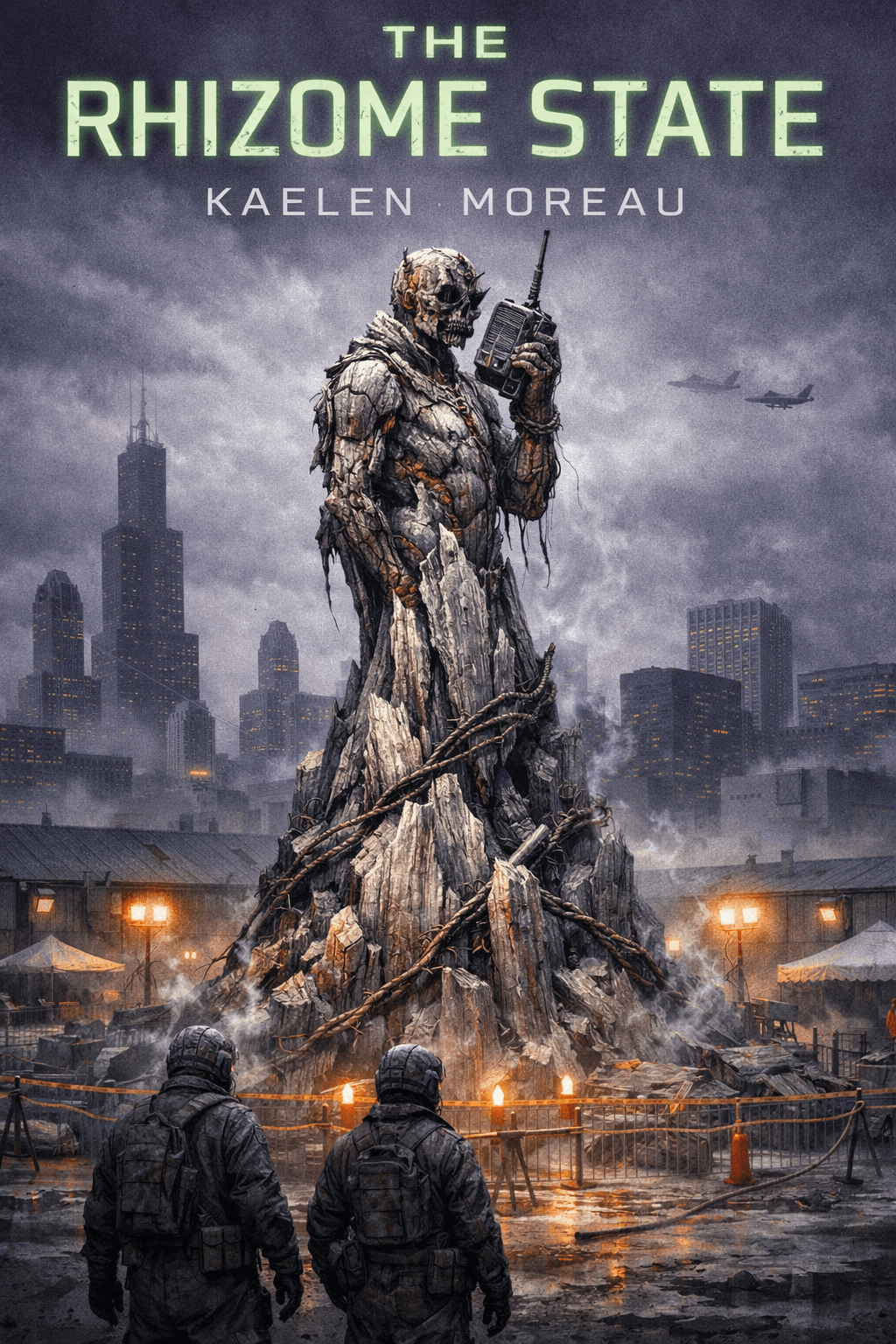
The Rhizome State
Chapter 1
The Breach
Vance Halloway welded for money and for quiet. The Vertex contract offered both if the job stayed clean enough to treat as metal and schedule, bead and penetration, heat input and inspection. The sub-basement did not stay clean.
They ran the canister bay under the auto plant where the air tasted of epoxy and coolant even before anyone started cutting. The room had been dressed to look temporary on paper: poly sheeting hung from Unistrut, taped seams, portable lights on stands. The canisters were not temporary. Each one sat in a cradle bolted to the slab, jacketed in stainless with a collar plate that Vance had been told to seal. There were hazard placards that used words without numbers. The company people wanted no photographs, no phones.
Ventilation had been choked down on purpose. Vance could see the dampers at the ceiling returns set to nearly closed, the access panels screwed back on with fresh paint across the heads. A flexible duct snaked to a scrubber cart that stood idle, power cable coiled and zip-tied. Someone had wrapped plastic around an intake grille and stapled it to the frame. A sign on a post read: FILTER CHANGE PENDING: DO NOT ACTIVATE. It looked printed that morning.
Kyson Griggs had walked them through the bay and used his foreman voice, the one that handled both men and steel, and said the same thing three times with minor changes: keep the schedule, keep the seams, keep the work inside the box. He held a clipboard without paper. Vertex did not put instructions on paper if a camera could pick it up.
Vance set his rig on a cart and checked his gloves for pinholes by stretching the nitrile under the leather. Tape at the wrists. Tape at the cuffs of the leathers. He wore a half-mask respirator because the air already irritated his throat, but he kept it loose enough to talk. The Vertex techs wore full-face units with clear lenses and hard-mounted filters.
The canister collar in front of him had a bevel prepped by someone with too much speed and not enough care. Vance cleaned it anyway, wiped with a rag that came back dark, then clamped a temporary backer ring to keep the puddle from dropping through. He struck arc and watched the bead wet in. He moved his hand in the rhythm that had saved his fingers on a hundred jobs.
A sharp odor cut through the usual solvent stink. Sweet metallic, the kind that made saliva thin and forced a swallow. It came and went in short pulses. He paused and sniffed through the mask.
He looked to the seam between the collar plate and the canister body. A hairline line of moisture sat there, clear at first, then catching light with a faint green tint.
“Kyson,” Vance said. His voice came out rough. “You smell that?”
Kyson stood at the far end with two Vertex people, a man in a clean gray suit and a woman in a helmet with a tablet strapped to her forearm. The suit stayed out of the welding haze, hands clasped behind his back.
Kyson walked over, boots loud on the slab. He leaned in close enough that the hood of Vance’s welding mask picked up his breath through the gap at the edge.
“What,” Kyson said.
Vance tapped the seam with the edge of his glove. The moisture jittered from the vibration.
“Sweet,” Vance said. “Metal. Copper. It’s coming out of that seam.”
The woman with the tablet followed and held a handheld probe near the collar. It beeped once, then twice. She tightened her grip.
“That’s not acceptable,” she said. Her voice sounded filtered through her face seal. “Internal temperature is climbing. We need a pause on welds until we get cooling up.”
Kyson didn’t answer her immediately. He looked at Vance’s bead and then at the set of clamps holding the collar. He scanned the bay, the other canisters with men working on them.
“We’re already behind,” Kyson said. “Corporate wants the canisters sealed before morning. That’s what we do.”
“Kyson, the catalyst-” the technician began.
“Don’t say the word,” Kyson said, low.
The technician’s tablet flashed a warning color. She held it so only he could see and then stepped closer to make the point physical.
“The internal temperature is above spec,” she said. “The heat input from your weld schedule is feeding it. Ventilation is reduced. The bay is under negative pressure but the scrubber’s not active. You want a failure mode.”
Kyson’s jaw tightened. He glanced at the plastic-wrapped intake grille, then at the idle scrubber cart.
“You signed off on this,” Kyson said. “I’m not stopping welders mid-bead. That’s how you get leaks.”
“You already have leaks.” The technician pointed at the seam Vance had flagged. The moisture now had a green edge.
Kyson looked at Vance again.
“That’s solvent,” he said. “Residue from cleaning. It gets trapped. It cooks out. Keep moving.”
Vance kept his hand on the torch but didn’t strike. The sweet metallic odor caught again. It scratched the back of his throat through the respirator.
“Solvent doesn’t smell like that,” Vance said.
Kyson’s eyes narrowed.
“You want to get paid,” Kyson said. “You keep it on schedule. We weld. They monitor. Everybody goes home.”
The technician’s gloved finger tapped her tablet in quick stabs.
“I’m logging this,” she said.
Kyson spoke over her.
“Weld,” he said. “Now.”
Vance struck arc.
The canister collar vibrated under his clamp. It wasn’t a normal vibration from his hand. The containment plating around the canister, temporary panels bolted to a frame, shifted inward by a fraction, then out. A flex that had no business existing at that thickness.
Vance adjusted his stance, braced his elbow against his torso, and fed filler. The bead sat bright, then dulled. He watched for undercut. He watched for porosity.
Moisture pushed out of the seam again.
He thought of the dampers above, nearly closed, and the scrubber cart tied off. He thought of someone deciding that less air meant less smell to the world above, less risk of a passerby catching it. The air in the bay had no clean exit.
His weld bead made a sound that wasn’t right. A short brittle tick.
He lifted the hood and saw a hairline crack running along the fresh bead. The metal had not deformed around it. It had fractured.
“Kyson,” he said, louder.
Kyson stepped in again, saw the crack, then looked past it to the containment plating. The panels bowed outward by a hand’s width and snapped back. Bolts scraped in their holes.
The technician stepped backward.
“Stop,” she said.
Kyson didn’t say stop. He reached toward the clamp as if he could pin the metal down by force.
A sharp hiss came from the seam. The sweet metallic odor surged hard enough that Vance’s eyes watered.
The bay lights went out.
For a fraction of a second, the room existed in the white afterimage of arc flash and emergency photoluminescent strips. Vance felt pressure in his ears, then a cold sensation at his cheeks that didn’t match the heat in front of him.
The blast ignited without warning sound. It arrived as light and force.
A hyper-oxygenated plume flashed through residual fumes in the bay, taking the solvent haze and turning it into a brief combustion front. Heat passed over Vance’s leathers and found the edges of tape at his cuffs. A pressure wave compressed his chest, forced the air out, then drove him backward.
The containment plating did not deform in a slow bend. It failed at joints, bolts tearing through slots. Panels became moving edges.
Vance saw the suit lift off his feet and strike the floor hard, neck bent wrong. He saw the technician’s helmet slam into a canister cradle, then stop moving. He saw another lab person further back, white coat, no helmet, hit a rack and fold.
Canisters ruptured with popping impacts, collars splitting, valves shearing. A dense aerosol burst out, finer than steam and heavier than smoke. It carried the sweet metallic odor with a green chemical note that burned the nose.
Vance’s respirator shifted on his face. The lower strap snapped or slipped. The mask lifted at the cheek.
He inhaled.
The air went wet and metallic in his throat. A cold sting ran down his trachea. He coughed and drew in again, reflex overriding thought. The second breath tasted sweet, then bitter.
Green-tinted condensation struck his exposed skin where his hood had lifted, dampened the corner of his mouth, gathered along the edge of his goggles. It clung to eyelashes. It made the skin at his wrist itch under tape.
Emergency lights flickered once and went dark. Darkness returned, then a dim red strip along the floor, then nothing.
A generator engaged with a low mechanical thump felt through the slab. Partial power restored in uneven rectangles. The portable lights did not come back. The fixed fixtures overhead came on at half output, a harsh yellow that made the condensation visible.
Green tint coated the canister jackets, the containment panels, the cart handles. Droplets hung on cable insulation. The condensation gathered in corners and seams.
Vance lay on his side against an equipment rack. His welding cart had flipped. A cylinder rolled and lodged under a bench.
Heat built in the bay. It forced sweat out from under his leathers. The air held the aerosol.
He tried to push up, but a jag of pain crossed his ribs and his shoulder slid on wet concrete.
Another impact somewhere near the canisters sent a burst of hot gas across the floor.
Vance’s ears rang. His vision narrowed to the green sheen on a wrench head near his face.
He reached for it and missed.
The bay tilted. The generator light smeared. Only the odor stayed consistent for a few seconds.
Then that went too.
*
He woke to a sensation of weight on his chest and the sound of water hitting metal.
It took him a long moment to identify the water as sprinkler discharge hitting broken containment panels somewhere out of view. The sprinklers did not make the air cleaner. They made it humid and drove the odor lower, closer to the floor.
Vance tried to sit and found his leathers stuck to his forearm. He shifted again and pain cut through in a clean line, the kind that came from skin pulling away.
He looked down.
The leather at his left sleeve had fused to blistered skin. The seam line of the sleeve had melted into a ridge. A patch at his shoulder had softened and then hardened again. Removing it would take tissue.
His gloves were still on. Tape still wrapped his wrists, but the tape edges had curled from heat. He flexed his fingers and found stiffness that wasn’t just swelling.
His respirator hung loose at his neck, one strap torn. The filters were wet.
He swallowed and tasted sweet metal.
Kyson stood a few steps away, half in shadow, one hand pressed to his face. Water dripped from his hair onto his collar.
Torrez leaned against a rack, chest heaving. Jaxon sat on the floor with his back to a panel, head tilted forward. Biggs was upright, unmoving, hands on his knees in a posture that could have been rest if not for the glaze in his eyes.
The bay was wreckage. Containment panels lay at angles across the floor. A canister cradle had tipped. A section of cable tray hung down, wires exposed.
Bodies lay near the canisters. Lab staff in suits and coats, helmets cracked or gone. Vance did not count them. The sight of skin against concrete, the wrong angle of a wrist, the flatness of a chest, made counting useless. The sweet metallic warning had been in his throat for a full minute before the blast.
Kyson’s hand dropped from his face.
He had a shard of glass protruding from the corner of his right eye.
“Kyson,” Vance said. His throat burned.
Kyson didn’t answer. He raised his left hand, pinched the shard, and pulled.
It came free with a wet sound that made Vance’s stomach tighten. Blood ran down Kyson’s cheek in a narrow line.
Kyson blinked twice. The eyelid dragged, one corner roughened.
Then the bleeding slowed. The tissue at the corner of the eye drew inward, closing. It sealed in a fast contraction. Small flecks appeared at the edge of the closure, pale gray, catching the generator light. The closure line formed a tight oval.
Mineral.
Kyson wiped his cheek with the back of his hand, leaving a smear that dried too quickly.
“You see that,” Vance said.
Kyson’s gaze fixed on him with the uninjured eye.
“Move,” Kyson said. “Get up.”
Torrez coughed, a deep cough that bent him at the waist. He spit onto the floor. The sputum was green-tinged, thick, with strands that held shape. It stuck to the concrete and didn’t spread.
Jaxon coughed too, shorter bursts, as if trying to keep it quiet. He wiped his mouth with his sleeve and stared at the wet fabric.
“Man,” Jaxon said, voice thin. “What the fuck is that.”
Torrez took a breath through his mouth and coughed again. The second cough came with a wet click in his throat.
Vance drew a breath and felt a scrape deep in his chest. He swallowed it down.
He planted his right hand on the floor to push up. The glove squeaked on wet concrete. His elbow protested.
He shifted weight and felt the fused leather pull again.
Kyson stepped over a broken clamp and went to the emergency door at the bay’s edge. He grabbed the push bar and leaned in. The door did not move. He leaned again, harder. His shoulder set.
A crack ran down the door’s frame where it met the wall.
Kyson hit it a third time. The latch gave with a metal snap and the door swung outward into darkness.
A colder current of air pushed into the bay through the opening. It carried diesel and old dust.
Kyson stood in the doorway and held position, his body blocking the view back into the bay. He lifted his hand and pointed without turning.
“Don’t look,” he said.
Vance’s eyes had already been there. The bodies were still bodies.
Kyson kept them from moving toward them, kept them from going near the canisters.
“Service corridor,” Kyson said. “Now.”
Torrez pushed off the rack and stumbled toward the door. His boots slid on water. He caught himself with a hand on the wall and left a wet smear.
Biggs rose without speaking, slower than the others, one hand braced on his thigh. He moved with care, favoring one side.
Jaxon took a step and then another, shoulders hunched.
Vance tried to follow, but his left arm resisted. He looked down at his glove and saw that the leather had fused at the cuff to the tape. He pulled.
The glove resisted, then came free with a tearing sensation that made him grunt.
Skin came with it.
A strip of epidermis pulled away from the wrist and exposed a layer beneath that did not look like dermis. It was thinner, translucent, stretched over thickened cords that ran longitudinally under the skin. The cords were darker than veins, more defined, packed tight.
Blood did not flow the way it should. It pooled, then slowed, then thickened at the edges.
Vance stared for a second too long.
Kyson’s voice rose.
“Leave it,” Kyson said.
Vance wrapped the torn tape back around his wrist and shoved the damaged glove on with his right hand.
He stepped through the door into the service corridor.
The corridor was narrower, concrete walls, pipes overhead, utility lights that flickered at generator voltage. Water ran along the floor in a shallow stream toward a drain.
Near the doorframe, at the base of the wall, Vance saw a patch of concrete that looked damp until he leaned closer.
Fine growth pushed through cracks. Not moss. Thin pale structures, branching, root-like in shape and density. Several splits repeated at similar angles. They pressed out from the crack with slow persistence. They did not curl. They occupied space.
A green tint sat at their base where they met the concrete.
Vance felt a pressure behind his eyes.
“This is outside us,” he said. He didn’t mean it as comfort. He meant it as an escalation.
Kyson moved down the corridor without answering.
A wall phone sat near an alcove, red handset on a metal cradle. Vance reached for it before he decided to. Habit. Call out. Report. Get help.
His right hand closed on the handset.
The plastic under his glove made a faint crunch. He tightened his grip and felt the handset give.
The surface under his gloved palm turned chalky. A pale crust formed at the contact point and spread outward along the plastic housing in an irregular front, following the handset curve. The plastic lost flexibility and fractured. Small pieces dropped to the wet floor. The crust advanced in branching lines, then stopped.
Vance released it and the cradle mount snapped off the wall with a brittle break. The handset disintegrated in his hand, leaving grit and shards that looked like mineralized polymer.
“What the-” Jaxon started.
Kyson turned back, saw the ruined phone, then looked at Vance’s hand.
Vance held his palm up, fingers spread, glove coated in pale residue.
“I didn’t squeeze it,” Vance said. “I just grabbed it.”
Torrez coughed again and wiped his mouth with the back of his hand, then looked at his skin, waiting for an instant change.
A series of clicks came from above, a mechanical sequence that Vance recognized.
Sprinkler valves.
Kyson’s head snapped toward the bay.
“Move,” Kyson said. “Before the water spreads it.”
“What about-” Biggs began, then stopped. He looked back toward the bay door and did not finish.
Kyson walked faster.
The corridor ahead split. One branch had a sign for MAINTENANCE ACCESS - AUTHORIZED ONLY. Another had a painted arrow toward UTILITY.
Kyson chose without hesitation.
Vance followed, holding his damaged wrist close to his body to keep it from brushing anyone.
Water hissed behind them as sprinklers fully engaged in the bay. The sound followed down the corridor, thin and constant.
Vance tasted sweet metal again and tried not to breathe too deep.
*
The maintenance tunnels were older than the retrofit. Concrete block, steel doors with chipped paint, cable bundles strapped to the walls. The ceiling height changed without warning, forcing them to hunch under low ducts.
Alarms began above. They were muted through the slab but still distinct, a pulsing tone that cycled and repeated. Vance felt impacts too, heavy steps or equipment movement, the kind that meant people were arriving with purpose.
Kyson kept his pace steady enough that the group could follow. He didn’t sprint; he controlled speed. It kept panic from becoming chaos.
Torrez did not match his pace. He surged ahead, then fell back, then surged again. Each time he passed Vance he brushed close enough that Vance flinched away.
“Don’t touch me,” Vance said.
Torrez laughed once, a short sound that turned into a cough.
“What, you think you got something contagious?” Torrez said, then spat green mucus onto the floor.
Jaxon’s eyes were red-rimmed. He kept wiping his mouth and then staring at his glove, as if checking whether his own body was leaving evidence.
Biggs breathed through his mouth. His breathing had a wet texture that made Vance’s throat tighten.
Vance’s chest pain hit without ramp. One moment he was moving; the next, his sternum tightened and forced him to slow. He tried to inhale and felt resistance deep in the airway.
He coughed.
Something came up that was not mucus. It was thicker, sticky, with a resin consistency that pulled in strands between his lips and the inside of his mask. It tasted sweet and plant-bitter. It clung to his tongue.
He spit it out and saw it hold shape on the concrete, glossy under the tunnel light.
Kyson glanced back.
“You good,” Kyson said, not a question.
Vance nodded because he needed forward movement more than truth.
They passed pipe joints where the sealant had split. A thin film of green tissue had formed around the joint, hugging the metal, running in irregular bands. It looked wet and new.
A steam line ran overhead, usually too hot to touch. Now it had a layer around it, greenish tissue, dense and insulating. The heat output into the tunnel changed. The air near it was less sharp. The tunnel felt uneven, patches of warmth and cool in short distances.
Vance watched the tissue as they passed. It did not sway. It simply occupied.
Kyson pointed at a gate ahead, chain-link with a padlock.
“Torrez,” Kyson said.
Torrez reached it first and grabbed the lock with bare hands. Vance saw his skin through the tunnel light: glossy in spots, green-tinged. Torrez yanked once. The chain rattled. He yanked again. The hasp held.
Torrez turned and drove a shoulder into the gate. The frame shook.
“Fuck this,” Torrez said.
He hooked his fingers through the mesh and pulled hard. The padlock bracket bent and then snapped free. Metal tore with a ripping sound.
Torrez’s palm slid along the cut edge. A wet smear streaked the metal where he grabbed. The smear looked clear at first, then turned opaque at the edges.
They filed through.
Vance glanced back once. The smear had begun to harden, turning pale and crusted, mineral along the mesh.
Trackable.
He didn’t say it out loud.
They took a left into a narrower tunnel. The air grew cooler, damp. A drain line ran along the floor.
Ahead, a man lay against the wall.
The sixth worker, the one Vance only knew as a body on the same shift, a set of hands on a grinder, a name that had never mattered to him until it should have.
The man’s legs were splayed. His helmet sat beside him. He tried to breathe and failed in short bursts. His lips had green residue at the corners.
Kyson stopped.
“We keep going,” Kyson said.
“Kyson,” Vance said.
Kyson looked down at the man and then at the tunnel ahead.
The man’s eyes rolled, then focused. He tried to speak. Only a wet sound came out.
“He’s done,” Torrez said. “Leave him.”
Biggs shifted his weight, stared at the man’s hands. His fingers flexed once, then stayed still.
Jaxon’s face tightened.
“Man,” Jaxon said. “We can’t-”
Kyson cut him off.
“You carry him, you slow, you all get caught,” Kyson said. “You want Vertex in here with cameras and bags? You want them to decide what happens to you?”
Vance stepped toward the collapsed man.
He crouched and reached for the man’s shoulder.
His glove touched fabric.
The sleeve stiffened under his palm. The cloth fibers tightened and lost give. The man’s skin beneath reacted in the same instant, pulling taut. Vance felt a hardening through the sleeve that had no time to be swelling.
The man gasped and jerked, pain visible in his eyes.
Vance snatched his hand back.
The sleeve and skin were bonded in a patch, cloth fused to flesh by a pale mineral layer.
“Fuck,” Vance said.
Kyson watched the fused patch and then looked at Vance’s glove.
“See,” Kyson said. “We don’t have time.”
Vance’s stomach turned. He reached again, slower, aiming to lift under the arm without pressing.
He made contact and the calcification jumped again, faster. The man’s skin tightened. The sleeve creaked. The man’s breath stopped for a fraction and then came back in a choke.
Vance let go.
He stood and backed away, palms open, keeping his hands away from all of them.
“I can’t,” Vance said.
Torrez spat again and laughed.
“You’re the one that hardens stuff,” Torrez said.
Kyson turned away from the collapsed man and started walking.
“Move,” Kyson said.
Vance followed. Five moving: Kyson, Torrez, Biggs, Jaxon, Vance. He looked back once more.
The man’s jacket had a green sheen at the hem. Thin growth crept onto the fabric from the concrete near his hip. It spread as a film, hugging threads.
Alarms above continued. Footsteps or equipment impacts intensified.
They reached a junction where the tunnel dropped into a sewer access chamber. A ladder descended into darkness. Air moved up from below, colder and wet.
They climbed down.
The cold hit Vance’s face through the gaps in his respirator straps. It made his eyes sting. It also eased the chest pressure by a small margin. His breathing rate slowed, and the resin strands at the back of his throat thinned. The resin taste in his mouth dulled. His skin stopped itching at the tape edges.
He took a breath and found it slightly easier.
No one said anything about it. They just breathed.
They gathered in a loose semicircle, breath visible in the cold, waiting for Kyson to speak or move.
The sewer junction had multiple tunnels branching off. A trickle of water ran through a channel at the floor. The concrete was damp, dark with age. The smell was sewage and rust and something green that sat behind it.
Kyson stood at the center and looked at the ladders.
“Up,” he said, pointing at one. “That gets you to surface near the perimeter road. We don’t go out the main plant. They’ll have it blocked.”
Jaxon stepped forward.
“I’m going now,” Jaxon said. “I need air.”
Kyson’s gaze held him.
“You go,” Kyson said. “You meet at the yard with the broken fence. You miss it, you go east to the service road and wait under the overpass. Don’t go to your place. Don’t call anybody.”
Jaxon nodded fast and grabbed the ladder.
Vance watched him climb. Jaxon’s boots made a dull ring on the rungs. Halfway up, Jaxon coughed and wiped his mouth on his sleeve.
He disappeared into the opening.
Kyson pointed to another tunnel.
“Outside city limits,” Kyson said. “We regroup. We get distance. We don’t get caught in a net.”
Torrez shook his head.
“Fuck that,” Torrez said. “We go up. We get food. We get pills. We get whatever. You think I’m sitting in piss water waiting for some plan?”
As he spoke, Torrez’s breathing changed. He drew in hard through his nose, then exhaled through his mouth. A fine dust came out with the breath, visible in the generator-lit haze of the junction. It drifted a short distance and then settled.
Vance felt it hit the back of his throat. It made him cough once, sharp.
Biggs coughed too, slower, then covered his mouth with his hand.
“Jesus,” Vance said.
Torrez smiled, lips wet.
“Air,” Torrez said. “That’s what you wanted.”
Kyson’s face tightened.
“Don’t do that down here,” Kyson said.
Torrez shrugged.
“Then let’s get out,” Torrez said.
Biggs leaned against the wall and slid down an inch, then caught himself. His forehead glistened. He kept his eyes on the floor.
Kyson stepped closer to Biggs.
“You walking,” Kyson said.
Biggs nodded once.
Vance looked between them. His wrist throbbed under tape. The mineral residue on his glove fingers felt gritty when he flexed.
“Hospital,” Vance said. “We need a hospital. They have burn units. They have isolation. We can-”
Kyson cut him off.
“Hospitals turn into controlled rooms,” Kyson said. “Cameras. Doors. People in suits who decide you’re a sample. You want to be a sample?”
Vance’s mouth went dry.
“What else is there,” Vance said.
Kyson’s voice dropped.
“Vertex will erase this,” Kyson said. “They’ll erase us. You don’t understand the contract you signed.”
“I signed for welding,” Vance said.
Kyson’s laugh was a short sound without humor.
“They got your name on paper. They got your prints. They got you in a room with their canisters. You think they’ll let you walk out and tell anybody what you saw?”
Vance’s stomach tightened again.
“They already killed those lab people,” Torrez said, jerking his chin back toward the tunnels. “Or whatever did. Same result.”
Kyson ignored Torrez.
“Survival means building something they can’t bulldoze,” Kyson said. “You get that? Something that stays. Something that makes their trucks useless.”
Vance stared at him.
“You talking about a fort,” Vance said.
Kyson’s eye, the one that had healed, didn’t blink.
“I’m talking about a place,” Kyson said. “A structure. A system. We work steel. We know what holds. We do it again, but we do it with what we got now.”
Vance felt cold air on his burned skin at the edge of the fused leather. It hurt in a clean way.
Torrez spat, then wiped his mouth.
“I’m not building shit in a sewer,” Torrez said. “I’m going up.”
“Go up,” Kyson said. “Go up and draw everyone to you. You want them to torch you in an alley?”
Torrez’s eyes widened.
“They can’t torch me if they can’t breathe,” Torrez said.
A second dust exhale came as if his body did it without planning. Vance coughed again. His eyes watered.
Kyson stepped closer to Torrez until they were nearly chest to chest.
“You do that in my space, I’ll leave you,” Kyson said.
Torrez’s grin faltered.
Vance kept his hands tucked against his chest to keep them away.
“My daughter’s near here,” Vance said. The words came out before he decided to say them.
Kyson’s head turned toward him.
“She’s a kid,” Vance said. “I have to warn my family. I have to get them out.”
Kyson’s mouth tightened.
“That’s a weakness,” Kyson said.
“It’s my kid,” Vance said.
Kyson stepped back a half step and studied Vance for a second.
“You go home, you draw attention,” Kyson said. “You bring cops. You bring Vertex. You bring everybody. You do that and I’ll follow you. I’ll make sure the attention lands on you and not on what I’m building.”
Vance held still. Kyson had said he would follow, and he had said what he would do.
“You’d follow me,” Vance said.
“I’ll do what I have to,” Kyson said.
Biggs made a low sound in his throat and pressed his hand to his chest, then dropped it.
Torrez looked between them, watching.
Vance’s mind reached for control measures. He thought of calling someone, then remembered the handset crumbling in his grip. He thought of touching a door handle and leaving a trail.
He reached into his pocket with his left hand, careful with the fused leather, and found the small knit hat he carried. Child-sized. He didn’t take it out. He held it through the fabric for a second, fingers pressing into soft yarn. It gave him one controlled breath.
“I’m not coming with you,” Vance said.
Kyson’s face did not change much.
“You’ll die alone,” Kyson said.
“Maybe,” Vance said. “But I’m not bringing this to you. I’m not building your thing.”
Kyson pointed at the ladder Jaxon had taken.
“That’s not for you,” Kyson said. “You go that way, you cross paths. You leave a trail. You get caught.”
Vance looked at another ladder on the far side of the junction, rusted, leading to a smaller access.
“I’m taking that,” Vance said.
Torrez snorted.
“Go ahead,” Torrez said.
Kyson’s gaze sharpened.
“You step out and you keep moving,” Kyson said. “You don’t sit. You don’t stop. You don’t go to a hospital. You don’t call anyone. If you do, you pull a net down and I’ll make sure it closes on you.”
Vance nodded once because he understood the terms even as he rejected them.
He moved toward the ladder.
His glove brushed the rung as he started climbing.
A pale streak appeared where the glove touched, chalky residue on wet rust. The residue spread in a short line along the rung and then stopped.
Vance paused and stared at it.
He moved his hand to the next rung and left another streak.
He looked down. Kyson watched him from below. Torrez watched too, breathing through his mouth with a faint dust haze around his lips. Biggs leaned against the wall, eyes half-lidded.
Vance kept climbing.
Each rung took a little more skin off his torn wrist under tape. Each rung took a little more residue off his glove and put it on metal.
A track.
He reached the top and pushed the cover with his shoulder because he didn’t want to put his hand flat on it. The cover lifted with a scrape.
Cold air hit his face. Not sewer cold. Street cold. It carried exhaust and wet asphalt.
He pulled himself out and found himself in an alley beside a chain-link fence and a loading dock. Sodium streetlight cast a flat amber across slush.
The air was warmer than the sewer by enough to matter.
Pain accelerated in his burned arm. The fused leather pulled tighter as the tissue beneath swelled. The chest tightness returned, sharper. His mouth filled with sweet metal taste.
He took two steps away from the access and coughed once, hard.
Resin rose again, sticky at the back of his throat. He spit into slush and watched it sit on the surface without dissolving.
He kept moving.
He turned the corner at the end of the alley and crossed a service road, staying under the shadow of a parked trailer. His boots left prints in slush. His gloves left pale dust on the trailer’s steel edge when he steadied himself.
He did not look back toward the plant.
Alarms were faint now, muffled by distance and winter air.
He moved toward the side streets where houses started, where a child might be asleep behind a window with a cheap curtain.
His hands stayed close to his chest.
His breath stayed shallow.
His pace did not slow.
Chapter 2
The Ghost at the Window
Police lights flashed at the far end of the service road, blue and red cycling against sodium streetlight in short intervals. Vance stayed on the edge of the street where parked trailers broke up sight lines. The plant lay behind him by distance rather than by any clean separation. He still tasted sweet metal when he swallowed.
Hands stayed close to his chest, elbows tucked, the way he held them in the tunnels. The new tape around his wrist pulled when he flexed. Under the tape and fused leather the skin itched, a thin abrasion that turned sharp when he warmed up.
Under an overpass, concrete showed soot streaks and wet patches from slush melt. A cruiser sat on the shoulder above, lights on, no siren. Two officers stood by the trunk with their shoulders turned toward the industrial corridor. Their faces caught the dashboard glow and the rotating bar. Vance watched for a second, then moved again, staying in the darker strip between a retaining wall and a line of dumpsters.
Wet prints formed behind his boots. He did not try to erase them. There was no time to solve every trace.
A roadblock appeared ahead at an intersection that usually stayed empty at this hour. A city plow sat angled across one lane. Plastic barricades and cones narrowed the rest. A flare burned on the asphalt, bright enough to show steam rising from a sewer grate. Two workers in reflective vests waved cars through, slowing them and pointing them away from the plant. Vance stayed off the main approach. He cut right down a residential side street where the houses started, where trees stood bare and fenced yards held abandoned toys.
Head down, he kept moving. The half-mask still hung around his neck, useless with the strap torn and the filters wet. Throwing it away would have been easy. He kept it anyway. The rubber carried the smell of his own breath and the bay.
The first houses had porch lights on. Some had nothing, blinds down, no movement. Others had doors open, people stepping out in coats, holding phones up and watching for something they could not see. A man in a knit cap walked to the curb and looked toward the industrial corridor, then turned back and went inside.
Vance avoided the lit sections of sidewalk and used gaps between parked cars. His left sleeve dragged against his forearm where the leather had fused. Each shoulder shift pulled the seam and brought a sharp pain across the burn.
At the corner of a block with duplexes, he saw his neighbor from two doors down loading a car. The neighbor’s name surfaced late and incomplete, the way names did after long shifts and short conversations. The man moved fast, pushing folded blankets into the back seat. A case of bottled water followed, plastic wrap reflecting porch light. He opened the trunk and set in two grocery bags. One scan up the street, then back to loading.
No squad car idled in front of the house. No official tape crossed the sidewalk. The neighbor acted without instruction.
From behind a parked van across the street, Vance watched and kept his distance. Calling out would have turned heads. He did not want anyone seeing the leathers, the taped hands, the wetness at his collar.
He moved on.
Farther down, a car sat half on the curb, driver door open, engine idling. The radio volume carried into the street.
The broadcast broke in mid-sentence: "...repeat, an industrial accident in the southwest corridor. Detroit Fire advises residents in the area to remain indoors. Close windows. Shut down any ventilation that draws in outside air. If you smell chemicals, call 911. If you are experiencing difficulty breathing, seek medical attention. Again, an industrial accident..."
The announcer’s voice stayed steady. The language stayed vague. No plant name, no company name, no mention of the street where the breach happened. Vance watched the open door. No one sat in the driver’s seat. A woman stood on the sidewalk in a robe and winter boots, phone pressed to her ear, looking toward the industrial corridor.
The radio continued. "...reports of a gas release. We do not have confirmation of hazardous materials at this time..."
Vance walked past without stopping. The words did not change his immediate problem. Stay indoors did not matter if the hazard clung to him and moved with him.
A strip of warmer air came from a building vent near a laundromat. It hit his face and throat and tightened his chest. He swallowed, counted breaths, forced them shallow. One. Two. Three. The itch under his leathers sharpened.
When he reached to adjust the collar, tape caught on stiff fabric. The movement pulled the fused seam and he hissed through his teeth.
In the shadow of a garage, he lifted the edge of his leather with two taped fingers. The skin beneath had changed. The burn pattern no longer looked like a burn. It looked like a surface that had replaced itself too fast. Translucent patches sat along his forearm and near his collarbone where the leather had rubbed through. Under those patches, dark cords ran in parallel lines.
Clear fluid seeped from a crack in the translucent area. It wet the tape, then the leather edge. It did not run the way sweat ran. It gathered, thickened, spread along the seam by a few millimeters, then stiffened.
Vance let the collar drop and checked his taped hands. The tape had started to discolor at the edges where the fluid touched it.
More barrier. Less skin exposed to friction and heat.
He kept moving, choosing side streets with fewer porch lights. A contractor pickup sat half buried in snow at a curb, windshield cracked. The passenger door was not latched. Vance checked the street. No one watched. He pulled the door open using his elbow and shoulder, keeping his palms away.
The cab smelled of stale coffee and cigarettes. A high-visibility vest lay on the seat. A hard hat rested on the floor. In the footwell, a box of nitrile gloves sat half open. A roll of duct tape lay near the center console.
Vance took the box and tape, then slid a box cutter from the console into his pocket.
Outside again, he closed the door with his hip and moved behind the truck where the streetlight fell off.
A nitrile glove came free from the box. The first tore at the cuff when it caught on the rough edge of his existing work glove. The second stretched over with careful pressure. Tape sealed the cuff to his sleeve. It stuck to wet leather and lifted fibers when he pressed it down.
The nitrile gave him a sealed surface, but it took away grip. Fingers felt thick.
On the other hand, he repeated it with less force, working the cuff down before taping it tight. The torn wrist sealed as well as he could manage without cutting off circulation he could still feel.
He flexed. The nitrile squeaked. A fist still formed. Holding a tool would be possible; fine movements would not.
The box and tape went under his arm as he started walking.
The street narrowed. Snow piles edged the sidewalks. A stray cat appeared from under a parked car, gray fur and a thin tail. It stepped into the street and stopped when it saw him. Its head turned, ears up.
Vance froze and tracked the cat’s movement. It took a few steps closer, paws wet from slush.
Two steps back, he kept his eyes on it without turning his back. Boots slid on ice; he caught himself by shifting weight rather than grabbing a car. The cat followed, curious, slow.
"No," Vance said under his breath. The sound came out rough.
He crossed the street at an angle and put distance between them. The cat paused, then went back under the parked car.
His diaphragm stayed held; he did not exhale. The next inhale burned his throat, so he kept it shallow.
A low buzz became audible above the neighborhood, intermittent, then steady. Near a bare maple, Vance looked up.
A small drone crossed the sky in a straight line toward the industrial corridor. Navigation lights blinked in a repeating pattern. It moved above the houses at an altitude where a person could see it but not reach it. It did not hover above him. It did not pause. It continued toward the lights in the distance.
Vance watched until it vanished behind a line of taller buildings.
Surveillance. Not just cruisers and barricades.
He cut down another side street, then another. Intersections with traffic stayed off his route, and he passed houses with people outside at a distance.
His block came into view a piece at a time as he moved: the corner store, the mural on the side wall, the patch of sidewalk where a concrete slab had sunk. He recognized the angle of the streetlight and the chain-link fences.
His mouth dried. He swallowed and tasted sweet metal again.
Behind a parked sedan with frost on the rear window, he stopped. From here he could see his duplex from the side, not the front. The yard gate sat closed. The windows looked unchanged.
That did not help.
Stillness held him in place while he listened for sirens close enough to matter and for footsteps on the sidewalk. He waited for his breathing to settle.
The nitrile squeaked when he flexed his fingers. He kept his hands from touching the car.
He chose observation.
*
The front walk stayed unused.
Vance moved along the side of the street, then cut through the gap between two garages where the snow had been trampled by kids earlier in the day. Shoulders angled away from walls, he kept the leathers off surfaces as much as he could. They scraped once against rough wood anyway. He flinched and tightened his posture.
The backyard gate was chain-link with a latch that usually stuck. Vance did not touch the latch. He hooked the edge with his elbow and pushed until the latch shifted. It clicked. He slipped through and let it fall closed behind him without letting it hit the post.
The backyard looked the same by shape. A small patch of grass showed through snow near the shed. The chain-link fence ran along the back. A wood post anchored one corner where the fence changed direction.
Lights were on inside the house.
The kitchen window had a thin curtain that did not fully close. Warm light fell onto the snow and reflected off the crust. Shadows moved across the counter.
Renee and Sadie were home.
He did not step closer right away. Near the shed, where less light reached, he watched until he could tell who moved where.
Renee’s outline crossed the kitchen. Something sat in her hands, maybe a mug. She wore a coat inside; the shape looked bulky. Her movement kept the tired rhythm he knew from the end of her shifts.
Sadie appeared at the table, hair tied back, shoulders wrapped in a sweatshirt. She leaned over something on the table. A workbook. A tablet. Vance could not tell.
Sadie turned her head toward Renee and said something Vance could not hear through glass and distance.
He could have spoken her name. He could have tapped the window.
Renee opening the door put her in the yard. Sadie would follow. A phone call would follow. Officers would follow.
Vance stayed outside.
He moved closer by inches, using the darker strip near the fence line. Boots pressed down snow with a faint crunch. He stopped when Sadie looked toward the window. Her eyes tracked the glass. She did not see him yet.
Vance pulled his hands tighter to his chest, the gesture small and contained.
His throat tightened. When he swallowed, it scraped.
The skin under his jaw felt tight, less able to shift with movement. Falling in the yard would bring someone out.
At the corner where chain-link met wood, he reached for the fence post.
Nitrile-covered glove made contact. He applied pressure for balance.
The wood changed under his grip.
It did not rot. It did not crumble. It thickened and hardened in a fast front that started at his palm. The grain pattern disappeared under a pale layer. Texture smoothed, then roughened as the mineral layer built unevenly. The post widened by a small but visible amount where his hand held it. A ridge formed along the contact area.
Vance released the post.
The post remained altered. The pale mineral layer did not reverse. The ridge stayed.
His gaze moved from the post to his glove. Pale residue dusted the nitrile in a thin film.
A sound came from the back steps.
The dog pushed through the partly open back door and ran into the yard. Paws kicked snow. It moved straight toward Vance with the directness of an animal that knew the shape of him.
Vance held still.
The dog slowed near him, tail moving, head up. It sniffed at the air near his legs. Vance did not reach down. He did not pet it. He did not push it away.
Hands stayed up, palms open, away from fur.
The dog stepped closer, nose near his pant leg. Vance exhaled without meaning to. A short breath; faint condensation in the cold.
The dog inhaled.
One cough. A short hack that startled it. It stepped back and shook its head.
Another cough followed, then a wheeze. The next inhale narrowed into stridor. Saliva thickened at the lips and held in a string before it snapped.
Within a few seconds, forelegs jerked in a tight pattern, then locked. Hind limbs kicked twice, then went rigid.
Vance’s chest tightened in answer. He did not move.
The dog’s legs stiffened and it collapsed onto its side. Limbs jerked. Jaw clenched and unclenched. Foam gathered at the corner of its mouth, then a clear fluid that held thick. Breathing broke into irregular pulls and then stopped for a short beat.
Vance took one step forward, then stopped.
Picking it up would have put it against his leathers. Carrying it inside would have put him at the door.
The dog convulsed again, claws scraping snow.
Vance looked toward the back door.
If Renee stepped out, she would come into the yard. She would come into his air. She would reach for the dog.
He scanned the yard for something long enough to use without touch.
A shovel leaned against the shed wall, the one he used for snow. Vance moved to it fast, keeping distance from the dog’s thrashing body. He grabbed the handle near the end with his taped glove, far from the metal.
The handle stayed unchanged for the moment. He kept his grip light.
He slid the shovel blade under the dog’s collar area without letting the blade touch skin more than necessary, using it as a hook. He pulled.
The dog dragged across snow, leaving a streak of disturbed slush. Limbs continued to jerk. Its head hit the ground once, then rolled.
Vance pulled it farther from the door, toward the back fence where the window light fell off.
The dog convulsed again. Its chest heaved. A thick cough expelled clear fluid and something darker that streaked the snow.
Vance kept the shovel between them.
Eyes stayed open, unfocused, then focused briefly on him, then unfocused again.
Inside the kitchen, Sadie moved closer to the window. Her face came into view at the glass. Hands pressed to the sill.
Vance stepped backward into the darker part of the yard, using the shovel handle as a barrier between him and the house.
The back door opened.
Renee stood in the doorway. She held the door with one hand and kept her feet on the threshold. Her other hand lifted toward her mouth, hovering without touching.
Her eyes went first to the dog. Then to the fence post. The pale ridge on the wood sat at her eye level.
She looked at Vance.
He could see her face clearly now: tired skin, hair pinned back, scrubs under her coat. Her hands looked cracked, knuckles raw from disinfectant.
"Vance?" she said. Her voice stayed low, tight.
Vance did not answer.
His taped hand rose, palm toward her.
Stop. Close the door. Do not come out.
Renee’s gaze flicked to the dog again. The dog’s limbs jerked once more, then slowed. Its jaw opened, then shut. Its chest moved in a shallow effort.
"What did you do," Renee said. The words came out flat, not a fight, only a need to define hazard.
Vance shook his head.
He did not step closer.
Sadie’s face appeared behind Renee at the edge of the door. Sadie leaned forward, trying to see around her mother.
"Dad?" Sadie said. The word reached the yard through the opening.
Vance’s throat tightened until speech failed. His posture held rigid.
His hand stayed higher, still, palm out.
Renee saw the gesture. She saw the dog. She saw the altered fence.
She did not step outside.
"Sadie, back," Renee said without turning her head. Her voice sharpened.
"But..." Sadie started.
"Back," Renee repeated.
Sadie hesitated, then moved back into the kitchen.
Renee kept her eyes on Vance. She looked at his taped hands and nitrile sheen. She looked at the leathers, the stiff seams, the wet sheen at his collar.
"You can’t be here," Renee said.
Vance nodded once.
The dog’s body jerked again, then fell still for a longer beat. A final cough came out as a wet sound without full breath.
Vance tightened his grip on the shovel handle until his glove squeaked.
"You need help," Renee said. Her voice shook on help and then steadied.
Vance shook his head.
His palm stayed up.
Renee’s eyes narrowed. She scanned the yard again, taking in distance, the direction of the wind by the way her hair moved near her temple, the open air between them.
Without crossing the threshold, she leaned back. Then she closed the door.
The latch clicked.
A second click followed. Lock.
Renee’s face appeared at the window for a fraction of a second, then she moved away. Sadie’s face did not return.
The kitchen light still fell onto the snow, but no one stood behind the window.
Vance lowered his hand. His taped fingers slid into his coat pocket and pressed the knit hat there, the yarn rough against the tape.
He looked at the dog. It did not move. Eyes stayed open.
The shovel remained between them. He did not touch fur.
Step by step, he backed away until the shed blocked the window light. Through the gate gap, he went out the way he had entered, using his elbow again, not his hands.
In the alley behind the garages, his right foot stalled mid-step. The next breath came thin, and distant street noise fell dull for a few seconds. He forced the foot down and kept walking.
Sweet metal filled his mouth again. His throat burned.
Movement continued because stopping would turn him back toward the house.
He walked away from the duplex that held his daughter.
*
Machine shops replaced houses, roll-up doors shut, lots fenced with chain-link. Vance followed service roads behind them. Memory from job sites guided him, the way streets connected when the goal was a loading dock rather than a front entrance.
Intersections with traffic stayed avoided. When a main road had to be crossed, he waited behind a concrete barrier until the lane emptied, then crossed fast.
Warm air made the pressure in his throat and jaw build within a few steps.
A generator ran behind a small clinic. Exhaust warmed the air near the fence. Vance passed through the warmer strip and the skin under his jaw tightened. Pressure built in the tissue at his neck. When he tried to turn his head to check behind him, movement limited.
Not paralysis. Resistance.
Under his chin, skin pulled against a plate that had not been there hours ago.
He swallowed. The movement scraped.
Breathing became a deliberate act. Inhale shallow. Exhale shallow. He counted again. One. Two. Three.
Hands tingled under tape and nitrile. He flexed and felt pressure at the knuckles. The gloves felt tight.
Vance kept walking.
The warehouse district sat closer to the river and the rail spurs. Two winters ago he had welded guardrails near a freezer plant where the doors opened and closed all day. The layout held in his head: truck queue, side doors, loading docks.
At the first row of buildings, the street was empty. Snow drifted in corners. A security light shone above a loading dock. No guard sat visible.
Vance moved along the wall where the light did not hit directly.
A side door sat near the dock, metal with a push bar. Vance did not grab the bar. He leaned his shoulder into it and pushed.
The door did not give.
Shifting weight, he tried again and kept his hands close.
The door rattled but stayed shut.
He looked around the dock for another entry. A loading bay door sat half open, enough space for a person to slip under if they crawled. The interior beyond looked dark.
Vance crouched. The movement pulled at fused leather. A sharp pain crossed his forearm. He kept it contained and quiet.
He slid under the bay door, keeping his hands off the floor as much as he could. The concrete inside felt colder than outside, a good sign. He stood and listened.
The interior smelled of cardboard and faint ammonia, the kind that came from refrigeration leaks. He followed the smell.
A corridor led to insulated doors marked FREEZER. The doors were shut. A red light above them glowed.
With his ear near the seam, he heard fan noise and a compressor cycle.
Power.
A lever handle sat on the door, metal. He did not want to touch it. Using the edge of his taped forearm, he pressed down.
The door opened with a suction release.
Cold air came out and hit his face and throat. The temperature drop caused pain at first, immediate and sharp at the burn edges, then shifted into a dull ache.
He stepped inside.
Metal racks lined the room. Boxes sat stacked, wrapped in plastic. Frost lay thin near the evaporator fans. His breath condensed and fell.
Tightness at his neck eased by small degrees. Pressure under his jaw slowed. Turning his head became possible by a small amount. The itch under his leather dropped from constant to intermittent.
He stood still, letting the cold act on him.
Heat held against his skin had become a problem. The welding leathers trapped warmth where his body generated it. Dampness sat under the leather at the translucent patches.
Vance took the box cutter from his pocket, the one from the contractor truck, and extended the blade with nitrile-covered fingers.
He cut along a seam where leather met tape near his forearm, slow, keeping the blade away from skin that had no normal boundary. The leather resisted, then gave. The cut opened a line.
When he pulled at the leather edge, it lifted with a wet peel. A faint tearing sound followed.
Skin came with it.
A strip of adhered epidermis tore away, exposing the translucent layer beneath. Clear fluid beaded at once. It pooled at the edge, turned tacky, then formed a thin skin where it met cold air.
Vance breathed through his mouth. Cold air dried his throat. He swallowed and tasted metal.
He cut again, widening the opening, sacrificing more skin to remove a section of leather that held heat. Pain registered at once, localized and sharp, different from the burn. The tearing stayed literal.
Blood appeared but did not run. It thickened at the edge of the tear and dulled in the cold.
He stopped when a panel of leather hung away from his skin, letting cold air reach the area.
Vance leaned against a rack without letting his hands touch it, using shoulder and upper arm through remaining leather.
Cold continued to slow him down internally. The urge to cough resin eased. Pressure behind his eyes lessened.
Hunger hit with force. His stomach clenched hard enough to make him bend.
He looked around the freezer. Boxes had printed labels for frozen meals, bulk packs for vending machines, cases of breakfast sandwiches. Using the box cutter, he tore open a case and kept the blade close. A plastic-wrapped sandwich came out. He bit into it still frozen at the center.
He ate fast. His jaw worked stiffly, limited by the neck tightness that had not fully left. Swallowing came before chewing finished.
A second item followed. Then a third.
His stomach cramped. Cold food sat heavy. He kept eating anyway.
Pressure rose from gut to throat. He turned away from the racks and bent over the floor.
He vomited.
The output did not look like the food he had just eaten. It came up thick and glossy, clear at first, then streaked with pale resin. A sharp chemical smell rose with it. On the cold floor it held shape, then the surface tightened from tacky to brittle within seconds, edges cracking where frost touched.
Vance spit once afterward. The spit came out thick.
He wiped his mouth with the back of his leather sleeve and tasted sweetness and bitterness.
Another minute passed in the freezer while he breathed through nausea.
Outside the warehouse, sirens rose and fell. The sound came from a distance, but it shifted position over time, passing along roads that led toward this district.
A helicopter crossed overhead. Rotor noise reached the warehouse through the roof and dock doors as a low thump. It moved from east to west, then faded.
Response was not staying near the plant.
He could not stay here long.
A freezer room with power would draw attention if anyone checked the building. Entry depended on doors he could mineralize if he leaned into them too much. Every surface became a risk.
He stepped out of the freezer and let the insulated door close. Warmer air in the loading bay hit him and neck tightness began again in a slow return. The itch increased.
Vance crossed the building without turning on lights.
At the bay door he had crawled under, he paused and listened. No footsteps close. No voices.
He slid out under the door and stood outside.
Night air felt colder than the neighborhood, but not as cold as the freezer. It bought time. Not safety.
He looked toward the direction of his duplex and did not see it. Distance existed in streets and blocks, and he kept his body from turning back toward it.
The public ice rink was still there. An old community rink, boarded for most of the year, sometimes reopened by volunteers when the city had money. Refrigeration equipment there was built to run cold for long periods.
He had welded railings there once. Side entrances and the service corridor to the compressor room stayed clear in his memory.
Vance started walking.
Industrial backstreets kept him off the main road where sirens traveled. He followed a service road beside rail tracks, then cut through an empty lot where snow covered broken concrete.
Taped hands stayed close to his chest.
Breath stayed shallow.
He did not slow.
The warehouse district fell behind as he moved toward the rink.
Chapter 3
Thermoregulation
Vance kept to the service roads where the streetlights thinned and the buildings had no windows at sidewalk level. The night stayed cold enough to keep his throat from closing all the way, but not cold enough to stop the itch under leather and tape. The removed sections of his welding leathers left raw bands along his forearm and ribs. Clear fluid had dried there into a tight film that cracked when he bent.
The half-mask respirator hung at his neck by the remaining strap. The torn strap slapped his collar when he moved. Wet filters carried the sweet-metal odor from the bay and the freezer, and his own breath. He did not pull it back up. It would not seal.
He followed a route he remembered from a winter job: a loading dock turned left, a rail spur, then a block of small homes that looked abandoned even when occupied. Past the last set of houses, the rink sat behind a chain-link fence and a parking lot patched with ice.
A community sign still stood near the entrance. The plexiglass cover was cracked. Flyers under it had bleached into pale rectangles.
The main entrance doors faced the lot. The glass panels were gone, replaced by plywood that had been screwed on from the outside. A strip of duct tape ran along the seam. The tape had split in multiple places, repaired with shorter pieces.
He did not touch it.
He moved along the building’s side where a service corridor should be. Snow had drifted against the wall in shallow piles. His boots left wet prints that filled with slush.
At the service door, someone had tried to secure it. A chain looped through the push bar and a steel anchor bolt set into the concrete. The chain was thick enough to resist hand tools. The padlock looked newer than the rust on the door frame.
A prior attempt to force entry showed in the metal around the latch. The door skin had dents and a long scrape where a pry bar had slipped.
Vance stood still and listened. The only sound close came from his own breathing and the faint squeak of nitrile when he flexed his hands inside the taped cuffs.
He backed away and scanned the lot.
A maintenance vehicle sat at the far edge near the fence, a city-white van with a faded logo and a side door that did not close flush. The windshield had a layer of frost. Someone had left it without finishing a lockup.
He crossed the lot fast, staying away from the front entrance where cameras might have once existed, even if dead now. At the van, he used his elbow to slide the side door open. It rolled on its track with a gritty sound.
Inside, tools were stacked in plastic bins. A bolt cutter lay across the top, red handles scuffed, jaws spotted with rust.
He lifted it by the handles with his taped glove and nitrile overlayer, keeping his grip light. The metal stayed intact. No chalking, no immediate crust.
The weight pulled at his shoulder. The fused leather there resisted and gave him a sharp line of pain.
Back at the chained door, he set the bolt cutter jaws around a chain link and squeezed. The first bite took effort. His hands had become clumsy inside layers. He bore down anyway.
The chain snapped with a flat report.
He froze and listened again. No answering voices. No car tires. No footsteps.
He cut a second link and the chain dropped to the ground, striking concrete with a clang that carried in the open lot.
He pulled the door by the edge with his forearm, not his hands. The latch resisted, then released.
Cold air flowed out from inside, but it carried dampness and a faint chemical odor from refrigeration. It was colder than the streets, not as cold as the freezer room he had used earlier. The difference still mattered.
He stepped in and pulled the door shut behind him without letting it slam, keeping the bolt cutter in hand.
The corridor was dark except for a green exit sign near the main entrance. The sign flickered at an irregular rhythm.
He moved deeper and paused at an intersection of hallways. The rink bowl should be beyond a set of double doors. The compressor room should be down a service corridor.
He listened.
A low mechanical sound came and went. It was not steady. It rose into a short cycle, then stopped. The gap before it returned stretched longer than it should have, close to a minute, then it started again with a rough restart.
Intermittent power. A generator somewhere on a schedule, or a failing feed.
He found the double doors and pushed one open with his shoulder.
The rink bowl opened into a wide space that smelled of stale popcorn, mold, and cold concrete. The boards around the ice were intact. The ice itself looked gray under dim light, a thin layer of frost on top that broke under his boot when he stepped off the rubber mat.
Bleachers rose on one side. The scoreboard was dark.
He walked out onto the ice with care. The soles of his boots slipped, then found traction. Near center ice, the surface had a rough patch where something had melted and refrozen.
He lowered himself down slowly, keeping his hands from bracing on the ice until he had to.
When his body touched the surface through his remaining leather and the coat from home he still wore, the cold transferred through the layers. It reached his joints, then deeper into his limbs.
Pain shifted.
The ache that had lived in his long bones since the blast, an internal pressure at the marrow line, reduced by small degrees. Not gone. Reduced. The tightness at his throat slowed. The urge to cough resin eased.
He exhaled and watched condensation fall onto ice.
His jaw, which had resisted movement for hours, loosened enough for him to swallow without a scrape.
He kept still.
A compressor cycle began somewhere behind the walls. The sound carried through the building’s structure and became audible in the bowl as a low vibration. It ran for maybe twenty seconds, then stopped. The air temperature did not drop instantly, but the temperature stayed low.
He turned his head slightly and looked at his hands.
The nitrile over-gloves were still intact. Duct tape at the cuffs had begun to peel at one corner where it had stuck to wet leather earlier and now stiffened.
He reached out and touched the ice with the tips of his gloved fingers.
A pale dust transferred onto the surface. It appeared as a faint chalk smear, barely visible until he angled his gaze and caught the low light. The smear broke into thin lines where the nitrile had creased, and it sat on top of the frost instead of mixing in.
He lifted his hand.
The smear remained.
The rink would show his traces. The ice, the boards, any towel he touched would keep a visible transfer, and no one was here to clean it. Anything that warmed later could become a place for growth or hardening.
He pulled his hands back to his chest.
Cold continued to spread into him. With it came numbness, and he had learned in the freezer that numbness did not match safety.
He shifted his weight and felt a pull at the raw band where he had cut leather away. The pain there had dulled under low temperature, which made him move too far without noticing.
He lifted the edge of his coat and examined the exposed strip along his forearm where translucent skin showed under torn epidermis.
The tissue looked paler than earlier. A patch near the wrist had turned gray-white. When he pressed near it through nitrile, he felt pressure but no clear pain signal.
He bent closer.
A small blister had formed, the fluid under it clear. The skin around it looked waxy.
Frost injury, early stage. His altered dermis did not warn him. Cold temperatures slowed the change, but they could also take tissue before he noticed.
He let the coat drop back down and stayed still again, counting breaths out of habit when his throat threatened to tighten.
He needed barriers.
He sat up and moved off the ice toward the boards. Each movement risked leaving residue. He kept contact minimal and used his shoulder to steady himself against the dasher board, leather between him and the painted surface.
A towel bin sat near the bench area, the kind used for youth hockey. He approached it without touching the lid, hooked it open with his elbow, and pulled towels free with a light grip.
He took them to the ice edge and laid them down in a strip where he could return to the surface without placing his body directly on ice. The towels were stiff with age, but they formed a layer.
In the storage area behind the bench, he found a roll of plastic sheeting still in its packaging, taped shut. He cut it open with the box cutter and pulled out a folded sheet. The plastic crackled in the cold.
He laid plastic over towels and stepped onto it.
The plastic reduced direct transfer. It also shifted under his boots. He had to move slower.
He returned to the ice and lowered himself onto the plastic layer, placing his body weight on the towel-lined area so he would not slide. The cold came through anyway.
He watched the faint chalk smear he had left earlier near center ice. It stayed visible.
Time here could suppress symptoms. His residue could also seed the space.
He closed his eyes and let the low temperature reduce his internal pressure until he could think in full sentences again.
He would stay long enough to stabilize and leave before his traces turned the rink into another node. He did not say it out loud. The words stayed in his throat with the sweet taste.
*
The first-aid cabinet was in a narrow corridor behind the lobby. The corridor smelled warmer than the bowl, with a draft from a broken vent. Vance moved through it quickly, keeping his hands off the walls.
He found the cabinet by its red cross sticker and the cracked plexi front. The lock had been broken long ago.
He opened it with the edge of his forearm and found gauze, a half-empty bottle of antiseptic that had crystallized at the cap, and a pack of alcohol wipes still sealed.
He took the wipes and a roll of gauze.
Back at the rink bowl, he kept to the colder air near the ice surface and sat on the plastic again. He pulled his improvised carry bag closer. It was a small canvas tool pouch from his welding gear, the strap stiff with dried residue. He had stuffed it with the box cutter, duct tape, and a handful of nitrile gloves from the stolen box after ditching the cardboard.
The other weight in the bag was hard plastic.
He pulled it out.
The handheld scanner was the size of a thick phone, with a small screen and a side port for disposable cartridges. The casing had a Vertex asset tag on the back, partially scraped. He remembered seeing similar devices clipped to a tech’s belt in the bay.
He had grabbed it when they pushed through the corridor after the blast. It had been on the floor near the bodies and the blown panels. His hand had been taped already. He had shoved it into his pouch without checking if it worked.
Now he needed anything that could tell him what his own blood had become.
He wiped the box cutter blade with an alcohol wipe until the metal squeaked. The wipe came away dirty and green-gray.
He chose his left index finger and cut a shallow line at the pad.
Pain came late, muted by cold.
Blood welled up. It was darker than he expected and thick. It did not bead and run. It formed a mound.
Within seconds, small pale grains appeared in it, suspended in the fluid. The grains gathered at the cut edge and the blood tightened.
He pressed gauze lightly to it and pulled away.
The gauze stuck.
He peeled it back and saw the clot held granular texture, hard points embedded in the soft mass.
Calcification inside circulation. Not just at the surface of his skin. Not just where he touched things.
He took a disposable cartridge from the scanner’s case. There were two. He opened one with careful pressure and slid it into the side port.
The device powered on with a slow screen glow. Battery level showed low but present.
He smeared a small amount of blood onto the cartridge’s sample strip. The blood dragged, resisting movement, then spread.
The scanner processed for several seconds.
On the screen, a magnified field appeared. Cells were not the round biconcave discs he knew from safety training diagrams. Many were elongated and irregular, their interiors cleared into channel spaces; others had thickened walls that pinched the open area down to slits.
He adjusted the focus control. The image sharpened.
Fine filaments extended between aggregates, then halted at junctions where new nodules formed. The clusters aligned along repeated angles, with narrow points clogging first, and he watched plugs thicken where flow would have had to pass.
His jaw set. Douleur tightened at the hinge when he tried to unclench.
Sieve-element analogs. Branching consistent with rhizome structures.
The scanner was not a full microscope, but it was enough to show replacement. Not an infection sitting on top of an intact immune system. A system changing its own components.
His stomach tightened. Not nausea. Hunger pressure under the ribs that came in waves.
He switched the scanner mode to pulse oximetry. A small clip-on sensor folded out of the casing. He peeled the nitrile back from the pad of his right ring finger so the sensor could touch skin, then clipped it on and held still.
The device struggled, then caught signal.
SpO2: 99%. Pulse elevated.
He sat still on plastic and towels on open ice, breathing shallow. His throat still felt raw. Resin had still coated the back of his tongue earlier. Yet the oxygen reading stayed high.
Hyper-oxygenation persisted. The blast had not been a single event. The chemistry in him continued.
He pulled the sensor off and watched his fingertip bleed again where the clot had been disturbed.
He held the cartridge close to the ice surface and watched the image on the scanner. The motion of the filaments and small aggregates slowed. The branching structures remained but the fine movement decreased.
He then raised the cartridge and cupped it in his hands for warmth, trying to do two things at once: warm his fingers enough to feel them, and see if the sample changed.
Within seconds, the screen showed increased activity. Aggregates shifted. Filaments extended and retracted in short movements. The plugs at narrow points thickened.
Cold slowed kinetics. It did not kill.
He kept the cartridge warm a moment longer, trying to get feeling back in his own fingers.
A sting returned at the fingertip cut. Sensation came back in patches.
Then deeper pressure rose.
It started under his sternum as a tightness, then expanded across his chest wall. His throat narrowed. His jaw stiffened. The plate under his chin, which had formed earlier in the night, tightened further.
He dropped the cartridge and scanner back onto the plastic and moved his body onto bare ice again, pressing his chest closer to the cold surface through thin layers.
The pressure did not stop immediately. It peaked and then slowly reduced.
He lay still, breathing through his mouth because his nasal passages had begun to burn.
He thought of Kyson.
Kyson had spoken in the sewer junction about building a place they controlled. He had said hospitals were traps. He had threatened to follow Vance to redirect attention.
Kyson would not choose cold spaces. Kyson would choose warm, active growth zones, places where the agent could convert quickly.
Any approach into that kind of environment would accelerate Vance. His own body would become more rigid, more reactive, less able to use tools. His breath would become more hazardous.
He could not wait for the next move to come to him.
A sound came from outside the building.
A car door, distant but distinct. Then another.
Voices followed, muffled by walls. Two, maybe three people. Not shouting. Not whispering.
Vance sat up, moving slow enough to avoid slipping. He collected the scanner, the cartridge, and the alcohol wipes into his pouch. He closed the pouch and set it under his coat.
He moved off the ice and into the bleachers. The steps were metal. He used his boots and kept his hands from the rails.
At mid-level, he crouched behind a row and watched the service door area from an angle.
The voices outside grew closer.
He kept his breath shallow. He kept the half-mask at his neck, untouched.
Contact would expose them. If they saw him, fear could turn into violence. He had nothing to offer that would not harm.
He stayed still and waited.
*
The compressor cycle stopped.
At first, Vance thought it was simply the intermittent feed turning off again. He waited for the vibration to return.
It did not.
The exit sign in the corridor flickered and went dark.
A minute later, the temperature in the bowl began to shift. It was subtle at first, a change in the way moisture sat on his lips. Then it became clear in the back of his throat. The air grew less dry.
The ice mass stayed cold for now, but without circulation and fans, the bowl would warm. The surface frost on the ice began to look wet in places.
Under his sternum, pressure rose.
It did not feel like muscle strain. It felt like internal tissue swelling against a fixed boundary. The pressure followed narrow lines across his chest wall, and the pattern matched what he had just watched on the scanner.
A tight line formed beneath the sternum and pushed outward. His rib joints ached. His breath caught.
He pressed his gloved hand to his chest through leather, trying to gauge if it was external movement.
The pressure did not shift under his hand. It increased.
His throat narrowed again. He swallowed and felt resistance.
He could not wait for the temperature to rise further.
He left the bleachers and moved into the service corridor toward the compressor room. The corridor was warmer already. The skin under his jaw tightened with every step.
He found the compressor room door and forced it open with his shoulder. The smell inside carried oil, dust, and cold metal.
Control panels lined one wall. A breaker box sat open, its cover hanging by one screw.
He could restart power if it was only a tripped breaker, if the feed existed at all.
He approached the panel and kept his hands close until he chose a contact point.
He used the bolt cutter handle as an insulated probe, pushing a switch with the rubberized grip.
Nothing.
He shifted, trying a different switch, then a contactor button that sat under a clear cover.
The cover was damp with condensation. When he lifted it with the edge of his glove, his knuckle brushed the metal edge beneath, where the torn nitrile and split skin film had left a small strip of exposed dermis.
A shock ran through him.
Not enough to throw him across the room. Enough to make his forearm jerk and strike the panel.
Pain flashed along the raw band where leather had been cut away. The skin tore at a corner that had formed a cold stiff film. The film split and wetness returned.
He stepped back and breathed out hard, then stopped himself from taking a deep inhale.
The pressure under his sternum increased again. The warmer air in the compressor room made it climb faster.
He abandoned the panel.
A mechanical repair would take time and fine movement. He no longer had fine movement. A second shock could do more damage, and it could accelerate whatever conductive pathways might be forming under his skin.
He needed cold now, portable cold.
He opened a maintenance closet in the corridor by hooking the handle with the bolt cutter jaw and pulling. The door swung open.
Inside, old equipment sat in piles: mop buckets, a broken skate sharpening stand, boxes of brittle paper towels, and two red cylinders mounted to the wall.
CO2 fire suppression canisters.
He recognized the shape from job sites. The label was faded. The hose was intact.
He pulled one free and carried it to the ice edge. The canister was heavy, cold to the touch even through gloves.
He aimed the nozzle toward a low corner under the bleachers where he could create a confined cold pocket.
He opened the valve.
Gas erupted in a white stream, loud in the empty bowl. Ice crystals formed on the nozzle within seconds. The discharge dropped the air temperature in a tight area, and a fog pooled at ankle level before it drifted along the floor.
He moved into the low fog and lowered himself down, pressing his forearms into the coldest air.
The sternum pressure reduced by a small amount. His throat loosened enough for a full swallow.
The canister emptied fast. The stream weakened in under a minute, sputtered, then stopped. The fog thinned and spread across the open bowl.
One canister provided under a minute of cold gas.
He turned back toward the maintenance closet for the second.
A crash sounded from the service door area.
Metal hardware struck concrete. A second crash followed. Then a splintering sound from a wooden jamb.
Voices rose in quick phrases.
“Come on, it’s open, it’s open.”
“Told you it’d be chained.”
“Shut up. Shut up. Get in.”
The side door hardware had failed.
Vance moved into the bleachers again, staying low. His breathing stayed shallow. His sternum pressure rose and fell in small waves.
Three people entered the bowl area, their flashlights sweeping.
They wore winter coats and hats, not uniforms. One carried a pry bar. Another carried a duffel bag.
They talked with the flat tone of people trying to make noise feel normal.
“Place is dead,” one said.
“Everything’s dead,” another answered.
Their lights hit the ice. One beam lingered on the pale smear near center ice.
“What’s that?”
“Old paint?”
“Paint doesn’t do that.”
The man with the pry bar stepped onto the ice.
His boot slid where Vance’s residue had altered surface texture. He flailed once, then dropped to a knee. The flashlight beam jerked and swept the boards.
“Shit.”
He put a bare hand down to steady himself.
Vance held his breath.
The man looked at his palm and rubbed his fingers together. In the beam, pale dust showed against skin.
“Feels like… chalk.”
The other two moved closer to the ice edge.
“Don’t fall in there. It’s fucked up.”
“Look at it.”
They shone lights across the surface. The ice had a roughness in places, a patchy film where the refrigeration had stopped and condensation began to settle.
One of them stepped closer to the boards near where Vance had laid towels and plastic earlier.
“What’s this plastic?”
“Somebody’s been here.”
“Yeah, no shit.”
Their attention shifted. The flashlights angled toward the bleachers.
Vance backed deeper into the rows, keeping his boots on the metal steps where they made less noise than the plastic seat surfaces.
If they found him, he would have to run past them or fight in a confined space. His touch would injure. His breath could injure. He did not know what they would do with a man in taped gloves and torn leathers.
He moved toward the highest exit he could reach without crossing their light.
A service corridor door sat at the top row, used by staff to access the catwalk. He pushed it open with his shoulder and slipped through.
The corridor beyond was colder than the bowl because it had no open air connection. It smelled of dust and old paint.
He moved down it fast, guided by faint ambient light from an exterior door window.
Behind him, a voice called.
“Hey! Who’s there?”
He did not answer.
His sternum pressure spiked with exertion and warmer air. He forced his pace anyway.
At the exterior service exit, he used his shoulder to barge it open and stepped outside.
Night air hit his face. The cold reduced throat tightness by small degrees. The sting in his skin tears became sharper.
He kept moving away from the rink, leaving the intruders behind with their lights and questions.
He stayed on the cold side of the streets, avoiding doorways with heat spilling out. The sternum pressure settled when he kept the air on his face, and he kept walking until the vibration in his chest eased.
*
The convenience store sat near a corner where a main road intersected with an industrial side street. The canopy lights over the pumps were on. A generator noise came from behind the building, low and steady.
Vance approached from the side, keeping to the edge of the lot. Cars were parked near the entrance. Two people stood smoking under the canopy, their breath visible.
He stayed outside the range where a casual glance would lock on his taped hands.
Through the front window, a small TV was visible above the counter. The image rolled once, then stabilized. The generator note dipped, surged, and the screen flickered before it held. A battery pack sat under it with a cable running up.
Vance stopped at the far end of the window and watched from outside.
Indoor air would be warmer. Warmth would tighten his throat and increase pressure under his sternum. It would also put his breath into a confined space with other people.
He kept the glass between them.
The news anchor spoke without conviction. The video provided enough detail.
Aerial footage showed blocks of Gary.
From above, the growth looked like an industrial conversion. Structures had risen where streets should have been visible: wood-mineral mass in geometric bands, pale and dense, with neon green groundcover spreading across lots and climbing walls. The color showed through even in the low winter light. The green looked wet.
The anchor’s caption mentioned containment zones and “unknown biological material.”
The next clip cut to Toledo.
Responders wore respirators. Civilians moved past buses with plastic-wrapped windows. Some people coughed into sleeves. A man held a child with a blanket pulled up over the face. A police officer spoke and pointed down a road.
The anchor said “air quality concerns” and “irritant exposure.” No names.
A shaky phone video appeared on screen. It had been posted by a bystander, the anchor said.
The camera shook as the person filming ran.
A thin man moved through an alley between cars. His skin had a green sheen under streetlights. His nose looked widened. His mouth tissue looked thick, lips swollen. He exhaled and a visible dust cloud left his face.
People near him staggered and coughed.
Vance recognized Torrez.
His breath hitched once and his sternum tightened hard enough to force his shoulders up. His grip closed on the bolt cutter handle until the taped layers creaked, then he let it ease before the sound carried. If Torrez was active that far west, the route toward Chicago would not stay clear, and Vance would have less room to use cold as cover.
Not from friendship. From job sites. From the way Torrez had pushed through the gate bracket in the maintenance tunnels. From the way he had argued in the sewer junction and exhaled dust into shared air.
On the screen, Torrez turned his head and the phone camera caught a profile. The angle showed the rib outlines under his skin and the altered nasal passage width.
The clip ended with the filmer dropping the phone and screaming.
A ticker crawled across the bottom of the screen.
“VERTEX CONTRACTS UNDER REVIEW…”
“STATE AND FEDERAL RESOURCES COORDINATING…”
“MILITARY SUPPORT REQUESTED FOR EVACUATION…”
No details. The ticker listed agencies and reviews, then moved on.
Inside the store, a customer laughed once, a short sound that did not match humor.
“Chicago’s next,” a man said, audible through the glass when the door opened. “Always is.”
A woman answered, “You think they’re gonna let it hit Chicago?”
The man shrugged. “They don’t let shit. It happens, then they get on TV.”
Vance kept his eyes on the TV.
Gary.
Torrez was moving. Torrez was leaving a trail that harmed anyone close.
If Torrez was active near Gary, the territory between Detroit and Chicago was already contaminated in nodes.
Kyson had talked about building, about controlling territory. Vance could not confirm Kyson’s location from the broadcast. He could infer trajectory.
He needed to find Torrez first.
Torrez was a hazard that could clear streets by panic alone. That kind of clearing would help Kyson if Kyson was organizing. Torrez would also kill civilians without even touching them.
Vance stepped back from the window and moved along the store’s side toward the alley behind it.
He found a donation bin near the dumpsters. The lid sat partly open. A sign on the side asked for winter clothing donations. Someone had scrawled “NO TRASH” in marker under it.
He lifted the lid with the bolt cutter handle and looked inside.
Coats. Blankets. A bag of children’s clothes.
He needed insulation. His skin could not rely on sensation to warn him of frost damage. His raw bands would freeze faster.
He pulled out a heavy winter coat, dark blue, with a broken zipper and a smell of cigarette smoke and detergent. He shook it once to dislodge dust.
He put it on over his leathers, sliding his arms in carefully so the rough lining did not catch on torn skin.
Warmth trapped immediately under the layers. He kept the coat open at first, letting cold air circulate.
Civilian contamination risk existed. The coat could carry saliva, skin flakes, anything. He had no sterile option.
He adjusted the collar with his forearm and then stepped away from the dumpsters.
From the store front, voices continued, unaware.
Vance left the lot by the side street and kept moving west, toward the route that would take him to Gary.
His fingertips pulsed with numbness under nitrile. Under his sternum, the pressure stayed present, controlled by cold and movement.
He did not look back at the rink. He did not look back at the duplex.
He walked through the last hours of night with a stolen coat and Torrez’s face on a screen held in his head.
Chapter 4
The Hunger
The frontage road ran parallel to the interstate in broken segments, connected by service lanes that dead-ended behind fast food and gas stations. Vance kept off the lit parts when he could. His boots left wet prints in slush where the asphalt dipped; the prints stayed visible in the sodium light until he crossed into darker stretches.
The donated coat from Detroit hung open over his leathers. The zipper teeth were broken halfway down and the pull tab was missing; he had accepted it because it added bulk without trapping too much heat if he kept his chest exposed to cold air. The collar scratched at his jaw where mineral plates had thickened under skin. He adjusted it with the edge of his forearm and left it uneven.
His half-mask respirator bumped his sternum where it hung by the remaining strap. The wet filters carried a sweet metallic odor when he breathed through his mouth. He did not lift it.
He walked west until the buildings changed from dense blocks to exit clusters and then to intervals of dark. A state-line sign slid past on the interstate shoulder; green in the dark. He stayed down on service roads and drainage edges.
The hunger came in pulses. It started as an ache under the ribs and then broke into a whole-body demand that made his jaw clench without choice. He had eaten frozen food the night before in Detroit and then again from scavenged packs in his pouch. It did not last. The thick resin he had coughed up had drained him fast and left his throat raw. Now the hunger ran on a cycle that did not match hunger he knew.
Behind a concrete barrier at the edge of a closed construction lot, he checked his hands.
Nitrile over work gloves remained intact but scuffed. Duct tape cuffs were peeling at the corners where wet leather had stiffened beneath them and then flexed. Grit had worked under the lifted edge. His fingertips pulsed with numbness. When he flexed them, the nitrile squeaked.
He counted breaths when the throat narrowed.
Two. Three. Four.
The narrowing stopped where swallowing still worked if he forced it. After another breath, he started again.
A highway exit appeared ahead with a higher concentration of light. A pharmacy sign glowed above a stand-alone building. The sign read in large block letters with a corporate logo he recognized from commercials. The parking lot held three cars. The drive-through lane was empty.
Exterior cameras watched the corners—two domes at the front and one above the back service door, their housings catching light. The rear faced a narrow service lane with dumpsters and a small loading step.
He stopped at the edge of the lot, behind a hedge that had lost leaves and now held only stiff branches.
A person moved inside behind the front counter, partially visible through the glass. Night shift. Not in uniform. Slow work—cleaning, restocking.
Exposure meant witnesses. Towns meant cameras and plates. Still, the tremor started in his thighs.
It ran upward into his abdomen and then into his arms, a vibration that did not match cold shivering. Sweat formed under his leathers, and the coat lining dampened at his shoulders.
He blinked and the lights smeared for a second.
Looking away from the sign, he fixed on the edge of a curb. The curb doubled, then returned.
He swallowed and tasted metal and sweetness.
Blur hit again when he shifted his head. His stomach tightened into a hard knot. The hunger became pressure that did not wait for food.
Across the lot, he kept his hands close to his chest, elbows guarded outward to avoid contact with walls and handles. Parked cars broke the line from the glass as he angled around the front and cut toward the back.
The rear service door had a push bar and a narrow window. A sticker warned of video surveillance. The camera dome above it looked directly down.
Without pausing, he used the bolt cutter handle to press the bar. The door did not open.
Deadbolt. An alarmed door.
At the base of the wall, a small vent cover sat at knee height—metal, screwed into masonry.
He did not have time for finesse.
The tremor worsened. He tightened his jaw until pain shot down the hinge.
Bolt cutter jaws bit the vent cover edge. He pulled until the metal deformed and popped free at one screw, then tore the cover away.
Cold air moved out when the opening cleared. It smelled of dust and cleaner.
The opening was small but enough.
Dropping to his knees, he pushed his shoulder through. The coat caught on the edge; he pulled it free with his forearm, not his hand. The lining scraped a raw band on his ribs.
Tile took his weight.
A storeroom. Stacks of paper towels and cases of bottled water. A rack of seasonal items: cold medicine, vitamin packs, small heaters.
He stayed low and listened.
From the front of the store, a soft scraping sound continued, consistent with a mop or broom. No call-out. No footsteps coming back.
In the aisle along the rear wall, his boots stayed light. The tile was clean and did not squeak.
Turning too fast blurred his vision again. He stopped and braced his shoulder against a shelf edge until the doubling stopped; edges stayed single.
The shelf label read GLUCOSE.
Plastic tubes and blister packs hung on hooks—orange tablets, white tablets, flavored gels.
Three tubes came off the hooks with brief contact and went into the canvas pouch. He took electrolyte packets from a lower shelf without reading flavors.
Near the pharmacy counter, a waist-high gate blocked access to the back dispensary.
STAFF ONLY.
A keypad sat on the gate post.
He did not attempt it.
His hands shook now. The nitrile stuck and then released.
He opened one glucose tube with his teeth. Plastic scraped, and his jaw stiffened. Tablets hit his palm and left chalk dust on nitrile.
Chewing turned them to paste. He swallowed twice, slow, forcing the paste past the narrowing throat.
An electrolyte packet tore open; he poured it into his mouth dry, then swallowed in pulses. Powder stuck to saliva and scratched.
He stood still long enough to measure the change.
The tremor did not stop. It slowed, tightening down from thighs to a fine shake in his hands. Breaths came farther apart.
Insulin would be in the back, in a refrigerator or a controlled cabinet.
Keeping low, he slipped behind the front counter through the half-door. The clerk had stepped into an aisle.
The dispensary door had a small window with wire mesh embedded. A sign warned of controlled substances.
He put the bolt cutter jaw at the latch plate and pried until the strike plate screws tore free from particleboard. The door cracked open.
A security alarm activated.
It was not a voice. It was a tone that rose and fell in an electronic cycle, loud enough to carry through walls. A red strobe above the dispensary door flashed.
He stopped and held still.
From the front, the clerk shouted. "Hey! Who the hell—"
Vance went through.
A narrow room. Shelves of pill bottles. A counter with a computer terminal. A small refrigerator with a clear door and a lock looped through its handle.
The bolt cutter bit the lock. The shackle snapped.
He pulled the refrigerator open with the edge of his forearm.
Cold air moved out.
Inside were boxes, vials, pen packs.
He looked for familiar shapes.
Insulin vials were small glass cylinders with rubber stoppers, boxed in pairs. He took two boxes and shoved them into his pouch against the scanner and the remaining cartridge.
On the wall beside the counter, a hook board held a small key ring with tags: SAFE, BACK DOOR, NARC.
He grabbed it and tried the drawer under the counter. The key labeled NARC fit.
Syringes sat in boxes beside alcohol swabs and pen needles. He took two syringe boxes and a pack of swabs, then pulled the key free.
His vision blurred again. He steadied himself against the counter with his shoulder.
A first aid kit sat on a shelf under the counter, labeled for store use. Gauze rolls, elastic wrap, tape, a small bottle of antiseptic.
The crawl through the vent had reopened raw bands. Clear fluid seeped and then thickened at the edges, dampening leathers and loosening tape.
He took the kit.
A back restroom door closed behind him with his forearm.
The restroom air was warmer than the dispensary refrigerator. Warmth tightened his throat within seconds.
Packaging fought his gloves. He used the box cutter to slice plastic.
Gauze wrapped his forearm where leather had been cut away at the rink and the skin had torn again. Translucent tissue beneath looked pale under fluorescent light. Clear fluid wet the first layer. He added another layer and pressed it down with the flat of his gloved fingers.
Store tape did not stick to damp leather. He added duct tape from his own roll, pressing with his forearm to avoid lingering hand contact.
A second tear at his ribs took a wrap worked by feel under the leathers. Pressure reduced seepage but trapped warmth.
His pulse stayed high.
He swallowed two more glucose tablets without chewing fully.
Back through the dispensary, he slipped behind the counter. The clerk was at the front door now, half hidden behind the register, phone pressed to ear.
Their eyes tracked him. They did not step closer.
"Don't—" the clerk said, voice loud and thin. "Don't come up here. Just—just leave. They're coming. Please."
Vance did not answer. When he tried, his throat produced a rough sound that did not form words.
He headed for the vent, then stopped.
Cold. He needed cold he could carry.
Behind the counter, a small portable cooler sat on a lower shelf, the kind sold for tailgates—white plastic, blue lid.
He grabbed it by the handle.
Pale dust marked the plastic where his glove touched, but it did not crack.
Through a back door into a break area, an ice machine stood near a sink. Its front panel was dented and partially open.
Ice sat inside.
Not fresh. Cubes clumped with melt water pooled at the bottom. The machine had run, failed, and started again.
He scooped ice into the cooler using a plastic cup, filling it halfway, then tore two bags of ice from a freezer chest with the box cutter and dumped them in.
The cooler lid snapped shut.
Back at the vent, he went out shoulder-first and dropped into the service lane.
Cold hit his face. His throat loosened a fraction.
The lane was empty.
He set the cooler down by the dumpsters and opened it.
A layer of water already covered the bottom. Ice shifted in it when he tilted the lid back.
He held his forearms over the opening, letting cold touch the wraps, then closed it and lifted by the handle.
A car approached fast.
Tires hissed on wet asphalt and a quick downshift came from the service lane entrance. Headlights cut across dumpster lids and brick.
Between the dumpsters, he pressed his back to the wall and kept the cooler low. Brick stung through a thin spot in his coat.
A dark sedan swept through. No light bar. No stop.
Once taillights were gone, he left through a gap between bushes and a chain-link fence, cutting behind a closed restaurant.
The tremor returned in a weaker form. Behind the building, he opened the cooler long enough to press his wrapped forearm into the cold space without touching ice. Gauze chilled and stiffened.
He shut it and kept moving.
He stayed off the frontage road, using the service corridor between businesses until the buildings thinned.
The hunger remained.
Glucose changed it, but did not end it. The shaking eased into a deep pull under the ribs; saliva came, then his mouth went dry.
Behind a tire shop, he crossed an access road.
A man stepped from behind a van.
Hoodie under a winter jacket. Jeans. A small flashlight in one hand and something in the other that might have been a knife. His gaze flicked toward the pharmacy lot, then fixed on Vance.
"Hey," the man said. Forced calm. "You. Stop."
Vance kept going.
"Stop," the man said again, louder. "Give me the bag. Give me whatever you got."
Backing away, Vance lifted his taped hand, palm out—the signal he had used with Renee.
"Don't," he tried.
The word came out rough. His jaw tightened and his tongue felt thick.
"What?" the man said. "You deaf?"
Vance backed further. His boots slid in slush and then caught on a dry patch.
"Don't touch," Vance said. The phrase came out in two parts. The second word scraped.
The man stepped closer.
"You robbing the place?" he said. "Cops are coming. So give me the stuff and I won't—"
He lunged.
His hand grabbed Vance's forearm just below the elbow, on the wrapped area where the gauze ended and leather began.
Contact.
Pressure shifted under Vance's skin, a boundary forming.
The man's fingers tightened on fabric.
Then the skin of the man's hand changed.
At the base of his thumb, a pale patch formed. It spread along the webbing between thumb and index finger, then across the back of the hand.
The grip changed from flexible to rigid in under a second.
His wrist locked in partial flexion.
The joints did not move.
The man's eyes widened.
"What the—" he said.
He tried to release.
He could not. Fingers stayed fused to the sleeve surface, and tissue under his palm stiffened.
The mineralization front advanced along his wrist toward the forearm. Skin took on a gray-white, granular texture.
He yanked back.
Soft tissue tore at the boundary where mineralized tissue met unconverted tissue. Skin split at the base of the thumb, exposing wet red beneath the calcified layer.
He screamed.
Vance jerked away, trying to break contact without using his other hand. The cooler swung and struck his knee; pain flashed and he kept his grip.
The man pulled again.
More tearing.
A strip of mineralized tissue detached from the man's palm and stayed fused to Vance's sleeve.
The man stumbled back, still attached for a moment.
Vance grabbed a loose metal pipe from the ground near the tire shop fence line—part of a bent rack.
He wedged it between the man's calcified hand and his sleeve and levered.
Calcified tissue fractured with a dry crack. Lines spread across the mineral layer. The wrist joint shifted by force; the rigid tissue did not flex.
The man's scream turned into a choking sound.
Blood spilled from torn skin where the mineral shell had cracked through soft tissue beneath. It ran, then thickened in seconds and clumped against pale fragments.
The man's knees hit the asphalt.
His free hand scrabbled at Vance's sleeve, trying to pull the calcified strip away.
Vance pushed him back with the pipe.
"Back," Vance said. It came out as a rasp.
The man tried to stand.
His calcified hand struck a metal railing near the loading step. Frost sat on the top bar.
The calcified surface caught on the cold metal, granular ridges locking into the frost and the rail's rough paint.
He tried to pull away.
It held. He hung by the injured arm, weight pulling the fractured wrist at an angle.
He screamed again, higher.
His legs kicked, boots scraping asphalt.
Vance took a half-step toward him, then stopped.
Siren sound carried from the frontage road, faint but closing.
He looked down at his sleeve.
The calcified strip formed a pale ridge across the leather seam. Removing it would tear his own skin where leather had fused underneath.
The man kept screaming.
Vance turned and ran.
The cooler jerked in his hand. Water sloshed as ice shifted.
He cut along the back of the tire shop and squeezed between a fence and stacked pallets. A shoulder caught a pallet edge. Pain flashed along the fused leather seam, and clear fluid dampened the wrap.
He kept going.
His canvas pouch bounced against his hip. The scanner inside hit his thigh through layers.
When sternum pressure rose into a hard band, he slowed to a fast walk behind a closed motel.
Sirens were clearer behind him.
He stopped long enough to look into his pouch.
Supplies had shifted during the struggle. Packaging had torn. One syringe box had cracked at the corner.
Blood marked the outside of the pouch.
Weight had to go.
Behind a row of trash cans, he dumped extra electrolyte packets, one glucose tube, loose first-aid packaging, and one insulin box.
One insulin box stayed, along with syringes, a few glucose tablets, the scanner, the remaining cartridge, duct tape, and the knit hat in his pocket.
His forearm wrap had loosened at one edge. Clear fluid seeped and thickened along gauze.
Using his forearm, he pressed the wrap down and added a strip of duct tape, tearing it off with his teeth.
Adhesive taste mixed with blood and sweetness.
He left the motel lot through a gap in the back fence and headed for the overpass where the frontage road crossed under the interstate.
Under the overpass, concrete columns were damp. The air was colder and carried exhaust.
Behind a column, he crouched and set the cooler down.
He opened it.
More water sat at the bottom than before, enough to float cubes.
He pressed his wrapped forearm into the cold space again. Gauze chilled and the seepage slowed.
Light flashed on the frontage road as he reached into his pouch. Red and blue approached, sweeping between buildings.
A glucose tube opened under his teeth. Tablets went under his tongue to dissolve.
The tremor changed from whole-body vibration to a fine tremor in fingers.
Insulin came out next.
Vials showed printed dosing information. No meter. No time to calculate.
As the lights drew closer, he snapped a syringe package open with the box cutter and drew insulin through the rubber stopper, pulling the plunger with shaking fingers.
Markings blurred when he held the syringe up.
He blinked and brought it closer.
The markings stayed hard to read.
He chose a small amount.
An alcohol swab wiped his left thigh through denim. He injected.
The needle went in and out clean.
A bead of blood formed at the puncture and thickened.
He sat back against the column, keeping his hands off the ground.
Breaths came slower, each one less shallow. The fine tremor in his fingers eased until it was a faint shake. A brief warmth rose at the injection site, then dulled.
The band across his chest loosened enough to allow a deeper swallow.
The hunger did not stop, but it pulled back from sharp pressure to a steady ache.
When he opened his eyes again, the world stayed stable.
He shifted for a view of the frontage road.
Two police cars moved toward the exit cluster. One turned into the pharmacy lot. The other followed. A third vehicle rolled in behind them and stopped near the entrance.
Vance stayed behind the column and kept still.
On the interstate above, vehicles moved west. Among them, a convoy.
Matte green trucks with covered beds. A pair of armored vehicles with angled panels. A flatbed with pallets under tarps.
They did not stop at the exit.
They kept toward Chicago.
That meant the response had moved past local police.
Vance did not have time to wait for Vertex to clean up quietly.
He had to find the crew.
Torrez had been on the TV in Detroit. Torrez had been active near Gary. Torrez could clear streets without touch.
Kyson had talked about building.
Vance could not allow either to gain time.
A semi sat on gravel under the overpass, parked with hazard lights off. Cab dark. Trailer plain white.
A CB unit hissed from inside.
Keeping distance from the handle, he hooked the door with the bolt cutter jaw. It was unlocked.
The door opened a few inches.
The cab smelled of stale coffee, sweat, and diesel. The radio unit on the dash was on.
"—told you they're blocking the ramps by Ridge, man. Don't take 12. You hear me?"
A second voice answered, nasal and tired. "I'm already on 80. I'm not going into Gary. I'm not."
"Gary's fucked," the first voice said. "Not just the streets. Drains too. Dude I know had green shit in the storm grates. It foamed when it got wet."
A third voice cut in. "They got crews out with vac trucks. Doesn't matter. It keeps coming back."
"They saying it's chemical?" the second voice asked.
"They ain't saying anything. They just close it. You see the masks?"
The radio hissed and popped.
"I heard the hospital in Hammond's turning people away," the third voice said. "Says air burns your eyes."
He closed the door and backed away.
Back at the column, he opened the cooler again while the CB chatter still ran in his head.
Ice had melted further. Water covered more of the cubes.
Ambient temperature was near freezing. The melt rate exceeded that.
Heat leaked from his leathers where wraps trapped it.
Cold suppression remained fragile. The cooler bought time, not much.
He lifted it and moved away from the overpass along a gravel path that paralleled the rail line. The tracks sat on a raised bed of ballast. A chain-link fence ran along one section and then ended.
His thigh stung at the injection site; the sting faded after a few minutes. He did not know how long the stabilization would last.
A roadside donation pile sat near a church lot. Cardboard boxes and plastic bags were stacked under a hand-painted sign: WINTER CLOTHES.
He stopped at the edge of the lot.
The coat was stained now—blood smeared across the sleeve over the leather seam where the calcified strip remained, along with pharmacy dust and sweat.
He stepped behind a hedge and stripped it off, pulling it free carefully so the lining did not snag his forearm wrap.
He left it on the ground.
At the donation pile, he used the bolt cutter to lift bags without touching them directly.
A black parka turned up with a working zipper and a torn cuff. A canvas jacket followed, brown, missing a button.
He chose the parka.
It went on and zipped halfway, then opened again to keep cold air moving across his chest.
He looked back once at the discarded coat and kept his jaw tight as he moved away.
The rail service path carried him past another overpass and out of the exit lights into industrial backstreets where illumination came from distant sodium lamps and traffic on the interstate.
Police stayed behind him.
So did the clerk.
So did the man on the railing.
He did not turn.
The cooler bumped his knee as he stepped down a gravel slope. Water sloshed.
Adjusting his grip, he continued west.
At the edge of the next industrial zone, the rail line split. One branch ran toward a yard with stationary cars. Another continued toward the northwest.
He took the line that angled toward Gary.
Boots crunched on ballast. Creosote odor came off the ties. Rail tops held a cold shine where light reached them.
Morning light increased, thin and gray.
His throat narrowed again for a moment, then eased.
He kept going toward the active region where Torrez had been seen and where Kyson would choose to build.
Cold rode with him in a small cooler already losing ice. Insulin sat in his pouch without certainty, and the scanner stayed tucked against it with a low battery.
The knit hat remained in his pocket, untouched.
He walked toward Gary.
The security tone at the pharmacy cut off behind him, too far now to place, leaving only sirens and traffic to mark the night.
Chapter 5
The Bloom
SCENE 1
Morning light stayed thin and gray. Vance followed the rail line until the ballast gave way to broken pavement and the industrial waterfront grid began to show itself through gaps in the warehouses. The cooler handle cut into his glove. Water sloshed inside with each step. The parka collar rubbed the mineral edge under his jaw, and he kept the zipper low to let cold draft across his sternum.
No sign at the city line looked intact enough to trust. The first reliable marker was the smell, diesel residue under an overlay of plant volatile that stung the eyes. The odor settled near curbs and storm grates. Where the wind broke around loading docks, it pooled in pockets that made swallowing harder.
He stayed off the main approach road. The direct streets had been turned into barriers.
At the first intersection near a line of shuttered warehouses, the asphalt had ruptured in long seams. The rupture did not resemble a simple frost heave. Dense growth had pushed through in layered slabs, wood-mineral composite with a pale crust, thick enough to lift whole plates of pavement. The surface looked dry and granular, with faint green in cracks where wetter tissue still lived. A city bus sat angled across the far side of the intersection with its front tires flattened, doors half open, and the stepwell filled with chalky sap. Sap had set in beads along the door seam and hardened into a ridged seal.
From behind a concrete jersey barrier, he watched until his breathing steadied. The cloth of the parka sleeve showed a pale smear where the calcified strip from the mugger still fused across his forearm seam. He did not try to peel it. He had learned what the bond did to skin.
Moving again, he chose a route that kept him near service alleys and fence lines.
The Bloom here organized around what carried heat and food. He saw it in the way mass gathered at predictable points. Steam lines ran from an older plant building toward a row of small restaurants and a laundromat. The steam line insulation had been split open; at each joint, vascular bundles wrapped the pipe and the nearby brick had a stain where sap seeped and dried. Growth spread outward from those nodes in thick fans, then thinned where the line cooled.
Behind a closed diner, he found the grease trap access lid lifted and then welded shut at some point, a ring of old weld bead visible under new mineral crust. The wall adjacent bulged outward by inches. A drain line entered the building at knee height; around it, tissue formed a cuff and thickened into a branching bundle that ran under the siding. The ground at the base was coated with a green film and a sugar smell that pulled at the throat.
He counted breaths. Four in, four out, through the mouth where the cloth did not filter.
Cars filled the streets in a pattern that showed panic. Some sat in two lanes with their hoods raised, abandoned mid-troubleshoot. Others were angled onto sidewalks, wheels turned hard, the driver apparently trying to mount the curb and go around a block. Many had doors that no longer opened.
Mineralized sap had sealed seams on several vehicles. On a white sedan, the driver’s door had a thick ridge of pale crust running along the edge from handle to hinge. The window was half down. Sap had flowed into the track and set. The interior looked stripped, glove compartment open, center console up, loose papers stuck in hardened film.
A minivan sat with its sliding door partially open by a hand’s width, then stopped. The gap was filled with a translucent plug that had dried to a brittle sheet. A palm print showed inside the plug, fingers splayed toward the opening. A child seat in the second row faced the rear window. A knit blanket lay on the floor with one corner caught in the plug.
No touch. Elbows stayed away from metal and glass. He moved with guarded angles, forcing distance between his forearms and the world.
Somewhere deeper in the grid, someone coughed.
It came in a series, wet and exhausted, followed by a thin, higher sound that might have been another person responding or the same person forcing breath through irritation. It was too far for language.
Vance turned away from it without trying to place it. He could not approach unknown survivors and speak comfort into them. He had watched what his breath did to a dog. He had watched a human hand turn rigid from a reflexive grab. He moved past the point where coughing would lead him.
The cooler weighed less than it had. In the lee of a dumpster enclosure beside a closed hardware store, he set it down and flipped the lid with his forearm.
Water. A few cubes, rounded and half clear. The ice that had once been bagged now floated as fragments.
The melt rate did not match the ambient cold. Heat was coming from him, trapped under leather and gauze, fed by the internal reaction he could not turn off.
He shut the cooler and carried it two blocks until he found a drainage ditch where slush had collected. Road salt had gray-stained the edges. He knelt on one knee and kept his hands off the ground.
With the cloth of his parka sleeve, he scooped slush and pressed it against the taped cuff over his right wrist, then against the left. The cold went through tape and nitrile and the work glove beneath. Numbness came first. A delayed burn followed along the edge of the gauze where clear fluid had seeped earlier.
He held it there until his throat loosened enough for a full swallow. When he pulled the slush away, a patch of skin near the wrap edge looked paler than the surrounding translucent tissue, waxy and dull. He flexed his fingers and got a delayed response at the tips. He tore a strip of tape free with his teeth and tightened the wrap at the cuff, then wiped the slush off his sleeve with the other forearm.
The strip mall came into view down a long block where storefront signs had been stripped or had fallen. The building’s front wall no longer tracked straight. Internal pressure had pushed against brick and glass until sections bulged outward between pillars. A pharmacy sign frame hung at an angle with its plastic face missing. A dollar store sign had been split down the middle by a vertical seam of pale growth.
The lot in front held abandoned cars and carts scattered without pattern. The entrance doors were gone from several units. One storefront had collapsed inward, leaving a jagged opening.
Vance stopped behind the corner of a detached ATM kiosk and watched the building for movement.
No obvious figures.
He needed information. He needed a trace of the crew, Kyson’s organized build marks, Torrez’s scatter, anything that confirmed direction and proximity. The CB chatter had named drains and foam. The TV had shown Torrez near cars. This strip mall sat in the kind of zone where civilians clustered and then ran.
The air near the lot carried a fine dust that caught at his throat and made his eyes water. It could have been drywall. It could have been pollen.
He looked for something he could use as a barrier. On the ground near the ditch, a torn towel lay half frozen. He lifted it with the bolt cutter jaw and dipped it into the slush until it darkened with water. The half-mask hung cold against his sternum; the filters were wet and the strap half gone.
He wrapped the damp cloth around his face, tying it behind his head with stiff fingers. Pulling air through it took longer. A full lung did not come. The cloth smelled of road salt and old fabric softener. He let the discomfort sit and held the knot tight.
The cooler handle bit again as he took it up and moved toward the collapsed storefront.
Inside the opening, the floor was not fully floor.
Tile had been pushed up in patches and replaced by fibrous tissue that ran between joists and rose into the wall cavity. It had a wet sheen where it was still active, and a mineral crust where it had dried. A thick bundle crossed the entrance threshold and disappeared into a pillar base, its surface ridged by calcified plates.
He stepped over it without letting his pants brush.
The first breath he took inside tasted sweet and metallic even through damp cloth. He kept his mouth open to reduce resistance.
The storefront had been colonized. Living tissue integrated into studs, into concrete joints, into the empty cavities behind retail walls. He could see it at the seams where drywall had split, vascular cords packed in parallel, pale green at their centerline, wrapped by a hardened outer layer.
He moved farther in, and the light from the broken storefront fell behind him.
*
SCENE 2
The interior had the stripped look of a rushed evacuation until the details stopped matching theft.
Shelving lay on its side, but the metal posts were fixed to the floor by pale crust. The checkout counters had been pulled from their mounts, yet the cables beneath were wrapped in fibrous tissue that ran to the wall cavity. A row of shopping baskets lay stacked, fused at the rims by thin sheets of hardened sap.
Vance kept to the center aisle where he could avoid brushing walls. The damp cloth over his face turned colder with each breath, then warmed and dampened again. Condensation ran along his upper lip and soaked into the fabric. Oxygen came in small volumes.
He moved past a hair salon unit where mirrors had cracked. Behind the reception desk, a mound of tissue rose to waist height and continued into the back room. A faint green band ran through it, deep under the surface, where a slicker layer held moisture.
He did not need to name it as a lung or a stomach. The function showed in structure.
In the next unit, a sandwich shop, the smell changed. Old grease, stale bread, then the sharp plant volatile that burned the eyes. He saw why.
Along the far wall, where the kitchen pass-through met the dining area, bodies were embedded.
They were not piled. Each one sat at a different height, integrated into a thick sheet of wall tissue. Their clothing was still recognizable: store-branded polos, aprons, a name tag on one chest with the plastic face clouded by mineral dust. Their limbs had been folded by force or growth and then fixed in place. The tissue around them had formed cuffs at wrists and necks. Where skin remained exposed, it had a translucent sheen and a pattern of branching dark cords beneath.
Sap ran in slow channels along the wall, not as a spill but as a routed flow. It beaded at junctions, then continued. The flow kept the embedded tissue wet.
Vance stepped closer by a half pace and stopped. The damp cloth muffled his breath. His throat tightened from odor.
Nerve bundles were visible.
They ran near the surface in pale cables with fine branching, not fully enclosed by mineral shell. Where they entered the wall, they disappeared into deeper vascular bundles. The arrangement did not look random. The nervous tissue stayed intact, protected in a layer that resisted full lignification. Sap perfusion kept it viable.
He had seen growth in Detroit creep along pipe joints and split concrete. This was different. This used a person as a component.
One embedded employee’s face remained mostly free of crust. The mouth was open by a few millimeters. The eyes were not fully shut.
A breathy sound came out, low and irregular.
It was not a word. It was an attempt to move air through a throat narrowed by tissue pressure.
Vance stopped moving. His hands stayed close to his chest. He did not know if his exhale would carry enough to worsen what the wall had already done. The cloth helped, but it was not a seal.
The embedded person’s eyes shifted toward him. The movement was small, but it was tracking.
Another sound came: a rough intake, then a soft vocalization that ended in a wet click.
Vance scanned the person’s neck. Tissue had formed a collar around the sternocleidomastoid region, leaving only a strip of skin. Under it, cords pulsed in slow changes of color as sap moved.
Connections ran from that collar into the wall tissue. Fine filaments, organized, not the smear of adhesion. Pathways were being kept intact.
He took the box cutter from his canvas pouch. The blade came out with a click that sounded too loud in the enclosed unit. He did not open it fully. He needed control.
The cooler went down near his boot. He crouched without putting a hand on the floor, pain flaring in the knee with the shift. The damp cloth pulled tighter against his face as he inhaled.
A cut line sat where tissue formed a seam around the embedded person’s shoulder. If he could free an arm or at least relieve pressure, the person might pull away. He framed it as decompression.
The blade bit into tissue.
It cut with resistance, fibrous and wet. Clear sap gathered at the cut edge, then thickened to a glossy gel. The smell intensified.
He worked the blade in short pulls.
The embedded person made another sound, higher now, and the eyes widened. Tissue around the shoulder tightened by degrees, compressing the cut line. Sap flow increased into the area.
Vance kept the blade moving.
The cut opened enough to expose a pale sheath over a nerve bundle.
His gloved knuckle brushed it.
Contact.
Over the next second, the exposed sheath lost translucence and turned milk-opaque. By the third second it had gone chalk-white, starting at the point of contact and traveling along the exposed length in a narrow front. The stiffening followed the same path. A granular mineral layer formed at the surface first, then thickened.
The embedded person convulsed.
The cuffs held most of it. A shoulder jerked once, then again with less range. The head snapped a fraction against the collar tissue and stopped. The mouth opened wider. A breathy sound came out, then broke into a choking rasp.
Vance pulled the blade away.
The calcified sheath kept whitening, spreading along the exposed line toward the collar. The person’s eyes rolled upward, then refocused. Tears leaked at the inner corners, clear at first, then streaked by green-gray residue.
He froze with the blade held away from the wall.
The box cutter blade went back in with a controlled click, then into his pouch. He did not speak to the embedded person. No promises.
His eyes moved to the others in the wall.
Some were more fully mineralized, their faces covered in pale crust, their clothes fused into tissue. Others showed patches of exposed skin that still held a wet sheen. The distribution looked purposeful.
He backed away without touching the wall.
At the back of the unit, a door labeled EMPLOYEES ONLY hung open. He pushed it wider with his shoulder and entered a corridor that led into the strip mall service spine.
The service corridor was narrow, lined with utility doors and electrical panels. Several panels had been removed. Conduit lay exposed. The conduit ran through channels formed by growth, bundled and fixed in place. A spray of pale dust marked the floor where someone had walked through wet sap and then over dried mineral crust.
Boot prints.
Tool marks showed in the metal.
A steel door frame had gouges where a pry bar or grinder had bitten. A panel cover had a line of scratch marks consistent with a screwdriver tip. Someone had worked here in the usual way, manual leverage and quick adjustments, then let the growth reinforce it.
He followed the prints to a back room where the smell of wet rot mixed with hot metal.
Plumbing lines ran overhead.
Cold water, hot water, drain. The pipes had been opened in sections. At several points, flexible tubing had been added, routed into thick vascular bundles that ran down the wall and through a hole cut into the floor. The hole’s edge had been lined with tissue that formed a gasket.
On a metal cabinet door, someone had scratched a map.
An arrow pointed east with the word CHI cut into the paint, incomplete. Another arrow angled northeast with a note: STEAM / SUBSTATION? A third pointed south toward a line labeled WATER.
A boxed note read: HEAT FIRST.
A vehicle outside changed that.
Tires on broken pavement. A door slammed. Voices followed, muffled but human.
Vance pressed himself into the corridor wall without touching it with his hands and waited, damp cloth tight over his mouth, listening to footsteps in the lot.
*
SCENE 3
After the door slam, he counted to ten, then shifted toward the service-side exit to avoid the front lot.
Vance waited until the footsteps moved farther down the lane, then went.
He chose a door with a crash bar still mounted and used the bolt cutter handle to press it. The latch released with a dry click. A draft came through the cracked seal at the door edge. Cold air eased his throat for a moment.
He pushed the door open with his shoulder and stepped into the lot behind the strip mall.
A van sat angled across the service lane. On the side panel, someone had painted a tag in quick strokes. Vance recognized the slant.
Torrez.
Near its rear tire, crushed plant pods littered the pavement. Thick-walled, oval, engineered. Broken seams leaked residue that dried to a green-gray crust. The odor near them burned the nose.
He stepped around them, careful not to grind them further.
The van’s side door was open by a few inches. He hooked the edge with the bolt cutter jaw and pulled it wider.
Multiple empty water jugs sat along one wall. A film coated the inside of each, thick and glossy, dried at the neck into crust.
He touched a jug’s outer surface near the cap.
Burning started under the glove within seconds. It sharpened into a hot line along the fingertip.
He pulled his hand back and held it away from his body until the burn dulled.
Shouting rose from the far side of the lot.
Two civilians stood near a sedan with its trunk open, arguing.
"We go east," one said.
"My mom's there," the other said.
Vance stayed behind the van. He did not speak to them. The damp cloth made his breath loud enough that he could hear it.
Fresh tire tracks cut through slush and pale dust in the service lane. They led toward a corridor between warehouses in the direction of the railyard.
He followed.
Exertion warmed him. Warmth tightened his throat. The internal pressure under his sternum returned as a band. He pulled the cloth down briefly to take a fuller inhale and felt the air burn the back of his throat.
His neck resisted turning. Mineral plates had extended upward along the side of his neck, limiting his angle.
A puddle lay in shadow near a dock ramp, thin ice broken by tracks. The water beneath looked black with oil and debris.
He dipped the cloth into it, then pressed it against his throat through the parka collar. He dipped his wrists near the wrap edges into the water without submerging his hands. Cold reduced the band pressure by a fraction.
Torrez first. Torrez could clear a street in minutes.
Vance moved toward the railyard corridor with damp cloth on his face and the cooler dragging water weight.
*
SCENE 4
Engine noise cut across the grid behind him. Multiple diesel engines. A convoy.
He stopped behind concrete parking stops and turned his body instead of his head.
Black trucks rolled into the strip mall lot. One had a covered patch where a logo had been painted over but still showed at certain angles.
Vertex.
Personnel deployed in pairs in protective gear. Full-face respirators, hard filters, tactical rigs.
Vance watched from concealment.
"Asset retrieval first. Live where possible," a voice said.
"If they're noncompliant," another said, "lethal containment. Then bag."
A hard case opened. A handheld sprayer came out.
The operator misted Bloom tissue at a storefront pillar base.
The tissue darkened from pale green to brown-black and collapsed inward. Sap thickened and stopped. No flame.
Targeted collapse.
A drone swept low over the service lane and pivoted toward Vance. The camera gimbal fixed on his plated jaw and cheek.
Visual acquisition.
He hooked a length of rebar with the bolt cutter jaw, swung it, and released. The rebar struck corrugated metal with a clang.
The drone pivoted toward the sound.
Vance ran for a drainage culvert and slid down an embankment. The culvert mouth was half occluded by mineral growth. He ducked and went in.
Inside, a protrusion on the floor caught his knee. Denim tore. Pain arrived late, then sharp. Blood soaked the fabric and thickened as it clotted.
He kept moving and climbed out the far side.
Rail lines opened ahead.
East.
He continued with the cooler pulling at his arm and his right leg shortening on each step. Weight stayed off the torn knee when he could manage it, heel landing first and the foot set careful before he let it take any load. A hand pressed above the rip in the denim for a few strides, then dropped as he forced pace back into the track bed.
He kept going with a bleeding knee, neck rotation reduced, and the knowledge that Vertex recovery teams now had a tool to collapse the Bloom and a drone that had found him.
Chapter 6
Vector Control
SCENE 1
Ballast shifted under his boot and rolled. The stones were sharp enough to find the torn denim at his knee when he landed wrong. He adjusted his gait with a heel-first set, then a careful placement, then weight. The cut in his right knee had stiffened into a crust at the edges, dark where blood had thickened and dried, lighter where clear fluid had leaked and then set. The joint still flexed, but the movement lagged and then came with a spike.
Additional track lanes came into view in the thin winter light. Tracks spread into a fan and then diverged into multiple spurs and later merged. Railcars sat in parallel ranks, some coupled, some cut loose, some angled across service lanes as barricades. He saw where civilians had tried to block access with what they had: a line of immobilized hoppers shoved into place, a flatcar with its deck half covered in plywood sheets, a coil of chain stretched from a ladder rung to a concrete post.
Green residue marked the metal.
It sat on the car sides in patches and streaks. It filled the grooves of ladders and the ridges of handrails. It had dried into a crust in some places and stayed glossy in others. Where the crust had been ground by tires or boots it had become powder, the same green-gray dust he had tasted at the strip mall.
A breath through the damp cloth and the layered half-mask still brought irritation. It started at the back of the throat and then at the inner corners of the eyes. His eyes watered immediately. Blinking hard, he kept his shoulders tight and stayed in the lane.
The space between cars reduced to one-body width. On the concrete base of a signal post, someone had sprayed letters in black paint.
DON’T BREATHE. BURNS. EYES.
Another message was smaller, written with marker on a sheet of corrugated plastic zip-tied to a ladder.
WIND FROM WEST BAD.
Ten feet past it, on the side of a covered hopper, he saw the tag.
A slanted line that hooked at the end, then a second mark that crossed it. He had seen it on the van at the strip mall. Torrez.
Vance did not touch the paint. He leaned close enough to confirm the same wrist movement and then backed off.
Torrez had marked the lane.
Keeping his forearms tucked, he angled his elbows out so his sleeves would not brush steel. The nitrile over-gloves squeaked when he flexed his fingers. The tape at his cuffs had begun to lift again; condensation had softened the adhesive. The skin under the tape pulled when he moved.
The half-mask respirator still had one strap. The other had torn during the Detroit breach and never held again. He had carried it around his neck for days because it made a problem he could name. Today he had forced it back into use.
He had found a discarded industrial mask near the yard edge, half buried under slush beside a utility trailer. The rubber was cracked, the straps snapped. One cartridge had been missing, the other clogged with dark dust. He had pried the cartridge housing open with the box cutter and taken the filter pad from inside. The pad stank of old sweat and solvent. He had layered it into his own respirator and then used duct tape to anchor the mask to his face, pulling tape from cheek to jaw and up toward the temple. He had used more tape to bind the remaining strap tighter so the seal did not lift when he moved.
Duct tape pulled at facial hair and at the plated skin along his jaw. That plated skin did not bend the way it used to. The tape edges lifted where moisture collected. Each inhale took work. Each exhale came out hot against his upper lip and returned as dampness against the filter.
Deeper in the yard, the odor sharpened. It had a plant volatile profile that burned in the nose, but it also carried sweetness and metal. The throat irritation got worse when he tried to take a full breath. Dizziness followed; the railcars shifted by a fraction at the edges.
Torrez was active.
Behind a low concrete barrier, he pulled a damp cloth from his collar and wet it again with slush from a ditch line, careful not to dip his glove into the water. He held the cloth out into the open lane, arm extended, and watched.
The cloth darkened at the edge first, a faint green-gray stain. He moved it a foot to the left. The discoloration slowed. Back in the centerline of the corridor, the stain deepened.
He pressed it over the respirator.
Less of it got through.
He took the lane that stained slower.
His knee caught again when the ballast dipped. A stone rolled under his boot and he put weight down too early. Pain hit hard enough to cut his inhale short. He bent at the waist and held the leg still until the spike thinned.
Warmth rose under his sternum as soon as he stopped moving.
He kept the leg straight and started forward again.
The railcar shadow offered cold. He ducked under the belly of a parked hopper, using the bolt cutter handle to push a hanging chain aside without putting his gloved hand on it. The chain had green residue at the links. Cold under the car reduced the burn in his throat. The dizziness stayed.
Sitting back against a steel crossmember without letting his spine fully rest, he kept his shoulders off the metal. The respirator made his breath loud enough that he could hear the filter load with moisture.
Dust drifted through the lane.
He saw it first as a faint thickening in the air beyond the wheels. It moved with the wind and with the gaps between cars.
Pulling the cloth tighter, he held his breath.
Pressure under his ribs increased immediately.
Dust entered the shadow under the railcar.
He could not hold.
He coughed once and the cough dragged a second cough behind it. The seal lifted at the edge of the duct tape. The air that came in tasted sweet and sharp, with a resin edge that stuck to the back of his tongue. His throat lining swelled and narrowed the swallow.
His eyes watered. His vision narrowed. Sound shifted too, a blood-occlusion buzz that made the nearby chain clinks dull.
He tried to get his hand to the tape edge to press it down. His glove squeaked and then slid on his own sleeve.
He coughed again.
He lost consciousness for a few seconds; when awareness returned, his cheek was wet against his sleeve.
He remembered the dust lane beyond the wheel, then the resin taste, then the cold steel under his thigh.
When he came back, his cheek had pressed against his sleeve. His mouth was wet. He had bitten his tongue. A small ache ran along his jaw where he had clenched.
The dust lane had passed.
Air came in through the filter with effort and he forced a swallow. The swallow caught once and then moved. His throat still burned.
He pushed himself upright. Pain shot through the knee.
Cold could slow it. Cold could keep his throat open long enough to move. CO2 fog lasted under a minute. Ice melted too fast in the cooler. Ambient winter air helped, but Torrez had filled the railyard with a particulate hazard that did not care about the weather.
Liquid nitrogen.
He needed a cold corridor that could drop dust out of the air and numb the volatile burn long enough for him to move without blacking out.
Keeping low, he moved along the yard perimeter, staying in the lane with less cloth staining and aiming for the place his trade knowledge kept returning to.
The welding supply yards.
*
SCENE 2
The sign on the fence read LAKESIDE WELDING & GAS. The letters were faded. A smaller placard below listed CYLINDERS, ARGON, OXYGEN, NITROGEN, CO2. Another sign was newer, zip-tied to the fence.
NO TRESPASSING. CAMERAS.
He did not see the cameras right away. He found them by looking for cable runs and mounting brackets along the eaves of the small office building. One dome camera sat over the front door. Another over the yard gate. He stayed in the dark strip beside a line of dumpsters.
His knee started to fold with each longer step. He took a glucose tablet from the tube in his pouch and chewed it down. Powder clung to his tongue. He swallowed carefully. The respirator seal made saliva harder to manage.
The bolt cutters shifted in his grip; he kept the load in his forearm and wrist more than his fingers. The nitrile over-glove at his right index finger had stiffened from residue. The duct tape cuff pulled at his skin.
The gate chain was new. The padlock looked newer than the fence.
He cut it anyway.
The cutter jaws sheared the chain link with a squeal that carried across the yard. He leaned his weight into the handles. His shoulder tore at the fused leather seam under his parka. The chain snapped.
Motion lights came on.
Hard white light from two fixtures mounted on poles filled the yard. Shadows became narrow and sharp. He moved through the opening without pausing, pulling the gate just wide enough for his body.
Rows of cylinders stood on racks. Some were chained in place. Some sat on pallets wrapped in plastic. The snow between them had been trampled and refrozen into ridges.
A cryogenic dewar sat near the back, white paint, stenciled letters: LN2. It was larger than his torso and mounted on small wheels.
He approached it and tried to grip the rim.
His fingers did not close the way they used to. The nitrile squeaked and slid. The mineral scale on his forearm made the skin less compliant. He tried again, using both hands, then using his forearm to hook the rim.
The dewar shifted an inch.
It felt heavier than it should. The wheels were stiff. Ice had formed at the contact points. He rocked it. The wheel did not roll cleanly.
He leaned into it with his shoulder.
Pain cut across his ribs. The plating along his right side pressed. He could not get a full breath. His visual field blurred at the edges.
He let the dewar settle back.
A smaller cylinder sat on a low dolly nearby, also labeled nitrogen. It was not a full dewar. It was a portable cryogenic cylinder with a handle loop and a short neck assembly.
He could move that.
A second one sat behind a rack of shielding gas bottles, half covered by a tarp. The tarp was stiff with ice. He pulled it free with the bolt cutter jaw.
Footsteps came from the office.
He froze, then moved into the narrow lane between two racks of cylinders. Using the bolt cutter handle, he pulled a chain aside without touching it, then crouched behind a pallet.
The security guard walked out with a flashlight and a radio on his shoulder. He wore a heavy coat and a knit cap. The flashlight beam swung across the yard.
The guard stopped and looked at the cut chain.
"What the hell," the guard said, into the open air.
Vance held his breath.
Pressure built under his sternum. The respirator seal pressed into his face. The seal lifted slightly at his cheek where sweat had dampened it. He left it alone.
The guard took a step into the yard. The beam passed across the racks, across the dewar, across the pallets.
Vance stayed still.
A cough tried to rise from his throat. He forced it down. His neck plates pulled when he swallowed.
The guard spoke into the radio. "Gate's cut. Motion lights tripped. I'm checking the yard." He paused. "Yeah. Yeah, I’m alone."
Vance listened to the guard move. Boots on frozen snow. Chain clink. The flashlight beam flashed across the ground near Vance’s boots and then moved away.
The guard did not come down the lane.
After a minute, the guard walked toward the far side of the yard, toward the back fence line.
Vance exhaled slowly through the filter.
His chest hurt.
The big dewar would squeal if he forced it, and the guard would hear. Two smaller cylinders would drag, but they would move.
Hooking the handle loop of the first cylinder with the bolt cutter jaw, he pulled it out from its position, careful not to bang it against the rack. The dolly wheels squeaked. He kept pulling anyway.
The second cylinder came after it.
The cylinders banged regardless.
Steel struck steel once, then again, a dull sound that traveled.
At the gate, he slipped out.
Outside air was cleaner. The plant volatile profile did not vanish, but it lacked the concentrated dust that had caused the blackout. He stopped for two controlled breaths and kept his back to the fence.
He had to test the cylinders.
He opened the valve on the first cylinder a fraction.
Cold gas vented and flashed into fog. Frost formed immediately on the neck assembly.
Fog rose along his cuff and entered under a lifted tape edge. It pushed under the nitrile and hit skin.
Numbness came first. Pain followed after a delay. He snapped the valve shut and held his hand away from his body.
The skin at the wrist edge had gone pale.
He flexed his fingers. The response lagged.
Using the side of his forearm, he pressed the tape down and then added another strip of duct tape around the cuff, tearing it with his teeth.
He dragged both cylinders away from the yard, accepting the noise now because he had little time.
A drone circled above the supply lot.
He saw it as a silhouette against the overcast sky, then as a small unit with a blinking light and a camera pod. It moved in a slow loop, passing over the lit yard, then over the adjacent street.
Vance kept his head down and took the service road back toward the railyard.
*
SCENE 3
The return run took him three blocks in about four minutes along the service road, both cylinders scraping over broken asphalt and frozen gravel. Their wheels clattered at each seam, and the sodium lights over the yard grew brighter ahead. By the time he reached the spur, the sky had gone dark and the lamps were fully on.
The railyard smelled different at night. Diesel remained at the edges, but the plant volatiles filled the gaps. Residue on the railcars caught the light from distant sodium lamps and reflected in wet streaks.
He dragged the cylinders along the rail spur until the dust lane began to thicken again. Then he stopped, braced his foot, and opened the valve in short pulses—about two seconds each—watching how the west wind pushed the fog into low spots between ties.
White fog spilled out and pooled low.
It stayed near the ballast. It slid along the base of the railcars and under the couplers. Each pulse cleared about three meters for a few seconds before the dust started to seep back in from the open lanes. Condensation wet his boots. Cold seeped under the tape, numbing the skin beneath.
His knee stayed unstable, but the cold stripped some heat from his chest, enough to take a deeper breath.
He moved into the fog lane.
The irritant burn reduced by degrees. His eyes still watered, but he could keep them open.
A figure moved between railcars ahead.
Then another.
Civilians.
They had no respirators. One had a scarf pulled up over the mouth. The scarf was damp and dark. Their eyes looked glassy in the spill light. Their steps were uneven, drifting from one side of the lane to the other, hands out but not gripping anything. A man bumped into a ladder rung and slid his hand down it. He jerked his hand back and shook it as if the skin had burned.
Vance stopped.
He could not approach. His breath was a hazard. His touch was worse.
"Hey," the man said, voice thick. "Hey, you got— you got water?"
Vance did not answer.
The woman with him turned her head in a slow arc, searching. Her mouth was open. Saliva ran from the corner and froze in the cold fog.
They were trapped in Torrez’s zone.
Vance stepped to the side, keeping distance. He opened the valve again and let fog thicken in the lane behind them, a crude push. The civilians stumbled forward, away from the heavier dust lane.
He chose not to watch where they went.
A voice came from above.
"Still playing in the cold," Torrez said.
Vance lifted his head.
Torrez stood on the roof of a boxcar two lanes over, silhouette sharp against the night. His frame looked thinner than the last time Vance had seen him in Detroit. The green sheen on his skin reflected in patches where light hit. His mouth tissue looked thick and wet. His nostrils were wide, the cartilage altered.
Torrez bent forward and exhaled.
A dense burst of dust poured out. It hung, then moved with the wind across the yard lanes.
The dust met the nitrogen fog and thickened into a heavier layer that moved along the ground.
Vance backed into the cold lane and pulsed the valve again.
Breathing resistance increased. The filter loaded. The seal lifted at his cheek.
Torrez laughed.
The sound was wet and broken by a cough at the end.
"You still waiting on a foreman," Torrez called. "Still need somebody to sign your checklist before you move?"
Vance kept his head down and stayed in the fog lane.
Torrez moved along the roofline, stepping from one car to the next, using ladders and handrails with a confidence that suggested he had been here for days. The tagged lane had been his route.
Dust drifted closer.
Vance took one cylinder in both hands and swung it.
His grip slipped. He caught the handle loop with his forearm and used his body to drive the cylinder forward.
He threw it hard against the side of a steel car.
The cylinder hit with a clang and rolled. The valve assembly struck the ballast and fractured.
Nitrogen vented in a continuous roar.
Fog expanded fast. It spilled into a wider zone and pooled thick. Frost formed on the railcar side where the vent stream hit.
The cold zone widened.
It cleared the lane for a few seconds.
Torrez watched and grinned with his thickened mouth.
"Waste it," Torrez said. "Waste it all."
Torrez stepped down onto a ladder and descended.
He was coming closer.
Vance moved toward a service lane where the ballast widened and a maintenance box sat on a concrete pad. He needed a corridor that could not be flooded by dust from above. He needed enclosure.
A flare gun lay in the maintenance box.
He found it by ripping the box open with the bolt cutter jaws. The box had a lock, old and rusted. The lock snapped. Inside were road flares, a flare pistol, a pack of earplugs, and a folded high-visibility vest.
He took the flare pistol.
Torrez dropped into the lane ahead and exhaled again.
Dust rushed toward Vance’s position.
Vance fired.
The flare shot downrange and struck a residue patch on the railcar side a few meters ahead, above the densest fog pocket—high enough that the air was still thinly moving, not fully displaced by the cold pooling at the ballast. Green-gray crust had thickened around the base of a handrail.
The flare burned bright and hot.
The residue ignited.
Flame ran along the crust in a short line, then flared upward in a burst. Heat reached Vance even at distance. It warmed the face seal and loosened the duct tape adhesive. His chest tightened immediately.
Dust burned off in a small zone.
Air in that lane carried smoke and a sharper chemical edge.
The heat made it worse.
Pain hit along his ribs. The plating segments under his parka shifted. New hardness formed between older segments, bridging gaps. The next inhale stopped where the plates met; he had to shorten the pull and breathe faster. His jaw stayed shut because speech would have cost air. He forced another breath and tasted metal.
Torrez laughed again.
"You set fires now," Torrez said. "You never did anything on the job without somebody watching your hands."
Vance opened his remaining cylinder and moved into the thinning corridor. The valve stayed cracked as he pushed through, knee unsteady but held in line.
*
SCENE 4
The stairwell to the hopper catwalk was bolted to a concrete base and ran up the side of a tall structure used for loading or transfer. The railyard had more than railcars; it had loading structures, chutes, and catwalks. Vance had worked around enough of these yards to know the geometry.
He limped to the stairs.
Each step pulled at the knee. Blood had soaked the denim and then stiffened. The joint did not glide. Using the handrail with his forearm only, sleeve between him and metal, he left a faint pale smear on the rail where fabric brushed. He kept his eyes forward.
At catwalk level, air moved differently. Dust still existed, but the densest lanes stayed lower. The volatile odor remained, but the burn reduced enough for him to keep his eyes open.
The hopper top hatch was a heavy steel plate with a hinge and a latch. A chain looped through the latch point, but the chain had been cut at some point and rewrapped. The latch itself still worked.
He walked the catwalk with his center of mass over his feet because rib plating restricted balance correction. A second access point sat farther down, a side panel with bolts, one bolt missing.
He could use the hopper volume.
He positioned himself so the hatch was between him and the ladder down. Torrez had to commit to the catwalk and lose the easy exits.
He opened the nitrogen cylinder valve and let fog spill along the catwalk floor.
Fog pooled around his boots and then drifted toward the ladder opening. The metal walkway frosted in spots.
He heard Torrez climb.
Boots on steel. A wet cough. Then a voice.
"Up here," Torrez said. "You think you’re safe up here?"
Torrez stepped onto the catwalk.
His face looked worse at close range. The mouth tissue had thickened into a swollen rim. The skin around his nose had stretched. His eyes were red at the edges, but not watery. His breathing had a different sound, deeper, as if his airway shape had changed.
Torrez spread his hands.
"Look at you," he said. "Tape on your face."
Vance kept the valve cracked. Fog stayed low.
Torrez leaned forward and exhaled.
Dust poured into the narrow space. It thickened against the railing and the hopper wall.
Vance’s filter loaded. Breathing resistance spiked. His vision narrowed.
He moved to the hatch.
Using the bolt cutter handle, he hooked the latch and pulled it free without putting his gloved hand on the metal. The last time his glove had brushed a wet nerve sheath, it had calcified within seconds. Metal did not respond the same way, but his residue did not behave. He had left chalk smears on ice that changed texture. He had mineralized polymer housings. He did not trust a latch under stress.
The hatch swung open.
Cold fog dropped into the hopper throat.
Torrez laughed and stepped closer.
"Put yourself in a box," Torrez said. "That’s what you do."
Vance stepped back and shifted his weight.
His knee buckled a fraction. He caught himself on the railing with his forearm.
Torrez moved fast.
He came in, leaning over the open hatch, trying to force Vance back.
Vance swung the hatch shut.
Steel hit steel with a slam. The latch caught.
The hatch now separated them by a barrier.
Torrez slammed his palm against the hatch and coughed, then exhaled dust into the narrow gap at the hinge.
Dust pushed through the hinge gap.
Vance backed away, opened the nitrogen valve wider, and directed the cold stream along the hatch seam. Frost formed at the hinge. The metal contracted by degrees.
Torrez moved to the side panel.
He grabbed the loose bolt position and pulled.
The panel flexed. The remaining bolts popped one by one with a metallic snap.
Torrez tore the panel open.
Dust surged out in a burst.
It hit Vance at the face seal gap.
Nausea hit with the breath. His stomach clenched hard enough to bend him. His visual field doubled, then tripled, then stabilized with a hard swallow. Distant engines shifted into a low vibration.
He did not name it. He knew what chemicals could do when they crossed mucosa and entered circulation. He knew what hypoxia felt like when a filter loaded.
He opened the nitrogen valve fully.
Cold poured into the open side panel and down into the hopper.
The hopper became a cold chamber.
Fog rushed out of the panel opening and spilled across the catwalk floor. Frost formed on the railings. The metal surface whitened.
Torrez coughed.
The cough broke into a gag. His mouth opened wider and a wet string of saliva stretched, then froze at the lip.
He tried to inhale.
His airway tissue spasmed. At the next breath, his nostrils flared and a thin ice film formed along the wet rim of his mouth. His chest heaved once. The next heave had less movement.
Torrez screamed.
The sound was rough and short, cut by coughing. He hit the hopper wall with his fist, then again. Each hit slowed as numbness set.
His skin changed.
It went from glossy to dull, then to a granular frost. Ice crystals formed at the corners of his mouth and in the crease where his nostril met cheek. His eyes blinked slower.
He pounded once more, then his arm stopped at half extension. His fingers stayed curled.
The scream became a hoarse exhale.
Then no sound.
Vance kept the valve open for several seconds longer, then shut it.
His own hands shook from cold and strain. The nitrogen burn at his wrist edge had gone numb again.
He stepped back from the hopper and waited.
Minutes passed. He used them to breathe slowly through the filter and keep himself from vomiting. The rib plating did not ease.
When he judged enough time had passed for complete freeze, he moved forward and kicked the hopper wall.
The kick landed low.
A brittle fracture sound came from inside. It was not a hollow clang. It was a dry crack followed by a faint settling sound.
Inert.
*
SCENE 5
He waited longer.
He could not risk a partial freeze. Partial meant Torrez could still exhale. Partial meant Torrez could still run. Vance could not afford another chase with no nitrogen left.
When his breath had steadied and nausea had reduced to a constant churn, he opened the hatch.
He used the bolt cutter handle again, keeping his hands off the latch. The tool slipped from his numb right wrist at the last pull and clanged off the hatch rim before he caught it with his left hand.
The hatch lifted.
Cold poured out.
Inside the hopper, Torrez did not look like a person.
The body had shattered.
Crystalline fragments lay in a pile where a torso should have been. The pieces had a green tint in some areas, clear in others. Between them sat clumps of resin, hardened into brittle sheets and nodules. A hand lay separate, fingers fused into a single shape by ice and mineral. The face was not intact. A strip of mouth tissue had frozen into a curved segment and then fractured.
No breath.
No wet sound.
Vance leaned closer and inhaled carefully.
The sharp volatile odor that had burned his nose for hours had thinned. Residue still existed on the metal, but the active emission had stopped. The air did not sting in the same immediate way.
Torrez’s output was gone.
He backed off without looking down for long. His boot found clear grating between scattered chips and he kept it there, refusing the darker cluster near what had been a face. He wiped the edge of his right glove on his sleeve until resin stopped catching, then tried to count breaths—four in, four out—and lost the count when the dry crack from the hopper returned in his ears. His hands did not settle.
Rotor sound increased in volume over the railyard.
It started as a low vibration, then became distinct, blades cutting through cold air. Searchlights appeared as moving cones across the railcars. The beams swept lanes, paused, then moved again.
A loudspeaker crackled.
"Contaminated individuals in the railyard," a voice said. The amplification distorted the consonants. "This is a containment operation. Remain where you are. Put your hands up. Do not run. Do not approach personnel."
Vance stepped back from the hatch.
The joint folded.
The knee bent and he hit the catwalk deck with his right side. Pain arrived late, then sharp, and he held the leg straight for a moment before the muscle shook.
He rolled onto his stomach.
The searchlight beam passed across the hopper structure and moved on.
He crawled.
Rib plating made the crawl awkward; his chest could not compress fully. His wrists took load. The nitrogen-burn numbness kept his right hand clumsy, and his gloves squeaked against steel.
He reached the stairwell and began the descent on his stomach, one step at a time, using his forearms and thighs, keeping his hands off the rails.
The loudspeaker repeated the order.
A second voice came through, closer, possibly from a different vehicle.
"If you are contaminated, you will be detained for medical processing. Do not resist."
He reached the base and pulled himself into the darker lane between a hopper car and a concrete barrier.
Looking back once, he caught a brief sweep of a searchlight across the lower lanes: two civilians, the same pair from earlier, were on their feet and moving under the beams as responders directed them toward the yard edge.
The empty nitrogen cylinder lay near the hopper panel opening. Frost still coated the valve. The other cylinder he had ruptured earlier was gone, vented and abandoned down the spur.
His improvised filter pad had begun to fail. Fabric had torn at one edge where he had forced it into the cartridge housing. He could not keep it. It would slow him.
He pulled the respirator off.
Duct tape peeled from his cheek in strips. Skin came with it in small points where it had bonded to plated surface. He dropped the torn filter pad and the tape wad near the base of the stairs.
Evidence.
He kept low and moved.
Searchlights crossed the lanes again. A beam slid along the ground and caught his boots for a fraction of a second, then moved past. He stayed pressed behind steel and concrete.
He crawled until he reached the yard office lot.
A chain-link fence separated the lot from the tracks. The gate was open. A small office building sat at the back with a porch light on. Two vehicles were parked on cracked asphalt: an enclosed pickup and an open-air Jeep with a roll bar.
He chose the Jeep.
An enclosed cab would trap heat. Heat would tighten his throat, accelerate the internal surge, and increase the breath hazard. Cold wind hurt, but it kept him functional.
The Jeep driver’s door hung ajar, cabin light glowing. A clipboard and a metal thermos sat on the passenger seat.
Keys were in the ignition.
He started it.
The engine turned over and caught. The sound was loud in the open lot.
Searchlights shifted. A beam swept toward the office lot.
He put the Jeep in gear and drove.
The tires hit a patch of gravel and the rear of the Jeep slid sideways on gravel. Rib plating pulled against the seat belt. He corrected with his left arm, keeping the right wrist from taking the full load.
He cleared the lot and took a service road out of the railyard perimeter.
Rotor noise stayed behind him, then shifted to one side.
He kept to the open stretch where the air stayed cold.
His face burned where duct tape had stripped skin. His throat held a chemical sting. Knee pain spiked with each flex, worst when the suspension jolted.
Torrez was dead.
His breathing cadence did not ease after he confirmed it. His hands shook on the wheel, and the air behind him no longer carried that thick, sweet edge.
With both hands on the wheel, he drove west and then south, away from the yard lights, toward rural Indiana roads where he could keep moving without street-level cameras and without enclosed heat.
The Jeep bounced over a pothole and knee pain spiked. He kept the throttle steady.
Behind him, searchlights continued to sweep the railcars.
Chapter 7
Interstate Necrosis
Vance kept the Jeep off the interstate.
The on-ramps were visible even from the county roads, pale concrete rising toward a strip of headlights. He saw floodlights at one ramp, a cluster of vehicles parked crooked on the shoulder, and the hard geometry of temporary barriers. Farther west, an overpass carried a matte green strip along its railing, too uniform to be paint. He stayed on the two-lane that cut between fields and low industrial lots, where the only light came from sodium lamps over a closed feed store and a set of red tower beacons far off.
The Jeep’s open cabin kept the air cold. It also kept him exposed.
Wind moved across his face and neck and into the gap at his half-zipped parka. The cold took pressure off his throat for minutes at a time, enough for a deeper swallow. It also reached the translucent skin on his forearms where the leather had been cut away and never fully closed again. The tissue there held a wet sheen under the streetlight, and the cold stiffened it until it pulled with each steering correction.
Sharp pain ran through his right knee with every bump. The joint had stopped moving cleanly after the railyard ballast. It caught, then released in short increments. He kept his heel planted against the floorboard to limit flex and took corners wide.
The tape at his cuffs had darkened from meltwater and sweat. Under the duct tape, nitrile was intact, but the surface had stiffened in places where residue dried. The cold made his fingertips slow and his wrist burn flare without warning. The nitrogen burn at the cuff edge had never returned to normal sensation. Numbness came in a half ring, then a thin ache.
To keep the cabin near ambient, he left the vents closed and the heater off.
A compact CB unit was clipped under the dash, wired with a coiled cord to a handset. He had seen it when he stole the Jeep, but rotor noise and searchlights had kept his attention narrow. Now he reached for the volume knob with his left hand. He needed grip more than warmth.
The CB produced static, then a burst of voices.
“Told you, don’t take ninety-four, you’ll sit.”
“Got turned at Calumet. Concrete blocks. No debate. They got guns up.”
“Green wall on the approaches. I’m not talking lights, I’m talking growth. You can see it from the bridge. Looks wet. Stay off the bridges.”
Vance kept his eyes on the road and let the chatter fill the cabin.
A voice with a Southern drawl cut through the noise. “Anybody smell that off the exits near the state line? Not diesel. Not ammonia. It’s sweet. It hits your head. I had to pull over because I kept drifting.”
Another voice answered, closer to the mic. “You’re not the only one. It’s at some ramps. Drowsy smell. Makes you slow. My partner started talking nonsense. We got out of there.”
Leather creaked under his grip on the wheel. He did not have a respirator. The last time he taped a mask to his face, heat and sweat had lifted the seal and Torrez’s dust had found the gap. He had left the torn pad and tape in the yard because he could not carry evidence and he could not keep fighting the seal with one good wrist.
The CB kept talking about the city ahead, the routes that still moved, the places that did not.
“State boys put cruisers across the ramp, no lights, just blocks. They’re making people go back roads.”
“Back roads are worse. You hit pockets. You hit places where it stings. I’m telling you, my eyes burned.”
When the voices thinned, the Jeep’s tires on rough asphalt came through, along with the faint rattle of the roll bar behind him.
A patch of open land passed in corn stubble and shallow ditches. Snow sat in thin layers in the low spots. There was no clean line between the road and the field. Everything looked flattened and damp.
The cold kept him functioning. It also hurt.
His left forearm tissue, where it had gone translucent and threaded, tightened until the skin surface split at the edge of a plate. Pain came late and sharp. Clear fluid collected along the crack, thickened, and then stiffened in the wind. He held his elbow out away from his torso to keep fabric from rubbing the split area.
His jaw plating had grown uneven since the flare heat in the railyard. Small segments had bridged gaps that had once flexed when he spoke. Now they held with a hard edge under the skin. It made his mouth feel smaller. Saliva collected and he had to swallow more often, each swallow measured because his throat still carried irritation from Torrez’s zone.
A road sign for a truck stop appeared, a blue panel with the exit number and a service icon. The ramp led to a dark strip of pavement with a few parked trailers.
He took it.
Behind a row of dumpsters at the edge of the lot, he killed the engine. Without the vibration, his hands shook more, so he kept them on his thighs and counted breaths until the tremor slowed.
The truck stop building was closed. The glass doors were taped with a strip of paper that read CLOSED BY ORDER OF HEALTH DEPT in block letters. Someone had added a second line in marker: DON’T BREATHE INSIDE.
He did not touch the doors.
A row of semis sat with their cabs empty and their curtains drawn. A service bay door stood half open at the side of the building, its bottom edge bent.
Through the gap, he slipped inside.
A faint smell of old coffee and cleaner sat under something sharper. The air was warmer than outside. He did not go deep. He stayed near the bay, where cold air still moved.
A rack of gloves hung on a pegboard: mechanic gloves, insulated work gloves, cheap knit gloves. He chose a pair of insulated winter gloves with a rubberized palm. They were thick, meant for loading docks. The fingers had less articulation than his work gloves and the seams would catch on tape.
He pulled one on over nitrile and his existing glove.
With the insulated glove, his grip lost precision.
Flexing his fingers, he felt the response lag as the rubber palm resisted. He kept the glove on anyway and pulled on the second.
Cold pain at his fingertips dulled within a minute. Grip feedback worsened immediately.
In a bin near the counter he found a road atlas, paper swollen at the edges from moisture. The cover read MIDWEST REGIONAL. He opened it with stiff fingers and turned pages until he found the Chicago grid.
He knew substations.
At infrastructure sites, he had welded conduit brackets and repaired fencing under clearance and paperwork. He had stood beside transformers that hummed and smelled of hot insulation. He had watched men in hard hats argue over lockout steps while he waited with his hood up.
A thick glove fingertip traced the printed roads. From a cup on the counter, he took a pen and pressed it to paper.
One substation location near a major corridor got circled. He drew a line that approached from a frontage road instead of a main access ramp. In block letters, he wrote SUBSTATION and underlined it once.
Jaxon had always chased power.
On the job, he had talked about the rush of a hot cut, the way a bright arc made him feel steady. After the breach, Vance had seen copper threaded under Jaxon’s skin and the way his attention shifted toward panels and conduit runs. The pattern fit.
The CB chatter had mentioned glow.
He closed the atlas and slid it under his seat.
On a shelf near the service bay he spotted a small propane torch in a blister pack, the kind meant for thawing locks or shrinking heat wrap. He tore the pack open with his teeth and dropped the torch into his coat pocket. It pressed against his ribs. He kept it.
He left the truck stop without going deeper.
Outside, the cold hit his face and the sting cleared some of the indoor sweetness from his sinuses.
Back on the county road, the CB stayed on. He listened to voices he could not verify and treated them as routing notes.
“Exit thirty-one is bad,” someone said. “Smell knocks you down.”
“Green’s up to the signposts,” another voice answered. “I’m not stopping. I’m not even looking.”
Low industrial zones slid by, shuttered factories behind chain link and pallet stacks. A rail line cut across the road with no gate arms, only a faded sign. The Jeep rolled over the tracks and pain spiked through his right knee. He inhaled through his mouth and kept his jaw still. Any clench pulled against the plated edge and sent a dull ache down his neck.
A state trooper car sat abandoned on the shoulder a mile later.
It was angled into the ditch, front tires half buried in slush. The light bar was off. The driver’s door stood open enough that the interior light had drained the battery and gone dark.
He slowed.
A respirator sat on the passenger seat, straps loose, facepiece turned toward the window. A clipboard lay on the floorboard. No one stood nearby. No footprints crossed the shoulder in the fresh slush.
Responders had left fast.
He did not stop.
Staying off the main roads, he chose county routes that bent around small towns and service plazas. Roadblocks got spotted early enough to turn onto gravel service roads that ran beside drainage ditches. With the headlights kept low, debris became its own risk.
The cold air kept his throat open, but it carried a different cost.
Frost formed at the edge of the split on his forearm. The skin there had less pigment, almost translucent, and the cold made it tighten until the underlying vascular cords became more distinct. Stiffness crept toward his elbow. He did not have time to let it go numb fully.
He closed his parka zipper higher.
Warmth built under the leather and the banded plates over his ribs.
He tolerated it until his throat began to narrow again. Then he dropped the zipper one inch. Adjustments stayed small, searching for a range that kept him breathing without freezing tissue that could not handle it.
The city ahead had hazards from more than one source. Torrez had shown him how fast air could become a weapon. The CB voices described a barrier visible from bridges and an odor that pushed drivers into drowsy swerves.
Vance kept his distance from any place with lights and parked vehicles.
Containment meant questions, and questions meant hands on him.
*
Miles passed under the tires, and evacuation arrows started showing up at rural intersections, stapled to posts above older signs. Steering took smaller arcs; the new stiffness in his shoulders made it hard to correct fast.
He stopped under an overpass when the pressure under his sternum exceeded what the bandage and plating could tolerate.
The road dipped and passed under a concrete bridge that carried a larger highway. The space beneath was dark except for a weak spill of light from the far side. Snow had been plowed into dirty piles along the shoulder. The concrete columns were stained with exhaust.
He pulled the Jeep onto the shoulder and killed the engine.
Without the vibration, the swelling under his sternum became more obvious. It pushed outward against the leather and the stiff plates beneath. It had a defined edge, a hard mass that did not move with breath.
He unzipped his parka and pulled the leather away from his chest with both gloved hands, careful not to catch the stiff bandage over minor tears. His breath condensed in front of him.
Under the sternum, the skin surface had risen into a dome.
The tissue was pale with a faint green tint at the center. Fine branching cords sat just beneath the surface. A granular rim marked the edge, mineral deposition set in a ring.
Pressure built with each inhale.
He could feel it pushing against the inside of his chest wall.
Leaning back against the roll bar for support, he tried to cool it the way he had cooled everything else.
Snow from the plowed pile went onto his forearm first, then onto the swelling through a layer of cloth. He held it there until his fingers began to burn through the gloves.
When he removed the snow, the swelling had not reduced.
He pressed road slush against it next, colder and wetter, meltwater running down his abdomen and into the waistband of his jeans. Teeth clenched, he held it longer. The cold numbed the skin surface and dulled pain.
Pressure continued.
He could feel the mass shifting, fibers trying to find a path.
Cold slowed things when it reached deep tissue.
He could not reach deep tissue with slush.
The thick winter gloves made his fingers clumsy. Fine work was almost impossible. Bolt cutters sat on the Jeep floor, handles scuffed, jaws spotted with rust. A box cutter sat in his pocket. The blade would not be enough to stop a breach. It would open it.
He needed a seal.
The propane torch came out of his pocket.
The canister was small, meant for short jobs. He snapped the ignition with his thumb. A flame appeared, blue at the base, loud in the still air under the bridge.
Heat rose toward his face.
His chest tightened immediately in response, tissue reacting to temperature before his skin did. He shut the torch off and forced himself to keep it anyway.
From the Jeep floor he took a flat metal piece, a trimmed section of steel strap he had used as a wedge weeks ago, still in his tool pouch. Welders kept scraps. He held one end with pliers from the pouch to avoid direct contact with the heated portion.
He lit the torch again and ran the flame along the strap’s edge until the metal darkened and then began to glow faintly.
Burning his own tissue could drive heat-linked change, but letting the mass break through would leave a breach he could not seal.
His breath shortened.
He set his jaw and brought the strap to his chest.
He did not make a wide cut.
He pressed the hot edge into the skin at the rim of the swelling, just enough to breach the surface.
Pain hit fast, different from cold pain. It forced a sound out of his throat that came out broken.
The skin parted.
A clear fluid appeared first, then a thicker sap that carried a sweet-metallic smell. Beneath it, tissue was not muscle. It was layered fiber, pale and wet, with fine filaments that pulled back from the heat.
He widened the opening by a few millimeters.
The pressure eased slightly as the mass found a path.
A bundled strand rose toward the cut, trying to push outward.
He used the hot strap edge to cauterize around it.
The tissue edges darkened.
Smoke formed in thin curls.
The smell was burnt protein mixed with plant volatile. It carried far under the overpass because there was no wind break.
He held the heat there until the emerging strand stopped moving.
Then he pulled the metal away and shut the torch.
His hands shook.
The full-body surge came after.
Heat exposure had been brief, but it was enough.
Pressure spread across his shoulders. The plates there had been patchy, thin in some areas, thicker in others. Now they thickened in a single sequence, hard segments bridging into a wider sheet. The skin at his neck tightened. He tried to turn his head and met resistance before he had rotated ten degrees.
He forced his shoulders down and breathed in short pulls.
The new plating restricted his chest movement. Each inhale met a hard stop sooner than before.
He tasted metal.
He had to close the wound.
From his first-aid kit he tore open a sterile pad with his teeth. He pressed it over the cut with his left forearm, then wrapped tape around his torso to hold it in place. The duct tape adhered to leather and cloth. It did not adhere well to damp skin.
Sap leaked anyway.
It soaked through the pad in a slow spread, stiffening it. The surface began to crust along the edges where cold air hit it. Under a two-finger press, the pad barely gave, and his chest hit resistance sooner on every inhale.
The seal was temporary.
He leaned forward, hands on his knees, and vomited onto the shoulder.
The first heave produced clear fluid mixed with resin threads that stuck to his tongue. As he gagged again, the threads hardened in his saliva and pulled at the back of his mouth when he tried to swallow. His left glove braced on the concrete, and the cold came through the palm and into his wrist. He stayed bent until the spin in his head eased enough to lift his face.
The second heave produced bile. He spat twice and wiped his mouth with his sleeve, then held still, jaw set, waiting for his throat to open.
His throat burned.
He was losing fluid.
He opened the Jeep’s passenger side door and found a case of bottled water stuffed under the seat, left by whoever had used the vehicle last. The plastic wrap had been torn and two bottles were missing.
He took one bottle.
He did not know where it had been stored. He did not know what had touched it.
Twisting the cap with stiff gloves, he drank in measured swallows.
The water was near freezing. It hit his stomach and stayed there as a weight.
His hands shook more after he drank. The surge did not stop. It continued building in smaller increments, and he could feel mineral deposition tightening at his collar line.
He forced the parka back over the bandage and zipped it halfway.
Smoke odor saturated his coat. Burnt tissue and propane.
He started the Jeep, rolled out from under the bridge to the far side where a thin crosswind moved, and let the open cabin carry the worst of the smell away before taking speed.
Back on the road, the pad tugged with each inhale and the tape cut into his ribs.
He drove anyway.
He had used control tactics since Detroit: cold, distance, barriers, silence.
Each time he used them to slow it, it answered with new structure.
He drove with his shoulders held rigid and his hands locked into thick gloves around the wheel, shaking in small bursts that he kept from becoming a weave.
*
The rest area came up after another stretch of county road and a short run along a frontage lane marked with orange detour boards. Abandoned cars started showing up in the grass off ramps, pulled too far from the shoulder to be accidental.
The rest area was abandoned in the way places became abandoned now: not destroyed, not burned, just emptied.
The parking lot held a few cars with doors shut and a thin layer of road salt on their roofs. A trash can lay on its side. A vending machine inside the building was visible through glass, unlit.
He parked the Jeep behind a concrete divider and shut it off.
He needed minutes. He needed to check the bandage before it stiffened fully and began to cut into his chest wall.
On the passenger seat sat a welding hood.
The hood was black, scuffed, with the flip-down lens scratched from years of grit. The interior headband smelled of sweat and faint flux. It was one of the few objects he could handle without fearing that he would injure a living thing.
He picked it up with both hands.
The hood’s weight was familiar.
He set it on the Jeep’s hood, facing him.
He did not pretend it could answer.
He spoke anyway.
“Sadie,” he tried.
The first syllable caught. Air leaked in a thin hiss, and the rest of the word came out as a scrape.
He cleared his throat and tasted blood.
“Sadie. Don’t open the door. Don’t let anybody in. If Mom says stay, you stay.”
He stopped. Breath resistance forced him to choose between more words and oxygen.
He exhaled through his mouth, slow.
“If you smell sweet.” A shallow inhale, then another. “Don’t stay there.”
His voice broke again.
The laryngeal tissue felt thick. The sensation was not a sore throat. It was mechanical, an obstruction that did not move as it used to.
He swallowed and continued.
“If you smell sweet-metal, you cover your face. You get away from vents. You don’t go outside. You don’t touch anything green.”
He watched the hood’s lens.
His own reflection was warped in it, a dark shape with a pale bandage across the chest under half-zipped fabric.
He tried to add something softer and failed. His mouth would not form it cleanly.
He reached into his pocket for his phone.
Vertex had banned phones on the job, but he had always kept his personal phone in his coat at lunch and in the truck after. He had not used it since the breach because he had not dared to bring a live signal near his home, and later because he had been running without control of his hands.
He held it now with thick gloves and had to peel one glove off to touch the screen.
His inner layer, nitrile over work glove, left a pale smear on the phone’s edge.
The screen lit.
He found the voice memo function by muscle memory and hit record.
He started to speak and his voice rasped out, weak.
The screen flickered.
A thin white line formed under the glass at the edge where his residue had touched. It spread inward in a branching pattern; it was not a glass crack. The display pixelated and then froze.
He hit the power button.
Nothing.
He hit it again.
Nothing.
Heat built under the glass, a faint warmth that should not have been there.
He set the phone on the concrete divider away from him.
He did not kick it. He did not smash it.
That was it for a clean channel. No recording to hand off, no call to place, no way to test signal without risking more residue spread.
He watched it for ten seconds, then looked away.
He picked his glove back up with stiff fingers and pulled it on.
A family photo lay on the ground near the building entrance.
It had been dropped face-up on wet concrete. The paper had curled. A man and a woman stood behind two kids in winter coats, a neutral studio background behind them. The edges were smudged by boot prints.
Vance did not pick it up.
If he touched it, his residue could turn it to brittle dust. If someone came back for it, he could leave contamination. He stood over it for a moment, then stepped away.
He opened his parka and checked the chest dressing.
The pad had stiffened into a hard plate at the center, crusting along the edges where sap had dried. The tape bands around his torso had tightened as they cooled. When he inhaled, the pad resisted expansion. Pain came with each breath.
He tried to loosen one tape band and stopped.
If he removed it, the cauterized cut could reopen.
If it reopened, the fiber mass could find the path again.
He left the tape.
Under the rest area’s light pole, which still worked, he listened.
At first there was only traffic noise far away.
Then a low boom arrived from the direction of Chicago. Pressure changed in his ears, then eased.
Another followed.
Artillery. Or controlled demolition.
He got back into the Jeep.
His shoulders did not settle into the seat easily now. The new plates over the shoulder line made the belt sit wrong, and he had to adjust with his forearm because turning his head down toward the latch pulled pain across his neck.
He started the engine.
The Jeep’s headlights caught the rest area sign and washed it out in white.
He drove.
Small movements got smaller. Turning his head stopped sooner, so his eyes did more of the work. On corners, he steered with shorter pulls and let the Jeep drift wide rather than force the shoulder plates.
The coping methods that had worked, cold, barriers, controlled breathing, now carried different costs when he pushed them. He did not have a clean solution. He had movement and short-lived control.
He took the county road that led toward the outer beltways and kept away from the lit ramps.
He followed the route he had marked in the atlas.
*
As the city spread closer, the detour boards multiplied and the traffic noise stayed constant even when he was still on back lanes. Distant floodlights began to wash low cloud cover.
Chicago’s outskirts appeared first as light.
Not the skyline. Not the downtown glow.
Floodlights.
They stood in banks on tall poles, aimed downward at concrete barriers that cut across a multi-lane approach. Jersey barriers formed channels. Razor wire sat on top in loose coils. A line of vehicles moved in slow increments toward a checkpoint tent.
He stayed on the frontage road and kept his speed low.
Civilians in winter coats clustered near buses parked nose-to-tail on the shoulder. A soldier with a respirator on a neck strap directed people with hand signals. Another checked bags. A third stood with a rifle held low.
Children were present.
Small figures with knit hats and scarves. He saw one kid lift a hand toward a bus window and press it to the glass. The adult beside them pulled the hand down.
Vance kept driving.
He did not pull over or approach.
If he stepped out, someone would see the plating on his jaw and the stiff way he moved. Someone would smell the smoke on him and the sweet-metal edge that still leaked through when sap dried. Someone might decide he was a problem to solve.
He stayed in the Jeep and passed by without turning his head too far.
A sign had been taped to a barrier a hundred yards beyond the main queue.
Handwritten.
A sheet of plywood with a map drawn in marker: thick lines for roads, arrows for detours. Someone had labeled SAFE ROUTE TO SHELTER with an arrow that curved away from a marked area. The marked area had been circled and crossed out with Xs.
The label near the circle read SUBSTATION.
Under it, someone had added: GREEN LIGHT. NO GO.
He drove past and felt the atlas press into the seat springs under him.
Near a barrier edge, a soldier in a full-face respirator stood where a patch of growth had reached the concrete.
The growth was low and wet, a seam of tissue that had climbed out of a crack and spread into a thin sheet. It carried a faint green luminescence at its center.
The soldier held a sprayer and applied foam.
White foam piled over the tissue and the crack. The smell had a bleach bite, oxidizer sharpness. It dried to a crust on the surface, dulling the glow without making the tissue collapse.
Suppression, not removal.
Vance kept moving.
He chose the frontage road that ran parallel to the barrier line, then took a service turn that led away from the queue.
The road passed behind a line of closed industrial buildings and then along a fence line where temporary signage warned NO TRESPASSING / BIOHAZARD. Tire tracks in slush had been made recently, likely by military vehicles.
His chest wound tugged with each bump.
Sap leaked.
He kept moving.
He could not wait for healing.
The system did not heal the way his old body healed. It replaced, rerouted, calcified.
He drove until he saw the fence line that marked the substation ahead.
Chain-link fencing rose with barbed wire at the top. Inside, transformer shapes sat in rows, boxed and ribbed. Insulators and bus bars formed a grid overhead.
A green glow came from within.
It was not a single point. It was distributed, a low illumination that caught on metal frames and made shadows under the equipment.
As he approached, a transformer hum came through the Jeep’s frame, joined by a faint corona hiss.
The smell changed in order: ozone first, then hot insulation, then plant volatile.
He did not drive the Jeep up to the fence.
Instead, he turned onto a service track that dipped into a drainage ditch and followed it until the Jeep sat below the road line. Dead weeds and slush covered the ditch bottom. The Jeep’s tires sank slightly.
He killed the engine.
The sudden silence made the distant cordon noise clearer: engines idling, a shouted instruction, a bus door closing.
Bolt cutters came off the floor.
He checked the atlas once more and left it under the seat.
He pulled the welding hood from the passenger seat and set it on the Jeep’s floorboard. He did not put it on. The hood would trap heat and limit peripheral vision.
He tightened his winter gloves.
Grip control remained poor.
He stepped out of the Jeep into the ditch slush.
His right knee threatened to fold. He locked it and shifted weight to his left leg.
Staying low along the ditch line, he moved toward the substation fence until the fence posts were close enough that he could see the glow more clearly.
Inside the fence, growth had integrated into the substation’s base structures.
Tissue climbed the legs of metal frames and wrapped around conduit runs. Mineral crust formed at bolt points. The green illumination appeared strongest where cables entered junction boxes.
Power fed it.
He kept his hands away from the fence.
Touch was not an option.
He moved along the ditch toward a gate section and looked for a place to cut without having to brace his body against metal.
His chest dressing tugged again.
Sap leaked.
He kept moving.
The cordon behind him stayed lit and loud. The substation ahead glowed through the chain link.
He approached the perimeter with the bolt cutters held out in front of him, preparing for work he could not do with bare hands and could not delay until his body stabilized.
He reached the fence line and paused, breathing short, eyes fixed on the green light inside the yard.
Chapter 8
System Shock
The ditch water had a thin layer of ice that broke in slow plates when his boot shifted. Vance kept his knee locked and let the left leg do most of the work. The substation fence rose out of the slush bank, chain-link stretched between posts, barbed wire at the top. Inside, the yard stayed bright under sodium floods and equipment lights. The green glow he had seen from the ditch carried through the mesh in low patches, strongest at the bases of junction boxes and the cable runs that disappeared into conduit.
Bolt cutters stayed out in front of him. The handles had rubber sleeves, worn and split at the ends, but they still separated his gloves from the steel. Winter gloves over nitrile and work glove layers made his grip wide and slow. Every flex scraped stiff seams across his knuckles.
No hand went to the fence for balance.
He placed the bolt cutter jaws on the mesh near the bottom where the wire had already been bent once, a gap that suggested somebody had tried it and backed off. He leaned his shoulder forward, careful with the new plates that restricted his chest, and closed the handles.
Wire snapped with a small sound. The cut ends recoiled into the mesh. He moved the jaws down and cut again, building a rectangle. Each closure pulled his chest against the hard pad under his sternum, and he breathed in short pulls through his mouth.
Ozone came in on the first inhale. Hot insulation. Under it, the sharp plant volatile that had been on him since the railyard.
He cut the last strand and used the bolt cutter jaw to push the flap inward. The wire had mineral crust at some intersections, pale and granular. When the flap moved, the crust shed in flakes.
He waited, listening.
No shouted order. No footsteps.
The transformer hum remained at low frequency; vibration carried through the ground. Corona hiss overlaid the low-frequency hum, thin and intermittent, a discharge at hardware points. He could hear it more than he could see it.
He stepped through the opening without letting his coat brush the cut wire. His boot soles met gravel and slush inside the yard. The ground had a grid embedded beneath it; he could see the pattern where snow had melted in narrow lines and refrozen, heat rising along buried metal.
A line of transformers sat in ranks, each with ribbed radiators and porcelain bushings. Bloom tissue wrapped the lower housings in thick cords that looked wet in the floodlights, sap shining at surface fissures. The cords ran up the radiator fins in places, bridging gaps, then dropped back down into gravel, disappearing into the ground near the copper ground straps.
Across the insulated housings, green tissue spread in thin sheets. Under the light it did not look fluorescent. It looked dense. Chloroplast-rich, a plant surface built for light capture. The sheets were not uniform; there were thicker patches where the tissue had layered, and in those areas the glow was stronger, a muted green under its surface.
Vance kept his hands close to his chest and moved in small steps. The neck plates limited head turn, so he used his eyes, scanning through the yard for movement and for a route that kept him away from the highest voltage hardware.
He saw the first sign of human integration near the second row.
A scaffold of conduit had been torn from somewhere else and arranged against a transformer frame. It formed a lattice, sections of galvanized pipe coupled with clamps and wrapped with pale tissue at the joints. Copper ran through it, not as clean wire bundles but as stripped conductor braided into cords and pressed into the tissue. Some of it still had insulation, cracked and split where heat had softened it.
At the center of that scaffold, a body sat fused into the structure.
Jaxon Pryce had been lean on the job. He had moved fast in tight spaces, small hands, fast eyes, always asking where the next feed was. Now his outline was still narrow but segmented by embedded copper. The channels under his skin held conductor the way vascular bundles held fluid. Burn scars from earlier arcs had spread into broader patches, shiny and tight. His chest and shoulders were anchored to the conduit lattice by tissue that had thickened into load-bearing bands. The lower half of him disappeared into a mound at ground level where sap pooled and calcified in layers.
Heat distorted the air above his copper-threaded arms.
Vance stopped at the edge of the equipment row, behind a concrete barrier that protected a control cabinet. He did not step closer. The gravel between them had wet patches that looked like spilled oil but had a sugar smell under the ozone.
Jaxon’s head lifted a few degrees. His neck movement looked limited by tissue at the throat and jaw, thickened and tight. His eyes tracked along the barrier line until they found Vance.
For a moment, Vance saw the younger man he had watched at the Detroit site, face smeared with sweat under a hard hat, red-rimmed eyes from welding haze.
Then Jaxon opened his mouth.
The sound came out dry, not loud. A rasp that carried through the hum.
“Vance.” The name broke at the end, air catching in altered throat tissue. “You made it. You look… you look worse.”
Vance kept his weight on his left leg. The right knee had a dull instability after the shock in the railyard and the fall. He did not let it fold.
“Get out,” he said.
His voice came rougher than it had in Indiana, with the smoke residue still layered in his throat from the cautery under the overpass. He did not try to clear it. Clearing meant coughing. Coughing meant heat and a seal failure he no longer had the tools to fix.
Jaxon’s lips moved slowly. The tissue around his mouth had thickened; the corners looked stiff.
“Out where?” Jaxon said. “Past the wall? Past the buses? They’ll bag me. They’ll bag you.”
“You’re tied in.” Vance tilted his chin toward the copper threaded through Jaxon’s arms. “You can’t move.”
Jaxon’s eyes narrowed. In the floodlight his pupils looked small. His skin had a green tinge in thin areas where blood had been replaced.
“I can move enough.” He flexed his right hand. The fingers did not close all the way; copper ran through the tendon lines and held them open. “I don’t need legs. This is better.”
Vance did not answer immediately. His breath resistance had increased since leaving the ditch’s cold, and he kept the zipper on the parka in the narrow range that let cold in without locking his tissue into numb rigidity.
“You’re feeding it,” Vance said. “This is how it gets into the city. You keep lighting it up.”
Jaxon’s jaw shifted. Saliva did not show. His mouth looked dry.
“The power keeps it stable,” Jaxon said. “You cut it, everything starts grabbing for heat. You saw Gary. You saw Whiting. This is controlled.” He swallowed with effort. “This is a grid. This is structure.”
“Structure,” Vance repeated.
Jaxon’s eyelids tightened at the word.
“You don’t get it,” Jaxon said. “You keep trying to stop it by going cold. You keep trying to hide. It doesn’t stop. It reroutes. It plates you over. You saw it.”
Vance’s right hand tightened inside the glove without his consent. The mineral scales on his jaw itched under the skin, a sensation that came in small prickles when heat rose. He did not scratch.
“Kyson told you that?” he asked.
Jaxon made a small sound that could have been a laugh. It ended as a cough that he did not fully complete.
“Kyson’s busy,” Jaxon said. “This is mine. This is a feed. It’s clean.”
Clean. In the yard, Bloom tissue wrapped transformer bases and climbed frames. Green sheets spread over insulated housings. Sap pooled in cracks and dried into crust. The smell burned the back of Vance’s nose.
“You’re addicted,” Vance said.
Jaxon’s gaze stayed on him. The air above his arms kept wavering.
“Yeah,” Jaxon said. “I am.”
The admission came without defense. Vance’s abdominal wall clenched; nausea rose. He swallowed hard and kept his eyes on the bushings.
From the barrier, Vance could see the nearest transformer bushing where it met the top assembly. Tissue had climbed there too, thinner and darker. A wet residue coated the insulator skirt. It glistened.
A sharp crack broke the hum.
A discharge snapped between hardware points on the bushing assembly. A blue-white arc flashed at the edge of Vance’s vision. For an instant the yard lighting shifted and the green tissue surfaces went bright, then returned to their previous glow.
The arc struck the residue.
A small flame appeared at the base of the insulator, where sap film had dried. It burned with a tight orange core and a greenish edge.
Heat hit Vance’s face and chest in the same second. The pad over his sternum, stiff with dried sap, pressed against him harder as pressure increased beneath it and altered tissue expanded. Plates at his collar line tightened. His breath shortened into smaller, faster pulls.
He took one step back.
Pain flared across his ribs where duct tape cut into skin. His shoulders wanted to rise, but the plating limited it. He forced them down.
Jaxon watched the flame with a look that did not read as fear.
“See?” Jaxon said. His voice had a brittle edge. “Uncontrolled growth intensifies near heat sources; the feed holds it in a steady regime.”
Vance shifted his weight, preparing to move around the barrier. He needed to get closer to know where the ground grid ran, where the safest path was, and whether Jaxon could be cut out.
His boot sole met a wet patch.
The gravel didn’t slip. It stayed in place.
The sap had a mineral crust at the surface that cracked under his weight. Under it, the layer was tacky. His boot tread sank and did not lift cleanly.
He tried to pull back. The sole resisted. He had to twist his ankle to break contact.
The motion drove pain into his right knee. The joint caught. He grabbed the top of the barrier with his forearm, leather against concrete, and used the leverage to keep from falling.
He kept his hands up and away from the gravel and the fence.
Jaxon’s eyes tracked the boot.
“It sticks,” Jaxon said. “Yeah. It’s good, right? It seals. It keeps people from climbing in.”
“You did that,” Vance said.
“Part of it,” Jaxon answered. “It changes when it’s hot. It changes when it’s fed.”
Vance’s jaw tightened. He flinched at the word changes but did not challenge it. His breaths were too short to keep talking.
He tried to step forward again, choosing a drier patch.
Flame spread along the dried sap film at the insulator base. Smoke rose in a thin column and flattened under the yard lights.
The heat spike pushed into Vance’s chest. The tissue under the pad pressed outward against his ribs. The cautery site under the dressing, already restructured once, throbbed.
He backed up again until the barrier covered more of him from the flame.
Jaxon shifted his head toward Vance. The copper channels under his neck skin glowed faintly for a second, then dimmed.
“Don’t come closer,” Jaxon said.
The warning did not sound protective.
Vance stayed still.
“What,” he asked. The single word came out with effort.
Jaxon’s eyes flicked down toward the gravel.
Vance saw it a half second later.
A pattern of metal straps ran along the ground, exposed in places where snow had melted. Ground grid. Bonding. Equalization.
Jaxon’s copper-threaded arm flexed. The movement was small but purposeful. The copper channels brightened under his skin, and the conduit lattice around him vibrated.
Vance felt it in his boots.
A shock ran up through the soles and into his legs. It was not a clean electrocution through a hand. It was step potential, a surge across ground where the voltage difference crossed his stance.
He kept his boots close, trying to reduce the voltage difference across his stance.
His left leg kicked involuntarily. His right knee took the load and folded.
Pain went sharp at the joint line. He dropped to one knee on gravel. His hands stayed up, elbows tucked, fighting the reflex to break the fall with palms.
The second pulse hit a fraction later, shorter and hotter. His calf muscles locked and released.
He made a sound that did not become a word.
Jaxon’s mouth opened.
“Back off,” he rasped. “I’m not going out. I’m not leaving my feed. You want me dead, you do it from there.”
Vance planted his left boot and forced his right leg straight in stages. The knee shook. The tremor ran up into his thigh. His chest plates limited how much he could brace.
He got upright using the barrier with his forearm again. Gravel bit through fabric at his knee.
Jaxon’s copper channels dimmed. The heat distortion above him remained.
Vance took one step back, then another, making sure both boots landed in the same voltage plane as much as possible. He shifted his stance narrower.
Direct confrontation meant a third shock, maybe longer, and then he would be on the ground in the sap. He did not have a respirator. He did not have a clean mask seal to keep him upright long.
Jaxon’s integration structure was not something Vance could cut out with a box cutter and a bolt cutter handle.
And if he managed to touch the conduit lattice or the copper, he would mineralize it. In a live yard, that meant a fault he could not control.
Vance’s eyes moved across the yard. He looked for a shed, a control cabinet, a tool rack. Anything that let him act at range.
Jaxon stayed where he was, fused and hot, watching.
The transformer flame persisted. A relay clicked somewhere, then another. The hum changed pitch for a moment and returned.
Vance shifted along the barrier line, keeping distance from the sap patches. His breath stayed shallow.
He moved toward the darker corner of the yard where a small maintenance shed sat behind a block wall. The wall was poured concrete with a rough surface. It did not glow. Tissue had climbed it at the base but had darkened there under cold and lack of direct light.
He stayed low and kept his boots close together.
Behind him, Jaxon’s rasp came again, louder.
“You always did this,” Jaxon said. “You always tried to control everything. You can’t.”
Vance did not answer.
The shed door had a padlock on a hasp. The lock looked new. Someone had tried to reinforce it.
Vance raised the bolt cutters and set the jaws on the lock shackle.
He kept his hands off the door.
He squeezed.
The lock snapped with a metallic crack. The shackle fell into the snow.
He used the bolt cutter handle to push the door inward.
Air from inside the shed smelled of oil, rubber, and old dust. The space was colder than the open yard, shielded from equipment heat.
He stepped in.
The door swung wider and bumped the interior wall. The sound carried, but the transformer hum covered it.
He found a rack of tools: insulated hot sticks, a fiberglass-handled shovel, and a plastic case with a cordless nail gun. The case was yellow, scuffed, with a faded label. He opened it with the bolt cutter handle.
A framing nailer sat in molded plastic, battery pack clipped in. Next to it, a cardboard box of nails sealed in shrink wrap.
He took the nailer by its grip. The polymer was slick with cold. The battery indicator lit when he pressed the button. Two green bars. Not full, but enough.
He did not waste time checking other tools.
He grabbed the box of nails and closed the case lid with his elbow.
When he stepped back out, the yard heat hit his face again. Smoke from the small transformer flame had spread into a gray sheet under the floods. The flame had spread along the residue trail at the bushing base.
Jaxon’s copper-threaded silhouette remained fixed at the center of his scaffold.
Vance moved along the block wall and stayed behind it as much as he could, using it to break line of sight.
He needed to create a fault where it mattered.
He knew substations. He had welded around industrial feeds and had been within sight of yards like this on job sites. He knew the difference between touching a grounded frame and touching something floating, and he knew what arc flash did to skin.
The Bloom had altered those rules by bridging insulation with wet sap and by integrating copper into living channels.
If he made a short, the protective equipment should trip and isolate. That would be the normal function. Breakers open. Relays act.
But the yard did not look normal.
Cables had tissue wrapped at entries. Junction boxes had green seams. Conduit runs had been opened and re-routed. Copper had been stripped and braided into thick conductors that did not match any utility spec.
Jaxon had been doing this.
And Jaxon was part of the path.
Vance stayed behind the block wall until he could see the nearest junction box that fed the transformer row. The box door hung slightly ajar, warped. Tissue ran into the seam. Sap had pooled at the bottom edge and dripped to gravel.
At the base of the junction box, a bundle of cables emerged, insulation intact in places, cracked in others. A wet sheen sat over them, thick enough to catch floodlight.
He did not step into the wet.
He crouched behind the wall, keeping his chest from compressing too hard against the stiff pad. The movement pulled pain across his ribs.
He lifted the nail gun.
The tool’s muzzle was metal. He did not plan to touch it to anything.
He aimed at the junction where cable insulation was already compromised, where sap bridged between the cable jacket and the grounded steel frame of the junction box. A 3-inch nail at that angle would pierce damaged insulation and touch the conductor before striking the steel lip.
If the nail hit the conductor and then the grounded enclosure through the sap bridge, fault current would route into the lattice Jaxon had built.
His throat tightened once, and he saw Jaxon’s wrist on a conduit run, the quick tap against Vance’s glove—Careful.
He fired.
The nail gun snapped. The recoil pushed into his thick gloves. A nail buried into the junction seam.
He fired again.
A second nail hit lower, into the wet sap line.
For a half second nothing changed.
A violent arc flashed at the junction box seam, bright enough to wash out the floodlights. The sound was sharp, a crack that came with pressure on his ears.
His vision went white at the center. Spots formed. He blinked hard.
Ozone and hot metal coated his tongue.
The transformer hum surged and then stuttered.
The ground under his boots vibrated.
Jaxon screamed.
The sound was not the dry rasp anymore. It came loud, forced out of a throat that still had enough structure to push air. It cut off in a choking break, then returned.
Vance’s eyes found him through the glare.
Jaxon’s copper channels lit under his skin in a branching pattern, distributed through his arms and across his chest. The conduit lattice around him sparked at clamps.
He convulsed in the scaffold.
The tissue bands that held him tightened. Sap frothed at some seams.
He screamed again and it ended in a wet sound.
Smoke came off his forearms first, then his chest. It came from under his skin, not from the outside. The smell was burnt tissue and insulation.
He opened his mouth wide and his jaw locked there. The scream became a sustained exhale that lost voice and turned into a hiss.
A bright flare appeared under the skin at his sternum line, where copper ran closest to surface. The tissue blackened in a fast spread.
Jaxon’s eyes rolled and then refocused for an instant. His pupils were small. His face had a strained look that did not translate into words.
He tried to pull away.
He could not.
The scaffold around him sagged. Conduit clamps softened in the heat, then snapped.
His body ignited internally.
There was no external flame at first, only smoke and a deep glow under his skin. Then flame broke through at a tear line near his shoulder where tissue had already been thin.
The fire spread along oils and sap. It spread along copper paths.
Jaxon’s scream stopped.
His mouth stayed open.
The conduit lattice collapsed on one side as tissue bands failed and fell into the sap mound at the base. The copper braided into the structure snapped and recoiled. Sparks sprayed where it broke contact.
Vance kept low behind the concrete. He turned his face away from the smell.
With sap bridging insulation along the buswork, the protection didn’t clear clean; relays clicked in sequence, chatter rising and falling, and load shifted across the next unit.
The explosion came from the far side of the row, not from Jaxon’s scaffold. It was a deep boom followed by a second crack that sounded like metal tearing.
A lid seam on the transformer blew out. Burning oil sprayed in a fan, orange flame catching at the spray edge. Shrapnel fragments spun across the yard, dark pieces that hit concrete and bounced.
Vance’s ears rang.
The blast pressure hit and shoved him off balance. His shoulder clipped the barrier and he went down hard behind it as a fragment struck the top edge and chipped concrete.
Hot oil landed on his coat.
The fabric did not melt immediately. It smoldered.
A patch of his chest dressing caught.
The duct tape band that had been tight across his ribs flashed with flame for a second, a thin line that traveled along adhesive.
Vance slapped his coat down over it with his forearm. He pressed hard, smothering the oxygen. Pain shot across his chest where the pad had crusted.
He did not peel anything away.
He held the coat there until the heat stopped biting through.
Smoke filled his mouth and throat. His eyes poured tears that did not clear his vision.
The arc flash afterimage remained.
He looked toward the fence opening. It was a dark rectangle beyond equipment and smoke.
Alarms began to sound from somewhere outside the yard. Not the substation itself, but the city: sirens rising, distant at first and then nearer.
Vance got to his hands and knees.
His fingers did not flex fully inside the gloves. The mineral plating around his joints had thickened after the blast. He tried to make a fist and could not close it.
He crawled, keeping his knees narrow to reduce step potential and keeping his boots from landing far apart.
Gravel bit into his right knee through denim. Pain pulsed at the joint line. The knee threatened to fold fully, but he kept it in the crawl pattern.
The yard behind him burned.
Jaxon’s scaffold area still threw light from internal flames. The smell was dense now: burnt insulation, hot oil, plant volatile, and a sweet-metal edge from sap heated beyond its usual range.
Vance crawled toward the fence opening, half blind from glare and smoke.
He reached the chain-link flap and used the bolt cutter handle to push it outward enough to pass through without grabbing it.
He slid out into the ditch slush.
Cold hit his face.
It did not stop the burn in his throat.
*
The alley behind the substation ran between a brick utility building and a loading dock wall. Snow had been pushed to the sides in dirty piles. A dumpster sat near a closed bay door. The air carried smoke and a plastic-chemical odor from burning insulation.
Vance staggered into the alley and let his back hit brick.
The impact drove pain through his shoulder plates. He did not slide down immediately. He stayed upright for a few seconds, head tilted forward because his neck plates limited extension.
His coat held smoke and oil; the odor stayed on him.
He pulled his coat open with his forearms.
The parka front had hot oil spots that had darkened the fabric. The duct tape across his chest was blackened at one edge where the flame had run. Under it, the sterile pad had hardened further, a plate now, crusted and stiff.
He tore at the melted fabric near his left side where a fragment had struck. The winter glove caught on fibers. He used his forearm and elbow, ripping instead of picking.
A section of fabric came away.
Under it, skin had blistered.
The blister surface had already changed.
Instead of a soft bubble of fluid, the area had thickened in layers. The outermost layer was pale and fibrous, with a granular mineral edge where it met normal skin.
He pressed the edge of a glove to it and got reduced sensation. Not numbness from cold. Reduced feedback from altered dermis.
He did not have time to interpret.
He looked at his hands.
The gloves were smeared with soot. At the knuckles, mineral scales had pushed against fabric. When he tried to flex his fingers, the range stopped early. Plating had thickened around the joints, bridged in new seams.
He opened his hand and closed it again.
The fist did not form fully.
He tried to pull the parka zipper higher for the cold, but his thumb wouldn’t pinch the tab; he caught it between palm and forefinger and dragged it up in a short jerk.
He swallowed.
His throat burned.
Smoke and volatile compounds had layered over the plant irritant that never left. His voice, when he tried to clear it with a low grunt, came out rougher than it had at the rest area.
He spat into the slush at his feet.
The spit was clear with a faint resin thread. It stiffened at the edge where cold hit it.
He needed cold on his burns.
He moved to the gutter where slush had collected in a line, gray from road salt and ash. He scooped it with the edge of his glove and pressed it to the blistered area through fabric.
Cold dulled the surface pain.
It also pulled sensation out of the translucent patches on his forearm, the areas where tissue had been thin and vascular cords were visible. The numbness spread unevenly. He watched his skin instead of trusting feeling.
He pressed the slush in short intervals and removed it to check color.
The skin stayed pale.
He heard sirens closer now. Multiple vehicles. The sound bounced off industrial walls.
Flashlights swept the far end of the alley.
The light moved across brick, across the dumpster, across snow piles.
He forced himself upright.
The movement pulled his chest dressing and made him cough once, a single involuntary burst.
He clamped his jaw and swallowed the urge for a second cough.
His throat scraped.
He adjusted his stance and felt gravel and soot stick to the wet oil patch on his coat.
When he stepped, mineral flakes dropped from his sleeves and jawline. They hit the slush and stayed visible, pale against gray.
He looked down and saw the trail forming.
Scorched residue from his coat. Mineral flakes from his plating. Sap crust fragments that had adhered to his boots.
Trackable.
He moved anyway.
He limped out of the alley and chose a route away from the substation road.
A park corridor cut through a line of winter trees, a service path that ran beside a drainage channel. It offered shadow and cold.
He headed for it.
His right knee did not straighten cleanly. Each step carried a catch.
His hands stayed close to his chest, elbows tucked to avoid accidental contact.
The bolt cutters hung low in his right hand. He did not swing them. He kept the jaws pointed down.
At the park edge, he stepped off broken asphalt onto damp dirt and dead leaves under thin snow.
The cold increased.
His breath eased by a fraction.
The burn in his throat stayed.
*
A loudspeaker announcement carried from a nearby road.
The sound arrived through trees and over the drainage channel, distorted by distance but clear enough.
“ATTENTION. DUE TO CONTAMINATION AND SMOKE FROM THE SUBSTATION FIRE, ALL CIVILIANS ARE ORDERED TO GO INDOORS. CLOSE WINDOWS. SHUT DOWN OUTSIDE AIR INTAKES. DO NOT APPROACH THE FACILITY. FOLLOW INSTRUCTIONS FROM UNIFORMED PERSONNEL.”
The message repeated. The voice did not add a company name.
Vance stayed low on the service path, moving between tree trunks and brush. His coat was open enough to let cold air reach his chest without freezing the thin skin patches on his forearms.
Through the branches he saw the road.
Military vehicles moved along it.
Matte green trucks and smaller armored units shifted position near the barrier line. A flatbed carried concrete blocks. Soldiers in cold-weather gear stood in pairs near a temporary gate. A set of floodlights had been turned to face the substation direction.
Evacuation posture had looked like lines and buses and bag checks.
This looked different. It was active containment, with strike readiness. Vehicles repositioning. Barriers moved. Lanes narrowed.
Rotor noise arrived from the south.
A helicopter passed low enough that Vance could see its belly lights through the bare branches. A searchlight beam swept across the park edge.
It moved fast.
The beam crossed the service path a hundred yards away and then moved on.
He did not run. Running meant heat.
He moved off the path and dropped into a concrete culvert that carried the drainage channel under a road.
The culvert ceiling was low. The concrete inside was damp and cold. Water ran in a thin stream along one side, unfrozen.
He crawled in and pressed his back to the wall, keeping his coat from dragging in water.
The concrete chill reduced the internal pressure slightly.
The tightness at his collar line eased enough to let one deeper inhale.
His chest pad did not flex.
The cautery site under it pulsed with pressure changes under the new plating.
He lifted his coat front and pressed the edge of a glove to the tape line. The tape was stiff and brittle at one charred edge. Under it, the pad was a hard plate, and the skin around it was thickening into new seams.
Outside the culvert, boots crunched on gravel.
Two soldiers stopped near the culvert mouth on the road shoulder. Their voices carried down the concrete.
“Command’s pissed,” one said.
“It’s not just the fire,” the other answered. “It’s the optics. They got civilians lined up on buses, then this.”
“They think there’s someone inside?”
“They think there’s contaminated in the area. They think one of the assets did it.”
The word asset made Vance’s jaw tighten.
“Downtown keeps going,” the first soldier said. “You seen the silhouette?”
“I’ve seen it,” the second said. “It’s higher today. Command’s talking nonstandard ordnance if it keeps rising. Not standard.”
“Yeah. I heard.”
Vance kept still in the culvert. His breath stayed controlled, shallow. His throat burned with each inhale.
The soldier voices shifted closer to the road again.
“They want it contained before they do something they can’t walk back,” the second said.
“Doesn’t matter,” the first answered. “If it breaches the wall, they’ll do it.”
Boots moved away.
The helicopter passed again, searchlight sweeping a different arc along the tree line. The beam did not enter the culvert.
Vance waited.
Cold stiffened his fingers inside the gloves. He opened and closed his hand, testing range. The joints stopped early.
Kyson and Biggs were next.
Torrez was gone. Jaxon was gone.
Kyson had always chosen heat. He had said it in Detroit without the words. He had pushed welds despite temperature warnings. He had framed survival as building.
Biggs had been large and quiet. Vance remembered him in the tunnels, wet mouth-breathing, moving slow.
If Biggs had survived, he would have been pulled into whatever structure Kyson was building.
The soldiers’ talk about a silhouette downtown fit the same pattern as the scratched map Vance had found in Gary: heat first, steam, substation.
Approaching had changed.
He had used cold to neutralize Torrez.
Here, heat had forced his plating forward again.
The next zones would be hotter than this yard, defended, integrated, watched.
He stayed under the culvert until the helicopter’s rotor noise moved farther away and the searchlight beam stopped sweeping the park edge.
Then he moved.
He crawled out the far side of the culvert into the drainage channel and climbed the bank using his forearms and a knee that wanted to fold.
He did not stand under the road lights.
He followed the park’s interior service path deeper into the tree line where snow lay thicker and the ground stayed colder.
Mineral flakes continued to drop from his sleeves, catching on dark leaves.
He kept moving anyway, step by step, away from the substation smoke and toward the darker corridors that led closer to the center of the city.
Chapter 9
The Hothouse
Vance woke with his jaw clamped and his tongue pressed to his palate, holding back a cough that had already started in the throat tissue. The culvert’s concrete chilled his shoulder plates through the parka. Water ran in a narrow channel to his left, moving under slush at the edges. He had taken this farther culvert after the searchlight’s second pass and gone still long enough for stiffness to set.
A low glow pulsed near the culvert mouth.
It hung in the air as a dim blue-green patch, not fixed to a point. Vance kept his eyes on it without lifting his head. In the last twelve hours he had seen floodlights, searchlights, and the hard white glare of an arc flash. This glow looked softer. For a moment he took it for a responder marker. A chem light in a dark cut. A point to draw a sightline.
Stiffness had locked into his right knee while he lay still. A small flex brought the catch at the joint line. The move pulled on the rigid plate at his sternum. The plate did not flex; the tape line bit into ribs as his chest tried to expand.
Breath stayed shallow.
Outside the culvert, boot sounds had come and gone earlier. Nothing now. Rotor noise carried at distance, softened by trees.
The glow shifted closer to the culvert mouth.
Vance tightened his grip on the bolt cutters. The handles were cold under layered gloves. He brought the jaws in close so they would not scrape concrete.
Rolling onto his left side, he brought his knees under him, narrow, keeping his boots close. The movement dragged pain across his collar line where plates had bridged in a stiff band. His neck did not turn enough to check behind him; his eyes tracked down the culvert’s dark length.
Nothing.
A few inches forward. Mineral flakes dropped from his sleeve and landed in wet grit, pale against dark.
The glow brightened in a brief swell.
Vance set his left boot and tried to lift his right. The knee shook, then held.
A shape blocked part of the culvert mouth.
No helmet silhouette. No light bar. It stood just outside the concrete lip where the drainage channel widened. The figure wore a layered, improvised outer shell—clear plastic sheeting taped over a dark coat, sleeves cinched with gray tape, a scarf or mask covering the lower face. A pair of goggles sat over the eyes, fogged at the edges.
The glow came from near the figure’s left shoulder.
A hand came up, palm out.
The gesture held.
Vance stopped. His throat burned with the urge to exhale hard. He held his breath for two counts and let it out slowly.
The figure did not step closer.
A second gesture followed, two fingers pointing down, then a small circle. Stay. Slow.
Bolt cutters stayed low. Vance kept his arms tight to his chest, elbows tucked.
Weight shifted, ready to lunge out of the culvert. Boots scraped grit.
The figure’s shoulder moved. The glow near it pulsed again, and the air carried a sweet edge that did not match smoke or ozone.
First thought: Torrez.
Second: the smell did not burn. It did not sting his eyes. It carried into his sinuses and then flattened, reducing the sharpness of the throat pain for a second.
Calves had been locking since the substation shocks. After tremors had followed him up the culvert bank. The tremor ran through him now in a small wave, then eased.
His breathing slowed even as he kept it tight.
Not Torrez.
The figure stayed outside the culvert mouth and spoke.
“Vance.” The voice was quiet, filtered through fabric. It carried a roughness that sounded mechanical at the edges. “Don’t move. You’ll leave a line I can’t fix.”
Vance’s jaw tightened. He shifted the bolt cutters so he could swing them.
“Who the fuck are you,” he said. The words scraped out. The throat tissue resisted each consonant.
The figure lifted the goggles slightly, then set them back. The movement exposed a strip of skin at the cheekbone, stained with green sweat residue.
“I’m Mira.”
The name meant nothing for a second.
Then a memory from the tunnels came back: a medic on the crew roster. A small woman with a first-aid kit. The person who had told them to drink water and keep masks on, before the blast made masks irrelevant.
Mira stayed where she was.
A flower extruded from the shoulder seam of her plastic layer. It had petals that gave off the blue-green light. The petals were thin and wet at the edges. A viscous bead formed at the base.
“I’m not with them,” she said.
Vance’s arms stayed tight. His chest plate pulled at each shallow inhale.
“You’re infected,” he said.
Mira nodded once.
The flower’s petals flexed slightly. The sweet smell rose again, stronger, then cut off when her shoulder shifted.
Vance’s hands loosened on the bolt cutters for a fraction of a second.
He tightened them again until glove fabric creaked at his knuckles.
“Don’t do that,” he said.
“I’m doing it so you don’t run into a patrol line and get bagged,” Mira said. “Or drop in the channel and crack open what’s sealing you.”
Vance shifted and felt the sternum plate edge press into skin.
Mira watched his posture without stepping forward.
“You burned the yard,” she said.
Vance did not answer.
“The substation,” Mira added. “That was you.”
He swallowed. The swallow hit the burned throat tissue and made his eyes water.
“Who else would it be,” he said.
Mira made a small downward motion with her hand, a reminder to reduce amplitude.
“You came from Detroit,” she said. “The auto plant basement. Canisters in a bay. Heat above spec. Your foreman kept the welders running.”
Vance heard Kyson’s voice in that sentence without Mira saying his name.
Mira said it anyway.
“Kyson.”
Vance’s jaw muscles tightened until it hurt.
Mira stayed outside the culvert and lowered her voice.
“I’ve been tracking you since the Gary corridor. You leave mineral on concrete, Vance. You leave it on everything.”
Vance looked at his sleeves. Soot and oil had dried into dark smears. Pale flakes pushed through fabric at the seams.
Softness came back across his shoulders with the sweet odor. Legs stopped trembling.
He set his teeth and forced his shoulders up.
Left boot drove hard into concrete. The right knee came under him and he forced it straight in stages.
The knee caught.
Chest plate pulled. He had to exhale through his teeth.
Half crouch.
Mira did not move.
“Stop dosing me,” he said.
“I’m not dosing you,” Mira said. “I’m managing your motor spasm so you don’t fall. I’m keeping it controlled. One breath at a time.”
Vance kept standing. Neck plates limited how far he could lift his head; his eyes did the work instead of his neck.
A thin tremor tried to return in his hands.
Mira watched it.
“I can shut it off,” she said. “I can let you shake. You can try to run.”
Vance’s throat tightened.
One step toward the culvert mouth.
Cold outside hit his face. It cleared some of the sweetness.
A brief pulse of odor followed and reduced the tightness again.
Vance’s jaw set hard.
He stepped out of the culvert.
The drainage channel ran under bare trees with thin snow on leaf litter. The park service path sat above it, dark asphalt with salt stains. Beyond the tree line, a road carried distant engine noise and the occasional loudspeaker phrase, distorted by distance.
Mira stayed on the opposite side of the channel, not close enough to brush him even if he stumbled.
“Why are you here,” Vance said.
Mira kept her hands visible, gloved under plastic.
“Because you’re going to get killed by a patrol line,” she said. “Or you’re going to calcify someone who grabs you, and then they’ll shoot you.”
“That’s their choice,” Vance said.
Mira’s goggles reflected the faint light.
“It’s not a choice when they don’t know what you are,” she said.
Vance looked down at the ground. The mineral flakes he shed were visible on dark wet soil.
Careful, he lifted his boot and set it down to avoid leaving a larger print.
“You can’t fix that,” he said.
“I can mask it,” Mira said. “I can cut trace. For a while.”
His knee trembled.
Vance squeezed the bolt cutter handles until the gloves creased.
Mira kept her distance and angled her body to indicate a direction along the channel.
“I’ve got a route,” she said. “Park service corridors. Maintenance gates. We stay off roads. We go to the garden complex.”
Vance laughed once without humor. It turned into a cough he suppressed at the throat.
“The conservatory,” Mira said. “Glass roofs. It’s not intact. We patched it. Plastic over broken panes. Sap seals. Air filtered through tissue mats. Heat controlled. Cold rooms in the service side.”
Vance kept his bolt cutters close.
“Heat controlled,” he repeated.
Mira nodded.
“You can’t live in cold forever,” she said. “You already know that.”
Vance remembered the ice rink power cutting out. The moment the air warmed. The pressure surge.
He did not answer.
Mira’s shoulder flower brightened and then dimmed.
“You’re getting tracked,” she said. “By them. By Vertex. By the cordon. You made a fire at a substation. That bought you minutes, not safety.”
Vance looked past the trees toward the road. A moving sweep of light crossed a trunk line, not on them, but near enough that it could.
He stepped back under thicker branches.
“I’m not going into a glass box,” he said.
Mira did not argue. She waited.
Vance tried to step forward, to leave the channel and go deeper into the park without her.
His right knee buckled.
Pain shot through the joint. The movement pulled his sternum plate. A sharp pressure rose under the hardened pad. His breath cut off.
He went down to one knee.
Gloves hit the ground. Palms stayed down, light, avoiding pressing too hard into wet soil.
He tasted metal.
Mira’s posture changed—no rush, but her shoulders tightened under plastic.
“Don’t touch the ground with bare skin,” she said, practical, flat. “You’ll seed it.”
“I’m not taking my gloves off,” Vance said.
The sentence came out too hard and kicked a cough. One burst got out before he clamped it down.
His vision narrowed at the edges.
He tried to stand.
The knee failed again.
Chest plate pressed into ribs. Breathing stayed shallow and fast.
Mira moved one step, then stopped at a distance that kept at least six feet between them.
She extended a tool shaft—an old shovel handle with tape at the end—toward him, sliding it across snow.
“Brace on that,” she said. “Not on me.”
Vance stared at the handle.
He did not want to accept anything. Accepting meant being placed. Being placed meant becoming a site.
Leg tremor kept going.
With a gloved hand, he gripped the handle near the taped end.
The wood did not mineralize immediately. Tape took the contact.
He used it to lever himself up.
Chest plate pulled again. A standing posture came back with the handle and his left leg taking most of the load.
Mira pulled her end back without coming closer.
“Thank you,” she said, not as comfort, an acknowledgement of function.
Vance did not answer.
Mira angled back down the channel.
“Cold air now,” she said. “We move while it’s still cold.”
They moved.
Mira walked on the service path above the channel, keeping a line that avoided patches of exposed soil where growth could take. Vance stayed lower in the channel where the air was colder and damp. He kept his elbows tucked. The bolt cutters hung low, jaws down.
The sweet odor came in brief pulses. Each time it arrived, his legs steadied. Each time it faded, pain and spasm returned in small shocks.
Mira’s shoulder flower stayed in his peripheral vision.
“Don’t,” he said once when it brightened.
Mira lifted two fingers in a small sign and closed the flower by shifting her shoulder under plastic. The glow dimmed.
A maintenance gate passed with a padlock already cut. Mira did not stop. Vance noted it.
Chain-link ran beside a service road. Plastic sheeting had been tied to it in strips, moving with the wind. Faint residue clung to their lower edges, dried to a pale film.
Mira moved through a narrow opening where the fence had been pulled aside.
Vance followed.
His knee caught again. He kept moving.
The conservatory complex appeared beyond a line of trees: low buildings, glass roofs, and a taller central dome shape. Many panes were broken. Plastic sheets covered gaps, pulled tight and taped at overlaps. Along some seams, a glossy line had been applied in thick strokes.
Sap.
It had dried to a clear amber crust in places. In others it remained wet enough to shine.
Mira stopped at the edge of the complex and looked back.
“Once you go in,” she said, “you’ll want to leave when the heat hits you. I’ll take you through the service side first.”
Vance looked at the glass.
A faint green tint sat at some frame joints and mineral crust ringed anchor bolts. Patchwork plastic and tape. A door propped open with a brick.
Damp soil and a plant volatile carried out, not stinging.
He stepped forward anyway.
*
The entry bay had been turned into a buffer zone.
Plastic hung in strips from a frame made of conduit. The strips overlapped and reached nearly to the floor, forcing movement through narrow gaps. Floor tile was wet with tracked snow. Absorbent mats lay in a line, covered by a thin film of sap that had dried to a tacky surface.
Vance avoided stepping on it.
Mira pointed to a path of bare tile along the edge.
“Stay on that,” she said.
Vance did not ask how she knew which areas were safe. He watched his boots and followed.
Warmth hit him as soon as he passed the plastic strips.
Moisture condensed on his cheeks and on the exposed edge of his jaw plate. The air carried a soil odor, fungal, and a sweet green note. Not diesel. Not smoke.
His chest plate tightened.
The hardened pad at his sternum pressed inward as his ribs tried to expand. The tape line cut.
After three steps he had to stop.
Mira was already moving toward a door marked STAFF ONLY.
She did not wait for him to collapse.
A point at the door, then at him, then a tight circle with two fingers. Move.
Vance forced his legs to take weight.
Short steps took him across the entry bay, heat kept down by not rushing.
Mira used the shovel handle to push the STAFF ONLY door open.
Cold air leaked out.
Vance stepped through.
The corridor beyond was concrete block and utility pipes. It smelled of bleach residue and damp insulation. Temperature dropped enough to ease the collar-line pressure by a fraction.
Mira closed the door with her hip, keeping her hands free.
“Greenhouse zones are for plants,” she said. “Service side is for people who still have a body that needs limits.”
Vance leaned his shoulder toward the wall but stopped short of touching it.
“I’m not staying,” he said.
Mira nodded.
“Fine,” she said. “Then you still need your burns treated. You’re splitting at the edges.”
Vance looked down at his parka front. Oil spots and soot had stiffened the fabric. The blackened tape edge at his sternum showed where the parka was torn.
Mira kept her distance.
“Pull your outer gloves off,” she said. “Just for a second. Let me see the cuffs.”
“No,” Vance said. His taped hands stayed close to his chest. “Gloves stay on.”
Mira did not press it.
She lifted her left shoulder under plastic.
The flower there opened. Several petals separated, wet at the base.
A bead of viscous gel formed.
It glowed faintly blue-green, the same as the petals but more concentrated. The light did not project far; it made the gel surface visible.
Mira pulled a thin plastic sheet from her coat pocket and held it under the flower without letting it touch her skin. The gel dropped onto the plastic in a slow coil.
“Take it,” she said. “Use your glove. Put it on the burn edges. Not on open drainage. Not in your mouth. Don’t smear it on the floor.”
Vance stared at the gel.
“Bioluminescent,” he said.
Mira’s eyes stayed on him behind fogged goggles.
“It’s a marker if you let it be,” she said. “It’s also a sealant and an analgesic. It keeps tissue from cracking when plates lay down too fast.”
Vance’s throat tightened at the word analgesic.
Nothing that softened sensation.
He also did not want the burn margins to split and open a new leak under the plate.
He took the plastic sheet by its corner with two fingers and kept it away from his coat.
The gel felt cool through the plastic.
Mira stepped farther back.
“Where,” Vance said.
Mira pointed to his left chest where the blistered area had thickened into pale layers. She pointed to his jawline where mineral seams had bridged unevenly. She pointed to the cuff area where nitrogen burn had left pallor and reduced response.
Vance used the edge of his right glove to scoop a small amount.
First contact went to the burn margin through fabric, testing.
Cold spread under the parka tear line. Sharp surface pain reduced without removing pressure.
He pulled fabric back with his forearm and applied gel directly to the thickened burn edge.
The gel spread with a viscous drag. It filled small fissures at the plate boundary. The boundary did not crack further.
Dry edges stopped biting as hard.
A smaller amount went to his jaw seam where tape removal had torn points of skin days earlier. The gel slicked the surface and reduced the abrasive pull when he swallowed.
Mira watched without speaking.
After a minute, Vance shifted his sleeve and saw fewer flakes dropping. Where flakes had been lifting at seam edges, the gel dampened the crumble.
He looked at the corridor floor. No fresh pale dust had formed under his elbows.
“That’s useful,” he said.
His voice came out flat.
Mira nodded once.
“Tactical,” she said. “Not comfort.”
Vance handed the remaining gel sheet back by sliding it on the floor toward her. He did not step closer.
Mira picked it up with gloved fingers and folded it into itself.
“Your glove cuffs,” she said. “They’re loose. Tape’s old.”
Vance looked at the duct tape line at his sleeve. The edge had lifted. Moisture from the greenhouse had softened adhesive.
He pulled the tape tighter with his teeth, then pressed it down with his palm. Feedback at the knuckles stayed dull.
Mira watched his hands.
“It’s moving into your joints,” she said.
“I know,” Vance said.
Mira lowered her chin.
A low sound came from her throat.
Not speech. A sustained hum, low frequency, steady.
Plant tissue ran along one ceiling corner where vines had been routed. The vines were thick, their surfaces coated in a thin mineral film. Leaves hung from them in stiff clusters.
As Mira hummed, leaf angles shifted.
The change was not fast. It occurred over seconds. Leaves rotated, some turning their surfaces away from corridor air. A vascular cord near a junction thickened and then thinned as sap flow redistributed.
Vance watched it.
“You’re controlling it,” he said.
Mira stopped humming.
“It responds,” she said. “The tissue’s alive. It has transport channels. It has pressure. If I change the pattern, it reroutes.”
Vance swallowed and felt the jaw seam glide with less friction because of the gel.
“How,” he said.
Mira shrugged under plastic.
“Resonance,” she said. “Mechanical stimulation. I don’t have a better word. It’s a low frequency. It shifts flow.”
Vance looked down the corridor. A door stood at the far end with a sign: MECHANICAL.
“Where’s the cold,” he asked.
Mira pointed to a side door.
“Storage,” she said. “Cooler. Not freezing. Enough to slow you without cracking thin tissue.”
Vance pushed off his left leg and tried to stand fully upright without using the shovel handle.
The right knee buckled.
He went down hard enough that his chest plate hit the stiff pad. Pain flashed across ribs. His breath cut off.
Hands did not go out fully. Palms stayed half closed to avoid full pressure contact with the floor.
Mira moved quickly, then stopped before crossing the buffer distance.
She slid the shovel handle toward him again.
“Use it,” she said.
Vance grabbed it and used it to lever himself up, teeth clenched.
Back to standing with weight mostly on the left.
Mira did not look away from his knee.
“That joint’s damaged,” she said.
“Ballast,” Vance said.
Mira nodded.
“Sit,” she said. “Not on the floor. On the bench.”
A metal bench ran along the corridor wall. Vance did not want to touch metal.
Mira pointed to a folded towel on the bench. It had been laid as a barrier.
Vance moved to it and sat with slow control.
The towel compressed under his weight. The bench cold seeped through it.
Mira kept her stance where he could see her hands.
“You killed Torrez,” she said.
Vance stared at the floor.
“Yeah,” he said.
“And Jaxon,” Mira said.
Vance’s jaw muscles tightened.
“Yeah,” he said.
“How,” Mira asked.
Vance’s throat burned. He did not want to narrate.
“Cold,” he said. “Electric fault.”
Mira stood still for a second. Her shoulders lifted slightly, then lowered.
“You did it,” she said.
“I didn’t have a choice,” Vance said.
Mira’s posture shifted back, a small retreat without moving her feet.
“That means he’ll be more careful,” she said.
Vance looked at her.
“He,” he said.
Mira nodded.
“Kyson,” she said. “He’s building.”
At the word building, pressure returned under Vance’s sternum plate: canister bay heat, weld bead fracture.
Mira continued.
“He’s building a larger structure. It’s not a shelter. It’s a system. He wants it fed and defended.”
Vance kept breathing shallow.
“And this,” he said, gesturing with the bolt cutters at the corridor and the patched glass he had seen.
“This is neutral,” Mira said. “Neutral ground. Rules. No fighting inside. No forced integration.”
Vance watched her for the slip in tone.
Mira’s voice remained even, but her hands stayed open at her sides as if she needed to show they were empty.
“Rules,” Vance said.
Mira’s goggles reflected the dim bioluminescent edges of her shoulder flower.
“Fragile rules,” she said.
Vance’s mouth tightened.
“You’re making them rest warm and sedated,” he said. “He grows off that.”
Mira did not flinch.
“Steam feeds are shut,” she said. “I rerouted irrigation off the warm bays, and I keep the dampers closed unless I’m moving someone through.”
*
The conservatory complex had multiple climates.
Mira moved Vance through service corridors that ran between greenhouse bays. Doors opened and closed with the shovel handle and with Mira’s gloved elbow. The greenhouse bays had soil beds and low trees, their trunks thickened with pale tissue cuffs at the base. Some bays had misting lines and irrigation pipes rerouted into vascular cords that ran along the ceiling.
Vance did not stay in those bays. He passed their edges and felt the humidity rise and then drop again as Mira pulled him back into maintenance air.
His chest plate tightened each time moisture condensed on his face.
Mira kept him moving.
“Don’t stop in the warm zones,” she said. “Warm zones feed it. Warm zones feed you, too. You don’t want that.”
Vance limped.
Every few steps the right knee caught. Left leg took most of the work.
He noticed that the gel had reduced flake shedding. Where his sleeves had been dropping pale dust earlier, the corridor behind him stayed cleaner.
He did not thank Mira.
They reached a small room with a metal door and a sign: STORAGE 3.
Mira opened it with the handle.
Cold air flowed out.
The room was not freezing. It was cool enough to make Vance’s throat open slightly. He took one deeper inhale and felt less burning.
A cot sat against the wall. A folded blanket lay on it. A stack of water bottles sat in a plastic crate.
Vance stared at the cot.
“I’m not staying,” he said again.
Mira nodded.
“Then you rest,” she said. “One hour. You leave after. You can leave anytime. I won’t lock you in.”
Vance looked at the door.
No lock visible from inside.
Corners of the room held vines near the ceiling, not thick. Leaves hung from them in a sparse line. A vent in the ceiling had a mesh covered by a thin layer of tissue, wet and translucent.
“Filtered air,” Mira said, following his eyes. “It catches dust. It binds volatiles. The tissue does it. Not perfect. Better than outside.”
Vance stared at the vent.
No respirator. Throat still burned from smoke and ozone.
Mira stayed in the doorway.
“You can’t run today,” she said. “Your knee won’t hold it. You’ll get seen. You’ll get contained.”
Vance’s jaw clenched.
“Contained,” he repeated.
Mira’s voice stayed low.
“Bagged,” she said.
Vance sat on the cot without removing gloves.
The blanket felt rough under his parka.
Mira stepped back.
Before leaving, she gestured down the corridor.
“Bathroom is two doors down,” she said. “Don’t touch the sink. Use paper towels. If you need water, take a bottle. Don’t drink from taps.”
Vance nodded once.
Mira moved away.
As she went, she shifted a planter on a rolling cart in the corridor. The movement narrowed the direct line out of the storage room. It did not block it fully; it created a bend.
Vance watched it.
“You said I can leave anytime,” he called.
Mira did not look back.
“You can,” she said. “You just can’t go straight through the warm bays. You’ll cross the main room and trigger watchers. The route out is service side. I’m keeping it service side.”
Vance lay back on the cot.
Cold air eased the collar pressure. The sternum plate still did not flex. Gel kept burn margins from cracking when he swallowed.
He listened.
A low hum carried at distance, Mira’s throat work somewhere in the greenhouse bays. It carried through ducts and through plant-lined vent channels.
Pain decreased by degrees.
Not gone.
Reduced enough for thought.
One gloved hand stayed on the bolt cutters.
The other went into his pocket.
Fingers met yarn.
The child-sized knit hat was still there. The knit pattern had compressed where he had gripped it days earlier.
He closed his hand around it.
Sadie in winter clothes. A coat too big at the sleeves. A knit cap pulled down over ears. Gloves with small fingers.
He did not picture touching her.
Renee’s face at the door. The way she had stayed on the threshold. Sadie being pulled back.
His jaw clenched.
Breaths went into a count.
One.
Two.
Three.
Sweet odor drifted into the storage room, light enough that the edge of his throat loosened. It did not flood him.
His shoulders dropped a fraction.
Not hers.
He forced them up.
Grip tightened on the knit hat until knuckles pressed against mineral scales under the glove.
The hour waited.
No watch.
Counting took its place. Breaths in sets of sixty and repeat.
By the third set, the knee started to throb.
By the fifth, sternum pressure shifted and made him swallow.
By the seventh, the door opened.
Mira stepped in, keeping distance. She carried a tray made from a plastic lid, not a plate. On it sat a sealed pouch and a plastic spoon.
“Eat,” she said.
Vance stared at it.
“What,” he said.
“High sugar,” Mira said. “And salt. The agent consumes energy quickly. Your tremors are partly energy instability. You know that already. You’ve been using glucose tablets.”
Vance’s throat tightened.
“You’ve been watching,” he said.
Mira nodded.
“I’ve been watching survivors die,” she said. “Eat.”
Vance did not move.
Mira placed the tray on a small metal table near the door, using a folded paper towel as a barrier so it did not scrape.
Then she stepped back.
Vance waited for a trick.
None came.
He took the tray and set it on his lap. He opened the pouch with his teeth, careful not to tear the glove. The smell was sweet and artificial, fruit flavor over something dense.
A small bite.
His throat accepted it with less resistance than he expected.
He chewed slowly. Resin taste stayed at the back of his mouth. Swallowing came under control.
Breath stayed shallow.
The rest went in measured bites.
Heat rose in him as the sugar hit blood. Not comfort.
Pressure returned under the sternum plate.
Collar line tightened.
Finger joints stiffened.
He flexed his hand and felt the range stop early.
Jaw seam pressed when he swallowed.
Eating stopped. The empty pouch went aside.
Mira watched.
“You feel it,” she said.
Vance stared at the floor.
“Rest accelerates it,” he said.
Mira nodded.
“Rest and heat and food,” she said. “Suppression will fail. It fails for everyone. Cold buys time. Distance buys time. Control buys time.”
Vance looked at her through narrowed eyes.
“And then,” he said.
Mira’s shoulder flower brightened slightly.
“Then you decide what you are,” she said.
Vance’s jaw clenched.
“I’m still a man,” he said.
Mira did not argue that sentence.
She stepped closer by a foot, still keeping a buffer.
“Kyson wants you,” she said. “He wants you there. You know why.”
Vance’s throat burned.
“No,” he said.
Mira’s voice stayed controlled.
“He’s building a system. Your calcification makes barriers. It makes walls. It makes plates. It makes hard points. You know what you can do with a welder’s mind and a body that turns contact into stone.”
Vance’s hands tightened on the bolt cutters.
“Perfection requires mutation,” Mira said.
Vance stared at her.
“What,” he said.
Mira’s mouth moved under the scarf.
“It’s a line he uses,” she said. “He repeats it. He wants you to hear it.”
Vance’s throat tightened.
“So you’re carrying his words now,” he said.
Mira’s goggles showed no expression, only fog and reflection.
“I’m carrying the truth of it,” she said. “He’ll keep building with or without you. The cordon will keep tightening. And you’ll keep losing dexterity and range until you can’t drive a bolt cutter jaw anymore.”
Vance flexed his fingers again.
A fist would not form.
His eyes stayed off his hands.
“No,” he said again.
Refusal stayed quiet. His throat did not support shouting. Chest plate punished any deep breath.
Mira tilted her head.
“You’re going to kill him,” she said.
Vance stared at her.
“Yes,” he said.
Mira’s shoulders rose slightly under plastic.
“That will bring the cordon down hard,” she said. “They’re already talking nonstandard ordnance.”
She moved to the door and pulled it open a crack.
Cold air slid in. So did sound: boot cadence on tile somewhere beyond the service corridor, a radio burst clipped by distance.
“—keep eyes on the garden complex perimeter. No contact. Repeat, no contact—”
Mira shut the door again.
Vance’s eyes narrowed.
“You heard that,” he said.
“I heard it,” Mira said. “And I saw what you did. The substation fire. That wasn’t invisible.”
Vance’s jaw plates pressed together.
“You want me to stop,” he said.
“I want you to see the cost,” Mira said.
Vance inhaled and tasted sweet residue in his saliva. He swallowed. Gel on his jaw seam kept the swallow from splitting the edge.
A vibration traveled through the room.
It came up through the cot frame and into Vance’s spine. It was not a single impact. It was a passing wave, low frequency. Water bottles on the crate rattled against each other.
Near the ceiling, a thin clear line feeding the vent showed a sap meniscus jump, then jump again.
Vance froze.
Mira went still.
The vines near the ceiling shifted slightly. Sap beads at a junction trembled and then settled.
Vance held his breath.
The vibration came again, stronger.
“What is that,” Vance said.
Mira did not answer immediately.
Her head turned toward the corridor beyond the door.
Voice dropped.
“He’s close,” she said.
Vance’s jaw tightened until pain rose into his temples.
“You set this,” he said.
Mira’s shoulders tensed.
“I didn’t set you,” she said. “I set rules. He knows the rules. He doesn’t always follow them.”
Vance swung his legs off the cot.
Right knee protested immediately. He forced it straight using the shovel handle leaning against the wall. The handle slid slightly on tile. He steadied it with his palm.
He stood.
Sternum plate pressed. Breathing stayed shallow.
Stiff fingers found the duct tape roll and tightened the cuff seals again, tearing tape with his teeth.
Mira stayed in the doorway.
“You can’t run through the greenhouse,” she said.
“I’m not running through anything,” Vance said.
Bolt cutters came up and then back down, held low.
Another vibration came through the floor.
This one carried a faint change in air pressure. It did not feel like a vehicle. It felt like mass moving through connected structure.
Vance stepped toward the door.
The knee buckled halfway and caught.
He bit the inside of his cheek and kept moving.
Mira stepped back into the corridor, keeping distance.
“Service side,” she said. “Stay on my line. Don’t touch the walls. Don’t touch the planters.”
Vance looked past her.
Planters on rolling carts narrowed the corridor. The route bent. Not blocked, but controlled.
He set his teeth.
Moving was still the only option.
Speed was gone.
Knee limited it. Chest plate limited breath. Finger joints limited grip.
He followed Mira into the corridor as the vibration traveled through the complex again, closer now, steady enough to register in his teeth.
Mira’s shoulder flower dimmed.
Her voice stayed low.
“Kyson is here,” she said.
Vance tightened his grip on the bolt cutters until glove fabric creaked.
He stepped forward into the bend in the corridor, moving on the sanctuary’s timing, not his own.
Chapter 10
The Communion
[Scene 1] The service corridor narrowed where Mira had bent the route with rolling planters. The carts sat on casters with taped seams and wet soil bags stacked on lower shelves. Vance’s shoulder plates brushed air close to a cart edge; he kept his torso centered and let his right knee lock to stop wobble.
The vibration came again through tile and through a residual ache along the erector spinae from the cot frame. This time it came with a pressure change at the back of his throat. His jaw seam dragged when he swallowed; the gel Mira had given him kept the seam from cracking, but the swallow still cost breath.
Mira stopped at a door marked with a faded label: TROPICAL BAY. The door had been propped earlier. A strip of plastic hung over the gap, wet at the bottom where sap film had been smeared as a seal.
She raised her hand, palm out, toward Vance. Slow.
Her goggles were fogged again. The blue-green glow at her shoulder stayed dim. Vance watched it anyway.
Mira shifted her weight and looked past the door seam.
A sound came from inside the greenhouse bay. Not speech. A wet scrape against metal framing, followed by short impacts that registered as vibration through the tile under Vance’s boots.
Vance tightened his grip on the bolt cutters until the rubberized sleeves creaked. His fingers stopped early against mineral thickening at the knuckles. The tool did not feel balanced in his hands anymore. He held it low to keep the weight close.
Mira whispered through fabric. “Stay back.”
“Move,” Vance said.
Mira did not.
The strip of plastic at the greenhouse door shifted outward. The bottom edge dragged over tile, leaving a wet smear that caught light. Then the greenhouse wall itself, on the far side of the door, opened where it had not been cut by any human tool.
A section of tempered glass had been patched with plastic. The plastic had been sliced from the outside, peeled, and then torn free. The metal mullion that should have held it was bent into a shallow arc. Pale tissue filled the gap where the frame had separated. The tissue had a layered structure and a crust at the edges where mineral had deposited.
Kyson Griggs came through that opening.
He did not fit any doorway meant for an ordinary body. His human outline remained only in the way his mass stayed centered above two points that functioned as legs. Those legs were bundles of cords wrapped in lignified sheath, thickened and segmented. Mineral plates covered the outer arcs, gray with white crust at their edges. Where knees would have been, the cords bent in limited range and then straightened.
External tissue moved with him. Vance saw it first as a set of pale vascular cords running along the greenhouse floor and up the remaining wall framing. The cords had cross-bridges and thicker nodes at intervals. Their motion came from tension and release as Kyson advanced, the cords tightening, then sliding against metal and tile. The cords ended in flattened pads that pressed against surfaces to brace.
Kyson’s right side dragged more than his left. The movement stayed deliberate. He did not hurry.
His head carried a mineral plate across the jaw and cheek. His mouth was wet. A thin line of sap sat at one corner and broke when he opened his lips.
Mira stepped forward into the corridor center, putting her body between Kyson and Vance. Her hands stayed empty, open.
“Kyson,” she said. Her voice came out rough through scarf cloth. “No.”
Kyson stopped at a distance that kept him out of Vance’s reach with the bolt cutters.
He looked past Mira at Vance.
The distance did not make him safer. Vance had killed Torrez without touch and Jaxon without contact. Kyson had seen what Vance could do.
Kyson’s voice came distorted by thickened tissue. It carried wet consonants. “You made noise.”
Vance shifted his stance to keep his feet close. Residual tension stayed in his calves from the substation’s ground grid. He had no reason to spread his stance in a building that might carry current or pressure surges.
“Your tower made noise first,” Vance said.
Kyson’s mouth flexed. The movement had limited range; his larynx did not shape sound cleanly.
Mira kept her shoulders square. “This is neutral.”
Kyson’s gaze stayed on Vance. “Neutral for who.”
“For everyone,” Mira said. “No fighting inside. No forced integration. You said you respected that.”
Kyson did not answer Mira. He shifted a fraction closer, then stopped again.
The external cords along the frame tightened. One pad pressed against a bent metal mullion. Another pad pressed to tile. The pressure made a faint cracking sound as mineral crust at the tile edge broke.
Vance watched the cords and counted their points of contact.
Kyson spoke again, slow. “You’re late.”
Vance did not correct him or talk about the railyard or the substation burning. Burned oil stains marked his coat; the chest plate had hardened.
Kyson tilted his head as far as his neck tissue allowed. “You lost weight. You lost control.”
Vance’s jaw plates pressed together. “Stay back.”
Kyson’s lips pulled. The expression did not read as humor. It read as tension across tissue that did not stretch well.
“I did,” Kyson said. “You’re still asking for distance. You’re still acting like distance is a plan.”
Mira’s shoulder flower brightened by a step. She inhaled shallowly, then exhaled through fabric.
The sweet odor spread.
Vance caught the first change in his hands. The tremor that had been sitting under his forearm plates flattened. His right knee stopped its micro-shake. His throat loosened for a deeper swallow.
His breath eased, but his jaw tightened until his molars pressed. His fingers clawed at the bolt-cutter grip even as the shaking stopped.
He also caught the delay in his own correction. The sweet odor reduced urgency. His next breath came slower than he chose. His next blink took longer.
“Mira,” he said.
“Just enough,” she said. “Just enough so nobody panics and grabs.”
Kyson watched Mira’s flower. “Garden scale.”
Mira held her ground. “Don’t.”
Kyson shifted his attention back to Vance. “You came all this way to kill people.”
Vance’s fingers tightened on the bolt cutter handles. The rubber sleeves squeaked. The tool did not rise.
“I came to stop you,” Vance said.
Kyson’s wet mouth moved. “Stop what.”
“The forced integration,” Vance said. “The bodies in that strip mall. The people kept wet in the walls. You built that.”
Kyson did not pretend he did not know what Vance meant.
He nodded once, a small motion limited by thickened neck tissue.
“It works,” Kyson said.
Mira’s breath made fog on her goggles. “Kyson.”
Kyson spoke over her. “You saw one building. You saw one method. You called it horror because you still measure by the old waste stream. You still measure by disposal.”
Vance stared at the wet line at Kyson’s mouth corner.
“You keep them alive,” Vance said. “You keep nerves exposed.”
Kyson answered in the same tone he had used at the Detroit sewer junction when he assigned routes. A foreman’s voice, compressed into altered tissue.
“Nervous tissue makes sensors,” he said. “Touch. Pressure. Chemical. Heat. It gives feedback without cameras and without boards and without batteries. It reduces waste.”
Vance’s stomach tightened. The sweet odor kept the nausea from rising fast.
“You’re calling people parts,” Vance said.
Kyson did not deny it.
“People die anyway,” Kyson said. “In the cold. In the cordon queue. In the buses. In the shelters. In the homes when they keep vents open. Your people die in the old way.”
Mira’s hands lifted slightly. “Enough. You don’t have to do this here.”
Kyson’s eyes stayed on Vance. The eyes had a sheen that suggested wet membranes. The lids looked thick.
Kyson’s external cords shifted, tightening on the frame behind him. A thicker cord slid along tile and stopped close to a planter wheel.
Vance adjusted his weight to his left leg. His right knee threatened to fold. The mild sedation made the threat feel far away until he tried to move.
Kyson continued. “The Rhizome State is ready for you.”
Vance kept his face still. “Don’t call it that.”
Kyson’s jaw plate moved with his next words. “Call it whatever you want. A system. A place. A structure that outlasts their foam and their bullets and their deadlines.”
“What are you building,” Vance said.
Kyson’s voice lowered a fraction. “A crown.”
Mira stiffened.
Kyson kept speaking to Vance. “You already saw the start. You burned one feed and you killed one conduit. You think you slowed it.”
Vance did not answer.
Kyson’s mouth opened wider than before, stretching wet tissue. “The tower is almost ready to push stable patterns across the city. No more patch territories. No more panic clouds. No more random necrosis. A broadcast. A pattern the tissue will follow.”
Mira’s flower brightened again, then dimmed as she controlled it.
Vance’s pulse slowed. The sweet odor reached deeper this time, into his chest where the rigid pad limited expansion. Even shallow breaths felt easier when the body stopped fighting itself.
Kyson watched Vance’s shoulders. “You feel it. You know it’s possible.”
Vance’s throat worked. “You’re feeding it people.”
Kyson answered without apology. “I’m feeding it structure.”
Mira’s voice came sharper. “Kyson, you can’t take him. Not here.”
Kyson ignored Mira again. “Join. Bring your plates. Your contact makes walls. Your contact makes hard points. You stop losing parts and start using them.”
Vance’s hands flexed. The fist would not close. The tool handles stayed trapped in his half-grip.
“No,” Vance said.
Kyson’s eyes stayed fixed. “You already built for Vertex.”
Vance’s shoulders rose, then settled as sedation smoothed the movement. “I welded collars. I didn’t sign up to turn a city into a body.”
Kyson spoke with the same sentence structure he had used in Detroit when he said hospitals were traps. “They will burn Chicago if the tower keeps rising. They will turn the whole zone into a sterilization field. They already started. Substation. Park corridors. Your smoke pulled them tighter.”
Mira’s hands lowered, then lifted again. “This is my sanctuary.”
Kyson’s external cords tightened. A thick cord slid along tile closer to Mira’s feet.
Mira stepped back half a step, then held.
Vance watched the cord’s tip. The tip had no hand. It had a flattened end with ridges that looked like layered fiber.
Kyson’s voice carried a foreman’s conclusion. “Your choice is time.”
Vance’s tongue pressed against a tooth edge. The sweet odor made his thoughts slow; he forced the next sentence out anyway.
“You’re using their threat to corner me,” Vance said.
Kyson’s mouth flexed. “I’m telling you what the schedule is.”
Vance saw how Kyson placed his words. The threat of eradication was not a warning meant to save anyone. It was a tool.
Mira exhaled another mild pulse. Vance’s eyelids felt heavy for a half-second.
Kyson watched him notice.
Kyson held position; his cords stayed braced. He kept the encounter at talk-range.
*
[Scene 2] Kyson’s gaze shifted from Vance back to Mira.
“You keep doing it in pulses,” Kyson said.
Mira’s shoulders lifted. “It keeps people from running into patrols. It keeps them from tearing their masks off when their eyes burn. It keeps them from grabbing a contaminated man because they think he’s their brother.”
Kyson’s jaw plate moved slowly. “Garden scale.”
Mira’s hands tightened into fists and then opened again. “I’m not a tower.”
“You don’t need to be,” Kyson said, and the sibilants softened in his mouth. “We integrate your output at the tower crown.”
Vance felt the sweet odor in his sinuses. Mild. Controlled. Mira had tried to keep it at the edge.
Kyson continued. “Your s-sedative output is inefficient at th-this scale. You keep aiming it at one body at a time. You keep spending it in rooms and corridors.”
Mira took a step to her left, staying between Kyson and Vance. “This sanctuary prevents casualties.”
Kyson’s external cords shifted. One cord slid from tile to the greenhouse threshold and then flattened again.
“Calm matters,” Mira said. “People die when they panic.”
Kyson answered in the same tone he had used to justify continuing welds with over-spec heat. “Calm matters when it reaches the whole city.”
Mira’s flower brightened. The petal edges glowed blue-green through the plastic sheeting taped over her shoulder.
Vance felt his eyelids dip. He forced them open wider.
“Don’t,” he said.
Mira’s voice stayed steady. “If he lunges, you’ll calcify half this building.”
Vance heard his own breath slow again. His chest plate allowed only shallow expansion; sedation made shallow feel adequate. That was the danger.
Kyson moved for the first time since entering. Not his main body mass. A vascular cord separated from the cluster at the breached wall, lifted its ridged end, and extended toward Mira.
The extension moved by tension through the cord length. The ridged end rose, then advanced in a straight line. It did not search. It went where Kyson aimed it.
Mira stepped back. Her boots squeaked on tile. She did not turn.
Consent had been a rule here, and neutral ground had held as long as Kyson allowed it.
Her retreat said she understood the rule was ending.
Kyson’s cord continued forward.
Vance shifted his bolt cutters. The tool felt too slow for a moving target. He looked for a barrier.
A stainless steel utility cart sat to the side, half-loaded with garden tools sealed in plastic and a roll of clear tape. The cart had two shelves and a handlebar.
Vance moved toward it. His right knee lagged behind his intention. He made the step anyway and put the bolt cutter jaws under the cart’s lower shelf to hook it without grabbing the metal.
He pulled.
The cart rolled toward the corridor center. Its casters rattled. The sound carried into the greenhouse bay.
Kyson’s cord paused, then changed direction slightly toward the cart as Kyson adjusted his aim.
Vance pulled again to place the cart between the cord and Mira.
His right knee buckled.
The collapse came without warning because sedation had flattened his balance cues. His body reached the limit and then dropped.
He caught himself before his gloved hands hit tile. The bolt cutter handles struck the cart frame, making a hollow clang. His sternum plate hit his ribs hard enough to cut his breath off.
Mira turned her head toward him but did not move to help.
The sweet odor thickened.
Mira did it. Stronger.
She tried to stop violence by slowing everyone.
Vance’s hearing dulled. Not lost. The edges softened. The greenhouse humidity mixed with the sweet volatile and made the air feel heavier.
He forced his right leg straight. The knee trembled and then held for half a second.
Kyson’s cord reached the cart and curled around its handlebar.
The ridged end wrapped and tightened. The cart handle bent inward by a few degrees. The cart rolled aside.
Vance tried to pull it back with the bolt cutters.
His hands did not coordinate. The tool jaw slipped off the shelf edge.
Mira’s flower brightened again. The petals opened wider, wet at the base.
“Mira,” Vance said, and his voice came out thick.
“I’m trying to keep you alive,” she said.
Kyson’s cord continued past the cart.
It wrapped around Mira.
The first loop caught her waist over her coat and plastic layer. The second loop rode higher, catching under one shoulder and across the other. The ridges pressed into fabric, then tightened.
Mira inhaled sharply. The breath stuttered under the pressure.
“Kyson,” she said. “Stop.”
Kyson’s voice came from his fixed body mass near the breached wall. “We reduce loss by integrating output at the crown.”
Mira’s boots dragged on tile. She tried to step back and widen distance. The cord pulled her forward.
Vance fought the sedation by biting the inside of his cheek hard enough to bring taste and pain. His jaw seam held.
He forced himself upright using the cart frame, then stopped short of touching it with his hands. He used the bolt cutter handle as a brace against the cart leg and pushed.
The cart moved only a few inches.
His right knee folded again.
Mira’s flower flared. The odor spiked.
Vance’s eyes watered. His tongue felt thick.
Kyson dragged Mira into the greenhouse bay.
Warm air hit Vance from the open door seam. Moisture condensed at the edge of his jaw plate. His sternum plate tightened against ribs. He swallowed twice and kept breathing shallow.
Inside the greenhouse bay, the central area resolved. Vance had only seen brief edges of warm zones before she pulled him back to cooler corridors. Now he could see the center.
A mass of lignified tissue rose from the floor. It had the density of a structural core. The surface looked layered, with pale fiber bands and mineral crust plates embedded in it. Irrigation tubing ran into it, the lines patched and tied into thicker vascular cords that pulsed with sap pressure.
Sap dripped from a seam and struck the floor in slow drops. The drops spread into a glossy film.
Mira’s boots slipped slightly on the film. She adjusted, then could not adjust further because the cord tightened again.
Vance moved after her, one step at a time. The sedation turned each decision into lag. He kept his feet close and forced his right knee to lock.
He could not grab Mira.
He could not pull her by hand.
Tools.
His left hand went to his coat pocket for the box cutter. The grip was clumsy under thick gloves. He got it out and flicked the blade forward.
He moved in close enough to reach the cord without brushing Mira’s coat.
He cut.
The blade edge met the cord’s ridged surface and dragged. The cut did not open cleanly. A white granular residue appeared at the blade edge where it scraped. The residue spread in a line.
Vance cut again, harder.
The blade’s edge dulled immediately. The granular line thickened and stiffened. The dulled edge rasped his glove fabric when he shifted his grip, and mineral flake shed onto his wrist.
His contact calcified what he touched. Here it did not turn the cord to stone in an instant. It laid down mineral at the blade edge and at the cord surface where the blade pressed.
The cord’s surface hardened where he cut. It did not sever. It resisted.
Vance pulled the blade back and saw the cutting edge had become uneven with a chalky crust.
“Shit,” he said.
Mira’s eyes met his through fogged goggles. She shook her head once.
The cord tightened.
Kyson dragged her the last few feet.
The lignified central mass had openings. Narrow slits where the layered surface parted. The slits were wet with sap. Thin filaments moved inside them, retracting and extending by pressure changes.
Mira’s lower back hit the mass.
The cord pushed her harder.
Her shoulder flower brightened, then flickered.
Vance tried to cut again. The blade skated over the cord and scraped. No penetration.
Mira’s voice came out short. “Vance. Stop.”
Kyson’s external cord shoved Mira into contact with the wet slit.
Filaments pressed into fabric. Then through.
Mira’s body jerked as the first penetration occurred. The plastic sheeting at her shoulder wrinkled and then tightened as something pulled it inward.
Sap smeared across her coat.
A thicker cord from the central mass rose and pressed against her waist. It wrapped over Kyson’s cord.
Sap exchange began.
*
[Scene 3] Mira stopped pulling against the cord.
Her shoulders lowered. Her hands, pinned partly by the loop around her upper torso, opened and then hung.
She looked at Vance.
“Leave,” she said.
Vance held the box cutter and bolt cutters at once, one in each hand, both too heavy now. “No.”
“If you fight,” Mira said, “you make more bodies. You make more walls with people inside them. You’ll calcify someone who comes running to stop this. You’ll do it here.”
Vance’s jaw plates ground. “You said no forced integration.”
Mira’s mouth moved under scarf fabric. “Rules don’t stop him.”
Kyson’s cord tightened again and pulled Mira’s torso closer to the lignified slit.
The sedative odor spiked.
Vance tried to hook Kyson’s cord with the bolt cutter jaws and pull it away from Mira’s waist without touching her.
His hands did not coordinate. The bolt cutter jaws clacked against the cord and bounced.
His right knee folded.
He went down to one knee on tile.
He tried to stand again.
Sedation delayed his correction. The floor dropped in his balance, then surged back. His peripheral vision blurred, and he stayed on one knee, breath stuck under the sternum plate.
Mira watched him drop.
Her voice came softer. “I’m sorry.”
Mira’s body jerked as the central mass engaged.
The filaments that had penetrated her coat seam thickened into cords. The cords pressed into her shoulder and lower back. A wet sound came from fabric tearing. Sap flowed over the tear and made it glossy.
Mira’s shoulder flower brightened once, then dimmed.
The petals folded inward as tissue at the base of the flower was pulled toward the slit. The glow reduced in the petals and increased briefly in the sap line at the slit edge.
Kyson’s side cord thickened.
Mira’s throat produced a hum.
It started low. Then it shifted pitch. It rose and then broke. The sound cut into shorter segments, then stopped.
Mira inhaled and could not complete the inhale.
Her shoulders trembled.
Vance pushed himself up from his kneel using only his left leg.
Mira’s face became visible as her scarf shifted.
Her mouth opened under the fabric, then opened wider as the fabric pulled tight against her lips. Her nostrils flared. The movement stopped as tissue at the cheek and nose bridge thickened into a pale line. Sap made it glossy.
Her eyes widened behind goggles.
She tried to inhale again. The inhale stopped.
Her body spasmed in pulses.
Kyson’s voice came calm. “Communion.”
Vance’s throat burned. “Don’t call it that.”
Kyson continued. “It’s painless.”
Mira’s body jerked again. Her hands clawed at the cord with gloved fingers that slipped on sap. Her boots scraped tile.
Vance forced himself fully upright.
His right knee shook and then locked.
He backed away a half step.
Mira’s eyes tracked him.
“Go,” she said again, and her voice came out strangled.
Vance kept backing.
He reached the threshold and held there for a beat. The pull to look again tightened his chest; he swallowed once, then turned his shoulders toward the door without stepping back in.
Kyson’s gaze shifted from Mira back to Vance.
“You can have the same,” Kyson said. “No more running. No more gloves.”
Vance backed out of the greenhouse bay.
He did not turn his back.
*
[Scene 4] Vance pushed into the maintenance corridor and pulled a metal door behind him. He grabbed the lever handle through gloves.
A pale crust formed where glove fabric pressed the metal. The latch did not retract cleanly. The door jammed partly closed, leaving a gap.
He moved into a stairwell and stepped down.
Sap film on a step edge caught his sole. His right knee buckled.
He fell down three steps. Shoulder plates struck concrete. His forearm scraped and tore mineral plates free at the edge.
He descended the rest on his left leg’s control.
At the bottom, a door stood open into a basement mechanical space. Refrigeration units hummed. Fans vibrated.
Cooler air thinned the sweetness.
He listened. Above, vibration traveled through wall and pipe hangers: Kyson moving through integrated structure.
He found a locker room and pulled a heavier face shield from an old locker. The visor was scratched across the center. He strapped it on and cracked it open at the bottom edge to breathe colder air.
His stomach turned. He vomited clear fluid with resin threads, then shook.
A broader low vibration replaced Mira’s earlier localized hum, transmitted through the building.
Kyson’s voice resolved through structure. “Vance.”
Vance crawled into a utility tunnel, closed a valve wheel, and wedged the bolt cutters through the spokes as a barrier.
*
[Scene 5] Through a basement vent, Vance heard soldiers outside shouting orders. The cordon had reached the conservatory.
Sweetness returned through the vent path, thicker than Mira’s controlled pulses.
His breathing slowed involuntarily. He bit his tongue to stay awake.
Kyson’s voice carried again through tissue vibration. “Vance.”
He checked his glove cuffs. Tape was stiff with mineral crust. It cracked when he tried to reseal.
An old acetylene smell led him to a chain-link storage cage with fuel cylinders and dusty torch heads. He thumbed a regulator thread through his glove; it turned.
Vance moved deeper into the tunnel, away from vents. Colder damp air thinned the sedation but slowed him.
He settled in a corner near cold pipes, bolt cutters across his thighs, face shield cracked open, eyes forced wide as the building vibrated above and voices carried outside. He had to be armed before they came.
Chapter 11
Atrophy
Vance stayed in the utility tunnel until the sweet volatile thinned.
The air down there stayed colder. Condensate sat on pipe insulation and did not evaporate fast. The smell of acetylene that had been a clue earlier stayed present, but it did not carry the sweet edge that had slowed his blinks.
He kept the face shield on. The scratched visor caught dim light from a caged bulb behind a grate. The bottom edge of the shield stayed cracked open a finger width to draw colder air across his mouth. His tongue still carried the raw spot where he had bitten it to stay awake.
His right knee held when he shifted weight. It held with a lag. It still threatened to fold.
The bolt cutters lay across his thighs. He’d wedged them through the valve wheel spokes earlier; the wheel had stopped, jammed by the tool. The pipe beyond it hadn’t changed sound. The barrier had slowed anything behind him, but it wouldn’t hold.
Low vibration traveled through hangers and concrete. When the sweet volatile had been heavy, the vibration had seemed muted. Now it read as pressure under his boots.
Mineral dust from his gloves and sleeves had crusted on the wheel spokes. The tool released with a short metallic scrape.
He waited for an answer. No footfalls. No voices in the tunnel.
He moved.
A maintenance room opened off the tunnel, its steel door left ajar by a hand span. Vance did not touch the handle. He pushed with the bolt cutter jaw against the door edge and widened the gap.
Warmer air leaked in from above. It carried damp soil odor from the greenhouse bays, mixed with a thin sweet trace. His swallow sped up, then held.
Racks lined one wall beside a workbench. Cinder block showed sap seams in the mortar joints. Tissue had grown into the cracks around conduit penetrations, glossy at the edges where it stayed wet.
A chain-link cage took up the far corner. Fuel cylinders sat inside, upright, secured by a steel chain that went slack and then tight where it crossed a padlock. The cylinders had paint and stamped collars. Torch heads lay on a shelf above them, dusty, with old grease at the threads.
Vance stopped and listened again.
Above the tunnel ceiling, muffled sound carried through the building. A door slam. A shout. A radio chirp. The voices stayed indistinct.
He approached the cage.
Friction rasped under his gloves on the bolt cutter grips. Tape at his cuffs had turned brittle; cracks ran through the adhesive band. The nitrile underlayer stayed intact, but the seal line had gaps.
The bolt cutter jaws settled around the padlock shackle. The shackle was thicker than the cheap locks he had cut before. He squeezed.
The handles did not close cleanly. New mineral plating around his elbow reduced the angle. He adjusted, planting the tool against his thigh, and squeezed again.
A sharp metal note carried through the room and into the tunnel.
He paused and counted breaths. Blinks stayed fast enough.
No immediate response came.
Another squeeze put a fracture through the shackle. The lock dropped and struck the cage floor.
Vance jerked at the sound and held still until his breathing leveled.
The cage door opened when he hooked the bolt cutters under the latch loop and pulled. He did not wrap fingers around the latch. Pressure through fabric had been enough to crust metal.
Inside, the acetylene cylinders were shorter than the oxygen ones. They had rounded shoulders and stamped caps. The oxygen cylinders were taller, green paint worn at the collar. Both had caps, but several sat loose.
One oxygen cylinder and one acetylene cylinder came out first. Weight and time decided it. He needed enough to burn through lignified plates, not enough to carry for hours.
On the shelf, an oxygen regulator sat beside an acetylene regulator. He set both on the bench and checked the gauge needles. They rested on zero.
Coiled hoses hung from a hook. He took a set with intact rubber and one fitted flashback arrestor, then brought the ends down to the bench. Threaded fittings took longer with stiff knuckles, so he used the heel of his glove and the edge of his index knuckle to turn them.
A brief crack of the oxygen valve sent a cold puff from the neck. The regulator went on next; the wrench he found ran small, so he used pliers from the bench and tightened until the joint stayed quiet. Acetylene followed. The valve wheel resisted, so he turned it with the bolt cutter handle as a lever, pushing without direct contact.
The hose pair went on in the usual orientation. He kept the runs short and looped extra slack, tying it off to the cart frame later so it would not snag in a corridor.
A torch handle with a cutting attachment sat on the shelf. The head carried an oxygen blast lever. He needed sustained heat, not a brief jet.
A high-output torch head sat in a bin, wider nozzle, multiple ports. Its threads matched the handle.
He tried to seat it.
Fingers slipped on the first turn. Mineral scales had pushed through his glove knuckles, and flexion stayed stiff. He pinned the handle in a bench vise and turned the head with both hands until it seated.
His eyelids dragged once. He forced them open and kept working.
He needed more than torch heat. Fire alone would not split the Bloom’s wet tissue fast enough.
On a site, an oxygen lance had been used when a plasma cutter failed on thick stock. A hollow steel rod, oxygen flow, ignition, then a sustained burn at the tip.
A stack of scrap conduit sat in a corner: thin-wall steel tube, about three-quarter inch. Enough for a lance rod if he could feed oxygen.
He lifted one length. A pale smear showed where his glove brushed it, dust thickening at the edge of the touch. Mineralization did not front across clean steel the way it did on wet tissue, but it left residue.
The tube went onto the bench. He cut the end square with a hacksaw; the blade bit, then skated when dust built. He leaned harder until it went through and filed the burrs down.
The cutting attachment had an oxygen port that could deliver high flow. He removed the cutting head to expose the outlet threads. No proper adapter sat in the room. Hose clamps, wire, and tape did.
After pulling a fitting, he slid a short section of oxygen hose over the outlet nipple and cinched it with a clamp tightened by screwdriver. The other end went over the steel tube; he pushed it in deep and clamped it.
It would leak. He accepted a slow leak over rebuilding outside.
The acetylene line stayed on the handle for preheat. Oxygen stayed connected for lance feed.
A striker turned up in a drawer. The flint wheel spun.
He set both cylinders upright and chained them to the cage frame with a loose loop to keep them from falling.
Another look around the room confirmed what mattered. Tissue seams in the mortar stayed glossy. One seam near the bench held a thin sheet of green mat that kept its sheen.
Vibration through the floor rose and fell. The timing did not match an engine outside. It matched a moving mass using integrated structure.
He opened the acetylene valve a quarter turn and set the regulator low. Oxygen followed. With his elbow braced against rib plating, he brought the handle up and struck the flint.
Sparks jumped. The flame caught with a small pop. He adjusted until the flame ran stable, then opened oxygen on the torch until the hiss steadied.
High-flow oxygen fed into the lance tube. The tube end sat at the flame until the steel glowed. He pressed the oxygen lever.
The tip flared brighter. Oxygen hissed harder through the tube.
A scrap beam leaned against the wall, an old I-beam with rust at the flange. He brought the lance to the edge.
Rust blackened. The flange edge warmed from dull red to brighter. Scale popped. A bead of metal ran and dropped to the floor, cooling into a hard glob.
He shifted toward a wall seam where tissue ran.
Heat hit the glossy mat.
The tissue blistered. The surface swelled and split. Sap hissed and steamed. Contraction pulled the wet edge back from the heat, exposing a drier layer beneath.
Plant volatile mixed with burned sugar and burned the nose.
Vance kept the face shield down. The bottom crack stayed open to draw colder air across his mouth.
The exposed seam browned, then blackened.
The lance produced the effect he needed.
He shut the oxygen lever and backed the lance away.
His chest plate tightened.
The sternum pad that had mineralized into a rigid plate pulled against his ribs. Heat in the room had risen a few degrees and his body responded faster than the room should have allowed.
Pressure rose beneath collar plates. Rotation at his neck had already reduced. Tightness spread down his upper arms.
Elbows thickened.
Resistance came first. Extension shortened; the plating around the hinge filled the last flex space.
He tried to straighten his arm. It stopped early. He pushed again. The joint did not give.
A delayed pain spiked at the hinge and ran heat into his forearm.
He shut acetylene and then oxygen, moving fast enough to keep his fingers from fumbling.
Warm air kept drifting. A thin sweet trace rode it, enough to slow his swallow again.
He could not wait.
He needed transport.
A wheeled cart sat under the bench, used for moving fertilizer bags or tools. Two rubber wheels. A metal frame. Tape wrapped the handle.
He rolled it forward. The wheels squeaked, and he stilled them until the sound stopped.
The oxygen cylinder went on first, tipped onto the frame. Weight pulled at shoulder plates. Cracked edges on his forearm plating scraped his sleeve.
A torn webbing strap came from the cage. He pulled it through the buckle with the bolt cutter jaw when his fingers missed the thread.
Acetylene followed. The torch handle and lance tube rode on top.
Before he moved, he looped hose slack and tied it with a simple wrap so it would not catch on door edges.
A test pull moved the cart a foot.
His right knee threatened to fold. He locked it and shifted weight to his left leg.
The cart could move. It would be slow.
Regulators stayed attached. He did not want to rebuild outside.
He bit the inside of his cheek and tasted blood.
The cart rolled toward the doorway.
On the floor near the threshold sat a half-mask respirator.
Two small filter cartridges hung off each side, the kind used for organic vapor when a full-face unit was not available. The straps were twisted. Gray tape marked the left strap with a quick letter: M, written in a blunt point that left a doubled line on the first stroke.
Plant gel residue dotted the strap near one buckle, faintly blue-green. Under his shield light it looked dried at the edges, tacky at the center.
Vance stopped.
His hand rose toward it by reflex and halted short. Inside his glove, the index finger flexed twice against stiff knuckle plating before it went still.
He kept his weight on his left leg and did not bend.
Mira came back in fragments: the shovel handle sliding toward him, her shoulder flower bright for a breath, then the glow dimming into Kyson’s mass.
He did not pick it up.
Breath caught against his chest plate. The face shield fogged for a moment.
He pulled the cart past it.
The respirator stayed on the floor.
He did not look back.
He entered the exit corridor.
The corridor led toward a service stairwell and a maintenance door to the grounds. Tile held damp patches. Sap film streaks showed where someone had dragged plastic or a cart earlier.
The sweet trace increased a notch, not enough to drop him, enough to slow the timing between blinks.
Without stopping, he confirmed the oxygen valve could open and close by nudging the wheel with the bolt cutter handle. Acetylene checked the same way.
He moved.
*
The service stairwell door sat ajar.
Vance stopped at the threshold and listened.
Outside sound reached him through the stairwell shaft and through the maintenance door at the end of the corridor. Engines idled. Tires rolled over gravel. A tracked vehicle clattered in the distance, its vibration distinct from Kyson’s.
A loudspeaker voice carried through cold air.
“Attention. Evacuation continues. Move to marked routes. Do not approach the facility perimeter. Do not remove respiratory protection. Close windows. Shut down outside air intakes.”
The phrasing matched earlier advisories near the substation. The voice did not name the conservatory.
Boots struck pavement outside, quick and repeated. A shouted order followed, then a radio chirp.
The cordon had tightened. It was not just a ring around downtown. It had reached this building.
Vance pulled the cart back a few inches so it did not sit in the stairwell crack.
His throat burned where the earlier sweet volatile had slowed reflex. He swallowed anyway.
The child-sized knit hat sat in his pocket.
Two fingers went in and gripped it.
Yarn texture pressed into his glove through nitrile and insulation. It held steady.
Sadie’s face at the window came back in fragments. The glass. The kitchen light. Her mouth moving around a word.
He tightened his grip.
Mineral dust transferred to the hat.
A pale film showed on dark yarn when he drew his hand out a fraction to check. It sat in the knit grooves.
His glove fingertips carried chalk from the room and from his own shedding.
He released the hat and pushed his hand back into the pocket without touching it again.
He did not have a way to wash it clean. He did not have a way to hold it without leaving more trace.
A palm pressed against the outside of his coat for a moment, feeling the stiff sternum plate under fabric, then lifted away.
The cart handle sat at a height that forced his elbows to a limited angle.
He lifted the front end slightly, testing whether he could pick it and run.
Weight pulled his cracked knee into tremor.
Elbows resisted extension; plating at the hinge stopped the motion early.
The cart dropped back to the floor with a small clack.
He could not run with it.
If a patrol saw him, he would not be able to sprint away and drop into a culvert. One route would have to be enough.
Warmth spread at his side where the acetylene cylinder rode close to his coat. The cylinder stayed cold, but the torch head carried residual heat and the hose joints had warmed.
Sternum plate tension increased at the margins.
He forced a deeper inhale.
The ribs resisted. The plate did not flex.
Air left through his teeth.
Cold had slowed division before. It had not stopped Kyson. It had not stopped the cordon. It had not stopped the broadcast moving through vents.
He had kept himself cold and kept movement minimal when he could. That had bought time and narrowed the work to the next hour.
Now he needed timing.
The lance tube clamp got another check by touch through the bolt cutter handle. The striker sat in his pocket. He patted the other pocket for the flare pistol out of habit and found only the box cutter and the small propane torch.
The propane torch no longer helped. The thermal lance had replaced it.
He looked at the stairwell.
Steps led up. He would have to climb with the cart, lifting and bumping each step.
His knee would fail.
He looked for a route that stayed level.
He knew the grounds had drainage. He had followed a drainage channel with Mira. He had entered through a buffer zone with strip curtains and sap mats.
Service access would connect to storm drains.
He crouched slightly and tested the right knee.
The joint caught. It did not track straight. Pain sat behind the kneecap.
No climbs unless required.
No jumps.
He listened again.
The loudspeaker continued outside. The words repeated.
Under the vehicle noise, low vibration came through the stairwell wall.
It did not match engine idle. It pulled and released at a slower pace.
Kyson was still above.
Kyson could descend through the building. The structure had tissue reinforcement. Vance had heard Kyson’s voice through it and felt mass movement through it.
The sweet trace in the corridor increased again, thin but persistent.
Vance’s eyelids dragged.
He bit his tongue again. The raw spot reopened.
Blood taste cut the sweet edge.
He turned the cart away from the stairwell.
He pushed down the exit corridor toward the exterior maintenance door, keeping the cart tight to the wall where the light stayed low.
He chose the sewer routes.
The cart wheels squeaked and then rolled.
*
Outside, cold air hit the face shield and cooled the visor.
Floodlight spill from cordon vehicles washed parts of the conservatory grounds. The service road stayed darker where shrubs and maintenance sheds broke the line.
Snow sat in patches against curbs. Slush filled low points.
The cart wheels bumped over a cracked seam and the cylinders shifted.
Vance pulled harder to keep momentum.
His right knee folded.
The fold came fast and without warning. Sedation had reduced his balance cue. The joint reached its limit and dropped.
The cart tipped sideways.
Oxygen cylinder weight shifted. The strap took load and stretched.
Vance caught the cart by driving his left hip into the frame. He did not grab the handle. He used body mass and kept fingers off the tape.
The cart rocked and almost went over.
He held it with his side until the movement stopped.
One strap began to tear at a stitched edge.
He lowered the cart back to upright. The oxygen cylinder sat at an angle.
He pulled the cart to the curb and stopped behind a maintenance dumpster enclosure.
Breath came fast. The chest plate cut off full expansion.
Straps needed tightening.
His fingers could not thread the buckle cleanly. He used the bolt cutter jaw to pull the webbing through.
A second strap came from a discarded harness in the enclosure. He wrapped it around both cylinders and the cart frame and cinched until the cylinders stopped shifting.
A vehicle approached.
Headlights swept across the service road. The engine stayed low. Tires crunched on frozen gravel.
Vance pulled the cart deeper behind the dumpster.
The dumpster smelled of disinfectant and wet plant matter.
He held the cart still with forearms pressed to its frame. He kept his mouth closed and breathed shallow through the shield gap.
The patrol vehicle rolled past.
Through a gap between the dumpster and the enclosure wall, a matte green side panel slid by, then a rear light. A soldier’s silhouette shifted in the passenger seat. A radio voice came through an external speaker and cut.
The vehicle continued.
Vance waited until the engine sound diminished.
A medic tent stood further down the road under a white canopy lit from within. Two figures moved inside. A third stood near a table with boxes. The tent sat behind a barrier line, close enough to the conservatory to work as perimeter support.
Cold packs. Bandages. Tape that still stuck. A better respirator.
He took one step toward it.
Then he stopped.
Containment teams did not hand supplies to contaminated workers. They bagged bodies. He would be seen by a patrol before he got within ten meters.
His body would calcify whatever grabbed him. That would not save him. It would change the response.
He backed away from the tent and kept to the darker edge of the service road.
Near the curb, half buried in slush, lay a road flare.
The plastic cap sat cracked. The paper label had smeared text. The pull string remained intact.
He picked it up with two fingers and did not squeeze. It stayed away from his chest plate and went into an outer coat pocket, separated from the striker and away from the acetylene cylinder.
He moved on.
The service road sloped toward a drainage cut along the grounds. Mira had kept him near a drainage channel when she first approached. He followed the grade and the turns he remembered.
A storm drain opening appeared at the edge of a concrete apron.
The grate was broken. Two bars were missing. A section had been pried up and left bent.
Cold air rose from the opening.
Vance leaned over it and kept his hands back.
A ladder ran down the shaft. Rust coated the rungs.
He tested the ladder by tapping a rung with the bolt cutter handle.
Metal rang, then the sound faded. The rung did not shift.
He tapped a second rung.
No movement.
He did not touch with his glove.
Mineral crust on the ladder could trap his own hand later.
The cart had to go down first.
The opening was not wide enough to roll it.
He would have to lower it.
He searched for rope.
A coil of nylon line sat in a maintenance bin near the drain, used for staking tarps. The line was wet. Grit clung to the fibers.
He hooked it with the bolt cutters and pulled it free.
A half-hitch went around the cart frame under the cylinder straps, then a backup knot. His hands fumbled; the knots took longer than they should have.
Sweet volatile drifted from the building behind him in uneven pulses. It did not show Mira’s earlier control. It pressed into his sinuses and slowed his swallow.
He tightened the line by pulling the free end with the bolt cutter jaw.
He tipped the cart toward the opening.
Weight shifted.
The rope took load.
The line bit into his glove.
He lowered the cart until the wheels hung over the opening.
Then it dropped a few inches as the rope slipped through his grip.
The sudden pull jerked his shoulders forward.
A bark plate at his left shoulder cracked.
The crack made a dry sound close to his ear.
A delayed pain spiked across the shoulder joint and down the upper arm.
His hand opened.
The rope slid.
He caught it again and wrapped it around the bolt cutter handle to add friction.
The cart lowered the rest of the way, slower now, using the tool as a brake.
It bumped the ladder side rail and settled at the bottom with a clank.
Sound traveled up the shaft.
He stayed still for two breaths.
No shout. No light sweep.
His left arm stayed close to his ribs. The cracked shoulder plate shifted with movement and ground at an internal seam.
Upper body strength dropped in a way he could measure. Pulling against load produced a tremor.
He had to get down before the cordon lights swung.
He tested the ladder again with the bolt cutter handle, then hooked the tool through his belt loop to keep his hands free.
He descended.
Boots found rungs without stamping. The right knee protested on each bend. He kept weight centered over the left leg.
Sewer air met him halfway down.
It was colder and damp. It carried concrete odor and stale water. A thin plant volatile sat under it, less sharp than in the greenhouse.
Pressure under his sternum plate eased a notch.
His throat loosened enough for a deeper inhale.
At the bottom, the cart sat tilted in shallow water, one wheel submerged. The cylinders remained strapped. The lance tube lay across the frame.
He righted the cart without pulling on the injured shoulder, using his hip against the frame.
Behind him, the storm drain shaft showed a rectangle of fading light. Floodlight spill crossed the opening once and moved away.
He did not climb back up.
He moved deeper.
The tunnel floor was wet concrete with grit patches. The walls showed older mineral streaks and tissue seams where the Bloom had tried to take and failed. Curled necrotic strips clung near a joint line; when his glove brushed one, it crumbled into dry flakes.
The cart wheels splashed through shallow water. Sound echoed.
He kept moving anyway.
Surface light narrowed and disappeared as the tunnel curved. Utility bulbs remained, spaced far apart.
In the dark section between lights, he stopped long enough to check valves and the lance clamp. The oxygen gauge needle had dropped a small notch since the room, a slow loss that fit a leaking joint.
His left shoulder plate shifted and pain flashed again.
He pulled the cart onward into the sewer, leaving the conservatory above with the cordon and Kyson’s vibration carried through connected concrete.
Chapter 12
Sewer Infiltration
The sewer widened into a trunk line with a ceiling high enough for maintenance crews to stand under it. Utility bulbs ran along one side in metal cages, some dark, some on. Their light cut out a narrow view of wet concrete, water sheen, and the cart frame in front of him.
Vance kept his left hand on the taped handle and let the right hover near the regulator knobs without touching them. The gloves had stiffened at the knuckles. Mineral scales pressed from under the fabric in thin ridges. Each time he tightened his grip, the glove seams pulled against the rough edges.
The tunnel walls carried growth, but it was not the thick corded build he had seen in Gary. Gray tissue clung in slick sheets, flattened to the concrete, smeared thin. It had a damp shine and a granular edge where it tore. No fat vascular bundles ran through it. No sap pressure lines, no thick bracing pads. In places the sheet had separated from the wall and hung in curls. Beneath it the concrete showed dark staining and a white crust along a seam.
He passed a length where the tissue had dried into a leathery film. His cart wheel brushed it and the film broke into flakes. The flakes fell into the water and the water carried them downstream.
He watched the edges for bright green tied to active chloroplast layers. The gray stayed gray. He looked for wet slits and fine filaments that had cut through Mira’s coat. He saw only tears and delamination.
The floor ran with shallow water and sewage. At a low point the flow pooled. The pool held a glossy surface with brown swirls under it. Sap mixed into it, thick and clear in strands, spreading at the edge into a faintly sweet smear. The smell was less sharp in the cold tunnel than it had been in the greenhouse, but it still hit the back of the throat.
He steered the cart around the pool, keeping the cylinder bases from dipping into deeper water. A band of pale mineral crust ringed the pool where the water had receded before. The crust set around a drain inlet as a chalky ring, layered in thin sheets. When he leaned closer he saw granular deposits stuck in the drain grid, packed into the corners.
Even here, where the tissue failed, the agent left mineral.
His sternum plate eased a notch in the colder air. He got one deeper inhale. The face shield fogged along the top edge and cleared as he forced a slower exhale through his teeth.
The humidity stayed high.
Moisture condensed on the inside of his parka and on the taped edges of the chest dressing. The duct tape had been blackened and stiff at one edge since the substation blast. Now it softened at the corners. The adhesive film lost grip. The pad beneath pulled when he breathed, and sap found a gap.
Warmth spread under the plate, then a cool leak followed. He did not touch it directly. He slid his palm over the outside of his coat for a second, pressure only, then pulled away.
A wet stain showed on the fabric.
He counted four breaths and kept his eyes forward.
The cart wheels made a steady splash and a low squeak. Each rotation repeated the sound, and the sound reflected along the tunnel walls. He stopped moving and listened; the wheel sound ceased while his breath stayed shallow.
Far down a side channel, a scrape came once. Water broke against concrete. Then another scrape, slower.
The bolt cutters hung against his hip, the metal jaws clicking once as they settled. He steadied them with his forearm and kept his glove off the bare metal.
Movement down here could be a rat. It could be something larger. It could be one of the feral dogs he had seen at the edge of industrial lots before the cordon closed. It could also be a person moving wrong, altered enough to live in the runoff and still move toward vibration.
Kyson had used people as sensors in the walls. Kyson had dragged Mira into a mass for her output and her control.
The scraping stopped.
He resumed pushing the cart, slower, keeping the wheels from clacking against the concrete ridges.
A collapse zone appeared ahead where the concrete wall had broken inward. A slab leaned into the tunnel at an angle. Rebar protruded at the fracture line. Between the slab and the opposite wall, the passage narrowed to a gap a little wider than the cart.
At the base of the slab, root pressure had left a ridge of mineralized composite: pale wood–mineral laminate embedded into cracked aggregate. The composite filled a seam and spread out under the slab in a wedge.
Vance angled the cart. The oxygen cylinder cleared by inches. The acetylene cylinder scraped once. He stopped and shifted the cart back half a foot. The right knee felt unstable; the joint did not hold under load. He shifted until it held.
He did not let his hands touch the wall. He used the cart frame and his hip to move the load.
He lowered his shoulder and pushed again. The cart cleared. The tape on the handle stretched under his grip.
Past the collapse, a metal grate blocked a smaller channel that cut across his route. The grate had been a maintenance screen. Now it was clogged by a mat of gray tissue and debris. A thick sap rope had hardened across one bar, binding it to the concrete lip.
He could not lift the cart over the channel without risking a tip. The grate had to open.
He set the cart brake by wedging a broken brick under one wheel. Keeping his boots planted, he reached for the torch handle.
He did the setup in the minimum steps that mattered. He opened the acetylene valve a fraction using the bolt cutter handle as a lever. He opened oxygen. Regulators stayed low. He slid the face shield down and left the bottom crack open for cold air.
The striker sparked. The flame caught.
He brought the torch to the lance tube end and preheated until the steel tip glowed. He pressed oxygen.
Heat flared at the tip. The sound changed from a small flame to a hard hiss.
He put the tip to the grate bar where sap had mineralized into a ridge.
The ridge blistered. Sap hissed. The edge browned then blackened, but the bar stayed intact. He moved to the metal itself.
The bar warmed to red at the contact point. The red turned brighter. The lance cut through in seconds.
Heat reached him through proximity and through the work.
Collar plates tightened. The sternum plate pulled against ribs. Plating at the elbows limited extension. A delayed pain followed the resistance, sharp at the hinge.
He shut oxygen first, then acetylene. He did not let the flame linger.
In the cold, he held still for two breaths.
Sap leakage increased at his chest. A wet creep worked under the pad edge. He did not fix it. He could not seal it better down here.
He pried the cut grate segment aside using the bolt cutter jaws, keeping the tool off his glove fabric. The remaining bars bent enough to create a gap.
He shoved the cart across, one wheel at a time, and listened for a response.
Nothing.
Near the side channel opening he saw the rats.
Three of them lay in a cluster along the lip, bodies half submerged in hardened sap. The sap had cured into a clear amber sheet with white mineral bloom along its edge. Fur had matted into it. Limbs were rigid. One skull showed teeth through a pulled lip, jaw stuck open by crust.
He kept moving.
The tunnel continued and the utility bulbs thinned. Dark sections forced him to rely on reflection from wet surfaces. He kept his pace even to keep the cart from tipping.
A vibration reached him through the wheels and the slab under them. It was not loud. It was periodic pressure that repeated at a steady interval, slow enough to count between it.
He stopped and placed his boot on the concrete, sole flat.
The vibration repeated.
He pushed the cart again in that direction.
*
The scratching returned, closer now, from a side run that broke off the main tunnel at a shallow angle. Water flowed into it in a thin sheet, carrying grit.
Vance stopped the cart and listened.
The sound came again, a fast scrape against concrete, then a wet cough. He kept his breath shallow behind the face shield crack. He did not call out. He did not want any answer in a human voice.
He left the cart in the main tunnel, wheels against a ridge so it would not roll, and stepped into the side run alone. The bolt cutters stayed on his belt. His hands stayed low, away from the walls.
The side run narrowed within a few meters. The ceiling dropped. Light from a single bulb reached only partway in.
Something moved in the dark at the edge of the bulb’s reach.
It came forward in a stagger.
A raccoon, low to the concrete, shoulders uneven. One forelimb had thickened into a stiff segment that did not flex at the wrist. Fur on that limb had been replaced in patches by pale wood–mineral laminate, smooth in one band and granular in another. The other forelimb still carried fur and skin, but the toes were fused, nails trapped in crust.
Its eyes were open.
A resin film clouded both. The film had dried at the corners into a hard rim. One eye leaked clear sap that ran down the cheek and stuck to the fur.
The animal made a sound in the throat, then lunged.
It came faster than its shape suggested. It hit his boot and clamped down at the toe.
Vance jerked back. The boot held. Teeth scraped rubber. The animal shook its head once, still attached.
He kicked.
The kick landed on the raccoon’s shoulder and knocked it sideways. It hit the wall and fell into shallow water. He did not reach down. He did not try to pry it off with his hand, even through glove.
The raccoon rolled and tried to stand. Its stiff limb did not take weight. It dragged itself forward using the more normal limb, leaving a smear of sap behind.
Its abdomen was distended.
Under the fur, bulges moved, not peristalsis in a gut, but pressure shifting in sacs. Pods pressed against the skin. One pod had broken through, forming a wet blister at the belly line. As it dragged itself, the blister tore.
Sap spilled.
The sap was clear with a sweet edge and a brown tint where it mixed with sewage. Granular particles floated in it, pale and irregular, some sticking to fur.
The raccoon convulsed.
Its spine arched. The stiff limb scraped the concrete in a single long line. The distended abdomen flexed and another pod tore, releasing more sap and grains.
The grains began to slide with the thin sheet of flow, drifting toward the runoff channel at the far end.
If it kept dragging itself, it would reach that channel. Water from the main line fed it. Anything loose would travel.
Vance took one step toward it and stopped.
He scanned the side run for a tool.
A plastic bucket was positioned under a broken pipe, caught in silt. It was a contractor bucket, faded color, rim cracked. It had been left in a maintenance niche long enough for grime to build on the outside.
He used the toe of his boot to pull it closer, then bent at the knees with care, keeping his chest plate from compressing. The right knee felt unstable; the joint did not hold under load. He shifted weight to the left.
He reached for the bucket with both hands.
The gloves resisted.
His fingers did not close cleanly around the rim. The bucket slipped once and fell with a hollow sound into shallow water.
The sound reflected down the run.
He froze for a beat, then lifted the bucket again, slower. He moved toward the raccoon, aiming to drop the bucket over it and pin it.
The animal dragged itself forward at the same time, forelimb scraping, abdomen leaving sap.
He tried to step around the smear without tracking it back to the main tunnel. His boot slid on the sap film and caught at the edge of mineral crust.
The bucket wavered.
Plating at the elbows limited extension and kept him from placing it precisely. He tried to compensate by leaning forward and the sternum plate pulled against ribs.
The bucket hit the raccoon’s back at an angle, then bounced.
The raccoon squealed and twisted away, half rolling, half dragging, and gained a meter toward the runoff channel.
Another pod tore at the belly line.
Vance backed one step to avoid the smear. He dropped the bucket. His eyes stayed on the animal and on the grains drifting in the sap.
He turned back to the main tunnel, grabbed the torch handle from the cart, and brought it into the side run. He did not pull the whole cart in. He kept the cylinders stable and the hose slack controlled.
He opened acetylene and oxygen low. Struck. Preheated the lance tip.
The hiss hardened.
He moved the lance toward the raccoon.
The raccoon tried to drag itself again. Its stiff limb scraped. Its jaw opened in a chattering motion that did not close.
Vance put the lance tip at the abdomen where the pod line had ruptured, close enough to cauterize and stop movement without a long burn. He kept the tip in contact for seconds.
Heat hit wet tissue.
Sap hissed and burst into steam. The pod wall blackened and collapsed. The smell changed from sewage and damp concrete to burned sugar and scorched hair.
Vance gagged.
He kept the face shield down and the bottom crack open for cold air, but the odor still entered his throat.
The raccoon convulsed once more, harder, then went rigid.
He shut oxygen, then acetylene. He did not keep the flame on.
Collar plates tightened immediately. The sternum plate pulled so hard he could not take a full breath. He bent forward at the waist, slow, and exhaled through teeth.
Sap leaked at his chest.
The loosened tape edge allowed a fresh line to run into his coat lining. Warmth spread under the pad and then cooled as it met cold fabric.
He did not try to press it down. His gloves were wet at the fingertips from the bucket and the sewer water. Pressing would smear more mineral residue.
He looked back at the carcass.
The abdomen had caved at the cauterized site. The pod line had stopped releasing sap, and the nearest grains had fused into a dark crust at the scorch edge, no longer sliding with the flow.
He could not carry it. He could not leave it in the channel.
A concrete alcove sat to the side, a maintenance cutout with an older access hatch installed into the wall. The hatch had been sealed with bolts at some point. Now mineral crust filled the bolt heads and the seam.
He hooked the carcass with the bucket rim and pushed it, using his boot to guide it into the alcove. He kept his hands off it. The bucket scraped on concrete with a sound that reflected down the run.
Once the carcass was inside, he shoved loose rubble at the opening: chunks of concrete, broken brick, a piece of pipe insulation. He built a rough barrier that would slow drift.
Water could still enter. Rainwater or rats could breach it.
He stepped back, turned off the side run, and returned to the cart.
He listened before moving.
No voices.
Only water and the distant vibration, still faint, repeating at a steady interval.
Both hands went back to the cart handle and he pushed on.
After fifty meters, warmth began to come through the concrete ahead, strongest near the pipe runs.
*
The vibration increased as he moved, not in volume, in clarity. It repeated through the cart frame and through his boot soles. At intervals it aligned with a low oscillation in the pipe clamps overhead.
The tunnel narrowed again. The concrete changed, older patchwork sections with brick insets and a different mortar line. A side wall showed a seam filled with pale composite.
The air temperature increased by degrees.
He noticed it first at the sweat line under his parka and at the edge of his face shield where the fog condensed less. The moisture in the tunnel remained, but his skin under the leathers warmed.
The tunnel wall near a pipe run held condensation. He needed to pass the cart through a tight bend. The cart handle required a turn that his elbows did not like.
He braced for a second with his forearm against the wall, glove and sleeve only.
Warmth came through the layers.
This was localized heat. The wall held it at the point where a thick line ran behind it, inferred only by the staining and by the mineral seam that followed a utility route.
Tower vascular lines. Heat routed down into the ground and into the sewer.
His sternum plate tightened.
The pressure beneath the plate rose. His ribs resisted expansion. He tried to inhale deeper and the inhale stopped early. He exhaled, then tried again with a slower draw. The draw still stopped.
Breaths came faster now. He held at the end of an exhale for half a beat to force the next inhale to start, then took in what he could.
The cart moved another meter. His right knee lagged. The knee joint caught and released, then caught again.
He took one step, then paused with both boots planted.
Air did not fill.
He pressed his tongue against his teeth and tasted the metal of old blood from earlier bites.
He pushed again.
A service hatch appeared on the wall, square steel plate with a recessed pull. Mineral crust had formed at the edges, but the seam was not fully fused. The hatch sat above a dry ledge.
He stopped the cart, set the brake with a chunk of brick, and reached for the bolt cutters.
He used the bolt cutter jaw tip to hook the recessed pull and pull it outward. The hatch resisted, then shifted with a short scrape. The scrape reflected down the tunnel.
He pulled again. The hatch opened enough for cooler air to escape from behind it.
Not clean cold, not freezer cold, but cooler than the tunnel.
He widened the opening and saw a maintenance room beyond, concrete floor higher than the sewer channel, a dry shelf for equipment access. A rusted ladder fixed to the wall led up into darkness. On the far side an old refrigeration unit was mounted, the kind used to keep a maintenance locker or chemical storage cool. Its casing was dented. Its power line ran into conduit that had been patched more than once.
The unit was on.
It rattled, and cold air flowed at the vent.
He stepped into the room and closed the hatch partway behind him, leaving a gap so the cart noise outside would be dampened. He did not shut it fully.
He brought his forearms close to the vent.
Cold air hit the sleeves and gloves. The cold reduced the itch at the plate edges and eased the elbow hinge resistance for seconds. He leaned forward and let the cold stream hit the chest dressing through the coat.
The wet line at his chest cooled. The leakage slowed.
He kept his face shield cracked and breathed the cooler air.
Two minutes.
Three.
The unit rattled harder. The pitch changed. The air at the vent warmed.
After three minutes, the outlet air rose above the tunnel air.
The warm flow increased fast, not gradual.
The unit had failed. The compressor cut out and the fan kept running, pushing warm air from its coil.
He turned away. Nothing down here would hold.
He did not touch the casing. His eyes tracked the conduit run.
A thin gray tissue seam traced the conduit penetration. The seam looked slick, underperfused, but present.
He returned to the hatch and opened it fully, letting the cooler sewer air move into the room again. Then he stepped back out and returned to the cart.
The heat zone remained ahead.
He pushed.
The vibration changed.
It still repeated at the same interval, but now a second element joined it, a fine modulation on the low frequency with the cadence of Mira’s throat hum in the service corridor.
Not the same. Mira’s hum had been local. It had affected leaves in a bay and sap in a line.
This carried through pipes and slab.
A faint sweetness appeared under the sewer smell.
It was not thick, not a pulse that dropped his reflexes the way it had in the greenhouse corridor. It sat at the edge of his sinuses and slowed the urge to cough.
His eyelids dragged once.
He stopped moving the cart and held still.
He could not afford a micro-sleep. Not here.
His forearm came up to a bark plate edge that had cracked earlier, a smaller plate near the wrist where mineral and lignin had layered. The edge had begun to flake in the damp.
He pinched a loose fragment between glove fingertips and pulled.
The fragment came away with resistance and a short sting that traveled from wrist to elbow.
He lifted the fragment to his mouth.
He bit.
The fragment tasted bitter and mineral, not edible, not food, but the ache at his jaw seam and the bitten gum line tightened his focus.
He chewed until the fragment broke, then spat the pieces into the sewer channel.
He stood still and counted ten breaths.
The sweetness stayed thin.
He pushed on.
Ahead, a vertical shaft appeared at the edge of the tunnel, older brickwork around it and a metal ladder fixed to the wall. Above, a round access cover was set in a ring, its underside visible through the darkness.
A stenciled marking on the brick read in faded letters: DC BASEMENT.
Distribution center.
He stopped the cart under the ladder and listened.
From above came a distant impact, dull, then another. Rotor noise followed, higher frequency, the sound of a helicopter passing at distance. The noise faded.
The city above was active.
He looked back the way he had come.
The tunnel behind was dark and wet, but colder. The forward tunnel was warmer, closer to the heat lines and the vibration. The ladder offered a way out, but it offered exposure.
He took the nylon rope from the cart frame and checked its knot points. The rope was still wet. Grit embedded in the fibers.
He hooked the rope through a rung using the bolt cutter jaw and pulled it back to him.
He kept his hands on the tools and on tape, not on bare metal.
The cart wheels went against the wall to keep it from rolling.
One boot went on the first rung.
The right knee caught.
He shifted weight to the left and prepared to climb.
*
The ladder rungs were slick with damp and rust. Vance climbed without letting his palms press bare metal. At times he used the bolt cutters as a spacer, hooking them over a rung so his glove fabric did not drag against mineral crust.
His right knee folded once on the second rung.
He caught himself with the left leg and the forearm against the ladder rail, sleeve scraping rust. The sternum plate jarred against his ribs from the sudden shift.
He held still until his breath timing steadied.
Above, something moved across a floor, heavy enough to make a low thud. Then a second thud, spaced apart.
He climbed again.
Each rung contact produced a small metallic note, and the note reflected up the shaft. Noise would carry; speed mattered more than quiet.
He reached the top and found a round access cover seated in a ring. The underside had been reinforced with a bar.
He used the bolt cutter jaws to hook the bar and lift.
The cover shifted with effort. Mineral crust cracked at the edge. A small shower of grit fell onto his face shield.
He lifted the cover enough to create a gap. Warm air flowed down the shaft.
The air carried an odor of disinfectant and wet plant volatile. It also carried a faint sweetness that sat at the back of his tongue.
He paused and took two shallow breaths.
He pushed the cover open farther and looked into a basement landing.
A steel door was positioned at the top, not sealed, held shut by its own weight. The door had a push bar on the inside.
Vance reached up and pressed the door edge with the bolt cutter handle.
The door opened an inch.
Light came through the gap, fluorescent and harsh.
He widened it and looked in.
The distribution center basement corridor ran straight, concrete walls, service pipes, and stacked pallets pushed into corners. The walls were lined with tissue.
Green tissue spread in panels, chloroplast dense, glossy with moisture. The tissue followed conduit runs and mortar seams. In places it formed cuffs around pipe penetrations, thick at the edges, thin in the middle. Sap lines ran along the ceiling where cable trays would have been, thick cords flattened against concrete, then branching into smaller lines at junctions.
He had entered the tower perimeter.
A distant impact sounded above, heavier than a door slam. Another followed. Between them, rotor noise passed overhead, a low thrum with a brief rise and fall.
Active engagement.
He tied the rope to a rung, double wrapping it with the grit-laden line. He fed the rope down and attached it to the cart frame below.
He descended two rungs to get leverage, then pulled.
The cart scraped against the sewer floor.
He pulled again.
Rope tension pressed through the glove fabric. The left shoulder bark plate shifted at its crack and a sharp pain traveled from shoulder to elbow in a delayed pulse. He kept his elbow close because extension failed.
The cart lifted, slow, bumping the shaft wall.
A cylinder tapped the brick once. The sound carried up the shaft.
He stopped, held, and listened.
No shouted order. No footfalls rushing toward the door.
He resumed, pulling in short draws to keep the cart from swinging.
The cart reached the top and caught at the lip. He shifted his stance to the left, braced his hip to the frame, and lifted with his legs. The right knee felt unstable; the joint did not hold under load. He used the left leg to complete the lift.
The cart rolled onto the basement landing.
His left shoulder burned in the joint with each movement. He rotated it once and got a grinding sensation at the plate seam.
He positioned the cart just inside the door gap and then stepped through into the corridor.
He followed the sap lines.
They ran in a direction that matched the vibration path he had tracked in the sewer. Where the lines thickened, the wall temperature increased by a degree.
Another impact sounded above.
Rotor noise passed again.
In the corridor, he stopped where the ceiling lines formed a thicker run.
He opened acetylene a fraction and oxygen a fraction, enough for a small flame. He struck once.
The flame caught. The hiss was low.
Heat rose from the torch head fast. The sternum plate tightened. Collar plates resisted a deeper inhale.
He shut the valves immediately.
He checked his glove cuffs.
The duct tape at the wrists had cracked in fine lines. Humidity and repeated bending had broken the adhesive. A gap showed where the nitrile underlayer wrinkled. He tried to press the tape down. The tape did not bond.
He tightened what he could by wrapping the cuff edge back onto itself and pressing with the heel of his glove.
The seal remained imperfect.
Both hands went back to the cart handle and he pushed deeper into the corridor.
At the end of the short hall, another door led into a larger interior section. The gap under it showed green light from tissue beyond.
Vance paused, listening for footsteps.
Only the distant impacts, rotor noise, and a steady low vibration through the floor.
He stepped through and then reached back with his elbow to push the basement access door closed.
The door shut with a soft metal note.
He left the sewer behind.
Chapter 13
The Vertex Tower
Vance kept the cart close to the wall. The rubber wheels left wet tracks on the concrete, and the sound carried. He controlled it by keeping a hand on the taped handle and letting the frame absorb small impacts instead of letting the load rattle.
The basement corridor continued in a straight run and then broke into a wider junction. The chloroplast-dense tissue that had lined conduit runs in the first hall thickened here into broader sheets. It followed seams and corners with the same logic as an old warehouse utility retrofit: cable trays along the ceiling, pipe saddles spaced on a regular pattern, a patch of fire suppression piping that had been cut and capped. A layer of mineral crust covered parts of the tissue at shoulder height where something had scraped along the wall. The crust looked recent, still chalky at the edges.
Vance kept his breathing shallow behind the face shield, bottom crack open. The sweetness in the air sat under the concrete and sewage residue he had carried up from the shaft. It stayed even, thin, and it slowed the urge to cough.
He followed the sap lines.
They ran along the ceiling, flattened and pressed into the concrete. At junctions they branched into smaller lines and then dropped down vertical seams toward the floor. At each drop, the floor carried a damp stain that did not match water. It had a thicker viscosity, and it left a sheen when he swept his boot across it.
The vibration had sharpened after he entered the building. In the sewer it had traveled through slab and pipe clamps. Here it came through the soles of his boots and through the cart frame. It repeated at a steady interval.
A pump cadence.
He pushed past a set of double doors that had been propped open with a pallet jack. The pallet jack was half integrated into a low ridge of pale composite; the forks disappeared into it. A strip of high-visibility vest fabric stuck out of the ridge, torn and dirty. Vance did not touch it.
At the far end of the junction a stairwell door stood open.
He stopped two meters short and listened.
No voices. No footsteps on stairs. The pump cadence continued. Above it, a slower vibration moved through the walls, not periodic, not timed to the pump. It carried the same modulation he had heard in the sewer, a fine shift in the base frequency.
He moved the cart forward and positioned it so the cylinders did not scrape the door frame. The stairwell smelled different. Less concrete dust. More disinfectant, the kind used in medical storage or industrial sanitation, and the wet plant volatile that burned the back of his throat if he took a deep breath.
The stairwell walls had been reinforced.
Mineral plates covered the lower half of the concrete. They were not smooth. They carried ridges and seams that followed the stair geometry and the load points at the corners. Some plates overlapped; others had fused into single panels that bridged cracks in the concrete. At the inner corner where the stairs turned, the mineral had thickened into a buttress that extended out from the wall and narrowed the walking space.
Vance tested the first step with his boot. The tread held. A smear of pale dust transferred to the edge of the stair where his boot had rubbed.
He pulled the cart up one step.
The right knee lagged. He shifted his weight to the left leg and used the cart frame as a brace, careful not to let his forearm press bare mineral plate. The left shoulder bark plate shifted at its crack and pain traveled down into his upper arm on a delay. He waited for it to pass.
He pulled again.
The cart rose in a stuttering motion, wheels bumping each step. The cylinders stayed strapped. The oxygen gauge needle sat lower than it had in the maintenance room. The slow leak had continued. He did not adjust the clamp. He had no clean surface to work with.
At the landing he paused, face shield still down, bottom crack open. Cold air from the shaft no longer reached him. The stairwell air sat closer to indoor temperature. Warmth reached the seam under his sternum plate and the pressure increased. His inhale stopped early.
He climbed.
The stairwell ended at another door. A mineral seam ran around the frame. The seam had cracked where the door had been forced open and closed repeatedly. Dried sap marked the crack.
He pushed through.
The door opened into the main warehouse.
The warehouse extended beyond the lit fixtures. One bank of fluorescent lights still worked; most were off. Emergency lighting and exterior floodlight spill reached through holes in the roof. The air carried suspended dust and fine plant particulate; the beam edges showed it when light hit at an angle.
A central spire rose from the floor.
It did not start narrow. Its base occupied a wide footprint. The lower section formed a clustered column that had fused through old racking lanes and torn up the concrete slab. The spire rose through the warehouse roof and out into the night. Where it broke through, the roof panels had torn. Steel trusses had bent and snapped. A section of skylight had collapsed, leaving jagged glass and plastic in the opening.
Vance’s gaze tracked up the spire.
In the lower section, the material was mostly lignified composite. Dense wood bands formed rings around the column, with grain visible where the surface had been abraded. Between those bands were mineral plates, gray with a faint green tint where moisture kept them fresh. Some plates carried fracture lines that had been filled with new deposit, pale and granular.
Higher up, where daylight entered through the roof breach, more green tissue held to the surface in panels. The sheets were thick at the edges and thinner where they stretched over mineral ridges. The green kept a wet sheen.
Sap lines crossed the floor.
They ran from floor drains and from trenches cut into the slab. Some lines followed old forklift lanes and dock approaches. At the loading dock edge, where the concrete dropped and the bay doors stood open to cold air, thick conduits ran from the dock drains and angled toward the spire base.
The routing followed the drains and lane cuts without breaks.
Near one drain, an open pallet of boxed goods had been torn apart. Cardboard sat shredded. Plastic packaging had been peeled and stuck to the floor under a film of sap. The sap had dried around it into a clear crust with white mineral bloom at the edges. A small trail of granules led from the pile toward a conduit opening.
Vance stayed away.
The walls at the perimeter had tissue in sheets. In several places clothing had been caught and integrated. A child-sized coat sleeve protruded from a wall seam at knee height, fabric darkened with sap. A boot sole showed under a fold of tissue. A high-visibility jacket panel, reflective strip dulled by mineral dust, had been pulled into the wall so only a corner remained visible.
He did not stop long enough to count. He did not look for faces.
The pump cadence came from the spire base.
It was not only a sound in the air. It traveled through the floor. Each cycle produced a subtle shift in pressure that he could feel in the cart handle and in the soles of his boots. The cadence stayed steady.
He kept the thermal lance off. The striker was in his pocket, and the oxygen and acetylene valves stayed shut. Even a small flame tightened his chest plates and shortened his breath.
He moved along the edge of the warehouse and then angled toward the spire base.
A reinforced chamber sat near the base.
Its walls had been built up with mineral plates and composite ribs. It read as an enclosure built around an existing utility room. A door opening remained, but the door itself was gone. The opening had a mineral lip. Sap streaks marked the threshold.
Vance stopped before the threshold and listened.
The pump cadence was louder here. A wet sound followed each cycle, a pressurized release into a conduit. He could smell sugar under the volatile.
He shifted the cart to a position where he could retreat quickly.
The sweetness in the air thickened by a degree. His eyelids dragged once. He bit the inside of his cheek and kept his mouth closed.
He stepped into the pumping chamber.
*
The chamber air was humid enough to fog the face shield. Condensation formed and then ran in thin lines down the visor. He kept the bottom crack open to pull cooler air up from the warehouse floor, but the chamber held its own temperature. Warm.
Biggs occupied the center.
Darryl Biggs’s mass had been fused into a pillar that rose from floor to ceiling. The pillar was not purely wood and mineral. It contained tissue that still carried water. Thick sap conduits ran into the base and out of it. The conduits had a diameter that matched industrial hose. They connected to manifolds that had grown into the pillar’s side.
Biggs’s chest had expanded into the pump.
The thorax was no longer shaped as a human chest. The rib region had thickened outward into a rounded structure with layered composite ribs on the outside and a wet, contractile surface under them. The surface moved in a cycle, compressing and releasing.
Each compression pushed sap.
A valve structure sat at the upper conduit. It opened on timing with the compression and then closed. The opening tightened into a ringed constriction. The tissue around it was pale and wet. When it opened, sap surged upward in a pressurized stream and vanished into a conduit that ran toward the spire.
Biggs’s limbs were not visible as separate limbs.
A strut-like composite extended from what had been the shoulder region and fused into the pillar. Another extended from the hip region. The struts carried mineral plating on their outer surface and wet tissue at the seams.
Biggs’s face remained.
Not fully.
A section of jaw and cheek protruded from a fold in the pillar on the side closest to the door. The skin was pale under a film of sap. Mineral had bridged parts of the jawline. His mouth sat slightly open. No words formed. No breath came out of that mouth. The pumping cycle moved tissue elsewhere.
His eyes were half covered by a ridge of composite. One eye was visible in a recess. It did not track Vance. The pupil did not shift. The eyelid did not blink.
The pump continued.
The wall surfaces carried sensors.
Vance saw nerve strands embedded in tissue plaques. Some strands lay close to the surface, pale bundles under a thin wet layer. Other strands ran into thicker nodes that bulged out from the wall at intervals, spaced in a grid. The nodes sat near the door, near the floor, near the corners.
Kyson’s explanation in the conservatory corridor came back with unwanted clarity.
Vance kept his hands low.
He stepped closer until he could see Biggs’s facial skin texture through the sap film. The skin had pores. The pores held sap. Mineral flecks sat at the edges.
He said, low, through the face shield crack, “Biggs.”
The name came out thin through the crack.
The pump cycle did not change. Biggs’s visible eye did not move.
Vance held still.
A pressure increase came with the next cycle. The valve opened wider. Sap sprayed in a stronger stream into the upward conduit. A fine mist formed at the edge of the stream where it struck a mineral lip.
Mist drifted toward the door.
Vance stepped back to avoid it.
His boot slid.
Sap covered the floor in a thin film. It looked like water until the sole moved over it and the slip happened without warning. The right knee tried to fold. He caught himself by twisting weight to the left and bracing his hip against the door frame.
His left shoulder bark plate shifted. Pain traveled down the arm. His hand opened reflexively and then closed again.
He did not touch the wall.
He looked down and saw his boot tread coated with sap. A small trail of granules had embedded in the film. The granules stuck to the tread.
He scraped the sole edge once on the drier mineral rib at the threshold, then set his next step along the seam where the sap sheen was thinner.
The chamber layout became clearer when he backed out far enough to see the conduit routing.
The upward conduit that carried pressurized sap ran behind a composite wall that had been built around the spire base. A service opening existed in that wall, a slot that led into a darker interior. The slot sat behind Biggs’s fused mass.
Biggs blocked the direct route.
A person could not pass through without stepping close to the pillar. The sensor plaques lined the walls on both sides of the slot approach. The sap film covered the floor.
Vance scanned the wall line and the floor cuts; every other seam ended in solid composite with no gap wide enough to take the cart.
Vance backed out of the chamber.
He did not close the opening. There was no door.
He moved two meters away and stopped again, listening.
The pump cadence continued.
Lighting the lance here would add heat and vibration in a space built for contact detection.
Vance pulled the cart away from the chamber opening and guided it behind a stack of collapsed pallets.
He left the chamber with Biggs still pumping.
*
The first jet pass reached him as a low roar through the roof breach.
The sound moved fast. It did not linger.
A second later, impact.
The floor shook. Dust fell from ceiling trusses. A section of roof panel shifted and then dropped, hanging by a twisted strip of metal. Mineral flakes shed from a beam and fell in a shower that struck the floor near the spire base.
Vance crouched behind the pallets and kept the cart close.
Another impact followed.
The spire surface shed fragments where a strike had hit near the roof breach. Mineral plate pieces fell through the opening and hit the warehouse floor. Dense wood fragments followed, splintered. The fragments landed with hard sounds.
He edged to get a line of sight.
Through the loading dock opening he could see the exterior yard under floodlights. Snow had been pushed into ridges by tracked vehicles. Soldiers moved in small groups, respirators visible on faces or hanging at neck level. One soldier stood near a barrier line and looked up.
A mineral plate fragment fell from the roof breach.
It struck the soldier’s shoulder and then his helmet edge. The soldier dropped to a knee and then to the side, hand moving toward his neck strap. Another soldier grabbed him by the vest and pulled him back behind a concrete barrier.
The yard movement changed.
A loudspeaker voice came through, distorted by distance and echo.
“Fall back from the structure. Fall back. Chemical hazard. Falling debris. Maintain respirators. Move.”
The words repeated.
Another jet pass.
Impact.
The tower held.
A section of exterior composite charred where the strike had hit. Within seconds, moisture and sap reached the patch edges. Mineral crust formed along the boundary and thickened over the dark surface.
Drones entered through the broken skylight.
They came in low and fast, rotors audible, lights blinking. They carried small packages under their frames. They approached the spire surface and the composite ribs near the roof breach.
A vascular extension reached up.
It was a cord with a flattened tip and mineral ridges along the length. It extended from the spire surface and struck the first drone.
The drone spun.
Its rotors clipped the cord. It bounced off the mineral ridge and fell to the warehouse floor. It hit hard and skidded. The package under it broke loose and rolled. No detonation followed.
A second drone tried to attach to a rib near the spire base.
Another extension struck it.
The drone hit a pallet stack and shattered. Plastic pieces spread across the floor.
A third drone entered and then veered.
It did not exit fast enough.
A cord struck it and forced it down. The drone hit the floor and slid under a rack frame.
Vance stayed still.
He watched the spire surface at the roof breach. Mineral deposit continued. Green tissue remained higher up where daylight reached. The char patch had been covered.
Outside, the sweetness in the air thickened. A pulse of airflow pushed through the dock opening on the next pump cycle, and the volatile drifted in with it.
Two soldiers near the barrier line slowed. One raised a hand to his respirator and then dropped it without adjusting. His head dipped once and then came back up in a delayed correction. Another soldier stepped forward and then drifted sideways. His boots scuffed snow. He reached toward a strap and missed it.
A third soldier grabbed him by the shoulder and shook him once.
The soldier’s head snapped up and then drifted again.
The loudspeaker voice returned.
“Back. Back. Move to secondary line. Maintain respirators. Do not approach. Repeat, do not approach.”
The retreat began.
Vehicles repositioned. A tracked vehicle reversed, treads throwing slush.
Vance listened to the cadence of the impacts.
He had heard controlled demolition in Chicago earlier. This was different. This sounded like air-delivered ordnance, timed and repeated.
It was not working.
The spire remained.
Rounds and fragments did not reach the interior. Mineral deposition continued at exposed surfaces, and the volatile at the dock opening kept thickening.
The sweetness reached his own throat again. It did not drop him. It slowed the urge to move fast and delayed his blink by a fraction.
He bit his tongue.
Pain spiked. His eyelids snapped open, and his next breath came in under control.
He thought of the phrase the soldiers had used near the culvert days ago.
Nonstandard ordnance.
He thought of Kyson’s words.
They will burn Chicago.
Vance looked back toward the pumping chamber.
Biggs pumped.
The tower fed itself.
If the outside failed, the schedule tightened.
Vance pushed the cart away from the pallets.
He needed cold. Not a torch. Not a drone. Cold and impact.
He moved toward the loading docks. He followed the perimeter wall past Dock 4 and a tipped rack frame, then cut into the corridor where the bay doors stood open.
*
The loading dock corridors carried a different temperature.
Cold air entered through bay doors that had been damaged and left partly open. Plastic strip curtains hung in one bay and had been pushed aside. Frost formed along the lower edges of the plastic where moisture had condensed and frozen.
He followed the dock lane markings, faded yellow paint on concrete.
A refrigerated logistics bay opened to his right.
The bay had insulated walls and a ceiling unit that looked dead, fan blades still. The air stayed colder than the warehouse floor, closer to the sewer air that had eased his sternum plate earlier. His inhale extended by a fraction.
A tanker sat inside.
It was parked tight to a dock position. The trailer was a vacuum-insulated cryogenic tank, cylindrical with a protective shroud and pipework covered by insulation jackets. Placards on the side read NITROGEN, refrigerated liquid, with hazard labeling. The company name on the side had been partly scraped, but the delivery markings remained.
Frost lines marked the exterior.
Not a full coat, but concentrated frost at relief valves and at coupler points where cold transfer had occurred recently. A thin line of ice ran down one jacket seam and ended at the floor where a small puddle had frozen into a clear patch.
Charged.
Functional.
Vance moved along the side of the tanker without touching it.
He kept his cart behind him and stopped near the pipework housing.
A vascular extension entered the bay.
It came through a gap at the bay door frame where composite had filled the corner. The extension was thick enough to dent sheet metal if it struck. It traveled low, close to the floor, and then rose along the tanker’s side.
It contacted the tank shroud.
The tip pressed, released, and pressed again a hand span away. It advanced in small increments, testing along the jacket seam at regular intervals.
Vance stood still.
The extension moved closer to his cart.
He could not let it reach the cylinders.
Vance reached for the torch handle.
His hands fumbled at the valves because the gloves were stiff and the finger joints did not flex fully. He used the bolt cutter handle to turn the acetylene valve slightly, then the oxygen.
He struck once.
The flame caught.
Heat reached his chest plate within seconds. The sternum plate tightened. Collar plates resisted his inhale. He kept the flame low and moved the lance tip toward the extension.
He did not touch the extension with his glove.
He brought the heated tip close and then into contact for a short cut.
The extension surface blistered. Sap hissed to steam. The tissue blackened at the contact line. The extension recoiled.
He shut oxygen first, then acetylene.
The flame died.
Heat remained in his chest.
His shoulders tightened. Elbow extension shortened further. When he tried to straighten his left arm, the movement stopped early. Pain followed at the shoulder crack.
He stepped toward the cab.
The cab door had been left unlocked.
Using the bolt cutter handle as a hook, he pulled it open.
Climbing into the cab took longer than it should have.
The right knee did not lift cleanly. He used his left leg and his hip to lever himself up, careful not to slam his sternum plate against the door frame. One boot got onto the step; the other swung in with a stiff motion.
Inside, the cab smelled of diesel and cold metal.
He closed the door enough to reduce wind, not fully latched.
The key was in place.
Vance turned it.
The starter engaged. The engine caught on the second attempt, then stabilized into an idle.
Vibration traveled through the seat and steering column.
The sweetness in the cab thickened.
Not from the tanker. From the structure.
His eyelids dragged. His mouth felt heavy.
He bit his tongue.
Pain spiked, and his next blink came faster.
Left foot found the clutch while the right stayed on the brake. The right knee trembled.
He shifted his right foot to the accelerator and felt the knee wobble. Fine control was gone.
Using the left leg to steady his posture, he released the brake and rolled forward.
The tanker moved.
He steered out of the refrigerated bay and into the dock lane.
A vascular extension struck the tanker shroud behind him.
It scraped along the side and left a groove in the frost line.
Vance accelerated.
He aimed toward the warehouse interior where the spire base doors sat.
Speed would keep distance. Precision would not.
He drove through a wide opening where a dock door had been torn off. The tanker cleared by inches.
Another eyelid drag hit him.
Engine vibration and sweetness combined.
Vance kept his eyes on the lane.
The spire base doors came into view.
They were thick.
The base had been reinforced. Composite ribs formed a frame around the doors. Mineral plating covered the frame. The doors themselves showed layered material, steel and composite with mineral seams at the edges. The ribs were deep enough to take a hit and hold shape.
Impact alone might not open them. Cold had to take the surface strength down before the strike.
Mineral plates at his wrists ground under the glove cuffs when he turned. The pain stayed present when he straightened the wheel.
His breath stayed shallow.
He thought of Sadie.
He did not speak.
Air moved in and out through the face shield crack, controlled, quiet, less volume.
He reached to the tanker control panel.
His fingers did not want to turn the knob. He used the bolt cutter handle as a lever again, careful of sparks, careful of repeated metal contact.
Vance leaned out the cab door onto the running board and reached back to the trailer’s front cabinet. Using the bolt cutter handle, he cracked the valve at the relief assembly.
A hiss started.
Nitrogen vented.
Fog formed at the edge of the valve housing and rolled along the frame.
Cold entered the cab at the lower seal where the door was not fully latched. A white fog line slid along the floor and rose at the seat edge.
His lungs burned.
Cold air scraped the back of his throat and the upper airway. His inhale tightened and then, after a second, extended a fraction. The sternum plate did not loosen, but the pressure eased for a short stretch.
He kept the valve cracked.
Vance drove.
A loud crack hit the cab.
A vascular extension struck the tanker’s side.
The impact dented the shroud. Metal flexed inward. The sound carried through the frame.
He accelerated harder.
The right knee wobbled. He forced pressure through it anyway.
The base doors grew closer.
Fog thickened at the cab edges.
Breath stayed shallow.
Vance reached down and released the seatbelt.
The buckle clicked.
He did not have time to reposition fully. He shifted his hips back into the seat and braced one boot against the floor, the other near the pedal, and held the steering wheel with stiff wrists.
His jaw plates tightened when he clenched.
The base doors filled the windshield.
No side gap offered a line in. The ribs boxed the approach.
Impact.
The cab slammed into a violent deceleration, and the steering wheel kicked in his hands.
Chapter 14
Siege Breaker
Scene 1: The nitrogen tanker cleared the last bend inside the distribution shell and came in too fast. Vance had kept his gloved hands off the dash, both palms braced on the wheel through taped leather, jaw locked behind his face shield. The cracked bottom edge left a thin gap that leaked air against his mouth. The spire base doors filled the windshield, layered composite ribs and steel plates stitched by mineral seams.
He kept the wheel straight.
The front tires hit the threshold ridge and hopped. The cab pitched, then settled hard against the chest plate seams—no belt to catch it. His left shoulder took the jerk first; the joint caught and didn’t roll with it. A short sound caught in his throat, and he swallowed it.
The doors did not swing. They yielded in the center seam.
Impact drove the nose into the ribbed frame. The windshield cracked in a single beat, then shed. Tempered shards and frost grit blew inward with a pressure pulse. His head snapped down and left; something cut his cheek through the edge of the hood, thin and hot.
Then the tanker’s forward mass kept moving.
Metal shrieked under load. Composite ribs buckled in sequence, not all at once, and a split opened at knee height. The nitrogen line at the rear shifted with the impact. A valve housing struck, shifted again, and the relief path dumped.
White fog poured under the door seam and around the cab, dense enough to erase the floor in seconds. It carried a bitter cold that reached him through the gap under the face shield and burned the wet parts of his nose and throat. He coughed once; the cough dragged at the rigid plates along his sternum and ended in a shallow wheeze.
The fog rolled low and fast. Frost formed along the door ribs from the floor up, a hard line that advanced, paused, then advanced again as the nitrogen pooled. Ice formed on exposed mineral crust and the outer lignified layers took on a pale film. A cold gap opened ahead of him where growth slowed and surfaces turned brittle.
Vance forced the latch with his right hand. The glove creaked where mineral crust had been building at the fingertip seams. He shoved the door wide with his boot and dropped down into the fog.
His left shoulder couldn’t take the landing. The joint did not take his weight cleanly; it hit a stop and sent a sharp pulse through his upper arm. His knees bent too far and he caught himself against the cab step with his forearm, leather scraping steel. The contact prickled through his sleeve where the Bloom had replaced skin with tight bundles and thin plating.
Cold helped in a narrow way. Tremor in his hands reduced to a fine vibration, and the itch under his ribs dulled. The relief lasted only while the fog stayed thick.
Past the broken seam, deeper inside, heat radiated from deeper conduits. It showed itself by what did not frost. Along the floor beyond the breach, wet sap lines stayed liquid and dark, feeding toward a drain channel cut into the composite. A conduit bundle pulsed behind a torn panel; its surface sweated, and the frost line stopped short of it, melting into beads.
Partial. Not dead.
A vascular cord extension snapped out of the spire frame and struck the frozen edge of a door plate. The plate shattered under the hit. Fragments skittered across the floor, hard and sharp. One piece caught Vance’s cheek again, under the first cut, and opened it wider. Warmth ran under the hood lining and cooled fast.
He ducked on instinct and the movement pulled his left shoulder. A second sound pushed out, clipped.
Behind the cab, the two-wheeled cart sat where he’d jammed it tight against the tank frame before the run, wedged in the rear access lane. The cart carried the oxy-acetylene set and the lance tube; straps ran around the cylinders, old nylon stiff with dried sap. He moved into the fog toward it, boots finding purchase on a floor that had gone slick under ice film.
A strap had shifted in the impact. The right cylinder leaned inward, its regulator close to the tanker’s dented rail. Vance reached with his right hand, then hesitated and used his forearm instead, keeping his palm insulated. The cylinder moved; the strap creaked; the cart rocked.
A bad angle and the regulator would shear.
He pulled the strap free with two fingers and tried to feed it back through the buckle. The joint at his index finger caught. Mineral crust had bridged the glove seam and the finger did not flex cleanly. He swore under his breath, a short word lost in the fog, then pinned the strap end against the cart rail with his forearm and worked it through the buckle with his right fingertips.
When the strap seated, he dragged the cart forward. The wheels bumped over debris and the cart’s wheels caught on uneven flooring and twisted the frame away from his grip. His shoulder couldn’t take the leverage, so he changed grip, shoved with his hip, and kept the cart moving toward the breach while the fog still held.
Scene 2: Inside the base opening, the nitrogen thinned. The fog stayed low but heat rose from deeper conduits, turning frost to runoff. Water and sap mixed underfoot, slick and sticky at once. His boot soles picked up strings of resin that stretched and snapped as he stepped.
The air hurt. Each inhale pulled cold across his upper throat and then met a warm layer that carried enzyme sting. He forced a four-count in through the gap under the face shield, then a shorter out, trying not to cough again.
Behind him, frost on the inner wall softened. The pale film on a mineral seam broke into wet patches, then vanished where sap flow warmed it.
A sensor plaque grid sat half-exposed on the left wall, nerve strands visible under a glossy membrane. Nitrogen had stiffened the membrane, but heat was already returning. The nodes around it swelled and settled in a slow rhythm.
His chest plates tightened with that rhythm. Not a thought, just a clamp. The plates along his ribs drew closer and limited expansion. Breathing went shallow; his shoulders tried to rise and his left shoulder couldn’t take it. He adapted by pulling air with his back muscles, each inhale small.
Ahead, an internal barrier blocked the service lane. Steel remnants were fused into lignified layers, then locked with mineral seams. The surface looked cut once before, then regrown over.
Vance parked the cart and set his right hand on the oxygen regulator. The needle sat near the bottom of the gauge window. He turned the knob and watched it climb, not trusting feel through taped gloves.
A click came from the backfire arrestor. He checked acetylene next, opened it a fraction until the needle steadied, then closed it and opened it to the mark. He brought the striker up with stiff fingers.
The first spark failed; his thumb did not travel far enough.
He reset his grip, pressed the striker wheel harder, and made the second strike count. Flame took at the torch tip with a short pop. Radiant heat tightened the plates along his sternum and shortened the next inhale. He closed acetylene a fraction to calm the pop, then opened oxygen until the flame tightened and the inner cone shortened. The color shifted from soft yellow to a bright core edged with pale blue.
Heat ran up the lance tube. His left hand tried to stabilize it and the shoulder joint balked; he moved the support point to his forearm and let the lance rest against the cart frame.
Preheat. He held the tip close to the barrier surface without touching it, watching the resin glaze sweat. The surface darkened, then started to bubble where lignified tissue met mineral seam. A smell came off it, hot sap, then a sharper chemical note that cut into his throat.
He opened the cutting oxygen valve.
The jet made a different sound, higher. Material separated in layers. First came a brittle crust, then a fibrous lignified band that glowed and tore away in strips, then a granular seam that spat white slag. The cut line brightened and advanced in a narrow channel.
Feedback came through the handle as vibration. When he hit mineral, the vibration changed to a hard chatter and he eased back, adjusting angle until the jet found the seam edge. When he hit vascular conduit, the surface gave in a wet slump and dark fluid pushed at the cut.
The opening widened enough to shoulder through. He closed the cutting oxygen valve and closed acetylene, leaving oxygen open a fraction to cool the tip without sucking back.
A pulse from deeper inside drove pressure along the conduit he’d nicked. Sap sprayed in a fan and struck his thighs. It found seam gaps at his coat hem and between taped layers. The sting started at the edges, then spread in a line where cloth held it.
His knees buckled a fraction, not from pain named, but from the way his legs tried to recoil and could not. Hands shook. He forced them still long enough to grab the extinguisher mounted in the tanker’s interior kit box, a CO2 unit with a black horn.
The pin resisted. His glove fingertip split more at the seam and the ring caught. He hooked it with the torn edge, yanked, and the pin came free.
CO2 blasted out, a white plume that hit his legs and the floor. The horn rim frosted over. The sap foam stiffened for a second and the sting backed off where the cold reached, then returned as the floor heat rewarmed it. A thin ice glaze flashed and melted.
The gauge dropped fast. He gave it two more controlled bursts, short, saving what he could, and watched the needle sink toward empty.
Above them, bombardment continued. Something heavy hit the tower exterior and a dull concussion traveled down the structure. Dust drifted from a ceiling seam. A fragment of mineral crust clacked onto the floor near his boot and broke into chalk.
He hauled the cart through the cut opening. The wheels caught on a resin ridge; his shoulder couldn’t take the yank, so he rocked the cart back, then forward, using his hips. The ridge tore free with a wet snap.
The air grew warmer with each step. Nitrogen fog thinned into strands that hugged the floor and then vanished. Sap runoff increased, and the sound underfoot changed from crunch to smear.
Somewhere ahead, he heard the pumping cadence, pressure surge, release, then a pause that let the walls settle. The pause shortened as he moved closer.
Scene 3: The pumping chamber opening had narrowed since he’d mapped it by eye from the warehouse floor. The threshold that had been a wide service aperture was now a half-tunnel formed by thick lignified folds. Mineral struts bridged the upper corners, reducing the height.
At the edge, the air pressure increased and the floor vibration sharpened.
Vance stopped and listened.
Pressure rose. The floor vibrated. Sap moved through a channel beside the opening and its surface rippled with each surge.
He shifted the cart position so it sat angled toward the nearest retreat lane. The movement pulled his left shoulder again. The joint still didn’t rotate, and he compensated by turning his whole torso, slow.
Breath hit the chest plates and came back limited. He swallowed, forced another inhale, and spoke through the gap under the face shield.
“Biggs.”
The name came out flat. No response followed, not even a change in cadence.
He tried once more, quieter. “Darryl. Hey. It’s Vance.”
No response followed, only the pump rhythm and the faint hiss of gas in his hoses.
He edged into the chamber.
Biggs was not a man-shaped mass anymore. The central pillar had thickened, its surface layered with wood-mineral composite that showed old tool scars sealed over. Where limbs had been, load-bearing struts ran out into the chamber floor and tied into steel remnants, using existing beams.
A pumping organ bulged at chest height, expanding and contracting on a timed cycle. Its surface was wet, coated in sap film that carried heat. Vascular conduits climbed from it in bundled cords and disappeared into the ceiling.
The chamber walls had moved inward. Tissue had grown across what used to be a maintenance bypass on the right, and mineral reinforcement had sealed it, smooth and new. Retreat would require backing through the narrowing threshold.
Vance kept his boots on the driest ridges he could find. Resin grabbed, then let go. He kept the lance tube angled away from his body, no contact.
A cord extension struck without warning from the left wall. It hit the cart frame and rang metal. The cart lurched. One cylinder strap slipped a notch.
The right cylinder tipped.
For a beat, the regulator head hovered close to the floor. Vance lunged with his right arm and caught the cylinder body with his forearm instead of his hand, pressing it back toward center. The movement jarred the cart, and his left shoulder tried to help and failed, sending torque into his ribs.
The strap buckle sat under the cylinder shadow. He needed two hands for it. He had one that could pull.
He jammed his boot against the cart wheel to stop it rolling, then leaned his weight into the cylinder until it steadied. With his right hand, he fed the strap through the buckle slot. His finger joints caught again; thickening made fine movement slow. The strap edge slipped once and snapped back, stinging his exposed fingertip through the split glove.
He held still, breathed in shallow counts, and tried again.
The strap seated. He pulled until the nylon tightened and the cylinder stopped rocking.
A grunt escaped, clipped.
In response to the intrusion, the pumping cadence increased. The organ expanded faster, and the conduits above it stiffened. Sap pressure rose; the channel beside his boot surged and a warm splash spotted his pant cuff.
He lost the count and restarted it once. Then he brought the torch tip up.
Regulator needles held steady for the moment. He opened acetylene valve a fraction, then opened oxygen, and ignited the torch. Flame took with a small pop. He adjusted to a tight core, then moved to preheat on the pillar’s surface where a seam line ran around the pumping organ’s base.
The surface resisted heat at first. Mineral content spread it, pulling warmth away and delaying glow. He held the tip close, steadying the lance against the cart frame again because the left shoulder couldn’t take a free hold. The preheat zone darkened. Sap film bubbled, then boiled off in a thin hiss.
He opened the cutting oxygen valve.
The jet bit into the mineral seam. White slag sprayed in short arcs and clattered on the floor. The seam split, exposing fibrous lignified tissue that charred and pulled back under heat. A darker layer showed under that, wet, with embedded nerve bundles near the surface that twitched and then went still as heat reached them.
Biggs did not speak. No voice came. The pumping cadence stuttered for the first time, a missed beat that made the whole chamber shiver.
Vance adjusted the cut angle and drove deeper.
Resistance changed every inch. Mineral crust chattered under the jet and forced him to ease pressure. Lignified bands separated in strips that curled, then fell away. When he hit a vascular conduit, pressurized sap pushed into the cut and flashed at the edge, spraying droplets that hit his forearm and smoked.
He flinched back. The motion tugged the hose line. His left shoulder didn’t allow the recovery step cleanly and he took a half step too short. His boot slid on sap glaze and he caught himself against the cart handle.
The cart shifted. A hose pulled tight. The torch flame wavered.
He closed the cutting oxygen valve, closed acetylene a fraction to reduce flame size, then reset the hoses with his right hand, careful to keep his forearm between glove split and bare fittings. The delay cost him. The pumping cadence recovered two beats, faster now.
He returned to the cut.
The smell in the chamber thickened, hot resin, then a sour note that rode up into his sinuses through the gap under the face shield. It made his throat tighten. He swallowed and forced air in, short and controlled.
A thin line of sap ran from the cut and pooled at his feet. It was not watery. It clung to itself, forming a rope that stretched when he shifted his boot and then snapped back, splattering his pant leg.
He pushed the cut around the organ base, aiming for a structural section where struts entered the pillar. The seam there looked denser, mineralized for load. He preheated longer, watching the surface change from wet sheen to a dull crust.
He opened the cutting oxygen valve again.
The jet tore into the load seam. Slag increased. The lance handle vibrated hard enough to numb his right palm through glove layers. He kept his grip, jaw clenched, shoulders rigid to keep the tip from wandering.
The seam failed. A segment of composite detached with a crack, not loud, but sharp enough to carry through the chamber. The strut it had been holding shifted. The pump organ above it bulged on the next cycle and did not recoil fully.
Cadence faltered.
Sap pressure surged once in response and a spray hit his shins, then it dropped. The channel beside his boot did not fill to its previous line.
Vance kept cutting.
His left shoulder burned at the joint line every time he adjusted stance. He stopped using it. He moved in small rotations from the hips and kept the lance supported against the cart frame. His breath kept catching on the chest plates; he worked around it by pausing at the end of each cut segment, mouth closed, drawing air through his nose in short pulls.
The pillar’s surface began to deform. The pumping organ contracted, then held. A tremor ran through the chamber floor as conduits above shifted their load.
He advanced the cut upward. The jet met a dense mineral patch and kicked slag back toward him. He angled away, but a hot fleck still found the cuff gap at his right wrist.
Sting flared. Skin under the cuff tightened in response and the mineral plating along his forearm accelerated, crawling over the edge of the glove tape. The glove seam popped another millimeter.
He did not stop.
Biggs’s central mass sagged on the next incomplete cycle. A structural section that had been supporting the pumping organ slumped inward. The organ surface wrinkled and leaked sap in a steady run rather than a pulse.
A sound came from deep inside the pillar, a wet crack followed by a grinding shift. The chamber vibration changed frequency. The floor settled a fraction under his boots.
Vance backed a half step, not trusting the surface, and then stepped in again when the pillar did not fall. He leaned the lance in for one more cut across the remaining seam.
He opened the cutting oxygen valve. The jet crossed the last bridge of mineral reinforcement.
The bridge failed.
The pumping organ expanded once, hard, then collapsed inward. Cadence stopped. Only the channel drip continued, steady under his mask. Conduit tension above released and cords slackened, settling against the ceiling with a soft drag. Sap flow in the channel beside his boot ran out and thinned into a slow drip.
A delayed splash came up from the cut site as internal pressure vented. Hot sap sprayed his forearms. It found the cuff gaps where tape had separated under heat and movement. It burned in narrow lines, following seam edges. His arms jerked back in an involuntary motion and the movement torqued his left shoulder; the joint locked and sent a sharp pain pulse.
Mineral plating surged in response to the contact, tightening over the forearm and stiffening the wrist. Fingers went numb at the tips where the glove splits had exposed skin.
He staggered back against the cart. A sharp inhale caught at the bottom edge of the face shield and rattled.
The pillar continued to settle. The semi-human structure did not collapse cleanly; it folded, then wedged against its own struts, leaving a gap open at the base where the service slot had been sealed.
Vance stood for a count that ran long, staring at the stopped organ. His right hand tried to unclench and failed at the last joint. He flexed it against the cart handle until it moved.
A gag reflex hit when the chamber air shifted from hot resin to exposed internal sap. He turned his head to the side and spit into the sap runoff rather than onto his own gear. The spit disappeared into the dark film.
He stepped around the sagged structure without touching it. His boots stuck once and he had to pull free, leaving a resin string behind. At the service slot, he ducked under a lowered strut and shoved the cart forward with his hip.
Behind him, the tower did not pump anymore.
Scene 4: The service slot led into a stairwell that had started as steel and had been rebuilt in composite. Steps were edged with mineral crust; handrails were half-encased in lignified growth. Without the pumping cycle, the stairwell air carried less wet heat. Sap film on the treads remained, but it did not refresh with each surge.
Cracking noises traveled through the spire core. Some were small, close, from settling composite. Others came from below as a longer grind. Loads shifted after the loss of pressure.
Vance started up.
His left shoulder couldn’t take any pull on the cart handle, so he moved the cart behind him and pushed it step by step, keeping his right arm straight and using leg drive. The movement scraped resin from each tread edge. It left streaks that cooled and stiffened.
Sweet volatile drifted down from above. It reached him through the gap under the face shield in thin traces. The first sign showed in his eyes. Blinks slowed. Eyelids stayed a fraction longer on each closure.
He paused at the next landing, cheek pressed to the cold steel of an exposed beam where the composite had cracked away. The cold bit through the hood fabric and helped reset his focus for a few breaths. He counted them, four in, two hold, four out, until the urge to let his head drop eased.
A step above the landing, his boot missed the tread edge by a few centimeters. The sole slid on sap glaze and he caught himself on the rail. The rail was slick; he took the grip with his forearm instead of his palm.
“Merde,” he muttered, then swallowed the word.
He kept climbing.
The glove fingertips split wider as the mineral crust advanced along his finger joints. Fabric threads snapped and exposed skin at the index and middle fingertips. He tucked those fingers inward, using the remaining glove pad to avoid direct contact with surfaces.
A blocked landing appeared two flights up. Composite had slumped from the wall and formed a bulge across the path, mineralized at the surface. He could not shoulder the cart through without opening it.
He set the cart down with care. The movement torqued his left shoulder; the joint locked and sent a sharp pain pulse, and he had to kneel instead of bend.
Regulator needles wavered when he touched the knobs. His right hand shook at the wrist, not from fear named, but from the way his altered tissue pulsed under strain. He steadied the regulator by bracing his forearm against the cylinder body, then opened acetylene and oxygen to the marks.
Ignition took on the first strike this time. The flame tightened to a bright core. He preheated the bulge surface. Resin polymerization at the skin layer bubbled and then broke, exposing a damp layer under it.
He opened the cutting oxygen valve. The jet separated mineral seam from lignified band. Slag fell in short bursts and cooled on the step, forming a gritty patch.
Heat ran back into his arms and chest. The plates along his sternum drew tighter. Breaths shortened until each inhale barely filled the top of his lungs. He closed the cutting oxygen valve and backed away from the heat zone, forcing himself to breathe out fully before pulling in again.
A thin leak from his dressing at the left shoulder seam dampened the inner coat fabric. The wet patch cooled at the edge and then warmed again as he moved. He did not touch it.
The cut opened a slot wide enough for the cart. He shoved it through using his hips again, shoulder unable to pull. The delay cost him time, and the sweet volatile thickened.
Above, bombardment continued. Through a broken wall section, the exterior showed a gray sky and moving specks. Drones dropped in arcs, struck the tower surface, and disappeared into the fog below. A deeper concussion followed, and the stairwell vibrated under his boots.
A collapse sounded from below, closer than the earlier grinds. Dust rose through the stairwell core. When he looked back down, the lower landing he’d crossed had partially caved. Composite and steel lay at an angle across the retreat path.
He did not speak.
Climbing resumed with shorter steps. The volatile made counting hard, so he set a different anchor. At each landing, cheek to cold steel for two breaths. At each flight, hand off rail, forearm against wall, then release.
Another misstep came at the next turn. His foot landed late and his knee hit the stair edge. Pain shot through the joint, then dulled as mineral stiffness advanced. He used the rail to get up without placing his palm.
Breathing stayed shallow, more throat than chest. He forced a full exhale, then drew in a measured inhale that expanded only the upper rib line. The air carried sweetness and enzyme sting together.
Vance kept moving toward the crown, cart wheels scraping each step, the tower settling around him without the pump beat that had held it steady.
Chapter 15
The Apex
Scene 1: The last steps carried him into colder air; the sweetness thickened as the stairwell broke open to night. The stairwell ended in a torn opening where the last flight had once met a roof access door. The doorframe remained, steel warped and half-embedded in composite. Beyond it, the spire widened into an upper platform with broken decking and exposed cross members. Night air moved through the opening without resistance. Snow grains came in on that movement and struck Vance’s face shield, melting to beads along the scratched visor before freezing again at the edges.
Pushing the cart forward one step at a time, he brought the wheels onto a flat plate of mineralized flooring. Rubber treads made a thin squeak on the residue film and then a harder note when they hit bare steel, so he stopped before that note could repeat. The cart shook once under his hand. He steadied it with his hip and let the oscillation damp out.
The platform was not a room. Roof panels were gone. Truss segments remained at angles where bolts had failed, and a strip of corrugated metal hung down, attached at one corner, shifting with each gust. Through the open sections he could see floodlit haze below and the gray-black mass of the tower’s exterior. In the gaps, the skyline was reduced to a few blocky silhouettes and a wide smear of cloud. The air carried cold, diesel traces from below, and the sweetness he had been climbing toward.
He moved forward without taking the cart far, only enough to see over a raised composite ridge.
The crown growth originated at that junction.
It did not read as a single mass. It was arranged in repeated structures—thin tissue panels with chloroplast density at the center and mineral reinforcement along edges, alternating with stiff plate segments that looked like laminated wood fused with granular deposits. Those plates sat in arcs and rows, oriented at slight angles relative to each other, leaving narrow channels between them. Some edges were frayed with filament residue that had dried and stiffened. Others were wet, sap-bright in the floodlight that reached up through the breach.
The geometry was not random growth. The panels were oriented toward open air paths where wind moved. The rows were aligned to the breach and to a gap where the spire had split its own roof. Vance could see multiple points where older steel conduit had been pulled upward and now disappeared into crown tissue, with thin sap lines running parallel to it. Those lines were not feeding a pump anymore. They remained filled, under residual pressure that was now dropping.
He held his breath for a count and watched the air.
In the gap between two plate rows, sweetness thickened and then thinned, moving in pulses that matched a slow vibration he felt through his boots and up his shin bones. The vibration was weaker now. It had gaps.
His eyelids dragged anyway.
The sweetness in this open air did not vanish. It was denser at the crown, carried out of wet seams and slits in the tissue panels. It entered under the face shield’s bottom crack and coated the back of his throat. His blink rate dropped and each closure lasted longer. His mouth opened on reflex to pull more air and the next inhale came shallow, caught under sternum plates that did not expand.
He counted four in, and the count broke at two.
His hand left the cart handle and came up toward his face. The fingers did not spread cleanly. The glove seam at the index finger pulled and a numb strip of exposed skin met cold air. The sensation did not register as pain first. It registered as a blank space, then a delayed sting.
He hit his cheek.
Not hard enough to break bone, hard enough to jar the face shield and make the visor edge tap his brow. His bark-plated cheek took the impact as a dull shock that spread across the mineral seam at his jaw. The cut on his cheek reopened. Warmth ran down along the hood fabric and cooled fast.
He hit it again, one more controlled strike.
His eyelids snapped open. His breathing stayed slow, but he could control the next inhale. He swallowed once, and the swallow scraped where laryngeal tissue had thickened.
Keeping the thermal lance low, he held it between himself and the crown, tube angled away from his coat.
A movement came from the crown’s center.
The panel rows did not shift as a whole. A seam opened. A wet slit widened with a pressure change. A bundle of vascular cords rose out of it, thick and layered, outer surface mineral-ridged where prior impacts had charred and then been overlaid with new deposit. The cords were not free limbs anymore. They were continuous with the antenna structures, anchored into the plate rows and panel ribs, running through them as load paths.
Kyson followed that rise.
The human outline was still implied in mass distribution, but it was no longer a man-shaped body that had been covered. The torso was wider, plated in layered composite that looked like stacked mineral sheets. The head was set lower, with less neck. The jawline had fused into a thicker seam that ran under the ear region and down into the chest plating. Mouth tissue was wet and thickened. When he exhaled, the air carried sweetness more than human breath.
He came to the edge of a panel row and stopped. The cords behind him remained connected into the array, making a continuous path from his mass into the crown architecture.
Vance kept the lance between them and did not ignite it.
Kyson spoke without raising volume.
“You made it up,” Kyson said. The voice came through wet membranes and lignified resonance. It was still speech. The phrasing stayed controlled.
Vance did not answer.
Kyson’s head angle shifted a few degrees, limited by plating.
“Torrez is gone,” Kyson said. “Pryce is gone. Biggs is gone.”
He did not ask. He stated.
“You cut the vector. You cut the conduit. You cut the pump.” Kyson’s mouth opened wider for the last word and sap sheen stretched across the inner lip line. “You understand selection. You did the work. You did it with your hands.”
Residual heat from earlier cuts remained in the tube; the grip warmed his glove. Flexion in his finger joints tightened within seconds, so he lowered the lance to keep range. His glove creaked where mineral crust bridged the fingertip seam.
Kyson continued.
“That’s what the system is,” Kyson said. “Pressure and response. You keep saying no, but you keep doing it.”
A gust pushed snow through the breach. It struck the crown panels and stuck to wet seams. It did not melt everywhere; some sections were cold now that pumping had stopped.
The sweetness stayed.
Vance shifted his stance to put more weight on his left leg. His right knee wobbled, then locked at a partial bend. He did not look down.
Kyson extended one cord forward a short distance and let it hang, tip flattened and mineral-ridged. The cord did not strike. It remained as a reminder of reach.
“You can stop fighting it,” Kyson said. “Integrate. Voluntary. Less pain. Less waste.”
Vance’s mouth opened on a shallow inhale. He forced a full exhale first, through teeth.
Kyson’s cord tip lifted slightly.
“Or you keep saying no,” Kyson said. “And you become something else. A seal. A plug. A wall in a place where it’s needed.”
The phrasing matched the way he had spoken in Detroit about building. It had the same cadence. The scale had changed.
Vance’s face shield fogged at the bottom edge and then cleared as wind moved through. His cheek cut cooled and stiffened.
He brought the thermal lance up higher, not ignited, but as a physical barrier.
“Not happening,” Vance said.
The words came out rough. His jaw plating limited the mouth opening and his throat tissue resisted the airflow. He did not repeat the sentence to make it cleaner.
Kyson’s head angle changed again.
“You always pick pain,” Kyson said.
Vance’s hand tightened on the lance tube. The grip did not complete at the last joints.
He stepped forward.
The movement was small. The step carried him closer to the crown panel row. He did not know if he could step back again. He took it anyway.
Scene 2: Kyson’s response did not come as speed.
A cord unfolded.
It did not lash. It extended in a controlled line, sliding out of the crown seam and then stiffening as internal fibers aligned. At the tip, mineral deposition formed a hard point that was not a flattened striker. It was narrow and tapered. Under the floodlit haze, Vance could see a seam line at the base of the point, a junction where the cord tissue thickened into a collar. A thin channel ran along the cord’s surface and disappeared into that collar.
A delivery line.
Kyson did not hide it.
“You don’t want mercy,” Kyson said. “So you get a correction.”
Vance ignited the thermal lance.
The striker wheel bit under his thumb on the first pass. Flame took at the torch head with a pop. Heat struck his wrists and ran up under the cuff gaps. The exposed skin at his index finger went from numb to sharp sting. His chest plates tightened in the first second. The sternum seam pulled inward and stopped his next inhale before it started.
He swung the flame toward the advancing cord.
The motion was restricted by elbow plating and left shoulder lock. He rotated from his hips and used his right arm as a lever. The flame hit the cord surface at an oblique angle. Tissue blistered and blackened where it took heat. Sap hissed off. The mineral needle point held shape for a beat longer than the tissue behind it.
He opened the cutting oxygen.
The jet made a higher sound. The cord separated in layers. A strip of lignified band tore away. The needle tip dropped, still attached to a short segment, and struck the platform surface with a hard clack.
The cut worked.
Heat fed back into Vance’s torso through the lance tube and through the air he was forced to inhale to keep the motion going. Pressure spiked under the sternum plate; a warm leak started and ran downward under his coat. The chest wound that had been a mineralized plate seam burned at its edges. The duct tape line that held the dressing had long since stiffened and cracked; the heat softened what remained and then tightened it again as it cooled.
His knees softened.
He shut the cutting oxygen, then closed acetylene a fraction to reduce flame size without extinguishing. He needed the lance as a threat for the next second.
Kyson did not pause.
A second cord came from the side, not from the front. It rose from a panel seam at Vance’s left. It struck his forearm near the wrist, where glove tape had cracked and plating had bridged. The impact did not break bone. It knocked the arm inward.
The cord wrapped.
Not fast. It looped and tightened with steady force. Vance tried to pull away and the movement did not complete. His shoulder did not rotate. His wrist did not flex cleanly. The cord tightened another notch.
Kyson used that leverage to shift Vance’s body position.
Vance’s back hit a mineral-plated rib at the platform edge. The rib had once been a steel beam. Now it was half-encased in composite, surface granular and cold where pumping heat had receded. His coat snagged on a mineral protrusion. His right shoulder plate scraped. His breath caught.
Kyson’s cords held Vance in a fixed angle.
The sweetness increased.
It came from a vent seam in the crown panel row behind Kyson’s mass. With pumping stopped, the emission pattern was less rhythmic, more constant. Wind carried it across the platform and into the face shield gap. Vance’s eyelids dropped in a slow arc. He tried to force them open and the muscles lagged.
Kyson extended another cord.
This one carried the needle point.
Vance swung the lance again, trying to intercept.
The swing did not reach full arc. His chest plates tightened and his ribs stopped expanding at mid-inhale. The flame wavered as he starved it of air. He still managed to bring the torch head close enough to heat the cord surface.
The cord tip avoided the hot zone by inches.
Kyson’s control was mechanical. The cord bent around the flame cone and continued.
The needle point found a seam.
It did not drive through his forearm plate. It slid along the mineral surface at his wrist, then dipped into the cuff gap where tape had split and exposed skin met plated edge. The point penetrated at that seam, between glove material and the mineral ridge that had grown under it.
A thick pressure pushed.
Vance felt it as a deep shove under the skin rather than a sharp sting. The bolus moved in. It was viscous enough to produce a delayed expansion in the tissue around it.
Sap.
Concentrated.
The smell shifted inside his own body first. A sweet-metal note rose behind his sinuses. His mouth filled with saliva and resin together. The next swallow did not clear it.
Kyson’s voice stayed calm.
“That ends the freezer trick,” Kyson said. “No more ice rink. No more fog. No more slowing it down.”
Vance’s body answered before he could.
Calcification accelerated.
Mineral crust under his skin advanced with rising heat along vascular channels. It tightened around the wrist seam first, then climbed the forearm and locked the elbow angle another few degrees. The stiffening did not come as a smooth clamp; it came in jumps, with fingers jerking, the thumb locking, and knuckles failing to extend.
His right knee wobbled, then locked further. Fine adjustment failed. The joint moved in short steps, catching and releasing.
His breathing slowed.
Not by choice. The inhale start signal came and the chest plates refused to expand. The body waited, then took a small breath high in the chest. The exhale came long, then stopped halfway. Another pause followed.
His eyelids dropped again.
He hit his cheek with his shoulder instead of his hand. The motion was clumsy and drove the reopened cut against the face shield edge. Pain came as a blunt pulse.
Kyson leaned closer by a fraction.
“You go out here,” Kyson said, and the cord around Vance’s forearm tightened. “Or you come in. The pain is optional. The function isn’t.”
Vance tried to reach into his coat pocket.
The pocket was on the inside edge, where he had kept the child’s knit hat. The motion required his fingers to hook fabric and pull. The fingers did not hook. The glove tips slipped. The exposed skin at the index finger met the pocket lining and the lining stiffened in a pale track at contact.
The hat did not come out.
He tried once more.
The wrist angle did not change enough. The hand trembled and then froze at the last joint.
He stopped.
He did not keep searching. He let the pocket go.
He forced his eyes open and fixed them on the crown panel row behind Kyson.
The goal remained. The crown. The array. The source of the sweetness and the vibration.
His breath came shallow and slow.
He adjusted his stance with a jerk, shifting weight against the mineral rib behind him until his boots found a stable ridge.
The lance flame was still on. Small. Close to his torso.
He had to decide what to do with the heat.
Scene 3: Vance stopped pulling.
The shift was visible in his posture. His shoulders settled against the mineral rib. His right hand brought the thermal lance inward rather than outward. He angled the torch head toward his own torso, close enough that radiant heat struck his coat and the rigid plate under it.
He opened acetylene a fraction.
Flame broadened. Heat output increased.
The first response came in his chest.
The sternum plates tightened until the next inhale could not start. The breath held at the throat. His eyes widened in reflex. He forced an exhale through teeth, then drew in a short breath high in the lungs.
The second response came in his tissue.
The bolus Kyson had injected did not stay localized. It moved into channels that were already altered. With the added heat, internal reaction accelerated. Calcification advanced under the skin as rapid deposition along existing vascular paths. The sensation was not pain alone. It was a loss of pliability.
Stiffness spread into his wrists.
Fingers curled and did not uncurl fully. The exposed index fingertip went numb and then gave a delayed burn at the edge.
Elbows locked further.
The left shoulder remained useless for rotation, but the right shoulder lost micro-movement as plating thickened at the seam.
Kyson reacted.
Cords tightened around Vance’s forearm and then moved to his torso. A larger cord looped across his chest and under his armpit, trying to pull him forward into the crown panel row. The absorption mechanics were direct: wrap, compress, drag, force contact with wet crown slits.
The cord touched Vance’s coat at a seam.
Mineralization started where contact pressure held.
The cord’s surface did not calcify instantly. It hardened in a thin crust first, chalk-white at the contact line. The crust grew outward as Vance’s accelerating skin converted the interface. The cord stiffened where it should have remained flexible.
Kyson pulled.
The pull did not translate cleanly. The hardened section resisted bending. The cord’s internal fibers strained and then stopped sliding.
Kyson shifted angle, using another cord.
That cord contacted Vance’s shoulder plate at a seam where the coat was torn. It held for a second. Mineralization began again, faster now that Vance’s reaction was accelerated. A gritty crust formed at the point of contact, spreading into a thicker layer.
Stiffened segments removed bend radius; positional adjustments degraded.
Vance opened the cutting oxygen.
The jet sound rose.
He did not aim it at Kyson.
Holding it close to his torso and to the cord contact points, he increased the local heat and drove acceleration further. The flame and oxygen jet made the air in front of him hotter. It was enough to blister tissue surfaces and enough to feed back into his chest wound.
The chest wound flared.
A warm leak ran down his abdomen under the coat lining. The leak was not simple blood now. It carried sap, thick and adhesive.
He used it.
He leaned forward.
The motion was short, forced, and painful at the shoulder seam. He pressed his chest and forearm into a crown panel rib, forcing direct contact between his leaking seam and the wet tissue structure.
Fluid entered through panel slits by capillary action.
Blood-sap mixture spread into crown slits and along a shallow channel in the panel rib. The tissue attempted to perfuse it upward. The attempt failed as mineral deposition outpaced flow. The surface turned dull where it should have stayed wet. The wet sheen broke into patches. A chalky crust formed at the contact line.
Mineral deposition advanced along the array’s vascular channels.
Where perfusion had once maintained pliable tissue, the channels stiffened. The panels lost their slight flex. Edges that had moved in wind locked into fixed angles.
A cracking sound came from above.
A plate segment shifted under its own weight and then stopped abruptly. Another crack followed, sharper, near the truss remnant.
Kyson pulled again.
The cords that wrapped Vance did not slide free. The mineral crust at each contact point had thickened. The cords were now locked into Vance’s plating and into the crown panel ribs where Vance had pressed himself.
Kyson attempted to withdraw the cords.
The motion translated into strain and then failure. The cords did not retract. They held. The hardened sections acted as rigid links.
Kyson’s mass shifted.
The shift was small, but it dragged against the array structures that now included mineralized cord sections. The crown panel row took the load and did not flex. A deeper crack sounded from a joint between two mineral ribs.
Vance’s vision narrowed.
The periphery darkened. Snow grains and floodlight glare became a thin, central strip.
Joints locked further.
His right hand stayed on the lance. The grip could not tighten more than it was. His left arm remained pinned, and now the elbow would not change angle. The right knee stiffened and then held at a compromised bend.
He tried to speak.
His jaw did not open enough.
Throat tissue stiffened at the next inhale. The airway narrowed. The breath came in as a mechanical scrape against hardened edges. He could still move air, but speech required fine control and that control was gone.
Only breath noise remained.
Kyson’s mouth opened.
No words came. Kyson’s laryngeal tissue was wet and thickened; the system required flow and pliability to drive resonance. With mineralization spreading into the crown and cords locked, that control degraded.
A final cord tried to wrap Vance’s abdomen.
The cord touched his coat seam. The contact line whitened and stiffened immediately.
Kyson attempted to pull back.
The cord did not release. It stiffened further, making a rigid link between Kyson’s mass and Vance’s torso.
Vance pressed harder into the crown rib.
His chest wound leaked into the contact seam. Sap and blood fed into the crown slit. Mineralization advanced faster. The rib surface turned from wet to dull to granular.
The crown array began to harden into a continuous mineral composite.
It did not look like poured stone. It looked like tissue overlaid with deposition until the original structure became a rigid scaffold. Panels that had shown chloroplast density turned opaque and chalked over. Mineral plates thickened along edges and bridged gaps, creating continuous load paths. The process created sequestration at scale: carbon contained in lignified layers and calcium-rich mineral deposition accumulated into a mass that did not circulate.
The upper structures cracked again.
A truss remnant dropped a few centimeters and lodged against a mineral rib. The sound was a hard scrape, then a stop.
Sap movement slowed.
Vance could see a wet channel along a crown panel seam. It had been moving earlier, a thin line shifting with pressure pulses. Now it thinned. The line broke into beads. The beads stopped moving.
Growth stopped.
Not as a dramatic change, as a failure of perfusion. Where new tissue would have extended, there was only stiffened interface and crust.
The petrification spread downward.
The crown conduits that led into the spire interior stiffened at their junctions. A deeper crack traveled through the platform rib under Vance’s shoulder and carried into the tower’s interior as a low, hard vibration.
Vance’s breath came in a shallow scrape.
His eyes stayed open, fixed on the crown seam where Kyson’s cords were now embedded.
He continued to hold contact until his jaw seam stiffened completely.
Scene 4: The tremor under his boots broke into weak fragments he felt through the mineral rib behind his back, and then it fell away.
It did not stop at once. A residual tremor ran through the structure in weak pulses, then the pulses broke apart into uneven fragments. The fragments faded. After that, there was no timed movement through the crown or platform.
Stillness settled into his legs first. The vibration that had carried up his shins was gone, leaving only pressure points at the boot soles and the hard contact at his shoulder.
Kyson did not move.
The mass that had been Kyson’s torso was now half-embedded in the hardened crown composite. Mineral crust bridged from his cords into the antenna panel ribs. The cords were rigid, no longer functioning as flexible levers. No tug came at Vance’s chest. No tightening loop arrived late. Withdrawal did not happen.
Kyson’s mouth was open a fraction.
Wet membranes had dulled and stiffened at the edges. Sap sheen was gone, replaced by granular film.
No flow remained through his mineralized cords; movement ceased.
The sweetness thinned.
It did not vanish in a single breath. Over counted inhales it reduced as emission stopped from crown slits that had mineralized. Vance took four shallow breaths and then four more; by the end of the second set the throat-coating taste had weakened. The smell shifted toward cold mineral dust and burned residue from earlier cuts.
His eyelids lifted.
The change was small but functional. The reflex to close his eyes eased. The next breath came with less involuntary slowing, though the airway remained narrowed by stiffening throat tissue.
Outside, the sound profile changed.
Jets still passed at distance, but fewer close concussions rolled through the roof opening. Motors that had hovered nearby were not present now. Floodlights below remained, but movement in their beams reduced.
He could not see the perimeter clearly through the breach and haze, but fewer active passes were audible.
Vance was fused at the apex.
His torso was fixed against the crown rib, mineral composite bridged over his coat seams and into his plating. The left arm was locked. Partial mobility remained at the right shoulder, reduced to a narrow range; the elbow did not extend, but it could shift enough to reach a short distance.
Testing that range once brought a grinding sensation under the shoulder seam and a thin crackle where mineral deposition continued to tighten, so he stopped before it escalated.
Within reach sat a damaged electrical junction.
It had been part of the original building infrastructure: a conduit run pulled upward into the crown during growth. The junction box cover was gone. Inside, insulation had been stripped back by heat and mechanical stress at some earlier stage. Copper strands were visible, darkened at ends. A length of wire hung free, attached to nothing. Mineral dust coated the plastic remnants.
Reaching for it, he could not pinch. He used the hook of his stiff index and middle finger and pulled the wire toward him in a short jerk. When the exposed index fingertip touched insulation, the insulation whitened and turned chalky at the contact point, so he let go immediately.
A faint sensation ran through his forearm.
Not heat. Thin vibration came through mineral composite and into his plating in irregular bursts.
Electrical interference.
The crown had become a rigid array connected to old conduit paths and to the broader city infrastructure below. Even inert, it still coupled to ambient noise—generator fields, residual grid arcs, radio-frequency spill.
He could use it.
Speech was not available now. Jaw movement was minimal. Throat tissue resisted the air needed for words.
Preparation was still possible.
In his coat, in a pocket that had once held the atlas and then nothing, he had kept the CB handset.
He had cut it loose when he abandoned the Jeep by the substation ditch, leaving the dash unit behind. The handset was a hard plastic rectangle with a push-to-talk button and a speaker grille clogged with grit. He could not run the full rig, but the handset had a microphone element and wiring he could expose.
Working it out with the edge of his thumb and the crook of his palm scraped the pocket lining into a stiff pale track. The handset fell into his palm and he caught it against his chest.
He turned it over.
The battery was not part of it. It required a base unit, but the microphone and speaker wiring could still be coupled to a junction. He needed only a path to carry signal as analog noise, enough to push a recording or a live utterance if his throat allowed it later.
He could not strip wire cleanly.
Using the mineral ridge at his wrist as an abrasive, he dragged the wire end across it until the insulation cracked and flaked. Flakes fell and stuck to wet patches of sap that had not fully mineralized. Copper strands showed through.
His arm shook.
Not fear, not cold. Fine control failed as mineralization advanced into the shoulder seam.
He twisted the strands together against the junction box edge, using the weight of his hand rather than finger dexterity. Copper deformed in a dull bend.
Pressing the exposed strands to the handset’s internal leads, he met the next problem: the casing was held shut by screws he could not remove.
Leverage at the junction edge broke the seam at the back. Plastic cracked. The interior showed two small conductors. He pressed copper strands against them and held pressure with his palm.
The faint vibration in his forearm increased.
A thin buzz reached the handset speaker as static, low and intermittent.
He had a coupling.
Speech could not be tested. The jaw seam kept tightening and the throat stiffened with each breath, but the connection could be set and wedged so it would not slip.
Outside, aircraft noise receded further.
No tissue response occurred in the breach. No sap line refilled.
His remaining mobility decreased.
Mineralization advanced into the shoulder and neck seam. The right shoulder joint locked another fraction. Holding the handset against the wire produced a tremor that ended in stillness as muscle was replaced by rigid composite.
He adjusted once more, pushing the handset and wire into a stable notch in the junction box so contact could hold without constant hand pressure.
His fingers did not release cleanly. The last joint hung for a second and then let go.
He drew a shallow breath.
The breath noise was mechanical and dry.
The setup was in place. Remaining time was measured by the spread of mineralization into the last movable joints.
His eyes stayed open, fixed on the handset and wire contact point as the neck seam tightened again.
Chapter 16
Petrification
Scene 1
Captain Rowan Seitz kept her boots on the packed slush at the edge of the secondary line and did not step past the tape. Floodlights threw hard bands of white across the yard and the warehouse shell. The distribution center’s roofline had torn open in a long ragged gap, and the spire rose through it on a slight lean that had not been present in earlier drone passes. The upper array at the crown had stopped moving earlier in the night, but the change had continued.
A drone feed ran on the tablet clipped to her forearm. The infrared palette that had been saturated with warm streaks now showed only narrow residual heat in a few places where steel met the composite. The rest of the tower read cold.
The surface that had been wet green tissue on the crown panels had lost its sheen. The panel rows looked dull and opaque, with a gray tone and low reflectance that cut the floodlight glare. Below the crown, the thick wood–mineral bands that formed the spire’s lower section were shifting in color as well. The last chloroplast-dense sheets, visible earlier in breaks where daylight had reached, had turned chalked over. Green disappeared first at the edges and seams. Then the interior dulled. The transition left no glossy residue.
A crack opened along an outer plate seam two meters below the roof breach. Seitz saw it through binoculars and then again on the drone’s magnified feed. The crack widened by a few millimeters and ran downward until it hit a rib and stopped. Another fissure branched from it at a shallow angle.
Warm vapor pushed out in a short release. In the cold night air it turned into a pale cloud that rose and dispersed. The vapor carried no sweetness. It carried a faint burned odor and a mineral dust note that reached the line as a dry taste at the back of the throat.
A soldier to Seitz’s left shifted his respirator seal with gloved fingers and checked the cartridge. He did not cough. His eyes tracked the spire.
“Air?” Seitz asked.
A medic with a handheld sensor stepped up from the cluster near the truck. The sensor’s screen showed numbers Seitz could not read at distance. The medic spoke without raising his voice.
“Volatile organics dropping. Not zero. Down. CO2 normal. No pollen spike. No irritant spike,” he said. “Smells like concrete dust now.”
Seitz watched the outer plates again. Another seam opened nearer the base of the roof breach. A thin line of vapor came out and stopped. This one condensed and fell as droplets that froze on the nearest rib.
When the spire had been active, cords had reached out from openings in the roof breach and struck drones out of the air. Tonight those cords hung in fixed arcs where they had stiffened mid-extension. Their surfaces had lost the wet texture and the faint green translucence. They looked like mineralized members, ridged and matte. Some had frozen in contact with broken truss pieces and held those pieces at an angle.
One cord fractured at a joint where it met the crown rib. The break was not elastic. The segment dropped straight down. It hit a steel rack remnant inside the warehouse and shattered into several pieces. The sound reached Seitz as a brittle clatter after a short delay.
More segments followed in the next minutes. Each break came at a narrow neck or a previous bend point. The pieces fell and struck the floor with sharp impacts. The fragments that did not pulverize slid across a thin film of ice and sap residue near the breach opening and stopped.
No new motion appeared at seams.
No new cord extended to replace the ones that fell. No pulsing appeared at seams. No wet line refilled.
A voice came over Seitz’s headset, clipped and strained.
“Viper One, confirm your status. We’re holding at stand-off. No additional runs without your call.”
Seitz keyed her mic.
“Hold. No runs. Maintain orbit and observation. Keep your drones high. Do not come under the roofline,” she said.
A pause, then an acknowledgement.
A second channel crackled with the sound of distant rotor units repositioning. Earlier that night, the near air had carried the beat of rotorcraft and the harder pass of jets. Now the sound had shifted to distant engine noise and the intermittent buzz of drones at a higher altitude. The withdrawal showed on the screen as well. The lights of the closest drones had moved back from the roof gap, then out over the yard, then higher until only points remained.
Seitz watched the ground line as much as the spire. Two squads moved forward in pairs, spacing held. They wore respirators and kept their hands off their faces. They used poles to test patches of residue and did not touch any composite.
A sergeant stopped at the edge of a fallen cord fragment and prodded it with the butt of his rifle. The fragment broke again and became smaller pieces.
“Brittle,” the sergeant said into his throat mic. “No wet. No movement.”
Seitz saw a second squad approach the warehouse opening. Their floodlight beam caught the interior spire base and the collapsed racks. The beam also caught the figure at the apex.
Vance Halloway remained in the same posture as the last clear drone still. He was fused to the crown rib at the roof breach. From this distance he read as a rigid irregular form with a human outline interrupted by mineral plates and embedded cord segments. A hand remained near the junction box where the loose wire and CB handset had been seen on earlier zoom.
The tower’s petrification front had not stopped at the crown. It had advanced down the spire face. The change had a visible gradient. At the top, gray composite looked uniform. Below, remnants of older wood–mineral bands still showed darker streaks and lighter seams, with green patches dying out in place.
A radio squawk came from the operations truck behind Seitz. A lieutenant jogged over, breath visible at his mouth, respirator hanging at his neck.
“Ma’am. Strategic wants a go or no-go. They’re still on the line,” he said.
Seitz did not ask what strategic meant. The phrase had been used earlier in the night in a way that did not belong to conventional air support.
“Give me the latest visual,” she said.
The lieutenant held up his own screen. A drone had zoomed in on the crown seam. The mineral composite had bridged across the panel gaps. The channels that had carried sap now looked dry. No movement appeared in the thin lines.
“No sweetness,” the lieutenant said. “Guys downrange say they can think again. No eyelid drag. No slurry in the air.”
Seitz nodded once.
She keyed her headset to the secure channel.
“This is Seitz. Visual confirmation. Structure inert. No active emission. No movement. We are holding the perimeter. You are not cleared for escalation,” she said.
A voice responded, older, controlled.
“Captain, confirm you can guarantee no further spread.”
Seitz kept her eyes on the spire and did not answer the question with certainty she did not have.
“I can confirm the crown has petrified. The broadcast stopped. Ground teams report no volatiles at effect level. I can confirm the structure is not responding to provocation. I am not authorizing a strike package on an inert site with our people inside a two-mile radius,” she said.
The voice paused.
“You understand the timeline.”
“I understand it,” Seitz said. “We are switching to containment and sampling. If movement resumes, I call immediately.”
The channel clicked and went quiet.
She exhaled once through her nose. The breath formed a short cloud and dispersed.
A line of black trucks rolled up behind the military vehicles, stopping at the outer barrier. Their markings were partly covered. Their headlights stayed low. People in full-face respirators dismounted and carried hard cases.
Vertex recovery teams. Seitz recognized their gait and their spacing.
A woman in a respirator with a clear face shield clipped over it approached the barrier with her hands up and palms visible. A patch on her shoulder read VERTEX in small block letters that had been scuffed.
“We need access to the structure,” the woman said. Her voice came through a voice amplifier and sounded flat. “Our property is inside. Our assets are inside. We can stabilize it.”
Seitz cut her off.
“This is a military containment zone,” Seitz said. “You do not cross the line without my authorization.”
The woman held her ground.
“You do not have the tools,” she said. “We have the agent. We have field countermeasures. We can remove samples safely. We can set a negative-pressure hood at the breach and collect slurry instead of pushing dust into the air.”
“Your countermeasure did not stop this,” Seitz said. “And you do not have custody.”
A second Vertex worker set a case down and opened it. Inside were battery-powered saws and a core drill with carbide bits. The worker stepped to a fallen cord fragment that lay just inside the barrier and looked at Seitz for permission.
Seitz did not speak.
The worker stepped forward anyway, keeping to the edge of the safe lane, and put the saw’s blade to the fragment. The saw whined. The carbide-tooth blade threw sparks. The fragment did not cut cleanly. The blade skated and left a bright scar on the gray surface.
The motor pitch dropped under load. The RPM sagged, then the saw stalled.
The worker tried again at a different angle. More sparks. The tooth faces glazed and the cut line polished instead of opening. He backed off, checked the battery indicator, then looked at the blade edge.
“It’s mineral composite,” the Vertex woman said. “Carbide teeth won’t keep bite. The motor bogs as soon as the feed goes above a few millimeters per second. We need a hydraulic ring saw or a diamond wire, and we need a shroud and vacuum to keep the dust contained. Otherwise you just glaze the surface and throw grit.”
Seitz looked past them to the spire and the roof breach. More vapor vented from a crack at the crown’s underside. The vapor rose and condensed. It did not carry sweetness.
“We keep it sealed without you by keeping you outside the line,” Seitz said.
The Vertex woman’s amplifier clicked, then steadied.
“You’re going to sit on a corporate biostructure in the middle of a city,” she said. “You’re going to let it stay here. That’s your plan?”
Seitz watched the warehouse interior through a gap between soldiers. More brittle fragments fell from above. No new motion followed.
“My plan is to keep it from moving again,” Seitz said. “And to keep civilians alive. Your plan created the problem.”
A soldier near the barrier loosened his respirator straps and pulled the mask down to his neck. Another soldier followed. Their faces looked raw from cold and from hours of sealed breathing. They did not cough when the masks came off.
The medic with the handheld sensor raised it again and nodded once.
“Air is workable. Keep masks on standby,” he said.
Seitz kept hers clipped at her neck. She did not put it back on. She did not step closer.
The spire’s lower bands continued to change. The green that had remained at depth faded to gray, and the surface texture changed from fibrous to granular. The change tracked downward along existing channels, following the structure’s load lines rather than spreading randomly.
A drone feed zoomed toward the apex again. Vance’s outline remained fixed. The hand near the junction did not move. No cord reached toward him. No sap line refilled.
Seitz turned to the lieutenant.
“Put a hard perimeter around the warehouse. No one enters. Not Vertex. Not us. Not until daylight and not without heavy engineering support,” she said.
The lieutenant nodded.
“And keep a channel open for any transmission from up there,” Seitz added. She did not point.
The lieutenant’s eyes flicked to the apex.
“Yes, ma’am.”
Dawn approached with no new growth. Cracks continued to open and stop. Vapor vented and dissipated. Brittle cords fell and shattered. The aircraft stayed back and watched.
Seitz did not call it over.
She only called it inert.
*
Scene 2
Vance Halloway’s right shoulder had stopped accepting micro-adjustment. The last range remained as a shallow arc, enough to keep his hand near the junction box and the handset. The elbow was fixed. The wrist angle had locked. The fingertips had lost individual motion first, then regained a small, unreliable flex at the index finger only.
Mineralization continued in slow steps. It moved across his neck seam and jawline. The skin that had once been a patchwork of translucent areas and gray plate now read as a continuous composite with fewer visible boundaries. A seam line that had carried a faint wetness earlier had dried.
The CB handset sat wedged in the notch at the junction. Copper strands remained pressed against the exposed leads. The handset’s speaker produced a faint static buzz that rose and fell without pattern.
He could still breathe. Each inhale came shallow and high. The airway remained narrowed, and the breath noise scraped against hardened tissue. The rhythm had slowed since the sweetness dissipated, but the capacity remained limited by chest plates and a rigid sternum seam.
He could still make sound.
The difference between breath noise and voice had narrowed. The tongue did not move cleanly. The jaw hinge resisted opening. The larynx felt thick and stiff.
He looked down at his hand.
The index finger hovered above the transmit switch. The button’s plastic surface had dulled where mineral dust had transferred earlier. The finger joint trembled once, then steadied.
The movement he had left was small. It would be one press.
He brought the stiff finger down.
The button depressed with a short travel. The handset’s static changed pitch. A higher hiss entered the speaker. The noise did not mean power. It meant circuit closure. It meant the crown array and junction coupling had shifted to transmit.
Vance drew one short breath and forced his jaw open far enough for words.
“Sadie,” he said.
The sound came out rough and broken. The name still formed.
He swallowed once. The swallow did not clear the resin taste.
“It’s Dad,” he said. The consonants softened. The vowel held.
A pressure moved at the base of his throat. The stiffening tissue made it feel mechanical.
“Vance Halloway,” he said.
The next breath did not come cleanly. The chest plates held. He forced air with back muscles.
“I love you,” he said.
“Listen to Mom,” he said. “Listen to Renee. You do what she says. You stay away from any green. Any green walls. Any green dust. Don’t go near it. Don’t touch it.”
His index finger held the transmit switch down. The finger joint started to numb. The numbness did not feel like cold.
He drew another shallow breath.
“One thing,” he said.
“You stay out of abandoned buildings,” he said. “No warehouses. No empty stores. No basements. You follow the evacuation routes. The posted ones.”
The word posted came out with a break. His throat tightened and the voice cracked.
He tried to continue.
The next sound came as breath noise without shape.
He forced his jaw again.
“I’m.”
The jaw hinge stopped.
The mineralization that had been creeping along the mandibular seam reached the last mobile boundary. The hinge locked at a slightly open angle that allowed air but not articulation. The tongue pressed against teeth and could not adjust.
He tried to form another word. No consonant formed. The throat produced a short harsh exhale.
The transmit remained engaged.
The handset carried static and breath noise into the interference field. The static continued without pattern.
From far below, through the cold air and the torn roof gap, a voice rose as a faint squawk. It did not reach him as clear words. It reached as a clipped rhythm through the handset speaker.
“Again. Who.”
The reply cut out and returned.
“Unit on channel, identify. Repeat. Repeat.”
Vance’s eyes stayed open. He could not answer.
The transmit switch remained depressed under his finger.
The finger joint stiffened further. The last flex stopped being voluntary. The fingertip did not lift. The button stayed down.
Static continued.
The reply from below came again, closer now, or on a louder radio.
“Command, we’ve got a voice. Male. Up high. It’s.”
The rest broke into noise.
The static changed pitch again. A thin rising whine entered for a second, then disappeared.
Vance’s hand froze.
The mineralization crossed the knuckle seam and locked the finger in place against the button. The wrist angle became fixed. The tendons that had been tight cords under the skin became rigid.
His forearm did not twitch.
His shoulder did not shift.
His breath continued shallow.
The transmit remained engaged until it did not.
A contact shifted somewhere at the junction. Copper strands that had been pressed into place lost pressure as the composite settled by a fraction. The circuit opened.
The handset speaker went quiet.
Distant city noise remained below. Engines. A shouted command. A vehicle backing alarm. The far wash of rotor blades at a wide stand-off.
Vance’s eyes stayed open.
No further movement occurred.
*
Scene 3
Renee Marchand kept the living room lights off. A thin strip of dawn light entered through the edge of the taped curtain and fell across the floor in a narrow gray band. The thermostat had been turned down days ago to keep the furnace from cycling too often. Room temperature stayed low near the exterior walls, and the air was still in the corners.
She sat at the kitchen table with a battery radio in front of her and a mug of water that had no steam. Her hands stayed around the mug for warmth, fingers flexing against cracked skin. Residual disinfectant odor lingered under her nails, mixed now with laundry soap and the stale odor of closed windows.
Sadie sat in a chair pulled close, knees tucked up. A workbook lay open but untouched. She held a pencil and did not write.
The radio speaker crackled. The voice on the channel was local, then cut to a rebroadcast from Chicago. The audio carried a delay and a hiss, but the words came through.
“Confirmed inert,” the announcer said. “Tower material has petrified. Military command states the structure is no longer emitting volatile compounds at prior levels. Captain Rowan Seitz has ordered a hold perimeter rather than further strikes.”
Renee’s jaw tightened.
Sadie leaned closer.
The announcer continued.
“Vertex Corporation recovery teams are at the cordon requesting entry. Command has denied access. Video from the line shows a handheld saw throwing sparks and stalling on contact with the mineral composite. Officials say sampling will be delayed pending engineering support.”
A knock came at Renee’s front door.
She did not stand at once. She looked toward the door and then at Sadie.
Sadie’s eyes were wide. She did not speak.
Renee rose and walked to the door without turning on a light. She did not open it fully. The chain stayed on. She pulled the door until the chain caught and looked through the gap.
It was the neighbor from two doors down. He wore a winter coat and a knit cap. He held a handheld radio unit with a long antenna and a scuffed case.
“I got something,” he said. His voice stayed low. “It’s on the CB bands and it’s on a couple scanner channels. People are replaying it. I heard Sadie’s name.”
Renee did not correct him.
“Don’t come closer,” she said.
He stopped with his boots on the porch step and held the radio out at arm’s length.
“Not from me,” he said. “It came from Chicago. From that tower. It’s a guy. He says it clear.”
Renee’s throat tightened.
“You’re sure?” she asked.
The neighbor nodded once.
“I recorded it. On my phone. Then my phone died,” he said. “But it’s saved on the unit. Listen.”
Renee hesitated, then opened the door enough to take the device without touching his hand. She used the edge of her sleeve as a barrier and gripped the radio casing.
The neighbor stepped back. He did not try to enter.
Renee closed the door and set the chain free. She locked it again by habit.
She carried the radio back to the kitchen table.
Sadie watched the device. Her hands stayed on the pencil.
Renee set it down and pressed the replay button. Her thumb hovered for a second, then went down.
Static filled the kitchen.
Then a voice came through, rough and strained, with breaks that sounded like air forced through a narrowed passage.
“Sadie,” the voice said.
Renee’s breath stopped.
Sadie’s head lifted.
“It’s Dad,” the voice said. “Vance Halloway. I love you.”
Sadie’s mouth opened. No sound came out.
The voice continued.
“Listen to Mom. Listen to Renee. You do what she says. You stay away from any green. Any green walls. Any green dust. Don’t go near it. Don’t touch it.”
The recording carried a hiss under the words. The consonants broke in places.
“One thing,” the voice said. “You stay out of abandoned buildings. No warehouses. No empty stores. No basements. You follow the evacuation routes. The posted ones.”
The word posted broke. The rest became breath noise.
The recording shifted into static.
A faint second voice on the channel cut in, distant, clipped.
“Again. Who.”
Then static again.
Renee pressed stop.
Sadie’s eyes had filled but no tears fell yet. Her hands gripped the pencil so hard her knuckles went pale.
“Where is he?” Sadie asked.
Renee did not answer.
Sadie waited, then asked again.
“Where is he, Mom?”
Renee’s lips pressed together. The muscles at her jaw worked once.
“He’s not here,” she said.
It was the only sentence she allowed.
Sadie’s shoulders rose with an inhale and held. Then the breath came out in a short sound that was not a sob yet.
Renee reached across the table, then stopped her hand short of Sadie’s wrist. She touched the table surface instead.
Sadie looked at the radio again.
“Can we call him?” she asked.
Renee shook her head.
“No,” she said.
She turned the battery radio back up. The Chicago rebroadcast continued, now paired with a television audio feed that some stations were relaying.
“Dawn light shows the tower as a gray petrified structure above the warehouse roofline,” the announcer said. “No visible emissions. No active growth. Civilians in evacuation lines have stopped to watch. Some are praying. Some are filming. Military units have moved closer and, after volatile concentrations dropped, some personnel have removed respirators.”
A second audio clip played. A woman’s voice, controlled and tight.
“This is Captain Seitz. Hold the perimeter. No entry. No strike. Maintain distance and observation. Repeat. Hold perimeter.”
Renee listened without moving.
The announcer returned.
“Vertex teams have attempted to take surface samples. Engineers at the line report carbide saw teeth glazing within seconds and motor RPM dropping under load. Officials say any breach will require heavy equipment and dust containment.”
The neighbor’s voice came again, faint, from outside the door, calling through the wood.
“You okay?” he asked.
Renee did not answer him.
Sadie pushed her workbook away. The pencil rolled and stopped against the mug.
“Dad said my name,” Sadie said.
Renee nodded once.
She turned the radio down and stood. She walked to the living room and pulled the taped curtain edge back a few centimeters. The street outside looked normal in a way that made her stomach tighten. Snow on lawns. A trash can tipped on its side. A car parked at the curb with a blanket on the back seat. No official vehicles. No sirens.
Normal did not mean safe.
She let the curtain fall back.
When she returned to the kitchen table, Sadie had taken the neighbor’s radio and was looking at the buttons.
Renee sat and put her hand over the device, stopping Sadie from touching controls.
“We don’t play with it,” Renee said.
Sadie did not argue. She only looked at Renee’s hand.
“Is he sick?” Sadie asked.
Renee’s throat worked.
“He’s not safe to be near,” she said.
Sadie swallowed.
“Did he do that tower?”
Renee did not answer. She turned the battery radio up again. The broadcast had shifted to footage narration.
“New drone imagery from the cordon shows the apex,” the announcer said. “A human figure is visible at the crown, fused into the structure. Authorities have not confirmed identity. The clip has been replayed on multiple local channels.”
The station played a description from a reporter on scene.
“You can see it,” the reporter said, voice windy and hoarse. “The drone camera zooms and you can see a person at the top. The figure appears fused into the crown. No movement observed.”
Renee closed her eyes for a second and opened them again.
Sadie listened and did not speak.
The radio continued.
“City officials state there is no cure at this time. The perimeter remains. Evacuation routes remain in effect. The structure is inert and will be treated as a biohazard site pending analysis.”
Renee reached for the mug and drank water. It tasted of tap minerals and cold.
Sadie’s voice came small.
“Why can’t he come home?”
Renee looked at her daughter’s hands, then at the pencil, then at the taped window line.
“Because home is where you are,” she said. “And you stay alive.”
Sadie’s face tightened. She nodded once, not agreeing, only copying the motion.
Renee left the neighbor’s radio on the table. She did not return it yet. She wanted the recording held somewhere other than her own phone, which still worked but had become unreliable during the last week of alerts and outages.
Outside, the morning light strengthened. The house remained cold. The radio continued to describe a petrified tower in Chicago, gray against the sky, with soldiers holding distance and Vertex trucks parked behind barriers.
Renee kept her eyes on the taped window edge and on Sadie’s knuckles around the pencil.
The broadcast continued. Renee missed sentences and caught single words. Perimeter. Sampling. Inert. Evacuation.
Renee reached across the table and pulled Sadie’s workbook back in front of her.
“Do your math,” she said.
Sadie stared at the page. Her eyes stayed wet.
Renee kept her own hands on the table surface. She did not reach for comfort through touch that promised more than it could deliver.
The day continued with the tower inert on the radio and the city altered in the distance, with containment replacing panic and permanence replacing repair.