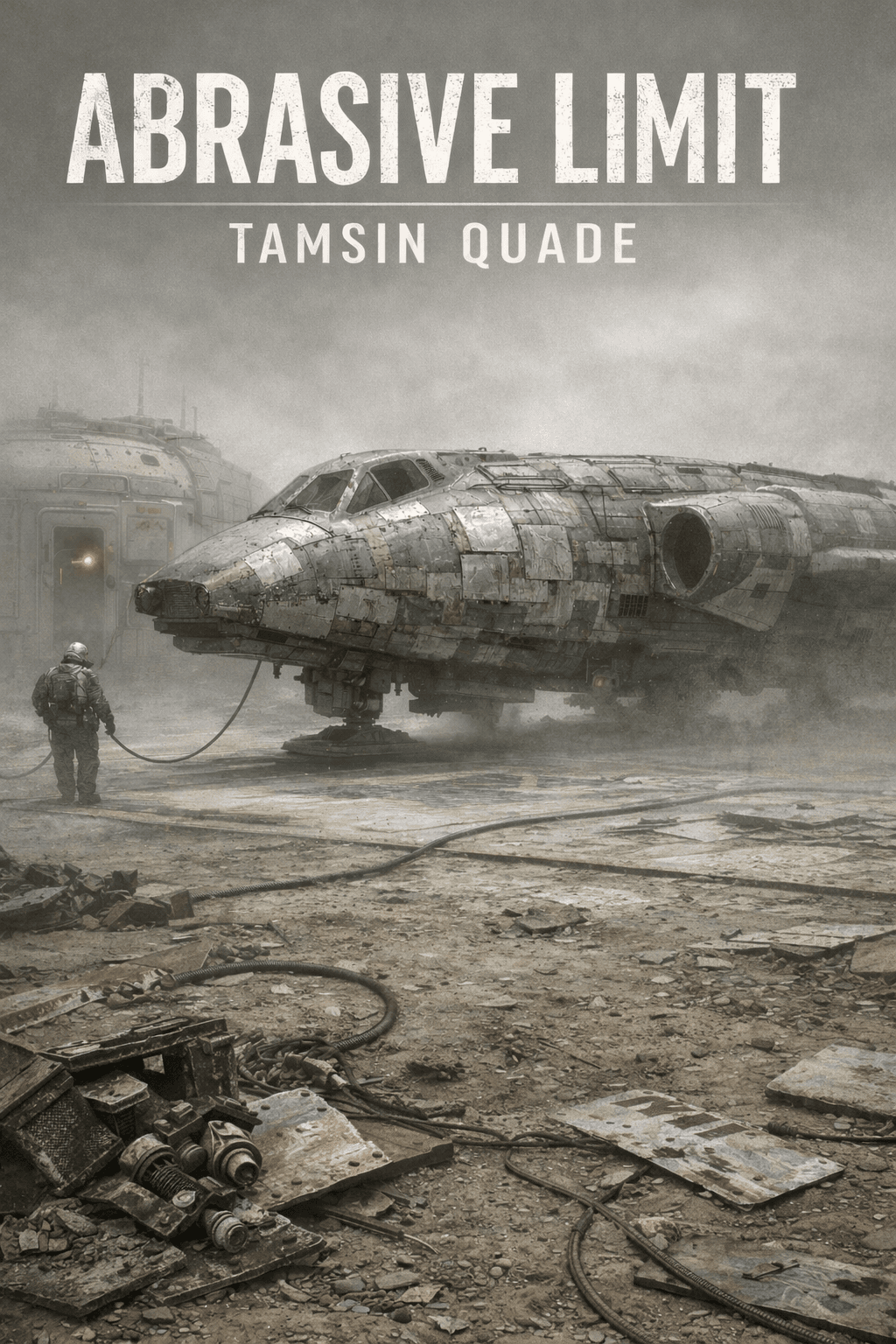
Abrasive Limit
Chapter 1
The Rotation
The Kestrel came down on the pad with its landing jets turned low, the plume kept tight to avoid throwing grit into the struts. Iona watched the last meter through the forward port, forearm braced against the frame, and tracked the sway by the vibration in the deck. The pilot held it steady, set it down, and cut thrust. Fans and pumps inside the cabin stayed at their baseline pitch.
A calm band, if the models matched what was on the ground. Outside, dust still moved. It just moved at a speed that let a person cross open ground without being shoved into a rail.
Iona checked the green on the cabin pressure gauge, then the latch indicator on the inner hatch. The hull gave a final shudder and went still.
"Helmets on," she said.
Her hand went to the tether hook clipped at her hip, then to the suit locker. The helmet ring locked with a hard quarter-turn at her neck. She flexed her fingers until the glove seals stopped creaking. A faint hiss came through the suit as pressure equalized at the collar.
"Trust the hiss," Bren Rooke said, already watching everyone’s neck ring. His movement stayed slow and exact.
Rowan Keats was at the locker, restless hands working the clip on his wrist strap. Lean build, lips split where he had worried them on approach. He didn’t argue; he checked his tether, then tapped two fingers against the side of his helmet in a comm check.
Soraya Finch sealed her helmet and settled her lenses strap beneath it, hair held in a tight coil. She scanned the pad through her visor, then looked back at Iona.
"Wind reads steady?" Soraya asked.
"Steady enough," Iona said.
Kian Brody bounced on the balls of his feet. New boots, clean tread, the stitching still the wrong colour for this place. His work suit carried band patches sewn onto one arm.
Jules Maren stayed half a step back from the hatch, tablet held close to his chest. Sharp features, close cut hair, a dry cough that sounded like irritation rather than illness. He kept his eyes on the pad, then on Iona.
"All right," Iona said into her collar mic. "Tether line. Single file. No hero steps."
Bren took the far end, waited until everyone had a clip and a double check, then held the common line out.
Iona unsealed the hatch and swung it open.
Dry air pushed in around the frame, and dust slid across the pad at ankle height. It tapped against her visor in fine hits. She stepped onto the ladder, tested each rung before she committed weight, and climbed down into the yard.
The yard beyond the pad had the basics: mining drones on gantries, storage crates strapped down with webbing and metal straps, and a stubby shuttle dock that held the outgoing team’s ride. The Silt-6 habitat sat low, linked pressure cylinders leading into a main ring. Nothing tall. Nothing that could take a hard hit and keep its shape without being overbuilt.
"Line on," Iona said.
The others clipped in and followed, their tethers running to the common line in Bren’s hands. Spacing held. If the wind jumped, the line would keep them attached to the same point.
They crossed from pad to habitat in a straight run. No wandering. Kepler-442b gave them a flat basin and a sky that stayed the same colour under haze. Dust reduced the sight lines and pushed them into the same narrow path.
At the airlock throat, Iona keyed the outer panel, watched the indicator go from red to amber to green, and pulled the outer hatch open. The seal released with a short peel. She stepped into the throat, then turned and held the hatch while the others filed in.
The throat was a cylinder, tight enough to cycle pressure without wasting volume. Suit hooks lined one side, maintenance nooks set into the wall: filter cartridges, seal grease, a roll of tape with half the core gone, and a rack for cracked faceplates that needed rework. The inner door sat opposite, with a small viewport and a status board.
One primary entry. It kept the ring simpler. It made the air budget easier. It also meant that if this door failed, they would spend hours fixing it or die trying.
Iona shut the outer hatch and spun the dog handles until the indicator clicked to sealed. The lock pins seated with a mechanical snap she trusted more than any screen.
"Cycle," she said.
Bren handled the panel. He keyed the cycle and watched the numbers settle. Pressure rose, equalized, and stopped.
The inner door light went green.
Team Alpha opened it before Iona reached for the handle.
Lysander Pritchard filled the frame first. Thick beard trimmed short, eyes tired but bright, left shoulder held a fraction stiff. He wore a work suit like everyone else but kept it cleaner than he had any right to. He reached out and gripped Iona’s forearm, firm, not showy.
"Mercer," Lysander said. "You made good time."
"You left us a calm band," Iona said.
"I left you a schedule," he replied, and the corner of his mouth lifted.
Warm air came through the open inner door, carrying food smells and heated plastic. Someone had a pan on heat. The fans ran steady, a low constant that put hard edges on every sound.
Behind Lysander, the rest of Team Alpha crowded the entry, not in a formal line. Someone pressed a wrapped tray into Bren’s hands before he could object.
"Eat," an outgoing tech said. "Before you start pulling panels and making faces."
Bren accepted it with both hands. "All right," he said.
Soraya got a hand on her shoulder and a brief squeeze at the base of her neck from someone who knew her. She returned it in kind, quick and practical.
Kian tried to step around to see into the habitat ring and got pulled into a half hug that rocked him back on his clean boots. He laughed and didn’t try to hide that he liked it.
Jules hesitated until Lysander’s second-in-command stuck a mug into his hand. The mug was metal, dented, with a clip ring welded on.
"Hot broth," she said. "Don’t dump it on the floor."
Jules took a careful sip.
Iona stepped through and let her eyes map the entry space. The ring opened wider here: a common area with a galley bench on one side, a mug rack bolted to a bulkhead, and a board where checklists had been taped and pulled down enough times to leave adhesive scars. Straps and tools hung where they could be reached without searching.
The warmth didn’t buy trust. Seals and filters still needed the same attention.
"Headcount," Iona said.
Lysander’s crew quieted without being told. That told her more than any welcome speech.
"Rowan."
"Here," Rowan said, eyes already flicking past Lysander to the inner panels and indicators.
"Soraya."
"Here."
"Bren."
Bren lifted the tray a fraction. "Here."
"Kian."
"Here," Kian said, too quick.
"Jules."
"Here," Jules answered, mug held careful and close.
Six. Whole. Breathing.
"Bays," Iona said, and pointed without looking at Lysander for permission. "Rowan, you’re near the comm panel. Soraya, take the bay opposite the scrubber access. Bren, next to the tool locker. Kian, you’re with Bren and me between you. Jules, you’re on the inside bay by the galley. You’ll hear if anyone’s moving. You’ll also hear if something changes pitch."
Jules opened his mouth, then shut it.
Lysander watched Iona assign beds and seemed satisfied.
"You keep them close," he said.
"They’re my problem," Iona said.
"That’s the job." Lysander stepped aside to let them pass deeper into the ring.
The outgoing crew had food laid out on the galley bench: a pot of thick stew, bread warmed in a foil sleeve, a jar of something pickled. Nothing fancy. Calories and salt, because dust pulled water out of a person faster than they noticed.
An outgoing rigger nodded at Kian’s feet. "Those boots still got the factory smell?"
Kian grinned. "Only if you put your nose on ’em."
"Give it a day," the rigger said. "Dust gets everywhere."
Bren snorted once.
Kian lifted one boot and checked the tread. Clean.
"Don’t go fixing it outside," Iona said, low enough that it cut only his grin. "Fix it by walking where I put you."
Kian’s smile shifted. "Yeah," he said. "Sure."
Rowan didn’t touch the stew. He scanned the room, checked the panel lights by habit, and then stepped toward the inner hatch back to the airlock throat.
"Where are you going?" Iona asked.
"Walkaround," Rowan said. "Quick."
"You’re eating first."
Rowan’s hands flexed. "Ten minutes."
Iona let him go.
Lysander leaned in toward Iona while the others ate.
"Kestrel rode in clean," he said.
"Clean enough," Iona replied.
"You’ve got good people."
"They work," Iona said.
Soraya set her tin on the galley bench without comment. The tin was small, dented, with a faded label that had been peeled off. She opened it and the smell came out sharp and real.
"Tea," Soraya said. "Real."
An outgoing tech made a sound. "You still have that tin?"
Soraya’s mouth tightened. "I don’t waste it."
She set a kettle on the warmer plate and filled it from the water line, checking the flow by sound. Then she pointed at the mug rack.
"Mugs stay there," she said. "You drink, you clip it back. No mugs in bays."
Kian lifted his mug in a salute. Soraya held his gaze until he clipped it back.
Rowan returned ten minutes later with dust on his sleeves and his helmet tucked under one arm. He didn’t meet the stew first; he met Iona.
"Fin edge has scuffing," Rowan said, voice low. "Starboard. Leading edge."
"How bad?" Iona asked.
Rowan rubbed his thumb along his glove palm as if feeling it again. "A strip about a finger wide. Pale, rough. My nail caught."
Iona wiped her fingers on a rag and glanced toward the inner door viewport that looked out toward the pad. The fin wasn’t visible from here, only the pad surface and lower struts. Rowan had been out.
"Dust wear," she said. "This place takes material off anything that faces the wind."
Rowan’s shoulders held tight under his suit.
"It’s a return craft," he said. "It’s the only one we’ve got."
Iona reached for the marker on the galley bulkhead and wrote a note in the margin of the taped scrap paper: KESTREL FIN—STARBOARD EDGE—INSPECT 0900. She capped the marker with a click.
"Full inspection tomorrow," she said. "Covers stay on until then. No hinge joints in the yard unless I’m standing there with wipes and a timer."
"Yeah," Rowan said. His eyes stayed narrowed, then shifted away.
Jules took that moment to slide in beside them, mug empty, tablet in hand.
"Before we unpack, I want to see the yield sheets," Jules said. "Alpha’s last quarter—"
"No," Iona said.
Silence hit the entry space. One of the outgoing techs stopped chewing. Kian’s grin dropped and he stared into his mug.
Jules blinked. "No?"
"Unpack," Iona said. "Eat. Sleep. Tomorrow you can talk yields."
Lysander’s second-in-command made a quiet sound that could have been amusement.
Jules’s jaw set. "The company expects—"
"Bodies first," Iona said. Her voice stayed level. "Then systems. The rest comes after."
Jules looked at Lysander, searching.
Lysander lifted both hands, palms out. "Mercer runs her crew," he said.
Jules stepped away, tight-backed.
The stew ran low. The outgoing crew ate like they had been waiting to see the pot empty before they allowed themselves to leave.
Iona kept an eye on the entry seal, on the lights above the inner door, on the condensation line near a cold spot on the bulkhead. Nothing changed pitch. The calm band held.
*
By the time the galley bench was cleared and the mugs were clipped back to their rack, the fan cycle stepped down one notch and the strip lights along the corridor came up brighter. Lysander took Iona around the ring.
The outgoing crew moved alongside, pointing at panels and scuffed corners where they had made fixes over the last rotation.
The ring corridor ran in a loop. It had a curve that hid the far end. Bulkheads carried tool marks on handrails where too many gloved hands had grabbed for balance.
"Engineering bay is through here," Lysander said, tapping the door frame with two knuckles. His left arm didn’t come up as far; the old shoulder made him compensate with his right. "You’ve got the main spares in the first rack. Filters in the second. Lock box in the third."
The engineering bay door had a keypad and a small mechanical slot beneath it. The slot had a dust cover that looked newer than the rest.
Lysander saw Iona’s gaze catch on it. "You’ll like that," he said.
"I like anything that isn’t a screen," Iona said.
He took a keyring from his belt, the metal ring worn smooth. On it hung one key that didn’t match the rest: heavy brass, thick in the shank, the teeth cut deep. A stamped mark sat near the head.
Lysander held it out flat on his palm. "Master key," he said. "Hardware bypass. If the software locks you out during a dip, this turns metal."
Iona didn’t take it immediately. Her eyes went from the stamp to the slot, then back to Lysander.
"What does it open?" she asked.
"Local backups," Lysander said. "Engineering bay, comm cabinet, power distribution. Anything we don’t want bricked by a glitch."
Rowan, trailing a step behind, leaned in. "Kestrel?"
Lysander’s eyes flicked toward him. "The Kestrel carries a flight ring," he said, "but the emergency slots take the same cut. If avionics go blind, a mechanical override still turns. There’s a slot in the cockpit panel under a dust cap."
He left it there.
Iona took the brass key. Cold weight settled into her palm.
"Test it," Lysander said.
Iona lifted the dust cover on the mechanical slot with her thumbnail and slid the key in. It met resistance at the last few millimeters. She braced her left hand against the door frame, adjusted the angle, and pushed until it seated. Breath held for a beat, then she turned her wrist.
The mechanism moved with a heavy feel. Gear teeth engaged. The latch indicator on the door changed and the handle unlocked.
She turned the key back, pulled it free, and let the dust cover drop into place.
"Good," Iona said.
Lysander nodded. "Clip it. Don’t leave it in a drawer."
Iona hooked the ring to her belt, to the same loop she used for her tether hook. The brass key knocked once against the clip and went still.
They continued the tour.
The airlock throat was the same cylinder they had come through, but Lysander pointed out the maintenance nook in detail: filter cartridges, spare suit seals, a bin for used tape and scrapped gasket material.
"You keep the throat clean," he said. "Dust builds here first."
Soraya ran a finger along the gasket edge on the inner door and checked it by touch. She didn’t speak.
The route from the ring to the yard ran through the throat and out. There were no alternate hatches. Lysander pointed at floor markers, faint under scuffs.
"Outside route is pad to gantries to excavator, always on the windward rail," he said. "You don’t cut across open yard when it’s up."
Iona tracked each instruction against the map she had built on arrival.
They passed the life support cabinet. Soraya paused long enough to read the last maintenance entry, finger following the handwritten line.
"You got a forecast update?" Soraya asked.
Lysander’s face didn’t change. "Models put the scouring band later in the season," he said. "This week’s within expected bands."
Soraya held the screen a beat longer. "Variability spreads wider here. Flat basin."
"It always is," Lysander said. "We built for it. You keep the filters changed and you keep the hatches sealed."
Iona stood between them, the key heavy at her belt.
"We’ll watch it," Iona said, and let the subject close.
Rowan took his own opening.
"Comms dropouts," he said to Lysander’s second-in-command. "You had any? On pad or in ring?"
The second-in-command shrugged, a small roll of shoulders. "On and off. Dust charge. It gets into the antennas."
"Enough to matter?" Rowan asked.
"Enough to annoy," she said. "Not enough to stop work."
Rowan’s mouth tightened.
Kian kept pace with Lysander, eyes on everything that looked like it connected to outside.
"Can I see the drone gantry?" Kian asked. "Just to get the layout."
Lysander glanced at Iona.
"Later," Iona said before Lysander could answer. "When we’ve got suits checked and a line set. Tomorrow."
"But I—" Kian started, then stopped. His jaw worked once. "Tomorrow. Yeah."
Jules pushed forward, using the corridor’s narrowness to force attention.
"If we’re not going out, we should at least set production targets," Jules said. He held his tablet up. "Alpha’s yields—"
Iona stopped walking. The corridor made everyone stop with her.
Lysander and two outgoing crew watched, interested now. Rowan’s gaze dropped to the deck plates. Soraya turned her head away and checked a wall label that didn’t need checking.
"No targets tonight," Iona said.
"We’re losing time," Jules replied.
"We’re getting baseline," Iona said. "You don’t dig until you know your air, your seals, your routes. You want a number? Six people arrived breathing. That’s the number I’m keeping."
Jules flushed, colour rising along his cheekbones. "That isn’t how the company—"
"I’ve signed the same contracts you have," Iona said. "They don’t run the airlock."
Lysander’s beard moved with a brief smile.
Jules stepped back, clipped his tablet to his side, and said nothing else.
They reached the inner door to the shuttle dock by the airlock throat. The outgoing crew had their bags staged, minimal and worn. They moved with the speed of people who had finished counting down the days.
Lysander stopped in front of Iona.
"Rotation’s yours," he said.
"Rotation’s mine," Iona answered.
He gripped her forearm again, hard enough to leave pressure marks. She returned it.
"Keep your filters changed," he said.
"Keep your shoulder from freezing," Iona replied.
He snorted. "I’ll try."
The outgoing crew filed into the throat, cycled out, and crossed to the shuttle in their own tethered line. Iona watched through the viewport as they moved across the yard with the same practiced caution she expected from her own people.
The shuttle sealed and lifted. Its jets threw dust outward and stripped a fresh layer off the pad surface. The sound reached the ring through the hull as a muted thump, then a fading vibration.
When the vibration ended, the ring’s fan noise stayed alone again.
Iona stood at the viewport longer than she needed to. The yard looked emptier with the shuttle gone.
Rowan’s voice came low behind her. "We’re it now."
"Yeah," Iona said. "We’re it."
Her fingers brushed the brass key at her belt, then pulled back.
*
The first week’s work went on a scrap sheet taped to the galley bulkhead. Iona wrote in block letters with a marker that bled at the edges, keeping it to checks, repairs, and acclimatization, with no yard work until routes were set.
The crew came in after bags were stowed and mugs clipped back to Soraya’s rack.
"All right," Iona said, marker still in her hand. "Week one. We get used to the air, we get used to the dust, and we find every small failure before it turns into downtime."
Jules made a small sound.
The marker pointed at him without her looking away from the sheet. "That includes you. If you want outside time, you earn it by being useful inside first."
Jules held up his hands. "I’m useful."
"Start by unpacking your sample kit and not leaving anything loose in a corridor," Iona said.
Bren stood off to one side, scanning the engineering bay door and the path to the airlock throat.
Rowan leaned against a rail, hands never still. His eyes kept moving to the inner door, to the panels, to the direction of the pad.
Kian stood closest to the paper, reading it hard.
Soraya had the kettle going again. She didn’t speak over Iona. When Iona finished, Soraya set mugs on the bench.
"Drink," Soraya said.
Kian reached for his mug.
Soraya stopped him with a finger to the rim. "Water first."
"It’s tea," Kian protested.
"Tea after water," Soraya said. "Dry air pulls liquid out of you. You don’t notice until you start making mistakes."
Rowan took a mug and drank without comment. Jules took one and drank with visible reluctance.
"Rowan," Iona said. "Kestrel checks. Brief. You’re not living on the pad."
Rowan pushed off the rail. "Copy."
"Bren, move heavy stores into engineering. Clear the corridor. I want a straight path to the airlock. No boxes in the throat."
Bren nodded once.
"Soraya, baseline on scrubber and water line," Iona said.
Soraya’s mouth tightened. "Already doing it."
"Kian, rigging practice. Inside. Internal handrails, knot and strap, quick release," Iona said.
Kian’s shoulders dropped a fraction. "No outside?"
"Not today," Iona said.
"Tomorrow?"
"Tomorrow we’ll see," Iona said.
Jules cleared his throat. "And me?"
"Unpack. Sample trays. Inventory. Tag everything," Iona said.
"I know how to tag," Jules said.
"Then do it," Iona replied.
Bren started moving the first heavy crate from the storage bay into engineering. He set it down on the floor markers with care. Tape followed, short strips on the deck plates, arrows toward the airlock throat, a clear lane wide enough for two people and a stretcher.
"You planning for a fall?" Rowan asked when he passed, helmet in hand for his pad run.
Bren didn’t look up from the tape. "Planning for speed," he said.
"Good," Iona told Bren. "Keep it clear."
Rowan took the inner door and moved into the airlock throat. Through the common area panel, Iona watched the cycle numbers climb and settle. He moved fast but didn’t skip indicators.
When the outer hatch light went green again, her shoulders eased.
Kian worked the handrails with strap and hook, practicing quick releases Bren had shown him. Speed came easy. On the second repeat, he cinched the knot too tight and fought it.
"Again," Iona said.
Kian’s jaw set. "Again."
Soraya opened the life support cabinet and checked the scrubber access panel screws by touch, then marked each with grease pencil. Water line flow got checked again.
"You’re turning this into a clinic," Jules said when he passed and saw the water station building: log sheet taped to the bulkhead, pen clipped with string.
Soraya didn’t look up. "Drink."
Jules gave a tight laugh. "I’m fine."
Soraya lifted her gaze. Behind her lenses, her eyes stayed calm.
"You cough more when you’re dry," she said. "You want less coughing, you drink."
Jules hesitated, then took water without comment.
Rowan came back in with dust on his sleeves again and a strip of grit stuck in the corner of his mouth. He wiped it with the back of his glove.
"Hinge joints," Rowan said to Iona as soon as he cleared the inner door. "Dust already collecting in the cover hinges. I wiped it once and it came back."
"How much?" Iona asked.
Rowan held up his glove. A grey film coated the fingertips.
"That’s from ten minutes," he said.
Iona looked through the viewport at the pad. The Kestrel sat with covers on, straps tight.
"Covers stay on," Iona said. "No more cycling out for comfort checks. You’ll grind it in."
Rowan’s hands flexed.
"Tomorrow we do a proper wipe-down under controlled cycle," Iona added. "With the throat clean and filters ready."
"And the fin edge?" Rowan asked.
"Tomorrow," Iona said. The note on the galley paper sat in plain view.
Rowan exhaled through his nose. "All right."
He went to the galley bench, ate a few bites of stew left from the pot, and drank water without being told.
Jules set up sample trays on the table near the ring’s inner curve, where the deck plates had fewer tool marks.
"Exterior time is going to be limited if you keep treating the yard as optional," Jules said.
"It’s abrasive," Iona replied.
"It’s our job," Jules said.
"My job is keeping you breathing," Iona said. "Your job is doing what you can without making that harder."
Jules’s mouth opened, then closed. His eyes moved to Rowan.
Rowan didn’t look up from his mug.
Kian glanced at the inner door again.
"I can do outside," Kian said.
"You can do straps inside until you can do them without light," Iona answered.
"It’s not dark outside," Kian said.
"Practice anyway," Iona said.
Kian went back to his rigging with too much force. The strap snapped against the rail.
Bren finished moving the stores and stood in the cleared corridor, checking the path.
"Clear," he said.
Iona nodded. "Good."
At the end of the shift, work lights dimmed and corridor strips stayed on. Soraya portioned tea without comment, water first.
Iona ate standing. Sitting turned into leaning, and leaning turned into missing a seal line. The brass key stayed clipped at her belt.
Jules watched the key when she shifted.
"You keep a key on you," he said. "Expecting to be locked out?"
"I keep it on me because I don’t trust drawers," Iona replied.
"You trust nothing," Jules said.
Her gaze held him over the mug rim. "I trust people who do the work."
Jules’s eyes went away first.
Rowan had gone quiet. His posture stayed set, one knee up, wrist strap pulled tight.
"You sleeping?" Iona asked.
"Later," Rowan said.
"Now," Soraya cut in. She pointed at the bay assignments on Iona’s scrap-paper list.
Rowan started to argue, then stopped and stood. "Fine."
He walked toward his bay near the comm panel and disappeared behind the curtain.
Kian kept working straps until Bren took the hook out of his hand.
"Enough," Bren said. "Hands get clumsy when you’re tired."
"I’m fine," Kian said.
Bren’s eyes stayed steady. "Sleep."
Kian’s shoulders rose, then fell. He went to his assigned bay without looking at Iona.
Jules gathered his tablet and sample log and hesitated at his bay. "We’re losing daylight," he said, quieter now.
"We’ll have daylight tomorrow," Iona replied.
Jules shook his head once and went into his bay.
Soraya cleaned the bench, wiped the kettle fill port, and clipped her tin of tea into a small locker with a latch.
Bren made one last pass down the corridor, tightened a clip, then went to his bay.
Iona stayed in the common area alone for a few minutes. She walked the short loop to the inner door and put her palm against the seal housing. It held steady under her hand. The fans held their pitch.
A deeper inspection of the Kestrel could have started right then. Rowan would have suited up again without complaint. A first night could turn into another work block.
She left it.
The main work lights went down to night level, leaving strip lights along the corridor and the status board glow near the airlock throat. The brass key sat flat on her belt clip when she checked by sight.
Fin scuff, hinge grit, comms jitter—morning.
At the inner door, a thin dust line showed along the gasket edge where the throat met the ring. Iona didn’t pick at it. She unclipped her mug from the rack, rinsed it, clipped it back, and closed the bay curtain behind her.
Chapter 2
The Shift
Iona clipped her mug back to the rack before the kettle finished its heat cycle. Soraya watched the rack, and the corridor lane to the airlock stayed clear only if every loose thing had a home.
Two weeks on station did not change the air. It stayed dry enough to split lips and roughen knuckles. It changed the crew.
Breakfast followed the same sequence now.
Soraya set the water log on the bench and ran a finger down the line of initials. She did it without comment, and people drank without needing the comment. Bren moved a crate that had shifted a few centimeters out of its tape box and pressed it back into place with his boot. Kian folded a strip of ration wrap into a tight square and tucked it into the scrap bin instead of leaving it on the deck plates. Rowan ate standing with his back to the comm panel so he could pivot and see the indicators without stepping around anyone. Jules came in late, as usual, tablet tucked under one arm, cough held back until he thought nobody had noticed.
From her seat, Iona watched the sequence as she ate. Sleep showed in hands and pacing, in the way eyes tracked the room. Soraya’s lenses stayed clear. Bren’s knuckles showed splits that would open under glove friction, and Rowan’s wrist strap had a deeper mark than yesterday.
Kian’s boots were not clean anymore. Dust collected in the stitching and the tread. He had stopped smiling every time someone looked at them.
"Water first," Soraya said when Jules reached for the tea.
"I know," Jules replied. He filled a mug, drank, then set the mug down on the bench instead of clipping it.
Soraya slid it back into the rack without lifting her voice.
Iona ate two bites of heated protein, then paused.
The fans shifted pitch.
It came through the deck plates as a change in vibration and through the duct grilles as a thinner edge to the airflow. It was not a loud failure. It was a small mismatch against the baseline that she had counted on since they came in.
Rowan saw her pause.
"What?" he asked.
Iona held her breath for two beats and let the sound run past her ears. She turned her head toward the corridor curve and then toward the life support cabinet.
"Fan load," she said. "Or a baffle loose. Give me a minute." She set her food down and walked along the inner curve to the nearest duct access.
She kept her tether hook clipped to her belt, even inside, and the brass key knocked once against the clip with each step.
At the first grille she put her palm to the bulkhead. The metal felt cool through her work glove. The vibration was there, light.
"Don’t open that," Soraya said from the bench.
"I’m not," Iona said.
She walked another five meters and put her hand to the panel where the duct junction ran behind a seam. The vibration changed. The air noise carried a faint scrape, the kind that came from grit on a fan edge or from a flap that had started to rub.
She crouched and checked the seam line by sight.
Grey dust lay on the galley bench.
It should not have.
The bench sat inside the ring, away from the airlock throat, away from the route where suits brushed bulkheads and dropped grit. They had kept a strict rule on suit handling. Helmets stayed in the throat. Suit outer layers stayed in the nook until wiped. The bench got wiped down every night because crumbs brought mold and mold brought filter load.
Iona stepped back to the bench, pressed two fingers into the film, and dragged her thumb across it.
It looked like ordinary grime at first. Grey on glove fabric. A thin streak on the bench surface.
Then a sharp line opened at the pad of her thumb.
She pulled her hand back and saw blood bead up. One bright dot that spread in a narrow oval.
Kian saw it before she spoke.
"You all right?" he asked. His chair legs scraped as he stood.
"Stay back," Iona said.
She held her thumb up so the blood didn’t smear onto the bench again. The dust stuck to the wet edge immediately and turned it dark.
Soraya was already moving.
She reached for the first aid pouch clipped under the bench, pulled it open, and took Iona’s hand with a grip that used the bones, not the soft parts.
"Show me," Soraya said.
Iona turned her thumb.
Soraya’s mouth tightened. She did not ask how it happened. She cleaned the cut with a wipe, then pulled a strip of tape off the roll and sealed it.
"That’s not dirt," Soraya said.
Jules gave a short laugh that didn’t match his face. "It’s dust. There’s dust everywhere. It’s what they sent us for." His eyes flicked to the bench, then away.
"No," Soraya said. "That’s inside." She pressed the tape down, hard, then released Iona’s hand. "Inside means air path. Inside means the scrubber sees it and we see it." She nodded once toward the corridor. "We check the duct runs. We check the junctions. We check the filter seals."
Rowan’s chair scraped as he pushed off. "I’ll pull externals," he said. He moved to the comm panel without waiting for anyone to answer.
Iona flexed her taped thumb. It stung once where the wipe had taken the top layer off.
"Kian," she said.
Kian looked up, alert. Two weeks of strap practice had given him a fast response when his name came sharp.
"Grab wipes," Iona said. "And the small flashlight."
He moved.
"Bren," she said.
Bren had already stood. He did not ask what she wanted. He watched her taped thumb and then her eyes.
"You’re with Soraya," Iona said. "Access panels. No prying unless she says. I want dust source. I want a line."
Bren nodded once.
Jules started to speak.
Iona cut him off before he could build momentum. "Eat," she said. "Then you can talk."
"We’re behind," Jules replied. He had a number ready; he always had a number. "Alpha’s sheets."
"Alpha’s gone," Iona said.
Jules held her gaze. He did not look away. He took that as a job.
"The company tracks output," he said.
"The company doesn’t breathe this air," Soraya said.
Rowan spoke from the panel. "Wind’s up." He sounded tight. He flicked through screens with two fingers, the other hand braced on the rail to steady against his own movement.
Iona went to him.
The comm panel sat in a recessed niche near his bay, a cluster of screens and a small physical switch bank beneath them. The displays were older than the rest of the ring. The numbers still mattered.
Rowan pointed with the tip of one finger. "Last twelve hours. Look."
The wind speed line climbed. It did not spike and drop the way it had during the calm bands. It climbed in steps and held. Gust readings sat above the baseline they had logged for the last two weeks.
"That’s above the handover band," Rowan said.
Iona watched the update tick.
The screen flickered once. The data froze for a fraction of a second, then jumped forward.
Rowan saw her look at it.
"Jitter," he said. "Small. It’s been doing it on and off. Dust charge."
"Annoying," Iona said.
"It’s worse than annoying when it drops during an EVA," Rowan replied.
She did not argue the point. She kept her eyes on the trend line. The numbers climbed again.
"How’s the forecast?" Soraya asked from behind them.
Rowan tapped another screen. "Forecast says it should flatten by late day. But the model’s been off on step changes."
Soraya made a quiet sound and moved closer. Her lenses caught the strip light and flashed once.
"We check the air path now," she said.
Iona turned back to the galley.
Kian came in with wipes and a flashlight. He held both in front of him the way Bren had taught him, so he didn’t have to fumble.
Jules stood at the bench, mug in hand, not drinking.
"We stop exterior," Iona said.
Jules opened his mouth.
"Nonessential," Iona added before he could speak. "We’re not locking ourselves in. We choose where we spend abrasion, and we don’t spend it on comfort runs."
"What counts as essential?" Jules asked.
"Air," Soraya said.
"Seals," Bren said.
"Return craft covers stay closed," Iona said. "No hinge checks in the yard unless I’m there. No one cycles out alone. If we go out, we go out with a plan and a timer."
Rowan’s jaw moved once. "And the drones?"
Iona’s taped thumb pulsed on the beat of her heart. She looked at the dust line on the bench, then at Kian’s boots.
The drones sat out on the gantry. They were exposed equipment, optics and joints and cable runs. They pulled power when parked wrong. They cost time if they broke.
"We’ll talk drones after the duct check," Iona said.
"If the wind’s up, they’ll start to rock," Rowan replied. "We lose one, we lose handling. And we lose power buffering if it shorts."
"We don’t know we’re losing one," Iona said.
"We don’t know we’re not," Rowan shot back.
Jules lifted his tablet. "The drones are linked to extraction output. If they go down, we don’t hit target and we don’t get resup priority."
Bren looked at Jules the way he looked at a strap that had been cut too short.
"Resup is weeks," Bren said.
"We’re here now," Jules replied.
Iona kept her voice level. "We’re here now, and we stay breathing now. Drones can wait fifteen minutes while Soraya checks the duct seam." She held up her taped thumb. "Dust inside means the boundary is moving. We treat that first."
Kian’s eyes stayed on her thumb. His mouth tightened.
"It’s nothing," Iona said, because she heard the thought in his breathing. "It’s a cut. It’s also a sample."
Soraya nodded once. "We should catch a wipe sample and keep it."
"Bag the wipe," Iona said. "Label it."
Jules looked as if he wanted to argue about sample protocols. He did not, because Soraya had said it.
"All right," Iona said. "Seal checks. Ducts. Then we decide on exterior. Until then: no one cycles out."
She did not add emergency words. She did not say scouring band. She did not say shelter posture.
She pointed at Bren. "Lane stays clear."
"It is," Bren said.
"Kian, you’re on wipes and lights. No touching gaskets with bare fingers. Use glove. No scraping."
"Got it," Kian said.
"Rowan, keep watching wind. Log the jitter times. If the comm drops, I want to know how long."
Rowan’s fingers returned to the panel.
"Jules," Iona said.
"Yeah," Jules replied.
"You keep your kit packed and your trays covered. If dust is inside, it’s in your samples too. You’re not contaminating the only clean surface you’ve got."
Jules stared at her for a beat, then nodded.
The breakfast pot cooled on the warmer. Nobody ate more.
*
Soraya took them to engineering because the duct maps were taped there and because the cabinet access panels sat behind a rack of filters that she had already labelled.
The engineering bay smelled of oil and old plastic. It stayed cooler than the ring because it ran closer to the outer hull.
Iona kept her left hand in front, taped thumb angled up so she didn’t smear blood onto anything.
Soraya pulled a step stool over to the duct junction that fed the scrubber intake.
"Here," she said.
A seam ran around the junction collar, a join between two sections of ducting that should have been sealed under a band clamp and sealant bead. Soraya held her flashlight close and angled it so the beam ran along the seam line.
Grey dust collected in the seam’s edge.
It was not a thick pile. It was enough.
Soraya took a wipe and dragged it across the junction. The wipe came away with a dark streak. She folded it, dragged again, and got another streak.
"That’s active," Soraya said.
"Could be settled from throat cycles," Jules offered.
"Not here," Soraya replied. "This is upstream of the throat. This is inside the sealed route."
Bren leaned in and ran a gloved finger along the seam. He did not rub hard. He lifted. The glove picked up dust.
"Seal bead’s scored," Bren said.
Iona stepped closer. The sealant bead had a fine line through it, a shallow cut that ran around a quarter of the circumference. It looked like the kind of score that came from abrasion and vibration together.
"That’s the hum change," Iona said.
Soraya nodded. "Air’s pulling through there. It changes load on the fan."
Rowan’s voice came through comm from the ring. He had stayed at the panel. "Wind’s climbing again. Gust line just stepped."
Iona touched her comm button. "Copy."
Jules turned his tablet so they could see the maintenance log he had pulled up earlier. "We’re due an exterior drone reposition anyway," he said. "And the gantry tie-downs are in the schedule. If the wind’s up, we do it now."
Iona watched Soraya pull tape from the roll.
"This isn’t a patch job," Soraya said. "Tape shows paths. It doesn’t stop pressure."
"We can clamp it," Bren said.
"We can try," Iona replied.
Soraya tore a short strip of tape and pressed it over the seam line.
"Watch," she said.
She held the flashlight low so the beam hit the tape edge. A thin flutter appeared at one corner. Not much. Enough.
"There," Soraya said.
"It’s pulling," Kian murmured.
"So we fix the seam," Jules said, too fast.
"We inspect the run first," Soraya corrected. "If it’s leaking here, it can leak elsewhere. Dust inside means we check every junction from intake to scrubber to exhaust."
Bren’s comm clicked. "And the yard doors," he said.
Iona looked at him.
Bren flexed his right hand, then his left. His knuckles had fresh splits.
"I cycled the outer yard door this morning," Bren said. "It didn’t swing clean. Dog handles felt rough. Track’s starting to grind."
"You cleaned it?" Iona asked.
"Wiped it," Bren said. "Wipe came away grey. Second wipe came away grey. It still felt rough."
Rowan’s voice came again. "That’s the load. If we keep waiting, it’s going to seize."
Soraya looked at Iona. "We’re choosing where the dust goes," she said.
"Okay," Iona said. "Duct junctions first. Then drones."
Rowan’s reply came sharp. "By the time we do that, the wind’s going to be worse."
"And if dust is in the ring, by the time we do drones our lungs are going to be worse," Soraya said.
Rowan stepped into the engineering bay then, coming fast enough that his boots scuffed the deck plate. He had left his mug clipped and his food half eaten.
"I’m not saying ignore the air," Rowan said. His lips were split, a thin line of dried blood at one corner. "I’m saying we don’t get to trade everything for one system. If the drones get loose, we spend more EVA later. Later will be worse."
Jules nodded hard. "Exactly. We lose them and we lose output. We lose output and then resup priority drops."
"Enough," Iona said.
The word came out flat. She kept it there on purpose.
Kian shifted his weight, ready to jump into whichever direction she pointed.
Iona looked at Soraya.
"How long for junction checks?" Iona asked.
Soraya didn’t pretend. "If we do it right, an hour. If we do a fast check, twenty minutes, and it tells us less than I want."
Rowan’s shoulders held tight. "Wind’s not giving us an hour."
Bren stood by the tool rack and said nothing. He stayed in the place where he could move fast if Iona decided.
Iona counted the crew by sight without speaking: Rowan, Soraya, Bren, Kian, Jules. Five. Plus her.
"Fast check," Iona said.
Soraya’s mouth tightened. She didn’t argue. She grabbed another wipe and moved to the next seam.
Iona followed, flashlight in hand. The taped thumb made the grip awkward, but she kept it.
They moved seam to seam. Soraya marked each junction with grease pencil. Clean. Light dust. Clean.
At the third junction, another seam carried a faint grey line.
Soraya stopped.
"There," she said.
Iona held the light steady. Dust collected in the seam edge, and the sealant bead had a shallow score. Not deep. New.
"Two points," Soraya said.
"Not a coincidence," Bren replied.
"Not yet a breach," Jules said, too hopeful.
"It’s a breach," Soraya corrected. "It’s a path."
Rowan’s comm clicked again. He was still watching externals on his wrist display. "Wind just stepped again."
Iona had enough.
"All right," she said. "We clamp the first seam now. Bren, get the band clamp kit. Soraya, you choose sealant. Kian, prep wipes and the vacuum nozzle. Jules, you stay out of the way."
"I’m not."
"Out of the way," Iona repeated.
Jules shut his mouth.
Bren moved to the kit with slow speed that still beat everyone else because he didn’t hesitate.
Soraya pulled a sealant tube from the rack. She checked the date stamp and then handed it to Iona.
"You want this," Soraya said.
Iona took it with her left hand so the taped thumb stayed away from the nozzle.
Bren loosened the old clamp, lifted it enough to clear the bead, and Iona pressed new sealant into the scored line. Soraya watched the bead placement and corrected with a short word when Iona’s angle shifted.
"More pressure," Soraya said.
Iona pressed.
Bren set the clamp, tightened it until the band seated, and then gave it another quarter turn.
"Stop," Iona said.
Bren stopped.
She held the light while Soraya taped the seam and watched for flutter.
The tape stayed still.
Soraya leaned toward the cabinet gauge, eyes tracking the needle. "Fan draw dropped two percent," she said.
"Not fixed," Iona replied.
"It holds for now," Bren said.
Rowan stepped closer. "Now drones," he said.
Iona looked at Soraya.
Soraya shook her head once. "I want respirator checks before anyone cycles."
Rowan’s hands flexed. "We do that every time."
"We do it fast," Soraya said. "Not today."
"We don’t have time," Rowan replied.
"We don’t have lungs to waste," Soraya said.
Iona held up her taped thumb between them. "We do the checks," she said. "Timer’s running either way."
Rowan’s jaw worked.
"Fine," he said.
It was not agreement. It was compliance.
Iona turned on her heel and headed for the throat.
The airlock throat stayed as a tight cylinder with hooks and bins and a control panel that never moved. The place smelled of disinfectant and old rubber.
Bren pulled suits from the rack. Their suits carried scuffs from two weeks of exterior runs in calm bands. The seam covers had been wiped so often the surface had gone dull.
Kian’s suit sat at the front of the row, newest. He had spent time on it every night after shift, following Bren’s habits. He cleaned seal grooves. He checked the neck ring by touch.
"My suit’s best," Kian said, already stepping into the legs.
Iona watched him for half a second.
He wanted the outside. He wanted to be useful in the way he understood.
"You’re fast," Iona said.
Kian’s mouth twitched.
"And you’re small enough to move on the gantry without burning time," Iona added. "That’s why you go."
Kian’s smile faltered. He nodded anyway.
Rowan pulled his own suit halfway on, then stopped. He did not need to go outside for this run. He needed to watch the panel.
"I’ll run comm," Rowan said.
"You will," Iona replied.
Jules stood at the throat edge, hands empty, face tight.
"I can go," Jules said.
"No," Iona said.
"I’m not dead weight," Jules replied.
Bren’s eyes shifted to Jules. His face stayed blank.
"You’re not trained for it," Iona said. "You fumble a latch and you cost us minutes."
"So does Soraya," Jules muttered.
Soraya didn’t look at him. She checked Kian’s respirator seating.
Iona stepped into Jules’s space without raising her voice.
"Say it again," she said.
Jules’s eyes flicked down to her taped thumb, then up.
He didn’t repeat it.
"Timer," Iona said, turning to Rowan.
Rowan tapped the panel and set a countdown. He held the display up so Iona could see.
"Twelve minutes," Rowan said.
"Eight on task," Iona replied. "Four travel and cycle margin."
Bren finished sealing his suit and moved to Kian.
"Common line," Bren said.
He held out the tether line they had used on the first day. Now it was just equipment, scuffed and taped at one section where a nick had shown.
Kian clipped in.
Bren clipped in.
Soraya stopped them both.
"Respirator checks," she said.
Rowan made a sound through his nose.
Soraya ignored it. She pressed fingers to Bren’s mask seal, checked for gaps, then did the same to Kian.
"Breathe," Soraya said.
Bren breathed.
Kian breathed.
She watched the valve response.
"Again," she said.
Kian’s breath came fast. Soraya held his gaze until it slowed.
Iona watched the timer count down.
"Filters?" Soraya asked.
Bren held up his filter cartridge. It was not new. It was within tolerance.
Kian held up his. New.
Soraya nodded.
"All right," she said.
Rowan’s voice went clipped. "Cycle."
Iona moved to the panel. "Bren anchors. Kian to gantry latch and tie-down. If the latch jams, you do not fight it past thirty seconds. You cut and strap. If you can’t strap, you drop it."
Kian nodded hard.
"If visibility drops below your hand reach, you come back," Iona said.
"Copy," Bren replied.
"Copy," Kian replied.
Iona keyed the cycle.
The airlock door sealed. Pressure numbers rose, then stabilized. Indicators flicked from red to green.
Rowan watched the comm graph. A small jitter appeared and vanished.
"There," Rowan said. "It’s doing it already."
Iona looked at the graph and then looked away. She couldn’t fix charge in air.
The outer hatch light went green.
Bren pulled the handle and opened the hatch.
*
Dust hit the suit faceplates immediately.
Not a sudden blast. A steady stream of grit that turned the outside grey.
Bren went first, tether line in his left hand. Kian followed, one hand on the line, one hand reaching for the yard rail.
Iona watched through the throat viewport until they moved out of that narrow frame.
Rowan called out their telemetry on the panel.
"Bren, suit pressure steady. Kian, steady. O2 draw normal." He paused. "Wind’s up. Gust line just hit the last step."
Jules stood behind him, too close.
"Move," Iona said.
Jules stepped back a half pace.
Iona took the headset and listened.
Outside, Bren’s voice came through with a light crackle. "Visibility is down. Rail’s visible. Gantry barely shows."
"Keep one hand on structure," Iona said.
Kian answered. "Got it."
Their suit cams fed to a small screen. The image showed grey and then a dark line that was the rail.
Rowan’s telemetry display twitched. A data line dropped for a moment, then returned.
"Jitter," Rowan said.
"How long?" Iona asked.
"Half second," Rowan replied.
Half a second did not kill anyone.
"Don’t lose comm," Rowan said into the mic.
"We don’t control that," Bren replied.
Bren moved on the windward rail, pad to gantries, the route Lysander had named. Kian stayed within tether reach.
The gantry rose out of the grey as they closed. The legs showed first, dark against the dust.
Kian reached the ladder and started up.
"Timer," Rowan said.
"I see it," Iona replied.
Kian’s cam showed the gantry platform, then the drone housings. Their surfaces looked dull. Dust had coated seams and edges.
"Latch is stiff," Kian said.
His gloved hand tugged. The latch moved a fraction and stopped.
"Don’t fight it," Iona said.
"I’m not," Kian replied, then pulled again.
The latch scraped. The sound came through his mic as a rough edge.
"Thirty seconds," Iona said.
"I’m on it," Kian said.
Rowan’s telemetry dropped again. The comm crackled.
"Kian, repeat," Rowan said.
No answer for a beat.
Then Kian’s voice returned, clipped. "Latch is jammed. I’m cutting."
"Good," Iona said.
Kian pulled a cutter from his suit kit and sliced through the old tie strap. The strap snapped back and hit the drone casing.
"Watch recoil," Bren said.
"Yeah," Kian replied.
Bren’s cam showed him on the gantry platform now, braced with one knee against a rail. He hooked a new tether line over the first drone’s frame and pulled it tight.
"One secured," Bren said.
"Copy," Iona replied.
"Second tether line is bad," Bren added.
"Define bad," Iona said.
Bren angled his cam. A line ran from the second drone to a tie point. The line surface had a pale fuzz. Individual fibers stood out.
"Fray," Bren said.
"How deep?" Iona asked.
"Enough that I don’t trust it under gust," Bren replied.
Kian moved toward the second drone, hand on a rail. He looked down at the line.
"It’s worse than it looked last week," Kian said.
Jules leaned in behind Rowan. "If that drone goes, we lose."
"Quiet," Iona said.
Rowan’s fingers moved over the panel. Another jitter hit. The comm popped.
"We’re going to lose them if we don’t tie that," Rowan said.
"Timer," Iona replied.
Rowan read it. "Four minutes to abort margin."
Iona pressed her comm button. "Bren, Kian. Drop the second. You secure what you can in sixty seconds. Then you come back."
Kian’s voice came fast. "We can swap the line. I’ve got spare."
"Not in this visibility," Iona said. "Not on this timer."
Bren replied without hesitation. "Copy."
Kian breathed once, loud in the mic. "Copy."
Jules stepped forward. "That’s two shifts, Iona. That’s not a minor loss."
Iona turned her head enough to look at him.
"Stop," she said.
"We’re here to."
"Stop," Iona repeated.
Jules’s mouth stayed open a fraction, then closed.
Iona turned back to the screen.
Bren pulled a strap over the second drone’s armature and tried to seat it. The strap slid on dust.
"It’s not biting," Bren said.
"Leave it," Iona replied.
Kian grabbed the strap, tried another angle.
"Kian," Bren said.
Kian stopped.
They moved back to the ladder.
On the rail run back, dust thickened. The yard lights blurred.
"Visibility is down," Bren said. "Rail is still visible."
Rowan’s telemetry dropped and stayed blank long enough for Iona to notice the timer again.
"Comms lost," Rowan said.
Iona’s stomach tightened at the words. She kept her face blank.
"How long?" she asked.
"One second," Rowan said.
Then Bren’s voice returned. "At hatch. Cycling."
Iona exhaled once.
The outer hatch closed. Pressure numbers rose.
When the inner light turned green, Bren opened the door and stepped into the throat. Kian followed.
Dust coated their suits. The seam covers at knees and elbows looked packed. Fine grit sat in the ridge lines of the joints.
Bren’s shoulders moved once as he flexed. "Joints feel rough," he said.
Kian lifted his arm and rotated it. A faint scrape came through the suit fabric.
Soraya was waiting with wipes and a bin.
"Don’t touch your face," Soraya said.
"I’m suited," Kian replied, then stopped because the instinct had been there.
Soraya took Kian’s arm and wiped the seam cover, then ran the wipe along the neck ring housing without pressing hard.
"Filters after," she said.
Rowan stepped close, eyes on their suits, eyes on the dust line.
"That was twelve minutes," Rowan said.
"It was nine," Iona corrected.
Rowan’s face tightened. He didn’t care about the correction. He cared about the wear.
Bren unhooked the common line and hung it on its hook.
Kian stood, breathing through his respirator, eyes bright.
"I could’ve fixed it," he said.
"You could’ve spent the timer," Iona replied.
Kian’s jaw worked. He didn’t argue again.
Jules stepped into the throat and looked past everyone toward the airlock door.
"So it’s just going to sit out there," Jules said.
Iona looked at him.
"It’s going to sit until we can get it without spending a person," Iona replied.
"That’s two shifts," Jules said.
Iona’s voice hardened. "You don’t get to trade shifts for lungs."
Jules blinked and looked down.
Soraya moved between them. "Filters," she said. "Everyone. Now."
They stripped suit outer layers in the nook with the care that kept seals from being nicked. Wipes went into the bin. Filters came out and got checked.
Bren’s filter showed grey load. Kian’s filter showed grey load and it was new.
"That’s fast," Soraya said.
"Wind’s up," Rowan replied.
Iona kept her taped thumb away from the filter dust as she helped Bren reseat his cartridge.
"We’re done outside for now," Iona said.
Rowan stared at her. "For now," he echoed.
"For now," Iona confirmed.
She walked into the ring and went to the exterior camera monitor mounted near the inner door.
The monitor had a crack in one corner that had been taped before they arrived. The tape line had collected a dust edge.
Iona pulled up the gantry feed.
The image showed grey haze and then, as the camera adjusted, the outline of the gantry. One drone sat tight. The other shifted in small increments, tether line moving in short arcs.
The frayed section showed as a pale band when the camera zoomed.
Iona watched the line vibrate with each gust.
Rowan came up behind her. He didn’t speak at first.
Soraya came next, wiping her hands on a rag that was already grey.
Bren stood to the side, shoulders set, quiet.
Jules hovered at the edge of the group, eyes fixed on the monitor.
"It’s going to snap," Rowan said.
"Not yet," Iona replied.
"That’s not an answer," Rowan said.
Iona didn’t look away from the feed. She watched the tether line angle shift again.
"We do another run when the gust line drops below our abort threshold," Iona said. She kept her voice even. "One run. We swap the line and add a secondary strap. We don’t fight the latch. We cut and replace."
Soraya’s mouth tightened. "After we check the duct seams again," she said.
"After," Iona agreed.
Rowan’s hands flexed at his sides. "If it drops," he said.
"If it drops," Iona repeated.
She reached for the marker clipped to the bulkhead by the checklist board. She wrote in block letters on a scrap and taped it under the day’s task line, below the duct seam note.
SECOND DRONE. GANTRY. RE-TETHER (SECONDARY STRAP) WHEN GUSTS < THRESHOLD.
She wrote the threshold number beside it. She underlined it once.
Then she opened the suit locker and pulled two spare tether lines and a strap. She set them on the bench in the throat, next to the timer. The brass key bumped her belt as she leaned in, and she steadied it with the back of her wrist so it stopped knocking.
On the monitor, the unsecured drone kept shifting on the frayed line. Iona stayed close enough that she could reach the throat panel without crossing the lane.
She left the feed running and clipped her mug back to the rack without drinking from it.
The fan pitch stayed slightly off.
The tape on her thumb pulled when she flexed it.
She checked the posted note once more, then turned and walked toward engineering without calling it an emergency.
Chapter 3
The Breach
Braced.
Iona kept her shoulder against the inner curve of the ring and watched the exterior camera monitor. The corner crack still held under tape. Dust had collected along the tape edge and turned the line grey.
On the screen the gantry camera cut through a short range of haze, then failed into a flatter grey. The camera’s auto-exposure shifted in small steps that never cleared the picture. In the middle of it, the second mining drone moved on its tether.
Not much. Enough.
The tether line angled and straightened in short pulses. The frayed section showed as a pale band when the camera sharpened. It blurred again when the dust thickened.
Behind her, the ring’s fan noise held a steady pitch for three breaths and then dropped as load changed. The change came with vibration through the bulkhead, a flex she felt under her palm.
Rowan stood at the comm panel with his mug clipped and untouched. His wrist strap left a red groove where it cut his skin. He stared at the wind graph and the telemetry bars with the same tight stillness he used in the cockpit.
Soraya sat at the galley bench with the water log open. She had a pen in her hand and didn’t write. Her tea tin stayed clipped in its locker.
Bren leaned by the tool locker, helmet under one arm, fingers flexing and relaxing. Split knuckles left small dark marks on the inside of his glove. He didn’t wipe them.
Jules lingered at the edge of the lane Bren had taped two weeks ago, tablet in his hand. He shifted for a view of both monitor and panel, jaw set.
Kian stood closest to the throat, in his work suit, hands on his hips, boots still on the mat where they belonged. His suit was not on yet. He kept looking toward the airlock door.
A new burst of impacts struck the outer panels. The sound came through as a rapid tapping, then as a deeper thud on one section that took longer to damp. Iona didn’t look up to name where it hit. The shape of the vibration told her enough.
Rowan broke the quiet.
"Wind speed jumped again," he said.
He turned the panel display so Iona could see. The numbers had climbed in short blocks since breakfast. Each step held for a few minutes, then climbed again.
"That’s not flattening," Rowan said.
"No," Iona replied.
She kept her eyes on the monitor. The drone moved again.
Rowan’s tone shifted. He left profit out of it.
"That thing tears free and it crosses the yard," he said. "It doesn’t just fall. It hits the pad gear, it hits the yard door, it hits the Kestrel if it gets a clean angle." He rubbed the side of his nose with his knuckle, then dropped his hand. "You saw what a loose panel can do."
Iona had seen it. She didn’t say it.
"It’s still tethered," she said.
"Frayed," Rowan corrected. "That line goes and it becomes a free mass. We’re not out there to catch it when it does."
Jules nodded once, sharp, ready to back Rowan’s point.
"Exactly," Jules said. "And if it takes out a door or a cable run, we don’t fix that from inside."
Soraya finally wrote in the water log. One short line. Her hand did not shake.
"If you cycle again," Soraya said without looking up, "you bring more dust through the throat. And if you cycle in worse wind, you sand your suits at the seals. It is already showing. You can hear it in their joints."
Bren flexed his right arm once. A faint scrape came from the suit fabric where dust had packed under the seam cover. He didn’t pretend he hadn’t heard it.
Kian swallowed and stepped forward.
"I can do it," he said. "It’s one line. I cut it and replace. We already staged spares."
Iona looked at him. His open face had gone tight around the mouth.
"We left it," Kian continued. "Last run, we left it. We should’ve fixed it."
"We followed the timer," Iona said.
"Yeah," Kian replied. His voice got faster. "And it was the right call, and now it’s worse. So we fix it now. I can make up for leaving it."
Soraya set down her pen.
"You don’t make up for a seal," Soraya said. "You don’t get extra neck rings."
Kian looked at her, then away. His jaw worked as if he was chewing nothing.
Bren spoke once.
"Wind’s up," he said. "If we go, it’s short."
Rowan tapped the panel again, bringing up the gust line.
"It’s short either way," Rowan said. "Or it’s not at all."
Iona let the monitor run for another few pulses. The drone shifted. The frayed band flashed pale, then vanished.
Her thumb tape tugged when she curled her hand. She turned her taped thumb inward and pressed it against her palm until the tape stopped pulling.
"No one goes out if we can’t cycle them back," Soraya said. "We already have dust inside. That duct seam is not magic. Another cycle adds load."
"Another cycle keeps the yard from tearing itself up," Rowan replied.
"The yard doesn’t breathe," Soraya said.
Jules took half a step forward.
"We can’t keep freezing every time something moves," Jules said. "We lose the drones, we lose output, and then we lose resup. That’s simple."
Iona turned her head enough to put Jules in her vision.
"It’s not simple," she said.
"It is," Jules snapped. "We’re here because the company expects work. And you keep acting like that’s optional."
"Stop," Iona said.
Jules’s mouth stayed open. He shut it with visible effort.
Rowan didn’t help him. Rowan stayed on the physical hazard.
"You don’t have to like it," Rowan said to Iona, "but that drone comes loose and we don’t get to choose what it hits."
Iona turned away from the monitor and walked to the airlock throat door. The lane Bren taped stayed clear. Nobody blocked her.
At the throat bench, the spare tether lines and the secondary strap sat where she had staged them. The timer sat beside them with its display dark.
She didn’t pick up the timer yet.
She took one breath and listened to the ring. Fans. A faint tick from a relay. Impacts on the outer panel.
"One run," she said. "We’re over threshold."
Kian’s head lifted.
Soraya’s shoulders tightened.
"One run," Iona repeated, and she let her voice go flatter so it couldn’t be mistaken for negotiation. "Six minutes total. Two travel out, two on task, two travel back and cycle margin. If the comm graph jitters longer than a second, you turn around. If visibility drops below rail reach, you turn around. If a latch fights, you cut it. If it takes longer than thirty seconds, you leave it."
Rowan exhaled through his nose.
"That’s tight," he said.
"It’s worse out there," Iona replied.
Kian was already moving toward the suit rack.
"I can do it in that," Kian said.
Soraya stood.
"You can do it until your seal fails," she said. "And then you can’t."
Iona stepped into the maintenance nook and pulled Kian’s suit forward. The suit surface had gone dull from wiping. The seam covers had dust in the ridges, packed tight.
"Suit," Iona said.
Kian started stepping into the legs.
Bren moved without needing a second order. He pulled his suit forward, checked the zipper run, and lifted his helmet.
Iona watched their hands.
"Bren anchors again," she said. "Kian on the gantry again."
Kian nodded hard.
Bren gave a short nod. No words.
Jules stepped into the throat doorway, face tight.
"I can go," Jules said.
Iona didn’t answer at first. She checked the common tether line on its hook. The taped section still held. She ran her fingers over it and felt the tape edge.
"No," she said.
"Why," Jules started.
"Because you don’t know how to move in that yard without pulling someone else off the rail," Iona said. "Because you’ll fight a latch too long. Because you’ll panic when you can’t see your own boots."
Jules’s throat worked.
"You don’t know that," he said.
"I know you argued with a taped duct seam," Soraya said.
Jules turned toward her.
"And you keep acting like you’re the only one who cares about breathing," Jules shot back.
Soraya didn’t raise her voice.
"I am the one who has to keep you from inhaling dust," she said. "That is my job."
Jules’s hands shook enough to make the tablet click against his palm. He clipped it to his belt with a sharp movement.
Rowan kept his eyes on the panel.
"Timer," Rowan said.
Iona picked it up and set it on the bench where Rowan could see it from the doorway.
"Six minutes," Iona said.
Rowan tapped the display and set the countdown.
"Six," he confirmed.
Iona turned back to the suits.
Soraya moved in close to Kian. She checked his respirator seating, pressed fingers around the edge, then watched the valve response as he breathed.
"Again," Soraya said.
Kian breathed again, slower.
Soraya checked Bren the same way. Bren didn’t complain.
"Filters," Soraya said.
Kian held up his cartridge. It was the same one that had been new last run, now already grey at the edge.
Soraya’s mouth tightened.
"That was one cycle," she said.
"Wind was up," Rowan replied without looking away.
Iona took Kian’s helmet, checked the neck ring by touch, ran her fingers around the seal groove.
The groove felt rough at one section. Dust had worked in.
She wiped it once with a clean cloth and saw grey on the cloth.
"Don’t rub," Soraya said.
"I’m not," Iona replied.
She used a blunt plastic pick to lift grit without scoring the groove. Two grains came free. They fell onto the bench and stuck to a smear of grease.
Kian watched her hands and kept quiet.
Iona reseated the helmet and locked the ring.
"Common line," Bren said.
He held out the tether.
Kian clipped in.
Bren clipped in.
Iona checked both clips with a pull. She did it with her taped thumb tucked.
"Rowan," she said.
"On telemetry," Rowan replied.
"You call the timer," Iona said.
"Copy," Rowan said.
Iona keyed the airlock cycle.
The door sealed. The indicator went red. Pressure bled down.
Jules stood close enough to see the numbers and too far to help.
Soraya moved to the bin and pulled wipes, set them on the bench with quick hands.
The outer hatch light went green.
Iona looked at Bren.
"Out and back," she said.
"Copy," Bren replied.
"Copy," Kian said.
Bren pulled the handle and opened the hatch.
*
Dust coated the throat viewport within seconds. It did not block the glass completely. It turned the view into layered grey with dark lines where rails cut through.
Bren stepped out first. One hand stayed on the structure. The common line ran from his belt tether back into the throat.
Kian followed, one hand on the line, the other on the yard rail.
Their suit cams fed to the small screen over Rowan’s shoulder. The image showed grey, then a rail line, then the base of the gantry as a darker rectangle.
"Visibility is arm," Bren said.
"Copy," Iona replied.
She stayed at the panel, one hand on the cycle control, the other on the mic.
Rowan called suit numbers as they moved.
"Bren, pressure steady. Kian, steady. O2 draw normal," Rowan said.
His telemetry graph flickered. A few pixels went blank in the corner of the display.
Rowan’s fingers tightened.
"Jitter," he said.
The data stabilized.
"How long," Iona asked.
"Less than half," Rowan replied.
Half a second didn’t matter unless it repeated.
Iona watched the timer count down. Five minutes twenty.
Bren’s cam showed his gloved hand sliding along the rail, gripping each joint as he reached it. Kian’s cam bounced with his steps. The tether line stayed taut enough to show where one ended and the other began.
A gust hit hard enough that the cam image swung. Bren’s body corrected. Kian’s cam jerked down to the deck and back up.
"Wind load up," Rowan said.
"Keep on the rail," Iona said.
"On it," Bren replied.
Kian’s voice came fast.
"Gantry in reach," he said.
He found the ladder by touch, gloved hand wrapping the rung. His boot hit the first rung and he climbed.
Bren stayed at the base. His cam view held steady on the ladder and the gantry leg.
"Braced," Bren said.
Iona watched Kian’s cam shift as he reached the platform. The drone housing appeared as a dull shape under dust.
"Timer," Rowan said.
"Three fifty," Iona replied.
Kian reached the failing tether. The frayed band looked worse up close. Fibers stood out in clusters.
"Cutting," Kian said.
His cutter came out. The strap snapped free and hit the drone casing.
"Watch recoil," Bren said.
"Yeah," Kian replied.
Kian pulled one of the staged spare lines from his suit pouch. He hooked it around the drone frame and reached for the tie point.
The comm carried a faint sound under his breathing.
A hiss.
Kian paused.
"You hearing that," he asked.
Rowan leaned closer to the speaker.
"Hearing what," Rowan asked.
"Hiss," Kian said. "Probably comm feedback. It’s doing that crackle."
The comm had crackled earlier. Charged dust did that.
Iona listened. The hiss was steady. Not crackle.
"Check your collar," Iona said.
"It’s fine," Kian replied. "Probably the mic."
Soraya had been silent until then. She stood behind Iona at the throat, head angled toward the speaker.
"That is not comms," Soraya said.
Kian made a short sound.
"It’s just noise," he said.
The hiss sharpened, then held.
Soraya moved closer.
"Kian, stop working," Soraya said. "Hand on your neck ring. Feel for flow."
"I’m on the tether," Kian said. "I’ve got it almost on."
Iona looked at the timer. Three ten.
She looked at Rowan’s telemetry. Suit pressure steady on both.
The hiss climbed again.
It cut through Kian’s breathing.
"Soraya," Iona said.
"That is airflow," Soraya replied. "That is a leak."
Rowan’s telemetry flickered and stabilized.
"Kian, pressure is holding," Rowan said, too quick.
Soraya shook her head once, hard.
"Holding until it doesn’t," Soraya said.
Kian’s breathing changed. Faster.
"It’s fine," Kian said. "It’s fine. I can finish and then—"
The hiss jumped louder.
Iona didn’t wait for another argument.
"Abort," she said. The word came out hard enough to stop everyone in the throat from moving. "Kian, off the platform. Now. Bren, you go with him. Leave the drone."
"Copy," Bren replied.
Kian’s voice broke into the mic.
"I’m almost done," he said.
"Now," Iona repeated.
Kian moved. His cam view swung down toward the ladder.
The wind hit again. The cam swung wider.
Kian’s boot missed a rung. His body hit the rail. The tether line jerked.
"Kian," Bren said.
"I’ve got it," Kian replied.
The hiss turned higher.
Rowan’s fingers moved on the panel.
"Suit pressure is dropping," Rowan said.
Numbers slid down faster than Iona expected.
"How fast," Iona asked.
"About a kilopascal a second," Rowan replied.
Kian made a sound that was half cough, half breath. The comm carried it with distortion.
"My collar feels cold," Kian said.
Cold meant gas expansion. It meant flow where there shouldn’t be any.
Soraya pressed her hand to her own throat without noticing she was doing it.
"Neck ring," Soraya said. "It’s the neck ring."
Bren moved up the ladder two rungs, then stopped. He had to choose between going up and keeping the line stable.
"Kian, clip down," Bren said. "Stay on the rail."
Kian’s cam showed his gloved hand clamp the rail.
The hiss turned into a louder stream. The sound filled the speaker.
Rowan’s telemetry dipped again.
"O2 draw spike," Rowan said.
Kian’s voice came short and thin.
"I can’t—"
The rest of the sentence broke into breathing.
Iona’s hands moved to the airlock panel.
"Emergency cycle prep," she said to Rowan. "Mark his numbers. Keep me updated."
"I’m on it," Rowan said.
Iona keyed the sequence that would accept the outer hatch when it closed, start repress, and clear the inner door as soon as indicators allowed.
She could not open the outer hatch from inside without Bren sealing it. She could not open the inner door early without blowing the seal and spreading dust deeper into the ring.
She watched the timer. Two twenty.
"Bren, get him back," Iona said.
"Moving," Bren replied.
Bren climbed. He reached Kian on the platform by touch and line tension. He grabbed Kian’s harness at the shoulder.
Kian’s cam swung. A cloud of grey filled the frame as dust hit the lens.
Then the view cleared enough to show the edge of the helmet collar.
A thin line of pale frost formed around part of the neck ring where gas vented. It appeared and thickened over two breaths.
The hiss rose again.
Rowan’s telemetry dropped in a steep fall.
"Pressure is collapsing," Rowan said.
Soraya’s voice came out flat.
"It’s cut through," she said.
Dust could score seals. It could chew through tape. It could work into a groove and lift it.
Kian’s breathing turned into a series of short pulls. Each pull brought more hiss.
"Kian," Iona said into the mic. "Stay with Bren. Don’t fight the wind. Hold structure."
Kian didn’t answer.
Bren’s voice came tight.
"He’s not moving right," Bren said.
Kian’s cam tilted sideways. The rail line turned diagonal.
"Bren, how far to the hatch," Iona asked.
"Too far," Bren replied.
He didn’t say it with panic. He said it with measurement.
Rowan’s display flashed red on Kian’s suit pressure.
"Time-to-unsafe is under a minute," Rowan said.
Iona kept her hand on the panel.
"Bren, drag," she said.
"Copy," Bren replied.
The yard cam feed on the monitor near the inner door still ran. Iona’s eyes cut to it for one second.
Grey haze. Gantry leg. A dark shape shifted.
Then a body moved across the ground, pulled by a tether line, dragging in short jolts as wind and suit bulk resisted.
The body stopped.
It did not try to get up.
Rowan’s voice cracked.
"Signal dropped," he said.
He stared at the display.
The monitor showed Bren moving again, hauling. The shape of Kian’s suit stayed limp.
Iona watched the airlock indicators.
Indicator logic advanced at its set rate, red and green state lights changing only when the lock allowed.
She keyed the emergency repress sequence again, faster, checking the pressure rise limit that kept the inner door gasket from blowing.
The numbers moved.
Not fast enough.
She pressed her taped thumb into the edge of the console hard enough to feel pain through the tape.
"Bren, close the hatch as soon as you can," she said.
Bren didn’t answer. His mic carried only breathing and the scrape of suit fabric.
The yard cam showed Bren reach the hatch area. A dark rectangle of the airlock outer door appeared in the grey.
Bren hauled Kian’s body to it. He got the helmet to clear the threshold and pulled hard. The body slid, then caught.
Bren shifted grip and hauled again.
Then the feed shook and went grey as dust hit the camera.
Rowan swallowed.
"He’s at the hatch," Rowan said.
Iona watched the outer hatch indicator. It stayed red.
She could not open it from inside.
She could only wait for Bren to close it.
*
The outer hatch light changed.
Green.
Iona did not speak. She keyed repress.
The lock pressure climbed. The numbers rose under her hand. She kept the rise rate just under the safe limit. The last thing she could do was damage the inner door seal and turn one dead into four.
Rowan stood beside her, eyes on his display even though there was nothing left to read from Kian.
Soraya stood a step back, hands ready and useless.
Jules had his arms crossed tight. His face was pale under the strip lights.
Bren’s suit cam fed again as the lock pressurized. The image showed Kian’s helmet on the deck plates, faceplate greyed with dust. The collar area showed a torn edge where the neck ring met the suit fabric. Frost still clung to the torn section, then began to melt into wet beads.
Bren’s breathing was loud in the speaker.
Iona watched the pressure equalize.
The inner door light flicked from red to green.
She pulled the handle and opened.
Bren fell into the throat on one knee, dragging Kian behind him by the harness.
The common line scraped over the threshold.
Kian’s body hit the throat deck with a dull sound. His arms did not move to catch himself.
Soraya moved at once.
"Helmet off," she said.
Iona dropped to her knees beside Kian and went for the neck ring lock with her taped thumb tucked away. Her fingers found the release and turned it.
Dust had worked into the lock groove. It resisted.
"Tool," Iona said.
Bren, still on one knee, reached into the nook and handed her a small pry bar without looking. He had already chosen the right one.
Iona set the bar against the lock edge and leveraged gently. The lock turned.
The helmet released.
Soraya lifted it free and set it on the bench.
Kian’s face showed under the strip lights. His eyes were half open. His mouth was open enough to show the tongue dry against teeth.
There was no movement at the throat.
No breath.
Soraya’s hands went to Kian’s jaw.
"Airway," she said.
She tilted his head, checked mouth, then reached for an airway adjunct from the first aid kit she kept stocked in the throat.
Jules made a sound.
"He’s gone," Jules said.
"Not yet," Soraya replied. The words came out by habit, by training. She inserted the adjunct.
It met resistance.
She pushed gently. It did not advance.
She tried again with a different angle.
The resistance stayed.
Kian’s throat tissue looked swollen. Dust and moisture had made a paste at the edge of his lips.
Soraya’s hands paused.
"Suction," she said.
Iona handed her the suction bulb.
Soraya tried to clear the mouth. The bulb filled with grey and saliva.
She tried the adjunct again.
It met hard resistance and stopped.
Soraya’s breath came through her nose in short pulls.
She withdrew the adjunct.
"I can’t get it," she said.
Her voice broke at the last word.
She sat back on her heels and pressed her fingers to her own lips for one second, then dropped her hands.
Bren stood slowly, one hand on the rail to steady himself. He moved his shoulder once. The suit fabric made a scrape at the elbow.
Rowan stared at the helmet on the bench.
"I heard it," he said.
Nobody answered.
Rowan’s voice went tighter.
"I heard the hiss and I treated it as noise," he said.
Iona looked at him. His lips were split worse, a new line of blood at the corner.
"You called jitter," Iona said.
"I watched the wrong bar," Rowan replied.
Soraya looked down at her hands. They had grey streaks from suction and dust.
"It was the seal," Soraya said.
"We shouldn’t have gone," Jules burst out.
The words echoed in the tight throat. Hard walls reflected every noise.
"We should have left the drone," Jules continued. "We were already inside dust. We were already compromising seals. And you sent him out for a piece of equipment that wasn’t even ours."
Iona turned her head toward Jules.
"Rowan framed it as yard hazard," she said.
"And you believed it," Jules snapped. "Because you wanted to fix it. You always want to fix the thing you can see. And now he’s dead."
Bren’s shoulders tightened.
"Stop," Bren said.
Jules kept going.
"He wanted to prove himself and you let him," Jules said. "You used him."
Kian’s face did not change.
Soraya swallowed hard.
"Jules," Soraya said.
"No," Jules replied. "No. Don’t tell me to drink water. Don’t tell me to breathe. Tell me why we just lost him."
Iona’s hand went to her belt by reflex. The brass key knocked once against the clip. She steadied it with the back of her wrist and kept her hand there.
"Because the seal failed," she said. "Because the dust cut through it. Because we were outside in conditions that eat equipment."
"Because you ordered it," Jules said.
"Because I ordered it," Iona repeated.
She did not raise her voice. She let the words stay flat.
The throat smelled of disinfectant and wet dust.
The pressure door behind them cycled its status light. The outer hatch remained locked.
Iona looked at the particulate indicator on the throat panel. The number climbed in slow steps.
Each step meant dust brought in on suits, on the body bag, on the lock seals.
"We are not staying in the throat," Iona said.
Jules’s eyes were bright.
"We can’t just," he started.
"We can," Iona said. "We are."
Soraya stayed beside Kian, hands near his shoulders, as if her palms could keep him there.
"Soraya," Iona said.
Soraya looked up.
"Bag," Iona said.
Bren moved to the body bag stored in the throat bin. He pulled it out and unrolled it on the deck plates.
Kian’s suit still held partial pressure in the torso. It bulged slightly, then softened as the leak continued at the torn neck ring.
Iona reached for the collar area and saw the cut.
The neck ring seal groove had a scored section. The score had lifted the gasket edge. The edge had torn.
Dust had packed into the tear.
There was no repair here.
Iona swallowed once, hard.
"Bren, help me lift," she said.
Bren took Kian’s shoulders. Iona took the hips and legs. They lifted in one motion and slid the body onto the bag.
Soraya gathered Kian’s hands and set them on his chest. Her fingers shook. She stopped shaking by gripping harder.
Jules stood back, breathing fast.
Rowan didn’t move. He stared at the torn collar, lips parting once, then closing.
Iona reached to the side of Kian’s sleeve cover and found one of his band patches. He had sewn them on himself. The stitching had held.
Her fingers went to the edge of the patch and traced the thread line.
"Iona," Soraya said, warning.
Dust numbers climbed again on the panel.
Iona pulled her hand back.
"We’re sealing him," she said.
Bren paused.
"Patch," Iona said.
Bren looked at her.
"You want it," Bren said.
"Yes," Iona replied.
She pulled a small cutter from the maintenance nook and leaned over Kian’s sleeve cover.
Soraya watched her hands, eyes wide.
Iona cut the threads carefully so she didn’t slice the cover fabric underneath. The cutter edge caught on a knot. She adjusted angle and finished the line.
The patch came free into her palm. It was damp at one edge where dust and moisture had collected.
She closed her fingers around it.
"Bag," Iona said.
Bren zipped the body bag up. The zipper stuck once at a fold. He smoothed the fold and pulled again until it sealed.
Soraya sat back, hands on her thighs. She stared at the sealed bag and did not touch it.
Rowan finally spoke again.
"I should have called abort on the hiss," he said.
"You didn’t hear it as a hiss," Iona replied.
Rowan’s jaw worked.
"I heard it," he said. "I didn’t trust it."
He went quiet after that. His hands moved to the comm panel by habit, checking data that was no longer there.
Jules’s breathing slowed. His anger didn’t.
"We’re down one," Jules said.
Iona looked at him.
"We are down one," she replied.
"So what now," Jules asked. "You going to write it on a scrap and tape it to the board."
Iona didn’t answer that.
She checked the particulate indicator again. It climbed.
"Everyone inside," she said. "Soraya, scrubber intake check. Bren, wipe down and seal the throat. Rowan, keep the wind and comm log running. Jules, you stay out of the lane and you do not touch the body bag."
Jules flinched.
"Don’t tell me what to," he started.
"I will," Iona said.
Bren moved first. He grabbed wipes and began wiping the throat rail, the bench, the control panel edge. He worked fast without smearing dust into seals.
Soraya stood on stiff legs and moved into the ring toward the life support cabinet.
Rowan went back to the comm panel. He didn’t speak. He didn’t look at anyone.
Jules hovered by the throat door, eyes fixed on the zipped bag.
Iona lifted the bag by the handles with Bren’s help and dragged it into the storage nook off the throat. The nook was cold. The floor marker tape there had been worn by boots.
They set the bag down. Iona checked the zipper again.
Bren closed the nook door.
When the door latched, Iona stayed in the throat.
Bren went after Soraya.
Rowan stayed at the panel.
Jules walked into the ring with a stiff gait and disappeared toward his bay without closing his curtain.
Iona turned to the throat viewport.
Outside, the yard was grey. Rail lines appeared and vanished as dust density shifted. The gantry camera feed kept running on the monitor, but the viewport gave her the only direct sense of depth.
The Kestrel sat on the pad as a darker mass against the lighter dust. The fin edges did not show detail at this distance.
A gust hit the outer panel near the throat. Vibration ran into the deck plates.
Iona put her palm on the bulkhead next to the viewport and felt the vibration pass through the metal.
Her other hand stayed closed around Kian’s patch. The stitching scratched her skin through her work glove.
She watched the yard for movement she could name.
She saw none.
On the comm panel behind her, Rowan’s voice did not come. He was logging in silence.
The fan pitch shifted again in the ring, a small change that told her load had changed somewhere.
She did not move to locate it.
She stayed at the window and watched the dust.
Airlock cycle time had been the limiter. It had not been skill. It had not been effort.
The storm had cut a seal faster than her hands could respond.
She kept her palm on the bulkhead until the vibration steadied into a constant low tremor.
Then she opened her hand and looked down at the patch.
The thread line was clean where she had cut it.
She folded it once and put it in her breast pocket beside the strip of seal tape she carried.
Her taped thumb brushed the pocket edge.
She did not look back at the nook door.
She kept looking through the viewport at the grey yard and the Kestrel on the pad.
They couldn’t choose when the next seal would fail.
Chapter 4
The Audit
She checked the seal.
In the airlock throat, Iona stood with her suit open at the chest and her hands inside the collar. She did not look at the storage nook door. The latch stayed shut and the floor marker tape in front of it stayed scuffed and empty.
Under her fingertip, the suit neck ring groove felt rough, more grit than rubber. She used the plastic pick from the maintenance nook and lifted two grains free without dragging them across the sealing surface, then wiped once with a clean pad and stopped before the wipe began to smear.
Bren waited on the throat bench with his helmet on his knee. He had the common tether line already unhooked and looped so it could run out without snagging. His knuckles were split again, fresh red lines that turned dark under the dust already ground into the skin.
Soraya stood on the ring side of the inner door with her lenses strapped and her hands busy on the first aid kit latch even though it was already closed. She kept checking the particulate number on the throat panel and then looking at Iona’s neck ring, tracking the same seal.
Rowan held the timer. He did not set it yet. He watched Iona’s hands more than the indicators.
Jules stayed back at the edge of the taped lane Bren had laid down weeks ago. He kept his arms crossed tight. His tablet sagged on the wrist strap and pulled at his skin. When he coughed, he turned his head into his sleeve, not away from the others.
Iona took her strip of seal tape from her breast pocket, checked its edge for grit, and put it back. The fabric of her pocket brushed against the cut threads of Kian’s patch and she felt it as a scratch through the lining. She left it there.
“Two out, four on pad, two back,” she said.
Rowan blinked. “Eight total?”
“Eight total,” Iona said. “If visibility drops below rail reach, you call it and we turn. If comms jitter goes over a second, you call it. If either of us hears a hiss that doesn’t match breathing, we turn.”
Bren nodded once. He didn’t answer with words. His hands went to his own neck ring, checked the lock tabs by touch, then let go.
Soraya said, “Filters.”
Bren and Iona lifted their cartridges. Soraya looked at the edges, then the date marks, then seated them again with a push that made the seal click.
“Iona,” Soraya said, and paused.
Iona looked at her.
Soraya’s mouth tightened. She didn’t say Kian’s name. She only said, “Don’t rub. Lift grit. Don’t rub.”
“I won’t,” Iona said.
Rowan finally set the timer and showed it to Iona. Eight minutes.
“I’ll be on the window,” Rowan said.
“You stay on telemetry,” Iona replied.
“I can do both,” Rowan said.
“You don’t do both,” Iona said. “You call the timer and you watch the bars.”
Rowan’s jaw moved. He nodded once, short.
Iona lifted her helmet and seated it, turned the ring lock until it engaged, then pulled once to confirm. The motion made her taped thumb pull against the tape edge. The tape held.
Bren stood and swung his suit pack onto his shoulders, tightened the waist strap, then held the common tether out.
Iona clipped in.
Bren clipped in.
Iona pull-checked both clips and then touched the brass key at her belt clip to make sure it lay flat and didn’t catch.
“Cycle,” she said.
Rowan moved to the panel and took the cycle control. He didn’t ask for the honor. He did it because he was already there and because the switches gave him something to do.
The inner door sealed. The indicator went red. Pressure bled down.
Jules stepped forward half a pace and stopped short of the lane edge.
Soraya reached for the wipes and laid them out in two neat stacks on the bench. She kept the suction bulb on top of the first aid kit, not put away.
The outer hatch light turned green.
Bren looked at Iona.
“Out and back,” Iona said.
“Copy,” Bren replied.
She didn’t ask Jules to confirm anything. She didn’t look at him.
Bren pulled the handle and opened the hatch.
*
Dust coated the throat viewport within seconds. It layered the glass in grey bands that shifted with each gust. The yard beyond reduced to rail lines and darker blocks where equipment broke up the light.
Bren went first with one hand on the hatch frame. The common tether line ran from his belt back into the throat and out again as Iona followed.
Iona stepped down onto the yard deck and found the rail with her left hand. The metal under her glove felt scored. The wind noise came through her helmet as a steady rush with a higher rattle when grit hit hard surfaces.
“Visibility,” Rowan said in her ear.
“Rail reach,” Iona answered.
“Copy,” Rowan said. “Telemetry steady. Both pressures steady. O2 draw normal.”
Bren started along the windward rail toward the pad. He didn’t stride. He moved by joint to joint, using the rail couplings as markers.
The yard route markers on the deck were buried. Iona could not see the tape lines they’d used in calm bands. She counted rail joints instead and matched Bren’s pace so the tether stayed taut enough to show position.
A gust hit. The tether line snapped tight, then relaxed. Bren didn’t speak. His glove tightened on the rail.
Iona watched her own glove seam where it met the suit wrist seal. A grain lodged there could start the wrong kind of wear. She kept her hand still on the rail and didn’t shake it.
The pad appeared as a darker plane through the dust. The Kestrel’s shape sat on it as a mass with softened edges, its contours blurred. The starboard fin edge that Rowan had shown her on arrival was on the far side from the airlock route. She had to go around the nose and reach the leading edge by touch.
Bren stopped at the base of the pad steps and braced himself with a wide stance. He kept a hand on the rail and another on the Kestrel’s landing strut.
“On the pad,” Bren said.
“Timer at six-thirty,” Rowan replied.
Iona climbed the pad step by step without counting them out loud. Her mouth stayed dry. Her tongue tasted of dust even through the helmet seal.
She reached the starboard fin root and put her glove on the leading edge.
The surface did not feel smooth. It felt pitted, the pits uneven in depth and spacing. She dragged her glove along in a short pass, slow enough to sense changes.
A pit caught her glove seam.
She stopped and pressed the seam against it again to confirm. The pit caught again.
“Deep,” she said.
Rowan didn’t answer immediately. Then he said, “How deep is deep.”
“Deep enough to hook a seam,” Iona replied.
Bren leaned closer, his helmet nearly touching the fin. He ran his own glove along the edge and pulled back.
“Edge is sharp,” Bren said.
Sharp meant missing material.
Iona shifted down toward the known inspection port. The port cover was on the fin root fairing, a small panel meant for routine checks that didn’t require pulling larger covers.
She found the fasteners by touch and set the driver bit into the first one. The driver vibrated in her glove and the fastener turned with a gritty resistance.
Two turns. Three.
The fastener came free.
She did not let it drop. She pocketed it in her suit thigh pouch, then did the next.
Bren held steady at the strut, keeping tether tension stable.
Rowan called, “Five-forty.”
Iona lifted the port cover free and held it against her chest. Dust hit the exposed recess and swirled, then stuck to the interior lip.
She pulled the portable thickness gauge from her suit pouch. It was a blunt tool with a small transducer pad and a simple display. It needed good coupling. In clean shops, they used gel. Here, she used a thin smear of seal grease, applied sparingly, and cleaned after.
She wiped the recess surface once with a clean pad, then dabbed grease, then seated the transducer.
The reading stabilized after one second.
It read 2.1.
Millimeters.
She lifted and reseated to confirm, then took a third reading slightly offset.
2.0.
She held the tool steady and watched the number stop jittering.
Rowan’s voice came tight. “Mercer.”
“Two-point-one at port,” Iona said.
Bren didn’t move. His breathing came steady over comms.
Rowan said, “Baseline was what.”
“Four,” Iona replied. “Last log at handover said four at that port. Manufacturing sheet says four.”
Rowan’s breath hissed through his teeth. The sound came through the mic as a sharp burst.
“That’s half,” Rowan said.
“Near half,” Iona corrected.
Rowan didn’t answer. Iona could picture him at the inner door window with his face close to the glass, watching a number turn into a flight margin.
Bren said, “Pad shield panels are moving.”
Iona looked down from the fin edge toward the upwind side of the pad.
The shielding panels that had been installed as windbreaks around the pad area did not look solid. Through dust, she saw their outlines shift. Not a full bend, but a repeated flex at the mounts in time with gust peaks.
“They’re flexing,” Bren said. “Mount points aren’t holding rigid.”
The panels weren’t supposed to take full scouring load. They were supposed to cut down debris impacts and keep loose equipment from skidding. Under this wind, they took wind load and pulled at the mounts. Under this grit load, every moving joint got sanded.
“We can’t wait for them,” Bren added.
Rowan’s voice cut in. “You got the numbers you need?”
Iona put the transducer down and looked again at the pitted leading edge.
She could keep measuring, but each second outside cost seal life and filter load. She could not act like this was a lab. The number was enough.
“Closing,” she said.
She wiped the grease off the recess fast, replaced the port cover, and drove the fasteners back in. She didn’t torque them to perfection. She seated them until resistance rose and stopped there.
Bren’s breathing changed. “Gust is up.”
The wind noise rose in pitch inside her helmet. Grit hit the Kestrel skin and made a faint tapping that cut through the rush.
Iona turned back toward the rail.
“Back,” she said.
Bren started first, pulling her on the tether line with a steady tension. Iona stepped down off the pad and found the rail again.
Rowan called, “Three-forty.”
They moved by rail joint count. The hatch appeared as a darker rectangle, then the green indicator light through dust.
At the hatch, Bren held position while Iona cleared the threshold. She turned and grabbed the hatch frame to steady herself while Bren stepped in.
Dust swirled in the lock as the hatch closed.
Bren dogged the handle. The outer indicator went red.
Rowan started repress without being told. The lock pressure rose under the safe limit. The inner door light remained red, then turned green.
Iona stood still and watched the particulate indicator in the throat. It climbed from their entry dust load and then slowed.
Soraya opened from the ring side and stepped back. She did not touch either of them. She held wipes out and pointed at the seam covers.
“Don’t rub,” she repeated.
Bren and Iona stripped outer suit layers by practiced sequence, slow enough not to smear grit into joints. Bren’s elbow seam made a scrape when he bent it.
Rowan stayed at the panel, eyes on the thickness number on his notes, not on the suits.
Jules stood near the lane edge and watched the suit collar seals like he expected a rip in front of him.
Iona pulled her helmet free last. The dry air hit her face with a copper taste at the back of her throat.
Soraya handed her water without comment. The mug rack rule stayed in place even now. Soraya waited until the mug clipped back.
Iona didn’t drink much. She wet her mouth and stopped.
Rowan said, “Engineering. Now.”
Iona didn’t correct his tone. She walked.
*
The engineering bay was cooler than the ring, the usual smell of oil and old plastic under a sharper disinfectant smell that lingered from the throat. Duct maps were still taped to the bulkhead where Soraya had left them after the last seam clamp.
Bren shut the door behind them and checked the latch indicator with a hard look.
Soraya came in next, then Rowan, then Jules last. Jules hovered near the spares rack, fingers opening and closing, then he caught the tablet strap and held it.
Iona put the thickness gauge on the workbench and wrote the number on a scrap, then wrote the baseline beside it.
4.0 → 2.1.
She underlined it once.
Rowan stared at the scrap. His wrist strap was tight enough to leave the mark deeper than it had been yesterday. He loosened it a fraction, then tightened it again.
“How fast,” Soraya asked.
Iona did not look away from the scrap. She did the calculation again, then again. Her fingers tapped the bench edge in time with the numbers.
“Two weeks since we landed,” Rowan said. “But the wind stepped up.”
“It stepped up and it stayed,” Bren said.
Iona nodded once.
“We can’t use the whole two weeks as a straight line,” she said. “But we can’t pretend the last day is a spike that goes away.”
Jules finally spoke. His grip on the tablet strap tightened until the strap bit into his glove. “You can’t turn that into hours.”
Iona looked at him.
“I can,” she said. “It’s not clean. It’s still a number.”
Rowan’s voice came fast. “Say it.”
Iona drew a line on the scrap.
“Minimum skin before we risk a breach at the port is one-point-two,” she said, “because below one-point-two the skin at that port can’t carry pressure ripple and abrasion together. We’ve lost roughly two millimeters since handover. We are losing faster now.”
Soraya’s hand went to her tea tin locker key on her belt by habit and then stopped because she wasn’t wearing it. She held her hand against her thigh instead.
“How many hours,” Bren asked.
Iona wrote again.
“Twelve if it keeps the same rate as the last day,” she said. “Twenty if it slows. Eight if it climbs again.”
Rowan exhaled once, hard.
Jules said, “That’s—” and stopped himself. Then he tried again. “That’s too pessimistic. You took one port reading in a storm and you’re calling it eight hours.”
“It’s not eight,” Iona said. “It’s eight to twenty. It’s hours, not days.”
Jules stepped closer and scanned their faces, then looked down at the scrap. “Recheck. Take another reading. Take three more readings. Different ports. Different sides.”
Bren shifted his stance. “And sand more seals doing it.”
Jules snapped his gaze to Bren. “Don’t talk to me about seals. You were the one who—”
Bren’s face didn’t change. His eyes stayed steady.
Soraya said, “Jules.”
Jules swallowed and closed his mouth.
Iona kept her voice level. “No more exterior checks today.”
Rowan stared at her. “We just went out.”
“We got a number,” Iona replied. “We don’t spend more suit life for comfort readings.”
Rowan’s jaw worked. “So what do we do.”
He paused, waiting.
Iona wrote another line on the scrap.
“Countdown,” she said. “We treat it as a countdown. We assess whether the Kestrel is safer to stay on the pad or safer to go through the band now. We do not do more production work. We do not take any more outside losses for equipment.”
Jules laughed once, short and wrong. “You mean no more losses for drones. We already paid.”
Iona looked at him until he stopped.
Rowan said, “We can launch now.”
Soraya’s eyes flicked to him.
Rowan went on. “A thin hull is still better than a thinner hull after another day on the pad.”
Bren didn’t answer. He watched Iona.
Iona kept her hands flat on the bench.
“You want to launch through this band,” she said.
Rowan’s mouth tightened. “I want to get above it. The longer we sit here the more it abrades the ship. You saw the pits. It’s not waiting.”
“It abrades faster in ascent,” Iona said. “Velocity goes up. Flow over the skin goes up. Impact energy goes up. That thin section sees higher shear and higher particle hit rate. If we’re at two millimeters sitting still, we don’t stay at two millimeters when we punch through atmosphere.”
Rowan’s eyes didn’t leave her face. “And if we don’t punch through, we never punch through.”
Soraya spoke softly, but the words were direct. “And if we stay, the dust comes in here. It’s already in here.”
She pointed toward the duct map on the bulkhead.
“I clamped the seam,” she said. “It helped for a day. The dust load on the filters is still rising. The throat particulate number hasn’t gone back to baseline since—”
She stopped. Her mouth stayed closed for a second too long.
Iona didn’t say Kian’s name. She said, “Since the last cycle.”
Soraya nodded once.
“So it’s forced,” Soraya continued. “It’s not launch or safety. It’s launch or slow lung damage. We don’t get a plan where we rest.”
Jules looked between them. “So we bring samples onto the Kestrel and we go. If we’re going early, we—”
“No,” Iona said.
Jules blinked. “No.”
“No samples,” Iona repeated. “Bodies and air. That’s it.”
“That’s the contract,” Jules said, voice rising. “We don’t go home empty.”
“We go home breathing or we don’t go,” Iona replied.
Rowan cut in, sharp. “Stop. Stop talking about ore.”
Jules stared at Rowan; the look held longer than it should have.
Bren spoke then. “We can cut the grit load on the pad.”
Rowan turned. “How.”
Bren nodded toward the yard layout on the wall screen.
“Wind shield,” Bren said. “Those panels on the pad are flexing. But we can build a shield around the Kestrel out of yard panels. Upwind. Strap it. Ground bolt it. Give the ship a physical barrier from direct grit. Buy time.”
Soraya’s eyes narrowed behind her lenses as she evaluated. “It reduces pressure fluctuation at the throat seam too, if we cut the gust hits.”
Rowan’s mouth tightened. “Panels will take wind load and pull at the mounts.”
“They already do,” Bren said. “But we can set them lower and brace them. We use the ground bolts by the pad fence. We use double straps and we don’t fight anything past thirty seconds. Same rules.”
Jules said, “Another EVA.”
His voice came out flat, more a cost than an argument.
Iona watched Rowan’s face. His shoulders were raised; his eyes stayed bright in a way she didn’t like. The last EVA had left a body bag in the nook. The next one could do the same.
The Kestrel was the only return craft on the pad.
“Stopgap,” Iona said. “We try it as stopgap. One build run. If a latch fights, we cut and replace. If a strap drags on grit, we swap it. If the shield moves, we abort. We don’t die for a wall.”
Bren nodded. “Copy.”
Soraya said, “I stay inside. I watch particulate. I watch intake. I’ll tell you if the throat number changes.”
Iona nodded.
Rowan’s shoulders loosened a fraction. “Good. Good. That buys time.”
“It buys time if it holds,” Iona said.
Jules opened his mouth again.
Iona cut him off before he started. “You don’t touch samples. You help rig. You carry straps. You keep out of the lane when we’re cycling.”
Jules’s face flushed. “I’m not trained—”
“Then you carry and you shut up,” Iona said. “You can do that.”
Jules swallowed. His eyes went wet and angry. He nodded once.
The argument could have continued. Iona stopped it by moving.
“Throat,” she said.
They left engineering and crossed the ring in a tight group. The mug rack sat on the galley bulkhead with one clip empty now. Soraya’s eyes flicked to it and away.
At the airlock throat, Bren pulled straps and ground bolts from the maintenance nook. He laid them on the bench in a layout that made sense to his hands.
Rowan checked the exterior cam feed and then the wind graph again. He kept tapping the same corner of the display with a fingernail, then stopped when it didn’t change.
Iona started to pull her suit out again.
Rowan stepped close, not in front of the others.
“Iona,” he said, low.
She turned her head.
Rowan’s lips were split enough that a new line of blood appeared when he spoke.
“I can’t guarantee control if this keeps sanding the ports,” he said.
Iona held still.
“What ports,” she asked.
“Anything that needs clean flow,” Rowan replied. “Pitot. Antennas. Sensor windows. Pitot’s jittering six percent on the last run. If we sit here and it keeps charging, I don’t know what I’m flying by.”
He glanced toward the inner door window where he usually stood during cycles.
“I can fly inertial,” Rowan said. “But I need stable alignment and I need to know the ship isn’t taking spurious inputs. And I need enough external confirmation to not put us into a bad angle under thrust.”
He stopped, swallowed, then added, “I’m not saying I can’t do it. I’m saying you don’t get to think it’s clean.”
Iona watched his hands. They were shaking, fine tremor that he fought by clenching.
“Copy,” she said.
Rowan nodded once and backed away. He didn’t want the others to hear him say it out loud.
Bren held up a strap and checked the fibers near the buckle. Dust had already abraded it to a pale fuzz.
“Timer,” Iona said.
Rowan set it without comment.
Soraya watched Iona’s neck ring check and then Bren’s. She kept repeating, “Lift grit,” under her breath.
Jules carried two panels’ worth of ground bolts to the bench and set them down too hard. One rolled. Bren stopped it with his boot.
Iona looked at Jules. “You do that outside and it’s gone. You do that outside and it becomes a projectile.”
Jules’s mouth tightened. “Copy.”
The outer hatch light turned green.
Iona didn’t wait for anyone to feel ready.
“Out,” she said.
*
They followed the same rail route they’d used when they brought Kian in.
Iona did not let herself look at the gantry. The rail route to the pad passed the junction where the gantry branch cut off. She kept her glove on the rail and counted joints. Bren led. Rowan’s voice came in her ear with timer and suit numbers.
“Ten minutes total,” Rowan said. “Two on travel. Six on rig. Two back.”
“Copy,” Iona said.
Bren said, “Copy.”
Jules’s breathing came loud on the comms. He was outside with them because he needed to carry panels and he wasn’t trusted inside with idle hands.
Visibility stayed near zero. The pad appeared as a darker plane again. Bren guided them to a stack of loose yard panels near the pad fence, the ones meant to be set as temporary windbreaks when the band was normal.
Bren put a hand on the first panel and felt along its edge.
“Warped,” Bren said. “Bow’s a couple mil.”
Iona felt it too. The panel edge was no longer straight; it had a slight bow.
“Set it low,” Bren said. “Less wind load.”
Iona nodded and took the other edge. Jules took the third point where his hands could reach.
They carried the panel upwind of the Kestrel and set it into position by touch, bracing it against the pad fence post and the ground bolt points set in the pad perimeter.
Bren drove the first ground bolt into the pad edge mount. The driver fought grit. He turned until the bolt seated.
Iona threaded a strap through a panel bracket and around the fence post. She tightened it until the strap vibrated at a high pitch under tension, then stopped before it cut itself against the bracket edge.
Jules held another strap out with clumsy urgency.
“Slow,” Iona said.
Jules froze.
“Give it to Bren,” Iona said.
Jules passed it over.
Rowan called, “Seven-forty.”
Bren and Iona moved to the next panel. They set a second one offset, building a low barrier upwind of the Kestrel’s starboard side.
Through the dust, the Kestrel’s body was a shape beyond, its fin edge still within reach if she stretched.
Iona kept her back to the wind and her hands on the work.
Bren put two straps on each panel and grounded each panel with at least one bolt. The straps ran to fence posts and pad mounts.
The panels wobbled under gust hits, but their movement was reduced compared to the pad’s existing shields.
“Hold,” Bren said.
Iona watched the strap fibers at the buckle. They were already fuzzed. The fuzz grew as the strap moved under vibration.
Rowan’s voice came in, slightly clearer than the last EVA. “Cam shows less direct impact on the ship. It’s not clean, but it’s less.”
Iona could not see the cam screen from outside. She trusted Rowan’s words because he had no reason to lie.
Soraya broke in on comms from inside. “Throat particulate dropped three points. It’s small. It’s real. Intake flutter is down.”
Bren’s breathing came out as a quiet grunt. “Good.”
For a few seconds, it worked.
The panels took the grit hits instead of the Kestrel’s skin. The Kestrel still sat in dust, still got impacts from turbulence, but the direct scouring line eased.
Iona loosened her grip for a moment, then tightened it again and checked the strap run at the bracket.
Rowan called, “Five-fifty.”
Bren moved to check the first anchor point again. He put a glove on the strap near the bracket and felt the vibration.
“Load’s rising,” Bren said.
The wind noise shifted. The impacts on the panels changed from a random rattle to a higher frequency tapping that hit in bursts.
A gust front hit.
Iona felt the panel edge under her glove vibrate harder. The strap line started to oscillate.
The first panel’s upwind corner moved.
Not much. A few centimeters.
But it moved.
Bren’s voice sharpened. “The anchor point is shifting.”
Rowan said, “Timer at five.”
Iona looked at Bren.
Bren was already moving. He pulled a secondary strap from his pouch and threaded it through the bracket.
“I can reinforce,” Bren said.
Iona’s mouth went dry. “Thirty seconds.”
“Copy,” Bren said.
He tightened the strap. The strap fibers at the edge were already abraded to a pale fuzz. The fuzz wasn’t cosmetic. It was loss.
He anchored the strap to a second ground bolt point and began tightening.
The gust hit harder.
The panel jerked.
The strap took load and the fuzzed section snapped.
The sound came through comms as a sharp crack.
The panel corner lifted.
Bren grabbed for it.
The panel swung.
Iona saw its edge come up and then down, driven by wind load and the failure of the strap path.
It swung toward the Kestrel.
“Back,” Iona said, but her voice hit a half second too late.
The panel edge struck the Kestrel’s fin.
The impact was dull through her helmet, but she felt it in the deck through her boots.
Rowan said, “Fin-edge vibration mode jumped from seventeen to twenty-four hertz.”
The fin edge jolted. A strip of dust fell off the leading edge in a sheet, exposing a fresh pale line underneath.
Rowan’s voice went quiet. “It hit.”
Bren didn’t speak. He stood with his glove still out where the strap had been. The broken strap end flapped against his sleeve.
Jules made a sound that wasn’t a word.
Iona stepped toward the fin edge and put her glove on the strike point.
The pits were worse. A new gouge ran across the leading edge where the panel had scraped. It wasn’t deep enough to cut through, but it was fresh damage on already thin skin.
Her glove seam caught again.
A second catch point.
They’d spent time and risk for damage.
Rowan said, “Mercer.”
Iona didn’t answer him. She watched Bren.
Bren was still, measuring the situation with his eyes.
Iona forced her voice back into procedure.
“Abort,” she said. “Leave it. Retreat. Now.”
Bren’s head snapped once in acknowledgement. “Copy.”
Jules started to reach for the fallen strap.
“Hands off,” Iona said. “Move.”
Jules moved.
They returned by rail, faster than the approach, but not fast enough to lose tactile confirmation. The tether stayed taut.
Rowan called timer and pressures.
“Two minutes,” he said.
The hatch appeared.
Bren got them in. He dogged the handle. The outer indicator went red.
Repress began.
Iona stood in the lock and watched her suit pressure number hold steady. She listened for any new hiss that didn’t match breathing.
None came.
The inner door turned green.
Soraya opened it and stepped back. Her eyes went straight to the suit collars, then to Iona’s face.
Iona took her helmet off and the air hit her with that same copper taste.
Rowan stood just inside the inner door, not at the window now. His hands hung at his sides. He looked at Iona’s face, then down at the broken strap fibers stuck to Bren’s glove.
He did not curse.
He did not yell.
His jaw tightened once, then his face went flat.
Iona recognized the shutdown.
Bren stripped his outer layers and put the broken strap end on the bench.
Soraya checked the particulate number again. “It rose on cycle. It’s coming back up. The drop didn’t hold.”
Jules stood near the lane edge with dust on his suit and his eyes fixed on the floor.
Iona walked past Rowan into the ring and then stopped at the mug rack.
One clip was still empty.
She took her mug, filled it with water, drank enough to wet her mouth, then clipped it back without looking at anyone.
Rowan followed her into the ring with slow steps.
“Damage?” he asked.
“Yes,” Iona said.
“How much,” Rowan said.
“Enough,” Iona replied.
He nodded once. He didn’t ask again.
Soraya moved toward the life support cabinet, already stepping into her next task because standing still pulled her eyes toward the storage nook door.
Bren wiped the throat bench and rails, careful not to smear grit into seams.
Jules finally spoke. “So now what.”
Iona looked at him.
She didn’t give him a plan that made it easier.
“We’re still on hours,” she said. “We spent time and we bought nothing. That’s the number. That’s what we have.”
Jules’s face tightened. “You said it would work.”
“I said we would try,” Iona replied.
Rowan stared at the floor for a second and then turned away, heading back toward the comm panel by habit. His shoulders were tight, posture narrow.
Iona watched him go.
Her fingers found the patch in her pocket beside the strip of seal tape.
Bren finished wiping and looked at Iona.
“Next call,” Bren said.
Iona nodded once.
She didn’t say, not out loud, what her hands already knew: each attempt to make the environment less lethal was turning into another abrasion path and another failure point, another number they couldn’t change with talk.
She walked toward engineering without announcing it as a plan. The others followed because there was nothing else to do.
The storm kept hitting the outer panels. The impacts stayed steady. The fan pitch stayed a fraction off.
The Kestrel sat on the pad with one more gouge in its fin edge.
Chapter 5
The Cough
She tightened the last fastener on the galley bench bracket and waited to hear if the pitch changed or the rattle eased.
Impacts on the outer skin had become constant. No clean gaps. A rattle built into a heavier thud and then broke back to rattle again. The floor under her boots passed a fine tremor through her knees. It wasn’t the big movement of a pressure shift. It was the small, fast shaking that backed screws out and lifted tape edges.
One hand stayed on the bench edge while the mug rack took the vibration. The rack didn’t move, but a dust line grew along its lower bar. It returned after each wipe.
Bren came in from the corridor with a strip of tape hanging from his glove. His shoulders sat tight in his work suit, no helmet, no EVA outer layer. His knuckles were split open again, the red darkening in the dry air.
“Panel in Bay Two,” he said.
“Which one.”
“Lower access on the return line. It’s chattering.”
The lane to the throat was still clear. Bren had kept the tape markers clean, even now. Dust sat on top of the tape, but the edges held.
“Show me.”
They moved together. No running. Running wasted breath.
At the bay entrance, Rowan stood with his back to the comm panel, arms crossed, eyes on the wind plot. His wrist strap was tight enough to leave a pale ring. His lips were split and dry; a fresh line of blood sat at the edge of one crack.
He glanced at Iona and didn’t speak. His fingers slid once along the strap buckle, checked it, then slid again.
Soraya sat at the galley bench with the water log open. A pen hovered over the page. One corner of her corrective lenses had fogged where breath had hit it; she wiped it and held still.
Jules stood near the inner wall, tablet pressed to his chest. He coughed once, short, and swallowed it.
The panel announced itself before the cover plate came into view. Fast tapping from behind the access, rising and falling with the impacts outside.
Bren knelt at the lower access and set his palm on the plate through his glove.
“Fasteners backing out,” he said.
Iona crouched beside him. A faint grey line sat at the seam. Dust had started to feed through.
Her thumb ran along the seam, just above the tape line from earlier. The surface felt scored. Not deep, but enough that tape would bridge the high points and leave low points open.
“Get the driver,” she said.
Bren handed it over from his belt without looking. He’d already pulled it.
She set the bit and turned. The screw tightened a fraction, then spun and caught again. Grit in threads. A quarter turn back, then seated again. The tapping quieted.
“Next,” she said.
Bren moved along the plate edge, touching each fastener head.
The fourth one didn’t take. It turned and turned with no rise in resistance.
“Stripped,” Bren said.
A stripped fastener meant she couldn’t rely on clamp force at that corner.
“Swap it,” she said.
Bren shook his head once. “No spares in that size in the bay kit. They’re in engineering.”
The tapping resumed as the impact frequency shifted.
A grey smear appeared at the lower seam.
Soraya’s voice came from behind them. “You’re tracking dust in there.”
“Copy,” Iona said.
“Wipes,” Soraya added, and held a packet out.
Iona took them without standing. The dust line on the plate wasn’t thick, but it was active. She wiped once, controlled, and the wipe came away grey.
Jules shifted his weight and cleared his throat. “This is everywhere.”
“No one said it wasn’t,” Bren replied without looking back.
Rowan said, still on the plot, “It’s pegged. Not stepping. Just staying.”
Iona didn’t need him to point. The impacts already carried that information.
“Bren,” she said. “Tape it until we can swap the fastener.”
Bren pressed tape along the seam. He started at one corner and worked across, pushing it down with the flat of a gloved finger.
The edge lifted on the next vibration peak. A curl, then a peel. It didn’t tear off cleanly; it crept.
Bren held it down. The next peak lifted it again.
He laid a second strip over the first.
The scored seam printed through. Dust fed under the tape in a thin line.
Bren’s jaw worked once. “It won’t hold.”
Iona watched the edge lift again. Tape lifted under vibration; grit and scoring kept it from seating.
“Stop,” she said. “Don’t waste tape.”
Bren tore the strip away and binned it into the scrap bag. Residue marked the scored metal.
Jules coughed again. This time he didn’t keep it quiet. He covered his mouth with his sleeve.
Soraya’s pen touched the log. She wrote a number and underlined it.
Rowan turned from the plot. His eyes flicked to the access plate, then to the wipe in Iona’s hand.
“We’re losing it,” he said.
Iona stood. Her knees cracked in the quiet between impacts.
“Back to the galley,” she said.
Jules stared at her. “For what.”
“For a mask,” Iona said.
He blinked.
Soraya’s head came up. Her eyes went to Iona’s face.
Iona kept her voice flat. “Respirators indoors. Now.”
Rowan’s mouth tightened. He looked past her toward the suit nook by the throat.
Soraya nodded once, already moving.
Bren didn’t argue. He went to the maintenance hooks and pulled respirators down by their straps.
Jules stared at the masks as if he’d been handed a punishment.
“You can’t be serious,” he said.
Iona turned to him.
Dust on the floor now showed shoe prints in the lane and scuffs outside it.
“You want to argue about taste,” she said.
“It’s not taste,” Jules said. “It’s— it’s rubber and stale and you can’t hear anyone. You can’t talk.”
“Speech is optional,” Iona said.
No one moved for a second. Bren’s hands stopped over the straps. Rowan’s eyes dropped to the floor and held.
Bren handed Jules a respirator.
Jules held it two fingers away from his face, then hesitated.
Soraya held out another to Iona. “Fit check.”
Iona took it and seated it. The straps pulled at the back of her head. She exhaled and felt the valve resist.
Her breast pocket tugged as she bent her neck. The strip of seal tape and Kian’s patch pressed against her chest under the fabric.
She didn’t touch the pocket.
Rowan put his respirator on last. He seated it, unseated it, then reseated it again, checking the seal with both hands. His fingers tapped the strap buckle three times before he let them drop.
“Water,” Soraya said.
Rowan didn’t move.
Soraya pointed at the mug rack. The clips rattled softly under vibration.
Rowan’s shoulders rose and fell once. He walked to the rack and unclipped his mug. His mug ring clicked against the bar twice.
He filled it with water and brought it up, then stopped at the respirator.
Bren leaned in and said, quiet, “Lift it. Sip. Then reseat.”
Rowan pulled the respirator down just enough to drink and put it back fast. The mug trembled once against his glove before he lowered it.
Jules watched him and then looked away.
Iona moved to the comm panel.
On the wind plot, the line held flat at peak with no dips.
“What’s the particulate in the throat,” Iona asked.
Soraya was already walking. “Rising. It’s not dropping between cycles because we’re not cycling. That tells you it’s coming from inside paths.”
A scrape came through the ventilation; the fan pitch carried a rough flutter.
“Scrubber,” Iona said.
Soraya didn’t answer. She reached the life support cabinet and knelt, opened the panel, and put two fingers on the differential pressure gauge.
Her lenses caught the cabinet light.
She looked up at Iona. “ΔP is up again.”
“Number.”
“Up nine since last check. Flow is down.”
Rowan stepped closer. “How far down.”
Soraya’s voice stayed even, but her hand shook slightly when she pointed. “Fifteen percent below yesterday. Twenty below baseline. It’s climbing. We’re pushing against a loaded matrix. Fan draw is rising.”
Bren looked at the gauge. “Flow is down; CO2 is climbing.”
Soraya nodded once. “Yes.”
Jules pressed his respirator to his face harder, as if pressure could make it filter better.
Rowan’s hands went into his pockets, came out again, then gripped the wrist strap buckle until his knuckles paled.
Iona listened to the fan pitch. Roughness now, not just a hum change.
“Name the failure,” she said.
Soraya looked back to the gauge. “Filter matrix is loading and tearing. Differential pressure is rising. Flow is dropping. Dust is bypassing.”
Bren said, “We open it.”
Soraya’s eyes went to him. “If we open it, we contaminate the bay.”
“It’s already contaminated,” Bren said.
“It will be worse,” Soraya replied.
Rowan said, “We’re already worse.”
Jules made a sound through his respirator. “Can’t you just— clamp it. Tape it. Like the duct seam.”
Soraya didn’t look at him. “The seam wasn’t the matrix.”
Dust sat in the cabinet screw heads. She’d have grit in the threads and grit in the gasket.
Procedure took over.
“Engineering,” Iona said. “Bench cleared. Wipes down. Masks stay on. No one eats in there. Bodies first, then systems.”
Rowan looked at her. The last phrase didn’t ease anything.
Bren moved immediately, pulling loose gear off the bench and shoving it into the tool locker.
Soraya shut the cabinet panel and stood. “I’ll need seal grease, the clamp kit, and a new gasket if we have it.”
“We don’t have a new gasket,” Bren said.
Soraya’s mouth tightened. “Then I’ll need what we have.”
Iona led them into engineering.
The bay was cooler than the ring. The smell of oil and old plastic sat under disinfectant. Dust lay on the workbench, a fine grey that turned darker where it caught skin oil.
One wipe cleared a strip across the bench. The wipe came away grey.
She looked at her taped thumb. The tape edge was dirty. She pressed it down again.
Bren set the clamp kit on the bench.
Soraya opened the scrubber access panel and stared into the housing.
Rowan stood back, arms crossed, eyes fixed on Soraya’s hands. His respirator shifted with fast breaths. He counted under his breath once, then stopped.
Jules hovered at the edge, not crossing Bren’s taped lane. His tablet hung at his side.
Soraya’s fingers went to the housing latches. She paused and looked at Iona.
“This won’t be clean,” Soraya said.
“It isn’t clean already,” Iona replied.
Soraya nodded. She opened the first latch.
A thin line of dust slid out and settled on the housing lip.
Bren held his chest still for a moment, then took a shallow breath through the mask.
Soraya opened the second latch and pulled the cover free.
The filtration matrix sat inside, swollen, darkened, torn. Grey grit was embedded in streaks. Edges were shredded. A flap of fiber hung loose.
Soraya lifted it carefully. It sagged under its weight. When it moved, grey dust fell off in small drops.
Rowan stepped forward before he checked himself.
“Jesus,” he said, then coughed once behind the respirator.
Iona leaned in.
The tears weren’t random. They ran in lines that followed flow paths. The edges were rough and fresh.
One gloved finger touched a torn edge. A light rub, just enough for texture. The fiber caught. Grit had cut it.
“Not age,” she said.
Soraya’s eyes didn’t leave the matrix. “No.”
“Abrasion cut,” Iona said.
Soraya nodded once. “Yes. It’s being sanded in place.”
Rowan’s voice sharpened. “So we swap it.”
“With what,” Bren asked.
Rowan turned his head toward the corridor, toward the pad beyond it. “With filters from the Kestrel. Cabin spares. Anything that moves air. We keep this place alive.”
Silence held for a beat. Bren’s shoulders stiffened. Jules went still.
Jules looked up fast. “Yes. Yes. That’s what I said. We keep the base stable and we don’t rush a launch.”
Iona stared at Rowan.
The Kestrel was the only way out.
“No,” Iona said.
Rowan’s eyes widened. “No?”
“We don’t strip the ship yet,” Iona said. “Ship filters are ascent lifelines; yard intakes we can burn through.”
Rowan’s jaw worked. He opened his mouth, shut it, then checked the edge of his respirator seal with two fingers.
Soraya cut in, voice steady. “He’s not wrong. But we don’t do that first.”
Rowan stared at her. “Then what.”
Soraya set the torn matrix on a tray to catch debris. Grey streaks showed immediately.
“Patch,” Soraya said.
“With what,” Bren asked again.
Soraya pointed at the storage rack. “Engine intake filters. The ones for the yard equipment. They’re meant to catch coarse and fine. They’re not right, but they’re material.”
Bren went to the rack and pulled the locker open.
The door squealed under grit. He stopped and pulled it slower.
Inside were spare parts sealed in bags, some cloudy with dust inside the plastic. He dug until he found flat packs marked with intake sizes.
He brought them to the bench and set them down.
Soraya slit the first bag and pulled the filter out.
Thicker than the scrubber matrix material and stiffer. Edges framed in a rubber band.
She held it to the scrubber housing.
It didn’t fit.
The frame was too wide by a few centimeters. The thickness was wrong for the clamp ring. If she tried to seat it, it buckled.
Rowan exhaled hard. “Of course it doesn’t.”
Jules said, “Can’t you just cut it.”
Soraya turned her head toward him, slow. “Yes. That’s the point. But cutting it changes how it seals.”
Iona watched the housing lip. The gasket surface was scored. Residue clung where the old matrix had sat.
“How many do we have,” Iona asked.
Bren checked the packs. “Four.”
Soraya nodded. “Then we can sacrifice one.”
Rowan’s shoulders dropped a fraction.
Soraya looked at Iona. “I need your hands.”
Iona stepped in.
A grease pencil marked the cut. The line was thin against the filter band.
Iona took a cutter and sliced through the rubber frame. The blade met resistance, then gave. The cut edge came out rough.
They stripped the frame away and exposed the filter media. It flexed once it was free.
Soraya trimmed it again, tapering corners to seat.
Bren held the housing open and angled a light.
Dust floated in the beam.
“Don’t breathe deep,” Soraya said through her respirator.
Rowan gave a short laugh that ended fast. “No one is.”
Iona pressed the cut media into the housing.
It resisted at the corners and bent. Compression took under her glove.
Soraya pushed grease along the housing lip to help coupling and catch grit. The grease turned grey.
Bren handed her a clamp ring.
Soraya set it and tightened.
The clamp didn’t seat cleanly. One side bit; the other rode up.
Iona held pressure on the high side while Soraya tightened again.
The clamp seated with a jerk.
Soraya stopped and listened.
“Start it,” Iona said.
Rowan stepped to the cabinet control and keyed the scrubber on.
The fan spun up. The sound was rough and lower than it should have been.
Soraya watched the differential pressure gauge.
It rose, then steadied below the previous rise.
She moved to the airflow indicator.
“It’s moving,” Bren said.
Soraya stared until the number stabilized.
“Flow is back,” she said. “Reduced.”
Rowan’s hands unclenched. He flexed them once, then caught himself and gripped his wrist strap again.
Jules stepped closer. “So we’re good.”
Soraya’s head turned toward him. “We’re less bad.”
Jules ignored her. “We’re stable. That means we don’t have to rush a launch. That means we can wait for the wind to drop.”
Iona watched the CO2 number.
It wasn’t spiking. It trended up by a fraction.
Temperature rose too. Restricted flow meant less heat exchange.
Rowan said, “How long does it hold.”
Soraya watched the numbers for another ten breaths.
“Hours,” she said. “Not days.”
Jules heard what he wanted anyway.
He turned to Iona. “You see? We can delay evacuation. We can bring samples. We can do it clean.”
Iona didn’t agree.
Hands stayed steadier when the numbers didn’t look fatal.
“We watch the trend,” Iona said.
Jules frowned. “That’s it?”
“That’s it,” Iona replied.
Bren stepped back from the cabinet and wiped his hands on a cloth. The cloth came away grey.
Rowan’s gaze stayed on the scrubber housing. He checked the cabinet latch, closed it, then opened it again by a few millimeters and reseated it until it clicked.
Soraya set the torn original matrix into a sealed bag and taped it shut.
“Tag it,” Iona said.
Soraya wrote a label with a marker: SCRUBBER MATRIX - FAILED - ABRASION.
She stuck it to the bag.
“If it isn’t tagged, it isn’t real,” Bren said under his breath.
No one replied.
*
After flow returned, they took respirators off to eat.
Iona sat at the galley bench with a ration wrap in front of her. The wrap smelled of disinfectant from the packet and oil from the heater. Dust sat in the wrapper folds.
She wiped the wrapper once. By the time she tore it open, a new film had dulled the clear strip of plastic.
Rowan stood by the comm panel with his own wrap in hand, not eating. His eyes stayed on the wind plot. The line remained flat.
Bren sat opposite Iona, cutting straps.
He took worn ties and old fiber lengths and trimmed them into usable pieces. Each buckle got a thumb check before it went into the scrap bin.
“Future work?” Jules asked, through a mouthful.
Bren didn’t look up. “Maybe.”
Jules had left his respirator hanging around his neck. His words came out clearer. He spoke more.
Soraya stayed in engineering. She hadn’t sat down.
Iona heard her at the cabinet by the panel latch and the small clicks of tools.
Iona put her respirator back on.
“Eat,” Rowan said, voice flat.
“I will,” Iona replied. “After this.”
Rowan’s fingers worried the edge of his wrap until it tore. He balled the corner, unballed it, then smoothed it again.
The mug rack rattled. One clip was still empty.
Iona’s eyes went to it and away.
Soraya’s water log sat open, pen clipped to the spine.
Iona picked the pen up and wrote the time block and a note: MASKS ON - INDOORS.
She underlined it.
Jules swallowed and said, “You don’t have to do that. We’re not— we’re not in emergency now. We fixed it.”
Bren stopped mid-slice.
Rowan looked away from the panel and fixed his eyes on Jules.
Iona kept writing.
“We patched it,” she said. “We didn’t fix the storm.”
Jules spread his hands. “But if the air’s moving, we can work. We can go back to targets. We can—”
“No outside,” Iona said.
Jules’s face reddened. “I’m not saying outside. I’m saying we can run some of the internal analysis. I have data. I can—”
“Speech is still optional,” Iona said.
Jules hit the bench with his hand, not hard enough to damage anything, hard enough to kick up dust.
Bren’s head snapped up. “Don’t.”
Jules froze, then lowered his hand.
Rowan drew a tight breath through his nose, then picked up his respirator and reseated it instead of answering.
Iona set the pen down and stood. “We do a clean-down. Thirty minutes. Target seals and interfaces. Not aesthetics.”
Bren nodded. “Copy.”
Rowan didn’t answer.
Jules said, “See? We’re stable. You can schedule.”
Iona ignored the word stable.
Wipes came from the cabinet. She started on the door seal to engineering. Dust sat in the groove. She lifted it with the wipe edge, not rubbing, and binned the wipe.
Bren cleaned the taped lane edges where dust had built up into ridges.
Rowan walked out of the ring toward the throat.
“Where,” Iona asked.
“The ship,” Rowan said.
He didn’t wait.
“Rowan,” Iona called after him. “Gloves on frame only. No exterior covers, seals untouched. Mask on.”
His hand lifted once in the corridor, two fingers, then dropped.
Dust returned while they wiped.
It stayed steady. A thin film built again on clean surfaces, collecting at corners, at screw heads, at the edge of the checklist board.
After fifteen minutes, Soraya’s voice came over the comm panel speaker from engineering.
“Stop the clean-down,” Soraya said.
Iona spoke into her collar mic. “Trigger.”
“ΔP up three since the patch,” Soraya replied. “Fan draw just stepped. If you keep stirring dust in the ring, you feed the bypass.”
Iona looked at the wipe in her hand.
Grey.
“Copy,” she said. “Everyone stand down. Wipes binned. Masks back on.”
Jules muttered, “Waste.”
“Protection,” Bren corrected.
Rowan’s voice came through from the throat area, distorted. “Cabin fans spin. They sound rough. I’m pulling the cover at the hatchway.”
Iona tightened her grip on the wipe.
“No exterior covers,” she said.
“I’m inside,” Rowan replied.
“Gloves on the frame only,” Iona said. “No seals.”
A pause.
“Copy,” Rowan said.
Bren gathered the used wipes into a bag and sealed it.
Jules watched him and looked away.
Iona stepped into the corridor and walked toward the throat.
The airlock throat was quiet. Impacts came through the bulkhead as a low rattle. Disinfectant smelled sharper here.
The storage nook door was shut. The tape marker on the floor in front of it was scuffed.
Iona didn’t touch the door.
Rowan stood at the Kestrel hatchway interface inside the yard-side section, not cycling out. He worked at the inner access where the cabin venting and fans could be reached from inside the pressurized path.
His respirator sat over his mouth and nose. A small panel was off. Light pooled from his hand.
“What are you doing,” Iona asked.
“Checking airflow,” Rowan said. “If we shelter in the cabin, I need to know it moves air.”
“That’s reasonable,” Iona said.
His fingers fumbled the panel screw once. The bit slipped, clicked against the edge, then he steadied it and reset.
He angled the light toward a small sensor cover visible through a narrow port view. Dust had built up around the edges in a ring.
“That wasn’t there yesterday,” Rowan said.
Iona leaned in and kept her face back from the opening.
Fine dust sat compacted on the cover and dulled it.
Rowan tapped the interior frame with a fingernail. Vibration made the ring shift.
“If that builds on ports,” Rowan said, “it changes readings.”
“Then you don’t trust that reading,” Iona replied.
Rowan looked at her. His focus held too long.
“That’s my job,” he said.
Iona nodded once.
“Panel back on,” she said. “Mask stays on.”
Rowan reseated the panel, checked the edge with his glove, then tightened until the screw head stopped turning.
Iona returned to engineering.
Soraya stood at the scrubber cabinet with her respirator on. Her tea tin sat on the bench beside her, unopened.
She didn’t look up when Iona entered.
“How’s the trend,” Iona asked.
Soraya pointed at the numbers. “CO2 climbing slow. Heat climbing. Flow stable at reduced rate. ΔP climbing slow. That means the patch is loading.”
The bay felt warmer than it had. Sweat gathered under the respirator edge. Gloves stuck to skin when Iona flexed her fingers.
“Bypass,” Iona said.
Soraya’s hand paused. “Yes. Some. Not catastrophic yet.”
Iona watched her fingers. They were stained grey at the tips.
“Sleep,” Iona said.
Soraya shook her head once. “Not yet.”
Bren came in behind Iona with his strap pile. He set it on the bench.
Soraya looked at it. “Planning.”
“Preparation,” Bren corrected.
Jules stood in the doorway, chewing. No respirator.
“So we’ve got air,” he said, “and we’re still acting like we don’t.”
Iona looked at him.
He kept going. “I have data outside. I have samples staged. The storm won’t last forever. We can do one run— not to the gantry, not to panels, just to the—”
“No,” Iona said.
Jules’s mouth opened again.
“Not a debate,” Iona added.
Jules’s face flushed. “You don’t get to decide that unilaterally. We’re a crew.”
Bren shifted one step, slow, and stayed between them and the cabinet.
Rowan’s voice came over the speaker, muffled. “Stop arguing. It’s wasting air.”
Jules snapped his gaze toward the speaker. “Easy for you. You don’t care about the work.”
Rowan didn’t answer.
Iona took a breath through her respirator and kept her voice level. “Bodies first. Then systems. The company doesn’t breathe this air.”
Jules laughed once, short. “That’s Soraya’s line.”
Soraya didn’t look at him.
“It’s correct,” Iona said.
Jules’s jaw worked. His hands curled into fists, then opened again.
The temperature alarm chirped, soft, from the cabinet.
Soraya looked up. “Heat’s crossing comfort band.”
Rowan’s voice came again, immediate. “How bad.”
“Not lethal,” Soraya said. “Yet.”
Iona stepped to the heat exchange controls.
Restricted airflow trapped heat from bodies and electronics. The scrubber motor draw added to it.
“Dump,” Bren said.
Soraya’s head turned. “Power.”
Iona already knew.
She opened the emergency radiator control.
The indicator flickered, then went steady.
Power draw rose.
The vibration underfoot didn’t change.
Iona watched the temperature number tick down by a fraction.
Jules stared at the panel. “So we burn power to be comfortable.”
“To sleep,” Iona said.
“To survive,” Bren added.
Soraya coughed behind her respirator. One cough, then another. She turned her head away from the bench and pulled a cloth from her pocket.
Her shoulders tightened with the cough.
Soraya pulled the respirator down for a second to clear her mouth and coughed into the cloth.
When she lowered it, grey flecks marked the fabric.
Soraya stared at the flecks.
She reseated the respirator and didn’t speak.
Chapter 6
The Collapse
She tightened the last fastener on the scrubber cabinet cover, felt the screw head bite through grit, and stopped before it stripped. The motor draw read higher than it had an hour ago. The fan tone had dropped, rough in the low band, and the vibration through the bench carried a scrape.
Engineering stayed cooler than the ring, but the difference had narrowed since the heat dump. Sweat still gathered under the edge of Iona’s respirator. When she pulled the mask away for a half breath to clear her mouth, the air tasted of rubber and disinfectant and something mineral that stuck to teeth.
Soraya stood at the cabinet, lenses fogged at the edges. She had a pen tucked behind her ear even though nothing here took ink. Her hands moved between the fan control and the gauges without hovering. She checked the differential pressure, then the flow, then the CO2 trend.
Iona set the screwdriver down and leaned in.
“What’s the number,” she said.
Soraya tapped the gauge face with a fingertip, once, not hard enough to jar it. “ΔP is still climbing. It climbed slower for a block. Now it’s stepping again.”
“And flow.”
“Up a fraction.” Soraya’s voice came flat through the respirator. “But only because I’m forcing it.”
Iona’s eyes tracked to the motor draw. “You’re pushing the fan.”
“Yes.”
“How far.”
Soraya shifted her grip and turned the control a small increment. The motor draw ticked, then held.
“Within the drive’s safe band,” Soraya said. “Not within comfort.”
Rowan had said hours. Soraya had said hours. None of them had said minutes. Iona watched the gauge needle settle and kept her shoulders still.
“Name the trade,” Iona said.
Soraya did not look up. “Motor strain. Bearing wear. Heat.”
“And the gain.”
“A little air. Enough to keep the CO2 trend from jumping.” Soraya’s fingers paused. “Not enough to make it clean.”
A cough started in Soraya’s chest, shallow and dry. She held it for two beats, then let it out in a controlled burst into the respirator. It sounded rough through the mask.
Iona turned away from the cabinet and pulled a wipe from the pack on the bench. She went to the duct junction seam where the intake line met the scrubber feed. The clamp had been tightened and re-tightened until the screw head showed scars. The sealant bead from the earlier repair looked grey now, packed with dust.
She ran the wipe edge along the seam, lifting, not rubbing. The wipe came away grey. A new grey line remained.
The seal bead was scored. The metal lip was scored. Dust remained in the low points where tape never held.
She found the small tube of sealant and turned the cap. Grit chattered in the threads. She cleared it with the wipe and kept the cap in her glove.
Soraya shifted behind her.
“You shouldn’t be doing that,” Soraya said.
“It’s leaking,” Iona said.
“It will leak,” Soraya replied. “The score is in the surface. Sealant doesn’t fill a cut that deep if the metal keeps vibrating.”
Iona held the tube over the seam anyway and laid a thin bead along the worst section.
A tremor ran through the bulkhead. Impacts hit the exterior panels in a fast series, then slowed. A faint rattle travelled through the bench. Iona held the tube steady until her forearm stopped shaking.
She pressed the bead with the wipe edge, just enough to seat it into the seam.
Dust still appeared at the line.
Not a burst. Not a new leak sound. A simple grey regrowth where she had just cleaned.
She set the tube down.
Soraya watched her hands. “Rest,” Iona said.
Soraya’s head turned a fraction. “No.”
“That’s not a request.”
Soraya held her gaze on the gauges, not Iona’s face. “Rest doesn’t reduce dust load. Rest doesn’t change bypass. If I sit down and the matrix loads another step, the next adjustment costs more motor and you lose the last margin.”
Jules’s voice came from the doorway. He hadn’t stepped into Bren’s taped lane. He stayed near the threshold with his tablet hanging at his side and his respirator around his neck instead of on his face.
“This is what I’m talking about,” he said. “This is getting worse. You’re pushing motors to feel in control. Soraya’s coughing because she hasn’t slept.”
Soraya did not answer.
Iona looked at Jules.
“Put your mask on,” she said.
Jules’s mouth tightened. “It’s hard to talk with it on.”
“Then don’t talk,” Iona said.
He made a small sound that might have been a laugh if he’d had more air.
“See,” Jules said. “That. You keep going to that line. You’re overreacting. We patched it. The numbers aren’t even red.”
Iona stepped toward him. The lane tape under her boots showed dust on its edges; the grey ridge along it had advanced inward by millimeters each time someone moved.
“Look at her cloth,” Iona said.
Jules glanced to Soraya’s bench. The cloth Soraya had coughed into earlier lay folded beside the tea tin. Grey flecks still marked one corner.
Jules looked away first.
“That’s from irritation,” he said. “Dry air. You know. You get flecks.”
Bren’s voice came low from the corridor outside engineering. He was approaching, boots scuffing on dust. “Flecks,” he repeated, and the word came out flat.
He stepped into view with a respirator seated and a bundle of cut strap pieces in his hands. The straps had been trimmed to usable lengths, buckles checked.
Bren set the bundle on the bench. He did not look at Jules.
“We’ve got another problem,” Bren said.
Iona turned.
Bren lifted his hand and tapped the side of his suit collar where the filter housing sat. “My suit filters aren’t clean. Not since the last cycles. Breathing resistance is up. I can push it, but I can’t push it for a long time.”
Soraya’s eyes flicked toward Bren for the first time.
“How far up,” Iona asked.
Bren shrugged with one shoulder. “Enough to notice. Enough that if we keep cycling, it becomes a limit.”
Jules frowned. “Why are you talking about EVAs. We’re not doing EVAs. We’re staying inside until the wind drops.”
Rowan’s voice came over the comm speaker from the throat, clipped and strained. “It’s not dropping.”
A pause, then his footsteps echoed. He had been in the throat. He moved fast.
He appeared in the corridor, respirator on, eyes narrowed above it. His wrist strap buckle had left a mark on his skin. He didn’t stop at the door; he leaned in, one hand on the frame.
“I checked the Kestrel ports again,” Rowan said.
Iona kept her voice level. “From inside.”
“Yes.” He swallowed. “That dust ring on the sensor covers has picked up frost at the edge. New score lines too.”
Soraya’s fingers paused on the fan control.
Rowan kept going. “If we wait, it’s not just skin thickness. Those covers change what the sensors return. Air data goes wrong. The proximity windows go wrong. I already told you pitot jittered. It’s going to get worse.”
Jules lifted his hands. “We don’t even know if it matters. The craft can fly. We fly inertial if we have to.”
Rowan’s eyes moved to Jules. “Inertial guidance still needs usable air data and proximity returns. Without them, control margins shrink. If the covers keep frosting and scoring, I lose the last external check I can use. I can’t recover it in flight.”
Jules opened his mouth.
Iona cut in. “Stop. Both of you.”
She walked back to the scrubber cabinet and looked at the gauges.
CO2 rose slowly. Temperature rose slowly. ΔP climbed slowly, then increased in a small step.
Soraya watched the step and moved her thumb to the control. “I can get a little more flow. It’ll cost.”
“Don’t,” Iona said.
Soraya’s eyes lifted to Iona’s face now. The lenses magnified her gaze. Her pupils looked too wide.
“You want me to rest,” Soraya said.
“Yes.”
Soraya exhaled through the mask. The exhale rattled.
“I can rest when the air does,” she said.
Iona felt the words in her jaw as pressure. She kept her hands busy.
She went back to the seam and tightened the clamp screw a quarter turn. The screw head resisted, then moved. She stopped at resistance that felt like thread shear.
She wiped again.
Dust remained.
A cough struck Soraya without warning. Not the controlled one. It came from deeper, hard enough that her shoulders jerked. She reached for the bench, missed it by a few centimeters, and grabbed the handrail bolted to the cabinet instead.
Her knees bent.
Iona was at her side in two steps.
Soraya held the rail with both hands until the cough passed. It ended in a wet-sounding pull.
Soraya straightened slowly, still holding the rail.
“I’m fine,” Soraya said.
Bren didn’t move closer. He watched, steady and tight.
Rowan’s hand gripped the door frame. His fingers flexed against it once.
Jules looked from Soraya to Iona and back. “She’s fine,” he said, too fast. “See. She said she’s fine.”
Soraya let go of the rail and turned back to the control.
Iona put a hand on Soraya’s shoulder.
“Sit,” Iona said.
Soraya shook her head once. “If I sit, you have one less set of eyes on these numbers.”
“Then I’ll watch,” Iona said.
Soraya’s voice stayed even. “You’ll watch and you’ll make a structural decision. You’ll trade heat for air. You’ll trade motor for flow. That’s your job. Mine is to keep it inside safe bands as long as there is a band.”
Iona removed her hand.
She turned to Rowan and Bren.
“Prep the ship,” Iona said. “Emergency posture. Mask on. No seals touched. Frame only. I want a mass tally, a cabin air check, and power status. Write down what we can pull without breaking ascent functions. Paper, not the tablet.”
Rowan nodded once. “Copy.”
Bren nodded too. “Copy.”
Jules looked between them. “What about me.”
Iona met his gaze. “Stay out of the lane. If you need to be useful, wipe the ring door seals. One wipe each. One pass. Then stop.”
Jules flushed. “That’s busywork.”
“It’s seal prep,” Iona said.
Rowan and Bren moved out together.
Iona stayed in engineering with Soraya.
Soraya’s fingers returned to the control. She increased load a fraction and watched the gauges.
The motor draw rose.
The airflow number rose a fraction too.
*
After twenty minutes—
Soraya inhaled and stopped mid-breath.
Her chest rose, then held, then rose again in a smaller pull. The respirator shifted on her face as she tried to pull more air through it.
Iona stepped closer.
“Soraya.”
Soraya lifted one hand as if to wave her off, then the cough hit.
It came wet this time. It forced her forward. The sound carried through the respirator as a thick rattle.
She tried to brace on the bench, missed, and dropped to her knees beside the cabinet.
Iona thumbed her comm. “Rowan. Bren. Back to engineering. Now.”
Her hands went to the floor, palms down, elbows locked. Her shoulders jerked with each cough. She tried to draw a full breath between them and couldn’t.
Iona grabbed the back of Soraya’s work suit at the collar and pulled. She dragged her away from the cabinet and the open seam line, away from the strip of dust that always appeared at the lip. Soraya’s knees scraped across the deck.
“Close your mouth,” Iona said.
Soraya tried. She coughed again.
Iona kept pulling until Soraya’s shoulder hit the corridor wall outside the taped lane.
Soraya’s hand found the rail and clamped. Her fingers shook.
Iona pulled the first aid kit from the shelf where Soraya kept it staged for scrubber work. It had an oxygen bottle and a mask interface.
She tore the seal on the bottle.
Soraya’s cough stopped long enough for a breath, then started again.
Iona knelt, held the oxygen mask to the respirator intake port to raise the fraction without breaking the seal, and kept it there with one hand.
She opened the valve.
The oxygen flow hissed.
Soraya inhaled and still didn’t get enough.
Rowan and Bren came in together, moving fast but not running.
Rowan stopped at the bench, eyes on Soraya.
Bren went straight to Soraya’s feet and crouched.
“What’s her saturation,” Rowan asked.
“No monitor,” Iona said.
Bren’s eyes narrowed above his respirator. “She’s not getting air.”
Soraya coughed again. A streak of grey spattered the inside of her respirator.
Jules appeared at the engineering doorway.
He froze there, one hand on the frame, respirator still hanging around his neck.
Then words came out fast.
“We need to call,” Jules said. “We need a medevac.”
Rowan snapped, “There is no medevac.”
Jules didn’t stop. “We have comms. We call.”
“Distance,” Bren said.
Iona did not look away from Soraya.
“Jules,” Iona said. “Mask on.”
He fumbled it up.
Iona reached into the kit and pulled an injector cartridge and braced Soraya’s arm.
Soraya flinched.
Iona injected.
The cough didn’t ease.
Soraya gagged around the respirator.
Iona pulled the oxygen mask away a centimeter and angled it so Soraya could spit into the edge.
The spit came out grey with a thin pink thread.
Rowan said, low, “This is dust.”
Bren said, “Airway resistance is climbing.”
Soraya’s eyes found Iona. Her brow tightened. She tried to say something and only a wet cough came out.
Soraya moved her hand from the rail, slow, and caught Iona’s wrist instead.
“What,” Iona said.
“Can’t,” Soraya said.
Soraya shook her head a fraction.
Iona looked over her shoulder at Rowan.
“Sealant kit,” Iona said. “Close the housing.”
Rowan moved toward the bench.
Iona stopped him. “Jules. You do it.”
Jules stared. “Me?”
“Yes,” Iona said.
Jules yanked the cabinet door open and dropped the kit.
Small parts spilled.
Iona’s jaw clenched.
“Stop,” she said.
“Pick up what you can see,” Iona said.
Bren stepped in and closed the kit lid with one hand.
Rowan took the kit and moved to the cabinet.
Iona watched Soraya.
Soraya’s breathing made the respirator valve flutter.
Her eyelids began to droop and lift.
Her grip on Iona’s wrist loosened.
Iona held her hand tighter.
Bren checked Soraya’s neck pulse.
Soraya exhaled. The exhale came thin, then stopped.
She didn’t inhale again.
Iona counted without speaking.
Bren shook his head once.
Iona closed the oxygen valve.
Soraya lay against the wall with her respirator still on.
*
She closed Soraya’s eyes with two fingers because leaving them open made Jules stare.
Soraya’s respirator straps left marks on her cheeks. Iona unseated the mask and replaced it with a clean cloth over the mouth and nose.
Bren helped without being asked. He lifted Soraya under the shoulders while Iona slid a sheet of plastic from the bench roll and wrapped it around her.
Rowan shut the cabinet and latched it.
The motor continued to run under high load. The airflow number remained where Soraya had forced it.
Iona watched the CO2 trend.
It still climbed.
Rowan spoke first.
“We can’t keep breathing this,” he said.
Bren said, “Without Soraya, none of us can tune this under load. We buy minutes, not hours.”
Jules snapped, “Don’t.”
Rowan looked at him. “What.”
“Don’t say we should have gone,” Jules said. “We were set up. They didn’t give us parts.”
“The company doesn’t breathe this air,” Bren said.
Jules said, “Exactly.”
Iona said, “Arguing won’t improve airflow.”
Rowan said, “We need to go, Iona.”
Bren said, “We launch into what. The hull is thin.”
Iona said, “We go.”
“We leave the habitat behind,” Iona said.
“No memorial routines,” she said. “No ceremonies. We carry what we can carry.”
Rowan asked, “Can the Kestrel survive ascent like this.”
“No,” Iona said.
Bren said, “Plating.”
Iona nodded. “It’s possible.”
She sent Rowan and Bren back to the ship prep.
She sent Jules to wipe seals.
She walked to storage and opened the welding case.
She pulled the torch head out and laid it on the bench.
Chapter 7
The Plan
She wiped the bench once and watched the grey come back at the edge before she finished the pass.
The scrubber cabinet stayed shut. Rowan had latched it hard enough that the latch mark remained on the metal. The motor still ran, held at the setting Soraya had left it on, and the airflow number sat where it had sat after she died. It didn’t drop. It didn’t climb. CO2 kept moving in one direction.
Iona kept her respirator on. The mask straps pulled at the skin behind her ears. When she swallowed, the dry scrape came back.
Rowan stood at the far end of engineering by the comm panel they used for interior calls. He didn’t touch the controls. The wrist strap on his left arm sat too tight, leaving a pale ridge. The scrap of paper in his hand read “4.0 → 2.1,” written in grease pencil and underlined hard enough to dent the fibers.
Bren stood by the bench with the welding case open. The torch head Iona had laid out sat on a cloth. He checked the connectors by touch, slow. He always checked suit seals the same way. His eyes didn’t go to the wrapped bundle by the corridor wall.
Jules hovered at the lane tape, not stepping inside it. His respirator sat on his face now, but his hands kept going to the straps.
Rowan spoke first.
“We launch,” he said.
No greeting. No lead-in.
Iona’s gaze stayed on the scrubber gauges.
“Say what you mean,” she said.
Rowan’s jaw shifted behind the respirator.
“We launch now. Before it takes more skin.” His voice came thin through the mask. “Every hour on the pad is another hour of abrasion on a hull that’s already half.
“You saw the number,” he added. “I wrote it down.”
Iona turned enough to look at him.
“Eight to twenty hours,” she said.
“On the pad,” Rowan snapped. “In a dead-air estimate. We already proved the pad shields don’t do anything. The fin edge has a new gouge because we tried to make our own shelter. We can’t do it again.
“The longer it sits out there, the thinner it gets. That’s not a plan. That’s waiting for it to fail.”
Bren shifted his weight once. The floor vibration under their boots stayed at the same low tremor; impacts on the outer skins came in bursts and pauses, and each burst backed dust off whatever it had been sitting on.
Jules lifted both hands, palms up.
“Finally,” he said. “Someone is saying it.”
Rowan’s eyes moved to Jules and back.
“This isn’t you winning an argument,” Rowan said.
Jules made a small sound and kept his hands up.
Iona stepped closer to the workbench and picked up the portable thickness gauge by its handle. She didn’t turn it on. She just held it, the plastic warm from the bay heat.
“Bare ascent,” she said.
Rowan didn’t answer.
Iona kept going.
“We launch with a thin hull into the same dust that’s sanding it now. The band is where the charge is high and the particles are dense. We already lost two millimeters on the pad. In ascent we push velocity up, flow goes up, particle impact energy goes up.
“We don’t get a gentle ride because we move faster.”
Rowan’s fingers flexed against the comm panel frame. He did not touch the keys.
“We don’t have a choice,” he said.
“We do,” Iona said. “We choose which death we accept. Waiting is hull loss. Bare ascent is hull loss faster.
“If the skin goes through its minimum before we clear the band, it doesn’t matter that we chose now.”
Jules cut in.
“And armouring makes it heavier. Which means you don’t clear the band. Which means you die in ascent anyway.
“You want to bolt metal to a ship that’s already struggling. You said yourself it’s thin. That doesn’t mean pile more on it.”
His voice rose. The respirator made the words blur.
Iona looked at him. She kept her hands steady on the gauge.
“Say it without the volume,” she said.
Jules’s eyes narrowed. “It’s math.”
Rowan’s voice stayed tight.
“It is math,” he said. “Mass margin is tight. It was tight before you measured the fin. It got worse when the fin got gouged.
“We don’t get to pretend we can carry more and still hit a clean ascent. Armour means trade.”
Bren’s glove scraped softly over the edge of a connector as he kept working.
“There isn’t a clean ascent,” he said.
Rowan’s gaze flicked toward him.
Bren nodded once, slow.
“Pad shields flex,” Bren continued. “The barrier we tried to build snapped. We can’t set up a windbreak outside. It stays out there and it gets hit.
“Waiting isn’t neutral,” he added. “It’s still work. It’s just work we don’t control.”
Iona let the thickness gauge rest on the bench.
“Name the failure, then fix it,” she said, and the words came out flat. Not comfort. Procedure.
Rowan’s eyes stayed on her.
“The failure is hull loss,” he said.
“The failure is lungs,” Iona answered. She tapped the scrubber gauge face once with a knuckle. “This air will keep moving until it doesn’t, and when it doesn’t we don’t have a person to tune it.
“We sealed it. It’s still climbing.”
Jules stepped half a pace forward, then stopped at the tape.
“We can still stay,” he said. “We can slow it. You did a heat dump. We can ration activity. We can—”
Bren’s voice cut in.
“Ration activity doesn’t change dust bypass.”
Jules shifted his gaze to Bren.
“You don’t know that,” Jules said.
Bren kept his face still. “I watched her cough. That’s what I know.”
Rowan’s breathing was audible in the comm space as a rough pull. He pressed his tongue against his teeth once, then spoke again.
“You’re talking about adding armour,” Rowan said to Iona. “To survive the band.”
“Yes.”
“How.”
Iona looked at the welding case and then at Bren’s hands.
“Windward side only,” she said. “We don’t plate the whole ship. We keep sacrificial material where it’s taking the brunt.
“We don’t need it in vacuum,” she added. “We need it to get through the worst of the dust.”
Rowan’s head tilted a fraction.
“And then we carry it the rest of the way,” he said.
“No,” Iona said.
Jules’s eyes widened. His mouth moved and didn’t settle.
“We design it to shed,” Iona said. “We attach it so it can come off after we clear the band. Release points. Pins. Bolts we can cut. It’s mass we carry for minutes, then we drop it.
“It becomes debris,” she added before anyone else could. “It isn’t clean. It’s still better than a hull that goes under minimum while we’re in atmosphere.”
Rowan stared at her for a beat.
“You’re going to drop metal,” he said.
Iona nodded.
“It falls,” she said. “It hits the basin somewhere. It isn’t orbit. It isn’t a ring of fragments around us. It’s dead weight we throw away before we need the margin.
“And we only do that if we make it out.”
Jules shook his head.
“You’re insane,” he said.
Iona’s voice stayed level.
“Keep the words useful,” she said. “You can say no. You can say what breaks. You can say what it costs. You don’t get to raise your voice at it.”
Rowan’s attention moved away from Jules.
“I can’t rely on sensors,” Rowan said.
The way he said it was different than before. Less argument, more admission.
Iona looked at him.
“Say what you saw,” she said.
Rowan swallowed.
“Dust rings on the sensor covers. Frost on the edge of it. Scoring. From inside.
“If the covers frost and score, the returns drift. Air data ports drift. Proximity windows drift. I already had pitot jitter. It’s worse now.
“I can fly inertial,” he added fast. “But inertial needs alignment, and it needs an external check to confirm I’m not drifting into the wrong profile.
“If we add armour and change the asymmetry and mass distribution, and I’m flying without trusted data, the control margin shrinks again.”
Bren looked up from the welding case.
“Everything shrinks,” he said.
Rowan’s eyes stayed on Iona.
“This is me telling you it’s not safe,” Rowan said.
Iona did not correct him. She watched his hands instead, the way his fingers wanted to keep moving but didn’t know where to go.
“If it was safe,” she said, “we wouldn’t be in masks inside.
“We stay, we die slow. We go, we might die fast. That’s the arithmetic.
“Bodies first,” she added, and the phrase came out without ceremony. “Then systems.
“The habitat is a system. It’s failing.
“We leave.”
Jules’s voice came tight.
“And the contract,” he said.
Iona turned to him.
“You think you can send ore data back from a dead lung,” she asked.
Jules’s shoulders rose. His hands clenched at the straps.
“You’re acting like none of this matters,” he said.
“It matters,” Iona replied. “It just doesn’t matter more than air.
“Company forms do not change the CO2 trend. We do.”
Rowan’s gaze dipped once toward the wrapped bundle at the corridor wall and then away.
“What’s the plan,” Bren asked.
Iona pointed at the welding kit.
“Cut plates,” she said. “From the excavator. It’s the thickest metal we have on site.
“We prep attachment points on the Kestrel where we can reach without opening seals.
“We plate windward side. We keep it low and tight. We design release points so it can drop after the band.”
Rowan’s mouth moved under his respirator.
“And mass,” he said.
“Later,” Iona said.
“No,” Rowan replied. “Now. If we pretend it’s later we will lie to ourselves about what we can carry.
“Armour means gutting. Seats. Bunks. Anything that isn’t structural or propulsion. We’ll have to throw out things that make it survivable inside just to get it up.”
Iona kept her face still. Her hand went to her breast pocket by habit and her fingers touched the strip of seal tape and the edge of Kian’s patch threads.
“Copy,” she said.
Jules laughed once, harsh.
“So we cut apart the excavator and then we cut apart the ship,” he said.
Bren’s voice came even.
“We’ve already lost people,” he said.
Jules’s laugh stopped.
Iona cut the pause. Each breath used what the scrubber could not replace.
“We don’t argue about it,” she said. “We do it.
“Bren, you cut and you choose plates. You know thickness and mounting points. You decide what comes off first.
“Rowan, you stay inside and prep the Kestrel. Power status. Cabin air. Mass ledger. Paper.
“You find what can be pulled without breaking ascent functions,” she added. “Write it down.
“Jules.”
Jules looked at her, eyes bright.
“What,” he said.
“Tether. Guide. Hold slack,” Iona said. “You don’t touch the cutter.”
His mouth opened.
“You don’t— you don’t trust me,” Jules said.
“I trust your hands to carry,” Iona replied. “I don’t trust your hands to cut while you’re overbreathing.
“If you want to be useful, be useful.”
Rowan’s eyes flicked toward Jules.
“Don’t make this harder,” Rowan said.
Jules turned on him.
“Oh, I’m making it harder,” Jules said. “Sure. Not the one who wants to fly without sensors, not the one who wants to drop metal into the basin. It’s me.”
Iona’s voice cut across.
“Seal your mask,” she said. “And stop talking.”
Jules stared at her.
“Speech is optional,” Iona added.
Bren closed the welding case for transport and clipped the latches.
“That’s the plan,” he said.
Iona nodded.
“Then we start,” she said.
*
She led them out of engineering and into the corridor that ran toward storage and the yard-side sections. Tape lanes still marked the floor. Dust sat on the tape edges and thickened where boots scuffed the lane boundaries.
They passed the galley. The mug rack was visible from the corridor angle: several mugs clipped back, one clip empty where Soraya’s had always been, and one clip empty where Kian’s had been. The rack rattled on its bolts with each heavier impact on the outer panels.
Iona did not stop. Her glove stayed on the handrail, using the contact to keep track of vibration.
Rowan peeled off toward the comm panel and the Kestrel hatchway path without being told twice. He moved fast but didn’t run; running inside meant falls, and falls meant seals scraped on scored metal.
Bren and Jules followed Iona down the corridor toward a small storage viewport that looked out into the yard. The viewport had a line of frost at one corner where pressure had dropped locally during a previous cycle; it had never fully cleared.
The yard outside reduced to blocks and edges behind grey dust. When the exterior lights cut through a fraction, the outline of the excavator appeared: tracked base, upper body, and the broad plates that wrapped the engine bay and operator cab.
Iona pointed.
“That,” she said.
Jules didn’t answer. His breathing came fast through the respirator.
Bren leaned closer to the viewport, not touching it with his glove.
“Body plates,” Bren said. “Engine covers. Side skirts.
“Thicker than pad panels. Thicker than habitat skin.”
Iona watched the excavator outline shift in and out as the dust load changed.
“It’s the only thick metal we own,” she said.
Jules’s voice came sharp.
“We don’t own it,” he said. “We’re leased on it. It’s the core machine. Without it there is no site.
“You cut that apart and you don’t just end this rotation, you end the outcome.”
Iona kept her eyes on the excavator.
“There won’t be an outcome if we’re dead,” she said.
“That’s not—” Jules started.
“Stop,” Iona said.
Jules’s shoulders rose. He held them high for a beat, then dropped them in a frustrated exhale.
Bren shifted his gaze toward Jules.
“It’s a donor,” Bren said. “Plate thickness on that skirt should be enough to take abrasion for a while. The mounting points are accessible.
“We can cut it without opening the hydraulic lines if we stay to the outer skins,” he added. “We don’t need to drain it. We don’t have time to drain it.”
Jules shook his head.
“Do you hear yourself,” he said. “You’re talking about dismantling the only thing that pays for our oxygen.
“You think the company doesn’t breathe this air,” he snapped, turning his face toward Iona. “Fine. But they do control the next rotation. They control the resupply.
“We cut up the excavator and they don’t just shrug. They blacklist. They claw back.”
Iona looked at him.
“They can claw back from a corpse,” she said.
Jules’s eyes widened. His face flushed above the respirator edge.
Bren didn’t step between them. His stance stayed square.
Iona turned away from the viewport.
“Bren, you pick the first plate,” she said.
He nodded.
“Jules.”
“What.”
“You carry,” she said. “And you stop talking about money.”
“It’s not money,” Jules said. “It’s—”
“It’s air,” Iona said. “And CO2 is still climbing.
“We aren’t bargaining with the company. The meter climbs while we talk.”
Rowan’s voice came over comms, clipped.
“Iona.”
She thumbed her comm.
“Go,” she said.
“I’m in the Kestrel hatchway,” Rowan said. “Cabin fans spin, rough, but they spin. Power is stable right now.
“Mass margin is still tight. If you add armour, you’re pulling interior.
“That has to be part of the plan. You can’t pretend it isn’t.”
Iona kept her eyes on the corridor ahead.
“Copy,” she said.
Rowan’s voice didn’t soften.
“I need you to hear it,” he said.
Iona stopped long enough that Bren and Jules almost bumped her.
“I heard it,” she said.
Her gaze went to Bren.
“Second cut,” she said.
Bren’s eyes stayed on her. “We’ll make a list.”
Jules gave a small, bitter laugh.
“Make a list,” he said. “Great. A list fixes it.”
Iona ignored the words and walked toward the airlock throat.
They suited in the maintenance nook by routine because routine reduced mistakes.
Iona checked her neck ring groove with a plastic pick and lifted two grains clear, then wiped once. She didn’t rub. Soraya’s voice was not there to say it, but the instruction had been correct.
Bren checked his filter cartridges and seated them until he felt the click. The cutter pack sat clipped to his harness. The indicator strip read half.
“Half charge,” Bren said. His thumb stayed on the strip. “It won’t run continuous. Short bursts.”
Jules fumbled his own filter once and had to reseat it.
“Slow,” Iona said.
Jules looked up.
“You want us outside,” he said. “And you want slow.”
“I want sealed,” Iona answered.
Rowan’s voice came over comm.
“Timer,” he said.
Iona looked at the throat timer on the bench.
“We’ll call it,” she said. “Same splits. Two travel. On-task until the cutter charge says stop. Two return.
“If comms drop longer than a second, pull signals,” she added. “No guessing.”
Bren nodded. “Copy.”
Jules’s breathing accelerated.
Bren put a hand on the common tether line.
“Clip in,” Bren said.
They clipped in. Iona pull-checked each latch and felt the slight snag of grit in one, then cleaned it with a wipe edge until the latch moved freely.
Her brass key knocked against her belt as she leaned. She steadied it without looking.
A loose excavator access cover leaned against the throat bin, paint scuffed. Iona slid a flat blade under the painted nameplate, levered it free, and pocketed it.
The outer hatch indicator stayed red.
Iona put her hand on the cycle control.
Jules’s voice came through the comm, tight.
“You’re really doing it,” he said.
Iona didn’t answer with reassurance.
“Cycle,” she said.
The inner door sealed. Pressure bled down. The disinfectant smell sharpened as the throat volume changed.
The viewport clouded with dust as soon as the outer hatch indicator turned green.
Bren took the hatch handle and dogged it open.
*
Outside, the first contact was impacts on her helmet shell and the scrape of grit across exposed joints. The yard lights did not reach beyond a few meters. The rail was under her glove, scored where grit had cut into the metal over weeks.
Bren went out first and kept the tether taut.
“Rail reach,” Iona said into comm.
Rowan answered immediately. “Copy. Pressures.”
“Stable,” Iona said.
Jules came after her. His boots hit the deck with a heavier cadence than needed.
“Easy,” Bren said.
Jules didn’t respond. His breathing filled the comm channel.
The route to the excavator had been described in the handover as pad to gantries to excavator along the windward rail. With dust this thick, without the rail under her glove she had no guide.
Iona counted rail joints under her glove and kept her steps short.
At the third joint, a gust pushed into her shoulder and tightened the tether. She let her knees bend with it and kept her glove still to avoid seam wear.
Bren’s voice came low.
“Keep it taut,” he said.
“I’m on it,” Iona replied.
Jules’s breathing spiked. He made a sound that might have been a curse.
“Stop fighting it,” Iona said. “Move with it.
“Count your breaths.”
They reached the excavator by touch: the side of the tracked base first, then the body plate edge.
Bren put his glove flat on the plate and slid it along the seam until he found a bolt head.
“This one,” Bren said.
He pulled the cutter unit from his pack. It was a compact hydraulic cutter head with a charge pack. The pack had a small indicator strip.
Bren tapped the indicator.
“Still half,” he said.
Rowan’s voice came through comm.
“I’ve got you on external cam in flashes,” Rowan said. “Wind is still pegged. Timer started when the hatch opened.
“You’re already at three minutes.”
“Copy,” Iona said.
Bren set the cutter jaws on a bolt head and began to cut.
The sound came through comm as a low grind.
After a few seconds, the grind changed pitch. It went rough; the jaws didn’t close clean.
Bren paused.
“Dust in the mechanism,” he said.
Iona leaned close enough to see the cutter body and the line where dust collected.
“Wipe it,” she said.
Bren did one pass with a wipe edge, then set the jaws again.
The second cut went through with a harder vibration.
Jules shifted behind them and his boot scraped across the deck. His breathing climbed.
“Hold your position,” Iona said.
“I am,” Jules snapped.
The tether line twanged as a gust pushed into it.
“You’re not,” Bren said.
Jules’s breath went loud.
“I can’t see anything,” Jules said.
“No one can,” Iona replied. “That’s why we don’t move unless we’re clipped and steady.
“Hands on the plate,” she ordered. “Flat. Find the seam. Feel the bolt heads.”
Jules hesitated.
“Now,” Iona said.
He put his glove to the plate. His hand shook enough that the glove seam scraped.
“Stop that,” Iona said. “Glove still.”
Rowan’s voice cut in.
“Iona, time. Five minutes.”
Bren had already cut two bolts. He moved the cutter to the next. The sound changed again, faster this time, and then stopped.
Bren swore once, quietly.
“Jaw jam,” he said.
He opened the jaw, flexed it, then closed it again. The movement was sluggish.
“Dust packed,” Bren said.
Iona’s glove went to the tether clip on Bren’s harness. She checked the latch by touch.
“Swap to manual,” she said. “Wrench on the last bolts. Save the cutter for the cut line.”
Bren nodded and stowed the cutter.
He pulled a wrench and set it on the bolt head. Grit made the wrench slip once.
He reset and turned.
The bolt resisted. His forearm muscles tightened under the suit fabric.
“Keep it straight,” Iona said.
“I know,” Bren answered.
Jules shifted again.
“Jules,” Iona said.
“What,” Jules replied.
“Your breathing,” she said.
“Fine,” Jules said.
It wasn’t. The comm picked up each pull.
“Slow it,” Iona said.
Jules laughed once, sharp.
“You want me to slow it,” he said. “Okay. I’ll just—”
His voice cut off as a gust hit and the tether yanked.
Iona grabbed the tether line above her clip and pulled it down, using her weight to keep it from snapping.
“Hands,” she said. “On the plate.”
Jules did it, breathing hard.
Rowan’s voice cut out mid-word.
“I—”
Then nothing.
Iona froze.
“Rowan,” she said.
No answer.
Bren’s head turned toward her, helmet light sweeping across her glove.
“Dropout,” Bren said.
Iona kept her hand on the tether and gave a short tug: one.
Bren answered with one tug back.
Jules gave two rapid tugs, panicked.
Iona snapped a stronger pull: two, then held. Two meant stop and hold.
Jules stopped moving.
Bren held.
After a few seconds, Rowan’s voice returned with a burst of static.
“—back. Sorry. Jitter.”
“Copy,” Iona said. “Keep timer.”
“Eight minutes,” Rowan said immediately. “You’re over. Get the plate loose or abort.”
Bren’s wrench turned with a final jerk. The bolt broke free.
“Bolt’s out,” Bren said.
He moved to the next.
Iona ran her glove along the seam where the plate met the excavator body and found a cut line that would free it.
“Cutter,” she said.
Bren pulled it back out and set it to the seam. The jaw took the first bite with a rough grind.
The sound changed again as dust packed into the jaw.
“Keep moving,” Iona said. “Short runs. Don’t stall it.”
Bren cut in bursts, pausing only enough to reposition.
Jules stood with his glove on the plate, breathing loud.
“Jules,” Iona said.
“What.”
“Tether. Guide. Hold slack,” she said. “Keep it from wrapping. Watch the slack.”
Jules’s head snapped toward her.
“I can cut,” he said.
“You can’t hold your breath,” Iona replied. “You’re not cutting.
“If you waste air, you waste time. If you waste time, you waste all of us.”
His breathing spiked again.
“That’s not—”
“Hands off the cutter,” Bren said, and his voice stayed calm.
Jules’s helmet light jerked.
“You want me to hold line,” Jules said.
“I want you alive,” Iona answered. “Manage the tether.”
The cutter finished the last cut.
The plate shifted.
It didn’t fall free cleanly. One corner held for a fraction, then released.
The plate swung outward under gust load.
Bren shouted once. “Pin it.”
Iona moved without thinking through it. Her glove went to the swinging edge and she pushed it back toward the excavator body, using her shoulder into the plate and her boots against the deck to keep traction.
The edge scraped across her glove. She kept it from catching.
Bren dropped the cutter and put both hands on the plate, shoving it flat.
Jules yelped and jumped back a half step, tightening the tether.
“Stop,” Iona barked. “Hold position.”
The plate slid under gust load.
Iona adjusted her stance and pressed harder.
“Bren,” she said. “Strap.”
Bren pulled a short strap length from his pack and ran it around a mounting lip to keep the plate from swinging out again.
He tightened the buckle until it resisted.
The plate stayed against the excavator body.
Rowan’s voice came through comm.
“What happened,” he asked.
“Plate released,” Iona said. “Nearly swung. Controlled.
“Time.”
Rowan’s answer came sharp.
“Ten minutes.”
Iona’s jaw clenched.
“Copy,” she said.
The plan was already off. Time and air were down.
“We move it,” she said to Bren.
Bren nodded.
Jules’s breathing rasped.
“We can’t carry that,” Jules said.
“We drag it,” Iona replied.
They couldn’t lift it without losing footing and ripping glove seams on the edge. They had no leverage except the scrape of the plate on the deck.
Bren cut the strap and they eased the plate down to the deck.
The first contact with the ground made a dull vibration through their boots.
Iona grabbed the plate edge with both hands and pulled. It moved a few centimeters, then stalled.
Bren added his weight and pulled with her.
The plate slid, scraping along the deck.
Jules stood back until Iona snapped at him.
“Tether,” she said.
Jules stepped in and kept the tether line above the plate so it didn’t snag.
His hands shook.
“Slow,” Iona said.
He shot her a look.
“Just do it,” Bren said.
They dragged the plate by inches and then by longer pulls as they found a rhythm.
When they reached the rail line again, Iona counted joints, relying on what she could feel through the glove.
At each gust, they stopped and braced.
The plate edge scraped against the deck and threw up a small spray of dust that stuck to suit fabric.
Rowan’s voice stayed on comm, calling time with no extra words.
“Twelve minutes.”
Iona kept pulling.
Her shoulders burned under the suit. The suit joints stiffened in the cold and grit. She shifted her grip to keep the glove seam from catching.
“Air,” Bren said, a warning, not a request.
Iona checked her suit pressure readout. Still in band.
Jules’s readout was visible on the shared comm overlay when it flickered in: his O2 draw higher than theirs.
“Jules,” Iona said.
“What.”
“Breathe slower,” she said.
Jules gave a thin laugh through the comm.
“I’m trying,” he said.
He wasn’t. Trying wasn’t a measurement.
They reached the pad edge by rail count. The Kestrel’s hull was a darker block in the dust. The pad steps were slick under grit.
Bren took the lead and guided the plate toward the windward side.
Iona kept one glove on the Kestrel’s skin as they approached, using the contact to keep orientation.
The hull under her glove felt colder than the yard rail. Pitting on the leading edge was not here, but the surface had a fine roughness where dust had scoured it.
“Thirteen minutes,” Rowan said.
Iona swallowed.
“Copy,” she said.
They set the plate down against the Kestrel’s windward side, not attached, just staged. It leaned at a slight angle.
Bren’s helmet light swept along the plate edge.
“Edge is sharp,” Bren said.
Iona nodded.
“Keep gloves off the edge,” she said.
Jules’s breathing sounded high and uneven.
“We’re out of time,” Rowan said.
Iona looked at the plate and then at the hatch route.
If they went back now, the plate would sit unsecured against the ship. A gust could shift it. It could gouge skin. It could hit a seam.
If they stayed to tack it, they spent more suit time and more air.
Bren met her gaze through his faceplate. His eyes were steady.
“Call it,” Bren said.
Iona put her glove flat on the Kestrel’s skin and kept it there.
“Hold,” she said into comm. “We’re not leaving it loose.
“Thirty seconds,” she added. “Tack strap only. No fighting hardware.”
Rowan’s answer came immediate.
“Copy. Thirty. Then you come back.”
Iona moved to the strap bundle Bren carried and pulled one free.
Jules stood too close.
“Back,” Iona said.
Jules didn’t move fast enough.
Iona shoved his shoulder once, hard, moving him away from the plate edge.
“Don’t touch it,” she said.
Jules stared at her.
Bren already had the strap around a pad mount point and the plate lip.
He tightened until the strap fibers showed pale fuzz.
“Stop,” Iona said.
Bren stopped.
The plate stayed in place.
“Back,” Iona said.
They turned toward the rail route without looking for agreement.
The plate remained against the Kestrel’s side, strapped just enough to keep it from sliding.
Iona’s suit timer was already in the red for the plan they had made.
Her glove stayed on the rail as she started counting joints back toward the hatch.
Behind her, Jules’s breathing filled the comm channel and did not slow.
Chapter 8
The Salvage
She counted rail joints with her glove pressed flat and her wrist locked to keep a worn seam from catching. One, two, three. The score in the rail had widened since the first week; the groove took grit and kept it, and she could feel each grain through the glove layer.
Jules’s breathing filled comms behind her. He had not found a steady rhythm on the way out and he had not found it on the way back. The shared overlay blinked as telemetry jittered; when it was visible, his O2 draw sat above hers and Bren’s.
“Keep the slack up,” she said.
“I am,” Jules replied. The words came tight, pushed past a narrow mouthpiece.
Bren stayed ahead, tether taut. His pace did not change, which meant he was counting too.
The Kestrel’s dark mass resolved out of dust at the pad edge. Her helmet light struck the hull and came back in a dull sheen broken by fine pitting. The first plate they had dragged and staged still leaned on the windward side where they left it. The strap Bren had fuzzed tight held it in place, fibers pale.
Rowan’s voice came through comm from inside, clipped and close. “You’re at the pad.”
“Copy,” Iona said. “Hold timer.”
“Timer’s already blown,” Rowan said. No anger, just a statement. “You’ve got—” A burst of static broke his next word. “—minutes until the next dropout band hits.”
Iona did not ask how he knew. He watched the comm graph and made predictions by habit.
“Bren,” she said. “We tack.”
Bren’s helmet light swung to her and back to the plate edge. “Copy.”
Jules exhaled loud. “We’re staying out.”
“We’re staying out long enough to stop it shifting,” Iona said. “Then we go in.”
Close to the hull, she kept her glove away from the plate edge. The outer layer at the base of her index finger was already scored from rail contact. The inner layer still held pressure.
Bren unclipped the welding case from his harness and set it on the pad deck with care. Dust coated the latches. He wiped once with the edge of a cloth and opened it. The torch head and cable sat in foam cutouts. He pulled the head free and checked the connector by touch, then looked at the indicator strip on the power pack.
“Charge is down,” Bren said.
“Short pulses,” Iona replied. “No wasted arc time.”
Rowan’s voice cut in. “Iona, keep the torch off the hull skin. You arc to the skin and you’ll thin it where you don’t want to.”
“Copy,” Iona said. She did not need the reminder but she took it. In this state, reminders were a second set of hands.
Bren ran a cable to the torch head and clipped it. He checked the ground clamp and then hesitated.
“Dust in the joint,” he said.
Iona put her palm to the plate face and pushed. The plate shifted a fraction against the strap, metal on metal. A gust hit the windward side and the plate tried to lift at its upper corner.
“Hold it,” Bren said.
“I’m holding,” Iona replied.
The physical work was not in the tools. It was in holding alignment with a body that could slip on grit.
Bren set the ground clamp to a strut, not the skin, and then brought the torch head to the seam where plate met strut. The first arc snapped on and threw a brief glare in her faceplate. The sharp electrical crackle came through the comm, then the steady hiss of gas.
The first tack did not take clean. A small bead formed and then broke as dust flashed in the heat.
Bren cut the arc.
“Contaminated,” he said.
Shifting her stance, she pressed harder. The hull under her suit shoulder felt cold. The plate edge vibrated against the strut as impacts hit the craft.
“Scrape,” she said.
Bren used a short tool, a flat scraper, and raked along the seam. The action lifted a line of grey that drifted in helmet light. The dust did not fall far. It moved in tight eddies close to the hull and then clung back to the metal.
“Again,” Iona said.
Bren struck the arc again, shorter. The tack took with a small bead and held.
He moved a hand span and repeated. Each time, the seam showed dust and each time he had to scrape or wipe. The weld took longer than it should have because nothing stayed clean long enough.
The torch pack indicator stepped down between tacks. Bren watched it and kept his motions economical. Iona watched his hands and the bead line, then checked the edge of her glove. The scoring looked the same.
Jules shifted behind them.
“Don’t move,” Iona said.
“I’m not,” Jules replied, but his boots scuffed and the tether line slackened for a half second.
Bren’s voice stayed low. “Hold the line up. Keep it off the plate.”
Jules breathed in hard. “I’m trying.”
Iona’s fingers tightened on the rail instead of answering.
Rowan’s comm came through with a faint rasp. “Cabin’s not clean.”
Iona pressed her comm. “Say again.”
“I wiped the hatchway frame,” Rowan said. “Grey on the wipe. It’s inside the cabin too. It’s not just the throat.”
Iona kept her face still.
“Filters?” she asked.
“Cabin intake screen has a film,” Rowan replied. “I can see it with the panel light. It’s building.”
Jules made a sound over comm, half laugh, half cough.
“So even the ship’s breathing it,” he said.
“Everyone’s breathing it,” Rowan replied. “Keep your mask sealed when you’re in.”
Iona watched Bren set another tack. The bead held, but the metal around it had a grey ring of fused dust where grit had baked to the surface.
“How many tacks?” she asked Bren.
“Four per strut if the charge holds,” Bren answered.
“Then do four,” Iona said. “Then we go in.”
Bren’s indicator stepped down again. He did not comment. He just kept moving.
When he finished the last tack on the upper strut, he pulled back and looked at the line. He touched the bead with a tool tip and felt for movement.
“Holds,” he said.
Iona eased pressure on the plate and felt it stay.
“Good,” she said.
It was not finished work. It was work that stopped immediate movement.
Rowan’s voice came through. “Cycle. Now. Before the next comm band hits. You’re already past what you called.”
Iona looked at the plate, then at the rail line toward the airlock throat.
“No,” she said.
There was a pause on comm.
Rowan asked, “No what.”
“No cycle yet,” Iona replied. “We go back for a second plate.”
Jules’s breathing spiked. “What.”
“We need coverage,” Iona said. “One plate won’t take the band. We saw the thickness. We don’t have the skin for it.”
Rowan did not argue by emotion. He cited durations and charge margins.
“Suit time,” he said.
“Suit time buys hull,” Iona replied.
Bren’s voice came steady. “Copy. Second plate.”
Jules started to speak, then stopped. The comm channel caught his breath as he held it for a beat and then let it out.
“Keep your voice down,” Iona said. “Less air.”
“Yeah,” Jules said, tight. “Less air.”
Iona checked the shared overlay. Jules’s filter differential had stepped up again. She could not see the numbers for long; the overlay flickered with jitter. When it was stable, the differential sat above his earlier baseline.
“How’s your pack,” she asked.
“It’s fine,” Jules said.
“It isn’t,” Bren replied. “Your breath sounds muffled.”
Jules went quiet.
Iona clipped the welding case back to Bren’s harness and put her hand to the rail.
“Rail route,” she said. “Same count. Tether taut.”
Bren took lead. Jules followed. Iona moved last, watching slack and the damaged glove.
They left the pad and the Kestrel’s mass fell behind them into grey.
At the third rail joint, the gust hit harder than the last run. It shoved her shoulder and her boot skated on grit. She grabbed for the rail and the scored spot on her glove caught on a sharpened edge.
The outer layer tore open. A small strip lifted. The inner layer stayed intact.
She kept moving.
“Hold,” she said.
Bren stopped on the next joint and held tension. Jules stumbled forward a half step.
“What,” Jules said.
Iona lifted her hand into her helmet light. The glove outer layer had a flap now, dust packed into the tear.
“Glove,” she said.
Bren angled his helmet light toward her. “Inner layer?”
“Holds,” she said.
“Then keep it off edges,” Bren replied.
Iona pressed the flap down with her thumb and kept moving.
The excavator’s tracked base came into contact as a hard line against her glove. Bren found the seam by feel and then the bolt heads. The cutter pack hung at his side. He touched the indicator strip.
“Charge is low,” Bren said.
“Manual first,” Iona said. “Save cutter for seam.”
Bren used a wrench. The bolt resisted, then turned.
As he worked, Iona traced the mounting points with her glove and felt the hardware. One bolt head sat proud and scored. Bren’s helmet light hit it and showed a thin shank, not a clean cylinder.
Bren stopped and held the bolt between tool and glove.
“This one’s half eaten,” he said.
Iona leaned close.
“Half eaten means it can shear when we don’t want it,” Bren continued. “It can let go uneven. Plate can swing.”
“Then we pin it,” Iona said.
Jules’s voice came quick. “Or we don’t take it.”
“We take it,” Iona replied.
Bren did not argue. He moved to the next bolt.
The wrench slipped once. He reset. The bolt broke free.
The comm channel crackled. Rowan’s voice came through in a fragment.
“—you’ve got—”
Then static.
Iona did not call him back. The comm dropouts had a pattern; chasing them used air.
“Bren,” she said. “Cut line.”
Bren switched to the cutter. The jaw took the seam and then hesitated. Dust packed into the hinge. He ran it in short bursts, pausing to avoid a full stall.
The plate freed at the lower edge first. Iona and Bren pushed it back flush against the excavator body and ran a strap around a lip to keep it from swinging.
“Plate’s loose,” Bren said.
Jules’s breathing sounded worse. He started to cough, then swallowed it.
“Hands on,” Iona said to Jules. “Flat. Don’t scrape.”
Jules put his gloves to the plate face.
“Now drag,” Iona said.
They eased it down to the deck and started the pull back toward the pad. The plate scraped along grit and sent a thin line of dust into their suit fabric.
Iona counted joints and kept the tether line off the plate edge. Jules held slack as ordered.
At the sixth joint back, Jules stumbled.
His boot caught the plate edge and his body weight shifted toward the tether line.
The tether slack dipped. The line slid toward the plate corner.
Iona saw it and moved fast, grabbing the tether above Jules’s clip and lifting it high.
“Up,” she said.
Jules’s breath came loud. “I—”
“Up,” Iona repeated.
Bren stopped pulling and put his weight into holding the plate still. The plate edge had a sharp lip where Bren’s cut passed.
The tether snagged anyway, caught on the plate corner, and for a fraction of a second it pulled tight.
The plate corner jerked with the pull and swung inward. Metal scraped the rail with a short grind, and the edge came up toward Iona’s suit front before the strap took load and stopped it short.
Iona felt the jerk through her harness. Dropping to a knee, she lifted the line higher and forced it over the lip.
Bren kept the plate still. Jules froze, boots planted wide. His hands shook on the plate face, then settled as he shifted his weight back into line.
Iona got the tether free with a hard lift and a twist. The sheath showed a fresh scuff where it had scraped the metal.
“Don’t do that again,” she said.
Jules’s voice came small. “I didn’t mean—”
“Meaning doesn’t matter,” Iona replied. “Hold slack. Watch the line.”
Bren restarted the drag. The delay had cost time and air.
They reached the pad edge. The Kestrel’s hull came back as a dark curve under helmet light.
Rowan’s voice returned, thin under static. “Where are you.”
“Pad,” Iona said. “Second plate retrieved. Staging.”
“Copy,” Rowan replied. “Your comm was dead for ten seconds. It’s getting worse.”
Iona checked the strap placement instead of answering. The torn glove stayed away from the edge while she guided the plate down.
Jules stood with shoulders high and breathed through it.
Iona watched the strap fibers fuzz under Bren’s pull. The strap would not last many cycles.
She looked at the hull and the staged plates. Three people. One ship. One storm. The work did not stop.
*
They went back out again because the numbers stayed the same.
Bren checked the cutter pack indicator before leaving the pad. “Low.”
“I know,” Iona said.
Jules’s voice came clipped. “My filter’s climbing.”
“Then you manage slack and you don’t talk,” Iona replied.
Jules made a short noise that could have been agreement.
Rowan’s voice came through comm. “Iona. Before you go. Cabin dust is up again. I wiped the intake screen twice. It’s still grey.”
“You’re inside,” Jules said.
“I’m inside,” Rowan replied. “Dust still gets in.”
Iona watched the comm indicator blink. The green light did not stay steady. It flickered. The proximity alarm light on the pad panel stayed red; it had been red since the early sensor damage and it did not turn green again.
“Timer?” she asked.
Rowan answered. “Call your own. If comm dies, you’re on tugs. Don’t wait for me.”
“Copy,” Iona said.
They moved along the rail again. Her glove flap stayed pressed down under her thumb. The inner layer held pressure, but she kept her hand away from edges.
At the fourth joint, the comm dropped.
Rowan’s voice cut mid-syllable and then nothing.
Iona waited one beat and then pressed her comm. “Rowan.”
No answer.
Bren said, “Dropout.”
Jules’s breathing jumped.
Iona kept walking. A stop in the open yard without reason wasted time.
Her hand went to the tether and she gave one tug.
Bren answered with one tug back.
Jules gave a quick series of tugs, too fast to be code.
“Stop,” Iona said. “Hold.”
She gave two firm tugs. Two meant stop and hold.
Bren stopped. Jules stopped because the tether went taut.
The comm stayed dead.
Iona counted breaths instead of seconds. Five, six, seven. She could not see the comm graph. The tether pulsed in her hand from Jules’s shifting.
Jules started to step back toward the pad.
“Don’t,” Iona said.
“I can’t hear him,” Jules replied.
“We don’t need to hear him to keep moving,” Iona said. “We know the route.”
Jules took another step back.
The tether angle changed. The line pulled against Iona’s harness.
The change meant slack somewhere else.
“Jules,” Bren said. “Hold.”
Jules kept moving.
Iona grabbed Jules’s tether line near his clip with her un-torn glove and yanked him forward.
He stumbled into the line and stopped.
“Position,” Iona said. “Now.”
Jules’s breathing rasped. His voice came sharp; he swallowed between words. “You don’t get to—”
“I do,” Iona said. “Because if you walk blind back to the hatch you’ll drag the line across an edge and take one of us with you.”
Jules held still. He did not say yes. He did not say anything that spent more air.
The comm came back with a burst of static.
“—hear you,” Rowan said. “I lost you for almost a minute. Almost a full minute.”
“Copy,” Iona said. “We’re continuing.”
Rowan’s voice sounded tight. “Iona. That’s long enough to die out there without anyone knowing where you are.”
“We already know,” Iona replied. “We’re on tugs.”
Bren’s voice cut in. “Keep it taut.”
They reached the excavator by touch. The plates left on the machine had shifted shape as they removed skins. Open seams led into cavities.
Iona put her helmet light into one opening and saw dust packed against inner ribs.
“Dust is in the cavities,” she said.
Bren looked and then nodded once. “Adds weight. Changes the swing.”
Jules breathed louder. “It’s getting heavier.”
“It’s getting worse,” Iona replied.
Bren set the cutter jaw on a seam. The jaw closed, then stopped.
“Jam,” Bren said.
He cut power and opened the jaw by hand. Dust had packed into the hinge. He used a tool tip to scrape it out.
The motion exposed his glove to the seam edge. A gust hit, he grabbed the rail to brace, and the glove outer layer tore at the fingertip.
Bren flexed his fingers once.
“You good,” Iona asked.
“Minor,” Bren said.
A thin dark line showed at the glove edge. Blood, not much, but enough to make grip slick.
“Don’t wipe it on the suit,” Iona said.
“I won’t,” Bren replied.
He pulled his hand back into better light and checked the knuckle line where dust had worked under the glove lip.
“Dex is down,” he said, reading it like a gauge.
“Then you slow your fine work,” Iona replied. “We can’t afford slips.”
Bren let out one short breath that could have been a laugh. “We can’t afford anything.”
Iona set a strap ready instead of answering.
They switched to manual for bolts. Bren’s grip was worse with blood and dust, so he used more wrist and less fingertips.
Jules held slack and watched the plate line.
The comm crackled.
Rowan’s voice returned. “Iona, I’m seeing more static on the guidance channels. Not clean dropouts. Static.”
“Copy,” Iona said.
Jules turned his head toward the sound. “What does that mean.”
“It means dust where it shouldn’t be,” Rowan replied. “And scoring. And maybe frost on the wrong edge. It means I can’t tell you what’s stable.”
Bren freed the last bolt. The plate edge loosened.
Iona pressed the plate flat to keep it from swinging and ran the strap around a lip.
“Cut line,” she said.
Bren brought the cutter back, cleared enough to get movement, and cut in short bursts. The cutter pitch went rough as dust packed in again. He paused, scraped, and continued.
When the seam finally released, the plate shifted outward.
Iona and Bren pinned it.
Jules’s hands moved to help without being told. His glove scraped the plate edge.
“Flat,” Iona snapped. “Not the edge.”
Jules pulled back and put his palms to the plate face.
They eased it down to the deck and started the drag back.
Rowan’s voice stayed on comm for a few seconds and then dropped into static again.
Iona did not chase it. She used the tether.
One tug to Bren meant stop. Two meant hold. A longer pull meant move now, together.
Dragging a plate without comms turned every correction into slow physical code. It cost time. It cost air.
Halfway back, Jules’s breathing turned ragged. He started to cough, then swallowed it.
“Differential,” Iona said.
“It’s climbing,” Jules admitted.
“I can see it,” Bren said. The overlay flickered and then held long enough to confirm.
Jules tried to speed up anyway. His boots scuffed and the tether dipped.
The plate snagged on a pad step lip and stopped.
Slack formed and dropped.
“Hold,” Iona said.
Jules did not hold. He pulled toward the hatch, shoulders hunched, head turning back and forth.
The slack slid toward the plate corner.
Iona moved fast and grabbed his tether, hard, at his clip point.
She yanked him back into line.
The sudden pull rocked the plate. Its outer edge lifted and came in toward Iona’s hip before the strap caught and the plate slapped back with a short scrape.
“Stay,” she said.
Jules turned toward her. His eyes were wide behind the faceplate.
“You can’t—” he started.
“I can,” she said. “And you will.”
Bren repositioned the plate with a boot shove and a strap pull. The plate cleared the lip.
They reached the Kestrel again.
The second plate still leaned against the hull. The first plate had tack welds on the struts. The third plate came in under their hands and hit the deck with a vibration she felt through her boots.
Bren set the third plate into position. He did not have time for fine alignment. The welder charge was down and his hand cuts made small adjustments slower.
“Iona,” Bren said. “This is going to be ugly.”
“Make it hold,” Iona replied.
Bren scraped the strut and the plate edge once. Dust returned immediately. He struck the arc and laid a short tack.
The tack sputtered. Dust flashed.
He cut power, scraped again, and laid another tack.
Iona pressed her shoulder into the plate and held her stance, knees bent to take gust load.
Jules stood back, hands on tether, breathing hard.
Rowan’s voice came through comm in broken bursts. “I— static— can’t—”
Iona kept her eyes on Bren’s indicator. The window was closing.
Bren tacked the second plate with less prep than he wanted. Then he tacked the third.
He did not run a full seam. He did not have charge or time for it.
He checked each tack with a tool tap.
“Holds now,” he said.
“Now matters,” Iona replied.
Rowan’s comm returned for a beat. “Guidance returns are nearly all static now. I’m seeing noise where there used to be a clean line.”
Iona swallowed once.
“Copy,” she said.
Jules heard it and took it as a lever.
“That’s it,” Jules said. “That’s the time limit. We stop plating and we launch before it’s all dead.”
Iona checked the rail route back to the throat.
“Cycle,” she said to Bren. “We go in. Swap packs. Then we talk.”
Bren nodded.
They turned toward the rail route, leaving three plates attached by straps and tacks that had cost charge and blood.
The rail brought them back to the throat. Grit clicked in Iona’s wrist joint when she flexed, and each inhale dragged through the suit pack.
Iona kept her torn glove pressed closed under her thumb. It would need tape.
*
Dust came into the throat on their suits no matter how carefully they moved. It showed on the bench as grey smears when Bren set the welding case down. It showed on the latch pins when Iona dogged the hatch shut. It showed in the neck ring grooves when she pulled her helmet free and ran a plastic pick along the channel.
“Don’t rub,” she said out of habit. Soraya’s voice had carried the instruction, but her mouth formed the words anyway.
Bren’s breathing was heavier with his helmet off. He sat on the bench edge and pulled his glove back enough to check the cuts. The skin at his knuckles had thin lines with grit packed into them. He rinsed them with a small squeeze bottle and wiped once.
Jules stood in the lane tape with his helmet off and his respirator still on his face. He did not take it off. His eyes went to the throat pressure gauge and then away.
“Swap packs,” Iona said.
They moved through the routine. Unclip, lift, seat, check latch, check pressure. Fumbles meant fatigue.
Jules’s hands shook on his latch.
“Slow,” Iona said.
“I am,” Jules replied, tight.
Bren finished his pack swap and flexed his fingers. The flex was not smooth. He looked at his hand, then at the welder case.
“Dex is down,” he said again.
“Copy,” Iona replied.
Rowan’s voice came over the interior comm panel from the Kestrel hatchway path. “Iona. Come to the ship. Now.”
Iona clipped her helmet back on but did not seal it yet.
“What,” she said.
“I opened the avionics access,” Rowan replied. “There’s dust in it.”
Jules let out a sharp breath. “In the avionics.”
Rowan did not answer him. “Fine grey layer. On the block. On the cable runs.”
Iona’s mouth went dry.
“Show me,” she said.
They moved along the taped lane toward the Kestrel hatchway interior path. The corridor vibration stayed constant. The scrubber motor noise stayed in the background at Soraya’s last setting, a rough tone that did not change. The CO2 number on the wall panel sat higher than earlier in the week. Iona kept her eyes on the lane tape and seal edges.
At the hatchway, Rowan had a panel open and a portable light clipped to the frame. He wore his respirator and his wrist strap was tight enough to leave a mark.
He pointed with a gloved finger.
A fine grey layer sat on the inside lip of the avionics access panel. It was not a single clump. It was a film that had built in a place that should have been sealed.
Iona leaned closer and kept her hands off the edge.
“Where’s the seal,” she asked.
Rowan traced it. The gasket was in place. The gasket had score lines.
“Dust got in,” Rowan said. “It’s in the cavity.”
Jules stepped up and then stopped at Iona’s look.
“Don’t touch,” she said.
“I wasn’t,” Jules replied.
Rowan used a small brush and a wipe edge and cleaned a connector block face. The wipe came away grey. He checked the pins with the light.
The contact faces showed thin lines. Not corrosion. Score marks.
“Scored,” Rowan said. “That’s not dirt. That’s abrasion.”
He reseated the connector and checked the return on his small diagnostic screen.
A line appeared, then broke, then returned.
Rowan’s jaw tightened.
“The reading jumps after reseat,” he said. “It isn’t stable.”
Jules opened his mouth.
Iona cut across before he could spend air in the corridor.
“Intermittent is worse than dead,” she said.
Rowan nodded once. “Dead means I stop using it. Intermittent means it fails when I need it.”
Iona stared at the scored contacts. This was dust past the cover. Past the gasket. In the cavity.
Even if they cleared the dust band on ascent, these marks would stay.
Her stomach tightened.
Rowan watched her face.
“Iona,” he said. “If it’s here, it’s in other bays too. Guidance. Proximity.”
Jules stepped forward again, voice raised. “Then we go. We stop plating and we go now. Before it’s all static.”
Rowan’s voice came sharp. “You think leaving now fixes scored contacts.”
“It fixes time,” Jules shot back. “Time is what we’re burning out there. Time and tape and people.”
Bren arrived behind them, still in his respirator, hands held slightly away from his body to keep from smearing blood on his suit. He looked at the open panel and then at Rowan.
“How bad,” Bren asked.
Rowan held the diagnostic screen up. “This is after reseat. It flickers.”
Bren’s eyes stayed on the flicker. “So it’s not clean.”
“No,” Rowan said.
Iona kept her gaze on the gasket. The gasket sat in the channel but the channel had score marks. The score marks meant dust had passed the barrier.
Jules said, “We’re going to launch blind. So we launch before the hull turns into foil.”
Rowan’s hand went to his wrist strap buckle and reseated it.
“We need armour,” Rowan said. “Because blind or not, you still have to get through the band.”
Jules snapped, “And if the sensors are dead you won’t know if you’re through anything.”
Iona raised her hand.
“Stop,” she said.
They stopped because she used the same tone she used at the airlock.
Iona looked at Rowan.
“Can you fix this,” she asked.
Rowan did not pretend.
“Not here,” he said. “Not with what we have. I can clean and reseat. I can try to keep it from getting worse. But scoring is scoring.”
Iona nodded once.
The trade-offs narrowed. It did not go away.
“Okay,” she said.
Jules leaned toward her. “So we go.”
“No,” Iona replied.
Jules froze.
“No?” he repeated.
“A blind launch in a bare hull is still a rupture risk,” Iona said. “We measured thickness. We saw the pits. We added plates because we need abrasion time.
“If you want to talk about blind, talk about blind after we’ve bought the hull a margin.”
Jules’s voice rose. “There is no margin. You keep spending it.”
“Keep your voice down,” Iona said.
Jules kept going. “You keep spending it and you keep calling it a plan.”
Bren stepped closer, not between them, but close enough that Jules had to look past him.
Rowan’s voice went quiet. “Jules. Stop.”
Jules looked at Rowan. “You want me to stop. You want me to shut up and hold line and die on the deck while you sit inside with your screens.”
Rowan’s eyes stayed flat. “I opened the panel because I’m trying to keep you alive. That’s the job.”
Jules turned back to Iona. “You can’t armour your way out of lost sensors. You can’t tape it. You can’t clamp it.”
Iona’s hand went to her breast pocket by habit and touched the strip of seal tape and the edge of Kian’s patch threads. The tape was thinner than it had been.
“Name the failure,” she said.
Rowan answered first. “Sensors. Avionics contamination.”
Bren said, “Suit packs. Filters. People.”
Jules said, “Time.”
Iona nodded.
“Fix what we can fix,” she said. “We can’t un-score contacts. We can’t make dust stop.
“We can add one more plate. Then we stop. One final run. We don’t chase perfect welds. We don’t chase more than one.
“Then we come back and we prep to leave.”
Jules stared at her.
“One more,” he said. “You heard him. Static. You saw the dust.”
“I saw it,” Iona replied. “And I also saw the hull thickness. I’m not launching through a dust band with a bare side because you saw a scored panel.
“You can be scared. You still hold line.”
Jules’s mouth worked. Then he shut it.
Bren rubbed his thumb along his glove edge, testing the tear he had made and the cut under it.
“I’m close,” Bren said.
Iona looked at him.
“Say it straight,” she said.
Bren’s voice stayed calm. “Breathing resistance is up. Hands are cut. If we go out again, fine work gets worse.”
“And you still go,” Iona said.
Bren nodded once. “I still go.”
Rowan looked at Iona. “You’re sure.”
Iona did not use certainty as comfort. She used it as a tool.
“I’m sure enough,” she said. “We do one more. Then we stop. That’s the call.”
Rowan’s jaw tightened behind the respirator.
“Copy,” he said.
Iona turned and walked back toward the throat. She did not let herself look toward the throat storage nook door. Her focus stayed on seal edges and time.
In the suit nook, she stripped her glove and inspected the torn outer layer. The inner layer was intact, but the outer flap had grit packed into it.
She took the small tape roll from the nook rack. It was not full.
She peeled a strip and pressed it over the tear, smoothing it down with two passes, careful not to grind grit into the fabric. The tape adhered unevenly where dust sat. She lifted it and tried again, using a fresh strip.
The roll got smaller.
Jules watched her hands.
“We’re running out of that,” he said.
“Yes,” Iona replied.
Bren stood with his helmet under his arm and looked at the tape. He did not comment.
Rowan’s voice came over comm. “Iona. If comm dies, don’t wait. Use tugs. If you lose the rail, you stop.”
“Copy,” Iona said.
She clipped her glove back on and sealed it. The taped spot felt stiffer than the fabric around it.
She checked the brass key on her belt by touch. It lay flat, heavy against her hip.
In the throat, the disinfectant smell sharpened as they staged for another cycle.
Bren clipped the common tether and pull-checked the latches. Jules clipped in last, eyes on his pack gauge. His respirator stayed on.
Iona put her hand on the cycle control.
She looked at Bren.
“One plate,” she said.
Bren nodded. “One.”
She looked at Jules.
“You hold slack,” she said.
Jules’s voice came thin. “I know.”
Iona did not soften it.
“Say it,” she replied.
“I hold slack,” Jules said.
Iona looked at the outer hatch indicator. Red.
She pressed the cycle.
The inner door sealed. Pressure dropped. The viewport clouded as dust hit the outer surface. The indicator turned green.
Bren dogged the hatch open.
Iona stepped through with her taped glove held close to her chest until her hand found the rail again.
The final run started with the same grit impacts on her helmet and a comm channel already rough with static.
Chapter 9
The Shear
Iona stepped through the outer hatch with her left glove held close until it found the rail again. The tape on the torn outer layer made the fabric stiff. Grit clicked against her faceplate in bursts, then in a steadier pattern as the gusts leveled for a few breaths. They had one more plate to get onto the Kestrel, over the thinned section near the starboard fin root, before the skin went any further.
Bren went first, keeping the common tether taut the way he always had, even when Kian had still been alive and making jokes about his boots. His pace was slower now. A cut at his fingertip had dried into a dark line under the glove tear, and it made his grip cautious. That hand stayed away from sharp edges.
Jules clipped in behind Iona and made a small sound into comms. His breathing filled the channel. It caught more than it had on earlier runs.
"Hold slack," Iona said.
"I am," Jules replied. The words came out in a rush.
Bren pulled them onto the windward rail route without waiting for a timer call. Rowan had already told them to call their own. The comm indicator on Iona’s HUD flickered between a clean bar and a broken one; charge-induced jitter toggled the indicator between lock and dropout.
They moved by touch and count, marking joints under breath until joint three. A gust tightened the tether and pulled it up off the deck. Iona bent her knees and kept her shoulder down. She did not let the line rub the plate edges stacked near the pad. The sheath already had a fresh scuff from the last snag.
Jules’s breathing rose with the gust and did not come down all the way after.
"Stop fighting it," Iona said. "Breathe slower. Hands flat when I tell you."
"Yeah," Jules said. He sounded ready to say more, then stopped.
The Kestrel came into view as a darker shape at the pad edge. Helmet light caught on the nearest strut and on the dull pitting of the skin. Three plates already sat on the windward side, held by straps and short tacks that had burned charge and time. The seams were not clean. Dust had flashed in the heat and fused into rings around each tack.
The work had not made the ship safe. It had made a thin section less thin for a few minutes.
Bren touched the first plate and then the second, checking for movement. He tapped a tack with a tool tip and listened through his glove for the vibration change. He gave a short nod.
Iona kept her taped glove off every edge. The tape had lifted slightly at one corner; she pressed it down with her thumb and felt grit under it.
"We’re taking one more," she said. She did not say final. Words didn’t change the readings.
Bren signaled with his free hand, a small motion, then turned them away from the pad and back along the rail route to the excavator.
At first she saw only the excavator’s frame. Tracked base, then the body where they had already stripped skins. Open cavities faced into the wind. Dust had packed inside, clinging to ribs and corners. Every cavity added mass where they could not scrape it out.
Bren ran a glove along the remaining plate and found the bolt heads by feel. He did not bring the hydraulic cutter up right away. The pack had been low last time. He put the wrench on a bolt instead, turned, backed off, then turned again, keeping it straight so it would not slip.
Iona stayed close enough to feel the tether pull and far enough to avoid the wrench path if it snapped free.
Jules stood where Iona had placed him, hands flat on the plate face, managing slack. His glove palms left faint arcs in the dust film.
The comm crackled.
"Iona," Rowan said, voice thin under static. "You at the excavator."
"Copy," Iona replied.
"Intake resistance is up again," Rowan said. "Cabin screen’s grey. Engine inlet path is loading. Starter draw on the spool test jumped. Ignition margin is shrinking." He paused long enough for a burst of static to cut across the channel. "If it doesn’t light clean, it doesn’t light. Don’t give me a reason to try twice."
Iona’s jaw set behind the mask. She kept it closed.
"Copy," she said.
Jules spoke before she could stop him. "So we’re done. Right? We’re done with this."
"Shut up," Rowan said. His reply was sharp and clipped.
Iona did not add anything. Bren had heard Rowan’s report. He kept turning bolts.
One bolt came free with a small shift. Bren caught it before it fell, stowed it against his suit, and moved to the next.
The plate was heavier than the earlier ones. It had been part of an engine cover section, thicker, with ribs. Dust packed into the rib channels made it harder to drag and harder to control in the wind.
When the last bolt loosened, Bren repositioned the wrench and nodded to Iona.
"Seam," he said.
Iona pulled a strap ready.
Bren lifted the hydraulic cutter and placed its jaw on the seam line. The jaw closed, paused, then continued. The pitch went rough. Dust had packed into the hinge again. Bren powered down, opened the jaw by hand, scraped grit out with a tool tip, and tried again.
The seam released unevenly. One corner held for a beat, then let go.
Iona and Bren pressed the plate flush against the excavator body.
"Strap," Iona said.
Bren ran the strap around a lip and cinched until the fibers showed fuzz. He stopped.
"That’s it," Iona said. "No more."
They lowered the plate to the deck with slow control. Its edge scraped the grit-slick surface and made a vibration she felt through her boots.
Dragging it to the pad took longer than any of them wanted. The plate caught on ridges, snagged at step lips, and needed corrections that cost air. They moved in short pulls with pauses under gusts.
Jules’s breathing started to whistle in the comm channel.
"Filter differential," Iona said.
"I know," Jules replied.
"Then stop talking," Iona said.
He did not answer.
The pad came back under helmet light. The Kestrel’s shape rose out of the dust. The plates already attached broke the outline into hard angles.
Bren staged the new plate on the deck, leaning it against a pad mount for a moment. He looked at the windward struts, then at the thinned section near the starboard fin root.
Iona remembered her glove seam catching on the pits during the audit. She remembered the thickness gauge reading, the small display showing 2.1, then 2.0 when she placed it off-center. She remembered writing the minimum safe thickness as 1.2 and knowing it was a threshold, not a guarantee.
"Cover there," she said, pointing with a gloved knuckle at the fin root area and the inspection port region. The words came clipped. "Two-point-one."
Bren nodded. He did not ask why. He had been there.
They needed the plate higher than they could lift and hold against gust load while welding. Straps alone would slip. The last tack strap fibers were already fuzzed.
Bren reached for a compact manual cable hoist clipped to the pad gear rack. The hoist handle had play, and the pawl clicked irregularly.
He anchored one end to a pad mount and ran the hook to the plate’s rib opening. The hoist handle sat close to his body so the gusts would not pull it out of his hands.
Iona leaned in to check the cable.
The wire strands were not clean. Dust had abraded the outer surfaces to a dull finish. Near the hook, three outer strands had already parted, and a section showed broken filaments, small wire ends splayed and catching grit. The fray meant less cross-section. Less safe load.
"Cable’s damaged," she said.
Bren looked. He did not argue. He did not have another hoist.
"We keep the lift small," he said.
Rowan’s voice came through comm again, broken by static. "Iona. Whatever you’re doing. Do it fast. Intake restriction is not improving."
"Copy," Iona said.
Jules’s helmet turned toward the comm sound. "Copy doesn’t fix it."
"Hold slack," Iona said.
Jules’s breathing spiked. He made a short noise that might have been a laugh or a cough.
She looked once at the broken filaments near the hook and gave him the lift signal anyway.
Bren started the hoist. The cable took load. The plate lifted a few centimeters, then more. The weight shifted against the hook point.
The plate rose to align with the fin root region. Gusts hit its broad face. The hoist and Bren’s arms held it for the moment.
Iona pulled the welding case strap forward. The torch pack charge had been low before. After the last run of tacks, it would be worse.
The old way took cleaning and alignment before a seam. It assumed time.
"No seam," Iona said. "No full prep. You give me four tacks. Short. We accept it."
Bren paused with the torch in hand.
"Holds now," he said, echoing what he’d said last time.
"Now matters," Iona replied.
She shifted her stance and braced her shoulder into the plate edge without touching the sharpest lip. The taped glove stayed away.
Bren scraped once at the strut contact point, just enough to lift loose dust. The dust returned immediately. He did not chase it.
He grounded to the strut, not the skin.
The arc struck and sputtered. Dust flashed in the heat and left a ring.
Bren cut power and tried again, moving a fraction.
Iona kept her body pressed in, knees bent, harness taking some load. She felt the plate’s vibration through her shoulder.
"Jules," she said. "Keep the tether line steady. Don’t pull unless I tell you."
"It’s moving," Jules said.
"It moves," Iona replied. "You stop it from swinging."
The plate shifted a finger-width under a gust.
Jules yanked the tether hard.
The plate snapped back past center.
"Stop," Iona said.
"It was" Jules started.
"Stop," Iona repeated. "Small corrections. You’re making it worse."
Bren placed the second tack. The torch pack indicator stepped down again. He placed the third.
Iona watched the hoist cable where it met the hook. A broken wire end vibrated against the hook shank.
The comm bar flickered.
"Iona," Rowan said. "Your comm keeps dropping. I can’t see you on camera. The feeds are grey. Say where you are on the ship."
"Pad," Iona said. "Windward. Fin root."
"Copy," Rowan replied. Static cut his sentence short.
Bren started the fourth tack.
A new gust hit and the grit impacts shifted angle across Iona’s helmet. Grit struck from her right at a steeper angle; the gust angle moved about thirty degrees starboard, and the tether lifted off deck to knee height.
Iona registered it as a change in load before she named it.
The plate’s broad face took the new vector and started to shift sideways.
"Shear," Bren said, voice tight.
Jules made a sound and pulled the tether again. Too hard.
The plate oscillated. The hoist cable snapped taut.
"Abort," Iona shouted. The word cost more air than she wanted to spend.
Bren reached for the hoist handle to dump load.
The cable took a sharp spike. The frayed section stretched, wire ends separating.
The first strand snapped. Then another. The cable let go in a cascade, not all at once but fast enough to be the same.
The plate dropped a fraction, then swung.
Iona pushed off, trying to move clear, but the tether and her stance locked her for a beat.
The plate’s edge came across the space where Bren stood.
*
The impact came through Iona’s suit as a jolt, not through sound. The plate hit the windward strut line and Bren at the same time, driving him back. His torso met the strut. The plate pinned him there.
Bren’s boots scraped for traction. His hands went up, flat on the plate face, trying to push.
His comm opened with a burst of noise.
"[gh]"
The sound cut into static.
Iona lunged forward and the gust pinned her mid-step. The wind load shoved against her suit and drove her sideways into a ladder rail on the pad structure. Her shoulder hit metal. The harness pulled tight.
She tried to move her feet and the grit under her boots slid. The only stable point was the rail under her gloved hand.
Bren’s pressure readout flashed on her HUD for half a second and then broke into a jittered line. When it returned, it was dropping hard.
"Bren," Iona said.
No answer.
His body moved once, a short jerk, then stillness under the plate.
The plate flexed against the strut as gusts loaded it. The flex pressed and released in small cycles, each one carrying vibration into the thinned skin at the strut.
Iona’s taped glove slipped on the rail and she caught herself. She could not advance. The space between her and Bren was filled by the plate edge and by the vector of its movement.
She looked for an approach: around the bottom, under the plate, to the side where the strut met the pad. Every path required stepping into the arc where the plate could shift again.
Bren’s suit shell had taken the crush. The outer fabric at his torso showed a dark tear line. Dust and a burst of white frost formed at the tear edge and then scattered away.
A suit breach. No clamp she could reach.
The comm crackled.
"Iona," Rowan said. "What happened. I can’t see. Talk to me."
Iona watched Bren’s pressure number drop another step.
"Plate swing," she said. "Bren pinned. Suit compromised."
"Can you get to him," Rowan asked.
Rowan wanted a yes. Iona did not give it.
"No safe approach," she said. "Gust load pins me."
Jules shouted into comms, voice high. "Move it. Just move it."
"Don’t pull," Iona said.
Jules pulled anyway.
The tether line yanked at Iona’s harness. Her body shifted off the ladder rail and slid half a step toward the plate edge.
The plate flexed again, its lower edge lifting a few centimeters as the gust caught it.
Iona’s stomach tightened. She pushed back into the rail and caught herself before the plate edge could catch her hip.
"Jules," she said. She did not raise her voice again. She made it flat. "Lock off. Now."
"I’m trying," Jules said, and he swallowed mid-word.
"Lock off," Iona repeated.
Jules fumbled. The tether pulsed with his movement.
The plate edge lifted again with the shear and scraped along the strut. If it tore the tacks that held the earlier plates, it would peel armour away and take hull skin with it.
Bren’s comm came back as broken noise.
"[ona]"
Then only static.
His pressure number was still dropping when the overlay held long enough to show it.
Iona forced her gaze off the number and onto the plate’s contact points. The hoist cable lay slack now, severed. The hook had whipped away and slammed against the pad mount, leaving a mark.
The plate was pinned by its own mass against Bren and the strut. It was also being loaded sideways by the changed gust direction. The load was levering the plate off the strut and into the hull.
Jules swore. The word was lost in his own breathing.
"Rowan," Iona said. "Cameras are dead. Stop asking. I need comm quiet."
"Copy," Rowan said. He did not sound calm.
Jules made another pull on the tether, smaller this time.
Iona saw his hands on the line. They shook.
"Lock off," she said again.
Jules finally clipped his tether to a fixed pad point and leaned back against it. The line steadied.
Bren moved once more. It was not a controlled motion. His head shifted under the helmet. Then he stopped.
The pressure number fell past a point where patching mattered.
Iona counted breaths through her mask and watched for any further movement.
Nothing.
The plate continued to flex against the strut. Each flex could cut deeper into the Kestrel’s thinned skin or rip the existing tacks.
Bren was pinned where he was. If she tried to move the plate now, she would be doing it with Jules’s shaking hands and her own body braced under gust load. She did not have a team anymore.
Rowan’s voice came through, clipped. "Iona. Say it straight. Is he"
"He’s gone," Iona said.
The words came out without a pause. If she waited for her throat to loosen, the plate would keep grinding the strut.
Jules made a thin sound. "No."
Iona looked at the plate again. She could either leave it to keep levering into the strut and hull or cut it free and let it drop to the deck where it would stop levering.
She had used it as a rule. It did not cover this.
Bren’s body did not breathe anymore. The ship still had to.
Iona took the hydraulic cutter from Bren’s harness where it hung. She moved to it with careful steps, keeping the tether angle stable. The gusts pushed her suit; she used the ladder rail and pad mounts as fixed points and kept her taped glove from scraping.
She powered the cutter and watched the indicator strip. Low, but not dead.
The plate had one remaining strap snagged at its lower rib, a piece of tie-down they had used in a rushed moment. That strap was now transmitting load into the strut.
She put the cutter jaw on the strap near the plate. Cutting near the plate kept the severed end from whipping into the hull.
"Jules," she said. "Hands off the line. Hold your body still."
"You’re cutting it," Jules said.
"Yes," Iona replied.
"Bren’s"
"He’s dead," Iona said. She did not let the sentence open into argument.
She squeezed the cutter. The jaw closed. Fibers snapped. The strap severed.
The plate dropped a few centimeters and settled into a new position with its bottom edge on the deck and its top edge leaning into the strut at a shallower angle. The flex stopped being a lever and became a dull vibration.
It did not free Bren. It did not make anything right. It stopped the plate from continuing to peel the ship.
Iona leaned in and clipped Bren’s tether line to a fixed pad eyelet within reach. The clip clicked. She pull-checked it once. If the storm shifted again, the body would at least remain in the same place.
She did not touch his helmet. The plate edge and the gust made it impossible without risking her own suit.
"We go," she said.
Jules stared at the plate and then at her. His eyes were wide behind the faceplate. He shook his head once.
"We go," Iona repeated. "Now."
She turned from the clipped tether, found joint three under her glove, and pulled Jules by the rail.
She tugged the common tether once to signal move, then again to confirm. Bren did not answer.
They moved along the rail toward the airlock. Iona led because she could count joints. Jules followed because the tether held him to her.
His breathing was loud enough to mask the lighter clicks of grit on their suits.
At joint three back from the pad, Jules stumbled. His boot skated on grit. The tether jerked.
Iona caught it and pulled him upright.
"Feet under you," she said.
"I can’t" Jules began.
"You can," Iona said. "Or you fall and you die outside with him."
The words were not comfort. They were instruction.
They reached the throat. The outer hatch indicator showed green through the dust-coated viewport. Iona dogged the hatch open, got them inside, and sealed it.
The pressure cycle began.
*
The throat air smelled of disinfectant and warmed rubber. Dust came off their suits in thin smears on the bench and latch pins. Iona kept her hands away from her neck ring until the pressure gauge steadied.
Rowan waited at the inner hatch with his respirator on and his wrist strap tight enough to leave a mark. His eyes stayed on the outer hatch.
The repress finished. The indicator changed. The inner hatch unlocked.
Iona and Jules removed helmets. The air hit their faces through respirators and still tasted of dust.
Jules coughed, a short burst he tried to swallow back. The effort made his eyes water.
Iona coughed once, lower and controlled, and forced it down. She did not want to start.
Rowan stepped forward. His voice came clipped and thin. "Where’s Bren."
Iona unlatched her helmet ring and set the helmet in its clip.
"Outside," she said.
"Alive," Rowan said.
"No," Iona replied.
Rowan’s shoulders lifted a fraction, then settled. He looked down toward the floor tape lane and then back up.
"Say what happened," he said.
"Hoist cable failed," Iona said. She kept it brief. "Shear shifted the load. Plate swung. Pinned him to a strut. Suit breached. Pressure dropped fast. No approach without a second casualty."
Rowan’s throat moved under the respirator. He did not pull it down to speak. He kept it sealed.
"You clipped him," Rowan said.
"To a pad eyelet," Iona replied. "If the tether holds, he stays where he is."
Jules stepped forward, breathing hard even inside. He coughed again and had to stop, one hand on the bench. "You killed him," he said to Iona. The words came out in a rush. "You got him killed for your armour plan. For your numbers."
Rowan’s head turned fast toward Jules. "Don’t."
"No," Jules said. "Don’t what. Don’t say it. Bren’s dead. Soraya’s dead. Kian’s dead. And you keep calling it a plan."
Iona did not move toward him. She stayed at the bench and reached for a wipe pad, not to clean, but to have something in her hands.
"You want to assign blame," she said. "Do it after you’re breathing clean air. We don’t have that."
"We don’t have anything," Jules shot back.
Iona turned her head toward the corridor wall panel where CO2 and temperature had been climbing since Soraya died. CO2 had climbed 0.2 in the last hour, the scrubber load bar had stepped up, and temperature was up another half degree.
"We have hours," Iona said. She did not soften it. "Not days. The scrubber’s patched. It’s loading. Nobody’s tuning it. Every time you talk, you waste air."
"Stop using that," Jules said, voice rising. "Stop using air as a weapon."
"It’s not a weapon," Iona replied. "It’s a limit."
Rowan stepped closer and looked past them toward the Kestrel hatchway interior path.
"Mass," Rowan said.
Jules stared at him, not understanding at first.
Rowan’s hands moved once, a quick motion at his wrist strap buckle. He reseated it. "We added armour. We did what we said we’d do. Now we cut mass for it."
"We already cut plenty," Jules said, and his voice broke on the word.
"No," Rowan replied. "We cut more. The ship won’t clear with that mass and our current prop margin. And Bren’s gone, so we’re not doing any more exterior rework. No more plates. No more shedding points. No more retacks. Abrasion was thinning the hull and dust was loading the intakes."
Iona watched Rowan’s mouth move behind the respirator. He stayed technical because it kept him from saying Bren’s name again.
"How bad," Iona asked.
Rowan answered with numbers he had written on paper because the tablet was useless now. He pulled the sheet from his pocket and held it up.
"We’re over," he said. "We’re over by enough that it won’t be a clean ascent. If it lights at all. Intake resistance is rising. Starter draw is up. The engine bay’s loading. I can’t make ignition better by wanting it."
Jules looked between them. "So we take the armour off."
Rowan’s expression did not change. "Outside. In this. Without Bren. With your filter climbing."
Jules opened his mouth and then shut it. His breathing rasped.
Iona went back to kilograms, liters, minutes. She looked at Rowan’s paper again and then at the corridor leading to the Kestrel.
The next sacrifice could not be outside. Outside had taken their strongest hands.
"Internal," Iona said.
Rowan nodded once, already there.
Jules blinked. "What."
"We gut the cabin," Iona said. "Seats. Bunks. Panels. Anything that isn’t propulsion, pressure boundary, or minimal life support. We strip it to frame."
Jules’s voice rose. "No."
"Yes," Iona said.
"We need supplies," Jules said. "Water. Food. Med. Tools."
"We need a ship that reaches orbit," Rowan said.
"We need to live after we reach orbit," Jules said.
Iona set the wipe pad down and stepped into the lane. She kept her hands close to her body to avoid smearing dust from suit fabric into seals.
"Water stays," she said. "Medical stays. Tool kit stays. Emergency patch stays. You don’t keep personal items because you want them. You don’t keep data because you think it will matter to someone."
Jules’s jaw tightened. "My samples."
"No samples," Iona said. "No ore. No trays."
"My drives," Jules said. "My work."
"Your work doesn’t keep you breathing," Iona replied.
Jules took a step toward her. Rowan moved too, not stepping between them but close enough that Jules had to account for him.
"You don’t get to decide what matters," Jules said.
Iona kept her voice low. "I do. Because someone has to."
"You decided outside," Jules said. "And Bren paid."
Rowan’s reply was sharp and clipped. "Bren got pinned because the gust angle shifted."
Jules shifted his body to face him. "Oh, so now it’s force. Not her orders."
Rowan’s hands shook once, then he pressed them flat against the inner hatch frame until they stilled.
"You want to blame Iona," Rowan said. "Fine. But if you do it while we’re still on this planet, you’re choosing to die angry instead of doing work."
Jules’s breathing stuttered. He coughed again, harder this time, and had to bend at the waist.
Iona watched his shoulders. The cough shook him through the respirator.
"Mask sealed," she said.
"It is," Jules rasped.
"Then shut up," Iona said.
She turned toward the Kestrel hatchway path. She did not look toward the engineering bench where Soraya’s wrapped body lay, or toward the throat storage nook where Kian’s bag was stowed.
Rowan followed. Jules followed last, slower.
The Kestrel hatchway interior path was already smeared grey from Rowan’s repeated entries to wipe screens and open panels. The cabin air fan noise had a rough edge.
Rowan keyed the hatch, cycled it, and held the frame while Iona stepped in.
The cabin was smaller than the ring, built for a crew that would strap in, sleep in bunks, and come home with their knees against panels. Now it had to be stripped to structure.
Iona looked at the nearest seat frame. It was bolted to the deck. It had straps and a padded back that would never matter again.
"Tools," she said.
Rowan handed her a wrench and a cutter without comment.
Jules stood in the hatch, staring at the cabin. "We can’t just rip it apart," he said.
"We can," Iona replied.
She reached down, put her taped glove on the seat frame where the metal was smoothest, and pulled.
The frame did not move. Bolts held. She set the wrench on the first fastener, turned, felt resistance, then the first give.
The bolt backed out.
Metal shifted under her hand.
She kept turning until the seat frame came loose enough to lift.
She lifted it and set it on the deck, ready for the next cut.
Chapter 10
The Gutting
Iona set the wrench on the next fastener and turned until her forearm tightened. The bolt gave with a short shift through the tool. She backed it out and dropped it into a small tray she had pulled from under the seat frame. Loose hardware could skid under boots and jam. She kept it contained because they had no time for a twisted ankle.
Rowan stood in the hatchway with paper in his hand, respirator straps cutting lines into his cheeks. The wrist strap on his left hand looked too tight again; he had reseated it twice in the throat. His eyes kept flicking to the cabin ceiling where the vent ran, then down to the deck ribs.
"We’re over," he said.
"How much," Iona said.
Rowan held the sheet out close. Pencil lines. The numbers were smudged at the edge where his glove had dragged. "With three plates and that fin-root mess we didn’t get to secure clean, we’re still over by enough that I don’t like the ignition margin. Intake is loading, starter draw’s up. Mass keeps it in the band longer. Longer in the band means more abrasion. If it lights at all."
He did not say Bren’s name again. He did not need to. Bren was the only one who could have gone back out to fix the fin-root plate, and Bren had been pinned under a slab of excavator skin.
Iona stared at the numbers until they resolved into kilograms and seconds. Her taped glove made a faint scrape on the seat frame when she shifted her hand. Tape edges still lifted at one corner; she pressed it down without looking.
"We can’t meet it," she said.
"Not with this cabin as-is," Rowan replied.
Jules stood just inside the cabin, shoulders hunched under the respirator straps. He had not removed it since the throat. He kept swallowing after coughs like he could trap them.
"So you’re going to tear out the ship," Jules said. His voice came thin through the mask. "This is already a wreck."
"Name the failure," Iona said.
"We’re too heavy," Rowan said before Jules could answer. "And the intake path is loading. If it takes two starts, we’re dead."
Iona slid the seat frame off its last bolt and set it down. The pad of insulation under it came away in strips, stuck to the deck by dust and heat cycles. A wiring run showed under the pad, held by two clips and a strip of tape that had turned grey.
"What comes out," Iona asked.
Rowan stepped in and braced a hand on a rib, careful not to drag grit across the seal at the hatch. "Bunks. Sleep webs. Any galley unit that isn’t tied to pressure boundary. Storage racks. Trim panels." He nodded at the cabin wall where a light panel sat over a run. "Those housings. Anything that’s there so people feel comfortable on the way home."
"Seats," Iona said.
Rowan’s mouth tightened behind the respirator. "Seats can come down to frames. The bolted points need to stay if we’re strapping in at all."
Jules turned his head sharply. "No."
Iona did not answer him yet. She moved into the narrow aisle between the seat mounts and the bulkhead. The cabin had been small when it was built. Now, with respirators and stripped panels, there was less room to move without brushing the ribs. The fan noise had a rough edge, the same rough edge Rowan had reported earlier. Dust in bearings. Dust in everything.
The first bunk webbing ran along the port wall, clipped to a light frame with quick pins. It let a person lie down without a rigid bunk. Now it was mass.
Iona put her taped glove on the webbing buckle and unhooked it.
"Sleep first," she said.
"We need to sleep," Jules said.
"We needed Soraya," Iona replied.
Jules made a sharp sound and turned away. Rowan kept his eyes on Iona’s hands.
The buckle fought because dust had worked into the latch. Iona did not wrestle it longer than she had to. She tapped it with the wrench handle, a controlled hit. The latch shifted. She unhooked the strap and folded the webbing in half, then in half again, and shoved it into a bag.
Fatigue sat under her ribs, turning each turn of the tool slower. Pulling the webs meant there would be nowhere to lie down between tasks.
"Bunks out," she said.
Rowan moved in and started on the second set, hands quick but careful. He worked by touch more than sight now, even inside.
Jules hovered near the hatch frame. He did not help.
Iona pulled the first bunk frame free from its mount points. Two bolts, both backed out with grit in the threads. When she lifted the frame, dust spilled from behind it in a thin sheet. It did not billow; it fell and spread along surfaces, catching on tape and wiring.
She froze for half a breath.
Rowan’s head snapped up. "Dust."
"Yeah," Iona said.
Jules coughed, a hard cough that bent his neck. He held his hand at his respirator valve and then dropped it, as if touching it would make it worse.
"Mask stays on," Iona said.
"It’s already on," Jules snapped.
"Stays sealed," Iona corrected.
They had all been pretending the ship cabin was cleaner than the habitat. It was not. The dust was in the avionics bay. It was in the seals. Now it was falling out of cavities in the walls.
Iona reached for a wipe, pressed it against the exposed cavity, and dragged it once along the edge. The wipe came away grey.
"The dust is coming with us," Rowan said.
"It’s been coming with us for days," Iona replied.
She kept pulling hardware. The second bunk frame came off with less fight. More dust fell from the cavity along with a strip of insulation that had been wrapped around a wiring run. The insulation tore where her glove caught it.
Rowan pointed to the torn insulation. "That’s your thermal buffer."
"Air buys time," Iona said. "Heat buys comfort."
"It also buys dex," Rowan replied, and his voice stayed flat. "Cold hands drop tools."
Iona did not argue. The tape on her glove had stiffened as the cabin air dried and cooled with every exchange.
Jules stepped forward. "We keep medical," he said. "We don’t throw medical out."
Iona moved to the next panel and put the wrench on the fastener. "Medical stays. Minimal."
"Minimal," Jules repeated, and it came out as an accusation.
Rowan looked at Jules without moving his head much. "If someone crashes in ignition, what do you think you do. You don’t have a clinic. You don’t have air to spare. You don’t have time to sit and stitch. We can keep a kit, sure. It won’t change the band."
Jules’s eyes narrowed. "So we just accept injuries."
"We accept the ones we can’t prevent," Rowan said.
Iona turned the fastener until it squealed. The panel shifted. She pried it back. Dust and scraps of foam dropped, and a wiring loom appeared, held by clips that had been installed for neatness, not survival.
The wiring moved when the panel came free. Iona caught it with her fingers and pushed it back, careful not to bend pins or cut insulation.
"Tie those," she said to Rowan.
Rowan nodded and pulled a strip of strap material from his pocket. He had been cutting everything into ties for days.
Jules watched. His breathing ticked fast in his mask.
"We take what out next," Iona said, more to keep rhythm than to ask.
Rowan pointed to the thin brace under the panel, a light strut that tied two ribs together. "This brace is mass, but it’s also vibration control. Losing this brace raises transmission to the mounts; expect a rougher mode at start."
Iona ran her fingers along the brace. Light gauge metal. Two bolts.
Rowan continued. "I’m not saying it stays because I like it. I’m saying if it goes, we accept more vibration. More vibration means more things back out. It means more wiring rub. It means we might lose what’s left of the displays."
"We already lost the displays," Jules muttered.
Rowan’s eyes went hard. "We lost clean returns. That’s different."
Iona weighed the brace against the paper numbers. She did not see Bren’s face in it. She saw only mass and the time it would take to push through the dust band.
"Brace comes out," she said.
Rowan held still for a beat. "Copy."
Jules stepped back as if he did not want to be near the choice.
Iona removed the bolts. The brace came free with a slight twist. She handed it to Rowan and he set it with the other parts.
With the brace gone, vibration would transmit more to the mounts at start. Iona noted it and kept moving.
She moved to the galley unit mounted near the aft bulkhead. It was a compact thing, a heater and warmer built to keep crew functional. The mount bolts were bigger.
"We can ditch the heater," Rowan said, reading her intent. "Cabin fan stays. Pressure boundary stays. Ignition controls stay."
"Water," Iona said.
"Water stays," Rowan confirmed.
"Medical stays," Jules said.
Iona looked at him. Her gaze did not soften. "Minimal."
Jules turned his head away and coughed again.
Iona put the wrench on the galley unit bolts and started backing them out. Each turn left grit in the threads. She kept going.
The cabin sound changed as panels came off. The fan noise was the same, but with less padding the vibration came through more cleanly. It traveled through metal. It reached her wrists.
A twinge ran through her left wrist when she shifted her grip. She shook her hand once and went back to the bolts.
She pulled the galley unit free from its mount and set it on the deck ribs.
"We need a path," Rowan said.
Iona nodded once. The ship interior could not hold the removed mass. It needed to go somewhere. The habitat had corridors and a taped lane to the airlock throat. The throat had a bench and a space where they could stage discard for a final shove outside later.
"Open the hatch," she said.
Rowan moved to the hatch between Kestrel and habitat. He cycled the latch with care, watching indicators even now, because he did not have another habit that helped. The seal broke and a thin line of dust on the frame smeared where his glove touched.
The habitat corridor looked worse than it had earlier. The lane tape was still there. Grey smears marked where they had carried suits and plates and bodies.
Iona stepped through and then came back with a loose panel, the lightest one she could pull, and two straps.
"Chute," she said.
Rowan understood without asking. He anchored one end of the panel at the Kestrel hatch threshold, angled it down into the corridor, and strapped it to the rail so it would not slide. The panel had scratches from prior use. The strap fibers were fuzzy at the edges.
"No dropping," Iona said.
"No dropping," Rowan echoed.
Jules stood in the Kestrel hatch and watched them rig it, hands still.
"You want me to carry stuff," he said.
"I want you to hold the bottom so it doesn’t slip and take the rail with it," Iona replied.
Jules’s eyes narrowed. He moved slowly into the corridor and put a gloved hand on the chute panel. His hand shook.
"Steady," Iona said.
"I am," Jules snapped.
Iona went back into the cabin and grabbed the galley unit with Rowan. Without Bren, the lift was awkward. The unit had a sharp corner where a panel met the frame.
"On three," Rowan said.
"Don’t count," Iona replied. "Lift."
They lifted and shuffled it to the threshold. The deck ribs pressed through their boot soles. The unit scraped once on the frame and left a line of grey on the metal.
Iona guided it onto the chute panel. Jules steadied the lower end.
"Slide," Iona said.
They pushed. The unit moved down the panel with a slow grind, then picked up speed.
"Hands clear," Rowan said.
The unit hit the corridor rail at the bottom, not hard enough to crack it but hard enough to bend it. The rail shifted inward, and the lane narrowed by a hand’s width.
Iona stared at the new bend.
"Hazard," she said.
Rowan ran a hand along it and felt the new angle. "That’ll catch a suit tether."
"Mark it," Iona said.
Rowan pulled a strip of tape and slapped it on the rail near the bend. The tape did not stick cleanly. Dust had coated the rail. He pressed harder.
Jules looked at the bent rail and then away. "So now we trip and die inside too."
"Stop talking," Iona said. "Move it to the pile."
They dragged the galley unit down the corridor to the discard staging near the throat. The airlock throat door was shut. They were not cycling; they were just piling.
Iona kept her respirator sealed. Her throat burned anyway.
When they returned to the Kestrel, Jules lingered at the hatch. He stepped back into the cabin without looking at Iona.
Rowan’s eyes tracked him. "Where are you going."
"Getting something," Jules said.
"Nothing to get," Iona said.
Jules did not answer. He ducked into the avionics recess area, the one Rowan had opened earlier, where the panel was already off and the gasket had shown score lines.
Iona followed without hurrying. Hurrying made mistakes.
Jules had a soft bag in his hands. It bulged. He was trying to push it into the recess behind a wiring block.
"No," Iona said.
Jules flinched and turned. "It’s not mass."
"Everything is mass," Iona replied.
"It’s mine," Jules said.
Iona reached past him and pulled the bag out with a single motion. Jules grabbed at it. His fingers missed because of the mask and shaking.
The bag came free. It was heavier than he had claimed.
Iona did not open it. She did not need to. The shape told her: small hard items, tablets, drives, probably samples he had managed to keep wrapped.
"You can’t," Jules said. "You don’t get to throw my life away."
Iona looked him in the eyes. "I get to throw mass away."
She walked the bag down the chute path without asking Rowan to take it. Rowan stayed in the cabin and tightened a tie on a wiring run with hands that shook, controlled by force.
Iona reached the discard staging and tossed the bag onto the pile.
The sound was a dull thump.
When she turned back, Jules was in the hatchway. His breathing was loud.
"Heartless," he said.
Iona did not answer him. She stepped past and returned to the cabin.
They stripped more panels. Fasteners backed out, clips clogged with dust, and brittle tabs snapped. Each removal dumped a little more dust.
Iona’s taped glove left grey smears on everything it touched. The tape itself was turning grey. She did not have enough left to re-tape it again if it tore.
Under the bunk frame on the starboard side, Iona found a box.
It was wedged under the mounting bar, caught behind a wiring run. She had to twist it free.
The box was sealed with old tape that had lifted at the edges. It had a label in block letters: NAMES + HOME.
Rowan paused when he saw it.
Jules stepped closer and then stopped. His eyes looked wet above the mask.
Iona lifted the box and felt its weight. Not huge. Not light either.
She cracked the tape just enough to see the top layer.
Photos. Printed paper. A few envelopes.
Team Alpha’s leftovers. Lysander’s crew had left a box of reminders under a bunk frame and forgotten it in the rush of handover.
Iona kept the box in her hands for a beat. She did not look through it. She did not flip a photo. She did not read a letter.
She weighed it again.
Then she set it on the chute panel.
Rowan’s jaw tightened. He did not speak.
Jules made a small sound and swallowed it.
The box slid down the chute and landed on the discard pile with the same dull sound as Jules’s bag.
Rowan stared at the empty space under the bunk frame where the box had been.
Iona went back to the fasteners.
Jules’s voice came out raw. "You’re throwing out their lives too."
Iona kept turning the wrench. "They’re not in that box."
"That’s what it is," Jules said.
Rowan’s hands clenched on the wiring tie until it cut into his glove. He released it and pulled his fingers open again.
Jules looked at Rowan as if waiting for him to disagree with Iona. Rowan did not.
Jules’s shoulders lifted. Then he stepped back. "I’m done," he said.
"No you’re not," Iona replied.
Jules shook his head. "I’m not moving another piece. I’m not helping you rip it all apart."
He walked out of the cabin and into the corridor, stopping just past the bent rail. He leaned his back against the bulkhead and slid down into a squat. His breathing was too fast.
Iona watched him for half a second. She did not go after him. She did not have a spare person to talk him through it.
Rowan looked at the empty hatchway. "We don’t have Bren for the heavy pulls."
"We know," Iona said.
They worked together on the next section, moving a storage rack that had been bolted into the aft wall. It was heavier than it looked because dust had packed behind it and because the rack had been overbuilt. Someone had wanted it to last.
Rowan got his hands under the lower bar and lifted. Blood had marked the edge of his mask at one corner. He did not wipe it.
Iona pulled the top bolts. The rack shifted, and the whole weight dropped into their hands.
Her left wrist took the load.
Heat flared in her wrist and ran up her forearm. She did not drop it. She slid her forearm under the bar and took more of the weight through her shoulder.
They dragged it to the hatch threshold. The rack scraped the deck ribs, leaving a bright line where dust was stripped away.
"You okay," Rowan said.
Iona flexed her fingers once and kept them tight. "Move it."
They fed the rack onto the chute. It slid out, slower than the galley unit because it caught on the straps. Rowan shoved it hard to clear the catch.
It went.
Iona’s left wrist shook when she let go.
She rolled it once; the joint grated and she stopped.
"Wrist," she said.
Rowan’s eyes flicked to it. "Tape it."
"No tape," Iona said. "Tape is for suits."
Jules coughed from the corridor. It sounded wet now.
Iona ignored it and kept pulling panels.
By the time Jules stood again, the cabin had changed. Bunks were gone. The galley unit was gone. Storage racks were bare bolts. Wiring looms ran along ribs with makeshift ties. Insulation hung torn in strips.
Jules stepped into the hatchway and stared.
"You turned it into scrap," he said.
"It was always a machine," Iona replied.
Rowan did not look up. He was tying down a loose run near the avionics recess.
"Help," Iona said to Jules.
Jules shook his head once. "No."
Iona did not raise her voice. "Then get out of the hatch."
Jules moved away, slow.
The corridor staging area near the throat was filling. Rowan kept shifting the pile toward the throat to keep the Kestrel hatch clear. The bent rail narrowed the lane.
The airlock throat door stayed shut. Cycling again would carry more dust inside. They had already cycled enough recovering bodies and hauling plates.
Iona returned to the Kestrel and found Rowan sitting on the deck rib with paper on his knee.
He did not look up when she came in.
"Still over," he said.
"How," Iona asked.
Rowan tapped the paper with the pencil. "Armour mass. We assumed clean plate. It’s not clean. The seams and ribs are dust-packed. That excavator was a dust trap by the end. We dragged plates across the yard and they filled up."
Iona pictured the ribbed plate Bren had been hoisting, dust packed into channels. She had felt the vibration of grit in the seam when they dragged it.
"So we cut more," she said.
Rowan nodded once. "Seats. Not just the shells. The remaining frames can be thinned if we’re willing to risk it."
Jules was at the hatch frame again. He had listened to enough to understand where it was going.
"No," he said.
Iona turned to him. "Say it."
"Flying without proper seats and straps is suicidal," Jules said. "You hit ignition vibration and you get slammed into ribs. You get knocked out and then you die because nobody can help."
Rowan’s eyes stayed on the paper. "He’s not wrong."
"Copy," Iona said.
Jules stared at her. "Copy?"
"Copy that it’s dangerous," Iona said. "Now listen. We’re already breathing dust. We’re already taking ignition with sensors that won’t give clean returns. We pick what kills us. Right now mass kills us fastest."
Jules stepped closer. "We can take armour off."
Rowan’s head came up. His voice stayed controlled. "Outside. In this. With your filter climbing. With the plates tack-welded and strapped. You’d have to cut tacks, and you’d have to do it clean. You can’t."
Jules’s mouth opened and closed.
Iona watched his breathing. The whistle was back.
"Help," Iona said.
Jules shook his head again. "No."
Iona moved to the seat shell nearest the hatch, put her taped glove on it, and pressed down. The padding compressed and returned.
"You help," she said, "or you stay in the habitat and die with the scrubber."
Jules went still.
Rowan’s pencil stopped moving.
The constraint sat between them.
Jules’s eyes flicked toward the corridor wall panel outside, where CO2 had been climbing. He had watched Soraya die on the floor next to it.
He swallowed. "Fine," he said.
"Good," Iona replied.
They began stripping seat shells.
Rowan took the bolts on one side. Iona took the other. Jules held the shell steady and tried not to breathe fast.
The bolts were stubborn. Dust had packed into the heads. Iona’s wrist pulled hot when she put torque through it. She shifted her grip and drove the turn from her shoulder.
Rowan watched her hand and then looked away. He did not comment.
The first shell came free and they lifted it out. Under it was the bare frame, bolted to the deck rib. The frame looked thin without the padding and shell. It would hold a strap if a strap stayed on.
Jules stared at the exposed frame. "This is what we sit on."
"This is what we strap to," Rowan corrected. "If we can keep straps."
Iona pulled the shell to the chute path and shoved it down into the corridor staging pile.
They removed the next one.
With each shell removed, dust fell out from under it. Dust that had been trapped behind panels and padding collected along the deck ribs in a grey line.
Rowan wiped once and then stopped. Wiping stirred it.
"Masks sealed," Iona said, because repetition was the only discipline she could enforce.
Jules did not answer. He coughed and then forced it down.
Rowan moved to the avionics recess.
"Housings," he said.
"You sure," Iona asked.
Rowan’s eyes were red around the edges. "We’re already blind. The housings are mass and they’re also protection. If we keep them, we keep weight. If we ditch them, dust gets in faster."
Iona looked at the gasket channel Rowan had shown them earlier, scored and dirty.
"We ditch them," she said.
Rowan nodded and set his tool on the fasteners. He pulled the housing cover away and exposed more wiring and a board edge already dulled with grey.
The grey on the board edge meant less chance of a clean sensor lock.
Jules leaned in. "You’re making it worse."
"We’re not fixing it," Rowan said. "We’re choosing what fails."
Rowan’s hands shook as he removed the housing, but the work stayed clean. He kept screws in a pocket and then dumped them into the hardware tray so they wouldn’t disappear.
Iona moved to the insulation mats that lined the lower wall. They were light by unit, but there were many. The adhesive had failed in spots, and dust had packed under the edges.
She peeled the first mat off.
Grey dust fell from behind it.
The wall behind the mat was colder to the touch, bare metal with a thin film of grit. The mat itself was stiff at the corners.
"This is heat," Jules said, voice thin.
"This is mass," Iona replied.
She folded the mat and pushed it toward the chute. The mat dragged on the deck and picked up dust as it went.
Rowan looked up from the avionics and said quietly, "If we strip too much, ignition vibration will transmit straight through."
Iona heard the warning again. She had already accepted it.
She removed another mat.
Her wrist burned. She kept moving.
The discard pile grew. It pressed into the corridor lane, and they had to angle wider around the taped bend in the rail.
Jules’s sleeve caught on the taped bend and he cleared it with a sharp tug.
When the last seat shell was gone, three bare frames remained bolted to the deck ribs. The cabin was ribs and exposed looms, the tie points visible where panels had been.
Rowan sat again with the paper. He reran the numbers, adding and subtracting with a pencil stub.
Iona watched his lips behind the respirator. He was counting without saying it.
"We’re inside," Rowan said finally. "Barely. If we get one start. If the intake doesn’t load more before we light."
Jules let out a sound that might have been relief. It turned into a cough.
Iona looked at the stripped cabin, the exposed runs, the missing padding, the bare frames.
"Pile’s ready," she said.
Rowan nodded toward the corridor staging. "We shove the rest into the throat area and seal the hatch. Keep the ship as closed as we can."
Jules wiped at his mask with a glove and left a grey smear.
Iona did not correct him. The smear did not matter compared to the air.
She stepped into the corridor and looked down the lane.
The discard corridor was full. The galley unit sat in the pile with panels and insulation shoved around it, and the bunk frames lay wedged at an angle. Jules’s bag was half buried. The taped box of photos and letters was still on top, dusted grey.
The Kestrel cabin behind her was reduced to metal ribs, wiring ties, and three bare seat frames.
She flexed her left hand and felt the strain in her wrist tighten when she closed her fingers.
Rowan came up beside her. He did not touch her. He looked at the pile and then at the bent rail.
"We’ll have to step around that," he said.
"We will," Iona replied.
Jules stood behind them in the hatchway. His eyes were fixed on the pile.
"You’re heartless," he said again, quieter.
Iona did not turn to him. She kept her gaze on the lane and on the airlock throat door.
"Bodies first," she said. "Then systems."
Her wrist pulsed with pain when she reached for the next panel to move.
She moved it anyway.
Chapter 11
The Blind Eye
Iona braced her boot against the cockpit threshold and kept her shoulder off the frame. Dust coated every seam now. Touching anything twice spread it.
Rowan sat forward at the pilot’s console with his respirator still sealed, straps cutting pale grooves into his cheeks. The cabin had been gutted until the ribs showed. The missing panels left wiring runs tied down with strips of old strap. The seat shells were gone. The frames stayed bolted to the deck ribs because the bolts were structure and because there had been no time to chase every gram.
His fingers worked the switches in a controlled rhythm. His hands trembled anyway, a fine shake at the end of each reach.
"Power bus stable," Rowan said. He kept his eyes on the indicators and not on the places where a normal cockpit had padding.
Iona stayed behind him, one hand on the top of a seat frame. Her taped glove left a grey smear on the metal. The tape edge had lifted at one corner, and she pressed it down with a thumbnail until it lay flat.
Rowan brought avionics up one bank at a time. Fans inside the console ran with a rougher pitch than before. Dust had gotten into the bearings. They had no clean room and no spare.
The radar display powered on in blocks, then filled with noise. It was not a clean blank. It was a field of broken bars and static noise, with occasional spikes that did not hold long enough to be a target.
Rowan tapped the side of the screen once, not hard.
"No return," he said.
"Run it again," Jules said from the cabin side. His voice came through his mask and into the small space as a tight scrape. He stood with his back near the hatch frame, hands hanging at his sides as if he did not trust them not to grab something.
Rowan did not look at him. He toggled the mode, watched the scan cycle, waited for the processing bar to finish, and watched the same pattern repeat.
"Static," Rowan said. "It’s not resolving anything. It’s not giving range. It’s not giving shape. It’s not even giving stable noise to filter against. It’s charge and grit on the window and grit in the bay. It’s done."
He switched to lidar. The processing indicator advanced, then reset. A grid flashed and then collapsed into a blank plane with a single unstable crosshair that slid and jumped.
"Lidar?" Jules asked.
Rowan’s answer came flat. "Blind. No geometry. No external mapping through the band."
His answer was clear. The cabin wasn’t clean. Grey grit had settled in every seam.
Iona reached past the stripped seat frame and put her palm against the bulkhead to steady herself. The structure carried vibration from the habitat ring even through the closed hatch; the scrubber motor ran in engineering at Soraya’s last setting, and the fan strain carried through metal.
"It’s intermittent," Jules said. He pressed his point at every pause. "You said intermittent was worse than dead. This is dead. Dead means we can choose."
Rowan’s hands paused over the controls. He flexed his fingers once and then went back to the panel.
"Dead means we don’t get a false okay," he said. "It also means we don’t get proximity warning. It means we don’t get external hazard confirmation. It means we lift and we don’t have anything to tell us if we’re clipping a plate on the way up or if the wind is rolling the craft on its axis."
Iona stepped back out of the cockpit and into the corridor between the stripped frames and the hatch. The Kestrel’s interior lighting cast hard shadows on bare ribs. There were no soft edges left.
At the small port by the hatch frame, a narrow view of the pad should have shown the leading edge of a sensor cover. The port was streaked grey, and wiping it would have taken a clean cloth they did not have. She used the edge of her sleeve anyway, one pass, then stopped.
Outside, there was no horizon. Only grey. Yard lights were smudged into bright patches without outlines.
Leaning closer, she brought her respirator up to the metal.
On the edge of the sensor housing, where the cover met the mount, a ring of dust had fused into a hard band. A frost ring adhered at the edge, a thin fringe that shifted when gusts hit the pad. The cover surface itself was dulled and pitted, the kind of finish that came from days of grit impacts. There was no clean surface left to reveal by wiping. A wipe would only drag more abrasive across it.
She could not see the pitot port from this angle, but she did not need to. Rowan had been calling its jitter for days.
Iona pressed her taped glove to the port frame and kept it there. The tape held.
"It’s physical," she said without turning. "Not software. Not a reset."
The seat frame creaked as he shifted his weight. He had stripped out the padding too, leaving a thin structure that flexed under him.
"I know," he said.
Jules made a sound into his mask that might have been a laugh, but it cut off as a cough. He swallowed and kept talking.
"We can clean it," he said. "We can cycle and wipe the covers and the windows. We can..."
"Cycle means outside," Rowan said. "Outside means abrasion on the covers while you wipe. It means the frost ring forms again as soon as you stop. It means the scored gasket that let dust into the bay gets more grit packed into it. It means you cut a new path for dust into contacts that are already scored."
"We already pulled the housings," Jules said. His hands lifted and dropped. "You took the protection off. How can you say we can’t try to clean it when you took off the protection?"
Rowan’s head tilted a fraction. His voice stayed even. "We took it off because we were over mass. Keeping it was a different death."
Iona looked once more through the port. The cover did not change. No clean edge appeared. A wipe would not rebuild lost metal.
She backed away from the port and walked to the hatch. The corridor beyond led to the habitat ring, now a discard lane full of bent rails and piled parts. Somewhere down that lane, the scrubber fan ran and ground in its housing.
The fan pitch had changed twice in the last hour. Each time it changed, Soraya’s hands were not there to correct it.
Iona put her palm to the hatch frame and felt vibration. The vibration was not steady. It came in small shifts as gusts hit the pad.
"We’re not cycling," she said.
Jules turned toward her. The respirator hid his mouth. His eyes were wide and raw from dust and lack of sleep.
"We can’t go blind," he said. "We can’t go up with nothing."
"We can’t stay," Iona said. "We can’t wait for a better band. There isn’t one."
Rowan’s hands moved again. He scrolled through the degraded sensor menus, checking for any channel that still gave a stable value. Each one flickered and jumped.
"We can launch on inertial," Rowan said. "We’ve got internal alignment. We’ve got gyros. We’ve got the last known pad attitude. We can hold through the band. We’ll have minimal attitude correction feedback."
Jules’s eyes darted to the side, toward the hull wall. Toward the place where Bren had been pinned outside, still clipped to a pad eyelet, and where Soraya’s body lay wrapped in plastic in the habitat.
"No proximity warning," Jules said.
Rowan nodded once. "No proximity warning. No external hazard confirmation. If something is out there, we won’t know. If a plate shifts, we’ll feel it in vibration and we’ll see it in thrust asymmetry, if the readings hold. That’s what we get."
Iona heard the scrubber strain change again, not as a clear tone but as a slight roughening in the vibration under her hand. It was small. It was enough.
She turned toward the cockpit. "No more talk about cleaning."
Jules stepped toward her, then stopped short of the stripped seat frame. He glanced at Rowan and then back.
"You’re choosing to die up there," he said.
"We’re choosing where we spend time," Iona said. "We’re out of time."
Rowan’s fingers slipped on a switch and he corrected, re-seating his grip. He exhaled hard through the mask.
"My hands are shaking," he said.
Jules’s head snapped to him.
Rowan did not hide it. He lifted his hands from the panel for a second. The tremor was visible.
"I can do it," Rowan said. "But I need to know the mass maths are real. Not hopeful. Not you wanting them to be real because you need them to be."
He turned his head to look back at Iona. The strap of his respirator pulled skin tight at his jaw.
Her grip on the seat frame shifted before she answered. She tightened her jaw, then let it go.
Iona’s left wrist pulsed; she flexed her fingers once and held her hand steady.
"The maths close," she said. "Narrow tolerance. But inside."
Rowan met her eyes for a second. He did not ask what the tolerance was. He already knew.
"Copy," he said.
Jules’s shoulders lifted and fell too fast. He was breathing hard again.
Rowan turned back to the console and navigated to guidance modes. He selected inertial-only.
The overlay that had once shown external references went blank. The remaining indicators were internal. Some were stable. Some jittered. The warning icons stayed lit.
Rowan kept his eyes on the displays.
"That’s it," he said.
Iona stepped closer and watched the same screens, not because she trusted them, but because she needed to see what Rowan was working with. The information was less than it had been yesterday. It would be less tomorrow if they still had a tomorrow.
She kept her hand on the seat frame and listened to the scrubber through the ship’s structure.
*
Rowan’s finger hovered over the arm control. He had moved to a page that showed a checklist in block text, but half the confirmations were red, and the interlock required an external lock.
"Arming," Rowan said.
Iona watched his hand. His thumb trembled against the edge of the switch guard.
"Do it," she said.
He flipped the guard and pressed.
A chime sounded, then a red field appeared across the arming line.
Rowan read it once, then again, checking for any change.
"It won’t arm," he said.
Jules made a sharp noise, half breath, half laugh. "It’s telling you no. It’s telling you."
Rowan’s hands stayed on the controls. "It’s a lockout. Sensor lock missing. External hazard confirmation missing."
"So we wait," Jules said. "We wait until it can lock. Until we can see."
"We can’t see," Rowan said.
"Then we clean it," Jules said.
Iona stepped forward until she was at Rowan’s shoulder. The stripped cockpit left no space for comfort distance. Her taped glove brushed the console edge and left another grey smear.
"The interlock is written for normal launch," Iona said. "Normal has ended."
Jules’s head jerked toward her. "That’s your answer for everything now."
"It’s not an answer," Iona said. "It’s a condition. The interlock required sensor lock because it assumed the environment would let sensors work. It required external hazard confirmation because it assumed cameras and proximity could see. It assumed you could stop if it flagged a block."
Rowan’s jaw tightened. He swallowed, then tried the arm sequence again, changing nothing.
The locked state returned.
"There’s a manual path," Rowan said, voice quiet.
Jules snapped to it. "Manual path means you can fix it."
Rowan shook his head once. "Manual path means you can bypass it."
He reached under the console edge where a dust cap sat over a recessed override slot. The cap had a small tab. It was filmed grey.
Rowan looked at Iona. "It needs the master key. The hardware bypass."
Iona’s belt was still clipped with the heavy brass key. It had knocked against her hip for weeks. She had steadied it by habit. She had used it on an engineering door on the first day to confirm it worked. She had not used it since.
She put her hand to her belt and felt it there, flat and heavy against her side.
Jules stared at the key.
"No," he said.
Rowan’s eyes flicked to Jules, then back to Iona.
Iona unhooked the key from the belt clip. The keyring scraped against metal. The sound was too loud in the stripped cabin.
She held the key in her palm. Brass, worn edges. It carried no information about whether this was right. It only carried the shape that fit the slot.
The slot sat under the console under the dust cap.
Iona’s hand stopped short of it.
Her thumb found the worn edge of the key bow. The brass was warm from her body.
Her left wrist twinged when she adjusted her grip. She shifted the key to her right hand and held it steady.
Rowan did not speak. He watched her hand.
Jules stepped forward, hand lifting toward the console. "Don’t."
"Step back," Iona said.
"Don’t do it," Jules repeated. His voice was thin. "That’s the last thing that keeps us from doing something stupid."
Rowan stood up fast enough that his chair scraped. He put himself between Jules and the console, shoulders squared, hands down but ready.
"Jules," Rowan said, voice low. "Back off."
Jules’s eyes flicked over Rowan’s chest, then to Iona’s hand.
"You can’t stop her," Jules said. "You can’t."
Rowan’s jaw worked. "I can stop you."
Iona did not let the pause stretch. Jules’s breathing had gone tight in the mask, fast and shallow.
She reached under the console, flipped the dust cap open with a finger, and exposed the slot. The edges were already greyed from fine intrusion. The slot had a clean shape, cut for the master key.
She lined the key up and pushed it in.
It seated with a dull click.
Her hand tightened on the bow. She turned.
The console state changed. A set of red confirmations went amber, then green where they could. The missing sensor lock stayed red.
A warning indicator remained lit, a red icon near the top of the arming list. It did not clear.
But the lockout no longer blocked the next step.
Rowan leaned over the console and watched the indicators update to the bypass condition.
"Interlock bypassed," Rowan said.
Jules made a noise into his mask that did not resolve into speech for a second. When it did, it was a rasp.
"You just..." He stopped. His hands lifted, then dropped.
Iona looked at the red warning icon and then at the key, now turned and engaged.
"It’s armed," she said.
"Armed with a red hazard," Jules said.
"Armed with a hazard we already live in," Iona replied.
Jules’s shoulders jerked. His hands shook too, visible now, trembling at his sides. He backed away from Rowan, not because he agreed, but because his legs did not trust him.
His eyes were wet above the respirator. His breathing sped up again, shallow pulls through the mask.
"You don’t get to do that," he said.
Rowan stayed between Jules and the console for a beat longer, then sat back down. His hands hovered over the ignition controls.
The red warning icon stayed red. It no longer blocked ignition.
Iona kept her hand near the key, watching for any movement. It did not move.
Jules stared at it, breathing fast.
*
Iona pushed a bare strap through the seat frame slot and pulled until the webbing bit into her glove. The strap fibers were rough from dust and repeated handling.
"Sit," she said.
Rowan was already in his frame. He had threaded his restraint through the remaining points. Without the shells, the straps ran directly across rib metal, and the angle was wrong for comfort but usable for keeping a body in place.
Jules stood by the hatch, still not sitting. He kept looking at the sealed corridor beyond as if he could walk back into the habitat and change what had happened.
"Sit down," Iona said again.
Jules shook his head. "I’m not. I’m not strapping into that."
"Then you’re loose mass," Iona said.
"Don’t call me that," Jules snapped.
Iona moved to him, not fast, because fast made mistakes. She stopped close enough to see the grey line of dust along the edge of his respirator seal.
"I’m not dragging you," she said. "And I’m not delaying. You choose where you are when the engine lights."
Jules’s eyes flicked to Rowan’s hands on the controls.
Rowan’s fingers trembled. He kept them under control by pressing them flat on the panel for a second before moving again.
"Jules," Rowan said, voice tight. "Sit."
Jules swallowed. He looked at Iona, waiting.
He moved to the remaining seat frame and lowered himself into it with a jerk, keeping his shoulders tight. The frame flexed under him.
Iona took the strap and pulled it across his chest. He flinched away from her hand.
"Hold still," she said.
"Don’t touch me," Jules said.
"Then thread your own strap," Iona replied.
His hands trembled too much to make it clean. He fumbled the buckle twice.
Iona watched his fingers and made a decision.
She reached in and guided the buckle into place with two quick movements. The strap clicked.
Jules’s breath hitched in the mask.
"Check," Iona said, and tugged the strap hard enough to test it.
It held.
She moved to Rowan’s restraint next. She did not ask. She pulled the strap and checked the anchor points.
Rowan’s eyes stayed on the panel. "Key stays," he said.
"I know," Iona said.
She leaned forward and looked at the manual override slot. The brass key was turned and engaged. She pressed it inward, checked for play, then left it.
The key stayed in the slot; it would ride with them.
Rowan ran through final engine prep. He checked the starter draw line, the intake restriction number that had been creeping up with dust load, the ignition sequence readiness. Some values jumped. Some held.
Iona watched his hands more than the numbers. The tremor worsened when he tried to do fine switching. He compensated by moving slower and using the flat of his finger.
"You good," Iona said.
Rowan’s jaw flexed. "Good enough."
Jules gave a short, strained laugh that ended in a cough. He turned his head away and tried to swallow it down.
Rowan shifted to external camera feeds for one last look.
The screen filled with grey.
Not static, not noise. Grey. A flat field with no contrast and no edge.
"Cameras are gone," Rowan said. He didn’t raise his voice. "Blank grey."
Jules stared at the screen.
"So we don’t see lift," he said.
"We feel it," Rowan replied.
Iona reached behind her to the hatch. The hatch connected the Kestrel to the habitat corridor.
The discard pile filled the corridor. The galley unit lay on its side among insulation mats and bent rails. A sealed box of photos with a label sat near Jules’s bag under scrap. The corridor led back to the main ring, the mug rack with empty clips, the water log with her own handwriting in it.
The hatch also led to the scrubber. The scrubber was the only reason air inside the habitat had lasted this long.
If they left it open, dust would keep feeding into the cabin. If they closed it, the habitat became a sealed room they would never use again.
"Seal the hatch," Iona said.
Rowan’s eyes flicked toward it. "Once it’s shut, it’s shut."
"Yes," Iona said.
Jules made a small noise. "We’re cutting ourselves off."
"We already did," Iona said. "When Soraya died."
She closed the hatch.
The seal engaged with a hard, mechanical cycle. The indicator went from amber to green. Iona put her hand on the dog handle and confirmed it was seated. The vibration through the handle changed when the mechanism locked.
That was the last physical confirmation she would get from the habitat.
Iona looked at Rowan’s hands again, at the tremor, at the way he had to press his palm down to stop it before moving.
She looked at Jules in his frame, strapped tight, eyes too wide, knees pulled in because there was no padding and nowhere to rest them.
Rowan’s display flickered. A small power dip. The backlight dimmed for less than a second, then returned.
Rowan’s head snapped up. He watched the bus line.
"Charge interference," he said.
The power held.
Rowan’s voice tightened. "We ignite before the next dip freezes a controller. We don’t get a second try."
Iona glanced at the red warning icon on the panel, still lit.
"Go," she said.
Rowan swallowed. He put his hand on the countdown control.
"On my count," Rowan said.
Jules’s breath sped up again.
Iona leaned forward and put her good hand on the seat frame. She kept her left wrist still.
Rowan began the countdown aloud.
"Three… two… one…" The strap cut at her collarbone.
Chapter 12
The Ignition
Rowan’s voice stayed on the count.
The brass key sat in the recessed bypass slot under the console, turned to the engaged position. Iona pressed two fingers to the bow, then to the dust cap edge. No play.
Cabin lights held steady, but she kept checking the bus line anyway, eyes flicking between the panel and Rowan’s hands. Nothing in the stripped cockpit held her gaze for long; wiring and bare ribs pulled it back. The seat shells were gone, and the frame under her hips pressed into the suit through a thin layer of fabric. Each fuller breath tightened the strap across her chest.
Rowan kept his face forward. Respirator straps cut pale grooves into his cheeks that deepened when his jaw tightened. His right hand hovered over ignition; his left kept the throttle steady. A fine tremor ran at his fingertips that didn’t match the vehicle vibration, so he braced the heel of his hand against the console edge.
Inertial-only still showed selected. The external reference overlay stayed blank. The warning icon stayed red.
“No lock coming,” Rowan said, not loud. The statement was for the cabin. “It won’t clear.”
“Ignition,” Rowan said.
Engine start was not a clean, single change. A hard vibration came up through the deck ribs, then a second vibration layered on it, sharper and faster. Straps snapped tight across Iona’s collarbone. A loose wire tie slapped a rib and then settled.
Rowan’s hand went down. The ignition control moved under his palm.
Vibration climbed.
Earlier, the cabin had been quiet enough to hear the habitat scrubber strain through the hatch. Now structure noise filled the space. With insulation and trim gone, it carried through metal and webbing and into her jaw; her teeth ached.
Iona kept her head still and tracked what she could affect.
Jules shifted in his frame, knees pulling in and pushing out again. The buckle at his chest rode high, and a twist sat in the left shoulder strap.
“Tighten,” Iona said.
Jules stared at her. Wetness gathered at the lower lid above his mask seal.
“It’s already—”
“Tighten the chest strap. Now.”
Fingers fumbled at the buckle. The tab kept slipping under the vibration.
As far as her own strap allowed, Iona leaned and caught the loose end of his webbing. Her left wrist protested as soon as she loaded it, so she shifted to her right hand, hooked the strap tail, and pulled.
The webbing slid with a rough, gritty sound. Dust had embedded in the fibers from days of handling.
Jules gasped at the pressure across his ribs.
“Hold.”
One more tug, then she stopped when the strap stopped moving. A quick glance confirmed the routing through the frame slot. No twist. The buckle sat flat.
Rowan spoke without turning his head. “Ignition confirmed. Chamber pressure rising.”
Iona’s grip tightened on her strap. They had one start, and they’d spent it.
Jules began shaking in full, shoulders vibrating against the webbing. He tried to talk and lost the start of it to his own breath.
Iona watched his chest rise and fall too fast for the filter.
“Stop talking,” she said.
“We’re—”
“Stop. Breathe slower. In. Out. Count it.”
His eyes darted toward Rowan, then back. The set of his jaw said no.
“In,” Iona said. “Out.”
Shoulders dropped a fraction. The shaking didn’t stop, but his breathing slowed enough that the exhale valve stopped chattering.
Vibration climbed again and then steadied at a high level. The thin brace they’d removed would have tied a rib and taken some of this load. Now the ribs took it directly.
A sharp rattle came from behind Iona’s right boot. Metal struck metal twice.
A narrow strip of paneling—left in place to cover a wiring run they hadn’t had time to re-tie—broke free from its last fastener and fell. It hit the deck rib on edge, bounced, then slapped flat.
It slid toward the center aisle and stopped against a frame foot.
Iona couldn’t reach it. Her strap held her shoulders to the frame, and her injured wrist wouldn’t tolerate a hard twist. Unstrapping would add another body to manage.
“Panel,” Rowan said, voice clipped. He had heard it.
“I see it,” Iona said.
The strip shivered under vibration, edge tapping a rib once, then settling as acceleration pressed it down.
Iona forced her attention back to the one irreversible choice under the console.
The brass key remained in the override slot. Its bow stayed turned to engaged. She leaned in as far as the strap allowed and pressed her fingers against it. No movement. The key did not work loose under vibration.
Rowan kept speaking numbers. “Starter draw stable. Thrust building.” A pause, then, “Nominal.”
“But?” Iona said.
“Fluctuating,” Rowan replied. “Small swings.”
Jules made a choked sound and stopped himself.
The cabin pressed back into their spines as the Kestrel transitioned off pad supports. Vibration shifted with it, frequency changing as contact points changed.
Rowan’s head stayed forward. “We’re light.”
Grit impacts rose.
On the pad, scouring had been constant outside the hull. In the cabin it had been vibration and a dull hammering through the structure. With velocity building inside the dust band, impacts turned into a continuous high-frequency transmission through the skin, irregular and sharp.
Iona held her jaw still to keep her teeth from chattering.
Rowan spoke again. “Rate is good. Attitude holding. Inertial stable.”
No horizon showed on the dead overlays. External radar and lidar stayed offline. The proximity page was blank. Only the accelerometers and gyros fed the inertial solution.
Straps, key, Rowan’s hands, Jules’s breathing—she kept her eyes on the places where failure would show first.
The cabin climbed into the grit.
*
The first minutes didn’t give them a clean rhythm. Vibration changed twice as Rowan adjusted for what inertial rates reported. Each input stayed small, not because small was safer, but because large inputs without external confirmation were guesses.
Grit impacts stayed constant, transmitting through the hull into the seat frames.
Heat built faster than she expected.
Without insulation mats, cabin walls didn’t buffer temperature changes. The engine section sat behind bulkhead metal that had been designed for layers and spacing. They’d pulled those layers out. Warmth came up through the floor and the walls, and the respirator made every breath dry.
Iona licked her lips once and tasted dust through rubber and stale filter air.
Jules made a small whine and clenched his jaw. His hands worked at the strap edges, fingers searching.
“Hands on your thighs,” Iona said.
“What?” Jules snapped.
“Hands on your thighs. Keep them there.”
He glared, then obeyed, palms down and fingers curled.
Rowan spoke, fast but controlled. “Vibration’s changing.”
A second later, Iona felt it.
A new mode developed under the existing vibration, a repetitive pattern settling into a narrow band. The cabin didn’t shake evenly. One frequency became dominant, rising and falling in a cycle that matched increasing velocity through dense air.
It wasn’t the general rumble of thrust. It was a buzz, a repeating load that made the seat frame hum under Iona’s hips.
Armour resonance.
A plate resonated at about twenty-two to twenty-three hertz, cycling load into the frame. That meant fatigue was accumulating on a weld they’d accepted as good enough.
Rowan’s fingers tightened on the console edge. “Twenty-three,” he said. “No—twenty-two point something. It’s shifting.”
He named it in hertz, the way he’d named fin vibration modes on the pad, because external sensors weren’t there to replace experience.
“It’s a plate,” Iona said.
“Is it about to tear?” Rowan asked.
He didn’t look back. He asked anyway.
Iona pressed her palm against the seat frame to isolate the sensation, wrist straight to keep the pain down. Vibration came through the metal and into bone.
A resonance didn’t mean failure in the next second. It did mean the structure was being worked.
If they aborted, they’d descend through the same dust band with a hull already abraded. Landing would put them back into a sealed habitat with a dead scrubber and no ability to go outside and rework the plates.
“We keep climbing,” Iona said.
Rowan exhaled hard. “Copy.”
Jules had been listening. The resonance reached him through his own frame, and he took it as proof the craft was coming apart.
“No,” he said, loud enough that the respirator distorted it. “No. You can’t. We abort.”
His hands went to the chest buckle.
Iona’s eyes tracked them. Fingers found the tab.
“Don’t,” she said.
“I’m not doing this,” Jules said. He yanked again, trying to release.
An unstrapped body would become a hazard in a second.
“Stay locked,” Iona said.
“We’re vibrating apart,” Jules shouted. Breath rate spiked; the exhale valve chattered.
Rowan’s hands hesitated over the controls, then settled again.
Iona leaned toward Jules as far as the strap allowed, voice low and flat. “If you unstrap, you break your neck when the craft bucks. If you reach for Rowan again, you break his hands. If I have to, I’ll cut your release line.”
Jules stared at her.
His hands hovered at the buckle. He didn’t pull again, fingers shaking against the webbing.
“Breathe,” Iona said.
Air came in too hard through the respirator. Shoulders rose; the strap cut deeper.
“Slower,” she said. “Count it.”
Rowan spoke again, clipped. “The band’s stable. It’s a resonance. It’s not the whole craft.”
He’d taken the phrasing from Iona’s world. Name the failure.
“Can you move us off it?” Iona asked.
Rowan’s jaw flexed behind the respirator. “Maybe.”
Throttle adjustment stayed small, a careful shift rather than a shove. The inertial profile deviated from any ideal ascent line, and Rowan accepted it.
Resonance shifted.
For three seconds it sharpened as airflow crossed the band, then dropped as the condition moved away. Cabin vibration returned to a broader rumble. The seat frame stopped humming.
Iona didn’t loosen her hands. She watched for the next mode.
Rowan exhaled once. “It’s down.”
External pressure probe remained at no signal. The flow-rate channel sat static. Radar, lidar, and proximity stayed offline, leaving only inertial rates, internal acceleration, and the vibration frequency Rowan kept calling out.
Jules made a short sound that could have been relief, then turned it into a cough he suppressed by clenching his jaw.
Heat kept rising.
Sweat gathered under Iona’s collar line where the strap rubbed. Her mouth dried out behind the respirator.
Rowan’s hands trembled more at the edges now. He kept them under control by pressing his palm down and moving with deliberate slowness.
Iona took a breath, held it for a count of three, then let it out.
“One,” she said aloud. “Two. Three.”
Rowan’s head tilted a fraction. He heard her and didn’t comment.
“Four. Five.”
Jules watched her, eyes narrowed. His hands stayed on his thighs, but the knuckles showed through the glove fabric.
“Count your breaths,” Iona told him.
“This is insane,” Jules said, quieter.
“Count,” Iona said.
The cabin kept climbing. Grit impacts didn’t stop.
*
Heat accumulated in the frame pads; breath stayed dry behind the masks.
Rowan’s voice changed when he read the next cue. It tightened, not from panic, but from the awareness that the next minutes would spend what margin they had.
“Approaching max dynamic,” he said. “This is the worst band.”
Iona felt impacts increase in a way that didn’t match a thrust change. A fine jitter transmitted through the hull skin, constant.
Her left wrist flared when she tightened her grip on the frame. The pain stayed sharp and local, but it cut into how fast she could move.
She eased her hand and shifted her grip to reduce torque.
“Prep for shedding,” she said.
Rowan’s eyes flicked to the release control page. It had been planned in engineering with paper and a thickness gauge, then executed outside with bad welds and a hoist cable that had snapped.
“Copy,” Rowan said.
He moved his hand over the control guard, thumb resting on the edge.
Jules’s eyes widened. “You’re going to drop them.”
“That was the plan,” Iona said.
“Where do they go?” Jules asked. The question came fast, breath riding it. “Do they hit the habitat? Do they hit the yard? Do they—”
Iona looked at him.
“We left a dead site,” she said. “Stop trying to make it clean.”
Jules stared back, angry and afraid. “People’s gear is down there.”
“There’s no one down there,” Iona said.
Rowan spoke without looking up. “Release actuators might be jammed.”
Iona shifted her gaze to the indicator strip on the release page.
Plate 1: armed LED steady.
Plate 2: armed LED flicker.
Plate 3: LED dark.
“From what?” Iona asked.
“Dust,” Rowan said. “Weld spatter. Grit packed into pins. We didn’t clean anything. We couldn’t.”
If release stuck, armour stayed on. Mass stayed high. Drag stayed high. Heating stayed high. The engine would have to hold more thrust through the worst band with an intake already loading.
The decision wasn’t whether shedding was safe. It was whether keeping the plates was survivable.
“We fire them,” Iona said.
Rowan’s hand hovered. “Even if it’s partial?”
“Even if it’s partial,” Iona said.
Jules shook his head, small and sharp. “This is what you do. You throw things away.”
Iona didn’t answer the accusation. Sleep webs, insulation, letters, personal bags—she’d pushed it all onto the discard pile by the throat. None of it came back.
The Kestrel hit a turbulence pocket.
Change was immediate. The cabin jerked hard enough that the straps had to catch. One restraint bolt at Iona’s frame creaked under load, a high metal sound.
The loose panel strip in the aisle shifted a few centimeters, then stayed pinned where acceleration held it against the rib.
Her left wrist flared again as she braced. She kept her hand closed around the frame edge until the peak passed.
Rowan’s voice tightened. “We’re past safe abort.”
He didn’t say it as an argument. He said it as a state.
Iona dipped her chin once. “Yes.”
Jules made a small choking sound. “No.”
“There’s no down that gets us back,” Rowan said.
“Shut up,” Jules spat.
Rowan didn’t answer. Eyes stayed on inertial indicators, hand near the release control.
Iona checked the brass key again, not because it helped here, but because it marked that the override remained engaged. The key stayed seated; the bow stayed turned.
“On my mark,” Iona said.
Rowan’s fingers curled around the control guard, hand hovering over the first release.
Grit impacts continued. Heat built. The cabin shook under load.
Rowan waited.
Iona held the count in her throat and didn’t speak it yet.
Chapter 13
The Ascent
She held the count in her throat and watched Rowan’s hand.
The release page stayed up on the central panel. Plate 1 armed light stayed steady. Plate 2 flickered at an uneven rate. Plate 3 remained dark, not dead so much as absent from the system’s confidence.
Rowan’s thumb rested at the edge of the guard. His other hand kept throttle by feel and habit, moving in small increments because big inputs turned into long corrections when there was no external reference to stop him early.
Heat built in the stripped cabin. It climbed from the floor first, then came up through the walls. The respirator made every breath dry, and Iona had it in her throat as a scrape that did not go away.
Jules’s hands stayed on his thighs because she had made it a rule in the only place she could still enforce rules. His fingers twitched against the fabric. His eyes kept moving from the dead overlays to the strap buckle and back.
The grit impacts were still constant. The sound changed in small steps as speed and density shifted, but it never stopped.
Iona put her right hand on the seat frame edge. Her left wrist stayed still against the strap, because loading it had already cost her time and control.
“On my mark,” she said.
Rowan did not answer. He held his breath for a beat and then let it out, controlled.
A thin red hazard icon stayed lit in the corner of the display. It had been there since she turned the key. It remained lit despite the forced interlock.
Iona watched the armed lights and listened to the vibration.
“Mark,” she said.
Rowan lifted the guard and pressed.
For half a second, the indicators did not change.
Then the cabin vibration shifted, not from thrust, but from a mechanical movement outside the pressure boundary. It came through the ribs and the frame. It was not smooth.
Plate 1’s indicator went amber, then green.
The craft jolted as mass changed and airflow rebalanced. The strap across Iona’s collarbone bit harder and her teeth clicked once. The loose panel strip in the aisle skated a finger’s width and stopped again, pinned by acceleration against a rib.
Jules made a sound and cut it off.
Rowan’s voice stayed flat. “One is off.”
The acceleration line jumped by a small increment and held. Not a miracle. A measurable change.
“Thrust margin’s up,” Rowan said. “A little.”
Iona kept her eyes on his hands. The tremor had not gone away. It had moved to the edges of his fingers and he hid it by pressing his palm against the console between actions.
The second release light did not settle.
Rowan pressed again for Plate 2 without being told, a short input to the control. The flickering light went steady for a moment and then returned to its uneven cadence. The craft did not jolt in the same way.
A new vibration mode entered the cabin, narrower and harsher than the earlier resonance. It hit the right side of Iona’s frame harder than the left. Roll rate deviated by 0.2°/s on inertial before Rowan corrected.
“That’s not clean,” Rowan said.
A localized warming came through the floor on one side first.
“It’s dragging,” she said.
Rowan’s jaw flexed behind the respirator. “Copy. I can feel it.”
Without sensors, he had only what the vehicle did to the seat frames and what the inertial solution reported from gyros and accelerometers. He could not see the plate, could not see how it tore free or hung on.
A partial release meant the plate could be acting as a brake, pulling on one side, changing airflow and load. It also meant heat would build along whatever mount or weld was taking the load.
The temperature bands on the panel climbed. One sensor line jumped up two degrees, then fell back one, then climbed again. Another line lagged and then caught up in a step.
Rowan made a small correction. The craft’s vibration changed as he altered the ascent profile to keep the asymmetry from turning into a roll.
“Inertial’s showing a drift,” Rowan said. “Small. Correcting.”
He did not say right or left, because he did not trust the panel to keep the same frame of reference as it would in normal mode. He had stripped external reference away and he had to keep his own mental map of the craft’s attitude.
Jules’s breathing began to speed up, the exhale valve chattering. He tried to say something and the words clipped in the respirator.
“Don’t,” Iona said, and it came out hard.
Jules looked at her.
“Breathe,” she said. “In. Out.”
The drag vibration sharpened.
Rowan’s hand hovered over the release control again.
“Plate two still armed,” Rowan said. “Still there. It isn’t clearing.”
“Hold it,” Iona said. “Name the failure.”
Rowan swallowed. “Partial release. It’s hung.”
“And the risk?”
He did not answer immediately because he was flying, because every second was load and heat and abrasion.
“It overheats mounts,” Rowan said. “It changes load. It can tear. It can take a chunk with it.”
The craft jerked through another turbulence pocket. Not as violent as earlier, but enough to snap the straps tight and loosen Jules’s control again.
Jules made a short burst of laughter.
It wasn’t a joke; it came out in short bursts he couldn’t stop.
The sound startled him. It startled Iona more, because it broke the small order she had built inside the cabin.
“Stop,” Iona said. “Stop making noise. Breathe. Count if you have to.”
Jules pressed his lips together under the respirator seal. The laugh tried again and he smothered it into a cough.
Rowan’s voice cut through. “We’re still in max dynamic. Not clear.”
Iona looked at the temperature bands again.
The cabin gauge reached the red edge.
That gauge was inside the hull, not in the airstream, and it did not need clean sensors outside to be real. It read what the cabin walls were doing and what their bodies were doing in a stripped space with reduced airflow.
The fan speed line sat below where it should have been. They had stripped insulation and braces and anything that helped manage temperature. Cabin airflow existed, but it was not enough against engine heat and friction.
Rowan’s hand shifted to a different panel page. “Cabin’s going hot.”
“I know,” Iona said.
“Cooling loop can take more if I divert,” Rowan said. “But it costs.”
“From where?”
“From everything that isn’t thrust control,” Rowan said.
Sensors were already dead. Displays were already degraded. There was not much left to sacrifice besides light and redundancy.
“Do it,” Iona said.
Rowan flipped a bus allocation switch and then another. The cabin lights dipped, then settled at a lower level. The console fan pitch changed, rougher then steadier, as load shifted.
The heat did not drop. It slowed its climb by a fraction.
Jules’s laugh came again, three short bursts that made his shoulders jerk against the strap.
“Jules,” Iona said.
He looked at her with eyes that were too bright.
“Breathe,” she said. “Quiet. Match your breathing to the count.”
He shook his head once, a small refusal, and then forced air in and out, loud in the mask.
Outside, the drag vibration continued.
Rowan kept correcting in small increments.
“I can hold it,” he said. “But it’s heating one side. It’s not stable.”
A stuck plate was not a slow problem. In dense air, a drag object made heat. Heat turned into softened mounts and shifting welds and tear.
They had built the armour to be sacrificial, but they had not built it clean. Dust and rushed work sat in every release point.
Iona listened to the vibration and watched the temperature line.
If the plate tore free under load, it could take mount points with it. It could peel back into the hull skin, already thin in places. It could open a path they could not patch in flight.
If it stayed, it could heat until it shifted and pulled.
She did not have the comfort of choosing the safe path. There was no safe path. There was only which failure they accepted.
“Fire it again,” Iona said.
Rowan did not argue. He lifted the guard and pressed.
Plate 2’s indicator flickered, went dark, then returned.
The drag vibration sharpened, then stopped in a hard step.
The cabin jolted to one side as asymmetry dropped away. Iona’s shoulders slammed back into the strap. Her left wrist flared when she reflexively tried to brace, and she stopped herself because bracing was load.
The loose panel strip in the aisle snapped forward and then pinned again, a short slide and a stop.
Jules cried out and then began laughing again, the sound breaking into coughs.
Rowan’s head stayed forward. “Two is off.”
Heat on the right side eased. The temperature line slowed, then stepped down by less than one degree.
The release page showed Plate 2 now green.
Plate 3 still showed dark.
“Did it tear?” Rowan asked.
“I can’t see it,” Iona said.
“Neither can I,” Rowan said.
They did not have cameras, and the sensor pages stayed dead: no radar returns, no proximity.
But the vibration change had been too sharp for a gentle disengagement.
Something had come free under load.
Debris trailed behind them.
There was no way to call it back, no way to track it, no way to promise it would not matter.
“Keep climbing,” Iona said.
Rowan did not answer because he was already doing it.
The grit impacts continued, but the sound began to shift.
It lost its continuous harshness in small increments. Impacts became less dense, spaced by tiny gaps that her ear could catch because she had listened to failure sounds long enough to treat them as data.
Rowan’s voice tightened. “Approaching band top.”
The craft still shook, but the vibration broadened. The earlier narrow-band resonance did not return. The drag vibration was gone.
The cabin heat stayed high. The cooling loop worked harder. The dimmed lights made the red bands on the panel easier to see.
Jules’s laugh broke again, then stopped as he clamped down on it.
“Quiet,” Iona said.
“I can’t—” Jules started.
“Then don’t talk,” she said. “Breathe.”
His eyes went to Rowan.
Rowan kept his voice to work. “If three won’t release, we keep it. We don’t touch it now.”
Plate 3’s indicator stayed dark.
They had already accepted that shedding would be partial. They had made the decision in the worst band. Now the craft had fewer plates and less drag. Keeping one plate meant higher mass, but not the same overheating risk if it stayed properly attached.
If it was properly attached.
Iona kept her hand on the seat frame, feeling for changes.
The grit impacts thinned further.
The pitch dropped.
The sound moved from constant abrasive impact toward a scattered rattle that came and went as they climbed.
Rowan’s voice changed. It loosened by a fraction. “It’s thinning. We’re close.”
Close was not clear. Close still meant turbulence could hit. Close still meant any loose hardware inside could become a projectile.
Iona looked at the panel strip in the aisle and then forced her gaze away. She could not fix that problem. She could only manage the problems she could reach.
The temperature gauge held in red.
Rowan kept power on cooling.
The craft kept climbing.
*
The grit impacts dropped sharply.
The change came fast enough that Iona’s jaw unclenched before she decided to unclench it. The sound outside the hull became intermittent, then rare. A few impacts came in clusters, then none for several breaths.
Vibration smoothed.
It did not become gentle. It became more predictable.
The mount warning stayed amber.
Rowan exhaled and spoke without turning his head. “Abrasion is decreasing. Impacts are sparse.”
Jules exhaled, then coughed.
Iona did not answer Rowan’s report, because she had learned that naming a victory early did not add margin.
She watched the panel.
The cabin temperature stayed high. The cooling loop kept it from climbing further, but the airflow still felt thin in the mask.
Rowan kept the craft on inertial and named small corrections out loud to keep himself from locking into silence.
“Rate stable,” he said. “Small drift. Correcting.”
A new flicker appeared on the console.
A small warning indicator at the edge of the display, not part of flight sensors, but tied to cabin structure monitoring and restraint loads. It had not been lit earlier. Now it pulsed amber, then went dark, then pulsed again.
Rowan noticed it late because his attention stayed on attitude and thrust.
“What’s that?” Jules asked.
His voice came thin through the respirator. He leaned forward against the strap as if proximity to the panel would help.
Rowan flicked his eyes. “Mount warning.”
Iona’s attention narrowed to the thing between her and the craft’s rib metal.
They had removed the thin brace that had tied ribs. They had stripped insulation that damped vibration. They had left the cabin frame exposed to meet mass.
With the brace removed, ignition had transmitted more vibration into mounts.
Now it showed as a flickering warning.
Iona shifted her weight in the frame and felt a movement that did not match vibration.
A small give at the left foot of her seat frame.
She lowered her gaze as far as the strap allowed.
The seat frame bolted to deck ribs. They had left the frame because they needed anchor points. They had accepted the wrong strap angles. They had accepted bare metal against suit fabric.
One bolt head at the forward left foot showed a thin gap where it should have been flush.
It had backed out.
The earlier creak during turbulence had not been only a sound. It had been a movement.
A loose frame meant a loose anchor. A loose anchor meant the strap could cut, the frame could shift, and a body could become a projectile inside a cabin that still had turbulence pockets ahead.
There was no room for a loose body.
Iona spoke without raising her voice. “My frame is loosening.”
Rowan’s eyes stayed forward. “I can’t spare hands.”
Jules stared at Iona. His eyes flicked down to her frame, then back up.
“Fix it,” he said.
“I will,” Iona said.
Her left wrist throbbed when she tightened her grip on the frame edge. She loosened it and used her right hand instead.
The tool tether near her seat had been left there on purpose during gutting. She had insisted on keeping a short wrench and a strip of strap within reach, clipped to a tie point.
She reached for it, fingers stiff in the glove, and pulled it toward her.
The strap across her chest held her too tight to reach the bolt properly.
She looked at Rowan’s hands.
He was flying. He was correcting drift by inertial. He was managing thermal load with power diversion. He was doing it with tremoring fingers.
There was no place for her to ask him to do more.
Jules’s hands lifted off his thighs. He reached toward the buckle as if he might unstrap to help.
“No,” Iona said.
Jules froze.
“Hands down,” she said. “Stay strapped.”
He swallowed and put his hands back on his thighs.
Iona made the decision.
She could not fix the bolt while strapped.
A loose frame was a slower killer than an unstrapped body, but it could turn fast.
She had done worse decisions in worse conditions.
“Rowan,” she said.
He answered without looking. “Say it.”
“I’m coming out of strap for ten seconds,” she said.
His breath hitched. “No.”
“I have a bolt backing out,” she said. “If this frame shifts in the next pocket, it breaks my restraint. Then it breaks yours.”
Rowan’s jaw tightened. “Time it.”
“I will,” Iona said.
She did not look at Jules while she spoke. Looking at him invited argument.
She watched the vibration.
In thinner air, the craft still vibrated, but it moved in pulses. A slight easing between corrections, a small change as Rowan adjusted throttle and attitude.
She waited for a lull that lasted two breaths.
Then she reached to her buckle with her right hand.
“Stay seated,” Rowan said.
“I am,” she said.
She pressed the release and kept her other hand braced against the frame so her body did not float off the seat. There was still acceleration, still force pressing her down, but without the strap she could shift.
Her torso lifted an inch.
The cabin did not let her stand. It let her lean.
The bolt sat just out of reach if she kept her wrist straight. If she twisted, pain would slow her.
She brought the tethered wrench down and set it on the bolt head.
The bolt fought. Dust and vibration had loosened it, but the threads still carried grit.
The wrench bit on a 10 mm head; two quarter-turns seated it, and the frame foot sat flush.
Pain cut up her wrist into her forearm.
Her fingers went numb for a beat.
She kept pressure on the wrench until the head stopped moving.
Then she pressed down on the frame foot and watched for give.
None.
Rowan’s voice cut in. “Drift.”
The craft changed its vibration as he corrected.
Iona kept her body low, keeping her center of mass close to the frame.
“Two seconds,” she said.
“Now,” Rowan said.
The correction finished. Vibration eased.
Iona pulled the wrench free, clipped it back to the tether point, and slammed herself back into the seat frame.
She reached for the strap with her right hand and hauled it across her chest.
Her left wrist failed to help. It shook once when she tried to pull.
She ignored it.
The buckle clicked.
She tugged the strap hard enough to test it.
It held.
The mount warning indicator flickered once more and then steadied, amber becoming a solid light rather than a pulse.
Rowan glanced at it and then back to his panel. “Mount warning still shows a fault.”
“It’s seated,” Iona said.
She felt the bolt through the frame. She felt no give.
The cost showed in her wrist.
When she tried to flex her fingers, the movement came slow.
Jules stared at her hands.
“Are you done?” he asked.
“Done,” Iona said.
His mouth moved under the respirator seal as if he wanted to argue and could not find the argument that did not sound like panic.
The cabin held a rough quiet under thrust.
No grit impacts.
Only the engine vibration and fan noise.
Rowan spoke again, more to himself than to them. “Efficiency’s better.”
He swallowed. “We cleared it.”
Iona did not correct him.
She watched the panel.
A temperature reading jumped up two degrees and then fell.
Another held steady.
Dust in contacts could make readings flicker. Scored faces made intermittent worse than dead. Rowan had said it in the avionics bay. He had been right.
Uncertainty did not read as fear. It left a missing check in their sequence.
Rowan’s voice shifted again. “Minor attitude drift. I’m correcting on inertial.”
“What’s causing it?” Jules asked.
Rowan did not answer immediately.
He made a small correction and watched the inertial rates settle.
“Could be residual asymmetry,” Rowan said. “Could be a plate. Could be a mount flexing. Could be nothing.”
Iona tightened her strap and forced her shoulders down.
Her left wrist throbbed under the suit cuff.
She kept her right hand on the frame instead.
They climbed.
*
Rowan’s voice took on a different cadence when he approached a planned boundary.
“Approaching insertion window,” he said.
He did not have sensors to confirm external state. He had no horizon lock. He had no radar range.
He had time since ignition, inertial integration, and a profile he held in his head while the craft shook and heated.
Iona watched his hands and listened to his breathing.
“Call it,” she said.
Rowan nodded once. “On my count.”
The cabin heat held at the edge of red. The cooling loop kept it from climbing, but the air felt stale and thin behind the respirator.
A temperature reading on the panel flickered again.
Iona leaned forward as far as her strap allowed and watched it.
The line should have moved smoothly if it was real.
It jumped.
She did not have Soraya to tell her which sensor was lying.
Rowan had found scored contacts in the avionics bay. That same scoring could exist anywhere dust had gotten into a connector.
A flicker could mean an actual temperature swing. It could also mean a contact losing signal under vibration.
Either way, it reduced certainty.
Iona put her right hand on the brass key bow under the console, feeling it through the glove.
It stayed seated.
The key had already done its damage. Keeping it in place did not undo it. It only reminded her that they had overridden a system designed to stop exactly this kind of flight.
Rowan began the count. “Three. Two. One.”
He executed the burn and held it for three seconds by the count.
Acceleration changed.
It did not slam them. It smoothed.
The vibration that came from air pushing against skin dropped away in stages, leaving engine vibration and structural resonance without the constant irregular impacts.
The seat frame no longer carried the aerodynamic load.
Iona noticed it in her jaw first. The urge to clench eased.
Jules let out a breath, ragged, and then tried to pull it back under control.
“Stop,” Iona said.
Jules shut his mouth.
Rowan spoke numbers. “Burn stable. Rate stable.”
His hands still trembled. The tremor did not stop when air thinned.
It came from fatigue and pressure and the knowledge that he was committing a machine to a path he could not verify externally.
Jules lifted his hands from his thighs again.
“No,” Iona said.
“I need—” Jules started.
“You don’t need to unstrap,” she said. “Not until he calls stable.”
Jules stared at Rowan.
Rowan kept his eyes forward.
“Stay in your frame,” Rowan said, voice tight.
Jules’s fingers hovered at the buckle.
Iona did not raise her voice. “Stay strapped. You already tried this once.”
Jules’s hands dropped back to his thighs. His fingers dug into the fabric.
The burn continued.
The cabin lights stayed dimmed from power diversion. The red hazard icon stayed lit. Plate 3’s indicator still showed dark. The mount warning stayed amber, steady.
The outside view had been a blank grey since ignition.
Now, through the forward viewport, the grey thinned.
At first it was only darker grey.
Then it turned black.
Not a dramatic change. A threshold.
Small points appeared.
Stars.
They did not fill the window cleanly; the viewport glass was scoured, dulled, pitted. Scratches turned some points into short streaks near the edges.
But they were points in black. They were stable enough that Iona could trust they were not dust on the inside of the glass.
Jules inhaled sharply.
He did not speak.
Rowan’s voice came in a whisper that still carried through the respirator. “We’re out.”
Out of the dust band.
Not out of danger.
The burn ended.
Rowan lifted his hand and cut thrust.
The engine vibration dropped in a hard step.
The cabin did not become silent. Fans still ran. The cooling loop still moved. The console still made a low electrical hum.
But the dominating force of thrust ended, and the cabin became quiet enough that Iona could hear Jules’s breathing as individual breaths.
Rowan’s shoulders sagged against the straps.
He kept his hands on the panel anyway, because letting go was a decision too.
“Orbit,” Rowan said. He swallowed. “Stable. Inertial says stable.”
He did not celebrate it. He named it.
Iona kept her eyes on the indicators.
“Confirm,” she said.
Rowan checked again, moving slow to control tremor. “Cutoff confirmed. Solution holds. We’re not dropping.”
Jules made a sound that broke into a cough, then stopped, eyes wide at the stars.
Iona did not let herself watch them for long.
She shifted her gaze to the sensor panels.
Radar remained broken bars and static.
Lidar remained blank.
Proximity stayed empty.
The same dead pages that had forced the key stayed dead.
No recovery.
No sudden return because they had cleared the dust.
The damage had been physical. Scored covers. Dust in gaskets. Contacts cut and dull.
They had taken blindness up with them.
Iona touched the panel edge with her right glove and then pulled her hand back.
Rowan’s head turned a fraction, enough to see her movement. “Any change?”
“No,” Iona said.
Jules stared at her. “We’re up. We made it. Doesn’t that—”
“It doesn’t fix scored contacts,” Iona said.
Jules’s throat worked under the respirator seal.
He looked back at the stars as if they could replace instruments.
Rowan kept his hands on the console. “We’re still blind,” he said.
The words remained, under the fan noise.
The warning icon stayed red.
The mount warning stayed amber.
The brass key remained engaged in the override slot, a piece of metal left turned in a machine that had been forced to accept their decisions.
Iona did not unstrap.
Rowan did not unstrap.
Jules did not unstrap.
They stayed in their frames because inertia did not care about relief and because a loose body could still injure a crew in a quiet cabin.
Breath came hard in the respirators.
Heat remained in the stripped walls.
Outside the viewport, the planet receded into black and points of light.
Inside, the panels stayed dead.
Proximity page remained blank. They stayed strapped.
They waited.
Chapter 14
The Impact
Rowan’s hands stayed on the panel after cutoff. The tremor in his fingers did not stop when thrust stopped. It tightened into a smaller motion at the tips.
Fans and the cooling loop kept air moving. The light stayed low from the earlier power diversion. Red icons and amber warnings sat on the page edges where they had sat through ascent.
Iona kept her shoulders pressed back into the strap. Even with thrust gone, her back held the same angle against the frame, as if the next jolt might come. The brass key sat under the console lip, bow facing out, turned to engaged. Dust clung to the dust cap edge. Her glove left a smear when she touched near it.
Rowan stared at the inertial page. His eyes stayed on the numbers.
“Orbit,” he said. It came out low and thin through the respirator. He swallowed and said it again, smaller. “Orbit stable.”
He did not look at either of them. He did not sit back. His head stayed forward.
A breath caught. Then another. His shoulders moved against the straps and the strap webbing creaked where it ran over the bare frame.
Tears ran down his cheeks and darkened the mask edge where the seal touched. He blinked hard. Then again.
“Rowan,” Iona said.
He dipped his chin once without turning.
The next breath turned into a shake. He tried to hold it down by tightening his jaw. The tremor in his fingers spread up his forearm for a second, and he pushed his palm flat on the console to steady it.
“Copy,” he whispered, in the same tone he used for calls. Then a short sound came out that went toward a laugh and broke into a sob he could not cut off.
Jules watched him with wide eyes above his respirator. His own breathing had slowed after cutoff, but the pause did not last.
“We’re—” Jules started.
Iona lifted her hand a fraction, not to stop him, but to hold the space until Rowan got a breath under him.
Jules did not wait.
The laugh came out hard and loud. It filled the stripped cabin. It bounced off the bare ribs and jarred against the dead sensor pages and the still-lit hazard icon.
Rowan flinched. He wiped at his eyes with the back of his glove, smearing wet across his cheek. His gaze left the inertial numbers for the first time since the burn. He blinked, looked down, and swiped again.
Jules kept laughing. His shoulders jerked against the straps. He tried to speak through it.
“We made it,” he got out, and the words broke into another laugh before he could finish the breath.
The laughter snapped into a cough.
It came deep, the kind that pulled his ribs tight against the strap. He coughed again, shorter, and tried to swallow it back. The respirator muffled it but the rhythm still showed in his chest.
Iona listened for the wet edge that had begun to show in the habitat weeks ago. She did not hear it, not yet. She heard a dry scrape and the valve chatter as he tried to pull air too fast.
“Slow,” she said.
Jules lifted his head. His eyes held on her, then flicked to the viewport, to the stars.
“I can’t,” he said, then coughed again.
“Then don’t talk,” Iona said.
Rowan dragged a breath in and held it. His eyes stayed wet; he blinked the same way they had blinked inside when dust got past a seal.
He turned his head a fraction toward Iona. The movement was small. It still marked a change.
“You good?” Iona asked.
Rowan did not answer right away. His glove stayed near his face. He wiped his cheek and then pressed at the respirator edge where the seal sat. The straps were tight enough to leave grooves.
“Give me a second,” he said. It came out rough.
The inertial page kept running. For two breaths, his eyes stayed off it. The craft kept moving on the trajectory the burn had set.
The load on Iona’s back eased. The strap still held her, but it held her against less, and the change made her stomach shift.
Her gaze dropped to the buckle.
The last time she had released it, it had been under thrust with a countdown in Rowan’s voice and the mount warning flickering amber. She had tightened a bolt and slammed back into the frame. That had been a controlled risk.
This was different. In orbit, straps were not the only thing stopping a body from moving. Loose mass could drift.
Two fingers tested the strap tension. Less load, more slack. Not enough to slide, but enough that a sudden push could lift her away from the seat.
“I’m coming out,” she said.
Rowan’s head snapped a fraction toward her. Tears still sat on his cheek. “Wait.”
“I’m not doing anything big,” Iona said. “I need to clear the cabin.”
Jules made a small sound that landed between a laugh and a cough.
“Stay strapped,” Rowan said.
“You already checked orbit,” Iona said. “We aren’t burning. We aren’t in the band. I’m not unstrapping you. I’m unstrapping me.”
Rowan swallowed. He dragged his glove down his face once more and looked back to the inertial page. His gaze held for a beat.
“Ten seconds,” he said.
“Copy,” Iona said.
Her left wrist throbbed the moment she started moving. At rest it had been quiet. Under pull it lit up.
She used her right hand to reach the buckle.
The release tab resisted for a fraction, then popped free. The strap loosened across her chest. Her shoulders lifted away from the frame without her meaning to. Her stomach rose with it.
A right hand went to the seat frame. She pushed down gently. The push moved her away from the frame instead of taking weight.
Her boots left the deck rib by a finger’s width.
No thrust pressed her down. No floor pushed back. Only contact at glove and boot and the slow drift from her own motion.
She held her breath to stop an overcorrection. The respirator made the inhale loud inside the mask, and she forced a slower exhale.
The cabin was small and full of edges. Every rib and frame foot gave a grip point.
A loose strip of paneling lay in the aisle where it had broken free during ignition. Under thrust it had stayed pinned against a rib. Now one corner lifted as her movement shifted air.
Iona reached for it and missed by two centimeters. Her left wrist moved to assist and pain ran up her forearm.
She stopped, then reset by pushing a boot toe against the seat frame foot. The contact changed her drift, and she slid sideways.
“Iona,” Rowan said. His voice was steady again. Calm was not in it. “Ten.”
“Copy,” she said.
Two fingers hooked the panel strip and pulled it toward her. It came easier than she expected because it carried no weight. The only resistance came from a bent corner catching on a rib edge.
She rotated it clear of the snag and held it flat against her chest with her right forearm.
No bag, no bin. The cabin had been gutted. There was no storage left that did not matter to flight.
She looked for a tie point.
A loose strap end hung from one seat frame where they had cut webbing during gutting. She had left it because it had not been worth the seconds then.
It was worth the seconds now.
With her right hand, she grabbed the strap end and wrapped it around the panel strip. The webbing slid against metal with grit embedded in the fibers. She pulled it tight until the strip sat flush against the seat frame upright.
Her left wrist stopped her from pressing the buckle tab cleanly. She switched hands mid-motion, awkward.
The buckle clicked.
The panel strip stayed in place.
“Seven,” Rowan said.
“Copy,” she said.
The tethered wrench sat clipped near her seat, the same one she had used on the bolt. The tether line floated up in a slow arc when the load came off. The wrench head knocked against the frame.
She caught it and seated it against the clip point, then checked the tether knot by touch. Tight.
Her eyes went to the brass key. It sat under the console, exactly as it had through ignition and ascent. Now, with the cabin quiet, its position under the lip held her attention: bow out, turned to engaged, locked in place.
“Four,” Rowan said.
Iona turned back to the console. Rowan’s eyes were on the inertial solution. His jaw worked once and his lips pressed together. Tears still sat at the corners of his eyes. He did not wipe again.
Jules stared at the stars and made small breath sounds in his respirator, trying to keep the cough down. His fingers had crept off his thighs, floating in front of him by a few centimeters as his body shifted within the strap webbing.
“Hands down,” Iona said.
“What?” Jules said.
“Hands down,” she repeated.
He pushed them to his thighs, then kept them pressed there, hard.
“Two,” Rowan said.
Iona pushed back toward her seat frame and caught the strap across her chest with her right hand. She guided herself in. Too much push would send her into the opposite rib.
She pulled the strap across. The buckle floated just out of reach when she tried to align it one-handed.
Pain stopped her left wrist from twisting.
A breath in. Elbow repositioned. She used the back of her left hand as a brace instead of trying to grip. The wrist still hurt, but it held contact.
The buckle clicked.
She tugged once, hard enough to test. The strap tightened across her collarbone. No slack.
Rowan exhaled. “Copy.”
It was not an order. It was his way back into sequence.
Iona kept her eyes on him for a beat. He had cried. The tremor at his fingertips had not stopped.
“You good to hold?” she asked.
Rowan swallowed. “I’m holding.”
Jules let out a short laugh again, smaller this time, and turned it into a cough.
“Stop,” Iona said.
“I’m—” Jules started.
“Stop talking,” Iona said.
Jules shut his mouth. His eyes stayed bright.
There was no longer grit hitting the hull. The impacts that had transmitted through the cabin had stopped. Vibration under their boots was down to fans and the cooling pump.
The sensor pages stayed dead. Radar remained broken bars with static. Lidar remained blank. Proximity remained empty.
The mount warning stayed amber. The red hazard icon stayed lit.
Iona scanned the cabin the way she had scanned corridors and throat lanes for weeks. Nothing loose looked big enough to do damage, but the stripped interior left no margin for a drifting edge.
A short length of cut strap floated near the deck rib by Jules’s boot. Under thrust it had stayed down. Now it drifted up and brushed his toe.
Jules jerked his foot away.
“Don’t kick,” Iona said.
“It touched me,” Jules snapped.
“Hold still,” Iona said.
Rowan made a small sound. He did not speak.
Iona turned toward the viewport.
The forward window was a narrow wedge of visibility through scoured material. In ascent it had shifted from grey to black by stages. Now the black held. Stars sat as points and streaks where scratches in the viewport spread light.
There was no horizon line. The planet was not in frame. Only black and points.
Without sensors, the viewport was the only external reference they had. It was a bad one. It did not give range. It did not give relative velocity.
It could still tell her one thing: whether the hull outside still existed in the places she had worried about.
She unstrapped again, slower this time. Floating had a feel now and she did not want to waste motion. A push from her boots sent her forward.
Her left wrist lagged behind her body. Rotation hurt when she tried to use it as a pivot.
With her right hand, she caught a rib edge and pulled her torso around until she faced the viewport.
A line of remaining armour plate showed at the edge of the window, not the full face but the profile where it wrapped along the windward side. The edge was scoured and pitted. Weld beads showed as raised lines, some discolored by heat, some ground down by abrasion.
Where Plate 1 had been, bare hull skin showed. She could not see the whole section, but the texture changed. The hull looked dull. The edge of the former mount point looked torn.
A jagged stub stood out where a release pin or bracket had torn. It was small, but it was a protrusion.
She shifted her head a centimeter, trying to change the angle and catch light.
The hull beneath the plates showed pitting and an area that looked paler where scouring had stripped away residue.
No thickness gauge now. No inspection port. Only her eyes and the knowledge that some sections had been near minimum when they left the pad.
The craft had made it through ascent. That meant the skin had held.
Held did not mean it would hold later.
She looked for a seam line along the hull edge. She looked for a crack. The angle through the viewport limited her.
Plate 3 mattered.
The release page had kept Plate 3 dark. They had not fired it. That meant it should still be attached.
A plate corner showed at the edge of view, farther aft, where it met a strut. It looked intact. The edge was chewed by abrasion. The joint line looked rough. She could not tell whether the weld bead had cracks.
Iona pushed herself back toward the centerline of the cabin.
Rowan watched her. His eyes were still wet.
“What do you see?” Jules asked.
Her voice stayed flat. “We kept the skin.”
“That’s it?” Jules said.
“That’s what I can see,” she said.
Rowan swallowed again and looked at the inertial page, then at another page edge where warning icons sat.
“We’re stable,” he said. “Solution holds.”
He paused, and his throat worked.
“I’m sorry,” he said.
Iona did not answer. There was no clean reply.
Jules let out a breath that went toward a laugh, then kept it down.
“We’re up,” he said. “We’re actually up.”
Iona moved back toward the viewport. She wanted to look again, not for hull skin, but for anything that moved.
Launching blind had not ended when they cleared the dust band. It had changed. On the surface, danger had been wind-driven grit and failing seals. In orbit, it came from things they could not see until they were close.
The star field gave no scale. Without an attitude reference, it did not even give direction. A point of light could be a star. It could also be a reflective fragment at range.
She tried to scan for motion against the background. Her eyes tracked points and then lost track when her head moved.
The next check step had nowhere to go. She had no tool to pull range from a scoured viewport.
*
A flash crossed the viewport.
It was small, a point of light that appeared at the edge of the scoured glass and vanished before she could decide whether it had been real.
Iona held still, one hand on a rib edge, boots hovering by a deck rib.
The flash was not a star. Stars did not cross a fixed field that fast.
She pushed off gently to change her angle, trying to bring more of the window into view.
The craft might have been rotating. Without an attitude reference, she could not separate her motion from the craft’s.
Her head moved closer to the viewport. She kept the respirator clear of the glass.
Nothing.
She backed off by a few centimeters and shifted left.
The flash came again, brighter, then gone.
Sunlight. Metal.
A reflective surface had caught the sun and sent a brief glint through their window.
“Rowan,” she said.
Rowan turned his head.
“I saw a glint,” Iona said. “Outside.”
Jules pushed against his straps, trying to lean forward. The straps held him.
“What glint?” he said.
Iona did not answer immediately. She moved again, trying to reacquire it.
Without instruments, tracking meant using her body as the reference. She shifted position and compared what the viewport showed at different angles.
Her left wrist limited how fast she could rotate. When she tried to pull with it, pain forced her to slow.
A push off the seat frame upright sent her toward the center aisle, then toward the opposite rib. The movement changed her line of sight.
The flash did not return.
Her mouth went dry behind the respirator.
A close object could cross their field in seconds. If it had already passed, the glint would be gone.
Or it could be approaching and rotating, with the reflection only lining up at one part of the spin.
“Rowan,” she said again, sharper. “Proximity.”
Rowan’s eyes flicked to the proximity page. The screen stayed empty.
“Nothing,” he said.
He said it as a report of dead equipment.
Jules stared at Rowan. “How can there be nothing if she saw something?”
Rowan did not argue. “It’s blind.”
Iona pushed back toward the viewport.
The flash came again, and this time it held for a fraction longer. A thin line, then a point, then a small shape.
It resolved as a jagged piece. The edges were irregular. One side looked like torn sheet metal. Another looked like a ring segment.
It rotated end over end.
Supply drop hardware. Something that had never been tracked cleanly, never been assigned a stable orbit, never been cleared from the lane.
They had known it existed as a line in a risk list. Now it was metal at speed.
“There,” Iona said.
Jules forced his head toward the viewport. “What is it?”
She pulled one breath and translated fast.
Distance was the problem. Without range data, a small object could be far away or close enough to kill them in seconds.
The way it moved across the viewport suggested close.
“Debris,” she said. “Metal.”
“How close?” Jules asked.
She could not answer. The scoured viewport and her own drift ruined any clean estimate.
“Rowan,” she said. “Can you—”
Rowan’s right hand moved toward the thruster control panel. He did not touch it yet. His left hand stayed near the main panel pages.
“No targeting,” Rowan said. “No range. No relative.”
His jaw tightened. “A burn could rotate us into it.”
Jules pulled a fast breath. “Do something.”
Rowan’s eyes went to the inertial page, then back to the viewport.
“If I pulse,” Rowan said, “I’m guessing.”
“Guess,” Jules said.
Rowan did not answer him.
Iona watched the debris spin. The jagged edge caught sunlight and flashed again. The shape grew, not smooth, but in steps as it rotated.
That meant it was closing.
Time was the only measure left.
“Brace,” Iona said.
Jules stared at her. “What?”
“Brace,” she repeated, louder. “Hands down. Head back. Strap tight.”
Jules’s hands pressed into his thighs. His shoulders pushed back against the frame. His respirator valve chattered as he pulled air too fast.
Rowan’s fingers hovered above the thruster control. The tremor returned at the tips.
“If I hit it wrong,” Rowan said, “I can make it worse.”
“Rowan,” Iona said.
He looked at her for a fraction.
“I don’t have a better plan,” she said. “Pick nothing or pick something. Do it now.”
Rowan’s mouth tightened. His hand dropped toward the control.
Iona pushed off toward him.
In free-fall, a gentle push carried her across the cabin. Her left wrist kept her from catching and redirecting cleanly. She reached with her right hand, missed, and her forearm struck a rib. The contact spun her.
Pain ran through her wrist when she tried to stop the rotation.
A boot caught a deck rib and checked her drift, but it cost time.
“Iona,” Rowan said.
“Brace,” she said again, to the whole cabin. “Brace.”
The debris took more of the viewport.
Holes and bent tabs showed along one jagged edge where it had torn away from a larger assembly. One side was darker and pitted. The other flashed when sunlight hit.
No sound came from outside.
The only cue was the change in size and the fact that the glint repeated faster as the object spun and closed.
Rowan’s hand hit the thruster control.
He stopped.
His eyes locked on the viewport for a fraction, then snapped back to the inertial page. It gave him no help.
“No,” Rowan said.
It was not refusal. It was a report of inability.
Jules made a choking sound.
“Tell me what you see,” he said, voice high through the respirator.
Iona tried to answer. The words did not line up fast enough.
“Ring,” she said. “Jagged. Spinning.”
“Is it—” Jules started.
The debris crossed the last gap of black and stars and became a shape that filled the window.
No alarm sounded.
No proximity light turned red.
No tone rose.
Only the viewport and the object growing until there was no space around it.
Iona reached for a handhold again, trying to get to Rowan.
Her glove slid on a dusty rib edge.
She did not make it.
*
Impact came with no warning beyond the last fraction of metal filling the viewport.
The first sign inside the cabin was motion.
Stable free-fall broke into a violent shift. Metal tore through metal. The pressure boundary failed at once. Air left faster than a breath.
Chest straps snapped tight against bodies. Masks pulled hard to faces as the cabin dropped pressure.
The remaining hull skin, already thinned and scoured, did not hold under the strike.
The brass key stayed seated in the override slot, bow still turned to engaged, as the console around it fractured.
Rowan’s hands never completed a corrective input. Jules did not finish a word. Iona did not reach the handhold.
The cabin stopped being a sealed space in less than the time it took to count one.
Fragments of the Kestrel separated. Armour remnants, torn brackets, and hull pieces spun away on diverging paths. The debris that had struck continued, altered by the collision, while new fragments joined it.
The orbital lane gained more untracked metal.
No further signals came from the craft.
No voice followed.
Only pieces moved on their last velocities.