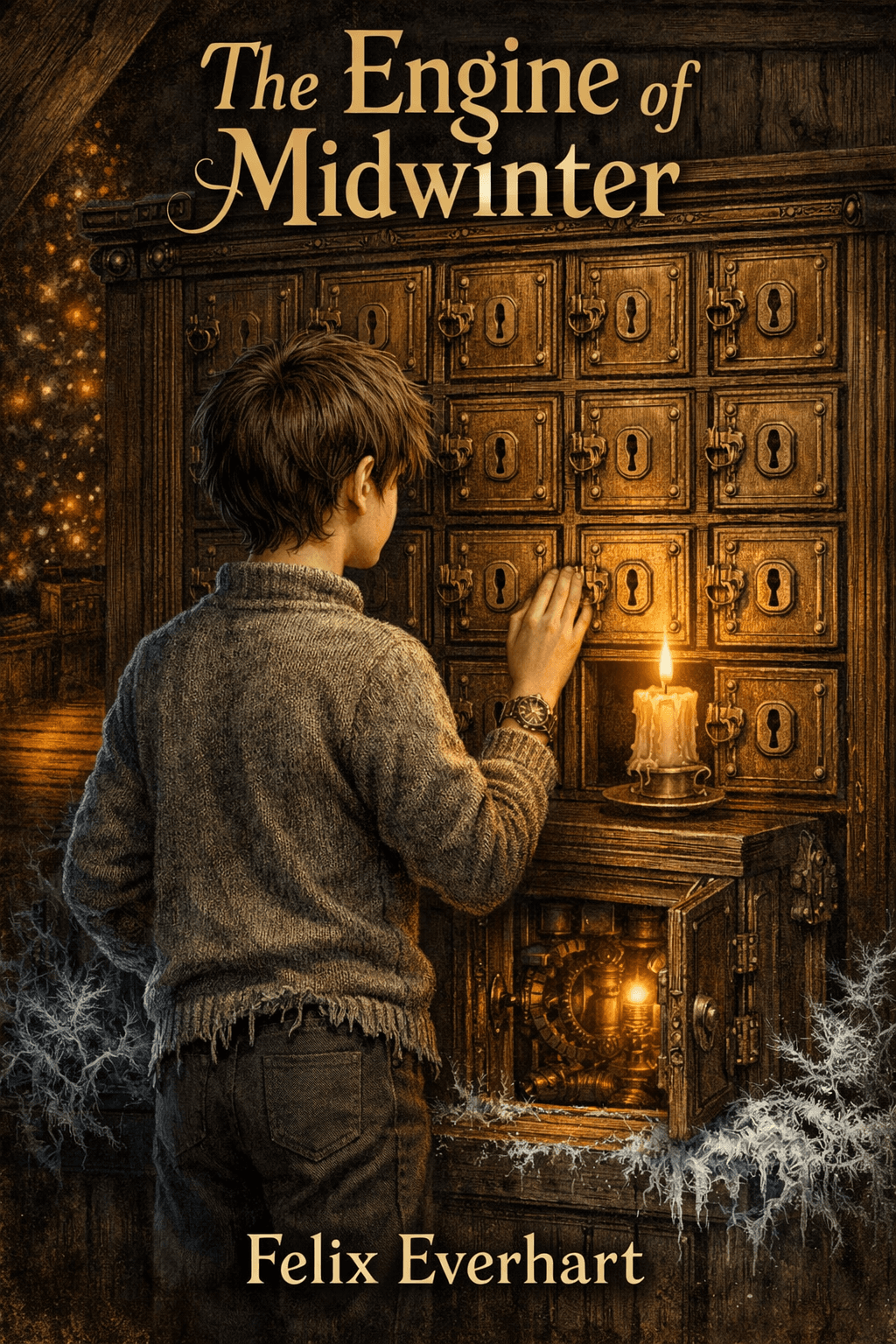
The Engine of Midwinter
Chapter 1
The Misaligned Tick
Thomas’s mother parked at the side of the gravel sweep where the snow had been pushed into a low ridge. It had started again on the drive up, dry flakes that lifted and dropped without much melt. Wind on the moor muffled the car door when Thomas shut it. He stood for a moment with his bag strap cutting across his shoulder, looking up at the windows.
Windhollow was lit for December in a way his town never managed. Warm bulbs in tall panes. A line of light under the front door. The stone around the porch had a darker colour where damp sat, and his trainers slipped on the first step.
His sister jumped down from the back seat and bounced once, trying to loosen her legs.
“Are we late?” she asked.
“We’re not late,” their mum said. Her voice was clipped, the way it got when she had already tracked everything that could go wrong.
Thomas adjusted his bag and did not ask what time it was. His watch sat against his wrist with the strap a notch tighter than usual. He had tightened it in the car when the road had narrowed and the radio had crackled and then cut out.
His sister shut her own door too hard. “I’m starving. Did Gran say there’d be those little sausages?”
“Inside,” their mum said. “Wipe your feet.”
Thomas did not correct her on the sausages. He watched their mum’s hand on her keys. The keys shook once when she turned them in her palm, then she closed her fingers and the movement stopped.
He followed them up the steps. The porch smelled of wet wool and the cleaning product Edith used on the stone. Thomas had seen her once on hands and knees in this exact spot with a brush, saying it did not matter that no one looked down at the flags if the flags were clean.
The door opened before any of them knocked.
Edith Keel stood with an apron tied tight over a jumper and her hair pinned back with a clip. Flour sat on the backs of her hands and along her wrist. She looked from the girl to Thomas to their mum.
“There you are,” Edith said. “Come in. Come in. It’s cutting out there.”
Their mum stepped forward first. Edith touched her cheeks and then pulled her into a hug that lasted one count too long.
Thomas waited and watched Edith’s eyes. She did not look at him until she had stepped back.
“There’s my Thomas,” she said, and opened her arms.
He went in because he always went in. Edith smelled of cinnamon and washing powder and something hot from the oven. Her hug was firm and quick. She squeezed his shoulder twice.
“You’ve grown,” she said, and then her voice sped up, the way it did when she tried to keep moving. “Right. Shoes off. Coats on the hook. Don’t trail snow in. Thomas, you can take that bag through to the boot room. Rachel, love, you’ll want tea straight away. Arthur’s got the kettle on.”
The girl rolled her eyes and toed off her boots without untying them. Thomas did his laces. He moved the boots to sit in a line by the mat. Edith’s own shoes were already lined up, toes even.
Their mum slipped out of her coat and hung it, smoothing the sleeve.
“You didn’t have to rush,” she said.
Edith made a noise that could have been a laugh. “There is no such thing. Not in December.”
Thomas took his bag by the handle and carried it through the corridor. The walls were hung with frames and winter greenery. A garland ran along the bannister. The air carried a sweet smell and a faint tang from the fire.
In the hallway, the longcase clock stood in its corner by the half-closed door to the sitting room. The pendulum moved behind its glass. The seconds hand had a thin black point.
Thomas checked his watch without lifting his arm much. His thumb pressed the side of the face. The cheap plastic edge dug into his skin.
The clock’s tick reached him through the corridor, steady enough that he could have counted it if he had wanted.
Edith followed him a step. “Boot room’s this way. We’ll sort bedrooms after tea. I’ve got lists and no one is leaving this house without knowing their jobs.”
She said jobs too brightly. It was her way of keeping herself upright.
Thomas nodded. “All right.”
“Your grandad’s been—” Edith started, then stopped. “He’s been waiting. He’ll be in the kitchen. Don’t let him fuss. You hear?”
Thomas nodded again. He did not ask what fuss meant.
The boot room was cold compared to the hall. An old radiator ticked once and fell quiet. He put his bag on the bench and began to undo it with care, folding his jumper that had come loose in the car and placing his spare socks on top.
From the hall, Edith called, “Wash your hands. I’m not having you touch my pastry with whatever you’ve had on those fingers.”
“I washed them in the car,” the girl called back.
“That doesn’t count.”
Their mum’s voice, quieter: “Mum, she’s—”
Edith cut across it. “Ritual, Rachel. It counts because we do it.”
Thomas zipped his bag, left it, and went towards the kitchen.
The kitchen door stood open. Heat moved out into the corridor. The kitchen at Windhollow was too big for one family but Edith filled it with trays and bowls and jars so it felt busy instead of empty. A row of cooling mince pies sat on a rack by the window. Tea towels were folded over the oven handle in neat squares.
Arthur Keel stood at the counter with a kettle and mugs. He wore a cardigan with a patch on one elbow and his spectacles sat low on his nose. His hands, when Thomas saw them, were the hands of someone who had spent a life using tools. Old burns marked the skin near his knuckles. His nails were cut short.
Arthur turned as Thomas came in.
“Ah,” Arthur said. He took a breath and smiled. “Thomas. You’ve made it.”
Thomas moved in and let Arthur’s hand settle on his shoulder. Arthur’s fingers rested lightly, then tightened.
“All right?” Arthur asked.
Thomas looked at Arthur’s eyes and then at his mouth. Arthur’s smile did not reach the skin around his eyes.
“We’re here,” Thomas said.
Arthur nodded once. “Good. Good.”
Their mum took a mug from Arthur without speaking. Edith put a plate of mince pies on the table and pointed.
“Hands,” she said.
The girl held up wet fingers. “See?”
Edith sniffed. “Dry them properly. I don’t want water in my flour.”
Thomas sat at the table and wrapped both hands around the empty mug Arthur slid towards him. The ceramic was warm from the kettle.
Edith pulled up a chair opposite him. She did not sit yet. She leaned forward and stared at his face.
“How’s your mum?” she asked him, not looking at Rachel.
Thomas kept his hands on the mug. “She’s all right.”
“And school?”
“All right.”
Edith’s gaze moved to the girl. “And you. You’ve got a hole in your cardigan already.”
“It was there,” she said.
“That is not a defence.” Edith straightened and finally sat. “Right. Mince pie. Tea. Then we do the wreath. Then the lights in the hall. Then your grandfather can show you the new tree stand because the old one rusted and I’m not having a rusted thing in the house at Christmas.”
Arthur made a small sound. “It was fine.”
“It was rusted,” Edith said.
The girl grinned at Thomas over her pie. “We’re going to be put to work,” she said.
Thomas’s mum held her mug near her mouth and watched the steam. Her phone sat face down on the table. Thomas saw her fingers tap twice against the wood beside it.
He did not ask about the hospital. He had decided in the car, when their mum’s phone had rung and she had silenced it without looking, that he would not bring it up unless she did. Not mentioning it did not change anything, but it kept the talk on tea and food.
Edith pushed a napkin towards Thomas. “You can take the job of list keeper,” she said. “You’re good at it. Write down what needs doing and who’s done it. Otherwise you’ll all wander off.”
Thomas looked at the napkin, then at Edith. “All right.”
“Good lad.” Edith’s hand came across the table and patted his knuckles once. Flour left a pale mark.
Arthur poured tea. “Any trouble on the roads?” he asked Rachel.
“A bit of snow,” their mum said. “Nothing worse than we expected.”
Arthur nodded. “Moor does what it does.”
Thomas swallowed a bite of mince pie. The pastry was warm. The fruit was sharp. His shoulders dropped.
Edith stood again. She could not stay seated when there were jobs to do.
“Wreath,” she said. “Thomas, you can fetch it from the pantry. It’s in the box. You can get the ribbon,” she told the girl, “but no scissors without asking.”
“I’m ten, Gran,” the girl said.
“And I have ten fingers and I’d like to keep them,” Edith said. “Move.”
Thomas went to the pantry. The pantry at Windhollow sat off the kitchen with shelves of jars and tins. A cold patch sat by the back wall where the stone ran through. He found the wreath box on the lower shelf, lifted it, and carried it out.
As he passed the kitchen door back into the hall, the longcase clock ticked behind him. The sound was clear enough to cut through the kitchen noise.
Near the clock, Thomas paused and looked at its face. The minute hand sat on the twelve. The seconds hand made its way around.
On his wrist, the watch seconds moved with small jerks. The clock’s second hand moved with a smoother sweep.
The clock’s tick went steady for six beats.
Then the seconds hand stopped.
Not for long. Not a full second. It paused, then jumped forward, catching itself.
Thomas blinked and looked from the clock to his watch. His watch kept going without the pause.
Edith called from the kitchen, “Thomas?”
He lifted the wreath box a little, to show he had it. “Coming.”
Another moment on the clock face: the seconds hand continued. The pendulum continued.
Thomas turned his head and looked into the kitchen. Arthur stood by the kettle. Edith had her back to the room and was reaching for a tray. The girl rummaged in Edith’s ribbon drawer with both hands.
Thomas held still and watched their faces for any sign they had seen the clock. None of them looked up.
He carried the wreath box into the kitchen. He set it on the table with care and did not mention the pause.
Edith opened the box and pulled out greenery. “Right,” she said. “We hang it before anything else. Then it looks right.”
“It’s a house,” the girl said.
Edith’s eyes snapped to her. “You will not start with that. Not in my kitchen.”
Their mum gave the girl a look. The girl pressed her lips together and looked at the ribbon.
Thomas kept his attention on the wreath. His thumb rubbed the edge of his watch strap.
They went into the hall as a group. Edith carried the wreath. Arthur took the step stool. The girl had the ribbon. Their mum carried the tape.
Edith stood at the door and held the wreath up. “Thomas, you can tie,” she said.
Thomas took the ribbon and tied it in a knot that sat flat. He pulled it tight once, then again, making the loop even. He kept his hands steady.
Arthur watched him. “Careful,” Arthur said, not unkind.
Thomas nodded. “I am.”
Edith stepped back to judge the wreath’s height. “Higher,” she said.
Arthur climbed the step stool with the careful movement of someone who had learned what a fall cost at his age. He held the wreath in place and Thomas lifted the ribbon behind it.
The door’s knocker was cold against Thomas’s fingers when he tied the final knot.
Edith clapped once. “There,” she said. “Now. Lights.”
They moved through rooms. Edith moved them on without pauses. Thomas carried boxes and fetched extension leads. The girl tested bulbs with an intensity that made her tongue poke out at one corner.
Their mum took a bag of rubbish out to the bin and returned with her cheeks red from the cold.
Thomas found himself back in the sitting room where a stack of logs waited by the hearth.
Edith stood with hands on hips. “That fire should have been going by now,” she said.
Arthur said, “I laid it.”
“You laid it the way you do,” Edith said, “which is to say you assume it will draw. Thomas, you’re tall. You can see what’s wrong.”
Thomas went to the grate and crouched. He did not want to be in charge of the fire, but he also did not want Edith’s voice to go sharp.
He looked at the kindling: a few thin sticks, paper scrunched too tight, logs placed with gaps that were too narrow for air to move. The damper was half closed.
Reaching up, he checked the damper lever. It moved with a jerk, stiff from soot. He pulled it until the gap opened wider.
Edith said, “He has a touch with it, doesn’t he?”
The girl leaned in behind Thomas and sniffed. “It smells burned,” she said.
“It always smells burned,” Edith said.
Thomas rearranged the kindling with a quick movement, making space. He opened the paper and placed it under, not on top. He pulled two smaller logs out and set them to form a wider V.
Arthur held a long match. He struck it and the flame took.
He put the match to the paper. The paper blackened and then flared.
The flame rose and spread along the kindling.
Then it thinned and shrank. The paper burned away and left only ash. The kindling darkened and did not catch.
Arthur frowned. “That’s odd.”
Edith waved her hand. “It’s damp. It’s a draught. It’s always something. Thomas, fix it.”
Thomas swallowed and set his jaw. “It needs air.”
“It’s got air,” Edith said.
Thomas pointed. “Not enough. The logs are too close.”
Edith sighed, impatient.
Thomas pulled the logs back and widened the gap. He moved the grate a fraction, leaving more space under it.
The girl said, “It went out because something’s wrong.”
Edith’s eyes narrowed. “Enough.”
“I’m only saying,” the girl said, and held up her hands.
Thomas kept his eyes on the grate. He took another sheet of paper, tore it, and placed it in a looser fold. He added thinner kindling from the basket.
Arthur struck another match.
This time the paper took and held. The kindling crackled and began to burn. Smoke rose into the chimney.
Thomas watched the flame. It held. Heat spread from the grate.
Edith breathed out, hard. “There. See. Nothing wrong. It just needed doing properly.”
Thomas stood. His knees creaked. He brushed ash from his fingers and wiped them on his trousers.
On the mantel, the sitting room clock showed a different time than his watch by three minutes. That was normal for Windhollow.
Still, his thumb went to his watch face again.
The girl moved closer to him. “You’re good with fires,” she said, loud enough that Edith heard.
Edith laughed. “A sensible boy,” she said.
Thomas let out a small laugh too, because it was expected, and because it was easier than saying that the first match should have been enough.
The sitting room warmed. Edith shepherded them back towards the hall.
The girl stayed close to Thomas. She watched him with a look she used when she thought she had caught him hiding something.
When Edith went into the kitchen to check the oven, the girl said, “Did Mum say anything in the car?”
Thomas kept walking. “About what?”
“You know what.” The girl dropped her voice. “Dad.”
Thomas swallowed and glanced towards their mum. Rachel stood at the end of the hall and was taking her coat from the hook again.
Edith came out from the kitchen with a tea towel in her hand. “Rachel, you’re not going out again.”
“Just to the car,” their mum said. “I forgot the—”
Edith pointed with the tea towel. “Thomas will fetch it. You can help me with the tree.”
The girl’s eyes flashed. “I can fetch it.”
Edith shook her head. “Not you. You’ll trail snow.”
The girl turned back to Thomas, frustration plain in her face. “How is he? Dad. Is he still sleeping?”
Edith’s head snapped towards them. Arthur looked up from the step stool.
Thomas felt every eye shift. In the hallway, the warmth from the sitting room did not reach.
He kept his voice even. “Not now.”
“Why not?” the girl asked. “It’s our dad.”
Edith’s hands stopped on the tea towel. “Rachel?” she said.
Their mum’s face tightened. “Enough.”
The girl kept going, because she always kept going once she had started. “Mum said they might move him. Is that true? Is he—”
Thomas stepped between the girl and Edith’s line of sight. His voice dropped, but the hall carried sound.
“Stop.”
The girl’s cheeks flushed. “Don’t tell me to stop.”
Arthur cleared his throat. “We can—”
Edith cut him off. “We can do this later,” she said, too quickly. “Not in the hall. Not when we’ve just got the wreath up.”
Thomas looked at the girl’s hands. Her nails had dirt under them already. She had been in Edith’s drawers, in the garden shed at home, anywhere she could find a screw.
He did not want her hands shaking with fear in front of Edith. He did not want Edith’s mouth to make that tight line that meant she was trying not to cry.
Thomas said, “Dad’s in hospital. He’s being looked after. We’re here for Christmas. That’s what Gran wants. That’s what Mum needs.”
The girl stared at him. “And what about what I need?”
Thomas wet his lips. He did not answer the question. He turned and went out through the side door to the car without waiting for permission.
Cold air made his breath catch for a second. Snow lay in a thin layer on the car roof. He opened the back door and looked for whatever their mum had left.
He found a plastic bag of presents and a box of biscuits and took both.
His watch face fogged slightly from the temperature change. He wiped it with his sleeve.
Back inside, Edith’s voice carried from the hall: “No, not there. That bauble is glass.”
The girl’s voice, sharp: “I know.”
Thomas stepped into the corridor. He went past the sitting room door where the fire now burned and towards the kitchen.
On the way he passed the interior window at the stair turn. It looked over the back garden and the stone wall. The glass was clean. Condensation sat in a faint line at the bottom.
In the upper corner, near the frame, a patch of frost had formed.
It should not have been there. The hall was warm. His breath did not show.
Thomas stopped and leaned in.
The frost sat in a triangle at the join where the frame met the glass. Its edge was sharp. A thin white line ran from it along the glass.
He lifted his hand and pressed his fingertip to the frost.
The cold stung his skin at once, deeper than the temperature suggested. He pulled his hand back and shook his fingers once, hard.
Thomas looked around to see if anyone had watched him. The hall was empty. Edith’s voice came from the far end, busy with the tree.
He pressed the back of his knuckle to the wooden frame instead of the glass. The wood was cold too.
Hands in his pockets, he continued to the kitchen, carrying the biscuits and presents.
Edith took the biscuits from him. “Oh, good. Put the presents on the side. Not under the tree yet. Not until Christmas Eve. That’s the rule.”
Thomas nodded.
Arthur came in behind him, holding the step stool. “Fire’s going now,” Arthur said.
Edith dismissed it with a lift of her shoulder. “It’s always awkward. I’m not going to stand here all night with it.”
Thomas did not correct her. The frost stayed in his mind.
Their mum took the presents and began to stack them neatly. She did it with care, folding tissue paper edges back into place.
Thomas watched her hands. They looked steady. The way she turned her phone over and checked the screen, then turned it face down again, had too much practice.
Edith clapped her hands. “Right. You’re all here. That means we do the first carol.”
The girl groaned. “Now?”
“Now.” Edith opened a drawer and pulled out a book of carols. She placed it on the table. “Arthur. The first one. You start.”
Arthur’s mouth tightened. “Edith—”
“You start,” Edith repeated.
Arthur took the book with reluctant fingers. He found the page.
Thomas stood by the table with his hands tucked into his sleeves. The girl leaned against the counter, arms crossed.
Edith sang in a strong voice. Arthur joined, quiet at first. Their mum sang under her breath.
Thomas moved his lips without sound. He watched Edith’s face instead.
The carol ended. Edith closed the book.
“Now,” she said, “we eat something proper. Then bed. Tomorrow starts early.”
It was not yet dark outside, but candles sat on the windowsills.
Thomas carried plates to the sink. He washed up without being asked. It kept his hands busy.
He kept seeing the frost in the corner of the window.
After supper Edith sent them all to unpack. Thomas carried his bag upstairs. The girl bounced ahead and then stopped outside the bedroom door.
“You’re being horrible,” she said.
Thomas went into his room. It was the room he had slept in as a smaller child, with a bed that had been too big then and now was too short. The wallpaper had a faded pattern. A hot-water bottle lay on the duvet.
He set his bag down and turned to her.
“I’m not being horrible,” he said.
“You told me off in front of them,” the girl said.
Thomas kept his voice low. “You asked in front of Gran.”
“So?” she asked. “She’s his mum.”
Thomas did not answer. He pulled his jumper hem down and tucked it in. The hem had started to unravel and he hated the feel of it against his skin.
The girl’s eyes narrowed. “What did Mum say?”
Thomas swallowed. He chose a lie that was close to the truth. “Nothing new.”
She stepped closer. “That’s not an answer.”
“It is,” Thomas said.
Her mouth tightened. She looked ready to shout.
From the landing Edith called, “Where are you? I’ve got your pyjamas here and you’re not sleeping in that old top again.”
The girl held Thomas’s gaze for a second longer, then turned and went out, shoulders stiff.
Thomas closed his bedroom door. He sat on the bed and checked his watch again.
He had checked it already. He still did it.
He listened.
The house made sounds. A floorboard in the corridor clicked when someone stepped on it. Pipes made small noises as hot water moved through them. The fire in the sitting room made a faint crackle.
Under that, he heard a tick.
It did not come from the hall clock. That tick had a steady spacing he knew from childhood, a long tick and a short tock.
This tick came uneven. A beat and a half pause. Two quick taps. Another pause.
Thomas got up.
In the corridor, the light from the hall had been turned low. The longcase clock stood in its place. Its pendulum moved. Its tick reached him.
The other tick did not match it.
Towards the stairs, he walked on the runner and kept his weight to the side, the way Edith had taught him when he was smaller.
At the bottom of the stairs he paused and listened again.
The irregular tick came from above, from the direction of the attic hatch.
Arthur could come up with his spectacles on and his small tool. He would ask questions. Edith would hear and then everyone would be awake and the house would be full of talk.
Thomas did not want talk. Talk made Edith’s face go still. Talk made their mum take calls in corridors.
He turned back towards his room and waited until he heard Edith’s bedroom door close.
Then he started up the stairs again, careful.
The full landing light stayed off. Thomas used the wall lamp by the stair turn and kept it low.
At the top, the attic hatch sat in the ceiling with a cord hanging down.
The irregular tick continued.
Thomas reached for the cord and stopped.
He checked his watch.
The second hand moved. The plastic case pressed against his wrist.
He let the watch settle back under his sleeve and took the cord in his hand.
He pulled.
The hatch came down on its hinges with a soft sound. Cold touched his face from the gap above.
The attic ladder folded down. He put his foot on the first rung.
Air from above carried something he did not expect: a sharp smell, faint but present, of hot dust and insulation.
Thomas climbed.
*
The attic ladder felt rough under his socks. Thomas climbed with one hand on the side rail and the other on the rung above. The hatch edge pressed against his shoulder as he squeezed through.
The attic air was colder than the landing, and not by a small amount. He felt it at his ears and at the skin on his knuckles.
The attic was not unheated. It never had been, not completely. Windhollow had old radiators up here too, small and often forgotten, but the pipes ran and heat drifted up from the rooms below.
This cold did not match that.
On the boards, he stood with dust in a thin layer under his socks. His torch lay in a box near the hatch; he found it by touch and switched it on.
The beam lit rafters blackened by age. Trunks sat in a row. Old linens were piled in a corner. A rug, worn through, was rolled up and tied with cord.
The smell on the ladder was stronger now: ozone and iron, with the same hot-dust edge.
Thomas kept moving, shifting his weight from foot to foot.
The irregular tick was louder up here. It came from the far end, beyond the trunks.
Across the boards, he placed his feet on the thicker joists where he knew they would hold.
He had been up here before. As a little boy he had come to hunt for decorations, dragging boxes out and leaving a trail that Edith had later made Arthur and Thomas carry back.
At the far end the roofline dipped. A narrow window sat in the gable with its blind pulled down.
Near that wall stood a cabinet.
It was oak, dark with age. Its shape did not match the attic. Windhollow’s stored furniture up here was mostly mismatched: old chairs, a table with a broken leg, a wardrobe that smelled of mothballs. This cabinet had clean lines. Its wood had a smooth finish.
Twenty-five brass doors sat on the front, arranged in a grid. Each door had a small latch.
Thomas approached slowly. He aimed the torch at the brass.
The brass was dull, not polished, but it did not have the green film he expected in old metal. The latches were intact. The numbers, stamped above each door, were clear.
The keyhole, in the centre beneath the doors, looked newer than anything around it. The wood immediately around it did not carry the same dust.
Thomas lowered the torch and reached out.
His fingers touched the brass on the nearest door. It was cold.
He tested the latch with his thumb. It did not lift.
A second door was the same. So was a third.
His hand moved to the central lock and touched the rim of the keyhole. The brass there had a faint warmth.
The irregular tick came from inside the cabinet.
Thomas leaned in and listened with his ear near the wood. The tick had the smallness of a mechanism.
He brought the torch close to the edge of one brass door and looked for gaps. None.
The cabinet was closed.
Thomas straightened and checked his watch by the torchlight. It showed 9:42.
His wrist slipped back under his sleeve and his hand pressed against his pocket. He always kept his watch in the same pocket at home when he took it off.
His fingers met something else.
Something hard, long, and ridged.
Thomas held still. He looked down at his pocket. He could feel the shape through the fabric.
He pulled the pocket open and put his fingers inside.
A key sat there.
It was not his house key. It was not the car key. It was not any key he had seen on his mum’s ring.
This key was larger, made of metal with a warm tone that showed under the torch. Its teeth were cut in a pattern that looked deliberate. The bow was plain, no tag.
Thomas lifted it out.
The metal felt warm, above the attic air. The warmth against his fingers made his skin prickle.
He stared at the key.
He did not shout. He did not call Edith.
He took a breath through his nose, slow, and held the key in his palm until his grip steadied.
His pocket showed no hole. No rip.
His watch sat on his wrist. He had not taken the key from anywhere.
Thomas moved closer to the cabinet and held the key up to the central lock.
The keyhole’s shape matched.
He did not have to force it. The key slid in with an exact fit.
He paused.
Through the boards he could hear faint movement below: Edith’s voice, muffled, and the girl’s answer. A cupboard door closed.
Arthur’s footsteps, slow.
Thomas kept the key in the lock but did not turn it.
Arthur would know what a key like this meant. Thomas did not know that as a fact, but Arthur’s quiet in the kitchen had been the same kind of quiet he used when he wanted a thing left alone.
If he fetched Arthur, Arthur might take the key.
If Arthur took the key, Thomas would be back in the position he knew too well: waiting, watching adults talk in corridors, hearing only parts.
Thomas’s fingers tightened around the key bow.
Then he loosened his grip until the key sat in his fingers rather than his fist.
He listened.
The cabinet ticked, irregular, from within.
He made himself think in steps.
This was not normal.
Telling Edith would bring her up the stairs.
If he did not find out what it was, it could do something worse later, when everyone was asleep.
Thomas breathed out. The air in front of his mouth did not show.
He kept his hand on the key and turned his head, listening for movement on the stairs.
A creak sounded below, then another.
Footsteps.
Someone was coming up.
Thomas pulled the key out of the lock and closed around it. He stepped back from the cabinet and aimed his torch towards the hatch.
Arthur’s voice drifted up, muffled through the ceiling. “Thomas? Stop stomping. It’s late.”
The girl answered from a room below. “It’s not me.”
Arthur’s footsteps reached the landing.
Thomas’s pulse hit hard at his neck. He put the key in his fist and held his arm at his side.
The attic ladder creaked. Someone pulled at the cord.
Thomas moved quickly, but not wildly. He stepped behind a stack of trunks, out of the direct line from the hatch.
The ladder shifted. A rectangle of warmer light appeared.
Arthur’s head and shoulders came up through the hatch.
Arthur held a torch too, a smaller one, and he swept it across the attic floor.
Thomas stayed still.
Arthur muttered, “Draughty old thing,” and climbed up another rung.
Thomas watched Arthur’s feet, then his hands. Arthur’s fingers were careful on the rung, feeling for stability.
Arthur stepped into the attic.
Near the hatch, he stood and listened. His mouth tightened.
The cabinet’s irregular tick continued.
Arthur’s torch beam shifted towards the far end of the attic.
Thomas pressed the key harder into his palm. The ridges bit his skin.
Arthur took a step forward.
Thomas moved from behind the trunks and stepped into the beam.
Arthur started, a small jerk of his shoulders.
“Thomas,” Arthur said, and put a hand to his chest. “What are you doing up here?”
Thomas lifted the torch in a way that tried to look casual. “I heard a noise,” he said.
Arthur frowned. “You could have woken me.”
Thomas’s fingers tightened around the torch. He kept the key hidden in his other hand, held low.
“I was going to,” he said.
Arthur’s eyes went past him, to the far end. “Where did you hear it from?”
Thomas did not answer straight away.
The cabinet’s tick continued.
Arthur’s gaze came back to Thomas’s face. “Thomas.”
Thomas said, “From up here. I thought it might be a bird.”
Arthur’s mouth pressed thin. “In winter.”
Thomas shrugged.
Arthur turned his torch towards the cabinet end and began to walk.
Thomas kept pace.
Arthur’s torch beam landed on the cabinet.
Arthur stopped.
Thomas watched Arthur’s shoulders lift, then settle.
Arthur said, very softly, “Oh.”
Thomas held his breath.
Arthur stood still for two beats. Then he turned his head towards Thomas.
“Is that what you came to see?” Arthur asked.
Thomas kept his face blank. “I didn’t know it was there.”
Arthur’s gaze moved to Thomas’s hands.
Thomas tucked his key hand into his pocket. The movement was too fast.
Arthur noticed. Thomas saw it in the way Arthur’s eyes narrowed.
Arthur said, “What have you got?”
Thomas let his breath out slowly. “Nothing.”
Arthur did not move closer. “Thomas.”
The word came out in a warning tone.
Thomas said, “I’m tired.”
Arthur’s face shifted. For a moment he looked older. “We all are.”
Arthur stepped forward and put his hand on the cabinet’s brass.
Thomas swallowed. Arthur would open it. Arthur would ask questions. Edith would end up in the attic in her slippers.
Arthur’s fingers tested a latch. It did not lift.
Arthur’s hand moved to the central keyhole.
Thomas felt the key in his pocket. The warmth pressed against his thigh.
Arthur said, quiet, “It’s locked.”
Thomas kept his torch steady.
Arthur looked back at him. “Where did this come from?”
Thomas could have told the truth and watched it turn into questions.
Instead he said, “It was up here.”
Arthur’s mouth tightened. “In your pocket?”
Heat rose in Thomas’s face. “It was near the hatch. I picked it up.”
Arthur stared for a moment, then looked away. “We should tell Edith,” he said.
Thomas wet his lips. “Why?”
Arthur’s eyebrows lifted. “Because it’s—” He stopped. His hand shifted, fingers rubbing at a burn mark on his knuckle. “Because it’s not an ordinary cabinet.”
Thomas said, “It’s just a cabinet.”
Arthur made a small sound. “Thomas. No.”
The irregular tick continued.
Thomas watched Arthur’s face and saw what Arthur kept pinned down by habit.
Thomas’s voice came out quieter than he wanted. “Are you sure?”
Arthur did not answer. He touched the keyhole again and then pulled his hand back.
From below, Edith called, “Arthur? What are you doing? Come to bed.”
Arthur’s shoulders stiffened. He called back, “Just checking a draught. Go on.”
Edith’s voice, muffled, “You’ll catch your death.”
Arthur looked at Thomas again. “Downstairs,” he said. “Now.”
Thomas nodded.
Arthur turned back towards the hatch.
Thomas stepped close to the cabinet. Arthur’s torch beam had moved away and did not land on Thomas’s hands.
Thomas took the key out of his pocket.
He fitted it into the lock.
He did it quickly, before he could think.
The key seated with the same exact fit.
Thomas paused.
Arthur’s foot hit the first rung of the ladder. The ladder creaked.
Thomas turned the key once.
Cool air brushed the inside of his wrist above the watch strap.
The movement was smooth, with a small resistance at the midpoint and then a final give. The cabinet’s tick changed, not louder, but different in its spacing.
He did not open any door.
Thomas pulled the key out and put it back in his pocket.
A sheet lay folded over the top of a trunk beside the cabinet. He grabbed it by a corner, dragged it free, and pulled it over the cabinet. The fabric caught on two brass latches before it slid into place.
He smoothed the front with both hands, pressing the corners down until only a thin line of brass showed at the bottom. Dust shifted in a narrow strip where his hands passed.
Thomas stepped away from the cabinet and followed Arthur.
Arthur climbed down. Thomas went after him and pulled the hatch closed. He did it quietly.
On the landing Arthur’s face was pale in the low light. “Go to bed,” Arthur said.
Thomas nodded. “All right.”
Arthur hesitated. His fingers moved to his cardigan pocket and pressed against something there.
“You didn’t see anything else up there?” Arthur asked.
Thomas kept his face straight. “No.”
Arthur held his gaze for a long beat.
Thomas did not look away.
Arthur’s shoulders dropped a fraction. “Good,” Arthur said. The word sounded flat. “Bed.”
Arthur went down the stairs. His footsteps faded.
Thomas stood on the landing until he heard Arthur’s bedroom door close.
He did not go to bed straight away.
Back in his room, he took the key out of his pocket.
Under his torchlight the brass looked clean.
He turned it in his fingers and ran his thumb along the teeth. Each notch had been cut with precision.
Thomas put the key back in his pocket and then, after a moment, took it out again and wrapped it in a sock from his bag. He tied the sock in a knot.
He slid it under the mattress at the head of the bed.
Then he got in under the duvet.
He lay still and listened.
Even through the ceiling, the irregular tick reached him, faint but present.
*
The kitchen felt different at night. Edith kept it warm even when everyone should have been in bed. A single lamp on the counter threw a pool of light across the table. A pot of tea sat near the edge and the lid rattled once when it cooled.
Thomas came downstairs because Edith had called again and again until their mum had said, “All right, we’ll have something small,” and then there had been footsteps and the sound of a cupboard opening.
Thomas sat at the table with his left hand in his pocket. The key pressed against his thigh through the sock. The knot dug in.
His sister sat opposite, legs tucked up on the chair, and watched him with narrowed eyes. She had changed into pyjamas but her cardigan still hung off her shoulders.
Edith placed a plate of cheese on the table and sliced it with a knife that had been sharpened recently. “No one sleeps properly after travelling,” Edith said. “So. Supper.”
Their mum stood by the sink with her phone in her hand. She did not sit.
Arthur came in last, moving slowly, and sat at the far end. Edith glanced towards the hall and said, “And nobody goes near the attic hatch. I heard it creak earlier.”
Arthur looked at Thomas as he sat down and then looked away.
Edith poured tea. “Tomorrow,” she said, “we start at eight. Church at ten. Baking contest at two. Arthur, you will not disappear into your shed. Rachel, you can have your phone on you but I don’t want it ringing at the table. You can help me with the mince pies and you can fetch the holly,” she told the girl, “but gloves, because I don’t want blood on the carpet.”
“I didn’t bleed last year,” the girl said.
“You bled the year before,” Edith said.
The girl’s mouth twisted, but she did not argue.
Edith turned her focus on Thomas. “And you,” she said. “You will be my assistant baker.”
Thomas blinked. “I thought she—”
Edith pointed the knife at him, careful. “She will poke. You will measure.”
The girl grinned. “He’s good at measuring,” she said, and her voice carried a small edge.
Thomas did not answer it. “All right,” he said.
Edith nodded, satisfied. “You’ll keep the list. You’ll time the bake. You’ll be sensible.”
Thomas’s thumb rubbed the inside of his pocket against the sock-wrapped key.
Their mum’s phone vibrated.
Rachel looked down at it. The screen light caught her face.
Edith said, sharply, “Rachel.”
Their mum lifted a hand. “It’s the hospital.”
Arthur’s fingers tightened around his mug. The ceramic clicked against the table.
Edith’s mouth opened, then closed. She looked away towards the oven.
Their mum stepped out of the kitchen. Her footsteps moved down the corridor.
Thomas watched the doorway. His shoulders stayed stiff.
Bea watched him instead.
Edith started talking louder. “Right. Baking contest. You know the rules. Each person brings one thing, no shop-bought, no excuses.”
Arthur said, “It’s only the three families, Edith.”
“It’s tradition,” Edith replied. “And it keeps people fed.”
Thomas listened with half an ear. He watched Arthur’s hands.
Arthur took a small tool out of his pocket without realising he was doing it. A flat screwdriver, worn at the handle. He turned it over and over.
Edith did not notice.
The girl did. Her eyes flicked to the screwdriver and then back to Thomas.
“Can I make gingerbread?” the girl asked.
Edith sighed. “If you promise not to add too much spice. You did last year.”
“It was better,” the girl said.
“It made your grandfather cough,” Edith said.
Arthur’s mouth twitched. “It did.”
The girl shrugged. “That’s because he’s old.”
Edith looked as if she might scold, but Arthur held up his mug. “She’s not wrong,” he said.
Thomas let out a small laugh, because everyone else did, and because the sound made the room feel normal for a moment.
His left hand stayed in his pocket.
Edith turned to him again. “Thomas will do shortbread,” she decided. “Reliable. Not fancy.”
The girl said, “He’s not reliable. He hides things.”
Edith stopped. Arthur’s screwdriver stopped turning.
Thomas swallowed. “Don’t,” he said.
The girl’s face set. “You did. You— you did in the hall.”
Edith looked between them. “What are you on about?” she asked.
Thomas kept his voice calm. “Nothing. She’s cross because I told her not to ask questions in the hall.”
Edith’s eyes sharpened. “Questions?”
Thomas did not look at their mum’s doorway. He kept Edith’s attention on him.
“It wasn’t the place,” he said.
The girl’s cheeks flushed. “It’s always not the place.”
Arthur cleared his throat. “Enough,” he said to the girl, and the word carried more weight than Edith’s scolding ever did.
The girl looked down at her hands.
Edith exhaled and reached across the table to pat the girl’s fingers once. “Love,” she said, softer. “We’ll talk about whatever it is tomorrow. Tonight we drink tea and eat cheese and we go to bed. All right?”
The girl did not answer.
Thomas could not look at her without feeling the knot of the sock press harder against the key.
He swallowed tea that had gone too strong.
Arthur’s gaze moved to Thomas’s pocket and then away. Arthur did not say anything.
The corridor carried their mum’s voice, low, from the next room.
Thomas could not hear the words, but he saw Rachel step into view for a moment, her head turned away, her fingers pressed to her forehead.
Her face tightened. Then she nodded once.
She ended the call and stood still for a moment before coming back into the kitchen.
Edith said, too quickly, “Everything fine?”
Their mum’s mouth moved in something close to a smile. “Yes. Fine. Just checking in.”
Thomas watched her eyes. He did not ask what the call had been.
Edith put her hand on Rachel’s forearm. “Sit,” she ordered.
Rachel sat.
They ate in quiet. The girl ate cheese and stared at the table. Edith ate a mince pie and watched her, trying to keep the room steady.
Thomas kept his hand in his pocket, holding the key through the sock.
Arthur sipped tea. His tool sat on the table now, near his plate.
Beyond the kitchen door, the longcase clock’s tick came down the hall.
Thomas had learned the sound as a child. It had always been slightly too loud in the night.
Now it did something else.
In the middle of Edith describing who would judge the baking contest, the tick skipped.
Thomas’s eyes went to the door.
The tick resumed.
Edith stopped mid-sentence, frowning. “That clock,” she said. “Arthur, it needs attention.”
Arthur nodded. “It’s old.”
“It’s always old,” Edith said. “It can be old and still keep time.”
Under the table, Thomas checked his watch and kept his wrist still.
The watch kept going.
He lifted his eyes and watched Edith’s face for any sign she had noticed the skip. Edith’s frown had already moved on.
Thomas added the hall clock, the fire, the frost, and the cabinet to his private list. The list in his mind was ordered, the way Edith kept her fridge lists. That steadied him.
When the plates were cleared, Edith herded them all towards bed.
“Enough,” she said. “If you stay up you’ll be useless tomorrow.”
The girl muttered, “I’m never useless.”
Edith heard and smiled. “Prove it by sleeping.”
Their mum went upstairs first. Arthur followed. Edith stayed behind to wipe the table, even though it was already clean.
Thomas went up last.
In his room, he took the sock-wrapped key from under the mattress. The knot had left a dent in the fabric.
He held it in both hands for a moment. The warmth was still there, faint.
He opened his pillowcase and slid the sock inside, then put the pillow back.
He turned off the lamp and lay down.
He lay in the dark and could not settle.
He listened for the longcase clock.
Its tick reached him through the walls.
He listened for the other tick.
At first he did not hear it.
Then, faintly, through the ceiling, it came: the irregular spacing he had heard earlier.
A tick, then a pause that was too long. Two quick taps. Another pause.
Under it, a different sound joined, very faint, more felt than heard. A hum, low and steady.
Thomas lay still.
He checked his watch by touch, pressing his thumb against the face to feel the edges. He did not turn on the light.
The hum continued.
He turned his head on the pillow and felt the key through the pillowcase, the lump of it pressing near his ear.
He thought of Arthur’s face in the attic. The way Arthur had said, it’s not an ordinary cabinet.
Arthur had tried to tell him without saying more.
Thomas worked his jaw. Swallowing took effort.
He did not want to wake anyone. He did not want Edith in the attic, telling him off for going up without slippers. He did not want their mum with her phone in her hand.
He wanted the house calm. He wanted one thing he could do without anyone else.
Thomas slid his hand under the pillow and closed his fingers around the sock.
He did not take the key out. He held it there, through fabric.
His decision came quietly.
He would open the first door.
He would do it early, before breakfast, before Edith’s lists started and before Arthur could stand in the landing and say no.
Thomas rolled onto his back and raised his watch arm enough to see the face in the faint light from the window. He set the alarm to a time before the house would wake.
He lowered his arm and kept his hand on the key.
The irregular tick continued above him.
He counted the beats of the longcase clock until his breathing matched them, and then he stopped counting because counting did not stop the hum.
Chapter 2
The Foundry of Snowflakes (Door 1)
Thomas woke before his alarm.
His thumb passed over his watch face before he was fully awake. He lifted his wrist into the dim strip of window. The hands sat where he had set them—early enough that Edith’s kitchen would still be dark.
Quiet held in the corridor. Radiators ticked as they cooled. Somewhere lower down, a pipe made a single knock and went still.
Thomas sat up and reached into his pillowcase.
The sock-wrapped key felt warm through the fabric, as it had in the attic. He held it long enough to steady his grip, then put it into the pocket of his trousers. The knot pressed against his thigh when he stood.
He dressed without turning on the lamp. The jumper hem caught on his waistband and he tucked it in by touch, twice, until it lay flat. Trainers went on without proper laces. Wrong, but faster.
On the landing, the air carried the faint smell of last night’s fire and Edith’s spice tins. The corridor ran colder than his room. He stepped over the board that creaked near Edith’s door; he had stepped on it once as a smaller child and been hauled into a lecture about waking people for nothing.
At the stair turn he passed the interior window. In the half-light the glass looked plain, but the patch at the frame was still there, a sharp-edged triangle where warmth should have kept everything clear. Thomas did not touch it. His hand stayed in his pocket and his shoulder kept a fraction off the wall as he went past.
The attic hatch cord hung straight down. Thomas looked at it, then back towards the stairs, expecting Arthur to appear with a torch and his flat screwdriver. Nothing moved.
He pulled the cord.
The hatch dropped a few inches with a soft thud. Cold air reached his face at once, enough to water his eyes.
Thomas climbed the ladder with one hand on the rung and the other pressed to his pocket where the key sat. The wood felt dry and gritty. The attic smell met him half way up: hot dust, insulation, and something metallic that did not belong to stored linen.
When his head rose above the hatch, the air temperature dropped; his breath condensed faster. He swung his leg over and stood on the boards.
The torch lay where he had left it among the trunks. He clicked it on. The beam ran across rafters and old boxes. The cabinet sat at the far end under its sheet.
Careful steps took him across the attic. He kept to boards he knew were firm. Hurry would put weight in the wrong place.
At the cabinet he lifted the sheet corner.
Twenty-five brass doors were arranged in rows; numbers caught his torch. The stamps above them were deep enough to hold a hard edge of light.
Door 1’s latch sat under his thumb. It did not move.
His hand went to the central keyhole.
The brass rim still held faint warmth. Fingertips prickled against it. He pulled the key out of his pocket, loosened the sock, and slid the key free. The teeth were precise, the ridges sharp.
Thomas fitted it into the lock.
It seated with no scrape. His grip tightened.
He turned the key.
Not the quick turn he had done last night while Arthur climbed down the ladder. Slower, measured, until it met resistance and then gave.
Inside the cabinet the irregular tick shifted into a different spacing.
His hand stayed on the key for a moment, listening for footsteps below, for Edith calling his name. Nothing.
The key went back into his pocket without the sock. The metal stayed warm against his fingers.
Door 1’s latch lifted under his thumb.
The movement was small, but it was movement. Thomas watched it, waiting for it to fall back.
He hooked his nail under the latch and pulled.
The brass door opened.
Cold air pushed out, sharper than the attic cold, with a metallic smell. A vibration traveled through the brass into his wrist.
He shifted his feet on the boards, trying to brace.
The pull took him before he could set his weight.
Trainers skidded. His shoulder hit the cabinet edge. The torch beam swung up to the rafters and then down; the light caught the sheet lifting once before it vanished from sight.
His hand closed around the door edge and slipped.
Cold cut his breath short.
Then his feet hit something hard.
He fell onto his side. His elbow struck metal. The torch clattered and rolled, its beam cutting across a floor of dark plates and scattered grit.
A breath came in, rough and fast.
The air tasted of hot metal and old smoke. It dried his tongue at once.
He pushed himself up on his hands.
Palms came away black.
The place was vast. Above him, high beams ran across a ceiling lost in shadow. Light came from rows of lamps strung on chains and from open furnace ports, each one a rectangle of hard brightness.
Hammers struck in patterns—two close, one spaced, then another run with the same spacing. Between the hammering came other sounds: metal scraping metal, belt motion, and a hiss that rose and fell.
Conveyor lines ran across the floor, metal belts carrying trays. On the trays lay shapes that caught the light as they moved. Snowflakes, but stamped and cut. Some were thin and bright, some thicker and unfinished, their edges blunt.
A set of mould stations stood to one side. Thick blocks of metal sat under presses. Each press rose and fell with a jolt, and each jolt left a new flake on the tray.
The presses rose and fell on a set cadence. Trays returned in fixed lanes, and a worker’s hands moved to that cycle without looking up. Winter was being made by steps someone had designed.
Workers moved along the lines in heavy aprons and gloves. Their faces were streaked with soot. Hair stuck out from under caps. None of them looked up.
Thomas held his breath and realised he was doing it.
This was not a cupboard with a hidden room behind it. This was not Windhollow’s attic with cold boards and stored boxes.
A tray passed near enough for him to see the flakes. Each flake had a small hole at its centre, made to be strung or fixed to something. A worker picked one up, checked thickness with a quick pinch through a glove, and dropped it into a crate.
The torch beam swept out and back. Oak, brass, the cabinet’s grid—none of it showed.
Behind him, where he had landed, a short corridor ran between two machine housings. Brass rails lined it, fixed into the floor with bolts. The rails matched the cabinet doors’ dull brass.
Thomas got to his feet and moved to them.
The corridor did not read as a door. It read as a work route, a place for carrying parts between stations.
Pulse thudded in his ribs.
He stepped into the corridor and ran his fingers along the brass rail, searching for a latch, a seam, anything that matched the cabinet door edge.
The rail was cold. A faint vibration ran under his fingertips.
Torchlight slid along the brass.
Nothing.
A worker on the nearest line turned their head, slow at the neck.
“Hey.” The voice came out hoarse. “You can’t be there.”
Thomas looked up.
The worker stood close enough for him to see cracked leather gloves and soot packed into creases. Their eyes were red-rimmed from smoke.
“I—” His voice snagged.
Their gaze went to the torch in his hand, then to his bare head and trainers.
“How did you get in?” the worker asked.
Thomas swallowed. “I just— I opened—”
Their jaw set. “You need a burn-light.”
“What?”
“You wander without one, you turn into a statue. That’s how it goes now.”
His fingers tightened on the torch.
Between two lines, deeper in, a row of shapes stood that did not move. At first they read as spare moulds stacked on stands. Then the torch caught a hand held at an angle no living wrist held.
The worker’s hand closed on Thomas’s wrist and kept the torch steady a beat longer. Frost had sealed eyelashes open.
Thomas pulled the beam away.
“Burn-light,” the worker repeated. “Candle. If you’re not carrying one, you don’t last long.”
On the housing beside the rails, a rack sat bolted in place. Stubby candles rested in it, thick and pale. Beeswax, the colour of old paper.
Thomas reached for one.
His fingers shook. He forced them to close around the wax.
“Light it,” the worker said. “Not there. Step out of the draft.”
Two steps took him to the corridor’s centre, brass rails on either side. He fumbled in his pocket for matches and found only lint and the warm key. Matches were still in his bag.
He stared at the candle.
An annoyed sound came from the worker. They held out a hand. A small striker sat in their palm, a strip of metal and a rough pad.
Thomas took it.
The first scrape did nothing. The second gave sparks that died in the air.
His breathing went shallow.
A third scrape, harder. A spark caught the wick.
The flame took, small and steady.
Warmth from it barely reached, but the air close to his face stopped biting. He drew a fuller breath without coughing.
Thomas held the candle close to his chest with both hands, using his body to block the draft. The wax stayed solid under his fingers.
The worker nodded once.
“Keep it sheltered,” they said. “Don’t go wandering. This isn’t a place for children.”
Thomas’s mouth went dry. “I’m not— I’m not meant to be here.”
“No one’s meant to,” the worker said, and turned back to their station.
Alone in the corridor, Thomas looked again for the way back.
At the corridor’s end, a brass frame sat fixed into the housing, the same width as the cabinet door. It looked like a service hatch. No handle showed.
A draft reached the flame and it dipped once.
He shifted his body until the candle steadied.
Behind him, the foundry’s rhythm changed.
A stutter ran along the conveyor line. The press that had been rising and falling on a set pace hesitated mid-stroke. Metal scraped. A run of trays jerked; half-formed flakes slid from the belt and clattered to the floor.
Hammering broke pattern.
The timing was off in a way he recognised.
The line jolted again. A worker shouted. Another pressed a lever down with a gloved hand.
Thomas stepped out of the corridor.
Back. Shut the door. Bed. Edith’s scolding. School.
The door was not there to shut. Not where he could find it.
And the stutter kept happening.
His grip tightened around the candle. By its light he checked his watch, wrist close to the flame. The hands moved steady.
He started towards the jam.
*
Closer in, the foundry’s noise pressed harder.
Heat from a furnace port washed across the floor in a band. He stepped through it and his cheeks stung. Two paces on the other side, cold returned and cut at his ears.
The candle stayed tucked behind his hunched shoulders. The flame wavered when he passed a gap between housings.
The jam was not one obvious blockage. Several parts met: a belt carrying trays, rollers guiding the belt, and a housing where the belt disappeared under a plate.
A tray had caught half under the plate. The belt’s motion kept pulling against the trapped tray, making a repeated clack, then a slip.
Thomas leaned in.
Bent metal showed where it had snagged. If someone yanked it without care, the tray would tear and scatter into the moving parts.
His free hand lifted.
A hand closed around his sleeve.
Thomas jerked back.
A man stood beside him, taller than Arthur, heavier in the shoulders. Soot streaked his face. His eyes looked raw and sleepless. A leather apron covered his front, and his gloves were cracked at the knuckles.
In one hand he held a long pole. Its end carried an ember that never steadied, but the ember held.
“You don’t touch that,” the man said.
Thomas tried to pull free. The grip tightened, firm.
“Who are you?” Thomas demanded, the words coming out higher than he intended.
The man’s gaze flicked to Thomas’s candle. “Not your foreman. Where did you come in?”
Thomas’s mouth opened.
From my grandad’s attic.
From a cabinet that shouldn’t exist.
He said, “From there,” and nodded back towards the brass corridor.
The man followed the gesture. His eyes narrowed.
“That door,” he said.
Thomas said nothing.
The man let go and stepped closer to the jam. He did not touch it. The pole tapped the housing once, controlled.
A vibration traveled through the metal and into the floor. Thomas felt it through his trainers.
The man listened.
He moved the pole along the housing, tapping in a pattern. Testing.
Thomas watched, trying to make sense of it.
“You’re going to break it,” Thomas said.
The man’s head turned. “If it breaks from that, it was already broken.”
Thomas swallowed. “I can fix it.”
The man’s mouth pulled tight. “Children say that right before they lose fingers.”
“I’m not—”
“Name.”
Thomas hesitated.
The man waited.
“Thomas.”
A short nod. “Bran Holt. Lamplighter.”
Thomas did not know what that meant, but the pole and ember made it sound like a job.
Bran’s gaze returned to the candle. “That burn-light yours?”
Thomas looked down at it. “I took it from the rack.”
“Good,” Bran said. “Keep it. Now. You touch this jam without reading it, you make it worse. Begin with what touches skin.”
Thomas frowned. “What?”
Bran nodded at Thomas’s bare hands. “Heat, cold, drafts. Start with what kills you first. Then you take a wrench to a gear.”
“It’s just stuck.”
Bran held Thomas’s gaze for a beat.
Then he said, “It’s never just stuck.”
The belt slipped again. A tray shuddered on the rollers.
Thomas moved forward.
Bran’s hand shot out and caught his wrist. Hard enough to hurt.
The candle flame shook.
“I said don’t,” Bran snapped.
Thomas twisted. “If we pull it out—”
“No jumps, no guesses,” Bran said. “You pull it out, the belt bites. You put your hand there, the rollers take it. You want to help, you stand where you can see and you listen.”
Thomas worked his voice down. “I can listen.”
Bran let go.
Thomas rubbed his wrist once and stopped. Complaining would not change anything.
Bran leaned close to the housing and set the pole end against the metal without pressing. His eyes went half shut.
The ember stayed small.
His head tilted.
Thomas tried to hear what he was hearing.
Belt scrape. Press jolt. Hammering further down. Beneath it, a vibration under the housing when the belt slipped.
Bran opened his eyes. “Misalignment.”
Thomas blinked. “The tray’s bent.”
“It is,” Bran said. “And that’s not the first wrong thing.”
The pole pointed, not at the tray, but at a seam where two plates met. A narrow gap ran along it.
Cold air came from that gap in a steady line.
Thomas felt it on his cheek when he leaned in.
“Draft seam,” Bran said. “You fix that first.”
“That’s not what’s jammed.”
Bran’s gaze went to the candle. “Your burn-light doesn’t care what you think is jammed. Your burn-light cares where the cold cuts through. You let that draft eat your flame, you lose time.”
The candle dipped, wick sputtering once.
Thomas brought it closer and looked at the wax.
The candle had shortened. Not by much, but enough that a lip showed where it had been higher.
“Minutes.”
Bran saw his look. “It burns faster here,” he said. “Cold takes it. Panic takes it. Wind takes it. You run around with it out in the open, you pay in wax.”
Thomas’s breathing went quick, then he forced it slower.
Bran’s voice stayed blunt, not unkind. “Burn-light is time and shelter. You keep it sheltered, you keep yourself sheltered. You don’t, you don’t.”
“It isn’t just this line,” Bran added. “The Engine’s failing across guilds. Doors are opening at the wrong temperatures.”
Thomas’s fingers tightened around the candle.
He looked at Bran’s pole. “That ember— why doesn’t it—”
“Because it’s not for you,” Bran said. “And because I’ve been doing this longer than you’ve been alive.”
Heat rose in Thomas’s face. “I didn’t ask—”
Bran raised a hand. “Where did you come from, Thomas?”
Thomas stared at him.
Bran waited.
“A door.”
Bran’s jaw tightened. “Which door?”
Thomas did not answer.
Bran’s eyes held on Thomas’s face and then dropped to the candle and down to the trainers.
“You’re not Foundry stock,” Bran said. “You’re not Guild stock at all.”
Thomas kept his mouth shut.
Bran let air out through his nose. “Fine. Keep your secrets. Just don’t make them someone else’s problem.”
A loud shout cut across the floor.
On a line two stations over, a conveyor stuttered and threw a spray of half-formed flakes into a trough set into the floor. The trough held something that steamed. Flakes hit it and a harsh crack ran through the air.
A worker reached out by reflex.
Their glove dipped at the trough’s edge. It locked rigid at once, fingers stuck half-curled.
The worker yanked their hand back and swore.
Another worker grabbed the stiff glove at the cuff and pulled. The glove did not bend. The worker’s arm shook with the effort.
Thomas stared.
Bran’s voice came low beside him. “That’s the cost. You see it now?”
Thomas nodded once. His throat would not let him speak.
Bran stepped to a side rack near the housing. He took a wrench from a hook, then a strip of wax-seal from a tin.
He held them out.
Thomas took them.
The wrench was heavy, heavier than any tool Arthur had let him hold. The handle was cold.
The wax-seal strip felt tacky and stiff.
Bran nodded at the draft seam. “Begin with what touches skin,” he said again. “Seal that gap. Then we see what the tray’s doing.”
Thomas crouched by the seam.
Cold air ran from it in a steady line. He could feel it on his knuckles. The wax stiffened in the cold and would not adhere.
He pressed it into place with his thumb, working along the seam.
The wax resisted and then softened where it touched warmer metal. He pushed harder.
Heat bit his thumb.
Breath pulled in through his teeth.
His thumb came back with a pale mark on the pad where wax had melted against his skin.
Bran watched him. “You stop?”
Thomas shook his head.
He used the side of his thumb and the flat of his nail, moving in short controlled pushes. The burn stung, sharp and immediate, but the strip went into the gap and held.
The draft eased. Not gone, but reduced enough that the candle stopped dipping.
Bran nodded once. “Good.”
Thomas’s thumb throbbed.
Bran looked past him, further into the foundry, to where the motionless shapes stood between lines.
“Those statues,” Thomas said, quiet, before he could stop himself.
Bran’s eyes came back. “You saw them.”
Thomas swallowed. “Are they—”
“People,” Bran said. “Workers. Apprentices. Anyone in the wrong place without burn-light, or anyone someone decided to stop.”
Cold settled under Thomas’s ribs.
“Someone decided,” he repeated.
Bran’s jaw worked. “Glazing. Someone is glazing the guilds.”
Thomas’s fingers tightened around the wrench.
Bran’s voice stayed level. “It’s not an accident. Someone wants output stopped, and they’re doing it by turning living people into glass.”
Thomas stared at the wax strip pressed into place.
He tried to picture who would do that and failed.
Bran pointed at the jam. “Now. We listen again. Seal first, then gears.”
Thomas nodded.
His thumb burned and the candle had already shortened.
He held both and leaned closer to the housing, trying to hear the difference the seal made.
*
Bran’s listening had rules.
He did not say them like a school lesson. He did them, and Thomas watched and followed.
Bran set the wrench against the housing, not to turn anything, but to feel. The handle rested light in his fingers. His eyes went half shut.
Thomas copied him.
Through the metal he felt the belt’s vibration. It ran steady until the skip, where it jarred.
Bran moved his wrench a few inches and listened again. A single tap from his knuckle near the tray, then stillness.
Thomas wanted to grab the bent tray and pull. The way it might come free was clear enough to tempt him.
He stayed still.
Bran opened his eyes. “Tray’s caught,” he said. “But the catch is fed by something else.”
“What?”
Bran pointed to a roller bracket. A bolt sat half proud from its seat.
Thomas leaned in. “That’s loose.”
“Or it was tightened and then forced loose,” Bran said.
Thomas’s mouth went dry.
Bran stepped closer to the bracket and lifted his pole. The ember end hovered near the bolt head. Frost at the bracket edge softened and ran.
Bran watched the run of water and then pulled the pole back.
He nodded at Thomas. “Your turn. Wrench, not hands.”
Thomas brought his wrench to the bolt.
The bolt head fit. His grip was not strong enough for a quick turn, so he set his feet and tried again.
It did not move.
Bran’s voice came sharp. “Don’t fight it. Read it.”
Thomas froze.
Bran pointed at the wax seal. “You fixed the draft. Now check what else is cold where it shouldn’t be.”
Thomas started to reach out, then stopped and used his wrist instead, hovering close enough to feel.
The bracket edge ran colder than the metal around it.
His eyes tracked the edge. A hairline seam showed at the base where it met the housing.
Another draft.
It cut across the bolt.
The candle dipped when the draft reached it, then steadied when Thomas shifted his shoulder to block the line.
He reached for the wax-seal tin.
Gone.
Bran had taken it back and tucked it into his apron pocket.
Thomas looked up.
Bran held out a shorter strip. “Take what you need,” he said. “Not what you want.”
Thomas took it.
The wax went into the hairline seam.
This time he used the back of the wrench head, not his thumb, pushing the wax in with controlled pressure. It stuck and held.
The cold line eased.
The wrench returned to the bolt head.
It turned.
Not easily, but with a steady give. Thomas tightened it a fraction, then another.
The belt’s vibration changed under his hand.
Bran watched. “Stop.”
Thomas stopped.
Bran’s eyes went to the candle. “How much wax have you got?”
Thomas looked.
The candle had burned down to a thick stub. Wax had run down one side and hardened in ridges.
“I can finish,” Thomas said.
Bran’s gaze stayed on the flame. “You don’t know that.”
“I can—”
“You don’t get to spend wax because you want to,” Bran said. “You spend wax because the job requires it. If the flame goes out here, you don’t just get cold. You lose your way back.”
Thomas’s jaw set.
The brass corridor, the frame, the seam Bran had found—none of it had read as a door until Bran touched it.
“If we clear the jam, it’ll stop,” Thomas said.
“And if someone has iced another seam, it’ll jam again,” Bran said. “You want predictable? You get it by doing steps in order.”
The word predictable landed and stayed there.
Thomas moved the wrench to the tray bracket and checked the gap for drafts before he shifted his weight. He eased the tray down a fraction and watched the flame, then brought the candle to the sheltered side Bran had kept him in.
He listened again.
The belt slipped.
The flame wavered.
Thomas froze.
A gust cut across the floor.
Cold hit the candle.
The flame bent low and spat. Smoke rose in a thin line.
Thomas cupped his hand around it.
The flame shrank to a bead.
Bran moved fast. His hand caught Thomas’s wrist and pulled the candle into the shelter of Bran’s apron and pole.
The ember at the pole end flared a fraction brighter.
The candle steadied, small and weak.
Bran’s face was close. “Now,” he said. “We leave.”
Thomas stared, tight with anger. “We were nearly—”
Bran’s eyes sharpened. “Nearly dead, yes.”
Thomas’s mouth shut.
Bran let go of the candle but kept hold of Thomas’s sleeve and pulled him away from the jam.
Thomas stumbled after him. The wrench banged against his leg. His hand wanted to wrench free.
Bran did not give him the chance.
They moved through heat bands and cold bands. The foundry’s noise blurred into one continuous strain in Thomas’s ears.
“Where’s the door?” Thomas demanded.
Bran did not look back. “Follow the brass. Keep your flame sheltered. Don’t stop.”
Thomas’s thumb burned. Wax ran down in a thin stream and cooled against his fingers.
The brass corridor came into view.
In the foundry light it still read as a service route.
Bran pushed Thomas into it.
Brass rails vibrated under Thomas’s hand.
Bran reached for the frame at the corridor’s end and pressed his palm to a section Thomas had not noticed as separate. A seam showed under the pressure, then opened.
Cold air hit Thomas’s face.
Bran nodded at him. “Go.”
Thomas hesitated.
Another pull. Another fall.
No sign of the cabinet grid.
Bran’s eyes flicked to the candle. “Now.”
Thomas stepped forward.
The pull took him again. Less violent than the first time, but it stole his balance.
The light vanished between one step and the next.
Attic boards hit his knees.
He landed hard, catching himself on one hand. The candle stub bumped the floor and rolled, leaving a smear of wax.
Attic air ran warm compared to the foundry. It still stung his nose.
Thomas sat back on his heels and dragged in air.
His clothes smelled of soot and hot metal. The smell stayed in his jumper fibres and hair.
His thumb throbbed.
He looked back towards the cabinet.
Door 1 was shut.
No sign of Bran.
Thomas’s eyes stayed on the cabinet longer than they needed to.
He snatched up the candle stub.
The flame still held, but weak.
He pinched it out.
Smoke rose and caught in his throat. He coughed once, muffling the sound into his sleeve.
Soot came away black when he rubbed his hands against his trousers. He wiped again. The black did not fully leave.
The candle stub was dented where it had rolled. Wax had chipped.
Evidence.
Thomas wrapped it in the corner of the sheet and shoved it behind a trunk, under a folded rug. The spot was out of sight.
His hands rubbed on the sheet again, trying to cut the smell.
It did not go.
He checked his watch.
Time had moved. More than he wanted.
The cabinet key went back into the sock and into his pocket. He pulled the sheet over the cabinet and smoothed it down, pressing corners flat until the brass doors disappeared.
Down the attic ladder, then the hatch shut.
On the landing he stood still and listened.
Edith’s voice drifted from downstairs, brisk; pans already moved on the range.
“Thomas!” she called. “Up already? Good. That’s what I like. You can set the table.”
Thomas’s mouth went dry.
He walked down the stairs.
In the kitchen the heat hit him. The room smelled of toast and cinnamon. Edith stood at the range in her apron, hair pinned up. Her hands moved in quick work.
Rachel sat at the table with a mug and her phone face down beside it. Her eyes looked tired.
Bea perched on her chair with her legs tucked under, cardigan on, braids sticking out.
Arthur stood by the counter with the kettle, spectacles sliding down his nose.
Thomas stepped in.
Edith turned and looked him over. “You’re pale,” she said, then nodded; that was normal for him. “Wash your hands. Table. Plates warmed. We’re not eating on cold crockery in this house.”
Thomas moved to the sink.
The water felt too hot on his hands. Soot ran in grey streaks.
Edith’s eyes flicked to his jumper. “And what have you been doing?”
His fingers tightened on the cloth.
“Nothing,” he said, and heard how it landed.
He added, too fast, “Just— I couldn’t sleep. I came down.”
Edith hummed. “Good. A sensible boy. You can help.”
Thomas dried his hands and went to the cupboard for plates.
The burned thumb stung when he gripped the stack.
Plates went on the table. He kept his thumb stiff.
Bea’s eyes followed his hands.
She leaned forward. “What’s that?”
Thomas stopped.
Edith’s back was turned. Arthur poured tea. Rachel stared at her mug.
Bea reached out and caught Thomas’s hand before he could pull it away.
Her fingers were small but strong. Her nails had dirt under them from yesterday’s holly plan.
She turned his thumb and saw the pale burn mark.
“What did you do?” she asked, quiet.
Thomas tried to pull back.
Bea held on a moment longer. Her eyes moved from the burn to his face. Thomas looked past her to the range.
“Nothing,” he said.
Bea’s grip loosened, but her stare did not. “That’s not nothing.”
Edith turned at the word. “What?”
Thomas set his face into the kind of calm Edith liked. “It’s fine,” he said. “I— I touched the kettle. It was hot.”
Bea kept looking at him.
Arthur’s eyes flicked to the burn and then away. His mouth tightened.
Edith tutted. “Well, you know better. Cold water on it, then butter if it blisters. Sit down.”
Thomas sat.
The chair felt too solid. Heat from the kitchen raised prickle-points on his skin.
Bea did not stop watching him.
Thomas kept his burned thumb tucked under the table edge.
Edith put toast down, then eggs. She placed plates and gave short instructions with each pass.
“You’re a good influence,” Edith told Thomas as she passed. “Early rising, washing up, helping. Maybe it will rub off.”
Bea snorted.
Edith pointed a spatula at her. “Don’t you start. Eat.”
Bea ate, but her eyes kept cutting back to Thomas’s hands.
Toast chewed without taste. Soot still sat in his nose.
Wax. The press stutter. The rigid glove.
He needed more wax.
He needed someone with him, someone who could see what he missed.
Thomas did not say it.
When Edith asked about school, he kept his answers small. “All right.”
Under the table, he flexed his burned thumb. Pain came sharp, then dulled.
Bea saw the movement.
Her face set into the stubborn look she got when Thomas told her she was too young.
Thomas looked down at his plate.
His jaw stayed tight. He kept his mouth shut.
*
By late morning Windhollow had found its December pace.
Edith moved them through tasks, hands occupied. Holly was fetched. Ribbons were cut under supervision. The hall lights were tested and rewrapped.
Thomas did what he was told and listened for the longcase clock.
Sometimes it sounded steady. Sometimes, when Edith’s voice rose over the clink of bowls, the tick paused for a fraction and then resumed.
He checked his watch twice and made himself stop. The watch kept going.
The smell of soot had not left him. Edith noticed it once and told him to change his jumper. Thomas said he would later.
He waited for a gap.
It came when Edith sent Arthur to fetch the step stool and Rachel to bring in a parcel from the car.
Bea sat at the kitchen table with a pile of cards and tape, making labels for gifts Edith insisted would not go under the tree yet.
Thomas stood by the pantry door with a box of fairy lights in his hands. “I can get the tinsel from the attic,” he said.
Edith barely looked up. “Yes. Take care. No messing about. And don’t you touch that hatch at night again,” she added, eyes sharp.
“It’s not night,” Thomas said.
Edith’s mouth twitched. “Cheek. Go on.”
He left the lights box by the stairs and climbed the steps.
The key sat heavy in his pocket.
In the corridor he listened for footsteps behind him.
None.
At the attic hatch he pulled the cord and climbed up.
Cold met him. He moved straight to the cabinet and lifted the sheet.
The brass doors looked the same.
His hand settled on them.
They were colder than before. Not just metal left in an attic. A deeper cold that caught the skin and made fingers ache.
He pulled his hand back and rubbed it on his jumper.
Along Door 1’s frame, a thin line of frost traced the seam between brass and oak.
Thomas watched it.
He did not touch it again.
The key slid into the lock.
Metal stayed warm in his hand. The contrast tightened his grip.
He turned the key, just enough.
Door 1’s latch lifted.
Thomas kept his breathing steady and opened the brass door a hand’s width.
Cold air came through at once, carrying soot and metal.
The hum came with it.
He did not step through.
Torchlight aimed into the gap.
The foundry corridor lay on the other side, brass rails and the frame that had opened under Bran’s palm.
Thomas searched the floor near the threshold.
No wrench. No wax tin.
He needed them.
He also needed proof—something he could hold that said this had happened.
Near the brass rail, a wrench lay where it had been dropped.
His throat tightened.
He opened the door another inch and reached through, careful not to let his sleeve brush the cold frame.
His fingers closed around the handle.
Heavy.
He pulled it closer and angled it into the torchlight.
On the wrench head, stamped deep into the metal, were two letters.
A.K.
Thomas stared.
Arthur Keel marked his tools. Not all of them, but the ones he cared about. The flat screwdriver in his cardigan pocket had A.K. scratched into the worn handle, faint but there.
A.K. on a foundry wrench.
Thomas’s hand tightened until his knuckles hurt.
This was not separate.
Windhollow and the foundry had touched before.
The cabinet had not arrived last night from nowhere. Arthur’s face in the attic, the soft “Oh,” the way he had said it’s not an ordinary cabinet—those had not been guesses.
Thomas swallowed.
He could march downstairs with the wrench and slam it on the kitchen table.
Edith’s face. Arthur’s silence. Rachel’s phone buzzing.
He did not want that.
Information first.
The wrench came fully into the attic, then Thomas stopped.
Proof, yes, but also something Edith would notice. A big tool in a child’s hands. A big tool that smelled of soot.
His eyes went back to the brass door seam. Frost lined it.
If he brought foundry tools into Windhollow, was he bringing the cold with them?
He did not know.
Thomas slid the wrench back through the gap and set it down on the corridor floor where it had been.
Then he shut Door 1.
The latch click sounded too loud in the attic.
He turned the key back until the latch held firm and pocketed it.
The sheet went over the cabinet again. Thomas smoothed it down. His fingers hovered over the frost line through the fabric.
He did not press.
A step back.
The attic ran colder than it had earlier.
Thomas grabbed the tinsel box from where Edith kept it under an old trunk and climbed down, shutting the hatch.
Downstairs, tinsel went into the hall.
The longcase clock stood by the sitting-room door, tall and familiar in dark wood.
Thomas stopped beside it.
He did not touch it. He listened.
Tick.
Tick.
Tick.
The pendulum swung steady.
Then the tick paused for a fraction. The next tick came too close.
His skin prickled.
It was the same timing break as the foundry belt slipping.
He checked his watch.
The hands moved without hesitation.
Thomas let his arm drop.
Foundry stutter.
Clock stutter.
Brass doors colder.
He looked down the hall towards the kitchen. Edith’s voice carried.
Bea laughed at something Edith had said, a short laugh that ended in a snort.
Thomas held still.
He could not open another door alone.
Not because it was the honest thing to do.
Because the candle had nearly gone out in his hands, and he had not even found the way out until Bran showed him the seam.
Tinsel went into the kitchen.
Edith took it and immediately started telling him where it would go.
Thomas nodded. “All right.” His burned thumb stayed tucked in.
When Edith turned away, Thomas stepped to the window sill where candles stood in a row, part of Edith’s December plan. His fingers passed along the wax, straightening them.
He lifted one candle, then another.
They slid into his trouser pocket under his jumper, where Edith’s eyes would not land.
Wax felt cool against his leg.
Bea looked up from the table.
Her eyes narrowed at his hand going to his pocket.
Thomas met her gaze and held it.
Words did not come.
He only knew he could not keep doing it alone.
Thomas turned back to the counter and cut tape for Edith’s labels with careful hands, keeping his usefulness plain.
The candles sat heavy in his pocket, and the burned thumb throbbed when the longcase clock ticked cleanly enough for him to notice.
Chapter 3
The Weaver’s Knot (Door 3)
Thomas wiped the side of his thumb on his jumper and felt the burn answer back. The fabric caught on the roughened skin, and he stopped doing it, holding his hand still at his waist instead.
Edith had flour on both wrists and a dish towel over one shoulder. She moved from counter to range and back again, setting down bowls and lifting lids, talking through a list, checking each item as she went.
“Where’s my ribbon,” she said, not to anyone in particular. “And if I find holly on the table again, I’ll have all your ears. Thomas, don’t just stand there. Your sister’s tied knots in the tape. Bea. Bea. Stop twisting it. You’ll split it.”
Bea did not stop twisting the tape. She watched Thomas’s hands.
The kettle had cooled. It no longer clicked. The hallway regulator counted beats, clean and far. No one spoke.
He had washed twice. The water had taken the worst of the black away and left a grey line at the cuticles and a smell he could not place on his skin, only in the jumper and hair. Edith had noticed and told him to change. He had nodded. He had not changed.
Bea got up from her chair and came to him without asking. She leaned in, face level with his chest, and sniffed at his sleeve.
“You stink,” she said.
“Don’t,” Thomas said, low.
“I mean it. You smell burnt.”
“It’s the fire.” He glanced at the sitting-room door. “We had the fire on. It’ll be that.”
Bea’s eyes narrowed. She took his hand in both of hers before he could pull away. Her fingers were cool and sticky with tape. She turned his thumb and looked at the burn again.
“You said the kettle.”
“It was,” Thomas said.
“It wasn’t.”
Thomas tried to draw his hand back. Bea held on. Not hard, just long enough to make it clear she could.
Edith clattered a spoon against a bowl. “What’s all this?”
“Nothing,” Thomas said quickly.
Bea did not look away from him. “He’s lying,” she said.
Thomas’s jaw set. “Bea.”
Edith’s head turned, sharp. “We don’t say that word in my kitchen. We say we’re confused, or we say we’re mistaken, or we say we’ve got something to talk about later. Bea, sit down.”
Bea kept her grip on Thomas’s hand. “Later never comes.”
Edith’s mouth pressed into a line that meant she would not argue. “Later comes when I have the oven on and I’m not tripping over children. Sit down. Both of you.”
Thomas sat because sitting was the easiest way to stop this becoming bigger. Bea sat opposite, still watching him.
Thomas kept his burned thumb tucked under the table edge. The two candles he had pocketed earlier pressed against his thigh, heavy enough to remind him they were there.
Edith set a plate of biscuits in the centre, then a bowl of oranges. “Right. We’ve got Jude arriving,” she said, as if saying the name would make the boy appear on the drive, “and I want a cheerful house when he does. Your aunt is doing her best, and we’re doing ours. That means no sulks.”
Bea’s eyes flicked to Thomas’s pocket. “He’s got”
Thomas cut in, too fast. “Nothing.”
Bea made a small sound through her nose. Not a laugh. Something else.
Edith’s attention went back to her bowls. “Thomas, I need you to fetch the good napkins from the sideboard. And please, change that jumper. You look like you’ve been up a chimney.”
He stood and went to the hall with the right speed. Not running. Not slow.
The longcase clock stood by the sitting-room door. The pendulum moved behind glass. Thomas stopped beside it, pretending to check the garland on the banister.
Tick. Tick. Tick.
He checked his watch without lifting his arm all the way. The second hand moved without hesitation.
A pause came from the longcase clock. Not silence, just a missing tick. Then the next tick landed too close.
When he checked the time again, the watch strap bit his wrist.
He walked on.
Bea followed him into the hall. He heard her before he saw her; the soft scrape of her socks on the runner.
“Bea,” he said, without turning.
“Don’t,” she answered. “Don’t do that voice.”
He took the napkins from the sideboard and folded the top one over his fingers, covering the grey line at his nails.
Bea stepped nearer. “You went up there.”
Thomas carried the napkins toward the kitchen, trying to finish the errand. Bea kept pace.
“I went for tinsel,” he said.
“You went for something else.” Bea’s voice stayed low. She glanced toward the kitchen door, listening for Edith. “You keep going upstairs and coming back wrong. And you’ve got that key.”
The napkins creased under Thomas’s grip.
He had not shown her the key. He had not meant her to know it existed.
“How do you know about the key?” he asked.
Bea shrugged, a small hard movement. “You’re always touching your pocket. You did it at supper. You do it when Gran talks about the attic.”
Thomas held the napkins tighter. “It’s nothing.”
Bea leaned in. “Show me.”
“No.”
Bea’s eyes stayed on his face. “Then you’re lying.”
Thomas glanced at the kitchen. Edith’s voice rose and fell over the clink of metal on stone. Rachel laughed once, thin.
He took two steps toward the stairs instead of back into the kitchen.
Bea followed, quick.
Thomas looked back once. No one watched the hall.
He climbed.
Bea climbed behind him.
On the landing, the air cooled. Cold air drifted along his knuckles where his sleeve rode up. The stair-turn window sat dark in its frame. Thomas did not look at it.
He went on.
At the attic door, he stopped.
Bea stopped behind him. “Go on, then.”
Thomas’s fingers found the cord that opened the hatch. He did not pull it.
“It’s dusty,” he said. “It’s cold. Gran said not to. We’ll get told off.”
Bea’s face did not change. “You’ve been. That’s how I know.”
“I went once,” Thomas said.
“Once,” Bea repeated. “And you came back burnt and black.”
Thomas turned and put his body in front of the hatch cord. It was a narrow landing. There was space to get past him, but not without pushing.
“Bea, stop. Just stop.”
Bea stared up at him. Her braids were coming loose. A strip of ribbon stuck out of her cardigan pocket.
“You’re not Mum,” she said.
Thomas’s burn throbbed when his fingers curled. “I’m not trying to”
“You are,” Bea said. “You are always trying.”
He did not move.
Bea did.
She pushed at his hip with her shoulder, not hard, enough to test. Thomas planted his feet.
Bea’s eyes flicked up to the cord. “Move,” she said.
“No.”
Bea reached past him. Thomas caught her wrist.
Her skin was cold. The ribbon in her pocket brushed his knuckles.
Bea looked at his hand on her wrist. Then she looked back at his face.
“Are you going to shout in the hall?” she asked.
Thomas’s grip loosened without him deciding. “No.”
“Are you going to tell Gran I’m being difficult?”
“No.”
“Then move.”
Thomas swallowed.
He could keep standing there. He could keep it shut with his body. But Bea could scream if she wanted. She could pull the cord herself and make a noise big enough that Edith would come. Thomas would have to explain the cabinet. He would have to explain the soot. He would have to explain why the attic was colder than it should be.
He took his hand off her wrist.
Bea reached up and pulled the cord.
The hatch opened. Cold air came down in a clean line. Thomas felt it at his wrist where his sleeve rode up.
Bea did not flinch. She grabbed the ladder and pulled it down. The hinges creaked.
Thomas caught the ladder with his unburned hand and held it steady.
Bea’s mouth tightened. “You going to make me fall?”
“No.”
“Then hold it.”
Thomas held it.
Bea climbed first.
Thomas’s watch pressed against his skin under his cuff. He checked it without looking, thumb on the face. The steady movement did not help.
He climbed behind her.
The attic boards were cold through his trainers.
Bea stood at the top and took in the rafters, trunks, rolled rugs, the dark shape of the sheeted cabinet. Her eyes moved fast, reading where things sat and how dust lay.
“You’ve been up here,” she said.
“Yes,” Thomas answered.
Bea walked straight to the cabinet and pulled the sheet back.
Brass doors in a grid. Twenty-five, numbered. The central keyhole at the centre, rim warmer than the brass around it.
Bea reached out and put her palm flat on one of the doors.
“Don’t touch,” Thomas said.
Bea did not stop. Her fingers spread, and she pressed.
Her mouth moved, then she swallowed. “That’s wrong cold.”
Thomas watched her hand on the brass. He had expected her to step back. He had expected her to ask to go downstairs.
Bea’s hand stayed there.
She moved her palm along the edge of Door 1, where the frost line had traced the seam earlier. Her fingers paused at the cold thread.
“You did this,” she said.
Thomas stopped breathing for a second, then forced air through his nose.
“It wasn’t” He stopped.
Bea looked at him. “What is it?”
Thomas’s hand went to his pocket without thought. The key was not in his pocket now. It was in the sock in his room. But the habit stayed.
Bea saw the movement.
Thomas forced his hand down.
“It’s a cabinet,” he said.
Bea’s eyes stayed flat. “No.”
Thomas’s mouth dried. He checked his watch, then stopped himself because Bea was watching.
He tried again. “It’s a door cabinet. It opens to somewhere else.”
Bea’s eyes widened, then narrowed again. “You went.”
“Yes,” Thomas said.
“You went without me.”
Thomas’s burn pulled when he tried to straighten his fingers. “It was an accident.”
Bea’s hand moved to Door 1, to the latch.
Thomas stepped forward. “Bea. Listen. It’s dangerous. I fell in. I didn’t mean to. There were machines and”
He stopped himself. Too fast.
Bea lifted her chin. “You said the kettle.”
“I didn’t want Gran to”
“Don’t,” Bea said. The word came out sharp, then she lowered her voice again. “Don’t use Gran. Don’t use Mum. This is you.”
Thomas’s hands curled and uncurled at his sides. The burn on his thumb made a small pull in the skin.
“I didn’t know,” he said. “I didn’t know what it was.”
Bea’s mouth tightened. “You knew enough to go back.”
Thomas swallowed.
Bea’s fingers touched the number on Door 3.
Thomas looked down at the brass. He had not opened Door 3. He had kept to Door 1 because it had already opened and because he could tell himself he was only checking.
Bea pressed her palm flat to Door 3.
Thomas heard it first as a faint vibration through the cabinet frame. Not loud. A fine tremor.
He stepped closer.
Bea’s hand stayed on the brass. The skin at her knuckles paled with pressure. She looked at Thomas, not moving her hand.
The brass under her palm warmed. Not in a way that rose from the room. It came through the metal, local, where her hand touched.
Bea blinked once.
Thomas stared at her hand. He had felt the key warm in his own grip. He had assumed everything ran through the lock.
Bea moved her hand away and touched the door again, a test. The faint vibration returned.
She looked at him. “It hummed only under my hand.”
Thomas’s fingers tightened on his jumper hem. “That’s the metal. It’s not”
Bea’s eyes held him. “It did that with my hand. You didn’t do anything.”
Thomas stopped rubbing his thumb when the burn pulled.
“Don’t,” he said, meaning don’t touch it again, meaning don’t make it worse.
Bea took her hand off the brass and folded her arms. “Where does Door 1 go?”
Thomas hesitated.
Bea’s face hardened. “If you lie again”
“I’m not lying,” Thomas said, too fast.
Bea stared.
Thomas took a breath and tried to speak in the measured way Arthur did when he wanted a fact to land.
“It’s a place with machines,” he said. “A foundry. They make snowflakes. It’s not a joke place. People get hurt.”
Bea’s eyes flicked to his thumb.
He lifted his hand without thinking, then stopped. He did not want her to touch it.
Bea’s voice went quiet. “You went there.”
“Yes.”
“And you didn’t tell me.”
Thomas’s jaw set again. “I didn’t want you to be scared.”
Bea let out a breath. “I’m scared of you leaving me.”
Thomas’s mouth opened and shut.
Bea stepped closer to the cabinet. “Open it.”
Thomas shook his head. “No. Not now.”
“Open it,” Bea said again.
Thomas’s fingers went to the sheet and grabbed it, pulling it back over the brass.
Bea put her hand on the fabric and stopped it. “Don’t.”
Thomas held the sheet. Bea held it.
Neither moved.
“You can watch,” Thomas said. “That’s fair. You can see. You don’t go through. You stand here where the ladder is. If anything happens, you go down and you get Gran.”
Bea’s eyes sharpened. “You want me to be the one that tells.”
“No.”
“Yes,” Bea said. “You want me to do the bit you don’t want to do.”
Thomas’s burn throbbed when his hand tightened on the sheet.
Bea stepped back. “I’m not watching. I’m not staying.”
Thomas’s voice dropped. “There’s force at the frame. It’s not a door you step through like a cupboard. It drags you.”
Bea looked at the cabinet again. “Then you shouldn’t have gone.”
Thomas swallowed hard. “I didn’t choose it.”
Bea’s eyes slid to his pocket again. “You chose to keep it.”
A voice rose from below.
“Thomas! Bea! Where have you both got to?” Edith’s call carried up the stairwell. It had the kitchen edge on it.
Thomas’s shoulders jerked.
Bea’s eyes widened, then she breathed out through her nose.
Thomas’s hands were still on the sheet. He let go.
Bea looked down toward the hatch, then back at him.
Thomas swallowed. His voice came out tight. “We’re coming.”
Bea raised her eyebrows. A warning.
Thomas tried again, smoothing his tone into something ordinary. “We’re coming, Gran.”
Bea watched him. Then she lifted her chin and called, bright and normal, “Coming! We were looking for ribbon!”
Thomas stared at her.
Bea’s mouth moved without sound: Do it.
Thomas opened his mouth, then stopped, then started again. “We have to”
Edith called again, sharper.
Bea grabbed the sheet and pulled it back over the cabinet in one motion. She smoothed it down with both hands, quick and sure. The fabric settled over the brass grid.
Thomas wanted to square the corners, to make it look untouched. Bea did it faster.
They went down the ladder with care, Bea first again.
Thomas shut the hatch.
On the landing, Bea stood close. “After,” she whispered.
Thomas nodded.
They walked downstairs side by side.
*
Jude arrived as the light outside shifted toward early dark.
Thomas heard the car door from the kitchen, a dull thud through stone and glass. Edith stopped stirring and wiped her hands on her apron as if the apron would make her ready for anything.
“Right,” she said. “Show faces. Shoes in a line. No muttering.”
Bea rolled her eyes and went to the hall.
Thomas followed, keeping his hands busy with the edge of his jumper hem, tucking the unravelled thread back in.
At the front door, Edith opened it before the knock.
A boy stood on the step with a bag by his feet. The bag looked heavy and full, straps pulled tight. Jude’s shoulders sat forward in a way that made him seem taller, and his hair fell into his eyes. The edges of his trainers were damp.
“Jude!” Edith said. “You made it. Come in. It’s freezing out there.”
Jude stepped over the threshold without looking at the garland. He wiped his shoes on the mat because Edith was watching.
“Hi,” he said. The word came out flat, then he added, “Thank you for having me.”
Edith made a satisfied sound. “Good manners. That’s all I ask. Bag in the boot room, coat on the hook, and then kitchen. There’s hot chocolate.”
Jude’s mouth tightened. “I’m fine.”
Edith’s eyes narrowed in a way that looked kind until it wasn’t. “Nobody is fine in my house when there’s hot chocolate on. Bea, take his bag.”
Bea grabbed the bag handle before Jude could stop her. It sagged with weight.
“What have you got in here?” she asked.
Jude’s hand went to the strap. “My stuff.”
Bea grinned. “That’s not an answer.”
Thomas watched Jude’s face. Jude’s eyes flicked to Thomas and away again, quick, as if Thomas was not worth the time.
Thomas straightened and stopped fiddling with his jumper.
Arthur stood in the hall by the sideboard, spectacles low on his nose. He looked at Jude without smiling.
Jude’s gaze met Arthur’s for a moment, then dropped.
“Come,” Edith said, ushering them toward the kitchen. “We’ve got mince pies, and I made the good ones, not those dry shop things. Jude, you’ll help Arthur with the lights later, and Thomas will show you where you’re sleeping. Bea, stop swinging the bag. You’ll bruise his things.”
Bea swung the bag once more, gentler.
In the kitchen, Edith set a mug in front of Jude before he sat. Steam rose. The smell of cocoa and cinnamon filled the space. The table sat near the range, close enough that the warmth reached their knees.
Jude sat on the edge of a chair, knees angled away from the table, careful not to bump the mug. His bag stayed by the door.
Edith noticed. “Bag away,” she said.
“I’ll do it in a minute,” Jude said.
Edith’s mouth twitched. “Now. There’s no minute in December. Boot room.”
Jude stood without arguing, took the bag, and left the kitchen. His steps were quiet.
Edith turned to Rachel. “See? It’s not hard.”
Rachel’s smile did not reach her eyes. Her phone lay face down by her mug.
Bea climbed onto her chair and leaned forward toward the space where Jude had been. “He’s got a tool,” she said.
Thomas glanced up. “What?”
Bea pointed. “On his belt. That thing.”
Thomas had seen it. A compact multitool in a worn pouch.
Arthur’s gaze moved from Bea to Thomas. It held for a moment longer than it should have.
Thomas looked away first.
Jude came back in and sat again.
Edith pushed a plate of mince pies toward him. “Eat,” she said.
Jude picked one up, hesitated, then bit. He chewed, still watching the room.
Bea stared at his belt. “What’s in that?”
Jude’s jaw worked. “A tool.”
“What kind?” Bea asked.
Jude’s eyes flicked to Edith. Edith was at the counter, chopping candied peel with fast strokes.
Jude unhooked the pouch and set it on the table beside his mug, careful. He opened it and took out the multitool.
Bea leaned closer, elbows on the table. “Show me.”
Jude’s fingers moved with familiarity. He opened a blade, checked it, and folded it back. He tried a file, then the small screwdriver, then shut it again.
Bea’s face lit with interest, the look she got when she saw a loose hinge.
Thomas watched Jude’s hands. They were quick and sure.
Bea said, “Can I?”
Jude held it out, then stopped half-way, looking at Thomas. “Does he let you touch things?”
Thomas’s burn pulsed. “She can hold it,” he said.
Bea took it and turned it over in her hands. She tested the joints with her thumb.
Jude watched her, and his mouth relaxed by a fraction.
Thomas’s grip tightened on the chair rung under the table.
Edith called across the room, “Thomas, tell Jude about the baking contest. He’ll need to decide what he’s bringing.”
Thomas seized the safe topic. “It’s just a contest,” he said to Jude. “We all make something. No shop-bought. Gran judges.”
Jude’s eyebrows lifted. “Sounds fair.”
Bea snorted. “It’s not fair. She likes Thomas’s shortbread.”
Edith pointed the knife at Bea without looking up. “I like good shortbread. That’s different.”
Thomas said, “Jude can do something simple. Like”
Jude cut in, “Like what?”
Thomas’s mouth tightened. “Like flapjack.”
Jude looked him over. “You’ve planned my personality already.”
Thomas’s fingers went to his watch, then stopped. “No. It’s easy.”
Jude’s mouth pulled to one side. “So’s minding your own business.”
Bea’s shoulders shook with a laugh.
Thomas did not laugh. He sat straighter.
Jude looked at the kitchen, at the old cupboards, the hanging pans, the list pinned by the range in Edith’s hand. He nodded toward the ceiling. “This place is old.”
Bea laughed properly then, a short burst. “It is.”
Edith called, “I heard that.”
Jude’s gaze flicked to her. “I meant it plain.”
Edith’s knife stopped. She looked over. “There’s no plain way to call someone’s home old.”
Jude shrugged. “Better than a dump.”
Edith returned to her chopping, still offended. “You’ll help Arthur with the lights later,” she said. “Old houses need maintenance.”
Jude’s eyes went to Arthur, who sat with his hands around a mug, not drinking. Arthur did not answer.
Edith spoke over the chopping, half to herself, half to Rachel. “And where did I put the extra bulbs. Honestly.”
Rachel answered without looking up, “By the tin, I think.”
Bea handed the multitool back. “That’s good,” she said, meaning the tool.
Jude nodded once. “It’s useful.”
Bea leaned in. “I’ve got tools too,” she said, and patted her cardigan pocket.
Jude’s eyes flicked down. “You’re ten.”
“I know,” Bea said.
Thomas said, “She shouldn’t have tools.”
Bea turned on him. “You shouldn’t have secrets.”
Thomas glanced at Edith and Rachel. Edith was still busy. Rachel’s gaze was on her mug. Arthur watched Jude.
Bea’s eyes held Thomas’s.
“Bea,” Thomas said, low.
Bea leaned toward Jude. “We’ve got an adventure,” she said.
Thomas moved too late. “Bea.”
Bea kept going. “In the attic.”
Jude’s head turned toward Thomas. “Do you.”
Thomas’s tongue stuck to the roof of his mouth. “It’s nothing.”
Bea’s eyelids fixed, unblinking. “It’s not nothing.”
Jude sat back. “You’re giving it away,” he told Thomas. “Whatever it is, you’re hiding it badly.”
Thomas’s watch strap cut again when he pulled his wrist in. “It’s not for you.”
Jude’s eyebrows lifted. “Then don’t bring it up.”
Bea’s hands went to the edge of the table. “Come and see,” she said. “If you want. You can leave if you want. But it’s real.”
Thomas stared at Bea. He wanted to grab her elbow and stop her.
He did not.
If he shouted in the sitting room now, Edith would look up. Arthur would look up. Rachel would look up.
Jude’s gaze stayed on Thomas. “Fine,” Jude said. “I’ll look.”
Bea grinned, quick.
Thomas’s burned thumb throbbed against his palm. “We’re not meant to go up,” he said, loud enough for Edith to hear if she was listening but not so loud that she would.
Edith called without turning. “You’re not meant to go up at night. It’s not night. But don’t mess about. And if I hear you clattering, you’ll both be peeling potatoes until Boxing Day.”
Bea stood. “We won’t clatter.”
Jude stood and picked up his bag. “Where am I sleeping?” he asked, not looking at Edith.
Thomas stood too. “Upstairs,” he said.
Bea reached for Jude’s bag again. Jude pulled it back.
“I can carry it,” Jude said.
Bea shrugged. “All right.”
They left the kitchen.
Arthur’s gaze followed them to the door.
Thomas felt it on his back.
He did not turn.
*
The attic hatch cord hung still when they reached the landing.
Thomas stood under it and looked from Bea to Jude.
Jude’s face had the same flat set it had in the kitchen. Curious, but guarded.
Bea stood with her hands in her cardigan pockets, shoulders forward.
Thomas checked his watch. The second hand moved clean.
He reached for the cord.
Bea said, “You’re not going to block me again.”
Thomas’s fingers paused. “I’m not.”
Jude’s eyebrows lifted. “Again.”
Bea looked at Jude. “He tried to stop me.”
Jude looked at Thomas. “Sounds like him.”
Thomas pulled the cord. The hatch swung down. Cold air dropped from the opening onto his wrist.
Jude stepped back half a pace. His eyes flicked up into the dark.
Bea did not move.
Thomas pulled the ladder down, holding it steady.
“We go up,” Thomas said. “Quiet. If Gran hears, she’ll come. And if she comes”
Jude cut in. “She’ll peel our skin off with a spoon. Yes. I’ve met her for ten minutes.”
Bea gave a short laugh.
Thomas did not.
He climbed first because he had to.
Bea followed close.
Jude climbed last.
In the attic, Thomas crossed to the cabinet and pulled the sheet back.
Jude stopped at the edge of the cleared floorboards and stared.
“It’s an advent calendar,” Jude said.
“It’s not,” Bea answered.
Thomas kept his voice level. “Don’t touch it.”
Bea’s eyelids narrowed. “Don’t do that.”
Jude stepped closer. He did not touch the brass, but he leaned in. “It’s built well,” he said. “Not the same as the rest of the house.”
Thomas’s burned thumb pulsed once.
He reached into his pocket and pulled out the sock that held the key. He had fetched it from his room after Bea’s earlier warning. He had not wanted to come up with nothing.
He untied the knot with his unburned thumb and forefinger. The warm metal key slid into his palm.
Jude’s eyes fixed on it. “Where’d you get that?”
“It was here,” Thomas said, too quickly.
Bea said, “It wasn’t.”
Thomas ignored her and went to the central keyhole.
He put the key in.
The metal rim at the lock felt warm against his fingertips.
Jude watched his hands. “You’re actually doing this.”
Thomas turned the key.
Inside the cabinet, the irregular tick shifted spacing, as it had before.
Thomas’s burned thumb tightened against his palm. He looked at the grid.
“Door 3,” Bea said.
Thomas’s hand moved to Door 3’s latch. He lifted it.
He turned to Jude. “I go first. I’m leading.”
Jude’s mouth pulled to one side. “Of course you are.”
Bea’s hand reached out.
Thomas snapped, “Bea, no.”
Bea’s face hardened. “You said next time.”
Thomas swallowed. “This isn’t”
Bea pulled the latch and opened Door 3.
Cold air came out in a clean push. Not as sharp as Door 1’s foundry cold, but it bit at the damp skin inside Thomas’s wrists.
A faint hum came with it, and a vibration through the boards.
Bea stepped forward.
Thomas reached for her sleeve.
Force at the frame drew Bea forward; her shoes lost grip.
Thomas lunged.
The pull caught him too. His shoulder struck the cabinet edge. Pain ran down his arm.
Jude swore once.
Thomas heard the word and then the sound cut off, replaced by pressure in his ears.
He fell.
Hard boards did not meet him this time.
His knee hit metal. He caught himself on his hands. The burn on his thumb flared.
His breath came in fast, and he tried to slow it because Bran had told him panic wasted wax.
The air was cold and dry.
Bea lay on her side a few feet away, pushing up at once.
Jude landed on his hip and swore again, but the word came out muffled and thin.
Thomas sat up.
They were in a long hall of looms.
Rows of wooden frames stood on either side, each rigged with belts and shuttles that moved in a steady beat. Webbing ran through the looms, pale and fine. It did not look like cloth for clothing. It looked like something made to be packed, layered, used.
Bundles lay stacked along the walls, tied with twine.
A sign hung near one post with a stamped mark Thomas could not read properly in the low light.
The looms made noise. Wood struck wood. Belts ran. Shuttles snapped across. But the noise did not fill the space. Sound stayed close to the frames, leaving pockets where Thomas’s own breath came through too loud, then too soft.
Bea sat up and looked around, eyes wide.
Jude pushed himself upright and rubbed his hip. “Where are we,” he said.
The sentence came out quiet. His voice sounded close to his own head and not much else.
Thomas reached into his pocket for a candle.
He had two. He pulled one out, a household candle from Edith’s windowsill display. It smelled faintly of paraffin and cinnamon.
He needed a flame.
In his other pocket, he had taken a matchbox from the kitchen drawer earlier, when Edith had been outside with Rachel checking the car. He had told himself it was for lighting the sitting-room fire if Edith asked.
He took it out now.
Bea saw the matchbox and stared. “You planned.”
Thomas did not answer.
He struck a match.
The flame flared. The light made the webbing lines show, fine threads running tight.
He lit the candle.
The wick caught. A small flame held.
The match burned his fingers. He shook it out and dropped it on the metal floor, stamping once.
The candle flame steadied.
The looms kept their beat.
With his thumbnail, Thomas scratched a shallow mark into the candle, level with the pad of his thumb.
Jude leaned in. “That’s not beeswax.”
Thomas’s mouth tightened. “It’s a candle.”
Bea’s eyes stayed on the flame. “Does it work?”
Thomas held it closer to his face, watching the flame.
It did not gutter.
“It works,” he said.
He did not know if it would last. He could feel the wax softening where his fingers held it.
He looked for the return.
In the foundry there had been a brass corridor. Here, the floor was metal and the looms were wood, but brass still showed in fittings and rails.
He turned slowly, candle held at chest height.
A brass-framed plate sat at the end of the hall, set into a wall of dark boards. It was about the size of the cabinet door back in the attic. The plate had a seam around it.
Thomas walked toward it.
Bea and Jude followed.
They stopped in front of the plate. Thomas swept his free hand over the frame, then the seam, feeling for any catch. Bea ran her fingertips along the edge. Jude leaned in, eyes on the corners.
Thomas reached for a handle.
There was none.
He ran his fingers along the plate edge. Smooth brass. No latch. No slot.
Bea put her hand on the plate. Her fingers pressed along the seam.
Jude stepped in and tried to find purchase. He put his multitool to the seam and flicked out a flat blade.
Thomas said, “Don’t force it.”
Jude’s eyes flicked to him. “You going to stop me, or just say it?”
Thomas swallowed. “Stop.”
Jude ignored him and wedged the blade into the seam.
He levered.
The blade flexed. Jude’s wrist tightened.
The brass plate did not open.
Instead, a ring of metal clamps, half-hidden in the wall around the plate, shifted.
Thomas heard the change as a small tightening sound, metal drawing closer.
The seam narrowed.
Jude froze, still holding the tool.
Bea’s eyes widened. “It got tighter.”
Jude pulled his blade out. The seam was thinner than before.
He stared. “That’s not”
His voice cut off as the candle flame dipped.
Thomas looked down.
Wax had run faster down one side during Jude’s words.
Bea said, quieter, “It took it.”
Thomas watched the candle. The flame steadied again when no one spoke.
He checked his watch by the candlelight. The watch hands moved steadily.
Jude pointed at the candle. “Talking does that?”
Thomas did not answer aloud. He nodded.
Bea’s voice came out low, careful. “So don’t talk.”
Thomas nodded again.
He turned his face toward the looms.
The looms’ beat stayed steady, a repeated pattern. Not loud. The sound stayed near them, and that made it easier to pick out differences.
Bea walked back toward the nearest loom line.
Thomas followed, candle held forward.
Jude stayed near the sealed plate for a moment, eyes on the seam, then followed.
Bundles lay stacked in neat piles along the wall. Each bundle was wrapped in a thin web that looked like the same material moving through the looms. A tag hung from each, stamped with a number.
Bea touched one bundle and pressed. Her lips moved without sound, then she stopped, glancing at the candle.
A loom down the line made a different sound.
A stutter in the beat.
Thomas turned.
One frame had a web caught at the edge of a shuttle track. The web had snagged and pulled tight. The shuttle tried to move, failed, and snapped back. The beat went uneven.
Thomas’s candle flame dipped as a draft moved near the snagged web. Not wind, not a gust, a shift that made the flame lean.
Bea moved at once.
She crouched by the loom without looking at Thomas.
Thomas stepped closer. His mouth opened, then he shut it.
Bea set her fingers against the web, not pulling, just feeling where it was tight and where it had slack.
Thomas watched her hands. She did not grab. She traced the web line along the track and found where it had caught on a burr of metal.
She reached into her cardigan pocket and pulled out a small spool of thread and a blunt needle. Edith had confiscated scissors earlier, but Bea always had a needle.
Jude crouched beside her. He opened his multitool and extended the file.
Bea glanced at him, then nodded once.
Jude filed the burr in short controlled strokes. The file made a small clicking sound each time it touched metal.
Bea held the web away from the file with two fingers, keeping it from snagging further.
Thomas held the candle over them, trying not to drip wax on Bea’s hands.
The loom’s beat hesitated, then resumed in a cleaner run.
The candle flame steadied.
Thomas looked back toward the sealed plate.
He gestured with his chin toward it.
Bea followed his gaze.
Jude straightened slightly and mouthed, “Door.”
Thomas nodded.
They moved back together.
At the plate, Bea put her fingertips on the brass again. Her eyes went half shut.
Thomas watched her face.
She shifted her hand lower, then higher, then set it flat.
She looked at Thomas and held up one finger, then tapped the air once, slow.
Thomas frowned.
Bea pointed toward the looms, then back to the plate.
Thomas listened.
The looms had a beat that repeated. Two quick strikes, a pause, then one strike, then a short pause, then repeat.
Bea tapped her finger against her own thumb, silent.
Two quick taps, pause, one tap.
Thomas stared.
He stepped closer to the plate and put his knuckle near the seam.
He tapped once, late.
The metal clamps around the plate shifted again. The seam narrowed.
Thomas went still.
Bea’s eyes widened, sharp.
Thomas mouthed, “Sorry.”
Bea’s mouth pressed tight.
Jude pointed at the clamps and then made a fist, squeezing. He raised his eyebrows.
Thomas nodded. Force made it worse. Wrong rhythm made it worse.
Bea pointed at the looms again and then at the plate.
Thomas held the candle and listened harder.
The looms’ beat stayed steady for now.
Jude held up his multitool and clicked it open and shut once. The click was small but clean.
He looked at Thomas, then at Bea, then at the plate.
Bea nodded once.
Jude set the multitool against the brass plate edge and found a point where the metal made a clean click when struck lightly.
He clicked it once in time with the loom beat.
Nothing changed.
He clicked again, matching the beat.
Thomas leaned in, watching the seam.
Jude clicked a third time. The beat was right, but Thomas’s knuckle came down too soon, half a beat ahead.
The clamps tightened again, a fingernail’s width.
Thomas pulled his hand back and watched Bea’s fingers.
Jude clicked again, same spacing.
Bea tapped once in the air, then started.
Thomas waited and followed her.
On the next full cycle, the clamps shifted back a fingernail’s width.
Bea’s eyes widened.
Jude clicked again. Same beat.
The clamps backed off another fraction.
Thomas checked the candle. The wax had sunk past his scratch by a thumb’s width.
The flame still held steady when they did not speak.
Bea put her fingers on the plate and began to tap with her fingernails, light.
Jude continued clicking.
Thomas added his knuckle taps, matching Bea’s cue.
They tapped in time.
The clamps backed off, one step at a time.
Thomas followed Bea’s timing, watching her hand for the pause, the quick strikes, the longer gap.
The looms continued.
Then one loom down the line began to slow.
The beat stretched. Not silence. A longer pause between strikes.
Thomas’s burned thumb tightened against his palm.
If the beat changed, the taps needed to change.
Bea’s eyes flicked toward the slowing loom. She listened, head tilted.
She altered her tap pattern to match the new spacing without looking at Thomas.
Thomas tried to keep up.
His first tap landed early.
The clamps tightened half a notch.
Thomas froze.
Bea shot him a look.
Thomas swallowed and watched her hand again.
He followed.
Jude adjusted his clicks, quick and accurate.
The clamps backed off again.
Thomas’s mouth opened, then shut. He wanted to count out loud.
He did not.
He watched Bea’s fingers and followed.
The slowing loom hesitated again, then resumed at a new steady pattern.
Bea matched it.
Jude matched it.
Thomas matched it.
The clamps around the plate backed off to the end of their travel.
A seam opened. A thin gap appeared at the plate edge.
Bea set her fingers in the gap and pulled, slow.
The plate moved.
Force at the opening drew Thomas’s weight forward.
He grabbed Bea’s sleeve.
Jude grabbed Thomas’s shoulder.
The gap widened and the pull strengthened.
Thomas’s candle flame leaned toward the opening. Wax ran.
Thomas stepped with Bea because there was no other way.
The light shifted.
Cold air cut to warm.
Attic boards hit Thomas’s knees.
Bea landed on her hands and knees, breathing hard.
Jude landed on his side and lay still for a second.
Thomas’s candle guttered. He pinched it out at once, coughing into his sleeve to keep the sound down.
Smoke curled up. He waved it away, then stopped, listening for footsteps below.
No one shouted.
Bea sat back on her heels and stared at the cabinet.
Jude pushed himself upright. His face looked pale in the attic dim.
He opened his mouth, then shut it, then said in a low voice, “Next time, check the teeth.”
Bea let out a laugh, short and surprised.
Thomas did not laugh at first. He heard the relief in Bea’s sound and felt his own shoulders ease.
He breathed out.
Then he gave a small laugh, quick, more air than sound.
Jude looked at him and raised his eyebrows, then shrugged.
Thomas’s hand shook as he set the candle stump on the floorboard.
It was not a stump yet, but it had lost more than he could spare.
He picked it up again at once. Evidence.
Bea’s voice came low. “We have to hide that.”
Thomas nodded.
He pulled the sheet over the cabinet, hands moving fast.
Jude watched. “So,” he said. “That’s what you’ve been doing.”
Thomas’s voice stayed quiet. “Yes.”
“And you didn’t tell anyone.” Jude’s voice stayed dry. “Because you thought you’d manage it.”
Thomas looked down at his hands. The soot line at his nails showed again.
Bea said, “He told me the kettle.”
Jude’s gaze cut to Thomas. “Did you.”
Thomas swallowed. “I didn’t want Gran to worry.”
Jude made a small sound. “That’s what everyone says.”
Bea’s eyes stayed hard. She did not argue.
A voice rose from below.
“Where have you three got to?” Edith called. “I’ve got a game set up, and if you miss it, you’ll regret it.”
Thomas’s shoulders jerked.
Bea looked at him.
Thomas heard himself say, “We keep it secret.”
Jude stared. “From her?”
“Yes.”
“And him,” Bea said, meaning Arthur.
Jude’s mouth tightened. “Why?”
Thomas’s fingers pressed the sheet corners down, making the cabinet disappear again. “Because if we tell, they’ll stop us.”
Bea’s eyelids narrowed. “And because you don’t want to be told off.”
Thomas’s burn pulsed. “No.”
Bea stared.
Thomas’s voice dropped. “Maybe.”
Jude looked between them. “This is mad,” he said.
Thomas kept his tone low. “You got pulled in. That’s the point. It doesn’t wait for permission.”
Jude’s eyes flicked to the hatch. “So I’m stuck here now.”
Thomas did not answer.
Bea said, “We’re stuck.”
Jude’s face tightened. He looked at his bag where he had left it earlier on the landing, by the hatch.
Thomas saw the thought. Leave. Walk out. Go back down the drive.
Jude’s shoulders lowered a fraction.
He did not reach for the bag.
“Fine,” Jude said. “Secret. But if this gets me killed, I’m blaming you.”
Bea snorted.
Thomas nodded once.
They moved fast.
Thomas tucked the candle into the fold of the sheet behind a trunk, under the same rug where he had hidden the beeswax stub from the foundry. He did it with care, keeping the paraffin smell as hidden as he could.
Bea rubbed her hands on an old blanket, then on her cardigan.
Jude wiped his palms on his trousers and grimaced. “This place is full of dust.”
Thomas pulled the sock over the key again and tied the knot with shaking fingers. He pushed it into his pocket.
Bea watched him. “Don’t lose it,” she said.
Thomas nodded.
They went down the ladder. Jude went last, quieter now.
Thomas closed the hatch and stood under it, listening.
No footsteps on the landing.
Edith called again, closer now, from the foot of the stairs. “Thomas! Bea! Jude! Don’t make me come up.”
Bea’s mouth moved without sound: Normal.
Thomas tried to shape his face into ordinary.
He checked his watch. The second hand kept moving. His pulse did not match it.
He called back, brighter than he felt, “Coming.”
Bea called, “Coming, Gran.”
Jude hesitated, then called, “Sorry. Coming.” His voice carried a forced politeness that sounded practised.
Downstairs, Edith had the sitting room set with a game on the table and a tin of sweets within reach. The armchair sat by the fireplace; the sofa faced it, a blanket folded on the arm.
“Right,” Edith said as they entered. “No sulks. No wandering. We’re doing charades.”
Jude’s eyes went to the game. “Of course we are.”
Edith pointed at him. “Don’t you start. You’ll have fun.”
Bea sat at once, hands on the table.
Thomas sat beside her.
Jude hovered, then sat opposite.
Arthur sat in his armchair with a mug, not drinking. Rachel sat on the sofa, phone face down on the cushion beside her.
Edith clapped her hands once. “Right. Teams. Me and Arthur. Rachel and Jude. Bea and Thomas.”
Bea rolled her eyes. “Why do I always get him.”
Thomas’s burned thumb pulsed.
Edith ignored it. “Because you’re both children and you’ll cheat if you’re not supervised.”
Jude raised his eyebrows at Rachel. Rachel offered a small smile that did not settle.
The game began.
Edith acted out something obvious. Arthur guessed wrong on purpose to make her laugh. Edith laughed anyway.
Thomas watched them and kept his hands in his lap to stop them shaking.
Bea acted out her first word with wild gestures. Thomas guessed it and she glared at him as if guessing was another kind of control.
Jude’s turn came. He acted out something minimal, only his hands moving. Rachel guessed it after two tries.
Edith laughed. “He’s a thinker,” she said.
Jude’s mouth tightened.
Thomas tried to laugh when the room laughed.
It came out thin.
Arthur leaned forward to reach the tin of sweets. His gaze dropped to Thomas’s hands for a beat, to the grey at the nails. He did not say anything, but his fingers tightened around his mug.
Bea leaned toward Jude once, mid-round, and said, “It’s like Door Th”
Thomas cut in, sharp. “Bea. Stop.”
Bea froze.
Edith looked up. “Stop what?”
Thomas forced a smile. “She’s giving hints.”
Edith narrowed her eyes. “Bea.”
Bea’s face went still. “I wasn’t.”
Rachel’s gaze lifted from the sofa cushion to Bea’s face and held there, quick and searching, before she looked away again.
Jude watched the exchange, eyes moving between them.
Arthur’s gaze lifted and caught Thomas’s for a moment.
Arthur’s expression did not change, but the look held.
Thomas looked away.
The game continued.
The longcase clock in the hall ticked through the open door.
Tick. Tick. Tick.
A pause.
Then a tick too close.
No one commented.
Edith laughed at her own joke.
Rachel reached for a sweet and did not eat it.
Thomas heard the skip and felt the attic cold return to his wrists.
He checked his watch under the cover of scratching his wrist.
Steady.
The game ended with Edith declaring her team the winner, regardless of points.
“Bed soon,” she said. “Early start. And you three,” she pointed at the children, “are up too late already.”
Jude stood as if relieved to have an excuse to leave the room.
His eyes went to the front door, then to his bag in the boot room.
Thomas saw the movement.
Jude’s shoulders tightened.
He did not move toward the door.
Instead, he picked up the empty mugs and carried them to the kitchen without being asked.
Edith looked pleased. “See? Useful,” she said.
Jude did not answer.
Upstairs, on the landing, Thomas stopped Bea and Jude with a hand held low.
“Attic,” he whispered.
Bea’s eyes narrowed. “Now?”
Thomas shook his head. “Not open. Plan.”
Jude leaned against the wall, arms folded. “Plan what. You didn’t even plan this.”
Thomas’s burned thumb pressed into his palm. “We need wax,” he said.
Bea’s voice stayed low. “We used one.”
Thomas nodded.
Jude’s mouth tightened. “So you’ve got a stash.”
Thomas hesitated.
Bea stared. “You do.”
Thomas swallowed. “One household candle and the beeswax stub from before. Now we’ve got a paraffin piece too.”
Bea’s face hardened. “You were going to do it without me.”
Thomas’s voice stayed low. “I did it once without you. I can’t now.”
Jude snorted, quiet. “That’s one way to say you nearly got yourself killed.”
Thomas did not answer.
Bea said, “What next.”
Thomas’s mouth went dry. The cabinet had twenty-five doors. He could not say the numbers aloud in the open landing. He could not say anything aloud that sounded like a plan.
He kept his voice low anyway. “Door 2 or 4,” he said.
Bea’s eyes narrowed. “Why.”
Thomas’s fingers rubbed his burned thumb, then stopped. “Because Door 3 wasn’t the foundry. Doors are different places. We need to find what’s wrong and fix it. Bran said”
Jude’s eyebrows lifted. “Who’s Bran.”
Thomas’s shoulders went tight. He had not meant to say the name. It had slipped.
Bea looked at Jude. “Someone he met when he went.”
Jude looked back at Thomas. “You’ve made friends in your secret factory.”
Thomas’s burn pulsed. “He told me rules.”
Jude’s mouth pulled to one side. “Rules I would’ve liked to know before I got yanked into a room where talking burns candle.”
Thomas swallowed. “No jumps, no guesses,” he said.
Jude stared. “That’s a rule.”
Bea nodded once, quick. “It’s a good one.”
Thomas looked at Bea. He had expected her to use it against him. Instead she filed it away.
Jude pushed off the wall. “Fine,” he said. “We do it your way. But I’m not doing this every day. I’m meant to be here for Christmas, not get dragged through a frame.”
Bea’s eyelids narrowed. “It’s not a cupboard.”
Jude’s gaze flicked to her. “It’s a cupboard with a brass door that drags you.”
Bea opened her mouth.
Thomas cut in, quieter, “We go in daylight. When Gran’s busy. We go in and out fast. We don’t waste wax. We don’t talk.”
Jude stared. “You want to go back tomorrow.”
Thomas nodded.
Bea nodded too, before Thomas could say anything else.
Jude looked between them and let out a breath through his nose. “You’re both mad.”
Thomas said, “Mind the cost.”
Bea’s eyes flicked to him, sharp. She did not soften.
Jude’s mouth tightened. “Yeah. Cost. Brilliant. Write it on the handle.”
Bea gave a short laugh.
Thomas did not.
He heard Edith’s steps on the stairs below, slow and heavy with tiredness. He moved back toward his bedroom door.
Bea did the same.
Jude hesitated, then lifted his bag from the landing and carried it into the spare room without being told.
Thomas watched him do it.
When Jude’s door shut, Thomas looked at Bea.
Bea’s expression stayed tight.
“You cut me off,” she whispered.
Thomas swallowed. “You nearly said it.”
“You hurt me,” Bea said.
Thomas nodded once. “I know.”
Bea stared at him for a long second.
Then she turned and went into her room, shutting the door without a slam.
Thomas stood on the landing, hand on his watch, feeling the steady movement under his thumb.
The longcase clock ticked below.
He waited for the skip.
It came.
His shoulders jerked anyway.
In his room, Thomas sat on the edge of the bed and pulled the sock-wrapped key from his pocket.
He untied it once, then tied it again, making the knot tighter than before.
He set it under his pillow.
Then he took a scrap of paper from his bag and wrote two numbers: 2 and 4.
He hesitated, then added 5, and crossed it out at once.
No jumps, no guesses.
He folded the paper and put it in his watch tin.
He lay down fully dressed.
The burn on his thumb throbbed when he curled his hand.
He did not sleep quickly.
He listened for Edith’s movements, for Arthur’s steps, for the longcase clock’s skip.
Sometimes it missed a beat.
Thomas kept his hand on his watch until his wrist went numb, then moved it to the key under the pillow, feeling the lump through fabric.
He did not say a plan out loud.
He did not say anyone’s name.
He kept the cost in his hands and waited for morning.
Chapter 4
The Voice in the Pipes
Thomas wound the attic ladder down only as far as he needed and stopped when the last hinge gave a short squeal.
He held it there, palm pressed to the wood, and listened for a reply from below. He heard the usual daytime sounds: a kettle lid touched down, a drawer slid, Edith’s voice carried a list across the kitchen. No one came to see why the hatch had moved.
Bea climbed first, as she had the night before, and set her trainers on the boards with care. She had put a cardigan over her pyjamas and pulled her hair into a rough tie that kept it out of her hands. Jude followed, slower, one hand on the ladder rail, the other on the strap of his bag as if he still did not trust leaving it anywhere.
Thomas went last and pulled the ladder up behind him until the hatch rested back in its frame. He did not latch it. The last time the cabinet’s pull had taken them, he had needed speed on the way out.
Cold settled on his wrists as soon as he crossed the attic boards. He checked his watch before he could stop himself. The second hand moved without a hitch. The strap had left a red line where he had tightened it.
Bea walked straight to the sheeted shape near the gable window and hooked her fingers under the edge. Thomas caught her wrist.
“Wait.”
Her eyes lifted. She did not yank away, but her hand stayed ready.
Jude said, low, “He’s going to say rules.”
Thomas swallowed and forced his tone even. “Look first. Don’t open.”
Bea’s mouth tightened. “That is looking.”
Thomas let go. Bea pulled the sheet back in one practiced movement and let it fall to either side of the cabinet. Brass caught the thin attic light and reflected dull.
Thomas expected to see the same thing they had left: Door 1 rimed with a thin frost line, Door 3 plain, the others cold to the touch in a way that matched the attic’s chill.
Instead, hairline frost lay across the brass, a fine trace along door seams and corners. On Door 2 it ran from the top hinge side to the latch, then split into a fork at the number. On Door 4 it crossed the frame at a slant that did not match the join. It did not sit as a single line the way Door 1 had. It broke and resumed in thin runs.
Thomas leaned in and set his burned thumb near Door 2’s latch without touching. The skin on the pad still carried a tender edge where wax had reached it in the foundry. He kept that thumb back and used his knuckle instead, hovering a fraction from the brass.
Bea put her palm flat on Door 4. She hissed once, then kept it there.
“Wrong cold,” she said.
Jude stared at the frost lines. “That wasn’t there.”
Thomas heard himself answer, too fast. “No.” He moved closer to Door 3 and checked the seam where they had opened it the night before. A thin frost thread had formed there too, but it was newer and lighter than the one on Door 1. It sat on the edge of the frame and the latch, a narrow rim.
His watch ticked on his wrist. The cabinet ticked on its own, not regular, not like a clock. He could hear it when he stopped moving.
Bea lifted her hand and pressed two fingers to Door 7, then Door 9, then Door 10, checking each for heat.
Thomas said, “Don’t touch every one.”
Bea looked at him. “I’m not licking it.”
Jude made a small sound that might have been a laugh if it had lasted.
Bea put her hand on Door 9 and held it there longer. Her face changed, not into surprise, into concentration.
“Here,” she said.
Thomas stepped in beside her. He set the side of his forefinger to the brass, quick, ready to pull away. The attic cold stayed on his skin, but under the number warmth came and went in a faint cycle.
He pulled his finger back and rubbed it against his jumper cuff.
Jude said, “That’s not you, is it. You didn’t do that with your hand.”
Thomas shook his head.
Bea tested Door 11 and found the same thing, weaker. Door 14 gave nothing. Door 16 gave a warm beat that matched Door 9 for two pulses and then slipped.
Thomas looked down at the cabinet lock. The rim of the keyhole was not as warm as it had been on the first night, but it was not as cold as the surrounding brass either. He did not take the key out. It stayed under his jumper, wrapped in the sock knot he had retied too tight in the dark.
Bea traced one frost hairline with a nail, careful not to scrape. The line did not smear. It sat in the brass grain.
Jude said, “So what does that mean.”
Thomas ran the steps he had learned from Bran, the order of safe work, but the cabinet was not a conveyor and the attic was not a foundry corridor.
“Begin with what touches skin,” he said, because it was the only part he could trust.
Bea’s eyes narrowed. “So we don’t open anything.”
“Not yet.”
Jude tapped the cabinet side with one knuckle and held still, listening. “It’s doing more than yesterday. You can hear it.”
Thomas listened too. The internal tick did not hold a pattern. It spaced itself and then changed. He could not map it by ear the way he had mapped the loom beat.
Bea moved to the cabinet’s right edge and pressed her fingertips against the oak. Not the brass, the wood. Her fingers travelled along the grain, stopping and starting.
“There,” she said.
Thomas leaned in. He saw nothing at first. Then, when Bea shifted her hand sideways, a thin seam showed in the oak, no thicker than a pencil line, running a short distance beneath the brass grid.
Jude said, “That’s a drawer.”
“It’s not got a handle,” Bea said.
Thomas put his face close enough to smell old dust and wax. The seam was clean. Too clean for the rest of the cabinet, which carried scuffs at the base and one dent near Door 19.
Bea pressed her palm against the seam and held it there.
“Warm it first,” she said.
Thomas watched her hand. The skin at her knuckles reddened in the cold, but she did not pull away. She kept steady warmth on the wood. Jude shifted from foot to foot, impatient and trying not to show it.
After half a minute, the seam changed. Not visibly widening, but the resistance under Bea’s fingertips altered. She slid her fingers along it and found a point where the wood moved with a small give.
Bea glanced at Thomas. “Don’t say don’t.”
Thomas did not answer. He set his fingers on the cabinet edge to brace it and felt how cold the oak was, colder than attic boards had any right to be.
Bea pushed.
The panel slid sideways by a finger’s width. It did not swing. It ran on a hidden track. The movement made a small dry sound of wood against wood.
Jude leaned in at once. “Oh.”
Behind the panel, a recess held a flat brass plate, darker than the door faces and cut with shallow grooves. Numbers were stamped in a pattern that matched the cabinet doors: 1 to 25, arranged in the same grid.
Between the numbers, lines ran in those grooves. Some were continuous. Some broke and resumed. Some ended at a number and then forked toward two others.
The lines did not sit fixed. They brightened and dulled, not all at once, not with the steady rise and fall of a switch. A line between 9 and 11 brightened, then dimmed. A line between 2 and 4 brightened, then dropped out for a beat, then came back weaker.
Jude said, “That’s doing what the lights do when the wire’s loose.”
Thomas stared at the line between 2 and 4. It did not stay steady. It dropped out for a fraction and then returned too strong.
His throat tightened. He had heard that pattern.
In the hall downstairs the longcase clock had missed a beat and then placed the next tick too close. It had done it again and again, never long enough for Edith to stop and look, always enough for Thomas’s shoulders to jump.
He looked at his watch. Steady.
He looked back at the plate. The line between 2 and 4 missed its glow and then jumped brighter.
“It’s the same,” he said.
Bea’s eyes flicked to him. “Same as what.”
Thomas kept his voice low. “The clock. The hall clock.”
Jude’s face changed into something sharper. “So the house is connected to that.” He pointed without touching the brass plate. “And that’s connected to the doors.”
Bea traced the grid with her finger in the air, not on the plate. “So we don’t just pick one.”
Thomas let out a careful breath through his nose. His shoulders dropped a fraction.
He found Door 1 on the map and followed its line. It ran to a number two columns over and one row down. Door 3 ran to another. The lines crossed in places, but not randomly. They formed routes.
Jude leaned closer and squinted. “Six.” He found the number with the pad of his thumb, hovering. “And eight.”
A single line ran between them. It brightened, dulled, brightened again. The pulses were uneven.
Bea said, “That means you can go from one to the other.”
“Or it means if one’s wrong the other’s wrong,” Jude said.
Thomas followed the connection between 6 and 8 with his eye until it met the groove at each number. The groove was cut rougher there, as if someone had corrected it with a hand tool.
“This isn’t a decoration,” Jude said.
“No,” Thomas said.
Bea set her hand on the cabinet frame again. “So what’s your plan.”
Thomas had been building one since the moment the plate appeared. The steps sat in his mind in order.
“We do them in an order that holds the lines steady,” he said. “Not just whichever one looks interesting.”
Jude’s eyebrows lifted. “You weren’t going to pick interesting.”
Thomas ignored that. “We fix what’s linked. If six and eight are linked, we do six, then eight. Or we do the one that’s flickering worse first.”
Bea’s eyes narrowed. “That’s tidy.”
“It’s safe,” Thomas said.
Bea’s hand moved to Door 9 again. Warmth came and went under her palm in a way the map line did not match.
“Touch and warmth matter,” she said. “Not just your lines. It’s reacting to hands.”
Thomas wanted to argue. He wanted to say lines were facts and hands were guesses. But the panel had opened because Bea warmed it.
He said, “Both.”
Jude shifted and rolled his shoulders. “So we’ve got a map now. Brilliant. What do we do with it.”
Thomas looked at the map again. Lines brightened and dropped out more often now, not only between 2 and 4. A line between 12 and 15—he did not know what those doors did, and he refused to guess—flickered.
The cabinet tick under the brass grid seemed closer. He could feel it in his fingertips where they rested on oak.
A pressure change touched his ears. Not a full pop, but enough to make him swallow. The air in the attic tasted of dry dust and the faint sweet of the cinnamon candles he had taken from Edith’s sill.
The hatch, above them, creaked.
Not a footstep creak. A long, slow sound from the boards and hinges that made the ladder rails vibrate.
Bea looked up at once.
Jude went still.
Thomas stared at the hatch line. The wood around it had not moved, but the sound had come from there. The ladder rails, which he had pulled up, gave a small click under the pressure.
His stomach tightened. He had not touched the hatch. Neither had Bea or Jude.
Bea said, very quietly, “That wasn’t us.”
Thomas’s watch strap bit his wrist as he lifted his arm and checked it again, though it told him nothing. “The attic’s part of it,” he said. “If this keeps changing pressure up here—”
Jude cut in. “You mean this place becomes a door.”
Thomas did not answer.
Bea put her hand on the ladder rail and felt it. She pulled her fingers away. “It’s getting colder here.”
Thomas stepped closer and put the back of his hand near the rail. Cold stung his skin a fraction from the wood.
His mouth dried.
Jude’s voice dropped. “So we can’t wait.”
Thomas looked at the map plate again. The line between 6 and 8 brightened hard enough to show in the recess shadow, then dulled to almost nothing.
“We open the next one soon,” Thomas said.
Bea stared at him. “Soon when.”
Thomas heard Edith’s voice below, bright and tight. “Bea! If you’re not helping, you’re peeling.”
Bea flinched.
Thomas said, “Today.”
Jude swore under his breath and then pressed his lips together.
Thomas slid the wooden panel back over the brass plate. He did it gently, but the movement still made that dry sound. He did not like making any sound near the hatch now.
Bea pulled the sheet up and over the cabinet without being told, hands fast and practiced. Jude stood nearer the ladder than the cabinet, eyes fixed on the hatch seam.
Thomas had his hand on the ladder rail when a new sound started.
It came from the pipes that ran along the rafters above the hatch, iron and wrapped at the joints. The house had its own ticks—the longcase clock, his watch, the kitchen timer when Edith used it—but this was not any of them.
Tick—tick. Tick.
A short gap, then two quick ticks too close.
Tick. Tick—tick.
Thomas’s fingers stopped on the rail. His head turned before he meant it to.
Bea frowned at the pipes. Jude lifted his chin, listening, then looked back to Thomas as if waiting for him to name it.
The tick held for three cycles, each one wrong in a different place, and then the sound rode the metal into something else: a hiss that wasn’t only steam.
“Thomas.”
The word came through the pipe, flattened by metal, still precise. Thomas’s throat tightened. His lips parted without sound.
Bea’s eyes snapped to him. “What?”
Jude said, “I didn’t—” He stopped. He listened again, then shook his head once. “I hear a hiss.”
The pipe ticked again, then the voice returned, calm and even.
“I can stop the wrong tick.”
Thomas’s grip tightened on the rail until his knuckles ached.
“I can keep it as it is,” the voice said. “The house steady. The days in order.”
Bea took a step toward Thomas. She kept her hands down, as if any movement might make it worse.
Jude’s gaze moved between Thomas’s face and the pipes. “Are you hearing words?”
The voice did not raise itself. It stayed measured.
“No more hospitals.”
Heat rose fast in Thomas’s face. His breath shortened. He looked down at his hands as if they had moved without him.
Bea’s brow creased. “Thomas?”
The hiss in the pipe thickened. A line of frost beaded at the nearest joint, then spread along the wrap in thin, pale runs. Another bead formed at the hatch seam. It clung, then widened.
Thomas’s eyes went to the latch he had not fastened. Frost gathered along the metal edge, dulling it.
The voice spoke again, still quiet.
“You can keep him where he is. You can keep her coming home.”
Thomas’s tongue stuck to the roof of his mouth. He swallowed once, hard.
“No,” he said.
The pipe tick stopped.
His watch ticked on. One beat. Two. Three.
Then the pipe tick started again, not in the same wrong rhythm as before, but still not the house’s.
Jude grabbed Thomas’s sleeve. “Say it again. What did you hear.”
Thomas pulled his arm free, not hard, just enough to breathe. His eyes stayed on the frost at the hatch seam.
“It said it could stop the wrong tick,” he said. His voice came out flat. “It said it could keep things steady.”
Jude stared. “That’s it?”
Thomas’s jaw tightened until it hurt.
Bea’s hands had gone still at her sides. She watched Thomas’s mouth, then his eyes, then the pipes. She did not speak, but the pause sat between them.
Jude said, sharper, “What else.”
Thomas shook his head once. “Nothing we can use.”
Bea’s gaze stayed on him for a long second, then she looked to the hatch seam. Frost had thickened there, a chalky edge along the wood.
“We’re going,” Bea said.
Thomas nodded once and moved first.
Thomas went to the ladder, eased it down, and unlatched the hatch with his fingertips before frost could take the metal.
They climbed down one by one.
Thomas pulled the hatch shut and held it with his palm until it seated. The hinge gave a small protest squeak again.
Edith called, sharper, “Thomas!”
Thomas forced an ordinary voice. “Coming.”
*
He had washed his hands in the kitchen sink, because Edith watched hands, but he could not wash the cold off his wrists. Bea dried a plate too hard and put it down with a clack that made Edith look up.
“Mind the noise,” Edith said. “I’m already trying to keep the oven steady.”
The kitchen smelled of flour and spice. It should have been comfort. Thomas kept hearing the hatch creak.
Edith had planned lunch as if it were one more duty that would hold the day in place. Soup from yesterday’s stock, fresh bread, cream for the pudding she had set to chill. Thomas watched her take the cream from the fridge and pause.
She unscrewed the lid, sniffed once, and her face changed in a quick, careful way.
“It’s turned,” she said.
Rachel looked up from the counter where she was slicing carrots. “Already?”
Edith gave a quick laugh and kept her voice bright. “Fine. We’ll do custard. We’ll do it properly.”
She tipped the cream into the sink and rinsed it away before anyone could say more.
Jude stood by the back door with his mug from earlier, hands around it. He had stayed quiet since the attic. His damp trainers left dark marks on the mat.
Bea opened the bread tin and pulled out the loaf Edith had baked that morning. The crust looked right. The smell was right. She tore a piece off.
“It’s stale,” she said.
Edith’s head snapped up. “It’s not.”
Bea held out the piece. It cracked at the edge.
Edith took it, pressed it between thumb and forefinger, and let out another quick laugh. “All right. Then we’ll do toast.”
Thomas watched her move. She did not stop. She did not admit anything was wrong. She went straight to the next task and kept her voice bright.
Rachel said, quietly, “It’s not your fault.”
Edith did not answer that. She began cracking eggs into a bowl with decisive movements.
The ceiling light flickered.
One hard blink. A second. Then it steadied.
Edith looked up and frowned at the shade. “Wiring,” she said. “Arthur said he’d look at it last year and he didn’t. He’ll have to do it now.”
Thomas’s eyes went to the hall door. The longcase clock tick reached the kitchen in clear beats when the house was quiet enough.
Tick. Tick. Tick.
He waited for the stutter.
It did not come in that moment, but he did not ease.
Bea caught his gaze and tilted her head, a question without words.
Thomas shook his head once. Not here.
Jude stared at the ceiling light.
Edith set the bowl down and clapped her hands once, flour dusting the air. “Right. Thomas, toast under the grill. Bea, set the table properly. Jude, you can stop hovering and slice the apples.”
Jude’s mouth tightened. “They’ll go brown.”
Edith gave him a look. “Then we’ll eat them quick.”
Jude picked up the knife anyway.
Thomas moved to the grill. He set the bread on the rack in careful rows and watched the heat redden the crust too fast.
He checked his watch again, because he needed one honest thing. The watch ticked against his skin.
The apple slices Jude made went brown at the edges before he finished the second apple. He stared at them and then slid them onto a plate with a stiff movement.
Bea whispered, without moving her lips much, “That’s not normal.”
Thomas did not answer.
Edith poured custard into a pan and began to stir with a wooden spoon, face set.
Thomas carried the toast out to the table. His hands shook a fraction when he set the plate down.
On his way back to the grill, he passed the hall.
Arthur stood at the bottom of the stairs.
He did not hold a mug. He did not hold a book. He held his small flat screwdriver, turning it over in his fingers without using it. His spectacles sat low on his nose. His gaze was fixed up the stairwell toward the landing and the attic hatch beyond it.
Thomas stopped.
Arthur did not look down at once. It took a few seconds.
When he did look, his eyes met Thomas’s and stayed there.
Thomas’s mouth went dry. Arthur’s shoulders sat tight, and his hands did not stop moving.
Thomas stepped closer. He kept his voice low, because Edith’s kitchen did not allow certain conversations.
“Grandad,” he said.
Arthur swallowed. “You shouldn’t be up there.”
Thomas’s stomach tightened. “Do you know about it.”
Arthur’s jaw moved once as if he had bitten the inside of his cheek. “Thomas.”
“It’s not just a cabinet,” Thomas said. “It’s—”
Arthur cut across him, quick and sharp. “Stay away from the attic.”
Thomas stared. “That’s not an answer.”
Arthur’s gaze went back up the stairs for a fraction, then returned to Thomas. “It’s the only one you’re getting.”
Thomas heard Edith’s spoon scrape the pan in the kitchen. He imagined her turning, wiping her hands on her apron, walking into the hall with questions and orders.
He did not move.
Arthur’s voice dropped further. “If you’ve opened it—”
Thomas swallowed.
Arthur closed his eyes briefly, then opened them again. “Don’t.”
Heat rose in Thomas’s face. His jaw locked. “You can’t tell me nothing and expect me to stop. It’s doing things. The clock. The lights. Food—”
Arthur’s mouth tightened. “I know what it does.”
Thomas’s breath caught.
Arthur’s fingers tightened around the screwdriver. “You think you’ve found a problem to fix.”
Thomas said, “It is a problem.”
Arthur’s eyes flicked to the kitchen door, checking for Edith, then back to Thomas. “Some problems aren’t for children.”
Bea’s voice rose from the kitchen, bright and false. “Gran, where are the good forks.”
Edith answered at once. “Top drawer, and don’t rummage.”
Thomas kept his eyes on Arthur.
Arthur’s voice went quieter still. “Ephraim—”
Thomas jerked at the name. Cold prickled up the back of his neck.
Arthur stopped after the first syllables. His lips pressed together.
Thomas stared. “Who.”
Arthur shook his head once. “No.”
“Grandad,” Thomas said, and his voice cracked on the word. He hated that it did. “Tell me.”
Arthur’s eyes held his. “Stay away from the attic.”
Thomas’s hands curled. He could feel the sock knot under his jumper where the key rested against his chest. He imagined pulling it out, placing it in Arthur’s palm, letting the adult take it, letting the adult decide.
His mouth opened.
He could have said: I opened Door 1. I opened Door 3. I brought Bea and Jude. We found a map.
He could have said: It’s getting worse. The hatch creaked without a hand on it.
He could have said: There was a voice.
He remembered the pipe voice from the attic, the words exact.
No more hospitals.
Thomas saw his father’s face under hospital lights. He smelled disinfectant. He heard the phone ring in his mother’s hand and the way her voice changed when she said hello.
If Arthur knew, Arthur would lock it. He would tell Edith. He would stop the children going up, because that was what adults did when they were afraid. He would take the key and hide it in one of Windhollow’s many drawers and cupboards where children were not supposed to look.
Thomas swallowed.
He closed his mouth.
Arthur watched him do it.
Arthur’s voice lowered, careful. “Whatever you think you heard, whatever you think you can do, you can’t bargain with it. Don’t.”
Thomas’s throat tightened. “You’re not helping.”
Arthur’s mouth twitched, not into a smile. “No.”
From the kitchen, Edith called, “Arthur! If you’re standing about, you can set the extra place. Stop staring at the stairs.”
Arthur flinched and then straightened. He tucked the screwdriver into his pocket with a practiced motion.
He said, low, to Thomas, “Stay away.”
Then he turned toward the kitchen with a normal face he had learned to wear.
Thomas stood in the hall and listened to the longcase clock.
Tick. Tick. Tick.
A pause.
Then a tick too close.
His shoulders jerked.
Bea came out of the kitchen carrying cutlery. Her eyes went to Thomas’s face, then to the stairs, then back.
Jude followed with the plate of apple slices that had already browned at the edges. He stopped when he saw Thomas.
“What,” Jude said.
Thomas shook his head once, then spoke anyway. “Not here,” he said. “After lunch.”
Jude’s mouth tightened. “Everything’s later.”
Bea did not argue. She set the cutlery down and went back into the kitchen without being told, moving fast, shoulders tight.
Lunch happened because Edith kept it moving. Toast, soup reheated, custard that set a fraction too thick because the pan had heated too fast. Edith talked about the village contest and who would be there and what she expected of their faces. Rachel answered where she had to. Arthur ate without looking up. Jude pushed food around as if he was waiting for permission to leave. Bea ate quickly, eyes on Thomas’s hands.
The ceiling light flickered again, two quick blinks, then steadied.
Edith spoke over it. “I’m not having a power cut this week. Not in my house. If the wiring is going to play up—”
Arthur said, mild, “It’s the old line.”
Edith shot him a look. “You know what I mean.”
Jude let out a brief exhale.
After lunch, Edith sent them all to jobs. She gave Bea a cloth and a bottle to polish the sitting room ornaments. She gave Jude a bag of potatoes and told him the peeler was in the second drawer.
Jude stared. “You weren’t joking.”
“I’m never joking about potatoes,” Edith said.
Thomas was sent to take rubbish out and bring in logs. He did it in quick trips, cold biting his cheeks when he stepped outside. The snow on the step had softened into wet grit. He wiped his boots on the mat when he came back in, because Edith watched that too.
When he had stacked the logs by the hearth, he found Bea and Jude in the corridor near the stair foot, half-hidden by the coat stand.
Bea held the polish cloth in her hands but had stopped using it. Jude had the potato bag at his feet and the peeler in his hand, untouched.
Jude spoke first. “What did he say.”
Thomas kept his voice low. “He knows something.”
Bea’s eyes narrowed. “About the cabinet.”
Thomas nodded.
Jude’s jaw tightened. “So tell him.”
Thomas did not answer at once.
“He told me to stay away,” Thomas said.
Bea stared. “That’s it.”
“He said a name,” Thomas added. “Ephraim.”
Jude frowned. “Who’s Ephraim.”
Thomas shook his head. “I don’t know.”
Bea’s face tightened. “So he’s scared.”
Thomas nodded.
Jude looked up the stairs and then back. “And you’re still not telling them about the attic.”
Thomas’s burned thumb pulsed, a small reminder of wax and consequence. He held Jude’s gaze.
“If we tell,” Thomas said, “they’ll stop us. They’ll take the key and hide it. They’ll say it’s not for children.”
Bea’s eyes flashed. “It is not for children. It’s for hands. And we have hands.”
Jude snorted. “And we have a cabinet that wants us frozen.”
Thomas ignored the word wants.
Bea stepped closer. “You don’t get to decide alone.”
Thomas swallowed. “I’m not.”
Bea stared at him.
Edith called from the sitting room, “Bea! Those ornaments won’t polish themselves.”
Bea flinched, then straightened. “Coming,” she called, bright.
Jude picked up the potato bag. “Fine,” he muttered. “I’ll peel your stupid potatoes. Then we go up again.”
Thomas’s ribs tightened at the last sentence.
He waited until Bea had gone and Jude had turned toward the kitchen.
Then Thomas reached under his jumper and pulled the sock-wrapped key free.
He looked down at it in his palm. The knot he had tied had left a tight ridge in the fabric. The metal inside pressed against his skin with faint warmth.
He could have put it back under his pillow later. He could have returned to the old hiding place.
Instead, he untied the sock knot with stiff fingers and slid the key out.
The key’s teeth were clean and exact.
He put it straight into his trouser pocket and felt it settle against his thigh. The sock he folded once and pushed into the other pocket.
His hand stayed on the key for a moment longer than it needed to.
From the hall, the longcase clock ticked on.
Tick. Tick. Tick.
Thomas checked his watch again. Steady.
He took his hand off the key and went into the kitchen, face arranged into the right shape, the weight of brass firm against his leg as he walked.
Chapter 5
The Steam-Press Failure (Door 6)
Thomas scraped the candle’s side with his thumbnail and left a shallow line as a mark. The wax felt slick under the attic cold, and his burned thumb complained when his nail caught too hard. He stopped, flexed the thumb once, and put it away inside his fist.
Bea watched him from the far side of the cabinet, shoulders hunched inside her big cardigan. Jude stood nearer the hatch with his bag strap in his hand, not because he needed it, because it gave him something to hold.
Thomas took the key from his trouser pocket and turned it once between his fingers. The warmth on the metal was faint. He did not like that it had cooled since the first morning.
"Door six," he said.
Jude tilted his head toward the hidden panel, which Bea had already slid open with her palm. The brass plate sat in its recess with the cut grooves still lit in uneven pulses.
The line between six and eight brightened, dulled, then brightened again.
"You sure?" Jude asked.
"We do the link," Thomas said. He kept his voice flat. "We fix six. Then we can reach whatever eight is without guessing." He held the key closer to his chest for a moment and then leaned in.
Bea’s hand moved over the numbers without touching. "And if six cooks us?" she said.
"We don’t cook," Thomas said.
Jude made a small sound that was nearly a laugh. "That’s reassuring." He looked at the beeswax candle in Thomas’s hand. "Where’d you get the posh one?"
Thomas did not answer that. He had taken it from the cupboard beside the pantry door earlier, the one Edith kept for power cuts and church arrangements. It had sat in paper with a stub of string around it. He had unwrapped it and shoved the paper back behind the tins.
"Matches," Thomas said instead.
Jude patted his pocket. "I’ve got a lighter. Don’t look at me like that. It’s not illegal." He produced a small plastic lighter, held it up, and tucked it away again.
Bea looked from the lighter to Thomas. "Still burns wax," she said.
"Still counts," Thomas agreed.
He tucked the key into the cabinet’s central keyhole. The brass rim felt colder than it should have, even with the key in his hand. He turned until resistance gave.
The cabinet’s internal tick shifted spacing. Thomas heard it as a change in his teeth.
He lifted Door 6’s latch. The brass under his thumb was damp.
"Candle first," Bea said.
Thomas struck a match. It took on the second scrape. The sulphur smell cut through the attic dust. He touched flame to wick and watched it catch. The beeswax took quickly, a steady flame with a fat base.
He held it low, near his chest, and kept his arm close to shelter it.
"Right," Thomas said. "No talking once we’re through unless we have to. Bea, you watch heat and seams. Jude, you watch our way back. If we lose the route, we die." He did not soften it.
Jude’s mouth tightened. "Lovely. Great."
Bea stepped closer to the door and pressed her palm to the brass edge. "It’s pulling," she said.
Thomas moved in beside her, candle held in front.
"On three," he said.
"No," Bea said. "On now."
She stepped, and the pull took her.
Thomas grabbed her sleeve and went with her because letting go would have been worse. Jude swore once, quick and quiet, and the pull took him too.
The attic vanished.
The metal under Thomas’s trainers was wet and ridged. He landed on his heel wrong, slid, and caught himself on a handrail that burned cold against his palm.
Vapour hit his face.
It was not only fog. It carried heat that bit at the back of his throat, and the air had a taste of boiled metal and damp grit. His eyes watered. He blinked hard and kept the candle between his face and the nearest vent.
Bea stood a pace away, bent at the waist, coughing into her sleeve. Jude staggered and grabbed the rail with both hands, shoulders up, head down.
The floor vibrated under them in a steady pulse. It travelled up through Thomas’s ankles and settled behind his knees. He looked down and saw the metal grating beneath their feet flex a fraction with each beat.
Pipes ran alongside the catwalk, thick iron wrapped at joints, valves set at intervals with small wheels. Between the pipes, vents cut into housings released bursts of vapour that flashed white in the candlelight and then spread thin.
Thomas moved his candle closer to the rail, watching for drafts. The flame leaned hard, almost horizontal for a second, then steadied when he shifted his shoulder.
"Don’t go near the vents," he said.
"We’re already near the vents," Jude said, voice hoarse.
"Then don’t go nearer," Thomas said.
Bea held her hand out, palm down, above the grating. She moved it along the line where the catwalk met a housing.
"It’s hotter there," she said.
"So we don’t touch it," Thomas said.
"That’s not what I meant," Bea said.
The press hall extended beyond the catwalk into a space filled with moving forms. Metal frames rose and fell behind fog. A piston drove down somewhere out of sight with a deep thud that made Thomas’s teeth click. Another thud followed, half a beat late.
He checked his watch without thinking. The strap bit his wrist. The second hand moved steady.
No help.
He forced his hand down.
"Where’s the way back?" Jude asked.
Thomas turned, candle lifted. Behind them, the brass corridor was not a corridor. It was a brass-framed plate set into a wall, seam visible, no handle.
"There," Thomas said.
"Good," Jude said. "So if you decide to get us killed we can at least do it near the exit."
"Shut up," Thomas said, then felt the candle shorten under his grip as wax warmed.
Bea had already moved on, slow and careful, one hand on the rail, the other held out to feel heat. She did not walk on the centre of the grating. She stepped where the support bars were thicker.
Thomas followed, candle held low, eyes on her feet and on the vents.
The nearest machine housing sat at the side of the catwalk. It was a box of riveted plates with a wide seam around its midline. Condensation gathered on its lower edge and dropped into a narrow drainage channel cut along the catwalk.
A gauge was bolted to the top. Its needle shook in small jumps.
Jude leaned in, then stopped before his shoulder crossed into the vapour band above the seam. "That’s not meant to do that," he said.
"No jumps," Thomas said.
"I didn’t touch it," Jude said.
Bea’s fingers hovered near the seam without contacting. She drew back and wiped her fingertips on her cardigan. "Draft," she said.
Thomas brought the candle closer, careful. The flame leaned and flickered.
The hiss at the seam was not constant. It came in pulses, matching the floor vibration.
"Pressure," Jude said.
Thomas listened. The press thuds were uneven. A strong thud. A weak one. A pause. Then two too close.
His stomach tightened.
He crouched and looked at the seam line. The gasket material was visible where two plates met, a pale strip pressed between dark metal. A section of it had split.
He reached out, then stopped himself. Begin with what touches skin. Not gears. Not the satisfying bolt.
He held the candle near enough to see.
The split was not ragged.
A clean line ran through the gasket, straight enough to be made by a blade. The metal edge beside it had scoring, shallow scratches that ran at the same angle.
Thomas swallowed.
"It’s cut," he said.
Jude’s gaze sharpened. "You sure?"
"Look," Thomas said.
Bea crouched beside him, keeping her sleeve tucked in. Jude leaned over them, one hand on the rail.
Bea breathed out through her nose. "That’s not wear," she said.
Jude’s mouth twitched. "So someone came along with a knife and thought, you know what this needs, a little bit of death."
Thomas did not answer. He watched the candle flame. It leaned hard again as a burst of vapour pushed out of the cut.
Wax ran down and touched his knuckle. It was hot. He shifted his grip and felt the mark on the candle rise closer to the flame.
"It’s burning fast," Bea said.
"Because it’s drafty," Thomas said.
"Because it’s boiling," Jude said.
"Same thing for the candle," Bea said.
Thomas forced himself to look at the route around them. Fog thickened and thinned in bands. Beyond the next housing, a set of steps led up to another catwalk. A worker moved there, blurred by vapour, carrying a length of cloth or insulation.
The worker did not look their way.
Thomas’s mouth dried.
"Roles," he said. "Bea, find where it’s cold. Jude, find me something to patch it." He looked at the seam again. "Not cloth. Not here. Metal."
"You want a patch and a prayer," Jude said.
"I want it sealed," Thomas said.
Bea lifted her hand toward the flange and then pulled back. The metal had a sheen of wet on it. "It’s cold right at the cut," she said. "Hot above. Cold at the join."
"So?" Thomas said.
"So you warm it," Bea said. "Or anything you put on won’t take." She rubbed two fingers together once, then stopped.
Jude looked at his multitool pouch. "If we clamp it, it won’t slip." He spoke quickly, because the candle shortened and because he liked solutions that fit in his pocket. "We find a strip of metal, we bridge it, we clamp it. Doesn’t matter if it’s warm. The clamp holds it."
Bea stared at him. "It matters," she said.
"It matters if we’re doing it properly," Jude said. "We’re not. We’re doing alive."
Thomas’s ribs tightened.
He looked at the candle again. The mark he had scratched was already close to his fingers.
He put his thumbnail on the scratch. It sat about six millimetres below the flame now. He checked his watch. A minute and twenty seconds had passed since he marked it, and the wax had moved that far.
Warming the flange would take longer.
"We don’t have Bran," Thomas said.
"No," Jude said. "We have you."
Bea made a tight sound. "Warm it first," she said.
Thomas swallowed. He looked at the seam. He could picture a process. Warm the flange. Dry the wet. Press sealant. Wait for it to take. That took time.
He looked at the candle.
The flame leaned and spat once as a gust came through the housing gap.
"We do the patch," Thomas said.
Bea’s shoulders rose. "Thomas," she began, but he did not look at her.
"We do the patch," Thomas repeated. "Now. Jude, get me a strip. Bea, watch the gauge. If it jumps again, we go." He said it before he could second-guess what it meant.
Jude moved along the catwalk, keeping one hand on the rail. He crouched by a guard plate on a lower pipe run and tested it with his fingertips. The plate flexed. He pulled his multitool out and flipped the blade.
Thomas’s throat tightened. "Don’t cut near a press," he said.
"It’s not a press," Jude said. "It’s a cover." He wedged the blade under the plate edge and pried. A screw gave with a screech.
The floor vibration travelled into Thomas’s wrists through the rail. The press thudded again, and this time the second thud came too soon. The gauge needle jerked.
Bea stared at the gauge. "It’s climbing," she said.
"Then we make it settle," Thomas said.
Jude freed the plate edge and snapped a strip off with two quick bends. The metal screeched as it bent, then gave.
Thomas flinched at the sound. In the loom-halls, sound had been cost. Here, the machine noise covered it, but he did not trust that.
Jude brought the strip back and held it up. "Patch," he said.
"Clamp," Thomas said.
Jude’s mouth tightened. "I don’t have a clamp. I have a multitool." He glanced at the seam. "We can make one."
Bea leaned in again. "It’s wet," she said. "Dry it. Warm it."
Thomas saw the condensation. Drops formed at the seam and slid down. The metal was cold enough at that edge to pull water out of the air.
He looked at the candle. Wax ran in a thicker line now and cooled on his skin.
"No time," he said.
Jude set the strip against the cut seam, bridging it. Vapour hissed around it.
"Hold your candle closer," Jude said. "I can’t see."
Thomas moved the candle in, careful. The flame leaned toward the seam and guttered at the edge of a gust. Smoke rose, grey and oily.
"Mind the cost," Bea said.
Thomas’s jaw tightened. "I know."
Jude worked fast. He unfolded the file and scraped the strip edge to fit the curve. He used the pliers head to bend it, then wedged it under the seam lip.
The floor vibration changed. It sharpened under Thomas’s feet.
Bea touched the gauge housing with the back of her knuckles and pulled away at once. "Hotter," she said.
Jude wedged the multitool’s flat screwdriver into a gap beside the strip and twisted, using it as a lever to push the patch tighter.
Bea’s eyes were on the needle. "It’s going," she said.
Thomas watched. The needle jumped, not smooth. A notch up. Then another.
Jude breathed through his teeth. "There."
The hiss at the cut reduced for a second. The vapour line thinned.
Thomas’s shoulders dropped a fraction.
"See?" Jude said.
The floor vibration steadied. The next press thud came on time.
Thomas looked at the seam again. The patch sat in place, held by pressure and Jude’s lever.
"We did it," Thomas said.
Bea did not smile. "We slowed it," she said.
Thomas shook his head once. "We did it. We seal it properly."
A bell began to ring.
It came from deeper in the hall, a metal strike repeated at a slow interval. It was not the same as the press thud. It rang at a different interval and carried through the thuds.
Jude’s head snapped up. "That’s new."
Bea straightened and looked into the fog. Shapes moved on the upper catwalk. More than one.
At the next bell strike, a voice carried from somewhere above, muffled by vapour. "Oi. Who’s down there?"
Thomas’s stomach tightened.
"They’ve noticed," Bea said.
"They noticed the pressure," Jude said.
"They notice strangers," Bea said.
Thomas swallowed. His mouth tasted of hot damp.
The bell rang again.
"We finish," Thomas said.
Bea stared at him. "Thomas."
"If we leave it half," Thomas began.
Jude shoved his shoulder harder into the rail and spoke over him. "We leave it half or we leave it dead."
Thomas’s hand tightened on the candle until wax slid over his fingers.
"One more," Thomas said. "One more adjustment. Then we go."
Bea’s eyes narrowed. "Warm it first," she said again.
Thomas ignored her and leaned in.
*
Jude had his shoulder against the rail now, bracing himself. He held the multitool lever in place with both hands. The patch shook with the press vibration.
Thomas held the candle close, trying to keep the flame steady. He moved his body to block the worst of the draft. It helped and then it did not as vapour shifted.
Bea crouched, not near enough to be hit by the seam, but close enough to watch the line where patch met flange.
"You’ve got to lock it," Thomas said.
"I am locking it," Jude said.
"No," Thomas said. "A second point. If it slips."
"It won’t slip," Jude said.
Bea said, low, "It will."
Thomas glanced at her, then back at the seam. Condensation gathered again on the cold edge, beading along the cut line.
"Dry it," Bea said.
"With what?" Jude asked.
Bea pulled a scrap of cloth from her cardigan pocket, not clean, but dry. She held it out.
Thomas reached for it and then stopped himself. Cloth near vapour. Cloth near hot metal.
"No," he said.
Bea’s jaw tightened.
Jude snatched it and wiped the flange quickly, hand moving fast and then away. The cloth darkened.
"There," Jude said.
Thomas leaned in. He could see the patch edge vibrating, a fraction of movement each press beat.
"We need a clamp," Thomas said.
"We don’t have one," Jude said.
Thomas looked along the catwalk. A bracket held a pipe run to the housing. Two bolts sat in its base. Rust marked their edges.
A tool would be better. A wrench. A spanner.
He did not have one.
Jude had a multitool. Bea had needle and thread. Thomas had a candle and a key.
He made a choice he did not like.
"Use your pliers," Thomas said. "Bend a tab. Hook it under the flange lip."
Jude stared at him. "That’s not going to hold."
"Do it," Thomas said.
Jude’s mouth tightened. He flipped the multitool into pliers and began to bend the patch edge. The metal squealed.
Bea flinched at the sound.
The bell rang again.
Figures moved on the upper catwalk, closer. Their outlines were blocked by fog, but their lamps made dull circles in the vapour.
"They’re coming," Bea said.
Thomas’s throat tightened. "Then we finish before they get here."
Bea’s eyes flashed. "That’s not how it works."
"It has to," Thomas said.
Jude bent the tab and shoved it under the flange lip.
For a second, the patch held harder. The hiss reduced further.
The gauge needle steadied.
Thomas’s chest loosened.
"Yes," he said.
Bea did not move.
A sharp thud came from the press that did not match the earlier rhythm. The floor vibration stuttered.
The gauge needle jumped.
Bea said, very quietly, "No."
Jude’s head snapped toward the gauge. "It’s fine. It’s"
The patch shifted.
The tab Jude had hooked slipped a fraction as wet on cold met pressure.
Thomas saw it happen as a clean movement. It slid.
"Jude," Bea began, but the seam opened.
Vapour burst out in a hard jet, white and dense. It hit the patch and tore it sideways. The metal strip struck the rail with a clang that rang up Thomas’s arm.
Thomas’s candle flame flattened and almost vanished.
He jerked back, and his heel caught on the grating edge. His balance went. His shoulder hit the housing.
Bea went down.
She fell back onto the grating and slid, hands scraping for purchase. The vapour jet passed over the space where her knees had been.
Thomas lunged for her.
His hand closed on her sleeve and he pulled her toward him. The sleeve was wet and then suddenly hot against his fingers.
"Bea," he said.
"I’m fine," Bea said, voice sharp with cough.
Thomas did not believe it. He looked at her sleeve and saw a darkened patch where steam had soaked into the wool and then dried hard. The fibres looked flattened.
"Your arm," he said.
"Thomas, move," Jude snapped.
Thomas’s eyes went to Jude. Jude was still braced at the rail, but his face had changed. He had lost his careful indifference.
The vapour jet had shifted. It tore sideways across the catwalk, driven by the pressure imbalance. Water droplets came with it, stinging Thomas’s cheek.
The bell rang again.
"Bea," Thomas said again.
Bea pushed his hand away. "Stop," she said. "I said I’m fine."
Her voice held. Her eyes watered. She was breathing.
Thomas forced himself to move.
Jude grabbed the candle from Thomas’s hand without asking and shoved it under his own arm, using his body as a shield. The flame returned from a bead to a thin steady point.
"We go," Jude said.
"The seal," Thomas said.
"Gone," Jude said.
A piece of metal clattered near Thomas’s foot. He looked down.
A lens housing, the size of his palm, had come loose from the top of the gauge assembly. It rocked on its screws, then tipped. A round glass lens slid free.
It did not shatter.
It skittered on the wet grating, turning once, catching candlelight in a quick flash.
"Lens," Bea said.
The lens slid into the drainage channel beside the catwalk with a clean click as it met the metal edge, then dropped out of sight.
Bea lunged and grabbed the drain lip with her fingers.
"No," Thomas said, too late.
She peered down. Vapour rose from the channel. The space beneath was a dark underworks with pipe runs and moving belts half-seen through fog.
The slot was two fingers wide, and a wire mesh sat just under the lip. A belt moved beneath it, fast enough that reaching down now would catch skin.
"I can’t reach," Bea said.
Thomas’s stomach turned over.
"Leave it," Jude said.
Bea’s fingers tightened on the drain edge, then let go.
The candle flame leaned hard again as the vapour jet shifted. It guttered, smoked, then almost died.
Thomas saw black smoke curl from the wick.
Seconds.
He grabbed Jude’s elbow and pushed him toward the brass-framed plate.
"Go," Thomas said.
They moved along the catwalk in a stagger. The floor vibration stuttered under them. Vapour jets hissed from vents in short bursts. Thomas kept his eyes down, looking for the thicker support bars.
Bea stayed close, one hand on the rail, the other held against her sleeve.
The bell struck again.
Shapes on the upper catwalk were closer, lamps now distinct points. A voice called out again, muffled by fog. The words did not carry.
Thomas did not answer.
They reached the brass-framed plate.
The seam was visible, a sealed-plate seam as in the loom-halls, but this one had a different finish. Moisture beaded on the brass.
"How?" Jude said.
Thomas leaned in, candle held close, and felt along the frame edge with his fingertips. He found a notch, small, and pressed.
The seam shifted.
A pull began, familiar and ugly.
Bea grabbed Thomas’s sleeve. Jude grabbed Bea’s shoulder.
As the seam widened, fog thinned for a moment behind them.
Thomas saw a figure in the vapour at the far end of the catwalk, nearer the housing they had failed to repair. The person’s posture was wrong, too upright, too still for a working press hall.
A section of their arm caught candlelight and reflected it back without texture.
The rest of them stayed in fog.
Thomas’s mouth went dry.
Then the pull took them through.
*
He hit attic boards on his knees.
Cold, familiar, landed on his skin at once. It was a different cold from the press hall’s wet heat. It stung at his wrists. His lungs burned from vapour and then from attic dust.
Bea landed on her side and rolled, coughing into her sleeve again. Jude stumbled and caught himself on a trunk, candle held high.
Fog came with them.
A thin film of damp clung to the sheet over the cabinet and to the nearby wood. The air smelled of hot metal and wet iron. Thomas could not imagine hiding it.
Jude pinched the candle flame out with spit on his fingers and rubbed the wick between thumb and forefinger until it went dark. Smoke rose, sharp and sweet.
"Close it," Bea said between coughs.
Thomas shoved Door 6 shut. The latch clicked down under his thumb.
He leaned his forehead against the brass for a second and felt the cold through the metal.
He did not speak until he could breathe without coughing.
"How much is left," he said.
Jude held the candle up. Wax had run down in thick lines. The mark Thomas had scratched was long gone.
"Not much," Jude said.
Thomas took the candle and turned it. It had been nearly full. Now it was a thick stub.
For no repair.
For a lost lens.
Heat rose in Thomas’s face.
"That was an emergency candle," he said.
"Well, an emergency happened," Jude said.
Thomas looked at him. "We wasted it."
"We used it," Jude said, tone hardening.
Bea pushed herself up. Her hair was damp at the ends and stuck to her cheek. She pulled her sleeve back and showed Thomas the darkened patch near her forearm.
"It got me," she said.
Thomas reached out without asking.
Bea jerked away. "Don’t."
"It’s burned," Thomas said.
"It’s a sleeve," Bea said. "I’m not a doll."
"You could have been," Thomas began.
"Could have," Bea said. "Wasn’t." She tugged the sleeve down again. "We still have to fix it."
Thomas stared at her. His chest tightened. The insistence was the same one that had made her pull the attic hatch cord and step through Door 3.
Jude wiped his hands on his jeans, leaving damp streaks. "Lens is gone," he said.
Thomas’s head snapped toward him. "What do you mean gone."
"Down a drain," Jude said. "Into the under-bits. I saw it go. Bea saw it go. The machine threw it."
"It’s your clamp," Thomas said.
"It was your call," Jude shot back.
Thomas’s throat tightened.
Bea spoke over them. "It slid. Like I said it would. Because it was cold." She looked at Thomas. "We didn’t warm it first."
Thomas stared at the candle stub. His hand shook a fraction. He forced it still.
"We don’t have wax to waste," he said.
"And we don’t have time to wait for you to be calm," Jude said.
Thomas flinched. He hated that Jude had named it.
He turned toward the trunk where he had hidden the other stubs under the folded rug. He lifted the rug edge and pulled the beeswax stub from the Foundry out, the one he had used on his first morning. It was misshapen, with hardened runs.
He held the two pieces in his hands, weighing them without a scale.
Not enough.
He swallowed.
"The lens mattered," he said.
"Yeah," Jude said. "I gathered that when you started shouting."
Bea crouched by the cabinet and ran her fingers along the edge where the hidden panel sat. She did not slide it open this time. "If six is linked to eight," she said, "then we can reach the underworks from eight. Maybe." She kept her voice careful on the last word.
Thomas’s eyes flicked to her. "No guesses," he said automatically.
Bea looked up. "No guesses. But the map is what we’ve got." She nodded toward the cabinet’s side. "It’s not random."
Jude stared at Thomas. "So we go in eight and we get the lens."
Thomas did not answer at once. He could still smell hot metal. He could still see the vapour jet cutting across the catwalk and Bea sliding back.
He turned toward the hatch.
Edith’s voice carried up from below, bright and sharp. "Thomas! Bea! If you’re skulking you can carry the boxes. We’re doing the front hall now."
Thomas’s stomach dropped.
He looked at Jude. Jude’s trainers had wet patches on the toes. Bea’s cardigan sleeves were damp. Thomas’s jumper clung at the cuffs.
"Change," Thomas said.
"With what?" Jude said.
"The spare room," Bea said at once. "Jude’s got stuff." She looked at Thomas. "You’ve got other jumpers."
Thomas moved without replying. He grabbed the sheet and dragged it fully over the cabinet. Damp made the fabric stick to the brass in places.
Jude helped without being told, pulling the edge down and tucking it under the cabinet base.
Thomas shoved the candle stub and the beeswax piece back under the rug near the trunk.
He wiped the damp along the hatch rim with his sleeve and rubbed his cuffs together until they stopped clinging.
His breath came shallow.
He brushed his fingers along the hatch rim as he reached for the ladder rail.
Cold met his skin through the wood line, deeper than earlier.
He pulled his hand back fast.
Bea was watching him. Jude was too.
Thomas did not tell them.
He could feel the accusation already. He could hear Jude saying it was his fault. He could hear Bea telling him to stop.
He swallowed and set his face.
"Now," he said. "Down."
They climbed down fast.
Thomas shut the hatch and pressed his palm to it until the wood seated.
Edith called again, closer now. "Thomas."
"Coming," Thomas called back, voice higher than he meant.
He checked his watch as he turned. Steady.
He shoved the key deeper into his trouser pocket and followed Bea and Jude down the stairs.
*
Edith had boxes of decorations in the hall, lids off, tissue paper spread on the runner. She stood with her hands on her hips, apron on even though there was no food in sight.
"There you are," she said. "What have you three been doing."
"Looking for the right lights," Bea said at once. She moved to a box and began untangling a string of fairy lights before Edith could ask again.
Jude picked up a coil of tinsel and draped it over his arm. "Sure," he said.
Thomas lifted a box without meeting Edith’s eyes. The cardboard felt damp against his fingers.
"You’re sweating," Edith said, narrowing her eyes at him. "In my house. In December."
"Carried trunks," Thomas said.
Edith sniffed the air. Her face changed a fraction. "What is that smell."
Thomas’s throat tightened. He did not have an answer that would satisfy her.
Rachel came from the kitchen doorway with a roll of tape and scissors. She looked tired. Her gaze flicked over the children and stopped on Bea’s damp sleeve for half a second.
"They’ve been upstairs," Rachel said, mild.
Edith’s head snapped. "I told you. No attic messing."
"We weren’t messing," Thomas said quickly.
"You’re all damp," Edith said.
Jude held his hands out as if in surrender. "It’s a big house. It’s cold."
"Change your socks," Edith said. "All of you. And wash your faces. I’m not hanging damp children on my banisters."
She moved on before anyone could argue, because Edith did not pause for argument. She thrust an ornament into Arthur’s hand as he came into the hall and told him to stop staring at the clock.
Thomas’s shoulders went tight.
The longcase clock ticked on, steady for a few beats.
He listened for the pause.
It did not come then.
They hung garlands and placed glass baubles in careful clusters. Edith insisted on symmetry and then, when it did not look right, insisted it was charmingly uneven.
Thomas kept his hands busy. He kept his voice small.
Bea did not mention the Steam-Press again. Jude did not mention the lens. They worked as children who had only been in the attic for tape.
Thomas’s jumper dried on him, leaving the cuffs stiff.
When Edith finally sent them away to wash up for tea, Thomas moved first.
He did not go to the bathroom.
He waited until Bea and Jude were at the landing, then lifted the hatch cord and pulled.
Cold dropped.
Bea looked at him, eyebrows raised.
"After," Thomas said.
Jude’s mouth tightened. "Of course."
They climbed.
The attic smelled worse now that the sheet had dried. Hot metal hung in the air. Damp sat in the fabric.
Thomas closed the hatch behind them and turned.
"You," he said to Jude.
Jude paused. "Me?"
"Your clamp," Thomas said.
Jude stared back, then laughed once without humour. "Your clamp. You told me to do it."
"You pushed it," Thomas said.
"I suggested it," Jude said. "You said yes."
Thomas’s jaw tightened. "Because we didn’t have time."
"Because you didn’t want to wait," Jude said. "Don’t pretend it was noble. You liked it because it sounded like a fix."
Bea stepped between them, not as a shield, as a line. "Stop," she said. "Both of you."
Thomas’s hands curled. Wax residue from the candle still clung to his fingers.
"We lost a lens," Thomas said. "A critical part. We burned a whole candle for nothing."
"We’re here," Jude said.
"That’s not the only measurement," Thomas snapped.
Bea lifted her sleeve and showed the mark again. Under attic light it looked darker, fibres still flat. "This is the measurement," she said. "And the other measurement is that we didn’t warm it first." She looked at Thomas, then Jude. "You both ignored that."
Jude’s face hardened. "We didn’t have time."
"We didn’t make time," Bea said.
Thomas opened his mouth.
Bea spoke over him. "You keep saying you don’t have time like it’s a fact. You still had a choice."
Thomas’s throat tightened.
He looked at the cabinet, at the sheet, at the place under the rug where the stubs lay hidden. He could count each bit of wax in his head. He could count how many doors were left.
Twenty-two.
He did not say it.
"New rules," Thomas said.
Jude’s eyebrows lifted. "Oh good."
Thomas forced his voice steady. "We don’t improvise clamps on pressure seams. We don’t touch anything without checking heat and drafts first. Bea calls the warming steps. Jude calls the tool use. And if I say we go, we go." He stopped.
Jude stared at him. "No. I’m not taking orders like that."
Thomas’s shoulders rose, then dropped. He did not answer.
Bea looked between them. "We can argue later," she said. "We need the lens back."
Thomas’s watch strap bit his wrist. He checked it without meaning to.
Bea saw.
"Stop doing that," she said.
"Doing what," Thomas said.
"Checking it," Bea said. "Like your watch gets to decide."
Thomas’s throat tightened. He kept his eyes on the watch until the second hand moved past the twelve again.
Jude said, quieter, "I’m not doing this if you’re going to blame me every time something goes wrong."
Thomas’s eyes snapped up. "You nearly got Bea scalded."
"You stopped," Jude said at once. "We almost lost the flame because you couldn’t move."
Thomas’s face went hot.
Bea’s shoulders rose. "Stop using me," she said. "You both did it. He grabbed me. You took the candle." She pointed at the cabinet without touching it. "If you want to talk about what went wrong, talk about warming the seam. Process."
Thomas swallowed.
The wet heat and the machine noise had made him think of the hospital corridor. Pressure. Lamps. People moving without looking at you.
He wanted to say it.
He did not.
"Secrecy is safer," he said instead.
Jude stared. "What does that even mean."
"It means we don’t tell them," Thomas said. He nodded toward the hatch. "Because if we tell, it stops."
Bea’s mouth tightened. "It doesn’t stop by being ignored."
Thomas looked away.
The longcase clock below ticked on. The sound travelled up the stairwell when the house was quiet.
Tick. Tick. Tick.
A pause.
Then two ticks too close.
All three of them froze.
The clock did it again, quicker than before.
Tick. Tick.
Thomas’s skin prickled.
Bea’s eyes went wide. Jude’s face changed, the indifference gone.
"It’s worse," Bea said.
"Because we failed," Thomas said before he could stop himself.
Jude’s mouth tightened. "There it is."
Thomas swallowed. "I didn’t mean."
"You did," Jude said.
Bea cut in. "We don’t have time for this." She looked at the cabinet’s side, where the hidden plate sat behind oak. "Six is linked to eight. We go through eight, we find where it leads, and we look for the lens. We come back."
Thomas stared at her.
"Door eight," Jude said, cautious with the number. "We don’t know what it is."
"We didn’t know what six was," Bea said.
"Six tried to boil us," Jude said.
"So we do it properly," Bea said. "Warm it first. No shortcuts."
Thomas’s jaw tightened.
He wanted to be the one to say yes. He wanted it to be his decision.
He also wanted the lens back.
He nodded once.
"Door eight next," Thomas said.
Jude watched him for a long second. "And if I say no?"
Thomas’s mouth opened, then shut.
Bea answered for him. "Then you don’t come," she said. "But you don’t get to stand in the way."
Jude’s mouth twisted. "Right."
Bea looked at Thomas again. "And you don’t get to treat us like parts of your plan."
Thomas stared at her. "I’m trying to keep you safe."
"By making decisions without telling us what you’re scared of," Bea said.
Thomas’s throat tightened.
He reached into his pocket, felt the key’s warmth against his fingertips, and kept his hand there until his breathing steadied.
"We keep it secret," Thomas said.
"We’re already keeping it secret," Jude said. "That’s not a plan."
Thomas pulled his hand out and tucked the key deeper. "We keep going," he said.
Bea’s eyes stayed on him. She did not look satisfied.
Jude looked away first, toward the hatch.
"Fine," Jude said. "We go get your lens."
The longcase clock ticked on below, steadier for a few beats and then wrong again. The pause before the next tick ran longer than it should have, then the ticks came close enough that Thomas had to count twice.
Thomas pulled the sheet tighter over the cabinet and pressed the edge under the base with his fingertips until it sat flat.
Bea slid the hidden panel shut with her palm, the oak moving on its track with a dry sound.
Jude went to the ladder and waited, one hand on the rail.
Thomas checked his watch one more time before he moved. The second hand kept moving.
He put the key in his pocket and went down after them.
The attic hatch shut behind him with a soft click that did not sound secure enough.
Chapter 6
The Bleed
Thomas wiped his hands on his pyjama trousers before he reached the bottom stair. The cloth came away damp anyway. He paused on the last step and looked along the hall.
Fog lay thick across the flagstones, deepest near the front door and thinner toward the sitting room. Garlands hung above it in tinselled loops, bright against stone, while the air below held pale and dense. His breath showed when he exhaled.
He checked his watch, then lifted his eyes to the longcase clock.
The second hand on his watch moved as it always did. The clock’s second hand moved too, but it held for a fraction and then jumped. The strap had left a mark on his wrist in the night and the mark had not faded. He put his hand back at his side and listened.
The longcase clock ticked, but the sound came thin. Thomas leaned toward it and tilted his head. The tick dropped out when he bent lower, near the fog layer, then returned when he straightened. He tried again, slower. Same result.
He knew this air.
The Steam-Press had been wet heat and metal vibration, and the fog there had been scald on the throat. This was cold in the nose and damp on the skin, but the smell carried the same note underneath: wet iron, hot metal remembered. The fog had come back with them through Door 6 and it had stayed on the sheet and the floorboards. He had expected it to dry.
Bea came down the stairs behind him, cardigan over her nightshirt, braids still rough. She stopped beside him without touching, then drew one finger along the banister and looked at the moisture on it.
"That wasn't here last night," she said.
Jude appeared in the doorway to the spare room, hair sticking up, a sock in one hand. He looked down the hall and said, "What did you lot do. Boil the house."
Thomas did not answer. Bea’s eyes went to his and held there. Jude saw it too and stopped talking.
A floorboard creaked at the kitchen threshold. Edith came out with her apron already tied, hair pinned up, and a tray in both hands. The tray held a teapot and three mugs, and the mugs were the good ones with holly leaves around the rim.
"There you are," she said, as if they had only been slow. "I was about to shout." She sniffed, frowned once, and added, "What on earth. Has someone left the door open."
"It's cold," Bea said.
"Yes, thank you," Edith said. "I have noticed. Thomas, move those boots. They're in the wrong place." She shifted the tray against her hip to point with her elbow. The movement made the mugs clink.
Thomas stepped forward and nudged the boots back with his foot. The fog shifted around his ankle. His sock darkened at the toe.
"It's foggy," Jude said.
"Fog?" Edith looked past them, as if the hall had only just presented itself. "Well. Of course it's foggy. It's December on a moor." She lifted her chin, the way she did when she was turning a problem into a decision. "We need air through. That'll do it." She angled the tray toward the side table. "Someone take this, don't stand there."
Thomas reached for the tray, but Edith had already set it down, fast and certain, and her hand went to the hallway window latch.
"Gran, don't," Bea said.
Edith paused with her fingers on the latch. "Don't what. Open a window in my own house."
"It's making it worse," Bea said, and the words came out too blunt. She had not put her cheerful voice on.
Jude leaned against the wall, eyes on the fog. "It's already worse," he said.
Edith clicked her tongue. "If you want drama, go to the theatre." She lifted the latch and pulled.
The window stuck for a moment, then gave. Cold air moved against Thomas’s cheeks and the backs of his hands. Fog pushed in under the window frame and spread across the flagstones. The open gap let more fog in.
Edith stared at it.
Thomas watched her fingers tighten on the window frame. Her knuckles went pale.
"Close it," Bea said.
Edith did close it. The window met the frame with a thud, and the latch clicked down. Edith stood still for a moment, looking at the floor as if she could make it make sense. The fog did not thin.
Rachel came into the doorway from the kitchen with a dishcloth in her hand. She looked past Edith into the hall and stopped.
"Is the heating off," Rachel said.
"No," Edith said quickly. "It's on. It's on, and it'll stay on. It's just—" She glanced at the window again, then at the floor. "It's fog. It will pass."
Arthur’s voice carried from the sitting room, muffled. "Edith."
"In here," Edith called back, too bright.
Thomas’s jaw tightened. His mouth tasted of yesterday’s smoke and steam.
Bea moved toward the mirror above the sideboard, the one with a gilt frame and a line of Christmas cards propped along the ledge. Condensation had filmed over it. She wiped it with the edge of her sleeve and then paused.
"Thomas," she said.
He looked.
Where her sleeve had cleared the glass, a thin pattern showed in the remaining damp. It was not a smear. It ran in straight, fine threads, meeting at angles that were too clean to be random. Bea wiped again, harder. The pattern stayed, and on the next breath it turned to frost along the same threads, white lines forming where her sleeve had passed.
Thomas stepped close enough to see the ends. The lines stopped sharply. In the cleared patch, the mirror reflected his face and Bea’s shoulder and the fog pooled at their feet. The frost lines sat over it, separate.
Bea traced along one line with a fingernail. She did not scratch the glass. Her nail left no mark. The frost stayed.
"That's upstairs," she said.
Thomas did not say yes. He did not say no. His throat held on the words.
Jude blew out a breath and watched it show. "So," he said. "We tell them, yeah. Because your gran just tried to air out the winter."
Thomas turned toward him. "No." The word came fast.
Jude’s eyebrows lifted. "No."
"If we tell," Thomas said, "they'll stop us going up. They'll take the key." His hand went into his pocket before he decided to move it. The key was there, warm enough to feel through fabric.
"They should take the key," Jude said.
Bea looked between them. "Jude." Her voice held a warning and a plea at once.
"No," Jude said. "No, listen. She just opened a window and the fog came in more. She's going to fall. Someone's going to break something. And you want to what. Keep sneaking up to the attic." He glanced at Edith, who was now rearranging the mugs on the tray as if the order mattered. "This is already in the house."
Thomas swallowed. Metal stayed on his tongue.
"We can handle it," Thomas said.
Bea made a short sound that was not a laugh. "You said that about Door Six."
Thomas flinched.
Edith turned back to them. "Stop huddling. You'll make yourself colder. Rachel, put the kettle on again. We need tea." She lifted the tray, more sharply than she needed, and added, "And someone fetch me the draft excluders. The big ones. We will block the door and be done with it."
Thomas moved before she could assign his name. He went to the boot room cupboard where Edith kept the rolled draft snakes. His fingers shook when he pulled them out. He made them steady by gripping the cloth hard.
Bea followed him. Jude came last, slower.
In the boot room the cold air held in the corners. The floor tiles were slick. Thomas set the draft excluders on the mat and looked at the base of the door.
The gap under it had widened. He could see fog sliding through in a thin sheet. He had not seen that gap yesterday.
He crouched and pressed his fingertips to the skirting by the doorframe. The wood felt cold in a line the width of a fingernail. He moved his hand along it until the cold line ended. At the end there was a hairline seam in the plaster where the wall met the frame.
Bea crouched beside him, close enough that her shoulder touched his. Her sleeve brushed his hand. The scald mark on the wool looked darker in the boot room light.
"Warm it," she said.
"With what," Jude said.
Thomas looked around. The boot room had a small radiator that never did much. Edith kept spare towels on a shelf for wet dogs that did not exist anymore. Thomas grabbed two, shoved one to Bea, one to Jude.
"Hold," Thomas said, and he pushed the towels along the skirting and under the door gap. He used the draft excluder on top, heavy with dried beans inside. Bea pressed her palm to the seam in the plaster and held it there until her skin reddened.
"Tape," Jude said.
Thomas stood, grabbed the roll of packing tape from the shelf where Edith kept it for parcels, and tore off strips. The tape cracked as it came free. He pressed it along the seam at the doorframe.
It caught for a second, then lifted at the edge where the plaster was damp. Thomas peeled it back, rubbed the seam hard with the towel until the towel dragged, then tried again. This time the tape held when he pressed it down with his thumb.
Bea said, very quietly, "This is us."
Thomas did not reply. He tore another strip and pressed it down.
Jude watched him. "This is still not fixing the press," he said.
Thomas pressed the tape along the bottom edge of the door as far as it would go. The fog still came through, thinner now, but it did not stop. It came through at places he had not sealed.
In the hall, the longcase clock ticked once, faint, then missed a gap long enough that Thomas looked up.
He stood and looked at the door.
He could seal the house until Edith ran out of tape and towels. He could light all the fires. He could check every latch.
The fog was already under the door.
His stomach turned low and heavy, and he held his mouth shut until it eased.
"Thomas," Rachel called from the kitchen. "What are you doing in there."
"Drafts," Bea called back.
"Well hurry," Edith called, voice turning sharp. "Tea will get cold."
Thomas swallowed and nodded once, though no one had asked.
"They're not optional," he said to Bea and Jude, low enough that Edith could not hear.
Jude stared at him. "What."
"The doors," Thomas said. "Fixing it. It's not—" He could not say game. He could not say secret. "It's already here."
Bea looked at the tape and then at the fog still slipping through. "Yes," she said.
Jude exhaled, hard. "Then tell the adults," he said again.
Thomas shook his head once. "No."
Bea straightened. Her face went tight. "You keep saying no," she said. "It doesn't stop it."
He could not answer without making it worse.
They finished the boot room and carried the damp towels back into the hall, tape stuck to Thomas’s fingertips. The fog still pooled across the flagstones. The garlands above it stayed bright.
Edith poured tea with her back straight and her jaw set. "There," she said. "Now. We keep going."
*
Edith crossed the hall with the tray held out, elbows locked. She used the same set to her shoulders she used when she carried a roast to the dining room.
Thomas saw her foot slide a fraction before it went fully. The flagstone under her slipper had a wet sheen.
"Gran," he said.
He stepped forward. The tray tilted. The teapot lid rattled.
Edith’s slipper slid sideways. Her other foot tried to catch, but it met the slick stone too. Her shoulder hit the wall first. The impact was a solid sound, cloth and bone and plaster. The tray lurched. One mug skittered. Tea splashed.
Edith made no sound for a moment.
Then she folded toward the floor, one hand going to her side, the other clawing at the wall. Her mouth opened. No air came.
Thomas dropped to his knees beside her. The stone soaked through his pyjamas at once.
"Don't move," he said, and the instruction sounded wrong because she could not move.
Her face had gone pale under the kitchen warmth she carried with her. Her eyes were wide. Her lips tried to shape words. Her breath came in a thin, high pull that did not fill.
Thomas’s own breath stuck. His chest tightened.
He forced his hands to function.
He put one arm behind Edith’s shoulders, careful, and lifted her a fraction so she was not twisted against the wall. His other hand hovered at her side and then rested on her forearm, steadying without squeezing.
"Breathe," he said. "Slow."
Edith’s eyes flicked to his. Her hand clenched on his sleeve. Her fingers were cold.
Bea was already moving. "Grandad!" she shouted, voice cracking on the word. "Grandad, now!" She ran for the sitting room doorway.
Jude moved in the other direction, toward the cloak hooks. He yanked a thick wool blanket off the spare hook where Edith kept it for guests and shook it once. Air moved through the blanket and fog shifted around the edge. He brought it down over Edith’s legs and Thomas’s knees.
"Here," Jude said, and his voice had lost its usual drag.
Tea had spilled across the flagstones in a puddle that steamed faintly where it hit cold. One mug lay on its side, holly leaves bright against grey stone, and tea ran out of it in a thin stream.
Rachel came out of the kitchen fast. She saw Edith on the floor and stopped short, one hand going to her mouth.
"Mum," Rachel said.
Edith finally got air. It came in a rough gasp that made her cough.
"I'm—" she managed, and then the cough took the rest.
Thomas tightened his arm around her shoulders to keep her upright. He felt her ribs move under his forearm. The movement was shallow.
"Stay," he said.
Edith pressed her hand to her side and tried to laugh. It came out wet. "Ignore me," she said, thin. "I've made a mess of the hall."
Thomas’s stomach rose. He swallowed it back.
He could hear the longcase clock tick once, faint, and then drop out again.
"Don't joke," Thomas said.
Edith blinked at him, as if surprised by the tone, then forced her mouth into a smile. "I'm fine," she said. "It's nothing. Just—caught my foot."
Thomas looked at the wet flagstone. He could see the smear of her slipper.
"You're not fine," Rachel said.
"I am," Edith said quickly. "Arthur will fuss and I won't have it. We have things to do."
Bea reappeared with Arthur behind her. Arthur moved fast, spectacles sliding down his nose. His face tightened as soon as he stepped into the fogged hall. He looked at the slick stone, the spilled tea, and then at Edith on the floor.
He did not ask what happened. His eyes went up the stairs for a moment.
Thomas saw it.
Arthur crouched beside Edith, one knee on the wet stone, and put a hand on her shoulder. His other hand held his spectacles in place.
"Edith," he said.
"Arthur," Edith said, attempting brightness. "Don't you start."
"Can you breathe," Arthur said.
"Yes," Edith snapped, then coughed again.
Arthur looked at Thomas. "Lift her this side," he said.
Thomas shifted his arm under Edith’s shoulders. Arthur took Edith’s other side. Rachel hovered with her hands out, not knowing where to put them.
"Chair," Jude said, and dragged the small hall chair from under the sideboard. The chair legs scraped on stone.
Arthur and Thomas lifted together, careful. Edith hissed through her teeth. Her fingers dug into Thomas’s sleeve.
They sat her down. Edith tried to wave them away even as her shoulders hunched.
Jude tucked the blanket higher around her. Bea crouched by Edith’s knees, eyes scanning her face, then her side.
Edith tried again for humour. "If anyone asks," she said, voice still thin, "I tripped a burglar."
No one laughed.
Thomas watched Edith’s hand pressed to her side. He could see her fingers tremble.
Arthur’s gaze tracked the fog along the floor and then went back to the stairs, sharp and brief, as if counting steps. His mouth set into a line.
Words pushed up into Thomas’s throat. He could say: We did it. We opened a door. We made a mistake.
He watched Edith’s breath catch and start again.
"I'll mop," he said instead.
Arthur’s eyes flicked to him. It was not gratitude. It was a quick assessment.
"No," Arthur said. "You stay."
Thomas stayed.
Rachel moved to pick up the mug and the tray. Her hands shook. She did not look at Thomas.
Edith tried to sit straighter and failed. She breathed in shallow pulls through her nose.
"It's nothing," she said again. "Just winded."
Thomas could not stop watching her breathe. The watching pulled his own breath short.
Bea put her hand on Edith’s knee. "You're hurt," she said.
"I'm fine," Edith said, too quickly.
Thomas kept his eyes on Edith’s hand. The skin around her knuckles had gone tight. He stopped moving for a moment, then forced himself to look away.
Arthur touched Edith’s shoulder and leaned close to her ear. "You need to sit," he said.
"We don't have time," Edith whispered back, and her eyes flicked toward the kitchen.
The longcase clock did not tick for a moment long enough that Thomas looked at it. Then it ticked twice in quick succession.
Thomas checked his watch without meaning to. Steady.
He looked at Edith again.
Door 6. The press hall. The patch that failed. Then this.
*
Arthur stood at the bottom of the stairs with his hand on the banister. Edith sat in the chair now with a cushion behind her back, blanket still around her shoulders, and Rachel had brought her tea again in a different mug.
Edith kept lifting her chin and dropping it when the movement pulled at her side. She watched Rachel mop the spilled tea with tight patience.
Thomas hovered near Arthur, close enough to speak without Edith hearing if Edith focused on the mop.
He waited for the moment when Edith’s attention shifted to the kitchen doorway and the hallway became only them.
"Grandad," he said.
Arthur did not look at him. "Don't," Arthur said.
Thomas swallowed. He tried again, keeping his voice steady. "We need help."
"No," Arthur said, and this time he did look. His eyes were bloodshot at the edges, though it was morning. "You need to stay away."
"It's in the house," Thomas said. He kept his gaze on Arthur’s shoulder because Arthur’s eyes made him feel held in place. "You can see it."
Arthur’s mouth tightened. He glanced at Edith, then back at Thomas. "I can see it."
"Then—" Thomas began.
Arthur cut in, low. "It doesn't care about your good intentions. It never did."
Thomas’s stomach clenched.
Arthur’s fingers tightened on the banister. His hand carried old burn marks and calluses that looked out of place against the polished wood.
"You heard it," Arthur said.
Thomas did not answer.
Arthur watched his face and gave a short nod.
"Ephraim," Arthur said.
Thomas heard the name again and went still.
"Who is he," Thomas asked.
Arthur’s jaw worked. He looked past Thomas, up the stairs, and his hand shifted on the banister as if the wood edge hurt.
"He kept sealing," Arthur said, and then stopped.
"Kept sealing what," Thomas said.
Arthur’s eyes flicked toward Edith again. Edith was speaking to Rachel now, insisting she could stand, Rachel refusing without raising her voice.
Arthur turned his body slightly, putting himself between Thomas and the stairwell.
"Not here," Arthur said.
"When," Thomas pressed.
Arthur’s mouth tightened. "Not."
Heat rose in Thomas’s face. His fingers curled against his palm.
"Watch your mouth," Arthur said, not loud, but sharp enough that Thomas stopped.
Arthur exhaled through his nose. The breath showed faintly in the cold hall.
"Who is Ephraim," Thomas asked again, more carefully.
Arthur looked at him for a long moment. Fear sat in his eyes. He did not say what Thomas needed.
"You don't need the name," Arthur said. "You need to stay away."
Thomas stared. Arthur’s shoulders turned away. The subject was closed.
Behind them, Edith shifted in her chair and hissed. "Arthur," she snapped. "Stop hovering. You're making me nervous."
Arthur flinched in a way Edith did not notice.
"I'm coming," Arthur called back, voice forced level.
He looked at Thomas one last time. "Stay in rooms where people can see you," he said. Then he stepped away toward Edith.
Thomas stood by the stairs with his fingers curled. His watch strap tightened against his wrist. He counted one breath in, one out.
Bea came up behind him and stopped, close. Jude hovered a pace back, holding a roll of tape he had taken from the boot room.
"Well," Jude said quietly. "That helped."
Bea glared at him without turning her head.
Thomas watched Arthur kneel beside Edith. Arthur lifted the blanket higher, checked her shoulder with careful hands, and spoke softly enough that Thomas could not hear.
Arthur chose care. Arthur did not choose explanation.
Thomas looked at Bea and Jude. "We do the seals," he said.
"We already did the boot room," Jude said.
"Not enough," Thomas said.
Bea tilted her head. "You're avoiding," she said.
"I'm working," Thomas said.
Bea’s mouth tightened. She did not argue, but her eyes stayed on him.
They moved through the hall and the front parlour and the small library, pressing towels into gaps, folding cloth into window corners, taping where tape would hold. Jude found the old roll of draught strip foam in a drawer and tore it into lengths, sticking it along the bottom of the sitting room door.
Thomas worked with the harsh precision he used when he was afraid. He pressed tape down and rubbed the edges until his fingers ached. He did not talk unless he had to.
Bea tested each seam with her palm and then pulled her hand back when the cold line met her skin. She pointed without speaking and Thomas sealed what she indicated.
Jude tugged at loose window catches and wedged folded cloth behind them. He muttered under his breath and Thomas did not ask what he said.
The fog thinned a little. In the hall, the air cleared enough that Thomas could see the flagstones fully again. The damp shine remained.
The cold did not leave. Thomas’s fingers stayed numb at the tips.
Bea stood by the front door and looked at the mirror again. The frost threads had spread in a larger patch now, more lines branching off the first set. Bea wiped them with her sleeve and they came back in the same places.
"It's spreading," she said.
Thomas looked at the lines and kept his voice plain. "It's tracing seams," he said.
Jude snorted. "Better than showing our faces." He pressed tape along a crack in the window frame and then, without looking at Thomas, said, "Mind the cost."
Thomas’s breath caught. His chest tightened, then eased.
Bea turned toward him. "We can tape the whole house," she said, "and it won't put the lens back."
Thomas kept pressing tape along the skirting. "I know," he said.
"Do you," Bea said.
He stopped rubbing the tape edge and looked at her. "Yes."
Bea stepped closer, lowering her voice. "Then say it."
Thomas’s throat held.
"Say what," Jude said, too loud. Rachel glanced in from the kitchen doorway, eyes tired. Jude lowered his voice again. "Say what."
Bea did not look away from Thomas. "That we did this."
Thomas swallowed.
"We left it broken," Bea said.
"We didn't have the lens," Thomas said.
"We lost the lens," Bea corrected.
Thomas’s face went hot.
Jude tore another strip of tape and slapped it down harder than he needed. "Can we keep this for later," he said. "Because your gran is going to get up again and fall again and then we'll be calling an ambulance."
"This is a real problem," Bea said.
"I know," Jude said. "I'm saying the adult problem is about to turn into an ambulance problem."
Thomas flinched.
Bea saw it and her eyes softened for a moment, then hardened again. "We need to go back up," she said, low.
Thomas nodded once. "Door eight," he said.
"Not now," Jude said at once, glancing toward the kitchen. "She's hurt."
"Not right now," Bea agreed, and that agreement caught Thomas off guard. "But today. We get the lens back. We repair what we broke."
Thomas forced his hands back to work. The tape edge lifted at one corner because the skirting was damp. He peeled it back, dried the wood with the towel until it dragged, and pressed a fresh strip down.
"We do the seals," he said, and he heard how it sounded.
Bea’s mouth tightened. "You can't fix this with tape," she said.
Thomas stared at her.
Jude made a small sound, not laughter.
Thomas looked away first and pressed the last tape strip down until his thumb hurt.
The hall was clearer now. He could see the longcase clock face again without fog between. The second hand moved in small jumps that did not match his watch. He listened.
The tick came back, faint but present.
Edith called from the kitchen, voice forced steady. "Arthur, bring me the mixing bowl. And someone fetch the mince pies from the pantry. We're not stopping because the fog's in the hall."
Arthur’s reply came low. "Edith."
"Don't you start," Edith snapped.
Thomas looked at Bea and Jude.
He could not rely on adults to act quickly. Arthur would not say the name. Edith would not admit the house was changing. Rachel was holding everything up by routine and exhaustion.
If the fog was already on the floor, then the next consequence would not wait for permission.
Thomas finished the last seal at the sitting room door, pressing the foam strip into place until it held. He flexed his fingers once, then stopped.
He looked down the hall toward the stairs. The attic hatch was two floors up, out of sight, but he kept seeing the brass doors.
He put his hand into his pocket and closed his fingers around the key. The metal was warm.
Jude checked his belt pouch without comment, then pushed his plastic lighter deeper into his pocket. Bea took her sewing kit out for a second, checked the thread, and put it back.
"All right," Thomas said, voice low. "We do it properly this time."
The longcase clock ticked once, then missed, then ticked twice too close.
Thomas kept his hand on the key as he walked toward the kitchen, placing his feet carefully on the damp stone.
Chapter 7
The Clockwork Orchard (Door 8)
Thomas wound the candle stub between his fingers until the softened rim took the nail mark again, then stopped before his thumb slid into the warm wax.
The attic boards stayed damp where their socks had tracked in from the hall earlier. The sheet over the cabinet lay stuck at one corner, pressed flat by moisture. Thomas lifted that corner and let it fall again, flatter, so it would not catch the light from the hatch if someone climbed the ladder and glanced across. They had waited until Edith was sitting with tea and a cushion, then brought their boots up and laced them at the hatch.
Bea stood on the other side of the cabinet with her cardigan sleeves pushed up. The darker patch on one sleeve had dried stiff and slightly shiny where the steam had hit it. She touched it once, testing the roughness, then tucked her hand into the cardigan pocket where her sewing kit lived.
Jude kept near the ladder with his bag strap in one hand. He had the expression he wore when he was about to say something unhelpful and had decided to wait until it would hurt more.
"Today," Thomas said, because he had already said it in the hall, and because Edith had fallen and the fog had not gone away when the tape did its best.
Bea tilted her head. "We do eight," she said. It was not a question.
Jude looked past Thomas, to where the rafters met the brickwork. "We do eight," he agreed, and the way he said it meant he was agreeing to the work, not to Thomas.
Thomas took the key out of his pocket. The metal sat warm against his palm, warm enough to feel through the skin even in the attic cold. His fingers paused on it. He liked things that took time to warm.
His wrist rose before he chose to move. The watch second hand swept on, clean.
"Stop that," Bea said, not loud.
Thomas lowered his wrist. "I need to know how long we have," he said.
"Then look at the candle," Bea replied. "Not your wrist. Begin with what touches skin." She nodded at the stub, then at the glove-less hands they were using in a place that liked to make things too cold.
Jude snorted. "Your hands touch your wrist." He said it mildly, but he was still watching Thomas.
Thomas did not answer that. He set the candle on the overturned tin lid they used as a saucer. The wax stub was thick, beeswax from Edith’s cupboard, already shortened by Door Six. It still smelled of honey and wet iron in the attic.
"We keep it sheltered," Thomas said.
"We keep it sheltered," Bea echoed.
"And we don’t just start pulling on things," Jude added.
Thomas looked at him.
Jude lifted his brows. "No jumps, no guesses," he said. "You made rules. I heard them." He shifted his bag strap in his hand; the strap creaked.
Thomas swallowed and nodded once.
Bea crossed to the cabinet’s right side and knelt. She laid her palm along the seam of the hidden panel, held it there until the wood warmed, and pushed. The panel slid aside on its track with a scrape; the high scrape vibrated in his molars.
The brass map plate sat recessed in the oak. The grooves between numbers held their dull gleam. The line between six and eight was there, brighter than most, with a roughness that caught under Thomas’s fingertip.
Thomas put two fingers to the line between 6 and 8. The brass felt colder at that groove than it did around it.
"That’s not just decoration," Jude said, as if he needed to say it again to make it real.
"No," Thomas said.
He slid the panel back, because looking at the map did not open a door and standing in the attic with the panel open left his shoulders high, waiting for footsteps.
Bea stood and reached for Door 8’s latch.
Thomas caught her wrist lightly. "Candle first." It came out sharper than he meant.
Bea did not pull away, but her eyes flashed. "Yes," she said. "Candle first. Warm it first." She freed her wrist, reached into her pocket, and held up the matchbox Thomas had taken from the kitchen drawer days ago. "Or do you want Jude to do it with his lighter so you can tell him off about that as well?"
Jude made a small sound through his nose.
Thomas took the matchbox, slid it open, and drew one match. His burned thumb had healed to a pale, thick patch. He kept the match between finger and thumb anyway.
He struck once. Nothing.
He struck again. The match flared and threw light onto the brass. He held it to the wick and watched the flame catch.
The candle burned steady for a beat.
Bea pushed Door 8’s latch up.
The pull came quickly, faster than Door Three had, and Thomas lost pressure on his soles; his knees unlocked as the attic boards left his feet.
*
The first thing he noticed was that the ground under him was not level.
He landed hard enough that his knees ached, but he did not fall. His boots met metal, not soil. A grated path ran forward between rows of trees whose trunks had been grafted into gear housings. The housings sat half-buried in packed dark material that might once have been earth. Teeth on the gears showed between roots. Some teeth were clean. Some were rusty.
Above, branches carried fruit that did not hang.
A pale round shape drifted a foot above Thomas’s head, turning slowly. Its skin was matte with uneven gloss patches. It rotated and moved sideways without touching any branch.
Bea landed to his left, one hand already out to steady herself against a trellis post. Jude hit the grating to Thomas’s right and swore under his breath.
The air smelled of oil, cold sap, and metal filings.
Thomas held the candle low, sheltered between his hands. The flame stayed upright.
"Stay close," he said.
"You mean don’t float off," Jude replied, and he looked up at the drifting fruit with a face that had lost its usual boredom.
Bea leaned forward and pressed her fingertips to the trellis post. The post was iron, thin and cold. A length of wire ran along it, disappearing into the gear housing at the base of the nearest tree.
"It’s moving," Bea said.
Thomas stared at the nearest gear housing. The gear teeth did not blur, but there was movement. A slow turn, measured.
Thomas tried to do what he always did first: map.
He looked for the door back, the brass-framed plate that had taken them in.
Behind them, at the edge of the path, there was brass. A frame set into a low wall, the same shape as the return plates in the other realms. The plate itself was closed, flush with the frame.
Good.
He looked down the path and tried to judge distance by the spacing of the trees. The rows were too neat. The grating was bolted down at regular intervals.
"If six links to eight," Thomas said, keeping his voice low, "then there should be a passage down to where the drains go. Underworks. We look for a chute. We don’t wander."
Jude looked at him. "And if the underworks are on the ceiling?"
"They won’t be," Thomas said.
Bea did not speak, but she looked up again. One of the drifting fruits slid sideways and bumped the end of a branch. It did not fall. It moved around the branch and kept drifting.
Thomas stepped forward one pace.
His boot lifted more easily than it should have. The grating’s surface gave little friction; his boot slid a fraction when he set it down, and less of his weight met the path. His jaw set.
He checked the candle.
The flame leaned slightly to one side, then straightened.
"It’s not stable," Bea said.
"It’s an orchard," Jude muttered. "Nothing’s stable in an orchard." He shut his mouth, then added, more careful, "The floor is. Sort of."
Thomas held the candle nearer his chest and moved another step. He watched his feet. He watched Bea’s hands. He watched Jude’s shoulders, ready for him to slip.
The trees were wrong in their joins.
Where a trunk met a gear housing, there were bolts, washers, and a tar-like seal around the seam. Roots ran out of that seal in thick cords and disappeared into the dark packed ground. Some roots were wrapped in wire mesh; someone had tried to keep them from spreading.
A fruit drifted down and touched the top of Thomas’s hair. It bumped once and floated away. It left no moisture. It left a cold spot on his scalp.
His throat worked once.
"Do not eat anything," he said.
"Wasn’t planning to," Jude replied.
Bea looked at the fruit and then at Thomas. "It’s not that sort of orchard," she said.
"It’s still an orchard," Thomas said.
A change came with no warning he could name.
The fruit above them all drifted upward at the same time, faster than before. Jude’s hair lifted off his forehead. Thomas’s abdomen tightened with the drop-pull.
His boots stayed on the grating, but his weight shifted. He put a hand out and grabbed the trellis wire.
The candle flame dipped hard, flattening close to the wick.
Bea grabbed Thomas’s elbow. "Shelter it," she said.
Thomas cupped his hands around the flame. The flame steadied, but the wax began to run faster, a thin line down the side.
Jude’s trainer toe lifted off the grating for a second. He slammed it back down with a scrape.
The shift eased. Fruit drifted into a new pattern, lower than before.
Air went out of Thomas through his nose.
"That’s the price," Bea said, very quietly.
Thomas looked down at the candle. Wax had dropped below the nail mark by about a millimetre in that one moment.
"Holding steady burned more wax," Jude said. His voice had lost its joke.
Thomas forced his eyes off the candle and back to the path.
"We keep moving," he said.
He tried to work out a rhythm to the shifts. If he could count them, he could predict. If he could predict, he could control.
He watched the fruit.
It drifted, then paused, then drifted again. The pattern slipped each time he tried to set it against time. He counted six fruit pauses to five watch seconds, then the spacing broke on the next count.
His wrist rose again before he stopped it.
"Thomas," Bea said.
He lowered his wrist.
They moved forward along the grating path. It branched once into three, each branch leading between different rows. Thomas stopped and tried to apply the cabinet logic: if Door 8 was linked to Door 6, then there should be a clear route that served the Steam-Press.
But the orchard did not offer a clear route.
One branch sloped downward into a dip between gear housings. Another sloped upward toward a higher trellis, where fruit clustered closer to iron supports. The third stayed level.
Thomas pointed at the level branch. "There. Least risk." He was already turning that way.
Bea put her hand on his sleeve. "Listen," she said.
Thomas froze.
At first he heard only the slow turn of gears in housings. Then he heard something else under it, a thin vibration.
Bea moved her fingertips along the trellis post, then along the wire. She pressed her ear close to it without touching it.
"That one," she said, pointing at the branch that sloped down. "It’s louder. That means it’s connected to something pulling."
"Or it means it’s going to snap," Thomas said.
Bea looked at him. "Or it means it goes where we need," she replied.
Jude shifted his weight, testing the grating. "She’s right," he said. "The level one feels—" He stopped. "It’s pointless."
Thomas stared at the downward branch.
His shoulders eased a fraction, then he set his jaw again. He had come here to get the lens back, not to prove his method was best.
"Fine," he said. "Down. Slow. No jumps."
They took the downward branch.
The grating dipped between gear housings and the air grew colder, with a faint tang of damp iron that pulled Thomas’s attention back to the Steam-Press.
He kept the candle close. The flame stayed steady as long as his steps were steady.
At the bottom of the dip there was a low wall, waist-high to Thomas, with a rectangular opening cut into it. The opening was covered by a rusted grate bolted down at the corners. Behind the grate was darkness. The edge of the opening was lined with a thick rubber gasket that had been compressed for years.
Thomas leaned close enough that the cold touched his cheek.
The smell was there.
Wet iron. Old fog.
"That’s it," he said.
Bea crouched and put her palm on the wall beside the opening. She flinched and pulled her hand back. "Cold line," she said. "It’s been running."
Jude knelt and peered through the grate. "There’s mesh under it," he said. "A filter layer."
Thomas held the candle to one side so the light fell across the bolts. The bolt heads had marks on them, shallow stamped lines, maintenance tags. One tag was a circle with a line through it, the same symbol Thomas had seen scratched into a guard plate in the Steam-Press.
His throat worked again. The link-lines were not just a picture in brass.
"We can get down there," Bea said.
Thomas stared at the bolts. "If we can lift it," he replied.
Jude shifted and looked up at the trellis above the opening. A framework of iron rods crossed overhead, holding wire supports for branches that did not stay in place.
"We don’t need to lift it by hand," Jude said.
Thomas followed his gaze.
At the trellis junction there was a wheel, iron with a deep groove in its rim. A line ran over it and down to a hook that dangled near Thomas’s shoulder height. Another line ran to a second hook, higher up.
"Pulley," Jude said, and he said it flat, focused.
Bea stood and stepped under the hooks. She reached up, careful, and tapped the hook. It swung slowly and did not drop.
"It was set up to be used," Bea said.
Thomas looked from the pulley to the grate.
His first instinct was to count what they had.
Candle stub. Key. Jude’s belt. Jude’s multitool. Bea’s thread.
His wrist shifted under his sleeve.
"How long until the next shift," Thomas said. The words came out tight.
Jude glanced at the fruit above the trellis, then at the candle. "Soon," he said.
Bea put her fingers on the trellis wire again, eyes half-closed. "There’s a beat," she murmured. "Not sound. Pull."
Thomas watched her. He had thought listening meant ears. Bea listened with her skin.
"Where would it catch," Thomas asked.
Bea moved her hand along the wire and then down the trellis post. She pressed her palm to the post and held it there. "Here," she said. "Vibration changes. Something’s rubbing in the line. Something small."
Thomas looked at the grate and pictured the lens, round and glass, caught in mesh and coated in residue.
"Jude," Thomas said. The name came out as a request.
Jude lifted his eyebrows.
Thomas set the candle down on the grating and held his hands still for a moment before he spoke again.
"You lead," he said. "You build it. You tell me what to do."
Bea looked at Thomas quickly.
Jude held Thomas’s gaze for a moment, then nodded once, sharp. "Right," he said. "Then don’t touch anything unless I tell you."
Thomas’s shoulder blades pressed in.
"Fine," he said.
Jude reached up and tested the pulley wheel with one hand. It turned with a soft grind.
"Rusty," he said.
"Warm it first," Bea said automatically.
Jude looked at her. "Not with the candle," he replied. "Not worth it. We just move it slow."
Thomas held the candle out of Jude’s way.
Jude took his belt off in one quick movement, threaded it through the lower hook, and pulled. The belt held.
Jude looked at Thomas.
"I need a weight," Jude said.
Thomas stared.
Jude looked at Thomas’s wrist.
Thomas’s tongue pressed against his teeth.
"It’s a watch," Jude said. "Not your hand."
Thomas’s mouth went dry.
The watch had been on him in hospital corridors. It had been on him when phones rang and adults spoke in low voices. He used it to count breath.
Bea looked at Thomas’s wrist too. Her face stayed plain. "Mind the cost," she said.
Thomas’s fingers went to the watch clasp.
He undid it. The strap pressed into the pale mark on his skin and left it whiter.
He placed the watch in Jude’s palm.
Jude glanced at it, then clipped the watch through the belt loop he had made at the hook. He checked the knot with his thumb.
"There," Jude said. "Counterweight."
Thomas’s wrist felt bare, and cold.
The candle flame stayed steady.
Bea put her hand on the line that ran down toward the grate, holding it lightly between finger and thumb.
"Tell me when," Jude said to Bea.
Bea closed her eyes and listened with her palm against the trellis post.
Thomas watched the fruit drift.
It slowed.
The candle flame lifted, straight.
Bea opened her eyes. "Now," she said.
Jude pulled.
The line tightened. The pulley wheel turned. The grate lifted a fraction with a sound of metal against metal that set Thomas’s teeth.
The watch swung once, then settled.
Jude pulled again, steady, using his body weight.
The grate lifted higher, clearing the opening by an inch.
"Hold," Jude said, and Thomas’s knees locked.
Thomas stepped forward, ready to brace the grate with his hands.
"Don’t," Jude snapped.
Thomas stopped.
He kept his hands at his sides.
The line jerked.
Thomas’s breath snagged. His fingers flexed once, empty.
His eyes flicked to the watch. It swung hard, but the belt held.
Bea tightened her grip on the line, knuckles whitening. "Shift coming," she said.
The fruit above them rose a foot.
Thomas felt his boots lighten again.
The candle flame dipped, leaning toward the wick.
"Shelter it," Bea said.
Thomas did, hands cupped around the flame until it steadied.
Jude held the line. His shoulders shook with effort.
The shift eased. Fruit drifted down. Thomas’s weight returned.
"Again," Jude said.
Bea pressed her palm to the trellis post. "Wait."
Jude held. Thomas watched Jude’s hands and kept his own where they were.
Bea said, "Now," and Jude pulled.
The grate lifted enough to expose what lay beneath.
Mesh.
A tight metal mesh stretched across the opening under the grate, clogged with residue. Caught in that mesh was a round glass lens, its edge wedged into the grid.
Thomas saw it and swallowed once.
"There," Jude said.
Bea leaned forward, eyes fixed on the lens. "Cold," she said. "Slippery."
Thomas brought the candle closer for light, but kept it sheltered.
The lens surface reflected the flame as a dull oval.
Bea reached toward it.
"Wait," Jude said.
Bea froze.
Jude glanced up at the fruit. "Not yet," he added.
Bea’s hand hovered.
Thomas watched her sleeve, the scalded patch, and the way her fingers shook from holding the line.
"I can do it," Bea said.
"You can," Jude replied. "But not when the shift takes your weight."
Bea looked at him, then nodded once.
Thomas did not comment. He kept his eyes on the candle.
Bea pressed her palm to the trellis post again. "Now," she said. "Pull holds."
Jude nodded and locked the line by wrapping it once around the trellis upright. He kept his hand on it.
"Go," he said to Bea.
Bea went down on one knee on the grating and leaned forward. Her fingers found the lens edge and tried to grip it.
It did not move.
Her fingers slipped on the residue.
"Careful," Thomas said, too fast.
Bea did not answer.
The fruit above them twitched upward.
Bea’s knee lifted off the grating by a fraction.
Thomas grabbed her sleeve at the scalded patch and held.
Bea jerked once, startled, then steadied as Thomas’s grip took her weight.
The contact burned cold through Thomas’s fingers, the wool damp and stiff.
"Hold," Jude said, and this time he was speaking to Thomas as much as to Bea.
Thomas held.
The candle flame dipped again, and Thomas curled his other hand tighter around it.
The shift eased.
Bea sent air out through her nose and glanced at Thomas’s hand on her sleeve.
"Thanks," she said, quick and clipped.
Thomas released her sleeve slowly.
"Move back," Jude said. "I’ve got it."
Bea shuffled back on her knee, then stood.
Jude pulled his multitool from his pouch and opened the smallest flat tip. He leaned in toward the lens.
Thomas raised the candle slightly so Jude could see.
Jude slid the tip under the lens edge and applied pressure in small increments. The mesh flexed.
Thomas stayed still, jaw set.
Jude adjusted his angle and pried again, controlled.
The lens shifted, one millimetre.
"Again," Bea murmured.
Jude set his jaw and pried.
The lens popped free of the mesh with a small movement and rolled into Jude’s palm.
Jude closed his fingers around it immediately.
Air went out of Thomas in a long exhale.
The candle shortened another fraction.
Bea reached out. "Give it," she said.
Jude handed the lens to Bea without comment.
Bea held it in both hands, careful. She wiped residue from one edge with the cleanest part of her cardigan cuff.
"It’s intact," she said.
Thomas swallowed.
Over Bea’s shoulder, near the base of the trellis, a root cord lay against the packed ground where wire mesh had been wrapped around it. A clear layer covered the root in a band as wide as Thomas’s thumb. It also coated the wire wrap, turning the dull metal into a smooth surface.
Thomas watched it and his breath shortened; his hand lifted and stopped in the air, then dropped back to his side. The edge of that clear layer moved along the root cord by a few millimetres, following the wire toward the opening in the wall.
"Bea," he said, low.
She followed his stare and went still.
"That’s not frost," Jude said, voice flat.
The fruit above them surged up again, faster.
The floor gave less.
Thomas felt his heels lift. His stomach tightened.
The candle flame flattened to the wick.
"Now," Bea said sharply.
"Go," Jude said at the same time.
Thomas did not argue. He turned toward the brass frame at the edge of the path.
They moved together, slower than a run but faster than careful. Their feet scraped on grating and their shoulders bumped once as an upward pull loosened footing.
Thomas kept the candle covered as best he could. Wax ran down and touched his finger. It burned hot enough that he hissed.
Jude reached the brass frame first and pressed the seam where the plate met the surround.
The plate did not move.
Jude pressed again, harder.
Bea grabbed Jude’s shoulder. "Slow," she said.
Jude froze, then adjusted, pressing at a different corner.
The seam gave.
The opening widened.
Thomas felt the pull before he could step forward.
He clamped his hands around the candle so the flame would not die in the threshold.
They fell back into the attic.
*
The attic boards took their weight again, solid. The air smelled of damp sheet and old wood, with a trace of oil that had not been there before.
Thomas set the candle down and pinched the flame out with two fingers, fast, before it could eat more wax.
His fingertips stung.
Bea stood with the lens in her hands, and for a second she held it too still.
Jude leaned his hands on his knees and stared at the floorboards.
Thomas’s wrist felt wrong without the watch.
"Give it back," he said.
Jude straightened, the belt already in his hand; he slipped Thomas’s watch out of the loop and held it out.
Thomas took it.
The watch face was smeared with residue. The strap was damp.
He wiped it on his jumper hem, then turned it so the light caught the glass. The film stayed at the edge. He rubbed harder with his thumb until it shifted in a dull streak.
The clasp took two tries. His fingers did not want to work with the strap.
When the watch was back on, the skin under it felt pinched.
Bea took a cloth from her pocket, the one that had dried her sleeve in the Steam-Press, and used a cleaner corner to wipe the lens. She rotated it slowly, checking both faces. The glass showed through, clear, with a ring of grime at the edge.
Thomas watched the way Bea held it: fingertips, not palm, and no sudden turns.
"It came from there," Bea said, and she did not mean the orchard.
Thomas nodded.
Jude shifted his belt back through his loops, then said, "We used your watch." His mouth pulled into something that did not settle.
Thomas’s throat moved. He looked at Jude’s hands, then at Bea’s cloth-wrapped lens.
Bea began to laugh and coughed; she cleared her throat and tried again, quieter.
A sound came out of Thomas once, then stopped. His shoulders loosened and he set them again, keeping his hands close to his sides.
"We should hide it," he said.
Bea nodded and wrapped the lens in the cloth, tighter this time. She pressed the bundle once at the edge to make sure the glass did not rattle.
She looked around the attic, eyes moving over the trunks and tins they had shoved aside since the first night. Instead of reaching for the nearest hiding place, she hesitated, then went to a small wooden box half-filled with cracked baubles. Bea lifted two baubles out, checked the bottom of the box with her fingertips, then set the wrapped lens in and built a layer over it again.
Thomas watched her choice of baubles: the heavy ones first, then the lighter ones on top.
Bea slid the box back behind a trunk, not all the way. She nudged it twice until it sat flush with the trunk corner.
"No one rummages in that," Bea said.
"Except you," Jude replied.
"Except me," Bea agreed.
Thomas pulled the sheet back over the cabinet fully and smoothed it down. Moisture held in the cloth. It did not dry.
Bea watched him. "You listened," she said.
Thomas kept his hands on the sheet, pressing the edge flat. "We had a plan," he replied.
"You listened," Bea repeated.
Thomas looked at her. His mouth opened, then closed.
"Yes," he said.
Bea blinked once.
Jude cleared his throat. He looked away toward the ladder. "I thought it was going to be nonsense," he said.
Thomas did not move.
Jude shrugged, but his fingers worried the edge of his belt pouch. "The cabinet. The doors. I thought you were both making it up. Or—" He stopped.
"Or what," Bea asked.
Jude lifted his eyes briefly. "Or you were both going to get yourselves killed in a cupboard and I’d have to explain it," he said.
Bea snorted.
Thomas swallowed. "It’s not nonsense," he said, and the words came out thin.
Jude nodded once, short. "No," he said. "It’s not. That’s the problem." He paused. "But we got it."
Thomas looked at Jude properly.
Jude’s face was flushed from effort, hair damp at the temples. Jude’s hands hung loose at his sides; his shoulders squared. He met Thomas’s eyes and did not look away first.
He did not say well done. He did not say thank you.
He stayed.
From below, through the attic boards, came the sound of the longcase clock.
Tick.
Tick.
Tick.
Thomas froze.
He had not heard it clean for days. Even when it was audible, it had missed beats and doubled.
Now it ticked with a steady spacing.
Thomas lifted his wrist and held it close to his ear. The watch ticked under the attic noise, smaller.
He counted ten beats on the longcase and checked the second hand against it.
Once.
Twice.
Ten.
The watch and the clock stayed together.
Thomas’s breath left him in a slow stream. His fingers loosened on the watch strap.
Bea heard it too. She looked at Thomas, eyes wide.
Jude tilted his head, listening.
"That’s—" Bea began.
"Don’t say it," Thomas said, quick.
Bea shut her mouth.
The tick continued, steady.
Then a cold touch ran across the skin of Thomas’s wrist above the watch strap.
He flinched.
He turned toward the hatch.
The hatch seam was closed. The ladder was up.
But the cold was there, a line of it, thin and definite. The line tracked along his wrist the way the clear layer had tracked along the orchard root.
Thomas stepped closer and put the back of his hand near the hatch edge without touching.
Cold.
Bea came to stand beside him. She held her palm near the seam too and drew back.
"Still there," she said.
The longcase clock ticked on below, clean.
Thomas’s mouth dried.
"We need to fix the press," he said.
Arthur.
The name Ephraim.
Kept sealing.
Thomas looked at Bea and Jude.
"Grandad knows," Thomas said.
"He won’t talk," Bea replied.
"He might have notes," Jude said.
Thomas swallowed once, hard.
"His study," Thomas said.
Bea watched his face the way she watched a latch. "Don’t," she said.
Thomas kept his voice low. "We need to know what he knows," he said.
"Then ask him," Bea replied.
Thomas pictured Arthur’s eyes, red-rimmed, and the way he had turned his body to block the stairs. He pictured Edith on the hall floor, trying to joke while she could not breathe.
His teeth set. The picture did not change.
Jude shifted his weight. "He might answer if she wasn’t there," he said, nodding toward the hatch and the floors below it. "But he’s been doing that thing where he looks like he’s waiting for someone to tell him off."
Bea looked at Jude, then back to Thomas. "You’re already planning it," she said.
Thomas did not deny it.
Bea stepped closer. Her voice dropped. "Don’t leave us out," she said.
Thomas’s jaw clenched.
"I won’t," he said, and his throat tightened on the words.
Bea’s mouth went flat.
Jude looked from Thomas to the hatch. "We should at least eat," he said. "If we’re going to keep doing this, we need food."
Bea huffed. "Listen to Jude being sensible."
Jude rolled his eyes. "It won’t happen twice."
Thomas went to the candle and picked up the stub. He checked the height against the nail mark.
Less.
He put it back under the rug corner where they kept the other stubs and made sure it was covered.
"Five minutes," Bea said, reading the movement. "Then we go down."
Thomas nodded.
They started for the ladder. Bea went first, then Jude. Thomas followed, then slowed at the last rung, fingers on the rail. He turned his watch once on his wrist, then stopped and set his hand back on the rung. When they were halfway down, he reached up again and eased the hatch closed until it clicked into place without a bang.
*
Thomas went down first this time. His palm slid along the rail; the wood felt warmer than the attic, but his knuckles stayed cold. From the stairwell came voices and a clink of crockery, then a quiet stretch where only the hallway regulator counted.
The upstairs corridor was warmer than the attic; his fingers still cooled at the knuckles. Thomas could smell cinnamon from the kitchen below and the sharp note of cleaning spray where Rachel had been wiping floors.
Edith’s voice carried up the stairwell.
She was laughing.
Thomas stopped on the last flight and gripped the banister. That laugh was the one she used during charades when she insisted on playing.
He listened.
Edith’s laughter cut off into a cough.
Rachel said something too low to hear.
Edith replied, bright and strained.
Thomas’s grip tightened on the banister.
He pictured her hand on her side.
He pictured the fog on the flagstones.
He pictured the clear glaze in the orchard extending along the root cords, coating the wire wrap and sliding toward the chute.
Arthur’s warning came back.
Ephraim.
Kept sealing.
Arthur had chosen silence. He had chosen it more than once.
Thomas’s jaw clamped.
The thought of going back up caught in his throat for a moment.
Bea would come if he asked.
Jude would come too, if only to stop Thomas doing it wrong.
Thomas’s fingers slid on the banister once, then tightened again. Leaving them out kept them upstairs. It also kept their eyes off him.
Along the corridor, Arthur’s study door stood at the end, darker wood than the surrounding doors, with a brass handle that had been polished too often. The corridor air stayed still.
Thomas reached out and tested the handle.
It did not move.
Locked.
He stood still and listened.
Downstairs, Edith laughed again, and it broke off into another cough.
Someone moved a chair. The scrape carried up through the stairwell.
Thomas’s mouth dried.
The key came out of his pocket.
Warm metal rested against his skin.
He held it up to the study lock.
The key slid in without resistance.
Thomas went still.
He had expected it to fail. He had expected this to be a childish thought.
The key fit.
He turned it.
A pressure shift touched his ears, the same as in the attic the first night he turned the key in the cabinet. It was not a sound.
Thomas pulled the handle.
The door opened.
The corridor air did not change. The light did not change.
Thomas’s skin tightened, the warning he got at a brass threshold.
Bea’s voice came back: Don’t leave us out.
Jude’s: No jumps, no guesses.
His hand stayed on the handle a beat longer.
Then he stepped inside.
He closed the door behind him, careful.
The latch clicked.
Thomas stood alone in Arthur’s study with the key in his hand and Edith’s laughter still drifting up from below, and he listened for footsteps on the stairs.
Chapter 8
The Study of E. Keel
Thomas stood with his back to Arthur’s study door until the sound of Edith’s cough faded into the house noise again.
The study smelled different from the rest of Windhollow. Downstairs there was cinnamon and washing-up liquid and warm milk. Here there was paper that had been handled too much, and an oil note from old tools, and the dry edge of coal dust carried in on wool over years. The curtains were half drawn. A lamp sat on the desk, switched off. Daylight came in as a flat strip under the curtain hem and a dull square at the top.
His hand stayed on the cabinet key. The metal had cooled slightly since he turned it in the lock, but it was still warmer than the brass handle.
He checked his watch without lifting his arm all the way. The second hand moved cleanly. The strap pressed into the pale line on his wrist.
He waited for a footstep on the stairs. Nothing came.
The desk faced the window. There were two chairs, one with a cushion tied on with tape at the corners. A bookcase filled one wall, but the books were not arranged for show. Some lay sideways, with envelopes used as bookmarks. A small tin sat on the edge of the desk, open, holding drawing pencils, a steel ruler, and a stub of white chalk.
Thomas moved toward the desk and stopped when the floorboard gave a small creak under his right foot. He shifted his weight off it and went around.
The first thing he saw that made his throat tighten was not a book or a letter.
It was a wrench.
Not the big one Bran had pressed into his hands in the Foundry. This one was smaller and cleaner, kept in a wooden rack at the back of the desk where it would not roll. The metal shone where it had been wiped. The handle carried scratches from use, but the edges were not rounded away.
Stamped near the jaw was “A.K.”
Thomas leaned in until the stamp filled his view. The letters were the same size as the letters on the wrench in the Foundry. The same blunt cut, not ink, not pen, but a mark struck into steel.
He drew back.
He took a slow breath through his nose. The air dried his throat.
He slid open the desk’s top drawer without pulling it all the way. Inside, a folded cloth lay around a set of small tools: a pair of pliers, a narrow file, a pin vice, and a small brass brush. The handles were worn. Each metal shaft carried the same stamp.
A.K.
Arthur had not picked up a screwdriver out of habit. Arthur had kept a set.
Thomas’s fingers went numb at the tips. He closed the drawer gently.
His eyes moved across the desk surface. There was an open ledger with neat columns, but the entries were household ones—bills, a note about a boiler service, a list of lightbulb wattages written in pencil. There were Christmas cards propped against the lamp base, half-hidden. A small framed photograph showed Edith and Arthur in the garden with Bea and Thomas younger, both squinting into sun.
He did not look at it for long.
He kept his hands away from the paper until he could not.
On the right side of the desk there was a stack of envelopes tied with string. They were not posted ones; they were thick, brown, with labels in Arthur’s hand. Some were marked with years.
At the bottom of the desk, beneath the knee space, there were three drawers. The top one had no keyhole. The second did.
Thomas crouched.
The lock was small, set into the wood with a brass plate that had been polished by fingers. The keyhole shape was not the same as the cabinet’s, but he had thought the study lock would not match either.
His throat tightened.
He did not want to try it. Wanting and not wanting did not change his hand.
Thomas slid the cabinet key into the drawer lock.
It went in.
The metal met a resistance and then seated. His fingers tightened.
When he turned the key, the pressure change came again, the same small shift behind the ears he felt at the cabinet, and again when he had opened the study door. It did not sound, but his jaw tightened.
The drawer clicked.
Thomas froze. He listened.
No footstep answered. No one called his name.
He turned the key back, withdrew it, and pulled the drawer open by a centimetre. The drawer slid smoothly. Arthur had kept it maintained.
Inside, the drawer held fewer things than Thomas expected.
A thin notebook. A packet of photographs wrapped in a rubber band. A brass object wrapped in cloth.
Thomas reached for the photographs first because paper made less noise than brass.
The rubber band was old and left a powdery feel on his fingers. He lifted the packet and set it on the carpet, then slid the band off with care.
The top photograph was newer, colour, glossy. It showed a Christmas table, a blur of candles and hands. Edith’s profile at the edge, laughing. Arthur in the background, half turned away.
Thomas pushed it aside.
Under that, black and white.
Arthur stood in the centre of the next photograph, younger, without his stoop. His hair was darker. His spectacles were not as thick. He held something in both hands at chest height.
Beside him stood another man.
The man was taller than Arthur, with a straight back and a narrow face. He wore a coat buttoned high. His hair was dark too, but combed back in a way Arthur’s never was. He held the other side of the object.
The object was a brass plate.
Not the cabinet itself, not one of its doors, but a plate with a number stamped into it and a latch at the top.
The number was eight.
Thomas’s stomach tightened. The brass plate in the photograph had the same proportions as the cabinet doors in the attic. The same border. The same four screws set at the corners.
He could not see the keyhole in the photograph, but the plate was held in the same careful way he had held the cabinet key on the first morning, when it was still a secret only he knew.
Thomas read the back of the photograph by turning it over.
Arthur’s handwriting ran along the bottom edge.
“Me and Ephraim. First winter on shift. Don’t show Edith.”
Thomas’s fingers went colder.
Ephraim.
Arthur had said the name once and then cut himself off. He had said “kept sealing” and stopped.
Thomas turned the photograph back. He looked at the taller man again.
Ephraim was Arthur’s brother.
Thomas had known “Ephraim” meant something inside the cabinet, something in the pipes, but his mind had kept it separate from anything else. Now it fit.
He sat back on his heels.
The Engine had not found them by accident. It had been near enough to be photographed in Arthur’s hand.
He picked up the thin notebook from the drawer. The cover was plain grey card. There was a smear of graphite on one corner.
He opened it.
The handwriting inside was Arthur’s, smaller than on the photograph, tighter. The entries were dated in the margin, with short notes and measurements.
No mystical language. No strange symbols. No calligraphic warnings.
Just work.
“North seam, door-frame: cold line persists. Warmed with palm, sealed with strip wax. Re-check after tea.”
“Foundry return plate: catch slow. Cleaned grit. Do not file teeth unless needed.”
“Fog press drain: mesh clogged. Needs lens set. If no lens, pressure hunts.”
Thomas’s mouth dried.
He had not told Arthur about the lens. Arthur had written about a lens anyway.
He turned pages faster than he meant to and forced himself to stop, to go back and read each line properly.
“Keep the flow,” one entry read, underlined once.
“Sealing is not stopping. Sealing is shaping. Draft first. Heat second. Then bolts.”
Thomas’s thumb touched the paper edge. The paper was thin at the corners from turning.
His watch strap bit. He checked it again and made himself stop. The numbers did not help.
He read on.
The notebook was not a diary. It stayed with seams, joints, and the points where one world reached into another.
Halfway through, a different hand appeared.
The lines became more upright. The letters were cleaner, more even.
Thomas knew the shape of Arthur’s “g” from the notes on presents in the hall. This was not it.
The margin showed a name.
“Ephraim took over this round. I can’t do it with my hands as they are.”
Below, in the other hand:
“Better. You shake. I do not. I will keep sealing until it holds.”
Arthur’s hand returned in the margin, smaller and angrier.
“Kept sealing. Not what it’s for.”
Thomas’s breath shortened.
He turned another page.
More entries in the clean hand.
“Seal again. If it leaks, seal again. No one needs to see it.”
“Noise in the pipes. Still it.”
“Workers panicked. Locked them out. Mercy.”
Thomas swallowed once and felt it scrape.
He flipped forward until he found the words again, in Arthur’s hand this time, written hard enough to dent the paper.
“Ephraim kept sealing. Always tighter. Always more. Not repair. Not keeping flow. Stopping.”
“Kept sealing” was not a compliment. It was an accusation.
The longcase clock ticked below the study, faint through the carpet and the closed door.
Tick.
Tick.
Then a gap.
Then two ticks too close.
Thomas’s shoulders locked.
He did not move. He listened to the next beats. The spacing was wrong for three more ticks and then steadied.
His watch remained clean on his wrist. The contrast left iron at the back of his tongue.
He turned another page.
There was a section marked with a torn-off tab. Arthur’s handwriting at the top of the page read:
“Breach: note for keeping it safe.”
Under that, Ephraim’s hand.
“Safe means still. Safe means no movement. Safe means no change.”
Thomas’s fingers tightened on the notebook until the card cover bent.
He forced himself to loosen his grip.
He read the next lines.
“Sealed Door Twelve in hush conditions. Do not speak. Do not scrape. Cold work only. When the bay is quiet enough, the door holds.
Workers complained of pain. They were moved out.
They stopped moving within the hour.
Mercy.”
Thomas’s vision narrowed to the word.
Mercy.
His stomach turned. He pressed his tongue hard against his teeth and breathed through his nose until the nausea eased.
He had seen the statues in the Foundry. He had seen the shine, the way a sleeve froze in a lifted position, the way a face stayed set.
Bran had called it glazing. Someone was glazing the guilds.
This was not a separate act done by a stranger.
This was sealing taken too far and called kindness.
Thomas’s hands trembled. He held the notebook steady by bracing it against his knee.
The voice in the pipes had offered “no more hospitals.” The voice had offered to keep things as they were.
Thomas had said no.
He had wanted to say yes.
He had wanted to say yes so hard it had hurt.
Cold ran along his back and he had to breathe carefully to steady it.
He did not need the Foundry to frighten him in that moment. He did not need the fog in the hall or the frost threads on the mirror.
He could see the offer now. It had not been new; it had been a family one.
Thomas’s watch strap pressed into his wrist again. He looked at it and then forced his gaze away.
From downstairs, faint through the floors and pipes, Edith began to sing.
It was not carols. It was an old song she used when she cooked, half under her breath, the tune more steady than the words. The sound reached the study in fragments—one line, then a pause, then another line. A pan clinked. A spoon tapped against a mug.
Thomas kept his eyes on the notebook.
Edith had fallen on the hall stone and still told jokes. Edith was making food and forcing her body to do what she told it.
The sentences on the page were neat, controlled.
Thomas’s throat tightened. He shut the notebook and held it closed with his palm.
He should go and get Bea.
He should go and get Jude.
He should tell them. If they were going to take the next door, if they were going to keep doing this, they needed to know what sort of person had already held the brass plates.
His hand hovered over the drawer.
He pictured Bea’s face when she heard it. She would go still first, then ask for the exact words, and then she would look at Thomas differently. Not accusing. Measuring.
He pictured Jude’s laugh that was never quite a laugh. Jude would say, “So it’s a family hobby,” and then his mouth would pull tight, and he would not let it go.
Thomas could not bear either of them holding that photograph between their fingers and then looking at him.
He could not bear them seeing the line between Ephraim’s clean handwriting and his own wish to keep his father safe by keeping him unchanged.
Bea and Jude needed sleep.
It was true that they did.
It was also a way to put time between himself and their eyes.
Thomas set the notebook down on the desk, careful, open to the page he had been reading. His fingers went to the edge of the paper.
He did not take the notebook. It was too big. Too obvious.
Instead, he pinched the corner of the page where Ephraim’s “Mercy” sat, and tore a small triangle free.
The sound of paper tearing was loud in the quiet room.
Thomas froze again and listened.
Edith’s singing continued. A cupboard door closed downstairs. No footsteps came up the stairs.
He held the torn piece between finger and thumb.
On it were only three lines, cut off at the edge.
“stopped moving within the hour.
Mercy.
Seal again.”
It was enough.
He folded the scrap once and put it in his pocket beside the cabinet key.
He closed the notebook and returned it to the drawer. He placed the photographs back, rubber band on, the way he had found them. He set the brass-wrapped object back without unwrapping it.
He pushed the drawer shut.
Then he looked at the drawer front.
His fingerprints sat on the polished wood, visible only because he knew where his hands had been.
He rubbed at the drawer pull with his sleeve until the brass dulled again. He rubbed the desk edge where his thumb had rested. He did not do it because he liked things neat.
He did it because his stomach turned and he did not want Arthur to know he had been here.
He put the key back into the drawer lock and turned it until it clicked.
The pressure shift came again, smaller this time, or perhaps he was already used to it.
He stood.
His knees were stiff from crouching.
He crossed to the door and put his hand on the handle.
Footsteps sounded in the corridor.
Thomas’s hand went cold.
The footsteps were close, slow, and careful, with a pause on each step.
Edith had been hurt. Rachel had been cleaning. Arthur had been hovering.
Thomas stepped back from the door and stood still, facing the bookcase, his shoulders set. The cabinet key lay in his palm, hidden by his fingers.
The footsteps stopped outside the study door.
A pause.
A soft sound, cloth against wood.
Someone’s hand touched the handle from the outside.
The handle did not move.
Thomas did not breathe for a beat.
The person outside did not rattle the handle. They simply held it, then let it go.
A pan rang downstairs; the footsteps turned away.
The footsteps moved off, down the corridor, then down the stairs.
Thomas’s breath came back, slow.
He waited until he could hear Edith’s singing again before he moved.
When he opened the study door, he did it by a small amount first, checking the corridor strip of carpet and the line of skirting.
Empty.
He stepped out and closed the door behind him.
He turned the key in the study lock again until the bolt set.
The lock click was clean.
The key went back into his pocket.
The torn paper pressed against his thigh.
*
Thomas did not go back to the attic that evening.
He went downstairs, sat at the table when told, ate what Edith put in front of him, and answered questions with the smallest true pieces he could find.
Bea talked more than he did, telling Jude that his belt knot had been good and that she would have done it worse. Jude pretended it had been nothing and took more potatoes when Edith pushed the dish toward him.
Edith kept her singing voice out of the kitchen, but she hummed between sentences. She moved carefully, one hand at her side now and then when she thought no one was looking.
Arthur did not mention the study.
When Arthur reached for the salt, Thomas pressed his pocket flat.
Thomas kept his left hand in his pocket when he could. The paper and the key pressed together. He did not take them out.
When the house quieted and the upstairs corridor lights were out, Thomas lay in bed and listened to the longcase clock from the hall.
Its tick was not clean for long. It missed, then doubled, then found a spacing again.
He looked at his watch until the strap mark on his wrist hurt.
Then he shut his eyes and counted anyway.
*
Before dawn, Thomas eased his bedroom door open and stepped into the corridor.
The house was colder at this hour. The radiator at the stair landing gave out a thin warmth, not enough to reach the corridor corners.
He moved without turning on lights. He kept to the quiet run along the wall; the central boards creaked.
Bea’s door opened when he reached it.
She was already awake. Her hair stuck out from the plaits. She wore her cardigan over her pyjamas, pockets heavy.
“You went in,” she said.
Thomas did not answer at once.
Jude’s door opened too, a crack. Jude’s face appeared, pale in the low light, hair in his eyes.
“Of course he went in,” Jude said.
Thomas’s mouth tightened.
“Attic,” Bea said, and turned toward the stairs.
They climbed without talking. Thomas’s watch face caught a strip of grey from the stair window at the turn. He checked it once, then forced his eyes away and watched Bea’s back instead.
The attic hatch opened with a soft shift when Bea pulled it. They climbed the ladder one by one. The air changed at the top: damp wood, sheet cloth that had not dried, a faint oil note from the orchard still trapped in fibres.
The cabinet was under the sheet; the cloth stuck at the damp corner.
Bea tugged the sheet back just enough to expose the door grid.
Jude stood by the ladder, rubbing his hands once and then putting them in his pockets.
Thomas went to the cabinet and kept his fingers off the brass for a moment. He listened.
The internal tick was present, thin through the wood.
He checked the hatch seam with the back of his hand without touching. Cold still ran along the edge.
Bea watched him and said nothing.
Thomas took the key out.
The key’s warmth surprised him. It had warmed against his body in the night, but it held a steady warmth that didn’t match the air.
“We do another door,” Thomas said.
Jude’s breath came out in a short sound. “We know,” he said.
Thomas looked at Jude, then back at the cabinet.
“We do twelve,” he said.
Bea’s eyes flicked to him. “Why twelve,” she asked.
Thomas did not answer the why.
“Quieter,” he said instead. The word came out wrong, too careful. “Riskier. But if we’re going to stop this spreading, we need a door that doesn’t throw fog into the house again.
“No jumps, no guesses,” he added, because it sounded like discipline.
Jude shifted his weight. “So you went into Arthur’s study, broke into a drawer, and now you’re picking numbers in the dark,” he said. “And you want us to go along with it.
“On your say-so.”
Thomas’s jaw set.
Bea stepped closer to Thomas and tipped her chin toward his wrist.
“You keep doing that,” she said.
Thomas’s eyes had already dropped to his watch. He had not noticed his hand moving.
Bea’s fingers hovered near his wrist and did not touch.
“What did you find,” she asked.
The pocket weighed on his hip. The key warmed his thigh. The paper scrap pressed against it.
He forced his voice to stay level.
“Grandad did repairs,” he said. “Years ago. Proper ones. Tools and notes.
“It’s complicated,” he added, and the phrase sounded like an adult’s excuse.
Bea’s face tightened.
“That’s not an answer,” she said.
“It’s what I can say,” Thomas replied.
Jude made a small noise at the back of his throat. “You mean it’s what you’ve decided you’re going to say,” he said.
Thomas turned on him.
“You weren’t there,” Thomas said, too sharp. “You didn’t hear him in the pipes.
“You didn’t see Edith on the floor,” he added, and the moment the words left his mouth, he knew they were not fair. Jude had been the one dragging a chair across the hall stone. Jude had been the one with the blanket.
Jude’s eyes narrowed.
“I saw her,” Jude said. “I was holding the line while you tried to pretend tape fixes a press.
“And I was the one pulling that grate up with your watch hanging off it,” he added.
Thomas’s throat worked. He tasted paper and dust.
Bea lifted a hand between them.
“Stop,” she said. “Both of you.
“Thomas,” she went on, “if we’re going to put our hands on brass again and go through another door, you tell us what you found.
“Not later. Not after. Now.”
Thomas’s fingers curled around the key in his pocket through the cloth.
His mouth opened.
He could see the photograph again: Arthur younger, Ephraim upright, both holding a brass plate marked eight.
He could see the words “Workers stopped moving within the hour. Mercy.”
He could hear Edith humming downstairs, keeping the house warm with force.
He could not make the words leave his mouth.
Instead he said, “After we’ve done it. After first light. There isn’t time to talk for an hour.
“I’ll tell you after,” he finished.
Bea’s eyes held his.
“That’s you trying to keep control,” she said.
Thomas swallowed.
Jude stepped closer, not into Thomas’s space but enough that his voice did not need to carry.
“You don’t get to go snooping and then tell us to risk it because you’ve decided,” Jude said. “That’s not how this works.
“And if you’re going to act like Arthur, then say so.”
Thomas snapped back before he could stop himself.
“I’m not like him,” he said.
The words hit his own ears and made his stomach tighten. He did not know which “him” Jude meant. Arthur, with his silence. Ephraim, with his neat handwriting.
Bea looked at Thomas’s pocket. Her eyes were quick. “What’s in there,” she asked.
Thomas’s hand moved. He pressed his palm flat over the pocket seam.
Bea’s fingers lifted toward him. Thomas stepped back a fraction.
The paper scrap shifted against his thigh.
Bea’s hand dropped.
Jude’s mouth pulled to one side. “There it is,” he said, quiet.
Thomas forced himself to breathe out.
“Look,” he said. “We can argue after. We can do it properly after.
“But the house isn’t stable.”
Bea turned toward the cabinet.
“Then show me,” she said.
Thomas nodded once, stiff.
Bea crouched at the cabinet’s right side and warmed the oak panel with her palm until it slid. The movement made a low scrape that Thomas felt in his teeth.
The brass map plate sat behind it.
The numbered grid was familiar now. The grooves that linked doors had been flickering for days. Thomas had learned to read their changes without knowing exactly what they meant.
This morning, the map looked worse.
Lines brightened and dulled in quick runs, not with the slow pulse he had seen before. The stutter between two and four that matched the longcase clock’s mis-tick was present, but other lines now did it too: a flash, a drop, a flash again.
Bea moved her finger along the grid without touching it, tracking the light changes.
Jude leaned in, eyes on the plate.
Thomas watched one line near twelve.
It brightened, dulled, then brightened again within three breaths—faster than yesterday.
Bea looked up at him. “That one’s close,” she said.
“Close to what,” Jude asked.
“Close to dropping out,” Bea said, still watching the brass.
Thomas pointed with a stiff finger. “That,” he said. “That’s why.
“We do twelve at first light,” he added. “Before it changes again.”
Jude’s eyes narrowed. “You’re using a flickering line to boss us around,” he said.
Thomas’s mouth tightened again.
Bea’s voice stayed practical. “It’s not nothing,” she said.
Jude looked at Bea, then back at Thomas.
“You tell us after,” Jude said. “Fine.
“But if you try to pull the same thing as with the press—one more adjustment, one more second, and we’re all paying for it—I’m not doing it.”
Thomas’s shoulders rose.
He forced them down.
“No jumps,” he said.
Jude’s mouth twitched. “No guesses,” he answered.
Bea slid the oak panel shut again and stood.
“First light,” she said. “We meet here. Candle first. No talking in there unless you have to.
“And if you’re hiding something that changes what we touch, Thomas, you tell me before my hand goes on it.”
Thomas nodded once.
“After,” he said again, softer.
Bea did not look satisfied. She did not argue it further. She turned toward the ladder.
Jude stayed where he was for a moment, watching Thomas.
“You’re not the only one who can keep a secret,” Jude said.
Thomas did not answer.
Jude went down the ladder.
Bea followed, quieter than usual, her cardigan pocket bumping the rungs.
Thomas stayed in the attic.
He pulled the sheet back over the cabinet and smoothed it once. The damp cloth clung at one corner. He lifted it and set it down again, trying to make it lie flat without tugging.
His pocket was too full.
He took the key out and held it in his palm.
The metal was warm.
He took the torn scrap out too, unfolded it, and looked at the three lines of text again.
He held the paper close enough that the daylight from the curtain gap in the attic roof picked out the pencil indent where the words had been written hard.
Then he folded it and put it back.
His fingers moved to his watch. He stopped himself before he touched the strap.
He thought of the photograph: Ephraim’s clean hands on brass, Arthur’s hands beside them.
Thomas looked down at his own fingers on the key.
His hands were smaller, his nails bitten too short in places, the skin at his knuckles dry from tape and cold.
Still, the grip was the same. Two hands, careful, holding a piece of brass as if careful grip could change what it did.
Thomas closed his fingers around the key until its edges pressed into his palm.
He put it back into his pocket beside the torn paper.
Downstairs, a floorboard creaked as someone shifted in bed.
Thomas stood by the cabinet and listened to the thin internal tick through the wood.
He did not open any door.
He did not wake anyone.
He stayed where the brass was, and waited for the light to change enough to start.
Chapter 9
The Guild of Frost (Door 12)
Thomas trimmed the candlewick to a point with the small knife from Jude’s multitool and stopped before he took a second shaving.
He held the stub up to the grey light coming through the attic’s small window and checked the wax line against the thumbnail scratch he had made the day before. It sat lower than he wanted, lower than his hand had expected.
Bea stood by the cabinet with her cardigan pockets heavy. Her sleeve still carried the stiff patch from the Steam-Press, glossy where the heat had bitten it. She kept her hands off the brass until Thomas set the candle down on the tin lid.
Jude crouched near the ladder. He had his bag strap in one fist and his other hand in his pocket. His hair fell into his eyes. He pushed it back once, quick, and watched Thomas rather than the cabinet.
Thomas struck a match.
The first scrape failed and left a brown line on the match head. The second caught. The flame held. He lit the beeswax stub and cupped it until the wick steadied.
Bea lifted her chin toward the cabinet’s right side.
Thomas nodded. He did not check his watch. His wrist itched anyway.
Bea warmed the hidden oak panel with her palm and slid it open. The brass map plate sat in its recess, numbers and grooves pale in the dim. The line near twelve brightened, dulled, then brightened again inside three breaths.
Bea tapped once near the twelve and then held her hand flat, a silent question.
Thomas gave a small nod. He shut the panel again.
Jude mouthed, without sound, “Now?”
Thomas held up one finger and pointed at the candle.
Bea rolled her eyes, but she shifted closer and put her hands around the tin lid to block any draft. Jude leaned in, close enough that Thomas could feel the warmth from his shoulder through his jumper.
Thomas took the key from his pocket.
It felt warm against his fingers, warmer than the attic air, warm enough to make his skin notice the contrast. He fitted it into the cabinet’s central keyhole and turned it until the lock clicked. The internal tick shifted, the same thin change he had learned to feel in his teeth.
Bea lifted Door Twelve’s latch.
The pull came at once. The attic boards left their soles.
Thomas kept the candle close to his chest and felt the heat through his jumper as the threshold took them.
They landed on a hard floor with a faint grit underfoot.
Cold stung Thomas’s cheeks and made his eyes water. He kept the candle sheltered, but the wick burned lower; the wax at the rim had stiffened. He did not say anything. He did not want the sound.
They stood in a long bay lined with workbenches and rigs. Overhead, pipe runs crossed and were wrapped at joints, some in cloth, some in thin metal bands. The lamps were dim, their glass smeared with fine powder. Frost lay on the edges of everything, in thin plating that followed straight lines and corners.
Bea moved first. She set her palm against the nearest bench leg and withdrew it at once, shaking her fingers once to bring blood back into them. She pointed at her own mouth and then made a flat, pressing motion with her hand: no talking.
Thomas nodded.
Jude nodded too, once, and kept his lips pressed.
A sign was nailed above the nearest station. The letters were plain on a pale board.
HUSH CONDITIONS.
COLD WORK ONLY.
NO SCRAPE.
Thomas read it and swallowed. He did not need the torn scrap in his pocket to recall Ephraim’s neat phrasing again.
They moved along the first row.
The rigs were made for hands that worked by touch. Brushes hung in racks, bristles fine and stiff, each one wrapped at the handle with cloth tape. Shallow trays held a milky solution. Above each tray, a thin armature held a nozzle or a drip feed, calibrated by small knurled wheels.
The bay had no ordinary chatter. No voices. No shouted warnings. Only the thin, regular sound of a belt running somewhere beyond, and a quieter pulse from a pump that did not climb into a full thud.
Thomas watched the candle.
The flame sat lower than it should have, not guttering, not flaring, simply smaller. He had it cupped and close, but the light reached only the nearest bench edge and their hands.
Bea stopped at a workstation and held up her hand.
Thomas looked where she pointed.
A figure stood by the bench.
At first, in the dim, Thomas took it for a person holding still. The posture made sense: one foot slightly forward, weight set for a reach. A hand lifted toward the tray. A brush held between fingers.
Then he saw the edge.
The apron did not hang. It sat out from the body in a fixed curve. The hair by the collar was a stiff arc. The eyes were open, looking past the bench, and the lashes were trapped in glass.
The worker’s mouth was not open in a scream. The lips were parted, ready to speak or breathe.
Bea lifted her hand toward the statue.
Her fingers stopped a centimetre from the glass.
She held them there for a beat, then pulled back and pressed her palm against her cardigan pocket, hard.
Thomas watched her face. She had gone pale under the attic dirt she still carried at the nails.
He looked again at the statue.
The brush was still in its grip.
A work ledger lay open on the bench. The page showed lines of numbers and short notes. A pencil lay beside it with its point snapped.
Nothing here looked like punishment. There were no chains, no signs, no staged display. The person had been working. The person had stopped.
Thomas swallowed.
He could not pull his eyes away from the fingers. They had been careful fingers. The brush was aligned with the tray edge, not dropped.
Bea touched the bench, not the statue, and traced the rim of the tray with one finger. The milky solution was frozen in a thin skin.
Jude leaned closer and looked at the worker’s shoes. The soles were set in a shallow puddle that had frozen around them.
Jude’s mouth moved. No sound came out. He lifted two fingers and tapped his own wrist twice, a question.
Thomas shook his head once. He held the candle up instead.
Bea pointed down the aisle toward the far end of the bay where a larger rig sat, higher than the bench stations. She moved with small steps, careful not to scrape her boots.
Thomas followed.
He watched the candle and the floor.
The floor was metal in panels, each panel screwed down with countersunk bolts. Frost traced some of the seams between them. The pattern was not random. It ran in straight lines that met at clean angles, matching the lines on the hall mirror.
They reached the larger rig.
It sat on a frame with four legs and a housing at its centre. Pipes fed into the housing, each pipe insulated except for a short exposed run near a valve block. A dial was set into the front of the housing, protected by a guard ring.
Bea crouched and held her palm close to the exposed pipe run without touching. She shifted her hand up and down and then pressed her fingers to her own lips in a tight line.
Cold.
Thomas set the candle down on the metal floor and shielded it with his hands. The wax at the top had turned firm, the surface dull.
Jude leaned in and pointed at the dial.
A dial sat in the guard ring. Its needle had been forced past a red warning line; someone had bent a small brass stop pin aside.
Thomas’s stomach tightened.
This was not a failed piece of maintenance. Someone had set the rig to overcool. The workstations did not need a Glazier to make glass if the rig could do it on its own.
Bea tapped the housing gently, once, then twice, and held up three fingers.
Three points. Draft, heat, bolts.
Thomas nodded. He remembered Arthur’s note, written hard enough to dent the paper.
Draft first. Heat second. Then bolts.
Here, he could not feel any draft. His breath stayed close to his mouth.
He moved the candle closer to the exposed pipe run.
The flame shrank again. There was no gust, no shift in air. The wick simply burned lower.
Thomas’s skin prickled under his jumper. He brought his hands closer around the candle, narrowing the space. The flame stayed small.
Bea watched it and then looked past Thomas down the bay.
More figures stood along the benches, spaced at their stations.
The candle’s light did not reach them fully. The glass surfaces caught what it did give and reflected it in hard points.
Thomas’s mouth dried.
He thought of Ephraim’s words.
Safe means still.
He had read it in neat handwriting, as if it was a measurement.
The candle’s wax level sank by a fraction. Thomas could see the wick sitting lower, its tip dark.
Jude leaned close to Thomas’s ear and whispered, “We fix it,” and the words were no louder than a breath.
The candle flame dipped.
Thomas saw it happen and felt his chest tighten. Wax ran faster down one side.
Bea’s eyes cut to Jude.
She pressed two fingers to her own throat and then pointed to the candle.
Jude nodded once, jaw tight. He lifted one finger in apology.
Thomas lifted his own hand, palm outward, and then curled his fingers into a fist and opened them again.
Gestures.
No sound.
Bea crouched lower and pressed her palm against the housing for a beat, warming it. She flinched and did it again.
Thomas watched her fingers. The skin at her knuckles was chapped from tape and cold. The scald patch on her sleeve brushed the housing edge, and she pulled it away at once.
Jude leaned back and looked down the aisle.
Thomas heard it too now.
A faint ticking, not the longcase tick from the hall and not the cabinet’s internal tick. This tick was higher, cleaner, with a small double note on each beat.
It came from the corridor beyond the bay.
Bea froze.
She held her palm on the housing without moving.
Jude pointed toward the corridor and then held two fingers together and walked them along his other hand, a silent sign for patrol.
Thomas’s mind went to the return plate behind them.
The rule from the Foundry sat in his body: without a burn-light, you become a statue.
He looked at the benches and the glassed workers and felt his jaw tighten.
Leaving now would mean the needle stayed past the red line.
More statues.
He lifted his hand and pointed at the overcooling dial.
Then he pointed forward.
Bea looked at him, eyes wide in the dim. She held his gaze for a beat, then nodded once.
Jude’s mouth tightened. He nodded too.
Thomas picked the candle up again and held it close.
They moved.
They left the glassed worker behind, still holding the brush.
They stepped toward the corridor where the ticking was approaching.
*
The corridor narrowed.
The walls were metal panels with seam lines that ran in long straight paths. Frost traced some of those seams. In places it had lifted into a thin ridge, brittle enough that Thomas could see where it would crack if brushed.
The ticking came closer.
Thomas kept the candle low and sheltered. The flame was small, but it was still light.
Jude stepped ahead by half a pace and then stopped. He held up his hand.
A shape moved at the far end of the corridor.
It was low to the ground, no higher than Thomas’s knee. It moved with a steady rhythm. The body was glass, clear enough that the inner structure showed through: brass rods, a small gear train, a housing that looked like a simplified escapement.
Four legs ended in narrow feet that made almost no sound on the metal floor.
A brass band circled its head, and under that band a lens sat in a frame, turning in small increments.
It rotated its lens toward the candle’s glow.
Thomas’s stomach clenched.
Clockwork Tick.
He had not seen one before. He had heard Bran speak of hunters in the guilds. He had seen statues and felt the wrong cold. This thing moved.
The Tick stopped.
Its lens turned a fraction.
The ticking sound came from it.
Jude’s hand moved in a tight circle: behind.
Bea’s fingers touched Thomas’s sleeve at his elbow, a check, then withdrew.
Thomas looked at the candle.
The flame kept them from turning into glass. Bran’s words sat in his memory, not pretty, just rule.
At the same time, the flame made them easy to spot.
Thomas tightened his grip until the candle wax pressed into his bare skin.
The Tick started forward.
Its movement remained regular. The lens kept turning in small steps.
Thomas pointed at the candle and then made a pinching motion.
Bea’s eyes widened.
Jude’s eyes narrowed.
Thomas held his hand steady: pinch it out.
He did not want to. His throat tightened, and his hands wanted light.
He waited for Bea’s response.
She looked at the corridor walls, then at the frost seams, then at the Tick.
She nodded, tight.
Thomas lowered the candle.
He pinched the wick between thumb and finger.
The heat stung. He held the pinch until the flame died.
The corridor fell into near darkness.
Not total. There was faint light from the distant bay lamps, filtered and weak.
Cold stung Thomas’s cheeks more without the candle’s heat.
He held the candle close anyway, an instinct that did not help.
Bea moved first in the dark, guided by touch.
She pressed the back of her hand to the wall seam, testing. She shifted left, then right, searching for a line that felt less cold.
Thomas heard Jude’s breath once, too loud in his own ears.
Bea found a seam that gave less bite. She tapped it twice with a fingernail, a signal.
Thomas followed her hand.
He moved his boots with care, keeping them off the raised frost ridges.
The Tick reached the point where it had last seen the candle.
Its lens turned.
Its inner ticking sped for a beat, then returned to its regular pace.
It moved closer, slow, testing.
In the dark, Bea’s breath showed once, a small cloud.
Thomas saw it and felt his body start to stiffen. His breath paused with it, as if his ribs had forgotten how to move.
The Tick turned its lens toward the pale breath.
Thomas forced air back in through his nose, controlled and quiet.
Bea’s hand rose and covered her own mouth, quick and precise.
Jude’s shoulder pressed against Thomas’s for a beat, then eased away. Jude pointed down and then held his palm flat: keep still.
Thomas made himself obey.
His calves and forearms wanted to lock. The urge sat in the joints, clean and steady, as if the easiest thing was to stop moving at all.
Safe means still.
His jaw clenched at the way the thought fit the moment.
The Tick took two more steps.
Its lens rotated toward the seam Bea had chosen.
Thomas’s throat tightened. He kept his breath shallow.
Jude’s hand moved at his side.
Jude slid his fingers into his pocket, slow enough not to scrape fabric. He drew out a small piece of metal.
Thomas recognised it as one of the odd parts Jude had collected from the orchard—thin, bent, not worth much.
Jude held it between finger and thumb.
He leaned toward a vent slot in the wall, a narrow opening where cold air seeped out in a thin line.
He dropped the metal piece into the slot.
It fell.
It hit something inside with a soft ping.
Then another.
The piece struck again, a small rhythm as it bounced and settled.
The Tick’s lens turned.
It stepped toward the vent slot.
The ticking from its inner mechanism remained steady as it moved away from them.
Thomas did not move until its body had passed their hiding seam.
Bea kept her hand over her mouth. Her eyes flicked to Thomas. She nodded once, a brief acknowledgment of Jude’s distraction.
Jude held up two fingers, then turned them down toward the floor: two beats, then move.
Thomas counted with his own pulse. When it steadied enough, he nodded.
They moved along the wall seam, keeping their boots off the raised frost.
Bea led with her hand. She tested each panel join by touch, staying near the slightly warmer line.
They reached a doorless opening into a side bay.
Bea lifted her hand and touched the edge of the opening. She felt for frost ridges, then waved them through.
Inside was a storage bay.
Shelves held jars and tins. Brushes hung in bundles. Cloth rolls were stacked on a low cart.
And figures stood between the shelves.
More glass.
Some were adult-sized. Some were smaller.
Thomas stared at a figure whose apron strap sat too high on the shoulder, whose sleeves ended above the wrist. The hands were smaller. The stance was the same as the others: mid-task, tool held, work interrupted.
His stomach turned.
Apprentices.
The cold in the bay settled into Thomas’s fingers. He flexed them once and stopped.
He looked at the candle in his hand.
Unlit.
If they stayed unlit, they risked joining the shelves.
If they lit it, the Tick would see.
Thomas signalled to Bea: light.
Bea hesitated for a beat, eyes on the corridor opening.
Then she nodded.
Thomas struck a match.
The first scrape failed. He tried again and the match caught. He lit the wick and cupped it until the wick steadied.
The light reached only the nearest shelves and their hands. It did not touch the back wall.
The candle’s flame stayed small, but it held. Thomas felt heat at his fingertips and kept his mouth shut.
Bea moved to the far wall and pressed her palm to it. She pointed along a line that led out of the bay toward where the overcooling rig sat.
Jude held up a finger, then pointed at the corridor opening, then drew a small circle in the air: patrol.
Thomas nodded.
They would have to move while the Ticks were still out there.
Thomas looked once at the apprentice-sized statue again.
His grip tightened on the candle. His teeth set, not at the statues, but at whoever had bent a stop pin aside and called it mercy.
He held the candle lower and pointed toward the overcooling rig.
Bea nodded.
Jude nodded.
They left the storage bay and stepped back into the corridor with their candle lit.
*
They reached a point where the corridor widened into a main passage.
At the opening, Thomas checked the candle again. The wax sat just below his scratch, and the wick had burned down to a blunt point.
The ticking ahead had changed too, closer together for three beats before it spaced out.
Thomas eased forward until he could see into the passage without stepping fully out.
Two Ticks this time, spaced apart, moving on parallel lines. Their glass bodies caught the candle’s glow in hard points. Their brass joints looked clean and dry.
Bea pressed Thomas’s sleeve and pulled him into a recess between two wall panels. The recess held a rack of spare nozzles and clamps.
A clamp hook shifted against the rack as Jude leaned in. It kissed metal.
Bea caught Jude’s wrist with her gloved hand before it could slide, then adjusted his grip and eased the hook back without a scrape.
They held still.
A human figure moved in the passage beyond.
At first Thomas took it for another worker and felt relief rise and drop in the same breath.
Then he saw the apron.
This apron was heavier, with a stitched mark at the chest. A tag ring hung from a belt. The person carried a ledger board under one arm.
Guild Master.
The Guild Master stepped out of the bay opening and stopped when the Ticks turned toward them.
The person’s shoulders lifted and then settled. The body language was not panic. It was tired recognition.
Thomas could not hear any words. If the Guild Master spoke, it did not carry, or Thomas did not dare lean closer.
One Tick moved in a close arc around the Guild Master’s feet.
The other Tick stopped in front and rotated its lens toward the person’s face.
A third device slid out from a side panel on the wall.
It was not a Tick. It was a nozzle arm on a track, fed by a thin pipe. It positioned itself near the Guild Master’s chest.
Thomas’s hands tightened on the candle.
He wanted to move.
He wanted to step out and grab the person’s arm and pull them away, even though his grip would not have mattered.
Bea’s hand closed on his sleeve.
She gripped at the stiff scald patch and held tight.
The pressure hurt. It stopped him.
Bea’s other hand made a sharp gesture: no.
Noise.
The nozzle arm released a thin spray.
The spray did not hiss. It laid onto the Guild Master’s apron and hands as a fine film.
Thomas watched the film turn opaque.
Glass formed.
It spread across cloth, then across skin, then across the ledger board.
The Guild Master did not fall. The body remained standing as the film thickened.
The eyes stayed open.
The mouth closed, not in a grimace, simply sealed.
Thomas swallowed and tasted bile.
A small tool slid out from the Tick’s brass leg housing. It tapped the new glass surface at the Guild Master’s shoulder.
A clear ring sounded.
The Ticks moved in.
They did not drag. They guided the glassed body onto a low trolley that ran on a shallow rail line set into the floor.
The trolley rolled into a side passage with a plain marking plate beside it: SERVICE.
The Guild Master went with it, upright and clean.
Thomas could not tell if the person could still see.
He could not tell if the person could still feel.
He could tell they were no longer part of the work.
Jude mouthed a word. Thomas did not hear it.
Jude’s face tightened and then settled into focus.
Bea released Thomas’s sleeve and flexed her fingers once.
Thomas felt his own muscles shake with the held-back movement. He clenched his jaw until it eased.
Delay meant more of that.
He pointed toward the overcooling rig.
Bea nodded, sharp.
Jude pointed at the corridor beyond where the Ticks had gone and then at the dial, and then drew a straight line with his finger: straight there.
Thomas nodded.
They moved.
They crossed the passage while the Ticks were turned away.
The overcooling rig sat in the larger bay, the same housing and dial.
Bea crouched by the housing and held her palm to it.
Thomas saw her fingers go red at the tips.
She held on anyway.
The dial needle sat past the red line.
The stop pin remained bent aside.
Bea pointed at the stop pin and then held up two fingers.
Warm it.
Then move.
Thomas set the candle down and shielded it with one hand. He brought his other hand close to the exposed pipe run.
The metal took heat from his skin.
Bea kept her palm pressed to the housing.
Jude leaned in and took the multitool out, slow to avoid contact. He extended a small flat edge.
Bea shook her head once.
No scrape.
Jude froze and then folded the tool back, frustration in the set of his mouth.
Bea shifted her hand from the housing to the guard ring around the dial.
She warmed it, palm pressed, fingers splayed.
Thomas watched her face. Her lips were pressed. Her eyes watered once in the cold.
Thomas pointed at the lens.
Bea’s eyes flicked to him.
She reached into her cardigan pocket and drew out a cloth-wrapped bundle.
The cloth was the one she had used to clean the lens in the attic. It still carried a faint oil smell.
She unwrapped it with careful fingers and held the lens out.
Thomas took it.
The glass was cold. It had weight and a sharp edge.
He held it between thumb and forefinger and positioned it near the candle.
The candle flame was small. He needed the heat where it mattered.
He angled the lens so a tighter spot of warmth fell on the seam.
A gear housing sat behind the dial, a small secondary train that fed the nozzle arm mechanism. The seam where its cover met the housing had frozen in a thin line. The cover did not sit flush; it was off by a fraction.
Thomas held the lens a hand’s breadth from the seam and counted to twenty.
His fingers began to ache from the cold.
The seam darkened as the frost thinned. A bead of meltwater formed and ran down the housing.
Bea watched and then shifted her palm to the dial ring.
She made a small motion: now.
Thomas kept the lens steady.
Bea moved the dial.
It resisted. Her fingers tightened.
Thomas saw the guard ring shift under her grip. He brought the lens a fraction closer to warm the ring.
Wax ran faster down the candle’s side.
Bea pushed again.
The dial needle moved back toward the red line.
It slid, a controlled shift.
Bea stopped with the needle just inside the marked boundary.
Her fingers stayed on the dial for a beat, holding it in place.
Thomas moved the lens toward the frozen seam on the gear cover.
The frost line thinned further.
Jude leaned in and used two fingers to press the cover, not scraping, just pressure.
The cover shifted. A small click sounded as the cover reseated.
Thomas’s shoulders eased by a fraction.
Bea lifted her hand from the dial and pressed her palm against the stop pin.
She bent it back toward its proper position, slow.
The metal resisted, then moved.
The pin aligned with the guard ring, preventing the dial from being pushed past the red line again without force.
Bea exhaled once, careful and quiet.
Thomas picked the candle up. The wax level had dropped. He could see the wick lower than before.
He held it close and watched the flame.
It remained small, but it steadied.
The bay’s cold did not vanish. Thomas still felt it at his cheeks. But his breath did not fog as thickly as it had in the corridor.
He turned his head toward the nearest bench.
The glassed worker stood as before.
No change.
Bea looked at the same figure and then looked down at her own hands.
Her fingers were red and raw at the tips.
Jude’s jaw worked once.
Thomas swallowed and tasted metal at the back of his tongue.
They had prevented more.
They had not undone what was already done.
Bea wrapped the lens back in the cloth and put it into her pocket.
She held up one finger and pointed toward the corridor: leave.
Jude pointed toward the passage where the Ticks had taken the Guild Master. His eyes held a question Thomas could not answer.
Thomas pointed toward the return direction.
They moved.
The ticking in the corridor returned, faint, nearer than Thomas wanted.
They did not run. Running would scuff a sole. Running would make breath loud.
They moved as fast as the hush allowed.
They reached the return plate, a brass frame set into a low wall.
Thomas pressed the candle close and used his free hand to find the seam.
He pressed where he had learned to press in the Foundry, where a return seam gave under steady pressure.
The seam shifted.
The pull took hold.
Thomas kept his hands around the candle, sheltering it through the threshold.
They fell back into the attic.
*
The attic boards took their weight with a dull sound.
Thomas set the candle down on the tin lid at once and pinched it out.
The smell of hot wick rose, brief.
Cold stayed in his hands. His fingers shook when he tried to curl them, and the candle’s leftover warmth barely reached through his skin.
Bea stood with her shoulders tight, hands held away from her body as if her fingers hurt to touch fabric.
Jude leaned on his knees and breathed through his nose, careful not to cough.
Thomas looked at the cabinet.
A thin frost line ran along the base where the oak met the floorboards.
He had not seen it before they left.
The attic air felt colder than it had at first light. The damp sheet over the cabinet had stiffened in places where it touched brass.
Thomas’s stomach turned.
They had set a dial back inside the Guild of Frost. The frost line at the cabinet base had still lengthened.
Bea crouched and pressed her palm near the frost line without touching the frost itself. She withdrew her hand and rubbed it against her cardigan.
She looked at Thomas.
“We didn’t save everyone,” she said.
Her voice was low. It made Thomas think of Jude’s whisper in the bay, and of the candle dipping.
Thomas stared at her.
He could see the apprentice-sized statue again. The small apron. The fixed fingers.
He did not have a reply.
He nodded once.
Jude took the candle stub and held it up. He turned it so the thumbnail scratch showed.
“We’re low,” Jude said.
Thomas nodded again.
He counted in his head what they had: the stub they had just burned, the other stub under the rug, the paraffin candles that burned fast and gave less shelter.
He did not say numbers.
Bea pulled the lens from her pocket and checked it quickly. She rewrapped it and returned it to the cloth bundle.
“Back,” she said, and pointed at the cabinet.
Thomas nodded. He pulled the sheet back over the cabinet and smoothed it once.
The cloth stuck at the damp corner. He lifted it and set it down again without tugging.
Jude watched him.
Then Jude said, “What did it say?”
Thomas froze.
Jude kept his voice low but did not soften it.
“In the pipes,” Jude added. “Last time. The voice you won’t repeat.
“What did it say?”
Thomas’s hand went to his pocket.
The key sat warm against his thigh. The torn paper scrap pressed beside it.
He felt Bea’s eyes on him.
He could have said, Not now. He could have said, Later.
He had used those words already.
“Not here,” Thomas said.
Jude’s eyes narrowed.
“That’s not an answer,” Jude said. “That’s what you say when you want us to stop asking.
“You saw what that place does,” he added, and jerked his chin toward the cabinet.
Bea’s face tightened.
Thomas swallowed.
He wanted to say: It offered to stop the wrong tick. It offered no more hospitals. It offered stillness.
He did not.
He said, “It was trying to bargain.”
Jude stared at him.
“And?” Jude asked.
Thomas did not answer.
Bea stepped between them.
“We can’t do this if you keep deciding what we get to know,” she said.
Thomas looked at her.
He saw the red at her fingertips. He saw the scald patch on her sleeve.
He felt the weight of the bargain in his pocket, warm metal and torn paper.
He said, “We’re low on wax.”
It was true.
Jude’s mouth pulled tight.
“Of course we are,” Jude said. “We keep going into places that eat it.
“And you keep picking doors,” he added.
Thomas flinched.
Bea lifted a hand, palm down.
“Count it,” she said.
Thomas crouched and pulled back the rug corner where they had hidden the other stub.
He took it out.
Two stubs. One paraffin candle wrapped in paper. Another paraffin candle behind a trunk.
He set them on the attic boards in a short line, then pulled the rug back into place.
Jude looked at them and then looked away.
“That’s not enough,” Jude said.
Thomas’s jaw set.
“It has to be,” Thomas said.
Bea shook her head once.
“No,” she said. “It doesn’t have to be. It can also mean we stop.
“And if we stop, the frost line spreads,” she added, pointing at the base by the cabinet.
Thomas stared at the line.
He did not argue.
They re-hid the spare under the rug.
They climbed down the ladder.
The stair rail felt warmer than the attic air, but the warmth did not reach Thomas’s fingers.
Downstairs, the kitchen smelled of cinnamon and flour.
Edith stood by the table with an apron tied tight. Her shoulder sat a fraction higher than usual, a guarded posture. She moved as if she had practiced moving around pain.
“Right,” Edith said when she saw them. “You three. Good. I need the firewood in, and the cranberries washed, and if anyone has been tracking muck in, I will know.
“Thomas, darling, your hands look like you’ve been fiddling with something.”
Thomas kept his hands behind his back.
“Just cold,” he said.
Edith snorted.
“It is December,” she said. “Cold is part of it. Now. Wood.
“And no disappearing,” she added, not looking at the ceiling. “I’ve got mince pies to do.
“We’re not losing the rhythm.”
Thomas nodded.
He went out to the back porch where the wood basket sat.
The air there was colder than the kitchen, with no oven warmth and no bodies close. He loaded logs into his arms and carried them back inside.
Arthur stood near the doorway between hall and kitchen.
He watched Thomas cross with the wood.
Arthur’s spectacles slid down his nose. He pushed them up with one finger and said nothing.
Thomas waited for a question.
None came.
In the first days, Arthur had not stopped him. That had let Thomas move through the house without being caught at a doorway.
Now the silence sat between them.
Thomas set the logs by the hearth.
Edith was arranging baking tins in neat rows.
She winced when she lifted one and then covered it by talking faster.
“Rachel,” Edith called, “the icing sugar, please, and no, I do not want that cheap packet from the corner shop, it tastes stale.
“Bea,” she added, “wash those cranberries properly. No grit.
“Jude,” she said, “if you know how to peel potatoes without taking your knuckles off, go for it. If you don’t, you can set the table.
“And Thomas,” she went on, “you can be useful and not hover.”
Thomas picked up the empty basket to take it back out.
He passed through the hall.
The longcase clock stood against the wall near the mirror.
He heard it.
Tick.
Tick.
Then a gap.
Then two ticks too close.
Thomas stopped with the basket in his hands.
His wrist moved toward his watch.
He forced it down.
Edith heard it too.
She looked up from the kitchen doorway with flour on her fingers.
“Oh,” she said, and laughed once, quick and bright. “That thing again.
“It’s had more fuss than the front door this week,” she added. “Arthur, don’t you start. It can tick however it likes. We’ve got work.
“Honestly,” she said, and waved her hand.
Arthur’s mouth tightened.
He did not answer.
Thomas carried the basket outside and set it down.
When he came back in, he looked at the mirror over the sideboard.
The frost threads still sat on the glass, straight and angled, ending clean.
They had spread.
He went back into the kitchen and took a bowl from Edith’s hand when her fingers trembled.
He washed cranberries with Bea at the sink, moving them through cold water until they shone.
Bea did not talk.
Jude peeled potatoes with his jaw set.
Edith hummed as she worked, a tune that broke when she shifted wrong and then resumed.
Thomas’s hands moved through domestic tasks—washing, carrying, stacking.
Each one kept him busy.
Upstairs, the cabinet sat under a damp sheet with frost spread at its base.
Inside the Guild of Frost, glassed apprentices stood by benches with brushes still in their hands.
Thomas kept his mouth shut.
He kept moving.
He knew the stasis was not only an offer made in a voice through pipes.
He had seen the dial past the red line.
He had seen how cleanly a person could be removed.
He pictured the beeswax stubs and counted what they could buy: a corridor, a repair, an exit.
He did not know if it would be enough.
The longcase clock ticked again in the hall, and the spacing stayed wrong for three beats before it steadied.
Edith laughed at something Rachel said, too loud, and then coughed and put a hand to her side.
Thomas kept washing cranberries until his fingers ached.
He did not look at his watch.
He watched what touched skin.
He watched what warmed and what did not.
And he kept the knowledge in his pocket, warm metal and torn paper, while the frost line upstairs stayed in place and the wax supply shrank.
Chapter 10
The Weight of Wax
Thomas set both beeswax stubs on the tin lid and tried to make himself see them as they were.
Not hope. Not a plan. Wax.
Neither stub was long enough to carry them through a door.
One stub was the thicker of the two, the one that had started as Edith’s emergency candle. The thumbnail scratch still showed as a shallow line near the side, now too close to the base. The wick had burned down to a nub that did not stand up enough for a steady pinch relight. The other stub had come from the Foundry, darker at the bottom where soot had worked into the wax. Its wick was longer, but the wax around it was pitted from drafts and from the times they had cupped it too hard and let it run.
Bea leaned close without touching. She kept her cardigan sleeves down over her hands. The skin at her knuckles was pink from cold.
Jude stood by the ladder with his bag strap around his wrist. He watched the stubs, waiting, as if time might change them.
Thomas took out his watch. He did it before he meant to, the wrist rising with the same old pull. The second hand moved cleanly. The skin above the strap still carried the pale mark from the orchard. He lowered his wrist and held it down with his other hand.
“Count it,” Bea said.
Thomas swallowed. “We can’t count it as minutes. It’s too short.”
Jude’s mouth pulled tight. “That’s still counting.”
Thomas did not answer the tone. He picked up the thicker stub and turned it. The bottom was flat from where it had stood on a saucer in the kitchen before he took it. The wick sat short and bruised.
“If we open a door with that,” Thomas said, “we get pulled through, and we’re already spending wax. Then we find the return seam. Then we come back. If it goes out between—”
He stopped before he could say what he pictured. The Guild of Frost corridor without flame. The tick of glass feet. The nozzle arm’s thin film.
Bea’s eyes flicked to the cabinet base. The frost line that had been a thin thread after Door Twelve had turned into a band as wide as Thomas’s little finger at one corner. It ended in a clean line, a straight stop at the edge of a floorboard gap.
“It’s longer,” Bea said.
Thomas nodded once.
Jude crouched and pushed the tin lid with his knuckle so it scraped a fraction across the floorboards. The sound was dull through the attic’s cold. He did not look at the cabinet.
“Use the house ones,” Jude said.
Bea’s jaw set. “Paraffin.”
“Candle is candle,” Jude said. “We already have them.
“And before you start,” he added, glancing at Thomas, “we’re already lying to your grandma about a lot. If we stop because it isn’t the right candle, the frost line keeps moving.”
Thomas’s throat tightened at the word right. He thought of Ephraim’s writing in Arthur’s notebook. Safe means still. Safe means no change.
He took the paraffin candle from behind the trunk and unwrapped it. The paper crackled and he froze, listening for footsteps on the floor below.
Nothing.
The attic boards stayed quiet.
He set the paraffin candle beside the stubs. It was taller, white, scented faintly with cinnamon that didn’t fit a place that smelled of dust and damp sheet.
Bea shook her head once, slow. “It burns fast.”
“And dirty,” Jude said, before she could.
Thomas looked at him. Jude did not look away.
“You’ve tried it?” Thomas asked.
Jude lifted his shoulders. “I’ve been in houses. They smoke. They drop soot. People pretend they don’t.
“Let’s not pretend,” he added.
Thomas’s hands tightened around the candle. The wick was new, straight, dry. That was something.
Bea took her sewing kit out of her pocket and set it on the floorboards. She did not open it.
“We don’t go far,” she said. “We don’t pick a room. We test the door-space. In and out.”
Thomas hesitated.
The cabinet stood under its sheet. The damp corner of the cloth had stiffened and the edge stuck where it touched brass. He could lift it. He could open a door and step through and learn if the paraffin would carry them.
He heard Edith’s voice downstairs, calling Rachel’s name with the bright insistence she used when her shoulder hurt and she did not want anyone to say it did.
No disappearing.
He could feel the pressure of that rule in his gut.
“Fine,” Thomas said. The word came out sharper than he meant. “We test. No more than ten breaths.”
Jude’s eyebrows lifted. “You’re giving orders again.”
“It’s a limit,” Bea said, cutting in, and Thomas was grateful and stung at the same time.
He took the matchbox from his pocket. The cardboard edge was soft from use.
Bea held the tin lid steady for him.
Thomas struck a match. The first scrape tore the sulphur head without catching. The second caught and the flame climbed quickly.
He lit the paraffin wick.
The flame rose tall, then flickered. A thin thread of black smoke lifted off the top at once.
Bea’s nostrils flared. Jude made a small sound through his nose that was not a laugh.
“It’s already filthy,” Jude said.
Thomas brought the candle closer to his face and then pulled it back when the smoke hit his throat. The smell was not honey. It was sharp, oily. It sat at the back of his mouth.
He set the candle on the tin lid and sheltered it with his hands to see if the flame steadied.
The smoke did not stop.
“Door,” Bea said.
Thomas nodded. He lifted the sheet from the cabinet’s left side and felt the cold at the brass under his fingertips. He did not hold the brass long. He moved his hand away and used the key.
The cabinet key sat warm in his pocket. He took it out and fitted it into the central lock. He turned it until the internal tick shifted.
He chose a door they had not opened, a low-numbered one near the corner. He chose it because he wanted something simple, though the cabinet had never cared what he wanted.
Bea watched his hand. “Not Twelve,” she said, quiet.
“I know,” Thomas said.
He lifted the latch.
The pull took at his stomach and behind his eyes. He had learned not to fight it. He leaned into it instead and kept his grip on the candle lid.
Their boots left the attic boards.
They landed on metal.
Thomas’s knee jarred against the floor and he bit down on a sound. The paraffin flame wavered and then steadied again.
They were in a brass corridor.
The walls were metal panels with narrow seams. The floor was a gridded plate with a drain run along one side. There was no machinery noise here, only a faint vibration underfoot that told Thomas this space was connected to somewhere working.
The air was colder than the attic and drier. It took the moisture from Thomas’s tongue.
Bea stood close to him. Jude’s shoulder bumped Thomas’s arm, deliberate, so they stayed in contact.
The paraffin candle smoked harder in the colder air. A grey plume lifted and rolled against the ceiling before thinning.
Thomas’s eyes watered.
He kept the candle low, as Bran had taught him, but it made the smoke sit at their faces.
Bea coughed once into her sleeve. The sound was small and sharp in the corridor.
Jude held up two fingers, then swept his hand toward the brass frame behind them.
Thomas nodded.
He turned toward the return.
The corridor did not give him a clear marker for where the seam would open. In the realms, the return plate usually sat flush in a low wall or at the end of a path. Here, every panel looked the same.
He moved one step. The grating rang faintly under his boot.
The smoke thickened. A black smear formed at the candle’s tip where the flame licked the wick.
Bea’s hand went to the wall, palm hovering close to the seam without touching. She traced the line by heat, searching for the small difference that meant thin metal and a path.
Thomas kept his eyes on her hand.
The smoke dimmed the light.
The paraffin flame burned lower as soot gathered on the wick.
Jude shifted his feet. Thomas heard the scrape and flinched. Nothing answered. The habit stayed.
Bea’s palm moved along the seam, searching.
Thomas counted breaths, not because he trusted counting here, but because he needed a limit.
One.
Two.
Bea paused.
Thomas leaned closer, then stopped when the smoke stung his eyes. He blinked hard.
Bea’s hand lifted and then set down again, a half-inch higher. Her fingers spread. She frowned.
Jude’s hand closed around Thomas’s sleeve at the elbow, a warning to stay close.
Bea moved one more step down the corridor.
Thomas’s stomach dropped.
He caught Bea’s sleeve and pulled once, hard.
Bea stumbled back toward him. Her shoulder hit his chest.
“What are you doing?” Bea said, and the words came out hoarse.
Jude gripped Bea’s other arm and jerked his chin toward the frame.
Bea blinked at them, eyes wet.
Thomas used his free hand to keep the candle steady. The flame wavered again. A bead of melted paraffin ran down the side and dropped onto the tin lid with a soft tap.
The smoke worsened.
Bea lifted her hand and pointed. Her finger shook once.
“There,” she said.
Thomas followed her pointing.
A panel seam near the base had a slight give. Cold air leaked there in a thin line. The metal just above it felt less cold when Thomas put his fingers near it.
Return.
He pressed his palm against the seam and leaned weight into it the way Bran had shown him in the Foundry.
The seam did not give.
He pressed again.
The paraffin flame dipped. It flickered. The smoke thickened into a cloud that sat at face level.
Thomas’s eyes streamed. He could not see Jude’s face, only the outline of his head and the white of his teeth when he spoke.
“Thomas,” Jude said. “Now.”
Thomas pressed again, harder.
The seam shifted.
A gap opened. The pull caught.
The paraffin candle sputtered.
Thomas tried to shelter it with his fingers, but the smoke smothered the flame; the light shrank. It tightened to a point and then flared once, too bright, then fell.
They were pulled through.
The attic boards hit under their boots.
Thomas’s knee struck a floorboard edge. He hissed through his teeth.
Bea’s hand flew out and caught the tin lid before it slid across the boards.
The flame went out.
Smoke rose in a last thick coil from the wick.
For a moment the attic was lit only by the thin winter light through the small attic window and the pale reflection off brass beneath the sheet.
Thomas stood still. His eyes stung. His throat burned.
Bea coughed and then stopped herself, pressing her sleeve over her mouth.
Jude wiped his face with his wrist and left a dark smear on his skin.
Thomas looked at his own fingers.
Black.
Not soot from the Foundry. Not grit from work. This was oily soot that sat on skin.
Bea turned on him.
“That was stupid,” she said.
Thomas swallowed. His throat scraped.
“We had to know,” he said.
Bea’s eyes narrowed. “We already knew. We said it burns dirty. You still took us.”
Thomas’s hands clenched.
He wanted to say: the frost line is longer. He wanted to say: I am trying to keep you from turning into glass.
He heard the offer in the pipes and his own answer to it: no.
He heard Ephraim’s neat writing: Mercy.
He said, “You walked away.”
Bea stared at him.
“I couldn’t see,” she said.
Thomas snapped before he could stop it. “Then listen.”
His body locked. The breath he’d been holding slipped out in a thin hiss, and then there was only the cold attic air between them.
Bea’s face went still.
Jude made a short sound, sharp. “That’s not fair.”
Thomas’s mouth stayed open for a second, as if the next word could fix it.
Nothing came.
He looked at Bea’s sleeve. The scald patch caught light, stiff and glossy. His grip on it in the orchard came back to him, the way she had trusted his hand for a beat.
He had just told her to listen, when she had not been able to see.
His stomach turned.
He shut his mouth.
Bea’s voice dropped. “You don’t get to talk to me like that because you’re scared.”
Thomas held his hands close to his body so he would not reach for her and make it worse.
“I’m not—” he started.
Jude cut in. “You are. We all are. And we’ve now proved the house candle goes out at the worst moment.”
Bea looked away. She rubbed her fingers against the inside of her cardigan pocket, a small movement, wiping soot without looking at it.
Thomas stared at the extinguished wick.
The paraffin candle had been tall. It should have lasted.
It had not.
That was the point.
Jude toed the tin lid a fraction. “We can’t do that again,” he said.
Bea’s head snapped back. “No. We can’t.”
Thomas nodded once.
Jude’s gaze moved past Thomas to the attic hatch seam. “And we can’t keep taking them from downstairs. Your grandma counts things without even writing them down.
“She knows where every matchbox is,” Jude added.
Bea gave a brief sound that might have been a laugh if her throat had not been raw. “She does.”
Thomas’s ribs tightened.
Edith’s hands in the kitchen. Flour-dusted. Moving bowls and tins into neat rows. Her insistence on rhythm.
If candles went missing, she would notice.
If soot showed on their cuffs again, she would notice.
If the attic cold got worse, she might finally look up.
Thomas looked at the beeswax stubs again.
He picked up the Foundry stub and tested the wax with his thumbnail. It was too hard. Too little.
“We need beeswax,” Bea said.
Thomas shook his head. “We need clean wax.”
Jude’s eyebrows lifted. “You’ve got a vat of it hidden?”
Thomas ignored the tone.
Clean wax. Enough to burn steady. Enough to keep a flame from smoking itself out.
He thought of Bran’s candle rack in the Foundry. Beeswax stubs stacked in tight rows.
They could not go back without fuel.
They hadn’t found wax in the cabinet.
Windhollow had candles, but those were paraffin.
His mind moved through the house by drawers and boxes.
Seals. Polish. Old things kept because no one threw them away.
Thomas felt his pocket where the cabinet key warmed his thigh and where the small torn paper scrap pressed against the seam.
Safe means still.
He had been carrying a piece of writing that turned people into glass.
He had been carrying a warm key.
He needed something else.
He looked at Jude. “We need pure wax.”
Jude’s face did not change. “So where do you get it?”
Thomas did not answer at once.
His throat hurt. His hands stank of paraffin soot.
He thought of his father’s voice.
Not the voice through the pipes, careful and precise.
The other voice.
Recorded before hospital corridors took over the family’s days.
A voice kept because his mother couldn’t throw it away.
Thomas’s stomach dropped with the recognition.
He did not say it.
Bea watched him. Her eyes narrowed a fraction, reading his silence.
“What?” she said.
Thomas’s fingers closed around the cabinet key in his pocket until the teeth pressed his palm through cloth.
He forced himself to say it plain. “There’s wax in the house that isn’t a candle.”
Jude stared. “What, furniture polish?”
Thomas shook his head.
He did not look at Bea when he spoke. “In a drawer. Downstairs.”
Bea’s face went still.
Jude’s mouth tightened. “What kind of wax?”
Thomas swallowed soot and cold. “Not from the kitchen.”
Bea stepped closer. “Thomas,” she said, low. “Tell me.”
He did not.
He lifted the sheet back over the cabinet and smoothed it. The damp corner stuck. He eased it down without pulling.
Jude watched him do it and did not let him use the cloth as a distraction.
“You can’t just—” Jude began.
Thomas cut him off. “We go down. Wash hands. Then I’ll get it.”
Bea’s jaw worked once. She did not say yes.
Jude said, “That’s another way of saying later.”
Thomas did not answer.
He started down the ladder first, because he needed to move and because if he stayed still Bea would make him name it.
The stair rail below the attic hatch was warmer than the corridor had been, but Thomas’s fingers stayed cold under the soot.
Downstairs, the house smelled of cinnamon and a hot oven.
Edith’s voice carried from the kitchen. “If anyone puts their fingers in the icing again, I will stop the whole lot and we will have plain biscuits. I do not care how traditional it is. I am not a martyr.”
Rachel laughed softly.
Thomas walked to the sink without waiting to be told and turned the tap. Water ran. He held his hands under it until the soot thinned and the water turned grey.
Bea came to his side and washed without looking at him.
Jude stood back and watched the doorway to the hall.
Thomas scrubbed until the smell of paraffin eased.
It did not go.
It stayed under the skin.
Edith’s shadow moved across the kitchen floor. “What have you three been up to?” she called, too bright.
Thomas kept his hands in the water.
“Attic decorations,” Jude said. He did not look at Edith when he said it. He looked at Thomas.
Edith made a small pleased sound. “Good. Keep it festive. But you will not put tinsel in the kitchen again. It was in my rolling pin last year.
“And,” she added, “if you’re all here, you can all join in later. Carols. We’ll do it properly. Arthur can grumble all he wants.”
Thomas’s stomach tightened.
He nodded without looking up.
When Edith moved away, Thomas turned the tap off. He dried his hands on a tea towel and put it back exactly where it had been.
His fingers twitched toward his watch.
He checked his wrist anyway, quick, a habit he could not stop.
It was early enough.
Not late.
Not too late.
He left the kitchen and walked toward the sitting room.
He chose a path that kept him in sight for half the hall and then cut behind the Christmas tree, where branches blocked the view from the kitchen doorway.
The longcase clock stood by the mirror. Its tick was steady for two beats and then there was a gap.
Thomas did not stop. He kept walking.
The sitting room was warm from the fire, but the corners near the windows held a colder strip. Curtains hung heavy. A stack of old board games sat near the side table.
On the side table, under a small pile of Christmas cards, was a drawer.
Thomas’s mother had put things there when they arrived, things she did not want in the kitchen or upstairs. Keys. Receipts. A packet of tissues. A small wooden box that did not match anything else in the room.
Thomas knew the box.
He had asked about it once, in the hospital waiting room, when his mother had set it on the chair beside him. She had said, not now, and then later, when he had insisted, she had opened it and let him hold the cylinder and listen for a moment.
The sound had been thin and scratchy. His father’s voice had been tired but familiar.
Thomas’s hand hovered over the drawer handle.
He heard Edith in the kitchen again, directing the placement of trays.
He pulled the drawer open.
The wooden box sat at the back, tucked behind cards.
He lifted it.
The lid was tight. He used his thumbnail to prise it and the hinge creaked. He froze, listening.
The kitchen noises continued.
He opened it fully.
Inside lay the wax cylinder.
It was in a paper sleeve, the sleeve folded at the ends. The wax itself was a pale brown, with a smooth sheen and fine grooves around the body.
Thomas’s throat tightened.
He lifted it out.
It had weight. More than a candle stub. More than a matchbox.
Not proof of magic.
Proof that his father had been a person outside a bed with rails.
Thomas held the cylinder and did not move.
He thought of the offer in the pipes. No more hospitals.
He thought of the glassed Guild Master being guided upright onto a trolley.
He thought of the apprentices between shelves.
He thought of Ephraim’s neat word: Mercy.
The recording would not change. It held one moment only.
Thomas’s fingers tightened.
He had wanted the phone not to ring.
He had wanted the monitors to keep a steady line.
He had wanted his father to stay in the same condition because change meant danger.
His grip tightened until his knuckles ached.
He closed the box and slid it back into the drawer. He kept the cylinder.
He turned toward the door.
Bea stood in the sitting room doorway.
Her cardigan hung open. Her hair was loose from its braid. Her face was pale, and her eyes went straight to Thomas’s hand.
“What is that?” she asked.
Thomas’s fingers curled around the cylinder.
Bea stepped into the room. Her voice dropped. “Is that—”
Thomas did not answer.
Bea’s eyes widened a fraction as recognition landed.
“You can’t,” she said.
Thomas tried to move past her.
Bea shifted to block him, not touching him, but using the doorway.
“It’s Dad,” she said. Her voice caught on the last word and she swallowed it down. “That’s Dad’s voice.”
Thomas stared at the cylinder.
“It’s wax,” he said.
Bea’s jaw set. “It’s not just wax.”
Footsteps sounded in the hall.
Jude appeared behind Bea, moving quieter than he ever moved in the kitchen. His eyes went from Bea’s face to Thomas’s hand.
He stopped short. His gaze fixed on the cylinder sleeve, then flicked to Thomas’s face.
“That’s what you meant,” Jude said.
Bea turned on him. “Shut up.”
Jude lifted his hands, palms out, and then dropped them. “Fine. But he’s holding it, and he didn’t bring it up here to play it.”
Bea looked back at Thomas. “We might want it later,” she said.
Thomas’s throat tightened.
Later.
Later could mean months. It could mean never.
Bea’s eyes stayed on his hand. “Mum kept it for when—” Bea stopped.
When he wakes.
When he doesn’t.
She did not say it.
Jude’s voice was flat. “Later doesn’t help if the house freezes.”
Bea flinched, then held her face steady. “Don’t.”
Jude did not back off. “It’s a voice on wax. It won’t get your dad out of hospital.
“And,” he added, glancing toward the hall, “it won’t stop your grandma slipping again when the floor goes slick. It won’t stop those things you saw from crossing into here if it gets worse.”
Thomas felt Bea’s gaze on him, and it did not feel like accusation. It felt like demand.
Name it. Own it.
Thomas swallowed.
He thought of his father awake, even if his voice was hoarse, even if his hands shook, even if he still had to go back to hospital.
He thought of his father as a person who moved.
Thomas drew a breath that caught on soot in his throat.
“I’d rather have him awake,” he said, and his voice came out rough. “I’d rather have him awake and not—”
He stopped himself from saying perfect.
He finished it plain. “Not preserved. Not recorded.”
Bea stared at him. Her lower lip trembled once and then she bit it.
Jude looked away first, toward the window.
Thomas held the cylinder up a fraction. “We melt it,” he said.
Bea shook her head once. “Thomas—”
Thomas did not soften. He could not. If he softened, he would stop.
“Bad trade,” Jude said, quiet, “but it’s the only one.”
Bea’s eyes flashed. “Don’t you say that at him.”
Jude’s face tightened. “It’s for all of us.”
Thomas’s hand shook. He gripped the cylinder harder until it steadied.
“We don’t have enough wax,” Thomas said. “We proved it. The house candles smoke and go out. The beeswax isn’t enough.
“And that”—he nodded toward the attic without looking—“is still getting colder.”
Bea’s shoulders slumped a fraction.
She looked at Thomas’s hand again, and her eyes filled. She blinked hard and they did not fall.
“Alright,” she said, and the word came out thin. “Alright.
“But we do it properly,” she added. “Not over the kitchen stove where she can smell it. Not where you rush and spill it.”
Thomas nodded.
Jude said, “We do it upstairs. Now.”
Thomas moved past Bea. He did not touch her as he went. He did not trust his hands.
They went up together.
In the attic, Thomas set the cylinder on the tin lid next to the failed paraffin candle. The wax looked clean beside the soot.
Bea took the smaller of the two beeswax stubs and pinched the dead wick between her fingernails.
“We need a wick,” she said.
Jude pulled his multitool out and opened the blade, then stopped when Bea gave him a look.
“No scrape,” Bea said, without thinking.
“This isn’t Twelve,” Jude said.
“It’s still wax,” Bea replied.
Thomas watched her hands. They were steady.
Bea lifted the stub and twisted the wick free with her fingers, easing it out of the wax in one continuous pull. The wick came away damp with beeswax.
She rolled it between finger and thumb, checking for grit, then nodded. “Clean. We can relight it.”
Bea set the wick aside on a scrap of clean cloth from her pocket.
Jude took the paraffin candle and snapped a small piece from its top with his fingers. The wax cracked. The wick showed and the smell hit again.
“That’s a backup,” Jude said.
Thomas did not argue.
Bea looked around the attic until her eyes landed on an old jam tin, the kind that had once held nails or buttons. It sat under a trunk, lid on. She pulled it out and opened it.
Empty.
She sniffed it, then nodded. “This.”
Thomas picked up the cylinder again.
His fingers left clean prints on it.
The grooves ran under his thumb. He could not read them, but he knew what they held. He could hear the thin recording in his head, his father saying his name, his father laughing once at something small.
He set it down in the tin.
Bea set the tin on the tin lid. Tin on tin. It made a small sound.
Jude looked at the attic window. “We can’t have smoke again.”
“We won’t,” Bea said.
Bea took the thick beeswax stub and lit it with a match. The flame rose small and steady and did not smoke.
She held the jam tin above the flame, not touching it to the wick, keeping the heat gentle.
Thomas watched.
The cylinder did not change at first.
The wax held its shape.
Bea shifted the tin a fraction to keep the heat under the centre.
Jude crouched near the ladder, listening.
Thomas stood with his hands clenched at his sides so he would not reach in.
After a minute, the wax began to soften.
The surface lost its hard sheen.
A shallow dip formed where the wax met the tin.
Thomas’s throat tightened.
Bea’s voice was low. “You don’t look away.”
Thomas did not look at her. He kept his eyes on the cylinder.
“I’m not,” he said.
The wax softened further.
The grooves began to blur.
Not all at once. One band near the bottom softened and sagged against the tin, and the fine lines that had held sound collapsed into a smooth smear.
Thomas’s stomach turned.
He pressed his tongue to the roof of his mouth until the urge to swallow eased.
Jude shifted. “If you’re going to stop it, do it now,” Jude said.
Thomas did not look at him. “I’m not stopping.”
Bea held the tin steady.
The wax collapsed inward.
The cylinder’s hollow core buckled and folded.
The shape became a slump.
Thomas watched the last intact band of grooves soften and slide.
There would be no replay.
No thin proof when hospital calls took over.
No moment where he could stand in a quiet room and pretend his father was in the next one.
Thomas’s fingers twitched.
He kept them at his sides.
The wax turned liquid at the bottom.
A pool formed, pale brown and clear.
It did not smoke.
Bea’s breathing changed. She made it smaller, controlled.
Jude watched the pool. His face was tight.
Thomas kept watching.
The last of the cylinder’s grooves flattened into a smooth sheet and sank into the pool.
The sound was gone.
Thomas’s chest hurt.
He let it sit there without trying to name it.
Bea lifted the tin away from the flame and set it on the lid.
The wax sat liquid in the tin, surface trembling once, then still.
Thomas’s eyes stung.
He blinked and the sting stayed.
Bea wiped her nose with her sleeve, quick, and then reached for the wick on the cloth.
She dipped the wick into the wax once and lifted it out, coating it.
“Hold the tin,” she said to Thomas.
Thomas took the tin with both hands. Before he settled his grip, he touched the side with the back of his knuckle.
Warm. Not enough to burn.
He held it steady.
Bea looked for a mould.
She chose the paraffin candle’s paper wrap, folded it into a narrow tube and pinched it into shape with her fingers. It was not perfect. It was a cup.
Jude held the tube steady while Bea set the wick in the centre, keeping it upright with a split matchstick laid across the top.
Bea poured the wax.
She did it slow, in one controlled stream.
The wax filled the paper tube, the colour a soft brown that did not match any candle in Edith’s cabinets.
Thomas watched the pool lower in the tin.
It was not much.
It was enough for one candle.
Bea stopped pouring when the level reached just below the top of the paper mould.
She set the tin down.
The wax began to cool.
The surface dulled.
Bea’s fingers hovered near it, judging heat without touching.
Jude said, “That’s it.”
Bea nodded.
Thomas stared at the tin.
There was a thin smear of wax at the bottom where the last groove had been.
Empty.
Bea covered the beeswax flame with her hands and pinched it out.
The attic went colder without that small heat.
Thomas breathed in and out through his nose.
He could taste paraffin soot and the faint sweetness of beeswax and something else he could not place.
Bea sat back on her heels.
Her voice was steady again when she spoke, but it had a tight edge. “We wait until it sets. Then we test it.”
Thomas nodded.
He did not touch the new candle.
He watched it as the surface hardened.
Time passed by small sounds from below: a cupboard door, a laugh that broke into a cough, the longcase clock marking seconds unevenly.
Bea lifted the candle when it was firm. The paper mould peeled away in strips.
The candle was rough-sided, handmade, with a slight ridge where the paper had folded.
The wick sat straight.
Bea held it up and looked at Thomas.
“It’s a tool,” she said.
Her voice shook once on the last word.
She swallowed it down.
Thomas nodded.
Jude watched Thomas. “You sure?” he asked.
Thomas took the candle from Bea’s hand.
It was heavier than the beeswax stubs.
It sat solid in his palm. He could still feel a little warmth from setting.
“Yes,” Thomas said.
He did not add anything.
Jude nodded once, accepting the way Thomas had said it.
Bea took the matchbox and lit the new wick.
The flame rose.
It burned steady.
No black smoke.
No oily smell.
The light was warmer than the paraffin had been, and it did not dim at once.
Bea watched it for five breaths.
Her eyes flicked to Thomas. “It’s better.”
Thomas watched the flame and kept his jaw set.
Jude leaned closer and held his hand near the flame, measuring heat. “Still a candle,” he said.
Bea snorted softly, then her face tightened. “Shut up.”
Jude lifted a shoulder. “I am. Mostly.”
Thomas reached for the cabinet’s hidden panel.
Bea’s hand stopped him. “Warm it first,” she said.
Thomas pressed his palm against the oak until the wood warmed enough to slide. The panel moved on its track and the brass map plate showed.
The lines flickered.
Thomas looked for the one he had been avoiding, the one he had been counting around in his head.
Fifteen.
The line near it was faint.
Not gone.
Not bright.
It pulsed once, then dulled, then pulsed again weaker.
Bea leaned close. “That one’s dropping.”
Jude’s finger hovered near the number without touching the brass. “What happens when it drops?”
Bea did not answer. She looked at Thomas.
Thomas’s pocket felt heavy with key and paper scrap.
He swallowed. “We don’t let it,” he said.
Jude’s mouth tightened. “You mean we try.”
Thomas did not correct him.
He pointed at the fading line. “We use this candle for Fifteen.”
Bea stared at him. “You’re picking again.”
Thomas kept his finger near the brass. “It’s not a guess. It’s the map.”
Bea’s eyes narrowed. “And if the map is wrong? If it’s panic?”
Thomas looked at the frost line along the cabinet base. It had lengthened again while they stood here, the edge now past the nail head at the corner.
“It’s not nothing,” Thomas said.
Bea’s mouth went flat. “From now on, you don’t make calls alone. Not with this.” She nodded at the candle.
Thomas’s ribs tightened.
He wanted to say he had already made the call alone. He had already taken the cylinder.
He did not.
He said, “Fine. We share it.”
Bea held his gaze. “Not fine. Real.”
Thomas nodded once.
His hand went to his pocket without thinking. The torn paper scrap pressed his fingers through cloth.
He did not take it out.
Jude watched the movement and his eyes narrowed. He did not speak.
Bea slid the panel shut.
The candle flame wavered as the air shifted, then steadied.
Thomas glanced toward the attic hatch seam.
Cold air leaked through in a thin line, enough to raise gooseflesh on his wrist.
Below, Edith’s voice carried up the stairwell.
“Right,” she called. “All of you. Ten minutes. Then we do carols. Proper ones. None of this whispering. I want to hear you.”
Jude’s eyebrows lifted at that. He looked at Bea.
Bea almost smiled. It did not settle.
Thomas looked at the new candle.
Bea pinched the flame out and wrapped the candle in the clean cloth from her pocket.
Thomas took it and tucked it under his jumper against his stomach.
The wax was cool now. It pressed through fabric.
He could feel its weight with every breath.
They covered the cabinet again. Thomas smoothed the sheet, careful with the damp corner.
They went down.
In the hall, the longcase clock ticked and then missed a beat and then ticked twice too close.
Edith stood by the sitting-room doorway with a tea towel in hand. Her shoulder was held stiff, but her face was bright.
“Come on,” she said. “We’ll do ‘Once in Royal’ and then ‘Hark’ and then if Arthur complains, he can go and polish his tools.
“Rachel,” she called, “you start.”
Rachel’s smile was tired. She began.
Thomas stood between Bea and Jude.
Bea’s hand brushed his sleeve once, a check, not comfort.
Jude shifted his weight as if he wanted to be anywhere else.
Edith sang loud.
Arthur stood at the edge of the room, arms folded, mouth tight.
Thomas mouthed the words without sound.
He moved his lips in time, careful not to cough.
Bodies pressed warm on either side. The candle under his jumper was cold. He could not settle between them.
He watched Edith’s face as she sang.
Her eyes were bright. Her jaw set when her shoulder pulled.
She did not look at the ceiling.
Thomas did not look at her hands.
He mouthed the last line and swallowed.
The candle under his jumper pressed harder when he breathed in.
When the carol ended, Edith clapped once. “There,” she said. “See? We can still do something properly.
“Now,” she added, “someone make tea. Jude, you look filthy.”
Jude’s mouth twitched. “That’s just my face.”
Edith snorted. “Rude. Go wash it.”
Bea slipped away toward the kitchen.
Thomas followed, then stopped in the doorway.
The kitchen was warm and loud with kettle noise and spoons.
He could not go upstairs now. Not with Edith watching the room.
He waited, hands in his pockets, until the tea was poured and the voices settled into the softer talk that came after singing.
When Edith laughed again and it broke into a cough, Thomas used the moment.
He moved.
He walked up the stairs at a normal pace.
At the landing, he turned toward the attic hatch.
The corridor was darker here. The window at the stair turn held a triangle of frost that had not been there in summer. The edges were clean.
Thomas reached the attic hatch and paused with his hand on the cord.
He listened.
Downstairs voices continued.
No footsteps on the stairs.
He pulled the cord and climbed.
In the attic, the cold met him at once.
He set the wrapped candle on the boards and unwrapped it.
He placed it on the tin lid.
He did not light it.
He warmed the hidden panel with his palm and slid it open.
The brass map showed its lines, flickering in faint pulses.
The line near Fifteen dulled again.
Thomas stared at it until his eyes hurt.
He could feel the torn paper scrap in his pocket. He could feel the key warm against his thigh.
He looked down at the candle.
It was the only clean fuel they had left.
He reached for the cabinet latch for Door Fifteen and stopped with his fingers on the brass.
He took his hand away.
He turned and went to the attic hatch.
He did not go down.
He leaned over the opening and listened for two sets of boots on the stair, because he would not do this one alone.
He stood there, candle and key within reach, waiting for the sound of familiar feet.
Chapter 11
The Northern Lights (Door 15)
Thomas checked his watch and stopped.
The second hand kept moving. It had not missed a beat all night, not through the hall clock’s gaps and doubled ticks, not through the draught that came under his bedroom door and cooled the carpet edge. He had slept in scraps. When he closed his eyes, he saw the wax cylinder going soft and the grooves collapsing into a clean pool, and then he saw the Guild Master in the hush bay with glass on his lashes.
In the attic, the air was several degrees colder than the landing. The ladder rails left a chill on his palms as he climbed.
Bea was already there, kneeling on the boards near the cabinet. Her cardigan was on, pockets sagging with thread, cloth, and the wrapped lens. She held her hands up in front of her face, flexing fingers that had been too cold too often. Jude sat on a trunk with his elbows on his knees, hair across his eyes, multitool open on his thigh and then snapped shut again when he heard Thomas’s step.
Nobody said good morning. They did not have enough wax to waste on greetings.
Thomas pulled the wrapped candle from where he had wedged it behind a beam last night, out of sight from the hatch. The cloth was clean, but the candle’s sides were rough where the paper mould had wrinkled. The wick stood straight. He could still see, if he looked too hard, the place where the paper had folded, and he could still feel the cylinder’s grooves under his thumb from yesterday.
He set the candle on the tin lid. The lid was dented from the paraffin test, and there was a faint black smear where soot had been rubbed and rubbed again.
Bea leaned in and held her palm near the candle without touching it.
“Begin with what touches skin,” she said, voice quiet. It was not a lesson now. It was a reminder to him.
Thomas nodded.
From a cracked mug on a shelf, he took a pencil, then tore a corner of card from a box. On the card he wrote, tight and small: Wick trimmed, no flare. Hands warm before brass. Contact points first. Pulse timing, no rush. Return seam found before leaving the frame.
The pencil point snapped once. Without looking up, he sharpened it with Jude’s knife.
Bea watched him write. Jude watched the pencil, not the words.
“That’s your list,” Jude said, flat. “Or ours?”
Thomas set the pencil down. “Ours.”
Bea’s eyes stayed on the card. “And the other list?” she asked.
The key sat heavy in Thomas’s pocket. The torn scrap from the notebook pressed against it.
“After,” he said.
Bea’s mouth tightened. She did not argue. She reached for the hidden oak panel instead.
“Warm it,” she said, and put her palm to the wood.
The panel had stuck yesterday, damp at the edge where the sheet had clung. Bea held her hand there until the wood warmed and the track eased, then slid it open. Brass showed in the gap, etched lines and numbers. The link-lines flickered, weak and quick.
Fifteen sat near the top right, the line to it pulsing faintly, dulling between beats.
“There,” Bea said.
Jude leaned in, careful not to touch the brass. “It’s nearly gone,” he said.
“It’s not,” Thomas said.
He did not check his watch. His wrist wanted to twitch anyway.
His fingers closed over the key through his pocket. The warmth was there, steady, wrong against cold cloth.
Bea slid the panel shut and pressed the edge until it sat flush.
The matchbox in Thomas’s pocket felt soft from being handled too much. He struck once. The match head crumbled.
“Again,” Jude said.
The second match caught.
He held the flame to the wick.
The candle took light in a steady rise. No black smoke. No stinging paraffin tang. The flame was taller than the beeswax stub had been in the hush bay. It gave off more heat. Thomas felt it on his knuckles when his hand hovered a handspan away.
The crackle was not loud. It did not sound like a recording. It sounded like wax and wick and heat.
The rhythm in it, two quick pops and a pause, then a longer hiss, caught at the back of Thomas’s throat.
His father’s voice, when he had been tired, used to do that. He spoke fast, then paused for breath, then started again.
Thomas stared at the flame until Bea’s hand came into his view.
“Thomas,” she said.
He blinked.
“Door,” Jude said.
Thomas nodded once. He picked up the key.
Before he put it in the lock, he warmed the brass rim with his palm. The metal drew heat fast, but it did not bite as hard as it had last night.
He fit the key into the central keyhole and turned until the lock clicked.
The cabinet’s internal tick shifted. Thomas felt it in his teeth, the spacing tightening and then easing.
Bea stood to one side, candle in both hands on the tin lid. Jude moved close enough that Thomas could feel him at his shoulder.
Thomas lifted Door Fifteen’s latch.
The pull took them.
The attic boards dropped away and the cold changed character, from damp stored air to dry metal. Wood gave way to grating under his knees as they landed.
They landed on a grated walkway with a handrail of flat steel. The candle flame did not lean. It burned upright, steady.
The air was dry; his tongue felt rough.
Thomas did not allow the word mystical into his head. He did not have room for it.
The corridor ahead was framed by ribs of metal, arched overhead in repeating spans. Between ribs, insulated runs of cable and pipe followed the curve, bundled tight with clamp bands. Some bands were snapped. Where they had broken, the cable sheath held a fine line of frost.
Along the walkway, a series of channel trays ran in parallel. They were shallow troughs lined with a pale, glass-like strip. Above each strip, a thin wire grid hung on standoffs.
On the wall, a small indicator lamp sat behind a glass cover. It was off.
Jude crouched and peered along the channel. “Conduits,” he said. “That’s all it is. Conduits and braces. Whoever called this a river can get in the bin.”
Bea made a small sound that could have been agreement.
Thomas moved toward the first junction box. A metal plate on its face had stamped letters and numbers.
MORNING SPARK FEED
Below that, smaller text:
DO NOT OPEN HOT
Bea put her hand near the plate, not touching. “Cold,” she said.
Thomas brought the candle closer. The warmth reached the plate and softened the frost on the edge. A bead formed and slid down, leaving a clean track through the dust.
A quiet sputter ran along the channel tray in front of them. A thin, weak light appeared at one end and died before it reached the next rib.
“Starved,” Jude said.
Thomas breathed through his nose and kept it controlled.
“Return first,” Bea said, and pointed back.
Behind them, the return frame was a brass-edged plate set into the wall at knee height, with a seam that would give under pressure. The brass was dull here, not polished. A number was stamped into it: 15.
Beside it, a small engraved indicator plate was bolted on. It showed a simplified map pattern: a short segment leading from a stamped 15 toward a junction.
The segment pulsed, faint.
Bea saw it too. She lifted her eyebrows at Thomas without speaking.
Thomas turned back to the feed box.
The candle’s heat eased the tightness in the skin on his face. He swallowed once.
“We do it properly,” Bea said.
Jude’s mouth twisted. “No guesses,” he said.
“We do it,” Thomas said.
His hand went to the feed box latch and stopped.
The warning said not to open hot.
“Bea,” he said, low.
Bea stepped in and touched the side of the housing with her palm, quick, then pulled away and flexed her fingers. “Not hot. Just cold. Cold enough to crack if you shock it,” she said.
Thomas nodded.
Jude shifted his weight. “So we warm it,” he said.
“Warm it,” Bea agreed.
Thomas put his hand flat against the housing, not on the latch. The cold pulled at the skin, but it did not bite as hard as the Guild of Frost had.
“Thomas,” Jude said, impatient.
Thomas kept his voice even. “We might lose the whole candle.”
Bea did not look away from the housing. “We made it to lose it,” she said.
Jude’s voice dropped. “You already lost it,” he said, and then he turned toward the channel trays.
Thomas held the housing until his palm warmed it in a patch.
The flame came close next, guided in small arcs so it did not sit on one point.
The frost on the housing edge softened.
The indicator plate by the return seam pulsed again.
The pulse was steadier.
Thomas opened the feed box.
Inside, there were two contact points set in ceramic blocks, and a set of braided conductors that should have been seated into clamps. One braid hung loose, end frayed. The clamp that should have held it was bent open.
There was no neat cut. There was no snapped bolt.
Someone had prised it apart and left it to cool.
Bea leaned in, eyes narrowed. “Contacts,” she said.
Jude leaned over her shoulder and let out a short breath. “Someone’s been in here,” he said.
Thomas pressed his tongue to the roof of his mouth and kept his breathing quiet.
Bea reached in and stopped her hand an inch from the ceramic. “Too cold,” she said.
Thomas lifted the candle again.
Bea’s hand came out, and she warmed her fingers near the flame before she went back in.
“Mind the cost,” Jude said, and Thomas could not tell whether he meant the candle or Bea’s fingertips.
“We fix this,” Thomas said.
*
The first burn on Bea’s fingertip looked like a small pale patch, no bigger than the head of a match.
She shook her hand once and put it back on the housing.
“Not on the ceramic,” Thomas said.
“I know,” Bea replied, too sharp, then she lowered her voice. “I know. I’m warming the edge.”
The candle sat on the tin lid, which Jude had carried through and set down on the walkway. The lid kept the candle stable on the grating.
Crouched beside the open feed box, Thomas tracked the braid.
A thin frost filmed the frayed end, as if damp had settled and then frozen. He left it alone for now.
In the channel trays, the ion flow came in pulses. Each pulse lit the pale strip for a second, a thin line of colour that did not reach the next span. When it died, the trough returned to its pale strip and dust.
A dim indicator lamp further down the corridor flickered once and went out.
Along the conduit run that fed the box, Jude moved his hand over the brace line without touching bare metal, using his sleeve cuff as a barrier.
“Brace is off,” Jude said. “This clamp here. It’s not seated.”
Bea looked up. “If you force it, it’ll crack,” she said.
“I’m not forcing it,” Jude said.
His multitool opened to a flat driver. He did not scrape; he pressed and levered with care.
“Lens,” Jude said.
Bea pulled the lens from her pocket and held it up.
“It is,” Jude said. “Give it. I need to see the mark.”
Bea hesitated.
“Let him,” Thomas said. “Warm it first.”
Bea warmed the lens between her palms for two breaths, then passed it to Jude.
Jude held it up near the brace, angling it toward the candle.
The lens tightened the light on the metal run and showed the alignment mark: a scored line on the brace and a matching line on the housing.
They were off by a fraction.
Jude’s mouth tightened. “That’s your problem,” he said.
He set the lens on the walkway beside the tin lid, careful not to chip it on the grating, then loosened the brace screw a quarter turn.
Bea’s hand hovered near the brace. “Warm,” she said.
“Yeah,” Jude said. “I heard you.”
Bea slid the tin lid closer so the candle’s heat reached the brace, then drew it back.
Between pulses, the corridor air stayed dry. Thomas could feel it on his lips.
He remembered the loom-halls, the way an off-beat tap had tightened the seal. The rhythm had been a rule, not a suggestion.
“On the pulse,” Thomas said, and counted three intervals. He matched the next.
Jude glanced at him, irritated. “It’s timing,” he said.
Bea nodded once, eyes still on the brace.
The next pulse came. A thin ribbon lit the trough.
“Now,” Thomas said.
Jude pressed the brace into alignment in the fraction of a second while the pulse held.
Bea stayed ready but did not touch.
When the pulse died, Jude held still.
The next pulse came.
“Now,” Thomas said again.
Jude tightened the screw a quarter turn. Not more.
The candle flame leaned once, then steadied. Wax ran down one side and formed a thicker bead.
The candle was shorter than it had been when they entered. Not by much. Enough.
Bea’s fingertips were reddening. One knuckle had a pale line where cold had split skin.
“Contacts,” Bea said.
She moved back to the open feed box.
Inside the box, the ceramic blocks held two contact plates with a dull film on them. Bea did not have a brush. She had cloth and her hands.
She warmed her fingers near the flame, then wiped the contact plates with the edge of the cloth, careful not to snag the frayed braid.
The cloth came away with a grey smear.
“Dirty,” Bea said.
“Oxide,” Jude said. “Or just grime.”
Bea shot him a look. “No guesses,” she said.
Jude lifted one hand. “Fine. It’s dirty. Clean it.”
Bea did.
Wipe, warm, wipe again, with her face turned away so her breath would not settle on the ceramic.
Thomas warmed the clamp body with his palm.
Bea’s fingers brushed his wrist, checking. “Not yet,” she murmured.
Thomas waited.
The pulse came and died.
The pulse came again.
This time it held for a fraction longer.
Down the corridor, Jude’s head lifted. “Something’s changing,” he said.
Thomas kept his eyes on the flame.
The crackle stayed soft.
His father’s voice had paid for the wax. The wax was feeding the system.
Bea leaned in and held her palm near the contact plates, checking for heat that would indicate charge. “Nothing,” she said.
Thomas nodded.
He took the frayed braid end between finger and thumb.
It was stiff with cold.
Held near the candle, it softened. Then he took the lens.
With the lens angled, a tighter spot of heat warmed the clamp edge without bringing the flame into the box.
Jude watched him and did not comment.
Bea’s eyes stayed on Thomas’s hands.
When the clamp edge was less brittle, Thomas waited for the next pulse.
On the pulse, he pushed the braid under the clamp and pressed it down.
The braid seated.
The pulse in the channel tray flared brighter, not wide, but clear.
A thin ribbon of colour ran farther along the trough, crossing one rib span and reaching the next.
Bea sucked in a breath through her teeth and braced her hand on the feed box edge. “Again,” she said.
Thomas held the braid steady.
The next pulse came.
The ribbon ran farther. A second trough lit alongside it, delayed by half a beat.
Jude moved to the brace and tightened another quarter turn on the pulse.
A glass cover on a wall lamp further down the corridor lit to a faint blue.
Not bright.
Alive.
Thomas’s stomach tightened.
He looked at the candle.
The wax had dropped to a point where the bead on one side was close to the tin lid.
“Keep it going,” Thomas said.
Bea’s voice was hoarse. “I am.”
Her fingertips were red. She kept warming them between wipes and presses. The cloth had grey streaks now.
Jude checked the alignment mark on the brace again with the lens. “It’s still off,” he said.
“By how much?” Thomas asked.
Jude held two fingers close together. “That.”
Bea looked at the channel trays. “That matters,” she said.
The pulse was stronger now. The ribbon ran in a more consistent line.
It still sputtered at the junction where the brace sat.
The next pulse came.
“Now,” Thomas said, and Jude pressed.
The brace moved into full alignment.
At the same moment, one of the glass insulators on the feed box made a small sound, a tight ring.
Thomas went still.
Bea went still.
Jude held his hand on the brace.
The insulator did not crack.
A thin line of frost on its edge softened and slid. Heat had reached it.
“Too much,” Bea whispered.
Thomas’s mouth was dry. “Pulse only,” he said.
The next pulse came.
They moved only on the pulse.
Jude tightened one last screw.
Bea pressed the contact plate down with a cloth-wrapped finger, seating it.
Thomas kept the lens angled so warmth stayed at the ceramic edge.
The ribbon of colour in the channel trays ran the full length of the nearest trough.
It reached a junction and split, one branch running upward into a higher tray.
A second lamp lit.
A third.
The corridor did not flare bright. It became readable.
Metal ribs took on a pale tint. The channels showed a thin, steady line of moving colour, not a sputter.
Bea sat back on her heels, then rose at once.
“Two seconds,” Thomas said.
He went to the return seam, pressed it, and let it give just enough to pass through.
In the attic, he slid the hidden panel and checked the map plate. The line to Fifteen held steady for one step, no longer flickering between pulses.
He pulled back through the return frame at once.
“Morning Spark,” Bea said, pointing down a side run.
A thick insulated cable ran away from the feed box toward a larger housing.
On the housing, an old plate read:
SPARK DISTRIBUTION
The housing had three access ports, each sealed with a latch.
“Do we touch it?” Jude asked.
The pulse was now steady enough to work with.
Thomas checked the candle. The wick was close to the base. The flame stayed steady, but the wax had almost gone.
“We check,” Thomas said.
Bea held up her hands. Her fingertips were shiny with heat and a little blistered. “Not with these.”
Thomas warmed his hands near the flame, then reached toward the distribution housing.
With the back of his knuckle, he tested the latch edge.
Cool. Not cold.
He opened the first port.
Inside, a set of glass tubes ran in a U-shape, each tube carrying a thin thread of charge. The thread moved now, but it slowed at a junction where a small clamp had been bent.
Again.
Not a cut.
A bend.
Jude swore under his breath. The candle flame dipped once.
“Don’t,” Bea said.
Jude shut his mouth.
Thomas watched the clamp.
It sat too close to the tube. Force would risk the glass.
The charge thickened on the pulse. In between, it thinned.
“On the pulse,” Thomas said.
Bea nodded.
Jude brought his hands in, steady now. He left the multitool alone and used his fingers, pressing the clamp back into place a fraction at a time, only when the pulse was thick enough to support the movement.
Thomas held the lens so warmth stayed on the clamp body.
Bea kept the candle close enough that the glass did not chill.
The wax ran.
The candle shortened.
Thomas kept his eyes on it.
He thought of the cylinder’s last intact band of grooves and how it had softened and slid.
The crackle stopped. Wax pooled.
Now the wax was almost gone.
He kept his jaw set.
Bea’s hands shook once, then steadied.
When the clamp returned to its original shape, the charge thread moved through the junction without slowing.
A soft band of colour ran through the tube and into the next run.
Jude let out a breath through his nose.
Bea turned her face toward the far window.
At first it was still grey.
Then, in the upper corner, a faint wash of green appeared, thin and uneven.
Bea caught her breath and put her fingertips to the glass, just for a second.
The green strengthened into a band.
Not dramatic.
Real.
Bea’s voice was rough. “That’s outside,” she said.
Thomas looked.
Beyond the grime-lined glass, the moor sky carried new colour, pale at first, then stronger.
He did not reach for triumph. He kept his attention on what held.
Jude stared at the window. “It’s actually doing something,” he said.
Bea’s mouth tightened, then eased. “That was the point.”
Jude kept looking. “Yeah. I know. I just… you don’t usually get proof, do you.”
Thomas’s throat tightened.
Proof was what the wax cylinder had been.
Now proof was colour in the sky.
He looked back at the candle.
The wick was nearly at the base.
“Return,” Bea said.
“We need to make sure it holds,” Thomas said.
Bea’s eyes flashed. “We don’t have candle to do a full inspection.”
Thomas’s wrist wanted to move toward his watch. He stopped it.
The channel trays held steady now. No sputter.
The indicator lamps were lit in a row, faint but consistent.
At the return seam, the engraved indicator plate pulsed.
It pulsed slower.
Steadier.
Thomas nodded.
“Self-sustaining,” Jude said, almost grudging.
Thomas lifted the tin lid.
The candle was a last stub now, wax pooled at the base.
“Now,” Thomas said.
Bea moved first. Jude followed, keeping one hand near the rail.
Thomas went last, the candle on the tin lid between his hands.
They reached the return plate.
Thomas pressed the seam with his palm.
The seam gave.
The pull caught.
As it took them, the candle flame flared once, then dropped.
The wick was too short.
The flame shrank.
They crossed the threshold with the light still on.
Wood met Thomas’s knees as they landed in the attic. The candle went out within a breath.
The wick glowed red for a second, then darkened.
Thomas set the tin lid down on the boards. Out of habit he held his hands over it, then stopped.
Bea sat on the boards with her back against a trunk and held her hands up, staring at her fingertips.
Jude leaned on a beam, eyes half shut.
Without the flame, the attic cold returned.
Thomas felt the draught at the hatch seam on his wrist.
He picked up the dead stub.
It was a ring of wax and a burnt wick.
Nothing else.
*
The sky outside the attic window carried colour.
Thomas did not rush to it. He stood with his back against the cabinet for a moment, feeling the cold through his jumper where it touched the oak.
He watched Bea’s hands. She flexed her fingers slowly.
“Let me see,” Thomas said.
Bea shook her head. “Don’t fuss,” she said, but her voice was not sharp. It was tired.
Thomas moved to the window.
From the attic, the view caught the moor beyond Windhollow’s trees. Snow lay in patches where the wind had not scoured it away.
Above that, the sky showed a band of green and blue, thin at first and then stronger near the horizon.
It did not fill the whole sky. It held in a strip with uneven edges.
Thomas pressed his fingertips to the window frame.
The wood was cold.
He thought of his father.
His father would not hear this.
There was no cylinder to play. There was no thin, scratchy proof to pull out when the phone rang.
Thomas swallowed.
His chest hurt.
Bea stood and came to his side.
She did not speak. She put her hand on his shoulder and squeezed once, a firm check.
Thomas did not pull away.
He let the pressure stay for a second, then Bea took her hand back and pressed her burned fingertips against her cardigan pocket.
Jude came to the window next. He put his forehead to the glass for a moment, then lifted it away.
“That’s… actually outside,” Jude said.
Bea gave a small snort. “Where did you think it was going?”
Jude’s mouth twitched. “I don’t know. A screen.”
Bea stared at him.
Jude lifted his hands in surrender. “Fine. That was stupid. But you get what I mean. It changes something.”
Thomas watched the colour shift in the band.
“It matters,” Jude said, quieter. “Because it goes past this house.”
Thomas nodded.
The dead candle stub sat on the tin lid behind them.
Without it, the attic’s cold returned to its earlier bite. Thomas could feel it along his knuckles, a dry chill.
His eyes dropped to the hatch hinge.
A line of frost sat along the hinge edge, thicker than the thin seam frost he had seen before. It traced the metal where it met the wood. The hinge screws had small halos of frost around their heads.
Bea followed his gaze.
“That’s new,” she said.
Thomas nodded.
He did not say Ephraim’s name.
He did not need to. The thicker frost on the hinge showed a response.
Bea turned to him.
“What did it say,” she asked, “in the pipes.”
Thomas’s pocket felt heavy.
The key warmed his thigh through cloth. The torn scrap pressed against it.
He looked at Bea’s fingers.
Jude watched without pretending not to.
“It said it would stop the tick,” Thomas said.
Bea’s eyes narrowed. “And?”
Thomas licked his lips. They were dry.
“It said it would keep things as they are,” he said.
Jude’s jaw tightened.
Bea’s voice stayed controlled. “What things?”
Thomas breathed in.
He could taste iron and old dust.
“It said no more hospitals,” Thomas said. He kept his voice flat. “It said it could keep Dad where he is. No changes.”
Bea’s face shifted. Hurt flickered and then set.
Jude looked back to the window, as if the sky took less effort.
Bea said, “Is that all?”
Thomas’s fingers curled in his pocket around the torn scrap.
He did not pull it out.
“No,” he said.
Bea waited.
Thomas did not continue.
Bea’s eyes narrowed further, quiet certainty settling in her face. “You’re still doing it,” she said.
Thomas did not argue.
Jude said, “He’s going to keep doing it. That’s his whole thing.”
Thomas snapped his eyes to Jude.
Jude met the look without flinching.
Bea lifted her hand. “Enough,” she said.
Thomas’s wrist twitched toward his watch. He stopped it again.
“We need sleep,” Bea said.
Jude laughed without humour. “We need wax. We need adults. We need.” He stopped.
He looked down at his trainers, still stained from earlier entries.
Bea said, “We can’t get wax right now.”
Thomas looked at the dead candle stub.
“We spent it,” he said.
Bea’s eyes flicked to him. “And it worked,” she said.
Thomas nodded.
Jude rubbed his face with the heel of his hand. “So we rest,” he said. “And while we do, it keeps running.”
Thomas did not want an argument over words. The frost line on the hinge was thick enough to catch light.
Bea looked down the ladder toward the hatch.
“We do it in shifts,” she said.
Thomas’s watch clicked under his sleeve when his arm moved.
“I’ll take first,” Thomas said.
Jude snorted. “Of course you will.”
Bea’s gaze stayed on Thomas. “Second,” she said. “You don’t do all of it.”
Thomas nodded once.
The attic light shifted as a cloud passed over the window.
A moment later, down the stairs, a lamp in the hall flickered once.
It was sharper than the earlier flickers, a clean off-on that made the shadow line of the banister jump.
Bea’s head turned at the sound.
Jude’s shoulders tightened.
Thomas looked at the hatch hinge frost again.
It had not moved.
It did not need to.
*
Thomas went downstairs with Bea and Jude behind him.
Edith found the aurora from the kitchen window.
She had been stirring something on the hob, shoulder held stiff, and Rachel had been at the table with a mug that had gone cold. Jude had been told to peel potatoes again, as if potatoes would change anything.
“Look,” Edith said, voice bright.
She pointed with a wooden spoon, leaving a smear of sauce on the window ledge when she leaned.
In the sky beyond the dark line of trees, the colour showed as a faint band.
Edith’s face lit. “Well,” she said. “That is something. We never get that down here. Not properly.”
Thomas stood in the doorway between kitchen and hall.
He forced his mouth into a smile.
His stomach rolled.
Bea stood beside him, hands tucked into her cardigan pockets. Her fingertips were wrapped in thin strips of cloth she had torn from an old tea towel in the attic.
Jude was at the table, potato peeler in hand, and he had stopped peeling.
Arthur stood near the back door, spectacles low on his nose.
He looked at the sky for a long moment.
Then his gaze shifted upward, toward the ceiling, toward the line of floor above.
He did not speak.
Thomas’s shoulders tightened.
It could have been nothing.
It could have been Arthur keeping track of something he would not say.
Edith clapped her hands once, spoon still in one. “Oh, that’s lovely,” she said. “That’s Christmas for you. You see? You see?”
Rachel gave a tired smile that did not reach her eyes.
The heating made a strained noise behind the wall, a low shudder through pipework.
Then it stopped.
The kitchen felt cooler within seconds, not freezing, but enough that Thomas noticed the hair on his arms lift.
Edith frowned and set the spoon down. “Oh, don’t you start,” she said, to the boiler.
Nothing changed.
The pipes stayed quiet for a breath.
Then the heating resumed with a weaker rush.
Edith nodded as if she had fixed it. “There,” she said.
Arthur’s mouth tightened.
Bea’s head turned slightly toward Thomas.
He did not look at her.
Edith turned from the window and looked at the three children with satisfaction. “You’ve all been so helpful,” she said. “Honestly. I don’t know what I’d do without you in this place.”
Bea’s mouth opened.
Thomas saw it in the corner of his eye and went cold.
Thomas stepped forward.
“We just… I mean, we’re,” he began, and forced cheer into his voice until it sounded wrong in his own ears. “Bea’s been, um, doing the cranberries, and Jude’s been… he’s been peeling, I don’t know, a lot of potatoes.”
Jude snorted.
Edith laughed, then coughed, and the cough caught.
Rachel’s hand went to Edith’s shoulder.
Edith waved it off.
Bea’s face shifted from the start of truth to something harder.
Her eyes flashed at Thomas.
“Helpful,” Bea said, voice flat.
Edith did not hear the edge. She was reaching for the spoon again.
Jude went back to the potatoes, jaw set.
He glanced at the window once more, not at the aurora.
Past the trees, down the moor road, Gullhaven’s lights should have sat steady.
They did not.
One streetlight flickered, then held, then flickered again, a faint stutter that did not match wind.
Jude’s eyes narrowed.
He said nothing.
Thomas watched his hands. The peeler moved again, quick and efficient.
Rachel’s phone rang.
She stiffened before she answered.
Edith kept stirring.
Arthur’s head lifted, as if he had heard the ring in his bones.
Rachel stepped away toward the hall, voice low.
Thomas followed as far as the doorway without meaning to.
He could hear Rachel’s side of the call.
“Yes,” she said. “Yes, we’re here.
“No, I understand.
“Is he.” She stopped.
Her voice changed on the next word, as if she had caught herself. “Is he responsive?” she said instead.
Thomas’s stomach dropped.
Responsive.
That was cautious language.
Rachel’s face was turned away, but Thomas saw her fingers tighten on the phone.
Edith called from the kitchen, too loud. “Is that the hospital again?”
Rachel’s voice stayed low. “I’ll call back,” she said, and ended the call.
She turned and saw Thomas.
Her eyes held his for a moment.
She did not smile.
She did not explain.
She walked back into the kitchen and put the phone down beside her mug.
Thomas stood in the hall.
Change was coming.
It would come whether he wanted it or not.
He went upstairs.
He moved past the longcase clock without looking at the face.
The tick was wrong again, a gap and then a double.
He did not check his watch until he reached the landing.
Even then, he checked it quick, a twitch he could not stop.
He went to the attic.
The hatch hinge still held frost.
It had thickened a fraction.
He climbed.
The cabinet sat under its sheet, damp at one corner, stiff where it touched brass.
Thomas lifted the sheet edge.
The frost line along the cabinet base had not retreated.
Near the corner where it had widened past a nail head, there was a new mark.
A scrape.
Not deep. Fresh.
Thomas held his finger near it without touching.
The wood there was colder than the surrounding board.
On the brass base edge, a matching faint scuff sat in the metal, as if something hard had tested the seam.
Bea’s voice came up the ladder behind him. “What is it?”
Thomas stepped back.
Bea climbed into the attic, face set.
Jude followed, slower.
Thomas pointed.
Bea crouched, careful, and held her hand near the scrape. She did not touch.
“That’s new,” she said.
Jude leaned over her shoulder. “Something’s been at it,” he said.
Thomas swallowed.
He did not say breach.
He did not say Tick.
He did not have to.
Bea stood.
“All right,” she said, voice brisk, trying to keep it steady. “We do shifts. Proper ones.”
Thomas nodded.
He pulled his watch sleeve back.
The strap left a pale mark on his wrist where it had been too tight too long.
He looked at the face.
He looked at the second hand.
He did not trust it to keep them safe.
But he could use it to share duty.
“Two hours each,” Thomas said.
Jude scoffed. “We’re going to be half-asleep,” he said.
Bea’s eyes cut to him. “We already are,” she said.
Jude shut his mouth.
Thomas flipped the torn card over. He wrote their names, then marked the time blocks under each with short lines.
No jumps. No guesses.
No sleep without someone listening.
He set the card on the trunk, weighted with the tin lid so it would not slide.
Bea looked at him and nodded once.
Jude rubbed his face and sighed.
Thomas pulled the sheet back over the cabinet, smoothing the damp corner.
He sat on the attic boards with his back to a beam and faced the hatch.
He did not close his eyes.
From below came a cupboard door and a kettle, then Edith’s voice rising and falling.
Outside, the sky held colour.
In the attic, the scrape mark stayed where it was.
Thomas watched the second hand go around, again and again, and listened for any sound that did not match the house’s ordinary work.
Chapter 12
The Attic Breach
Thomas sat with his back against a roof beam and kept his face turned toward the attic hatch.
The boards under him were cold through his jumper. The cold did not settle evenly. It marked out lines: the hatch frame, the hinge metal, the nail heads that had always been there and now carried small rims of white.
The rota sat on the back of the card, weighted with the tin lid. The lid still had a smear of black soot from the paraffin mistake. He had meant to wash it, but he had not dared take it downstairs.
A pale line showed on his wrist where the watch strap sat. He checked the time and made himself move his fingers away before the second hand could hold him.
Downstairs, a cupboard door shut and a kettle clicked. A board creaked in the kitchen floor below, then Edith’s voice rose and fell before cutting off. Someone ran a tap.
The attic stayed darker than it should have been at that hour. The window showed a band of winter light, but the corners stayed grey.
Thomas listened for the cabinet.
The cabinet’s internal tick was irregular in a way he had learned to recognize. It missed and doubled and then found a spacing that held for two beats. The longcase clock downstairs had started doing the same.
This was different.
A second tick sat under the cabinet tick. It came in a close pair, then a gap, then another close pair. It did not match the cabinet’s spacing, and it did not match the hall clock’s gap-and-double. It sat lower, carried through the boards.
Thomas put his palm on the floor beside his knee.
The boards were colder there. Not a draft on skin. A cold that drew heat from his hand.
The tick pattern came again.
His gaze went to the cabinet base. The frost line at the oak’s edge had widened since yesterday. The scrape mark on the brass base edge was still there, faint and clean.
The close-pair tick came again, and this time he felt the vibration under his palm.
Not from the cabinet.
From the hatch side.
He slid his hand across the boards, slow, not because slowness mattered to the thing making the tick, but because he did not want his movement to make noise that would carry into the house below. His fingertips passed a trunk corner, then a pile of folded fabric Edith had once declared too good to throw away.
The cold deepened at the hatch frame.
Thomas leaned forward until his knees creaked.
The hatch hinge had been frosted in a line last night. Now the screw heads carried thicker halos. The hinge leaf at the top edge had a thin film over it. The film looked dull, not wet.
He set his fingers near the insulation strip that ran beside the hatch frame.
Edith had pushed that insulation in years ago, after a winter when the upstairs rooms never warmed. It had been a soft strip then. Now it had stiffened. The tape over its edge had gone brittle and lifted at one corner.
The close-pair tick came again.
The tape edge lifted a fraction more.
Thomas froze.
He did not breathe through his mouth. He kept his lips closed and held his breath until the pressure behind his ribs made him blink.
The tape edge split.
It split with a sound he could hear over his own heartbeat: a dry tear.
A thin line of frost formed along the split. The fibres at the insulation edge looked rigid.
Thomas’s hand twitched toward his watch.
He stopped it. He pressed his knuckles into his thigh until the urge passed.
The split widened.
Something hard pushed from the inside.
It did not look like an animal. It had no fur, no skin. It came through on four narrow feet that ended in points, each point finding a purchase on the timber.
The body that followed was glass.
The glass was clear enough that Thomas could see the brass rods and gear train inside, and the way those rods moved in time with the close-pair tick he had heard. A brass band sat where a head would be, and in that band a lens rotated.
The lens turned toward Thomas.
He did not wait to see what came next.
He kicked.
His foot hit the Tick’s side and slipped.
The Tick skittered across the boards and hit the cabinet’s lower edge. The glass body rang, not loud, but sharp.
Thomas lunged.
He brought his heel down.
His heel connected.
The Tick did not crush.
The glass body fractured.
A line opened in the glass and split into two, then three. A piece snapped free and slid across the boards. Another piece sprang up and struck Thomas’s shin through his trouser leg.
Pain flared. He jerked back.
The Tick’s gears kept moving inside the cracked casing. The close-pair tick continued, louder now that the thing was out in the open.
The lens rotated again.
Thomas saw the danger at once.
He could break it, but he could not break it cleanly.
Fragments cut. Fragments hid under fabric and in floor gaps. Fragments made the attic impossible to use.
“Thomas.”
Bea’s voice came from the ladder.
She had been asleep under a spare blanket on the landing. The blanket slid off her shoulder as she climbed.
Her fingertips were still wrapped in tea-towel strips from Door Fifteen. The cloth had gone stiff at the ends.
Jude followed her, half stumbling on the last rung, hair sticking up on one side, eyes narrowed.
“What’s—” Jude started.
The Tick’s lens turned toward him.
Jude shut his mouth.
Bea did not waste a question. She looked at Thomas’s shin and then at the floor where the Tick moved.
The Tick’s cracked body made the lens angle uneven. It rotated anyway.
It took two steps toward the hatch hinge.
Thomas moved to block it.
He did not stomp.
His slippered foot dragged across the boards, trying to push the Tick sideways without crushing it.
The Tick shifted. The lens swung toward his foot.
Thomas yanked back.
“Cloth,” Bea said.
She reached into the pile of folded fabric and grabbed the nearest thing: a square of cotton, checked, the kind Edith used for polishing brass on the landing.
Bea threw it.
The cloth fell over the Tick and covered the brass band and lens.
The Tick jerked under it.
The close-pair tick tightened, faster.
The cloth moved as the Tick’s legs tried to find purchase, but the cloth tangled around the feet, and the lens had no clear line.
Jude moved at once.
He snatched up the empty jam tin that had held the melted wax yesterday. It was not clean. A wax smear lined the rim.
He hesitated, then grabbed instead a shallow biscuit tin from under a trunk.
“Hold it,” he said to Bea, and his voice came out sharp.
Bea pressed her wrapped fingertips onto the cloth to pin the Tick in place without putting her skin on glass.
Jude dropped the tin over the cloth.
The tin hit the boards with a dull clang.
Under it, the tick continued.
Jude’s hands went to the tin edges.
He tried to slide the tin to seal it against the boards.
The tin edge met a raised nail head and caught.
The Tick moved under the cloth.
The tin shifted.
Thomas grabbed the tin and pressed down with both palms.
Cold cut through his skin.
The tick stayed fast.
“Got it?” Jude said.
“Maybe,” Thomas said.
Bea lifted her hands a fraction.
The tin did not lift.
Jude tugged at the tin edge.
It did not move.
Frost had formed along the tin’s base seam, a thin band where metal met wood.
Jude swore under his breath.
The tin’s lid, which had been loose, snapped into place.
Not by Jude’s hand.
By ice.
Jude grabbed the lid edge and tried to pry.
His finger slipped.
He pulled back and sucked in a breath through his teeth.
A thin red line opened on his fingertip.
Thomas kept his hands on the tin.
The cold under his palms deepened.
The tin edge began to stick to the boards.
“Let go,” Bea said.
Thomas hesitated.
If he let go, the tin could tip and the Tick could get out.
If he held, the tin would freeze to the floor, and then the Tick would freeze it to the hatch, and they would have a lid of metal sealed to their own boards.
Bea looked at him hard.
“Let go,” she said again.
Thomas lifted his hands.
Jude yanked the tin sideways.
The tin moved in a judder, and the frost band at the base tore away in flakes.
The tin tipped.
The cloth shifted.
The Tick burst out from under the tin edge.
It ran on its four narrow feet toward the hatch hinge.
Thomas lunged.
His hand went out, then stopped short.
Glass.
He would cut himself open.
He snatched the cloth and threw it again.
The cloth landed half on the Tick, half on the hatch frame.
The Tick kept moving.
Its feet found the hinge metal.
The close-pair tick slowed.
It did not stop.
The hinge screw heads frosted over further.
The frost spread along the hinge leaf.
Thomas watched the hinge line change from a thin frost trace to a thicker band.
The hatch was their way down.
If the hatch sealed shut, they would be trapped in the attic with the cabinet and no adult help without telling the truth.
If the hatch sealed shut, the Tick had achieved something that mattered.
Jude grabbed the tin again and moved to trap the Tick at the hinge.
The Tick’s lens rotated under the cloth.
It angled toward Jude’s hands.
Jude flinched back.
“Stop moving,” Jude hissed.
“Don’t,” Bea said.
She was not talking to Jude. She was talking to all of them.
Thomas’s throat tightened.
His watch sat heavy on his wrist.
He checked it.
The second hand moved.
It did not help.
Thomas looked at the candle stubs.
They had the beeswax stubs, both short. They had paraffin, and he would not use it again.
They had no voice-wax candle left.
But if he did nothing, the hatch hinge would ice fully.
“Candle,” he said.
Jude’s eyes snapped to him.
“No,” Jude mouthed, then spoke anyway, voice clipped. “We can’t waste—”
Bea cut in. “We waste it or we lose the hatch.”
Thomas grabbed the matchbox from where he kept it under a folded cloth.
His fingers shook.
He struck a match.
The first head crumbled.
He struck again.
The second caught.
He lit the beeswax stub and set it on the tin lid.
The flame rose clean.
Heat reached his fingers. Not much. Enough to keep his skin from cracking.
He carried the tin lid close to the hatch hinge.
Bea held the cloth down with her wrapped fingertips. The tea towel strips were already damp from melted frost.
Thomas angled the candle so warmth reached the hinge leaf and screw heads.
The Tick moved under the cloth.
The lens rotated.
The cloth shifted.
The Tick’s feet tapped on hinge metal.
Thomas kept the candle close.
The wax began to drip faster.
A thin line of melt formed along the hinge edge.
Then a louder crack sounded.
Not from wood.
From the hinge film.
A brittle snap.
The hinge leaf did not break free, but the ice film fractured.
The Tick’s feet skittered.
The cloth slid.
Thomas saw the Tick’s lens for a fraction, bright under the candle’s light.
He did not know how to kill it without turning the attic floor into shards he could not find.
He did not have Bran’s pole.
Bran.
Thomas’s mouth went dry.
The frost band on the hinge widened, and the cloth crept off the metal.
He turned toward the cabinet.
Bea saw the look.
“Do it,” she said.
Jude’s jaw tightened. “You’re going to open a door in this?”
Thomas did not answer.
He ran to the cabinet.
The sheet over it was stiff at the corner where damp had dried into a cold patch. He yanked it aside and the fabric made a tearing sound as it pulled from brass.
The cabinet’s brass doors were cold. Door numbers sat in dull relief.
He pulled the key from his pocket.
It was warm against his palm.
His fingers went to the central keyhole.
He did not warm the rim. He did not have time.
He thrust the key in and turned.
The cabinet tick shifted under his hand.
He grabbed Door One’s latch.
The brass was so cold it stuck for a fraction.
Then the latch lifted.
The pull took the air out of his lungs.
He braced his feet.
The door swung open.
Soot and hot metal dried his throat.
The doorway showed a brass corridor beyond, gridded underfoot.
Thomas leaned in.
He opened his mouth and did the thing he had sworn not to do.
“Bran!” he shouted.
His voice bounced off brass.
Bea’s head snapped toward him.
Jude swore.
Thomas shouted again. “Bran Holt! Bran!”
A worker’s voice answered from deeper in the corridor, angry and scared.
“Oi! Shut your mouth!”
Thomas swallowed.
He held the candle up with one hand and kept the door open with the other.
He did not step through.
He did not dare.
He shouted again, lower. “Bran. Please.”
Footsteps came. Heavy, quick.
A pole tip scraped on grating.
Then Bran Holt appeared, soot-stained face turned sharp with focus, leather apron stiff with old use, gloves cracked at the knuckles.
His lamplighter’s pole was in his hand.
The ember at the tip was unsteady, not bright, but hot enough to show as a small orange point.
Bran’s eyes took in the attic in a sweep: the candle on the tin lid, the cloth on the hatch, the frost on the hinge, the tin box with ice still along its seam, the cabinet base frost line.
He did not ask questions.
“Back,” he said.
He stepped through.
He stepped through without the usual drag; no pressure change caught at him.
Heat from the foundry followed him. Thomas felt it on his wrists.
Bran’s boots hit the attic boards.
“Where?” Bran asked.
Bea pointed with her elbow, keeping her wrapped fingers on the cloth.
Bran moved to the hatch.
He lowered the pole.
The ember tip did not touch the cloth.
Bran used the pole to lift the cloth edge a fraction without exposing his hands.
The Tick’s lens rotated into view.
It angled toward the ember.
The close-pair tick sped up.
Bran set the hot tip down in front of the Tick, not on it.
Heat reached the hinge metal.
Frost at the hinge edge dulled.
The Tick moved forward.
Bran shifted the pole and pinned the Tick’s front feet to the board with the pole’s metal shaft, not the ember.
The Tick jerked.
The glass casing flexed.
A fracture line that Thomas had caused with his stomp widened.
Bran held the pressure steady.
He moved the ember tip close to the fracture line.
The glass did not melt.
Fine cracks formed along the line.
Bran’s voice stayed flat. “Don’t stamp. Don’t kick. Don’t grab it.”
Thomas swallowed. “I know.”
Bran did not look at him.
He adjusted the pole angle so the ember heat reached the glass at two points: the band near the lens and the side near the gear casing.
The Tick’s legs scrabbled.
The lens rotated toward the candle.
Bran shifted his body between the Tick and the candle, blocking the direct line.
He pressed the pole down.
The glass casing snapped along the crack.
Not explosive.
A clean break into two halves.
The gear train inside spilled partway and then stopped.
The close-pair tick cut off.
One last small tick came from the lens band and then ended.
Bran lifted the pole and set the ember tip down again, not on the glass, but near the broken halves.
Heat carried into the edges.
The glass fractured further into smaller pieces, then stopped shifting.
Thomas’s shoulders sagged.
His jaw ached from being clenched.
Bea let go of the cloth and pulled her wrapped hands back, flexing her fingers.
Jude breathed out through his nose.
Bran looked at the hinge.
Ice still sat in a band along the leaf.
The screws had frost halos.
A thin split line ran across the ice film where it had cracked.
Bran nodded once.
“Now,” Bran said, “you clean.”
He pointed with the pole shaft to the spread of glass fragments near the cabinet.
Thomas looked.
Shards lay in lines and small fans from his stomp. Some had slid under a trunk edge.
One fragment sat near the cabinet’s base frost line.
He did not want it there.
Bea had already moved.
She grabbed a dustpan from the back of the attic where Edith kept things for moth season. The brush bristles were bent.
Jude grabbed the jam tin and held it out.
“Don’t use your bare hands,” Bran said.
Thomas nodded and pulled his sleeves down over his hands.
He crouched.
He used the dustpan edge to slide shards, not to scrape, not hard enough to grind them into the boards. The dustpan lip made a small sound each time it met glass. He kept it low.
Bea brushed shards into the pan with careful strokes.
Her wrapped fingertips held the dustpan steady.
Jude held the jam tin close.
The shards dropped into it with a crisp sound.
One long sliver caught on the tin rim. Jude used the edge of the biscuit tin lid to knock it in.
Bran stood over them and watched the corners.
The ember tip hovered near the hatch hinge.
When Thomas’s hand drifted too close to a shard, Bran tapped his wrist with the pole shaft.
“Mind the cost,” Bran said.
Thomas did not answer.
His palm already had a small cut where the shard had nicked him earlier.
The cut had bled and then stopped in the cold.
He kept working.
They found a shard under the trunk edge and another at the cabinet base, resting against the brass. Bea used a folded cloth to lift that one, keeping her bandaged fingers away from the edge.
When the boards looked clear, Bran nodded.
“Tin,” Bran said.
Jude held up the jam tin.
The glass fragments inside caught candlelight in hard angles.
Bran closed the jam tin lid. He pressed it down and then wrapped a strip of cloth around it, tying a knot.
“Under a trunk,” Bran said. “Not where someone’ll poke it.”
Bea slid it under the blue trunk by the eave with her foot.
Thomas looked at the candle.
The beeswax stub had shortened by a visible notch.
He pinched it out with damp fingers and set it back on the tin lid.
Smoke rose, thin and clean.
Bran turned to Thomas.
His eyes were red-rimmed with sleepless shifts. His voice stayed calm.
“You shouted in the Foundry,” Bran said.
Thomas’s face heated, then cooled.
“I had to,” Thomas said.
“I know why,” Bran replied. “But now they know you can do that. And they know the door opens from this side and from theirs.”
Bea’s mouth tightened.
Jude spoke first. “So more of them can come through.”
Bran nodded once. “If they can find the seam and if the cold holds. That one found it.”
Thomas looked at the hatch hinge.
The hinge ice remained.
The frost halos around the screws did not vanish.
The insulation seam where the Tick had pushed through had been torn. Bea had shoved the fibres back with a cloth, but the tape had split.
“Can you stop it?” Thomas asked.
Bran’s gaze held him.
Bran did not say no kindly.
He said it as a fact.
“I can stop what’s in front of me when it crosses my path,” Bran said. “I’m not your soldier.”
Jude made a sound, half laugh, half anger. “We didn’t ask for—”
“Didn’t you?” Bran cut in, and his voice had edge now. “You’ve been opening doors. That’s asking.”
Thomas flinched.
Bea’s eyes stayed on Bran. “We’ve been fixing,” she said.
Bran nodded. “Some. And that matters. But every time you open without fixing what you can, you widen what comes through. Bleed doesn’t just go down the moor road. It goes both ways.”
Thomas swallowed.
He thought of the frost line on the cabinet base, the scrape mark, the hinge frost thickening after Door Fifteen.
He heard again the wrong tick in the attic pipes.
“Is it the Glazier?” Thomas asked.
Bran’s jaw tightened.
“I don’t do stories,” Bran said. “I do shifts and seals. What you call it doesn’t change the cost.”
Thomas pressed on anyway. “It talks. In the pipes.”
Bran’s eyes flicked to the pipe run along the rafters.
“Yeah,” Bran said. “It can reach.”
“Who is it?” Thomas asked.
Bran’s gaze stayed level. “Not my history to hand you.”
Bea’s voice was rough. “Then what is?”
Bran nodded toward the hatch hinge.
“That,” he said. “And your wax. And your choices.”
He reached into a pocket under his leather apron and took out a small item.
It was not a candle.
It was a short capsule, about the length of Thomas’s thumb, wrapped in dull metal with a plug at one end.
Bran held it between two gloved fingers.
A faint heat came off it. Not enough to burn skin at a distance, but enough that Thomas could feel it when Bran held it near.
“One warm,” Bran said. “One hinge, one latch, one bolt line. You crack the plug and it gives heat for a short count. Then it’s dead.”
Jude stared at it. “Where do you even—”
Bran cut him off with a look. “From my kit. And I don’t have many. You use it wrong, you don’t get another.”
He put it into Thomas’s hand.
The capsule was warm and heavier than it looked.
Thomas’s fingers curled around it.
Bea leaned in. “We use it on the hatch hinge.”
Bran shook his head. “Not yet. Not while you can still keep it with cloth and tape and a little wax. You use it when the hinge’s close to locking and you’ve got one chance to keep the hatch moving.”
Thomas nodded.
He did not want to nod. He did anyway.
Bran lifted his pole.
“Door One,” Bran said.
Thomas looked at the cabinet.
The sheet lay half off it, stiff at the corner.
Thomas reached for Door One.
His hand shook.
Bea put her wrapped fingertips on his wrist for a second, then let go.
Thomas opened Door One.
Foundry air cut into the attic again.
Bran stepped to the threshold.
Before he went through, he looked down at Thomas.
“Keep your burn-lights sheltered,” Bran said. “Seal what touches skin. No jumps, no guesses.”
Then he went.
The door pulled shut behind him.
Thomas shut the latch.
His hand stayed on the cold brass for a moment; the air beside it did not move.
Jude lifted the hatch a quarter inch and set it back down, testing the hinge; it moved, rough but free.
*
They worked with what Windhollow had.
Bea tore strips from an old wool scarf she found in a trunk and pushed them into the torn insulation seam. She used the blunt end of a pencil, not her fingers.
Jude held the scarf strips in place while Thomas wrapped tape over the edge.
The packing tape roll came from the boot room and still smelled faintly of damp coats. Thomas had brought it up earlier in the week and hidden it under the boards near the cabinet.
He did not think about how many more rolls there were downstairs.
He did not think about Edith’s eyes on every shelf.
He taped the seam.
The tape stuck, then lifted at one corner where frost had formed.
Bea rubbed her palms together to warm them and pressed the tape down again.
This time it held.
Jude moved to the hinge.
He had the tin lid and the last beeswax stub on it, unlit.
Jude did not like being told what to do; it showed in the set of his mouth. Still, he held the lid steady while Bea packed a folded cloth around the hinge leaf.
“Not on the metal,” Bea said. “Around it. So it’s got something to soak into.”
Thomas nodded.
He could hear Bran’s voice in the words.
He rubbed his hands and then put his palms near the hinge without touching. Heat from skin was not much. It was what they had.
The hinge still showed the crack line in the ice film. The ice did not clear.
It dulled.
Then it stayed.
Bea sat back on her heels.
Her wrapped fingertips were damp now, cloth darkened at the ends.
“We can open it,” she said.
Jude tested the hatch with careful pressure.
The hatch shifted a fraction.
Not smooth.
Not stuck.
“It’ll go,” Jude said.
Thomas watched the hinge and did not let himself loosen.
“It can freeze again,” he said.
Jude looked at him. “It will,” Jude said.
Jude did not look away when he said it.
Thomas swallowed.
He took the rota card and pulled it closer.
He had written two-hour blocks earlier. Two hours felt stupid now.
A Tick could cross in less time than that.
The breach had happened while he was awake and listening. If he had been asleep, it would have been at the hinge before he knew.
“We need tighter watches,” Thomas said.
Jude’s eyes narrowed. “You mean you need them tighter,” Jude said.
Bea held up her wrapped hands. “We need sleep,” she said. “Or we’ll make mistakes.”
Thomas’s jaw tightened.
He did not want to admit that his stomp had been a mistake.
But the cut on his palm said it anyway.
He drew the rota card toward him and crossed out two-hour blocks.
He wrote one hour.
Bea watched him. “That’s worse,” she said.
“It’s not worse,” Thomas said. “It’s shorter. If something changes, it won’t sit for two hours.”
Jude gave a dry sound. “You’re still trying to use that watch to force it,” he said.
Thomas’s wrist twitched.
He wanted to check it.
He did not.
“Jude,” Thomas said, “you take late.”
Jude stared.
Of the three of them, Jude looked the most wrecked. His eyes had grit in them from broken sleep. His hands were red at the knuckles.
“Why me?” Jude said.
Thomas could have said because Jude was older than Bea. Or because Jude had been the quickest during the fight. Or because Thomas wanted to keep Bea closer.
All the reasons tasted wrong.
“Because you’ll stay awake,” Thomas said.
Jude’s mouth twisted. “Oh, will I.”
Bea’s voice was low. “Jude.”
Jude looked away, jaw tight.
Then he nodded once, not agreement, only compliance.
Thomas wrote Jude’s name in the late slot.
He did not thank him out loud. He did not know how to do that without it sounding like a command with manners.
Bea stood.
She walked to the cabinet and put her palm near the brass without touching.
The brass was cold.
“So,” Bea said.
Thomas waited.
Bea turned.
Her face was pale from lack of sleep. Her braids had come loose at the ends. The tea towel strips around her fingers were grey at the tips now.
“You’ve still not told us,” Bea said.
Thomas kept his eyes on the rota card.
“Bea,” he said.
“No,” Bea replied. “Not ‘Bea’. Not that voice.”
Jude leaned on a trunk and watched, quiet.
“The pipes,” Bea said. “You said it promised no more hospitals. You said it promised Dad stays where he is. You said it would keep things as they are. And then you stopped.”
Thomas’s pocket felt heavy.
The key sat against his thigh, warm even in the attic cold.
The torn notebook scrap pressed against it.
Bea took one step closer.
“Do you get it?” Bea said. “A Tick came into the attic. It tried to freeze the hatch. That’s our way out.”
Thomas’s throat tightened.
Bea’s voice stayed steady, but her eyes were bright.
“If it comes again and we’re asleep, we could be trapped up here,” Bea said. “Or it could go down. It could go into the house.”
Thomas’s mouth went dry.
Edith in the kitchen.
Rachel’s phone ring.
Arthur looking up toward the ceiling.
Thomas heard a faint wrong tick from the pipe run.
Not loud.
Enough to notice.
He looked up.
Frost beads sat along one joint.
The beads had not been there earlier.
He did not say it out loud.
Bea followed his gaze.
“Is it doing that again?” she asked.
Thomas kept his face still.
He did not want to give the thing in the pipes any proof that they were arguing.
He also did not want to lie to Bea’s face.
He looked back down.
Bea took a breath.
“You’re still keeping it,” Bea said. “You’re still deciding what we get to know.”
Thomas’s fingers tightened on the rota card.
“It’s not for you,” he said.
Bea’s mouth opened, then closed. “What does that even mean.”
Thomas forced the words out, short. “I can’t. If you know, it hears. It uses it.”
Bea stared.
Jude snorted without humour. “Right. So it only gets into you.”
Thomas flinched.
Bea’s voice sharpened. “That’s not protection. That’s control.”
Thomas’s jaw locked.
He wanted to say he was trying to keep Bea safe.
He wanted to say he was trying to keep Dad safe.
He wanted to say he had been in hospital corridors too long and had learned what words could do to people.
None of it would land.
“Bea,” he said, lower.
Bea shook her head. “Don’t,” she said. “Don’t do that voice. Don’t do that big brother voice. I’m not a parcel you can wrap up.”
Thomas’s cheeks heated.
He heard the wrong pipe tick again.
It came in a close pair.
Not from the cabinet.
From above the hatch.
Cold spread low in his gut.
He did not know how to stop it.
He did not know if it could hear their words or only the shape of them.
He did not know what counted as an opening.
Bea looked at his face.
She saw something there.
Her voice lowered again. “We’re doing this together,” she said. “Or we’re dead. Pick.”
Thomas swallowed.
He could not pick the clean version.
He said, “We’re together.”
Bea waited.
Thomas did not speak.
Bea’s eyes narrowed. “That’s not together,” she said.
No one spoke; below, a cupboard door clicked and the wrong tick carried through the pipe.
Jude pushed off the trunk.
He looked at Thomas.
“You know I saw you, yeah?” Jude said.
Cold spread again, low and sharp.
“Saw me,” Thomas repeated, careful.
Jude’s mouth twisted. “You with the key. On that study door. When you thought no one was watching.”
Bea’s head snapped toward Jude. “What?”
Jude shrugged, one shoulder lifting, then dropping. “I came up for socks. He was at the door. He used it. Same key.”
Thomas’s pocket felt hotter.
Bea looked at Thomas.
Thomas looked from the rota card to Jude and weighed the choices.
Tell them about Arthur’s notebook.
Tell them about the photograph.
Tell them about the torn scrap.
If he said it out loud, it became real in the room.
If he said it out loud, Bea would ask why he hid it.
Jude watched him with flat patience.
Thomas chose the smaller lie.
“I checked it,” Thomas said.
Bea’s eyes narrowed. “Checked what.”
“That the key fits,” Thomas said. “After Door Eight. We already knew it fit house locks.”
Jude’s eyes stayed on him. “Yeah,” Jude said. “And did you find what you wanted.”
Thomas kept his face still.
“I didn’t take anything,” he said.
That was not the question Jude had asked.
Bea heard it.
Her mouth tightened.
Thomas looked away first.
Bea stepped back.
She did not shout.
That was worse.
She said, quiet, “We can’t keep doing this. You can’t keep doing this.”
Thomas did not answer.
He could not answer without either confessing or denying.
Jude rubbed his face with the heel of his hand.
“We’re out,” Jude said.
Bea blinked. “Out of what.”
“Out of everything,” Jude said. “Tape’s half gone. We’ve used the good cloth. The candles are gone.”
Thomas looked at the beeswax stub.
It was shorter. The wick tip was black from being pinched out.
Jude continued. “We can’t nick more. Edith will count it. She counts everything.”
Bea nodded once, jerky.
Thomas thought of the cupboard in the kitchen where Edith kept emergency candles.
He thought of Edith’s hands, flour-dusted, shaking when she tried to lift a tin.
He could not take more without being seen.
“So what,” Bea said, “we just wait for another one to come through.”
Thomas looked at the hatch hinge.
The ice line remained.
The screw halos remained.
He reached into his pocket and touched the ember-capsule.
Warm.
Single-use.
He took his hand away.
“We need supplies,” Thomas said.
Jude gave a dry laugh. “From where. The candle shop.”
Bea’s eyes flicked to him. “Gullhaven,” she said.
Thomas looked at Bea.
He had seen the village lights stutter from the window.
Going down there meant stepping into whatever the bleed was doing beyond Windhollow.
It also meant shops and money and wax that Edith would not notice missing.
It meant matchboxes.
Tape.
Gloves.
Maybe a proper metal container for glass shards.
Bea’s voice stayed practical. “You can’t go on your own. Edith will notice.”
Thomas nodded.
Arthur went to Gullhaven sometimes for flour and meat when Edith decided the village butcher did it better.
Arthur went because he liked errands with a list.
Thomas could go with him.
It was cover.
It was also proximity to Arthur’s questions.
“We go with Arthur,” Thomas said.
Jude stared. “He’s going to ask why.”
Thomas looked at the floorboards.
He had been dodging Arthur’s eyes since the aurora night.
“I can carry bags,” Thomas said.
Bea’s mouth tightened. “And I stay,” she said.
Thomas looked at her.
He did not like the idea of Bea alone with the cabinet.
He also did not like the idea of Bea alone with Edith’s cheer and demands.
Bea saw the hesitation.
She looked at him hard. “Don’t,” she said. “Don’t start.”
Thomas swallowed.
Jude spoke, quiet. “Bea’s hands are messed. You go with Arthur. Bea stays with the attic. I take late watch.”
Bea looked at Jude.
Surprise showed in the set of her mouth.
Jude looked away first.
Thomas nodded.
He did not say thank you.
He said, “We do it.”
He folded the rota card and put it back under the tin lid.
He covered the cabinet with the sheet and smoothed the stiff corner down.
His fingertips felt the cold through fabric.
He did not let himself picture another Tick crossing while he was down in the village.
He did not let himself picture one crossing while Bea was alone.
They kept to the plan because there was not another one.
*
Edith wanted faces washed and hair brushed.
She did not want excuses.
On the stairs down, Thomas’s hand brushed the banister at the turn, and a thin frost line sat along the underside.
The kitchen was warm enough that his skin stung when he came in from the hall. The warmth made his cuts notice themselves. The small nick on his palm reopened and left a faint smear on the tea towel when he dried his hands.
Edith did not see that.
She had flour on her wrists and a stiff shoulder. She moved as if the shoulder did not hurt. The movement made her wince anyway.
“Right,” Edith said, bright and forced, and pushed a bowl across the table. “Breakfast. And then we’ll get you all presentable. We’re not slouching into the day looking rumpled.”
Thomas kept his face still.
He had slept in scraps, not in a hedge, and he felt as if he had not slept at all.
Bea sat at the table with her hands tucked into her cardigan pockets. The tea towel wraps had been replaced with fresh strips, but the skin beneath looked raw at the edges.
Jude slumped in a chair and stared into a mug.
Edith looked at him. “Honestly, Jude,” she said. “If you’re going to sulk, do it with your shoulders back.”
Jude’s mouth tightened.
He did not correct her.
He took a bite of toast and chewed slow, jaw working.
Bea’s jaw clenched.
Edith turned to Thomas. “And you,” she said. “You look pale. Don’t tell me you’ve been up with that silly clock again.”
Thomas forced a small laugh.
It sounded wrong.
“No,” he said. “Just… didn’t sleep much.”
Edith waved a hand. “Well, none of us sleep properly in this place. It’s the wind.”
Arthur came in from the hall.
He had his spectacles low on his nose. His cardigan hung open over a shirt. A small flat screwdriver sat in his hand and turned between finger and thumb.
He looked at the three children.
His gaze stopped on Thomas’s face.
Arthur did not say their names.
He asked, “You three all right.”
It was not a big question.
It was careful.
Thomas saw the attic hinge ice.
He saw Bran stepping through Door One.
He saw shards in the jam tin.
He saw the cabinet frost line at the base.
Arthur waited.
Thomas’s throat tightened.
If Arthur knew, Arthur would go up.
Arthur would see the cabinet.
Arthur would shut the hatch.
Arthur would take the key.
Arthur would tell Edith.
And Edith would try to make it ordinary.
Thomas heard again the wrong tick in the pipes.
He looked at Arthur’s screwdriver.
Arthur’s hands had old burns on them.
Thomas shook his head. “Fine,” he said. “Just tired.”
Arthur’s eyes did not leave him.
Edith cut in, brisk. “They were up late with carols, weren’t you, Rachel. They get themselves into a state.”
Rachel looked up from her mug.
Her face was tired in a way Thomas recognized from hospital corridors.
She nodded once, automatic.
Arthur did not argue with Edith. He never did, not directly.
He turned his screwdriver once more and put it into his pocket.
Bea’s mouth opened.
Thomas saw it.
He saw her about to snap at Edith for calling it a state.
Bea’s fingers tightened in her cardigan pockets.
She swallowed the words.
She looked down at her own hands.
Edith did not notice.
She was already talking about lists.
“Arthur,” Edith said, “if you’re going to Gullhaven today, you’ll need to go earlier. The butcher’s queue gets silly. And pick up more matches. We’re down to one box in the drawer, and I won’t have people running about lighting things with the hob.”
Thomas’s jaw tightened.
Matches.
Arthur frowned. “I was going anyway,” he said.
Edith nodded, satisfied. “Take Thomas,” she said. “He can carry.”
Arthur looked at Thomas.
Thomas nodded too quickly. “Yeah,” he said. “I can come.”
Arthur’s eyes narrowed a fraction.
He saw the speed.
He did not call it out.
Bea jerked her head up. “I’m coming,” she said.
Edith turned to her. “No you’re not,” Edith said, still cheerful. “I need you here. You can do the cranberries, and you’ve got good hands for it.”
Bea’s hands were in bandages.
Bea stared at Edith.
For a moment Thomas thought Bea would say it.
Then Bea’s mouth closed.
She nodded once.
It was not agreement.
It was containment.
Her eyes slid to Thomas.
The look sat on him, hard.
Thomas looked away.
He could not make it better in the kitchen.
If he tried, Edith would push harder.
He stood and picked up his plate.
He took it to the sink and rinsed it.
The water ran hot.
Steam rose.
Thomas did not let himself linger.
When he turned, Jude was watching him.
Jude’s eyes flicked toward the hall.
Toward the stairs.
Thomas gave a small nod.
They kept to the rota.
He went into the hall to fetch his coat.
Arthur’s voice came from the bottom of the stairs. “Thomas,” he called.
Thomas forced his feet to move.
He went down.
Arthur stood by the front door with his scarf in hand and his keys ready.
Edith was in the kitchen doorway, already calling after them. “Don’t forget the flour. And the oranges if they’ve got any that aren’t half green.”
Arthur nodded without turning.
Thomas pulled on his coat.
His pockets held the cabinet key, the ember-capsule, and the torn scrap of paper he had never shown Bea or Jude.
It all pressed against his thigh as he moved.
He opened the front door.
Cold came in.
Snow lay in patches on the drive where yesterday’s wind had left it.
Arthur stepped out first.
Thomas followed.
Behind him, Bea stood in the doorway, cardigan hanging off one shoulder, hands hidden in pockets.
She did not wave.
She did not speak.
Her eyes held Thomas’s face.
Thomas wanted to say something that would make her trust him.
He did not have it.
He shut the door and walked beside Arthur toward the car.
The moor road lay ahead.
Gullhaven lay down the slope.
Thomas kept his hands in his coat pockets and felt the capsule’s warmth against his fingers, heat he could not spend yet.
He did not check his watch until Arthur had started the engine.
When he did, the second hand moved.
It did not mark the frost on the banister.
It did not mark the hinge ice.
It marked only itself.
Thomas put his sleeve down and kept his eyes on the road ahead. Edith’s list sat in one pocket, and the capsule warmed the other while the attic hinge stayed in his head.
Chapter 13
The Village Flicker
Thomas pulled the seatbelt across his chest and fed the tongue into the buckle until it clicked. The strap sat on the same spot it always did, over the jumper seam, and the pressure on his shoulder felt familiar enough to hold for a minute.
Arthur eased the car down the drive, tyres crunching over grit and old snow. Windhollow dropped behind the hedge line and the estate walls, and the road took them out onto open moor where the wind pushed hard across the fields.
The sun was out, low and pale, and it made a bright strip along the tops of the hedges. Frost stayed anyway. It sat in the shaded forks of branches and in the tight angle where stone met soil, white against dark. Thomas watched for melt, for drip, for the damp shine that came after. He saw none.
Arthur drove slower than he usually did on this road. Both hands stayed on the wheel. When the surface changed from patched tarmac to a rougher run, Arthur did not speed up to carry the car over it; he let it roll and corrected small slips with short movements of his wrists.
Thomas kept his hands in his coat pockets. The ember capsule was warm against the side of his finger, contained heat, the kind Bran said was for a single line when everything else had failed. The cabinet key sat in the other pocket with Edith’s list, metal on paper. The torn scrap from Arthur’s notebook was between them, thin and sharp at the corner.
Arthur did not speak.
Thomas tried to count the gaps between the longcase clock’s missed ticks in his head and compare them to the rhythm of the engine, but the car made too many small sounds to set a clean pattern. Heater fan. Indicator click. A faint rattle from something in the door pocket.
They passed a field where a fence ran in a straight line toward a stand of bare trees. Birds sat on the top wire, evenly spaced along it, gaps matching roughly a hand’s width. Thomas expected them to lift when the car came close.
They did not.
The birds stayed in place as the car drew level. Their bodies looked too still. Thomas kept his eyes on them until the angle changed and he lost the line of the fence behind a rise.
He did not say it.
Arthur’s jaw tightened once. He cleared his throat, then did not speak.
Thomas watched Arthur’s hands. The skin over the knuckles was pale. Arthur’s fingers were marked with old burns and calluses, and those marks made his grip look more deliberate than it needed to be. Thomas could see where Arthur had braced his thumb against the seam of the wheel.
The same worry returned each time Thomas looked away. Ephraim. The name Arthur had said once and then refused to carry further.
Thomas waited until the road straightened and Arthur was not checking verges.
“Grandad,” he said.
Arthur made a sound that could have been yes.
Thomas kept his voice even. “Ephraim. You said his name before.”
Arthur’s eyes stayed on the road. “We’re going for flour,” he said. “And matches. And oranges if they’ve got any worth eating.”
Thomas swallowed. “That’s not what I asked.”
Arthur’s shoulders lifted a fraction, then settled again. “Edith will want plain flour,” he said. “Not that self-raising nonsense. If they’ve only got it in the big sacks we’ll take it and deal with it.”
Thomas stared at the side of Arthur’s face. The skin under Arthur’s eye twitched once.
It was the same thing Thomas had seen in hospital corridors: adults using tasks to avoid what they did not want to say. Clipboards. Forms. Parking tokens. Anything with an action.
Thomas leaned back against the seat.
The moor opened wider. Snow lay in patches where drifts had built along ditches. The sun touched those drifts and still the edges did not soften.
At the crossroads, Arthur slowed early. There was a signpost with arrows and faded paint and a small mirror fixed on a pole to help drivers see around the bend.
Arthur stopped.
Thomas felt the car still roll forward a fraction as Arthur kept his foot ready to move again.
Then the engine noise cut out.
Not like a stall. No jerk. No cough. The car kept rolling on its own weight, tyres still turning, and Thomas could see the hedge line sliding past the side window.
There was no engine sound.
No tyre sound.
Arthur’s hands tightened on the wheel until the skin around his knuckles pulled taut.
Thomas held his breath without choosing to. He watched Arthur’s face for a reaction.
Arthur did not speak.
Sound returned in a single step: engine hum, a faint rattle, the fan pushing air through vents. Arthur eased the car forward and turned as if nothing had happened.
Thomas did not ask if Arthur had felt it.
He already knew.
His wrist itched under his sleeve.
He pulled the cuff back and looked at his watch.
The second hand moved.
It did not move cleanly. It took a small jump, then it kept moving in the new place.
Thomas stared until his eyes hurt.
He had used this watch as proof. He had trusted it over the longcase clock, over the kitchen timer, over the way, after the miss and the double, the hallway clocks resumed a normal tick.
The seconds hand jumped; it didn’t move cleanly.
He lowered his sleeve and pressed his thumb into the strap where it lay against his skin. The pressure hurt a little, and the pain gave him something that stayed consistent.
Arthur said, after a long stretch of road, “We’ll be in and out.”
Thomas nodded. He did not tell Arthur about the watch.
He kept it to himself, the way he kept the key, and the way he kept the worst offers.
Gullhaven appeared at the bottom of the slope, roofs and shopfronts clustered around a main street that ran toward the sea. The sky above the water looked washed out, light on grey.
As they drove into the village, a streetlight blinked once even though it was day.
A car in front of them slowed for no reason, then sped up again.
Arthur’s grip did not loosen.
Thomas watched the shop windows as they passed. Glass. Reflections. Pale breath marks on the inside of a bus shelter.
The village showed strain that didn’t fit ordinary winter. Delays at lights, late sounds, engines starting and stopping a beat apart.
Arthur found a space near the co-op and parked. He switched off the engine and sat for a second with both hands still on the wheel.
Thomas did not move first.
Arthur let out a breath through his nose and reached for the door handle.
They stepped out into cold that tightened Thomas’s cheeks fast. The air smelled of sea and exhaust.
Thomas followed Arthur up the pavement into Gullhaven, and he kept his hands in his pockets and his sleeve pulled down over his watch.
Arthur chose the ironmonger’s first. It was a narrow shop between a bakery and a card place with a window full of glittered paper stars.
The ironmonger’s sign was old paint on a board. A metal bracket held it out from the brick. A strip of frost clung to the bracket even though the sun had reached this side of the street.
Arthur pushed the door.
They stepped inside and the smell changed to machine oil, rubber, damp rope, and old wood.
The bell above the door did not ring when the door opened.
Thomas registered that absence before he turned his head.
The door swung in. Arthur let it close behind them.
Then the bell rang. One clear jingle, late.
Thomas looked up at it, a small brass dome with a striker that should have moved with the door, not after.
Arthur did not look up. He walked straight to the counter where a woman in a fleece stood with a pen and a pad.
“Morning,” Arthur said.
His voice was polite. It was also short, as if every extra word cost something.
Thomas stayed a step behind him and scanned the shop.
Shelves held tins and packets: nails in plastic boxes, screws in paper envelopes, tape rolls, lengths of cord. There were candles too, plain white sticks in a cardboard tray near the till, the kind people bought when they remembered power cuts. He knew those would be paraffin. He kept his hand away.
A man in a flat cap stood by the paint section talking to the woman behind the counter.
“I said,” the man was saying, “it’s not the colour, it’s the finish. If it’s too glossy you’ll see every mark.”
His mouth stayed open at the end of “mark.” His hand stayed up, palm facing himself, as if he had been about to tap his thumb and finger together.
He did not move.
For a short beat, the shop held still. The man’s face, the woman’s pen above the pad, Arthur’s coat hanging open.
Then the man blinked and carried on.
“Every mark,” he said again, and his hand dropped, finishing the motion.
The woman nodded as if she had heard nothing strange. She wrote something on the pad.
Arthur’s eyes flicked toward the man and then away.
Thomas’s throat tightened.
He had seen stillness like that in the Guild of Frost, except there it held for good. Hands on tools. Hair caught in glass. Shoes fixed into ice.
Here, it lasted a breath.
It still made his stomach drop.
Arthur slid Edith’s list onto the counter. He kept two fingers on it, as if holding it down mattered.
“Matches,” Arthur said. “Two boxes, if you’ve got them.”
The woman nodded and reached under the counter.
Thomas moved slightly to the side so he could see the front window.
Outside, a small red car sat at the kerb. The driver’s hands were on the wheel. The car did not move.
Then the headlights blinked.
The car rolled forward a foot.
Thomas did not see brake lights. He did not hear engine noise through the glass.
A second car behind it rolled forward too close, then stopped.
Then sound came back in steps: a muffled engine note, a horn too short to be a deliberate beep.
The red car’s headlights flickered again.
Thomas watched the drivers. No one got out. No one shouted. They corrected and carried on.
He turned his attention back to the shop.
Arthur had started gathering things from the counter area without browsing. A pack of thick tape. A roll of insulating foam strip. A bundle of plain cloths from a bin marked CLEAN RAGS.
The woman set two matchboxes down. Arthur picked them up and put them straight into his coat pocket without looking.
“And nails,” Arthur said. “A mixed tin.”
“You want bright or galv?” the woman asked.
Arthur paused, and the pause looked like a decision he did not want.
“Galvanised,” he said.
Thomas noticed Arthur had not met the woman’s eyes yet. Arthur looked at the counter, the pad, the tins, the card reader.
A child stood by the window display of small torches and batteries. The child wore a school coat and a knitted hat that sat too low, so only the nose and mouth showed.
The child pressed two fingertips to the glass.
On the lower corner of the window, a frost pattern showed through the inside warmth. It was not a foggy smear. It was thin lines meeting at clean angles, running a short distance and stopping with an abrupt end.
The child traced one line, slow.
Thomas’s skin prickled.
He had seen those lines on the front-hall mirror at Windhollow. Bea had wiped and the lines had come back in the same places. He had seen hairline frost on the cabinet door seams and the base line where oak met floorboards.
This was the same quality of line. Straight, thin, ending sharp.
The child looked up at the frost, then looked through the glass at the street, and then back at the frost without any sign of surprise.
Thomas tried to swallow and found his mouth dry.
If a child could stand here on an ordinary morning with the wrong frost on a shop window, then whatever was coming through Windhollow was not staying behind the attic hatch.
Arthur took a tin down from a shelf himself, a squat metal tin with NAILS stamped on the lid. He did it too quickly. The tin slipped from his grip.
It hit the floor.
The sound was sharp, metal on tile, and it rang once.
Arthur flinched.
Not a polite startle. A full jerk of shoulders and hands, as if he had expected something to come in on the noise.
The man in the flat cap turned. The woman behind the counter looked down.
Arthur bent to pick the tin up and his hand hovered above it for a fraction, then he grabbed it and set it on the counter.
“Sorry,” Arthur said.
He did not sound sorry. He sounded like he wanted the noise gone.
Thomas watched the child at the window. The child did not react to the tin. The child kept tracing frost lines.
Arthur tapped his card. The machine beeped, and the beep came late, not with the tap.
Thomas saw the tightness around Arthur’s mouth change.
Arthur gathered the bag and the tin and moved toward the door.
Thomas followed, keeping close.
Arthur pushed the door open.
They stepped out.
The bell rang after them, late again.
Outside, the street had changed by small degrees. Not different buildings. Not a new crowd. The timing between things had shifted.
A pedestrian crossing light stayed green too long.
A delivery van sat with its hazard lights on and the orange blink was uneven.
A car at the kerb rolled forward, stopped, rolled again.
Arthur did not stop to look.
He walked faster than Thomas had ever seen him walk in town.
Thomas kept pace, bag swinging against his leg, and he watched the shop windows as they passed: glass, reflections, faint frost lines that should not have formed.
They did not speak until they reached the car. At the door, Thomas shifted the tin of nails to stop it knocking his knee and glanced down at his watch face. The second hand kept moving, with the same small jumps.
Arthur unlocked the car with the key fob and opened the boot. The hinge lifted with a dry squeak.
Thomas held the bag of cloths and the tin of nails. The tin had a dent in the side where it had hit the shop floor.
Arthur took the tape and foam strip from Thomas without asking and set them in the boot in a neat line. He did not toss anything. He placed it, then adjusted it.
Thomas stood on the pavement and watched the shopfront opposite. Glass reflected the street in flattened colour. His own face showed in it when he shifted his head: pale skin, hair sticking up at the crown, jumper collar pulled too high.
Behind the line of his jaw in the reflection, a second figure stood close.
It did not match the street behind him.
It was taller than Arthur. It stood too near Thomas’s reflected shoulder without taking up pavement space. Frost held along the coat edges. The hands, where they showed at the cuff, carried a pale translucence over the knuckles.
Thomas did not turn.
His fingers tightened on the tin.
The figure in the reflection looked forward. The head angle was slightly off for casual watching. The timing was too exact.
Thomas felt the ember capsule warm against his finger in his pocket. The warmth did nothing against the cold along his spine.
A voice came through the glass, not loud, not whispered. The words were shaped cleanly.
“Thomas,” it said.
Thomas’s throat closed for a second.
He had heard it through pipes. He had expected it there, in Windhollow’s attic, in the wrong tick and the frost beads.
He had not expected it here, with people walking past carrying bread and a dog pulling at a lead.
Arthur shifted in the boot and set a bag down with a dull thump.
Arthur did not react to the voice.
Thomas kept his face toward the window. “Stop,” he said, low.
The voice did not change.
“You are tired,” it said. “You are spending wax and sleep and skin. You are doing work that should never sit on a child’s hands.”
Thomas’s mouth opened before he chose it. “You’re making it worse.”
The figure in the reflection remained precise. “I am stopping the damage.”
Thomas’s grip on the tin tightened until the metal edge bit his palm through his glove.
“My dad,” Thomas said.
The voice responded immediately, as if it had been waiting for that line.
“No more hospitals,” it said. “No phones in the night. No new words from doctors. No waiting for a change that you cannot control.”
Thomas’s breath caught high in his chest. Part of him pulled toward the sentence, the way his hand went to his watch when he needed proof.
His sleeve brushed his wrist as his hand twitched, and he did not let himself look at the watch.
“Safe,” the voice said. “Held.”
Thomas swallowed.
He did not say yes.
He did not say no quickly enough.
Arthur straightened and reached for the next bag.
Thomas forced words out. “You glass people.”
The voice stayed flat. “They do not suffer.”
Thomas’s teeth hurt when he spoke. “You’ve done it in the guilds.”
A movement flickered across the glass.
For a moment, the reflected street was replaced.
Thomas saw a workshop bay with a bench and a tray and a hand holding a brush. The brush angle was wrong by a fraction, a paused movement. A thin film spread over the hand. It went from clear to cloudy. The fingers stayed on the brush.
The worker’s face was turned slightly toward something out of sight. Eyes open. No blink.
Then the bay was gone.
The shop window showed Thomas’s face again, and the pavement behind him, and Arthur’s car.
Thomas breathed out through his nose with a small sound he could not swallow.
Arthur did not turn.
Arthur lifted another bag and set it in the boot.
Thomas tasted metal at the back of his tongue.
“That’s what you’re doing,” Thomas said.
“That is what I am preventing,” the voice answered. “Entropy. Injuries. Illness. All of it.”
Thomas stared at his own reflection and hated how closely those words matched what he wanted when he lay awake and listened to his mother’s phone calls.
“You can’t,” Thomas said.
“You can,” the voice corrected. “You have the key. You have the way in. You have already paid.”
Thomas’s stomach turned.
He thought of the wax cylinder melting. The grooves collapsing. Bea telling him not to look away, and him not looking away.
Arthur reached for the boot lid.
Thomas heard a small scrape of rubber on metal as the boot seal flexed.
The voice spoke again, a fraction softer without being kind.
“Take this,” it said.
At the edge of Thomas’s reflection, a disc appeared. Thin glass, clear enough that he could see the pavement through it. Around its edge ran a ring of brass teeth, fine and regular.
Thomas’s hand lifted.
He did not plan it.
His fingers closed on the disc.
Cold pressed through the thin glove at his fingertips. Thomas pulled his hand back with a sharp breath and the disc came with him.
It lay in his palm, heavier than it looked.
The brass teeth were cold. The cold made the skin at his fingertips ache.
Arthur lowered the boot lid. The latch caught.
Arthur turned and looked at Thomas.
Thomas shut his fist around the token and dropped his hand into his coat pocket.
The disc pressed against his thigh through the fabric and the cold spread in a small circle.
Arthur’s eyes moved over Thomas’s face. “You all right?” he asked.
Thomas forced his mouth into a shape. “Yeah,” he said.
Arthur nodded once, as if that was a completed task.
The voice came again through the glass, not for Arthur.
“When you are ready,” it said, “you will use it.”
Thomas kept his eyes on Arthur.
“It will open the quiet path,” the voice added.
Thomas did not ask what the quiet path was.
He already knew enough.
Quiet meant hush conditions. Quiet meant the way the looms demanded silence. Quiet meant turning off a candle and feeling a Tick find the warmth anyway.
Quiet meant no more phones in the night.
Arthur turned toward the driver’s door.
Thomas looked back at the shop window.
His reflection showed only him. His own tired face, hair stuck up, coat collar crooked.
No frost-coated figure.
No translucent knuckles.
The glass showed the street again, cars inching and stopping, a pedestrian stepping off a kerb and then pausing mid-step and continuing.
Thomas stood for a beat with his fist clenched in his pocket around the token.
The cold stung. It did not stop.
He followed Arthur to the car and did not speak.
Arthur started the car without fuss and pulled out into traffic that moved in short hesitant runs.
Thomas sat with the bag at his feet and the tin of nails held between his knees to stop it rolling. The token sat in his coat pocket, cold against his thigh, and he kept his hand away from it.
For a while, Arthur drove without speaking.
The road out of Gullhaven climbed quickly. Buildings thinned into scattered houses and then into fields and low stone walls.
On the rise, a patch of frost sat on the north side of a wall, bright white, and Thomas watched it for a measure. It stayed sharp-edged.
Arthur spoke when the village was out of sight.
“You felt that,” Arthur said.
It was not a question.
Thomas kept his eyes on the road ahead through the windscreen. “Felt what.”
Arthur’s mouth tightened. “Don’t,” he said.
Thomas said nothing.
Arthur drove a little slower again and kept both hands on the wheel.
“The stops,” Arthur said. “The little.” He stopped. He swallowed. “The little stutters.”
Thomas shifted the tin of nails slightly. It made a small scrape on the car mat. “Yeah,” he said.
Arthur nodded once.
The heater blew air that smelled faintly of old dust.
Arthur spoke again. “It’s tied to the old work,” he said.
Thomas kept his face still.
Old work meant Arthur’s tools stamped A.K. It meant the photograph of Arthur and Ephraim holding the brass plate marked 8. It meant the notebook and the torn scrap in Thomas’s pocket.
Arthur did not say attic. He did not say cabinet. Arthur kept the words back.
Thomas decided to push while Arthur had opened a crack.
“Ephraim,” Thomas said.
Arthur’s jaw tightened. His eyes stayed on the road.
“You said his name,” Thomas continued. “You told me to stay away. You said he kept sealing.”
Arthur breathed in and out through his nose. He did not speed up.
“Ephraim,” Arthur said at last, “was my brother.”
Thomas already knew that from the photograph. Hearing it out loud changed the weight of it.
Arthur continued, each sentence measured. “He thought he was doing the right thing. He thought he was keeping people safe.”
Thomas waited.
Arthur’s hands shifted on the wheel. His left thumb rubbed at a worn spot on the leather.
“Once he started sealing,” Arthur said, “he couldn’t stop.”
Thomas pictured the note in Ephraim’s hand. Safe means still.
“He saw every draft as a threat,” Arthur said. “Every gap. Every little flaw.”
Thomas did not miss the way Arthur had chosen the words.
Draft. Gap. Flaw.
Those were words Thomas used.
Arthur’s voice went on. “He sealed and sealed until there was no give left. Until nothing could move without his say-so.”
Thomas kept his gaze forward. His fingers tightened around the edge of the tin.
“Did you help him,” Thomas asked.
Arthur’s shoulders moved in a small jerk. He did not pretend not to hear.
“Yes,” Arthur said.
Thomas flinched at the admission.
Arthur added, quickly, as if adding detail would control the shape of it. “At the start. Before I saw where it was going.”
Thomas swallowed. “And then.”
Arthur’s mouth thinned. “And then I helped stop him.”
Thomas turned his head a fraction, not enough that Arthur would have to look back. “How.”
Arthur’s voice stayed low. “We sealed the breach.”
Thomas felt his pulse in his throat.
A sealed breach. An attic hatch taped and packed. A cabinet base line frosted and scraped.
“Why is it failing now,” Thomas asked.
Arthur did not answer.
The car ran over a patched section of road and the tyres made a rougher sound for a few seconds.
“Grandad,” Thomas said.
Arthur’s eyes stayed on the road. “It isn’t something I can explain in a car,” he said.
Thomas heard what was not said: it isn’t something I will explain.
He thought of the cloth-wrapped brass object in Arthur’s locked drawer that he had not unwrapped.
He thought of Bea in the doorway when he left. Of her hands hidden in her pockets. Of her face set hard.
Thomas’s coat pocket burned cold where the token sat. He could feel it even without touching it.
He could tell Arthur. He could say there was a voice and that it had followed him to the street. He could pull the token out and put it in Arthur’s hand.
Thomas pictured Arthur locking the attic hatch and taking the key. Edith would be told. The house would fill with routine.
Thomas kept quiet.
Arthur spoke again after a minute, voice tighter. “Listen to me,” he said.
Thomas looked at Arthur’s hands.
“If it comes down to a choice between quiet and movement,” Arthur said. “You choose movement.”
Thomas frowned. “What does that mean.”
Arthur did not look at him. “It means it will hurt,” Arthur said. “And you do it anyway.”
Quiet.
The token pressed colder against Thomas’s leg through the fabric. The edge had shifted with the movement of his thigh.
Thomas flinched and pressed his knee outward slightly to break contact.
Arthur did not notice.
Or he noticed and refused to.
Windhollow came into view at the top of the rise, the estate walls dark against the pale ground.
They turned in at the drive.
As Arthur brought the car to a stop, the porch light over the front door blinked.
It blinked again.
A short pause, then a third blink.
Thomas watched the rhythm and felt his stomach tighten.
They got out.
Arthur carried the flour and a bag with oranges. Thomas took the tin of nails, the cloths, the tape, and the foam strip. He took more than Arthur offered, because it gave him an excuse to move first and keep his hands full.
Inside the front hall, the lamp on the sideboard flickered twice, fast.
Edith’s voice came from the kitchen. “Is that you? Did you get the oranges?”
Arthur called back, “Yes,” and his voice was steady enough to fool anyone who wanted to be fooled.
Thomas walked into the kitchen with the bags and tins and kept his voice level while Edith took the oranges and started complaining about their size.
When she turned back to her chopping board, Thomas slipped out.
He carried the hardware bag upstairs, keeping it close against his side so the tin of nails did not rattle.
On the stairs, the underside of the banister still held a thin line of frost in a place where hands did not touch. Thomas did not press his fingers to it. He kept moving.
The landing was colder than the kitchen. His mouth dried and his breath came rougher.
He reached the attic hatch and listened.
No voices.
No obvious movement.
He pushed the hatch up.
The hinge moved rough, not locked, and the cloth packing around it shifted with a small scrape.
Thomas climbed the ladder and pulled himself into the attic. The board under his knee creaked and the cold air caught at the back of his throat.
Bea sat on an old trunk with her shoulders rounded forward, cardigan sleeves pulled down over her wrapped fingertips. The wraps were greyer now. Her face was pale.
Jude leaned against a rafter post with his arms folded, his head tipped back against the wood as if he had been trying to rest without lying down. His hair fell into his eyes. His damp trainers were off, socks showing at the heel.
Both of them looked up when Thomas arrived.
Bea spoke first. “You’re back,” she said.
Thomas set the bag down on the boards. “Yeah.”
Jude straightened a fraction. “What was it like,” he asked.
Thomas pulled out the tape and the foam strip and set them beside the hatch. The tin of nails went down more carefully.
“Stuttering,” Thomas said. “Lights blinking. Cars stopping and starting.”
He kept his voice flat. If he kept it flat, it sounded like a report instead of an admission.
Bea watched his face. “People,” she said. “Did it happen to people.”
Thomas thought of the man in the ironmonger’s, mouth open at the end of a word. He thought of the shop window replacement, the worker fixed with a brush.
He answered with the safer part. “Some of them paused,” he said. “Just for a second.”
Bea’s jaw clenched. “That’s not normal.”
“No,” Thomas said.
Jude pushed hair away from his eyes. His fingertip, nicked the night before, was taped with a short strip and the tape had lifted at one edge. “So it’s not just the house,” Jude said.
Thomas shook his head.
Bea looked down at her wraps, then back up at him. “What did Grandad say,” she asked.
Thomas chose the parts that would not force the other parts out.
“He knows,” Thomas said. “He’s seen it.”
Jude let out a short breath. “Good. Adults finally catching up.”
Thomas ignored that.
He knelt at the hatch seam and took the cloths from the bag. They were plain, rough cotton cut from old sheets.
Bea shifted forward. “Let me,” she said.
Thomas glanced at her wrapped fingertips. “You can tell me where.”
Bea’s mouth tightened. She did not argue, but the look she gave him was the same look she had given him in the kitchen when Edith refused to let her go.
Thomas started working the cloth into the seam where the old insulation had torn. He used the blunt end of a pencil, like Bea had done with scarf strips.
The boards were cold under his knees.
A small movement at his thigh made him flinch.
The token pressed its edge through the pocket lining.
Thomas realised his hand had drifted to his coat pocket without him choosing it. His fingers rubbed the fabric once.
Bea saw it.
Her head tilted. “What’s that,” she asked.
Thomas stopped rubbing.
“What,” he said.
Bea nodded at his pocket. “That. You’ve been doing it since you got back.”
Thomas kept his face still. He reached for the nearest lie that sounded like the truth.
“Screws,” he said. “Packet of screws. The shop had them on offer.”
Bea stared.
Jude’s eyes narrowed. “Screws,” he repeated.
Thomas kept pushing cloth into the seam. The pencil slipped on a patch of frost and skittered off the hatch frame. It clicked against the boards and rolled under the trunk.
Thomas froze for a beat, then reached for it and dragged it back by the eraser end.
Jude nodded toward Thomas’s thigh. “Screws don’t make you flinch,” he said.
Thomas’s hand paused on the pencil.
Bea looked at him harder. “Show me,” she said.
Thomas lifted his head. “No.”
Bea’s eyes widened, then narrowed again. “No,” she repeated, as if testing the word.
Thomas heard his own voice from earlier chapters, the voice that told Bea to wait, to keep quiet, to follow his timing. He hated the sound of it.
“Why not,” Bea asked.
Thomas did not answer.
He could not say, Because it’s from him.
He could not say, Because I took it.
He could not say, Because it’s a way out that isn’t ours.
Jude pushed away from the rafter post. “Because he’s doing it again,” he said.
Bea’s face tightened. “Doing what.”
Jude looked at Thomas. “Deciding,” Jude said.
Thomas’s throat tightened.
Bea’s voice dropped. “Thomas. Show me.”
Thomas kept his hand on the pencil and drove the cloth deeper into the seam, using force when he should have used patience, because force was easier than talking.
“It’s nothing,” he said.
Bea’s mouth twisted. “Nothing doesn’t make you lie.”
Thomas’s cheeks heated.
Jude spoke, tired. “If it’s nothing, you can put it on the boards.”
Thomas kept still.
Bea sat back on the trunk. She did not shout. She did not cry.
Her face hardened into something Thomas recognised from the moment she had said he could not talk to her like that because he was scared.
“All right,” she said.
The words were too calm.
“If you won’t show me,” Bea continued, “then you’re back to doing it alone. That’s what you’ve picked.”
Thomas swallowed. “No I haven’t.”
Bea looked at the hatch seam. “Yes you have,” she said.
Jude watched Thomas without blinking.
Thomas forced himself back onto the immediate work, because work did not ask questions.
“Help me with this,” he said.
Bea did not move.
Jude knelt instead and held the cloth in place while Thomas took the foam strip from the bag. The foam was adhesive-backed, meant for draughty windows. Thomas peeled the paper away and pressed it along the edge of the hatch frame where the old tape had split.
The foam stuck, then lifted at one corner where frost had formed in a thin bead.
Thomas warmed his fingers in his armpit for a second and pressed the foam down again.
It held better.
Jude opened the tin of nails. The nails were galvanised, dull silver. There was a small hammer in the attic, old and light.
Thomas found a thin strip of wood among the trunks, likely part of an old crate. He set it across the torn insulation edge as a cover strip.
“If we nail it,” Thomas said, “the cloth can’t shift.”
Jude nodded once and started the first nail by hand.
The hammer strike was quiet. Thomas watched Bea for a reaction. Bea kept her face turned away.
They nailed the strip down with short taps.
Thomas leaned close and watched the seam.
Frost still formed along the screw heads at the hinge leaf. It still formed in halos around two nails that sat closest to the metal.
Along the packed seam, the new frost line appeared slower.
That was all.
Slower, not stopped.
Thomas sat back on his heels.
Jude wiped his forehead with his sleeve and left a faint smear of dust there. “Along the seam, it’s spreading slower,” he said. “Not by much.”
Bea finally spoke. “It’s something,” she said.
Thomas nodded. His throat hurt.
He needed a moment where Bea was not looking at him.
He stood and went to the cabinet under the sheet, moving as if he was only checking the frost line at the base.
The sheet corner was stiff. He lifted it enough to slide his hand under, careful not to scrape his knuckles on the brass.
The cold line at the cabinet base was thicker than it had been a week ago. The scrape mark from the night of the aurora was still visible on the oak. A faint scuff on the brass edge caught the attic light.
Thomas did not call Bea over.
His hand went into his pocket.
He touched the token.
It lay flat, glass disc against his palm, brass teeth against his fingertips.
A faint vibration ran through it.
Not constant.
Timed.
Thomas held still and listened.
Inside the cabinet, the irregular tick continued. Under that, the map plate behind the hidden panel flickered in its own pattern. Thomas could not see it with the panel closed, but he knew the pulse from earlier checks: brightening and dulling lines, especially where they were close to dropping.
The token’s vibration matched that pulse.
The vibration carried into his fingers. It was not a trinket. It was made to line up with the cabinet’s pattern.
He closed his fist around it until the brass teeth pressed into his glove.
Then he let go.
Behind him, Jude said, “So. What now.”
Thomas dropped the sheet back into place.
He turned.
Bea looked up, eyes steady. “What’s the next door,” she asked.
Thomas opened his mouth.
He should have told them.
He should have put the token on the boards between them and let them decide what it meant.
He could not.
Not yet.
He said, instead, “We check the map.”
Bea’s mouth tightened. “Together,” she said.
“Together,” Thomas repeated.
He moved to the hidden oak panel on the cabinet’s side.
Bea stood and came closer, wrapping her arms around herself to keep her hands warm inside her sleeves.
Jude followed, slower, rubbing his eyes with the heel of his hand.
Thomas did not reach for the panel until Bea warmed the wood first with her palm held close, not touching the brass.
When the panel slid, the recessed brass map plate showed its numbered grid and the faint link-lines that brightened and dimmed.
Thomas watched the lines.
He kept his hand in his pocket around the token, and the token stayed cold and active against his skin while the three of them leaned toward the map and tried to decide what they could repair next without a candle worth the cost.
Chapter 14
The Silent House
Thomas set the kitchen matchbox on the table and did not open it straight away.
The kitchen should have been the warmest place in Windhollow at this time of year. Edith kept it moving, one job into the next with no pause and no wasted steps, heat in the oven and heat in the kettle, her hands always busy. This morning, the air was still and cold in his nose. When he breathed out, a pale cloud showed in front of his face and then broke apart.
Edith stood at the counter in her apron, hair pinned up, staring at a mixing bowl while her hand kept the spoon going. Flour dusted her hands and clung to the creases at her knuckles. She turned her head when Thomas came in.
"There you are," she said. "We’re late on the mince pies. Where’s your sister?"
"Upstairs," Thomas said. His voice sounded too loud in the cold.
Edith set a spoon down. The metal made a small ring on the stone counter.
"Well, tell her to get down," Edith said. "No point in sulking. It’s Christmas Eve." She nodded toward the kettle. "Put that on, would you? We’ll just have to make do without the radiators for a bit. Your grandad says he’ll look at the boiler once he’s had his tea."
Thomas looked toward the radiator under the window. It was the same colour as the wall. He put his hand on it anyway. The metal was cold all the way across.
"It’s off," he said.
Edith glanced at him, sharp. "Yes, love. That’s what I just said."
The kitchen clock above the door showed the right time. It did not help.
Arthur sat at the table with his spectacles on, hands wrapped around a mug that gave off no steam. Thomas watched him bring the mug closer, pause with it a finger’s width from his mouth, then hold it there. The pause lasted long enough for Thomas to count it without trying.
One.
Two.
Arthur blinked, and the mug moved again. He drank. His throat worked once. He set the mug down and stared at his own hands.
Thomas had seen that kind of stop in Gullhaven the day before. A man mid-word. A pen held over paper. A doorbell that rang late. It had looked like a trick of attention, something you could miss if you were tired.
Arthur’s mug sat on Edith’s table.
Edith did not look at Arthur. She was cracking an egg with one hand.
The egg did not fall cleanly into the bowl. The shell split too far and a bit dropped into the flour.
Edith’s mouth tightened. She fished the shell out with the tip of her finger and set it on the edge of the sink.
"There," she said. "See. Nothing to it."
Thomas moved to the kettle. The kettle was heavier than it should have been when he lifted it, and the water inside did not slosh with its usual quick sound. He set it on the gas ring and reached for the lighter Edith kept in a tin by the hob.
The click came. The spark showed. The flame caught small and blue.
He turned the knob and the flame stayed small.
The other rings did the same. Each flame came up and stayed low, blue at the base with a short tip. After a minute, the kettle still made no sound.
Edith did not look around. She was measuring sugar.
"We’ll keep it low," she said, still not looking. "No need to waste."
Thomas stared at the flame. It did not reach the sides of the kettle.
Jude came in from the back passage with his damp trainers on and his hair sticking up in a way that made his face look sharper. He rubbed his hands together once, hard, then shoved them under his armpits.
"It’s colder in here than the hallway," Jude said.
Edith gave a thin laugh that became a cough. She turned her face away, recovered, and went back to her bowl.
"The wind’s come round," she said. "That’s all."
Jude looked at Thomas. His eyes flicked down to Thomas’s coat pocket and back up again. He said nothing.
Bea came in a moment later, cardigan pockets bulging, tea-towel wraps still around her fingertips. She had pulled her sleeves down over the wraps, but the cloth had darkened where it had rubbed against flour and attic dust. She paused in the doorway and looked at the kitchen, at the cold air, at the way Edith kept moving as if nothing had changed.
"It’s freezing," Bea said.
"It’s bracing," Edith corrected. "Wash your hands. We’ve got work."
Bea went to the sink without arguing. Thomas watched her hold her bandaged fingertips away from the water, then cup water in her palms and splash it up her arms instead. When she dried them, she did it carefully, pressing the towel rather than rubbing.
Arthur stood up from the table.
He moved toward the cupboard where Edith kept the plates, then reached out.
His hand stopped with his fingers an inch from the cupboard door.
Thomas’s own hand went to his watch without permission. He did not lift his sleeve. The strap pressed into his wrist when he tightened it.
Arthur’s hand moved again. He opened the cupboard and took out a plate.
Edith spoke to Bea without turning.
"You can do the pastry. Your hands are small. Better for crimping."
Bea’s head lifted. "My hands"
Edith cut in, cheerful. "Not too hot. Not too cold. You’ll be fine. Your brother can take the kettle."
Thomas looked at the kettle. It sat on the ring with the low blue flame under it. It did not rattle. It did not steam.
"It’s not boiling," he said.
Edith’s spoon paused mid-stir. She looked at him at last.
"Then give it time," she said. "Stop hovering."
Bea’s eyes met Jude’s across the room. It was not a long look. It did not need to be. Bea’s brows lifted a fraction. Jude’s mouth tightened.
Thomas turned away from both of them and picked up the flour bag.
Edith clapped her hands once, flour puffing into the air.
"Right. We’ll make do," she said. "Later we’ll do the oranges, and we’ll have tea. Tree lights before dark."
Rachel’s phone. Thomas did not look toward the hallway.
He moved his flour bag to the counter and started measuring into a bowl. He kept his head down so no one could see his face.
The flour felt colder than usual under his fingers.
When Edith spoke again, it was to Arthur.
"Can you fetch the suet? Top shelf."
Arthur nodded.
He stepped toward the pantry door.
Halfway there, his foot stopped mid-step.
It was not a stumble. He did not sway. He simply stopped with his weight split between feet.
Edith did not see.
Thomas saw because he had learned to watch for small breaks. Hospital corridors had taught him that the worst news came in the pauses between sentences, in the way a nurse’s hand hesitated before a curtain.
Thomas moved without deciding. He crossed to Arthur and took his elbow. Arthur’s sleeve felt thin under Thomas’s fingers.
Arthur blinked at him.
"Grandad," Thomas said.
Arthur’s mouth worked, then he said, confused, "Suet."
"I’ll get it," Thomas said.
Edith looked up, startled for the first time.
"He can get the suet," Edith said sharply, to Thomas. "Arthur can sit. Don’t fuss."
Arthur pulled his elbow out of Thomas’s hand, not rough, but definite.
"I’m all right," Arthur said.
He turned and sat back down.
He did not pick up his mug.
Thomas went into the pantry and climbed the step stool. Cold made his fingers clumsy, and he held the shelf edge too tight. He got the suet down and carried it back as if it might shatter.
Bea had started rolling pastry. She did it with her palms, keeping her wrapped fingertips out of it. The pastry stuck to the board in a thin sheet.
"It’s too cold," Bea muttered.
"Warm it first," Jude said under his breath, not to her, not to Thomas, but to the situation.
Bea shot him a look. Jude shrugged one shoulder.
Thomas measured raisins into a bowl. The raisins were hard.
Edith was stirring mince meat with a wooden spoon, shoulders squared. Her cheeks were pale. She spoke while she stirred.
"We’ll do the stockings this afternoon," she said. "They won’t hang themselves."
Thomas looked at the hearth in the sitting room through the kitchen doorway. The sitting room was dimmer than usual.
"The fire’s gone out," he said.
Edith glanced toward the sitting room and nodded once. "Then relight it," she said. "We can’t sit in the cold."
Thomas set his bowl down and went to the sitting room.
The sitting room always smelled of old upholstery and wood polish and coal dust. Today it smelled of cold stone.
He knelt by the grate. The coal sat black and dull, not giving off any heat. Ash had settled in a grey layer.
The grate handle scraped when he pulled it. He adjusted the damper, then pulled out the ash pan and emptied it into the metal bucket.
His hands started shaking as soon as he touched the metal. He pressed his thumb into his palm to stop it.
Kindling went in the way Arthur had shown him years ago, back when Thomas had been small enough to be allowed to watch without being asked to do. Thin sticks first, crosswise, then paper, then a few larger pieces.
A match waited in his pocket. He had not put one there on purpose.
The match head crumbled on the strike.
Thomas stared at the broken match.
Another match flared. He held it under the paper.
The paper browned, curled, and went out.
He tried again. The flame stayed under the paper longer, angled the way it always worked.
The paper caught in a thin line, then died.
Thomas’s mouth dried.
He looked toward the door. No one was in the room with him. The sound from the kitchen was distant: Edith’s spoon against bowl, the scrape of a chair.
A third match lit.
The flame stayed small. It did not spread across the paper.
Thomas held the match until it burned his finger. He shook it out and watched the ember drop into the ash.
His hand went to his coat pocket.
The token was there.
He pressed it through the fabric with the pad of his finger. Cold went into his skin. It did not shift with the room.
Safe means still.
The words came up with Ephraim’s tight handwriting, the way it had looked on the page, and Thomas’s hand locked for a beat before he pulled it away.
He went back to the grate and rebuilt the stack, slower, then struck another match and held it under the paper until it finally took.
The flame rose thin.
It burned the paper fast, then went out when it reached the kindling.
The kindling did not catch.
Thomas stared at the sticks.
He knew how to do this. He had done it on the first night, when the fire would not catch until he adjusted the damper and the spacing and the kindling.
Now the spacing was right. The damper was open. The sticks were dry.
The heat was not there.
He sat back on his heels and listened. The only sound in the sitting room was the small tick of the mantel clock and, fainter, the longcase clock in the hall. The longcase tick was not even. It missed and then ticked too close.
The newspaper tore loud in his hands. He crumpled a page hard, slid it under the kindling, and lit it.
The newspaper flared and died.
A brief warmth touched his face, then vanished.
Thomas held his palm over the kindling without touching it. There was no heat.
He backed away from the grate.
Edith would want an answer. If he said the fire would not take, the kettle would not boil, and Arthur was stopping mid-step, she would move fast, hands already reaching for control. He pictured her on the attic ladder with her apron on and her floury hands on the hatch.
The cabinet key sat in his pocket.
The token sat in his other pocket.
Thomas went back to the kitchen.
Edith had filled a tray with pastry cases and was spooning mince into each one. Her spoon hand moved in small jerks.
"Fire on?" she asked without looking.
Thomas hesitated.
Bea looked up from her pastry board.
Jude’s eyes moved from Thomas’s face to the doorway, then back.
Thomas put his hand on the counter and said, carefully, "It’s trying."
Edith nodded briskly. "Good. Keep an eye. It’ll catch."
Arthur picked up a knife and started slicing apples, slow. The knife edge pressed into the apple, stopped, then pressed again.
Edith spoke again. "Thomas, set the table for lunch. And we’ll do the stockings after. I want the tree lights on before dark."
Her words were clear until they weren’t.
"And then we’ll go in the sith."
The last word dragged. Edith blinked, and her tongue moved against her teeth as if correcting itself.
"Sitting room," she said, crisp. "Carols."
Bea’s hands stopped on the rolling pin.
Thomas’s throat tightened.
Edith smiled at him as if she had not just lost a whole word.
"Go on," she said. "Quickly."
Plates were in his hands before he thought about it. He carried them to the table, set them down, and went back for cutlery. Tasks that did not require speaking were easiest.
Bea and Jude exchanged another look.
Thomas did not look back.
Movement kept his eyes off Arthur’s knife and Edith’s mouth.
The kettle stayed on its low flame and did not boil.
When Thomas walked through the hall, the longcase clock ticked once, then missed, then ticked twice too close together.
His wrist stayed still. He kept his sleeve down.
By the time Edith had the mince pies in the oven, the kitchen had not warmed.
She pushed the oven door shut.
"There," she said. "You see? We carry on."
Thomas stood by the doorway with his hands at his sides, fingers stiff.
Edith’s cheeks were pale, her mouth held in place.
Arthur’s hands moved slow, the old burns visible when his sleeves pulled back.
Bea kept her wrapped fingertips tucked under her sleeves.
Jude’s taped finger showed where the tape had lifted.
Thomas’s jaw set.
If they waited, Arthur might stop and not start again.
If they waited, Edith might lose a word and not find it.
Thomas turned away from the kitchen and walked toward the stairs.
His hand slid along the banister. The wood felt cold through the skin of his palm.
*
The attic hatch had been reinforced with cloth packing and foam strip and a nailed cover, but the cold still marked the metal.
Thomas pushed the hatch up and climbed the ladder with his shoulders tight.
The attic air hit his face and dried his throat.
He saw the cabinet under its sheet.
He saw the nailed strip over the torn insulation.
He saw the jam tin tied with cloth under the blue trunk.
Bea and Jude were already there.
Bea stood by the cabinet with her arms folded, sleeves pulled down over her wrapped fingertips. Her face was set in a way Thomas recognised from the kitchen when she had stared at him and said he was choosing to do it alone.
Jude sat on a trunk, elbow on his knee, and watched Thomas come in.
Thomas set the matchbox and a roll of tape on the boards, more carefully than he needed.
Bea did not speak until Thomas was within arm’s reach.
"Show me," she said.
Thomas stopped.
"What," he said.
Bea’s eyes did not move. "Your pocket," she said. "The thing you keep rubbing. Show me."
Thomas looked down at his coat.
The token pressed cold against his thigh.
"Bea," he said, warning.
"No," Bea said. Her voice stayed level. "Don’t do that. Don’t make it sound like I’m being daft. This is survival."
Thomas’s mouth tightened.
"It’s nothing that helps," he said.
"That’s a lie," Bea said.
Thomas’s hand went to his pocket before he could stop it. His fingers pressed the token through the lining. Cold steadied the skin of his palm.
Bea’s eyes followed the movement.
"There," she said. "That."
Jude shifted on the trunk. "He’s been doing it since Gullhaven," Jude said.
Thomas kept his hand on his pocket.
"It’s nothing," Thomas repeated.
Bea stepped closer, so close Thomas could see the flour dust in the knit of her cardigan and the faint grey smear on her sleeve from the attic boards.
"If it’s nothing," she said, "put it on the floor."
Thomas’s throat tightened.
"I’m protecting you," he said.
Bea stared.
"That’s what you said about everything," she said. "You said it about the attic. You said it about telling Grandad. You said it about the paraffin."
Thomas flinched.
Bea kept going, not loud. "And it nearly trapped us. If Jude hadn’t found the seam, we’d have been stuck breathing that smoke."
"I found the seam," Thomas said, too quick.
Bea’s mouth twisted. "You found it after we were choking. That’s not protection."
Jude’s voice cut in, tired and blunt. "And Edith falling. That was you too. Not directly. But the whole thing where we keep patching and not telling anyone."
Thomas looked at Jude.
Jude did not look away.
"Secrets are how people get trapped in machines," Jude said. "They get told to keep quiet. They do. Then no one stops the belt."
Thomas’s cheeks heated.
"You think you’re clever," Thomas said.
Jude’s mouth pulled to one side. "I think I’ve seen it."
Bea’s eyes stayed on Thomas.
"What is it," she asked again.
Thomas could have told them.
He could have pulled the token out and put it on the boards, cold and clear, brass teeth catching the attic light.
He could have said: it came through a shop window. It came from him. It said quiet path.
Bea’s face in his head did not change into surprise. It tightened.
Jude’s mouth in his head pulled thin.
Ephraim’s handwriting in the notebook came back again. Safe means still.
Thomas’s fingers closed on the token through the fabric.
He started to reach into his pocket.
His hand stopped.
Bea saw the stop.
Jude saw it too.
The pause lasted long enough to count.
Thomas took his hand out of his pocket empty.
"No," he said.
Bea’s breath showed in front of her face. She looked at it and then back at him.
"That’s not protection," she said. "That’s you choosing."
Thomas said nothing.
Bea’s voice stayed steady. "If you choose his quiet path," she said, "I’ll choose against you."
Her shoulders were tight. The wrapped fingertips stayed tucked under her sleeves.
Thomas kept his eyes on the boards between them. His mouth tasted of copper.
Bea waited a beat.
No one spoke.
Bea nodded once, as if she had received the only answer she was going to get.
"Right," she said.
She turned and went to the hatch.
Thomas watched her lift the hatch edge and climb down the ladder without looking back.
Jude stayed on the trunk.
He rubbed the heel of his hand over his face, then dropped his hand.
"So that’s it," Jude said.
Thomas did not look at him.
He went to the cabinet and pressed his palm against the sheet. The fabric was stiff at the edge where damp had dried and re-frozen.
"We have to fix it," Thomas said.
"We do," Jude agreed. "Soon."
Thomas’s fingers went to the cabinet key in his pocket. The key had a faint warmth to it that did not match the attic air.
Jude slid off the trunk and stood.
"The house is failing faster than we can patch," Jude said. "We can nail strips all day. It doesn’t matter if they stop moving downstairs."
Thomas nodded, small.
Jude looked at Thomas’s coat pocket.
"Whatever that is," Jude said, "it’s not helping you keep us alive. It’s just helping you keep quiet."
Thomas did not answer.
Jude breathed out through his nose.
"I’m not going to chase you," he said. "But I’m telling you now. We go for the heart door soon, or we freeze here with your grandad staring at his mug."
Thomas nodded again without meeting Jude’s eyes.
Jude moved toward the hatch.
He stopped at the ladder and looked back once.
"Mind the cost," Jude said.
Then he climbed down.
Thomas was alone in the attic.
He stood in front of the cabinet and put his hand on the key in his pocket.
His other hand went, without permission, to the token.
He did not pull it out.
Cold pressed into his palm through the fabric. Key-warmth on one side, token-cold on the other.
*
By afternoon, less daylight reached the worktops. The low winter sun did not bring warmth through the windows.
Thomas went downstairs because Edith would call if he stayed away too long, and because Bea had gone down and he did not want her alone with Edith’s forced cheer.
The kitchen smelled of spice and flour, but the scent did not mean heat. Trays came out baked, and the room stayed cold.
Edith stood by the kettle again.
The kettle had been on the hob for a long time. The flame under it was still low. The water inside made no sound.
Edith lifted it with both hands.
The kettle rose an inch.
It stopped.
Edith’s arms shook.
Thomas moved in and took the handle.
"I’ve got it," he said.
Edith’s head snapped toward him. Her eyes were bright with irritation.
"I can lift a kettle," she said.
The kettle stayed in place.
Thomas tightened his grip and lifted. His wrist bent under the weight and the cold metal pressed into his skin through his jumper cuff.
He poured into the teapot. The water came out in a slow stream.
It was not boiling. It was barely hot.
Edith watched the pour, lips pressed tight.
"Your grandad will look at the boiler," she said again.
Arthur sat at the table with a list of groceries in front of him that no one needed now. His pencil lay beside it, untouched.
Bea sat on the other side of the table, sleeves pulled down over her hands. She was supposed to be sticking cloves into oranges.
The oranges sat untouched.
Jude stood by the doorway, shoulders hunched, rubbing his hands together.
Edith reached for a mug.
Her hand stopped halfway.
The mug stayed on the counter.
Edith blinked, and her hand moved again.
She picked up the mug and set it down with a small clack.
"There," she said, too bright. "We’re fine."
Thomas set the kettle down.
His sleeve stayed over his watch.
Edith looked at Bea.
"Orange," Edith said. "Cloves."
Bea’s mouth tightened.
"My fingers," Bea began.
Edith cut in. "You can manage. Use a fork. Don’t start."
Bea’s eyes flicked to Thomas.
Thomas’s lips pressed together. His gaze slid to the kettle base, to the stove knob, anywhere else.
Bea looked away.
Rachel’s voice came from the hallway, low on the phone.
Thomas did not turn his head.
Edith clapped her hands again, flour dusting her apron.
"Right," she said. "Tree lights before dark. Stockings after tea. And we will do carols, and then we’ll put the mince pies out for Father Christmas."
Jude made a small sound.
Edith looked at him sharply.
"What," she demanded.
Jude shook his head. "Nothing," he said.
Edith’s eyes narrowed. "Don’t be miserable," she said. "Not today."
Thomas picked up the teapot and carried it to the table.
He poured tea for Arthur.
Arthur’s hand came up to take the cup.
It stopped mid-air.
Thomas held the cup steady until Arthur’s fingers closed around it again.
Arthur looked at Thomas, confused.
"Sorry," Arthur said.
Thomas’s jaw moved once. No words came out.
He went to the back door and pulled it open a crack.
The air outside was colder than inside. It should have been.
The air inside should not have been close to it.
Thomas closed the door and leaned his forehead against it for a beat, not for comfort, but to feel something solid.
Bea’s voice came behind him.
"Attic," she said.
Thomas turned.
Bea’s face was set. She did not ask. She did not plead.
Jude was already moving.
Thomas followed them up the stairs.
The longcase clock ticked once, missed, then ticked twice too close.
Thomas kept his sleeve down.
They climbed the ladder into the attic. The cold there was sharper. Frost clung to the hatch lip where the foam strip met the metal.
Bea went straight to the cabinet.
Thomas waited for her to speak first.
She did not.
Jude shut the hatch as far as it would go and leaned his shoulder against it, not to hold it shut, but to keep the draught off his neck.
Bea stood by the hidden panel and put her palm near the wood to warm it. She did not look at Thomas.
Thomas took the matchbox out and set it on the trunk.
He took the cabinet key out and held it in his hand.
His fingers curled around it until the edges pressed into his skin.
Jude watched him.
"So," Jude said. "Are we pretending everything’s fine downstairs."
Thomas looked at the hatch seam. Frost still formed at the screw heads.
"No," Thomas said.
Bea slid the oak panel open.
The brass map plate showed its grid of numbers.
The link-lines brightened and dulled.
Thomas leaned in.
The line between six and eight still flickered faintly. Fifteen held steady, but the brightening came slower.
He followed the lines toward the higher numbers, where the pulses had been weaker each time they checked.
Bea’s voice came flat. "We can’t wait," she said.
Thomas nodded.
Jude rubbed his forearm and winced. Thomas looked at the arm. A bruise near the elbow had gone dark, likely from the attic fight and the hammering and the rough boards.
Jude reached into his pocket and pulled out a strip of cloth. He wrapped it around his forearm, not tight enough to cut off blood, tight enough to brace the joint.
"It’s fine," Jude said before anyone asked. "I can still use my hand."
Bea did not respond.
"Door twenty-five," Thomas said.
Bea’s head lifted a fraction.
Jude’s eyes narrowed. "The last one," Jude said.
Thomas swallowed.
He kept to what he could name.
"If the Engine is what’s driving this," Thomas said, "then the only way to reverse the drag is to get it moving again."
Bea’s wrapped hands stayed tucked under her sleeves.
"And we can’t do that from here," she said.
Jude jerked his head toward the hatch. "Not while your gran can’t lift a kettle."
Thomas’s jaw tightened.
"We can’t patch the house faster than it’s failing," he said.
Bea’s eyes flicked to his pocket and away.
"So we go through," Bea said. "We go for the heart."
Thomas nodded.
"It won’t be one door," Jude said. "Nothing has been one door."
Bea traced a line on the map with her eyes.
"Door twenty," she said, and her voice tightened on the number. "The one Grandad’s notebook keeps circling around."
Thomas’s fingers went to the torn scrap in his pocket. Mercy. Seal again.
"Hall of Memory," Bea said.
Thomas looked at her.
"Don’t," he said automatically.
Bea’s gaze met his for the first time since the argument.
"We need names," she said. "We need to know what we’re walking into. I’m not doing your guessing."
Jude’s mouth tightened.
"Door twenty," Jude said. "Memory. If that’s what it is. Then what."
Thomas forced his eyes back to the map.
The lines between higher numbers were faint. They did not brighten with the same strength. Some dropped out entirely for a beat and then returned.
"Door twenty-four," Thomas said.
Jude made a small sound. "Gauntlet," he said. "That’s what it looks like."
Thomas did not like the word.
Bea’s voice stayed level. "And then door twenty-five."
Thomas nodded.
"The Solstice Engine," he said.
The words came out stiff.
"We restart it," Thomas said.
"How," Jude asked.
Thomas hesitated.
He did not know how. Not yet.
"By doing what it needs," he said. "By following the mechanism. Not what we want."
Bea held his gaze for a beat.
"That’s vague," she said.
Thomas could not argue.
Jude looked between them.
"You’re going to say you won’t choose him," Jude said to Thomas. "And you’re going to not mean it."
Thomas’s cheeks heated.
Bea did not step in.
Thomas looked down at his hands.
The key sat in his palm.
His other hand drifted toward his coat pocket.
He stopped it.
"I won’t choose him," Thomas said.
The words were plain.
Bea’s face did not soften.
"That’s what you said about telling Grandad," she said. "That you’d do it later. Later didn’t come."
Thomas’s shoulders tightened.
Jude’s voice stayed rough. "We don’t have later."
Thomas nodded.
"Candles," he said.
Jude snorted once. "Good. Something real."
Thomas went to the trunk where they had hidden their stubs and tins.
He pulled back a cloth and took out what remained: a beeswax stub in a tin lid ring, a second shorter stub, and a third that was barely more than a thick coin of wax with a charred wick.
The voice-wax candle was gone. The tin lid that had carried it still had a soot smear from the paraffin test.
Thomas set the stubs on the boards.
Bea leaned in.
Jude leaned in too.
No one spoke for a beat.
The longest stub was still not long.
"That’s one," Jude said.
"It’s a burn," Bea said. "Not a safe one."
Thomas swallowed.
"We’ve got paraffin," Thomas said.
Bea’s head snapped up. "No."
"I didn’t say we’d use it," Thomas said too fast.
Bea’s eyes stayed hard. "You already did. Once. Don’t bring it up like it’s a choice."
Thomas shut his mouth.
Jude picked up the smallest stub and turned it over between finger and thumb.
"This won’t get us across a room," Jude said.
Bea watched Jude’s taped finger and did not comment.
Thomas reached into his coat pocket and touched the ember capsule.
The capsule was dull metal, thumb-length, with a plug.
Heat for one hinge, one latch, one bolt line.
He left it there.
Using it downstairs would have bought a minute of warmth. Saving it meant the hatch hinge might still move when they needed it.
The plug edge pressed into his skin when his fingers tightened.
"We can join stubs," Bea said.
Thomas looked at her.
Bea nodded toward the longest stub. "Warm the end. Press it to the next. Wrap with thread."
Jude made a small sound. "You mean make a longer candle out of scraps."
"It’s what we’ve got," Bea said.
Jude’s mouth tightened. "Fine."
Thomas heard the fatigue behind the agreement.
Bea pulled thread from her pocket kit and started wrapping. The thread slipped on the first pull, wax smearing onto her thumb through the wrap. She swore under her breath, then started again, slower.
"We’ve got one burn that might carry," Thomas said.
Bea’s eyes stayed on the join. "Might," she corrected.
Jude tapped the tin lid once with his fingernail and then stopped.
"And if it doesn’t," Jude said.
Thomas kept his eyes on the map panel seam.
Bea pushed the stubs back under the cloth.
"We go soon," she said. "Tonight if we can. Before your gran starts stopping mid-sentence."
Thomas’s mouth tightened.
"She already did," Thomas said.
Bea’s mouth tightened too.
"Then we don’t wait," she said.
Jude shifted his wrapped forearm and nodded once.
Thomas looked at the cabinet.
The sheet lay over it, stiff at the edges.
He lifted the sheet corner and looked at the base.
The frost line along the oak-foot seam was thicker.
The scrape mark was still there.
He dropped the sheet back down.
Bea slid the oak panel shut, then opened it again.
"Look," she said.
Thomas leaned in.
The map lines brightened and dulled.
He found twenty-five by its number.
The line near it pulsed.
Weak.
The brightening came, then failed to reach full, then dulled again.
Jude’s voice was low. "That’s the heart," he said.
Bea did not take her eyes off the map. "It’s slowing."
Thomas’s mouth dried.
Edith’s voice carried up from below, calling for someone to come and help with the tree lights.
Arthur’s chair scraped, then stopped, then scraped again.
The longcase clock missed and doubled.
The token stayed cold in Thomas’s pocket.
He kept his face turned toward the brass plate.
"Door twenty," Thomas said. "Tonight."
Bea looked at him.
She did not soften.
She nodded once.
Thomas slid the oak panel shut.
The click of the panel on its track sounded too loud in the cold.
Thomas put the cabinet key back into his pocket.
His hand brushed the token.
He did not pull it out.
He kept it hidden and turned toward the hatch.
Downstairs, Edith called again.
"Thomas! Bea! Jude! Tree lights!"
Bea looked at Thomas.
She did not reassure.
She nodded once.
Thomas nodded back.
He climbed down the ladder first. The rung bit cold through his sock.
He did not look at his watch.
Chapter 15
The Hall of Memory (Door 20)
Thomas wound the joined candle between his palms until the wax softened under skin heat, then set it upright on the dented tin lid. The wick had been spliced from scraps, straightened with a thumbnail and a breath held shallow so the plume stayed low. Bea stood close enough to shelter it without touching, sleeves pulled down over her wrapped fingertips. Jude held the matchbox under his jumper for a few beats, then slid it out and shook it once, listening for the rattle of a broken head.
"No jumps, no guesses," Jude said. The words came out dry, not quite aimed at Thomas and not quite not.
Thomas nodded and kept his eyes on the wick. He had written lists for worse days than this, in hospital corridors where the chairs were bolted down and the vending machine took coins and returned nothing, but lists did not keep a flame alive. Warmth did.
Bea’s voice came low. "You ready. Properly."
Thomas did not answer with yes. He checked the match heads instead.
The first match crumbled on the strike. A small smear of sulphur stayed on the box edge. He used a second, slower, and the head caught. He held the flame to the wick and watched it take.
The candle burned steady. The join line between the stubs held; thread lay tight around it, wax sealed into the fibres.
Thomas lifted the tin lid with both hands. The metal was cold enough to sting the pad of his thumb. He kept it level.
The attic hatch was above them, rimed at the lip where the foam strip met metal. The draught there found wrists and ankles even when the hatch was shut. Downstairs, Edith was still trying to make the house run on routine and force. Thomas did not picture her face just then. He pictured her hand stopping halfway to a mug.
Bea’s eyes went to the cabinet under its stiff sheet.
"Door twenty," she said.
Thomas pulled the sheet back at the corner. Brass caught the candlelight in small points. He did not let his mind go to the token in his pocket. He kept his fingers on the key.
The key’s warmth did not match the attic.
He fitted it into the central lock and turned. The internal tick shifted by a fraction. He heard it in his teeth, and his throat tightened at how cleanly he could measure it.
Door Twenty’s latch sat under his hand. The brass was colder than the key and colder than the other doors had been, even before they had started failing. Bea put her palm near the number, careful of her wraps.
"Wrong cold," she murmured.
Jude’s chin jerked toward the hatch. "And we’re burning the last one." He did not add anything after. None of them spoke; shoulders stayed tight.
Thomas lifted the tin lid and held the candle close to the door frame without touching brass. Heat travelled the short distance in the air gap. He could not spare wax to waste on bravado.
Bea’s hands hovered, reading warmth by the skin of her palms. "A bit more," she said.
Thomas let the flame do its work, then pulled it back.
He opened Door Twenty.
The pull was immediate. The boards under his feet dropped away into the threshold drag, and his stomach lurched. He kept the tin lid level. Bea’s shoulder hit his. Jude’s elbow caught Thomas’s sleeve. Then the pressure changed and the three of them stood on a metal floor that was not attic boards.
The Hall of Memory had racks.
It had rows of metal frames bolted to the floor and ceiling, with slots for glass plates the size of a baking tray, each plate held on its edges by clips. The plates were clear until the candlelight hit them, then faint impressions showed in the glass. Some looked like fingerprints across a surface. Some held the outline of a face in a way that made Thomas’s throat tighten, because it was too precise to be frost.
Metal cylinders sat in cradles along one wall, each cylinder capped at both ends and strapped into place with a band. The bands were stamped with numbers and short labels Thomas did not recognise.
The air was dry and cold. It tasted clean and sharp at the back of his tongue.
The candle flame burned upright, no lean.
Bea moved first, reading the place by hand and heat the way she always did. Her wraps looked greyer than they had in the kitchen. She kept her fingers curled inward so she could use her palms.
Jude stayed behind, half a step back from them, eyes scanning the floor joint and the low gaps under the racks.
Between them, Thomas held the candle and looked for signs.
Dust here was different. It lay in thin lines along rails and corners, not in heaps. A lot of the floor looked wiped.
"Registry," Bea said. She pointed with her chin rather than with a finger.
Ahead, the racks opened into a bay where the frames were thicker and the slots were numbered. Brass housings sat in the middle of the bay, each housing a box with a latch and a narrow window.
The windows were covered in a thin frost film. Under the film, the metal behind showed as a darker shape.
Thomas stepped closer and felt the cold on his wrists.
Something shifted.
Not a sound, not a movement of air. A change in pressure against his ears, a fraction. The candle flame rose.
Bea was behind him. Jude was to his left.
The flame rose again when Thomas looked directly at a glass plate in the nearest slot.
He did not want to look.
He looked anyway, because he had learned that refusing to see did not stop things existing.
The plate held a corridor. Windhollow’s front hall, the sideboard, the gilt mirror. The view sat in the glass, fixed and sharp. There were Christmas cards along the frame. The frost threads on the mirror were absent.
The candle flame flared.
Thomas jerked his gaze away and the flame steadied.
Jude noticed. "That’s you," he said, low.
Thomas swallowed. "It’s reacting to heat." His voice sounded flat.
"It’s not reacting to me," Jude said.
Bea stepped in close, her shoulder not touching Thomas. "Don’t stare," she said. "We don’t have wax for staring."
Thomas nodded once.
He kept moving.
The Solstice Gear registry bay was not hidden behind riddles. It was in the labels.
A brass plate above the central housings read SOLSTICE REGISTRY, and beneath it a second line in smaller letters: COMPONENTS. RETURN IN SEASON.
Jude read it over Thomas’s shoulder and made a short sound that might have been a laugh if it had not come out so tired. "That’s optimistic."
Thomas set the tin lid on a low metal shelf so the candle could burn without his hands shaking from holding it too long.
His watch came up out of habit.
The second hand jumped.
He covered it with his sleeve again and moved on.
The registry housings had latches with no keyholes. Each latch had a seam around it and a narrow band of frost along the seam. The frost line was not even. It thickened at one corner and thinned at another.
"Warmth lock," Bea said. She leaned close, careful not to breathe on the seam. "See the mark."
There was a small notch cut into the metal beside the window, a red line etched into the brass. Above the notch, the metal was dull with cold. Below, it looked almost normal.
"It opens when the frost gets past the line," Bea said.
Thomas did not ask how she knew. Bea did not offer a lecture. She put her palm near the seam and held it there.
Her wraps hid her fingertips, but the pain still pulled at her mouth.
"Warm it first," she said, more to herself than to Thomas.
Jude moved around the bay, crouching to check the rails.
"Ticks?" Bea asked without turning.
Jude’s answer came after a beat. "Not here." Then, quieter, "Not right now."
Thomas glanced toward where Jude was crouched.
There were scrape marks on a metal rail. Fresh enough that the burr at the edge was bright. There were straight frost threads along the floor joint that looked like the mirror lines in the hall, not like random ice.
Jude’s voice stayed low. "Recent. Something’s been through."
Thomas moved his attention back to the housing.
Bea lifted her palm away. A faint smear of moisture had formed where her warmth met metal.
"Candle," she said.
Thomas picked the tin lid up and brought the flame close, careful not to scorch the seam. Wax was a finite resource. He remembered the last clean candle had been his father’s voice. This one was thread-bound stubs.
The frost band thinned by a fraction.
Bea put her palm back and held it.
"Not yet," she said. "We don’t force it."
Thomas’s fingers went to his coat pocket before he stopped them.
The glass token sat against his thigh, a thin disc with brass teeth. It lay cold against his leg through fabric.
He kept his hand out of the pocket and put it on the housing instead.
His palm touched brass.
The pressure at his ears shifted again. The candle flame rose.
Bea looked at him sharply. "Don’t."
"I’m not doing anything," Thomas said.
Bea’s eyes stayed on his hand. "Your hands are the thing that does it," she said.
Jude stood. "He’s right about one thing," he said. "We need the gear. Arguing in here burns wax."
Thomas did not answer. He checked the latch seam instead.
The frost line retreated by a thin thread.
Bea moved her palm a touch, following the retreat. The wraps on her fingertips rubbed the metal lightly. No scrape.
"There," she said. "See. It’s nearly at the line."
Thomas held the candle closer, then pulled it back. He watched the wick. It burned clean, but the flame had shortened since the attic.
"Mind the cost," Jude said, watching the wick.
Thomas nodded without looking at him.
They moved as a unit toward the housing marked SOLSTICE GEAR. The label was stamped into the brass, not written.
Bea’s palm hovered near the seam.
Jude stood at the aisle mouth, head angled toward the darker racks.
Thomas set the tin lid down again and reached for the latch.
The candle flame flared.
Not at the latch.
At a glass plate two slots over, where an impression showed a hospital corridor, pale linoleum, a chair with a bent metal leg.
Thomas’s eyes snapped there before he chose.
The flame grew.
He forced his gaze away.
"Thomas." Bea said his name like a grip.
He took a breath shallow enough that the plume stayed low.
"I’m here," he said.
His fingers went back to the latch.
The seam was still frosted, but the frost had retreated to the red line.
"Now," Bea said.
Thomas pulled.
The latch did not move.
Bea’s mouth tightened. "More warmth."
Thomas slid the tin lid back within Bea’s reach. She drew the flame close, careful of the seam, and the frost line slid past the red mark.
Warmth past the red mark tripped a track overhead; there was a clean whirr, and the glass partition dropped.
Thomas’s hands hit the glass before he decided. Skin pressed to cold. He pulled them back hard enough to sting.
Bea’s face was on the other side, close. Her mouth moved.
Thomas could hear only a thin blur of sound.
Jude’s shape was behind her, head turning toward the racks.
Thomas’s breath caught.
He tested the glass edge, looking for a seam.
No gap. No latch.
He hit the glass once, then stopped.
Bea’s mouth formed a word. "Stay."
Thomas shook his head. "I can’t."
He looked for a way around.
The partition ran from floor to ceiling. The racks on his side were closer now. The candle flame, on the far side, threw light across the glass, and his reflection sat in it, pale and sharp.
Another reflection appeared behind his.
Not a body in the aisle. A shape in the glass, coat edge traced with frost, knuckles too clear.
Thomas did not turn.
A cold pressure settled against his ears.
The voice came through the reflection, precise, level.
"Thomas." No warmth in it. No anger. Just the name.
Thomas’s jaw locked. He kept his hands away from the glass.
"Where’s Bea," he said.
"Working," the voice said. "You are the one who stops."
Thomas swallowed. "I’m not stopping."
"You did," the voice said.
A small change in the reflection pulled Thomas’s eyes to a plate slot to his right.
The candle flare had not reached it. This was his side. His own light was the glass and the thin glow from archive lamps mounted high.
The plate in that slot showed Windhollow’s sitting room.
The fire in the grate was lit.
The kettle on the hob steamed.
The longcase clock’s pendulum moved with even timing.
Edith stood by the counter with her apron straight and her shoulders not hunched. Her hand moved smoothly, spooning mincemeat without jerks.
Arthur sat at the table and lifted a mug without stopping.
Rachel stood in the doorway, coat on, phone in her hand, but her face was not tight.
Thomas’s throat closed.
The plate’s impression shifted. Not a film, not a moving picture in the way Thomas knew. Pressed moments sat close together, and the room changed by degrees.
Then Peter walked in.
Peter wore his old jumper, the one with a pulled cuff. He was upright. His shoulders were not sagging. His colour was better than it had been in months.
He crossed the room and reached for a biscuit tin.
His hand did not shake.
Thomas stepped closer before he meant to.
"Dad," he said.
His voice came out too loud in the archive’s dry air.
Peter did not turn.
Peter’s eyes stayed on the tin. He lifted the lid and took a biscuit and set the lid back down.
Thomas spoke again, quieter. "Dad."
Peter’s eyes moved, once, across the space where Thomas stood, and carried on to the wall beyond.
He did not register Thomas.
Relief came fast, and Thomas’s shoulders dropped for a beat.
Then his breath caught.
Peter put the biscuit in his mouth and chewed.
Edith laughed.
It was the right laugh. No cough behind it.
Peter glanced at her and smiled.
Thomas stood close enough to the plate that he could see the pressed seam of Peter’s cuff.
Peter did not look at him.
Thomas put a hand to the plate’s edge.
Cold stung his fingertips.
The voice spoke from the reflection again. "You see."
Thomas’s mouth moved without sound at first, then words came. "He doesn’t—"
"He does not need you," the voice said.
Thomas’s head snapped up. "He does."
"He needed you when he was afraid," the voice said. "You do not need fear to hold him."
Thomas’s hand clenched and unclenched.
Behind him, beyond the glass partition, Bea and Jude were still in the registry bay. He could not see them from this angle. He could see the candle’s glow as a band across the partition.
"What did you do," Thomas said.
"I stopped the damage," the voice said.
Thomas’s tongue felt thick. "This isn’t mine. This isn't right."
"It is clean," the voice said.
Thomas stared at the plate again. Peter’s face was better. The lines at his eyes were softer. His hands were steady.
Thomas took another step.
Peter’s gaze passed over him again, and again did not catch.
No recognition. No flicker. No pause.
Thomas’s watch strap cut into his wrist as his hand tightened.
The voice continued, still level. "Stasis preserves bodies. It removes pain. It removes the shocks that take people away in corridors and beds."
Thomas’s mouth tasted of copper.
"And it fixes what hurts," the voice said. "It fixes what grinds. It fixes what pulls at a family until it breaks."
Thomas stared at his father’s face and understood it in his body before he named it.
In the plate, the room continued without him.
The arguments and pauses were missing.
His chest tightened, not from cold, but from the sudden sharpness of the cost.
"You cut me out," he said.
"You were the one who wanted quiet," the voice said. "You were the one who wanted no phones in the night. You wanted no new words from doctors."
Thomas swallowed and did not answer.
The reflection shifted. The frost-coated figure’s face did not show in full; there was only the edge of a mouth in the glass, the line of a collar.
"I gave you the path," the voice said.
Thomas’s fingers moved to his coat pocket.
The token’s cold stung even through fabric.
"You took it," the voice said. "You closed your fist around it."
Thomas did not deny it.
The voice did not rise. "Use it. Stop working against the seal."
Thomas looked at the plate again.
Peter laughed at something Edith said.
Thomas’s stomach tightened at the sound.
For a beat, he wanted it back in his hands: a room where Peter was upright, where the kettle steamed, where Edith laughed.
Then he saw Peter’s eyes again.
Not seeing him.
Thomas’s throat burned.
His hand pressed harder against the token through his pocket.
He wanted the room.
He wanted to be in it.
He wanted Peter to look at him.
Peter stayed in that room and did not look at him.
Thomas lifted his hand off the plate’s edge, forced his eyes off Peter, and stepped back.
Behind him, a clean click sounded.
Not from the memory plates.
From the registry bay.
A second, softer click followed from higher up the bay, and the pressure dipped once at Thomas’s ears.
His head snapped toward the sound.
The click had a mechanical certainty to it: latch release, housing opening.
Bea’s voice came faint through the glass partition now, sharper, urgent.
"Thomas!"
He moved.
He ran along the aisle, boots striking metal with controlled steps that were not quiet enough. He hit the glass partition and looked through.
Bea was at the Solstice Gear housing. Her hands were on the latch lip. Jude was beside her, his multitool out, held close to his body.
The housing door was open.
The cradle inside was empty.
Bea’s face held still for a beat.
Jude’s mouth was open. He looked at Thomas through the glass.
Thomas’s hands flattened on the partition. His palms left faint moisture marks that fogged and cleared quickly.
His breath came shallow.
"No," he said.
The partition lifted.
Not all at once. It rose on the track with a smooth motion and slid into the ceiling.
Bea shoved past the place where it had been and grabbed Thomas’s sleeve.
"Where were you," she demanded.
Thomas’s mouth opened.
His tongue stuck to his teeth.
"A wall," he said. "It dropped."
"We know that," Jude snapped. His voice was hoarse. "We were here. Where did you go."
Thomas looked at the empty cradle.
The space where the Gear should have been showed clean metal and a ring of frost at the edge.
"It pulled me down the aisle," Thomas said. "There was— it moved."
Bea’s grip on his sleeve tightened. "What did it show you."
Thomas opened his mouth, shut it, then tried again.
Peter. Upright.
Peter not seeing him.
The cost spoken cleanly.
The token in his pocket.
He could not say it. Not here, not with the candle burning down and Jude scanning the aisle and Bea’s hands shaking under wraps.
"Just plates," he said.
Bea stared at him.
Jude bent and looked at the housing hinge and the latch seam, as if something might be caught there.
"He took it," Jude said.
Heat climbed Thomas’s cheeks.
"We can still find it," Thomas said too fast.
"Where," Jude said. "In your pocket with the screws."
Bea’s eyes flicked down to Thomas’s coat pocket.
Thomas twitched.
"I didn’t do that," he said.
"No," Jude said. "You just went away and it happened."
Thomas’s jaw worked.
Bea caught his wrists and turned his hands to the light.
Thomas tried to pull back.
Bea held.
His hands shook.
Under the candlelight, his palms showed a fine dusting of glass. Not the thick grit of the floor. A fine powder that caught the light. There was also a faint oily smear across the heel of his hand.
Bea’s eyes narrowed.
"That’s not from this housing," she said.
Thomas’s mouth went dry.
The registry bay was dry brass and cold, a light dust, no grease.
The smear was from the cylinder bands and plate edges in the side chamber where he had touched the glass and metal without thinking.
"I—" he began.
Bea let go. Her hands dropped, then she stepped back.
Jude looked at Thomas’s hands and then at the aisle.
"You touched something else," Jude said.
Thomas curled his fingers in, trying to hide the dust.
He could have told them.
He could have said: he showed me Dad. He showed me a room where Dad is well and I don’t exist.
His tongue would not do it.
Windhollow came up in his head in short cuts: Edith’s hand stopping, Arthur’s step halting, the kitchen cold.
He heard the Glazier’s calm voice offering a clean seal.
He could not admit how much he had wanted it for a beat.
"It slipped," he said.
Bea stared. "What slipped."
"The gear," Thomas said. His voice sounded unconvincing even to his own ears. "When the wall moved. I tried to—"
"No," Jude said, harsh. "No. That cradle is built to hold. Those housings don’t just drop parts."
Thomas’s ears burned.
"It fell," Thomas repeated.
Bea did not shout.
She turned her head slightly and looked past Thomas to the aisle where the memory plates stood.
"We go," she said.
Thomas blinked.
Bea’s voice stayed flat. "Get out."
Jude swallowed and nodded once, then moved to the return plate.
The candle flame dipped a fraction as they shifted away from the registry bay.
Thomas grabbed the tin lid and lifted it. His hands left smears of glass dust on the metal.
They moved back through the racks. Thomas forced his eyes to stay off the plates.
The flame still flared when his gaze caught a pressed hospital corridor.
He looked away.
At the return seam, Bea pressed a wrapped palm to the brass edge, and the plate loosened.
They crossed.
The pull took them into a narrow brass corridor, colder and tighter than the archive bay. The corridor floor was gridded metal with a drain line along one side. The seams between brass panels were thin, straight, and cold at the edges.
Thomas set the candle down on the tin lid and crouched over it.
A draft touched the back of his wrist.
He shifted his body to block it.
"Shelter it," Bea said.
Thomas cupped his hands around the flame without touching it. The heat warmed his knuckles and made his cuts sting.
Jude held his coat out a little to break the draft at the seam.
The candle’s wick had bent slightly. Thomas pinched it between finger and thumb, straightened it, then pulled his hand back fast when the heat stung.
"How long," Jude asked.
Thomas glanced at the candle’s height. The joined stub had been longer in the attic. It was not long now.
"Not enough," Thomas said.
"We knew that," Jude said.
Bea shifted her stance. She did not stand behind Thomas now. She stood to his side, closer to Jude, where she could reach the candle and also watch Thomas’s hands.
Thomas noticed and did not comment.
The token sat against his thigh again.
Colder here than in the attic; the edge teeth chilled through the coat when he shifted.
Jude’s gaze flicked to Thomas’s pocket, then away.
"You can stop doing that," he said. "It doesn’t help."
Thomas’s jaw moved once.
Jude’s voice stayed hard. "We won’t survive Door Twenty-Four if we keep pretending nothing’s wrong."
"I know," Thomas said, too fast.
Jude’s eyebrows lifted. "Do you."
Thomas’s hands tightened around the tin lid. "Yes."
Bea said nothing.
The corridor ahead ended in another brass plate, marked 24.
The number was stamped into the metal. The edge had a ring of fine teeth, not a keyhole but a pattern that met the cabinet’s mechanism.
Jude crouched at the plate and ran his finger along the teeth. He did it lightly, keeping his nail off the edge.
"Check the teeth," he muttered. He paused.
Bea leaned in, careful of her wraps.
Thomas held the candle back to keep the flame safe.
Jude’s finger stopped on one tooth.
"That one’s wrong," Jude said.
Thomas’s throat tightened.
"Filed," Jude said. He looked up at Thomas. "See the edge. Someone’s taken it down."
Bea’s head tilted. "Sabotage."
Jude’s mouth pulled thin. "Or wear. Either way, it’s not right."
Thomas stared at the tooth. The brass looked clean at that point, an angled flat where a point should have been.
His thoughts kept trying to sort themselves into steps.
Going back cost time.
Telling them cost time.
Windhollow did not have time.
"Thomas," Bea said, level. "Decide."
He forced air into his lungs.
"We go," he said.
Jude stared. "With that tooth."
"We go," Thomas repeated. His voice came out hoarse. "We can’t go back."
Bea did not soften. "If it jams."
"Then it jams," Thomas said. "And we deal with it."
Jude made a short sound. "That’s your new plan now. Deal with it."
Thomas twitched.
The token lay cold against his leg. The brass teeth chilled the fabric where it touched.
His mouth went sour.
He did not take it out.
Bea reached for the candle and lifted it, careful of the tin lid’s edge.
"Keep it sheltered," she said.
Thomas nodded and took the key out.
He fitted it into the plate’s lock.
The warmth of the key did not match the corridor.
He turned.
The mechanism answered with a shift in pressure that made his ears pop.
The brass plate loosened.
The gap opened as a thin line, then widened.
Cold hit his face from the other side.
Not a draft from a seam, but a full change of temperature.
Beyond the plate was darkness broken by metal gleam and a regular mechanical sound that did not match any clock in Windhollow.
Jude stood and pulled his coat sleeves down over his hands.
Bea moved first, not waiting for Thomas to lead.
She did not step behind him.
Thomas lifted the candle and stepped through after her.
Jude followed, last, eyes still on the filed tooth.
The plate closed behind them.
Machinery started under their feet.
Chapter 16
The Gauntlet (Door 24)
The brass plate shut behind them with a tight, metallic clack, and the corridor that had held them between doors vanished from view. A push of air came through the grating and along the plate seam; the flame leaned at once.
Thomas kept the candle low on the dented tin lid, both hands around the edge, his wrists tucked in so his sleeves could break the drafts.
Under his boots, the gridded floor vibrated in a steady pulse that came up through his shins and knees. The sound arrived after it: a heavy, repeating strike, a breath of vented air, a second strike that landed too close behind the first.
Bea moved ahead, not far, keeping close to the handrail of a narrow walkway. She did not look back at Thomas. Jude followed her, shoulder turned to keep his body between the drafts and his hands. His face looked grey in the candlelight, and he breathed through his mouth; the inside of his nose was raw from the cold.
There was no room beyond the plate. The walkway started at once, already between iron frames, and pistons were already dropping. On either side, iron frames held pistons the size of house radiators. Each piston travelled down into a bedplate and came up again with a wet scrape of oil and cold metal. Between the frames, presses dropped in timed pairs, stamping flat plates into ridged parts that slid along a channel into darkness.
Thomas tried to look for labels, for warnings stamped into brass. He saw only numbers on the frames, shallow and worn, and a smear of pale frost along a bolt line that should have been damp, not frozen.
The candle leaned again when a return draft came off a vent seam and struck his cheek, drying the inside of his nose.
"Keep it covered," Bea said, voice raised to clear the noise.
Thomas tightened his hands around the tin lid. He kept the flame as low as he could without losing it to the grating.
The press cycle hit again: strike, vent, strike. The second strike landed a fraction early.
He checked his watch out of habit, thumb rolling his sleeve back. The second hand moved, then jumped. It left the mark it had been heading for and landed ahead.
Thomas shoved his sleeve back down. The strap bit his wrist where it always did when he tightened it. He did not tighten it this time. There was no point.
"If it goes like that," he called to Bea, "we cross on the gap after the vent. Not the second strike." He heard his own voice high, clipped.
Bea did not answer.
She stopped at a junction where the walkway narrowed and the handrail broke. Ahead, the path ran under a press bed that overhung the line. A piston on the left dropped, rose, then dropped again. The second drop took the space where Thomas expected air.
Bea leaned out and watched the piston rod. Her wrapped fingertips did not touch it. She kept her hands to herself, close to her chest.
Jude stepped up beside her and watched with his head tilted.
"Not steady," he said. He kept his voice flat, but his eyes stayed on the rod. "It should be steady. It isn't."
Thomas moved closer, candle held low. The flame shortened in the cross-draft running under the overhang.
"It could be us," Thomas said. He did not believe it, but saying it gave him a second to count. "The candle."
"The candle doesn't change the stroke length," Jude said. He swallowed. "Look at the marker."
Thomas leaned in and saw a shallow mark on the piston frame, a scored line where a guide should align at the top of the travel. The rod came up past it, paused a fraction too long, then dropped.
The pause changed.
The rod dropped early.
Jude made a small sound under his breath. He did not look at Thomas when he spoke again. "Someone's shifted it. Or taken something out. Same as the others."
The word "others" tightened Thomas’s throat. He could see the Steam-Press seam in his head, the cut gasket line, the cold flange they had not warmed.
Bea stepped forward, then back, then forward again. Her eyes tracked the piston rod the whole time.
"Thomas," she called, not turning. "Don't count."
Thomas opened his mouth.
"Just hold the candle," Bea said. "Let Jude call it."
Thomas’s shoulders drew in. His hands clamped tighter around the tin lid, and the counting in his head stopped.
He did not argue.
Jude watched three more cycles. On the fourth, he raised two fingers, then dropped them.
"Now," he said.
Bea moved on the word, feet quick but not running. She kept her weight low and her hands clear. Jude followed, a half-step behind. Thomas went last, candle sheltered in both hands, eyes on Bea’s back.
The press dropped as he passed under the bedplate. The air pushed at his ears. A vent burst off the return stroke and the flame flattened.
Thomas hunched over it. Wax ran down the wick and pooled on the tin lid.
They reached a wider platform where the line split. To the right, a channel carried stamped parts into a chute that dropped into a lower bay. To the left, the walkway continued toward a row of larger presses, each with twin pistons that hit a central block.
At the base of the nearest press, a metal tray slid out and back in again in time with the strikes. Each time it slid, it scraped against a guide rail with a squeal that made Thomas's teeth hurt.
Bea stood at the platform edge and watched. The candle light caught the wraps on her fingertips; the cloth was darkened in places where wax had soaked it before.
Jude leaned on the handrail with his good hand. His other arm stayed close to his body.
"The draft's worse here," Thomas said. He heard the caution in his own voice. "It's burning faster."
Bea glanced back then, just once, not at his face but at the candle. She saw the height of it and her mouth tightened.
"No stopping," she said. "Candle's dropping."
Thomas swallowed. He looked for a return plate. There wasn't one. Door 24 had shut behind them, and the corridor that had led there was gone.
A sign hung above the left walkway, stamped MIDNIGHT OUTPUT. Beneath it, smaller lettering read FINAL MINUTE.
Thomas stared at the words until a vent pulse hit the alcove mouth and his eyes watered in the draft.
"That," Jude said, following his gaze. "All this for one minute."
"Don't start," Bea said.
Jude huffed a laugh that scraped. "Not starting anything. Just. Noting it."
The press struck twice, too close.
Bea moved left.
The walkway narrowed again, and this time it ended at a gate.
The gate was a section of the walkway fenced off by a crossbar and two linked levers mounted on either side of the path. Each lever had a grip polished by use. Between them, a chain ran down into a housing that disappeared under the grating.
Bea reached for the nearer lever and tested it with one hand.
It did not move.
She tested the other with her wrapped hand.
It moved a fraction and stopped.
"Two hands," Jude said. He peered at the linkage. "Both. Same time."
Bea looked at Thomas.
Not his face, his hands.
Thomas stepped forward, tin lid held level. He could feel the vibration through the metal.
"I'll hold the candle," he said.
"No," Bea said. "If it goes out, it goes out. We need the gate."
She reached for the left lever. Her wrapped fingertips closed around the grip. She did not test it again.
Thomas set the tin lid on the grating where the cross-draft was weaker. He put his hands on the other lever.
The metal was cold enough to sting.
Bea spoke without looking at him. "On three."
Thomas nodded.
"One." Bea's voice was flat.
The press struck.
"Two."
Thomas kept his eyes on the lever mounts and the chain.
"Three."
They pulled together.
The levers moved down in a stiff run. The chain tightened. Something inside the housing clicked, clean and hard.
The crossbar lifted.
Bea pushed it aside with her hip and stepped through.
Jude followed, slower, careful not to catch his sleeve.
Thomas grabbed the tin lid and lifted the candle in one motion, then went through.
Behind him, the levers sprang back up with a clang.
The gate did not shut on its own, but the crossbar dropped into place with a heavy fall.
The press cycle changed.
The next strike came early.
The shift ran through the rail into Thomas’s ribs. The vibration underfoot did not match the last count.
Bea stopped. Jude stopped with her, mouth open, then closed again.
Ahead, the walkway ran between two presses that faced each other. Their pistons dropped in alternating strokes, leaving a narrow gap between them that opened and closed too fast.
Thomas opened his mouth to call a count.
Bea raised her hand, palm out, without turning.
No.
Thomas shut his mouth.
Jude watched the pistons for three strokes. He flinched once when the second stroke landed early.
"It's not just off," Jude said. His voice came out tight. "It's changing."
A return stroke pulled air along the walkway and the flame tipped toward the right press.
Thomas shifted his body, using his coat as a shield.
"Go when the vent hits," Jude said. He nodded toward a side pipe that spat a short burst of air with each full stroke. "When you feel that on your face, it's the longer gap."
Bea did not argue. She moved on Jude's cue, stepping into the gap as the vent burst struck her cheek.
Jude went after her.
Thomas followed.
The piston on the right dropped as he passed, and the draft off its movement tore at the candle again.
Wax ran down the side and pooled at the base.
The flame dipped, then flared when the wick caught the running wax.
Thomas hunched and kept moving.
They cleared the alternating pistons and reached a section where the grating widened. Under it, he saw the lower bay: a drop of several metres, with belts and rollers feeding stamped pieces into bins. The pieces hit the bins and rang, a clean ring that tightened his gut.
Bea kept to the centre of the walkway.
Jude moved closer to the handrail, keeping his shoulder away from the open drop.
The press rhythm changed again.
Thomas forced himself to breathe shallowly.
The candle shortened.
He could see the join where Bea had wrapped thread around the stubs. The wax at the join had softened from heat and then re-hardened. The thread showed through, dark where soot had touched it.
There was not much above it now.
They reached another junction. This one had a service platform with a panel door set into the press frame. The door had a small latch and a hinge on the left.
Bea stopped at it and put her wrapped palm near the latch seam. Her wraps brushed the metal lightly.
"Warmer," she said.
Jude leaned in. His eyes were half-lidded, sweat shining at his temple despite the cold drafts.
"Shelter," he said. "We need a break."
Bea looked at the candle.
Thomas held it out a fraction, tin lid steady.
A vent pulse rolled through the junction and the flame pulled sideways. Thomas drew it back.
Bea reached for the latch with her wraps and lifted.
The door opened into a narrow alcove. Inside, the noise dulled by a small amount. The vibration still came up through the metal floor, but the drafts were less direct.
Bea stepped in. Jude followed, shoulders hunched.
Thomas brought the candle in last and set it on the floor between them.
Jude sat down hard on the metal lip at the back of the alcove. His good hand shook as he worked at the scrap of cloth he'd knotted round his fingers.
Bea knelt beside him and took his forearm gently. She did not pull the cloth away, just checked the tightness at the knot.
"It's still holding," she said.
Jude's face tightened. "Holding isn't the same as fine." He tried to smile and failed.
Thomas watched the wax level drop. Bea’s gaze went to the candle, then to the alcove mouth.
"Two breaths," she said. "Then out."
Jude swallowed. "Fine. Two."
Thomas picked the tin lid up again before the drafts found it. Bea went first, Jude after her, and Thomas kept the candle low as they re-entered the piston run.
Noise filled his ears again. The vibration rose up his legs. Drafts struck his face in short bursts with each piston stroke.
Jude moved between them now, not in front. Bea held his elbow. Thomas held the candle and watched their feet.
The presses kept their pace. The rhythm shifted by fractions and then by full beats.
Jude watched the vent bursts again and called the gaps.
"Now." He breathed the word, thin.
They crossed under a press bed. Bea pulled Jude through with a sharp tug that made his face pinch.
A return draft off the bedplate pushed under Thomas’s sleeves and the flame dipped. He covered it with both sleeves, then lifted his head and moved faster.
The next station was worse.
Two pistons struck down into a central block, and a third piston, mounted above, travelled on a sliding frame that moved sideways before it dropped. It was a crushing press, meant to compress a stack into a single piece.
The sideways movement drove a broad draft across the walkway.
The flame pressed low.
Thomas’s breath caught. If it went out here, they did not have another safe burn. He could not light paraffin. Bea would not let him, and even if she did it would smoke them blind.
"Keep it down," Bea shouted over the noise.
Thomas nodded.
Jude watched the sliding frame. His eyes went unfocused for a moment, then sharpened again.
"It's dropping early," Jude said. "On the second slide. Not the third."
Thomas tried to count in his head anyway. He hated his own habit.
The slide went once.
Twice.
The piston dropped.
Too fast.
Bea swore under her breath.
They waited.
The cycle repeated.
Bea shifted her feet, getting ready.
Jude lifted his good hand and made a small chopping motion.
"After," he said. "Not during. After the drop, when it rises."
Thomas nodded, eyes on the piston rod.
The slide went.
The piston dropped.
It rose.
"Go," Jude said.
They moved.
Bea pulled Jude with her. Thomas followed, candle low.
Thomas's foot caught on a raised bolt head. He stumbled.
The candle jerked. Hot wax splashed and stung his knuckle.
He clenched his teeth and kept the tin lid level.
The piston dropped again.
Not in the expected place.
It dropped early.
It dropped between Thomas and the space they had just crossed.
The metal slammed down with a force that shook the walkway. The rail drove the impact into Thomas’s ribs.
The piston head blocked the route back.
Thomas stopped.
For a heartbeat, he did not move forward or back. His mind went to counting, to whether there was room to duck, to whether the piston would lift in time.
Bea shouted his name.
"Thomas!"
Her hand grabbed for his sleeve.
The space between the piston head and the bedplate was narrow. It would not hold a body.
Thomas tried to move.
His feet did not answer fast enough.
The piston began to rise.
Then it dropped again.
It misfired; there was no full lift. Bea’s fingers caught his sleeve and yanked as Jude lunged for the press frame.
Jude moved in a straight line, not toward Thomas but toward the service slot on the side of the housing. A service pin hung beside it on a short chain.
Jude did not reach for the pin.
He shoved his arm into the slot.
Thomas saw it in the candlelight, the cloth wrap and then skin as the wrap slid.
The piston hit.
The press did not complete its stroke. The head stopped short, shuddering.
The whole frame shook.
Jude screamed.
The scream broke at the end when his breath ran out.
Thomas moved then.
Thomas grabbed Jude's shirt with one hand and pulled, hard, while Bea hauled Thomas back by the sleeve. Another shudder ran through the frame; the head stayed down, held by Jude's arm jammed in the slot.
Jude's face looked wrong in the candlelight. His mouth hung open. His eyes were wide and wet.
"Get it out," Bea said. Her voice shook. "Get it out now."
Thomas dropped the tin lid to the grating without meaning to. The candle wobbled. Wax splashed.
He used both hands on Jude's shoulders and hauled him back.
Jude tried to pull his arm free with his body and could not.
Thomas grabbed Jude's wrist and pulled.
Jude made a sound that was not words.
The arm came free.
The press head dropped the last fraction, slamming into the bedplate.
A vent burst hit Thomas's face hard.
Bea snatched the tin lid up and hunched over it, shielding the candle with her body.
Thomas held Jude upright by the shoulders.
Jude's arm hung wrong.
The forearm was angled where it should have been straight. His hand shook and then went still. His fingers curled in.
Jude swore once, a low word that came out ragged.
Thomas stared at the arm.
His mouth stayed open. The only thing he could hold was the bend, and the way Jude’s good shoulder kept trying to pull it back into place.
Thomas pulled Jude back toward the service platform, away from the press frame.
"Sit," Bea ordered.
Jude tried to shake his head.
"Sit," Bea repeated, louder.
Jude sat.
He pressed his broken arm to his chest with his good hand, trying to keep it from shifting.
Bea knelt beside him. She did not touch the broken arm at first. She took his good wrist and made him open his hand.
"Breathe," she said. "Don't hold it."
Jude's breath came in short runs.
Thomas picked up the tin lid and brought the candle closer, trying to give them light without giving the press drafts a chance to kill the flame.
The candle had lost a visible chunk. Wax had spilled and cooled in a thin skin on the tin lid.
Bea looked around. Her eyes moved fast, checking the press frame, the walkway, the service platform.
She found a metal brace lying beside the platform. It was a guard bar, torn or removed. The end had two bolt holes.
Bea grabbed it with her wrapped hand.
"Hold his arm," she said to Thomas.
Thomas blinked.
"Hold it," Bea repeated.
Thomas crouched and took Jude's forearm carefully. He supported it beneath the wrist and near the elbow without squeezing. The bones shifted under his fingers and Jude made a choking sound.
Thomas's stomach rose.
He kept holding.
Bea tore a strip from her own cardigan hem with a quick tug. The cloth ripped with a dry sound.
She wrapped it around Jude's forearm above the break, then below, making loops that would hold the brace.
Jude's face was slick with sweat now. He was biting the inside of his cheek hard enough that Thomas could see a smear of blood at the corner of his mouth.
"Don't bite through," Bea said.
Jude made a sound that might have been agreement.
Bea set the metal brace along the underside of Jude's forearm, from near the wrist to beyond the elbow. She checked the angle, then tightened the cloth loops.
Thomas watched her hands. The wraps on her fingertips were dark and stiff. She worked anyway.
Her eyes shone, but nothing fell.
She blinked hard and looked away for a fraction, then looked back down at the cloth knot.
"Tie it," she said.
Thomas fumbled with the cloth end and tied a knot that held.
Bea checked it with one tug.
"That'll do," she said.
Jude let out a breath that shook.
"I'm going to throw up," he said.
"Not here," Bea said. "Turn your head and swallow."
Jude made a short sound that might have been laughter and then turned his head and swallowed hard.
A vent burst pushed at the candle, then the flame steadied when Bea leaned in and blocked the draft with her shoulder.
Thomas stared at the flame.
He had expected the press cycle to tighten after the misfire. He had expected the next drop to come faster, or in the wrong place.
Instead, the misfire had shifted the timing. The head had stopped short.
Thomas could only register it: the same press could drop in a new place.
Jude opened his eyes again and looked at Thomas.
His gaze was sharp, even with pain.
"Don't," Jude said.
Thomas blinked. "Don't what."
"Don't just stand there and do the face," Jude said. His voice was hoarse. "Move."
Bea lifted the candle on the tin lid.
"We go," she said.
Thomas nodded. His throat hurt.
He got under Jude's good arm and lifted him. Bea got on Jude's other side, careful of the broken arm, holding his elbow and shoulder to keep his weight stable.
Jude's knees shook as he stood.
"Forward," Jude said. His voice cracked on the word.
Bea looked at him and then away.
"Forward," she repeated.
They moved.
The press station behind them continued to strike. The misfire did not stop it.
They crossed two more piston gaps, slower now.
Jude could not move quickly. His balance was off. He kept his broken arm pinned to his chest.
Thomas held the candle low and kept his body between it and the vents.
Bea watched the pistons directly, eyes tracking each rod and bedplate.
She did not ask Thomas for a count.
At a narrow section where the walkway ran beside a belt line, they found another alcove. This one was not marked as service. It was a gap in the press frame where a worker might stand to check output.
Bea pushed Jude into it.
Thomas followed with the candle.
The drafts were less direct here. The flame held steadier.
The candle was down to the last thick section above the join. The thread at the join was exposed in one place where wax had melted away.
Bea watched it and then looked at Thomas.
"Now," she said.
Thomas swallowed. His chest tightened.
"In the Hall of Memory," he said, "he showed me Windhollow. Working."
Bea did not blink.
"What did you see," she said, flat.
Thomas kept his eyes on the tin lid. "No stutters. The kettle boiling. The fire lit. Dad walking around." His tongue stuck. He forced the next part out. "Dad didn't see me."
Jude's good hand pressed hard against his own knee. He watched Thomas without moving his shoulders.
"And the Gear," Bea said.
Thomas’s throat tightened again. He nodded once. "He took it while I was standing there. While I stopped."
The noise outside the alcove kept its pace. Inside, nobody spoke for a moment.
Bea spoke first.
"So you lied," she said.
Thomas kept his head down. "Yes."
"You lied," Bea said again, still level, "and you kept us going with one candle and no Gear. You kept us going into this." She gestured with her wrapped hand at the alcove mouth, at the vibration, at Jude. "Because you wanted to keep the lie."
Thomas opened his mouth and shut it again.
"Don't explain it," Bea said. "Not now."
Jude shifted, a small movement that made him flinch. He breathed through his teeth.
"I did it," Jude said, voice low, "because I wasn't going to watch you get crushed." He looked at Thomas, eyes bright with pain. "Not because you deserved it."
Thomas held still.
Jude swallowed and went on, voice thin. "If I let you die in there, I become him. That's the line."
Bea did not look away from Thomas. "And I don't know if I can trust you when it matters," she said.
Thomas nodded once.
"You're right," he said.
Bea's eyebrows lifted a fraction.
Thomas kept his voice small. "At the last door, if he offers quiet, I won't take it. If he offers Windhollow like that again, I won't take it."
Jude let out a breath that might have been a groan.
Bea's gaze narrowed. "Don't promise it if you can't do it."
"You'll see it," Thomas said. "You'll be there."
The candle sank lower.
Bea glanced down at it, then back at him.
"Hand over anything he gave you," she said.
Thomas's stomach tightened.
The token lay in his coat pocket. It pressed cold into his thigh. The brass teeth around its edge caught the cloth when he shifted.
Bea waited.
Jude watched from the corner of his eye, face pale.
Thomas hesitated.
Bea's mouth hardened. "Now, Thomas."
Thomas's hand went halfway to his pocket and stopped. His palm pressed flat over the pocket seam, pinning the disk’s outline.
"There's nothing," he said.
Bea held his gaze.
"You're lying again," she said.
Thomas did not answer.
Jude closed his eyes and leaned his head back against the alcove wall. His breathing stayed shallow.
A draft found the alcove mouth and the flame tipped, then steadied.
Bea looked at the candle and made a decision.
"Done," she said. "We move."
Thomas nodded. His face was hot.
He lifted the tin lid. The candle wobbled. Wax shifted at the base and ran in a thin line across the metal.
Bea stepped out first.
Jude pushed himself upright with his good hand. Bea caught his elbow and held him steady. She did not touch his broken arm.
Thomas followed, candle low.
The final piston run began with a long, straight walkway between press frames that grew taller as they went. The pistons here were larger, and the vent bursts hit harder.
Jude leaned into Thomas’s shoulder. His breath came in rough pulls.
Bea held Jude’s elbow and guided his feet over bolt heads and grating joins.
Thomas kept the candle low and sheltered.
A press ahead struck twice too close. The second strike drove a cross-draft down the walkway and pressed the flame flat. Thomas bent over the candle and felt heat sting his face.
"Keep moving," Bea said.
Thomas nodded.
They reached a hinge gate set across the walkway. It was a safety gate, meant to swing open and shut to regulate flow. The hinge side was rimed with frost, a thin line along the pin.
Bea grabbed the gate bar with her wrapped hand and pulled.
It did not open.
A piston struck behind them. The vibration ran through the walkway and made the gate rattle.
Bea pulled again, harder.
The hinge did not move.
Thomas saw the next press cycle line up. A piston on the left would drop across the walkway in a diagonal sweep. If they were still at the hinge when it came down, it would catch the edge of the gate and trap Bea between the bar and the press frame.
"Bea," Thomas said.
She did not turn.
"It's stuck," Bea said. Her voice was tight.
Jude tried to step back and nearly fell. Thomas tightened his grip on Jude's shoulder.
The diagonal piston began its travel.
It moved into position.
A vent burst hit Thomas's face.
Bea yanked again.
The gate stayed shut.
The diagonal piston dropped.
Bea was still at the gate.
Thomas's hand went to his pocket before he decided.
He pulled out the ember capsule.
It was dull metal with a small plug. Bran had told him one warm. One hinge. One latch. One bolt line.
Thomas's thumb cracked the plug.
Heat came fast, enough to sting his skin.
He pressed the capsule against the hinge pin and held it there.
The frost film on the hinge pin thinned. Moisture formed and ran.
Bea pulled.
The gate swung.
She stumbled forward, through, and grabbed the far rail.
The diagonal piston dropped where she had been.
Metal struck metal.
The gate bar shook under the impact.
Thomas dragged Jude through the open gate. Jude hissed through his teeth when his broken arm bumped the bar.
Thomas shoved the gate wider with his hip.
The piston rose.
He pulled the ember capsule away.
It stayed hot for a count of four, then dulled and cooled in his hand.
Thomas stared at it for a fraction.
Spent.
He shoved it back into his pocket.
There would not be another.
Bea was already moving ahead, jaw clenched.
"You used it," she said, not as a question.
"Yes," Thomas said.
Bea did not thank him.
She did not accuse him either.
She kept moving.
The walkway widened at the far end of the plant.
The presses here were set back, and the pistons struck into enclosed housings. The sound was still there, but the drafts were less direct.
Ahead, at the end of the run, a brass plate was set into a frame that matched the cabinet doors. The number stamped into it was 25.
Thomas’s gut tightened and rose.
The plate was not clean.
A film of frost covered the seam. It was not the thin, random frost from cold metal. It lay in straight threads that met at angles.
Bea stepped up to it and put her wrapped palm near the seam.
"Glaze," she said.
Jude leaned in, face drawn. "He's trying to keep us out."
Thomas held the candle out. It was down to a nub above the join, the wick too long now, bending.
"Warm it first," Bea said, voice low.
She did not wait for Thomas to move. She put her wrapped fingertips against the brass seam and held them there.
Thomas saw her flinch, a small movement in her knuckles.
She did not pull away.
"Candle," she said.
Thomas brought the flame close. He kept it near the seam without letting it lick the frost film. The heat pressed at his fingers.
The frost thinned.
Bea shifted her palm a fraction, following the retreat.
Her wraps smoked slightly where they touched the hottest patch.
Thomas saw a dark spot form on the cloth.
Bea inhaled sharply through her nose.
She did not stop.
Jude leaned his head against the frame for a second, eyes closed.
"We can't stay," Bea said.
Thomas nodded.
The frost film retreated in a thin line.
It did not retreat evenly.
At one corner, it held.
Bea moved her wrapped hand to that corner and pressed.
Thomas saw her lips pull back from her teeth.
A breath escaped her, short.
The frost at the corner thinned.
The seam looked normal for a narrow strip.
Thomas's hand moved toward the plate without thinking.
The Rhythm Rule came back to him, not as a memory of the loom-halls but as a habit in his hands: the right beat loosened; the wrong beat tightened.
The presses behind them still struck in a pattern. Not steady, but there was a last piston beat near the end of the cycle that landed heavier than the others.
Thomas listened.
Strike.
Vent.
Strike.
A heavier strike.
He lifted his knuckles and tapped the brass plate on that heavier beat.
Once.
He waited and tapped again on the next heavier beat.
Bea looked at his hand.
Her eyes narrowed, then shifted to the pistons, then back to the seam.
Thomas tapped again, keeping the beat.
The frost film at the seam cracked in a thin line.
Not a loud crack. A small break in the film.
Bea moved her wrapped palm along the seam again.
"Again," she said.
Thomas tapped on the heavier beat.
The seam shifted.
Jude opened his eyes.
"It's working," he said.
Thomas tapped again.
The plate loosened.
Bea grabbed the edge and pulled.
The brass did not swing. It separated along a seam and opened into a narrow gap.
Cold hit Thomas's face.
Not a draft off a piston. A full change, dry and sharp, with less oil smell.
The candle pulled toward the opening.
Thomas hunched and shielded it.
Bea pulled the plate wider.
Beyond it, a stair ran upward into a tall space. Metal steps climbed into darkness beyond the candle's reach.
The sound from behind them continued: strike, vent, strike.
The presses did not stop because they had opened the last door.
Jude swallowed.
"If that goes out," Jude said, voice tight, "we're done."
Bea nodded once.
Thomas lifted the tin lid and stepped forward.
His pocket pressed cold against his thigh where the token sat. He did not touch it.
Bea went in first, still holding Jude’s elbow.
Thomas followed, candle held low.
Jude came last, teeth clenched.
The plate behind them closed.
The piston beat continued on the other side.
The sound remained audible through the stair metal as they climbed toward whatever waited in the Solstice Clocktower.
Chapter 17
The Solstice Engine (Door 25)
Thomas kept the candle low as they climbed.
The stair was metal, open-backed, with a thin line of frost along each tread edge where the press air rose through the structure. The sound from below came up through the soles of his feet: a deep strike, a vent, another strike, and then the heavier beat he had used at the door.
At the top of the flight the smell changed. Less oil. Less hot metal. The air was so dry his nasal passages stung; his throat tightened.
Bea reached the landing first, still holding Jude’s elbow. Jude’s face was grey; he set his teeth and kept his broken arm pinned to his chest, the guard bar strapped beneath his sleeve with Bea’s torn cardigan strips. Thomas followed and set the tin lid down for a breath so he could shift his grip and stop the flame from leaning.
The landing opened onto a round platform.
The central mechanism stood in the middle of it.
Thomas had expected movement, even slow movement, because everything they had seen in the other guilds had been work. Even the worst of it had been work. Here there was no motion at all.
Gear wheels rose up in a stacked column, some as wide as the kitchen table, some small as a saucer, with spokes and teeth that should have shown old grease and scuffed edges. Instead a clear film lay across them.
It was not thick enough to be a casing. It was thick enough to join tooth to tooth.
Thomas stepped closer and felt the chill through his jumper as the air around the mechanism ran colder than the rest of the platform.
No tick came from it.
The only sound was the plant below, dulled by distance, and their breath.
Bea lifted her wrapped hand and held it near the gear face without touching.
“Wrong,” she said.
Jude let his good hand rest on the rail and leaned into it, letting the rail take some of his weight. “That’s glaze,” he said, hoarse.
Thomas watched the candle flame. The wick bent, then lifted. The flame was a small wedge, not the steady shape they had needed in the loom-halls or the Aurora corridor. Heat from it did not reach far.
He picked the tin lid up and moved it closer to the central housing, then stopped when Bea made a small sound.
“No,” she said. “Not on it. Not yet.”
She crouched and ran her wrapped fingertips along the base seam where the column met the platform deck.
“Any give?” Thomas asked.
Bea shook her head once. “It’s sealed at the teeth. Everywhere. That’s why it’s so clean.”
Thomas looked up the column and saw it: a brass band partway up, where a gear should have been larger but was not.
A piece sat there that did not match.
The Solstice Gear.
He had not seen it clearly in the Archive. He had only seen the empty cradle and Bea’s face when she understood what had happened. But the size and cut were unmistakable. The tooth profile was crisp. The brass was newer than the surrounding metal.
It was seated where a larger gear ought to have given drive, but it had been forced into the mesh with no clearance. Teeth met teeth with no slack.
“You’ve got to be joking,” Jude said.
Bea’s eyes went to Thomas. Not asking. Checking.
“It’s there,” Thomas said.
He wanted to reach and touch it. He did not. He kept the candle steady.
Bea rose. The wraps on her fingertips were dark where they had smoked at the door. She flexed her fingers once and held them close to her body.
“Where’s the release?” she asked.
Thomas looked for levers, for a keyhole, for any manual latch, because he understood locks now: warmth lines and red marks, paired levers, teeth filed to jam.
A half ring of housings circled the base of the column. Each housing had a narrow glass window set into the face. The glass was filmed over, but not opaque.
Bea moved from one to the next, slow because every second mattered and moving too fast was how people slipped. She pressed her palm near the seam of one housing, then the next.
“No red marks,” she said. “No warmth lock.”
Jude turned his head carefully, trying to look without moving his shoulders. “Maybe it’s just—”
“It isn’t just,” Bea cut in.
Thomas swallowed. His throat was raw from the plant drafts.
He took a step left to get a better angle on the central band.
His watch sleeve had slid up during the climb. He saw the pale line where the strap had pressed his skin earlier in the night. The second hand moved.
He did not look long.
A tick sounded near his left ear.
Not from the gear column.
Not from his watch.
It was a close, precise tick, spaced evenly, too small to come from the plant below. It came again, the same spacing.
Thomas held his breath without meaning to and waited.
Tick.
Bea paused. Her head lifted, slightly.
Jude’s good hand tightened on the rail. He winced and loosened it.
“You heard that,” Thomas said.
“I heard something,” Jude said. “Not the same as you.”
Bea’s mouth tightened. “I heard a tick,” she said, level. “Not the plant. Not your watch.”
Thomas’s fingers cramped around the tin lid. The candle nub was so short that wax ran down the wick faster than it should and pooled on the metal.
The tick came again.
Thomas looked down at the nearest housing window.
The glass film on it showed a faint reflection.
At first it was just their shapes and the candle’s small flame.
Then another shape stood behind them.
Tall. Straight-backed. A coat edge that did not move with breath.
Thomas’s stomach turned.
He knew the outline.
The reflection did not show eyes. It showed the line of a collar and the angle of a jaw.
Bea did not turn.
Jude looked at Thomas’s face and understood enough. “He’s here,” Jude said.
Thomas’s mouth was dry. “Yes.”
The tick continued.
Bea moved closer to Thomas, not touching him, close enough that Thomas could feel her heat through wool.
“Where’s the heart,” she asked.
Thomas lifted his chin toward the center of the column.
Above the Solstice Gear band, a larger housing sat: the escapement chamber. It was boxed in by two plates with narrow inspection slits.
He had seen an escapement once, in Grandad’s hall clock when Grandad had let him look inside, years ago. The pallet fork had been worn. Grandad had said wear was information.
Here there was no visible wear. Only glass.
“There,” Thomas said.
Bea followed his gaze. “No override,” she said. “So we open it.”
“We warm it first,” Jude said, and his voice cracked on the last word.
Bea nodded once.
Thomas shifted the tin lid to bring the candle closer to the lower edge of the escapement housing.
The flame bent. He cupped it with his sleeves.
The heat reached the plate and did almost nothing.
Bea leaned in and held her wrapped fingertips near the seam.
“Cold,” she said. “Dead cold.”
The tick came again, closer.
Thomas did not look at the reflection. He did not want to give it more than a glance.
“We can’t wait,” he said.
Bea’s eyes stayed on the housing seam. “We can’t do it alone,” she said.
Jude let out a breath through his teeth. “You’re looking at me and that’s funny,” he said.
“No,” Bea said, quiet. “It isn’t funny. It’s the point. He keeps trying to split us.”
Thomas swallowed again.
He could feel the token in his pocket, cold against his thigh, even through fabric. He did not touch it.
He kept the candle low.
“Get me to the seam,” he said. “We open the escapement housing. If we have to crack something to get movement, we do it. We don’t stand here listening to him.”
Jude’s jaw tightened. He nodded once.
Bea moved her body into position beside the housing, shoulder close to the metal, hands ready.
Thomas stepped in with the candle.
The tick continued.
The platform stayed still.
The central geartrain did not move.
Thomas brought the flame closer and felt his own knuckles stiffen as the nub shortened, and he understood with a clarity that did not need words: this was the last burn they had.
The tick came again, close enough that Thomas felt it behind his teeth.
His candle flame bent toward the gear column.
The glass on the nearest inspection window cleared for half a breath.
“Thomas,” Ephraim said.
The voice did not carry through the air the way Bran’s did. A chill pricked his inner ear; the sound came through the inspection glass.
Bea’s head did not turn. Her hands stayed near the seam.
Jude’s eyes narrowed. He looked at the glass, then back to Thomas.
Thomas kept his shoulders square. The candle shook, a small tremor in his grip.
“What do you want,” he said.
Ephraim did not answer the question.
“You have done enough,” Ephraim said. “Stop. Let it hold. The stutter ends. The drag ends. No more calls in the night. No more hospitals.”
Thomas swallowed. He tasted old soot and cold.
Bea’s voice came out low. “Don’t.”
Ephraim’s reflection sharpened in the inspection glass. The line of his coat looked stiff. His hands were down by his sides.
“You have seen what it is to keep them well,” Ephraim said.
The glass on the gear face brightened, and an image showed in it.
Windhollow’s kitchen.
The range flame was full, not the thin blue they had watched all day. Steam lifted from a kettle.
Edith stood at the counter, an apron clean and tied straight. She smiled. Her cough did not interrupt her.
Arthur sat at the table with a mug in his hand. He did not pause with it half raised. He smiled too, the corners of his mouth set and rested.
They were both still.
Not frozen mid-motion the way the statues in the Guild of Frost had been.
Still in a way Thomas recognised from the Hall of Memory plate. Clean. Held.
The image shifted.
The sitting room.
The fire was burning. The longcase clock behind it ticked without missing.
Arthur sat in his chair. Edith sat on the sofa. They were placed neatly.
Their faces were calm.
Thomas could not see himself.
He could not see Bea.
He could not see Jude.
His throat closed.
Ephraim’s voice stayed level. “I can preserve them now. Before decline. Before mistakes. They remain as they are. You remain without fear.”
Thomas’s fingers tightened around the tin lid. The metal edge pressed a sharp line into his palm.
His chest loosened at the promise of no phone calls.
It came as a clean relief, the same relief he had felt when he had imagined his father’s voice staying in a drawer, safe and unchanged, never wearing down.
He heard his own words from the attic arguments. Protecting. Keeping safe. Making sure.
He had been using his hands to hold things shut.
Bea’s wrapped fingertips hovered near the seam, ready to burn again to keep it moving.
Jude leaned into the rail, breath shallow, broken arm pinned, his face drawn and sweating.
Thomas looked at them and then at the reflected kitchen.
He forced his mouth open.
“I want it,” he said.
Bea’s hands stopped for half a beat.
Jude stared at him.
Thomas kept going because stopping was the danger.
“I want the kettle to boil,” he said. “I want Grandad to move without stopping. I want Dad out of the hospital and I want to stop listening for the phone.” His voice cracked on the last word and he swallowed hard and went on. “I want quiet. That’s the truth.”
Ephraim did not move. He did not need to. His reflection stayed clean.
“You have the token,” Ephraim said.
Thomas’s thigh ached where it pressed against the glass disc in his pocket.
Bea’s eyes turned toward Thomas’s pocket without moving her head. Bea’s mouth tightened; she did not step back.
Jude’s mouth pulled to one side. “Of course,” he said. He sounded tired rather than surprised.
Bea’s voice was quiet. “Thomas.”
Ephraim’s voice went on. “Use it. Step onto the quiet path. Let the Engine seal. Let it shape the world correctly.”
Thomas’s chest hurt.
He thought of the voice cylinder wax collapsing in the jam tin, the way the grooves had gone flat and there had been no way back. He had done that on purpose. He had called it worth it because the house was freezing.
He looked again at Edith and Arthur in the reflected kitchen.
They were tidy.
They were still.
He did not see Edith’s hands dusted with flour or Arthur’s burn marks shifting as he worked.
He saw a clean version with no risk.
Bea spoke, very softly, close enough that Thomas could hear even with the plant beat beneath the floor.
“I’d rather have a messy Grandad,” she said. “I’d rather he forgets the suet and drops the nails and stops mid-step and then swears at himself. I’d rather that than… that.”
She did not point. She did not need to.
Jude drew a breath and hissed it out. “Quiet isn’t peace if you force it,” he said. His good hand shook on the rail. “That’s just you getting what you want and calling it kindness.”
The candle flame dipped.
Thomas looked down. Wax had run to the edge of the tin lid and skinned.
He had seconds.
His hand went to his pocket.
He felt Bea’s eyes on it.
He took the token out.
The glass disc was thinner than his palm. The brass teeth around the edge caught the cloth as he pulled it free. The glass was so cold it stung his fingertips.
He held it up between himself and Bea.
“I took it,” he said. He spoke; Bea flinched. “In Gullhaven. He gave it to me. I lied.”
Thomas kept the token up where they could all see it. He did not put it away.
Bea stayed at the seam. Her fingers adjusted the wrap at one knuckle and then stilled again.
Jude shut his eyes and rested his forehead to the rail for a beat.
Thomas’s fingers cramped from the cold.
Ephraim’s voice stayed calm. “Now. It opens.”
Thomas looked at Bea.
Her face had gone tight. Her mouth was a thin line.
She did not say forgive.
She did not say anything.
She stayed.
Thomas turned back to the glazed deck.
He did not try to throw the token far. There was no need.
He said, loud enough for all of them, “No.”
Then he threw it down.
The disc hit the glass film on the deck and broke.
It did not shatter into dust. It cracked into three main pieces and a scatter of small shards. The brass ring buckled and sprang loose on one side.
A fracture line ran out from the impact point through the clear film on the deck. It branched. It ran toward the base of the gear column.
Bea inhaled sharply.
Jude opened his eyes.
Thomas watched the crack travel and understood one practical thing: the glaze fractured under vibration. It relied on stillness.
Ephraim did not raise his voice. He did not need to.
“That was foolish,” he said.
His tone changed.
Not angry.
Colder.
The tick sped by a fraction.
The clear film on the deck thickened.
A new layer spread across the deck, thin and clear. It spread over the broken token pieces and sealed them under it.
The edge advanced to the toes of their boots.
Bea moved without looking away from the seam. “Thomas,” she said.
He backed one step.
The glaze edge kept advancing.
Jude shifted his feet, awkward with his balance. He hissed and steadied himself with his shoulder against the rail.
Ephraim’s voice did not offer anything now.
“Then you will stop another way,” he said.
The candle nub bent.
Thomas felt the cold rise through his soles.
Negotiation was over.
The glaze edge reached Thomas’s boot.
It climbed the sole in a thin sheet, clear enough that he could see the stitching line through it. His toes went numb with cold.
He yanked his foot back.
The film stayed on the deck where his boot had been, a smooth patch with a faint ridge at the edge.
“It’s trying to pin us,” Jude said.
Bea’s hands moved. She grabbed Thomas’s sleeve with her wrapped fingers and pulled him closer to the escapement housing.
“Then we don’t stand on it,” she said.
Her voice stayed level. Her eyes were bright.
Thomas shifted the tin lid so the candle nub sat between Bea’s hands and the housing seam.
The wick bent and the flame flattened.
He cupped it with his sleeves until it lifted again.
Bea put her palms against the housing plate.
Thomas set his free hand beside hers.
The plate was so cold it took heat from his skin fast.
“Warm it,” Bea said. “Not the whole tower. Just the seam. Just what touches.”
Thomas pressed his hand harder, pain sharp at the heel of his palm.
The glaze edge slid toward their boots in a steady line.
Jude moved with a careful step and braced his shoulder against a narrow upright that supported one of the lower housings. He found a lever beneath it, a long handle meant for a full-handed grip.
He could not grip it.
He set his good forearm against it and leaned his body weight into the handle, pinning it down.
His face went white.
“Tell me if it moves,” Bea said.
“It’s moving,” Jude said through his teeth. “Everything’s moving. Not in the good way.”
Thomas glanced at Jude’s arm and then away.
The lever trembled under Jude’s weight.
Bea’s hands did not leave the seam.
“No heroics,” Bea said.
Jude gave a short laugh that ended as a hiss. “You don’t get to say that to me right now.”
Bea’s mouth twitched once, then went flat again.
The seam did not open.
The plate stayed closed.
Thomas brought the candle closer.
Wax ran down the wick and dropped onto the tin lid with a thin sound.
His fingers stiffened.
He searched along the platform edge for anything that could help without needing clean light.
A maintenance rack stood against a curved wall panel. It was bolted down. Tools hung on hooks: a small hammer, a short wrench, a brush, a pair of pliers.
No special thing.
Just what a person would use to keep a mechanism running.
Thomas let the tin lid sit on the deck for half a breath and reached for the hammer.
Cold metal met his fingertips.
He took it by the handle and lifted it free.
Bea saw it and did not ask what he planned.
Jude looked, eyes narrowed. “Mind the cost,” he said.
Thomas nodded once.
He stepped back to the escapement housing.
He did not swing hard.
He set the hammer head against the plate edge first, feeling for a spot that would shift a seat without cracking the whole casing.
He struck once, controlled.
The sound was sharp.
The vibration went through the plate and into his wrist.
A hairline crack opened in the glaze film on the plate.
It ran out in a thin branching line.
Bea’s eyes flicked to it, then back to the seam.
Thomas struck again.
Not at the same point.
A second hairline crack opened.
The glaze on the deck near their boots fractured in fine lines, and the edge that had been sliding forward stopped at the edge of a fracture.
Thomas’s breath came in a quick pull.
It was not a solution. It was evidence.
“This,” he said, and his voice sounded strange to his own ears. “It breaks under vibration.”
Bea’s jaw tightened. “Then make it vibrate,” she said.
Jude shifted his weight against the lever and flinched. “Don’t make me laugh,” he said.
Thomas struck again.
The housing plate shifted by a fraction.
He felt it through the hammer.
Bea’s hands pressed the seam.
“Again,” she said.
Thomas struck.
The plate edge moved.
Not open.
Loose.
The tick in Thomas’s ears sped.
Ephraim did not speak.
The glaze line spread toward the tool rack now, clear film sliding over the deck.
Thomas saw it spreading to the hammer hooks.
He did not stop.
He moved his feet back out of the path and kept striking, small impacts, each one a deliberate wrongness against the perfect seal.
Bea’s fingers slipped once on the cold plate and she hissed. A fresh dark spot showed through the wrap on her index fingertip.
She did not pull her hand away.
The plate shifted.
A gap opened at one corner, about a fingernail’s width.
Thomas set the hammer down for a breath and jammed his fingers into the gap, using his nails as purchase.
Cold stabbed under his nail beds.
He pulled.
The plate lifted, stiff at first, then giving.
Inside the escapement chamber, everything was still.
The pallet and wheel sat locked together.
And the Solstice Gear sat above it, meshed into a place it did not belong.
Thomas saw the teeth seated clean.
Too clean.
No play.
No room for error.
Bea leaned in beside him, her breath shallow so it would not waste heat.
“Can you move it,” she asked.
Jude’s voice came from behind them. “You can’t do it with two hands.”
Thomas’s mouth went dry.
The candle nub was a stub now, flame smaller.
He reached up to the Solstice Gear band.
His fingers touched brass.
Cold met skin.
He tried to shift the gear.
It did not move.
He struck the housing edge again, one tap with the hammer, just to send vibration into the mesh.
A crack ran across the glaze film on the Solstice Gear teeth.
The gear gave a fraction.
Bea’s hand came over Thomas’s, her wrap brushing his knuckles.
Together they pulled.
The gear shifted.
Jude made a low sound, half warning.
“The lever’s—” he started.
A tremor ran through the base housing.
The glaze at their feet fractured further.
Thomas did not stop.
He turned the Solstice Gear back one tooth. The tooth edge rasped against its mate.
Not much.
One tooth.
The teeth no longer matched perfectly.
A gap opened where there had been none.
It looked wrong.
It felt wrong.
His hands wanted to put it back the correct way.
He kept it there.
“Hold it,” Bea said.
Thomas held.
Jude leaned harder against the lever.
His breath came in a ragged run.
“Now,” Jude said, and Thomas did not know what Jude meant until the mechanism answered.
The escapement wheel jumped.
Not a smooth start.
A jerk.
Then a second.
Then a tick.
The sound was small at first, metal on metal with no cushion.
Then another tick.
The interval between them was uneven.
Thomas stood with both hands on the gear, feeling a wobble he had made on purpose.
The tick continued.
Not clean.
Not perfect.
Moving.
A vibration ran down the column and into the platform.
The plant beat below shifted in response; the load had changed.
The glaze film across the deck fractured further, hairline cracks spreading outward from the column base.
Thomas looked past the mechanism and saw an open arch to a side chamber he had not noticed before, because the glaze film had masked the seam.
Inside were figures.
Glassed.
Workers, upright and fixed mid-task, hands on tools, faces blank behind clear casing.
The vibration reached them.
Cracks appeared along shoulders and elbows.
One figure’s forearm split at the joint.
A hand broke away and hit the floor in pieces.
The sound of it was thin.
Three finger fragments skittered farther than the palm piece and stopped near the arch. A small tool clattered once against the broken glass and lay still.
Thomas’s stomach turned.
He stepped toward the arch.
Bea caught his sleeve with her wrapped hand and pulled him back.
“No,” she said.
He looked at her.
Her eyes were wet. Nothing fell.
“They’re breaking,” he said.
“I know,” Bea said. “Keep it moving.”
Thomas’s throat tightened.
He looked at the figures again.
Some cracked.
Some did not.
None moved.
Nothing came back.
It was not a rescue.
It was a change.
The tick steadied by a fraction.
Not perfect.
Usable.
Thomas kept his hands on the gear.
He felt the wobble become part of the motion.
The candle flame guttered.
He glanced down.
The wick had burned too low.
The nub had no wax left to feed it.
It leaned, flared once, then went out.
Smoke rose in a thin line and vanished in the cold air.
The light dropped quickly; details disappeared.
Not complete, because a faint light had begun to show from within the mechanism: a dim glow through inspection slits as friction warmed metal and cleared parts of the glaze film.
Bea’s breath came out in a hard exhale.
Jude’s voice sounded stripped. “That’s it. No candle.”
Thomas kept his hands on the gear.
He listened.
Tick.
Tick.
Tick.
The tick continued steadily.
The platform under his feet was no longer dead cold.
It was still winter-cold.
But it was not the same.
Thomas did not let himself stop moving.
He kept the misalignment.
He kept the tick going.
And in the side chamber, glass continued to crack and fall in pieces that would not be put back.
With the candle out, the tick was the only clear sound on the platform.
It came from the escapement, small but steady.
The plant below kept striking, but the sound changed. It was no longer only heavy impact. A faintly even timing sat under the strikes.
Thomas’s eyes adjusted to the dim light from the inspection slits.
Bea moved closer to him. She kept her hands near the housing seam, ready to push the plate back down if it lifted too far.
Jude stayed at the lever station, leaning into it.
The tick that had been in Thomas’s ear sounded nearer the inspection glass.
The reflection in the housing window cleared.
Ephraim was no longer only an outline.
A figure stood on the platform edge where the glaze cracks met the intact film.
His coat looked stiff, but now Thomas could see the surface: a clear casing where cloth should have been, with frost lines running across it in straight threads. His hands were visible.
The knuckles were translucent.
The joints had fine cracks already; the restart vibration had been working on them from the first uneven tick.
Bea’s breath caught.
Jude swore under his breath.
Ephraim stepped forward.
His movement was smooth, timed to the tick, and Thomas’s stomach tightened.
Ephraim’s eyes were clear glass.
He looked at Thomas and then at the escapement.
“You damaged it,” Ephraim said.
Thomas held the hammer.
He had not noticed when he picked it up again.
The handle was damp from his palm.
“You sealed it,” Thomas said.
Ephraim did not answer the accusation.
He reached a hand toward the housing plate.
The glaze on his fingertips was thicker than on the deck.
He intended to put his hand on the moving part.
To hold it.
Thomas stepped between.
He did not swing at Ephraim’s body.
He brought the hammer down onto the housing edge, hard enough to jolt it.
The tick stuttered for half a beat, then continued.
A new crack opened across the glaze on Ephraim’s wrist.
Ephraim’s hand stopped.
Bea moved fast.
She crouched and scraped the tin lid with her wrapped thumb, gathering the thin wax skin that had formed when the candle had spilled earlier. It was not much. It was enough to stick to her skin.
She tore a few fibres from the frayed edge of her cardigan hem where she had ripped it for Jude’s splint.
Then she flung the wax and fibres into the gear mesh below the escapement.
Thomas saw the scraps hit the teeth and snag.
The tick changed.
A rougher timing sat under the tick.
Not loud.
Present.
Bea’s mouth was set hard.
“Friction,” she said.
Jude gave a broken laugh and then hissed with pain.
Ephraim’s head turned toward Bea.
His expression did not change.
“That is not repair,” Ephraim said.
“It’s keeping it moving,” Bea said.
Ephraim stepped closer.
The glaze film began sealing behind his boots, closing cracks.
The vibration kept opening them.
The cracks would not close.
Ephraim’s hand reached again for the housing.
Thomas lifted the hammer.
Ephraim’s gaze went to it.
“You will break your inheritance,” Ephraim said.
Thomas’s grip tightened.
“I already did,” he said.
He thought of the voice cylinder.
He thought of the broken token sealed under glaze.
He thought of Jude’s arm.
He did not say any of it. There was no time.
Ephraim moved.
Not fast.
Certain.
Thomas stepped in and set the hammer head against Ephraim’s forearm and pushed.
Glass met metal.
A crack ran along Ephraim’s elbow joint.
Ephraim’s fingers twitched.
The tick continued.
Bea put both hands on the housing plate, holding it in place so it would not shift into a worse alignment.
“Jude,” Bea said.
Jude did not answer.
Thomas heard a lever scrape.
Jude had found another handle.
It was higher up, near a curved wall where a bell assembly sat behind a grille. Thomas had not noticed it in the dark.
Jude hooked his good hand under the lever and pulled down, using his body weight.
His broken arm stayed pinned to his chest.
The movement still pulled through his shoulder.
His face contorted.
He held it anyway.
A bell began to ring.
Not a single strike.
A sustained ring, fed by the motion of the mechanism.
The sound filled the platform.
Vibration increased under Thomas’s feet.
Ephraim’s coat casing showed new cracks.
Fine lines ran across his collar and down his sleeve.
Ephraim spoke again. Thomas heard only parts under the bell.
“Stop.”
“Mercy.”
The bell drowned the rest.
Bea’s eyes stayed on Ephraim’s hands.
Thomas kept the hammer between them.
The bell continued.
Ephraim’s hand lifted, trying to reach past the hammer.
A crack opened across his knuckles.
Then another, at the joint of his thumb.
The next vibration ran through the platform and his forearm split along an old fracture line.
Ephraim’s hand sagged.
Thomas saw the break at the wrist.
Ephraim looked at it.
His expression did not change.
He tried to step again.
The tick continued steadily.
The bell continued.
The cracks increased.
They ran across Ephraim’s cheek.
Across his throat.
Across the back of his other hand.
He opened his mouth.
The sound that came out was not the calm voice from the pipes.
It broke under the bell.
His body shuddered.
Not from emotion.
From vibration.
Then his knees buckled.
He did not explode.
He collapsed.
Glass and brass pieces fell to the deck, scattering across the cracked glaze film.
A shoulder piece slid and stopped against the base of the gear column.
A hand broke into fragments as it hit.
The bell rang on.
Thomas’s stomach heaved.
He did not look away.
He kept his eyes on the place Ephraim had stood until he could confirm there was no body rising again.
Bea’s breath came in a shaky pull.
Jude’s voice came out thin. “Is that—”
“He’s down,” Thomas said.
The words sounded wrong. He used them anyway.
The bell ring changed; the tone softened as Jude eased the pull.
Jude’s grip on the lever slipped. He gritted his teeth and kept it down for two more beats.
Then Bea said, “Enough,” and Jude let it rise.
The ringing reduced to a smaller resonance.
The tick remained.
Thomas’s hands shook around the hammer handle, then around nothing when he set it down on the deck.
Bea leaned close to the open plate and watched the escapement. The gap at the corner held at about a fingernail’s width.
Jude shifted his feet under him and swallowed a sound, keeping his shoulder braced near the bell lever.
Thomas watched the escapement.
The Solstice Gear stayed one tooth off.
The wobble remained.
The mechanism did not lock.
Metal warmed by friction. Thin fog of breath no longer came from Thomas’s mouth in the same thick plumes. The air was still cold, but it no longer stung in the same way.
Thomas lowered his hands.
His wrist ached.
He looked down.
A thin line of clear glass had formed under the skin at his left wrist, just above the watch strap, where the glaze edge had brushed him when it reached his boot.
It was not on the surface.
It sat under the skin as a hard, bright line.
He rubbed it once with his thumb.
It did not change.
Bea saw the movement.
Her eyes flicked to his wrist.
She did not comment.
Not now.
She looked past him to the side chamber.
The figures there were still.
Some were broken.
Shards lay on the floor around their feet.
Some remained intact, upright.
None moved.
Thomas turned back to the mechanism.
Tick.
Tick.
Tick.
It continued steadily.
The geartrain continued.
Ephraim was scattered across the deck as glass and brass pieces.
The cracks in the glaze film remained.
And Thomas understood with the same clarity he had felt with the candle’s last flare: ending Ephraim did not undo what he had done.
The tick continued.
It did not change back into silence.
It did not smooth into the clean, too-perfect timing Thomas had seen in the Hall of Memory plate.
It stayed slightly off.
Usable.
Bea stepped away from the escapement housing first.
She did not touch Ephraim’s shards. She moved around them.
Thomas followed, hammer still in his hand until he remembered and returned it to the hook on the rack. He did it carefully. He did not want another sound that would change what they had just forced into motion.
Jude let his back slide down the rail for a moment.
His breathing was shallow.
Bea moved to him and took his elbow.
Thomas took Jude’s other side.
They did not speak about the token.
They did not speak about the lie.
They did not speak about Ephraim’s body on the deck.
They moved.
The glaze film across the platform remained cracked.
In places it still lay in smooth sheets. In others it had fractured into a web of lines.
It did not advance to their boots now.
The cracks broke the surface continuity.
Thomas watched his footing anyway.
The inspection slits gave more light as the mechanism warmed. It was still dim.
They passed the side chamber again.
The glass figures stood where they had stood.
One had fallen at the waist and lay in two main pieces.
Another had cracked at the shoulder and was leaning, held only by the remaining glaze film at the feet.
Others were intact.
Still.
Thomas’s throat tightened.
He did not know their names.
He did not know what they had made, exactly, or what they had been paid, or whether they had families.
He knew the shape of a hand holding a tool.
He knew the way a body looked when it would not move again.
Bea’s grip on Jude’s elbow tightened.
“Don’t look too long,” she said.
Thomas nodded.
Jude’s voice came out rough. “Are we… leaving them?”
Thomas could have said something tidy.
He could have said they would come back.
He did not.
“We can’t fix all of it tonight,” he said.
Bea did not respond.
Jude’s jaw worked once.
They moved on.
The return route was not the stair they had climbed.
A plate in the curved wall showed a seam, now visible because the glaze film had cracked around it. It was brass-edged, stamped 25.
No candle flame licked at it.
Thomas put his palm to the brass edge anyway.
It was cold.
Not dead cold.
He felt faint vibration in it.
Bea pressed her wrapped fingertips to the seam.
The seam shifted.
Not because of their heat.
Because the mechanism was moving.
A gap opened.
Air came through.
It did not strip heat from Thomas’s face the way the gauntlet drafts had.
It smelled of wood and dust.
Windhollow.
Jude’s breath hitched.
“You sure,” he said.
“No jumps, no guesses,” Bea said.
She checked the seam again, then nodded.
Thomas stepped through first this time.
Not to lead.
To take Jude’s weight on the other side.
The threshold pull was present, but weaker. It did not drag at his chest the same way it had in earlier doors.
He felt a brief pressure change in his ears.
Then attic air.
Cold air, but not the same bite.
The smell of old trunks, pine needles from the tree box, and the faint sour note of damp from the sheet that had stuck to the cabinet weeks earlier.
He turned and reached back.
Bea came through, guiding Jude.
Jude stumbled as his foot caught the lip.
Thomas caught him under the good arm.
Jude made a sound that turned into a hiss.
Bea steadied him on the other side, careful not to jolt the broken forearm.
They cleared the threshold.
The brass plate behind them slid closed.
The tick continued.
Not in the attic.
From the other side, through the cabinet’s wood.
Thomas could hear it.
He could also hear Windhollow’s longcase clock from below.
For a moment he thought he had imagined it, because the attic had been so cold and so wrong for days that he had stopped trusting his ears.
Then he heard the pendulum beat.
One.
Then the next.
Evenly spaced.
He swallowed.
His hands began to shake now that there was no immediate task holding them steady.
Bea lowered Jude onto the blue trunk lid.
Jude sat hard and pressed his broken arm to his chest.
His face was slick with sweat.
Bea crouched and checked the splint knots.
“Still holding,” she said.
Jude gave a short, ugly laugh. “That’s your favourite word.”
Bea did not smile.
Thomas set the tin lid on the trunk edge; a soot smear from the last spill marked one side.
Thomas sat down on the boards beside the trunk, his back against another crate.
His legs did not want to hold him.
He looked at his wrist.
In the dim attic light the glass-line under his skin caught what little there was and shone.
He pulled his sleeve down over it and then pushed it up again.
It stayed.
Bea saw.
Her eyes flicked to it, then away.
Jude followed her gaze and swore, soft.
“What is that,” he said.
“Just a mark,” Thomas said.
Jude’s mouth tightened. “That’s not just.”
Thomas did not argue.
The attic boards under them were less icy.
It was not comfortable.
It was a change.
From below came a sound Thomas had not heard all day.
The boiler, catching.
A deeper rush through pipes.
Not steady yet.
Present.
Bea closed her eyes for a second and opened them again.
Jude’s head tipped back against the trunk.
His breathing eased by a fraction.
Thomas listened to the tick from inside the cabinet.
It did not stop.
It did not settle into perfect alignment.
It continued.
There were no words with it.
Keeping it running would cost them in wear and heat.
Thomas’s throat tightened again.
He did not tell Bea that he was sorry.
He was.
It was not enough.
Bea stood, slow, and went to the attic hatch.
She put her palm near the foam-sealed edge.
“No frost,” she said.
Her voice shook on the last word.
Jude let out a breath that sounded close to a sob and stopped it.
Thomas’s eyes burned.
He leaned his head back against the crate and closed his eyes for two beats.
Downstairs, a floorboard creaked.
A voice called, distant.
Edith, muffled by floors and walls.
“Thomas? Bea? Jude?”
Thomas opened his eyes.
The tick continued.
The attic air warmed by a fraction.
Jude shifted and winced.
Bea looked at Thomas, her face still tight, and then looked away and reached for the ladder rung.
Thomas did not stand yet.
His legs did not obey.
He stayed on the boards, breath shallow, listening to the house begin to work again.
He looked at Jude’s splinted arm, Bea’s burned wraps, and the glass line under his skin.
Chapter 18
Morning and Movement
SCENE 1
Thomas kept his palm against the attic boards until the tremor in it eased.
The tick came through the cabinet wood in a steady run. Not clean. Not the old hall clock’s even spacing. This was tighter, closer, with a slight unevenness at the edge that made counting useless.
Jude sat on the blue trunk with his back against it and his knees apart for balance. The metal guard bar under his forearm lifted the sleeve away from skin; the cloth strips Bea had torn from her cardigan were pulled tight, the knots set with a hard twist that had left Jude sweating and swearing. His fingers on the broken side were swollen now, not only stiff. When he shifted, his mouth tightened and he kept the sound in.
Bea crouched in front of him, her wrapped fingertips hovering close without touching the splint. She checked the knots again, not because they had loosened, but because checking kept her hands busy.
Thomas sat on the boards with his back to a crate. His legs had started shaking when they stopped moving and had not decided to stop yet.
From below, the boiler ran a rough cycle. A low rush through pipes came, stopped, came again. It did not smooth out into a steady flow. Each start carried a faint metallic smell up through the floorboards. No steady warmth came up after it. The boards under Thomas’s heels felt less cold; the air near the hatch stung less at the inside of his nose.
Bea lifted her head.
“Still no frost,” she said again, trying to make it sound reliable.
Thomas nodded. His throat felt scraped raw. He tried a swallow and it caught.
Jude’s good hand moved to his hair, then stopped halfway, and he let it drop to his knee without touching his head. He stared at the splint, then looked past it to the cabinet. His eyes were red at the rims.
“How long,” Jude asked.
Thomas could have answered with a number. His watch was still on his wrist. The strap sat above the mark it had left over weeks, and now there was another line beneath it.
“Long enough that Gran’s not freezing,” he said.
Jude made a short noise that might have been a laugh if it had more air behind it.
Bea stood and went to the hatch. She gripped the ladder rail and tested it with a pull. Her hands were careful on the wood where frost had been, avoiding the nails that had held cold halos.
Edith’s voice carried up from the kitchen again.
“Thomas? Bea? Jude?”
Thomas’s shoulders tightened. He checked his watch before he could stop himself. The second hand moved evenly.
He looked at Jude.
“We can’t,” he began.
“Hide it?” Jude finished, glancing at his arm. “No. Unless you’ve got a spare arm in one of your boxes.”
Bea’s eyes flicked to Thomas.
“Begin with what touches skin,” she said, and then she paused, jaw tight, after saying it. “Jude can’t come down like that without a blanket. And you can’t come down with soot on your face and expect Gran not to ask why.”
Thomas looked at his sleeves. The cuffs were dark with grime and dried wax. His knuckles had a thin scorch mark where hot wax had run on the tin lid. He could smell the cold metal of Door Twenty-Five on his coat, an oily edge that did not belong in an attic.
He rubbed under his left wrist with his thumb, just above the watch strap.
The glass line under the skin caught the strengthening light from the small attic window. It was not on the surface. It did not flake. It did not lift when he pressed it.
He pressed harder.
The skin hurt. The line did not change.
Bea saw him and did not comment. Her eyes moved away, back to Jude.
Thomas stood carefully, using the crate edge for leverage. He went to the back of the attic where Edith had stored spare bedding under canvas and took two folded wool blankets. One was grey. One had an old tartan strip on one edge.
He carried them to Jude.
Jude watched him approach, jaw tight.
“I’m not dropping,” Jude said.
“No,” Thomas said. “You’re not.”
He spread the grey blanket across Jude’s shoulders, keeping it clear of the splint. Bea took the tartan-edged one and folded it into a cushion at Jude’s lower back.
Edith called again.
Arthur’s voice followed, quieter. Thomas heard his name and Bea’s and then nothing else.
Bea climbed down first. She stopped halfway, turned her head, and looked back up at Thomas.
“No jumps,” she said.
Thomas nodded.
Jude went next. Thomas stayed above him and kept one hand near Jude’s good shoulder without touching unless Jude lost balance. Jude’s trainers scraped once on a rung and he sucked in air between his teeth and kept going.
Thomas came down last. The attic smell changed as he passed through the hatch: less cold iron, more kitchen flour and the stale pine of the tree box stored on the landing.
On the landing, the air was still cold enough to see a thin plume when he exhaled. It was not the thick breath-cloud from the day before.
They moved down the stairs in a slow set. Bea went ahead to clear the turn. Jude followed, one hand on the rail, his broken arm held tight across his chest. Thomas stayed behind Jude and watched his feet.
The longcase clock in the hall ticked evenly.
Thomas stopped for a beat, because the even tick still sounded wrong after days of misses and doubles. He listened for the gap that had become normal.
No gap came.
Bea’s voice from the bottom step cut through.
“Come on,” she said. “Before she comes up here.”
The kitchen door was open. The air near the range felt warm; the stone floor stayed cold.
Edith stood at the counter with her hands on a tea towel. Her grip loosened, then tightened again. Her hair was pinned up, but a few strands had come loose and hung at her cheek. Her eyes were puffy from tiredness. Her apron was on.
Arthur sat at the table, not reading, with his mug between his hands. His spectacles sat lower than usual on his nose.
Both of them turned when the children came in.
Edith’s face changed first. She took in Jude’s blanket, then his arm.
“What have you done,” she said.
Jude’s mouth tightened.
“It wasn’t,” Thomas started.
Edith stepped closer and caught the edge of Jude’s sleeve with careful fingers. She lifted it enough to see the cloth strips and the metal bar.
Her breath came out sharp.
“Jude,” she said, and then she added, “Love. Sit down.”
Jude moved to the chair nearest the range. He lowered himself with his good arm and hissed when his forearm shifted.
Edith looked at Thomas.
“What happened,” she said.
Thomas opened his mouth.
His tongue found the start of a lie without asking him.
“He, he caught his arm in the,”
He stopped speaking.
Thomas looked at Jude.
Jude stared back. Waiting.
Thomas swallowed.
“It wasn’t here,” he said.
Edith blinked.
Arthur’s mug made a faint sound against the table as his grip tightened.
Edith’s eyebrows pulled together.
“What do you mean, it wasn’t here?”
Bea moved to the kettle, checked the water level, and turned the gas on under it.
“We need tea,” Bea said.
Edith’s head snapped around.
“Beatrice, I’m asking,”
“I know,” Bea said. “But he needs tea. And a blanket. And you need to sit down for a second.”
Edith did not sit.
She looked from Bea to Jude to Thomas.
Arthur’s eyes moved over the children now: soot at Thomas’s cuffs. Bea’s finger wraps, darkened at the tips. A smear of grime at Jude’s jaw.
Arthur’s gaze went up toward the stairs.
His face went pale.
He did not speak.
Edith followed the line of his gaze without turning her head fully.
She saw the stairs.
Thomas stood with his hands at his sides.
Bea reached into the cupboard and pulled out four mugs. She set them down.
Jude’s breathing was shallow.
Edith’s voice dropped.
“You went into that attic,” she said.
“Yes,” Thomas said.
Edith’s face tightened.
“And you did what,” she said.
“No,” Thomas said. “Not that.”
Arthur stood and carried a folded blanket to Jude. He laid it over Jude’s knees.
Jude looked down at it, then up.
“Thanks,” Jude said.
Arthur nodded.
Thomas took the mug Bea pushed into his hands when the kettle boiled. The ceramic warmed his fingers.
They stood and sat in a rough circle around the table.
No one sang.
No one joked.
The longcase clock ticked in the hall, even and plain.
In the hallway, Rachel’s steps crossed the runner near the phone.
SCENE 2
The kitchen phone rang.
Rachel came in from the hallway with her cardigan half on. She picked up on the second ring.
“Hello,” she said.
Nobody moved. Rachel held the receiver; Edith’s tea towel stayed bunched in her hands.
“Yes,” Rachel said. “Yes, I’m here.”
She listened.
“Awake?” she said.
Thomas’s stomach tightened.
“Yes. Conscious,” Rachel said. “Right. And he’s... he’s asking?”
Thomas set his mug down and it trembled against the saucer.
Rachel’s voice stayed careful.
“Okay,” she said. “You said his oxygen, yes, I understand. And the temperature. And the bloods are, right. So we don’t, we don’t get carried away. I know.”
The phrase made Thomas’s shoulders tighten: don’t get carried away.
Rachel listened again.
“He wants to see the kids,” she said. “Today?”
She nodded.
“Yes,” she said. “We can come. We’ll come. Thank you.”
She hung up.
“He’s awake,” Rachel said.
Thomas’s shoulders dropped, then he gripped the mug handle until his knuckles went pale. His jaw held tight as he swallowed.
“He’s still ill,” Rachel added. “They’re being careful. But he’s awake. He wants you.”
Edith made a thin sound, then pressed her knuckles to her mouth and wiped her face with the tea towel.
Arthur sat heavily.
“It was family work,” Arthur said. “The Engine. The seals. The breach. Ephraim and me.”
“I don’t get to excuse it,” he added.
Bea’s eyes went to Thomas’s wrist when he shifted his mug; the glass line showed beneath the strap. Her gaze moved to Jude’s splint, and she set her mug by Thomas and pressed her knee against his under the table.
Jude, pale, said, “At least hospital will be warmer than this place.”
A short laugh came out of Bea.
Rachel reached for the coats. Arthur checked his keys with a small shake in his hand before he stilled it. Edith pulled two hospital bags from the cupboard and set them on a chair.
SCENE 3
By the afternoon, door latches clicked harder and voices sounded closer with packing and planning.
Thomas went upstairs and into the attic.
The cabinet sat closed. The oak was cool, not rimed. The brass was cool, not wrong-cold.
He pictured breaking it.
He pictured sealing it.
Then he pictured the stutter returning, somewhere else.
He took down an old tin of tools; inside were a small screwdriver, a stubby spanner, pliers, and a tin of graphite powder.
He tested the key in the central lock and felt a drag.
He found a burr at the keyhole lip.
He lifted it carefully with the screwdriver tip, wiped the plate, rubbed graphite on the key shaft, and tested again.
The key slid in cleanly.
He turned it once and felt the familiar pressure change. The tick inside shifted and settled.
He removed the key.
He pulled the sheet back over the cabinet.
He found a coil of cord under a tinsel box, threaded the key through it, tied two knots, tested them, and put the cord over his head.
The key settled against his chest.
He looked at the glass line under the skin above his watch strap and touched it.
It remained.
He climbed down and went to the hall.
The longcase clock ticked evenly.
Bea came to stand beside him without speaking.
Thomas closed his fingers around the key through his shirt.
He stood with Bea and listened to the even tick. The key warmed a small circle through his shirt.