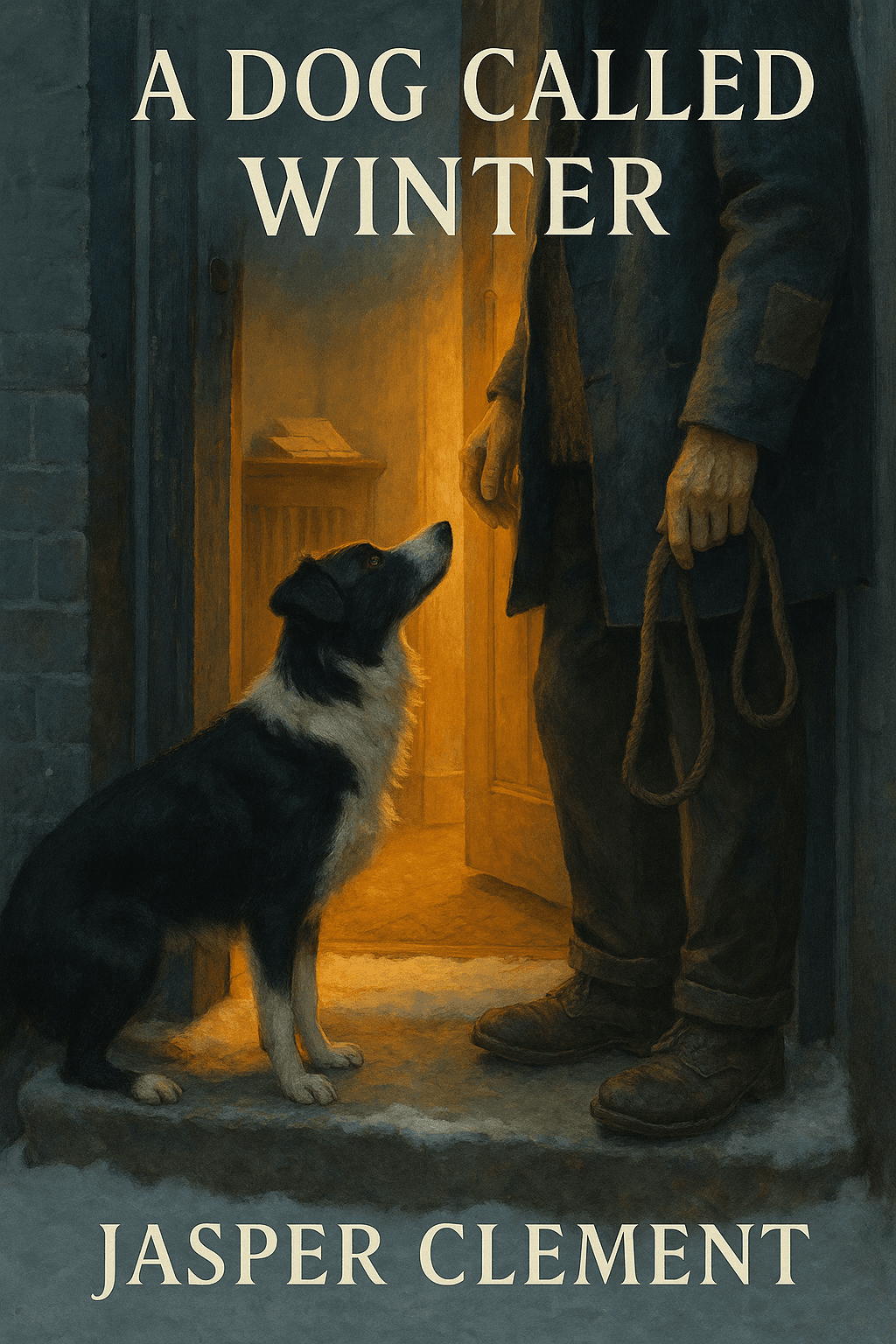
A Dog Called Winter
Chapter 1
The Last Shift
Rain hit the factory roof in steady lines. The yard shone with it, slick concrete and tyre tracks filling with shallow water. Mark stood by the time clock he no longer needed, a damp patch spreading across one shoulder of his coat where the gutter above leaked. The machine hall behind him was quiet but for a low hum from the emergency lights and the far-off whirr of a fan that someone had forgotten to switch off. Oil hung in the air. Swarf dust lay thick in the channels beside the presses. He could taste metal at the back of his mouth.
A laminated notice had gone up by the clock last week. Review of staffing. Necessary step. The notice was printed straight, black on white, with tidy margins. So had the face of the man who asked Mark to step into an office with a window looking at a brick wall.
The office held two plastic chairs, a desk that had lost a corner of veneer, and a box of tissues that looked out of place. Simon from HR sat on the desk with a folder in his lap. He did not look at Mark when he said the words. Restructure. Redundancy. Last day today, Mark. The plant would cut the midnight shift first, the machine three crew second, and then the rest, as needed. Not personal. A phrase he had heard before, in other mouths. Not personal.
Simon took the pass from the lanyard Mark wore on habit. He slid it into a small brown envelope with Mark’s name written in blue ink. He left the envelope open on the desk as if there might be a better use for it. Mark watched the small plastic rectangle slide away and said nothing. He did not shake Simon’s hand. The desk phone rang twice and stopped. His jaw worked once, then stilled.
He walked to the lockers with his empty hands. Men he had known for years stood nearby, tying laces, checking their pockets, adjusting their caps. One of them nodded at the floor. Another gripped a wrench he did not need and ran his thumb over the handle. Boots moved. Nobody said his name. The strip lights buzzed faintly overhead. Mark set his hand on his locker door and felt the cool of the paint.
Inside were the bits he kept here out of habit. A spare pair of socks rolled into a ball. A half-used tin of hand cleaner. A folded photo of Leo and Mia at the seaside when Mia still had her baby cheeks and Leo’s knees were scabbed. A postcard Sarah had slipped into his lunch once, a drawing of a loaf of bread and the words there’s enough. And the watch.
His father’s watch did not look like much. The leather strap had cracked at one hole, and the glass showed a thin scratch near the twelve. The face was plain, with black numbers and hands that moved without fuss. Frank Miller had wound it with two turns each morning for decades. After the funeral, Mark had taken it to a man in Rookham who knew how to clean it, then he had worn it for a while until the work at the press put nicks in the glass and cut his wrist once. He stopped bringing it to the floor. It had lived in the locker since then, safe from oil and grit.
He picked it up now and felt the weight of it. Not heavy. Enough to know it was there. He wound it twice, out of habit, held it to his ear, heard the small tick, and slipped it into the inside pocket of his coat. Home, he thought. He would keep it at home, on the shelf by the kettle. Where he could see it and put his hand out to it when the house was quiet.
He rolled his overalls into a tight bundle and pushed them into his bag. Powder blue from years of wash, knees thinned, a dark smear of grease on the left thigh that never came out. A pair of gloves, one finger patched with tape. A small screwdriver set he had bought himself because the shop ones never matched properly. He put it all in, then zipped the bag and stood for a moment with one hand on it, as if to hold it all in place.
On the bench behind him someone placed a cup down too hard. The plastic flexed and water slopped onto the surface, running into a groove and dripping to the floor. A man said, "Sorry," to no one in particular. Another man’s phone buzzed and he stared at the screen until it stopped.
Mark looked at them. He opened his mouth. He could tell them it was fine, say there was work somewhere else, talk about a mate who had left and done well up north. The words formed. He closed his mouth again. He lifted the bag onto his shoulder, shut the locker door with care, and walked out.
He passed the window of the office again. Simon watched the rain on the brickwork, his hands flat on the manila folder as if to smooth it. Mark kept his eyes on the grey floor paint where it had worn to bare concrete in a path that showed the steps of years.
At the gate, he stopped and reached into his coat. His phone showed Sarah’s name near the top. The picture he had taken of her in the kitchen last summer, hair wet, a towel about her shoulders, laughing at something Mia had said. He looked at the numbers, at the blue call button, at his own thumb. He put the phone back. Not yet.
The security guard glanced at him, then at the station where the pass would normally beep. There was no beep for him now. The guard’s mouth pressed into a line. He slid the barrier open with his hand. Mark stepped out into the yard. Water gathered in the collar of his coat. His breath lifted white in the cold air. He hitched the bag higher and walked toward the road.
Out on the street, the wind blew hard between the houses and into his face. He took the left that would keep him away from the bus stop where he knew a few of the lads would be waiting. He put his head down and counted the drain covers as he went. One, two, three, a gap with weeds, then a fourth sunk low with a puddle round it. He rehearsed a sentence. Love, I need to tell you something. He shook his head and tried again. There’s been a change at work. Under a hardware shop awning he stopped, where water spilled from a cracked gutter in a thin sheet to the left of him. Water hit the pavement. His hand went to his chest where the watch sat and stayed there for a few seconds. Then he moved on.
He reached Moorbridge High Street and kept to the shop fronts, walking in the shallow shelter given by doorways set back from the pavement. His boots left wet prints. A bus rolled past, sending a spray up where the road dipped. In the butcher’s window a string of small sausages hung beside a tray of drumsticks. The paper sign said Special. He didn’t go in.
Other words came to mind. We can manage. I’ve got a bit put by. The envelopes on the sideboard came next. He could see them, even now, the white pile against the pine. He tried to picture Sarah’s face when he would say the words. The image wouldn’t hold. He walked on. The rain eased and then came again, lighter this time, more a fine spray that settled on his hair and the backs of his hands.
The wind blew hard between the mill wall and the houses, through the gap at the top of the street and between the brick fronts and the stone back walls. Mark bent his head and climbed the last short hill. He had walked it more times than he could count. He knew every step. His key turned stiff in the lock. The door stuck for a moment on the swollen jamb and then gave with a brief jerk. The floor just inside the door was colder.
He set the bag down near the mat and stamped his boots once to shake off the worst of the wet. The air in the house was cold. The small hall opened straight into the kitchen, the room they lived in during winter because it was the warmest when the boiler held pressure. The boiler added a faint rattle from its casing. The radiator along the far wall gave off a modest heat. He shut the door and the noise from the street dropped to a low hum.
The sideboard stood opposite the table. On it, a stack of envelopes sat square and plain. A corner of one had caught and folded back, showing a sliver of the paper inside. The top envelope had a red bar printed at the top and a reference number below. He did not need to open it to know it was overdue. He put a hand to the stack and turned it ninety degrees, then back again so it matched the grain of the wood. He could smell old paper and the faint sweet of the polish Sarah used when she had the energy to wipe the surface.
Sarah slept in the armchair near the small gas fire that they rarely lit because it cost too much to run. A wool blanket had slipped from her shoulder to her elbow. Her hair was pulled back, dark against the white of the cushion. Her face had lost the colour it had in October. The corners of her mouth were soft with sleep. A shadow lay under each eye.
He crossed to her and lifted the edge of the blanket back over her shoulder. His fingers brushed the bone there. She lay warm under his hand. He tucked the blanket in at her side so it would stay. On the table near her were a half-empty glass of water, a packet of paracetamol, and the mug he had chipped last winter, a thin white line along the rim showing in the light from the window.
He went back to the sideboard and tipped the top envelope to see the printed line without tearing it. Final notice. He set it down again and pressed his palm to the pile as if to flatten it. He did not open a single one.
He filled the kettle and set it on. The small red light lit. A low hiss came as the element warmed the water. He reached into his coat and took out the watch. On the shelf above the counter, he set it next to the small jar that held loose screws and the tea caddy. The second hand moved in its steady way. He watched it make one full trip round the face, breathed in through his nose and out again. He thought about telling the truth now, before she woke, while the house stayed quiet.
"Mark?" Sarah’s voice came, rough from sleep.
He turned and saw her eyes open, looking for him and then finding him by the kettle.
"You all right?"
"Ay," he said. "You fell asleep."
She pulled herself up a little in the chair and winced. "What time is it?"
"Half four."
"Kids?"
"At next door’s. Jo said they could stay until tea."
She nodded, looking toward the window as if she could see the street there. "How was it?"
He drew in a breath that made his chest lift. He looked at the envelopes and then at her. "Busy," he said. "They’re keeping us on through the rush. All hands."
Her shoulders lowered. She let out a breath. "Good."
"I might get a few extra hours," he said, putting a mug down without noise. "We’ll be all right through Christmas."
She exhaled and let her head rest back on the chair. "Good," she said again. "I was thinking about the gas."
"I know." He poured water over the teabags and waited for the colour to come through. He brought her the mug and set it on the table within reach. "Drink that. It’ll warm you."
She wrapped her hands round the mug and gave a small sound that was almost a sigh. "You’re wet through," she said, taking in his coat.
"Rain was blowing across coming up the hill."
"You staying in for tea?"
"Ay," he said. "There’s bread. I’ll do toast and beans."
She nodded and sipped the tea. The kettle clicked as the element cooled. He stood by the counter and looked at his hands. Grease still showed in the lines around his nails. He rubbed them on a tea towel. It left a grey smear there.
"How’s the boiler today?" she asked, she glanced at the radiator to see if the heat held.
"Holding," he said. "I’ll check the gauge later."
She gave a small smile without showing teeth. He could see the effort it took to sit upright. He wanted to lift her and lay her on the sofa under more blankets, but she would say she was fine and then use energy arguing that she didn’t have.
A key turned in the lock. The door opened and cold air came in as the kids came in with talk and wet shoes.
"Dad!" Leo’s voice from the hall. "Jo gave us biscuits."
"Take your shoes off," Mark called. "Don’t track water all over."
Mia came in first, her scarf looped twice round her neck and her cheeks red from the wind. Her fringe stuck to her forehead in small wet strands. She saw her mum and veered toward the armchair, careful round the table leg.
"You awake, Mum?" she asked.
"Just," Sarah said, smiling in a way that pulled at the corners of her eyes.
Leo headed for the kettle. "Can I have tea?"
"One cuppa," Mark said. "Then we’ll do beans."
Leo looked at the sideboard and the pile of letters, then away again. He had learned not to ask unless told. Mark saw the tiny shift and felt something in his chest move that he couldn’t name.
He buttered toast thin, four slices placed in a row on the board, steam lifting from them. He tipped the beans into a pan and stirred them until they thickened. The four of them ate at the table, elbows in, the plates warm under their hands. For a minute the air felt warmer from food and their closeness. It cooled to the same as before when they finished.
After, the kids cleared as best they could. Mia took care with the knives. Leo stacked plates and turned on the tap. The water ran hot for a few seconds and then cooled. Mark moved the pile of envelopes to the far end of the table to wipe the crumbs.
When the washing up was done, Leo hovered near the door. "Can I go over to Jamie’s? He’s got a new game."
"Homework done?" Mark said.
Leo made a face. "Mostly."
"Finish the rest. Then you can go for an hour."
"Dad," Leo said, drawing the word out into a plea, then seeing the look he was getting and changing his mouth into a line. "Okay."
Mia set her hand on Sarah’s knee. "Can I read to you?"
"Yes," Sarah said, closing her eyes for a second and then opening them again. "Bring the one with the bear."
Mark put the kettle on again and watched the blue flame come. He wiped his hands on his jeans and moved to the washing machine. He took the overalls from the bag and fed them in. The machine door clicked shut. He shook the powder into the drawer and slid it back. He turned the dial and pressed the button. The machine gave its normal start noise and then settled into a rhythm. He stood for a moment and listened to the water fill, then stepped away. The smell of detergent rose, bright and clean, and the oil smell thinned.
He opened the lunch tin he had brought home empty and washed it out. He dried it and placed it on the counter. He took the heel of the loaf and two slices from the middle, spread a thin line of butter on each, and put cheese between. He cut it in half and placed it in the tin. He added an apple that had lost some of its shine but still felt firm in his hand. He filled a small flask with the last of the hot tea and twisted the lid tight. He set the tin and the flask near his boots by the door.
Sarah read three pages with Mia’s voice carrying bits she could not manage. Mark listened without turning his head. He stood by the boiler cupboard and opened it to look at the gauge. The needle pointed at a number he did not like on cold mornings but could live with now, with the rads warm and the day not at its worst. The pilot burned a steady blue. There was a faint metallic rattle when it cut off and on again. He closed the cupboard door and rested his hand on it for a second.
"All right?" Sarah asked from the chair, her voice low so Mia would keep reading.
"Ay," he said. "I’ll bleed the rad in our room before bed."
"Okay."
He watched her mouth shape the words to help Mia. He had always liked her mouth. Frank had said once, in the way fathers say things and then never repeat them, that he should choose a woman whose face he would not mind watching day after day, washing up, bending to pick something off the floor, reading. He looked at her now and felt his throat work.
Leo finished his homework after much sighing that he thought was quiet and then pulled on his hoodie. "I’m going," he said.
"Hour," Mark said.
"Yeah."
The door opened and closed. Cold air came through gaps in the frame and then left. Mark nudged the draft strip back into place with his foot.
Later, after Mia had been coaxed into bed and Sarah had climbed the stairs slowly with him hovering a step behind without touching her, he stood in the narrow hallway and turned off the landing light. He went back down, turned off the kettle at the wall, checked the back door latch, and then went to the front again to test that lock twice. He put his hand into his coat pocket and touched the watch. He took it out and set it on the shelf again, centring it between the tea jar and the screw jar. He looked at it a long moment and then went up to their room.
He found the small key for the rad and bled it into an old tea towel, small spurts of water wetting the cloth and cooling his fingers. When he was done the rad felt warmer, even at the edges where it often stayed cool. He put the towel on the chair back to dry.
Sarah lay in bed with the blanket drawn up. There was a notch between her brows that showed when she had pain. It had eased but not gone. He wanted to sit and rub her feet, which sometimes helped, but she had that particular set to her mouth that meant she wanted him to lie down, not fuss. He pulled off his shirt and folded it, laid it on the chair. He lifted the edge of the blanket and slid in beside her. The sheet felt cold against his legs where his socks had been. He lay on his back for a moment, hands on his stomach, looking at the ceiling where a faint water stain near the light fitting marked the day the roof had let in two winters ago.
"If they need you," Sarah said into the dim room, "you might be late some nights."
"Ay," he said, keeping his voice steady. "I might."
"We’ll manage."
"There’s enough," he said without thinking. The words came from the postcard on his locker, and he heard them now in the dark. He turned his head and looked at her. She turned hers and looked at him. In the faint light from the street he could see her eyes.
"There’s enough," she said back. She reached across and found his hand. Her palm felt warm. She squeezed once and then let go.
He lay awake while her breathing settled. The boiler cut in below, a firm click and low sound that came through the pipes. He kept his breathing slow so it would not wake her. He counted a few seconds each time the boiler stopped and started. The bag by the door, the lunch ready; the pile of envelopes; his father winding the watch in the mornings, two turns, no more; the guys at the plant looking away; Simon’s face. The phrase not personal didn’t fit inside any sentence that included his children’s names.
He counted to sixty and did it again. Somewhere down the street a car door shut and an engine started. Leo came in, lighter feet on the stairs as he tried to be quiet and still hit the bit of the third step that creaked. Mark smiled without showing his teeth. He turned onto his side, toward Sarah, and slid his hand under the pillow to press his fingers against the cold sheet and then took them back out. He closed his eyes and shaped a sentence he knew he could say tomorrow, then let it go. Downstairs, the watch ticked. He slept.
Chapter 2
The Library
The kettle light glowed red against the grey of the early hour. Mark stood in the kitchen in his socks and watched the element bring the water up. The clock above the door read not quite five. He kept the room half-dark. Only the small lamp by the bread bin was on. The boiler gave a low clank and settled into a steady noise. He put his hand to the radiator and felt a thin warmth along the top. Enough for now.
He moved without waking the house. Coat from the chair. Shirt from the back of the kitchen door where he had left it to air. Jeans with the cleanest knees. He chose socks with no holes. He sat and laced his boots the way he always had, pulling the leather tight and tucking the ends. The boots showed salt lines near the toes where last winter’s snow had dried. He rubbed at one with his thumb and then stopped. No time for that.
The lunch tin sat by the door where he had placed it last night. He opened it and checked the halves of cheese sandwich he had made. The apple still looked firm. He twisted the small flask and made sure it sealed. The metal felt cold. He set the tin and the flask back by the mat and went to the sink.
On the shelf above the counter, the watch lay between the tea caddy and the screw jar. He glanced at it and did not touch it this morning. Leaving it where it could be seen by anyone who came in felt safer, as if it had always been there and would stay there. He filled the kettle again to the halfway mark and switched it off at the wall. He did not want a click later to wake anyone.
He moved to the hall and pulled on his coat. The old patch on the sleeve near the elbow felt rough under his hand. His phone went into the inside pocket. He checked the back door latch, then the front, and left the chain off. He went back to the kitchen, lifted the lunch tin and the flask, and placed them into his old work bag to better hide them from anyone passing on the street with sharp eyes.
He stood a moment by the table. The stack of envelopes on the sideboard was square and white in the low light. A corner still folded from when he had tipped the top one last night. He set his palm flat on the pile and then took it away. He picked up his bag, bent to lift the draft strip with the toe of his boot so it would not tear when he opened the door, and then eased the door open.
Cold air came in at him. It hit the skin under his collar and ran down his back. He stepped out and pulled the door to. The lock turned with a small click. He tried it. Turned it again and tried it once more. He lifted the draft strip back into place with his foot and tucked the loose end under the frame.
The street lay empty. A thin haze hung under the one working lamp at the corner. Wind moved down the length of the terrace and blew bits of grit along the pavement. He lifted his collar and set off toward the cut-through that ran behind the houses. He took the lane past the bins rather than the main road. If he went by the bus stop this early there was a chance he would meet Gary or one of the others who had been kept on. He was not ready to hold his face steady for that.
He walked with the bag strap across his chest. His breath showed. He put one hand in his coat pocket and flexed it against the cold. He told himself the hours. Start at six. First break at eight. Lunch at noon. Two more hours and a small break. Off at half three, on a good day, or four, on a day when someone needed a hand with a jam. He would follow the hours and go home at dusk. He would let his shoulders drop before he reached the door.
At the end of the lane he paused and listened. A van moved somewhere toward the high road. A dog barked three gardens over and then stopped. He crossed to the next side street, keeping to the houses. He passed the small cafe that opened early for drivers and night men. Yellow light showed through the steamed-up window. A man sat at the counter with both hands round a mug. When the door opened, bacon steam drifted into the cold. Saliva gathered under his tongue.
He kept walking. There were coins in his pocket but he could not be seen in there, not this week. A man sat in a cafe at this hour was a man who had a morning off or had been out all night. Either way, a man with a job he could talk about. He watched his feet and the lines where the concrete slabs met. He stepped over a broken place where water had settled and gone to ice by the edge.
By the time he reached the library it was still not light. The automatic doors did not open until eight thirty. From other mornings of cold and early starts when he had come in to use the computers to check a rota or pay a bill, he knew that. Today he walked past, crossed the street, and made a slow loop around the block. He would go back when the doors opened. For now he kept his chin low and his pace even, eyes on the pavement. The wind off the moor felt sharp. It came through the seams of his coat and made him clench his jaw.
He counted minutes on his phone and then put it away. He ran through the shape of the day again and fixed it in his mind. A rule, then: no pub or cafe, not even for a warm, not unless he could pay for it without taking from the house. Sarah under the blanket in the chair came to mind, and the children getting themselves ready for school next door with Jo’s voice calling out times and a list of items to remember. The pile of letters on the sideboard and the red line on the top one. He stopped at the bench by the bus stop and did not sit. He stood for a minute, then turned back toward the library for opening.
The doors slid aside at half past eight. He went in with two others, both older, both wearing thick coats and hats. Inside, the air felt different at once, drier and warm near the entrance. The tall windows let in a pale light. The radiator along the far wall gave out a low hum. He breathed in through his nose. Old paper, dust, a faint scent of polish where someone had wiped the desk.
He chose a seat near the radiator. It ran just under the sill, painted dull brown. He held his hands out for a moment to the gap where the heat rose, then pulled them back and sat. He slid his bag under his chair and looked down the rows of shelves. The spines formed lines in shades of faded blues and greens, black, brown. A man at the far end coughed behind a book and then fell quiet. The librarian at the desk stamped a return and set it aside. The stamp sounded once, then stopped.
He went to the newspaper rack and took the local. Folding to the jobs page, he ran his finger down the columns. Part-time, seasonal, so many hours, driving licence required. He lifted the paper higher so his face sat behind it and read the words he had read before. He found a listing for a warehouse in Rookham, nights, temp-to-perm, agency number given. He held the page open and looked at the agency number, then closed the paper and returned it to the rack.
He took a seat by a different table, this one near the large-print books. He kept the radiator within reach. He shifted in such a way that he could see the desk but not be directly in the librarian’s line. He did not want to hold one place too long. Men who held the same seat all day were noticed. Men who moved were less likely to be noticed.
At nine he checked the clock above the biography section. He did not pull out his phone. He made a small line on the corner of a scrap paper he had taken from his pocket—a habit from the floor where men sometimes marked down minutes until a break. He drew the line and then put the paper away.
The tall windows showed a solid sheet of grey cloud low across the sky, though no snow fell. Schoolchildren came in with a teacher just after ten. They made small noises as they came through, zips on coats, the scrape of shoes. The teacher told them to settle and spread out. Mark lowered his head and stood, carrying a book as cover. He walked to the shelves near the windows and pretended to read the backs. He saw a mother he knew from Leo’s year standing by the door, talking to the librarian about a form. He turned his face to the shelf and moved to the travel section. He waited until the mother had gone and the class had been shepherded toward a corner, then returned to a table further back.
He picked up the national paper and went through the business pages. The page held dense blocks of print. He did not need the detail to know what it meant for places like Moorbridge. He read a piece about quarterly results and put it down. He let his hand rest on the table for a few seconds and then took it away. He stood again and changed tables, moving to the one by the small computers, then to a desk by the window. Each move was small and even, the sort his father had taught him with tools, steady and unhurried.
At eleven the librarian put a notice on the desk about Christmas hours. Mark stood to read it as if that had been his purpose all morning. He nodded, though he would not come in on Christmas Day. He sat down again and pretended to go through a book of photographs of the Peak District. He stopped at a shot of the gritstone edges under frost, a brief memory of standing there with Sarah years before passing through. He closed the book and put it back where it had been.
His stomach tightened at noon. He opened the lunch tin, then shut it again, a slight tremor in his fingers on the lid. He took the flask and poured a small portion of tea into the lid. He sipped at it and felt the heat move down his throat. He capped the flask without finishing the portion and returned it to the bag. He told himself he could eat later if there was anything left over at tea time. He folded his hands and rested them on the table, then stood because he had been sitting too long and crossed to the magazine rack to stand and read the cover of a trade magazine he would never buy.
Every hour, he looked at the clock and marked another small line on the scrap paper in his pocket. He did not look too often. He let minutes collect. He thought of the press at the plant and the way the hands there had lined their days around the machine’s rhythm. Here there was no rhythm, only the sound of the radiator and the shuffle of pages. He breathed through the tightness that came into his chest when he kept still too long.
A man in a high-vis jacket came in and asked at the desk about printing a form. Mark watched the man’s hands, square and nicked, and the way he held his shoulders, lowered from a morning of carrying weight. He wanted to ask the man where he worked. He turned his head and studied a shelf of dictionaries instead, then wrote another small line on the scrap paper and put it away.
At quarter past three, the librarian called out that they would close soon for maintenance. Mark lifted his bag and slipped the strap over his head. He put the chair back under the table the way he had found it. He walked out at ten to four, just before they pulled the doors, so that if anyone saw him on the street, he would look like a man leaving a place at the end of a day.
Outside, the air felt colder than in the morning. He walked toward the High Street, keeping his pace even, breath showing in the cold. He walked along the street with the bag light at his side. He turned toward the cashpoint at the corner of the high street. A man in a hat stood at it counting out notes. Mark waited and held back a step so he would not stand too close. When it was his turn he put his card in and watched the screen. A minus sign sat before the amount on the screen.
He stared until the screen asked him to choose another option. Pressing balance again, he watched for a change. Nothing changed. He cancelled the transaction and took his card. Stepping aside, he let the next person use it. He had known the numbers would be bad. His stomach tightened and stayed tight.
He turned down a side street to the small corner shop that carried basics and cheap tins. The bell over the door rang when he went in. The light inside was bright and a little harsh. A small radio in the back played a song he knew from years ago. He picked up a basket and walked to the tea. On the bottom shelf he chose the box with the small price printed on the corner. He looked at the brand he normally bought and put it back. He could steep it longer.
Past the fridge with the milk, he took the smallest bottle. He thought of the children’s breakfast and put it in the basket. At the bread he picked up a loaf that would last them through to the weekend if they watched it. At the meat section he turned away. At the tins he took two of tomatoes and one of soup. In his head he counted what he had left. The second tin of tomatoes went back; he kept the soup. He added a small packet of pasta. Weighing the basket in his hand, he headed to the till.
At the counter he laid the items out in a neat line and watched the numbers on the screen climb and then stop. He pulled coins from his pocket and counted them onto the small tray. A two-pound coin he had forgotten turned up and he let out a small breath. He still owed pence, so he reached for the small zipped section of his bag and took the rest. The man at the till slid the items into a thin plastic bag and handed him the milk separate so it would not crush the bread. Mark lifted the bag and thanked him. He pocketed the change and felt the coins too light in his coat.
Outside, he stood with the bag in one hand and looked up the street. The sky had a dull, white look to it. He told himself how he would say it when Sarah asked. On offer, he would say about the tea. It was the truth, in a narrow way. He let out air and began to walk.
He slowed as he turned onto their street and dropped his shoulders to the set of a man tired from work. He let his steps sound on the pavement in a way that matched the end of a day. He loosened his grip on the bag and rolled one shoulder, easing a stiffness. He pushed the draft strip with his boot and opened the front door.
Warmth, thin as it was, rose at once. The boiler had cut in. He stepped into the kitchen and set the bag down on the counter. The new tea sat next to the caddy they normally used. The difference between the boxes was plain. He turned the cheaper one so the label with the small price faced the wall.
Sarah sat in the chair with her knees drawn up under the blanket. A book lay face down on her lap. She looked up when she heard the door and watched him for a second, taking in the bag and the set of his shoulders.
"You all right?" she asked.
"Ay," he said, taking off his coat and hanging it on the back of the chair. "Cold out."
"Looked it," she said. She sat a little straighter. "Day all right?"
He kept his eyes on the counter. "Busy," he said. He lifted the milk and put it in the fridge. "Same as."
She watched his hands. "You look tired."
He nodded and went to the kettle. He filled it from the tap and set it on. The red light came on. "Be good to sit a bit," he said. "How were you?"
"Slow. Jo took Mia at three for an hour. Leo brought his reading home and did it at the table." She looked at the new tea on the counter. "We out of the other?"
"On offer," he said without turning. "This one was." He kept his tone even. He flicked the switch and listened for the first sounds of heat building.
"Right," she said. She did not push it. She pulled the blanket tighter over her legs and shifted the book off her lap to the arm of the chair. "I did the ring-round for the GP repeat. They put it through."
"Good," he said. He opened the cupboard and took down the chipped mug and then her mug with the thin blue line near the rim. He set them side by side.
"Any talk of extra hours?" she asked, eyes still on his hands.
He picked up the kettle and poured water over the teabags. "Might be some," he said. "They said they could do with it if orders come in."
She let out a slow breath. Her shoulders lowered a fraction. "That’ll help."
He slid a mug toward her. "Careful," he said. "Hot."
She wrapped her fingers around it and held it near her chest. "Thanks." She watched the steam rise and then looked back at him. "We’re steady, though," she said. "With careful."
He nodded, keeping his jaw still. "We’ll manage."
The children came in then, cheeks pink. Mia had paint on the side of one hand and held it away from her scarf. Leo went to the sink without being asked and washed his hands. He looked at the bag on the counter and then at his father. Mark lifted the bread and the tin of soup and set them out as if the shop had been an afterthought.
"Tea?" Leo asked.
"One," Mark said. "Then we’ll eat."
Mia raised her painted hand high, fingers spread. "We made trees," she said.
"Nice," Mark said. He found a damp cloth and wiped the paint gently from her fingers when she held them out. He did not look at the letters on the sideboard but he knew where they were, white shapes against the wood.
He moved the stack to the far edge of the table to make space for plates. He straightened the corners so they sat square. He did not open any. He took a pan from the cupboard and the tin opener from the drawer and set them on the counter, then put the pan on the hob. The tin yielded to the opener with a familiar sound. He poured the soup into the pan and added a little water to thin it and make it stretch.
He cut four slices of bread and laid them out, buttered thin. He gave Mia the corner piece she liked, the one with the most crust, and set the others on the board. He let the soup warm and watched for the small bubbles at the edge. He stirred. He did not taste.
They ate at the table. The soup was simple and hot. Mia blew on each spoonful before she lifted it. Leo ate fast at first and then slowed to match Mia. Sarah took small sips and rested between them. Mark cradled his mug and forced himself to take only a few mouthfuls. When Mia pushed her bowl toward him with a small amount left, he shook his head. "Finish it," he said. "It’s yours."
"Did you eat at work?" Leo asked, not looking up.
"Ay," Mark said. He touched the lunch tin under his chair with his boot. "Had mine."
Sarah watched him and then looked away. "Thank you," she said, not to the soup but to him, for the day and the shop and the steady.
He set his spoon down and lifted his mug again to give his hands something to do. "We’ll keep it going," he said. "There’s enough."
After the bowls were cleared, Leo washed and Mia dried. The water came hot for a short run and then cooled. Leo closed the tap and opened it again, and the water ran cool. He shrugged and used the towel longer, making his hands pink. Mark wiped the table and then wiped it again where soup had splashed. He set the stack of letters back in place and smoothed the top one with his palm.
"You all right to take Mia next door for half an hour?" Sarah asked Leo. "I need to lie down."
"Okay," Leo said. He helped Mia with her scarf and they went out into the hall. The door opened and cold air came in, then shut again.
Mark put the kettle on and watched the blue flame, then switched it off and back on as the pilot clicked in and out. He crossed to the boiler cupboard and opened it. The gauge sat where it had sat this morning. The pilot burned a steady blue. A faint rattling sound came when it cut out and then back in. He closed the door and rested his forearm against it for a second.
Sarah pushed herself up from the chair. He went to her without making a show of it. She stood with his hand near but not on her elbow. She took one step and then another. He followed her up the stairs, one behind, careful not to crowd her. At the top she paused. He waited until she moved again and then went after her into the bedroom.
He pulled the blanket back and helped her sit. She lay down with care and drew the blanket over her shoulder. He tucked it under her back where a draft always found its way through the window frame. He smoothed the corner and stepped back.
"You need anything?" he asked.
"No," she said. "I’m fine. Put the radio on for Mia when she comes back."
"Ay."
Downstairs, he turned off the kettle at the wall. He took his coat from the chair and laid it over the arm as he would in the morning. He put the lunch tin beside it. He opened it and looked at the sandwich. He closed it and left it shut. He would offer it to the children as a snack later if they asked. He looked at the tea caddy and the new tea behind it. He would get used to the taste.
In the living room the small gas fire was off. He did not turn it on. He turned the radio to a low volume and set it to the station Mia liked at this hour. He sat at the table and rested his hands on the wood. He ran his thumb along a scratch in the surface where Leo had dragged a fork too hard years ago. The scratch caught at his nail. He thought of his father’s line about cracks and history and set his thumb flat again.
The children came back in with a burst of talk about a game and a song they had learned. Mark stood and made space for them to pass. He found the old biscuit tin and shook two into each of their hands. Mia climbed into Sarah’s chair and set herself deep, hands on the arms. Leo sat on the first step in the hall and listened to the radio without saying he was listening.
The light outside faded, then dimmed further. The radiator along the wall felt a little warmer at the top and still cool at the bottom edge. Mark fetched the small key and bled the living room rad into a tea towel. Small spurts of water came and then steadied. He tightened the valve and folded the towel, setting it over the back of a chair to dry.
When it came time, he sent Leo next door to say thanks to Jo for having them and to bring back the lunch box Mia had taken earlier. He stood at the sink and washed the pan from the soup. The water ran cool and the grease took longer to come off. He rubbed until it did. He set the pan upside down to drain.
He made tea with the new bags and let the brew sit longer than usual. He poured for Sarah and then himself. The tea had a sharp, dry taste at the back of his tongue. He did not show it in his face. He added a drop of milk to both and carried Sarah’s upstairs, holding the mug steady with a steady hand. She stirred without lifting the spoon and sipped.
"Different," she said.
"On offer," he said again. "Tastes all right if you leave it."
"It does," she said. "Thank you."
He went back downstairs and sat. A folded scrap of paper with the hour marks lay in his pocket. He drew it out and looked at the short row of lines he had made in the library. He folded it into a smaller square and pushed it deep into his pocket.
At eight he turned off the radio and told the children it was time. Mia said she was not tired and then yawned and put her head on his arm. He lifted her and carried her up the stairs, one slow step at a time, careful with the third stair that made a sound if you hit it heavy. He tucked her into bed and smoothed her hair off her face. Leo lingered by the door. "Night," he said from the doorway, older than his years for a second.
"Night," Mark said. "Mind the lamp."
He stood in the hallway and listened for a moment to the muffled sounds of them settling. He went down and turned the kettle off at the wall. He checked the back door latch again, then the front door twice. He moved his coat to the chair by the table and placed the lunch tin beside it at a deliberate angle. He picked up the watch from the shelf and set it down again in precisely the same place. The second hand moved in its plain way. He watched it for a full turn.
He went up to bed and slid in next to Sarah. The sheet felt cold on his legs. He lay on his back and looked at the ceiling. The faint stain near the light fitting had not spread. He placed a hand flat on his stomach and breathed to the count he had learned to use when sleep did not come. Below, the boiler cut in and then out. He kept his breathing steady so as not to wake Sarah. He turned onto his side toward her and lay still. His chest felt tight, and the sheet stayed cold against his legs. He closed his eyes and listened to the sounds of the house, the low noise from the boiler pipes, the occasional tick from the watch downstairs when the house was quiet enough to hear it through the floor. He kept his hand where it was. He lay still while the house went quiet.
Chapter 3
The Ghost
Snow came in fine grains at first, a dry sting on his cheeks, then thicker, faster, driven across the row so it slid against brick and stuck in the gaps of the paving. Mark kept to the side streets and the shallow shelter of low walls, his old work bag strap across his chest, his hands deep in his coat. The last hour of the day was always the hardest. Cloud hung low over the roofs; the snow cut the street down to a few yards. He moved as he always did at that time, a steady walk that would look like the end of a shift to anyone who glanced out from a lit room.
He took the cut-through behind the terraces. Bins stood in a line. Lids rattled when the gusts came along the lane. He leaned his shoulder as he passed the gap by the mill wall where the wind came straight down from the moor. The white thickened. Streetlamps came on early and the light around each lamp shortened to a small circle.
At the corner he paused, listened, and crossed. The bus stop bench held a thin layer of snow on the seat. He didn’t sit, checked his phone without unlocking it, then slid it away again so he would not bring his hands out of his pockets in the open. Another loop was possible. Waiting it out in the library lobby would have worked if they hadn’t shut early for maintenance the day before. He looked toward the High Street and saw only small yellow rectangles in the shop windows and a dark shape lumbering past the butcher’s with its head tucked in. He thought of Gary at the plant and of the bus stop where men still waited, then put that thought aside.
He took the back road that ran parallel to the High Street and headed toward his own end of town. The snow climbed his boots at the toe and packed into the creases in the leather. He kept to a steady pace. When a stronger gust came and pushed him into the gutter he righted himself and set his feet again.
At the top of the short hill the kerb had vanished under a low drift. He stepped sideways, tested the ground, and sank to the ankle. Meltwater reached his socks. He drew his foot out and shook it once without meaning to. He looked left, then right. To his left, the road opened onto a wider stretch that would be worse. To his right, he could turn down and cut back under the lee of the old warehouse. He turned right. The wind blew against him and took his breath for a second. He leaned into it, head low, steam rising from his mouth and going at once.
He could keep the loop going and come back at four, the way he had the day before, and he weighed it: the look of the streets now and the look of himself if he slid or fell and turned an ankle in the drift. Sarah in the chair, a blanket at her knees, watching the light dull in the window, came to mind. Then the letters on the sideboard, the red bar on the top one. Men who walked in this weather to be seen were remembered for slipping. People would remember if he slipped up.
He chose his own street.
On that stretch drifts built at the corners. He lifted the draft strip with his boot when he reached the front step and eased the door. The door stuck, swollen with damp as always. He put his shoulder in, pressed, and got it wide enough to get through. He kept a hand on the strip, careful not to tear it, and shut the door against his back with a muffled thud. Snow had driven under his collar. He felt it melt and run cold along the nape.
The radiator gave off a weak warmth. The boiler gave its small metallic rattle when it cut in and then went still when it cut out. He hung his coat on the chair back and shook water from his hair. Drops fell to the kitchen flags and made small dark marks. He wiped his face with the heel of his hand and then rubbed his hands together to bring them back.
Sarah looked up from the chair. The blanket was folded over her legs. She held one corner in her hand. A book lay open on the arm, her place held with a finger. Her cheeks had some colour from the room’s heat and the way she had tucked herself in close to the radiator.
“You’re early,” she said.
He glanced at the lock screen. 3:35. He bent to the bag and set it down by the table leg. “Line’s down,” he said, keeping his voice even, not making anything of it. “They sent folk home. No point standing there.”
She studied him a second longer and then nodded, not in a way that tested the story. She glanced toward the window, then nodded again. “I thought it had set in,” she said. “Sound carries. It’s strong.”
“Cold out,” he said, without thinking. He rubbed at the edge of his left boot where the snow had gone through and saw a white salt line he had rubbed the day before. The salt line could wait. He crossed to the boiler cupboard and opened it. The gauge sat just where it had been. The pilot burned a steady blue. When it cut in, the rattle came and then stopped when it cut out. He closed the door and set his forearm to it for a second, his sleeve damp from the snow.
“You’ve not eaten, then.” It wasn’t a question. She looked at the lunch tin on the chair and then at the bread on the counter.
“I’ll make tea,” he said. Filling the kettle halfway, he flicked the switch and watched the red light come on. From the cupboard he took down her mug with the thin blue line near the rim and his own chipped mug. He set them side by side. Reaching up without looking, he touched the shelf where his father’s watch sat between the tea caddy and the screw jar. He didn’t take it down. He left his hand there for a breath and then drew it away.
Leo came in from the stairs, socks on, hair flat at the front where he had pressed it with his hand. “It’s thick,” he said. “Jamie texted but Mum said no.”
“Right,” Mark said. “Good.” He didn’t mention it would have been no even if the weather was fine. He poured water over the tea bags, watched the colour lift, and let it sit longer because of the cheap brand. “Mia?”
“Upstairs with her animals. She wanted to look from the window.” Leo peered at the door. “It’s coming under.” A little ridge had formed along the base where the strip didn’t quite meet the threshold.
Mark took the brush and drew the line of snow back into the world, sweeping it into the dustpan and tipping it into the sink. At the tap, it melted quick in the flow. He turned the kettle off at the wall and lifted it. He poured, added a drop of milk to Sarah’s, and set it on the table near her hand. She wrapped her fingers round it and held it without drinking.
“Shops shut already?” she asked.
“I passed the corner. He was pulling the sign in.” He sipped his tea; the tea left a dry edge on his tongue. He didn’t mind. It was hot and something to hold. “We’ll sit tight,” he said. “No sense going out again.”
She nodded and leaned back. “What about tea?”
“Soup. Bread. We’ll make it enough.” He set the tin on the counter and opened the cupboard. One tin of tomatoes sat next to the small packet of pasta he’d bought the day before. He opened the tomatoes and poured them into a pan, added water and a pinch of salt, and set it on the hob.
Snow hit the glass in short ticks. In the hall, the letter stack sat on the sideboard where he had left it that morning. He went to it, pressed his palm on the top envelope to make the corners sit flat again, then left it alone. Not yet. Not when the weather had the feel of a night where you did the next thing and the next and left the talk for another day.
They ate early, bowls in their hands, steam rising, the bread cut thinner than he would have liked but doing the job. Mia came down with a scarf wound round her shoulders over her jumper. She held the scarf ends in her hands and sat on the floor near Sarah’s chair as if the closeness would help. Leo took the chair by the radio and turned the volume until the voice came in clear. There was talk of weather warnings and grit lorries turned back on the tops. He turned it down again and sat, watching the window as if the storm might lift if he looked hard enough.
“Tomorrow school?” Mia asked, her voice small round the spoon.
“We’ll see,” Sarah said. “Depends.”
After, Leo washed up and Mia dried, the water coming hot for a minute and then sliding cooler. Mark moved the rack to the side to catch the drips and wiped the damp off the table with a cloth. He left the cloth on the radiator to warm for a bit, then folded it over the rail.
He drew the curtains as the light went and tucked them behind the little bracket to keep the crease. He stood for a second and looked at the place between the two houses opposite where wind funnelled. Little swirls rose off the main drift and pushed against the brick. He closed the gap in the curtain and checked the drafts at the sill with his palm.
“Early night,” he said. He kept his voice gentle. They stayed near the radiator; the doors stayed shut.
“Right,” Sarah said. She folded the blanket up over her legs and tucked the edge in at her hip. She was pale again but her mouth had a set to it that he trusted. “We’re all here,” she added, as if that was the measure.
They sat with mugs, the radio low; they saved where they could, watching the room take on the look it had when the curtains were drawn early and no one planned further than the next warm drink. The boiler clicked on and off. He noted it and then let it go.
An hour passed. The radio gave another warning.
A scratch came at the front door. A single, quick sound, then nothing. He lifted his head and kept still. Leo looked at him.
“Wind,” Leo said, trying to make it light.
The scratch came again. A scrape, low, then a pause, then a quicker set, a catch, then a scrape free. Mark stood. He listened for a third time before he moved. He didn’t want to make drama where there was none. He put his mug down on the table and lifted a hand, palm down.
“Stay there,” he said.
He crossed the hall. The sideboard sat to his left, the white envelopes square and quiet, the red bar on the top one clean against the paper. He felt the cold make its way through the door’s edges along his shins. He slid the bottom bolt back and lifted the chain so it wouldn’t rattle. He bent and set his boot on the draft strip, pinning it. He leaned in and put his ear to the wood. He could hear only the wind and then, faint under it, a small whine.
He opened the door a hand’s width. Snow pushed in at once and he caught the strip with his free hand. A shape stood close, pressed to the step, the kind of black-and-white that showed bright when seen against snow. As soon as the door opened, the dog pushed through with a shoulder. Mark held the strip and let the door open because if he fought both, he would lose the strip and the dog. He stepped back. The dog half-slid on the mat, held itself low, and stood, sides moving. Its coat was soaked to the skin. It was not thin, not mangy. It had a collar, dark and plain.
Mia took a step off the bottom stair without thinking. Sarah’s voice came from the chair, not loud. “Bring him in, love.”
Mark closed the door with care, rehung the chain, and pushed the bolt into place. He bent to the mat and reached for the towel that lived on the shoe rack for wet hands and worse days. He set the towel over the dog’s back and rubbed, lifting water. The dog stood, eyes flicking to his face and away again, then to the room and then back. Its ears twitched at each sound. It didn’t bare teeth, didn’t flinch when he reached the sides. He worked down the legs and across the chest, changing the towel’s fold when it grew heavy.
Leo came to the hall, then stopped and looked for a signal. Mark flicked his eyes down to the floor, a sign to mind the wet. Leo took a half-step back onto the rug.
“Council?” Mark said toward the kitchen, breath steadying as his hands worked. He kept his voice flat, practical. “Out-of-hours number?”
“In the book,” Sarah said. “By the phone.” She had the thin phone directory with the local numbers and set it on the arm of the chair. “Or on your mobile. But love—”
He didn’t make her finish. He straightened, wiped his hands on the towel, and took his mobile. The screen lit his face for a second. He scrolled with his thumb and found a number that looked right for animal services. The call went through to a recorded message about adverse conditions and limited response. It asked him to leave a message and someone would return the call when they could. He ended the call.
“No one’s coming,” he said. He looked at the dog’s collar. It had a ring but no tag. “We can’t… We’re not set up for…” He didn’t finish. The dog shook itself once, hard, and drops flew. His mouth tightened and he looked away from the letters on the sideboard because that was where his eye had gone.
“Bring him in,” Sarah said again, the same steady tone as before. “He can’t go back out.”
Mark took a breath. “Just for tonight,” he said, to the room and to himself. “We’ll see in the morning.” He stepped back and angled his body so the dog could pass him without feeling cornered. The dog moved into the living room, paws light on the floorboards, head turned, taking in the place. It dipped its nose to the radiator, then to the edge of the rug. At the rug’s edge it put one paw on, lifted it back, then set it again. It looked up at Sarah in her chair and held there.
Mia lowered herself to her knees by the arm of the chair and held her scarf out and kept still. The dog sniffed it, then sniffed her hand and set his head under her fingers for a second before moving on. She smiled without showing her teeth and kept her hand where it had been so he could find it again if he wanted.
“Don’t crowd,” Mark said, and Leo drew back a half-step more, his hands in the pockets of his joggers. He kept his hands still in his pockets. The set of his shoulders gave him away.
Mark went to the cupboard under the sink and found the old mixing bowl with the dent from the drop last year. He rinsed it, filled it, and set it near the radiator where the dog had sniffed. The dog lowered himself and drank with quick, clean laps at first and then slower, pausing to swallow, then lapping again. Mark clamped his hand against the back of the bowl so it wouldn’t slip on the floor. When the dog lifted his head, drops hung from his muzzle. He licked them off and looked up.
“Hungry?” Mia whispered. She looked to Mark as if his face would answer.
“We’ve soup left,” Sarah said. “Bread crusts.”
He checked the loaf and counted what was left without lifting the slices: the heel and two thin pieces. Mark weighed a bit of bread in his hand, a corner piece from the end of the loaf that Mia liked. He pinched off a small piece and set it down on the floor. The dog sniffed it, took it, and chewed. He gave another small piece. He stopped after that. “That’s it,” he said. “Not on soup. Belly won’t like it.” He had seen what happened with dogs that took too much after a day roaming. He kept his voice steady, matter-of-fact.
The dog paced the living room perimeter once, nosed at the gap beneath the kitchen door, and then came back to Sarah’s chair. He lowered his body and lay near the foot, a small distance from the radiator, with his forepaws out and his head up. He let out air through his nose and then stilled. His sides moved, slow and regular. Mia slipped her hand down between the arm of the chair and her knee and let the tips of her fingers meet the fur at the top of his head. The dog didn’t startle. He seemed to weigh the hand, then allowed the touch.
“That’s it,” Mark said softly. “Gentle.” He didn’t know who the word was for.
Leo moved to the doorway and leaned his back against the frame. He had a look on his face Mark had not seen on him in weeks: open and unguarded. He sank into a slow crouch, palm down, fingers loose.
Sarah had gone still in a different way. Her shoulders eased. The tight line at her mouth softened. She allowed it without moving an inch, as if to move would break the shape of it. A smile touched the side of her mouth and stayed.
Mark watched that. He took it in. He had not planned for this. He had planned for lists and for rules. He had planned to ration bread and to lie about hours and to bleed radiators. He had not planned for an animal to look at his wife and stop there.
“Tonight,” he said again. “We’ll ring first thing. See if anyone’s—” He didn’t say it all because a call in the morning would set a process he could not stop.
Mia looked up at him from the floor. “He needs a name,” she said.
“Not yet,” he said. “Not ours to name.” The words were plain. He didn’t put weight in them. They were for him as much as for her.
He opened the kitchen door, heard the steady breath from the next room, and left it open. He could have shut it to keep the dog to one room. He looked at the line of wet on the hall floor and the towel heavy with water. He looked at the way the dog had chosen a place by the chair and settled. He left the door.
“Bed,” he said to the children. “It’ll be early if school is on. If it isn’t, still early.” He waited to see if they would argue. Leo didn’t. He held on to the frame a second longer than he had to and then pushed himself off it and went up the stairs. Mia got to her feet clumsy with the way she had been folded and then leaned over the dog once, quick, and touched his head with her lips. “Night,” she said into his fur.
“Night,” Sarah said, smiling in a way that changed the lines of her face back toward the woman he had married, less pulled by pain. “Brush and bed.”
When the children’s feet had gone quiet above, Mark picked up the towel and took it to the sink. He squeezed it and watched the water run brownish and then clearer. He wrung it out and hung it over the back of the chair near the radiator. He put the mixing bowl by the wall so no one would kick it in the night.
A man on the radio said the gritters would try again in the early hours if the wind eased. The man on the radio said the tops were closed. He listed road numbers that meant something to men in cabs and men in vans. Mark half-listened and set the volume low.
He took his father’s watch from the shelf, wound it twice, and set it back in the exact place between the tea caddy and the screw jar. He watched the second hand go round once. His shoulders eased. He put the kettle on while he still had hands free. He didn’t switch it on. He left the plug out to save the click.
Sarah’s hand drifted from her lap to the arm of the chair and down. Her fingers rested for a second on the dog’s ear. The dog made a small sound that was not a whine, more a breath shifting through a different shape, and stilled again.
“Thank you,” she said, not looking at him, not making it a big thing.
He looked at her and then at the dog and then at the letters and nodded.
He sat at the table and listened. The dog’s breathing had its own pace. Between those breaths came the click from the watch when the house quieted enough. Then the boiler cut in and out with that faint sound just at the edge of hearing. He measured time by the dog’s breath and the watch tick. The last tin of tomatoes stayed where it was. The lunch tin stayed shut; with his foot he slid it under the chair where it would sit in the morning if he needed the sign of work. He didn’t lift it from there and put it by the door. He left it under the chair and sat with his hands folded.
His phone lay on the table. He didn’t open it to look at the advisory notices or the work listings he wasn’t calling. He didn’t set tomorrow’s hours in his head the way he had on the other days. He would have to take the dog out in the morning, at least to the end of the street. He would have to find a lead. He thought of the old length of rope in the cupboard and knew that would do until he could do better.
“You should sleep,” Sarah said. “You’ve done enough for a day.”
He looked up at her, at the way her head had eased back into the chair and the colour in her cheek hadn’t dropped away. “I’ll sit a bit,” he said. “Make sure he’s settled.” He meant the dog and he meant her.
She nodded and let her eyes close. A tightness in his chest eased. He watched the dog shift once to find a better place for his legs and then go still again. He listened to the dog drink once more from the bowl and then yawn, the tongue curling pink against white teeth, then the chin lowering to the rug.
When he couldn’t sit any longer without moving, he stood. He turned the kettle on at the wall and waited for it to come up. The light from the switch picked out the front of the tea caddy. He lifted the chipped mug and a teabag. He poured and let it sit long. He added the briefest drop of milk. He carried the mug to the sink and drank half of it there so the sound wouldn’t carry into the room, not that anything could have woken the dog then.
He made a pass of the house: back door latch, window latches, front door test twice. The draft strip sat where he had left it after the snow had tried to lift it. He nudged it a fraction with the side of his boot until the seal was better. He went upstairs and paused at the children’s doors. Mia had left her scarf on the bed in a little pile. Leo’s trainers sat at angles just inside his room as if he had dropped them from a height. He pushed one with his foot so the doorway was clear.
When he came back down, Sarah’s eyes were closed and her breathing steady. He looked at the dog. The dog’s ears flicked once, then stilled. Mark turned off the kettle at the wall, though it was already off, a habit with no real use. When he switched the radio off, the room was quiet.
He took the towel from the chair and set it folded on the radiator rail for morning. He looked at the lunch tin under the chair and left it there. Once more, he looked at the pile of letters but did not touch them or press them with his palm.
He switched the light next to the stove off, leaving the small lamp on by the shelf. It gave the room enough light to walk by. He breathed out and went to the stairs, his hand sliding along the banister he had sanded once to get rid of a splinter.
At the bottom step he turned back. The dog lifted his head and met his eye. Mark nodded to him and the dog lowered his head again, not breaking the look until the last second. “Good lad,” Mark said under his breath, not knowing if it was for the dog or for himself. He went up to bed and lay down next to Sarah without waking her. The sheet was cold at first. He drew the blanket up to his chest and lay on his side facing the door. He listened for the dog once more, the measured breath in the room below, and the sound steadied him. He lay still until his eyes closed, with the storm still going outside and the rooms just warm enough.
Chapter 4
Winter
The kettle boiled. Mark switched it off at the wall before it clicked by itself, then lifted it and poured. The light in the kitchen had a grey cast. Snow lay thick along the yard wall. Cold air came under the front door and along the floor. He rubbed his thumb against the rim of the chipped mug and watched the tea colour the water. He let the bags sit longer than he used to before money got tight. It made the taste less sharp.
Sarah sat where she had slept best lately, tucked near the radiator in the living room doorway. Her blanket was around her shoulders. She held the edge in one hand. Steam rose from her mug and touched her cheek, leaving a small dampness on the skin. She kept her eyes on the dog.
The dog had taken the corner by her chair again, settled in the same spot. He had woken when Mark's boots touched the kitchen flags. He had stood, stretched his front legs out one at a time, and let his weight shift back. The collar ring bumped once against itself when he shook. He moved to the threshold and looked up at Mark, then past him to the counter where the loaf sat.
The bread bag held little. The heel. Two slices pressed thin already. Mark took a breath and set the bread on the board anyway. He pressed his palm to it, felt the give, then cut as careful as he could, keeping the slices even. Toast would make it feel more. He slid two slices into the toaster and turned the dial down so they wouldn't burn. The smell rose quick enough. He watched the slices darken and then pop. He spread the thinnest scrape of butter across each, just enough to shine, and cut them in half to make the pieces seem more. The heel he left for later.
Leo came into the kitchen with his hair fallen into his eyes, rubbed at it with the back of his hand, and stood with his arms folded in against the chill. “School?” he asked, looking toward the radio for the answer.
“Wait till the half past,” Mark said. “They’ll say.” He set a plate with four halves on the table and pushed it toward the middle. “Tea,” he added, and nodded at the mug. Leo wrapped his hands round it.
Mia came not long after, the scarf around her neck though she was indoors. She touched the dog as she passed his place by the chair and then stood on tiptoe to see over the edge of the table. “Toast?” she said.
“Ay,” Mark said. He held out a half. “Small now, we’ll eat again later.”
The dog put his chin on the line where carpet made way for floorboard. He didn’t whine. He held his eyes on the plate without moving. When Mia sat on the front edge of her chair, her legs swinging above the floorboard, the dog lifted his head and then lowered it again.
Mia looked down and then back up at Mark. “He’s hungry,” she said, but softly.
“He had water,” Mark said. “Bread doesn’t sit well, not much of it.” He took the heel and held it in his hand. He could feel through the crust where the bread gave a little. He pinched off a piece the size of a thumbnail and touched it to the plate. He waited. The dog got to his feet, stepped forward, and took it from the plate rather than the hand. He chewed, swallowed, and sat back down. Mark pinched off another piece and set it down again. “That’s it,” he said, before anyone could move. “No more on an empty belly. He’ll have a walk in him. That’ll help him more.”
“Walk?” Leo said. He looked at the window and at the white that piled in the corner of the panes. “In that?”
Mark didn’t answer straight away. He put the heel back into the bread bag and clipped it shut. He moved the bag to the far side of the counter and turned the label around so the price faced the wall. He had done that last night with the tea and had done it again without thinking. He hid prices and labels when he could.
Sarah blew on her tea, then took a sip. “Leave him in a bit first,” she said. “Let him warm.” Her voice was rough with sleep and a night of breathing small. “Then see if it eases. It might.”
“It might not,” Mark said. He set the knife in the sink. He shook his hands dry and then wiped them on the towel that hung over the chair back near the radiator. He glanced at the front door, at the draft strip that had kept its shape through the night. He pictured opening the door and the snow falling in and the dog trying to go out to where it made no sense to be. He pictured putting the dog back out and closing up and listening to him scratch. His hand tightened on the chair back.
“You’re thinking of turning him out.” Sarah wasn’t asking. She watched his face the way she watched the dog. Steady. Patient. Not pushing.
He ran his thumb along the edge of the table. A groove had formed there over years of plates set down. He could have said no. He could have said he had only thought it for a second. “We’ve not got dog food,” he said instead. “We’ve not got anything spare. If it keeps on like this, no one’s driving. Shop pulled the sign in yesterday.”
Sarah drew the blanket tighter across her lap. She didn’t look at the letters on the sideboard. She didn’t look toward the bank card he had used to find a minus sign. “Keep him,” she said. She set her palm on the arm of the chair and rubbed once where the dog’s fur had gathered overnight. “Till it eases. He came to us.”
Mark stood for a moment longer with both hands on the back of a chair. He could feel the notch where the chair back had taken a knock when Mia was little. There was the notch from when Mia ran into the chair, and the groove at the table edge. He breathed out. “All right,” he said. “Till it lifts.” He looked at Leo. “Small shares on everything. Milk goes to you two, and your mum. I’ll have mine black.”
Leo nodded. He took a bite of his toast without complaint and looked at the dog the whole time he chewed. “Can we keep him?” he said then, quietly, keeping his eyes on the plate.
“Not ours,” Mark said. He kept the words plain. “He belongs to someone. We’ll do right.”
Mia put her toast on her plate and laid her palm flat on it. “Can we keep him?” she tried again. “Just for today?” She pinched the scarf ends between her fingers.
“For today, yes,” Mark said. He looked at Sarah when he said it so it counted more than a dodge. “We’ll ring again when the roads are clear.” He kept his tone steady and set the teaspoon down without letting it tap. He felt the corners of the spoon against his fingers and held there.
They ate the rest of the toast without much talk. The radio gave the list of schools closed and Leo smiled at Mia without trying to hide it. Mia slid half her toast toward the dog. Mark caught her wrist, eased the toast back onto her plate, and shook his head. He pinched off a thumbnail piece from his own and gave it to the dog. “Small shares,” he said. “Walk first.” He set Mia’s toast under her hand. She nodded and ate it in small bites.
When the mugs were empty, Mark filled the kettle and set it back. He didn’t switch it on yet. He moved to the boiler cupboard and opened it. The gauge sat where it had been. The blue flame showed, same as last night. The rattle came and then stopped. He closed the door and rested his forearm against it a second. Heat came through the sleeve and took the sting out of his skin. He checked the radiator along the wall. Warmth ran along the top but not the bottom. He made a note to bleed it later if the key was to hand. Not now.
The dog stood and walked a small circle, then another, then stopped by the back door. He looked at the handle, then at Mark, then back at the door. He sat. His ears turned toward the sounds that came with wind moving snow round corners outside. He stood again and set a paw on the lower wood as if to test it. He didn’t scratch. He just stood with purpose and then sat down again.
Mark’s eyes went to his old work bag by the table leg where he had set it last night. He could put his lunch tin in it and leave like other mornings. He could wait outside the library again. He knew that door wouldn’t be open yet, and if it did open, the same dry heat would meet him. He looked back at the dog. “He’ll need out,” he said. “Not now. When it’s a touch less.”
“Can we keep him,” Leo said again, quieter.
“We’ve said,” Mark answered, not unkindly.
The crease at Sarah’s brow eased as the dog came back to her place and dropped to the floor. He set a little weight against the chair leg and let out a small sigh. Her shoulders lowered. One hand loosened on the blanket. Her breath ran longer, steadier. She let her hand rest on his head for a second and then drew it back.
Mark nodded once. It was enough of an answer to what was not asked. He gathered the plates. He ran a small amount of hot water into the sink and added a drop of washing-up liquid. He washed the two plates and two knives, then set them in the rack. The water cooled quick. He turned the hot tap once more and shut it when it ran lukewarm. He shook his hands in the sink and wiped them on the tea towel. He folded the towel and set it over the radiator rail to dry. He took the bread bag in his hand again and weighed it, then put it back and closed the cupboard. He did not look at the tins.
At half past nine the radio read more closures. Buses were not running up the hill. The man reading the list spoke names that meant nothing to their street. Mark turned the volume down and left the radio on just enough to hear if the advice changed. He pulled the old towel from the back of the chair and wiped the wet patch near the front door where the snow from last night had melted and run. He wrung the towel and set it back on the radiator rail.
The dog’s eyes were on him the whole time. Not pressing. Just waiting.
“Not yet,” Mark said, half to the dog and half to himself. “Give it a bit.”
*
At midday the light on the yard wall was flat and white. The wind had dropped a fraction. Mark cracked the back door and held it there with his shoulder. Cold came in along his arm. The dog stood with his front paws close to the threshold and looked out across the small yard. The snow at the step had been trodden once and then crisped again. The bins at the back had a sloped top now. The fence line was clean and straight in white where snow lay along the slats.
“Patch,” Mia said, kneeling on the lino with both hands on her scarf. “He could be Patch.”
“He’s got more white than just a patch,” Leo said. “Socks?” He reached for a ball from under the table and then thought better of it when Mark shifted his weight. He put the ball back and stood up again, hands at his sides.
“Snowy,” Mia tried. She smiled and said it again, watching the dog. “He’s black and white.”
“Max,” Leo said. “He looks like a Max.”
Mark watched the dog hold himself, head forward and high, ears taking every small sound that came from beyond the yard. A crow landed on the chimney across the way and sent a spray of powder down. The dog didn’t flinch. He watched it drop and then let it go and returned to the slice of garden in front of him. His breath showed. The collar ring tapped once when he turned his head.
Mark drew breath, opened his mouth, then closed it. He glanced at Sarah. He looked back to the dog. “Winter,” he said.
Mia straightened. Her mouth opened, then turned into a smile. “Winter. Come here.” She said it again, softer the second time, almost to herself.
The dog turned and looked at her, then at Mark, then took two steps back into the kitchen. Mia lifted her hand for him to smell again and he did. She touched him just between the eyes like she had before. He blinked and stood steady. Leo tried it, too. His eyes checked Mark’s face and then went to the dog. “Winter,” he said, low, listening to how it sounded. “Winter.”
From the chair Sarah said it once and nodded. “Winter,” she repeated. She didn’t add anything. She didn’t have to. After that, none of them said any other name.
Mark closed the back door to a narrow slice and stood there with his palm flat against the wood. He could have said, Not ours to name. His jaw set. He put his hand to the doorframe and felt the paint flake under his fingernail. He didn’t say the words. He looked at the phone on the sideboard and at the thin directory with the page folded to the council numbers. He didn’t move toward either.
“We should call,” he said, not leaving the door. The dog’s fur under his palm was warm where it brushed him. “Not now. When the roads are going again. When someone can come.”
“Not yet,” Sarah said. Her eyelids lowered a touch, resting, and her breathing held even.
“Not yet,” he agreed, and this time he meant all of it.
Winter moved away from the door and took the corner by Sarah. He laid down with his forepaws long and held his head up. Mia sat cross-legged a little way off and watched his chest rise and fall. Sarah let her fingers rest on his head for a moment and then tucked her hand back under the blanket. Mark shut the door the rest of the way and checked the latch.
He set his hand on the sideboard near the letters without touching them. The top one had a red bar. The stack looked uneven, so he straightened it and left it alone.
“Do you think he belonged to a farmer?” Leo asked.
“Could be,” Mark said. “Could be town. Hard to say.” Winter was clean in the way of a dog kept well. “Collar on. No tag.” He looked at Mia. “Eat your apple,” he said, nodding at a small round one in the dish from last week. She took it in both hands and bit into it. The room was quiet; the bite sounded loud.
They gave Winter a small bowl of water again, and he drank in the same measured way. When he finished, he looked at the back door once, then returned to his place without being called. Mark set the bowl by the wall so it wouldn’t get kicked.
Outside, a gull went past low, slow against the white. Winter’s ears tipped forward and then eased. He stayed.
*
The morning passed in small tasks and quiet.
By afternoon the light on the wall stayed pale. Winter kept close to Sarah’s chair and took his time with Mia. When she laid her scarf on the floor, he watched, waited, then let her lift it again and tie it round her neck. He followed Mark into the kitchen and kept clear when Mark moved, then returned to the doorway and lay down. The small crease had gone from between Sarah’s eyebrows.
The house was quiet. The kettle clicked and the pipes settled. Mark stood by the sink and watched Winter walk the edge of the rug and then fold down. He looked at the legs of the big chair and the table and at Sarah’s steady breathing. Not much in the house would fetch money if broken. Not much had cost money to begin with. He had repaired most of it over the years, and he could repair what teeth marked, unless it was the seat where Sarah sat or the table they ate at. He ran his hand over the table’s surface and felt the smooth from a summer he had sanded it down in the yard.
Winter put his head back on his paws. He didn’t mouth anything. He took his place and held it.
“You tying him up?” Leo asked, watching Mark go to the cupboard.
“Inside? No,” Mark said. He crouched and reached into the back of the cupboard where he kept bits of this and that: a length of string, rubber bands, the torch with a battery he wasn’t sure of, and the old length of rope he had thought of last night. He lifted the rope and ran it through his hands. The fibres felt rough. He’d used it to tie the boot of the car once in the summer before last and then for the ladder when he painted the top edge of the front window frame. He stood and brought it to the table.
“Can I help?” Leo asked.
“You can watch,” Mark said. He didn’t say it to keep Leo out. He said it because knots taught better by seeing it once and then trying. He made a loop at one end and fed the other through the ring of the collar to see the measure. Winter stayed still and let it happen without flinching, even when the rope brushed his jaw. Mark tied a simple loop so the rope would pull against itself without tightening on the neck. He tested it with a steady pull and then gave it a firmer tug. The knot held. He loosened and retied it once. He kept it short enough not to trip him and long enough to give the dog his line.
“Can we go now?” Mia asked, eager more than ready for the weather. She had her hat in her hand even though no one had said anything about going out.
Mark looked at the back door and the line of snow pressed up against it. He looked at the front, where he’d have to lift the draft strip with his boot and push through the swollen wood. He looked at Sarah. Her colour was good for now, but she would lose it if they opened everything up and let the cold sit in the room.
“Tomorrow,” he said. “Early. If the wind’s dropped. We’ll keep to the back and stay where it’s trod.” He hung the rope on the peg by the door where he kept his coat. He set it there and meant to use it.
“Tomorrow,” Mia repeated. She set her hat on top of the chair and then took it back again and hung it on the peg below the rope, careful to set it so the bobble didn’t crush. She looked up at the rope and then over at Winter and smiled in a small, private way.
Sarah moved her hands under the blanket and then out again. “Take him round the yard now,” she said, not as an order but to spare the morning if she could. “Just once. Quick. He’ll do better for it later.”
Mark nodded. He unhooked the rope, knelt, and threaded it through the collar ring again. “All right,” he said to Winter. He stood and set his hand to the back door latch. Cold air came in at once when he opened it even a little. He made the opening as small as he could and bent his body to make a wall for the kitchen. He took two steps out with Winter and kept him close. The dog didn’t pull. He moved forward and back with Mark’s body. He set his paws in the snow and found space behind the bins. He did what a dog needed to do and they were back inside under a minute later. Mark wiped the damp from Winter’s legs with the towel and set the knot of the rope open with a twist.
Leo grinned at how quick it had been. He hadn’t expected it to be so easy. He kept his eyes on the dog. “He’s good,” he said.
Mark hung the rope back on the peg, glanced at the front door, and eased the draft strip square with his boot. “He’s steady,” he said. Steady mattered more.
He checked the front door out of habit. He laid his boot along the draft strip and nudged it into place. He slid the bolt once, then returned it to open, then slid it again to feel it seat in the hole. He didn’t know who he was locking out. Could have been no one. He did it because that was the way nights went and days, too, in a house that needed care.
The letters sat on the sideboard. He drew a cloth over the table and crumbs came with it. He took the stack in his hand and set it on the chair while he wiped the sideboard, then put it back in the same spot. He kept his palm on the top envelope for a count of three. It made the paper lie flat. He didn’t open them. He kept them closed to keep the room quiet a bit longer.
After tea, Mia found a pencil and drew the dog on a bit of lined paper from Leo’s exercise book. The dog in her drawing was a circle for a body and four stick legs and two ears like triangles. She wrote WINTER in her best hand above it and held it up. “Is this right?” she asked.
“Looks like him,” Sarah said. It wasn’t the shape so much as how she set the letters across the top.
Mark watched that and had to look away to keep steady. He took up his father’s watch from the shelf and held it face up in his palm. He turned the crown twice. He set it back exactly, centred between the tea caddy and the screw jar. The second hand moved round in its slow way. He looked at the rope by the door. He looked at the old work bag on the chair. He took the bag and set it on the floor under the table, farther back than last night, out of the line of sight from the hall. He set his foot on the strap and kept it there a moment. He lifted his foot and left the bag where it was.
Near four, the light outside shifted toward dusk even though the sky had stayed dull. Mark made more tea. He poured a little milk into Leo’s and Mia’s mugs and into Sarah’s, then left his black and set it aside to cool. He turned the radio down when the voice changed to a phone-in. He told the children, “When school is back, you can help with him after. Gloves on. Shoes, not socks. No running in the house with him. Walks at the end of the road and back till the paths are clear. You pull, he stops. He pulls, you stop. That’s how you do it.” He set the terms.
Leo nodded as if he already knew. He liked rules he could follow when they had a use. Mia nodded, too, because she liked being included in them even when she didn’t intend to break any in the first place. She reached for Winter’s ear; he allowed it, and she didn’t tug.
Mark warmed a little soup left in the pan from last night and split it into two bowls. He thinned it with water to make it reach. He took none. He cut a single slice of bread into four and laid the fourths on a plate. He set them down without talk. Sarah ate half. Mia ate slowly and then handed Sarah her last mouthful when she thought no one saw. Leo cleared the bowls after and washed up with the water that came hot and then cooled. Mark dried with the towel. He liked the weight of the towel when it held water; it felt like a small job that had a clear start and end.
At seven he went through the house the way he always did. Back door latch. Kitchen window latch. The front door bolt and the chain. He moved the draft strip with the side of his boot and then set it square. He turned off the radio. He put the rope up high enough that Mia couldn’t reach it for a night game. He checked the boiler cupboard one last time and shut it with the heel of his hand. He bled the radiator with the key and caught the first spit of air and then the trickle of water in a small bowl. He closed it when the heat came even. He wiped the valve. He folded the tea towel square and set it on the radiator rail.
He took his father’s watch, wound it twice, and watched the second hand move. “Tomorrow,” he said to Winter, quiet. The dog lifted his head and then put it back down.
He went upstairs behind Sarah when she took herself up with one hand on the rail. He didn’t crowd her. He kept just behind in case. He helped her settle in the bed and set the blanket across her, tucked it once at her hip. He switched off the landing light and left the bedroom lamp on until her breathing found its pattern.
Downstairs again, he looked at the rope by the door and at the letters on the sideboard. He didn’t touch the letters. He put his palm to the door and felt the cold there, then took his hand away. He checked on the dog. Winter’s eyes were half-closed but watchful in that way. Mark bent and laid his hand along the dog’s head and felt the fur under his palm. Warm. Solid.
He turned the lamp near the shelf low and went up to bed. He lay on his side and faced the door. The mattress had a dip he knew. He let his body fall into it and then adjusted his shoulder so it wouldn’t ache come morning. He thought of the path along the edge of the football pitch where they could set their feet on snow packed by others. He thought of the gap in the fence near the allotments where the wire had pulled loose last spring. He thought of the track that led to the moor where the wind came level and hard, where you had to keep your head down and your feet quick to stay warm. He didn’t think of the factory floor. He didn’t think of the clock on the wall. The watch ticked on the shelf; he left time to it.
When his eyes closed, the rope hung on its peg by the door and the dog’s breathing was slow and even, and the room stayed quiet.
Chapter 5
The Leash
The kettle hummed; he switched it off at the wall before it clicked by itself. Pale morning light came through the window. Snow lay in rucks along the yard wall. A line of damp showed under the front door where last night’s melt had reached the draft strip. The boiler rattled once and then settled; heat reached the top of the radiator but not the bottom.
Winter stood from the rug, did a tight circle, and went for the old cushion in the armchair by the window. He caught the seam with his teeth and shook his head once. Cloth tore. A mouthful of fill scattered onto the floor in small clumps. He went in again. Mark crossed the space fast and took the cushion by the corners. The dog let go without a growl. Mark turned the cushion and pressed the split seam together with his thumb and forefinger. The stuffing held for a breath, then pushed out again in a soft lump. He lowered his hands and looked at the floor, at the few bits of white and then at the dog’s face. Winter watched him, ears forward, tail loose. Waiting.
“Right,” Mark said. He didn’t raise his voice. He set the cushion on the table, turned the torn edge down to stop more from coming out, and swept the fill into a small pile with his palm. He picked up what he could. His hands were dry and the fill clung to his skin. He brushed it off into his other hand and dropped it onto the cushion between the torn edges, then set his thumb there again.
Sarah watched from her chair by the radiator. The blanket lay across her lap. Her scarf sat round her neck though they were inside. “He needs running,” she said. Her voice was rough but steady.
Mark kept his thumb against the seam and looked at her. He didn’t argue. The cushion was old. He could top-stitch the split later if he found the right needle and thread. He took his thumb away and didn’t put it back. He carried the cushion to the corner and stood it upright so the torn part faced the wall. He swept up the last shreds of fill with the flat of his hand and took them to the bin.
Mia came into the room with her scarf already tied. She watched him put the lid back on the bin and kept her mouth closed on whatever she might have said about the cushion. She looked at Winter instead. “He’s bored,” she said, not to make a case, just saying what was in front of her.
Leo came after her, hair in his eyes, hands pushed into the pocket of his jumper. “School says open,” he said. “Radio just said it. They said ‘take care on footpaths.’” He sounded like he was reading the words off a board.
Mark’s eyes went to the sideboard where the letters sat. The top one with the red bar lay against the others. He put his palm on the stack once, pressing them flat, then took his hand away and reached for his coat. “We’ll go out,” he said to the dog. Winter’s ears lifted a notch and then settled.
“Now?” Mia asked. She had one glove on already and was working the other over the sleeve of her jumper.
“Now,” Mark said. “Round the pitch. Through the allotments if the gap’s not drifted. Up the track to the edge if it’s fit.” He spoke to Sarah but used a tone that answered the children as well. “Back before dinner.” He looked at the clock over the doorway. Not a factory clock. Just a face and hands near the bookshelf. He made a line in his head. Out now. Back within the hour.
Sarah nodded. “Go on then.” She tipped her face toward Winter. “He’s waiting.”
Mark pulled on his patched navy coat and sat to lace his boots. He set each heel down hard into the boot to seat it before he took up the laces. The leather at the top had cracked in places. He pulled the laces tight and double-knotted them. He stood to feel the set and then bent to tighten the left one again. He took the rope from the peg by the door and ran it through his hands to check for frayed spots. The loop he had tied yesterday held clean. He crouched, threaded the loop through Winter’s collar ring, and settled the knot so it would pull against itself and not close. He tested it with a steady pull. The collar shifted a finger’s width; the dog stood without complaint.
“Just today,” Mark said. He didn’t look up to see if Sarah heard him. He said it so he could take the step without calling it a change.
“Can we come after school?” Leo asked. He tried to speak lightly but his voice thinned at the end.
“After school,” Mia said, quick, before Mark could answer. “I’ll wear my wellies.”
Mark glanced at the door and at the strip against the threshold. “If the paths hold,” he said. “Gloves. Shoes. You listen.” He didn’t smile. He didn’t have to. He said yes.
He checked the back door latch, turned it once and back, then moved to the front. He put his boot along the draft strip and eased it away so it wouldn’t tear when the swollen wood moved. He slid the bolt, lifted the chain, and opened the door a hand’s breadth to see how it would go. Cold air hit his face. He opened the door the rest of the way, kept his foot near the strip, and stepped out with Winter at his knee.
“It’s cold out,” Sarah said from the chair.
“Ay,” he said. He let the door fall to, slid the bolt, and put the chain on. He nudged the strip back square with his boot before they took the step. Winter looked up once, then forward. The rope lay in a light bow between them.
*
On the street the snow had been trampled by others going and coming. The path to the corner had more grit showing than white. Mark kept Winter close as they went past the parked cars with frozen arcs on their windscreens. A gull stood on a roof and flapped once to keep its balance. The air stung his ears. He lifted the collar of his coat and kept his mouth closed against the cold.
They reached the small green where the football pitch sat. The council hadn’t marked it this week. The posts carried a rim of snow along the crossbars. Mark took the edge of the pitch where feet had already pressed a line. Winter’s head came up. His ears twitched. Mark shortened the rope and set his shoulder square.
“Steady,” he said. He didn’t pull. He stopped moving. Winter looked back, then forward, then felt the stillness and stopped, too. The rope slackened. Mark took a step. Winter moved with him. Two steps. Three. Winter surged once more at a scent that lay under the snow. Mark stopped again and waited. He didn’t speak this time. The dog settled to the pace. When they reached the far end of the pitch he let the rope out a little and set them both at a walk that would make heat.
At the fence near the allotments a panel leaned where someone had forced a gap in the spring. The snow lay thin there, blown clear. He turned his shoulder to slide through without catching the rope on the wire. Winter followed and waited on the far side without being told while Mark checked the rope hadn’t snagged. Beyond, the track showed where others had stamped a way. It dipped, then rose toward the moor edge. Up there the wind sounded clear, not louder, just less sheltered. He felt it on his face and in the ache it set in the skin under his eyes. He kept moving.
Winter tested the rope again with a pull. Mark didn't yank back. He planted his boots, not wide, not ready to fight. He faced the same way the dog faced and held, which asked more of the dog than of him. Winter looked back, then stood. The rope bowed soft between them. Mark took three steps, then four. He counted them in his head and let the numbers drop away when his feet found a rhythm.
He made a note of the corners of what he could see. To the right, the housing estate fell away to the road with the small shop down the side street from the High Street. To the left, beyond a dip, the timber yard’s boundary lay out of sight behind a shoulder of ground and a line of gorse. He knew where it was even without seeing it, the way men in town did when they had carried timber there. He kept the line in mind. Not yet. Just a mark on a map in his head.
A small group came down the track toward them. Two men in dark coats, one with a hat pulled low. They kept to their side. Winter’s ears flicked toward them. Mark brought the rope in shorter and said, “With.” Winter’s shoulder brushed his leg for a stride. The men passed with a nod and a “Morning” that carried across the gap. Mark returned it and kept going. No one wanted to stop and talk.
At a junction where the track turned back down, they could have gone home. Mark looked at the sky. It was the same heavy colour as it had been at breakfast, no worse. He felt the dog at the end of the rope, not leaning now, but ready. His own chest had found a rhythm that was not tight. He turned left instead, along a line of stones that marked a field edge. The snow lay shallower there, scoured thin. Wind hit his face and took the feeling out of his cheeks. He raised his shoulders into it and kept walking.
He checked the rope with his hand from time to time, not to pull, just to feel it. The knot he had tied yesterday held firm. Winter settled into the work of it. He moved forward with his head up, quarters strong, tail loose. He didn’t lunge. In the dips between rises he sniffed and then moved on. The simple work of holding a line and walking it steadied them both.
He hadn’t slept through a night this week. Out here he noticed smaller things. His right boot let in a little water at the seam near the toe; he wiggled those toes once to make sure they still did what they were meant to. His hands were warm enough inside his gloves. The rope had a roughness to it he knew as well as he knew sandpaper grits. The sound of his own breath came and went in a pattern he could have matched to the tick of his father’s watch if he’d had it in his palm.
Where the track came closest to the far side of the timber yard, he could see over the dip at last. Not into the yard—too far—but he could make out the top line of the stacks from the way snow had set along them. A muddy lane cut off toward town on the far side. He noted the lane and the stacks, same as he had the fence gap and the corner of the pitch. Not a plan. Just a sense of where things were.
At a squat stone set by a gate with a chain, he stopped. Winter stopped. The dog’s tongue showed for a moment and then went back in. Steam rose from the dog’s flank where it met the air. Mark felt heat in his own chest now, under the cold on his face. He patted the dog’s neck once, not a reward, just contact. “Back,” he said. He turned them toward home.
On the way down, wind hit them from behind. His face stopped stinging; the push went into his back instead. He lengthened the rope a touch and let Winter set a brisker walk. When the dog tested the line, Mark waited for slack before they moved. The stop-pull rule worked without words when both ends understood it. At the fence gap he turned his shoulders to slide through again and kept the rope high enough to spare a catch. Winter stood on the other side and waited, then stepped into place when Mark moved. On the football pitch edge he set them at a tidier pace to take his heat home but not burn it out of him before he crossed the doorstep.
By the time they reached the street his cheeks felt hot in the way skin feels when it’s cold and then finds air that isn’t moving. He bent and brushed the packed snow off his laces before he went inside. He lifted the draft strip with his boot, opened the door, and stepped over it into the warmer air of the hall. He closed the door carefully, slid the bolt, and set the chain.
Sarah watched him from her chair. “You’ve colour,” she said.
He rubbed his cheek with his knuckles and felt the sting there. He couldn’t help the small sound that came with it. He unthreaded the rope from Winter’s collar and hung it on the peg, not up high this time, but where a hand could take it without reaching. Winter walked to the side of Sarah’s chair and lay down with a breath that came and went even, jaw easy, not tight. His eyes were open but loose; he would sleep if the room stayed as it was.
“Round the pitch,” Mark said. “Gap by the allotments was clear. Up to the stone and back.” He didn’t say it like a boast. He said it as a plain list of what they’d done, a measure they could keep.
Sarah’s mouth made the shape of a small nod. The line between her eyebrows, the one that often sat there, had eased. “Good,” she said. “That’s good.”
He put the kettle on but didn’t turn it on yet. He went to the boiler cupboard, opened the door, and looked at the gauge. It sat where it had been. The blue flame showed steady. The rattle came when it cut in and went again when it cut out. He touched the top of the nearest radiator. Warm along the top; cool along the bottom again. He took the key from the small dish on the sideboard, set a bowl under the valve, and turned the key a fraction. Air hissed, then water came in a trickle into the bowl. He turned the key back when the top and bottom felt closer. He wiped the valve. He poured the small bowl of water into the sink and set the bowl to drain.
From the rug, Winter watched him with his head down on his paws. The dog’s eyes tracked him but didn’t ask anything. Mark turned the kettle on. He set out two mugs and a third for when the children came back. He left his without milk; he’d said that, and he would keep it.
He noticed the cushion he had stood in the corner and picked it up. He checked the tear. He could do a passable top stitch with black thread; the seam would show but the cushion would last. He looked in the drawer for the little tin where Sarah kept needles. He found it and set it on the table. Not now. Later, when the light over the table did more than it did at midday.
He went to the sideboard and pressed his palm on the envelopes again. It did nothing but flatten the paper. He took his hand away and turned the top one so the red bar faced down. He pushed the stack back to the exact spot it had been. He took up the tea and poured when the water rolled. He brewed longer to take the edge off the cheaper leaves.
He set Sarah’s mug near her hand. “Careful,” he said. “Hot.” He set his own on the table and cupped it with both hands to bring some feeling back.
Winter shifted and let out a breath that reached the floor and warmed it just there. Mark glanced at him and then at Sarah. “He’ll sleep,” he said. He didn’t add that the quiet might last.
Sarah sipped and held the mug under her chin for the steam. “You’ll keep at it,” she said, not as a command.
“Till the paths clear,” he said. “Same again tomorrow.” He glanced toward the window and then toward the back of the house, past it to the moor in his head. “Maybe a touch farther along the boundary and back. It’s sound underfoot there.” He didn’t say timber yard. He didn’t need to for now.
By late afternoon, the latch clicked and Leo pushed the door. He stamped his feet and took his hat off as he came in. Mia followed, her scarf skewed. They both looked to the dog before they looked to the table.
“How was he?” Leo asked.
“Settled,” Mark said. “He’ll do better if we keep him to it. After school we’ll try the pitch to the corner and back. Gloves on. Shoes, not socks.” He had said it before, and he would keep saying it.
Mia knelt and touched Winter between the eyes the way she had before. The dog blinked once and let his eyes close halfway. “He likes the walk,” she said.
“He needs it,” Mark said. He put his mug down and stood. “Leo, there’s the last heel of the loaf. Crumbs only. Put them in the bowl with a bit of warm water and press them down. Not much. This is for after.” He reached under the sink and took out the dented mixing bowl they had used as a water bowl. He set a smaller bowl beside it for the softened crumbs.
Leo washed his hands without being told and did as he had been asked. He took the heel and rubbed his thumb along it to make crumbs, then dropped them into the bowl and added a splash of warm water from the kettle when Mark nodded. He didn’t make a paste. He made it just soft enough that a small mouthful would sit easy in the belly. He set the bowl aside for later.
Mia watched and didn’t ask for more than that. Sarah watched, too, and the watching itself steadied them. They had a plan and a small job that made sense.
After they had been home long enough to warm, Mark stood and took the rope down again. “End of the road and back,” he said. “No running. You pull, he stops. He pulls, you stop.”
Leo and Mia both nodded. Leo reached for the rope and then looked up. Mark handed it to him but kept his hand on the line near the loop. “I’ve got it. You hold here.” He showed Leo where to place his hand so there would be no burn if Winter moved fast. They went out and kept to the narrow line of packed snow. Winter matched them. When Leo pulled, Winter stopped. When Winter pulled, Leo stopped. It took a minute for both to find it and then it worked without words.
Back inside, Mia took off her scarf and set it on the peg under the rope. She smiled in her small way at how the two things looked together. They gave Winter the softened crumbs. He licked the bowl clean and then went to his place again. Mark rinsed the bowl and set it by the wall.
They kept to small tasks through the afternoon. The light never brightened; it went from flat to dim. Mark mended the cushion with small stitches that weren’t neat but held. He tied off the thread and pushed the needle back through the fabric to hide the end. He turned the cushion in his hands to feel whether the seam would give. It didn’t. He set it back in the chair. Winter looked at it once and then away.
When it grew dark he turned on the lamp near the shelf. He wound his father’s watch twice and set it back between the tea caddy and the screw jar, centred the way he liked it. He checked the back door latch, the kitchen window, the front door bolt and chain. He squared the draft strip with his boot. He turned the radio on low and then off again when the call-in started. He didn’t want other people’s voices in his head tonight. After that he bled the living room radiator again and shut the valve when water came even. He put the rope back on the peg, not high, not hidden. Where it would be taken up in the morning.
“Tomorrow we’ll go past the hedge and swing closer to the fence,” he said, half to the dog, half to the room. He had not told anyone about the timber yard; he still wasn’t telling them. He placed the line in his mind as a fact of ground, nothing more.
Sarah drank tea with a little milk. The cheaper leaves tasted better when brewed longer. “You’ll sleep,” she said. Not a question.
He shrugged. “Legs’ll make me.” He felt it already: the steady soreness that comes from a distance walked rather than idled.
They ate what there was: the last of the tin soup, thinned again. The bread was gone, except for the crumbs they had given to the dog. Mia didn’t ask for more. Leo washed up with water that ran hot and then cooled. Mark dried. He liked the weight of the towel when it took the water, the way a small task did not demand more than what it was.
At seven he went round the house, checking the back door and kitchen window latches, then the front bolt and chain. He squared the draft strip. He checked the boiler gauge one last time and put his palm to the cupboard door to take the heat into his skin. He turned off the radio. He pushed his old work bag farther under the table with his boot and left it there. The library would open tomorrow whether he was there or not. He had something else to do now.
He helped Sarah up the stairs without crowding her, two steps behind just in case. He settled her and tucked the blanket where the draft came in along the edge of the bed. He left the lamp on until her breathing found its pattern.
Downstairs, Winter shifted on the rug and moved his head to follow Mark’s step, then rested it again. The dog’s chest rose and fell at even intervals. Mark bent and ran his hand over the dog’s head once, feeling the warmth there. “Tomorrow,” he said. The dog stayed still.
He turned the lamp low and went up to bed. He lay on his side, lined his body up with the dip he knew in the mattress, and set his hand on his stomach the way he did when he needed to keep still. The soreness in his thighs and calves wasn’t the same as the tightness he’d been carrying these weeks. It was simpler. He adjusted his shoulder so it wouldn’t ache in the morning.
He thought of the route the way he had walked it: the pitch edge, the fence gap, the rise, the marker stone, the turn. He didn’t think of the factory floor. He didn’t think of the cashpoint or the numbers that had shown there two days ago. The watch ticked downstairs on the shelf. His breath lengthened, his limbs grew heavy, and he slept.
Chapter 6
The Drift
Snow squeaked under his boots. The rope lay warm from his glove where it ran across his palm. Winter moved at his knee with a loose tail and a forward look. The sky had not changed from yesterday. Flat and high. The wind came steady along the edge of the field, not driving now, just there.
He took them the same way as the day before: along the pitch edge where feet had pressed a line, through the leaning panel at the allotments gap, up the track where it dipped and then rose to the stones at the field boundary. When they reached the squat marker by the chained gate, he paused long enough to feel his chest settle. Winter stopped beside him and then looked along the line of gorse. Mark tapped his leg and they moved left, the way he had drawn in his head last night. Not much farther. Just nearer the line he knew by the yard.
At the top of the rise a lane cut away toward town. Drift piled along the windward side of a bank there, packed hard into the angle where a Land Rover had come in too fast or late and sank its rear end into white that had set hard. The vehicle sat skewed, nose pointing toward the chain on the gate, tail buried. The rear wheels were smeared with grey slush. Someone had already dug by the rear tire; the hole was too narrow and too deep.
A stocky man in a high-vis jacket worked a shovel, white breath in his beard. He wore heavy boots with good tread. His shoulders moved in a steady way, not frantic. He did not look up when Mark came close. He had the shovel under the snow at the tire and lifted out a wedge, then another, then stood to look at what he had cut.
Mark stopped short of him and looked at the ground, not the man. Winter stood well back, ears half-forward, watching the moving metal, then looking at Mark, then back again. The lane was narrow; if the wheels spun, stones would fly. Taking the rope with both hands, he ran it around the stout post of the fence there, then threaded the free end back through a loop he made on itself so it would hold. Bending, he threaded the loop through the ring on Winter’s collar so the dog had room to sit and lie down but not to come near the vehicle. He checked the knot with a pull. “Stay,” he said, and touched Winter’s shoulder. The dog blinked once and lowered his head without complaint.
Walking the last few yards of churned snow, he saw the man set the shovel against the bumper and straighten with a small sound. The man's eyes were steady when he took Mark in. He didn’t ask. He didn’t have to.
“Need help?” Mark said. Not a big offer. Just a small one that addressed what was in front of them.
The man gave one short nod and lifted the back door. Inside, against the side, lay another shovel, spare and clean. He tipped his chin toward it. Mark took it out and weighed it once in his hand. The blade had a straight edge. Good for cutting into the packed face rather than scooping loose drift.
“Went in soft, turned to this,” the man said, breath showing. His voice was flat in the cold.
“Ay,” Mark said. He put the blade under the hard crust by the front wheel, not the one they had been working. The snow was tighter here, a single mass with a glassy skin. With his boot on the top of the blade, he felt for a give. There was one. He levered a chunk up and threw it aside to where the lane ran clear, not back against the bank where it would roll down again. He took another cut, then two more, working into the wedge that faced the tire. The aim was to let the wheel climb a bit rather than push into a wall.
The man watched for a moment and then moved to the rear. “Digging out behind,” he said, reading Mark’s shift. “I started there.”
Mark stepped back, took in the angle of the body and how the rear end sat in the cut. The hole behind was deep and square, but there was nowhere for the wheel to go if it reversed, just a shape that would take the tire and trap it again. He met the man’s eye and shook his head once.
“Give it somewhere to go,” Mark said. “Clear it behind. Not a pit. A run.” He pointed with the shovel to show a line no wider than the tire with a flat base and a gentle slope down to the firmer track. “If she rolls back, you want her landing on something, not dropping.”
The man nodded once. “Right.” He went to work where Mark had pointed, cutting low and pulling snow back in long pulls so it didn’t just fall in again. Mark kept at the front, easing the skew at the front. The air smelled of wet iron from the slush against the exhaust. His gloves took damp through the seams but held heat; the digging kept them warm.
They did not talk. When one had to switch sides to keep his back from seizing, the other moved without a word to fill the space. When the shovel rings hit stone, they lifted and changed angle. Where the snow turned to soft at the edges and would run back into the cleared space, Mark stood with his boot to hold it while the other cut a clean face again. They kept the thrown piles where they would not fall back, building low walls that wouldn’t collapse. Once, the man stepped to the boot and took out a short-handled scraper and went under the chassis to pull packed slush away from the housing. Mark cleared what came loose.
He stood and looked into the opened boot to see if there was anything else useful. Two hi-vis vests, a chain for a gate, a bottle of screen wash, a pair of old gloves. At the side, tucked behind the shovel handles and held with a bungee, he saw two green boards with teeth molded along one side. He looked at them and then at the rear wheels. He put his hand to one board. The man’s eyes followed.
“Those,” Mark said.
The man nodded and stepped round. He unclipped the bungee and pulled the boards free. They were plastic, stiff with the cold. He set one down and looked to Mark for where. Mark knelt and cleared a clean strip right behind the rear wheel on the driver’s side, then did the same on the other side. He took the board and fed the leading edge under the tire, teeth toward the rubber, then pressed down the tail end to set it into the flat they had made. He did the same on the opposite side while the man worked the shovel to stop the lip collapsing.
“Low. Don’t spin,” Mark said. He stood and moved to where the driver’s mirror would take him. He put up his hand and the man nodded and walked to the door. He climbed in and shut it without slamming. The engine came up from a steady idle to a notch above. Mark lifted his hand and then rolled his palm slowly to ask for a slow, steady take-up.
The tires gripped the teeth on the boards and climbed the first inch. He felt the movement in the mirror and leaned weight onto his front foot, braced to hold if the board shifted. The rear end shifted a fraction toward him and then steadied as the two tires found the same pace. He kept his hand up and moved it back an inch more to say, keep it. When he saw the near tire run off the first third of the board and onto the flat where they had cut, he brought his hand up again to tell the driver to stop. The man stopped. No spin. No fight. Mark stepped to one side to check the line behind them.
“Another foot,” he said. He brought his hand back again, slow. The Land Rover eased further down onto the cleared strip, rear end lowering to level. When both tires sat on clean ground, he raised his hand, palm out. The man stopped again. Mark stepped back and pulled the first board away with a short tug; the second he lifted clear and set to the lane’s edge. He kicked loose slush out of the way so it would not find the tread again.
“Right,” Mark said. He pointed to the open place where the track held a firmer top. “Back there. Steady.”
The man nodded and reversed the rest of the way in a slow line until the vehicle stood on ground where other tires had gone and pressed the snow into something that would take weight. He put it in neutral and set the handbrake, then climbed out. He pushed the door with the flat of his glove until it clicked and came round the back. His beard was wet where his breath had risen and fallen. He looked at the lane and the boards and the tidy cut they had made. He looked once more at Mark and gave a short nod.
“Thanks,” he said. One word. The right one.
Mark bent to take one of the boards. He brushed the face with his glove to clear the set snow and handed it to him. The other followed. The man slid them into the boot and clipped the bungee back over. He put the shovels in next, the spare back where it had been.
Mark went to Winter. The dog had not whined. He had stepped once to the end of the rope and then sat, ears up, taking in the scrape of metal and the engine’s rise and fall. When Mark reached him he lifted his head and then flicked his gaze back to the vehicle and again to Mark’s hands. Mark put his palm on Winter’s shoulder and felt the heat through the fur. “Good,” he said. He checked the loop on the post with a tug and then left it while he crossed back.
The man had opened his wallet and held out a folded note. “For your time,” he said. He made it plain. Not a big thing. A straight thanks.
Mark shook his head and put up his palm, the same way he had told the man to stop the vehicle. “No,” he said. “Anyone would.” He kept his voice even.
The man didn’t push. He took Mark in for a second time, then set the note back in his wallet. He closed it and put it away. “All right.” He gave that single nod again. “Jim,” he said then, as if the name followed from the work rather than from the offer.
“Mark,” Mark said.
“Jim Harrow,” the man added, as if the surname mattered only for the office door or the invoice, not this minute. He tipped his head toward the chained gate. “Yard’s ours up that way.”
Mark glanced toward the gate. On the door of the small office set inside the fence was a sheet in a clear sleeve. He read the hours and left them. Seven to four weekdays. Saturday half-day.
“Ay,” Mark said. He stepped back. “All right now.” It wasn’t a question.
“Right,” Jim said. He rested his hand on the rear door of the vehicle for a moment as if to feel it steady, then gave another nod. No more words to fix it.
Winter let out one bark and then went quiet again when Mark turned back for him. Mark undid the loop and pulled the rope free. He ran it once through his hands to knock off any packed snow, then threaded it back through the collar ring so it lay as it should.
“All right, lad,” he said to Winter. He tipped his chin once to Jim. “We’ll go.”
“Right,” Jim said.
They took the track back the way they had come. Winter walked out a touch more than before, a light push at the rope that Mark checked by stopping once. The dog stopped. The rope loosened. They moved again. By the time they reached the field stones, his cheeks stung from the wind. The wind met them face-on at the rise and fell off again where the fence ran. When they came through the allotments gap, the panel scraped the rope, and Mark lifted his arm to spare it a catch. Winter waited on the far side and then moved in at his knee. On the pitch edge he set a pace he could carry home without losing heat in the last stretch.
At the street he paused to brush frozen mud off his laces. He eased the draft strip with his boot and opened the door. Warmer air met them in the hall. He closed the door, slid the bolt, and set the chain. He squared the strip with the toe of his boot.
Sarah had moved to her usual place by the radiator. The blanket lay across her lap. She looked at his face and then at the dog and then back again. “Cold out,” she said.
“Ay,” he said. He hung the rope on the peg at a height where a hand could take it without reaching. Winter walked to the side of the chair and lowered himself to the rug with a breath that ran out even and then came back. The carbon smell from the burner in the boiler cupboard sat light in the air. Mark went to the sink and ran a small amount of water into the kettle. He set it back on the base but didn’t press the switch yet.
“How far today?” Sarah asked.
“Up to the stones,” he said. “Along the boundary a bit. Back by the lane.” He kept it plain. He took his gloves off and set them on the radiator rail to dry. Steam rose where the snow melted in them and ran down to the edge. He wrung them once and set them back.
She watched Winter’s chest rise and fall. “Good,” she said. “He’s settled.”
Mark reached under the sink for the dented mixing bowl and set it near the radiator. He filled it from the cold tap and set it back by the wall where no foot would kick it. Winter lifted his head and drank, the sound of his tongue against the side regular and steady. When he had done he licked once at the edge of the bowl and set his chin down on the rug again.
Mark went to the cupboard where the pasta sat. The bag was half-used. He took a small handful into his palm and let the rest settle back. He ran water into a small pan and set it on the hob. He turned the knob to the smallest flame that would keep the water moving. When it came to a roll he tipped the small handful in and stirred. He set the lid askew and watched until the pieces softened. He turned off the flame and tipped the pasta into a colander to drain, then rinsed it with a little cold so it would not stick. He gave the dog four pieces in a small bowl beside the water. Winter ate them and sat back, content with that modest share. Mark took the pan and bowl to the sink and washed them with a small squeeze of washing-up liquid. He set them to drain.
Sarah lifted her mug and then paused. “There’s milk?”
“Bit left,” he said. “Save it for you and the kids.” He poured hot water into the mugs and left his without milk again. He set Sarah’s down where her fingers could find it. “Careful,” he said. “Hot.” He took his own and held it between his hands.
The letters sat in their place on the sideboard. He picked up the stack, wiped under where a patch of damp had formed when he put the gloves there a moment too long, set the stack back, then turned the top one so the red bar faced down and laid his palm on them before taking it away. They would not be lighter at night. They never were. He could leave it for an hour.
“Leo and Mia?” he said.
“Still at school,” Sarah said. “Jo’s taking them the last bit after. She texted.”
He nodded. He went to the boiler cupboard and opened it. The gauge sat where it had been. The blue flame burned steady. When it cut in there was that same metallic rattle and then it stopped again when it cut out. He stood with his palm on the cupboard door a moment, letting the heat come into his skin. He shut it and stood still in the kitchen to listen. The radiator ticked as it settled. The wind outside made the rose canes tap the fence in the yard; it was a dry sound and stayed where it was.
He set the rope higher on the peg so Mia’s scarf would not catch it. He looked at the cushion he had mended yesterday. The stitches held. He put his thumb to one and it didn’t give. Winter lay with his nose at the line where the carpet met the bare boards. The dog’s ear flicked once and then eased. Mark set his mug down and knelt. He put his hand on Winter’s head and ran it once to the base of the neck. The dog’s eyes half-closed.
“Good lad,” Mark said. He stood and went to the table. He opened the little tin where Sarah kept needles and set it on the shelf where it belonged, then took his father’s watch and set it between the tea caddy and the screw jar where he kept it. The second hand moved round the face. He watched it pass the scratch near the twelve. His chest eased.
The latch went at the front door. His son’s voice came with it. “Back,” Leo called, as if giving notice, not asking. The chain slid. Mark went to the door to lift the draft strip so the swollen wood wouldn’t catch when Leo pushed. He made room and the boy came in with his hat in his hand and snow on the shoulders of his jumper. Mia came behind him with her scarf on her neck even though she was inside already.
“Cold out,” Leo said, stating what had already been said. He went straight to the dog with his eyes and then to the rope on the peg.
“All right?” Mark said.
“Miss said to go straight home,” Mia said. “She said don’t slide on the bits by the wall.” She had the tone of someone carrying instructions from one adult to another, careful until she had said them.
“Right,” Mark said. “Shoes by the mat.”
They did as told. Mia smoothed her scarf and reached to touch Winter once between the eyes. The dog blinked and let his eyes close halfway. Leo crouched, hand out, palm down, and the dog shifted to meet it.
“We’re going later?” Leo said, chin tipped toward the rope.
“End of the road and back,” Mark said. “Gloves. Shoes, not socks.” He had said it enough that they followed without thinking. Soon he would not need to say them.
He poured more hot water and made them weak tea the way they liked it. He put a little milk in theirs and none in his. Mia gathered the mugs and carried them in a careful line, both hands steady. They drank without talking for a minute.
“What’s for tea?” Leo asked.
“We’ll see what there is,” Mark said. He went to the cupboard and took out the pasta. The bag went back on the shelf with the open side against the wall. He counted the tins with his eyes and did not take one down. Not yet. Back at the table, he set his mug down on the ring he had set there last week without thinking. The ring had dried into the wood and would be there until someone sanded it back. He ran his thumb over it and then lifted his hand.
They walked the end of the road when the light started to dim, in the half hour before the street lamps came on. Leo took the rope. Mark showed him again where to place his hand so it would not burn if Winter moved. Mia walked on the other side with her scarf tucked into her coat. The dog matched them, pace for pace. When Leo stopped, Winter stopped. When Winter put weight into the rope, Leo stopped and the dog yielded. They turned at the corner and came back. The snow at the edge of the road was a dirty grey; the middle was packed and clean. They stepped where the ground was even. Mark watched their feet and the dog’s and the small ways they learned each other.
Back inside, he squared the draft strip and set the bolt. He shut the door, and the wind stayed outside. The kettle came up and clicked. He turned it off and on with his thumb. He sliced an onion thin and softened it with a little oil they had left, then tipped in water and a handful of pasta and let it simmer. He added a pinch of salt from the pot he kept near the hob. The smell reached the table and made Leo sit up a little. Mia fetched the bowls without being asked. Sarah watched over the rim of her mug. Mark put a few pieces of pasta into a small bowl for Winter and set it down by the water. Then he split the rest among the four bowls at the table and took a smaller share for himself. He didn’t say there was enough. Once, he said it when he shouldn’t have, and after that no one spoke. Spoons rested on the bowls. He kept the bowls even by sight and they ate in quiet.
They ate, and the scrape of spoons against the bowls made a sound that matched the quiet. Mia pushed her last two pieces of pasta into Sarah’s bowl with her spoon when she thought no one saw. Mark saw and did not stop her. Leo put his bowl in the sink when he had finished and ran water to keep the starch from drying. He washed up after, and the water cooled around his hands. Mark dried the bowls with the towel and set them on the sideboard. Steam ran down the window and pooled at the frame. He wiped it with a cloth and wrung it into the sink. The cloth was heavy in his hand; he folded it and set it on the radiator rail.
The radio went on low and then off when a call-in started. No strangers in the house tonight. He checked the back door, the window, the bolt, the chain. Then he checked the boiler again. The gauge was where it had been. The rattle came and then was gone. He bled the small radiator in the hall with the key and caught the trickle in a bowl until water ran steady. He closed the valve and wiped the small spill with the cloth and set the bowl and key back.
When the room was quiet he took his father’s watch, gave it two turns, and set it back between the tea caddy and the screw jar. Mia touched the drawing she had made the day before and smoothed the paper at the corner where it had curled. “It still looks like him,” she said. She meant the name on the page, and the dog on the rug.
“It does,” Sarah said.
“Tomorrow we go past the hedge again?” Mia asked.
Mark thought of the lane and the cut and the way the boards had taken the weight. He thought of the man in the high-vis, of the short nod. “A bit,” he said. “If it’s fit.” He looked at Sarah and then back at the dog. “We’ll see.” He rubbed his thigh once. His thighs tightened when he stepped; a clean ache from work. He liked how his legs felt now when he moved.
He went upstairs with Sarah when it was time. He walked two steps behind her on the stairs and did not crowd her at the turn. He settled her pillows and tucked the blanket along the side where the draft came in. He stood until he could tell by the sound of her breath that she had found a rhythm. He turned off the lamp and stood for the count of ten to let his eyes adjust. He stepped out and pulled the door to without closing it all the way.
Downstairs the dog lifted his head when Mark’s foot hit the third stair and then set it back down. The watch ticked on the shelf. Mark checked the rope on the peg, the letters on the sideboard, the latch again just because he always did. He turned the lamp low and went up to bed. On his side, he let his body fall into the dip he knew. He set his hand on his stomach and drew three steady breaths the way he had learned when the heart would not slow.
He laid out the path in his head. The pitch. The gap. The rise. The stones. The lane. Not much farther than that. Enough to make heat. Enough to bring a dog home ready to sleep. He did not think of the factory floor or the corridor with the clock above the door, or the cashpoint, or the red bar on the envelope, even though it lay there under the top sheet, turned down. He lay in the worn dip and stilled.
He slept.
Chapter 7
The Pawn
The letter hit the mat.
Mark stood in the kitchen with his hands still damp from the sink. The element clicked and hissed without boiling. He heard the flap draw back and then drop. A small slide on the tiles. Not much of a sound, but sharp, metal on ceramic. Wiping his hands on the tea towel, he folded it once and went to the hall.
Cold came up through the cracked tiles there. The strip at the base of the door had shifted sideways when the post dropped. He nudged it square with his toe and picked up the envelope. White. A red stamp printed crooked at the top. He knew the weight of it before he turned it over. The window showed their name and the address in blue. There was a barcode at the bottom edge. The envelope felt rougher than the others.
From the chair in the living room doorway, Sarah shifted her blanket and raised her head. Winter lay with his chin on the rug near her feet, eyes open and easy, watching whatever moved. He did not lift his head for the letter.
“Post?” Sarah said.
“Ay,” Mark said. Standing in the doorway, he looked at the red stamp again. Notice of intended disconnection. He could read that without opening it. His fingers pressed the edge without meaning to. He set the envelope flat on the table, pushed the others aside with the back of his hand, and drew the knife from the drawer. He did not look at Sarah when he slit the edge. He was tired of moving the pile and not seeing. He was tired of guessing by weight and ink.
He slid the paper free and opened it. The letter came in two sheets stapled once at the top. Amount due. Dates. A line that said if payment was not received the supply would be cut off on or after a date that was not far. There was a block that explained what to do. Pay at a PayPoint, online, by phone. He did not look at all of that. He looked at the amount again. It did not change.
He set the paper on the table, reached into his coat for his wallet, and lined up the notes. Ten. Five. Another five folded too many times. He put his thumb to the corners to hold them down. He tipped the coin jar on its side and counted out what lay at the top—pound coins and twenties mixed with old copper that would not help much. He added it up twice with the habit of someone who had done so often. He read the amount again. It didn’t change. The total on the table did not meet it. Not without leaving nothing for milk or bread, not without bus fare, not without anything else, not without letting Sarah see what he had tried to hide. He wouldn’t knock next door. Not for money.
Winter shifted and let out a breath. The sound was steady. Sarah watched Mark’s hands more than his face. He could feel that from the doorway. He picked up the notes and put them back into the wallet, then slid the coins into the jar again, the metal clink dull. He did not sweep them hard; he placed them because the sound carried through a house and told more than words sometimes.
“Who was at the door?” Sarah said, voice low.
“Post,” he said again. He lifted the sheet by the corner and slid it under the other envelopes so the red bar on the top one covered part of it. He did not fold it. He did not put it away either. He left it at the front of the stack on the table, in plain sight.
“You all right?” She watched Winter’s ear for no reason but to give him a place to look.
“Ay,” he said. He made the kettle click with his thumb and set two mugs closer to the edge. His hands had steadied on jobs like this. That had carried him through other weeks. It would not pay the figure on the page.
He went to the shelf by the kettle, to the things that stayed in place because they were a kind of order. The tea caddy. The screw jar. His father’s watch set between them. The glass had a scratch near the twelve where he had knocked it years ago on a press frame. The leather strap was cracked at one hole and still took a tongue through when it mattered. He did not need to wind it now to know where the second hand sat. He put his thumb to the face, not hard, just enough to feel the smoothness that time had made. Two turns each morning, his father had said, and it would run well. He had kept the watch out of harm at the factory. He had kept it safe in the locker and then on the shelf. He had put it here to keep time for them in a room that was always short of warmth.
The disconnection date, the notes on the table, and the cost of bus fare and bread lined up in his head. He picked up the watch, looked at the bill, put the watch in his pocket. He would take it to Rookham. Not Moorbridge. Rookham, where a man could walk into a shop and not meet anyone who would also stand with him at the bus stop or glance at him on the High Street. He would leave early and be back before the after-school walk to the end of the road.
The kettle clicked off. He poured, took milk from the fridge, and measured what was left in the bottom of the bottle with an eye. A little into Sarah’s and none into his. He brewed them longer the way he had learned to make the cheaper tea sit better on the tongue. He set Sarah’s mug by her blanket and kept his hands round his own for a moment.
“What was it?” Sarah asked then, nodding toward the table with her chin. Not a hard push, just a question to keep them honest where they could be.
“From the company,” he said. “Just the usual.” He pressed his lips together. He was good at that. It had held for weeks now.
“Right.” She did not press. She held the mug with both hands under the blanket and lifted her eyes to the dog. Winter moved his head an inch toward the heat from the radiator and rested it again.
Mark took his wallet and pushed the coin jar back with the heel of his hand. He set the opened bill to one side of the stacked envelopes and squared the stack. He pressed his palm on top for the count of five and took it away. In the hall he stood a moment to feel the cold that seeped in at the edge, then shut the door on it.
He bled the radiator in the hall after that. Not because the radiator needed it right then but because it gave him a job that put sound and metal and water in his hands. Holding the small bowl under the valve, he listened to the hiss, then shut it when a thread of water came. He wiped the tiny spill and tucked the cloth onto the rail. Passing the table, he looked at the opened letter again. He did not fold it. He left it face down.
“Will you take him out later?” Sarah said, nodding toward Winter. “End of the road.”
“Ay,” he said. He checked the rope on the peg and the knot in the loop. He stood by the shelf and put his fingers on the watch once more. He drew a breath that reached his ribs and let it out slow so it would not show. Then he set the plan in his head the way he would lay out a work day: first bus if it was running, straight to the shop in Rookham, back on the next, no wandering, pay what he could the quick way with a reference number, home by dinner. He would not stop at the library and he would not go by the hardware, even if it cut time off his walk.
By dusk the light on the yard wall had gone to a flat grey. He took the kids to the corner and back with Winter on the rope. They came in and he set the bolt. He stood with his back to the door until he felt warm air on the back of his neck. At the table, the letter sat facedown under the older stack. He put his palm to it once and then took his hand away fast. He set the watch where it always lay.
He did not sleep early. He lay on his side and listened to the boiler cycle and the little rattle on cut-in. When he closed his eyes he saw a glass case and a counter he had never put his hands on. He took the watch from the shelf, slipped it into his inside pocket, and buttoned the inside pocket. He slept, but not quickly.
*
He left before light. Not as early as the library days. Early enough that the kids would still be in their beds and Sarah would not try to rise to see him off. He washed and moved in the quiet, pulled on the patched coat, and checked the rope on the peg though he would not use it yet. Winter lifted his head in the doorway and watched him. Mark went to the back step and opened the door a slice to let the dog out for a quick round behind the bins. Winter stepped out and found his place without fuss. Cold came in at ankle level. Mark kept his shoulder against the door and then brought the dog in again at once. He wiped the dog’s legs with a towel and the dog stood steady for it.
He opened the front door. The cold on his cheeks narrowed his eyes. He pulled the door to so it would seat clean and quiet. The street lay dark and salt-gritted, a dull shine under the lamps. Mark walked down to the High Street by the way that ran along the old warehouse because it cut the wind, then stepped out to the stop by the butcher’s. The bus sign showed the first run. He blew into his gloves and kept his mouth closed and his jaw clenched to keep warmth in his head.
Two others waited there: a man in a flat cap who stamped one foot now and again, and a woman with a scarf up over half her face. They did not speak. The bus brakes released a burst of air and a leaden thump that he felt up through his boots. He fed coins into the tray and moved down the aisle. He chose a seat near the back on the left to watch the moor edge as the light came. He kept his coat zipped and his hands inside his sleeves. He looked at no one.
The road to Rookham ran flat for a stretch and then tilted down. As the sky lightened the fields showed with a white crust and brown edges where the wind had scoured the top. The stacks at the far yard were a line of grey against a paler grey. He put his hand inside his coat to touch the watch in his inner pocket, the way he had touched it before a first day on a job years ago, just to feel it there. The bus jolted and he left his hand and then took it away.
Rookham was lower in the valley and looked older in the brick and the tight corners of the rows. The bus door folded open and he stepped down. He did not linger. He crossed to the narrow shop where he had thought of going last time he had been in town for parts. A small bell hit the glass when he pushed the door. The room smelled faintly of polish and cloth and something metallic that could have been old coins or old watch movements. A glass case ran the length of the counter with trays set in it—rings, cuff links, a couple of chains. Behind the counter on the back wall were shelves of old cameras and a radio. The man behind the counter had steady eyes and a face that did not shift much when he looked up. He was the kind who saw a lot without moving himself.
Mark took the watch from his inside pocket with care. He did not set it down all at once. He kept his palm under it and then let it rest between them.
“What can I do for you?” the man said. He spoke evenly, as if he said it ten times a day.
“Pawn,” Mark said. “On this.” He kept it clean. No story.
The man drew the watch closer with two fingers at the edge. He did not put his nail to the scratch. He did not pick at the strap. He set it flat, looked at the face, and then turned it in his hand once. He held it to his ear long enough to register that it ran true. He did not draw out the moment. He set it to the counter again.
“Strap’s worn,” he said. “Glass scratched. Keeps time?”
Mark swallowed. “Ay,” he said.
The man named a figure. It sat lower than Mark had let himself think on the bus, but not far. It was the number for a working watch with no box and no papers and an old strap. Mark looked at the man and considered asking if there was room. He saw the line of customers he had been decades ago, men with things to trade before holidays, and the way the man had set his own line upon them to keep his business steady. He shut his mouth. He nodded once.
“Right,” the man said. He wrote on a pad and tore the top sheet and wrote again on another and turned it for Mark to sign. “Name and address here. Thumb here.” He pushed over a small black pad for ink.
Mark wrote his name. He wrote the address, careful and neat. He pressed his thumb to the pad and then to the box on the paper. When the mark sat there dark enough, the man nodded and blotted it. He slid the stub for Mark to keep and counted out notes. Two tens. Two fives. He tucked the stub into the inside pocket where the watch had been. He did not press the pocket to hold it against him. He left his hand on the counter because it felt wrong to reach and check.
“Thank you,” Mark said. It came out rough.
The man nodded once. “You’ve got the date there,” he said, tapping the stub. “After that, it goes. Interest listed at the bottom.” He pushed the second copy of the slip into a drawer with other slips. He was not unkind. He was a man who did a job and did not go on with it longer than he had to.
Outside air stung his cheeks after the warmer shop. He counted the notes with his thumb while he walked. He did not stand still to count. The Rookham High Street had a newsagent with a yellow terminal sign in the window. He went in. No one looked up.
“Pay a bill,” Mark said to the woman behind the counter. He slid the letter he had brought from his inside pocket and showed the bar code.
She scanned it. The machine made a short, dull beep. “How much?” she said.
He named an amount that would take the red warning off and buy them a week. He did not name the full figure. He knew the next letter would come either way. He would deal with that one then. She hit keys and said the figure again and waited. He laid notes down. She printed a receipt and tore it free. “Keep that,” she said. He folded it and put it with the stub in the inside pocket. He did not put them side by side; he turned one the other way so his fingers would know which was which.
The bus back ran sooner than he had guessed but slow over an icy bend. He took a seat at the front this time and watched out. The fields were brighter and low cloud. His hands were colder than before. He put both into his sleeves and crossed his arms and sat with his weight even so the seat would not creak against the pole. He thought of Sarah and the chair by the radiator and Winter at her feet, and of the number that had rolled back in the system when the woman hit the keys. He felt the pocket under his coat where the stub lay. He saw his father lifting his wrist to measure a morning and setting a line to a day. He pressed his thumb to the seam of his pocket and kept his eyes on the glass.
At the Moorbridge stop he stepped down. The hardware awning with the cracked gutter marked the corner. He paused at the mouth of the back lane and looked that way, then turned across to the post office and went in. A radiator gave a thin whirr and the air had that dust smell of envelopes kept too long on a shelf. The corkboard on the left had cards with neat handwriting and some in block print from a heavy hand. 'Room to let.' 'Lifts to town.' 'Christmas fair at the church hall.' He stood near the board and kept his back to the door.
He took a spare card from the pile under the counter and a pen that had a bit of tape around it to keep the lid on. He kept the words short. 'FOUND. Border Collie. Black and white. Found near estate.' He wrote the number. He did not write the house number. He did not write the street. He pinched the taped pen low and felt the drag of the tip on the matte card. Pressure bowed the card at the middle and the fibres showed along the fold. The F took on a heavy downstroke where he paused; the ink spread a hair at the crossing of the 8; a faint tremor marked the last two digits. He put the pen back. He took a red drawing pin from the tin and set the card halfway down the board, not at eye level, not tucked into a corner. He pushed the pin through the cardstock and into the cork until the head lay flat.
He looked to the right because there was a small window there and checked whether anyone waited outside who might have seen the number. Only a parked van sat there with frost on the glass. He stepped back and out. He did not run. He did not look behind. His breathing quickened; he slowed it as he walked. He turned the corner and kept to the side away from the wind.
By the time he reached the small shop off the High Street he had settled. He went in and stood in front of the terminal near the counter. The same brand as the other. He gave the bar code again and named a smaller amount. “Just a bit more,” he said, and the man behind the counter nodded and took the note and tapped the keys without comment. The receipt came with a soft rip; minimum there to clear the red, a bit here to push the cut-off past Friday. He added the slip to the pocket opposite the stub so the paper did not raise the same edge against his chest. He had paid enough to stop the worst. For now, anyway.
The last of the light sat low when he pushed at the front door of the house with his shoulder. He set the bolt and the chain and squared the strip. He felt warm air on his face at the threshold with the faint smell of carbon from the boiler. He shut his eyes at that for a second. He turned into the room.
Sarah looked up at him and at his coat and then at his mouth. “Cold out,” she said.
“Ay,” he said, and gave a tired smile. He pulled off his gloves and set them on the radiator rail. He rubbed his hands together and the skin caught on the dry patches and tugged.
“Where’ve you been?” she asked. She did not push it hard. Just enough to show she knew he had gone somewhere other than their usual lines.
“High Street,” he said. “Corner shop. Pay a bit. Check the bus.” He kept his voice level. It was not all a lie. It was just not the whole of it.
Winter stood and came over to meet him. The dog’s head reached his thigh and his nose found Mark’s sleeve and then his hand. Mark set his palm to the dog’s head and pushed fingers to the base of the ear. Winter leaned into his hand. Mark swallowed.
“Kids?” he said.
“Leo’s upstairs,” Sarah said. “Mia’s sorting her scarf again.” She took less time between words than the week before. He looked down at Winter and knew why.
He took the last heel from the bread bag and scraped the butter thin off the paper there, then cut small pieces and softened them with hot water in the small bowl. He set the bowl by the bigger one near the radiator, and Winter came to it and took the softened pieces without noise. The dog licked the bowl once and left it. Mark rinsed it and set it to dry. He reached to the sideboard as if for the tea caddy, moved the stack of envelopes and the opened letter into the drawer under the tea towels, and slid it shut. He set the receipt on the table and put his wallet on it.
“Tea?” he asked.
“Please,” Sarah said. She held herself steady as she spoke, but he saw the small tremor under the blanket on the far side of her knee. He added a spoon against the cheaper leaves and left the bags to sit longer. He poured and brought her mug and set it near her fingers. “Hot,” he said, the same way he always did, like a cue for what they could manage.
He reached into his inside pocket to touch the stub. He did not take it out. He kept his hand there until he could tell which corner it sat at without looking. He thought of the date stamped on it and of the interest printed at the bottom. He took his hand away and picked up his mug.
“What shall we have?” he said. “For tea.”
“What you think,” she said. “Something warm.”
He sliced the onion and cooked it down with the last of the oil, then tipped water in and a handful of pasta and put the lid part-on to keep the heat. He shook the salt from the little pot and set it back. He set the bowls out. He did not pull out the envelopes again. He set the bread bag back in the corner with the label turned to the wall. Leo came in and washed his hands without being told. Mia came after, trailing the scarf and then hanging it on the peg under the rope with care. She stroked Winter between the eyes with two fingers and went to get the spoons.
They ate with the scrape of spoon on bowl the only sound for a minute. Mark took a smaller share and ate without tasting it. His mouth worked the way it always did, but the food sat on his tongue without change. He swallowed and took a drink of his tea. The tea was harsh on his gums.
The phone rang once. A short ring that did not complete the pattern. He looked up. His chest jolted. He waited for the second ring that didn’t come. Leo looked at him and then at the phone and then at his bowl again.
“Wrong number,” Sarah said, eyes on the dog. She set her spoon down and picked it up again.
“Ay,” Mark said. He did not move. He ate two more spoons because everyone else had and because the bowls needed to be cleared. He kept thinking of the card on the board in town and of the watch no longer in his pocket. He did not say a word to bring it into the house yet.
After tea he washed the bowls and Leo dried. He wrung the cloth and set it on the radiator rail. He checked the back door latch and then the front bolt and chain. He opened the boiler cupboard and looked at the gauge and the blue flame. The rattle came and went the same way as before. He put his palm to the cupboard door for a second. It warmed his hand. He shut the door and stood in the kitchen a moment with the light low. Winter lay on the rug with his nose at the line where the boards met the carpet. Mia smoothed the corner of her drawing on the table and looked at the dog. Sarah watched the steam from her mug curl and thin.
When it was time, he took the rope from the peg and walked the children to the end of the road and back, the dog at a steady pace between them. They turned at the corner and came in again. He set the bolt and the chain. He wound the radiator key once in the living room and got a short hiss, then a dot of water, then shut it. He put the key back on the sideboard in its dish. He did not wind the watch. His fingers went to the gap where it sat and found air. He closed his hand and set it on the table and then took it away.
When the house lay quiet and the lamp was low, he put his hand under his coat and touched the stub again in the dark. It made a small rectangle against his fingers. He lay down on his side and put his hand on his stomach and breathed slow. The phone did not ring again. The dog shifted and settled. The boiler cut in and rattled and cut out. He counted the beats of the pump instead of the second hand. He almost got up to fetch the opened letter to read the date again, then stayed where he was. He did not bring it back into the room.
He slept a bit and woke and slept again.
Chapter 8
The Bedside
The kettle rattled and then clicked off before he reached for it. He did not touch it yet. He set his hand on the table; his palm came away damp. The draft strip lay skew at the front door where the post had shifted it with the morning’s push. He set it square with his toe.
Sarah sat in her chair by the radiator with the blanket tucked under her elbows. The scarf was around her neck though there was no wind in here. A faint line marked the place where pain had stayed the past weeks; it was lighter today. Winter lay half on the rug and half on the boards. His chin rested near the line where carpet met wood. His eyes were open but soft.
“Shall we make him a place?” Sarah said. Her voice came steady, not strong. She looked toward the corner by the radiator where the bowl stood.
Mia nodded. She had her scarf in her hands, winding the tassel around her finger. “A bed,” she said.
“Go on then,” Mark said. He reached for the cushion he had mended and turned it so the stitching faced the wall. His stitches were black against the fabric. They held when he pressed two fingers under the seam. He set the cushion down by the radiator. The radiator was warm along the top and cooler at the lower fins. Better than last week.
Leo fetched an old blanket from the cupboard and shook it once. Dust rose in a pale cloud. He looked at Mark. “Sorry.”
“It’s fine,” Mark said. Taking the blanket’s corner, he folded it so the worn patch sat inside. On the floor by the cushion, he pulled one edge under so it would not ruck when the dog turned and smoothed it flat with his palm. He pressed the heel of his hand, and when the crease returned, he pressed until it flattened. The old mixing bowl he placed near the wall so it would not get kicked. The fewer trips, the better.
Mia put her scarf beside the cushion. She left the tail tucked under as if it might blow up, habit more than need. “For nice,” she said. Mia smoothed the scarf’s edge flat with her palm.
Sarah watched from the chair. “There now,” she said. “Looks decent.” She spoke the word as if that mattered. It did.
Mark crouched and tapped the blanket with his fingers. Winter lifted his head. The ring on the collar touched the floor with a small tick. The dog came forward and sniffed along the edge where Mark’s knuckles had pressed the fabric. The dog put a paw on the blanket. He did not lie down. He looked at Sarah’s hand on the arm of the chair and then back at the nest the children had made and returned to his place on the rug, chin to the floor again, eyes soft. Mark slipped the rope from the peg and checked the loop. He hung it back where it could be reached without a stretch.
“Up later,” Sarah said. “I might lie up after tea.”
“Ay,” Mark said. Two mugs went by the kettle, and he measured the milk left in the bottle. A bit for Sarah, none for him. He brewed the bags long to soften the taste. Sarah’s cup he set under her hand. “Hot.” He left his own on the counter and wrapped his hands round it a moment. It warmed his hands. He kept his mouth closed and took a breath through his nose.
After the tea, he helped Sarah stand. She held the rail with both hands and took one step and stopped, then another. He walked two steps behind up the stairs and did not say anything on the way. He had learned not to talk on stairs. Leo and Mia stood to the side at the bottom and watched and did not call up. Winter watched too. The dog’s head moved with each step.
In the bedroom, the air was cooler. The curtains were not thick. Mark tucked the edge of the blanket along the bed where the draft came from the sash. He eased Sarah’s feet in under the cover and lifted the corner to her shoulder. “You’re all right?”
“I am,” she said. She spoke the words without stopping for breath. She settled her head into the pillow. The pillow had a flat place where she lay most. She turned her face toward the door and listened.
Winter appeared in the doorway without noise. His paws clicked once, then not again. He looked once, noted the bed and the floor space, and stopped. He went to the far side of the bed without being told. Lowering himself until his chest met the floor, he stretched out along the length of the bedside. The collar ring touched the board when he laid his head down. Then nothing.
Mia leaned on the frame. “He likes it here,” she whispered.
“Downstairs for you two,” Mark said, gentle but firm. “Let Mum sleep.”
Leo took Mia’s hand and drew her back. They went down, their feet careful on the third step. The third step gave its usual small noise and then stopped.
Mark stood at the door with his hand on the edge. He looked at the dog, then at Sarah. If he closed the door, the dog would stay out. Closed soft enough, it might not wake her and they would keep order. His hand started toward the dog’s collar, then stopped and dropped to his side. He did not move the door. He took his hand off the wood.
Sarah lifted her hand from under the blanket and let it rest on Winter’s back, fingers just in the fur at the neck. The dog’s ribs rose and fell in a slow, steady way. Her shoulder muscles loosened; the skin at her mouth eased. She took a longer breath through her nose, then another the same. She did not say anything. He nodded once in the doorway where she could see.
“All right,” Mark said. He paused and cleared his throat once. “Good lad,” he added to the dog, very low. Winter’s ear twitched once but he did not lift his head.
Mark stepped back and left the door open the width of his hand. Down in the kitchen, he turned the lamp low and checked the bolt and chain on the front. He lifted the draft strip and set it true. He opened the boiler cupboard and glanced at the gauge; the needle sat where it had been. The flame burned clean blue. When the pump cut in there was the same faint metallic rattle. Closing the cupboard, he put his palm flat to the door. Heat came through the thin panel and warmed his skin a little. He put the kettle back on its base so it would be ready when he needed it.
Upstairs, the bed springs gave a small sound and then settled. He did not go back up, leaving the bedroom door open and the dog where he was.
He sat in the kitchen chair with his hands round his mug and listened to the house sounds that were not many: the pump cut in and out. A car passed at the end of the street. Somewhere a bin lid tapped once and stopped. He put his hand to his inside pocket. The stub lay there where the watch had lain, corners against the seam. He did not push it further in. He left it where it was.
When he went up later, he stepped to the side of the bedside to tuck Sarah’s blanket at her shoulder. The dog opened one eye and closed it again. Mark stepped round him and took care not to touch his paws. There was space between bed and dog; nothing in the way.
*
In the morning he woke to the sound of the upstairs floorboard outside the bedroom, the one that had a slight give where the joist ran short. Winter’s paws came down on it with four quiet taps and then he padded to the landing. Mark pulled his shirt on and buttoned it. He pulled the door a little and saw the dog stand with his head turned toward the stair and then toward the bed, checking both. Sarah’s breath came long and even. The line around her mouth was less cut-in today. Her hand was empty on the cover now; he could see where her fingers had pressed the quilt through the night.
Mark nodded to the dog and pointed down. Winter moved. The first step took the same small click as last night. Mark went after him and opened the back door with care to let him into the yard for a moment. Cold air hit his cheeks and stiffened the skin. Winter went to the bins, lifted his head once, then came back in when Mark held the door a hand’s width. Mark wiped his legs with the towel. The dog stood for it without moving.
He filled the old mixing bowl and set it by the radiator. From the corner he took the bread bag and pinched the last heel between finger and thumb. He cut it in small pieces and put them in the small bowl and added a little warm water. The bread darkened as it soaked. Tea smell filled the room when he shook the bags free of the mugs into the sink.
He listened for the phone. Nothing. The radio stayed off. He wanted the ring clear if it came. He slid the phone base a little along the sideboard, nearer the edge. The lead stretched just enough. He moved his chair so his knee almost touched the sideboard and he could reach the handset without standing.
He took Sarah’s mug upstairs. She woke when he stood by the bed and opened her eyes without a start. He set the mug where a patch of light hit the steam. “Hot,” he said out of habit.
“Smells good,” she said.
He smiled with half his mouth and let it go again. Winter raised his head and set it back down. Mark turned and saw the dog’s flank move under the patch of light. He put his hand to the door; he always did that now, not to push it, just to feel it there.
“Leave it,” Sarah said softly, looking at the door edge. “It’s all right.”
“Ay,” he said. He left it half open and went down.
By mid-morning the house was quiet. He wiped the ring that had sat on the table from last night’s mug and let the cloth dry on the radiator rail. He turned the tea box so the label faced the wall, counted the remaining pasta in his head when he touched the bag, and set it back. When the dog finished the softened bread he rinsed the small bowl and leaned it to dry.
At midday, Sarah dozed without lifting her head. Normally she would jerk awake once and flare a hand to her side, a reflex she could not stop. She did not do it now. Her lips did not pinch. Winter lay with his ribs moving in the same long count. Mark watched from the door and then went down before the floor creaked under him.
He ate a half-bowl of onion and water with four pieces of pasta in it by his count. Three pieces he gave the dog and kept his hand close to the bowl until the last piece went, not to keep the dog away—there was no need for that—but to steady the bowl against the floor. The spoon he kept low so it would not knock the bowl’s edge. He did not think about the spoonful that was not in his own bowl. It was not worth the thinking.
When he had to go out for bread he took the back lane. He put his coat on, zipped it, and checked the front bolt again with his finger before he left. Down past the old warehouse and then across behind the butcher’s. The post office door sat farther down, the corkboard he could see if he looked. He kept his head down. Across the road a van blocked the sight line, so he crossed to that side. He kept his eyes on the paving before his boots and counted his steps under his breath to set a pace. At the corner shop he chose the cheapest loaf and a small milk, added the coins from his pocket one by one on the counter, and took the bag in his hand with the receipt folded under his fingers. He went back the same way, behind the butcher’s, up along the warehouse wall, and then down the lane to the house. A gust of wind hit his ear, then stopped as he turned in. He squared the draft strip as he went in and set the chain.
“What’s for dinner?” Mia asked when the school papers were put away.
“Pasta,” he said. “Bit of onion.” He turned the pasta bag in his hand, shook out what would be enough to split and still leave some for later. He did not say the word later out loud. The bag went back.
“Radio on?” Leo said.
“Not today,” Mark said. “Want to hear the phone if it goes.” He did not look at them when he said it. He set the handset nearer the edge of the sideboard and let the cable lie in a loop that did not pull.
“Shall I get it, if it rings?” Leo said. He tried to make it sound ordinary. It did not sound ordinary.
“I will,” Mark said. “If I’m in. If not, you can.” He met Leo’s eyes and then looked away. Leo nodded and watched the dog with his head to one side, learning something about waiting.
In the afternoon he took Winter out for the walk. He did not go up to the stones. He cut it short at the pitch edge and turned at the allotment fence. The rope ran easy between his fingers. When Winter tested the line Mark stopped and waited for slack without a word, then went on. He looked once toward the rise and pictured the marker stone by the chained gate. Turning back toward the house, he kept the line short; he did not want to miss a call. He lengthened his stride to get warm again faster.
“Short one?” Sarah said when he came in. She had colour in her face that was not from the cold.
“Ay,” Mark said. He hung the rope on the peg as he had set for it and rubbed his cheek with the back of his hand. The skin stung. “Phone.” He did not explain. He did not need to.
His hand went to his inside pocket and felt the stub with one finger. He let it sit and took his hand away, then bent to the dog and set his palm on the head between the ears. The dog blinked once, slow.
They ate early because the light went early. He gave Sarah an extra spoon from the pot that sat thin at the bottom and did not glance up when he did it. Mia slid her last piece into her mother’s bowl when she thought no one saw. Leo watched and then looked away. Mark stood at the sink and washed up in water that cooled around his hands. He wrung the cloth and set it on the radiator rail. He bled a half-turn from the living room radiator to take the air out; a hiss came and then a short thread of water. At once he shut it and wiped the dot that had formed.
The phone rang once in the late afternoon. Mark was at the table. He reached for it before he had taken a breath. He caught it on the second ring. “Hello?”
“Jo here,” the neighbour said. “Do you want me to drop those mitts back? I found them in my hall. Might be Leo’s.”
“They’re his,” Mark said. He felt his shoulders fall a fraction. “Ta.”
“I’ll put them through,” she said, and she did. The flap clicked and a soft weight hit the mat. He thanked her again. He put the handset back without meeting anyone’s eyes.
About an hour later, just after he had sat down, the phone gave half a ring and stopped. He stood with his hand out and then let it drop. He set the phone back into the cradle and looked at the base. A red 1 lit on the base. He pressed delete without playing the message. He did not want to hear a voice he did not know. His palm left a damp print on the handset.
Near dusk he put his coat on again with the thought of bread for tomorrow if they were short. He walked toward the High Street and stopped where the back lane opened to the road that led to the post office. Left would take him to the door and the corkboard. He could see it from here if he took two more steps. He thought of the pin head, the small push into cork and how easy it would be to pull it free. He closed his mouth and turned right instead and cut down behind the butcher’s and did not go near the window. He bought nothing; he wanted to be near the phone. Back the other way, he lifted the draft strip and set the chain. He set his hand to the edge of the table and felt the smooth worn place where plates had rubbed for years and let go again.
The kettle boiled and he poured for Sarah and then for him. No milk for his. Holding the mug in both hands, he stood in the door to the bedroom and looked at the two of them: wife and dog. He set a rule: if the phone did not ring by Christmas, the dog stayed. He did not say it aloud; saying it would not help. It made no sense. He kept it anyway.
“Cold out?” Sarah said from the bed.
“Ay,” he said. “It’s cold out.” He set her mug within reach. “Hot.”
She nodded. “Thank you.”
He pulled the kitchen chair to the kitchen-to-hall doorway downstairs and sat where he could see the first steps and reach the handset on the sideboard if it rang. Listening to the boiler cut in, he counted to four before the faint rattle came. Then he counted to seven and the sound went as the pump settled. He breathed in the same count to keep himself steady. Winter’s tail moved once, a slow thump against the board, and stopped.
He had not thought about the post office again by the time Leo and Mia came in from the end-of-road walk. They stamped snow out on the mat and set their shoes along the line. Mia tucked her scarf on the peg under the rope, looked up at both, and smiled. Leo looked at the phone base and then at his father. Mark shook his head once. Nothing yet.
They ate bread and a thin bit of jam between four, the jar scraped clean with a knife to take the last of it from the corners. He cut the slices small and spread it thin. When it reached the bottom, he did not watch the knife. He washed the knife and wiped it with the cloth and set it to dry.
Outside, the light faded. A lamp went on in the bedroom and the kitchen light stayed low. He checked the bolt, the chain, and the back door latch. He opened the boiler cupboard and looked at the gauge and flame. No change. He set his palm to the thin door for heat and then shut it. He wound nothing. His hand went to the place where the watch had been and met empty shelf. He set his hand to the table instead and took it away.
He helped Sarah with the pills by the bedside and watched her swallow. He adjusted the blanket at the edge where the cold came through the sill line. He tucked it under and pressed it flat with the back of his hand. She shut her eyes and let out a small breath. Her hand found the dog’s neck without looking. Winter’s ear flicked once, then lay still.
“Thank you,” she said.
“There’s enough,” he said. He looked at the lamp and turned it lower. He stood a minute longer because it felt wrong to move too soon and then went down.
During his last check he touched the phone base and moved the chair half a foot to bring it closer to the hall. The handset he set down again with the cord lying clear so it would not catch. He stood and listened and heard only the pump and the small tick in the hallway where the pipes met the bend around the stair. The radio went on and then off at once. He preferred the quiet. He did not want another voice to be in the house before the one that might come.
He lay down on his side and placed his hand on his stomach where the mattress dipped. Looking at the place on the ceiling where the plaster line had been filled years ago, he counted the seconds between boiler cycles. He did not think of the factory floor or the gate. He thought of the post office board without seeing it and of the red pin in the cork. The pin he would not touch. He breathed in and out and tasted the cheap tea dry on his tongue, and he did not sleep until after the boiler cut in again and out and again. The phone did not ring before he slept.
In the night the dog shifted once on the boards. Sarah did not start. The house was quiet.
Chapter 9
The Tree
The next evening, the box scraped on the stone when he tugged it clear from under the stairs. Card tore at one corner where the tape had lifted and stuck back on itself. The cardboard was darkened where it had been held; the tape was yellowed and greasy at the edge. He tilted the box and set it against his thigh to get his grip, then walked it out into the kitchen, the weight a dull pull on his forearms.
Leo looked up from the table and pushed his chair back so the leg wouldn’t catch. “What’s that?”
“Old bits,” Mark said. He said it like it was nothing and set the box down where there was room, by the sideboard. He wiped his hands on his trousers and felt dust in the creases of his fingers. The phone base sat near the edge of the sideboard the way he’d left it. The loop of cable lay clear.
Mia stood with both hands flat on the table and peered at the tape. “Christmas?” she said, the word careful.
“Ay.” He angled the box open and pressed a thumb into the seam of the tape, splitting it without tearing the lid. Inside lay a mess of tinsel, flattened where it had been pressed and dull now, a strand of lights coiled tight and kinked, paper chain links that had curled on themselves, and a plastic star. One arm bent down; the plastic showed a white stress line. A handful of small hooks clinked against the bottom as he shifted things. “What we’ve got.”
Sarah raised herself an inch in the chair by the radiator. The blanket was tucked along her thighs, and her scarf sat over the collar of her jumper though there was no wind in here. Colour had come back into her mouth. She watched his hands rather than his face. “There now,” she said, the words even. “It will do.”
Winter lay with his front half on the rug and his back half on the boards. At the sound of the hooks he lifted his head and lifted his nose and drew in two short breaths. The ring on his collar ticked once against the floor when he shifted his chin.
“We’re not putting the radio on,” Mark said to no one in particular. His hand went to the knob out of habit and stopped. He left it. “Want to hear the phone.” He said it without weight, the way he had most days now. The words were routine. He listened anyway. Nothing.
He pulled the lights out first. The wire held the shape it had kept for a year in the box and bent back slow under his hand. He shook the last loop free, keeping the little bulbs from knocking each other hard, and set the strand on the table where Mia’s drawing of the dog still lay with the corner smoothed flat. He checked for fray at the plug and for any cracked plastic at the bulbs. At the wire, he tapped once. The insulation was intact.
Leo was already at the cupboard under the stairs for the old stand. “Got it,” he said, dragging the two crossed bits of metal across the floor. The feet left a line in dust where no broom had got under for a while. He stood them upright and fumbled with the wing nut that fixed the upright.
“Careful,” Mark said. Not sharp. Just so.
“We using the little one?” Mia asked. She had her scarf in her hands though it was warm enough in here. She wound the tassel around her finger and unwound it again.
“The little one,” Mark said. From the cupboard he lifted the short tree with one hand round the trunk where the fake needles thinned and the wrapped wire pressed through the plastic. It was light and it was thin, and it came out with a dry sound as the branches shifted each other. He brought it to the living room and set the base into the cross and turned the wing nut until it held. It leaned to the right. He stood back, put two fingers to the trunk just above the stand, and settled it true. Then he let it lean again a fraction and looked at it. He went to fetch the kettle and brought it back, set it on, then left it without pressing the switch. No need yet.
“Hooks,” Sarah said, and lifted the small tin they kept under the sideboard. She popped the lid with her naked thumb. “There.”
Mia reached first and set two hooks on the table as if they might roll away. “Can I put the bells?”
“If they’re in there,” Mark said. He took a breath. The boiler cut in behind him and gave that same faint rattle as the pump started, metal catching on metal somewhere behind thin board. The flame stayed steady when he opened the cupboard to look. Gauge needle where it had been. He set his palm to the door and held the warmth for a moment, then shut it again.
Leo pulled a tangle of tinsel out of the box. He pulled the tinsel free in a clump; strands snagged on his knuckles. “It’s dead,” he said.
“Flattened,” Mark said. “Duller where it was pressed.” He reached for one end and ran his fingers along it to find the middle, lifted as he went to shake dust off without dropping glitter into the dog’s bowl. Winter raised his head and watched the shake. Tinsel made a soft hiss against itself and then lay quiet.
Mia had found two small bells that had once been shiny silver and now showed yellow plastic through the scuffs. She held one at eye height to see if it would catch light, then hooked it onto the nearest branch that would take it without drooping. The branch sagged a fraction but held. She looked back at Sarah. Sarah nodded. “That’s right,” she said. “Higher’s not better. Where it sits is right.”
Leo looped the strand of lights round the trunk low, then up, and then back down, not neat but not a mess either. He handed the plug end to Mark with the switch still off. “Shall we test it?” he said, his voice not quite steady with hope and not quite steady with the other thing either.
“In a minute,” Mark said. “Let’s dress it first.” He did not want the light to be the only thing. He turned to the box. A paper star with glitter clumps lay under the bent plastic star and a string of red beads with half the paint rubbed off sat coiled on top of old tissue. He took the red beads and laid them soft across two branches so they would not fall. The beads carried a faint smell of old plastic and dust that had sat in the box all year. He sneezed once and turned his head away. Winter sneezed after Mark did, and Mia laughed. The laugh came out small. It stopped quickly.
Mark let the corner of his mouth lift, then the other. He hadn’t laughed in the house for weeks. He did not hurry it. He looked at Leo tying a paper chain link to a branch with a twist of wire, and at Mia watching the bell swing once, and at Sarah with her hand on the rim of the hook tin. Winter’s ear flicked when the bell moved. Mark eased air down into his chest and out again, and the laugh came small and honest. He let it go.
Mia turned fast at the sound, eyes wide, then grinned back, and then looked away. She went for the box again and pulled out a square of old foil that caught the low light in the kitchen and sent it back dull. “Star,” she said. “Top?”
“Not that one,” Sarah said, voice gentle. “The other.” She nodded to the bent plastic star. “That’s the one.”
“It’s broke,” Mia said, running a finger along the bent arm.
“Bent,” Sarah said. “Not broke. There’s a difference.”
Mark straightened the arm a little with his thumb. The plastic whitened where it had bent, a pale stress line just off the point. He did not press it further. He set it near the top where the trunk thickened and the branches grew spare. The star sat crooked. He stepped back, reached up, turned it a shade, and let it be. Bare spots showed where the wire poked through the fake needles, and on the left there was a gap where no branch had been in the right place to take a weight. He thought about moving two things to cover it and did not. He kept his hands at his sides and took Mia’s hook and passed it back to her.
“Here,” he said. “You do that one.”
Winter stood up to see better, letting his front paws come a little closer. He set his nose near the low branches and breathed in, long and slow. A line of tinsel caught on his whiskers and hung there bright. He blinked at it. Mia held her breath; Leo reached as if to take it off; Mark raised a hand, open. “Leave,” he said to the dog in the tone he used on the track, not harsh. Winter paused, gave a small puff through his nose, and the tinsel fell without a sound. He shifted a half-step back and sat, the way he did when the rope went slack and Mark waited. Sarah reached one hand down without looking and set it on the top of Winter’s head. Her fingers found the place between his ears and rested there. The skin at the corners of her mouth sat easier.
Mark turned the kettle on now. The click sounded louder than it was. The sound of water deepened as it warmed; he watched for steam he could see. He took down the mugs and set them out: two big ones and two smaller for the kids. He measured the milk by sight and set aside a bit for Sarah and the children. The bag of tea fell with a soft tap when he dropped a bag in each mug. The smell rose with the steam and sat under the tinsel smell, sharper and cleaner. He turned off the kettle before it rolled to a full boil and poured, saving the electricity he could in the small ways that would add to nothing and still mattered.
“String?” Leo said, fishing in the bottom of the box. “There’s string.” He held up a coil that had once been white and now had a grey edge from hands and years.
“Hands,” Sarah said, and held one out for hooks. “Pass them. I’ll set you up.” She gave them out two at a time, counting without speaking the number. Mark watched her hand, the tremor small as she set each hook on the edge of the table. She breathed before the tremor came, then set the hook down, then lifted her hand clear so it would stop without shame.
Mia found a small wooden soldier with half his paint gone and his hat rubbed smooth. She ran her finger along the old paint, then hooked him low where Winter could see him but not reach unless he stood. “For him,” she said, and then, worried, “He won’t bite him?”
“He won’t,” Mark said. “He’s got better sense.” He said it like a fact. Winter turned his head to look at the soldier, then back to Sarah’s hand. He did not smooth his muzzle across the branch, though the smell of old wood was strong.
When the mugs had steeped long enough, Mark lifted Sarah’s bag out with a spoon and squeezed it once against the side with the back of the spoon, then dropped it in the sink. He tipped a little milk into Sarah’s mug and none into his own. He set hers near her hand like always. “Hot,” he said. He set the children’s mugs with a bit of milk and tapped the table twice with his knuckles so they’d look up before they reached.
Leo took one mouthful and set the mug down on the ring that was already on the table from earlier. He ran his thumb over the edge of the ring like he was trying to fix it just by feeling it. He left it alone and lifted another paper chain link. He tied it to a branch with a short twist of string and looked at the phone base as if it might have moved. The light on it showed nothing. Mark pushed it half an inch nearer the edge of the sideboard and moved his chair so the reach was clean if it rang.
Mia brought the lights’ plug to him two-handed. “Now?”
“Ay,” he said. He slid the plug into the socket, pressed the switch on the strand, and stepped back. It took a second for the small bulbs to warm, then they lit, not bright, but with enough to make the bells shine and the red beads look deeper. Some bulbs stayed out; the strand must have been knocked once hard and not come back right. He could have fiddled, testing each, swapping ends, but the good lit enough. He left the dead ones be.
“There,” Sarah said. She did not pitch her voice up. She kept her voice level.
“It’s got a bald bit,” Leo said, pointing at the left side where the gaps lay wider.
“It’s got us,” Mark said. He did not feel clever saying it. He looked at the gaps and left them. “That’s enough.”
Mia craned her neck to look at the star. “It’s a bit wrong.”
“Bit wrong,” Sarah said. “Still a star.”
Mark’s chest felt warm and odd. Not like tea. Different. He looked at the four of them: Mia with the mug tight in both hands, Leo with his hair in his eyes and string dusting his jumper, Sarah with her hand on Winter’s head and her scarf still round her neck indoors, the dog’s eyes soft. He took the feeling in, the way he took heat from the boiler door, knowing it would fade. He was glad of it anyway.
They stood back together and looked at what they had done. The tree leaned a hair. The lights worked in patches. The paper chains curved where the links had curled in on themselves from the box. The star sat crooked. It was enough. Mark nodded once, a short motion. Mia smiled and watched him.
“Shall I sweep?” Leo said, looking at the dust and flecks on the floor under the tree.
“After,” Mark said. “Let it sit a minute. Let the branches settle.” He spoke, then closed his mouth.
Winter moved his chin off his paws and set it back, a shift that made a soft sound where bone met board. Sarah rubbed the fur at the back of his neck once, then let her fingers rest there. She did not look tired yet the way she would most afternoons. She had not asked to go up.
“Right,” Mark said after a while. “Let’s sweep.” He got the brush and pan and stood still a second so he would not say more. He brushed with short strokes so the tinsel wouldn’t ride the bristles and spring away. Leo held the pan. They moved together without talking. Mia collected the hooks into the tin and pushed the lid down with both thumbs until it clicked. Her gaze moved from one to the other, unhurried.
The phone did not ring.
*
By the time the tree lights had been on for twenty minutes, Mark went to the plug and pressed the switch down. He checked the kitchen clock: twenty past seven. The bulbs went dark. He listened for the change and heard nothing—the bulbs gave off too little heat to make a sound when they cooled—but he felt in his skin the small rightness of not pulling more power than they could spare. He left the strand in place so the tree still looked like itself, not bare sticks on wire. “Enough for now,” he said. Mia nodded. Rules she could see made sense to her.
He set the bolt on the front door and lifted the draft strip back into place with his toe so it covered the line along the bottom. He looked down at the strip to make sure the fabric sat flat and there was no twist to let cold air through. The chain was on; he checked it anyway. Habit. He went back to the kitchen and opened the boiler cupboard. Blue flame steady. Gauge where it had been. He set his palm to the door and held the warmth for a moment through thin wood, the way he always did now.
“Up?” he said to Sarah after the mugs had been washed and turned upside down on the rack. He was at her elbow before she answered. She nodded. He braced the chair with his foot so it wouldn’t skid, and she stood, holding the rail with both hands. She took one step and stopped. Another. He did not talk on the stairs. The third step gave its usual small sound. Leo and Mia watched from the bottom and did not call up to say goodnight because they had learned not to use words there unless they were asked to. Winter stood at the bottom and looked up, his head tilted to check the line of the stairs and the bed beyond. Mark went two steps behind her and then stood in the doorway while she lay back and pulled the cover over. He tucked the edge at the draft line along the sash. He did not close the door. “Leave it,” Sarah said without opening her eyes. He left it the width of his hand. The dog came to the side of the bed as he had done and lay with his chest on the floor and his head long by the rail. The collar ring touched the board with a small tick when he settled. Sarah’s fingers found the fur without looking. “There,” she said, the word a breath.
Downstairs, Mark did not switch the radio on. He moved the chair so he could reach the phone without standing, the handset on the sideboard where it would sit in his hand clean and not pull its cable. He put the kettle on, then took it off again before it boiled because he had been thinking and lifted it too early; he set it back and waited, thumb under the handle, not pressing. When it clicked he poured for himself this time and set the mug by the corner of the table where his hand knew it would be if he reached in the half light.
“Bed,” he said to the children when the hour went right. Mia hugged him round the waist, face to his jumper. Leo said “Night” from the doorway and stepped round the chair without touching it. The third stair gave its small sound and then stopped. Mark sat until he heard the floorboard on the landing give its shallow note when a light foot stepped near it and then away.
He stood a moment near the dark tree, then went back to the table. After a few minutes, he took his wallet out of his inside coat pocket and laid the notes on the table. A ten and a five. He thumbed them once, straightened their edges, then set them down again and put his thumb on them to stop any urge to fold them into his pocket where they might feel more like a cushion than a number. He tipped the coin jar and counted the coins out with his finger, lining them by size and counting twice to be sure he hadn’t given himself a half pound that wasn’t there. It came to less than he would have liked to see even in his head. Bus fare had taken its bit the morning he’d gone to Rookham. The two payments on the bill had taken the weight of the watch and turned it into a date not this week. He looked at the receipt he had put under his wallet earlier and did not unfold it. He knew what it said.
He spoke without looking up. “There’ll be no presents,” he said.
Sarah’s breathing was steady above. He had not thought she would hear. The bed gave a small sound when she turned her head on the pillow. He hadn’t meant to send his voice up. He said it again when he stood at the bottom of the stairs and she had not answered. “There’ll be no presents,” he said, the words low, not a call. He set his palm on the newel and waited.
“All right,” she said from the bed. A small pause, the kind of pause that used to be filled with more words, not now. “They’ll understand.”
He let the breath out of his nose he had been holding. His eyes went to the corner of the kitchen where the tree sat. The lights were off. The bells did not catch anything. The star looked wrong but also final, which counted for something.
“I’ll tell them,” Sarah said. She added, “Tomorrow,” as if they could both carry it easier through the night if they gave it a day to settle.
“I’ll do it,” Mark said. He rubbed his thumb along the edge of the table and felt where it had worn smooth under plates and hands for years. He did not look at the door or the phone. “Food first,” he said. “Bread. Milk. Heat.” He did not explain heat. She knew what he meant: not turning the lights on if the daylight was enough; not letting the kettle boil hard; bleeding the rads when they needed to be bled; closing doors; tucking blankets where drafts came in. All the small things that made a difference you could not see until one day you could.
Sarah was quiet a moment, and in the quiet he heard Winter’s breath in that long count he had come to know the past days, two counts down, one count held, two counts out. The dog did not move. “All right,” she said. There was no weight to it; there was no pity. They were agreed.
Mark went back to the table and picked up the notes one more time and felt the paper give under his thumb. The ink dragged a little against his skin. He walked to the counter, lifted the bread tin with his left hand, and slid the notes under it, watching where they disappeared to fix the place in his head. The tin scraped the counter when he put it back and left a faint arc on the old laminate. The mark stayed. He left the coins on the table to make small change easy in the morning.
He didn’t tell her about the job. Not yet. He went to the sideboard and put his hand inside his coat where the stub lay at the seam, touched the corner, then took his hand away. He did not push it deeper or take it out.
Winter lifted his head a fraction upstairs and let it fall the same. The collar ring counted that small shift with a tick. Mark looked up, then back down. By the line of light under the door he could tell Sarah had turned back on her side of the bed and faced the dog again. He pictured her hand: fingers just sunk into the fur at the place where the skull rounded to the neck. He knew the shape now. He had put his hand there himself enough to know the depth.
He scraped two plates to clean the last crumbs and set them on the rack, then wiped the table down in straight lines and wrung the cloth; a damp smell rose on the air. At the front door he lifted the draft strip and set it square with his toe and checked the chain again though he knew it was on. He opened the boiler cupboard and looked at the gauge and the flame. The rattle came as the pump cut in. He counted to four, then to seven, the way it always went. He shut the door and laid his palm flat against it one last time.
He stood with his back against the counter and because there was no one there to watch and tell him not to, he touched the rope lead on the peg and looked at the dog and said, very low, “You’re the best of it.” He had not meant to say that either. He lifted his eyes to the line of light under their door and pictured Sarah’s hand resting on Winter’s head. The dog did not lift his head and no one would be hurt by it. He had been careful with harm. The harm he had done was the kind that did not look like harm at first. He pressed his tongue to the roof of his mouth and let it rest there until the urge to speak again went.
He washed his mug and left it upside down. He walked to the living room and looked at the tree. Years back, in a workshop before the factory, he had learned that he could see more by taking a step back than by leaning in to fuss. He looked at the bare spots and the star that would not sit straight and the lights that had gaps and he permitted himself not to fix what did not need fixing to be true.
He went back to the plug and pressed the switch again to check the seating. The bulbs glowed. He watched for any flicker and held his palm near the socket for warmth. He counted to sixty in his head the way he used to count seconds by his father’s watch when the shop’s clock had stopped and he needed to know if glue had set enough to move on. At sixty, the socket stayed cool. He pressed the switch down and the light went out. He did not pull the plug. He did not move the strand. He let the tree hold the shape it had been given for the night and turned his back to it, not to leave it behind, but to let it stand.
He turned out the kitchen light and left the low lamp only, the one that didn’t give much but gave enough. He moved the chair in the doorway half a foot and checked the reach to the phone with his arm to see if it would be clean if the ring came. He set the handset straight. He looked at the small screen on the base. No numbers showed. He breathed and tasted the cheap tea on his tongue still.
He went upstairs with the steps that did not need words. In the bed he lay on his side and set his hand on his stomach the way he did when he wanted his breath to come slow and not run off. He looked at the crack line where the plaster had been filled years ago and watched it until his eyes did that soft blur that did not hurt. He could hear Winter’s breath again through the door. He could not hear Sarah’s because it had settled to the kind of quiet that made the dog stay where he was. The room was quiet except for the boiler’s faint rattle and the dog’s steady breath.
He ran the morning in his head: boots by the door, rope on the peg, kettle on once before light, the back door opened a hand’s width to let Winter into the yard for a minute and then the towel on the legs when he came back in, the bowl filled, and then out along the pitch edge to the allotment fence, testing the ground where feet had pressed a line, and along the track to the rise. Not as far as the stones maybe—he should keep close to the phone—but far enough that the dog would feel it in his legs and lie easy after. He pictured the leaning panel and the way he would lift his arm when they passed so the rope wouldn’t catch. He pictured the cold on his face. He pictured the first light on the estate, the small windows where people woke to work or to what was not work but still required rising.
He had a thought he had kept down until now: that the phone might not ring. He let it come up where he could see it and left it there. He had put a card on a board with a red pin. That was work he had done with his hands. The card listed his number. There was no sense in pretending it did not exist because he wanted it not to. He moved his hand on his stomach and felt the ridge of old scar where he had once cut himself on glass and healed. He did not think of the watch.
He wanted the morning. He would take it, the walk, the small air and the dog’s pace. He did not say it out loud because saying it would not make it more likely. His hands stayed warm for a while. After that would be after.
He rolled onto his back and looked at the way the low light from the lamp downstairs came up along the edge of the door. He counted to four after the boiler cut in before the rattle started the way it always did, then counted to seven for the run to settle. He checked the line of his breath against it and matched it once and then let it go when it made him feel like he was trying too hard. He turned his head to look at the doorway and listened for the small step click he knew the dog made sometimes when he shifted. It did not come. He closed his eyes.
Downstairs, the rope hung on the peg at the right height, not put away, not hidden. The phone sat on the sideboard within reach of the chair. The notes lay under the bread tin where his hand would find them in the morning if he needed them. The tree was dark. The bells did not move. The red beads lay still over two thin branches and did not fall. The star stayed wrong and all right. He slept.
Chapter 10
The Call
The kettle clicked. Mark waited a beat before lifting it off the base and poured into the two big mugs and the two smaller ones. Steam rose and thinned. The coats by the door smelled of wet wool. He set the kettle back and watched the light go out.
The slices lay in a line, thinner than he liked, and he cut the heel in two so no piece looked like less than a piece. The grill element had left pale bars across the bread. He buttered while the heat held and scraped the knife once, twice, to make it reach the edges. He set a quarter slice on a plate and pushed it toward Mia with a small nod. He did not ask her to eat. Leo reached for his mug without being told to watch it. Mark tapped the table with his knuckles and Leo drew his hand back and then lifted the mug by its handle instead of the body. The milk in the children’s cups was just enough to change the colour. Sarah’s cup had a little more. His had none.
“Cold out,” Sarah said from her place by the radiator. She had the blanket tucked along her thighs and the scarf round her neck inside the house. Her hand rested on Winter’s head without weight. The dog lay half on the rug and half on the boards, his chest flat to the floor. The collar ring touched wood when he turned his head.
“Ay,” Mark said. “Wind came through the lane.” He had opened the back door a hand’s width earlier and let Winter into the yard to do what he needed. The towel he used on the dog’s legs hung over the chair back. A damp patch on the chair would go on its own.
He watched the phone base where he had set it nearer the sideboard edge. The handset sat straight so his hand would know where it would be without searching. He had moved his chair last night to make the reach clean. The radio was off. He kept the room quiet.
The phone rang. One clean ring that did not falter or stop. His hand was already there. He did not look at Sarah. He lifted the handset and pressed it to his ear.
“Hello?” he said. “Mark Miller speaking.”
There was the sound of a breath and then a woman’s voice. “Good morning. I hope I have not got you at a bad time. I am calling about the card in the post office. The found dog.”
Mark’s eyes went to the dog on the floor by Sarah. Winter’s ears did not move. “Ay,” he said. “Yes.”
“My name is Edith Gable.” The voice was clear and even. “I live off the lane that runs behind the church. I believe the dog you have is mine.”
Mark looked at the line of white that ran up Winter’s nose and split just above his eyes. He had run his thumb along that hair many times without saying anything about it. He looked at the ear closer to him and saw the small pale crescent inside where the skin had a raised edge. He had thought it was a mark from long ago. His hand lowered to the table, still holding the handset.
“You’ve seen a notice at Moorbridge Post Office,” he said. “The card.”
“Yes,” she said. “Pinned by a red drawing pin, halfway down the left board. ‘Found. Border Collie. Black and white. Found near estate.’ A telephone number, no address.”
“That’s right,” he said.
“He is my dog,” she said. Her tone eased and she paused before the next part. “Barnaby. He has a white blaze that divides at the brow. Inside his left ear there’s a half-moon scar from a gate hinge when he was a year old. He steps back from a bowl between sips, and he rests with his chest on the floor at my bedside in the evenings. He won’t take food from a hand unless you say it is all right.”
Winter lifted his head and set it back. The collar ring ticked. Mark had to clear his throat. “Ay,” he said. “That’s him.” His breath caught. His hand on the table went cold. “Someone’s had him well.”
“The collar tag came off in the summer,” she said. “I had not put it back on when the weather turned. He slipped out two nights ago when I was bringing in salt from the porch. I put messages in at the surgery and the pet shop. I did check with the council. Your card was the first with a number. I am grateful for it.”
Mark did not speak at once. He watched Sarah’s hand as she kept it on the dog’s head. She had not looked over. She watched the mug she held.
“Is he with you,” Mrs Gable said, “or have you left him at, ah, a shelter?”
“He’s here,” Mark said. He nodded once and then stopped himself. “He came to the door the night the snow came down. We’ve had him since. He’s been no bother.”
“I am sure he hasn’t,” she said. “He is well mannered.” There was a pause. “I would like to collect him.” She kept her tone even. “If that suits you.”
Mark looked at the clock above the cupboard, then at the rope on the peg and at the draft strip along the bottom of the door. “When?” he said. The word came out flat.
“Tomorrow morning would be best for me,” she said. “The twenty-second. Ten o’clock? I have a man from the church who can give me a lift.”
Mark laid out the morning in his head, step by step. Boots lined at the mat. Rope from the peg. The bolt slid. The draft strip lifted and set again. He pressed his thumb to the handset. “Ten’s fine,” he said.
“Your address?” she said. “I have your number.”
He had left the house number off the card on purpose. Not now. He gave the street name and number and the nearest corner shop, in case directions wanted a landmark. He kept it all in a steady tone. He wished she had known it already so he didn’t have to say it.
“Thank you,” she said. “I should ask—have you fed him anything he oughtn’t?” There was no sharpness in it. Just a list to be gone through.
“We kept it light,” Mark said. “Bread softened with warm water. A bit of pasta. Water in a bowl. We’ve been getting him out. Not far these last two days. Side of the pitch and back.”
“He does not take milk well,” she said. “It gives him loose stools.”
“What do you say to bring him in to heel?” Mark said.
“If you need him to settle on a walk, the word is ‘With.’ Quietly. He heels on that. I whistle just two notes to call him off a scent. He knows my step on the stair. He’ll look at the handle if he wants to go out, put one paw on the lower panel and then wait. He dislikes drains. He skims across them. He is still a dog and will test if you let him, but he enjoys work.”
Mark could have said every one of those things now in his own words. He put his hand to his mouth and rubbed his lower lip with his knuckle, then set his hand down again.
“Ay,” he said. “We’ve seen that.” He looked at Winter again and then at the floor. “He came in wet and we let him stay the night on his own steam. It was the weather.”
“Yes,” she said. “It was the weather.” Her voice did not change when she said it. “I am sorry for the imposition on you and your family.”
“It isn’t that,” Mark said. He swallowed. “I put the card up. We’ll be here at ten.” He did not say any of the other words. He did not say them.
“Thank you, Mr Miller,” she said. “I will bring his tag. And his biscuit tin. I look forward to meeting you.”
“Ay,” he said. He took the handset away from his ear and then put it back because he had not said goodbye. “We’ll see you then.”
When the line clicked he put the handset in the cradle with care. He did not let it drop. With his hand still on it, he stood a moment, then let go. The room looked the same. The mugs on the table. The knife lying on the plate with a smear of butter near the tip. The draft strip lying straight along the door bottom. He did not sit down.
Sarah did not lift her gaze. “Who was it,” she said. Her voice was soft. Not weak. Soft.
“The card,” he said. He set his palm on the table and then lifted it because he was aware of the damp ring there from Mia’s mug earlier. “A woman. Mrs Gable. The dog is hers. Barnaby, she calls him.” He swallowed the rest. His tongue felt thick in his mouth. “She’s coming in the morning. Ten.”
Mia’s head jerked. “Morning?” Her voice broke on the last part. She clutched the edge of the table with both hands as if the table might move away. “We only just—” She couldn’t finish.
Leo looked not at the dog but at Mark. Mark watched his son’s jaw shift under the skin. “That’s not fair,” Leo said. He didn’t raise his voice. He did not need to. “He came to us.”
“It’s the rule,” Mark said. “He belongs to someone. We put the card up.” He heard the sound of his own breath and counted it, out of habit now, two down, one held, two out. He did not do it to calm himself. He did it because it kept his hands steady.
Leo’s eyes stayed on his face as if he might see an opening there. “We could say we never got the call,” he said. “We could just—” He cut off and looked at the phone where the handset sat neat in its place. He had seen how quickly Mark had answered. He blew out air and shook his head once, hard. What he wanted was out of reach. “She’s got a house,” he said. “She’ll be all right. We haven’t got—” He stopped himself and glanced at Sarah.
“Leo,” Sarah said. No weight in it. A shape to make him look at her. He did. Her gaze went back to Mark, and she stayed on his face as if each small muscle there mattered. He didn’t look away. He met her eyes and held them because that was better than looking at the door and seeing it open under his hands.
Mia set her head down on her arms, then lifted it again because she did not want to miss anything. Wet gathered along her lower lids. “Does she love him?” she said. “The lady.”
Mark could have said many things. He did not pick any of those. “Ay,” he said. “She does.” He saw the way her mouth tightened and knew he had hurt her with that, but lies are a kind of harm too. “She told me about him. The mark in his ear. How he steps back from a bowl.” He reached, palm up, to show he wasn’t hiding anything there. “The whistle.” He didn’t try a smile. He had no right to try a smile about this.
Mia’s eyes filled. She pressed the heels of her hands to them, then took them away fast and straightened her scarf. She looked at Winter and then at Sarah’s hand on his head and pushed her chair back so her feet could find the floor. She went round the table and slid onto the rug and put one arm around the dog’s neck, gentle. Winter raised his head, then set it down against her forearm. The collar ring ticked once. She bent and spoke into his fur in words Mark did not try to hear.
“Today we’ll take him for a long one.” His voice was steady. He set out the steps. “Out past the pitch. Through the gap. Up to the gate.” He could see the gate in his head, the chain black with old grease. “We’ll take our time. Then tonight we’ll have something warm. There’s a tin left. We’ll make soup. Toast with it. We’ll sit.” He put his hand out for Leo’s mug and Leo let him take it, and he set it closer to the centre so it would not leave another ring on the edge. “Tomorrow morning we’ll be ready.” He looked at Leo when he said it.
Leo stared at him hard and then turned his face away. “I’m not going,” he said. “You can go. Take her.” He jerked his chin at Mia. His throat moved. “I’m not holding the rope so you can hand him over.”
“You won’t be handing him over,” Mark said. “You’ll be holding him like you have been. That’s all. I’ll do the door.”
Leo’s foot tapped once under the table, then stopped when he caught himself doing it. He got up fast enough that the chair scraped. He went to the hooks by the door and stood there looking at the rope on the peg. He reached toward it, then left it where it was. “Fine,” he said without turning round. The word came out clean, clipped. He touched the rope this time and lifted it a finger’s width, then let it fall. He put his hands in his pockets and took them out again before pulling his coat off the peg and shoving his arms in. “Fine.”
“All right,” Mark said. He picked up the knife and scraped the last of the butter from the wrapper onto the edge of the bread and then folded the wrapper neat along the foil so it would cover what was left. “Eat something,” he said to Mia without looking at her face. She shook her head, and he didn’t press it.
He turned to the peg and checked the rope with his thumb, feeling the knot where he had tied it days back and retied it once to stop it from closing. He looped it over his hand to see if there was any grit there from the last walk that might burn a child’s palm. It felt smooth enough. He let it fall and took it again with care so it wouldn’t swing and strike the door.
“Boots,” he said. Leo had his on already. Mia stood and wiped her face with the scarf that was always there and then tried to make it look like she hadn’t. She put her boots on and looked at him with eyes that had gone red round the edge. He bent and tugged the heel of one boot so it would sit right on her foot. He did not say she was brave. He did not say anything at all about it. He stood and took the lead and touched Winter’s collar ring with his finger, then threaded the rope through. Winter stood without being told to and waited. Mark reached for the latch and then turned back once more to look at Sarah.
“I’ll be all right,” she said. The scarf made a dark line against the pale of her skin. She set her hand down on the arm of the chair. “Go on.”
He slid the bolt and took the chain out of its cradle. He lifted the draft strip with his toe and eased the door open, careful of the swollen wood. Cold air came in along the floor. He felt it through the soles of his boots. He went first. Leo stood behind him and then started to step past him, then waited because he knew what the rules were now when there was a dog on a rope.
Out on the green, wind hit their faces and left them red. The football pitch’s crossbars had a thin line of ice on one edge. They took the track that people had made by walking the same line each day, so the snow was pressed and the track showed where to put your feet. Mark did not talk as they went. He kept quiet and used his words for handling cues.
“Hand,” he said to Leo when Leo’s fingers started to close on the rope in a way that would make a burn. Leo changed his hold without looking back. “Swap,” he said twenty paces later, and Mia took the line with her small hands and set it over the end of her scarf so it would not rub her skin. Winter glanced back at each change and kept his pace.
When they reached the leaning panel at the allotments, Mark lifted his arm the way he had learned, so the rope would ride high and not scrape on the wood. “With,” he said when two men went by on the narrow path. Winter fell to his knee without fuss and then stepped forward when Mark moved again. The men nodded and looked away the way people do when they see a family doing something they have no right to judge.
Up on the rise the wind had no hedge to stop it. It came at them clean. Mia’s nose went pink and came back under control when she tucked her scarf higher. Leo’s hair blew across his eyes and he shook it back and set his jaw. The wind pressed the coat flat along his ribs. Winter did not falter. He put his feet down where the ground was firm and shifted when it wasn’t, and his ears flicked once when a crow called from a post.
They went to the marker stone and then kept on toward the chained gate. The chain hung dull against the metal. The field beyond had a line of stones marking the boundary. Mark looked left, toward the shoulder of land that he knew marked the timber yard out of sight, then looked away, because there was nothing to be done about work from this point on the path. He set his palm on the bar where the paint had been rubbed away by years of opening and closing. He left it still and let go.
“Right,” he said after they had stood long enough. “We’ll head back.”
On the way down, the sun came through for a minute and made the snow glare. They squinted and then the cloud covered it again and the strain eased. Near the gap in the fence Mia stumbled once when the pressed track gave way under the outer edge of her boot. Mark felt her jerk through the rope and tightened his hand to take the shock before it reached the dog. “Got you,” he said, and then, “All right,” when she found her feet again. Leo had seen it and did not speak. He kept his eyes on the ground in front of them. When a frozen clump showed in the track, he caught it with his boot and sent it on ahead, then walked on.
At the green, Mark paused and let the rope slacken. “Call him,” he said to Mia. She said, “With,” the way she had heard Mark say it, without a question in it, and Winter came in close and set his shoulder by her knee. She made a short sound in her throat and then set her mouth straight and nodded. She had done a job and done it right.
Back at the door, Mark lifted the draft strip with his toe and eased the wood. They stamped their boots and set them in a line along the mat. He unthreaded the rope from Winter’s collar ring and hung it on the peg, then took it down again and coiled it round his hand. He laid it by the door. Warm air met them in the kitchen. He folded the old blanket they had once put by the radiator for a bed and set it beside the rope. He looked at the old cushion on the chair and smoothed the black top-stitching with the tips of two fingers, then left it where it was. He rinsed the mixing bowl and set it upside down to dry, then carried it over and placed it with the rope and blanket.
Sarah watched them come in. She had stayed in her chair. He could see in her face how it had gone. “All right?” she said. She put her hand out and Mia went to her and leaned into her side. Winter went to the place by the chair and lay down with his chest on the floor in the same place.
“We’ll make tea,” Mark said. “Soup tonight.” He glanced at the cupboard. He had known there was one tin left. He had left it alone for days. He took it down now and set it on the counter and did not open it yet. He kept his hand on the tin and felt the seam under the label. He set the bread tin forward, lifted it, and saw the two notes he had placed under it the night before. He left them in place. He did not want their ink on his thumb now.
He put water in a pot and set it on the hob, and when it came hot he set the tin opener to the lid and turned it slow so the metal would not kink. The smell of tomatoes reached him, sharp and thin. He added water to make it reach four bowls and a bit, then a pinch of salt. He set four bowls on the table and a plate for toast. He checked the grill and slid the bread under and stood there so it would not burn. He turned the slices once and pulled them when the edges browned. He scraped butter thin across them and cut each piece into quarters. He put an extra piece on Sarah’s plate and then looked up and saw Mia watching and put a piece on her plate without saying anything about it. Leo did not look down when he ate. He kept his eyes on the corner of the table where the ring from the mug had marked the wood earlier.
They ate without much talk. The soup ran thin but it was warm and carried a familiar taste. Halfway through, Mark stood and checked the boiler cupboard. Blue flame, steady. Gauge where it had been. The faint rattle when the pump cut in came at four and then at seven in his head. He set his palm against the cupboard door, flat, and then went back to the table. He did not switch on the radio. He did not go near the phone except to move the base again a half-inch to the right so he could reach it with less stretch in the morning even if he did not need to. He knew it was a foolish thought. He did it anyway. He placed the handset straight in its cradle.
After they had eaten, Leo took the bowls without being asked and set them in the sink and ran water over them. The water cooled on his hands and he did not flinch or say anything about it. He wiped the table with the cloth and wrung it tight. Mia collected the crumbs from her plate in her palm and went to the dog and opened her hand. Winter did not take food from a hand without being told. She looked up at Mark. He nodded once. “All right,” he said. Winter took the crumbs and licked her palm once and then set his head on her knee and left it there a second.
As the light went, Mark went through the usual. He set the bolt and the chain, checked the back door latch, used the small key on the living room radiator for a half turn and then shut it when water came. He lifted the draft strip and set it square with his boot. He turned the tree lights on for a minute to see the bulbs, then turned them off again and felt the socket with the back of his hand. Cool. He left the strand on the tree and the star crooked. There was no sense in fixing a thing that did not need fixing to be what it was.
He looked at the rope, the folded blanket, and the bowl by the door. He thought about leaving a note and dropped the idea. The time was set.
When it was time, he helped Sarah up the stairs. The third step sounded the way it always did. In the bedroom he tucked the blanket along the sash to stop the draft and set her mug on the table. He lowered the lamp. He looked down and saw Winter choose the place by the bed and lie with his chest on the floor. The collar ring touched the board. Sarah set her hand into the fur on his neck. “There,” she said. It was the same word she had used the night the tree lights went on. It meant something different now. Or it meant the same thing and they were different.
Downstairs, he washed the last bowl, set it on the rack, and dried his hands on the towel. He looked at the clock. He fixed the hour in his head so he would not have to say it out loud. He imagined the morning. He would open the back door first thing and let Winter into the yard. He would wipe his legs with the towel, quiet, the way the dog liked. He would fill the bowl and then he would take the rope up from the floor where he had left it coiled and he would run it once through his hand to see that there were no knots. He would lift the draft strip and set it back. He would slide the bolt before the chain. He would stand in the doorframe when a car pulled in at the kerb and he would watch the woman cross the pavement, and he would keep his hands at his sides and not on the dog while they stood there. He would not snatch. He had posted the card. He would not pretend otherwise.
He went upstairs and sat on the edge of the bed. On the floor, he set his boots side by side. He went to bed early and lay down without taking up the book. He put his hand on his stomach as he had taught himself. He tried to match his breath to the pump rattle and then stopped when counting made it worse. The line of light under the door made a thin rectangle on the carpet. He did not speak. He did not reach to touch the pocket where the stub was. He left it alone.
He closed his eyes. When he opened them again a little time had gone. It had not been long. He turned onto his side and then onto his back. He listened. Winter stirred once and then went still again. Sarah’s breath went in and out in a way that meant the pain had not taken the hour away from her. The radiators were still warm; the window sashes felt cold. He touched the sash; the glass felt cold. A draught came along the join. He knew where the lines were now. He had sealed what he could with the blanket. The rest would come in. That was the fact of it. He let his head rest on the thin pillow and then adjusted the angle to ease his neck.
He drifted, woke once at the click of the collar ring, woke again when the pump started in the cupboard, and then slept without a dream.
In the dark, the rope lay by the door, coiled without kinks. The folded blanket sat beside it. The bowl was dry and sat with them by the door. The phone was on the sideboard near the edge where he could reach it if it rang again for some other matter. The tree stood with its bent star. The bread tin held the two notes and their ink would not change in the night. The boiler flame burned a steady blue in the cupboard. The pump rattle came and went in its usual intervals. He had to sleep first. Then it would be ten.
Chapter 11
The Handover
Mark slid the bolt, lifted the chain from its cradle, lifted the draft strip with his toe, and eased the swollen wood. The latch clicked. Cold air came along the floor. He felt it through the soles of his boots.
He kept the time from the boiler’s cycles and the kettle’s click. He had set the rope by the door, coiled. The old blanket was folded and stacked beside it. The mixing bowl was dry and ready. He had put the phone base near the edge of the sideboard and pushed his chair back so he would not reach for it. There was nothing more to do.
The car stopped at the kerb. He saw the shape of a man in the driver’s seat and the line of an older woman’s shoulder as she leaned forward, then straightened. The passenger door opened. A tall woman stepped out. Tweed coat, neat collar. Leather gloves. Silver hair pinned. She shut the door with a firm hand and came up the small path without hurry. Controlled. No waste of movement.
“Mr Miller,” she said when she was close enough. Her breath showed once and was gone.
“Ay,” he said. He stood aside and opened the door the rest of the way. “Mrs Gable.”
He held the door so the edge did not scrape the strip. Cold air ran in along his ankles. The children stood back from the mat because he had told them. Leo set his shoulders. Mia held her scarf at her neck. Sarah was in the chair by the radiator. Her hands were inside the blanket and then out again, one palm on the arm of the chair.
Winter stood from the place he had taken up near the door. He had been lying with his chest on the floorboards. He raised his head at the sound of the steps on the path and turned when the woman crossed the threshold. His tail moved once and then again. He did not rush. He went to the edge of the mat and stopped. He looked from her face to Mark’s and back.
“Barnaby,” she said. She did not reach at once. Her voice was low and even. “There you are.”
The dog stepped toward her and then, without being told, stepped back half a pace. He looked over his shoulder at Mia, then at Leo, then at Sarah. His tail wagged once more and checked itself. He looked to the woman again and sat, neat, the way he sat when he had a job to do.
“Thank you,” she said, still not looking away from the dog. Her mouth was set. It was not hard. It was contained. When she had finished that breath she lifted her gaze to Mark. “For keeping him. With the weather as it was. I am grateful.”
“We did what we could,” he said. “He came to the door the night the snow came down. We let him in.”
She nodded once. “Has he eaten? I asked you yesterday but I would like to hear it again.”
“Bread softened with warm water. A bit of pasta. Water. No milk.”
“Good,” she said. She reached to the pocket of her coat and drew out something small wrapped in greaseproof. She unwrapped it with care. A biscuit the size of two fingers, light brown, hard-baked, bone-shaped at one end where it had broken. She held it in her palm and did not say anything to the dog. The dog watched her hand. He looked once at Mark. He waited.
“All right,” Mark said. His voice was steady. The dog took the biscuit and chewed, slow, then swallowed. He sat again.
“He heels on ‘With,’” she said, as if confirming a fact already shared, and looked down at the collar ring. “He will go out now if we ask it of him.” Her gloved hand went to her other pocket and came out with a small round disk and a short split ring. “His tag.” She kept the tag in her palm, then closed her fingers and left it there for the moment.
“Been sleeping by the bed,” Mark said. He could have left it unsaid. He did not. “Chest to the floor. She rested easier.” He did not look up to the bedroom when he said it.
“It is his habit,” she said. “I will see that he has the spot.” She did not sound pleased or displeased. She stated it as a fact. She touched the dog’s neck with the back of her gloved hand, a small stroke that was less a pet than a recognition. “He dislikes drains,” she added, almost to herself. “You kept him from the gully?”
“Ay,” Mark said. “He skims ‘em.”
She nodded once more and let out a breath that changed her shoulders by a small degree. “Forgive me. I am going through a list.” She looked properly at Sarah now. “Mrs Miller. Thank you for indulging an old woman. I will not keep you standing long.”
Sarah inclined her head. “He’s a good dog,” she said. She moved her hand on the blanket and set her fingers flat. Her eyes were on the dog, then the woman, then back to the dog.
Edith turned the tag over in her hand, then fitted the split ring with a small pull to the collar ring. The metal clicked. Her fingers worked with quick practice, but the clasp pressed once against the pad of her thumb and shook. She steadied it. The shake stopped. She made sure the ring sat clean and let it fall against the dog’s throat.
From the same pocket she brought out a leather lead. Brown, stitched. The clip was dull from use, not from neglect. She held it up for Mark to see without flourish. He said nothing. She crouched enough to meet the dog’s eye level without bending the rest of her spine. She slipped the clip to the ring. The sound was small and final.
She bent close so only he would hear, the clip under her thumb. “Home then,” she said to him. “With.”
The dog stood. He did not pull. He looked once at Mia. Mia had not moved since he rose. She had one hand at her scarf and one hand open as if she had planned to do something with it. She did not know what to do now. Leo had his hands in his pockets. He took them out. He put them back in again.
“I brought his tin,” Edith said, straightening. The biscuit tin was under her arm. The blue paint had rubbed away at the edges to bare metal. A dog pattern along the side had worn to faint marks. She kept it there. “He knows the sound of it.” Her mouth shifted, almost a smile, but not. “He does not beg.”
Mark nodded. He could say that, too. “He doesn’t take from a hand unless you tell him.”
“Good manners,” she said. She looked again at Mark. “I should not keep you in a draught.” Her eyes went to the floor where the strip lay straight. “May we?”
“Ay,” he said. He stepped out of the way and put his hand on the door so it would not move in the wind. He kept his other hand at his side. He did not let himself touch the dog’s back as it went by the place where his hand would have fitted.
Sarah made a small movement with her head. Not a nod. An acknowledgment that this was the right thing and that it cost something to be right.
They stood in that narrow place where the warmth of the kitchen met the cold from the path, and none of them made a sound they did not have to make. The dog’s collar ring tapped once against the clip. Out on the kerb the man in the driver’s seat looked straight ahead.
Edith shifted the lead to her left hand and reached into the inner pocket of her coat with her right. She took out a folded note. “Please,” she said. “For the inconvenience. Petrol for finding what he needed. It is not a bribe. It is thanks.”
Mark looked at the note and then at her face. He shook his head. “No.” He kept his voice even. “Anyone would.”
She studied him, not in a rude way. She looked at him for a moment as if deciding how to think of him. She returned the note to the pocket without arguing. “Then I will say it once more and leave it there. Thank you.”
He dipped his head. “He’s been lying at her bed,” he said again, the words slower this time, not to press but to set them down where they would be found. “She slept. He settled her. If there’s a way.” He stopped there.
“I will attend to it,” she said. “I will see to how it is done.” She looked at Sarah again. “I hope your rest returns.”
Sarah’s mouth tightened and then eased. “We’ll manage,” she said. “There’s enough.”
Leo stepped forward, quick, as if if he did not move then the chance would pass him. He set his palm on the top of the dog’s head and held it there, gentle. No patting. Just weight and warmth. The dog did not move. The collar ring ticked once against the new tag. Leo drew his hand away and pushed it into his pocket, then pulled it out again and wiped it on his jacket as if he had touched something that had left a mark he could not keep or show.
“Right then,” Mark said. He lifted the draft strip with his toe and held the door wide. The cold came in clean and clear. He kept his hand on the edge to stop the wood from hitting the wall. He stood to the side.
Edith gathered the lead. “With,” she said, barely above a breath. The dog stepped to her left knee and stayed there. She took a small pace and he matched it.
On the path the man from the church got out and came to the rear door. He opened it and stood back, no words. Edith gave the lead enough slack and the dog jumped up onto the seat, turned, and stood. He looked through the open door at the three of them in the doorway: Mark with one hand on the frame, Sarah in the chair, the children on either side. Then he looked at Edith. She raised her hand half an inch. “Down,” she said. He settled on his belly on the seat, front feet tucked in the way he always settled when he was somewhere that was his. The man shut the door with care so it did not catch a tail.
Edith turned back to the house. “Mr Miller. Mrs Miller. Children.” She inclined her head. She did not go on. She turned and went to the car and got in. As the car moved, the dog turned once and looked through the rear glass.
Mark closed the door. Chain set; bolt slid. The draft strip he nudged straight with his toe. For a moment he stayed in the hall with his palm flat on the wood, then let his arm fall.
The room behind him was quiet. No collar ring on the floorboard. No shift of paws. No weight settling by the chair. The kitchen was still. Metal ticked as the kettle cooled, and the pump at the boiler cupboard gave its small rattle two counts sooner than he expected.
Mia took a breath that caught. She did not cry out. She held the edge of the table with both hands and then let go and wiped her fingers on her scarf. “Will he remember us?” she said. She kept her eyes on the door.
“He’ll remember being looked after,” Mark said. It came out with a certainty he did not have. He did not correct it.
Mia nodded and did not speak again. She went to Sarah without being asked and leaned her weight into the side of the chair. Sarah put her hand on the top of Mia’s head and left it there.
Leo turned without a word and went to the stairs. The third step sounded the way it always did when weight crossed it. His door closed, firm but not slammed. The latch clicked once.
Mark picked the mixing bowl up from the floor where he had left it in case the dog had needed it again. At the sink he ran water around the rim and shook it dry. After that he stooped and slid it into the cupboard under the sink, against the left wall. It made a small sound when it touched the saucepan next to it. He stood. The rope lay coiled on the floor by the door. He lifted it. It was warm from the sun through the glass earlier. He held it and did not know where to put it. For now he set it on the sideboard.
He went to Sarah. “Do you want to lie up?” he said.
She met his eyes. She nodded. “Yes. I’ll go up.” She set her hands to the arms of the chair. He slid the chair back and braced it with his boot so it would not move. She stood with care, both hands on the rail when they reached the stair. He kept a half-pace behind her and did not speak. The floorboard outside the bedroom gave a small give. In the room the bed waited with the blanket already tucked against the sash where he had left it the night before. She sat and then lay down. He pulled the blanket up so it lay along her shoulder and tucked it in along the line where the cold came through. She looked at the space along the far side of the bed where the dog had lain the last nights. There was only floor. She set her hand to the sheet instead and left it there.
“I’ll be downstairs,” he said.
“Leave it,” she said, looking at the door. He left it a hand’s width open the way she asked last time and went down.
At the bottom of the stairs the phone sat on the sideboard near the edge. There were no numbers lit. The kitchen table held the stack of envelopes where it had held them since he moved them the last time. He did not touch them. From the chair he had put near the doorway he could see the stairs and the handle, and he did nothing. He watched the place on the boards by the radiator where the dog had slept that first night before they put him upstairs. There was a faint mark on the board where the collar ring had tapped. It would not be anything to anyone else. It was a mark all the same.
The kettle boiled. He poured a mug without milk, let the bag sit longer than he usually did, then took it out and drank. The tea had a dry edge.
The radio stayed off. He did not want the presenter’s voice in the room saying anything about the day. He wanted the pump and the tick and the faint whistle at the sash where the blanket could not cover it all.
He went to the boiler cupboard and opened it. The gauge sat where it had sat all week, the needle dipping a mark lower than yesterday before it settled. The flame was blue. The rattle that came when the pump cut in had an extra loose sound on the end that had not been there yesterday. He set his palm on the door and then shut it and turned the catch.
The light through the net curtain thinned as the afternoon light changed. He watched the shadow on the table move along the ring left by Mia’s mug yesterday morning and then off the edge of the table. He put his own mug down and picked it up again and did that because he did not know what else to do with his hands.
From upstairs the bed springs made a small sound that meant she had shifted. He did not go up. He left her to find what rest there was without a voice at the door.
Standing, he took the rope from the sideboard and opened the drawer where the tea towels lived. He looked in at the folded cotton and closed it, then opened the drawer under the sink. Pans and a sieve. He closed that too. At the hooks by the door where they had hung the rope before, he hung the rope on the peg. It was just a length of rope.
He wiped the table with the cloth and wrung it and hung it by the radiator to dry. He took the knife from the drain rack and dried it with a corner of a tea towel and put it back in the drawer because leaving it in the rack would leave a watermark and he could not add anything today that would ask something more of him later.
He opened the back door a hand’s width and looked at the yard. The step was clear where he had swept it, and the bin lids were tight. He shut the door again and slid the small latch that kept it from lifting in the wind.
With his palms on the edge of the counter, he leaned without putting weight on his wrists. He looked at the bread tin and did not lift it, knowing the two notes were under there; he did not need to see them to know the count.
Mia’s door opened late in the afternoon and closed again. He heard the small sound of a drawer and then nothing. Leo’s door stayed shut. There was no click of claws in the hall. Mark moved through it.
At dusk the streetlight hit the glass in the front room at the angle that made the thin line along the wall. He went to the door without thinking about it and set the chain, slid the bolt, checked the draft strip and eased it back with his toe until it lay straight.
He switched on the small lamp by the tree and then switched it off again because there was no point in burning it when no one was in the room to look at it. The star at the top stayed crooked.
He went up when it was time to help Sarah with her pills. He took the glass to her. She took the tablets from his hand without looking at them. “All right?” he said.
She nodded and swallowed and set the glass back on the table. “All right.” She pulled the blanket up without him and then let it fall back to where it had been. Her hand lay along the line where fur had been. Her fingers curled in and then out.
“Do you want the door as it is?” he said.
“Yes,” she said. “Leave it.” Her voice stayed low; a line at her jaw tightened. He went back down.
In the kitchen the kettle clicked and then settled. He poured the last of the hot water over the tea bag he had left for himself and carried the mug to the table. At the table he set the mug down and did not touch the stack of envelopes, did not move them to wipe under them, did not turn the top one so the red bar did not show. He left them as they were.
He listened to the boiler. The pump cut in. The rattle had moved closer together. It came at three counts, then five, then three again when it ought to have gone to seven. The rattle came at intervals he could count.
He put his hands around the mug and let the heat go into the skin and then out of it. He drank. The tea had gone cold and the taste turned thin. He drank it anyway.
He did the last rounds as if it were any night: bolt, chain, strip; back door latch; lamp low. He stood a moment in the doorway to the hall where he could see the stair and the sideboard and the front door. He waited for the sound that would come when the pump started up again. When it came he let the air out of his chest and then took it in again. He put his hand on the back of the chair and left it there.
He kept quiet. He stood there until the pump stopped and then went to the sink and ran cold water and rinsed the mug and set it on the rack.
The rope hung on the peg by the door.
The boiler cut in once more with that extra loose sound at the end. He looked toward the cupboard and then away. He would see to it if the sound worsened.
He turned out the kitchen light and left the small lamp in the living room at the lowest notch so there would be something to see when he went upstairs later. He set his hand on the smooth worn place on the table. Then he lifted his hand and went to the foot of the stairs and listened. No sound came from above. He put his first foot on the first step and went up to sit on the bed’s edge and look at the door where the line of light met the floor, a thin strip in the same place it always lay at this hour. He rested his hands on his thighs and did not move them.
Downstairs, the phone sat on the sideboard near the edge. The bread tin stayed where he had left it. The envelopes lay in their old place. The rope hung from its peg. In the cupboard the flame showed blue. The rattle came and went, harsher than yesterday. The sound came and faded.
Chapter 12
The Break
A hard scrape sounded from the boiler cupboard and then a flat click. After that, nothing.
Mark set his mug down. He reached the cupboard, opened the door, and looked through the small window where the flame showed when it was on. No blue. He pressed the reset and waited. No ignition. He checked the gauge; the needle had sunk a mark lower than the last time he had watched it. He pressed the reset again. The little sound of a spark did not come.
Sarah had come back down. She had her blanket round her, the chair pulled close to the radiator. Her fingers tightened on the edge of the wool.
"What was that?"
"It’s stopped," he said. He kept his voice even. "I’ll have a look."
He crouched, the floor cold through the knee of his jeans, and put his hand to the pipe. The pipe still held some warmth, but it was fading. At the smallest radiator he loosened the bleed cap a half-turn and got a short hiss, then a spatter of water. He shut it and wiped the drop with the corner of a towel. Closing the cupboard, he opened it again, as if a second look might change what he had seen. Still no flame.
Leo stood in the kitchen doorway. He had come down the stairs without a sound. His hands were pushed into the sleeves of his jumper. Mia slid her scarf up to her mouth and breathed through it. The small lamp in the front room was on its lowest notch. The air beyond it looked darker than it had a moment before.
"Ring someone?" Sarah asked. She was careful with the words. There was no complaint in them. "Get a man out."
Mark kept his eyes on the panel. "Let me try it again first." He reached and pressed the reset once more. The same flat click came and then nothing. He thought of the fee he could not pay. He stood and rubbed his palm on his thigh to warm it. "Sometimes they hang and then catch," he said. He did not believe it.
He went to the drawer and took out the radiator key. He did the run he knew: far room, hall, then back to the living room. Air, a short thread of water, close. The radiators gave up what heat they had. When he touched the top rail again a few minutes later, it was only not-cold.
Sarah watched him move. Each time he left the room and came back she looked for a sign on his face. He kept it steady. She drew the blanket higher on her chest. Her breath showed a little in the light by the door when she turned her head.
"Blankets," he said. He said it as a step in a list. "We’ll keep the door shut. I’ll look again."
Leo had already gone to the cupboard under the stairs. He brought out the old duvet that they kept for nights when cousins stayed. He shook it. Mia tugged at the corner to help and then tucked the edge under her legs when it reached her. Mark lifted the draft strip with his toe and set it straight again. He closed the living room door to hold what warmth there was in the kitchen.
He knelt at the boiler again and opened the panel to the igniter. The metal felt cold against his fingers. He pressed the switch. No spark. He tried the small reset at the side with the tip of the screwdriver. The same. He looked at the gauge again. The needle stayed where it was.
"If someone came," Sarah said, "they’d do it quick."
He did not answer for a breath. He pictured the corner shop terminal and his card balance on the ATM screen with a minus before it. The pawn ticket had weight in his pocket though he did not touch it now. A call-out fee was a number they did not have.
"I can’t get anyone tonight," he said. "They’ll be shut or stuck."
Sarah’s eyes stayed on him. She did not argue the weather. She had the look she had when she was folding the hook tin shut and the clasp was being awkward, not angry, only set to do what needed doing.
"Tomorrow then," she said.
"Ay." He looked back in at the window again and saw what he had already seen. "Let it sit. I’ll try it again in a bit."
Mia sat beside Sarah’s chair with her knees tucked up. She had her scarf pulled up over her nose. She looked at the spot near the radiator where Winter had laid the first night and then at the phone with its blank screen. Leo came to the table and stood with his hands round his own elbows.
"It’s getting cold," Leo said, not as a complaint. An inventory item.
"I know," Mark said. The kettle had been boiled a while back and the water was warm but not hot. He poured it anyway and made tea thinner than most nights. Steam rose only a little. He slid Sarah’s mug to her so the heat of it would come up against her palms. He did not take milk. He set the children’s mugs down and did not tell them to drink. They did not ask for sugar.
Surfaces cooled; his breath showed. The window glass cooled and set a film that his hand print stayed on when he touched it. The floor by the door was colder than the floor by the stove. The air cooled as the minutes passed.
He went to the front door and checked the bolt and the chain. At the threshold, he pressed the draft strip closer with his boot until the edge lay flat. He set a towel against the bottom of the back door without saying why.
He thought of Jo next door, of the way her kitchen light showed sometimes when she made early toast, and of Jim and the yard, the way the man had turned the lead in his hand before saying thank you at the drift. He shook his head once. He did not move toward the hall. "No," he said aloud, as if he had been asked. No one had asked him.
He left his hand on the cupboard door longer than he needed to and took it away when the panel gave no warmth.
Sarah pulled the blanket over Mia’s lap. "Ring them in the morning," she said. "Put it on the card."
He kept his eyes on the cupboard. "Not tonight," he said. "Leave it off tonight. I’ll try in the morning."
Mia looked up. "Will it come back on?"
"We’ll see," he said. He did not add more. He fetched the old blanket that had been folded by the door for Winter and laid it over Sarah’s legs as well. His hands knew the fold as if they had done it for years.
Leo took a drink of the tea and set the mug down quick. "It’s gone cool," he said.
"I’ll try the kettle," Mark said. He clicked it on. The light showed orange and then went out before the water had built a proper boil. He had turned it off early on other nights to save, and his hand did the same shape now. He clicked it on again and let it run longer, then clicked it off. The sound faded, and it was not the same as last night when the pump had still been cycling.
They ate slices of bread without toasting. He cut them thin and worked the butter to the edges so the knife would catch crumbs and not waste anything. He gave the larger piece to Sarah first, then split the rest without comment. There was not much talk. They ate and drank tea without speaking.
He tried the boiler again. No spark. He was careful not to swear. He wiped his hands on a tea towel and hung the towel square on the rail.
"He’d have kept by Mum," Mia said softly, as if she had not meant to say it out loud.
Sarah’s hand went to Mia’s hair and rested. She did not answer that.
"He gave off heat," Leo said, looking not at anyone but at the floor where the faint mark lay by the radiator. He had rubbed at it with his heel once when Mark had not been looking. The mark stayed.
"We’re all right," Mark said. He stood straight to make the words steady. "We’ve blankets. It’s not a hard frost tonight."
"Is there money for it?" Sarah asked. Her voice was level. It came quiet. "If we ring them."
He did not move. He counted what he had and what he owed: the price of a call-out, the count under the bread tin, the minus on the ATM screen, the receipt under his wallet, the stub in his pocket. He did not put any of it on the table. "I’ll sort it tomorrow," he said. "First thing."
Sarah watched him. She did not blink much. "We need plain," she said. "More than heat."
He drew a breath through his nose and let it out. He picked up a plate and put it down. He folded the cloth and unfolded it. He touched the cupboard door with two fingers and took his hand back. Then he stopped moving. He pulled a chair out and sat. The wood felt cold through his jumper. He looked at the edge of the table where the laminate had a scratch that ran from the corner halfway along. He could have sanded it flat if it were wood. It was not wood.
No pump rattle. He put his hand on the radiator. Cold metal. The small lamp in the front room still burned, and he thought about switching it off. He left it for now. It was not the lamp that would save them money; the boiler would.
He folded his hands together and set his thumbs against one another to keep them from shaking. When he lifted his head he kept his eyes on Sarah’s face. "I’m going to say it," he said. The words came out plain and done. "They let me go. End of November. Thirtieth. Last day."
Mia made a tiny sound. Leo did not move.
Sarah didn’t speak at first. Her eyes stayed on him. The line at her mouth deepened and then eased. She raised her hand an inch and set it back on the blanket. "And you’ve been where?"
"Library," he said. "Back lanes. Across the green. I set a day on paper so it looked like a day. Seated by the radiator when I could."
"Not working."
"No."
"Why not tell me."
He swallowed. "I thought I’d keep us steady. Just till Christmas. Thought I’d find a bit before then and it wouldn’t touch you. I was wrong."
"The card at the post office," she said. "The dog."
"I put it up," he said. "I did it. I wrote the number and pinned it. I did it because it was right."
Mia’s head bowed. Her scarf shifted when her shoulders moved with the breath she took.
He reached into his inside pocket and brought out the small stub. The paper was soft at the corners where he had turned it in his fingers too many times. He set it on the table so the printed side faced up. Under the shop name the line REDEEM BY and the interest were printed. He did not push it at her. He just laid it there. "I pawned the watch," he said. "My dad’s. Paid the bill as far as I could with it. So they didn’t cut us. There’s a date. Interest. It’s in Rookham."
Leo’s chair legs scraped. He stood so quick the chair rocked and then settled. "You lied," he said. It was not a shout. Mark’s jaw tightened. He turned and walked out. The third step sounded under his weight. His door closed firm.
Mia’s tears came without noise. She put her face into her scarf. Sarah moved her hand and laid it on Mia’s head again and kept it there.
Sarah looked at the stub, then at Mark. "You should have told me," she said. No more than that. No less. She drew breath and let it go. "It’s not the watch," she added. "It’s that you thought I couldn’t be told."
He nodded. "Ay." The word had weight. "It’s on me."
"What else."
He reached for nothing. There was nothing else he could drag out that would change any of it. "That’s it," he said. "The rest is me trying to keep you from it. I’m done with that."
He sat at the table. She sat in her chair. The air between them did not move. The kettle’s light was off. The radiators did not sound. The phone gave no ring. He could hear the clock in the living room. It was not his father’s watch; it was the cheap one on the wall with a battery that still had charge.
"Go on then," Sarah said, and her words came shorter, catching in the cold. "You take the sofa. I’ll go up."
He stood. He took the old blanket from the peg and a spare pillow from under the stairs. He did not ask to stay in the chair by the radiator. It wasn’t about comfort now. He laid the blanket on the sofa and smoothed the edge. He left space at the end for his feet because the sofa was not long enough for him to lie straight.
He followed Sarah up the first step and then stopped. She went on without him. She used the rail with both hands. At the top she paused. Not to look back. To breathe and set herself to cross the landing. The bedroom door stayed a hand’s width open. He heard the same little give in the board outside the room as it took her weight.
He went back down. He checked the front door again. Bolt and chain. He looked at the small lamp and turned it down to its lowest notch if it wasn’t already there. He folded his coat over the arm of the chair and set his boots side by side. He lay down. The sofa pushed into one shoulder blade and then the other until he moved his arm to change the point where it pressed.
He stared at the shelf by the kettle. The space where the watch had sat looked bare, not because the shelf itself had changed but because he kept glancing at that spot out of habit. The tea caddy and the screw jar were there as they had been for years. The gap between them had nothing in it.
He turned onto his side and pulled the blanket higher. He counted out the tools he had: screwdriver, spanner, small adjustable, bleed key. There was half a roll of PTFE tape in the drawer by the sink. There was a torch in the cupboard under the stairs. In the morning he would try a repressurise and a relight, check the spark, check the bit that keeps the flame on if he could get at it. He had no spare parts. He knew that. He knew, too, that a call-out would be a number that was too large for what lay under the bread tin.
He thought of Jim for a moment, then let it go. Pride was not the word he would have used for it sitting there in the cold, but he could not turn himself toward asking.
He lay and listened. No pump rattle. No collar ring tap. No slow breath from the floor at the bedside above. Only small sounds from cooling boards and moving air. He drew his knees up a little to put his feet flat on the cushion because the soles of them felt raw from the cold floor. He closed his eyes, opened them, closed them again. He dozed and woke, again and again, and each time he looked for a light or a switch left on and found nothing.
Grey light filled the window. He did not wait for a proper light. He sat up and the blanket slid from his shoulders. His breath showed. He stood and went to the cupboard and looked at the gauge. The needle had fallen another small mark. He put his hand to the pipe and got nothing back. His jaw muscles tightened and he went to the drawer for the tools he had named in the dark.
He stopped in the doorway and looked up the stairs. From there, the bedroom was out of view. A strip of lighter paint ran along the banister where hands had gone for years. He stood still until his hands steadied. Then he pulled the boiler cupboard door open and reached for the first thing he could do.
He did not put the radio on. He left the phone where it was on the sideboard. He set the kettle to boil, then clicked it off before it rolled. He picked up the spanner.
During the night, a board had given its small sound upstairs. He had listened and kept still.
On the sofa, Mark looked at the door and then at the cupboard. He would not ask anyone to come in. He would not wake the children before he had tried. He set the spanner on the floor by his foot and bent to the valve. He worked slow, careful not to round anything off. He did not speak aloud. He made no promises. He kept quiet, the way he did on night shifts at the plant.
If he could not fix it, then he would decide the next step when he reached that point. He did not think past that.
He set the spanner on the valve and turned.
Chapter 13
The Repair
Grey light came through the kitchen window and made the glass show his breath. Mark set the torch on the table and laid out what he had: screwdriver, spanner, small adjustable, the bleed key, the half roll of PTFE tape. He took a clean tea towel from the drawer and folded it once.
He opened the boiler cupboard and looked at the gauge. The needle sat below one. He pressed the reset again and got the same flat click as last night. No tick from the igniter. He stood a moment with his palm against the panel. Cold.
Upstairs, boards sounded soft under a careful step. He pictured Sarah under the duvet with the children tucked in close. When they woke, he told them to stay there until he said, and Leo had nodded once without speaking.
He slid the casing screws into his pocket and lifted the front cover. The metal edge touched his knuckle. He shifted his hand and set the cover against the wall. His stomach tightened, a small pull in the muscles, and he stood still until he could reach by feel without scraping.
He leaned in and looked at the fill loop tails. A brown run had dried on the chrome nut. He turned the nut a quarter and saw a bead form. He backed it off and saw the washer inside the tail. It sat crushed and dark. He took the small adjustable and loosened the tail, eased the washer free with the tip of the screwdriver, and set it on the folded towel. In the toolbox lid he kept a handful of odds: two flat rubber washers left from a tap kit, a damaged screw with a stripped head, a bent picture hook. He matched one washer to the tail, turned it to check the seat, and wrapped two turns of tape on the thread.
He cleaned the ring with the towel and fitted the washer. The nut took the thread and seated clean. He wiped it again and watched. No weep.
He cracked the drain point below and let a mugful of brown water hiss into the bowl he’d set there. He shut it when it ran clear. He worked the bleed key on the small hall radiator and got air, then a thread of water that made a line on the cloth he held. He shut it and stood a moment, listening. Nothing.
He left the casing off for now and crossed to the back door. He lifted the latch and opened the door a hand’s width. Cold came in along the floor. He looked at the white plastic that ran out and down the wall to the yard. The section at the bend felt hard and brittle when he touched it with two fingers. He shut the door and boiled a half-kettle, not to a roll, then carried it to the step and poured it in slow runs along the plastic from the inside bend outward. He waited and poured again. In a moment he heard a drip at the trap by the cupboard and a small movement in the pipe that wasn’t there before. He wiped the step with the towel and shut and latched the door.
He checked the gauge again. He opened the fill valve a crack and watched the needle climb. At just over one he shut it. He pressed reset. The click came, then silence. Another press gave the same. He looked at the igniter block and the two spade connectors that fed it. He slid his fingers past the panel edge and caught his knuckles on a lip he hadn’t seen. The skin broke in a thin line and bled at once. He drew his hand back, pressed the towel against it, and counted to ten. He pushed the connector home with the flat of his thumbnail and checked the other.
“Leo,” he called toward the stair, not loud. “Stay up there a bit longer. Keep your mum warm.”
“All right,” came down. The word was tight against the banister.
He went radiator by radiator once more. In the front room, the top rail was not-cold, which meant nothing yet. He put the key to it and gave it a quarter-turn; air, then water. He shut it. In the bedroom he set the blanket tighter under the sash and touched Sarah’s shoulder through the duvet. She opened her eyes. She nodded, and he went back down.
He lifted the draft strip with his toe, eased the swollen door an inch, and checked the pipe again. The section was softer now. He touched the joint to feel for a block and took his hand away when the plastic gave a little against the wall. He shut the door and set the strip square.
He pressed reset and kept his eyes on the window. The first time there was only the flat click. The second, a dry tick came once and stopped. He didn’t slam anything or swear. He checked the fuse at the spur by the side. He took it out, looked at the wire, and put it back.
The cold got into his fingers while he worked the small screws around the igniter cover. He set them in a line on the towel so he wouldn’t drop them down into the body. He moved one connector free and back home. The metal took the spade with a small give. He pressed reset. Nothing.
He stood up straight and rolled his shoulders back. He thought of Jo and the kettle that whistled early in her kitchen. He had said last night, “No.” He said it again now, low, to the floor.
He paused to settle his hands and made thin tea he didn’t drink. Steam rose and then didn’t. He set the mug near the edge and went after the small pump bleed at the front of the unit. He cracked it with the screwdriver and got air and then a trace of water. He shut it and wiped his hands.
He opened the back door once more and poured the last of the warm water over the outside run. When he shut the door the towel made a wet sound on the flagstone. He wrung it hard into the sink, turned it, and wrung it again.
Upstairs, Mia’s voice came soft and then stopped. He heard the groan of a spring as Sarah shifted. He pictured the duvet pulled to her chin and Mia’s scarf tucked under her arm.
It went on like that. He knelt, stood, went outside and in, checked the gauge, opened a bleed, shut it, and waited, counting without looking at a clock. The light moved across the table and off it. He ran the torch along the underside without turning it on because there was enough to see by. When his knees got cold through his jeans, he changed the way he sat.
At noon or near enough, he sent Leo down to take the kettle up, set it on the floor by the bed with the cord tucked back from the rug, and leave it unplugged. “Just so it’s there,” he said. Leo nodded and went back up. The third step sounded under his weight and then the landing didn’t.
He kept at it until the tightness across the back of his neck turned to a dull ache. He went to the sink and rinsed his hands under water that had gone cool again and shook them dry. The cut along his knuckle had set a thin brown line. He pressed it once with his thumb and let it be.
He looked at the cupboard, at the strip, at the stairs. He bent to the cupboard once more and set his thumb to the reset.
*
It was mid-afternoon when the little tick came back. He had topped the pressure after the bleed upstairs to just over one, and the condensate trap had begun to drip into the small line at the back where it joined. He pressed the button and this time the tick came steady, quick, two, three, four, and then gas hissed in and caught with a low whoomp. A blue flame showed in the window, even.
He didn’t shout. Hand near the panel, he waited to be sure it held. The needle sat where it should while he watched. Listening for the pump, he heard it start and run. He heard the small rattle he knew, quieter, under the pump’s steady run.
He shut the small pump bleed. He wiped the small damp at the tail with the cloth and saw that it was from his hand, not the joint. He put the casing back and pressed each screw in with the screwdriver and felt them seat. He turned the slots level and wiped the face once with the cloth. He wiped his hands and went upstairs.
In the bedroom the top of the radiator warmed in a slow line. He set the key to it and gave it a quarter-turn. Air hissed and then a short thread of water came. He shut it and pressed the towel to the dot. He laid the towel along the sill to catch any lift of damp from the sash, even though the blanket he had tucked last night sat right. He nudged the room control a notch and left it.
Sarah’s eyes were open. She had colour back at the edge of her cheek. “All right?” she said.
“Coming through,” he said. He looked at the corner of the radiator, at the slow heat there, and then back at her. “I’ll make you something hot.”
She nodded and did not smile. “All right.” She set her hand under the duvet and left it there.
On the landing, Leo waited with his shoulder against the wall. He didn’t ask. Mark gave a small nod to the right, toward the stairs. Leo followed him down. The third stair sounded under his weight as it always did.
In the kitchen the kitchen stayed cold at first, then eased. His breath stopped marking the glass after a minute, and his hands didn’t sting when he put them on the table. He set the torch back in the cupboard under the stairs, wiped the spanner and the small adjustable with the towel, checked the tape roll, and put them in the drawer. He set the bleed key on top of the tea caddy in plain sight, then moved it to the drawer where it belonged.
Mia came to the doorway and held the frame with both hands. She had the scarf around her neck. “Is it on?”
“Aye,” he said. “Give it a little time.”
She came in slow. She stood near the radiator, not too close, and watched the fins for heat. She looked at the faint mark on the floorboard where the collar ring had once tapped. Then she looked away.
He took the kettle off the base and filled it halfway. He clicked it on and let it run until it rolled once and clicked off. He set three mugs on the counter and lined the handles the same way out of habit, then turned one so Sarah could hold it from the bed without twisting her wrist. He poured and set two teaspoons near the edge of the sink so they would not drip on the counter. He added a drop of milk to the children’s, none to his, and set Sarah’s aside for a little more milk later.
He went back to the cupboard, opened the door, and checked the window. The flame stayed blue. The gauge held steady. The pump ran with a low, even tone beneath it.
He did not say what he had done or what he had not done. There was nothing about the freeze outside or the washer that might not last a year. Nothing about yesterday, which had been a lot of trying and not much else. He set one mug on the table for Leo and another for Mia and waited until each put a hand around the ear.
“Thanks,” Leo said, low. He stood at the corner of the table and drank without looking up.
Mark picked up the spanner he had wiped and put it away in the drawer with the bleed key and the tape. He shut the drawer all the way until the wood met the frame, no more, no less. He left the torch under the stairs where he could find it quickly if he needed it and put the towel on the rail to dry. He looked at his hand and saw the line on his knuckle had stopped bleeding. He washed the cut under the cool tap and shook off the water.
He carried Sarah’s mug upstairs, added milk, and set it on the table by the bed. “Tea,” he said.
“Thank you,” she said. She lifted it and took a sip and let the mug warm her fingers. “Warm.”
“Aye.” He stood with his hands at his sides, then rubbed his thumb into his palm where the skin had gone rough in one place. “I’ll do soup.”
“Good,” she said. Her voice was thin but steady. “They’ll want it.”
He went back down and opened the cupboard. The tin of tomatoes sat at the back behind the pasta. He took it out and turned it in his hand to find the edge of the key. He opened it slow so the lid wouldn’t fall in and cut him. He tipped it into the pan and added a mug of water and a pinch of salt. He stirred and set the flame low under it.
He pulled the grill out and set four slices of bread on the tray. He waited until the bread reached the colour that meant it would take butter without tearing. He turned each slice and slid the tray back in, keeping an eye on the pan.
Mia stood on the other side of the table and watched the steam. “It smells like that night,” she said.
He nodded. He thought of the first night the dog had come and the sound of the collar ring on the board. He set the thought aside and kept his hands moving, buttering the toast to the edge so crumbs wouldn’t fall and be wasted.
He cut the toast into quarters and set the pieces on three plates, then cut two extra pieces and set them on Sarah’s. He poured the soup into bowls and carried one upstairs first. He set it on the table by the bed and held the toast plate level so it wouldn’t slide.
He stood there and didn’t move, and then he said it. “I’m sorry.” His voice stayed even. He didn’t add why, or for how long, or what he would do to fix it. He kept his hand away from his pocket.
Sarah looked at him. She set the mug down and slid her hand out from under the duvet and put it over his. Her palm was warm from the mug. “We’re here,” she said. She held his hand and didn’t squeeze. “There’s enough.”
He nodded. He didn’t say thank you. He looked at the radiator where the heat had reached the corner. He let go first because the bowl steam had gone thin and he didn’t want it to cool.
Back in the kitchen, Leo stood at the table. He had not sat, but he had pulled the chair back so the leg lined up with the mark in the floor from years of use. Mark set the bowl in front of him. Leo met his eyes for a blink and then looked away and sat. Mia climbed into her chair and set both feet on the rung so they wouldn’t swing.
“Would Winter like soup?” Mia said, and then bit her lip and looked at the bowl.
“He’d watch it,” Leo said. “He’d wait till you said.”
Mark folded a napkin and set it near Mia’s bowl. “He didn’t take from a hand unless told,” he said. “You did right.”
Mia nodded and ate a spoonful. She closed her eyes for a second and then opened them again and looked at the radiator. “It’s nice,” she said, as if she were testing a word she wasn’t sure of.
They ate with little talk. The soup wasn’t rich, but it was hot and it warmed his stomach. The toast cut the acid and the butter helped. The radiator warmed the air in the space by the table. Leo’s shoulders lowered a notch as the heat moved through him. He kept his eyes on the bowl and ate everything in it.
When they were done, Mark took the bowls to the sink and ran water over them. He washed them with the last of the hot from the kettle and dried them and put them back. He wiped the table and wrung the cloth and hung it on the rail the way he always did. He checked the front bolt and chain and set the draft strip square with his toe. He opened the boiler cupboard and looked at the window. The flame was still there. The gauge sat where he had left it. The pump note was steady and the loose knock was faint. He shut the door and latched it.
Sarah called from the top of the stairs. “Mark?”
He went to the bottom. “Aye?”
“Leave it,” she said. “The door.”
“All right,” he said.
He turned the small lamp in the living room to the lowest notch and left the kitchen light on while he put the knife back in the drawer and pushed it closed with his hip. He picked up the tea towel and found a dry corner and wiped the wet place where his hand had dripped from the cut. He checked the back door latch and the towel he had set there last night to block the line of cold along the floor. It sat where he had put it. He left it.
Leo stood, pushed his chair in, and took his bowl to the sink without being told. He set it beside the one Mark had washed. “I’ll do them,” he said.
“They’re done,” Mark said. “Next time.”
Leo nodded once and went to the doorway. He turned back and looked at the cupboard. “You fixed it.”
“It was the pipe outside,” Mark said. “And a washer.” He didn’t say more than that.
Leo’s mouth moved like he might say something else, and then he didn’t. He went up. The third step sounded the way it always did under him.
Mia stayed at the table and ran her finger along the place where the laminate had a scratch. “Will it stay on?”
“It should hold,” Mark said. “We’ll keep an eye.”
She nodded and slid off the chair and went to the radiator and stood near it and then went upstairs with her scarf in her hand. The scarf tassel brushed the banister once and then was gone.
Mark stood with his hand on the back of the chair. He didn’t move for a time. Then he reached for the phone base and nudged it a half-inch to the right and set the handset straight in the cradle. He looked at the bread tin and didn’t lift it. He put his palm on the table, lifted it, and watched the print fade. He went to the boiler cupboard and opened it with two fingers on the latch and looked in. The blue was there. He shut it.
He went upstairs and stood in the bedroom doorway. Sarah’s bowl sat empty on the table. She had set the spoon in it with the handle straight. She looked at him from the bed and then looked at the radiator. “Warm,” she said.
“Aye,” he said.
“Good,” she said. She didn’t reach for his hand this time. She didn’t turn away, either. He nodded and stepped back and let the door rest at the hand’s width she wanted.
Downstairs he turned the lamp off and left the kitchen light on low. He listened to the unit start and run and stop and run again. He timed the cycle. It matched the numbers he knew it should. He drew a breath, held it to the count, and let it go. He went to the sink and rinsed the last smear of red from the tea towel and hung it back on the rail, neat.
He sat in his chair by the table and set his boots side by side under it because that looked right. He looked at the peg by the door where the rope hung. The loop lay against the wall, tidy. He turned from it. He rested his hands palm down on the table and left them there until the skin felt the warmth of the room.
He didn’t plan past the next hour. He would keep the flame going and watch the gauge and make tea again later. That was all for now. He breathed in and out and counted to seven, then to four, then to seven again until the count matched the sound. The house stayed the same shape it had been in the morning, but the cold had eased. He left his palms on the table and felt the wood warm against them.
Chapter 14
The Favour
The kettle clicked off and stayed off. Mark watched the steam thin at the spout, then lifted it and poured into the two mugs already set on the counter. He had aligned the handles out of habit while the light grew at the window. The glass showed no breath now. The kitchen stayed warm. The hall wasn’t cold.
The tree in the living room looked the way it had the night before. Bare in places. The bent plastic star still sat crooked at the top. No parcels at the base. Only the cord of the lights looped neat, plugged in and off. Mark had left it that way because they had said that was right. Food first. Heat. He listened to the pump in the boiler cupboard run and then ease off. He marked the runs and stops in his head and found the intervals as before.
Sarah sat in the armchair near the radiator with a blanket pulled over her legs and the scarf tucked inside the edge of her jumper. Her eyes were bright in the morning light, the colour back in her cheeks from yesterday. She watched him and then looked at the mug he nudged toward her. She reached, took the ear, and warmed her fingers before taking a sip.
“All right,” she said. She set the mug down on the little table and leaned back.
“Aye,” he said.
Mia came down in her thick socks, one hand along the banister, her scarf wrapped loose round her neck. Leo followed, taller, hair in his eyes. He stayed on the far side of the table for a moment. Mark had left his chair set back from last night by an inch. Leo put it square and then sat without a word.
“Merry Christmas,” Mia said. She spoke it plain. She looked at the tree and then back at Sarah.
Sarah lifted her hand and brushed Mia’s sleeve. “Aye.” She smiled at Mia and then at Leo. The smile was small but held.
They had agreed last night: no presents. There’s enough. They kept to it this morning. Now they sat with mugs and the smell of tea and the low heat coming from the radiator. The table held three plates and an empty space where a fourth might have gone. Mark set his own mug to the side to keep his hands free.
“Toast,” he said. He took the bread from the tin, lifted the tin to see the faint scrape line it left on the laminate, and set it back. He sliced four pieces. Thin. He spread the butter soft along the edge to stop crumbs. He slid the tray in under the grill and stood to watch.
Leo leaned forward, elbows off the table, hands folded, eyes on the grill the way he watched a job he had to do.
“You eat,” Sarah said to Mia.
“I can wait,” Mia said, but her eyes were on the bread and the way it changed colour. She wound the end of her scarf around a finger, then unwound it and let it hang.
When the slices reached the colour that would take butter, Mark turned them. He kept the flame steady. The sound of the pump cutting in and out matched the way he moved the tray. He lifted the toast to plates and quartered each piece with a clean edge to keep the butter from tearing. He kept two quarters back without comment and set them on Sarah’s plate. Leo had learned not to argue when he saw that. He took his share and ate in straight bites.
They ate without fuss. The toast went quick. Tea went slow. Mark thought about his coat on the peg in the hall. He thought about the track up past the pitch and the gap by the allotments and the stone at the gate. He pictured the wind up there and the way the snow held in the dip. He thought about the rope loop on the peg near the door, the knot he had tied that pulled against itself and held. The house was warm, and Sarah looked over at the bedroom doorway now and again, checking the space. He stayed where he was.
“We can do another lot,” he said.
“Leave it a minute,” Sarah said.
They did. The four of them sat without a plan. The clock ticked. No one reached for coats. Leo looked toward the window, then at the phone on the sideboard. The handset sat straight. No numbers showed on the small screen. He reached for his mug without taking his eyes off the display, drank, and set it down again. He did not say anything about yesterday. He did not need to. The room was warm and the bowl was washed and put away.
Mia slipped off her chair and went to the radiator. She held her hands there for a moment and then brought them to her cheeks. She had done that when she was smaller.
“Warm,” she said.
“Aye,” Mark said.
He lifted the grill handle and let it settle again. He did not put another lot in. He watched the light change on the floor by the door. They had time.
By half past nine the cups had cooled to a film at the top. Sarah shook her head when Mark moved to make more.
“All right,” he said. He set the kettle back on the base anyway and turned it a little so the cord sat straight. He had never liked it twisted. He straightened the tea towel on the rail without thinking. The cut along his knuckle had set hard. A thin brown line. It tugged a little when he bent his fingers. He flexed them once and left it alone.
They drifted into the hall near ten, as far as the front door, in the bit of light from the window over the stair. The draft strip lay square along the base of the door. He rested his boot on it and moved his foot side to side until it sat right. Sarah’s chair faced toward the living room where the tree stood. She had asked to be there. He set the chair by the radiator and checked that the back wheel didn’t wobble.
“We’ll sit a bit,” she said.
“A bit,” he said.
Sarah adjusted the blanket. Mark rubbed his thumb along the door edge.
The bell rang at ten. A clean, single sound. They all stopped.
Mia’s hand went to her scarf. Leo looked at Mark and then at the door. Sarah shifted and set both feet firm on the floor. Mark glanced at the chain and the bolt and then at the draft strip. He should have expected nothing and he had expected nothing. His breath shortened and then evened. He nodded once, more to himself than to them.
“Stay there,” he said. He lifted the strip with his toe until the edge cleared. He slid the bolt back, eased the chain off, and put his palm on the wood. The wood felt cold, not beaded with damp the way it had been in the worst of the weather. He pulled the door a hand’s width and then a little more.
On the step stood the tall woman from three days ago. Tweed coat. Leather gloves. Silver hair pinned. Behind her, at the kerb, the same car idled, the same man from the church in the driver’s seat. The exhaust made a low cloud that rose and went away into the cold air. She held the brown stitched leather lead. At the end of it, the dog stood with his weight forward, one paw lifting and setting down. His ears were up. He took one hard step toward the gap, then checked and looked up at her hand. She shifted the lead in her palm and did not tug. She looked at Mark.
“Mr Miller,” she said.
“Mrs Gable,” he said. His voice came out steady.
The dog’s eyes went to Mark, then past him into the hall. His tail moved once, quick, and stopped. He stood with his chest up and then placed both front feet square.
Mark lowered the draft strip further with his toe to clear the opening and held the door wider. Cold came in along the floor and raised the hair at his wrist where his sleeve had ridden up. He took his hand back down over the cuff.
“I’m sorry to come unannounced on the day,” she said.
“It’s all right,” he said. He looked at the dog again, at the leather lead. The clip was the dull same one she had used before. The collar ring on the dog’s neck ticked once when he shifted, the added tag bright out of the dark hair.
“May I?” she asked, nodding toward the hall.
“Aye,” Mark said. He stood aside.
She stepped into the porch space but did not cross the threshold. Her eyes took in the hall, the tree, the children at the edge of the mat, Sarah in the chair by the radiator. She held the dog a step back. The man in the car looked straight ahead, the same as before. The dog leaned forward again and the ring tapped against the tag.
Sarah’s hands tightened on the blanket. Mia’s scarf end brushed the top of her boot. Leo had his hands in his pockets and then took them out and set them by his sides.
“I’ll speak plain,” the woman said.
Mark nodded. He kept his body square to the door and kept one hand on the wood.
“Since Thursday,” she said, “he has howled. All night. He would not take food. He drank, a little. He lay down and got up again. He went to the bedroom doorway and lay with his chest on the floor and then got up and went down and stood by the back door and then back up again. He did not settle. I have had dogs all my life, Mr Miller. I can tell you what each one meant when he looked at me. I could not ease him.”
Her face did not change, but her jaw did set as she spoke. The skin at her throat showed her age.
“I am seventy-two years old,” she said. “I can keep him fed, and I can walk him round the green, and I can let him into the yard. I cannot give him what he is asking for when he stands at that door. It is not fair to him.” She took a breath, not a show of it, just enough to carry the next piece.
“I am too old for a dog with this much heart,” she said. She looked at Sarah and then at Mark. “Will you do me the favour, Mr Miller, of keeping him? For his good. He will answer to Winter, it seems. That is a good name. If you will have him, I will sign what you like. I only want what is right for him.”
The lead went slack for a moment as the dog leaned and then stood still again because she stood still. He looked past Mark to Mia and his tail gave a short thump against his own leg.
Mark looked over his shoulder toward Sarah. She did not speak at once. She set her palm on the blanket, then lifted it. She met Mark’s eye and held it. Her mouth was level.
His fingers tightened on the door edge; he glanced at Sarah’s hands and then her face.
“Aye,” he said to Edith. “We’ll look after him. We’ll walk him. He’ll keep by her,” he added, with a glance at Sarah. “If anything changes, we’ll ring you. We’ll do it right.”
He started to speak and shut his mouth. He would be responsible for feeding, walking, and keeping the dog by Sarah. He glanced down at his knuckle and thought of the thin line there, the way repairs showed if you looked closely.
Sarah’s voice came across the hall, not loud.
“Thank you,” she said to Edith. She did not add more. The lines at her eyes eased. Her mouth held its shape. She swallowed and let out a breath. Her shoulders dropped. She had not done that since Thursday.
Leo stepped forward one pace and stopped. His eyes were wet, which he would not like anyone to see. He rubbed his sleeve under his nose. Mia made a sound that was laugh and cry at once, stepped to the edge of the mat, and crouched with one palm open at her knee. She did not reach. The dog moved the one step with the slack lead and lowered his head so that his nose was near her hand. He did not touch his tongue to her palm until Mark said,
“All right.”
At that, the dog gave a small lick and then lifted his head and looked at Sarah and held still. The ring ticked once on his tag when he turned.
Edith’s eyes had wet in them too, but she blinked and they did not spill. She reached to the collar ring and felt the tag with her finger and then let go. She lifted the lead with both hands and showed it, then held it out to Mark.
“If you would take this,” she said. “I should like him to have it. It is sound.”
Mark took the leather in one hand and felt the dull weight of the clip. He nodded.
“Thank you,” he said.
“I will not take tea,” she said, anticipating what he would say next. “I have kept you long enough. It is Christmas Day. You have your family. I’ve done what I came to do. I’ll go.”
“We’ll bring him to see you,” Mark said. It came out before he had weighed it. He meant it when it sat in the air. “After the weather. When it’s kinder.”
She inclined her head, a small movement that seemed to reset how she stood.
“I will be at the house,” she said. “Off the lane behind the church. You have the address.” She looked down at the dog. “Winter,” she said. The dog’s head lifted and his ears came forward at the sound. She closed her fingers without tightening and then opened them again to let the loop of the lead fall free when Mark had it.
“Home,” she murmured, but she did not give the heel cue. She did not need to. The dog had already taken a step over the threshold because he was invited. He stood on the mat. His paws left faint damp marks.
Edith took one step back out onto the path. She looked up into the house and said,
“Mr Miller. Mrs Miller. Children.” She gave the same small bow of the head she had given on Thursday and turned. The man from the church had got out and stood by the rear door again. He did not speak. He opened the door, waited for her to sit, and then went round to his own seat. He closed the car door, careful. The car rolled away from the kerb.
Mark set the chain. He slid the bolt. He lowered the draft strip with his toe so it lay square again. He kept his palm on the wood a second longer than he needed to, then let it fall. Cold air no longer came along the floor. His ankles felt warm.
Mia stood without moving for a count of three, then threw her arms around the dog’s neck in a brief hug. He stood and took the weight of it and then eased back without shaking her loose. Leo stepped up and set his hand on the dog’s head once, flat, the way he had done on Thursday. He left his hand for a second and then took it away and wiped it on his jeans.
“Come on,” Mark said. He did not clap or whistle. He held the leather lead in one hand and looped the slack so it would not drag. He let the dog step past him into the hall.
The dog stopped outside the bedroom doorway. Sarah had watched him come from the chair, her hand at her mouth. He looked at her and then lowered his chest onto the floor, front feet tucked in the way he did when he belonged to a place. His breathing settled into the pattern Mark knew. Two counts in. Pause. Two counts out. He did not put his chin down yet. He held his head up and watched Sarah’s hands and face. She reached her hand out along the blanket until her fingers rested on the floorboards by his chest. She didn’t touch his fur. Her fingers rested near his collar.
Mark’s shoulders loosened. He had not set them there on purpose but now they dropped. He let out a breath. It went out even. He smiled, small, and did not hide it. With the dog at the doorway, nothing looked out of place. He recognised that truth and did not say it aloud. He had lied enough. Plain was better.
Mia crouched again and set her open hand near the dog’s paw without touching.
“Winter,” she said. The dog’s ear tipped toward her.
Leo stood behind her and watched.
“We’ll take him later,” Mark said. He kept his voice level. “After dinner. Round the pitch and up to the stone, if the track’s all right. Hand holds where I showed you. No pulling. With if we pass anyone.”
Leo nodded once.
“Aye,” he said. He did not argue to take him outside at once because he knew not to run a dog straight off a lead into heat. He had learned something from the last weeks.
“Bowl,” Mia said, looking up.
“Under the sink,” Mark said. He went to the kitchen and opened the cupboard. The mixing bowl sat against the left wall where he had put it after rinsing it on Thursday. It touched a saucepan and made a small sound when he moved it. He set it by the radiator and filled it a quarter full. The dog came in without hurry, drank in measured sips, stepped back between sips the way he always did, and then returned to the doorway and lay down again by Sarah.
The phone sat on the sideboard with the handset straight. Mark moved the base a half-inch to the right and then back. He looked at it and then at Sarah. She shook her head, once. He left it.
He took the brown lead and hung it on the peg by the door, next to the rope. The two lay side by side. The rope knot was still sound. He touched it with his thumb and felt the fibres. He checked for grit and found none. He set his hand flat against the door to feel the cold on the other side, then took it away.
“Tea,” he said.
“Toast,” Mia said at the same time and then smiled at saying it with him.
They went to the kitchen. The kettle took longer to come, as it always did when the thermostat meant it did not need to push to a roll. He clicked it off when the light changed. He lined up the mugs and turned one for Sarah. For the children he added a drop of milk. For himself he did not. He put the tin of tea back with the label turned to the wall, and not because he was hiding anything. It was where it belonged.
He opened the bread again. They had enough for today if they cut corners and enough for tomorrow if they spread it out. He sliced four more pieces, steady. He set the tray under the grill and watched.
“He’s back,” Mia said to Sarah from the doorway.
“He is,” Sarah said.
“Thank you,” Mia said to Sarah.
Sarah shook her head and looked at the hallway and then looked at Mark. He met her eyes because there was no reason not to. She did not smile, not a full one, but her mouth softened.
Leo stood beside the counter and watched the bread. He did not speak. He reached toward the knife, then withdrew his hand and let Mark do it. When the toast was ready he took two pieces without waiting to be told to take the smaller share. He set his plate at the corner the way he had earlier. He kept one eye on the doorway.
Mark carried Sarah’s mug to the chair.
“Careful,” he said. He set it down within easy reach. He lifted the plate as well and set it square to the edge of the little table. He picked up the blanket where it had pulled and tucked it under her elbow. She nodded once in thanks. Her fingers touched the rim of the plate and then moved away.
“Eat yours,” she said.
He went back to the grill and took his share. He ate standing up. The heat from the toast and the tea and the room worked through his chest and into his hands. The cut on his knuckle stung when he flexed his fingers around the mug, then stopped. He watched the boiler cupboard for a moment and then looked away. The cycle he knew sounded the way it should.
The dog’s ring ticked faint on the board when he turned his head. The sound was so soft that only someone listening for it would have heard it. Mark was listening for it and he heard it. He looked over. The dog’s head was still up. Sarah’s hand had moved from the blanket to the floor. Her fingers rested on the wood, close to his collar. Her breathing matched the dog’s.
“We’ll keep it steady,” Mark said. He spoke quietly. No one argued.
Mia laughed once at nothing and put her mouth over the edge of her cup to hide it, then laughed again at doing that. Leo looked at her and then away and the corner of his mouth lifted before it went flat again. It was enough.
They ate. They cleared their plates. Leo moved to the sink and ran water over them. Mark stood beside him with the towel and dried. The rhythm was one they knew. The clink of the bowl against the rack, the slide of the knife into the drawer, the soft thud of Mia’s feet as she crossed the room, the click of the dog’s paw once on the board by the bedroom doorway as he adjusted his weight. Familiar. Sound that belonged.
“After dinner,” Mark said to Leo.
“Aye,” Leo said. He glanced towards the peg with the rope and then toward the brown lead.
“Leather’s for in the street,” Mark said. “Rope for the field.” He hung the leather with care, the clip toward the wall so it wouldn’t catch on a sleeve in passing.
“With,” Mia said, trying the word in her mouth. She kept her voice soft so as not to lift the dog’s head by mistake.
“Aye,” Mark said.
He looked at the bread tin and did not lift it. The notes under it were where he had left them. The tea had a faint metallic taste. He drank it anyway.
Sarah’s hand found his as he passed by the chair to check the cupboard. She touched the back of his fingers with hers and then let go. It was not an ask for anything. It was the plain weight of her palm for a second and then it was gone. He stood with his hand at his side for a moment and then moved on.
He opened the boiler cupboard, checked the window. Blue. Gauge holding. He shut it and latched it with two fingers and did not press hard. The pump ran on for a few seconds and then clicked off. He counted to himself. The number matched what it should be and that was enough.
Mia had gone back to sit on the floor by the bedroom doorway with her scarf bundled in her lap. She whispered words into the fabric without needing anyone to hear them. Leo leaned on the counter with his hands braced, looking into the yard through the back door pane. The day was bright and cold. The bins in the yard sat with their lids set right. There was nothing else to do before dinner.
“We’ll do soup again,” Mark said.
“All right,” Sarah said.
“It was nice,” Mia said, not looking up.
“It was all right,” Leo said, and then after a moment added, “Ta.”
Mark nodded. He saw the next hours clearly: soup, a walk, a check of the gauge. He did not think past it. That was enough for today.
He took the scissors from the drawer and clipped the end of the string on the red bead garland that had loosened where it draped across the lower branch. He tied it off again. He didn’t try to straighten the star. It was right as it was.
At the doorway, the dog lowered his head and set his chin on the board, the tag ticking once against the floor. Sarah’s fingers made a tiny movement toward his fur and then stopped. Her fingers rested close to his collar. There was hardly any gap.
When the kettle clicked off he poured water over the tea bags, waited, and pressed each one once with the back of a spoon. He turned Sarah’s handle out for her hand.
“There’s enough,” he said. He hadn’t meant to say it aloud, but it sounded fine. Sarah glanced up and gave him the smallest nod.
“There’s enough,” she said.
He breathed in and let it out, not counting this time. He could hear the dog breathe, could hear the pump, could hear Mia make a small humming sound she wasn’t aware of, and could hear Leo rinse the last plate, set it on the rack, and wipe his hands on the towel. The brown lead hung beside the rope on the peg, the kettle light off, the dog breathing slow at the doorway, Mia’s low hum in the room, Leo setting the last plate on the rack.
“After dinner,” he said again, and the dog’s ear tipped.
“After dinner,” Mia said.
They had plates, and they had cups, and they had the dog alongside the bed. It was Christmas. There were no gifts under the tree. They did not need any to know what the day was.
Chapter 15
The Future
Tyres sounded on grit outside. Mark looked up from the tray where he had set four slices of bread and the knife. The engine noise stayed at one pitch, then lowered. Through the frosted edge of the front window, a shape blocked the light and then went still.
He put the knife down. The dog lifted his head at the doorway, ears forward, and did not move from where he lay with his chest on the boards. Sarah shifted her feet under the blanket and watched Mark stand.
He went to the hall, touched the bolt and the chain as he always did, then pressed his toe along the draft strip so it sat flat. He eased the chain off and slid the bolt back. When he opened the door, cold air ran clean along the floor and around his ankles.
Jim Harrow stood on the step. High-vis over a dark jumper. Beard wet at the edges from the air. In his hands he held a wrapped turkey in its thin plastic. Behind him, the battered Land Rover sat half on the kerb, its engine off, a thin vapour hanging and then thinning. The yard mud along the sills had set hard.
"Mr Miller," Jim said. There was no grin, no big hello. "All right?" He glanced past Mark into the hall. The dog’s tag gave one light tick.
"All right," Mark said. He kept his hand on the door and held it as wide as it needed to be. He watched Jim’s breath in the cold.
"Sorry, day an’ all," Jim said. "Should've rung. Thought I’d take the chance while I was out."
Mark nodded once. "You’re all right."
Jim set the turkey a little higher in his grip. "This was spare," he said. "We got given two extra down the yard. One’s sorted. Other’s this. I don’t want to take it home to sit. You’ll make use."
He pressed his lips together. His fingers tightened on the wood and then eased. He looked past Jim to the car and then back at the plastic-wrapped shape.
"I didn’t come for thanks," Jim said, quick. "I came for two reasons. One’s this. Other’s this: logistics lad’s done. Packed it yesterday, didn’t even put the shovel back. I need someone who turns up and doesn’t make a fuss." He breathed once through his nose. "Saw you up by the lane. Steady. You refused notes. I clocked it. Can you start Boxing Day?"
Mark’s hand warmed where it touched the inside edge of the door. The kitchen light made a thin stripe on the hall floor. He looked over his shoulder. Sarah had turned the chair a little so she could see him. Her fingers lay flat on the blanket, steady. She looked at him and did not look away. She did not speak. She did not nod. She was there.
He looked back at Jim. "Aye," he said. He said it plain. "I’ll be there."
Jim shifted the weight of the bird. "Seven," he said. "Seven’s the start. Yard’ll be quiet, but there’ll be a lorry, and there’s stock to shift. Boots. Gloves. We’ve got hi-vis. Bring what you’ve got."
Mark stepped out a half pace and took the turkey. It was colder than the air. He set his palms under the rim of the tray it sat in and made sure the plastic didn’t tear.
"Not charity," Jim said, softer, in case Mark hadn’t heard the line about spare. "It’s spare. It’s Christmas. I’ve done what I came to do."
"Ta," Mark said. He gave one short nod. He did not layer anything on top of the word.
Jim pushed his chin at the doorway where the dog lay with his head up. "Good dog," he said under his breath. Then, to Mark, "See you seven." He took a step back, gave the quick nod of a man who had another stop to make, turned, and went to the car. The Land Rover door shut with a dull thump. He put it in gear, eased away, and was gone.
Mark shut the front door, slid the bolt, and set the chain. He glanced at the peg where the rope and leather lead hung, then at the clock over the cooker, and counted back from seven. He laid his boot along the draft strip and moved it with the side of his foot until it sat right, then stood a moment with his palm on the wood before lifting the turkey with both hands and carrying it down the hall.
Mia had come to the kitchen doorway. "Who was it?" she said, half-whispered, though the sound of the car had already gone.
"Jim from the yard," Mark said. He set the turkey on the table and spread a tea towel under it. "We met him up by the lane other day." He looked at Sarah. "Seven," he said. "Boxing Day."
Sarah’s shoulders eased a fraction. She pressed her hand on the blanket once and took it away. "All right," she said.
Leo stood by the sink with his hand on the edge. He looked at the bird and back at Mark. He didn’t ask anything.
"He brought this," Mark said. He tapped the tray with a knuckle. "Said it was spare down the yard."
Mia’s eyes widened. She drew in air like she might laugh and then didn’t. She looked at Sarah. "We’ll cook it," she said.
"We will," Sarah said. She sat back into the chair, but the line of her mouth had changed. It had lost a tightness.
Winter’s ears went flat and up again as the plastic crackled. He stayed at the doorway with his chest on the floor and his head up.
"I’ll see to it," Mark said. He looked down at the plastic and the small ice on the corners and thought about oven time and fuel. He looked up at Sarah. He wanted to speak two or three things at once. He didn’t. He put his hand on the kettle and turned it so the cord lay straight, then set it back.
He took the tray to the sink and turned the tap for a thin run to wash off the grit from the base. Then he set the turkey on the counter. He wiped the table with the cloth and put the cloth on the rail, draped square.
"We’ll do it," he said to Sarah as he passed her chair.
*
They stood for a minute in the quiet after the door closed. The dog lowered his head, put his chin on his paws, and watched Sarah’s hand move at the edge of the blanket.
"Early," Sarah said. Not a question.
"Aye," Mark said. "I’ll be up in the dark."
"Walk him first," she said, eyes on the dog. "Then go."
"I’ll take him round the pitch and to the gap, just the loop," Mark said. "Back in. Kettle on."
She nodded. "I’ll keep him by me when you go."
Leo pushed himself away from the sink a little. He had not taken his eyes off Mark. "So you’ve got work," he said.
"A shift," Mark said. "Boxing Day. Yard’s quiet but there’s lorries. It’s a start."
Leo’s jaw moved. "So it’s fixed now?"
Mark shook his head once. "No. It means I can work on it."
Leo looked at the floor then. He scratched his cheek with the back of his hand. "All right," he said. He didn’t smile. He didn’t leave either. He stood there and looked at the peg by the door where the rope and the leather lead hung side by side.
Mia came in close to the table, hands flat on its edge. "Can Winter come with you on the first morning?" she said. "Before seven."
"Aye," Mark said. He looked at the peg and then at the dog. "He’s coming."
Mia’s eyes brightened and she covered her mouth with her scarf and rocked up on her toes. She whispered the heel word to herself. "With," she said, soft, not to lift Winter’s head.
Mark glanced to the sideboard where the phone sat straight. "I’ll ring Mrs Gable," he said to Sarah, quieter. "Not now. Later. Say thank you. Tell her she’s welcome to see him when she will."
Her eyes fixed. She nodded. "All right."
Mark looked down at his boots. He pressed a thumb to the right toe and felt the thin give where the leather had thinned from damp. "I’ll tape the toe inside," he said, half to himself. "Grease ‘em. Gloves I’ve got."
"Your coat," Sarah said.
"It’ll do," he said. He didn’t say what he wanted instead. "Jim said hi-vis there."
"You’ll take a drink," she said. "Flask."
"Aye."
He went to the alarm clock on the sideboard and counted the marks around the face. He rolled the small wheel on the alarm until the hand sat at a time that would wake him long before light, and tested the switch twice. He had always done that. The small click came and then came again.
"We’ll need bread," he said, doing the numbers without saying them. "Milk. After."
Sarah didn’t answer that. She didn’t need to. They left it at that.
"I’ll tell you the rest when I’ve been," he said to Leo, because it felt wrong to let the boy stand with a question open. "What it’s like. Who’s there."
Leo shrugged a shoulder and then nodded. It was as much as he could give, and he stayed where he was.
Winter moved, just a shift to ease the weight on one elbow, and let out a small breath. Mark heard it.
"All right," Mark said. He brushed the back of his hand along the dog’s shoulder and left it there for one count. He took it away and went to the work at hand.
*
The turkey was on the counter where he’d left it. He set the oven and checked the shelf, then peeled back the edge of the plastic over the sink so any wet went where it should. He set the bird on the tray, turned it once to find a stable sit, and slid it into the oven. The door shut with a clean sound, not a slam. He watched the heat mark climb to where it should sit and left it.
"Toast while it goes," he said. "We won’t wait for it."
Sarah held out her hand for the mug and he turned the handle out for her before he set it down. "Careful," he said. She took it with one hand and then both, warming her fingers around the ceramic. Mia came with her plate and set it by the corner where she always sat. Leo hovered near the grill and watched the bread colour.
Mark slid the tray under and watched the pale change to the colour that would take butter without tearing, turned it, then lifted it to the board. Mark quartered the slices and set the sharper corner on Sarah’s plate without saying why. Leo didn’t argue. He knew the shape of these choices now.
Winter came in from the doorway and slid under the table, keeping his body low and his paws under. He placed his chin on Mark’s boot, not heavy, just there. Mark didn’t move his foot away.
They ate. The toast went quick as it always did. Tea took longer. The kettle clicked off once and he pushed it on again for a few seconds to get what he needed and then off. Steam rose. He set the tea bags on the edge of the sink to cool before he put them in the bin so they wouldn’t burn the bag through. He had made that mistake once.
Sarah swallowed and set her mug down. "There’s enough," she said. Everyone took their share.
Mark stood a second with the knife in his hand and looked at the gap on the shelf by the kettle where the watch had sat. He didn’t wish out loud. He put the knife down and wiped the board instead. The letters on the sideboard stayed where they had been since before the cold night. He looked at them and didn’t look away.
"After we’ve eaten," he said. He meant after they’d had this small meal and Sarah had her breath. "I’ll open them. We’ll do it here."
Sarah didn’t tell him not to. She reached out and touched the board with one finger. She drew her hand back and took another small drink of tea.
"We’ll do it here," she said.
Leo breathed out through his nose. Mia reached for the last small square of toast on her plate and then looked up at Sarah. When Sarah didn’t look back, Mia slid the piece onto Sarah’s plate with the edge of her finger and then looked down again.
"Ta," Sarah said. She ate the piece. She didn’t make a fuss of it.
The dog’s ring ticked once under the table where his collar met the board. Mark felt the light weight of the chin on his boot and kept his foot where it was. He poured hot water over the last tea bag and pressed it once.
He thought about Boxing Day, about the route to the yard if he cut by the pitch and along the allotment fence before the track; the turn into the lane where the yard sat and how the ground there stayed muddy long after a frost; gloves over knuckles and the right way to lift sheets so his back didn’t yank; the kettle at four, the dog’s loop, the gauge check, the walk to the yard at six-fifteen, and the door on seven. He knew the steps: alarm, kettle, walk, yard.
"After dinner we’ll take him," Mia said from her corner. She watched the dog as if telling him. "Round the pitch."
"Aye," Mark said. "After."
He rinsed the knife and set it blade-down in the rack so no one would catch a hand. He took the cloth to the table, wiped it, and hung the cloth on the rail. The oven hummed. He checked the temperature through the glass, opened the door one hand’s width, and shut it again. He didn’t stand with it open; he wouldn’t waste heat.
The kitchen didn’t have frost on the inside of the pane. He looked and checked, not trusting feeling alone the way he had the other night. The glass was clear. The boiler gave its even rattle on cut-in and then eased off as he expected. He counted to himself and the number matched what he knew it should be. He let the count go.
He went to the sideboard and put his hand on the top envelope without pressing down, then took his hand away and turned back to the board.
"Eat up," he said. No one argued.
*
When the plates were cleared, he lifted both leads from the peg. The rope looked as it always had: clean fibres where his thumb had rubbed them smooth. The leather carried the faint mark from a different hand and the dull shine of use. He held them together for a second, feeling the difference, and then set them back as one loop on the peg, the leather clip turned toward the wall so it wouldn’t catch a sleeve.
He tore a strip off a scrap from the edge of an old envelope and wrote with a pencil stub: 7. Boxing Day. Against the side of the kettle, he set the strip, not under it, and checked the angle so he would see it when he reached for the switch in the dark. He had put notes there before for other kinds of days. He pressed it flat with his thumb.
He looked to the shelf again and the space where the watch used to sit. He didn’t sigh or curse. He lifted the pawn stub in his pocket with two fingers and took his hand out again without showing it. "When I can," he said, the words level. "When it’s right."
He went back to the table and sat down. The chair made a small sound he knew. He didn’t talk. He put his hand under the edge and set it on Winter’s shoulder. The dog’s ear tipped and then settled. The muscle under the fur felt warm and strong. The dog did not move his head from Mark’s boot.
"Soup for now," Mark said. "We’ll keep the oven on steady."
"I’ll do the tea," Sarah said. She set both feet and then reached. He stood to lift the kettle to the right height so she didn’t have to lean too far. The kettle clicked and he poured. She put a drop of milk in the children’s and none in his. He turned the handle of her mug out again for her hand.
Mia hummed a bit, not a tune, just air. Leo watched the oven and then the peg with the leads and then the phone. He didn’t touch any of them.
Snow drifted down outside in a light way that didn’t stick quick. Mark watched a flake on the outside of the glass melt and run. Inside, the glass stayed clear, no frost at the corners. He looked at the boiler cupboard and then didn’t open it. He didn’t need to. He knew the sound.
He lifted his mug and didn’t make a speech; he looked at Sarah and at the children, then at the letters.
"Not yet," he said, almost to himself. "After we’ve eaten."
"After we’ve eaten," Sarah said back.
He set the mugs where they went, listened to the oven’s low hum, and thought of seven. He knew there would be cold, heavy sheets and a long day; the notes under the bread tin were thin, the watch was not here, and the envelopes would show numbers he didn’t like. He looked at the first envelope.
He rubbed his thumb once along the dog’s shoulder and left it there a second. Winter breathed in and out, even. Mark drank his tea. The radiators stayed warm; the window pane stayed clear. He reached for the first envelope and set it where the light fell right.
"There’s enough," Sarah said.
He nodded. "Aye," he said. He lined the corner of the envelope with the table edge so the tear would be clean. Then he looked up at the oven, at the strip of paper by the kettle, and at the peg with the rope and the leather loop laid together as one loop.
He put his thumb under the flap and began.
The paper tore with a small sound. He drew the tear along the fold and lifted the flap, then set the open envelope under the light. Sarah sat close; her sleeve brushed his arm.