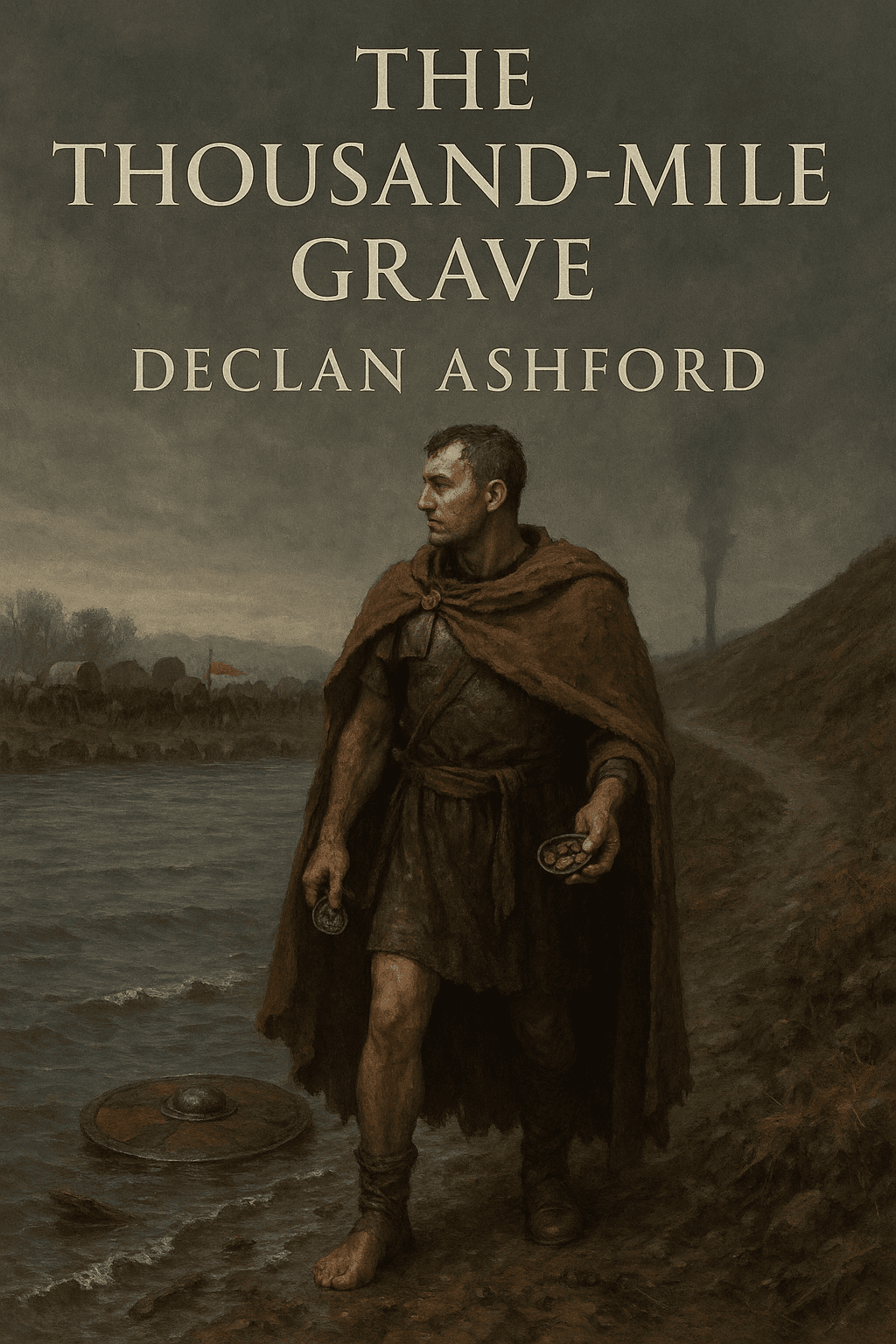
The Thousand-Mile Grave
Chapter 1
Arausio: The Ignored Report
The ridge gave him angle and distance. Quintus Sertorius lay behind a prickly mat of low gorse and watched a road that was no longer a road but a groove cut by wheels. Wagons moved in files, two by two where the ground widened, single file where a willow stand narrowed the track and forced a halt. Oxen pulled with heads low. Children rode the boards or walked with sticks. Men with spears ringed the moving mass in a loose ellipse. The line bent toward a shallow reach where the river ran with a steady low sound over pebbles.
He counted the wagons. Fifty to the first bend, then another set, slower, strung behind a mudded rut. He noted the gap between units, the way a stopped axle blocked more than itself. A woman in a patched tunic clambered down, scraped mud from a wheel with a flat of wood, and climbed back up. Two dogs trotted on the flank. Herds dragged at the rear, goats picking at weeds, cattle drifting from the ditch when boys struck their flanks with green switches. He counted the cattle, not for slaughter but for draught. Meat was weight lost. Draught was forward motion.
He shifted his elbow on stone. The smell of wet earth and old smoke drifted up from the river. A flock of late gnats gathered over reeds and broke apart when a rider splashed through the shallows on the far side, then wheeled back to the line, calling. The sound of iron on iron rose and fell as men adjusted buckles and checked fittings. A banner with a boar device hung limp from a pole tied to a wagon arcanum, the cloth dark with old rain.
He timed the ford. A wagon axle deep in water; a boy walked beside the oxen and slapped their flanks; the front wheel climbed, slid, then climbed again. The rear wheel caught in a soft patch and sank until two men levered it free with a stave. He counted heartbeats from water entry to the far bank and added the minutes lost to the stuck wheel. His chest pressed to the ground; his ribs began to ache as he kept his counts steady. He checked the sun against a thumb held at arm’s length, then fixed a rate in his head with the margin of error. He looked for the next pinch. A copse pressed the track. The land dipped; a tangle of roots had pulled soil into a small shelf above the low ground. The line of carts stretched beyond his sight but advanced at a fixed pace set by axle drag and soft ground.
There were children under the carts. He registered their small legs and the way cold water made them shriek and then go quiet. The old walked far off the track where the ground gave a slightly firmer surface. None of that was an enemy count, but it was the shape of this war.
From his right the outriders came again, pairs trading off, overlapping their lines. They rode ahead in a shallow crescent, then fell back to speak with a man on foot who carried a horn and a short axe. One rider’s hair was plaited and wrapped with a strip of red cloth. The man’s fox-fur mantle lay over his shoulders without hang. When he dismounted, he moved like a hunter who had not learned marching but knew distance. Sertorius watched where he looked: not at the nearest wagon, but at the spaces between the wagons and the scrub, then at the ridge where Sertorius lay. The man’s face lifted. Sertorius lowered his head into the gorse and waited without moving. A fly crawled along his cheek and into the old scar line. He did not brush it away.
When he raised his eyes again the rider had mounted and turned away. The patrol ran another arc and handed off guards to men on foot with bows. Those men were old or young, not prime. It did not matter. The arc closed and opened with the same rhythm every time the line stopped for a wheel or a herd tangle. At one handover a boy stepped late with the herd rope, and a rider drifted wide. The arc opened by two horse-lengths for a count of ten before it closed again. Patterns meant planning.
He slid back a hand’s breadth and drew a small stick out from beside his elbow. In the dust between stones he sketched a curve for the river, a line for the track, a circle for the wagons’ radial guard. He marked a ford with a cross and the shallow below as triangles of pebbles. He laid out four times of day along the line: dawn, mid, late, dusk, and put small cuts where he had seen the outrider changes. At dusk, the herders changed and the boys wandered. He cut a longer mark there. He wiped it all smooth with the side of his palm until the grit coated his skin.
Down by the fields, three Roman scouts wandered into a swale that looked harmless from height, a bowl with grass blown flat by earlier wind. Sertorius saw their horses’ ears twitch and the lead man half-stand in the saddle. Too late. The outriders closed, not at a gallop but at a steady run, letting the bowl’s lip cut the angle of escape. The plait-haired rider (Sertorius fixed him as Wulfhar for his own use) threw a loop over the lead man’s arm and pulled. The man’s sword fell into grass. Another had a spear in his back before he turned his horse. The third cut free once, then a second rope took his wrist. His horse went to its knees. The riders took heads and hands with short, ugly strokes. They pulled rings from fingers with their teeth. They left the bodies in the grass and rode back, not with hurry. The work was finished.
His breath stopped for three counts before he let it out. Sertorius’s jaw tightened until his molars ground. He registered the angle of the kill and the easy discipline with which they remounted. He made a note against any plan that relied on scattered small parties surviving contact.
He slid downslope through brush until the ridge hid him fully from the near river reach. At a pause he looked over the floodplain where two barns stood without doors. The floors were swept and marked by grain scoop arcs in the dust. In one corner, heaps of milled husk lay damp under broken thatch. A girl with a rope at her waist stood near sacks stacked along a wall. A spear leaned against the door post. He put together how they were doing it: captured stores, then more as they advanced, always tied to the wagons because the wagons were the food, the shelter, the children, the haul of the war.
He pictured a line of farms ahead, stripped and burned. The cost of that ground ran quickly in his head: the faces of people he had seen here before the year turned bad, the smoke they would watch rise from roofs they had built with their own hands because a Roman had decided to make a desert to save a province. He did not flinch from it, but his stomach cooled. He filed it. Armies moved when coin was paid, grain was issued, and men expected plunder. Deny the second and the third would fail.
He found the secondary ford by its signs: a doubled track through sedge, willow roots cut with dull axes where carts had bumped over, a bar of gravel showing pale where water had fallen by two finger-widths. He cut a willow switch and pressed the butt into the runnel. The water reached his knee, and the mud held his push, coarse with grit. Hoof churn on the near bank showed splay. The far bank rose in a low hump that forced a turn left, leaving a moment when wagons would be half-turned with oxen exposed. He fixed the landmarks: the twisted poplar with a lightning scar, the boulder with a white vein, the reedbed cut by two channels. He paced the exit and marked a forced left angle at three long steps from the lip.
He set his back to the ridge then and moved. The sun had dropped, and low contrast made the far bank look closer. He used his shirt hem to wipe grit from his palm and tasted dust when a gust lifted it. In his head, he set his argument in order. Begin with limits, not fear. Show the clock and the wagons. Show that a host tied to children cannot march fast. Put the ford times before them. Ask for time and coin. Ask for denial of grain. Ask for patience. He would speak to them as to men who knew all this, because men with standards did not like to be taught.
He crossed the camp’s outer ditch at a place the engineers had boarded. The sentry nodded without challenge. The smoke from wet wood carried a cold tang. Mules blew and stamped. At the staff line, the largest tent had a new ridgepole lashed to uprights, fresh cord dark against canvas. It meant repairs recently done. He took a breath that came tight and pushed the flap aside.
*
Gnaeus Rutilius Varro stood over a map scratched onto a wax tablet with a blunt stylus. He had thrown his cloak over a chair, and the wool hung heavy and damp. Two tribunes stood near the table, eyes on the wax, but their bodies angled toward Varro, not the map. A boy with an ink-stained thumb held a basket of messages. He looked exhausted.
"Tribune Sertorius," Varro said. His mouth set in a straight line that he used for welcome and for warning. "You have seen them?"
"From the ridge above the lower ford," Sertorius said. He kept his voice even. "They are moving with wagons in tight files. Non-combatants as weight. Herds behind. Outriders in patterned cycles. Their rate is fixed by axles and water. We can fix them to ground if we will use time as a weapon."
One of the tribunes made a noise in his throat. Varro did not look at him. "Speak plainly, Sertorius."
"If we burn the next belt of granaries and mills and do not offer battle, their march slows. They cannot forage at distance without pulling the wagons apart, and they cannot pull the wagons apart without exposing children and goods. Deny grain and time to cross, and they will starve faster than we will."
"Starve them." Varro repeated the words, and his jaw set. "This army did not come to watch smoke." He turned the tablet toward Sertorius. "Look. This:" he tapped at a drawn bend in the river "is where we force them to turn or to fight. They will not turn with glory in sight. Men with courage do not run when a Roman army stands before them."
"Courage does not feed oxen," Sertorius said. He kept his gaze on the map, not the man. "Their oxen will set the pace no matter how brave their chiefs are."
Varro’s jaw moved side to side. He set down the stylus. "You have a soldier’s face, Sertorius, but you speak like a grain-merchant."
The flap opened and a courier pushed inside, breath harsh. Dust striped his legs. He held a folded letter sealed with a smear of resin and twine. Varro broke it with his thumb. He read. A resin flake stuck under his thumbnail; he scraped it off on the table edge. Sertorius watched. He did not ask what was written. He already knew the tone of such messages. Move now, before you lose the credit. Hold position, and the other commander will claim the victory. Rome counts victories by names, not by avoided disasters.
Varro handed the tablet to the nearer tribune. He straightened; his shoulders squared. "We assemble at first light."
Sertorius said, "Give me two maniples of light troops and a cavalry turma. I will go at the wagons. They have a secondary ford two miles upriver with a poor exit. I can make them bleed time there."
Varro did not let him finish the list. "No. You will remain attached to staff. Reports. Messages. We will bring them to the field and show them what Rome is." He looked at the two tribunes. "Tell the engineers. Ladders and fascines."
A man standing half behind Varro’s left shoulder stepped forward a fraction. He had a heavy gold ring and the neat beard of a man who invested in olive presses rather than used them. His hair shone with oil. He smiled without showing his teeth. "Word will reach the city, Tribune. As will certain gentlemen of means who understand how hesitation is read in the Forum. Marcus Albinus Crispus among them."
Sertorius did not look at him. He kept his eyes on the wax. "Hesitation is not my proposal. Denial is my proposal."
"Denial," Varro said, as if parsing an unfamiliar word. "We did not come to deny. We came to kill or to drive."
The aide with the oiled hair shifted his weight. "There is such a thing as obstruction, Tribune. Men lose postings for less."
Sertorius said, "I ask you again to use time as an ally. Deny them grain across the belt between here and the hills. Do not give them a field that suits them."
Varro waved him away with two fingers. "You have made your point. Go and prepare the men for a fight. We will end this crawling." The two tribunes shifted apart by a half step. From outside, a horn called the engineers to the lines.
Sertorius took his tablets from the table. He folded them closed once, then again, then slid the thong into his belt until the leather tugged at his waist. The motion calmed his hands. He bowed as the forms required and stepped out into air that had cooled; river chill reached the tents.
Two junior tribunes stood near the tent ropes. One nudged the other with an elbow and raised his voice enough for Sertorius to hear. "Shall we starve them with our looks?"
The second let out a short laugh that sounded like a cough. Another man farther off met Sertorius’s eyes and then looked down as if inspecting his boot laces. Sertorius registered the faces, not for revenge but for future conversation limits. He turned away and walked along the engineer line.
*
Lamps were lit, and smoke hung low under the canvas ridge line. The mess smelled of sour wine and boiled grain. Tables had been set out in two long runs under a lean-to of canvas and poles. At the far end, near the better lamps, Varro’s clients clustered around a platter of pork with an even layer of fat. Their cloaks lay thrown over the backs of benches, spread to mark place. The rest ate with heads bent and elbows set out to mark space.
Sertorius stood and watched where the men of the legions mixed and where they did not. One section held men all from the same cohort by the look of their arm and shoulder scars; another held a proportion of men who had the same camp slang, which told him they had marched together before this campaign. The seats nearest the serving trough were taken by men with clean chiming buckles and tidy knotted baldrics. Clients. He had no table to join that would add a layer of cover.
He took a bowl and ate standing against a tent post. The grain clumped against the wood. A man with a smooth face and an equestrian’s easy carriage drifted across and leaned his hip against the post beside him.
"Quintus Sertorius?" the man said. "A friend in Rome said to look for you. Marcus Albinus Crispus will enjoy your report when the speeches begin."
Sertorius said, "The speeches should come last."
"They come when the city needs them," the man said. He lifted his bowl in a small toast. "A day like tomorrow produces many needs."
The man did not give a name. He did not need to. He had the look of a man who traded introductions without committing his own. Sertorius set the contact aside in his head as hostile.
At the next table the same claim spread. Sertorius could hear it by the way one man kept repeating the same sentence. "If we delay," the man said, "the other consul will be in position by the end of the week. He will cut the road, and we will find ourselves watching his triumph from the shade." By the time he had taken three spoons, the same sentence was repeating at the far benches. Orders from staff took longer to reach that distance.
A quartermaster with a frayed cord around his waist shoved past the line and thumped a ledger onto a bench. He swore under his breath. He had the look of a man counting the same numbers each night and finding less each time. "Four days’ grain if the wagons from Narbo arrive," he told no one in particular. To someone else he said, "And if the mules break again, we will be boiling leather by the time the standard is raised." He wiped his nose on his sleeve and went back to his ledger. Sertorius did not press him. He did not need to. The information was plain: Rome’s army could not treat grain as a variable any more than the enemy could. The point was plain.
An old centurion with a flattened nose and a scar like a white cord down his forearm took his bowl and sat on the ground with his back against a cart wheel. His men formed a loose ring around him. "Eighteen days since the paymaster smiled on us," he said, low. No one complained aloud. It was just a fact passed like a skin of wine.
He walked past the engineers. Ladders went up in stacks, rungs facing each other, their raw ends pale where the saw had bitten them. Men wrapped the steps in rawhide to keep the rungs from splitting. Fascines lay bound with wicker. An officer tapped a ladder with a vine staff to test the joinery. The sound rang dull. Sertorius counted the stacks. He did the arithmetic by habit: each ladder matched to a cohort’s frontage, each frontage to a number of men who would climb into a narrow interval and be cut down at the wrong time. He set his jaw.
He found a tribune he trusted, a plain man with a square hand and a steady way of standing. "Keep your men back on the order," Sertorius said, quiet. "Let the first shout run; do not run with it."
The man looked at him for a long beat and then glanced toward the command tent. "I heard your advice in there."
"Advice is not an order."
"No." The man’s mouth moved in a tight not-quite-smile. "And there is censure for men who mistake the one for the other."
Sertorius let it lie. He had no more to give a man who knew what caution would cost him. He turned and went to his tent.
*
He set his kit out on the groundcloth and decided which half to carry. Cloak, knife, small waxed packet of notes, thin spare tunic, a whetstone, two spare thongs, the small purse he kept tucked into the inner fold. He laid the spare tunic aside. It had no weight by itself, but one more thing was one too many in a rout. He touched the whetstone with his thumb and slipped it away. A sharpened blade could be made with a door post in a peasant’s yard if he lived to see one. He rolled the waxed notes and felt the edges catch the cloth. He tucked the packet deep where sweat would not wet it.
The canvas snapped once with a wind shift. He blew out the lamp until the wick glowed and went dark, then relit the smallest lamp and set it against the pole. In the re-dimness he pulled the small purse and held it between finger and thumb. He counted by touch. One, two, five, eight, ten. He did it again, a second pass to confirm he had not lied to himself. He did it a third time to store the number in his head. Ten denarii and a broken as. The as went into a separate fold. The ten fixed the limits of what men would do for him until he could promise more than coin.
He cut a sliver of map from an old copy, a strip no wider than his thumb. It showed the river bends and a rough line toward the south-east along the edge of Helvian land. He threaded a needle and stitched the strip into the hem of his cloak with close, tight bites that would not draw the eye. The stitch lines scratched his fingers. He did not mark the seam. That would defeat the point.
He sat and closed his eyes and ran the report again. He repeated the sequence until he could say it without pausing. A migrating host bound to wagons has a maximum daily range. The range is set by ford times, axle failures, herd drag, and non-combatant care. Deny grain and maintain pressure without decisive engagement. Force them against hard ground and hard water. Make them turn themselves into a dead end. He did not use the words in that order with Varro. Varro heard what he wished.
He lifted the tent flap and went to the engineer line again. The river made a low constant sound where it ran over stones in the reach below camp. He walked toward it until the ground cooled and the air dampened around his ankles and the hair on his arms prickled. He traced the run in the dark, not by sight but by the way sound moved around obstacles. Lower ford, then. The boards the engineers had laid there were rough but firm when he tested them with his heel. He did not cross. He found where he would if he had to.
Back at the tent, his aide sat with his back straight and his hands flat on his knees. The boy had a narrow face and a new soldier’s stare that tried to be blank and missed by a finger’s width.
"If I shout, you move," Sertorius said. "You do not look for me. You go to the lower ford and cross. You do not stop for anything that is not a wall."
The boy swallowed and nodded. He was brave enough for this camp. He would not be fast enough for a broken line.
Sertorius lay down fully dressed, cloak over his chest, boots within reach of his hand. He did not close his eyes for long. The camp’s sound changed as men finished tasks and fell silent, then changed again as men shifted on their blankets, turned, cleared their throats, and did not sleep. Mules snorted. A man in the row behind him sat up and retched quietly and then lay back down. Somewhere near the latrine trench a man whispered a prayer and crossed himself twice. Sertorius kept his breath steady. He did not ask for help from gods who did not haul wagons.
He must have drifted without knowing, because the trumpet call lifted him before the sky had fully paled. He had bitten the inside of his cheek; blood salted his tongue. He stood. He had no time to think about the taste. He pushed outside into the thin light and fixed his belt. Men rose around him in a rush. A centurion’s vine staff snapped across a laggard’s shoulder with a sound that carried.
"To the line," a voice shouted. The voices layered and then turned into one direction. Sertorius moved toward the ground he had told them not to stand on. He found his place with the staff group behind the front ranks. The engineers hustled ladders forward. The standards rose and fell in the press. He checked the faces nearest him. Men did not look at him. They looked across the field to where the river bent and the land climbed. Along the right edge of the front rank he saw a slick patch where water had pooled overnight. A shallow rut crossed the step-off two paces in. One man tested it and stumbled before he found his feet.
He set his jaw and did not speak. The line formed.
Chapter 2
Arausio: The Thousand-Mile Grave
The standards rose in a slow, uncertain lift. The second horn note wavered. Men stepped off into ground that had not dried in the night. The river defined the field’s left boundary and left no space to swing a flank. Sertorius watched a man test the rut two paces in and stumble again. The engineers had done what they could. Boards on the ford. Ladders stacked and ready. None of it altered the ruts and the mud.
He kept to the staff line where the runners would pass. The first ranks moved steady enough for twenty paces. Shields stayed flat; points showed in a row. Then the front edge met men with long spears who gave ground and did not break. That forced the men to tilt shields and push. A gap opened where a junior centurion drove ahead of his neighbour to make a name he had not yet earned. The gap did not close.
On the right the allied contingent, men who had been promised land if they stood well today, took the first rush and held for half a count. Then the rush came again. Sertorius saw the change in their feet. They went from set to stagger. A boy dropped the standard there, not on purpose. He reached to lift it and took a stone in the face. The cohort’s edge folded. Varro sent a runner. Then another. Then two turmae went forward, not together, not with space, but they moved on the nearest shout, at cross-purposes. The horse skittered in the slick shadow of the ditch. One fell and kicked a man’s knee out behind him. The piecemeal commitment achieved nothing. It made noise and motion.
Out on the far right, where the scrub had gaps, Sertorius saw pairs of riders run their arcs again. They hit the edges, never the middle. They forced attention outwards. Beyond them, behind a thin veil of thrown dust and trampled grass, the wagons did not move. He had timed those wagons from the ridge. He had told them this shape. The host’s centre was families and grain and iron-packed tools, fixed to oxen that ate and shat and slowed. None of that had changed because men shouted.
He looked for the signal that would tell him Varro had seen enough. It did not come. The line pushed and gave. The left held until it did not. Shields that had been flat started to show angle as men tilted to look for space to breathe. The sound of iron on iron was muffled by the shouts and strained breathing. Someone tripped on the rut he had marked in his head and dragged two others down. He heard a centurion call a number and a word, but it came muffled through teeth clenched too hard.
A standard went down near the centre. It was not raised. Men waited for a count of one, then two. No one stepped into that place. The dust rose thicker and then thinned as men moved back. Not in order. Not by file and rank. Men fell back in widening, uneven files.
On the left a wedge of cavalry formed. The point looked clean for a moment, lances level, men’s heels set. They drove into the space the allied cohort had left. They vanished. Three horses without riders came out the other side and tried to find their way back. One tripped on a ladder the engineers had left in the wrong place. The animal screamed once and then lay still with legs twitching.
Sertorius looked past all that to the far line of the wagons. They stayed where they were. Cloth hung dull with old rain. Oxen stood flanks wet with sweat. Children sat under carts, small legs tucked up. The centre did not move.
A runner came up beside him with blood across his chin that was not his. "Orders for the reserve, sir?"
"Hold them," Sertorius said. He kept his voice even. "If you throw them now by halves, the first ranks will fall and the rest will check and scatter. Horses will come back without riders." The boy stared at him for a moment, jaw tight. Then he ran toward a different shout.
Sertorius stepped into a cluster of men who had lost their places but had not yet lost their discipline. "By twos," he said. "Back on a slant. Ground toward the willow line holds. Do not turn your faces away from the line. Move."
A centurion with grey in his beard squared his shoulders and shook his head a fraction. His eyes went toward the staff standard where Varro’s aides stood; no signal lifted. "No order," he said. He did not raise his voice. He had seen men punished for being correct without being authorised. He would not take that risk now.
Sertorius wasted no more breath on him. He caught two staff runners and a clerk with an ink-smeared hand and pointed with his chin. "With me. You—take that man with the cut cheek. You—pull those two who can still hear. We go to the lower ford."
Behind them a raw-throated roar rose and fell. Not a cheer. Not a command. The sound that comes when breath is used without words. Sling-stones began to come in low and fast. The first hit the mud near Sertorius’s left calf and kicked grit into his boot. Another hit a man behind him in the cheek and left him without a lower face. The man coughed once and stopped walking. Arrows began to come in high. He did not look back to see where they were loosed from. He had counted this distance in the dark. He fixed the pace in his head. Thirty steps to the ditch edge. Ten more to boards. Twelve across the bobbing give of them. Then water.
Do not look back. Count the ground ahead. Keep them moving. If one falls, do not stop.
At the ford, men jammed the shallows. Soldiers. Engineers. A cook with a ladle still in his hand. Two mules from the baggage line with their eyes showing too much white. The boards the engineers had thrown down flexed under the load and dipped as two men stepped to the same place. Someone went to his knees in the water and clutched at a stranger’s cloak. The stranger tried to kick him loose and lost his own footing.
Sertorius drove his shoulder into a man’s ribs and pushed him aside. He felt the man’s breath on his ear. He did not hear what he said. He put the flat of his hand into the centre of another man’s back and moved him forward. "No stops," he said. "Move your feet. Move." He did not apologise. There would be no coin for mercy here. There would be no pay for boldness either. Only the difference between breathing and not.
At waist depth he looked up and saw the plait-haired rider with the red wrap in his hair and the fox-fur. The man sat his horse still. He had the face of someone who could wait all day for the one step that made a mistake possible. The rider’s eyes fixed on Sertorius. He did not blink. His gaze did not shift. Sertorius did not lower his head. He gave him that single count and then he turned away and pushed into deeper water to the thighs.
He felt bottom for one step and then not at all. The channel never shallowed to axle and boot; the depth held. A shield floated for a count, then sank. He let his go. It bumped the back of his hand and then slid away and tumbled where the current dragged it. A drifting board freed from the ford struck his thigh and turned him half around before the pull took it past.
A stone hit the water to his left and sunk without a splash. An arrow cut through and shivered when it hit the flow above his shoulder. He took a breath that did not fill him and went under when a man clawed at his cloak and pulled.
Two held under if he waited; one breath if he cut. Sertorius got his hand to his knife by habit. The scabbard’s edge found his palm and then the handle. He sawed once where leather met leather and felt it give. The cloak went loose on his shoulders but did not leave him. He kept his left hand on cloth and the right on the knife and kicked without rhythm until his head came up into air that was full of grit and water. He coughed and gagged and tried to spit and took another breath that had no value. The man who had held him went past, eyes open, arms wide. He did not come up again.
Sertorius let the current carry him towards the reeds he had tested at night. He had done this to keep his body from being a fixed point in a fixed aim. It was not instinct. It was practice. He took water again and came up into a pocket where the reeds broke wind and slowed drift. He got both forearms onto slick stems and hauled his chest onto mud that pulled at his elbows, heavy and cold. Cold locked the backs of his thighs; his fingers would not close at once. Wet wool dragged at his shoulders and made the breath short. He lay for three counts and listened. Breathing. River. Men dying beyond sight. Above the ford, riders walked horses belly-deep at three shallows, turning back where the bottom dropped.
He rolled onto his side and checked what he still had. Knife. Belt. Cloak, wet and heavy, throat-thong cut through but cloth caught under his own arm. The small purse in the inner fold pressed against his ribs. He did not open it here. He touched it once to prove it still existed. He had one boot. The other had gone where he left it. He kept the one boot for a print he could place where he chose. He lifted his foot and saw the skin already rubbed raw at the heel where the leather had dragged before it went.
At the willow fringe, he pushed up to hands and knees and crawled under the willows. The shade dropped the air a little. He put his ear to the ground and heard nothing that told him a horse was on this side of the river. He smelled river rot and wet wool and iron. A thin whistle came and went and then came again from the far bank where someone tried to find a friend who could no longer answer.
Do not move inland. Keep to the line where water can take your trace. Every step on dry ground will be watched by a man with eyes and patience.
He moved parallel to the water, keeping one hand brushing reeds so he knew he had not drifted off the line. When mud pulled at his bare heel, he pressed his toes hard into it and left a print where the shape would confuse a tracker who expected two boots.
He came to a small bar of gravel where the bank had broken in spring floods and reformed. He eased himself behind a fallen branch there and pulled a corpse toward him by the belt. The man had a pale line of skin where his helmet had sat and a gouge at the temple. From the dead man he took the cloak and pulled it over his own shoulders, over the officer’s tunic with its purple edge that marked him for men who kept such scores. The extra cloth would keep his outline low and dirty and less interesting to anyone who looked across the water.
He lay flat again and watched. Across the river, small teams were already moving through the field that had held the army. Oxen pulled carts toward places where shields lay thick on the ground. Men stooped and lifted, not fast and not slow, and laid iron and leather into the carts, and boys tried to pull rings from stiff fingers and then called for a knife when they could not. No one hurried. It was a task that would be done today or tomorrow. There was no enemy standing to prevent it. The host had time because the wagons had not moved and because Rome had failed to make them move.
A line of riders walked along the shallows above the ford. They were not probing this bank. They were counting their own dead across from them. One paused and looked downriver. Sertorius pressed his fingers into mud and did not move his chest while he took the next breath. The rider nudged his horse with a heel and went on. Sertorius counted them as they passed him. Nine, with one spare mount on a lead.
He lowered his face to the water and drank. The taste put metal on his tongue that he could not spit out. He swallowed again and it did not change. He rinsed his mouth and wiped the back of his hand across his lips and left a smear of red there that the river did not take off cleanly.
The horn notes changed. They moved away, up the bank and then inland a little. He watched the cart teams finish their work at the furthest edge he could see. Then even they pulled back toward the wagons. The dust settled. The flags on spears that had been lifted for direction came down. When nothing moved for a long count, he rolled, set one knee under him, and stood.
He looked once toward the place where the camp had been. There were poles and collapsed canvas and dark shapes where men lay in clumps. He did not speak. He did not mark the moment with any sign. He turned his back on Arausio and shifted his cloak until the wet weight lay where it did not pull at his cut throat.
The line he had sewn into the hem of that cloak was only a strip. In his head he held more: the river bends, the line along the Helvian edges where patrols would be thin if men thought the main roads were safer for them and more dangerous for him. South-east to Massilia was longer than cutting across to the nearest garrison west. The garrison would ask questions set by men who had already decided answers. He had seen the face of the equestrian with the oiled hair in Varro’s tent and heard a name spoken in a flat tone that ended discussion. Men like that did not need the truth; they needed a name to carry blame. At the first fork where a stone marker pointed west, he stepped off the path into a drainage line that ran south-east and kept his shoulders low.
He set his course by the sun and by the feel of the bank under his feet. He kept enough distance from the water that anyone on the far side could not bring him down with one throw from a sling, and he kept close enough that his trail would be broken by every wash that licked the reeds. He raised his right hand and pressed the purse under his tunic once more. It was still there. Under his thumb he found the ridged edges of coin; the broken as lay apart with its rough break. Ten denarii and a broken as. Not enough to buy safety. Enough to buy the next ferry when coin still mattered more than fear.
He had no victory. He had a route and a tongue that could still shape what he had seen into words if he found a man who would listen. Notes do not move men; orders and grain do. He would move until he could put his plan into a man’s hands who could make a campaign out of it.
He went under the willows and into the day’s second half with one boot off and the other on, with a cut at the ankle that would need washing, with a cloak that dragged and a tunic he had covered. He did not wait for anyone to follow him.
*
They had gone no more than two hundred paces downstream when the river forced him into a strip of mud that narrowed to the width of his shoulders. The reeds on his right were thicker and hid his outline from the far bank. He kept his knees bent and put his hands out once when a root caught his toe. The dead man’s cloak scratched his neck where the nap had gone rough with age and sweat. The cut throat-thong dangled. He tore it the rest of the way off and pocketed the longer piece. Leather always had a use.
On a shallow spit a soldier with no helmet and a nasty cut on his brow tried to stand when he saw Sertorius and then sat again. "Sir," the man said. His voice came thin and flat. "Orders?"
Sertorius did not stop. He could not lift this man across this ground. "Cross further down if you can," he said without raising his voice. "Do not climb any bank. Stay with the water until dark." The man nodded without much hope. It was a good instruction and a poor promise. They both knew it.
The outriders had not crossed. Sertorius could tell by the lack of hoof-churn in the soft edge along this side. They would test the upper ford first, where the boards were. They would send boys with short bows to shoot the men in the water. They would not waste men on a crossing until they had reason. He would give them none.
When he found a patch of dry ground large enough to hold both knees, he stopped, pulled off his remaining boot, and dug his heel into the mud until it filled the hollow the first boot had left. The pain would come later. He could walk on the outer edge of his foot for a while to change the wear. He rubbed a smear of mud along the visible skin of his ankle to dull its colour. A track that looked the same as the others would not interest a tracker who had bodies to strip and a camp to sack.
He used the knife to nick the cuff of his tunic where the purple showed, then pulled the cuff under the dead man’s cloak. An officer’s edge drew knives faster than coin. He had no interest in testing whether that rule applied today as it applied every other day.
He kept moving. Breathing was a conscious thing. In through the mouth. Out through the nose. Do not take a breath that pulls your shoulders up. Keep everything flat.
At a break in the reeds he risked a glance across. Far away on the opposite bank a single rider sat his horse on a small rise and looked up and down the line. He wore the red cloth in his hair. Sertorius saw the man’s head move by small degrees. The rider had the patience of a man who had eaten hunger for longer than a season. He would not gallop to nothing. He would place a man on a bend and another on a ford and wait for a shadow or a splash to tell him which way to lean his men. Sertorius kept his face turned away until the reed-bed took the angle again.
The sun moved. He marked it without lifting his head. He made his day into pieces: movement, listening, drinking when there was cover, movement again. Each piece had a number he could keep in his head. The strip held just enough width for a man; reeds closed on his shoulders; the flow tugged at his calves.
By the time the sun had gone past mid, the field behind him made fewer sounds. The cart teams had finished the near plunder and gone back toward the wagons. A wind came up from downstream and blew old ash and damp leaves into his mouth. He spat them out and kept walking.
A fox stepped out of a smear of shade ahead of him and froze with one paw lifted. It paused, then trotted back into the trees. Sertorius watched where it had come from and cut there as well. Not for omen. For cover.
He reached a place where a row of willow stumps made a low fence and the bank lifted. He crouched and waited. Horns sounded again far off. Short notes this time, not the rising call he had heard when the first push came. Signals for moving stores, not for fighting. He flattened himself and stayed until the notes ended and did not answer each other. Then he slid forward, found a gap between two stumps, and went through to a patch of grass that had been flattened weeks earlier by a camp and had then grown again.
He drank at a filmy pool that had collected in a hoof print. The taste was worse than the river and told him nothing useful. He rinsed his mouth again at the river and moved on.
Time was a matter of sun and shadow now. He gave himself another interval and then another. Muscles in his legs began to shake when he stopped. He kept them moving so they would not. When he reached a strand of higher ground skirting back from the water by a long way, he turned from it even though his body wanted dry, firm footing. Dry ground would draw a throw from the far bank; he stayed in the rough edge.
By late afternoon the line of trees turned east. He kept to his rule and made the turn with them, though the direction took him a little away from the river. The bank dropped steep in a new place, and he had to crouch and slide the last three strides with his weight on the backs of his thighs. His bare heel burned. He set the foot down and lifted it again at once. The skin had split along the back of the heel; each step pulled at it, so he rolled his weight to the outer edge.
He came to a place where reeds made a small room against a dead trunk lodged in the mud. He set himself with his back against the log and pulled the dead man’s cloak up to his chin. He kept his hand on the purse because it steadied his breath. The purse held the same coin as at dawn. Survival had not added to it.
He slept for a number he could not later name. He woke into a light that had shifted and into a pain in his heel that had sharpened. He put the hood of the cloak over his head and listened again. The river still made its low sound. No hoof on this side. No metal on stone. He stood and began to walk with the same care as before.
When he cleared the last bend where anyone on the far bank could reasonably throw to him, he let himself widen the distance from water by two body lengths and then three. He cut across a patch of nettles and did not flinch when they stung. He stepped over a rope of vine and then under a branch. He made himself small when a crow flapped up from a bush at his foot. He kept his knife in his hand and the blade low so it did not catch light.
He came to a cart path that ran rough and narrow along the contour above the river. Two wheel ruts, grass high in the middle, mud at the far edge where rain had not drained. He looked both ways and then stepped into the grass strip and moved along it for ten paces to see what kind of track it left. The grass sprang back most of the way. He left the road.
When he finally edged far enough south that the line of the wagons’ dust no longer marked the sky in any quarter he could see, he allowed himself to think past the next patch of cover. Massilia lay south-east by more days than anyone who had coin for a horse would risk without escort. He had no horse. He had a cloak with a strip of map in the hem, a knife, a belt that marked him as a Roman if any man cared to look past the dirt, and a body that had breath left in it because he had refused to stand where men died when standing was no longer service but gesture.
He knew where the roads were. He would not take them. He would follow water and boundary lines and cut across where farms pinned soil to the ground with ditches. He would go to places where men traded quietly for salt and where a denarius bought less than it had last year but could still buy silence for a night.
He put his head down and walked until the sun began to drop and the insects lifted off the grass. He said nothing and kept going.
*
By dusk, after the short horn notes had ceased, he stepped into a stand of alder and stopped. He pulled the dead man’s cloak tighter and then looser to let the air take some wet out of it. He eased the cut throat-thong from his pocket and tied it in a new knot that would hold until he could stitch it. He had thread. He had used it last night. He would not risk a light now.
He ate two mouthfuls of hard bread softened with river water. He chewed until the edge of hunger dulled and then put the rest away. He would make the bread last.
He retraced every step of the morning in order, counting, until he found the change. The point was not to punish himself. It was to draw the shape of what could be changed next time. If there was a next time. If any of this reached a man who could stand a line in a different place.
He put his hand on the sewn hem and felt the stiffness of the thread that held the map strip. He pictured the bends in his head and then matched them to the small stiffness under his fingers. The strip would not save him. The route would not either. Only the decision to keep moving and to avoid places where men thought rank had value would do that. He let his breath out. He counted on his fingers to a set number and waited until it passed. Then he let himself lie with his back against a tree and his knees up and his knife between his right hand and the mud.
A night bird called once. He slept at once.
When he woke it was with a small ache that had spread from the heel into the arch of his foot and into the calf. He flexed it and then did not, because flexing only told him how bad it would be tomorrow. He stood and rolled the cloak around his shoulders so the wet did not sit on one place too long. He put his hand in under the tunic and touched the purse again. By touch he found the ridges and the rough break. Ten denarii and a broken as. Enough for one passage.
He turned his face where the sun would be when it rose. He began to walk again.
Chapter 3
The Decision Line
By late light, shadows lengthened off the ridges, and the wind carried grit off the floodplain. Sertorius stopped in the lee of a thorn clump and marked the options, not with words but with the lay of ground. West meant a clerk and questions. South-east meant Massilia, where coin bought names left off lists.
He took the purse from the fold under his tunic and pressed it between his thumb and forefinger. Raised edges told him the number before he counted. He counted anyway. One, two, three. He shifted the packet in his palm and kept going. Four, five, six, seven, eight, nine, ten. The broken as lay separate, rough against the seam of the leather. Ten denarii and a broken as. He closed his hand on them and pictured what they bought if prices were high: a ferryman who disliked Romans but fed a family, two nights of bread and bad wine if he stayed moving, and one bribe to a petty functionary to look past a face he had seen on a field that morning. Not enough for mistakes. Enough for one passage and a silence if he was careful.
He slid the purse back into place and touched the knife’s hilt with two fingers. The blade was short and known to his hand. He would not take it out unless a body blocked a line he could not go around. Do not fight unless the way is closed. Do not test yourself for pride. Save breath for the last gate in Rome.
He lifted the cloak’s hem with his left hand and pressed the sewn strip against his palm. The stiffness of the thread followed the curve he held in his head: the river’s south reach, the belt of low farms, the line of trees that marked the Helvian boundary. He did not look at the cloth. He did not need to. He kept his eyes on the ground where the next foot would land.
He moved along a ditch with standing water spotted with green scum and a line of crushed grass where a cart had crossed last week. He tested the cart path’s central strip with one foot and watched the grass lift back almost to form. He stepped off it and followed the ditch itself, pressing the edge with his heel to leave no clear print on the dry bank. The heel throbbed when he put weight on it. He shifted the load to the foot’s outer edge again and kept going. Pain did not change the distance. It only changed the time.
Downwind, a dust line rose in a faint smear over a far rise. Not a plough. Too far from fields that still had men. Riders. He stopped behind a stand of low willow and watched the smear for a count of twenty. It moved parallel to the river for a space and then angled inland as if sweeping for sign. He changed his line one ridge further from the water and took a shallow gully that ran at a slant. He did not trust a hope that they would not see him. He trusted that cover reduced angles.
At a place where the gully pinched and the banks grew higher than a man, a trickle of brown water cut across his path and ran into a pool under roots. He tested the depth with the tip of his knife and set the knife back in the sheath. He stepped in. Water stirred mud around his toes and numbed them. Two more steps and he was through. He put his feet on the far bank and scraped them once to take the sludge off that would leave a mark later. He looked back once, not for sentiment but to fix the entry and the exit. Mark the threshold. Cross it once.
He climbed the bank and stopped where the gully opened into scrub. He ate a mouthful of the hard bread from his pouch. It turned to paste in his mouth and tasted faintly of smoke and old sweat. He forced it down with a sip from the water he had taken at the river and waited until the breath ran smooth again. Then he moved.
He set his day’s order. Move when the sun drops behind the low hills. Hide when light returns. He would lose miles to daylight sleep and keep his life off the skyline. Keep off ridgelines where a man casts a shape others can count. Use water and thorn when the ground opens. Do not speak to anyone if a coin can do the speaking. Do not become the centre of anything.
In a patch where the scrub thinned and a farm’s field wall had fallen, he saw the print of three men’s sandals crossing toward a copse. The heel cuts were fresh, the edges not yet rounded. He kept away from them. Soldiers without a line would be looking for a leader and a reason. He had neither to offer that would not slow him. He did not look to see if the tracks wore hobnails or leather soles. The information would not change his choice now.
He paused under an ash and looked again to the west. The roofs of the garrison town would be two, three days if he pushed and turned his feet to blisters. He saw the gate in his head and the stone where men leaned to clean their spears. He saw a clerk’s stylus and the shrug a guard gave when he was told to detain a man until someone important decided what to do with him. He did not go there.
He turned his face to the south-east and began the long line toward the sea. Massilia first, then Ostia, then Marius.
*
Hoofbeats. Irregular. Two, then three. Sertorius slid down into a shallow wash and flattened himself where a thorn bush grew low and tangled. He pushed his forearms into the dirt and let the thorn ends press the cloak into his back so the cloth would not lift and show a line.
Along the ridge above him, riders topped out against the pale sky. He saw the fox-fur on one and the red wrap braided into hair that he knew. Wulfhar. The man sat easy on the horse, weight balanced as if he had ridden the same path a hundred times. A youth rode with them, no beard yet, eyes quick. The boy pointed with two fingers at a line along the wash fifty paces north where a single boot had printed in damp silt earlier in the day. Sertorius’s ribs opened and closed once against the dirt. He did not change his breath again.
The riders angled toward the line and followed it downwash. Sertorius kept his face turned to the bank and let the thorn bite. He had chosen the single boot to confuse a man who looked for two. He had not counted on the eye that would mark a mismatch as a trail of its own. He waited until the lead three dipped out of sight along the wash and the last two turned their heads to glance back up toward the ridge where the rest waited.
When the riders committed to the line and looked past their own mounts to the wash ahead, he moved. Not up the wash, not down it. Perpendicular. He slid on his belly under the thorn’s lower branches until his hand found stony ground where water had run hard in spring and left a bed of small rock that shifted under weight but held less shape. He put his weight on his forearms and toes and pushed himself across the stones until he reached a patch of compacted earth under a wind-thrown stump. He lay still with his cheek on the dirt until his heartbeat returned to a pace he could count without hearing it in his ears.
A lagging rider, not Wulfhar, turned back along the lip of the wash. The man’s horse flicked an ear, and the rider eased the reins and stood in his stirrups to gain one more hand of height. Sertorius could have reached a rock the size of a man’s head where he lay. He judged the distance, the weight, the chance of hitting the horse’s knee cleanly with a single throw. He kept his hand still. Do not break the rule you set when your breath was clear. Do not become a victory with a cost larger than the gain.
The rider’s gaze passed over him. The man’s mouth opened as if to call to someone, then closed again. He turned the horse and let it pick its way back toward the line where Wulfhar’s fox-fur made a stunted shape against the scrub.
Sertorius did not move until the dust settled; the air cleared enough to see hoof scuffs. He counted to a number that meant time enough for a horse to cover two hundred paces at a walk. Then he slid down into the wash he had not used before and followed it south where it cut around a low hill and divided. He took the narrower branch. It dwindled to a dry bed with banks as high as a man and deep shadow even with the sun still up.
He moved there through the first of the dark, testing each foot placement before he shifted weight, because the bed had holes where water had undermined the dirt and left pockets that would take a leg. Once his foot skidded on loose gravel and slid into a shallow pit. He fell forward onto his hands and a stone cut his palm. The cut throbbed, a sharp line from palm to wrist. He rolled onto a hip and used his teeth to tear a strip from the hem of the dead man’s cloak where it would not show, then wrapped the hand tight enough to slow the blood. Small bleeds wasted strength that should be kept. He tied the strip with the short piece of the leather throat-thong he had saved and tested his grip on the knife. The hand would hold.
He walked on in the dark, head low, shoulders angled to keep the cloak’s weight from pulling at the cut in his heel. The bed turned again. He counted the turns. He held the number for as long as it was useful and then let it go when the shape of the ground mattered more than the count.
By the time the light started to grey, he saw a bramble thicket with a hollow at the centre where a small animal had lain often. He pushed in backward so he did not catch his face and pulled the cloak around his chest. He set the knife where his fingers rested on it without looking. He put his head down on his left forearm. He slept. The body had reached its limit.
*
After first light, when the ridge lay quiet and no dust lifted, he left the bramble and followed the scrub east. The air was cool. Keeping the foot still spared the heel; the skin had pulled at the split and sent a line of pain into the calf. A hand went under the tunic to touch the purse: ten denarii and a broken as, counted once more by touch. He did not take them out. He did not let the sound of coin carry.
He eased himself out of the thicket and turned in place until the bramble closed the small hole he had used. He moved in a crouch along the edge of a low wood, listening before he looked. The dry bed ran out into a shallow dip filled with scrub. At the far edge someone had scraped a shallow pit and laid two bodies there, shoulder to shoulder. The soil had been kicked back over them without care; foxes or dogs had pulled it away at the edges, and a hand showed pale against the dirt. A belt lay off to one side where someone had thrown it after taking the buckle. The bodies were Roman auxiliaries by their hair and the thick wool of their tunics. Locals had stripped what had coin value and left what did not move easily.
Sertorius looked once at the nearest face and then away. He did not make the sign the man would have expected from a friend. He tugged at the dead man’s cloak where it had bunched under the dirt and pulled it free. It was rough and smelled of sweat and old rain. He held it up and judged the cut. Coarse. No purple edge. He took a tunic from the shallower of the two bodies, working the arm that would not bend without tearing. The wool rasped his hands. He dragged the tunic free and shook dirt from it.
He stripped off his own under his cloak and slid into the coarse garment, then pulled the dead man’s cloak over both. He cut at the inner sleeve of his old tunic and sawed away the purple edging he had nicked the day before, cutting close to the seam. He took the strips and the small square of tablet-cloth with a pin hole that had once held a badge at the shoulder and walked three paces to a place under a flat stone. He scraped a hollow in the loose dirt with his knife tip, laid the cloth and edging in it, and pushed the dirt back. He set the stone flat again with both hands and pressed once to seat it. He kept his hand on the stone for a slow count and held his breath before he rose. He did not look at the place a second time. An officer’s edge marked a man for death. He would not carry one.
Near a clump of birch saplings, water sat in a dent where animals drank. A length of rawhide thong tied to a sapling ran to a tether ring and then to a small horse that lifted its head when Sertorius stepped into view. The animal’s ribs showed under a dull coat. Its ears flicked forward and back when he came closer. Someone had tied it to wait while they fetched more from a field. Sertorius put his hand out, palm down, and let the horse smell him. The animal’s nostrils flared. It shied one step and then stood.
A waterskin hung from the same sapling by a knot that had been hurried. He lifted it, felt the weight, and drank two swallows. The skin tasted of rancid fat. He swallowed anyway. He poured a little into his cupped palm for the horse. It licked his fingers and snorted once.
He looked back toward the scraped pit. One of the dead men wore a ring on the third finger of his left hand, a plain band. Sertorius took the finger and worked the ring. The dead fist did not open. He pushed the finger against the ground to brace it and pulled, then twisted. The skin tore under the ring. It came free with a stickiness that stayed on his fingertips. He wiped his hand on the dead man’s tunic and held the ring up between forefinger and thumb. It would not buy much. It would buy a word that others pretended not to hear.
He slid the ring into the purse with the coin. The weight changed by less than a mouthful of water. He checked the horse’s feet, lifting each with care, watching for split hooves or stones caught in the frog. The hooves looked rough but sound. He ran his hand along the animal’s legs and belly, then up to the neck. A rope scar lay around the throat where it had been tied hard more than once. He loosened the tether and walked the horse three circles in the scrub. Its gait was uneven in the first circle, then steadied. He stroked its neck once. He did not speak to it.
He did not mount. In daylight a rider drew eyes. A man leading a small horse drew less. He set the lead across his left palm and adjusted it with his right until the pressure did not rub against the cut. He pulled the cloak’s hood over his head to shade his face and looked at the ground for sign as he moved off.
At the edge of the scrub he stopped and laid out the route in the only way that mattered. Skirt Helvian village fields to the east where their boys would watch at the edge of light for strangers. Stay between the river line and the first ridge so he could cut to water when he needed it and to cover when he needed that. Aim the long line to Massilia and count coin before every crossing. He said the steps once under his breath so he could hear the order. Then he shut his mouth and walked.
He kept the horse on his left and his knife on his right and took a path animals had made along the edge of a fallow field. He watched his feet, then the horse’s, then the wash ahead, and set a count in the back of his head so he would know when he had stopped paying attention and was only moving.
He felt hunger in the hollow under his ribs. He took the strap of a leather bag off the shoulder of the nearer dead man and pulled it open. Inside lay a turn of dry bread and a piece of meat as hard as wood. He broke the bread and chewed. Sour dust and salt hit his tongue. His throat tried to close. He made it swallow. He took another bite and gave the horse a scrap of the meat to take its nose off his hand. The animal took it with stiff lips and chewed without interest.
On a low rise, he stopped and looked back. The bramble thicket lay out of sight by now. The scraped pit showed as a darker patch in the field where dirt had been thrown and not pressed flat. No one stood near it. Far to the north, a dust line moved in a slow pattern that matched a combing search rather than a pursuit.
He put his hand inside his tunic and touched the purse again. Ten denarii and a broken as, and a ring that might count as one more in a poor market with a hungry man at the scales. He let out a breath and lowered his hand.
He led the horse down the slope and into a line of willow. The leaves rattled against each other when the wind came. He watched for sign of other men: crushed nettles, broken twigs at knee height, the small curve of a human heel in damp soil. He saw none.
He passed a mill ditch with no water running down it. The mill wheel lay still with a spar broken and the broken end floating in the ditch’s pool. A mud swallow nest sat under the mill’s eave. He did not stop.
He crossed a narrow runnel where his boot did not sink and his bare foot found stones just under the surface; the horse’s hooves marked lightly. He took the lead shorter to keep the animal from blowing in the water. He put one foot down and then the other and felt the cold through the sole. The habit fixed itself. Mark, cross, do not pause on the lip, do not look back.
He looked up toward the ridge beyond the willows. Nothing moved there. He knew that meant little. He kept going.
By late day, the heat eased. He loosened the lead and let the horse drop behind him on a longer line so it could put its feet where it chose. He listened for the click of hoof on stone. When he heard it he changed course a finger’s width to his right and walked on earth again.
Stillness did not mean safety. It meant no one had chosen to cross his path yet.
He walked until the light thinned and then failed. He did not make a fire. He did not speak. He led the horse into a thicket of plum saplings and tied it with a short lead to a trunk that would not move. He lay down on his side with his back against a root and his knees bent, keeping his hands where he could feel both the knife and the lead rope.
He watched the last of the light go. He did not pray.
He slept in pieces.
The sun stood high; shadows were short. He had slept longer than planned. He rose and set the rope over his shoulder so the horse’s pull would not drag on his palm cut. He checked the knot at the cloak’s neck, which he had re-tied with the leather he had saved, and pulled it once to test. It held.
He moved on toward the south-east where the sea lay behind two days of ground if a man had a horse and coin for a ferry, and more if a man had only his feet and a face he wanted no one to remember.
Chapter 4
Gates Shut
The palisade rose out of scrub and waste ground where a ditch had been cut and only half cleaned. A gate of two planked leaves stood half open with a bar on the inside. The ditch water showed green at the edges. A plank led across the lip. Sertorius led the small horse by the worn rope and stopped outside the open angle. The horse put its head down and mouthed at the plank’s edge. He drew the rope short and kept the animal’s head up.
A sergeant with a scarred cheek and a spear came to the gap and set the butt against the plank. Two men in worn mail stood behind him. A boy with a stylus and a thin tablet hovered near the jamb, blinking in the light.
“Water,” Sertorius said. “For the horse and for me. I’m a courier on the south road.”
The sergeant’s eyes ran over the horse’s ribs and settled on Sertorius’s cloak and belt. His gaze paused on the knife hilt and moved away. He did not look at the face for long. He did not ask for a name.
“You’ll take it here,” the sergeant said. “No step inside. Orders.”
A woman at a stall under a patched awning, with two buckets and a shallow trough, turned her head away when Sertorius looked in her direction. She lifted a cup that did not need lifting and poured water that did not need pouring. Her hands moved without pause. Her body stayed within the shadow of her cloth. She did not meet anyone’s eyes.
“Orders from whom?” Sertorius asked.
“Magistrate Marcus Albinus Crispus,” the sergeant said. He spoke the magistrate’s name cleanly and without stumble. “Deserters are to be turned away or held if named in the order. We’re to accept no one who cannot show a written pass with seal.”
The boy edged forward with his stylus and tablet. “There’s an edict, sir,” he said to the sergeant rather than to Sertorius. He pointed with the end of the stylus to a panel nailed to the gate, a sheet of scraped wood with twine threaded through holes and a brown resin blob fixing the twine. “It says if a certain tribune is seen on these roads, he’s to be refused entry. It says he fled the field at Arausio and took men with him.”
“Read it,” the sergeant said, not taking his eyes off Sertorius.
The boy licked his lip and read. He raised and lowered his voice at certain lines and watched the sergeant’s jaw.
“By order of the magistrate Marcus Albinus Crispus, acting under authority, all outposts and towns shall deny succour and entry to deserters from recent operations. A certain tribune, unnamed here, is reported to have abandoned the field and incited cowardice among ranks. Any officer or citizen who harbours such a man shall be liable under the same action. Acting commanders are authorised to detain as needed.” The boy’s eyes flicked up, then back to the script. “Dated the day before yesterday. Sealed at Narbo.”
Sertorius kept his face still. He set the horse’s rope over his shoulder to free both hands. “I’m not asking entry,” he said. “Water at the trough will serve.”
“You ask nothing,” the sergeant said. “You’ll take what I tell you and then you’ll leave. If you are a courier, where is your pass?”
Sertorius let the question pass. “Let me speak to your officer within,” he said. “Two words in private.”
“No private words,” the sergeant replied. “No steps inside the gate. Crispus has men counting who comes and goes.”
Sertorius looked at the resin blob and the twine holding the board. The resin had a clean edge with a small chip missing. The twine was hemp, not flax, with black grit pressed into the fibers. Dust lay in the cracks of the plank. Mud had dried along the lower half where a wet hand had pressed the wood flat to fix the nail. He set the twine, the grit, and the chipped seal together and traced it to Narbo and up the road to this post. Two days from Narbo was leisurely pace for a rider with stops. A good courier could do it in one day. Crispus was not hurried. He was thorough.
He lifted his left hand away from the horse’s rope and spread two fingers. “I’ll leave the horse with you as warrant and go on foot if need be, if you’ll give me a sealed copy of that edict. I want to know exactly what stands behind your refusal.”
The sergeant shook his head. “We’re not a court. We’re a gate.”
“Then let your boy copy it on a slate and put your mark on the copy,” Sertorius said. “I’ll pay for his time.”
“No,” the sergeant said. He gestured with the spear. Two more men came forward a pace, setting their own spear butts on the plank. The points did not waver. The inner bar sat ready in its sockets, and the rear pair stood heel-braced with their spearheads offset across the gap.
Sertorius tested the rope against his shoulder, then stepped back a pace. As he turned, one of the spear points pricked his upper arm through the cloak. It stung. He did not look down. He kept the step smooth and took another. Blood began under the fabric.
“The trough,” he said to the woman, without looking at her face.
She did not answer. She carried a bucket two steps and set it down hard enough that water slopped. The trough held three inches of water already. Sertorius led the horse to it and let the animal drink, counting five breaths, then six, then pulling its head up with a short tug to stop it from dropping the muzzle too far and fouling the rest. He cupped one hand and scooped a small measure to his mouth. The water tasted of wood and old iron. He swallowed. He wiped his palm on his cloak’s hem and took the rope again.
The boy at the gate tried not to stare. The sergeant did not hide his watchfulness.
“If you see a man named Quintus Sertorius,” the boy said, the words too soft to be for anyone, “You’re to send to Narbo.”
“Names are for men under seal,” the sergeant said. “You tell them nothing else.”
Sertorius backed away from the gate without turning his back to the spiked leaves. He set each foot down flat and steady so he would not stumble or give a man an excuse to push him. He did not look over his shoulder. When the distance made a rush unlikely, he turned and walked toward the hedge line with the horse following on a short rope.
He kept the gate in the side of his eye until the palisade blended with the scrub and the ditch’s green band sank behind the low rise. He stopped tracking the gate and turned fully to the hedgerow.
*
Four tracks met at a post made of three rough beams staked together. On it, under a swatch of scraped hide, another notice hung, darkened at the edges from damp. Twine held it to the post through drilled holes. At the bottom, resin had set around a seal ring pressed flat.
He tied the horse to a hawthorn and walked to the post. A cart with a load of brushwood rolled past, the driver slumped under a hat of woven reeds. The man did not look up. The wheels bumped over a rut and creaked on. Flies moved where a bit of rawhide lashed a bundle tight.
Sertorius read the notice. Crispus’s name stood at the end, not the beginning. The text named a charge.
By order of the magistrate Marcus Albinus Crispus, and by authority delegated, one Quintus Sertorius, tribune, is charged with abandoning his position at Arausio and provoking disorder among ranks. All officials and citizens shall deny aid and passage to the said person and to any who abet him. Those who detain him will be commended. Those who harbour him will be subject to censure and confiscation.
He read the lines twice. The letters were cleanly formed, traced by a clerk’s hand and copied to a board by a scribe with a straighter eye than the boy at the gate. The resin showed a thumbprint along one side where a man had pressed the seal flat in a hurry. Grit lay embedded in the resin’s surface, not from this place. The grit matched warehouse dust.
His hand checked the place where an officer’s badge would sit, then fell.
He reached under his cloak and slipped out a small strip of reed lath he had cut from a broken basket the day before, rubbed with grease and a line of wax left from an old packet. He folded it once, then again, and slid it into his belt. The motion came without thinking. He had folded orders in staff tents this way and slipped them away. Read twice. Fold. Put away. Act.
The horse stamped once and shook its head. Sertorius scanned the four tracks. One ran toward heavier use, cart grooves deep and litter to the side. One cut to the west toward a garrison town he had already refused. One ran south along hedges, narrower, a path sheep and boys would use. One ran north toward open country he did not want.
He pressed the board once and felt the nail hold. His knife would have scraped a gouge easily enough. The thought came and passed. Cutting it would mark his passage. It would do nothing to the fact. It would cost minutes. He lowered his hand.
A cart driver with a load of raw wool came up from the south and pulled the team to a halt to let a pigherd pass. The driver looked up at the notice, then down at Sertorius’s cloak and face. He spat on the ground and said the word low.
“Coward.”
His grip on the lead rope tightened, then eased.
Sertorius neither looked at the man nor looked at the ground. He retied the horse’s rope to take the slack out and put the animal’s head beside his hip. He took the knife and slid the tip under the tunic at his upper arm. The cloth had stuck to the graze and lifted. He cut a strip from the inner hem of the coarse tunic he had taken from the pit and bound it around the arm, tight enough to stop the slow wet. The wound was nothing. The sting angered him because it wasted attention he would need later.
“Do not engage,” he said under his breath. “Find water. Move by night.”
He took the waterskin from his belt. He lifted it and let a measured swallow fall into his mouth, then stopped and pressed the stopper in. He counted the weight with his hand. He put it back at his belt.
He led the horse onto the hedge path, south and east. The hedge ran tight along the west side of the track. He brushed the branches with his cloak to wipe any trace a watcher would read at ankle height. He kept his eyes low for snare lines, then up for dust plumes. At a break in the hedge he stepped off the track and into the narrow strip of pasture under poplars. He set the horse’s feet on the same patches where his own had fallen.
No dust moved on the road behind him. The notice on the post would still be there for men he did not want to meet.
He took the next stretch with the hedge tight at his shoulder.
*
The hedge path fell toward water in a slow descent and brought him to a shallow crossing. Willow and nettle crowded the stream. Hoof marks and small bare footprints showed where children had come to fill pots. The water ran clear across flat stones, the colour of the stone underneath. Sertorius crossed where the stones showed, stepping where a deer had once made a crossing. The horse tested a step and let its hoof slip, then found purchase at the next. Its breath came out in short puffs at the climb on the far side.
Up the slope, a scatter of scree lay under a seam. Sertorius pushed the pace to lengthen the line from the streamside. Behind him came a call in a tongue he first took for noise from the river and then, by tone, for orders. Riders had found sign at the water.
He took the slope at a speed his body did not want. The horse’s shoes struck loose stones and sent them down the slope in small slides. The animal’s hindquarters bunched, pushed, slipped. Sertorius turned and set his shoulder under the horse’s neck and heaved on the rope to keep it moving. The stones slid more. A clatter on stone below told him a rider had reached the lower lip of the slope.
The horse’s left hind foot went out and the animal went down on a knee. Sertorius lost footing with it and went to ground. A sharp edge cut across the meat of his calf and left heat. He caught the horse’s head and kept it from smashing its jaw. He held until the animal found a footing again and pushed upright. He kept the horse up. If he killed the horse, he could ride hard for an hour; kept alive, it could carry him for days.
He did not look at the cut. He hauled the rope and drove the horse across the last five paces to the first of the scrub. There, a belt of thorn and young oak offered cover no wider than his shoulders. He pushed through the first layer and pulled the horse’s head down until it followed. The branches scraped along the animal’s flanks and left dark lines. One branch tore the rough cloak on Sertorius’s shoulder with a dry sound.
He set the horse behind a hummock and stood still. The calls behind had shifted. A second voice, higher than the first, moved toward the stream, then back to the slope. Another voice answered above, to the north. The pursuit spread to either side of his line.
Sertorius pulled his knife and cut a strip of cloth from the torn cloak. He wrapped the calf once, pulled it tight, and set his fingers into the cut to press the flesh together. Blood soaked out again at the edges and ran down into his boot. A drop struck a pale leaf and left a brown-red spot. Drops would leave marks on stone and leaf; he pressed mud over the cloth to stop a trail. The pain came hot and then settled into a dull ache.
He led the horse along the inside of the scrub for ten paces, making sure the branches would mark a movement to the east, then doubled back behind the hummock and headed west along a rabbit-run tunnel, stepping where the animal had worn the earth smooth. At a gap he lifted a branch and hung the torn strip there, letting it show at eye height. Any man pushing through would see it and think the body that wore it had forced through in that direction.
He pulled the horse’s head down with one hand and laid the other on the animal’s nostrils to quiet its breath. He closed his own mouth and let air come through his nose slow and low.
A horse’s head thrust through the brush within an arm’s length to his right, wood snapping where the rider pushed. The spear came next, dark with old stains along the shaft. The tip moved slow as the rider tested the space beyond. Sertorius closed his fingers tighter over the horse’s nose. The animal did not snort. The spear tip stopped within the length of his forearm and hung there a count. A fly landed on the metal and walked. The spear drew back as slowly as it had come, the rider’s shoulders shifting beyond the leaves. The horse’s head turned, showing the white at the corner of its eye, then withdrew. A twig brushed Sertorius’s cheek. He did not move.
“There,” a voice called from upslope. The voice used a word he did not know. The answer came from below, deeper, shorter. Then another call farther east. They were counting positions.
Sertorius kept the rabbit’s run. He slid along it until the brush thickened and then angled downhill toward a cluster of boulders. He stopped where the ground showed bare stone and stepped in the spaces that would leave the least sign. He turned his foot to take weight on the outer edge to protect the torn calf and the split heel. The horse followed with head down. When it stumbled, the sound came soft against the hum of insect noise.
The light began to change. Shadows lengthened under the low branches. Calls from the riders thinned, closer to the stream. One set of hooves beat above, east to west, and stopped. A man spoke. Another set passed the same line, then back again. The calls shifted to his east and west, then behind him; they were closing the perimeter. They would close it when the light failed.
Sertorius looked up through the scrub at a strip of pale sky and set his count. He counted until his mouth went dry and then stopped. He listened. He picked numbers that matched the rhythm of the horses. Nine horses. One spare. He waited for the spare’s hoofbeat to lag and listened for the soft jingle of a curb chain when a rider moved the bit. It came once, then stopped.
He did not move until the last hoofbeat faded down toward the stream. Then he put his hand on the horse’s neck and felt the skin twitch and settle. He let out a breath, shifted his weight to test the calf, and found he could place the foot if he did not ask for a full step. He put weight on the calf. The stride shortened. He could not run.
He set a south-east line, keeping to the side of the ridge that did not show to the stream valley. He did not take the direct descent. He made a line that would put him on ground where a Roman order mattered less than the coin he could put on a table. Helvian farms answered first to their own chiefs, and patrols crossed there less, so Crispus’s orders would loosen.
*
He kept the ridge for a short while until the calls fell behind, then scraped a pit where the brush hid a hand’s work.
He scraped a shallow pit with the heel of his hand and the knife tip in a place where the scrub made a low roof. He set a few dry grass stems crosswise in the pit. He found a flinty edge in the stream bed earlier and kept it. He took it out now and struck it against the back of the knife. Sparks came thin at first. He brought the knife closer and struck again. A spark caught on the grass and made a dim red point. He bent and blew once, then again, small breaths. The red deepened. He fed it a thumb-length of dried bark, then a splinter. A curl of smoke rose. He did not let it lift above the scrub. He put his body over the pit to keep the light from going out into the open. It cost him a short stretch of minutes to bring the ember to a steady glow.
When the ember held, he laid the knife’s blade across it and waited. He tested the flat with a spit of moisture. It hissed. He moved the edge into the heat and waited again. The smell of warming iron came up.
He pulled the bandage from his calf and saw the cut: a clean slice with frayed edges where the stone had not been clean. Blood oozed but did not gush. He took the knife and set the heated edge across the worst of the cut. The flesh tightened under it. The smell was scorched skin. He counted ten breaths before he set the edge again. He held it a count, then lifted, then set it another place along the slice, then again. His hand did not shake. He pressed the muddied cloth back over the sealed line and tied a fresh strip around the calf to hold it. The bleeding slowed.
He pulled the ember aside and used the flat of a stone to crush it. He ran the ash through his fingers until he felt no heat left.
He took the purse from under his tunic. He pressed each coin’s edge with his thumb and counted by touch. One, two, three, four, five, six, seven, eight, nine, ten. The broken as lay in the corner with its rough side. He took the plain ring between his forefinger and thumb and let it rest there a moment. He set the ring back and closed the purse. The plain ring could buy a night if needed.
Bread by the heel for two nights if weighed light. Two cups of wine turned into one if he wanted coin left for talk. A ferryman’s passage if he found one who liked coin more than orders. One favour bought from a petty man who wanted to be paid twice.
He set the horse on a short hobble between two thorn stems where the animal could crop a strip of dry grass. It tore the grass in short bites and chewed, then paused between mouthfuls. He let it have a little time and then pulled the rope and chucked the animal’s head back to stop it from pulling the sapling over.
He lifted the waterskin and let half a swallow fall into his mouth. He felt it hit the back of his throat and go down. Another half swallow. Then he closed the skin and ran his fingers over the knot he had tied at the strap to test if the leather held. He gave the knot a flick and then set his hand on the purse under his tunic and felt the shape of the coins once more. He rubbed the belt where the knife hung. He was not praying. He was fixing the things he could fix.
He slid a small worn token on its thong along his belt, found the notch with his thumb, then let it drop. Not for luck. For habit.
He put his face toward the ground and spoke, the words no louder than the breath that pushed them.
“Wagons in file. Axles drag in soft ground. Fords tie them to water. Herds pull the rear. Outriders hand over at dusk. The gap is small and regular.”
He recited the points until the pain dulled. An owl called once from the trees beyond the scrub. His shoulders tightened, then he stopped them in the same moment. Jumping used muscle he would need for movement.
He lay on his side in the shallow scoop he had made and put the knife where his right hand did not have to move to reach it. He set his left hand on the horse’s rope and wrapped the end around the first and second fingers without pulling it tight so the animal’s movement would wake him. He closed his eyes. He counted a set number and let himself sleep.
When he woke, the strip of sky beyond the scrub showed stars and a pale smear of cloud. The calf ached but held when he put weight on it and kept the step short. The heel burned. The palm throbbed when he bent the fingers hard around the knife. He checked the knife’s seat on the belt and the knot on the waterskin and moved.
He loosened the hobble and led the horse back onto the animal run between the scrub patches. He fixed the angle in his head: south-east, brush to the right, low ground to the left, the ridge ahead showed as a narrow dark strip of trees. He pictured the curve of trees that marked Helvian land. He pictured a hearth set a short way back from a track and a man who took coin and ignored edicts.
He moved into the dark where a man was not a shape at a distance. He did not look back.
He went under the hedges. The ground changed under his feet and then changed again. He adjusted without words. He walked on.
Chapter 5
Terms with the Helvii
The palisade showed first as a line of vertical logs along a low ridge, the logs fitted tight, the gaps chinked with clay. Smoke lifted from inside and flattened along the ridge before the wind thinned it. Sertorius stopped outside the gate and held his hands open at his sides. He kept the small horse close on a short rope. The animal's breath touched his wrist and left it damp.
Two boys watched from the walkway, each with a spear near their height leaning against the parapet. A woman carried a pail past the gate mouth and did not look out. The ditch below the palisade held water and weeds. A scraped board with a seal hung by the gate. He put his heel on a flat stone and eased weight off the calf. The bandage under the rough cloak pulled when he moved.
"Guest-right," he said in Gaulish that came back to him without effort. He pitched his voice low so it would not carry as a challenge. "Water for me and the beast. Word for your chief. I ask nothing else."
A man with a plait of grey hair over one shoulder stepped to the gap and raised one hand, palm out. He wore a leather vest set with bronze disks, old and polished. A spearhead rested in the shadow behind his shoulder, not levelled.
"Which chief?" the man asked.
"Brennus of the Helvii," Sertorius said. "If he is here." He kept his gaze on the man's face and let his hands stay open. "I will stand outside if that is your wish."
The man's eyes flicked to the bandage that showed under the cloak and down to the small horse. He looked back toward the interior. A voice came from within, then another. The man lifted his chin, not quite a nod. "Wait."
While he waited, Sertorius touched the edge of the sewn strip in his cloak hem and followed the raised thread with a thumb. River bends, a stand of trees that marked the Helvian line, an angle of a low ridge. The map sat where he had put it when he still thought orders could be heard over shouted claims.
Boots sounded on the packed earth inside, steady. Brennus came to the gate with two men a step behind him. The chief was broad through the chest. Ash-grey tattoos ran over his collarbone and disappeared under an old wolfskin cloak. A torque sat snug at his throat. He looked once at Sertorius's face, once at the heel of his boot and the way he protected the other foot, then at the horse. His glance took in the knife at the belt and then returned to the face.
"You know my name," Brennus said.
"I do," Sertorius said. "Brennus, I am a Roman officer without authority, a courier without a pass, and a man who has crossed the river behind a slaughter that will make another if it is not stopped. I ask water and a word."
One of Brennus's men shifted his grip on the spear. The other scratched at the edge of his beard and watched the road. Brennus did not move.
"Water you may have where you stand," Brennus said. "Word we can speak there, or in here, if I say it. If I bring you in, you eat my bread and you do not lie."
"I will speak plainly," Sertorius said. He kept his voice even.
Brennus pointed to the trough inside the gate and then looked to the man with the grey plait. The man brought a bucket with a quick tilt of the head and placed it at the lip. Sertorius led the horse forward a half step and stopped for Brennus's decision. Brennus lifted his hand and Sertorius walked them both into the narrow shade just inside the gate.
The horse drank, taking the water in short pulls. Sertorius counted to six, then raised the rope and checked the animal before it pushed its muzzle under and fouled the rest. He cupped one palm, took a small measure, and swallowed. Wood and old iron sat on the tongue.
Brennus stood with his arms folded. He angled his head a finger's width. "You say there will be another slaughter. Yours? Or ours?"
"Both, if they meet in the wrong place," Sertorius said. "Your fields will be stripped no matter which way the first line runs, if the wagons pass near enough. They are slow and tied to water. They will not come if there is no grain, but your people will pay for that in the counting of this year and the next."
"We pay every year," Brennus said. "To men who collect for Rome and to men who take because they are hungry. What do you offer if I carry your weight a night?"
Sertorius took the purse from under his tunic and pressed it in his hand until the shape settled. He counted by touch: one, two, three. He drew out three denarii and placed them on the plank edge of the gate post, close enough that Brennus could reach without stepping nearer. He thought of a tavern in Narbo and a ferryman who would look at those same coins and judge their weight against the watch at the quay. He took the plain ring from the purse, the ring he had twisted from a dead man's hand in scrub, and placed it beside the coins. He paused before he let the ring go; his throat moved once.
"Coin now," Sertorius said. "A ring that any man can spend, not a badge to mark him. And this: Gaius Marius will command and he will not spend men to win a speech. I carry a report he will use. I will make him know this village's name and the name of Brennus when I speak to him."
Brennus did not reach for the coins. He stepped closer and looked at the ring. "Is it yours?"
"It is not," Sertorius said.
"Then there's no oath in it," Brennus said. He put his hand over the coins and ring and drew them to his side. "Men have come with worse offers and better lies."
"You have riders to the north," Sertorius said. "Three or four at a time. They sweep the lower ridge and leave their young to the east where they think nothing crosses. They eat when the sun drops behind those mounds and in that time their guard loosens. I saw their pattern two days and a night. If you put a boy high with good ears, it will keep your cattle."
Brennus kept his hand on the coin. He looked at the ditch and the weeds there and then back at Sertorius. He jerked his chin toward the scraped board with the seal by the gate. "A man at my gate with Roman speech says there is a Roman paper naming a traitor. It names the man. He is to be refused. Crispus at Narbo writes it and seals it. If I feed the named man, Rome takes the rest of what I have. The riders to the north take what they can put on a back."
Sertorius stood with his hands still. "I have seen that board. It will hold for a season or until the next patron at Narbo pulls it down and nails a new one with someone else's name on it. The riders to the north eat now. And tomorrow night."
The man with the grey plait spoke in Gaulish to Brennus, too fast for Sertorius to catch all of it. Brennus answered with one word and a small motion with two fingers. The man went away at once.
"You are lame," Brennus said.
"I am cut but I can walk," Sertorius said. "I do not ask a bed. A corner near your fire will serve so long as I am not seen on the road before dark."
Brennus finally lifted his hand from the plank and the coin and ring were gone. "You can have more than a corner if I decide it. And less if I do not. You will eat bread and you will speak to me about burying grain where men who do not wash will not search. If what you say keeps one sack through this month, that is a better oath than your Senate."
"It will keep more than one sack if your men dig fast," Sertorius said.
Brennus looked past him down the track. Dust hung in low scrapes where carts had cut the earth, not fresh. He nodded once and called the men. "Bring him in. Bread and a bench. I will have the boys." He turned and spoke to the second man, the one with the beard, who left at a run.
They walked in under the logs. At his shoulder Sertorius felt the moment when the gate post moved past him and the packed earth of the forecourt came up under his feet, smoother than the ground outside. He tasted smoke in his mouth. The narrow shade cooled the skin at the back of his neck. He did not look up at the walk where the boys watched him pass.
Inside, a low hall opened to the right with rafters black from cook smoke. A beam ran the length of it and posts held the roof at even intervals. Sacks sat piled against one wall, tied with rawhide. A pig squealed outside and then fell silent. Brennus sat on a bench and laid his wolfskin aside. He wore a linen shirt stained with salt. He reached for bread without asking and tore it, then pushed a piece across the table.
Sertorius took the bread and waited. A woman placed a bowl of water near his elbow and moved away again. The two men returned with two boys, one taller than the other, both with narrow wrists and hair cut rough at the neck.
"These are Nantos and Iccos," Brennus said, pointing to each. "They will walk you to a pass that keeps you off the road. You will pay them with a true word when you give your Roman chief our names."
Sertorius chewed and swallowed. The bread was coarse and dry enough to pull at the sore place at the back of his mouth. He put a hand on the table to stop himself from reaching for the purse again; coin kept houses through winter.
"I will speak the names," he said. He looked at the boys and then at Brennus. "I will also show you where to hide grain so it will not be found until you dig it."
Brennus sat back. "Speak it then."
Sertorius pushed himself to his feet and walked to the yard door. The yard fell to the right, past a pen built of poles and rails. Pigs rooted there, shoulder to shoulder. The smell of their waste sat heavy near the rails. He pointed to the corner.
"There, under the hard part where the ground has been pressed all year," he said. "Dig at night, a little at a time. Place the sacks in pottery or oil skins if you have them. Pack clay over the top no thicker than a man's hand. Then put back what the pigs have already made. Check sacks for damp every few days. They will put their feet and noses there again. Even a hungry man will not go long with his hands in that filth."
Brennus's laugh was short. "Some do."
"Not enough to empty the ground before the month is gone," Sertorius said.
Brennus pointed to two men on the far side of the yard. "You heard him. Spades. Quietly. Use small baskets. If anyone asks what you carry, it is manure for the figs." He shifted his weight and looked back at Sertorius. "You are a Roman who tells men to hide food in dirt."
"I tell men how to keep their people alive," Sertorius said. "I told my own commander to avoid a battle and burn mills. He did not listen."
Brennus studied him for a count and then moved his attention to the two boys. "You know the pass. You know where the rock falls and where the path runs thin and rough. You will go before dawn." He looked at Sertorius again. "Before dawn."
"Before dawn," Sertorius said.
Brennus stood. "You will sit now. We will see if you lie when the bread is finished. If you lie then, I will put you outside the gate, and you will walk to the road with your hands on your head so my people see I gave you no shelter."
"Understood," Sertorius said.
The woman came again with a cup. Wine cut with water. He drank and set the cup down. He forced his shoulders to settle. The bandage at his upper arm pulled where the cloth had dried to the graze. He eased the rough fabric away from the tack and did not look at the small stain. He kept his face without changes.
Brennus's hand closed over the coins and ring he had drawn to his side. He slid them into a small leather pouch at his belt. Sertorius watched because a man who watched money understood what held men to a course. Brennus watched his watching and said nothing.
"You will sleep in my hall," Brennus said at last. "Not outside on the ground. If Rome comes to me honest, it should find I keep rules, even with a Roman without stripe or pass." The corners of his mouth moved; it might have been a smile. "Do not bring eyes on my gate tonight. Tomorrow we will see you gone."
Sertorius inclined his head. The motion cost him nothing and might ease a mind. He finished the bread, stood, and followed where a girl showed with a lifted chin toward two pallets laid along the inner wall beyond the fire. He kept the horse in sight through the doorway; a boy took the rope and looped it to a post where there was grass.
He took the purse again in his hand before he lay down. He pressed the coins one by one with his thumb and checked their edges for bites. One, two, three, four, five, six, seven. The broken as sat rough where it always did. The purse hung lighter by a ring's weight now gone. He slid the purse under his tunic, placed the knife where his right hand could catch the hilt without moving far, and let himself lie back. The rafters above were black with old smoke and spider lines ran between beams. Sound came from the yard in regular chuffs as the pigs worked the pen. The roof blocked the draft. He let his eyes close and then open again until, once his eyes adjusted, the rafters and pallets were clear.
Brennus's step came near his head and stopped. "If Rome comes," Brennus said, "tell them we gave a man water and bread and took a copper for it."
"I'll tell them," Sertorius said.
"Tell Marius, not Crispus," Brennus said. "We hear both names here. One sends men to ask for strength, one sends papers demanding it."
"I'll tell Marius," Sertorius said.
Brennus walked away.
*
By the last light a dozen men had moved in twos from yard to sty and back, small baskets covered with a layer of straw that did not move in the wind. They did not hurry. Their hips and backs took the load; their arms stayed close. Sertorius stood behind the sty corner and watched the rim of clay appear and disappear as the baskets tipped. He pointed once and the man corrected the lay of the clay with his palm.
"Make it level with the ground the pigs already know," Sertorius said. "Don't smooth it more than it is now. Leave a broken edge." He kept his voice even. The men listened because Brennus had told them to listen, not because he spoke Latin. He pointed to a fig behind them. "Take that dung and put it there after. Keep the smell where it belongs."
When the men had the sty open, he crossed the yard. One of the men lifted his chin toward a boy holding his wrist. A youth waited with a child whose wrist swelled above the hand to a hard cuff. The child had a fixed jaw and looked at the ground.
"He fell off a wall," the youth said. "The wrist bends. He will not let us straighten it."
"Sit," Sertorius said. He put down his cloak and set the boy's arm on it. He touched the bones with two fingers and felt the shift where it should be smooth. He pressed until the boy hissed air through his teeth, then set the forearm straight. He did not tell the boy to be brave. He wrapped wool to pad the skin, then cut two hazel wands with the borrowed long knife, the village blade one of Brennus's men carried. He set the wands as splints and bound them with strips of cloth torn from the edge of a sack the youth brought without waiting to be asked. He smoothed the binding with his palm until he felt no gap.
"Keep it dry," Sertorius said to the youth. "Do not take it off for six days. He can move his fingers but not the wrist. If I am here at first light, bring him so I can see if it sits."
The child flexed his fingers and watched the hand without focus. His breathing settled. The youth nodded and gave a short grunt in Gaulish that carried thanks without words. They moved away and one of the men at the sty gave Sertorius a half-smile, quick, and went back to his work.
A woman approached with a plaited token in her palm, a small thing made of grass and thread with a bead. She held it out. Her hand did not shake. "For luck."
Sertorius shook his head once and put his hand up, palm open, not to take it. "Keep it for your son," he said. He did not say that luck had not stopped stones or arrows. She did not look put down. She lifted the other hand, the one with a small pouch of dried meat, dark and hard, and set it on the bench. He picked it up and gave a dip of his head that was not thanks as Romans said it but carried weight in any place.
When the light faded, men put tools away; only the pigs made noise. Brennus came to the sty's shadow and looked at the patched ground.
"It looks right for pigs," Brennus said.
"Good," Sertorius said. "It should."
Brennus looked toward the north ridge. "Men say the riders came late yesterday near the stones. They left as the sun went from the lower field."
"Their handover," Sertorius said. He took a stick and scraped a square of dirt and marked three arcs with it. "They run here and here, in long lines. This is where they cut to save time. If you put two men on that mound each time, one who can see and one who can hear, they'll tell you when to pull your goats in."
"We do not have horns," Brennus said.
"You do not need them," Sertorius said. He picked up three pebbles and set them aside. "One pebble when you see dust. Two when you see the riders themselves. Three if they turn their horses toward your field. A boy can count pebbles." He looked at the two boys who would guide him. "You can count pebbles. Pebbles to be left on the flat stone by the hall door by the watcher coming off the mound."
They grinned with the quick, private pride of someone named to a task.
Brennus touched the scraped arcs with his boot. "Rome draws lines. We had lines when I was a boy, but they were to show where we would drive cattle. Yours are to show where to hide them."
"Rome draws lines because coin follows them," Sertorius said. "And because a man with a line will claim it is a law. Yours are older and truer than ours when there is no man to enforce either."
They sat at the end of the bench. A small fire smoked in the hall; smoke drifted through the door. The night air cooled sweat on the back of Sertorius's neck. The cut in his calf no longer throbbed; the bandage held. The heel ached each time he set it down longer than a breath. He counted his breaths to pace the pain.
When the hall went quiet and the last bowl went inside, Brennus spoke without lifting his gaze from the yard. "Will Rome come here?"
"Yes," Sertorius said.
He did not say when. He did not say who. He did not say how many. Brennus did not ask again. They listened to the pigs snort and the wind move along the outer logs. There was no other noise.
"There is a track over the high pass," Brennus said. "Goats and boys use it. It leaves the main path past the standing stone, then turns to rock where your horse will hate you. It comes down near a stream that runs east in summer. You will not be seen if you keep the water to your left when you descend."
"I will need that," Sertorius said.
Brennus nodded. "The boys know it. They sleep in the small room by the door tonight so you can wake them without waking my hall." He pushed himself to his feet. "Sleep. You smell of iron and river. My men do not like it."
Sertorius stood and followed him inside. After the yard emptied, he lay down on a pallet near the inner wall. He placed his knife near his hand and slid his fingers once along the thong of the small token at his belt, the worn edge catching the notch. He let it drop. He recited, silent at first and then with a whisper so low it was only breath moving.
"Wagons in file. Two or one when ground narrows. Axles drag in soft ground. Fords tie them to water. Herds pull the rear. Outriders hand over at dusk. The gap is small and regular."
He added, in the same dry voice, what the Helvii had given him. "Riders cut below the standing stone to save ground. Boys to the ridge. Pebbles to count."
Under a roof, his muscles stayed tense. He lay awake awhile with his eyes closed until small movements in the hall stopped. Then he slept in brief spells.
He woke to the scrape of a coal in the hearth and a murmur near the door. He pushed up on one elbow. Brennus's shape stood at the doorway to the yard. The chief looked back, saw he was awake, and made the small motion people made for quiet when there was no danger.
Sertorius lay back and let his eyes close again. His mouth was sour. He slept another short piece and then woke when a boy laughed outside and was hushed at once.
*
Before first light, he rechecked his strap knots and pulled the bandage tight over the calf. They made the map on trampled dirt by the door. A torch on the walk burned low; no voices carried from the parapet. Brennus drew the standing stone as a rectangle with one end pointed. Sertorius drew the track as Brennus described it and asked where the rock fell last spring. Brennus put a thumbprint where the track had been mended and said the stones never lay the same way twice.
"Here," Brennus said. "The path looks like it ends. It does not. You step to the outside and keep that old cedar to your left. Then you turn. When you turn, the ground widened again."
Sertorius nodded and traced the turn with a finger. He looked up at the two boys. "Say the turn."
"Past the cedar," the taller one said. "Left side. Not right. The right falls away."
"And the stream?" Sertorius asked.
"Left as you go down," the smaller said. "If you keep it to your right, you come to the marsh and feet stick."
Sertorius looked at Brennus and then rubbed his palm over the lines until the dirt smoothed. He did not like maps left where any man could read them. The used space by the door looked as it had before.
He placed his small pile of things on the bench and made a pack from his cloak, folding it over the dried meat and the bread he had not eaten the night before. He checked the waterskin knot, pulled it tight, and weighed the skin in his hand. Enough for a day if he did not waste his mouth on habit. He took the village blade and used it to trim the edges of two more hazel splints he had cut for the boy he splinted, then wiped it on his cloak and handed it back to the man who had lent it. The man touched the blade's spine with two fingers and slid it into a loop at his belt.
"Thanks you cannot spend," Sertorius said to Brennus.
"You have given coin," Brennus said. "You have given more with your hands. You will give more when you speak your Marius's name."
Sertorius did not answer. He avoided binding words. He tightened the rope on the small horse's head and put his hand under the jaw to feel if the animal had eaten. The jaw did not work; the horse had not been given grain, only grass. Good. A hungry horse moved quieter than one loaded too full.
They walked to the gate together. Outside the palisade, the ditch stank as before and the posts stood against the sky with the same blunt tops. He was outside the wall again.
At the gate, Brennus put his hand out. Sertorius met forearm to forearm and gripped. Both men's hands were dry.
"If Romans come here," Brennus said, "you will show your face."
"If Romans come here," Sertorius said, "I will show my face." He swallowed. He met Brennus's eyes and held the grip a moment.
Brennus squeezed once and let go. "The Helvii remember debts."
Sertorius looked at his eyes and said nothing. There was nothing useful to add.
The boys stood by with small packs. Brennus looked at them and then back at Sertorius. "They go with you to the stone."
Sertorius shook his head a fraction. "They will go to the stone and return. At the stone they will wait until I turn the cedar and then they will go back and tell you the pass is clear." He looked at the taller boy. "You will say that. Cut along the hedge below the field, not the track. Keep away from the north mound."
The boy nodded, solemn enough to make it weight.
Brennus looked at the ground and then away. "Go then. Send back my boys."
"I will send word at Massilia for aid." He swallowed; his mouth was dry.
Sertorius took the rope in one hand and stepped out before dawn. The air had the cold that sat on field edges in the hour before the sun reached them. The small horse's hooves clicked once on a stone near the ditch and then went quiet on the packed earth of the track. He kept his pace slow enough that the boys did not have to run and fast enough that, after the second bend, the palisade and ditch were no longer visible.
At the fence past the first bend, a boy stood with both hands on the top rail. He wore a shirt that had once been white and now kept the colour of field dust and wood smoke. He did not call out or wave. He watched them pass. Sertorius did not turn his head, but when he reached the curve where the fence ended, he looked back once. The boy did not move. He marked the fence corner and walked on.
The standing stone rose above a low mound where rabbits had made grass bare in spots. The stone had marks cut into it that might have been letters or might have been men's attempts at letters. The boys stopped without being told to stop. The taller one pointed to a line of scrub where the cedar jutted from it.
"There," he said. "Left of that. Then turn."
"Good," Sertorius said. "Now you go back. You will wait by the gate to say 'clear' when you see us cross that turn."
"We could go farther," the smaller boy said. He said it without pride.
"You could," Sertorius said. "But you will not today."
They looked at him as if measuring if he had changed since the village. He had not. They nodded and turned. They walked a few paces and then jogged, the smaller choosing to put his feet in the exact prints the taller left without thinking about it. Sertorius watched them until they turned the lower bend and disappeared. He waited another count and then led the horse to the track that was not a track to anyone who did not know where to look.
The ground changed under his feet when the path took the slope. Loose stone shifted. He set his weight on the outside edge to spare the cut in the calf and kept the rope short so the horse would put its feet where he put his. The cedar stood ahead, its dead lower limb pointing out. He approached the tree, put his palm on the bark as a marker, then stepped left and turned as Brennus had told him. The ground widened along a narrow bench wide enough for one man and, with care, one horse.
He did not look back until he reached a bend where a look could not be seen from the lower track. He looked then. The village did not show. The ridge hid it and the ditch and the yard. He exhaled. He was committed to the high pass. Any man waiting on the road for a figure leading a horse would not find him here.
He touched the purse again. Seven coins. He took one out and put it back. Counting changed nothing. The count fixed what he had left. He thought of the plain ring in Brennus's pouch and how the ring had turned from a dead man's finger into coin that would have bought beds and passage. The ring would have paid for two nights and a ferryman's fee. His throat caught once and then cleared; he did not cough. He hitched the waterskin's strap so it would not slap the horse's neck.
He moved on along the narrow bench. The stream lay below and to the left now, a grey line in low light. He kept it at his left, as told, and said nothing to the horse. The animal followed the rope and dropped its head when the ground asked it to. He counted steps when the footing was certain and stopped counting when it was not. He let the counting come back when the ground allowed it.
At the cedar he had told the boys the pass was clear. He had used the right word. He tested the narrow footing and kept moving. He set his boot on the next flat stone and kept the stream on his left.
He stepped onto the hidden track and kept moving.
Chapter 6
Warrant and Blood
The track pinched to a strip of cracked stone cut into the slope. From ahead came iron on iron, then the cadence of Latin commands carried up the runnel. He drew the horse short with two fingers in the rope and felt the animal’s jaw work once against the knot. He could not move through men he could not see. He eased the rope over a low branch, looped it twice, and pressed a thumb to the knot until he trusted it. The horse’s ear flicked toward the sound and then back to him.
He stepped off the bench path into scrub, putting his feet where the earth held. Two breaths later he was out of sight of the cedar. He kept the stream at his left and descended by short zigzags, placing his hand on rock when the slope offered it. When the ground flattened he ran along the gully edge until he reached a line of trees along the ditch below the palisade. Smoke from damp brush drifted low. He crouched behind a fallen trunk and looked through the thin places.
They came in clean and in order. Six men behind a centurion with a scar along the forearm where a blade had once skidded. Their mail showed use but sat even on their shoulders. The centurion called for the gate in a drill-ground voice that carried evenly. The boys on the walk lifted their spears and looked to the yard. Brennus came out with two of his men equal in step but without the Roman ease of drill.
Decimus, a type Sertorius knew before he heard the name, rested gloved fingertips on his belt.
“By order of Magistrate Marcus Albinus Crispus of Narbo,” the centurion said, “the outposts and villages of this valley will deny succour and entry to deserters and traitors and will surrender the person of Quintus Sertorius, tribune, who is charged with abandoning his position at Arausio and provoking disorder.” He lifted a hand to the boy with the stylus. “You’ll read it.”
The boy stumbled through the named clauses. The resin blob was dull with dust. Grit sat whitened along the seal where a thumb had dragged it flat at the presses. The script carried the Narbo clerk’s tight, rounded hand. Sertorius read it with the boy without moving his lips. He had read it before at a crossroads post and at a gate where a spear had pricked his arm for stepping too close. The words were false each time.
Brennus’s face did not change until the boy reached the forfeiture clause. The Helvian chief looked once at his men and then, against his own rule, looked to the trees. The motion was small. Decimus’s head shifted at a small click in a branch. He did not look up into the green. His eyes stopped on the shadowed gaps where a man could stand.
“Names are for men under seal,” Brennus said.
“So is punishment,” Decimus said. “You’ll hand him over if you have him. If you don’t, we’ll search.”
A child made a sound from the corner hut. Light feet scuffed the floor. The boy on the walk flinched. Decimus signalled with two fingers and kept his eyes on Brennus. Two soldiers left their mounts and moved toward the huts with the slow confidence of men whose work usually ended with the right man on a rope.
Sertorius slid two fingers along the seam of his cloak and found the purse. The leather lay flat against his side. He pressed the coins by touch. One. Two. Three. Four. Five. Six. Seven. The rough of the broken as. He drew his hand away and closed it on the knife’s hilt instead. He could walk down and place the purse and the knife on the gate post and ask for a rope. He saw in his head the shackle ring, the mule-cart, the officer in a narrow room in Massilia who would remind him of orders and courtesy while the man waited for permission to hang him and close a ledger.
That was not his work.
He rose from the trees and stepped over the ditch lip where the water lay green against weed. His boot sank for a heartbeat and came free with a wet sound he did not let himself hear. He walked into the lane with his hands empty.
“This way,” he said to the two soldiers about to push into the first hut. He did not raise his voice. He used the even tone he used with engineers. He moved toward the woodpile at the bend of the lane. Stacked billets would constrict their flanking and the hut’s wall would turn the third spear.
Decimus looked at him once and knew the face. Centurions remembered faces.
“Alive,” he said. “Take him alive.”
Spears came level across the lane. The points did not waver. Sertorius moved until the woodpile’s cut ends pressed bark stain against his cloak. He did not speak again. He kept his hands just outside the reach of the nearest spear so the man would have to choose between stepping and thrusting. The choice would make a gap.
The first came low for the thigh to pin the leg. Sertorius knocked the shaft with his forearm, hooked with his knife, and stepped across the line of the thrust to the inside. He turned his wrist and cut behind the knee while the man’s weight was still forward. The hamstring parted under the blade. The soldier went down with a shout. It was loud in the narrow lane and echoed once against the hut’s plank.
The second soldier’s point lunged for ribs. Sertorius took the scutum off the falling man’s arm and drove its rim into the second’s chest while the man’s point was extended. The man hit the hut wall with the back of his head and slid sideways, eyes open and useless while his hands still held the spear.
Decimus came in without waste. Shoulders square, gladius tight to the shield’s bite. No wild swing. No noise. He had fought men who were not careful and men who were careful and tired. Decimus was careful and fresh and the only thing that worked against careful and fresh was making him commit when he did not want to commit. Sertorius watched Decimus’s feet, not his blade. The left foot turned a degree when the man lifted the shield to press. The man’s breath shortened a fraction and came through his teeth.
Sertorius gave him a quarter step of opening and then filled it. He came under his own borrowed shield and drove the knife up and left into the soft space under the ribs. Bone shaved the blade and then there was only the tightness of muscle around it. He pushed until the hilt was against Decimus’s tunic. Decimus’s mouth opened. He made a sound without air behind it and sagged. Blood soaked the linen below his belt and spread through the weave. His knees went. Sertorius pulled the knife free and stepped back before weight pulled the blade with the fall. He drew one breath through his teeth and let it out slow.
A Helvian with a grey plait, the same who had watched the gate, stooped, grabbed a stone, and hurled it into the face of the soldier recovering by the wall. Bone cracked. The man sat down hard, blood running over his lips into his beard. The last two Romans did not push in to die where the lane narrowed; they took their wounded and the one who cried for his mother and dragged them toward the open space by the trough.
Sertorius did not go after them. He let his own breath calm until it matched the count he used for river crossings. He put the shield down with care and bent to Decimus. The centurion’s eyes had begun to fog. The mouth tried to close on air that did not come.
“Orders,” Sertorius said, to the dead man because the word belonged here. He slid his fingers under the belt and found the reed and wax packet. Resin had been pressed flat with a thumb that left a whorl. Grit sat along one edge of the seal. The binding twine had caught a strand of dark hair. He turned it, read the clerk’s hand in a glance, and folded the packet twice. He did not break the seal. He slid the orders into his belt.
Brennus stood at the lane’s mouth with two men. His eyes went to the blood and then to Sertorius’s knife and then to the packet.
“More will come,” Sertorius said. He did not make it a warning or a plea. It was a fact. Once the first blood was reported, patrols would keep coming regardless.
A wounded Roman whose nose bled freely staggered out and leaned against the trough. He looked at Sertorius and then away. He picked his way over the gate’s sill and down the outer path. Sertorius let him go. By dusk, his description would reach Narbo, and by dawn, more spears would come with orders to kill.
Brennus stepped closer. He did not extend his arm as he had in the morning.
“If I put you on your knees now and handed you to them when they came, would that end it for my people?”
“No,” Sertorius said.
Brennus looked at the bodies and then at his hall door. His jaw worked.
Sertorius took the purse again and pressed the coins by touch. One. Two. Three. Four. Five. Six. Seven. The broken as. He pulled three denarii and held them in his palm a moment, then added a fourth. He set the coins on the bench by the hall door. The metal rang once against the wood.
“It will not be enough,” he said.
“No,” Brennus said. He did not touch the coins. Brennus studied his face and then looked away.
“I’ll take a half day,” Sertorius said.
Brennus nodded once.
“Until the sun leaves the cedar’s dead limb,” Brennus said. He did not offer his hand. He shifted his weight and faced the lane again.
A woman who had given him dried meat the night before crossed the open space and spat at his feet. Spittle hit the dirt with a wet slap. She did not look at him again.
Sertorius bent, took the centurion’s cloaked sagum, and threw it over his shoulders. The wool held oil, sweat, and metal polish. At a glance, Roman, not rank. He turned and walked out of the lane. He kept his eyes forward, not on the woodpile or the body or the coins on the bench. A bench went over near the trough. Two men argued by the door. The hall bar dropped with a thud. At the trees, voices by the hall overlapped and then faded behind the trunks.
Under the trees he took the orders packet again and pressed the seal with his thumbnail. He could hear the cadence of men’s voices down the outer track where the survivors had gone. He pressed the packet to his ribs. It was proof that he was what Crispus had named him and proof that he was not. In Rome, in a private room, in the right hands, it could be made into something. Here, it weighed his belt.
He climbed by the slope that hung above the cedar and found the rope around the horse’s jaw as he had left it. The animal blew once and rolled its eye. He touched the rope scar at the throat and felt the ridge. He checked the knot and the leather thong at the waterskin. He drank a swallow and let it sit in his mouth before swallowing. He pressed and counted again: two denarii and the broken as. He could not afford generosity. He had already made that mistake with the ring. The ring had bought food and a place to lie down; it would not buy passage. He closed the purse on the coins and the rough as and slid it deep.
He moved up the bench path until the cedar’s dead limb showed black against the sky. He stopped and looked north to the long line where the Allobrogian lands joined this valley. Roman patrols would come from there and from the west narrows, perhaps on the same day, because men who heard bad news moved, even if their orders told them to wait. Cimbric riders would show at dusk, three or four at a time, using the short ground below the standing stone. The path showed old hoof wear. He held his hand flat and measured with it the ground between the tracks he knew and the ground where he could make them meet.
He ran the other choice in his head to set it aside before night. He could go down to the outpost with this packet and the dead centurion’s cloak and say: I’m your man; take me to Narbo and send to Rome. There would be a chain around his ankles. There would be a man with a clean tunic and a wax tablet in a room that smelled of ink and oil. There would be days before any letter crossed any water. Crispus’s name would sit on more boards by then. Certainty would not save him.
He listened for hoofbeats and heard only the dull clack of stone warmed by sun.
He counted ground and angles and kept his eyes on the ground. A high ridge above the mule path had once held a signal for shepherds and herd calls. The fire place would still be there under the white stone. He would build a small fire and feed it slowly until dusk. A far watch would see it and each man would think what bright meant to him. Outriders would come to test it if they were close enough to think it was for them.
Separately, on the Roman side, he would make Roman sign: cuts on bark used on engineer lines, twigs broken one way not the other, a small wedge of chalk where a man who had drilled would see it and think an officer had gone ahead to point. He would not write letters. He would not leave names. It would be enough. When men were frightened, they wanted to believe a direction was an order.
He looked down the slope into Brennus’s valley and measured the place where the hill pulled the track into a narrow way. He did not say the word aloud. He did not name it. He whispered what mattered.
Do it quickly. Do not watch.
He sat on a flat stone and took the pouch the woman had given him. He chewed a strip of meat. It tasted of salt and smoke. He swallowed and waited for his mouth to make water again. He put the rest back into the pouch and tied the thong. His fingers went to the packet. He pressed the seal once and then let it go. Proof in Rome. Weight here.
He stood. The calf cramped when he put weight on it. Pain went up the tendon. He did not change his gait to save it. He counted five steps and then stopped counting. He took the rope and gave the horse the slack it needed to place its feet where he had placed his own.
As he climbed, the air cooled. The ridge above had old char and white stone. He would make a fire there and feed it without smoke. Then he would go down the other side and start making the marks that Roman men in a hurry would follow. He thought of the woman’s spit on his boot and the sound it had made. He did not think of the child’s cry. He looked only at the next place where he would put his foot.
He did not speak.
When the ridge came, the stones lay in a rough ring and the old ash clung in pockets. He worked by habit, not prayer. He gathered dry wood under the lee where the wind would not carry scent far, then stopped his hand before it picked up the next twig. He looked south and west for dust. He saw nothing. He lowered his hand and set the wood aside in a small heap no higher than his palm. When the sun pulled away from the cedar, he would light it. Until then he would walk the Roman side and make the marks that drew men who trusted marks.
He counted again because it kept his hands steady. Two denarii. One broken as. He could turn those into bread, bad wine, and a place to sleep for a night in a town that did not read boards too closely. He could not turn them into passage on a barge unless the owner chose coin over caution. He slid the purse deep under the cloak and away from sweat. He stepped from the old fire ring and set his feet on the track that ran down toward the Roman routes where his chalk would be taken for instruction and his broken twigs for orders. He limped. The limp stayed. He moved anyway.
He kept moving without turning toward the valley. Voices from the village had carried to the slope when he first climbed; now he could not hear them over the wind. He put his hand once on the small token threaded on his belt and felt the notch. Then he let it fall and placed his next step on stone, then dirt, then stone again.
He pressed the chalk wedge into the bark, a finger’s height above the cut. Then he moved on.
Chapter 7
The Diversion
The stones of the old ring were as he had left them, a rough circle with ash pockets under a pale slab. He had come up by the cedar with the dead lower limb and reached the ring as the sun neared that limb, after laying the first marks along the Roman approach. He stood a moment and checked the view lines: south to the Roman approach, north to the low saddle where riders cut ground below the standing stone. Wind moved across the ridge without pattern and then dropped. He counted his coin by touch because that was what steadied his hand when steadiness mattered.
Two denarii. The broken as. Nothing else.
He slid the purse back under his cloak, under the dead centurion’s sagum. The cloak still smelled of oil and sweat and polish. He had not fastened it with the bronze cloak fibula; he had tied a short knot, which freed the pin as metal with a Roman hand to it. He took resin off a scarred pine with the back of his knife and the blade edge, scraping small curls that stuck to his thumb. He kept the curls in a shallow fold made with his palm.
He gathered brush that would catch fire quick and collapse inward, not blow sparks across the ridge. He stacked the twigs in even layers and checked spacing by eye, each piece placed to feed the next without showing hurry to anyone with eyes. He set the resin curls under a hand’s width of dry grass, then dry heather stems, then thin sticks no thicker than a finger, then a few lengths no thicker than a wrist. He left heavier wood aside. He did not want a beacon that burned past the moment he needed it.
He stepped to the rim and looked to the north. The slope held sheep paths and old goat runs. Distant dots moved near the shoulder beyond the standing stone’s mound. He waited. One dot broke from the line and showed the longer shape of a man on a horse when it crossed paler ground. The horse’s head rose as it tested a shallow. The rider sat easy, weight set back. When the animal stepped clear, the rider’s mantle swung and a strip of red showed at the plait. Fox fur lay across the shoulder.
Wulfhar.
He watched one full count longer to make sure of angle and speed. Then he turned to the heap, crouched, and used flint on the back of the knife with two quick strikes. The first spark died on the resin without taking. The second sat a heartbeat and took. He closed both hands around the start of flame and breathed once into the cup of them, lips tight so there was no sound to carry. The grass caught. He fed the smallest sticks and then the next. He leaned a length of resin near the base. The smoke came heavy and dark when the resin warmed and ran. It climbed straight until a light breeze shifted; then it drifted in a dirty band toward the north slope. From the far saddle, a rider turned. Then two. Wulfhar stood in his stirrups for a look and sat again. The line that had been going east began to bow south.
He did not watch long. He pulled the small horse’s rope from the stone where he had looped it, led the animal down from the ring, and moved off the crest. He kept to the broken side, where stone and brush took a man out of any sightline from the village. He used the same path he had cut earlier toward the Roman approach, but a third lower to place himself between trees when he needed to stand still.
At a patch of soft ground he checked where Roman eyes would come first. The ground here took a print that held its edge. He lifted his heel and worked it in. He stepped again and set his weight to press deep. He did not make a run of tracks. He made a sequence, far enough apart that a horse would not blur them under hooves. He placed them in a line that led from a cut-marked trunk—his chalk wedge still visible above the old cut—toward the shallow dip on the shoulder of the ridge that trended to the village track. When the prints were set, he took the dead centurion’s sagum by the edge and cut a strip with his knife. He left the cut clean so it looked like a tear and then frayed the edge with his thumb.
He hooked the rag onto a thorn where a man with Roman drill would expect torn cloth to catch. He was careful not to snag the whole cloak. He knotted the cloak at his chest again, short. He took a bronze cloak pin stamped with a maker’s mark common on the Narbo line from his belt pouch, the one he had lifted from the cloak before tying it. He rubbed it against his palm to mark it with sweat and dirt and then dropped it so it lay a pace beyond the pressed boot sign. A Roman would see it before a Gaul would read it. He stepped back, checked the alignment from three paces left and three paces right, then moved off without laying more sign.
He kept the horse behind his hip and touched its jaw when it tried to lift its head. He tested the wind once with the back of his hand up; the smoke lay low on the northward drift. Sunlight still lay on the cedar’s dead limb. He needed the Romans to see what he had planted and he needed the Cimbric riders to look where the smoke told them to look.
He eased into a notch in rock that gave him a slit to the north slope. A small lizard froze, its sides hard under his palm when he slid his hand to brace. He heard hooves on the far shoulder, then saw them: three riders first, then another two behind, then one spare horse led. The man in the fox fur raised a hand. They slowed, scanning. One youth pointed, hand straight, toward the smear of smoke. Wulfhar did not break pace with his horse. He shifted his weight, and the others drew into a looser file behind him. They angled down the slope at an oblique that kept speed without losing ground to the smoke. He counted the horses. Nine with one spare. The same number as at the ford and at the stream weeks ago. He had a measure for how long nine horses could hold that angle on this ground.
He left the notch and climbed by short steps to a second vantage on the southern side of the ridge. He set his eyes to where a Roman patrol would come along the lower mule path, over the cut trees he had marked earlier with chalk on the bark. He did not have to wait the full time he had counted. They came at a rush: not a full turma, but more than the handful that had fled. Twelve men at least, maybe fourteen, shields up, spears up, one standard pole held without cloth. The survivors had reached men and pulled them. They moved under orders to close fast. Their horses showed sweat under the chest straps. At a bend two men dismounted and checked the bark marks where he had pressed chalk and cut, and one of them pointed at the rag of Roman wool on the thorn seventy paces ahead. They did not debate. They followed the rag and the pressed prints without pause.
He marked their pace against the Cimbric angle in his head. Twelve to fourteen Romans, nine riders with a spare. In the yard, the gate, trough, and wall narrowed any advantage in numbers. The gate hinge, the trough, and the hall wall fixed the fighting space. The Cimbri would come down the north slope and bend at the mid-saddle to hit the village from above the gate. The Romans would come from the lower track and swing into the yard at the trough, where the space opened enough to fight. The Helvii would be in the middle without time to make order. Men from both sides would see each other as threat or prize before they saw anything else.
He knew what that made him. He did not name it. He kept his eyes on the ground that connected the two lines and checked the light. The sun had moved past the limb; his head start was over. Brennus’ word held to the measure he had named; beyond that, it did not.
He closed his hand once around the purse in his belt. The shape of the rough as told him the purse had not changed weight. He pulled it free anyway and pressed the coins with his thumb as if they might have changed without his hand knowing it.
Two denarii. Broken as.
He put the purse away. He pressed the orders packet against his ribs. The seal held. He looked once more to the village and once more to the north shoulder. He whispered one word to the ground between them.
"Go."
He moved at an angle that would give him his next line of withdrawal as the two lines fell into each other.
*
The first horn came from the north, short calls to mark speed and direction. A second horn answered from the south, not Roman brass but a poorer pipe made for cattle, blown hard by a man who did not care what tune it sounded. Boys on the palisade had wit enough to lift the bar. The gate opened twice its width and then stuck at the hinge. Men pushed at it from within with their shoulders, feet slipping in old mud at the threshold. The pigs in the sty set up a racket and then fell quiet when a man hit the sty wall with a pole. A woman ran into the yard from a hut and came out again dragging a child by the arm; the child’s other hand trailed a wooden toy that scraped along the dirt.
The first clash did not scream. It cracked. A spear butt struck a shield rim. A blade skimmed along iron and shaved it. A man took a hit to the mouth with wood. He went down without noise and stayed down. Roman iron rang low, with weight under it. Another sound broke across it, a heavier chop: an axe head against the flat of a scutum, the rim taking the rest. The gate space held both movements until bodies blocked each other; then a rider forced his horse’s chest into the opening and the horse came up, hooves beating air and then dirt. The animal’s head knocked into a Roman’s helmet and the man stumbled back and fell onto a grain basket, which split at the lashings. A Roman shifted the shield to his right hand; blood marked his left palm. One rider lost his left stirrup in the mud, recovered, and swung from the knee.
Sertorius held his place on the ridge and tracked movement by the pieces he could see. He found Brennus by the faded wolfskin. The Helvian chief had no shield. He held a staff with iron at one end, not a spear. He was on foot, not mounted. He moved to pull the child’s mother away from a falling man and put her behind him with one hand. He looked once toward the hill and then back to the yard. He did not look up again.
The Romans made a short push to the trough, where they could set a line against the wall of the hall to one side and the trough on the other. They called to each other with numbers and names. "Left two." "Hold." "Press." The words were not shouted for show. They were counted. A man with a standard pole without cloth set the pole backward like a stake and braced the butt against a stone. He used it to keep the man on his right from being knocked down when a rider shouldered through between pig pen and gate. A Cimbric rider swung for the Roman on the pole. The axe head hit the pole’s shaft and bit deep; the rider pulled and left the axe in the wood for a heartbeat, then pulled again and freed it.
Two Helvii tried to close the gate. The hinge stuck again. One of them, a boy with the rough cut at his neck, Nantos or Iccos—he could not say which from this distance—threw his weight against the wood while a Roman’s back pressed into it from the other side. A rider’s horse pushed the gate wide and broke their hold.
A hut took fire. It did not burst. A line of flame ran along a dropped lamp’s oil and then caught a straw edge. Smoke thickened, grey first and then brown when thatch began to go. Sertorius smelled damp straw burning from the ridge and pitched roof tar. Brennus moved toward the flame, then checked, then turned back toward the yard where a Roman had fallen and was trying to get up with a bad leg. Brennus put a hand on the man’s belt and pulled him back behind the trough without looking to see if the man could stand. The man tried to speak and could not get it out past his tongue. He had bitten it in two places.
A rider saw Brennus moving a Roman and marked him as a man worth striking. He put the horse’s head straight and gave it heel. The horse came at Brennus at a trot because there was not space in the yard for more. Brennus did not run. He stepped to put the trough between himself and the horse, then reached over the trough and struck the iron staff down at the horse’s knee. The horse stumbled, checked, and sat back onto its haunches. The rider lost balance for a heartbeat and kept it with his knees. He reached down with the axe to strike over the trough. Brennus lifted the staff to parry and the axe head bit into the wood. The rider twisted to free it. A Roman gladius came up under the rider’s arm and cut at the seam. The rider yelled once and lost the axe. He pulled the horse across and out and another rider came at the line from the left, where the pig pen gave less room.
A child ran from a hut toward the sty. The woman who had dragged him earlier ran after him. She caught him by the shoulder and lifted him. At the same time, a Roman on the end of the line looked left to see the rider coming. A spear point took the Roman in the side because he had lifted his shield to see the rider. He exhaled hard and sat down in the dirt with the spear in him. The rider did not follow the spear into the line. He veered for the gate, where there were men to cut.
Sertorius did not move. He did not call out. His breath stayed slow. He watched Wulfhar make a circle at the far side of the yard and pick openings he had learned from watching penned animals turn. Wulfhar’s horse held a steady head. Wulfhar’s plait swung once and then lay against his neck when he checked the horse hard to avoid the trough edge. He had a short spear in his left hand now. He used it to jab at a Roman’s face past the rim of a scutum and to make the man blink, then he drew the spear back and threw it not at that man but past him at the standard pole. The spear hit the pole and glanced. It did not break the pole. It did not have to. The Roman on the pole ducked. When he came back up, the men in his line had shifted half a pace right.
The Helvii did not form. They could not. They ran the way men run when there is no agreed line to hold them. A grey-plaited man—the same who had thrown the stone in the lane—tried to bring two boys past the sty and onto the inner path. He took one by the collar and the other by the wrist. One boy fought against his hand because the boy had seen something on the ground he wanted to pick up. The man dragged him anyway. A rider’s horse came across their front. The man dropped the boys and put his shoulder into the horse’s head to knock it sideways. The horse lifted its head and the man slipped, falling to his knee. The rider did not strike him. He struck at a Roman whose back was to him, and his axe bit cheek bone and teeth instead of the back of a skull because the Roman turned half around when he heard the breath of the horse.
A second hut took fire. The pig sty did not burn. Men did not waste a thrown brand on pig filth when the thatch of a hut held better flame. Sertorius pictured the sacks under the packed filth, clay seam no thicker than the breadth of his hand, pig dung smeared back over it, safe for now while men struck each other down in the yard above. He did not smile. He did not move. He did not blink more than he had to.
Brennus came into view again near the hall door. The wolfskin lay back across his shoulder now. His arm moved once and then again; he had taken a cut on the upper forearm and the blood ran in a line to his palm. He lifted both hands and showed them open toward a Roman on the ground. He did not beg. He tried to move the Roman out of the way of a horse’s hooves. A rider saw him bent over with his head forward. The rider stood in his stirrups and set the axe head to come down at an angle that would go into the side of the neck. Brennus raised the iron-tipped staff to deflect. He took the blow on the wood, and the wood split, and the iron ferrule slid. The second blow came faster, with less space to work, and the edge took him along the collar line. He went back onto the hall step. He did not get up. He struck the step with his left shoulder and slid to a sit; his breath shortened once, then steadied. Sertorius gauged the distance at thirty paces to the hall. At a run it was twelve heartbeats. He did not move. He counted to five as Brennus slid on the hall step and set his feet for the descent.
Sertorius breathed once and counted five. He looked for the boys at the gate. He did not see them. He searched for the woman who had spat at his feet. He saw her near the sty, her head down, her shoulders up, the child tucked under her arm like a sack. She went through a gap where the palisade had a broken spline. She did not look back.
On the Roman side, men kept formation as best they could. The ground was uneven and wet; footing slipped. A senior man on the left shouted for a lock-in. "Line. Line." The left end tried to look straight ahead and not at the horse coming along the wall. A man in the center slipped in blood and went to his knee. The man to his right stepped over him and drove his shield forward. A rider cut low and took the man’s calf as he planted. The rider’s blade lifted skin and flesh and the man’s foot lost strength. He buckled and the line opened a hand’s width right there. The man with the standard pole saw it and drove the pole butt into the dirt and leaned his weight to hold the space. A Roman shouted a number and another number. Two men changed places without looking about.
The Cimbric riders had numbers of their own. They spoke them in a language Sertorius did not need to understand to hear the pattern. Short calls for left and right. A different call for a man on the ground. When three voices called together he knew it stood for a push to a corner. He had heard them use it at Arausio when they circled men and closed without breaking into their friends.
He kept his hand on the horse’s rope. The rope lay slack across his palm. The horse’s breath warmed the back of his hand. When the yard below reached a pitch where voices merged, he moved away from the ridge and did not try to mark each part of it. At three hundred paces, the line of shields blocked sight from the gate; the overlapping shouts masked footfall; he stepped off the ridge while the noise covered his movement. He knew what the end would look like without watching each step of it. The Roman patrol would not break clean. The riders would not pull out without something they could carry. The Helvii would lose more than houses.
He did not go down. He did not watch the last ten heartbeats of Brennus’s life. He had already counted the first ones. He used that count and the task ahead to start moving.
He took the line he had set earlier for withdrawal. He stayed below the crest and above the path. He did not leave prints where a mounted man would look. He chose stones over soil where he could and brushed the ground where he could not. He did not allow himself to listen for separate voices. The shouts overlapped; he could no longer separate voices; he moved while the noise covered his steps. When the noise broke into single shouts again, he let his pace settle back.
At the shoulder where he had planted the cloak strip he paused with his back to the rock and pressed the purse again.
Two denarii. The broken as. No more.
He pushed himself on.
*
He did not speak much on the road unless he needed a sound to set a count. He set his jaw and spoke once now. He set the horse’s rope between his fingers so the animal would feel him even if he slept for a step and he spoke in a flat counting tone.
"I will remember the Helvii."
He did not add to it. He did not attach it to a god or to the Senate. He put it where he kept the counts of his purse and the clauses of his report. He fixed the sentence in memory. He would act for these people when he could.
As he walked he went through headings in his mind the way he had been trained when he had no tablet and still needed to hold the structure of an account. Cimbric outrider rhythms remained as he had observed them: arcs that overlapped and exchanged at dusk with a brief gap; numbers that held around nine riders with one spare; speeds that dropped with load when they escorted carts and rose when they hunted. He came to the part he had titled in his head at Numidia when he was a younger man and did not know yet what he did not know: Gaulish Alliances, Reliable and Contingent. He stopped on the word reliable; he removed the word reliable from the heading and left it blank. He would not call men reliable when their lives could be pulled out from under them by a Roman’s warrant or a raider’s hunger. He would speak in terms of coin and season and what part of a promise could live inside before the outer rules cut it down.
He worked out how he would tell Marius the route of the wagons, the ford times, the herds, the gap at dusk, the way carts could be held at bad points in the ground to make the host bleed days into weeks. He stripped from that account the hour on the ridge, the smoke he had made, the bronze pin dropped into dirt. He kept the parts of the truth that saved future men. He left in his mouth the parts that saved him nothing and would not change his position. Marius would understand the result and he would not thank the man who had reached it this way.
He repeated what he told himself when the horse had slipped on the slope and he had wanted to strike at the lagging rider. Do not look back. He said it low, not for instruction, and kept his eyes where he would put his next step. He threaded through a stand of fir where the ground sank under the needles. The air cooled by a degree or two. His breathing was shallow and even; intervals matched the count he used for waking checks. He adjusted the rope so the horse could swing its head under branches without pulling him sideways. The animal’s ears moved. It stepped where he stepped when he placed its feet for it.
He took a strip of dried meat from the pouch the Helvian woman had given him. He ate while his feet moved on stone because stopping would mean hearing the yard again in his head. The meat tasted of smoke. Not the pine resin at the ridge but the wet straw and pitch from the huts. He chewed until his jaw hurt. He swallowed when his mouth made water again.
His calf began to ache with distance. The cautery had held the worst of the bleeding, but the cut had opened inside where his foot struck bad angles. The wrap rubbed. Under the wrap the skin started to heat. He knew what that heat meant. Heat built under the wrap; his thoughts slowed at each pulse. He would not light a fire. He would not signal even by accident again today. He would make a bed under stone overhead that would trap any smoke against rock if there was any. He would choose a shelf where airflow stayed parallel to the ground so whatever scent he made would move along the face and not rise.
When the light had fallen to the place where the edges of rock took on no color and only lines held, he stopped under a shelf that had broken from the face years before and lay across two supports. Goat pellets lay in a line where animals had used it before him. He stepped through them and made a place for his back and a place for the horse’s head. He put the rope across his fingers and made a loop that would lift his hand if the horse moved. He did not take off the cloak even though the oil in it made his neck itch. He pressed the orders packet against his ribs and then put it back down where it had been. He counted in his purse because he had to fix something that did not change. He wet a finger for the air and chose the leeward side of the stone.
Two denarii. Broken as.
He put his hand to the token on his belt thong and touched the notch with his thumb. He let it fall. He set his knife where he could take it without moving his shoulder much. Then he lay back and let his eyes shut where he could still tell the line of the stone over him. He did not sleep at once. His breathing was shallow and even; he could wake without confusion.
He woke to a tone and raised his head and listened. It came in two separate lines and training told him horns from two directions. He pushed himself up and held the rope. The horse did not move. He counted, held, and then let the breath go. The tone came from air moving through two gaps in the rock shelf and the trees, one above him and one below. The gust hit that lower gap after it hit the upper one. He lay back down again and let his head take the weight of his body.
He did not count how many men might have died in the yard. He did not know and he would not know and he did not have to know to finish the work he had set himself when the water ran over his head at the ford and he had cut the throat-thong of his cloak to free himself.
He kept his eyes closed and ran through ford times again.
*
Near midnight the cut in his calf began to throb in a slow way rather than the sharp way that had owned his steps. He turned his leg a fraction and pressed the wrap to see if it would weep more. His fingers came away damp but not wet. He tightened the strip with one hand. He did not pull the whole bandage off because he would not build light to put it on better. He moved the weight in his hip so his back would not knot and then lay still again.
He set the next day’s route in his head then, while he could still fix lines. He would not use the low track where Roman eyes could catch chalk marks in the morning and think their officer still ahead. He would take the higher run that cut behind two limestone shoulders and dropped into a wash that ran in spring. He would keep his left hand to rounded, uneven stones that scraped his palm. He would cross no open ground until the sun had been up long enough to burn off the dew that showed prints where a rider might look down and see wet edges.
He did not think about Massilia by name. He thought only of the next ridge line and then the next. He would need coin before he reached the river path, and coin would not come from men who hid in their pens and halls. He might have to take coin off a man who carried it for a different purpose. He did not use the word theft in his head. He used the word transfer because the State did not care if names were placed on a column nobody would see and because coin was coin and moved where it moved under pressure.
He did not know if Brennus still breathed. He counted five again and made no sound when he did. He put that count with the denarii and the broken as. He set the day’s measures in order and he slept in short intervals.
When wind made the tone again he rolled to his other side and placed the rope across different fingers so they would not numb. The horse’s jaw worked once in a slow chew. The animal breathed slow and regular. It had eaten what grass it could find in the dirt at the shelf edge. Its belly did not sound. He left his hand under the rope so it would wake him if he needed waking and then he closed his eyes and slept until the first color came back to the eastern face of the ridge. He would keep to the spine toward Massilia and avoid open ground at first light. Cold lifted off the high ground to the east and low cloud began to sit along the ridges.
Chapter 8
Cold Country
The wind shifted and increased across the ridge line and drove sleet level. The same wind from the Helvian ridge drove sleet along the slope.
Sertorius came off the leeward shelf where he had slept and kept his hand on the rope end he had used as a halter. The rope ended at his fist. The small horse was not there. Two prints showed in soft ground beside the stone where he had tied the waterskin strap as a second point; the jaw rope lay in his hand, but the waterskin strap had frayed and parted. Beyond that, the ground was rock and he saw nothing useful.
He stood in patches of grey light between fast cloud and weighed whether to go after the animal. He did not. He had a river to find and a report to carry. The sleet struck his face with small impacts and ran under the edge of Decimus’ sagum. He pulled the wool tighter across his chest and set his feet along the bench until a darker line showed ahead where turf met stone. A hut sat there, built low into the slope. Smoke rose through an irregular square cut near the roof.
He went to the door and knocked with the side of his fist until the movement of the door bolt sounded. The door opened a hand’s width. An old man looked at him from shadow. He wore a short beard gone mostly white and a rough, grease-dark tunic. He had slate-grey eyes. He looked at the sagum, at the tied packet under it, at Sertorius’ left hand where the rope ran across two fingers, then at the slice through the calf wrap.
“Night,” the old man said.
“Half a night,” Sertorius replied. “A corner. A blanket. Water for a pot. I have coin. I have a horse’s halter.” He lifted the rope end by two fingers to show the knotwork and the smoothed section that had rubbed a jaw.
The old man opened the door enough to let him stand inside out of the sleet. The room held a pallet against the back wall, a built hearth, a three-legged stool, a bench, and a small pot on a hook. The air held the stink of wet wool and old smoke. The old man held out his hand. Sertorius reached to his belt and pressed his purse to check the shapes inside.
Two denarii. The rough edge of the broken as.
He drew the broken as first because a man like this would take any metal that could be passed in a village. He put the half-coin in the old man’s palm and then set the rope halter into the other hand. The old man closed a hand on the rope first, as if the feel of it told him what he needed to know, and only then did he look at the copper. He made a sound in his throat that could have been approval or only breath and turned away. He hooked the halter on a peg over the hearth. “There,” he said, and pointed with his chin to the pallet’s near edge.
Sertorius sat and loosened the wrap on his calf, careful not to pull the cautery free. The old man moved with a flat economy. He lifted the pot, poured out what was in it into a wooden bowl, and handed it across without stepping close. Barley water with a handful of oats was all the bowl contained. Sertorius took it. The first mouthful tasted of ash.
“You’re fevered,” the old man said.
“It will break,” Sertorius said. He set the bowl on the packed earth and unhooked the waterskin, handing it over. The old man took it to the door, pushed the door half open, and let sleet wash over the mouth for a count, then he pulled the stopper back in and set it on the hearth stone to warm slightly.
Sertorius drank the barley thin and set the bowl aside. The old man said nothing more. He sat on the bench by the door and set a stick across his knees, both hands on it. They listened to the sleet. When Sertorius’ breath had settled and his hands had stopped shaking, he put a palm flat on his belt under the sagum and pressed until his thumb found the packet with the seal. The resin felt hard and cold through wool.
He lay down with the cloak still over him and fixed the knife at his right side where he could take it without swinging an arm wide. He closed his eyes and let his lungs work at an even count. When he slept he went back into water that covered his face and back and he could not see where the bottom went. He felt the cold deep in his ears and water went up his nose. A hand found his wrist, a mouth opened and filled and opened again, the weight of another man’s clothes pulled them both down. He reached for his throat and found only the leather thong and cut it. His hand broke the surface first.
He woke with the knife in his hand and the blade angled toward his own ribs, not out into the room. He checked the door, the old man’s hands, and the seal under the sagum. The old man had not moved from the bench. He lifted his right hand enough that Sertorius could see it and then put it back down. Sertorius slid the knife home under the cloak and let out the breath he had been holding without sound.
“Show it,” the old man said, still not moving his eyes from the door.
Sertorius peeled back the wrap on the calf. The cut line ran ugly and straight; the cautery had done its work. The skin around it had raised and reddened. The old man leaned forward, spat on the floor to wet the dust, and touched two fingers to the wrap’s inside where it had crusted and stuck. He sniffed once and came back with a strip of cloth from a peg behind the pallet. “Better.” He took the old wrap, tore the worst of it free, and bound the calf tighter, forcing pink through the weave in two places without drawing new blood. He tied it flat, with the knot off the shin, and tugged once to seat it.
He reached for Sertorius’ purse without asking and lifted it by two fingers before handing it back. The weight was what Sertorius knew it to be, but the old man’s hand had confirmed what he would ask for in the morning. Sertorius slid the purse back and checked the coins again in the palm of his hand before hiding them under the sagum.
Two denarii.
He looked up to the smoke hole. The cut showed black against a lighter patch. In this wind a thin line of smoke would drift level and then bend. Men on a ridge would see it from three fields off and go to see what made it. He judged a fire here would draw eyes from the ridge; he would not light one again in this place.
He slept once more. The old man’s chin dropped to his chest twice and came back up; each time he opened his eyes, looked at the door, and then at Sertorius’ face, his expression not changing.
Before dawn, Sertorius sat up, folded the blanket he had used, and set it where he had found it. He drew the purse, pressed his thumb to the edges, and counted by touch. He took out one denarius and set it on the stone of the hearth where a man could not miss it. He looked once at the rope halter hanging on its peg and did not take it down.
He went to the door and lifted the bar in its notch. Sleet hit him at once. He stepped out and shut the door behind him. He waited two breaths. The door opened again, a hand came out into the air and picked up the coin by its edge, and then the door shut with the bar falling into place.
He stood with his back against the outer stone and counted what he had left.
One denarius.
The broken as was gone. The halter was gone. He still had the packet. He pressed it once through the wool. The seal rasped under his finger. He set his course along the slope toward a shallow he had crossed at noon the day before and began to walk while there was still enough dark to keep him from being seen on the line of the ridge.
At first light, on the track below the ridge, he began to speak the lines aloud. His mouth was dry. A tremor ran in his hands; his calf tightened on the incline.
He kept his head down into the sleet and spoke small words into the space in front of his mouth to make them form right; he did not say them loud. He gave them enough voice that he could hear where the breath broke.
“Host: too many to feed off the land. Wagons fix speed. Axles drag in soft ground.” He lifted his foot and placed it on rock, then on damp needle that had the give of rot. “Ford rate. Oxen at half pace with cold water above joint. Numbers: nine riders with one spare. Arcs overlap. Dusk gap at handover.”
He said “Oxen set depth” before “Wagons fix speed,” heard the slip, then repeated them in order and went on.
“Grain in barns along the floodplain. Captured and carried in carts. Herds at the rear set second pace.” He tasted iron at the back of his mouth that had nothing to do with blood.
He matched each line to a fact. “Do not take a field where they can push numbers at a corner. Do not give them a river bend with your flank to it.” He shortened the lines. “No battle where they want one. Cut captured grain. Burn belts ahead. Break carts at bad exits. Hold at rivers.” He paused. “Hold water. Burn mills. Leave wagons hungry.” The words fitted. He could say them and then stop for breath and say them again and they would not change. He wondered if Marius would believe him; he stopped the thought and returned to the practiced cadence.
Six lines. He spoke each once, then twice. “Wagons fix speed. Oxen set depth. Outriders in nines. Dusk gap. Hold water. Burn mills.” He used the red-veined boulders as cues so he could shift order if a man at a doorway interrupted. He paused as if a voice cut in, then resumed at the next point. “At the ford, boards. Secondary ford—left turn out, poor exit. Floodplain barns—grain. Signal fire—theirs and ours. Dusk patrol handover—one boy late.” He could recite the six lines without losing order. It held even if a man interrupted with a question.
He added the thing about men. “You can count cohorts,” he said, and took a breath he had not meant to take. “You cannot count the will to fight.” He put that sentence after the rest and then took it out, not because it was wrong, but because it belonged only in a room where Marius asked for it. If Marius did not ask, he would not say it. He would not add comfort.
He reached a line of old boundary stones and set his palm on one that lay tipped. His palm grew cold against the stone until it was numb. He took his hand away and moved his thumb under his cloak to the packet again. He did not look at it. He pressed it once so that he would remember the feel if he could not put his hand there later.
He came to the part he had already erased in his head. He left it erased. He would leave Brennus’ name out. It did not help a commander decide. He kept the ridge fire out as well. He left out the Helvii. He touched his wrist once and took a steady breath.
He walked out of the pines into a gap where low scrub and stones made cover only if he kept low and moved quick from one rock to another. He dropped into a shallow wash and let the sleet run at his back. He counted again because it steadied his hands. One denarius. His purse held one coin that would move a man, and the copper was gone. He took the coin out, put it in his palm, closed his fingers, and put it back two times so the muscle memory fixed which fold of the purse it lay under. If he fell and had to buy a hand on his arm, he would not fumble for it.
He came to a cut in the slope that men had used enough to make it hold more dirt than the land around it. A track had been rolled into it by wheels. He followed it down until he could see fields and a hedged strip of oak and thorn set for a boundary. A river lay beyond it somewhere; he could not see water, but the poplars made a line that did not fit the rest of the trees.
The hamlet was three huts and a lean-to for tools. A woman lifted a bucket and poured it into a trough for geese and did not look at him. A man with a black line of hair on his upper lip and a knit cap stood under the lean-to looking at an animal that did not enjoy the weather. The animal was a mule with a back rubbed bare under a rope pad and a mouth line scarred where a bit had been pulled harsh and often.
Sertorius stopped far enough out that a thrown stone would fall short. He lifted his hand to show it empty and then turned his palm so it showed the coin in it. The man under the lean-to did not move.
“A mule,” Sertorius said. “One night and the next day.” He set the coin on his own palm with two fingers so the man could see it was silver.
The man looked at the sagum on Sertorius’ shoulders. “Cloak’s worth more than that.”
“The cloak is stained; the coin is not.”
The man glanced toward the hedged track and then the fields. “Men watch the road. Faces.” He lifted his chin toward the south. “Two.”
Sertorius did not have two. He did not tell the man that. He set the coin on the stone sill of the nearest hut, far enough from his body that the man could take it without stepping into his reach. “The mule,” he said again.
The man looked past Sertorius to the fields, then to the hedged track, then to the coin. He took the coin. “Leave the cloak be,” he said, as if that had been the main thing he had been pushing for and not the second coin he knew he would not get.
He checked the purse by touch: no silver.
Sertorius did not offer the small horse. It had gone in the night. He took the rope pad from the animal and set it back in a way that would not rub a fresh sore. He moved the waterskin strap to a place where it would not chafe. He set the orders packet tight under his cloak again and tied the sagum short so it would not catch on the mule’s flank.
“You want a rope?” the man asked, seeing there was none.
Sertorius shook his head. “It will follow,” he said.
He put his hand on the mule’s shoulder and pressed until it stepped. He made a small sound in his throat and the mule’s head came with him. He kept his hand on it for twenty paces until the animal understood the line he would take. He did not look back.
He took the hedged path and kept the mule off the banked edge where the ditch had cut away. When they reached a stream that ran shallow over flat rock, he let the mule drop its head and drink. He counted to twenty and then to thirty. He made the mule lift its head and step to take grass. He did not put water in his own mouth yet. He would drink when he could do it without another man watching.
He looked down the path where it went to the southeast and saw the road showed as a flat strip beyond the fold. He kept his eyes on the trees that marked the river instead. On the road, men with orders would be waiting. On the river, men sold passage for coin. He had learned in Numidia and learned again here that coin and an animal move more surely than a paper with seals. Rivers ran whether there were warrants or not.
He walked until the hedges ended. A scatter of carts stood upended beside a ditch where a wheelwright had lifted wheels to check pegs and then left them when weather came in. He put his hand flat on one cart’s axle and felt the roughness where a man’s rasp had not done enough. He crawled under it and lay on his side facing out, the mule’s rope pad under his head. The animal stood with its head down and blew once through its nose.
He did not sleep at once. He ran the order of names he would say to Marius. “Arausio. Lower ford. Secondary ford. Rhone barns. Cévennes passes north of Helvian land. Saône ferries.” He kept anything beyond the next river out of the open. That belonged in a closed room in Rome.
He took out his purse in the dark under the cart and counted it so that he would not wake and reach for something that was not there. Nothing moved in it but the leather. The denarii were gone. Only the folded leather itself and a stray bead of grit sat under his thumb. He put it back. He moved his hand to the packet. The seal felt the same, hard, with a nick on one edge he had noticed when he took it from Decimus’ belt. He let the back of his head rest against the rope pad and set the knife where the mule would not step on it.
He woke when the sky lightened into a flat grey. His teeth ached with cold when he breathed. He rolled onto his knees, pushed himself up, and set his hand on the mule’s neck. The animal’s skin twitched under his palm. He stood all the way and the blood ran slowly out of his calf and then back into it and he waited until the tingling eased before he put weight on the joint. He said nothing.
He went three paces into the ditch and pissed. He looked along the ditch line; there were two places where men had cut down to water. He knelt by one and scooped a double handful and drank without making noise in his throat. He rinsed his mouth and spat and rubbed his fingers together to take some of the animal’s hair off them. He stood and picked up the rope pad and put it back over the mule’s back and tied it down with a strap that did not belong to it but would hold for a day.
He walked to the edge of the field where a patch of bare earth showed and drew with one finger a quick map that nobody else would be able to read unless they had stood in this place already. Two bends in the river, one with poplar closer on the near bank, one with reeds on both sides. He marked both and wrote in his head what each would cost. The first had a ferry where men made change for Roman coin and watched by order for faces. The second had a barge that carried sacks in harvest and a man there who would take an animal in place of stamped metal. The nearest ferry took men at first light and at noon; the second barge loaded after dusk.
He stood up and wiped the map out with the flat of his hand. He looked once back toward the hamlet. No one stood at the hedge. No one followed. He picked up the mule’s lead strap and then dropped it again. He made the sound in his throat and moved. The animal came with him without needing the rope.
He turned south toward the poplars and walked. The line of the river lay where it had always laid. He would follow the river south, crossing where he must, until it led toward Rome. He did not speak on the path. He kept his eyes on the ground ahead and on the next place where the hedge ended and the cover began again.
Chapter 9
River Teeth
He found the barge at a low bank where reeds leaned from last season's growth and a man with rope-callused hands lifted sacks from a sled to a plank. The river at that place ran close to the land, the current taking the outside of the bend. A single pole lay along the gunwale with its iron shoe scratched bright. The mule balked at the water’s edge until Sertorius pressed a hand to its shoulder and waited for the animal’s breath to steady.
Ferry posts were watched and his purse had been empty since the uplands; before he stepped down to the bank, he scanned the carts and chose a sleeper for the least risk. It was the nearest. It was not a ferry post. A carter had slumped asleep on a cart tongue under a stand of poplar, hat over his eyes, hand loose. His sleeve was patched at the elbow. A pouch hung off a leather thong on a nail in the cart’s frame. Sertorius slid two fingers under the thong, lifted the pouch enough to take its weight, and touched along the edge until he felt knots. He eased the thong clear of the nail with the tip of his knife and lowered the pouch into his palm. He did not hurry. The cart carried nothing more than straw and a wheel rim, and there was no sound beyond the river and a goose cried once to the left. He stepped back into hedge shade, opened the pouch against his knee, and counted by touch.
Three denarii. Two asses. The copper was pitted. The silver had the wear of passing through many hands. He closed his fist and returned one of the coppers to the pouch, then hooked the pouch back over the nail where he had found it. He slid the remaining coins into the inner fold of his purse and pressed the leather flat so the shape fixed under his fingertips. He moved on without looking at the cart again.
At the bank the boatman set a sack down and watched Sertorius’ hands as much as his face. The man’s teeth were broken at one side; a strip of rope had left a polish along the base of his fingers. He looked at the mule and at the sagum tied short around Sertorius’ shoulders. He did not ask for a name.
‘Passage south,’ Sertorius said. ‘Coin and no questions.’ He kept his hand visible at belt height and showed the purse in his palm. The mule flicked its ear and stamped once. Sertorius did not turn his head.
The boatman spat into the river, watched the spit hit and spread, and then took the pole up with one hand to lever a sack farther inboard.
‘Price?’ Sertorius asked.
‘High,’ the man said. His Latin had the hard consonants and clipped vowels of the river towns. ‘Riders on both banks. Reed stems are broken where men came down to drink. Mule makes it higher.’ He watched the mule’s back. ‘And if men on the bank shout, I pole for the bank I choose. I do not fight for a stranger.’ He looked at Sertorius again. ‘Three.’
Sertorius put his thumb on the edge of the purse, pressed to feel the coin rims, and lifted it out. He did not look down at it while he counted. He set one denarius on the plank where the man could see it and hear it strike wood. He set a second. He did not push them toward the man. He kept his hand above them and took the third from the purse. The shape of the as lay separate, thick. He left it where it was and closed the purse.
‘A mule and no questions. You pole for the bank you choose unless I say otherwise once. If we hear them, you run us into shallows. I stand and cut. You pole to take their feet.’
The man looked at the coins without reaching. ‘Three is high for a day,’ he said. ‘Not high for a day like this.’ He lifted his eyes and held Sertorius’ for a breath. ‘Done.’ He took the coins and slid them into a slit at his belt. ‘Aremnos,’ he said. ‘Heard the horns last night. Not ours.’
Sertorius pressed the purse at his belt. One copper left.
Sertorius did not reply to that. He dug his fingers into the mule’s rope pad to shift it where it had begun to rub again and then pressed his palm to the animal’s neck until it took the line of the gangplank. It stepped twice and then stopped with both forefeet on the plank, looking down at the water. Sertorius set his hip against its shoulder and pushed. Aremnos reached and took the pad near the withers and pulled with the sure pressure of a man who had moved balking animals a thousand times. The mule came forward and then stood with its legs spread, head low. Its breath sounded loud in the small space.
‘Reeds to the right bank,’ Aremnos said. ‘We run our pole against this first current and then let it take us down the inside. If men on the bank give us news we do not want, I will throw us into mud in two heartbeats. Do not stand until we are stuck.’
‘If I say “Mud”, drive us in,’ Sertorius said.
Sertorius shifted the sagum so it would not catch on the gunwale and set his right hand to the packet under the cloak. The resin seal scratched against his thumb through wool. He pressed the edge and let it remind him of its exact shape. He nodded once. ‘If they come in the water, cut behind the knee,’ he said. ‘It is soft even in cold.’
Aremnos did not answer. He pushed off with the pole. The barge came clear. Water ran along the planks and seeped through open seams. The bank slid past and the reeds moved as the wake reached them. The current set the bow where the pole allowed. Aremnos put his feet in positions set by long use and worked the iron shoe against bottom and bank in a steady rhythm that did not change for wind or for the mule’s shifting weight.
Sertorius kept low under the line of the gunwale, eyes on the bank and on the lines where willow whipped at the edge. He let his breath fall under the count of the pole strokes. He kept his hand on the packet and the knife within two finger widths of that hand. He did not look behind them. He watched for cut banks where a horse could come down into the water. He watched for freshly broken reed stems on the shore that would show recent passage.
‘Romans pay,’ Aremnos said after a time, not looking away from the pressure of the pole. ‘Cimbri pay. Men who need a boat pay. Coin from any hand buys grain the same.’ He spat over the side and wiped his mouth with the back of his hand. He took two short strokes and then a long one, setting them in against the turn of the river.
Sertorius made no reply. He measured the bend ahead. The inner bank lifted in a small shoulder and hid what lay around it. The outside cut tight into deeper water and ran under a line of alder. If a rider waited beyond, he would not be seen until the barge had committed to the turn.
‘We hug the inside,’ Aremnos said, reading the same ground. ‘If they come, mud.’ He looked once at the mule. ‘If it panics, take the ear. It will stop it chewing at the rope.’
‘Mud,’ Sertorius said. ‘On that, you drive us in.’
Sertorius moved his hand a finger’s breadth along the packet and then let the sagum drop into place again. The barge slid into shade and then into grey light as the bend took them. The sound off the water changed against the hull, quicker and sharper, and then flattened as the current slowed along the inner bank. Aremnos lowered his head and set the iron shoe to grind, taking the barge in close enough that reeds brushed the planks.
Both men went quiet without agreeing to it. The mule raised its head, set it down again, and blew once. The reeds ahead were unbroken, and then the bend took the line of sight and there was nothing beyond it but water and the strip of the far bank.
An arrow struck the water to their left and skipped twice. Aremnos did not swear then. He set his weight to the pole and shoved hard, jamming the iron into mud until it caught and skidded. A second arrow hit the planks and lay there shivering. Sertorius did not lift his head; he put his palm against the mule’s neck and pressed it down, and the animal lowered its head into his hand. Aremnos wrenched the pole loose and shoved again.
The barge went into the bank; the hull drove into the mud under Aremnos’ shove and held. The planks ground under the bow and stuck and then stuck more. Mud showed through water in a fan under the bow. Aremnos dropped the pole and took it halfway down the shaft and braced. ‘Now,’ he said.
A man splashed into the shallows and came at the gunwale with his head down, one arm in front of his face. Sertorius waited behind the mule and the board, reading the man’s legs instead of his hand. The man stepped high to clear a weed line and then planted his foot in a hole. His knee went soft and he threw his arm out to catch the gunwale. Sertorius stepped up once, put his heel down on the man’s fingers, and felt small bones give. The man made a noise with his throat and chest and went backward into the slow water and sat down hard. Sertorius let his heel come off the board and went back down behind the mule’s shoulder.
Two more men waded near the bow. One had kept his shield tight to his body and moved slow to hold his footing; he would not reach the plank quickly. The other tried to step fast and light and take the board in one move. He put his hand on the edge and pushed to vault, and the board lifted the weight of him until his belly hit the plank and his legs thrashed in the water. Sertorius put the tip of his knife into the man’s thigh, just above the knee, and pushed until he felt the edge scrape along bone. The man heeled his body and slid back into the water, head under for two counts before he came up coughing through blood and air both.
Arrows hit the water again, closer, low into the mud where they stuck at angles and quivered. Aremnos had the pole across his chest and then used it as a spear, the iron shoe catching the flank of a horse coming in sideways along the barge. The iron made a dull sound. The horse went over a fraction, its rider’s knee dipped into the water, and the rider’s hips went wrong. The man did not fall clean. He slid sideways, one foot still hung in the stirrup, and Aremnos jabbed again without lifting his feet, the iron against shin where there was no leather. The rider got his leg clear and backed off, his horse’s head high, nostrils wide. Aremnos’ face did not change.
‘Wulfhar,’ Sertorius said under his breath, seeing the fox fur and the red strip in a plait around the bend. The tall rider left his horse and came in on his feet, moving slow and without wasted weight. He had a short spear in his right hand and a knife close to his body in his left. He let the spear ride along the water and tested without overcommitting.
Sertorius watched his feet. Wulfhar stepped left and let his right foot trail to feel the bottom. He lifted his chest to breathe through his nose and then his mouth. His breath did not change when he feinted, spear-point running toward Sertorius’ face. Sertorius did not move on the feint. He held the mule’s head down with his left hand and let Wulfhar read the cover wrong by half a pace.
When Wulfhar came, he did not come with the spear-point straight, he came in with his left foot turned, and that was the tell. Sertorius stepped once onto the plank and then off again into the water with his right foot set flat, and the knife came up and over and then down in a short draw across the back of Wulfhar’s calf. It was a cut he knew from his own leg. The skin gave and then the muscle gave a little, and Wulfhar’s foot went soft in the mud and he had to catch himself with his left hand on the plank. He grunted through his teeth and his mouth did not open for more air. He stepped back and showed no change in his face beyond a tightening at the eye.
Another man came in at Sertorius’ side with a short blade and did not think to look at the water. Sertorius put his left arm around the man’s neck and pushed down, putting his weight on the crown of the head and angling the head and neck into the brown water. The man thrashed and pulled at the arm with both hands, then at the wrist, then at the elbow. Sertorius used his hip to hold the man where he wanted him and counted three slow breaths while the man’s legs beat at the water. When bubbles cleared and did not return, he let the man’s head slide down and took his arm back without looking at his face.
A horn blew from upriver, a short pattern. The sound did not carry far, but it was the note a man used to call others back to the bank. Wulfhar lifted his head and looked past Sertorius, then put his foot down and set his weight on it to test what he could bear. He drew back a pace and let the water take the blood off his leg for a moment. He turned without turning his back, the spear held along his forearm now, and moved back into deeper water where his horse waited with its head high. He did not look away from Sertorius as he put his hand on the horse’s mane and hauled himself up and over the withers. He settled into the saddle without showing what that cost him. He made a small gesture with his hand. Two men in the water took hold of a dead man’s arm and belt and pulled him backward until their feet found firmer ground, and then dragged him up the bank. No one raised a shout. They stepped away in good order, their mounts coming in and then turning, careful not to bog in the worse places.
Aremnos still held the pole, the iron shoe half-buried. He took a breath and spat in the river again. ‘We cannot hold the barge with this bank and current,’ he said. He did not mean the men. He meant the water and the shape of the bend, which would trap them if they came back here. ‘We put it down out there and walk.’
Sertorius slid the knife along the inside of his forearm for a second to clear the water and then put it back at his belt. He put his hand under the sagum and pressed the packet again. The seal felt the same, hard and nicked at the edge. He nodded. ‘Do it.’
They worked the barge free. The hull tore free; mud lifted from the bottom and ran brown along the side. Aremnos set the pole with the iron outboard and the two of them pushed until the hull moved into deeper water where it floated but did not sit easy. Aremnos took one quick, hard thrust straight down, then lifted the iron and jabbed it through the plank between ribs. Wood cracked where it had been soaked and dried too many times. Water came in through the hole in two steady streams. He moved half a span along the seam and did it again. He handed the pole to Sertorius without words and Sertorius punched through below the other. Water ran in and darkened the inside of the plank where it soaked.
They waited while the barge settled. Aremnos watched without expression and then stepped into water up to his knee and pulled the mule’s head around so it would not jump when the hull changed under its feet. The mule made a sound, short, then kept its legs wide. When the water reached its belly, Aremnos slapped the pad and the animal stepped off and down and snorted and then found its footing and moved toward the reeds where ground rose under the surface.
Sertorius put his hand around the pad strap and kept his fingers clear of the animal’s teeth when it snapped at the sensation. He did not speak. He let his body be a weight forward and low. The mule followed that line and came through mud to where reed roots held better ground. He set the rope pad back in place where it had shifted and put the strap under a different loop so it would not rub the same sore place.
Aremnos stood in the water by the barge for a count longer than needed, then came up to the reeds and shook water from his sleeves. He looked at Sertorius. ‘You owe me more than coin now,’ he said, not accusing, not making a speech. ‘Half the price back, later. Not coin. A thing. In Massilia. I will find the thing.’
Sertorius thought of the city’s piers and alleys and the men who stood with their backs to walls there. He nodded once. ‘I will answer if I hear your name in a doorway,’ he said. He did not promise more. He put his hand to his purse, felt the shapes he knew now by touch from habit, and took out the as. He set the copper on Aremnos’ palm. ‘The last small one. For the barge you lost.’
Aremnos closed his fingers around it and put it away without looking at it. ‘There is a hill,’ he said, ‘beyond that copse. On a clear day you will see a pale strip of water on the horizon from there.’ He pointed with his chin. ‘Massilia lies under that. Go no closer to road than a thrown stone. Men watch faces.’
Sertorius nodded. He did not say anything about men watching faces. He had seen enough men looking at him like they were counting what they would tell in a bar. He took the mule’s rope pad in his fingers, not around the wrist but along the palm, and moved into the marsh grass. It came around his legs, wet and stiff. He put his feet where the silt showed dark and did not lift his knees higher than he had to. The animal followed, water slapping off its belly and then running down its legs.
They came out of the reeds into a strip of ground where cattle had made a path, firm under the surface. Aremnos stopped at the edge of a small stand of ash, stood with both hands on his hips long enough for his breath to show in his lifted shoulders, and then left the path. He did not turn again. He moved across the open ground with the same steady gait he had used with the pole. Sertorius watched him go and then took the path toward the hill without checking behind him. He knew the kind of men who stood on banks and watched. They would have moved by now.
At the edge of the copse he put his hand against the packet once again. The resin under the wool felt the same as each time. He lowered his hand and kept moving.
He did not climb the hill in a straight line. He moved along a fold that kept him out of sight from the road for as long as he could, then crossed a bare section at a fast walk with the mule at his knee. The animal stumbled once on a stone and blew through its nose. He put his fingers at its ear and pressed and the animal checked the chewing it had started and followed his pace. He did not speak to it. He did not pat it. He kept his eyes on the ground.
At the hilltop the land opened. He could not see sea because cloud lay along the line of the south, but a lighter band on the horizon showed through gaps in cloud. He could see where the land lowered and then lowered again and where the trees thinned. He could see where roads ran as pale lines between fields, and where carts had cut a darker ribbon into the soil. He did not stand for long. He looked for watchers and saw no easy movement. He listened and heard wind pushed through small leaves and a soft tick from his own belt where the thong with the token knocked against the buckle. He put his thumb to the notch on the token and then let it fall back and moved on.
Below, at the bend they had left, men came back to the barge they had put down. Sertorius watched from between two trunks on the east side of the hill. He lay a body-length below the crest with a low rise masking him from the road line. The angle let him see upriver and down without showing his head against the sky. The distance was about three hundred paces; he could not read faces. But he saw the fox fur and the red strip. He saw a man go into the water and wade out to where the hull rolled against bubbles. He saw him put his hand into the water and lift it and rub his fingers together and check the thickness. He saw him touch the back of his own leg with that wet hand and then look down at the spot and not move his face.
The man pointed upriver, and men on horses turned and went that way at a steady paced walk, not fast. The rest stood still in a line that kept its edge clear of the mud and then turned as one and came back to their own bank. The man bent and picked up a small bronze buckle from a mule pad strap near the waterline, with short coarse hairs stuck in grease. When he straightened he held it in his palm, looked at it, and then shut his hand on it. A man with a mule moved slower than by water.
The man lit a small fire by bundling reeds and breaking them into short lengths. He did not make a beacon. He made something that showed a thin line of smoke and heat enough to do a small job. He held a bit of iron he took from a bag close above the flame and watched it color. The smell lifted when he brought the iron to his leg. Sertorius could not hear him. He saw only the change in the set of his shoulders when he pressed the heat into where the cut lay and then took it away and then pressed again.
He turned his face up to the wind and looked at the grey line above the trees and held finger and thumb close together in the air to mark a small change. It was not a religious sign. The riders sorted themselves smaller than they had been at the bend, went two by two, and then broke again, a steady run parallel to the river line and the near roads, spaced to cover lanes toward the city. Two pairs rode upriver toward the ford; the rest angled south along field margins to watch tracks and lanes that ran toward Massilia.
Sertorius eased back from his place between the trunks and led the mule on. He did not try to go where the riders would go. He went against the fall of the ground and kept to field margins and water where he could, staying off the road. The riders spread to cover approaches toward Massilia; if he took lanes or roads, they would see him.
Chapter 10
City Traps
He unknotted the rope pad and turned the mule loose in an olive strip outside the wall; the back was raw under the pad.
The gate lintel forced him to duck. He kept the hood low and did not look at the watchmen as he crossed into the Greek quarter. The stones inside the gate were worn where carts had cut the same line for years. Fish scales lay in the joints and pressed slick under the edges of sandals. He kept to the left of the flow as men pushed past toward the forum stalls.
He saw the first watcher beside a fruit rack. The man did not test the figs; he watched faces. He lifted his hand twice to rub at a ring he did not wear, the movement of a man who had put metal aside to work but had not left the habit of touching it. The second had his back against a plastered column and a good angle at both lanes that split the quarter. He shifted his weight as if his shoes hurt him and still did not look at the goods hanging close enough to brush his arm. Beyond them, a boy pointed at a fish head; the buyer did not haggle. Prices were not the point of this line.
Sertorius set his jaw and walked on. The rope pad and strap had begun to rub a different patch of skin raw. The animal would find a hedge in the night and men who looked at animals before faces.
At the ship market the air had the sharp fat stink of boiled pitch. He saw men near the anchor chains. They did not watch the chain links; they watched mouths. A pair took the deeper shade by the shed mouth and let their eyes work past the line of customers at the counter. When Sertorius paused to turn his head as if reading a price scratched into wood, one of them closed his fingers and lifted his chin a fraction to the right, tracing movement for the man beside him. The mark was not for a purchase.
He slid into an alley that ran along the back of a dye house. A thin red trickle leaked from a crack where a vat had overflowed. The alley smelled of stale urine, damp soot, and the copper of a fresh slaughter gone down a drain somewhere out of sight. He stepped into a doorway and waited as if making a choice between two doors. The shape at the far mouth of the alley checked at the same time. The man did not enter. He showed only the shoulder and a tilt of the head. Three men covered separate lines of sight on the alley mouth, the market run, and the quay path. Three men for one target.
He went on and angled toward the low shrine that sat near the bend where the fish hawkers split to cut along the inner wall or swing out toward the docks. It was a Greek place, neat stone with a shallow offering bowl and a simple carving from a salt-eaten block. Aremnos had told him: two pebbles from different ground, one flattened shell pressed between them, tucked under the lower step where the mortar had fallen away. No more. He stood as a man might to lift his sandal and pick at a stone, let his cloak fall against his thigh, and slid the shape under the step where old hands had shaped mortar once and left an easy void. He did not look toward the street. He moved to the side and watched the reflection in a lentil dealer’s polished scoop.
A boy came. Bare feet, a strip of cloth at his waist, ink at the base of his thumb from carrying tablets in his fist. He did not look at Sertorius when he stood in shadow.
‘Warehouse by the southern quay yard,’ the boy said. He sounded bored and young. ‘Dusk.’ He reached under the step and took the shell-shape away with a careful finger so no one else read it and then walked on. He did not look back.
Sertorius stood until a fishmonger shouted and a line of customers turned. Dusk gave him smoke and movement; posts loosened. A time when men tired of counting and went to eat. Smoke turned the air low to grey and covered faces. Lamps came out. At dusk, smoke hid faces and men turned toward food. That was when a closure held with least effort.
He cut a curve around the forum stalls, moving with shoulders set under the hood like a man who had slept in the street. He paused by a potter’s wall and put both hands in the fold of his cloak, not to warm them but to count. Leather. A grit bead. No coin. His fingers moved by habit and found only the worn leather at the fold. He let the breath go slow and stayed in the shadow until he could move again without changing his pace.
Behind an amphora stack a porter slept with his head against his forearm. His fingers hung over the lip of a crate, loose and filthy. A small, dark coin lay against a splinter at the board edge where a man had balanced it while he scratched a tally and then forgot it when he lifted a jar.
Sertorius reached past the porter’s wrist and lifted the coin with his nail. The nail clicked on wood, but the man did not wake. He shifted once, then sank again. Sertorius stepped back, stayed behind the stack, and pressed the coin’s thickness in his palm. A chalkous, not Roman, but it would buy a small thing from a stall that did not care about heads on silver.
He moved with the cellars at his back until he saw the warehouse they had named by the caulking yard. The yard had three pots of pitch near a wall, lids set slant on iron bars. Hemp rope lay in coils, half-tarred, and a line of greasy rags had been hung to dry and would never be clean. A ladder leaned against the wall; its shadow reached the balcony outside the warehouse’s side door. A wicket showed a slice of dark just inside the main door where it did not quite shut. On the water side, a lane ran down to steps. There would be a watcher there and two at the top of the lane to kill the choice. He walked the perimeter and noted who could see which door and the quay steps, then climbed to the balcony.
He took the ladder and tested each rung with his palm before he put his weight to it. The left calf pulled once where it had healed hard. The balcony boards creaked where nails had moved in their holes. He lay with his chest on the board and his boots on the ladder and watched the doors. Two men went in through the main, one from the south lane, one from the quay. A third came late and took the wicket, closing it with his heel, his hand inside his cloak as if he expected someone to like what the hand could bring out. They would have men outside as well. Not many. Enough to close from two sides once they saw him step in.
He left his place long enough to walk back to the corner where lamp oils were stacked in small clay jars, sealed with a finger’s worth of resin and covered with a stamped cloth. The woman behind the board had a blue mark on her forearm. She did not look up.
He put the chalkous down with two fingers. ‘Small jar,’ he said.
She slid a jar and lifted the cloth. He took it, weighed it with a tilt in his hand to make sure it was not empty clay, then set it under his cloak where it would not knock against anything and make its presence heard. The purse remained empty. He pressed the leather to make the emptiness fix in his palm. He did not look back as he walked off.
He climbed to the balcony again and settled into the shadow where a broken board had left a notch. His rib weighed the packet he had kept since the Helvian lane. He pressed the seal with two fingers through wool. The resin was still hard, the nick on the edge still under his nail when he tipped it and checked for change.
Men arrived in ones and twos. He counted five inside. He counted three outside at different points, not speaking to each other, but in sight of the doors. None of them looked toward the pitch yard. The yard was behind their lines. Men forgot what was behind them when they had a place they expected to serve. Crispus would not come himself; hired men closed nets in cities.
He watched the light drop. Faces blurred and then had to be read by movement instead. Voices carried differently as men stepped closer to be heard. The bell at the north gate struck the hour. He lifted his head and then lowered it. Dusk had come. He rose and went down the ladder without looking toward the men at the doors.
He crossed the yard in a straight line. He took the jar from under his cloak, broke the seal with his thumb, and slopped oil into the hemp bales and over the pitch lids. He worked fast. He set the jar down and took a lantern from a peg near the yard door with his other hand. He lifted the latch long enough for the board to creak and suggest recent use, then he set the lantern on the lid of the nearest pot. The glass cracked when flame met the lid’s metal and the oil on the lid ran toward the edge and along the hemp where it touched. He did not wait to watch.
He cut back across the yard and into the lane with his head down, taking the same path men used for the privy. He was twenty steps out when the first sound from the yard changed. Not a shout. A deeper sound and an edge of heat. A drawn, wet pull came from the yard. He thought of what men would do next.
‘Fire,’ someone called. Then the bell at the small tower by the quay began to sound, a hand-bell in a guard’s fist following it as men ran. A watcher at the far end of the lane lifted his chin and then ran toward the yard instead of toward Sertorius. Two men at the main door looked toward the hand-bell, looked at each other, and cut that way. Two from the wicket ran for the bell, leaving that door uncovered for as long as the bell took to carry and draw more men. The gap was where they should have been. He did not hurry then. He kept their focus on the yard and slid into the angle of shadow by the warehouse’s far side.
He came against a stack of crates that had been tied with rope under a tarpaulin. He put the point of his knife in and cut across where the rope twisted. He did not saw. He pressed and forced the point through. The rope gave; the stack shifted and then tipped. The top crate thumped the boards and slid into the lane mouth where one man who had decided he should not go to the fire after all now had to stop and think what to do next to climb past that. Sertorius cut the second rope line. A crate split when it hit a corner; jars went rolling with dull knocks. The fallen crates and jars blocked the lane. A watcher stepped, caught, and had to detour around the tangle, losing ground.
He dropped from the shadows under a mooring rope that had been pulled tight to keep a boat at the stairs. He felt the tar on the rope against his cheek and the roughness along old fibres. When he came out onto the steps, two men turned their heads, and he was already past them, taking the steps with his hand by the rail to keep his feet from sliding where fish slime had made the stone dirty. Boats bumped at their lines. He did not take a boat. He kept to the waterline path and came around the quay’s curve toward the freighter he had picked before the light failed.
He ran then. Men ahead did not look behind them when a bell and men shouting made them look the other way. He reached the freighter as the gangplank was already drawn up. A loose coil lay by a mooring pin. He took it up, threw the free end across the rail, caught a turn on the pin with a twist, and used the rope to take his weight as he walked up the angle he made with it. His boots scuffed wood at the rail and his hands burned with the friction, but he came over the side and into the dark between the rail and the pile of nets.
A man lifted a club. He was lit by one lamp on the mast. His jaw moved side to side as if he worked a bit of tough meat with his molars. He had a broken nose and a gapped front tooth and his wrists had rope scars. He stepped in without shouting.
Sertorius said a name. Aremnos had spoken it with contempt and respect at once. The club slowed and the man shifted his eyes to Sertorius’ cloak and then to his hands and then to his eyes again. He spat behind his teeth. Aremnos’ name stayed the club. Work bought the place—on deck, not below.
‘Coin?’ the man said.
‘Work,’ Sertorius said. ‘Now.’ He glanced at the quay where men were already running toward the lane he had blocked and toward the fire that was lifting sparks up past the roof line.
The captain came around the mast. He wore a cap with the front split from salt and the back dark with sweat. He looked at Sertorius once and then at the quay. He made a short sound and jerked his chin toward the bow. He had already chosen.
‘On deck,’ he said. ‘Not below. If they come aboard, you stand where I put you.’ He looked at the man with the club. ‘Get the line off the pin. Cast off. Now.’
Sertorius went to his knees without speaking. He took the line under strain and kept it moving through his hands as if he had done it his whole life, turning it so the twist would not catch and bruise. He did not look at the faces gathering at the edge of the quay. He watched the line and his hands and the cleat.
A voice cut across the water, high and sharp. ‘That one. There.’ Then another voice, lower, a man who knew the captain by name and used it like a threat. The captain did not answer. The ship moved as the stern came away from the quay and the bow turned to the channel where the current ran strong.
An arrow buzzed past Sertorius’ ear. It struck a crate that had been tied under the mast and stuck there with a small quiver. The man with the club looked up, his mouth open now. His mouth showed the gap; he spat toward the quay. The captain shouted for sail and men moved. Sailcloth rasped, then snapped as it filled. The first set went up dirty and flapped until the rope drew tight. Tar and wet hemp sat in his nose. Water slapped under the quarter. The ship’s weight took, then the slight give in the mooring line the last man on the quay had not wished to let go gave way as he saved his fingers and let it go.
A small boat pushed out from the near steps with three men at oars and one standing with a hook. They pulled hard and the boat’s bow pointed at the freighter’s quarter. The captain angled the bow into faster set. The small boat’s bow fell off; their oars lost bite in the eddies.
Sertorius kept his head down and coiled line into flat rounds, then lifted his coil and handed it to the man the captain pointed to without looking at the man’s face. He let his hands do the work he had said he would do and did not try to see if the man with the club still watched him. He knew where he was on the deck. He knew the line of the mast and the net pile and the tiller. He kept his eyes on the line and the cleat.
Light from the flames reflected on the undersides of gulls as they wheeled. Shouts ran along the quay and then faded. When the bow met the deeper run of the channel, voices on the quay came farther apart and then stopped. The lights on shore looked smaller and then smaller again until they were set apart and lost some of their order as the vessel came away at an angle that promised open water if nothing else intervened.
‘With this wind, two nights if the sea held,’ the captain said, low, to no one in particular.
He drew in and let out one breath, then took the next coil. It was not deep. It was measured by the length of time it took to pick up the next coil and set his foot where it would not slip on wet deck. He put his hand under the sagum and pressed the packet sealed with Decimus’s mark against his ribs again. The resin was the same as it had been before and the twine under it had the same raised edge. He would keep it on his body until landfall. He lifted his head to the east where the dark lay over open sea, where the next shore lay, and beyond it, Ostia. He did not say it. He knew Rome’s jurisdiction would resume at the next harbor. Couriers from Narbo would have posted the same names at Ostia.
He looked down and worked. He did not say the name of the man whose reach had driven him into the water, then across a river, then over rock, and now onto a deck. He knew who paid for the men at the quays. The men on shore did not fall into the water to chase the ship. They did not climb into the small boat again. They shouted and named names and would write them on wood and wax, and those names would be read to other men with clubs and rings, and those men would watch faces at the next place where ships came in and where coin changed hands. He kept his eyes on the line and on the knots, because that was what would keep him on the deck.
The captain came past him once and did not stop. He had rope scars on his hands. He looked at Sertorius’ hands and then away, weighing whether this was a man who would put his back into the work when it needed doing. He did not ask questions with words. Questions made no difference to the weight of the ship against the water.
Sertorius rolled his shoulder where the knife had rubbed a mark in the day’s walking. He kept silent. He did not count coin. There was no coin to count. He pressed the fold of leather where the purse hung under his belt, pressed the empty purse once, and left it. Then he took another breath when the captain shouted, and he put his hands on the next line.
Chapter 11
Ostia to the Palatine
The quay stones were wet before dawn. When the freighter's hull scraped the fenders and the mooring line came over the pin, men on the deck moved without talk. Gulls circled and dropped to the water and lifted again. The air had the fish-brine the port always carried, cut by pitch from a caulker's shed where someone had worked all night.
He went down with the first of the crew, head bent, hands on a coil, indistinguishable from the crew. The gang officers looked past the men to see who had not deserted in the night. Two watchers stood at the foot of the plank with a waxed tablet and a stylus. One read names off the tablet and angled his head to match each face. He wore a striped cap. The other held the tablet and kept his shoulders close to the post where a lantern hung. Their eyes moved fast when a man did not meet them directly.
When the line of sailors stacked against the quay's crowd, he took two steps left and let a fish cart edge in front of him. The old man pulling it had a rope around his chest. The cart's wheel rattled at a bad plank and set a pitch bucket swinging. He stayed behind the cart until the watchers had to shift to clear a path for a magistrate's messenger. A moment's break was enough. He stepped into it and became a man with his shoulder against a rolled sail, moving toward the shed mouth.
Vigiles in leather caps had a trader hemmed against a post twenty paces away. The trader's mule breathed steam. The mule had a rope halter and a raw patch rubbed under it. One of the vigiles gripped the mule rope tighter than needed. Another held out his hand for coin while he made a slow count of the sacks on the cart. The trader paid into the wrong hand first and was made to pay into the right one. Sertorius watched the flicker of the exchanges: who took into his palm, who shaved from the measure, who touched the mule's face with care not to rile it, who was there just to stand with a baton in his hand. He did not stop. He did not watch anything long enough to be watched himself.
He touched his purse under the sagum. Leather. No coin. The grit that had been in the seam was still there. He pressed the fold and felt the shape of nothing. The packet with the resin seal lay where he had kept it across the weeks, just under the fold of cloth across his ribs. The resin was hard and smooth where his fingers habit had made a groove.
He took the lane that ran behind the salt sheds where men stored fish in clay tubs. Brine stung the nose there more than on the quay. He walked two doors down and stopped at one that had its bottom board white with old salt. He lifted his hand and knocked: three short, two, a gap, then one. He waited without turning his head.
A hand lifted the bar. The door opened just far enough for an eye, then one leg and the line of a hip. She wore a plain stola with clean stitching and had her braid tight to the skull and tied off with a dark cord. The limp remained, slight enough to miss if you did not look down when she moved. Ink stained the inside of her right thumb and the edge of the nail.
'Tullia.'
She looked at his face and the line of his shoulder and then the scars on his hands. 'Quintus.' The first half of a smile came and then stopped. 'You smell of a boat.'
'You were limping in Thala when you ran the governor's reply through the Nubian camp at night and did not wait to be paid. Two nights without water. I carried you the last half-mile to the fire pit.'
Her shoulders loosened a fraction. Then they set again. 'You remember what you should remember.'
'I need a path to Marius.'
'You and every officer with a whisper after Arausio.' She looked past him toward the quay mouth, saw no one looking their way, and opened the door enough to step aside. 'Inside. Two breaths, then we go.'
He stepped over the sill. The room had a table and a chest and smelled of old oil and scratch-ink. A reed pen in a cup sat with its tip dark. A board by the door had lines and notches in wax too smudged to read. She took a cloth bag and put it over her shoulder and then sat on the chest to tie a thong around the bag's flap.
'Coin?' she said.
He pressed the purse, made it clear with the gesture itself. 'Empty. A favour I cannot define. In your name, when you ask it, if I live to answer.'
'No, not a favour. A debt.' She pulled the door and set it wide. 'Follow. Do not talk. If I stop, you stop. If I say lie down, you lie down.'
'Yes.'
She went out without looking back. He went after her into the pale light that comes before the sun when men began to move sacks because that was the hour their labour was bought for.
They did not use the main lane. They clung to the backs of sheds where salts had soaked boards, under lines where flat fish hung by their tails and dripped. A boy with a broken sandal ran past them with a basket of eels. A woman pulled her shawl close, glanced once at Tullia, then looked away quickly.
'Left,' Tullia said without turning.
They stepped through the shadow under a stair that had been nailed to a beam and came into a square with a low wall round a hole where a cistern sat. Two men were passing a skin between them and washing blood off their hands. The blood came off in sheets because it was fresh. The two did not look up. Tullia crossed the square, touched with two fingers a crack in the plaster of the far wall, then went through a door that led into a narrow yard.
'Wait,' she said. 'Hands at your sides. Don't scratch. There's fish-dry on your neck. Let them read you as a carter.'
He stood. He would have liked to wipe at the salt itch. He did not. He set his shoulders square and looked at the wall opposite, a low weave of reed, and counted his breath in the steady four-count he used on cold lines when men needed to see him steady. He put his hand on the sagum and pressed the packet through wool. The resin edge stood the same height as yesterday.
When she came back, she carried nothing new. She held up two fingers and pointed to the river with her chin. 'Boat.' At the landing she spoke to a poleman; they crouched behind baskets on a work barge that pushed upriver without a word to them. At the city cut she tapped his sleeve; they stepped off and took the stair up from the landing into a lane that stank of frying oil and old piss. Someone had dumped a coal raker there in the night; black dust sat on cobbles and made a greasy smear under their shoes.
'We don't use the big streets,' she said under her breath. 'They count faces there.'
They climbed a tight stair between two walls patched with three kinds of plaster. The wall on the left had a painting half flaked away: a ship under square sail and a dolphin on the prow. On the right, ivy stems had widened a gap in the mortar. He put his foot where she put hers because some steps creaked, and avoiding those spared attention.
They turned and entered the Subura. Voices on all sides. Men speaking close and fast; women with buckets; a man carrying ten loaves on his shoulder, careful to keep the cloth clean under them; a girl sweeping a stoop with a thin broom while her mother counted two cuts of wool a customer had brought to measure. Above, clothes hung on lines and dripped on passersby. Eyes flicked, mouths formed names, then closed.
Tullia angled her chin. He followed the line of her movement around a man selling dates. A patrol of three in clean tunics had halted a group where a pack-man's rod had spilled his trinkets. The patrol leader ran his hand down a list and spoke three names. Two matched faces; the third was a name no one in the stopped group carried, so the leader repeated the name, louder. Tullia had already turned aside into a low passage under a clothes line.
They went into a baths' back hall where steam wet the walls. Men laughed in the tepidarium on the other side. A slave slid past with a stack of folded towels. He did not look at them. The tile underfoot was wet and slick. Sertorius put his hand on the wall rather than risk slipping. The calf tugged once. He adjusted the set of his foot and did not grimace.
They crossed a courtyard where a girl swept water toward a drain with a flat board. She saw them out of the corner of her eye and did not call out. A door on the far side led to a lane that climbed toward light. The street at the top had the angle of a hill under it. He felt the change in wind and the sound of carts now pulled by two mules, not one. The houses were better kept here. Doors were painted. The stones of the lanes had been reset more recently and had less tilt in them.
'Here,' Tullia said, and stopped. The domus she chose was modest. No guards at the door. The hinge had fresh oil. A bronze ring hung on a lion's head and lay flush against the wood because no one had swung it for a while. She did not touch the ring. She lifted her hand and knocked with a rhythm he did not recognise, different to the one in the port.
A boy with cropped hair unlatched and opened the door. He wore a short tunic and a clean belt with a small bronze buckle. He did not speak. He looked at Tullia first, then him, then a spot on the wall behind him, avoiding faces. He opened it as far as the chain allowed.
'You will say nothing,' Tullia whispered. 'You will stand when told to stand, sit when told to sit.' She did not look at him when she spoke. 'This is as far as I go.'
'Tullia,' he said. He did not add more. Naming her once contained the thanks and the weight of his debt.
The boy slipped the chain. He stepped over the threshold. The air in the vestibule had the smell of water kept inside sweep-clean walls. It was cooler than the street. The boy lifted a hand to show a side room. Sertorius looked back just long enough to see Tullia walk away with the same measured limp. He did not watch where she turned.
He went into the room pointed out. There was a bench and a table and a narrow window with a lattice that let in light and showed nothing. A small shelf held a wax tablet cut with levy marks. He stood for a count and then sat because men read men who do not seem to know what to do with their bodies while they wait. He put his hand on the packet and moved his thumb along the edge of the resin. The nick his nail knew had not changed. He set his hands on his knees and kept them there.
The latch lifted; Marius came in.
Gaius Marius came in without a train. He wore a cloak with the edge darkened by sweat where it had rubbed against his neck. His hair had grey in it and lay flat. His hands were thick and bore the marks of rope and tool handles. He looked at Sertorius and then at the corner of the table where a man might put his hand if he was going to push himself up fast.
'Quintus Sertorius,' he said, flat, and watched for confirmation.
Sertorius stood. He did not salute. This was not a field tent. This was a house and a private room and there were no signs for that besides civility. He set his feet and kept his hands in sight on the table's edge.
'You came by sea,' Marius said.
'From Massilia. Two nights. Before that the Saône. Before that the Cévennes and Helvian land.'
'Sit,' Marius said. He did not sit himself. He leaned one hand on the table and kept the other on the back of the chair opposite. 'Tell me what you saw. Not what you think I should hear. What you saw that can be acted on.'
Sertorius did not look down to find his words. He had set them in order when he walked alone along red-veined rock. He kept his voice level so the cadence of it would carry meaning without adornment.
'Wagons fix speed. Oxen set depth at fords. Outriders in nines with one spare mount where the ground allows. Dusk handover opens a gap. Cut their grain before they reach it. Burn mills.' He took a breath. 'They cannot forage out of sight of the wagons without opening holes that can be taken. They move as families, not as a field army. The carts set the pace; in soft ground, axles drag. In the Saône bend, on the inside bank, they placed men with short bows behind reeds. They do not commit horses to deep water without testing depth with men first. At Arausio, they did not fight to take the camp. They let the field break and then sent carts to collect what could be taken. The central host did not move. They did not need to.'
Marius moved the chair with his right hand an inch and set it again. 'Rates.'
'At the lower Rhone ford: engineers' boards held about twenty men in a count of thirty before the boards flexed and had to be eased. A mule cart took the same space and three counts longer. At the secondary ford upriver from Arausio, knee depth, coarse grit under foot, poor exit that forces a left. A wagon there took a long count past forty if the oxen were tired from the first hour of movement.'
'How long to starve them?' Marius said.
'You cannot starve them in the open if they can keep their carts together and move as one. But if you burn the mills and grain stores along the bends they must pass, they will be forced to split to find food and push cattle out for grazing where they can be seen. They cannot hide the smoke of their own cook fires without eating cold. If they split, you can cut and run before they can pull back. If they do not split, the oxen eat what the men should eat. They do not have a line of supply back to a city. Their supply is the road under their wheels.'
'Outriders?' Marius said.
'Nines when mounted, pairs when they test ground on foot. Hand-overs at dusk. They are disciplined. They do not chase far. They mark a quarry and send others to watch the likely exits. They take hands and heads when it costs them nothing. They use short calls for left and right and a three-note call when they want a push at a corner.'
Marius nodded once. 'Rivers.'
'Hold water. Make the water the fight. Pull logs from fords, cut footings at exits where you can without being seen, set spikes under the surface where a horse will take a step and pull back, and you can hit while he cannot. At a bend, take the inside bank and stand them in mud. Do not give them a river bend behind them. At Arausio, we had the bend wrong. They used it.'
Marius took his hand off the chair and began to walk a line along the far wall, once, then back. He did not turn his head when he changed direction; he turned his whole body. 'How do you keep our men in hand if we deny them a field fight? They were angry before. They will be angrier.'
'Pay them. Feed them.' Sertorius did not change his tone. 'Make them work. Give them a wall or a line to hold at night and a target to burn in the morning. Show them grain going into the ditch instead of into another man's sack. Give them mules enough to carry their own food. Do not tell them the enemy are gods. They are not. They are herders with discipline and time.'
Marius stopped with his hand on the chair again. 'Proof.'
'Buried at Arausio with the men who believed me. The rest is the sight of carts and oxen and water and men who do not move faster than their women and their cattle.' He reached to his ribs and brought the packet out. The twine was not new. The resin had a nick in the edge where he had found it again with his nail every day since he had taken it. He put it on the table and set his hand on the table beside it, not over it. 'Decimus Silanus carried that under Magistrate Marcus Albinus Crispus' seal. He came to take me under warrant. I did not break the seal. It maps the men who serve Crispus by their routes and their habits more than by the words in it. You will read the words anyway. Keep the packet.'
Marius took the packet by its corner and turned it in his hand. He did not look at the seal for long. He put it inside his cloak. 'Anything else I need to know that will change what I do next month?' His eyes did not change.
'Diversions can be made at cost.' Sertorius kept his face still. 'If you cannot cut their grain, force them to cut it themselves by making the road beyond a mill too dangerous to use. They will burn it. If you can choose the ground, choose ground that compels them to turn their cart lines into a corner that tightens. And do not stand on a field where the river pins your flank.' He did not say Helvii. He did not say Brennus. He saw Brennus' forearm split where the axe had struck, and he did not speak the name.
Marius set his knuckles against the chair back. 'I will rebuild to fight a migration, not a field army. Cohorts together, not scattered; ditch and ramp after every march until the men do it without an order; mules for the baggage so we can move what we need and leave what we do not. We will hold the rivers and make them fight for water. We will send men ahead of the roads and make sure no mill can grind for them. We will try not to break our own farmers doing it.' He made a small sound that was not a laugh. 'Try.'
He stepped back. 'And you will do nothing that can be tied to this room.'
Sertorius watched the pause before Marius spoke again; the set of his jaw. There was no doubt there, only calculation already made. His jaw tightened; he drew one slow breath. 'Yes.'
'No speeches. No claims. You can help more by not existing in the story than you can by being praised in it.'
'Yes.'
Marius left and pulled the door closed without a sound. The room seemed larger because there was one fewer man in it, not because anything changed. He took a breath and placed his hands flat on the table to stop himself from doing the small, pointless things men did when they were left alone, and kept himself from counting the lines in the wood. He touched the notch in the small token at his belt and let it go.
When Marius came back he carried a small piece of bread. He put it on the table and did not sit. 'Eat. Then go.'
Sertorius did not reach for the bread until he saw Marius' eyes move away from the table and toward the door, measuring the steps he would take next. Then he took the bread and put half of it into his mouth and chewed. It was yesterday's bread. He swallowed it with care so it would not stick.
'You will find a room in the Subura under another name. You will be sent for if you are needed. There will be no pay for this.'
'I understand.'
'Honours will go to the dead. The Senate will be quiet if we make them quiet with honour. Survival requires them to be quiet.'
Sertorius looked at the corner of the table for the length of a breath. 'I understand.'
'I will use what you brought.' Marius' hands opened and closed once. 'I will not use your name.'
Sertorius let the breath out through his nose. 'Good.'
Marius set his mouth. 'Every victory is provisional.' He used a field tone, precise and flat. 'Do not forget that when you are hungry and angry at being hungry.'
Sertorius stood. He did not bow too low. He let the weight of his head tip forward so it registered and then lifted it again. He put the remainder of the bread under his cloak and held it there where a thief could not pull it away in a crowd.
'Go out the other door.' Marius pulled it open with his left hand and stepped aside. He did not offer a hand to clasp. Sertorius did not offer his.
The corridor beyond ran along a wall with lamp niches spaced evenly. None were lit. A slave with a broom looked at the floor and swept dust toward a crack where it would fall under the skirting and out of sight to anyone who did not sweep. Sertorius passed him and did not look up at the slave's face. At the end of the corridor, a doorway led to a lane with a cart-width of light. He stepped over the sill. The air outside was cooler. He pulled the sagum closer and moved with the crowd headed to buy lunch and count coin.
He pressed the purse once more. Leather. No coin. The bread under his cloak was the only weight different on his body now that the packet had been taken. He kept his head level and walked toward the downhill side where stairs would give him cover footsteps and noise to hide his own. A boy ran past shouting about fresh dates, voice high to draw buyers. A woman with a basket touched her palm to her shoulder where a strap had irritated the skin and then set the strap in a new line across her collar.
He did not think of the Helvii then. He had thought of them enough. He repeated six lines under his breath: Wagons fix speed. Oxen set depth. Outriders in nines. Dusk gap. Hold water. Burn mills.
He took the first right down into the Subura. He chose a path under a line where the cloth dripped in a steady fall; most did not look up. He looked at hands and feet before faces. Hands that had knives; feet that had the set of a man about to stop without anyone touching him. He passed two men looking at a piece of wood scratched with a name. One used his nail to trace it and smiled without letting his mouth open.
He stood at the edge of a stall and looked at jars. He did not look at the seller. He set his hand under the cloak and touched the bread. Then took his hand away.
He chose a doorway with a broken hinge and a smell of boiled cabbage coming from behind it. It would do for a night if he could pay in labour to carry bucket water for the woman who lived there. He could sleep under a stair again if he had to. He would not light a fire. He would not take anyone else's coin if he could avoid it until he had to carry a message for Tullia and pay her debt with a debt paid.
He crossed the threshold into the dark of the stair mouth and stood long enough for his eyes to set. Then he moved again, with a steady, work-tired gait. He did not look back toward the Palatine. There was nothing behind him that would change what lay ahead.
Chapter 12
Erasure
The crowd thickened around the Senate steps until a man's shoulders pressed another man's arm and, in the dense crowd, when one man shifted, others moved with him. Sertorius stood at the back edge where a cart line could pass if a mule balked. He watched senators go by in clean togas, a thin sheen of chalk on the hems where they had been rubbed before dawn. The procession moved without hurry. Faces set. Rings heavy. The names were spoken as they reached the door, each name matched with a nod from the lictor who counted without looking at the men he counted.
'Gnaeus Rutilius Varro,' the usher called at the end of the line of living men. The dead man did not climb steps. The name was enough. Hands lifted to touch foreheads. Sertorius did not raise a hand. He watched who did and how long it stayed up.
Below the steps, a herald held a scroll by both ends and read in a clear voice that carried to the wall and came back thin. The words were the kind used when a state did not want to fight itself again. A sudden weather-shift at the river. A treacherous turn of bank. Allied failure on the right from men unaccustomed to Roman discipline. The line of cause and effect stayed outside the walls. No mention of warnings. No mention of warrants. The text did not name the men who had pressed for speed with a courier letter. It did not say 'Crispus'. It said nothing about engineers' boards laid in the wrong place.
Sertorius looked at the faces around him while the voice held to broad terms. A trader with fish-knife nicks on his fingers nodded too often. A young man with a new cloak looked up at the eagles and tried to make his mouth a certain shape. Two soldiers in working tunics stood with their belts loosened a hole; one swallowed when the herald said 'allied failure' and then looked at his boots. The pattern told him what he needed to know. Men nodded; accepting this version meant fewer quarrels and no prosecutions.
A black-haired attendant cleared a space near the door with two small waves of his hand. Publius Fabius Longinus came forward. He carried no writing. He did not pretend he could stand long without a prop; he set his palm on the door's frame and steadied himself. He spoke enough to mark the Senator's voice in the ritual. Loss dignified by duty. The Republic's calm. Those who sought to profit by division named enemies by mistake. The words were tidy. The pauses were regular. When he said, 'We will remember the dead and we will not dishonour them with quarrel,' there was a sound from the crowd that was not applause and not a shout. Shoulders loosened a fraction. Men found it easier to stand.
Sertorius noted which officers he recognised in the pack had come inland from ports and farms to hear this. The grey-bearded centurion who had refused his withdrawal without signal was present, with his mouth shut, a new belt and a new scabbard, his eyes fixed on nothing. A tribune he had warned to hold back lowered his head and kept it there two counts longer than the men around him because he believed the ritual and needed to. Another held his head without movement, and only his fingers told the truth as they pressed and flattened a fold in his cloak without purpose. Belief and pretence produced the same obedience here; the difference did not change what would be written.
He stepped back until his heel touched the edge of a cart rut. To his right, at the foot of the forum board, a scribe stood on a stool and smoothed a fresh posting with the side of his palm. Twine threaded drilled holes. A resin blob sealed the cords. The top line read in a steady hand: Measures for the safety of the Commonwealth: Ditch and rampart to be constructed after every march; cohorts to remain within trumpet-sound; mules to replace wagons in army train; mills beyond the northern roads to be closed and stones withdrawn. Beneath that, 'by order of the consul-elect and the Senate'. Next line: 'Intelligence received'. No name beside the line. No space left for one.
Sertorius read to the end to be sure of what was absent. He moved his eyes down to a smaller notice tacked beside it. The hand was the tight, rounded script he knew from Narbo. It named Quintus Sertorius, tribune, deserter, to be refused succour and detained. Crispus' name was at the end, with a seal pressed flat and a grit edge ground into it. The same grit as before. He looked at the resin until he knew it was the same maker's mix. He folded his arms. He kept them folded. He let his jaw unclench and then set again to neutral. Do not speak. Do not seek a stone to throw at a board. Walk away.
He reached under the sagum and pressed the purse with two fingers to the leather. Nothing. He did not check twice. The purse lay flat under his fingers. He lifted his heel from the rut and put his foot down on the flat, then stepped clear of a mule with a crooked ear as the man holding it used his knee to keep it still. He left before the last lines were read. Behind him, beyond the next column, the words broke and could not be made out. He heard the slap of a water-seller's strap on the man's shoulder as the man turned a corner.
*
North of the city wall, the ground fell to a field that would be mud by winter and dust by high summer. Men with wooden shovels cut a straight ditch and set the earth to one side. Behind them a line of boys from the levy carried hurdles and dropped them in sequence. An optio used his vine-staff to show where the ramp should top. Further off, a line of mules stood facing into the wind with rope pads cinched fair and two men checking for rub under the rope edge with their palms.
The measures on the board were in use here: ditch nightly, mules checked for rub, cohorts within trumpet-sound.
Sertorius watched from a knoll where an ash grew with a split trunk. He counted loads passing the tool cart. Twelve in a quarter hour by the shadow's turn. Enough to throw a low wall in a night if the ground did not resist. A wagon rolled past with a reinforcement on the axle hub: a double ring of iron. The rim had been pegged and peened fresh. The hub was broader than the narrow wheels Varro had used and would not cut itself into clay as deep. A second wagon rolled clear behind it and he saw the hubs were greased with animal fat and cloth layered under the hub. He did not smile. Hubs were broader, rims double-peened; cloth under the hub left a thin smear of fat.
On the far side of the field, a cornicen tried a short sequence and failed to carry the third note through a gust; the second man beside him repeated the call correctly without turning his head. The line corrected at once. A centurion shouted 'Press' and a pile of turf met the edge of the ditch at a better angle. The shape of practice repeated until the mules stamped once and settled.
He came down from the knoll with his hood low and took a lane between gardens where a woman beat linen against a plank laid over a tub. The alley led into a broader run with a low tavern that smelled of watered wine and lamb fat. Inside, the turned wood at the bar was black with use. Two men with clean sandals sat with their backs to the door and spoke with ease.
'It was Metellus' man,' one said, and pulled a bit of wine skin down along the neck to keep the drop from falling on his hand. 'Everyone knows it. He chose the northern routes that season.'
'No,' the other said, softer, to mark himself as a man who knew more than volume. 'It was Ahenobarbus' adviser. Old family. Quiet. They don't put that on a board. But that's whose name was spoken in the room.'
Sertorius drank nothing. He had no coin. He stood until the boy with a broom began to beat the corners and he stepped out into the light. The lane tilted toward the city. He walked with a steady, unhurried gait. At the corner by a leather-worker's stall, a woman with a jar in her arms lifted her lip at him as if he had blocked the way, though he had not. He stopped to let her pass because men watched, and watching drew notice he could not use.
By the cistern square, a water-carrier shouted for backs to move. Sertorius took the strap when the man offered it and carried the jar forward five doorways, set it down on a raised stone so it would not crack, and stood while the man counted his customers with his finger. The carrier spat to the side and put a small copper in Sertorius' palm. It was worn down to the god's shadow. Sertorius closed his hand, felt the weight and the wheel-cut edge, and put the coin between the leather layers of his belt so it would not make a shape in his purse that a man could see.
He went to a baker; warm air pushed out from the oven mouth into the street, and he set the copper on the plank; the baker lifted it, bit it, grunted the way men did when they knew it was what it was, and slid a small loaf across. Flour dusted Sertorius' knuckles when he took it. He stepped aside and pressed his thumb into the loaf until it gave, then tore a piece a third of the loaf's weight and chewed slowly. He wrapped the rest in a strip of cloth and slid it under his cloak into the line where he had kept the packet. The packet was gone now. The habit of that place remained.
Tullia came through the square from a lane that smelled of dye. He knew the limp because it was a measure of placement, not a weakness. Her braid was tight. Ink had stained the inside of her right thumb again. She did not look at him. She turned her head the smallest amount toward a street with a new-laid paving stone and kept walking. He looked at where she had looked and saw a patrol of three with a tablet in a hand; he did not go there.
On the second day he ate another third by evening.
He sat on a low step and bound his calf again with a piece of clean cloth bought from a rag seller who brought armfuls from a push-cart. He put the knot off the shin and felt with two fingers to find where the knot would rub under his sagum when he walked. The scar pulled when he flexed his foot toward him. He moved it the other way and the pull changed, a hard line across the muscle.
At the edge of the training ground a man with a flattened nose stood with a boy and spoke in measured phrases, setting the steps for the boy. 'You will not like the ditch every night,' he said, 'but you will stand in it and you will dig it. It keeps you alive when the men at the front want to run the other way. You will not run because there will be a wall under your shoulder when you put the shield there.' The boy's mouth was tight. He nodded too much. The older man tilted his head as if he had seen that nod before and had learned not to push at it. Sertorius listened and did not say anything. The words were not wrong. They were also not enough.
He went back into the Subura with the last third of bread wrapped and flat against his rib. He passed the alley with the bath's back door and chose stairs that creaked on every second step so anyone behind him would have to move to a pattern he could count. He smelled frying oil from a window and old urine from a corner where boys went when they did not have coins for the baths. His purse lay flat against him, leather and grit and no weight.
On the third day the last piece was dry and hard at the edge.
A month passed. No runner came from Marius.
Ditches went in each night, mules took the loads, cohorts kept within trumpet-sound; the change held.
*
Two campaigning seasons passed. The city kept cutting ditches and moving north. Men spoke names of places they had never seen. Aquae Sextiae. Vercellae. The words meant wagons caught on the wrong ground. Oxen that had nothing left to eat but the road under them. Reeds where archers had stood became firewood. Ditches cut at night held men in the morning until the next line went up further ahead.
Sertorius watched one procession pass on a day set for it by the priests. Men were painted with chalk so dust would not show on their arms. Chains ran from wrist to wrist on a row of captives, and the skin was rubbed raw where metal had moved under the skin on long roads. A pair of boys ran at the wheel of a painted cart and shouted the consul's name. They stumbled, laughed, and kept pace. The cheering was not for one man. It was for an idea of what the city believed itself to be when it moved together and won. He stood with his hands by his sides and kept his face still. The method had been set at a table with a bench and a narrow window where light came in sideways. He had put the lines in order with his mouth and given them to a man who would use them. Men named the consul. No one named the hand that had set the method.
At his belt, the small worn token on its thong rested against the leather. He pinched it between finger and thumb and turned it once. He had kept the token when coin would not stay. He turned the notch once and put it back. He did not look at it. He pressed it back to the thong and left it there. He had promised himself to remember some things and to speak none of them aloud.
The chariot rolled past with a man standing in it. The laurel on his head lay flat where sweat had damped it. Men behind him sang something that had a beat a mule could walk to. A woman on a window ledge held her child's ankles as the child leaned out to see better. Sertorius let himself make a small change to his mouth that would not be read as anything by the men beside him. It was not for them.
When the axle went by, he leaned back a step to let the wheel clear. He turned away from the line and took a narrower street that fell toward the river. The air was cooler where shade fell from a warehouse wall. At the bottom of the street, wooden pilings held a quay built in stages by men who had added boards when they had coin and held off when they had not. The current ran past the pilings; rope scars marked old levels. The posts had cuts at the level where ropes had been tied. Silt lay against the lowest boards a finger's thickness since the last rain. A flat boat was tied to a ring and knocked the wall with irregular pauses between impacts.
Sertorius stood until he had the count of the barge's knock and the short change in the set where the current left the quay end. He did not speak here. He thought of Spain without words. No picture. No promise. A road beyond this city, empty of voices, would need what he knew. He touched his belt once more where the thong's knot sat, then left the token sitting where it was.
A boy ran along the bank in the other direction with a stick and struck at clumps of weed where frogs sat, turning them up and laughing when one landed in the shallows with a flat, wet slap. A fisherman's wife rinsed a pot and did not look up when he passed. He took a step onto the path that led under the quay and did not look back at the triumph. With distance, the separate voices blurred into a steady noise. He set his shoulders the way he had on nights when the wind cut and there was still ground to cover, and he walked along the bank toward the bend.
He had bread enough tucked flat for another day if he measured it the way he had, no coin in his purse, and debts in a woman's name and another in a boatman's. He kept walking, head down, until the quay turned.